




Abstract
Purpose
Infancy and early childhood are critical stages for the development of both cognitive and socioemotional skills, which are predictive of subsequent academic success, labor market outcomes, and socioeconomic achievement. Empirical research both in China and in other countries has revealed that nurturing quality is increasingly divergent among social classes, leading to intergenerational accumulation of advantage/disadvantage, declining social mobility, and exacerbating class inequality. The article aims to systematically examine existing theoretical and empirical research on early childhood development and social mobility and provide a holistic comparative and analytical framework for future research in the context of China.
Design/Approach/Methods
This article systematically reviews relevant theories and empirical research in the field and provides preliminary findings of early childhood education investment in China, using the data from the China Family Panel Studies (CFPS). Specifically, the article focuses on the differences in early childhood education investment and child development among families of different socioeconomic statuses and discusses the potential impact of these differences on children's future development.
Findings
The findings of this study reveal distinct patterns in early childhood education investment and child development across diverse socioeconomic strata in China. China's initiatives to enhance children's education and human capital have robust theoretical foundations and timely policy implications. However, despite the ongoing efforts, early childhood parenting and education programs lack systematic research, emphasizing the urgent need for intervention programs and comprehensive databases to inform evidence-based policymaking.
Originality/Value
The article concludes with a comprehensive analytical framework for the study of early childhood development and social mobility in China, which has implications for promoting human capital investment and facilitating social mobility.
Introduction
The polarization between the rich and the poor and the ensuing issues of social mobility and stratification are perennial topics of interest for social scientists. Economic research shows that the more unequal the income distribution, the higher the intergenerational income elasticities and the weaker the intergenerational income mobility (e.g., Björklund & Jäntti, 2009). Sociologists also pay extensive attention to the intergenerational transmission of social or occupational status. For instance, the classic status attainment model highlights the importance of education in status attainment and intergenerational social mobility in modern society (Blau & Duncan, 1967), viewing education as both a vehicle for social mobility and a means for social reproduction. However, while children from disadvantaged families can achieve upward mobility through education, the level and quality of education received are affected by the family's socioeconomic status. Therefore, parents and family play a significant role in children's development (Ishida et al., 1995).
In a broad sense, research on social mobility primarily focuses on the transmission of intergenerational socioeconomic status and the mechanisms involved. In recent years, research in this field has evolved beyond the traditional origin-education-destination triangle (O-E-D) and adopted a life-course perspective, which encompasses a long-term advantage/disadvantage accumulated since birth (DiPrete & Eirich, 2006). However, research on such topics tends to excessively focus on the role of formal school education, overlooking the fact that formal school education and academic achievement are also the outcome of social stratification. The foundations for human capital investment are laid by families during a child's infancy and pre-school age, during which early cognitive and noncognitive abilities have started to develop. Social science research has experienced a surging interest in early childhood development, underpinned by substantial endorsement from neuroscience and brain science research (McEwen & McEwen, 2017). Human brain development is rapid and exhibits its greatest malleability during the initial years of life, when neural connections are established at an accelerated rate (Nelson, 2000). In addition to congenital conditions, an individual's family atmosphere and nurturing environment during early childhood play important roles in affecting academic performance and achievement (Gertler et al., 2014; Kulic et al., 2019). As emphasized by the Nobel Prize Laureate in economics, James Heckman, the divergence in nurturing quality within the family across different social classes has served as a pivotal mechanism underlying the pervasive stagnation in social mobility (Heckman et al., 2006).
From the perspective of human capital accumulation, parents and families should invest in their children as early as possible. Heckman et al. (2010) reveal that investment in human capital has the greatest benefit for a child's future development during the prenatal and early life stages. Investing in early childhood education provides an annual rate of return of 7%–10% in the future, greater than the average annual rate of return on U.S. stocks. In China, it is estimated that the average annual rate of return on early childhood development projects in rural areas is as high as 7%–15% (Wang et al., 2019). It is worth noting that this calculation only encompasses the cumulative economic value of the health, nutrition, cognitive, and social-emotional development acquired by children aged 0–3 years in the programs but does not include benefits that cannot be quantified in monetary terms. Prioritizing the disadvantaged, reducing social inequalities, and promoting social mobility are imperative goals for government to uphold principles of fairness and justice. Social welfare services are inefficient if they are only available when vulnerable children reach adulthood and experience difficulties in education and the labor market. Instead, policy interventions are needed during the early development stages to guarantee equitable opportunities for each child, thus establishing a solid foundation for their future life.
This article systematically reviews theoretical and empirical research on early childhood development and social mobility in China and presents a preliminary analysis of family investment in early education based on the data from the China Family Panel Studies (CFPS). Specifically, this study compares the investment in early education and child development between families from different socioeconomic strata and explores the implications of these disparities on children's future development. The study concludes with a holistic comparative and analytical framework for multidisciplinary research on early childhood development and social mobility, as well as outlines its contribution to evidence-based policy for promoting human capital investment and reducing social inequality in China facing dwindling fertility rates.
Theoretical foundation and empirical evidence
Cognitive growth and development begin at birth, long before entering the formal school system. Specifically, the first three years of life are the crucial period in the development of cognitive and social-emotional skills (Gertler et al., 2014). Research in life sciences and neuroscience reveals that the brain exhibits the most malleability and heightened neurogenesis in the initial three years of life. Infants and toddlers allocate 50%–75% of their total energy consumption to brain development. During this phase, the brain's pace of establishing neuronal connections reaches its zenith, surging at a rate of over a million connections per second. By the age of three, infants’ visual acuity, auditory capabilities, receptive language, and expressive skills are all well developed, culminating in a cognitive peak (Leisman et al., 2015). At three years of age, brain cell activity in toddlers is approximately double that of adults, marking a crucial period for the formation of their cognitive abilities and socioemotional skills (Gertler et al., 2014). These early skills and abilities interact with and reinforce each other and determine future academic success and socioeconomic achievement (Bowles et al., 2001; DiPrete & Jennings, 2012).
Insufficient care during the early stages of child development negatively affects children's future growth. A noteworthy case emerged from Romanian orphanages in the 1960s when the Romanian government enacted “Decree 770” to prohibit abortions and contraception to encourage childbirth. As several impoverished families lacked the means to care for the resulting influx of children, numerous infants were abandoned and subsequently became orphans. The socialist government of Romania at that time constructed hundreds of orphanages nationwide to accommodate these children. Subsequent research on these children revealed that their brains were less active compared to those who grew up with parental care, and their growth and learning were markedly delayed. Nonetheless, if they were adopted as early as possible, they stood a higher chance of attaining a normal life in adulthood (Cohn, 2011).
Long-term effects on early childhood development: The Marshmallow Test
Mischel and Ebbesen (1970) conducted a seminal study, widely known as the Marshmallow Test in psychology, in which they examined how early childhood development affects long-term adult development. The experiment focused on children's early self-control or delayed gratification among 32 kindergarten children between the ages of 3 years and 6 months and 5 years and 8 months. The children were told that they could choose to receive an immediate small reward (such as a marshmallow) or wait for a period to receive a larger reward (such as two marshmallows). The researchers found that those children who demonstrated delayed gratification received higher Scholastic Aptitude Test scores and had better patience, self-control, stress resistance, and social skills, as well as a lower risk of drug abuse and obesity after they grew up (Schlam et al., 2013).
The Marshmallow Test became one of the most famous pieces of social science research. However, this study has been heavily criticized in recent years for the underrepresentation of the research sample. Some scholars contend that, because the participants were primarily from middle- and upper-class backgrounds, delayed gratification may not impact children who grow up in less affluent families with more challenging circumstances. Specifically, children's ability to delay gratification may be a byproduct of their upbringing (Watts et al., 2018). A multitude of factors may be associated with children's behavior during their growth process, such as family background, cognitive development, and socioeconomic environment. When controlling for these factors, the impact of delayed gratification is not as significant as it first appeared. For instance, a longitudinal study conducted in the 1990s involving 1,000 4-year-old children found that, while the Marshmallow Test results could predict these children's performance in adolescence, the correlation was only half as strong as initially identified. Moreover, the association nearly disappears when accounting for factors such as family background and intelligence (Watts et al., 2018). Therefore, while developing a child's ability to delay gratification may confer a competitive advantage, the environment in which they grow up largely determines the likelihood of acquiring these skills/abilities (Benjamin et al., 2020; Calarco, 2018).
Early childhood intervention research and causal evidence
Economists attempt to identify the causal relationship between early childhood development and their socioeconomic achievements in adulthood. The most representative study is Heckman's investigation of a series of previous interventions in early childhood education among disadvantaged families (Heckman et al., 2010, 2013). The Perry Preschool Project (PPP) was the first early childhood program in the United States designed to improve the academic performance of preschool children from underprivileged families. Studies show that, compared to those who did not receive early childhood education, children who received high-quality early childhood education had a lower rate of early pregnancy in adolescence, reduced likelihood of committing crimes, increased high school graduation rates, improved employment prospects, higher income levels, and greater home and car ownership rates (Heckman et al., 2013). Heckman et al. (2010) reveal that as an investment, early education yielded an average annual rate of return ranging from 7% to 10% in terms of social benefits. Considering the cost-benefit analysis from a public policy perspective, the government should thus ensure children's early development through social welfare programs. Analysis of two other similar early childhood education programs (The Carolina Abecedarian Project [ABC]/Carolina Approach to Responsive Education [CARE]) implemented in North Carolina in the 1970s also found that high-quality early childhood education had long-term benefits for children, particularly for those from low-income families. Notably, the return on investment for ABC and CARE that were provided since the participating children's birth was estimated to be as high as 13%. The return rate was higher than that of the PPP (7%–10%) that commenced at the age of 3 (García et al., 2020). Similarly, an intervention project implemented in Jamaica in the Caribbean demonstrated that early intervention had long-term benefits for vulnerable children in low- and middle-income countries. In other words, the earlier the intervention, the greater its positive impact (Gertler et al., 2014).
These randomized experimental (intervention) programs and the follow-up studies have confirmed the importance of prenatal and infant care (0–3 years) in human capital investment and skill formation, establishing a causal link between the development of early childhood capabilities and socioeconomic achievement in adulthood. Such research has provided a scientific foundation for governments in numerous countries to incorporate child development programs into their poverty reduction policies on a larger scale. Several interventions have been launched to enhance infant and child care, early education, and family support, including the Head Start program in the United States and the Sure Start program in the United Kingdom (Glass, 1999; US Department of Health and Human Services, 2020; Vinovskis, 2005).
Longitudinal survey of early childhood development
Building on the insights from past projects, social scientists and educational researchers have progressively expanded the use of population-based probability sampling and longitudinal surveys on preschool children since the turn of the 21st century. These studies have provided comprehensive and valuable data for academic research and policy formulation. For instance, the Early Childhood Longitudinal Survey in the United States and the National Educational Panel Study in Germany have provided valuable data for analyzing the relationships between family, school, and community, along with individual factors and child development, early learning, and school performance.
Using the data from these population-based representative longitudinal surveys, studies have found that disparities in health, and cognitive and noncognitive development between children from different socioeconomic backgrounds appear at a considerably early life stage across countries. These disparities result from the interactions between genetics and nurturing and can be altered through interventions on parenting behavior. Furthermore, across countries, children from different socioeconomic backgrounds already exhibit significant disparities in their foundational readiness before entering the formal education system, and these differences significantly affect their subsequent academic performance in school. Therefore, it is vital to close the gaps during preschool education (Kulic et al., 2019). Moreover, these gaps emerging in the preschool period tend to persist. The advantages and disadvantages continue to accumulate, perpetuating socioeconomic inequality and blocking social mobility (Attanasio et al., 2022).
Early childhood development intervention programs in China
Considering the fundamental role of early childhood growth as a basis for human development in adolescence and adulthood, early intervention for disadvantaged children can narrow the skill gap and promote economic productivity and social mobility. As such, several developed countries have long advocated for early childhood intervention projects through government social policies (e.g., Vinovskis, 2005). Empirical evidence has demonstrated the significance of such interventions for improving children's early education experience and facilitating their development (García et al., 2020; Heckman et al., 2013). Similar projects have been extended to various developing countries. Subsequent studies show that the intervention effect is more pronounced in developing countries (e.g., Jamaica) than in developed countries (Gertler et al., 2014). For example, the Jamaica stimulation program yielded significantly greater impacts on earnings when compared to any of the U.S. programs. This suggests that Early Childhood Development programs could serve as an exceptionally effective approach to enhancing the long-term prospects of disadvantaged children in developing nations (Gertler et al., 2014).
Early childhood intervention projects remain limited in China, with few projects focusing on rural children's education. For instance, the Rural Education Action Program (REAP), sponsored by Stanford University, is committed to uncovering the causes of poverty in rural China, focusing on early childhood intervention and parenting training by implementing multiple interventions (Wang et al., 2019, 2022, 2023). Another project, the Rural Education and Child Health Project (China REACH), is initiated by the China Development Research Foundation and evaluates the impact of nutrition programs, parenting interventions, and caregiver training among children in low-income rural areas in western China.
Although the projects mentioned above started relatively late compared to those in other countries, they are groundbreaking for two reasons. One, these programs integrate child development and investment in human capital into the national campaign for poverty alleviation in China's remote rural areas, drawing on the evaluation of early interventions on disadvantaged children conducted in Western countries since the 1960s. Thus, the findings have far-reaching significance for policymaking. Further, in a broader sense, these interventions attract intensive attention toward early childhood development, particularly toward parental education at the preschool stage.
However, both REAP and China REACH have their own limitations. First, the programs solely focus on specific population subgroups in particular rural areas in central and western regions and rely heavily on field experiments (interventions). The causal effects are not immediately observable and may take time to become evident. Furthermore, while experimental research designs are one of the most commonly used methods to uncover causal effects, the external validity of these findings has been questioned. Even if the intervention in a given project is effective, its generalizability to other regional contexts and population subgroups requires further verification. In addition, the programs cover only a few research topics and employ restricted measurement tools to assess children's developmental outcomes. This implies that while they excel in specific areas, they may not cover the full spectrum of factors that can affect child development. Finally, the tools they use for assessment may not be able to capture the nuances of all aspects of child development, hence potentially limiting the comprehensiveness of their findings.
Unequal investment in early childhood education: Evidence from the CFPS
The CFPS provides a unique population-based, nationally representative data source that can be used to study child development in China. Launched in 2010, the baseline survey of CFPS consisted of 14,960 families, including 33,600 adults and 2,990 children within these families. Respondents have been followed up in 2011, 2012, 2014, 2016, 2018, and 2020 (Xie & Hu, 2014). The survey encompasses five core questionnaires: community questionnaire, family roster questionnaire, family questionnaire, adult questionnaire, and children questionnaire. This study primarily analyzes data from the baseline survey in 2010 that contains measurements of child development. We examine inequalities in early education and development among children from various socioeconomic backgrounds.
Our primary focus lies in the early education and developmental disparities among children aged 0–6 across different regions, income groups, maternal education levels, and maternal employment statuses. Specifically, the regional types are coded as urban and rural; income groups include low-, middle-, and high-income families determined by the 25th and 75th percentiles of the income distribution within the sample; maternal education is classified into three levels: primary school or below, middle school, and college education; maternal employment status is categorized as employed or unemployed.
Nurturing
Nonmonetary resources such as expectations and parenting styles may play a significant role in children's development and achievements (Liu et al., 2020). In this section, the measurements of parenting behaviors encompass the extent to which parents express concern for their children's education and engage in communication, as evaluated through observations of the family environment by interviewers, as well as the frequencies of parent–child interactions reported by the respondents themselves. The interviewers rate whether the family indicate parental concern for the child's education and whether parents actively communicate and engage with the child. Self-reported parent–child interactions involve the frequency of activities such as reading, purchasing books, and engaging in outings.
Parenting behaviors differ significantly across different family backgrounds. As Table 1 shows, mothers are more likely to become the primary caregivers among lower-income households, lower-educated (primary school and below) or unemployed mothers, and households from rural areas. In cases where the parents were not the primary caregivers, children can meet their parents more frequently if they are from urban areas, higher-income households, or their mothers have higher-level education. Both objective observation and subjective reports found that parents from urban and high-income households and those with high levels of education dedicated more time and effort to caring for and interacting with their children.
Differences in parenting behaviors across family socioeconomic backgrounds among children aged 0–6 in China (2010).
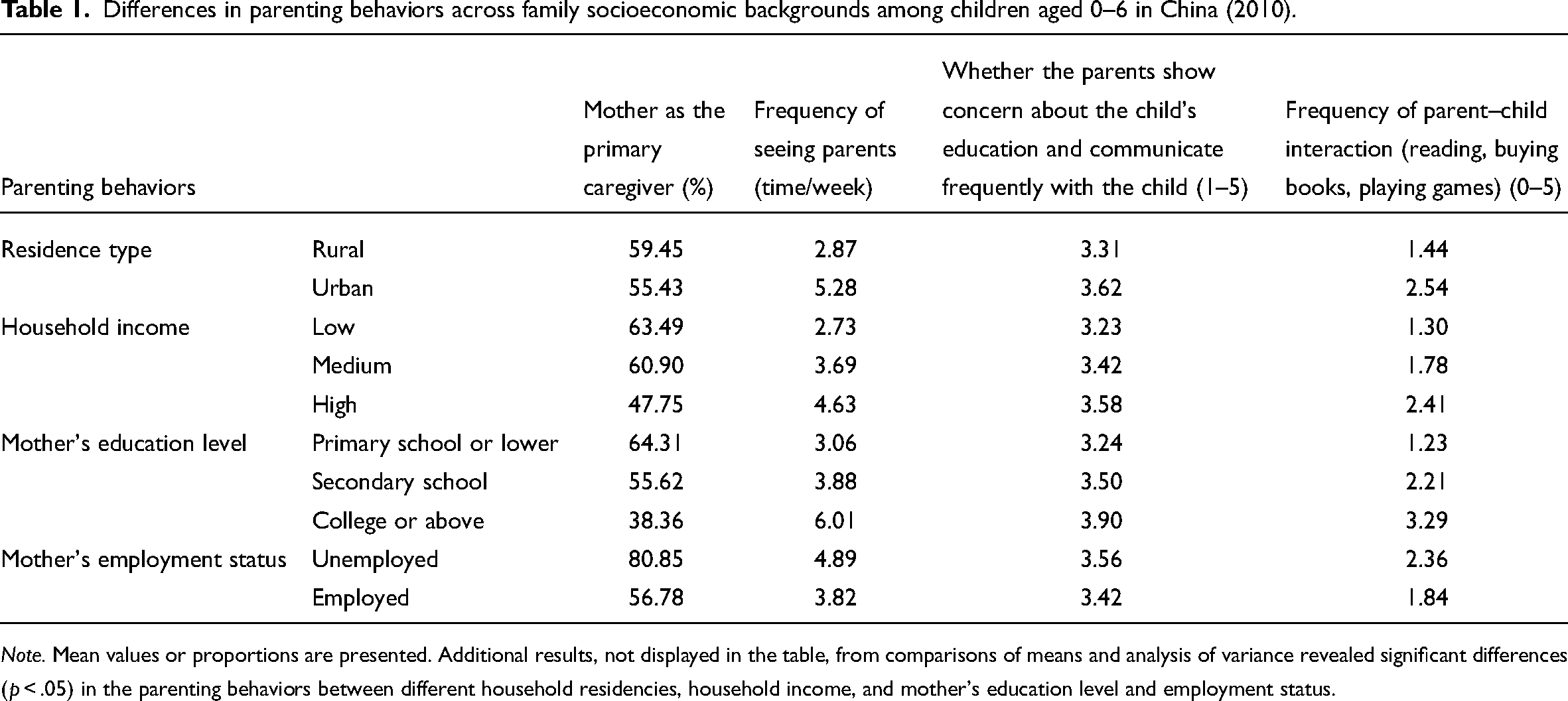
Note. Mean values or proportions are presented. Additional results, not displayed in the table, from comparisons of means and analysis of variance revealed significant differences (p < .05) in the parenting behaviors between different household residencies, household income, and mother's education level and employment status.
We then employ multivariate analysis, including logit and OLS models, to investigate family-level factors that affect the mother becoming the primary caregiver and self-reported parent–child interaction frequency. The results are presented in Figure 1. Logit regression results indicate that the mother as the primary caregiver was significantly and negatively associated with urban household residency, household income, mother's education, mother's employment status, and mother's experience of working in administrative/managerial positions. In addition, based on the OLS model, the frequency of parent–child interactions is associated with residence type, household income, and mother's education. Parents in urban areas interact more often with their children than their rural counterparts. Although the probability of the mother being the primary caregiver is lower among higher-income households and mothers with a higher education, these households tend to have more parent–child interactions.
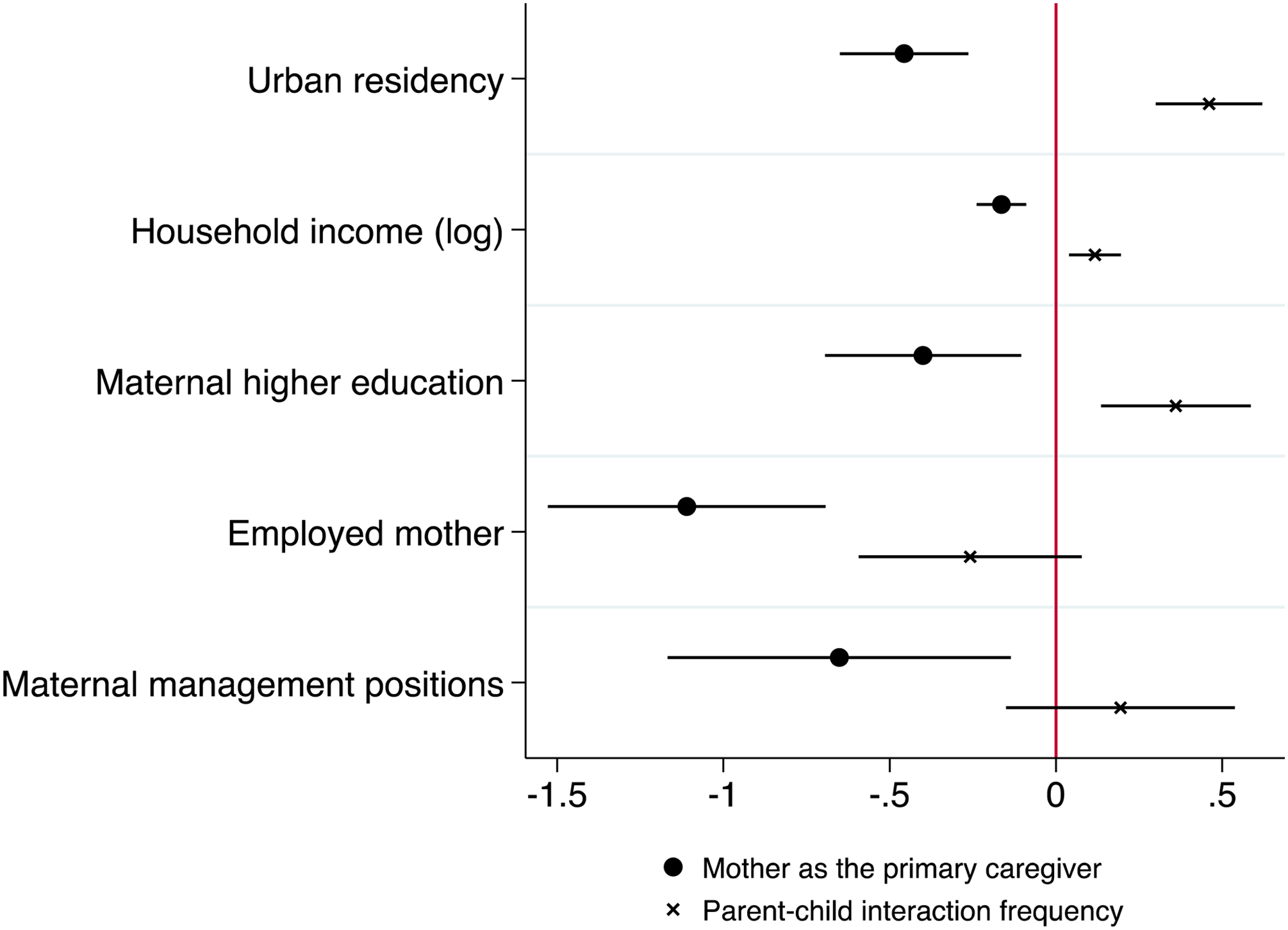
Association between parenting behavior and family socioeconomic backgrounds: Results of mother as the primary caregiver and parent–child interaction frequency.
It is widely accepted that mothers are the best caregivers during children's early-stage development. However, our study shows that the mother being the primary caregiver does not necessarily lead to better outcomes. Mothers are more likely to be the primary caregivers in low-socioeconomic families but show lower levels of concern for children's education and interact less frequently with children. There are evident disparities in the quality of caregiving across different social strata, and the long-term impact of these differences on children's development invites further investigation. These findings suggest that there is significant room for improving parental education in China, particularly parenting behavior. Enhancing early childhood development among vulnerable groups through policy interventions is necessary to ensure that they are not disadvantaged at the starting point. Narrowing developmental gaps in the early life stage also contributes to reducing economic inequality, promoting social mobility, and thereby achieving common prosperity for all citizens.
Early childhood development
Table 2 illustrates that children from different family backgrounds show different developmental outcomes, including health, cognitive, and noncognitive abilities. Children born in urban, higher-income households with higher-educated mothers have higher birth weights. These disparities may result from differences in mothers’ income, health, and nutritional status during pregnancy (Arendt et al., 2021). Children from higher socioeconomic backgrounds also showed significant advantages in language and mathematics insofar as they can speak complete sentences and count from 1–10 at an earlier age. Furthermore, their noncognitive abilities (i.e., self-control or delaying gratification) are significantly better than of those from other backgrounds. 1
Differences in early developmental outcomes among children aged 0–6 in China (2010).
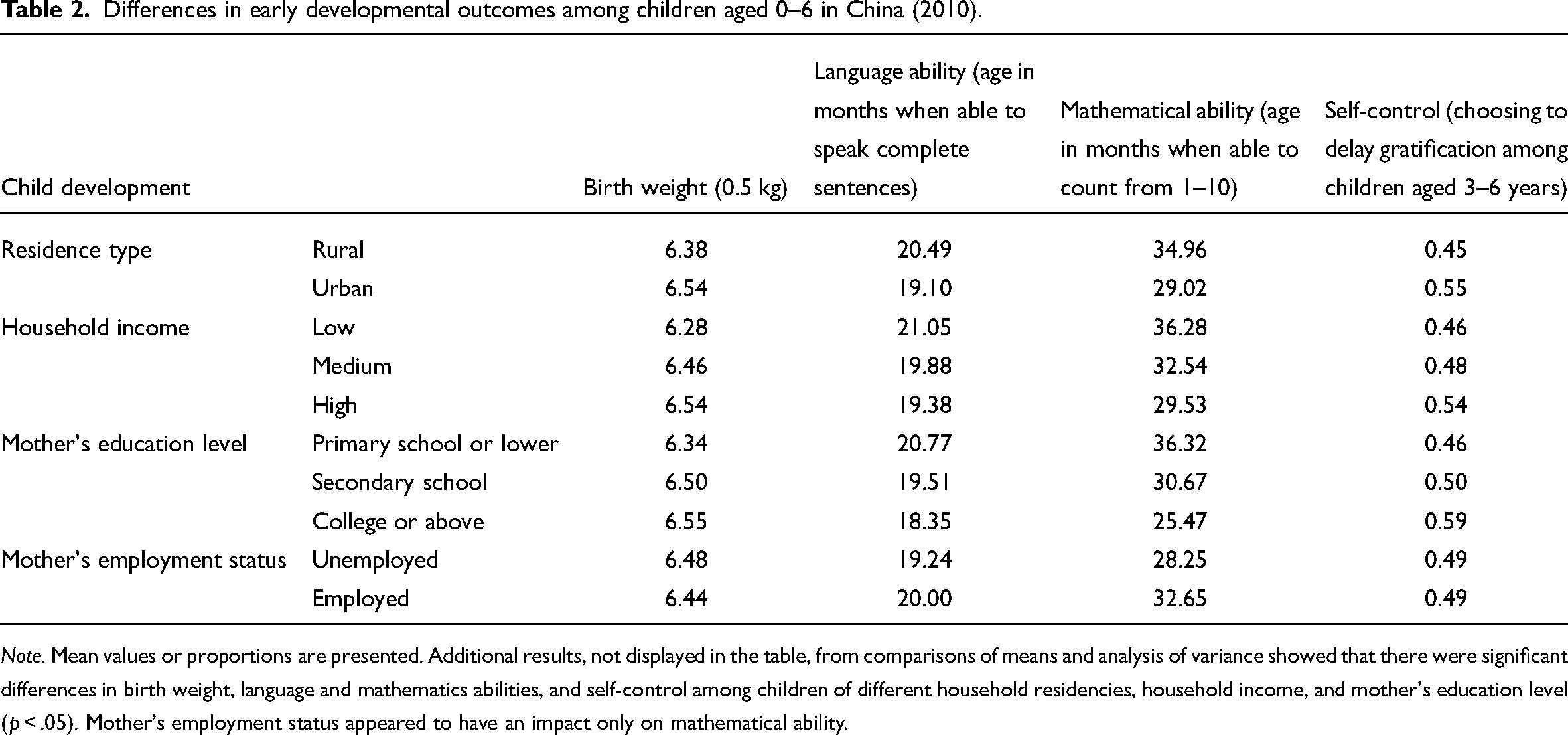
Note. Mean values or proportions are presented. Additional results, not displayed in the table, from comparisons of means and analysis of variance showed that there were significant differences in birth weight, language and mathematics abilities, and self-control among children of different household residencies, household income, and mother's education level (p < .05). Mother's employment status appeared to have an impact only on mathematical ability.
We use birth weight and mathematical ability as the measures of the early childhood development outcomes. Regression results show that birth weight was significantly greater among children born in urban households and higher-income households. Mathematical ability, measured as the logarithm of the number of months from when the child can count from 1 to 10, is positively associated with urban residency, household income, mother's employment status, and parent–child interaction (Figure 2). Children with working mothers displayed delayed development in mathematical ability compared to those with non-working mothers, as they begin counting from 1 to 10 at a later age.
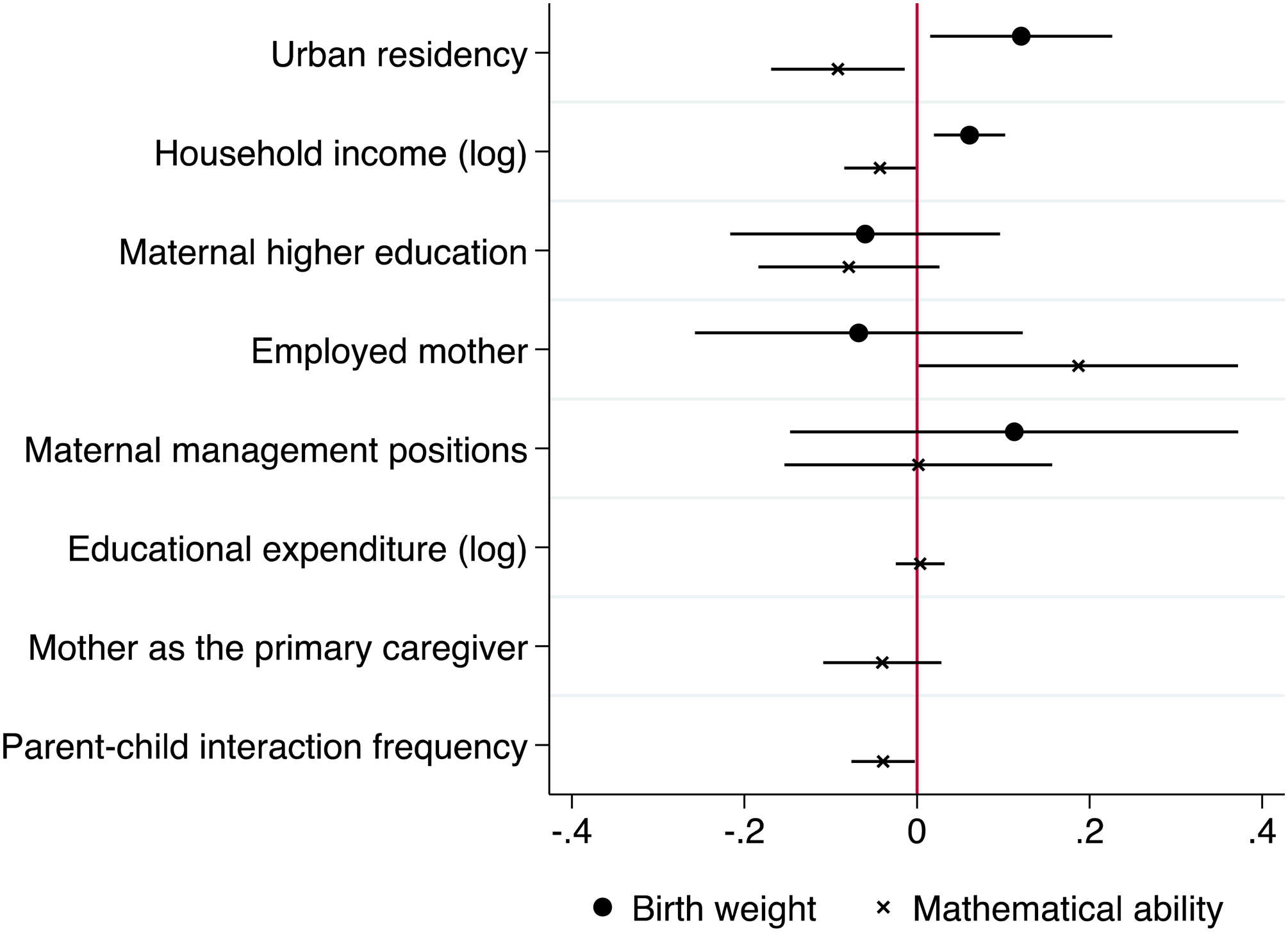
Factors influencing early childhood development.
Summary and discussion: Future research on early childhood education in China
Investing in early childhood yields high returns on human capital; however, differentials in such investment lead to inequality in child development outcomes. Early childhood development—including brain development, physical health and growth, cognitive abilities, and social-emotional skills—is the foundation for socioeconomic achievement and social mobility in later life stages, and is closely associated with multi-layered factors (e.g., parents, family, community, school, regional social policy, and national welfare systems). From a sociological perspective, an individual's growth cannot be separated from the constraints of their social environment. As Figure 3 depicts, child development outcomes are shaped by multi-level and multi-dimensional factors. Accordingly, research on child development should be conducted at the micro-, meso-, and macro-levels, which form an ecological system for child development (Bronfenbrenner, 1974, 1977), as elaborated below.
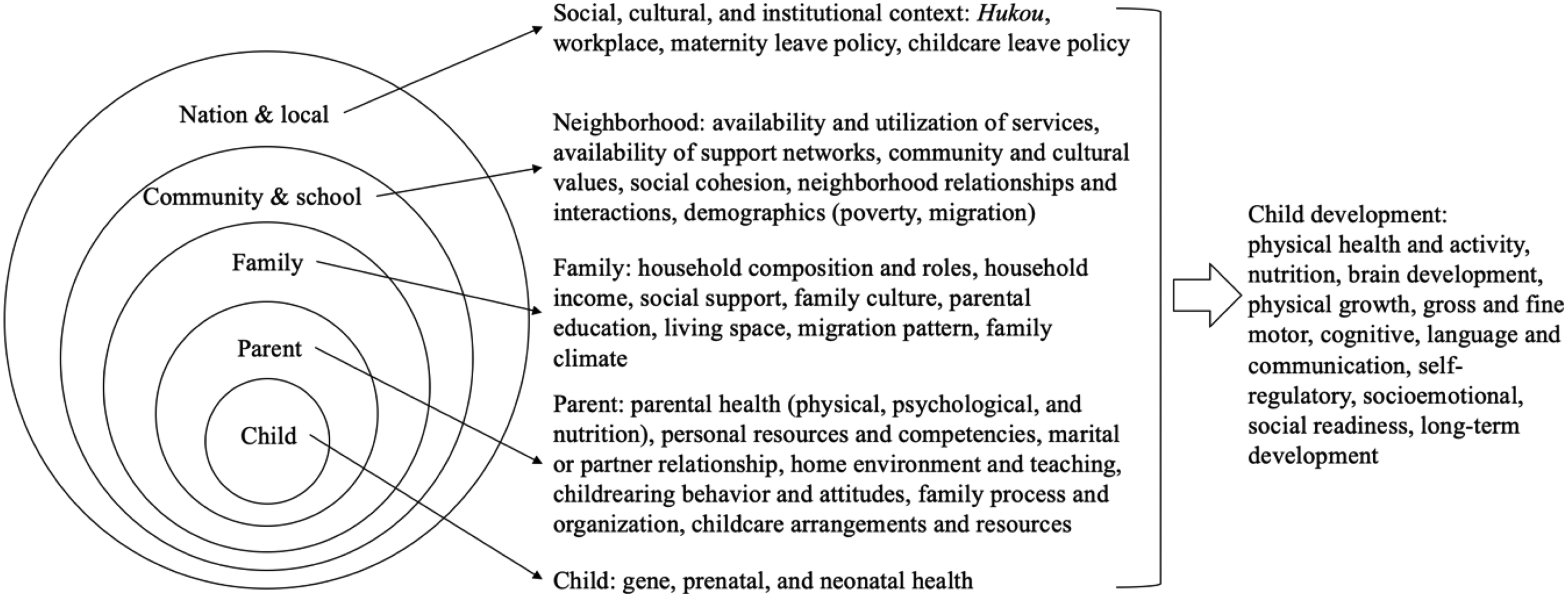
Conceptual framework for research on early childhood development.
First, parents and families are the micro-environment in which children grow and develop. Genetics and prenatal/birth health are foundations for later development. Parents’ cognitive and noncognitive abilities, physical and mental health, and employment status affect their parenting behaviors. Household composition and division of labor (e.g., grandparenting in urban areas and left-behind children in rural areas), household income, social network, living space, and educational background collectively contribute to the parenting and general environment that affect children's growth and development (Farkas, 2003; Kim et al., 2018).
Second, communities and schools (kindergartens) provide a meso-environment where children grow and develop. Households are embedded in communities. Neighbor interactions and public resources in the community affect children's development through their influence on families (Chetty & Hendren, 2018; Sampson, 2012). Educational resources are one of the most critical public resources in a neighborhood. Schools are responsible for organizing systematic education and are the primary setting in which children acquire knowledge and skills. Resource integration and close cooperation between educational stakeholders are essential in the early stages of a child's development (Farkas, 2003). Such integration and cooperation can also trigger changes in parenting norms and behaviors.
Finally, national and local sociocultural backgrounds, institutions, and policies form a macro-environment for early child development. Different nations and regions have different parenting concepts, behaviors, and social policies (e.g., maternity and parental leave), which may affect family reproductive decision-making, quality of infant care, and parent–child relationships (Clark et al., 1997; Kulic et al., 2019; Thévenon, 2011). Thus, the macro-environment has a profound impact on children's physical and mental health and development, ultimately contributing to the intergenerational transmission of socioeconomic advantages/disadvantages.
In China, research and social programs that aim to promote the provision and quality of children's education and increase the stock of human capital not only have a solid theoretical basis but are also timely and have immense policy implications. Education consists of both formal schooling and early education that establishes the groundwork before children enter the formal education system. As the birth rate continues to decline, Chinese parents are comparing the “quantity” and “quality” of childrearing, placing greater emphasis on quality prenatal and postnatal care. To provide more scientific parenting knowledge and services, we advocate for a comprehensive exploration of parenting behavior theories rooted in Chinese culture and daily practice. The Chinese government is currently exploring social policy aimed at encouraging childrearing and assisting families to successfully fulfill their children's early care, nurturing, and education.
The life-course perspective extends from child rearing to school education and socioeconomic status attainment in adulthood, providing a holistic and long-term perspective for formulating policies that alleviate poverty, promote social mobility, achieve common prosperity, and facilitate all-round human development. However, early childhood parenting and education programs, as well as related policies, are in their early stages of development in China, and there is a lack of systematic scientific research in this area. Therefore, it is essential to design, implement, and evaluate intervention programs for early child development. Establishing longitudinal, comprehensive databases covering the relationship between children's development and family, school, and other societal environments is also vital. These foundational efforts will promote high-quality, evidence-based research on parenting science that can inform policy making and practice to facilitate the development of children and adolescents in China.
Footnotes
Authors’ note
An earlier and extended Chinese version of this article was published in the Journal of East China Normal University (Educational Sciences) in October, 2023 by the first and second authors (Wu & Li, 2023). However, the three authors have streamlined and reorganized the current article but also elaborated the theoretical framework. The use of the analysis results of Wu and Li (2023) has been authorized by the Journal of East China Normal University (Educational Sciences) and acknowledged by the ECNU Review of Education.
Acknowledgments
We would like to express our gratitude to the support from the US National Science Foundation and the Center for Applied Social and Economic Research (CASER), NYU Shanghai.
Contributorship
Xiaogang Wu was responsible for the design and outline of the paper, and writing part of the paper; Xin Li contributed by conducting literature search and reviews, data analyses, and writing; Jia Miao contributed to the paper by adding more literature, reviewing, and polishing the paper.
Declaration of conflicting interests
The authors declared no potential conflicts of interest with respect to the research, authorship, and/or publication of this article.
Funding
The authors disclosed receipt of the following financial support for the research, authorship, and/or publication of this article: This work was supported by the US National Science Foundation (grant number #1756738) and the Survey of Early Education and Development Study [SEEDS] at NYU Shanghai Center for Applied Social and Economic Research (CASER) through an internal grant (2021BF XG_W).
