




Abstract
Purpose
Students develop and grow throughout higher education. However, the underlying mechanism remains unclear. Building on the premise that individuals develop and grow through interacting with the world, this study explores how students develop, grow, and become empowered in higher education through the lens of I–world interactions.
Design/Approach/Methods
This study employs a multicultural and multidisciplinary approach by first examining different cultural philosophical approaches to I–world interactions. This is followed by an elaboration of what the interactions mean for individual development and growth in higher education by drawing on psychology, sociology, and educational research.
Findings
This study argues that there are three essential elements of I–world interactions across three philosophical approaches: acknowledged, exercised, and enhanced individual agency. In higher education, students are strong agents, as demonstrated by sociological theories of agency and psychological evidence of agentic human functioning. Students actively exercise their agency, particularly when interacting with the environment. If organized and practiced well, universities can help students enhance their agency.
Originality/Value
The three shared elements and empirical evidence together form the foundation for understanding how students become empowered in higher education and for positioning the enhancement of students’ agency at the center of higher education across contexts.
Introduction
Recent decades have witnessed the dominance of the human capital model and skill-based rhetoric in higher education. The education of students today, including relevant policies and curricula, prioritizes the acquisition of skills and employability. Consequently, problems have arisen, as Wheelahan et al. (2022, p. 1) point out, “human capital theory [has come] to dominate policy in post-compulsory education, [and] result in the fetishisation of skills.” Underlying the skills fetish is equating human beings with individuals who have earning power and reducing education to skill acquisition. What is lost is the humanistic tradition of individual formation that views human beings as reflexive agents and underlines their holistic development (Marginson, 2018, 2023a; Taylor, 2017).
The importance of student development and growth has long been established in higher education across cultures and contexts. In Europe, before the “Humboldtian” model of the university in 19th-century Germany, teaching was the primary activity of the university and for many, the sole activity concerning student cultivation and preparing students for certain professions. The “Humboldtian” model also sees student formation as the university's core mission through the idea of the Bildung (Rohstock, 2012). In British universities, there is a “liberal education” tradition of student cultivation that highlights the development of individual personality and cultivating “well-rounded persons.” Newman's propositions demonstrate a milestone in making liberal education the university's primary content, that is, providing training for university students to gain intellectual power through apprehending and contemplating truth. I have been insisting, … first, on the cultivation of the intellectual, as an end which may reasonably be pursued for its own sake; and next on the nature of that cultivation, or what that cultivation consists in. Truth of whatever kind is the proper object of the intellectual; its cultivation then lies in fitting it to apprehend and contemplate truth. … Such a union and concert of the intellectual powers, such as enlargement and development, such as comprehensiveness, is necessarily a matter of training. … This process of training, … is called Liberal Education; … this I conceive to be the business of a University. (Newman, 1852/1996, p. 108, 109)
Similarly, in the Chinese culture, xiushen (individual self-cultivation) is a self-initiated lifelong process that requires higher learning. It highlights individuals’ work on the self to realize self-enhancement, both morally and epistemologically (Yang, 2022a). Islamic culture also has a strong tradition of and emphasis on learning and self-improvement. Placing a high value on knowledge and self-education is seen as a sacred duty for every Muslim and is repeatedly highlighted in religious sources (Samier, 2020; Weir, 2012). The revelation of the first verse of the Qu’ran, “Read!” (Fatoohi, 2010), signifies the read-before-anything-else understanding in the Islamic culture (Atay, 1979; Gündüz, 1978).
In recent years, an increasing number of researchers have identified the problems of the human capital model in higher education and have appealed for a return to humanistic approaches to educating students (e.g., Jabbar & Menashy, 2022; Tan, 2014). Important arguments include the call for liberal arts and science education (Anders, 2017), concept of capability in guiding students’ learning (Nussbaum, 2000; Sen, 1999), and idea of “higher education as self-formation” developed by Marginson (2014, 2018). These arguments highlight developing and enhancing individual students’ freedom of agency in education and acknowledge student empowerment through education, especially higher education.
However, despite the wide discussion of topics, such as teaching and learning, skills acquisition, and building students’ capability in higher education, it remains unclear how student empowerment unfolds in higher education. This study explores this question by focusing on how individuals develop and grow through the lens of I–world relations and interactions. This is based on the premise that individuals form, transform, and empower themselves through constant interactions between themselves and the world and that their approaches to these relations are fundamental to their interactions (Chesterton, 1986; Yang, 2022a, 2022b; see also below). We begin by exploring German idealist, Chinese Confucian, and Islamic Sunni philosophical approaches to I–world relations to reveal the major elements and nuances in an individual's development and growth. Three major elements are identified: acknowledging the I agency, I exercising agency in interacting with the world, and I working on enhancing and developing agency through this interaction. As philosophical discussions only provide abstract conceptual ideas and lack empirically grounded details about how these elements affect individual students in higher education, we draw on psychological, sociological, and educational studies to add details and nuances to the three identified elements to unpack how students develop and grow in higher education.
Notably, material selection is paramount in this conceptual exploration because any change in materials may lead to different research findings and arguments. The ideas examined in this study are not exhaustive, as certain ideas are omitted from the analysis. For example, in addition to the Confucian approach in Chinese philosophy, Buddhist and Daoist approaches also exist. Moreover, the potential danger of homogenization exists in referring to the German idealist, Chinese Confucian, or Islamic Sunni cultures and philosophies. However, selection is necessary for such a conceptual exploration when considering the scope of a journal article. The materials are selected based on the study's research focus: the development and growth of students in higher education.
I–world relations and individual development
Chesterton (1986, p. 41) argues that “the most practical and important thing about a [hu]man is [their] view of the universe”—their worldview. One's worldview determines how one sees and understands the world and one's place within it (Anderson et al., 2017). As Naugle (2002) points out, a person's worldview is the foundation of everything else, including education, career, and interpersonal relationships. It is the basic cause, with all else an effect or result. A worldview is a broad concept. It involves metaphysical questions about what reality is, epistemological questions about what truth is, and anthropological questions about the nature of human beings.
What makes worldview particularly important and relevant to student development and formation in higher education is its focus on the relations and interactions between the I and the world. In most ideas related to individual development (i.e., Bildung, Confucian xiushen (self-cultivation), growth, and capability), the development process involves constant interactions between the individual and the world. Thus, it is important to explore approaches to I–world relations and interactions to understand individual students’ development, growth, and empowerment in higher education. Here, we focus primarily on relevant philosophical ideas in three cultures: German idealistic, Chinese Confucian, and Islamic Sunni. These three cultures are selected for their broad influence on contemporary higher education and the vast differences among them. Modern universities originated in Europe (Altbach & Balán, 2007); however, China's higher education system is developing at an extraordinary rate and is a rising star in global higher education (Wen et al., 2022). The legacies of Chinese culture and philosophy are generally visible in East Asian countries and regions, as well as in Singapore and Vietnam (Marginson, 2011). While higher education in the Islamic world attracts less attention globally, Islamic cultures cover a quarter of the world's population, and the proportion may grow in the future as their median age is younger than the global median and other socio-cultural populations (Hackett et al., 2012).
The discussion of relevant ideas in the three cultures is not exhaustive. Considering this study's overall arguments and scope, we focus primarily on idealistic ideas in German philosophies, Confucian ideas in Chinese philosophies, and mainstream Sunni ideas in Islamic cultural philosophies.
The dualistic I–world relations in German idealistic philosophies
The dualistic worldview is at the center of German idealistic philosophies. It sets the premise of the German Bildung idea and relevant Anglo-American ideas of individual formation (e.g., John Dewey's idea of growth/education and Amartya Sen's idea of capability; see more in Yang, 2022a). This dualistic worldview provides an epistemological understanding of the world based on the duality of I and non-I/other (von Humboldt, 2000; see Figure 1). The I and the other are in lasting tensions and conflicts. According to Schumann (2019, p. 491), there are at least two types of alienation between the I and the other—“alienation from the present self, the letting go of immediate desires and egotistic interests in order to allow for an immersion into the world” and “alienation from the world in order to return home to the self.”
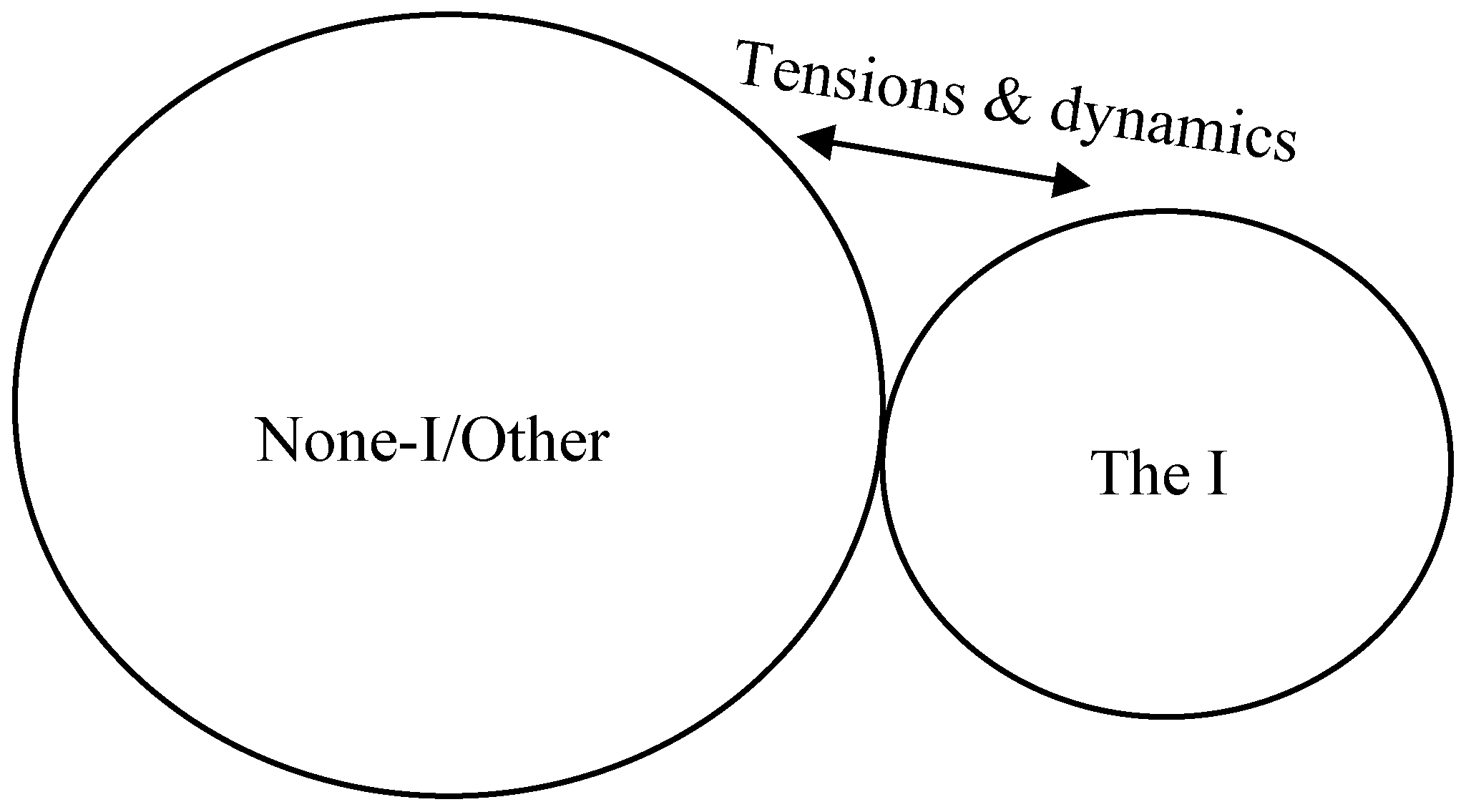
I–World concept in German idealist understanding (authors’ own conceptualization).
Following the dualistic worldview, German ideas of the formation of the self, as represented in the idea of Bildung, is centered on expanding freedom of the self, especially concerning striving for release from external limitations. Bildung views an individual's formation and growth as an intellectual and moral endeavor (Taylor, 2017) and focuses on the holistic development of individuals and how it contributes to the achievement of a vision of a better society. For example, according to Kant, an individual's development of reasoning can lead to social harmony (see Kivelä, 2012). The Bildung idea also considers the external environment in the formation of the self, arguing that only certain types of environments are conducive to such formation. Particularly, an ideal environment contains at least two elements: freedom for individuals to self-form and self-develop and the existence of various situations rather than a monopolistic one. Using von Humboldt's words, The true purpose of [the human]—not that which changing inclinations prescribe but that which the eternally unchanging reason enjoins—is the highest and most harmonious Bildung of his powers to a whole. Freedom is the first and essential condition for this Bildung. Besides freedom the development of human powers requires one other thing, which is closely associated with freedom, a great manifoldness of situations. Even a free and highly independent person, when restricted to monotonous situations, cannot develop fully. (cited from Konrad, 2012, p. 110)
The harmonious I–world relations in Chinese Confucian philosophies
An important, if not dominant, Chinese understanding of the I–world relationship is manifested in the Confucian anthropocosmic worldview and the pursuit of harmony (Tu, 2013; see Figure 2). Confucianism ontologically perceives the world as composed of a series of expanding entities: the self and communities, including the family, the state, and all under heaven (tianxia) (Yang & Tian, 2022). The conception of the self is grounded in communities (Li, 2018), and in this worldview, the self is nested within communities. The relationship between the self and communities or, more broadly, the world, is best captured by the notion of harmony.
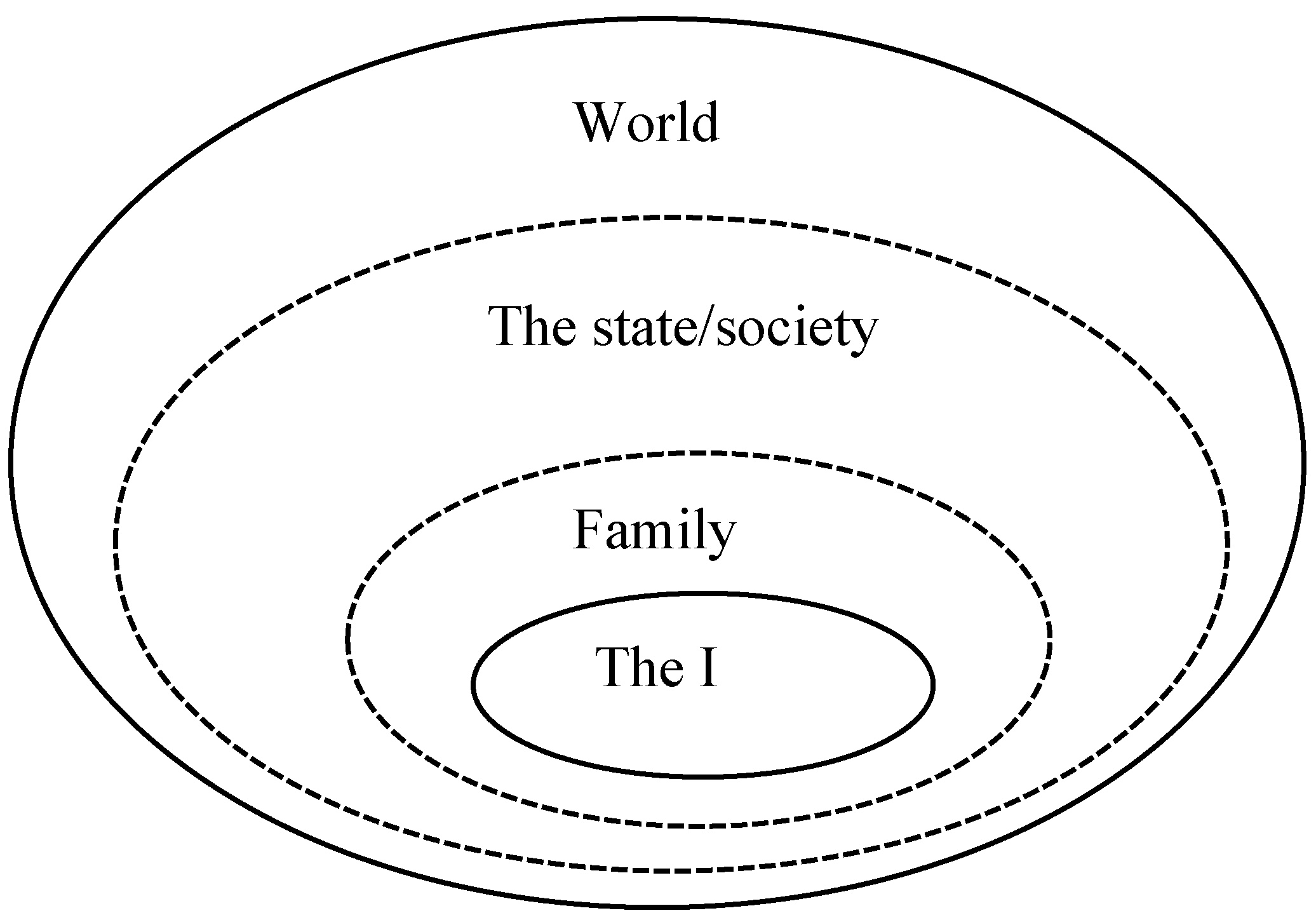
I–World concept in Chinese Confucian understanding (author's own creation based on the ideas in Tu [1985]).
The harmonious relationship between the self and the world in Confucianism has at least a two-fold meaning. First, it contrasts with the idealistic view of conflicting international relationships. In Confucianism, the self “is partly constituted by social relationships and is integral to the very fabric of the community” (Li, 2018, p. 8). There is no natural tension between the I and the world. The self is not isolated from the world and the purpose of its formation is not to release it from the limitations exposed by the world. This leads to the second point: Harmony is both a verb and a noun. It describes the state of affairs in the I–world relationship. More importantly, it indicates an ongoing dynamic, developmental, and generative process with the objective of realizing a harmonious I–world relationship through individuals’ efforts (Li, 2018). Confucian xiushen, or self-cultivation, is an essential means of realizing this objective. It highlights working on the self, including inward and outward self-perfectionism, to realize personal formation and contribute to building a harmonious world (Yang, 2022a). The free will (zhi) of the self is enhanced through inward perfectionism, and the self deliberately works to harmonize the world in outward perfectionism, which emphasizes the cultivation of moral qualities and becoming morally virtuous.
The virtuous I–world relations in Islamic cultural philosophies
In Islamic constellations, every individual is perceived to have freedom of agency; however, this freedom is not positioned to access infinite possibilities (Kazanç, 2007). Individuals in a society are agents who act within the boundaries set by God, that is, the sphere of possibles (külli irade). Thus, the I–world relationship in Islamic cultures is about what “I” is choosing or not choosing to do (cüz-i irade) within their “sphere of possibles” (see Figure 3 for a visual conceptualization). The agency of the “I,” cüz-i irade, by direct translation, means small or limited agency as it is perceived to be a small droplet in the larger sphere of possibilities (Çınar, 2020). The sphere of possibles for the individual does not cover all sets of possibilities that can ever exist; hence, the addition of another layer is shown in Figure 3. This level exceeds the possibilities that a specific individual can achieve and denotes unknown and infinite sets of possibilities under God's dominion.
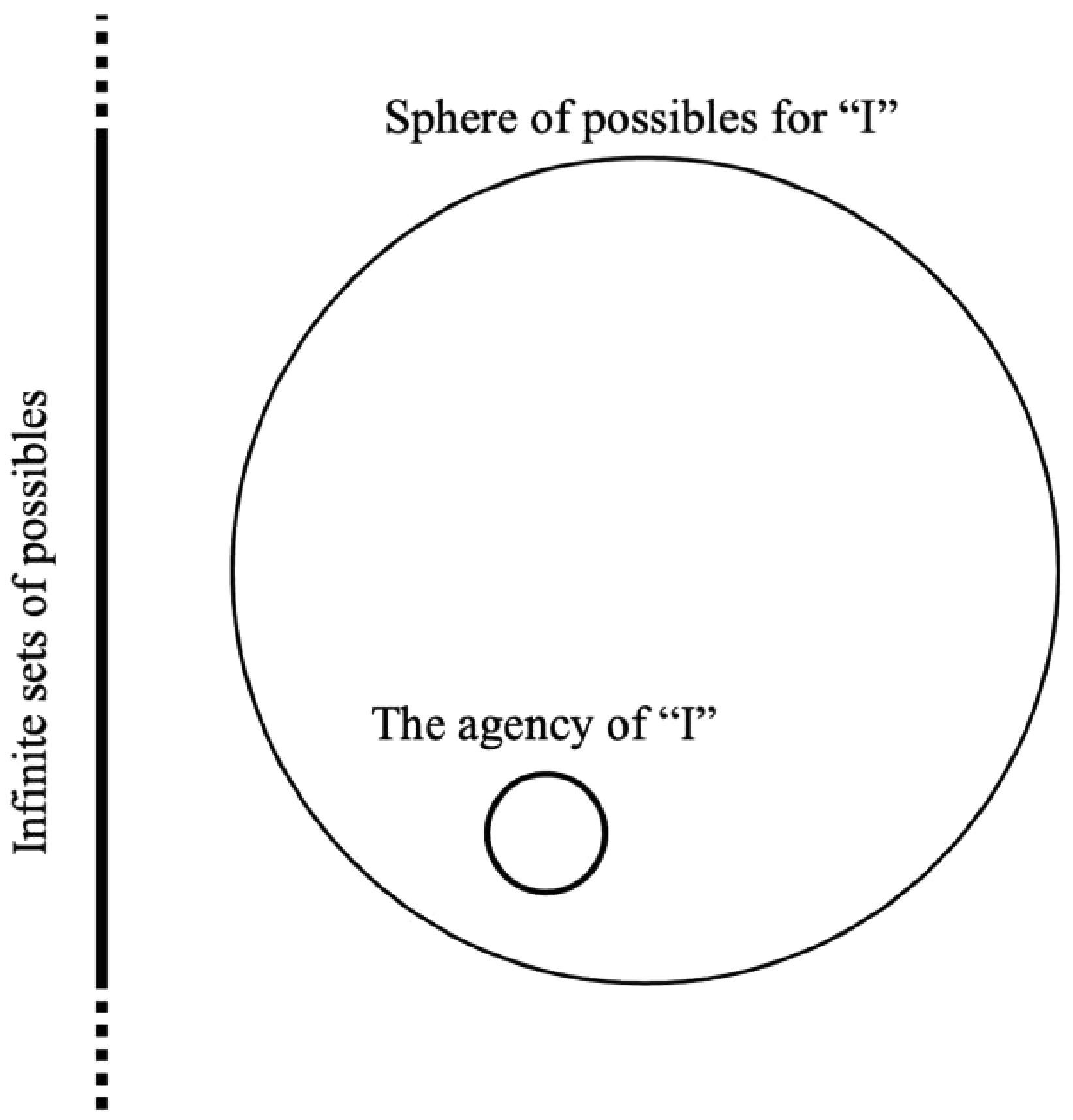
I–World concept in Islamic Sunni understanding (authors’ own conceptualization).
In Islamic cultural philosophy, being virtuous involves being aware of one's limitations and acknowledging the existence of a sphere of possibles. This is not only reflected in people's relationship with God because God sets the “sphere of possibles” but also toward other people in the society. However, this situation does not negate the agentic power of the “I.” On the contrary, every “I” is considered capable of acting within the sphere of possibles and is encouraged to strive for personal formation. However, the boundaries of the sphere of possibles remain unknowable by the “I” (Kazanç, 2007). Thus, the results achieved are under God's control, and not reaching the intended outcomes is always possible. Hence, from the individual's perspective, there is no clearly visible limit for “I” to interact agentically with the world and form oneself. What “I” can and should do is try to achieve a task in the best capacity. If no success is achieved after trials, a typical virtuous action is to humbly accept the sphere of possibles.
God's strong presence exists in framing I–world relationships in Islamic constellations. Usually, all factors constraining or enabling the agency of I can be positioned outside the smaller circle shown in Figure 3. These may include the agential acts of other agents or factors beyond the control of I, such as uncontrollable environmental disasters. Because God is envisioned as all-powerful, these factors are all accepted as being under his control. The self has the potential to form oneself and rise above the surrounding unfavorable circumstances; however, one should also accept this sphere of possibles, which has unclear boundaries from the individual's perspective.
Although the Islamic Sunni approach covers most Muslim populations globally, we acknowledge a significant diversity among the Muslim-majority countries in their secularization level. For example, while Turkey and Algeria experience a highly secularized system, other countries, such as Saudi Arabia, may have a much less secularized system. Nevertheless, the Islamic cultural philosophy discussed in this section is felt to some degree in the daily lives of all Muslim populations, regardless of the secularity level of their respective country.
A summary of the I–world relations in the three cultural philosophies
Following the discussion above, these three cultural philosophies vary regarding I–world relations. They differ in the scope of I, agency of I, and relationship between I and the world. The I in the Chinese Confucian and Islamic Sunni philosophies is bounded rather than entirely independent, whereas the German idealistic philosophies do not set a clear boundary for I. The freedom of the I is a fundamental condition of its self-development in the German idealistic philosophies. Nonetheless, the Chinese Confucian and German idealistic philosophies share an emphasis on achieving a harmonious I–world relationship, although they possess different views about what harmony is and how it can and should be achieved.
The Confucian I is bound within communities and the Islamic Sunni I exists within the boundaries set by God. Correspondingly, agency freedom in these two philosophies is not absolute. Moral qualities and social relationships are essential for exercising freedom of agency in Confucian philosophy. Although the sphere of possibles’ boundaries are not clear from the perspective of the I, it determines the scope and potential of the I's agency freedom in Islamic philosophy. As Figures 2 and 3 illustrate, the I is nested within the world. However, the two philosophies differ despite commonalities in terms of boundedness in Confucian and Islamic Sunni philosophies. The boundary of the I in the Confucian philosophies derives from the ultimate goal of achieving harmony in the world. Although harmony and moral qualities desire certain pathways for the formation of the I, there is no predetermined sphere of possibles, as in the Islamic philosophies. Accordingly, while the Islamic philosophies argue that agency is limited (despite this limit being unknown to individuals), the Confucian philosophies emphasize unbounded personal will. In contrast, the German dualistic worldview sees the world as composed of I and non-I. The I is an independent entity with no predetermined boundaries. The agency of I is unlimited, and such unlimitedness should be protected and pursued in interactions with the non-I (the world). Although achieving a harmonious relationship between the I and non-I is desirable in this dualistic worldview, it is not the final objective. The ultimate goal is to expand the agency freedom of the I through individual formation.
Differences among the three culturally grounded philosophies have led to varied approaches to individual formation. The German idealistic ideas focus more on the expansion of individual freedom and the development of capabilities; the Confucian xiushen views the realization of a harmonious world as an essential aim and highlights both the free will and moral qualities in individuals’ formation; and the Sunni Islamic ideas emphasizes the maximum development of the agency freedom within the possibilities.
Although the three philosophies are not identical regarding I's place in the world, they share certain common elements related to how the I develops and grows. The first is the acknowledgment of the agency of the I. Despite varied ideas on the scope of this agency, all three philosophies acknowledge its existence and potential. The second is the importance of the I's exercising their agency in interacting with the world, contrary to the idea of shaping the world's influence on the I, highlighting how the I is not a passive recipient of what the world imposes on them. Rather, the I constantly navigates what is available and makes their own decisions. The third is the emphasis on the I's work on enhancing and developing their agency through interacting with the world as the process of self-formation. This element indicates the virtuous circle between the I and the world through their interactions—the I interacts with the world by exercising their agency and this process further enhances that agency. Moreover, it is in this process that higher education plays a vital role in individuals’ development, growth, and empowerment.
Student agency in higher education
This section provides examples of and elaborates on how student agency is acknowledged, exercised, and enhanced in higher education by drawing on knowledge from various disciplines.
Agency acknowledged
In the major approaches to understanding higher education, student agency is not taken for granted; however, it has been placed in the background (Marginson, 2023b; Oldac et al., 2023). However, in other fields that higher education researchers often draw upon, human agency has been widely recognized, implicitly and explicitly. In social theories, agency is almost always included as an element of society in conjunction with structure. Agency–structure debates in social theories are most prominent in the works of Margaret Archer, Pierre Bourdieu, and Anthony Giddens. Although they agree on coupling agency with structure, they differ in their opinion of the extent to which individual agency is empowered and the scope of effective interaction between agency and structure. Such varying extents are shown in different theories of the agency–structure interplay. Archer's (2003) realist social theory empowers agency by separating it from structure to form two independent and autonomous entities of society. Giddens’ (1984) structuration theory argues for an interdependent dialectic between agency and structure. Falling between the positions of these two scholars, Bourdieu's (1977) notion of habitus incorporates autonomous agency but only into the reproduction of the structure (Adams, 2006).
Although these social theories imply distinctive configurations of I–world relations, they all recognize individuals in society as agents with varying levels of causal efficacy within the structure. Highlighting the limitation of always positioning agency in conjunction with the structure, Emirbayer and Mische (1998) propose a way of analyzing what agency is in relation to temporality, which has influenced further conceptualizations of student agency in education (e.g., Biesta & Tedder, 2007; Klemenčič, 2015). In particular, Klemenčič (2015) theorizes student agency in higher education by distinguishing agentic orientation and agentic possibilities; while the former refers to the individual capacity to more effectively interact with the given contexts, the latter is conditioned by the perceived affordances of the environment. This approach helps recognize student agency beyond the structure boundary by separating agency as (a) individual, internal, and psychological property and (b) agency in holism, as determined by an external structure. By engaging with the literature on student learning in higher education or student engagement, Klemenčič (2017) introduces the idea of agency, prevalent in educational sociology, into the research that is more closely related to more psychological aspects of higher education.
Psychologists have provided highly agentive perspectives for researchers in higher education. Although with few exceptions (e.g., Bandura, 2018; Ryan & Deci, 2000), agency rarely appears in the psychology literature; its strength is in illuminating empirical nuances for sociologists’ theoretical and conceptual approaches to agency. While sociologists are more interested in defining agency in relation to structure, psychologists focus more on internal human functioning, enabling the operationalization of human agency for empirical research. Although agency is usually defined differently in psychology, several theories draw on the notion of agency in their elaboration of how the human psyche operates. For example, two psychological theories appear frequently in higher education research that borrowed the assumption of human agency when investigating students’ affective, behavioral, and cognitive development in higher education (Bandura's [1977] self-efficacy and Ryan and Deci's [2000] self-determination theories).
Bandura (2001) posits “self-efficacy,” referring to one's beliefs about one's own capacity to take initiative to achieve desired outcomes, as “the foundation of human agency” (p. 10). Bandura explains human actions not because of external conditioning within the automatic stimulus-response mechanism but as an outcome of human self-reflexive thinking. For example, previous empirical findings have revealed that self-efficacy can hinder or aid human actions through the following mechanism. It affects human actions, including effort and time expenditure, in the face of adversity, which determines the stress level and accomplishments that follow (Bandura, 1977). From this perspective, student development is not an unconscious, mechanical process; rather, it involves students’ reflexive deliberation and agentic behaviors. Decades of empirical research have confirmed and extended the concept of self-efficacy and its influence on individual performance and various academic phenomena (e.g., Honicke & Broadbent, 2016).
Self-determination theory (SDT; Ryan & Deci, 2000) is another psychological theory premised on the acknowledgment of human agency and has often been adopted by research on higher education. For SDT, a quintessential manifestation of agency is an intrinsic motivation that makes people behave not as a result of external stimuli but because the activity they are engaged in is inherently interesting and enjoyable. SDT assumes that human beings, including college students, are inherently “agentic and inspired, striving to learn; extend themselves; master new skills and apply their talents responsibly” (Ryan & Deci, 2000, p. 69). In this view, students’ engagement in higher education is primarily intended to satisfy the human nature of their growth propensity. Students innately desire to augment themselves by exploring and developing their capacities and actively seeking novelty and challenges in the environment. Previous attempts to explain college students’ academic achievement and dropout (Jeno et al., 2018), why and how students learn in higher education (Levesque et al., 2004), and more general university experiences have all acknowledged agency as the premise of student development in higher education.
In summary, various sociological and psychological discussions in higher education research acknowledge active agency in their different I–world conceptions. In social theories, human agency is proposed as a necessary constituent of society in the various forms of its relationship with the structure that constructs society. Conceptual attempts have been made to analyze agency itself, centering on tracing how agents relate to structure. Contrastingly, psychological theories focus on the internal mechanisms of human functioning that lead to agentic actions and orientations. Although this section introduces some exemplary theories in which agency is acknowledged, they are not representative of the major discourses in higher education research.
Agency exercised
Shifting to the discussion of “agency exercised,” this section narrows the scope of exploration to a particular manifestation of agency: reflexivity (Archer, 1995). Reflexivity is theorized to enable humans to practice agency on the self in relation to the world as well as on the world in relation to the self (Archer, 1995). Thus, it is expected to be useful in examining how student agency is exercised at the center of I–world relations. This section focuses on two major occasions in which such reflexive agency may be stimulated and observed in higher education settings.
First, previous literature has shown that active reflexivity is required for students’ engagement with knowledge (e.g., Case, 2013)—the key activity in higher education (Ashwin, 2020). As each discipline has its own culture, language, and social community (Becher & Trowler, 2001), disciplinary knowledge imposes a form of structure with which students reflexively interact in higher education. Second, researchers have analyzed student agency exercised at the social level, for example, through student activism or as an institutional agent in higher education (e.g., Jacoby, 2017; Kay et al., 2010). A university provides a distinctive environment deliberately created by students regarding their personal projects. Studies imply that a successful university experience requires students to exert their agency, for example, in their engagement in various academic and extracurricular activities (Kuh, 2009) or in their integration into university environments (Tinto, 2012).
In particular, reflexive agency has been highlighted as a crucial factor when students interact with knowledge in the process of their academic learning in higher education (Case, 2013; Klemenčič, 2017). For example, some students build more agentic relationships with knowledge by adopting more autonomous and critical engagement in learning activities rather than passively accepting the given knowledge (e.g., Marton & Säljö, 1976; Vermunt & Donche, 2017). Research on self-regulated learning (SRL; e.g., Pintrich, 2004) reveals that more successful and efficient learning occurs when students have the capacity to reflect on their cognitive, motivational, and behavioral levels in relation to given academic tasks. According to these studies on student learning in higher education, stronger reflexive agency seems to be activated when students process, communicate, and construct the given knowledge as a particular form of structure in a more intrinsically motivated, internally regulated, and self-monitored manner.
While learning researchers have focused on agency practice in generic learning, another area of research concentrates on students’ agency in their interaction with disciplinary knowledge, which distinguishes learning in higher education from other levels of education (Ashwin, 2020). Previous studies on students’ relationship with disciplinary knowledge have indicated that students might exercise their agency by means of “powerful knowledge” (Young, 2007). By investigating students’ changing accounts of their disciplinary knowledge, Ashwin et al. (2023) reveal that students’ accounts tend to develop from a basic account that only refers to the immediately visible features of a discipline to an inclusive account in which students link disciplines not only to personal meaning but also to a wider context, such as society. This indicates that students can enact reflexive agency at both personal and social levels by immersing themselves in knowledge. Therefore, student development through agentic learning processes can be extended to student agency in social development through engagement with knowledge in higher education.
As highlighted by Marginson (2023b), understanding how students exercise agency in social formation is an important but difficult part of this puzzle. The exercise of agency never occurs in isolation; it is always part of a larger social context. Reflexivity in the Archerian sense supports this argument in that while students’ internal discussion is influenced by the larger society, students consequently activate their agency through their internal elaborations and exert their influence on the larger society (Lee, 2023). The chronology and direction of this mutual relationship does not have to move from society to the student; it can also move in the opposite direction. This perspective provides a framework to understand how student agency is exercised in the larger social context. This relationship between student agency and society has been discussed in perennial cultural understandings relevant to I–world relations; however, the details of how agency is exercised are not always explored. For example, the Kantian understanding of Bildung emphasizes the development and flourishing of students in education as autonomous and rational people who eventually form the public sphere as graduates (Kivelä et al., 2012). These agentically active and autonomous individuals play a key role in the emerging civil society (Biesta, 2002) and engage with their larger political environment (Klemenčič, 2015). The interaction between student agency and social formation is studied in empirical research that considers student activism at its epicenter, shaping university policies and larger social discussions (e.g., Bellei et al., 2014; Klemenčič, 2014; Luescher et al., 2016).
To summarize, student agency, particularly the reflexive type, is exercised when students engage in academic and social activities in higher education. SRL is a good example of agency enacted to reflect on the learning self in relation to the learning environment (e.g., content, curriculum, pedagogies, and assessment). Engagement with specific knowledge also manifests as the exercise of agency but with an expanded I–world relationship; reflexivity is practiced on the self, considering the broader social and natural world beyond the learning environment.
Agency enhanced
Further, we examine how agency is restricted or enhanced in higher education, which may also indicate how I–world relations are reconfigured as students develop through higher education. It is widely agreed upon in the literature that individual agency is conditioned by various external factors present in structure (e.g., Klemenčič, forthcoming). Higher education is no exception in terms of providing an environment in which students can enact their agency to a greater or lesser extent, according to varying contextual affordances. This indicates the opportunity for higher education to enhance student agency. Educational research has identified various resources for agency development in universities.
The aforementioned learning researchers have revealed that changing learning environments (e.g., pedagogies) can facilitate more agentic learning processes. Certain pedagogical strategies that enable learner agency are listed in Fryer's (2017) extensive review of students’ perceived control of learning processes, such as a manageable workload, clearly communicated course aims, and sufficiently contingent assessments. Previously introduced psychological theories that acknowledge human agency (Bandura, 2018; Ryan & Deci, 2000) also emphasize the impact of environments in fostering agency. SDT (Ryan & Deci, 2000) suggests that strong agentic motivation (intrinsic motivation) is only enabled when the given context satisfies basic psychological needs (a sense of belonging, competence, and autonomy). For example, student agency can be enhanced by higher education, which supports students in perceiving themselves as included, competent, and autonomous by providing communities, knowledge, skills, and an independent learning and living environment.
Beyond simply enabling existing agency by regulating environmental affordances, another approach focuses on developing agentic capacity. Biesta and Tedder (2007) argue that education can develop agentic capacity and orientation. Adult education encourages students to participate in more reflective thinking, such as biographical learning, transforming how students relate to the context, or agentic orientation (Biesta & Tedder, 2007). Similarly, students’ academic backgrounds, through which they directly and indirectly experience the creation of their own success (Bandura, 2018) and their acquisition of more background knowledge and skills (Fryer, 2017), are found to promote student agency. Focusing on developing agentic capacities rather than regulating environmental affordances resonates with the capability approach (Nussbaum, 2000; Sen, 1999). Academic knowledge can improve capabilities—the freedom to achieve personal well-being by being able to do and be. Thus, disciplinary knowledge, distinctive from common sense and everyday knowledge, is “powerful” (Young, 2007) in empowering students by conferring their capabilities, thereby enhancing human agency.
However, higher education that enables and enhances student agency is not confined to academic phenomena. Non-academic yet critical social factors enhance agency in higher education. One factor is that students gain access to immense new social resources to develop their agency through their higher education experience. This is usually the first time that students move away from their hometown (sometimes abroad) and encounter social interactions within a wider context. Such social interactions play a central role in the formation of students’ reflexive agency (Mead, 1913; Mead & Morris, 1962). Mead (1913) endorses that human development involves a reflexive internal conversation between the active self/the subject “I” and “me” as the object of an action. As “me” is an object that other people's actions can influence, it is situationally variable and dependent on both the actions of the “I” and those of other individuals. With the heightened social interactions in higher education, the inner stage of students becomes a “forum and workshop of thought” (Mead, 1913, p. 376) or reflexive agency.
Social interactions, as resources for agency development, are particularly highlighted when students study abroad. Day-to-day social interactions and extracurricular activities occurring in different social, cultural, and academic contexts can stimulate students to practice more reflexive agency. Building on Biesta's (2009, 2010) thesis, in which socialization and subjectification are two of the main purposes of education, it can be suggested that international higher education significantly contributes to agency development. For example, international students are required to engage in constant internal negotiation through the I–world interaction in a novel country context. They are placed in the process of becoming more like a society that is novel to them (socialization) in some respects and becoming different from an unfamiliar society (subjectification) in others. Such a process can significantly foster student agency because it requires heightened reflexivity of students in choosing to become more similar to or different from novel observations and experiences in the host country (Oldac, 2023). Additionally, agency enhancement is amplified in international higher education because students have greater resource diversity as they immerse themselves in a new social context while not completely removing themselves from their home country context.
Conclusion: Agency and student empowerment in higher education
This study has attempted to unpack how students develop, grow, and empower themselves in higher education. Ideas from the three cultural philosophies (i.e., the German idealist, Chinese Confucian, and Islamic Sunni philosophies) on I–world interactions and individual formation suggest an essential role of agency in these processes. As important components of worldview, I–world relations and interactions are the basis for how individual students navigate higher education and broader social settings. While the three cultural philosophies vary in certain aspects, such as the boundaries of the I, they share three elements essential to understanding I–world interactions: the acknowledgment of an individual's agency, exercise of agency, and enhancement of agency. As I–world interactions determine how individuals navigate the world and correspondingly develop and grow, the three elements emphasize that agency, particularly its existence, practice, and development, are the key to understanding students’ development, growth, and empowerment in general and in higher education.
Nevertheless, the cultural philosophies discussed do not provide details regarding what students’ agency is, how they exercise agency, or how they may enhance their agency in higher education. Knowledge in education, sociology, and psychology, especially that developed from empirical studies, is a valuable resource for adding details and nuance. Regarding the first element, both sociological and psychological studies have confirmed the existence of agency in humans, including higher education students. Sociological studies emphasize agency-structure dynamics, whereas psychological studies concentrate more on internal human functioning. With the risk of oversimplification, the existence of agency manifests in individual students as autonomous and independent entities with innate growth tendencies (e.g., intrinsic motivations) that integrate external resources and constraints, who believe in their own capacity to take action in their lives and engaging in reflexive deliberations. Students are the masters of their own formation and empowerment. Their motivations, behaviors, and reflections are not the result of molding the external environment. The acknowledgment of agency distinguishes this study's perspective on student growth in higher education. Given this, this study echoes a relatively novel idea of self-formation, arguing against the deficit framing of students in higher education represented by rhetoric and human capital theory (Marginson, 2018, 2023a).
Regarding the second element, higher education students exercise their agency by engaging in university activities and immersing themselves in university and broad social environments. Empirical studies have revealed how students exercise their agency in both generic and disciplinary learning when acquiring and processing knowledge (e.g., Pintrich, 2004; Vermunt & Donche, 2017) and linking knowledge with personal and social meanings (Ashwin et al., 2023). This is also supported by García et al. (2021), who argued that students make sense of the world through their own interpretation rather than being passive recipients of the knowledge being defined, taught, and assessed in classrooms. In part, the exercise of agency also occurs in students’ interaction with the broad social context, pointing to possible connections between individual self-formation and social formation, although contexts differ regarding these connections (Klemenčič, 2015; Marginson, 2018). As young adults, the lives of university students are not confined to the campus. Rather, they engage in constant interactions with society, become involved in internships and volunteer work, participate in social activities, and attempt to bring change to society in their own way. All of these reflect their exercise of agency, involving reflexive deliberations and taking actions according to their own intrinsic motivations through their interactions with the university and society.
Notably, higher education is considered distinctive because of its ability to enhance individual student agency. For example, Biesta and Tedder (2007) highlighted the power of higher education in developing individual students’ agentic orientations. Additionally, student agency can also be constrained or enabled depending on how higher education is organized. Modifying university environments to provide students with adequate free space to navigate their own courses in higher education (in aspects such as major selection and course enrollment) and frequent social interactions is conducive to enabling agency. This directly indicates the problems of many existing higher education practices guided by other formational ideas. For example, equaling higher education with merely professional preparation, portraying students as objects and “governing” them using numbers and grades, and disconnecting students from society all dismiss how student agency can be enhanced through higher education (McArthur, 2023; Nieminen, 2021; Nieminen & Yang, 2023).
In summary, students in higher education possess agency and exercise it; if organized well, higher education can enhance their agency. This provides a useful approach to understanding how students develop, form, and empower themselves in higher education. In particular, they echo the idea of “higher education as self-formation.” Marginson (2018) argued that self-formation is both a living empirical reality and a pursued norm. This highlights the need to organize higher education activities in ways that can effectively enhance student agency, which is one of the major objectives of higher education. However, the dominance of ideas, such as the human capital model in higher education, shows that there is still a long way to go in pursuit of this normative end, and many challenges remain. Nevertheless, the commonalities among the three examined cultural philosophies regarding the acknowledgment, exercise, and enhancement of agency together form the foundation for positioning students’ agency at the center of higher education across contexts.
Significantly, while the three cultural philosophies suggest varied approaches to individual development and empowerment, existing disciplinary knowledge regarding how individuals develop, including empirical findings in educational, sociological, and psychological studies, is primarily developed through Western conceptual lenses. Most, if not all, of these findings tend to suggest dualistic German ideal cultural philosophies. It is rather difficult to link them with notions of I–world harmony and God-controlled spaces of possibilities, which are hallmarks of the Chinese Confucian and Islamic Sunni philosophies. Therefore, with the variously conceptualized and practiced approaches to individual formation across cultures and contexts, future (empirical) research should urgently consider and engage with diverse cultures in inquiring into student agency and development in higher education.
Footnotes
Acknowledgments
We would like to thank Professor Simon Marginson for his support and feedback.
Contributorship
Lili Yang was responsible for the overall research design and manuscript writing, including the introduction, cross-cultural discussion, general discussions, and conclusions. Soyoung Lee contributed to writing the manuscript for the cross-disciplinary discussion. Yusuf Ikbal Oldac contributed to writing the manuscript for the cross-cultural and cross-disciplinary discussions. The overall conceptualization was a joint effort by the three authors.
Declaration of conflicting interests
The authors declared no potential conflicts of interest with respect to the research, authorship, and/or publication of this article.
Funding
The authors disclosed receipt of the following financial support for the research, authorship, and/or publication of this article: Lili Yang's research is funded by Hong Kong Research Grants Council under Early Career Scheme [Grant number: 27612823]. Soyoung Lee's research is funded by University of Oxford under Oxford Swire-Foot Graduate Scholarship and Clarendon Scholarship. Yusuf Ikbal Oldac is a Hong Kong Research Grants Council Postdoctoral Fellow, funded by the University Grants Council of Hong Kong.
