



Abstract
Purpose
This study analyzes digital equity realities in U.S. K-12 schools and the role that school leadership plays in digital equity.
Design/Approach/Methods
Based on Selwyn’s conception of technology as three interlocking elements (access, educational practices, and social context), we applied the ideals of equity and social justice to each of the three elements to conceptualize a framework of digital equity, situating school practice in the larger social, cultural, and political context of the United States. Guided by this framework, we conducted a systematic literature review of the current state of digital equity and school leadership in K-12 schools.
Findings
The findings demonstrate that U.S. K-12 schools face digital inequity issues, including inequitable access to technology, exclusionary and punitive educational practices using technology, and an unjust social context for technology in schools. These findings indicate that school leadership plays an important role in digital inequity.
Originality/Value
Based on these findings, we present a framework to assist K-12 leaders in enhancing digital equity, including addressing educational inequities and creating an inclusive social context for the school, ensuring equitable accessibility to technology in schools, and supporting teachers in developing meaningful and equitable practices using technology to address the opportunity gaps encountered by marginalized learners.
Introduction
It has been 69 years since Brown vs. Board of Education (Brown hereafter) ruled that all children, especially students of color and those historically marginalized in the United States, should receive fair and equitable education. Over that time, educational technology changed drastically from lectures, textbooks, chalk, and blackboards to today's podcasts, chrome books, smartboards, virtual reality, and AI. Education has participated as enthusiastically as other sectors of society in the transition to a post-digital world (Peters & Besley, 2019) in which digital technology is part of the taken-for-granted base upon which the superstructures of society depend. How has the rise of post-digital education operated in the context of the promise of equity proffered by Brown?
We know that within U.S. public education in general, the promise of Brown has not yet been fulfilled. Students of color are still disadvantaged by education debt and opportunity gaps (Ladson-Billings, 2006; Milner, 2010), being subjected to discipline at rates two to three times higher than White students (Bryan et al., 2012; Carter et al., 2017; Skiba, Michael, et al., 2002; Skiba, Horner, et al., 2011), discriminatory school funding policies (Baker & Green, 2005; Ladson-Billings, 2006; Vaught, 2009), and a high percentage of inexperienced teachers, leading to high rates of staff turnover (Howard et al., 2018). These factors jointly lead to shortfalls in achievement (as measured on standardized tests), ranging as high as 34 points (NAEP, 2023). Furthermore, the proximate goal of Brown, eliminating the legal racial segregation enshrined in the U.S. school system by the 1896 Plessy v. Ferguson decision, was stymied by white flight, first from urban to suburban schools and then from public to private education (Fairlie & Resch, 2000; Morris, 2019; Zhang, 2008).
Although much research on educational technology in the United States focuses on the technical issues of design and implementation, there are several strands of scholarship concerning the social and political issues that intersect with technology. One issue concerns inequitable access to technology: the digital divide. In its classical formulation, the digital divide is defined as the gap in access to new technologies between affluent students, families, and communities and those considered less affluent (Warschauer et al., 2004). However, researchers working from the standpoint of educational equity argue that digital equity concerns more than equitable access to technology because decisions for implementation and use, which are sociopolitical decisions, are susceptible to inequitable treatment. For example, Howard et al. (2018) define digital equity as “equal access and opportunity to digital tools, resources, and services to increase digital knowledge, awareness, and skills” (p. 1), clarifying that the pedagogical goals of the provision of educational technology are an important part of digital equity. Selwyn (2017) goes as far as to build these issues into the conceptualization of technology, including in their definition of technological materials and devices, activities and practices designed around technology, and the social context of technology implementation. Selwyn further argues that technology should be considered a social element and subject to analysis in its social context because it is “intrinsically linked to the social, cultural, economic, and political aspects of our society” (p. 18).
A final point, which is particularly true in the post-digital age worldwide, is that we need to recognize the non-neutrality of technology from design through implementation. Whether considering search algorithms (Noble, 2018; Vaidyanathan, 2012), technology implementation in the K-12 classroom (Garland & Wotton, 2001–2002; Li & Ranieri, 2013; Maunah, 2020; Miller & Liu, 2023; Valadez & Duran, 2007), or the in-built bias of technology when implemented in institutions developed and operated through ideologies of power and supremacy (Matias & Aldern, 2020), it is vital that we understand digital equity with “a critical attitude (or philosophy) that inquires into the digital world, examining and critiquing its constitution, its theoretical orientation and its consequences” (Peters & Besley, 2019, p. 30). Educational technology implementation and use occurs at an institutional level in U.S. K-12 schools, which means that school leadership plays an important role in both aspects of technology, yet the impact of that leadership on digital equity is understudied. Therefore, this study intends to answer questions related to the digital equity realities in U.S. K-12 schools and the role that school leadership plays in digital equity.
Review method and literature analysis
First, we developed search keywords related to digital equity and school leadership such as “educational technology,” “digital equity,” “digital inequity,” “digital divide,” “school leadership,” “educational leadership,” “school leader,” “principal,” and “administrator.” We then employed those keywords in pairs (e.g., “educational technology” AND “school leadership”) to search the major education databases (ERIC, Education FullText, and Education: A Sage Collection) as well as the broader collections in JSTOR and Google Scholar. The raw search results (Table 1) demonstrate that the literature overwhelmingly focuses on the role of school administrators and principals in selecting and implementing technology, with specific issues of educational equity or inequity barely registering—for example, a Google Scholar search on “educational technology” and “administrators or principals” produced 51,000 hits, while a search using the same database on “digital inequity” and “school leadership” produced only 67 hits. Moreover, neither “digital equity” nor “digital inequity” are very common terms in the literature, appearing in a tiny fraction of the searches regardless of the database chosen.
Raw search results for the literature review, ordered by magnitude of results.
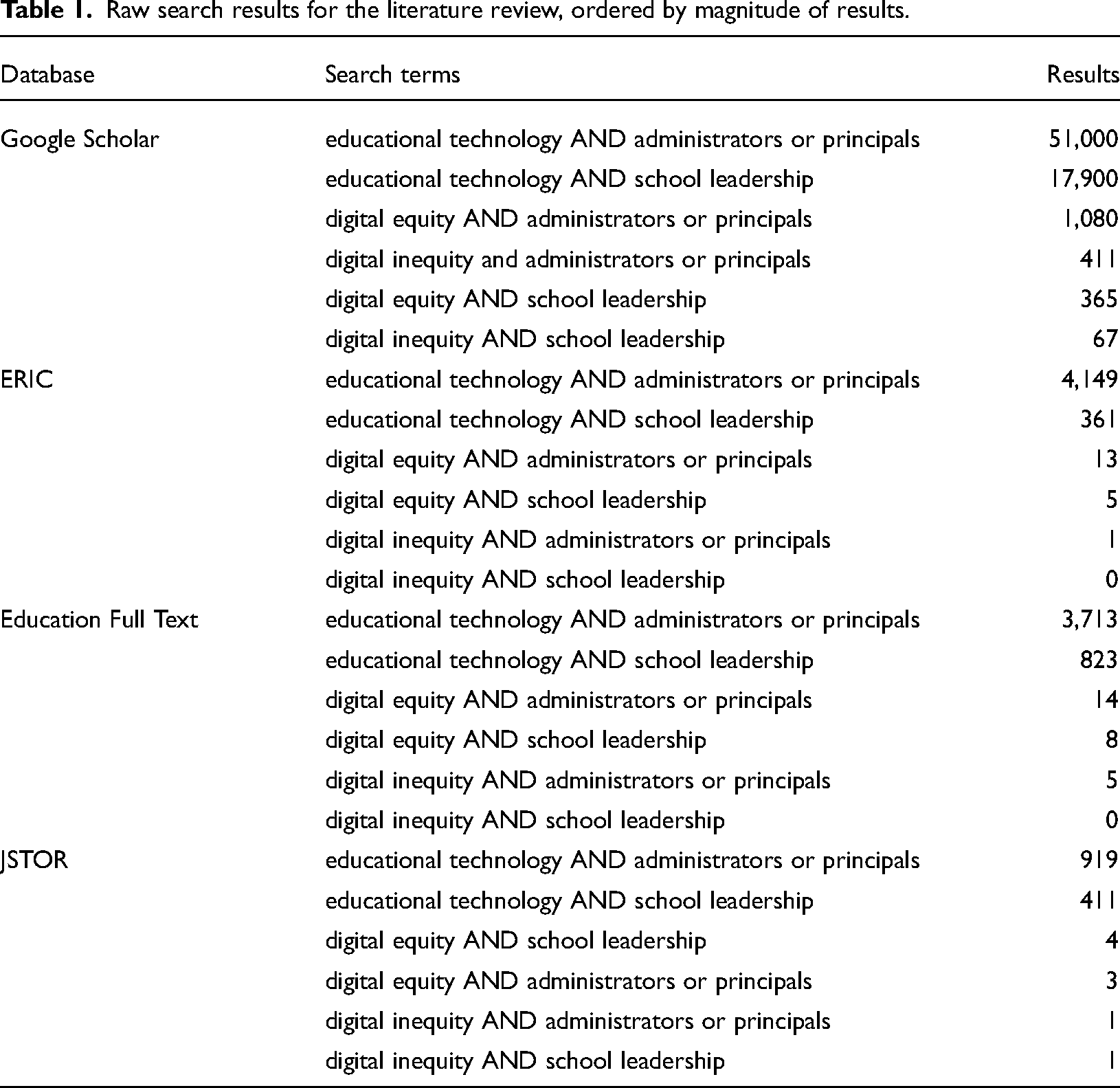
Given the large number of sources generally addressing educational technology and leadership and the small number discussing digital equity/inequity, we chose to build a hybrid literature pool for coding by first skimming the broader category for relevance to our research questions and then combining the resulting pool of relevant sources with all of the sources that specified digital equity/inequity. After eliminating duplicates, the literature search generated 80 sources that were analyzed in depth to answer our research questions.
Based on Selwyn's (2017) conception of technology as three interlocking elements (access, educational practices, and social context), we apply the ideals of equity and social justice to each of the three elements to conceptualize a framework of digital equity, situating school practice in the larger social, cultural, and political context of the United States. Guided by this digital equity framework, we conducted a priori coding (Liu, 2020; Saldaña, 2015) of the in-depth sources we identified. The a priori codes that we developed based on the theoretical framework included equitable access to technology, meaningful/equitable practices in using technology, and an inclusive social context in school. Each author read and coded the sources separately and then compared the coding results until 100% agreement was reached. During our data analysis, we focused on the current state of digital equity and school leadership in K-12 schools to analyze the results in terms of equity and social justice in the access, practices, and social context of educational technology, paying particular attention to the role of school leadership in facilitating digital equity.
School leadership roles and practice
School leadership has been defined in the literature in two ways. The first is in terms of leadership roles, which are defined in the U.S. national legislative code as follows: A principal, assistant principal, or other individual who is—(A) an employee or officer of an elementary school or secondary school, local educational agency, or other entity operating an elementary school or secondary school; and (B) responsible for the daily instructional leadership and managerial operations in the elementary school or secondary school building. (20 USC § 7801[44])
From Cuban's standpoint, school leadership is not solely vested in administrative personnel but may shift among staff, students, families, and even individuals and organizations outside the school itself. This distributed (Spillane et al., 2001, 2004) or shared leadership (Fletcher & Kaufer, 2003)—“sharing the responsibilities for leadership across stakeholders at multiple levels” (Bingham, 2021, p. 3)—has been shown to be effective in educational technology selection and implementation (Dexter, 2011; Levin & Schrum, 2013). Working with a technology-based personalized learning implementation project in which leadership was shared between administrators and pilot teachers, Bingham (2021) pointed out that distributing leadership among teachers and administrators increased communication between the two groups, enhanced all parties’ commitment to curricular changes, and provided stability even if there was a change in administrators (pp. 28–29). One implication of these results, Bingham (2021) suggested, was a potential link between distributed leadership and efforts to address educational equity. However, a striking example of school leadership external to the school itself is the gradual privatization of public schooling through standardized testing, curriculum, and pedagogy, all stitched together with technology, a process driven by the corporate capture of the government's funding and regulatory processes (Miller & Liu, 2023). For the purposes of this paper, we use both definitions, employing the first (roles) for literature analysis and the second (practices) for critique and recommendations.
Given the digital inequity issues described above, how does school leadership address digital inequity? Various strategies have been suggested to orient school leadership toward addressing educational inequities in general, such as inculcating awareness of deficit perspectives through critical reflection (Lewis-Durham & Saastamoinen, 2022), encouraging school leaders to hold activist perspectives (Kemp-Graham, 2015; McIntosh, 2020; Warner, 2020), or building relationships with families (Flores & Kyere, 2021) and the more broadly defined community (Mayger & Provinzano, 2022; Maylor, 2020). There have also been calls to address the lack of diversity among school leaders and the accompanying disparities in power and pay based on gender and race (Grissom et al., 2021; Jansen, 2021; Quintero et al., 2023). However, this general literature does not specifically address digital inequities, although research suggests that one source of digital inequality lies in the lack of training, expertise, and skills required for the equitable and effective implementation of technology (Kaden, 2020; Reinhart et al., 2011). It is well recognized that teachers need to possess the necessary technological skills and resources to engage students in effective digital education (Fulton & Sibley, 2003; McLeod & Dulsky, 2021) and that school leadership plays an important role in supporting these goals (Sandvik et al., 2023; Wharton-Beck et al., 2022). What is less recognized is that teachers also need a critical awareness of digital inequities and the skills and resources to combat these inequities (Liu, 2020). We argue that school leadership plays a key role in supporting these goals. Therefore, we explore the issue of digital equity in U.S. K-12 schools in the post-digital era, focusing on ideologies, assumptions, actions, and, more importantly, school leaders and the consequences of digital technology in urban school contexts. First, we conceptualized a digital equity framework to analyze research on school leadership and digital equity. We then propose a framework for digital equity leadership with the potential to guide K-12 leaders and educators in their efforts to implement technology. We conclude with some implications that this framework poses for teachers and school leaders in the selection and implementation of educational technology.
Theoretical framework: Digital equity in a post-digital world
The starting point for any notion of digital equity is to reimagine the relationship between technology and equity. We begin with Selwyn's (2017) conception of technology in terms of three interlocking elements: (1) access to technology, (2) educational practices using technology, and (3) the social context of technology implementation in education. We then apply the ideals of equity and social justice to each of the three interlocking elements of technology to conceptualize a framework (see Figure 1) of digital equity, situating school practice in the larger social, cultural, and political context of U.S. society characterized by racism and White supremacy (Ladson-Billings & Tate, 1995; Milner, 2010; Spring, 1994). We use this framework to analyze technology access, educational practices using technology, and the social context of technology implementation in U.S. K-12 schools. Our findings demonstrate that a lack of equity and social justice in any of these three elements results in digital inequity.
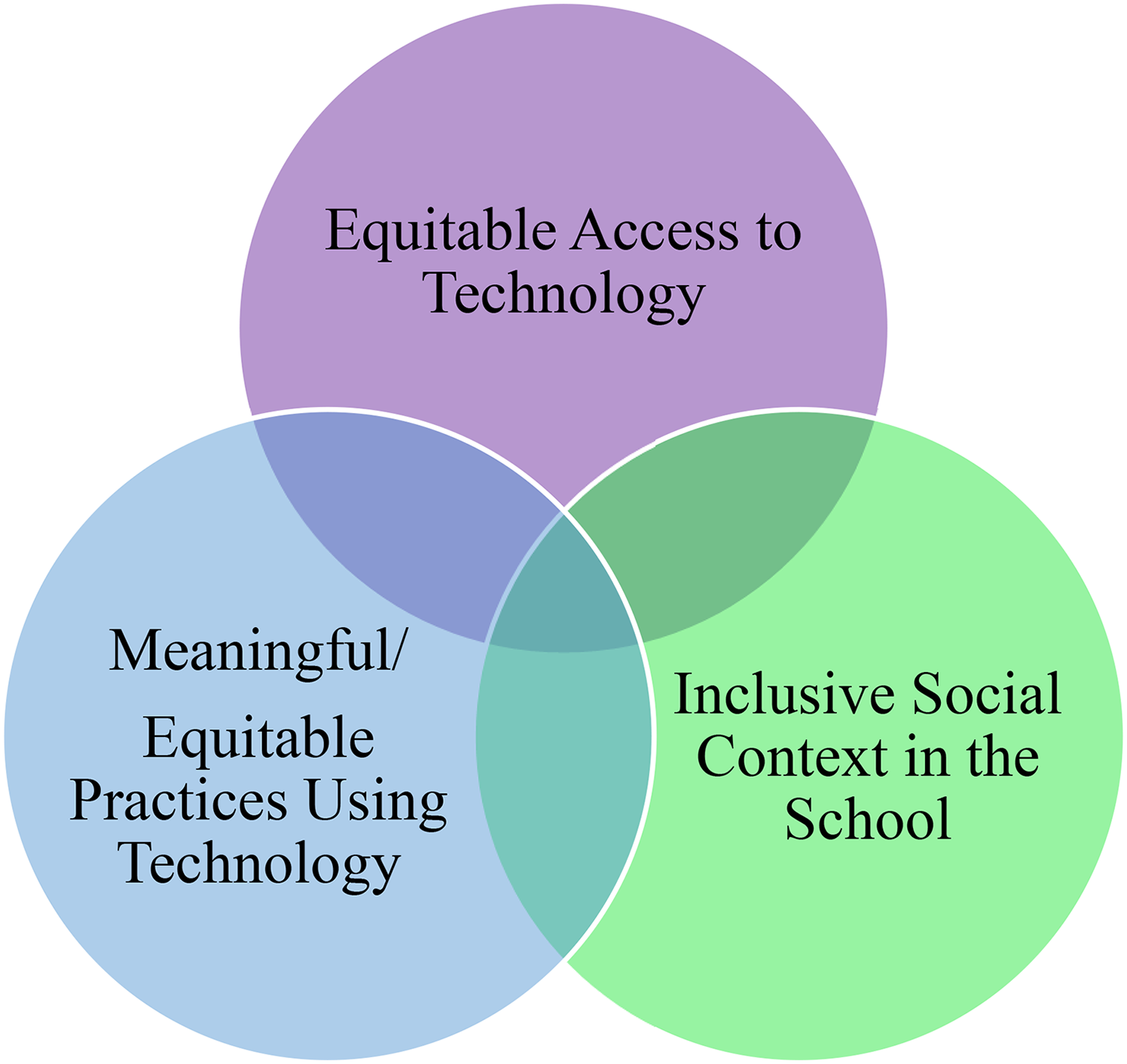
A framework of digital equity in K-12 schools based on Selwyn (2017).
Inequitable access to technology
The first category addresses the most basic aspect of digital equity: physical access to technology, that is, “living, working, or learning in close physical proximity to technology” (Gorski, 2009, p. 351). Over the last few decades, physical access to technology in homes and schools for different groups of students in the United States has improved considerably. For example, the percentage of U.S. public school classrooms with Internet access rose from 3% in 1994 to 77% in 2000 and 94% in 2008 (Gorski, 2009). This is not an accident; schools in the United States have invested in increasing technology in classrooms, spending (for example) an estimated $7.6 billion on hardware and software in 2009 alone (Dexter, 2011). Nevertheless, students of color and those who live in poverty are still subject to a significant access gap. Only 55% of students living in a household with an annual income of less than $10,000 have access to digital technology; this percentage increases to 97% if they live in a household with an annual income of over $100,000 (Snyder et al., 2019). Researchers have also found variations in the type of Internet access based on income level. For example, 33% of families below the poverty line had mobile-only Internet access (Howard et al., 2018). The digital divide was also evident by race and ethnicity. For instance, 90% of White children had a desktop or laptop in their homes in 2016, compared to 95% of Asian children, 73% of Hispanic children, 72% of Black children, and 65% of American Indian/Alaska Native children (Snyder et al., 2019). It is important to note that there is evidence that student use of technology is linked to their ability to make use of technology at home; the low socioeconomic (SES) and disadvantaged status of students correlates with mobile-only Internet access at home and a greater tendency to use home technology for gaming and social media rather than education (OECD, 2017). The impact of access inequity has been exacerbated in remote learning during the COVID-19 pandemic. A large percentage of urban students of color and those living in poverty have been left without high-speed Internet connections and powerful computers (Tinubu Ali & Herrera, 2020). Consequently, inequities in access have directly caused a “homework gap” (Clausen et al., 2020), in which students lacking home technology access cannot complete online learning tasks.
This secondary digital divide in the use of home-based Internet access can be ameliorated by providing students with laptops for either home or school use (OECD, 2017), and schools have attempted to close the access gap by upgrading digital technology in their buildings. However, despite some progress, access to high-speed Internet connections continues to vary by student demographics. For example, Horrigan (2014) reports that students in high-minority schools were half as likely to have high-speed Internet compared to students in low-minority schools, and students in low-income schools or remote rural areas were twice as likely as students in affluent schools or their urban and suburban peers to have slow Internet access at their schools. Raw numbers on digital accessibility need to be tempered with an understanding of the quality of that access (Miller & Liu, 2023) as well as whether digital education in schools can be reinforced at home.
Exclusionary and punitive educational practices using technology
In addition to simple access to technology, it is important to consider the pedagogical and institutional aspects of technology—the activities and practices that educators design around technology—by examining what students and teachers do with technology within the social context of schooling. Surveys of public schools indicate that U.S. schools have achieved high accessibility to computers and the Internet in the classroom (NCES 2010-034) while simultaneously reporting relatively low use of that equipment in the classroom (NCES 2010-040)—as Cuban (2003) observed two decades ago, educational technology appears to be “oversold and underused,” especially in schools with a high percentage of students of color. In addition, there can be a significant difference in the cognitive demands of learning tasks between low- and high-SES students, even with comparable access to computers and the Internet (Garland & Wotton, 2001–2002; Valadez & Duran, 2007; Warschauer et al., 2004). For example, Warschauer et al. (2004) found that low-SES students used computers in math classes for individualized instruction, while high-SES students used computers to conduct statistical analyses; in social studies, low-SES students completed more visual representation projects, while high-SES students conducted research and analysis. Similarly, Garland and Wotton (2001–2002) found that low-SES students were directed to use computers for basic drills and practices, whereas students in affluent schools engaged in research projects and problem-solving activities, a disparity reaffirmed by Valadez and Duran (2007). This use gap has been reported as evident in remote instruction during the COVID-19 pandemic, with urban children of color “more likely to be tasked with reviewing material, rather than learning new concepts” (Barnum & Bryan, 2020). Furthermore, Monahan (2004) researched technology incorporation into the classroom, observing teachers using that technology for punitive purposes, employing scare tactics, isolation, and surveillance to reinforce disciplinary regimes that primarily target marginalized students.
These practices intensified during the COVID-19 pandemic through remote technology, continuing the school-to-prison pipeline (Skiba, Chung, et al., 2014) even for students outside school. For example, schools ejected students from online sessions for not wearing uniforms, punished them for lateness and absence caused by home technology failures (Klein, 2020), and even used the broad vision of students’ home computer cameras to apply zero-tolerance policies on weapons when the teacher identified toy guns in the background (Elfrink, 2020).
These disciplinary uses of technology, combined with the low cognitive load of technology-based tasks given to marginalized students, demonstrate how “technology adoption can accelerate inequalities within individual schools” (Reich, 2019, p. 32). In addition, the usage divide further exacerbates the existing accessibility divide described above, something Healy (1998) describes as dividing students into two groups, “the interacting” and “the interacted.” The “interacting” are students who interact with the technology using sophisticated applications and approaches, becoming creative subjects of their own learning, whereas the “interacted” are those who participate in the most simplistic applications, becoming the object of someone else's programmed teaching. This usage divide replicates the longstanding opportunity gaps in school curricula identified by Ladson-Billings and Tate (1995) as demanding study and amelioration through the lens of Critical Race Theory. In other words, attempts to address digital equity by increasing the type or amount of technology within a school or even a home setting will not automatically address the digital inequities facing historically marginalized student populations. Without meaningful practices and activities designed around technology for these students, technology itself cannot address the opportunity gaps within schools but only reinforces existing inequalities (Miller & Liu, 2023).
Unjust social context of school technology implementation
In addressing the third of Selwyn's elements of technology, social context, we consider the overall issues of social and political inequality inside and outside schools. In addition to the broad issues of inequality, however, specific problems arise from the fact that, from the choice of hardware and software through the provision of professional development to classroom teachers to the oversight of the integration of technology into the curriculum, school leadership is key (OECD, 2017; Schrum & Levin, 2016). The problems may seem rooted in school organization and culture (Schrum & Levin, 2013) or teacher knowledge and beliefs (Cennamo et al., 2009; Means, 2010) but are ultimately conditioned by leadership (Dexter & Barton, 2021). These problems can be broadly categorized into general inequities in schooling that go unaddressed by leadership and inequities stemming directly from the leadership itself. In the next section, we address the role of school leadership in educational equity in general and digital equity in particular.
School leadership and educational inequity
K-12 schools engage in an array of social and cultural practices, including (but not limited to) discrimination based on age, race, gender, social class, language, and culture (Ball, 2009; Ladson-Billings, 2021; Liu, 2020; Liu & Ball, 2019; Spring, 1994). Within these social arrangements, schools and classrooms have experienced an overall failure to achieve or address equity problems. Although inequities are found in every realm of schooling, the challenges in achieving equity in technology are particularly apparent. For example, Monahan (2004) observed that educators in the Los Angeles Unified School District were unaware of the impact of race, gender, and class on technological implementation. Many interviewees in the study felt that issues of race were “off-topic, inappropriate and most likely irrelevant” (p. 282), and they felt more at ease discussing issues of class rather than race. Brooks and Watson (2018) found that school leaders’ thoughts and actions have a substantial effect on student achievement and that there is evidence of race-based decision-making in K-12 schools. They revealed that many school leaders have mental models that incorporate deficit thinking, including the belief that cultures that differ from the dominant one are inferior. With 80% of school leaders being non-Hispanic Whites, this belief can lead to institutional racism and perpetuate educational inequities. Brooks and Watson (2018) suggest that it is crucial for school leaders to unlearn their miseducation about race and “… increase their awareness of their own relationship with racism …” (p. 7).
It is important for school leaders to critically analyze their beliefs and actions regarding educational equity. Scott (1997) argued that equity failure cannot be eradicated until beliefs and attitudes regarding institutional racism and educational equity are fully addressed. His research revealed the desire of public school stakeholders to eliminate social and educational inequities; however, their beliefs and attitudes toward wealth and poverty did not align. For example, individual personality traits of those in poverty, but not SES structure, were among the top causes suggested for success and failure. He concluded that stakeholders act in concert with the deficit-based beliefs “that contributed to unjustified inequities which are visited upon students entrusted to their care,” and that these inequalities, “in turn, have a negative effect on students’ opportunities to learn and their chances for success in life” (Scott, 1997, p. 102).
Technology leadership and digital inequity
Research on educational achievement has confirmed that school leaders and their leadership abilities play an integral role in school and student achievement. Therefore, it is crucial to understand the essential assumptions of school leaders and the actions they take to facilitate and support the effective use of educational technology, a role that Anderson and Dexter (2005) and Bektas (2014) call “technology leadership.” According to Bektas (2014), technology leadership is “… the process of facilitating and supporting the effective use of educational technology in integrating all organizational decisions and policies at school with learning and teaching process” (p. 1767). Bektas (2014) reported that, overall, principals have a positive perspective on adopting and utilizing technology, even though they may still harbor fear of the unknown. This positive attitude may then serve as a catalyst for principals to take action to integrate technology into their schools. Claro et al. (2017) confirmed that the actions taken by school leaders to implement and integrate technology must align with their vision, which must include the pedagogical contribution of the integrated technology (not just technical or administrative contributions). Moreover, this must be a shared vision that includes all stakeholders, especially teachers, who are expected to employ the new technology to change classroom practices.
As the pressure on school accountability continues to rise, school leaders are at the forefront of their school's successes and failures. Part of this responsibility includes addressing digital equity, especially in conjunction with longstanding practices of institutional racism that perpetuate inequality in general. Aguilar (2019) argues that “racial inequities exist in schools largely because of educators’ actions—but actions emerge from beliefs” (p. 62), reflecting the fact that actions are often based on assumptions that are taken for granted and socially distorted (Brookfield, 1995; Liu, 2015; 2017; Mezirow, 2000). It is especially true that teachers’ practices are impacted by socially distorted assumptions regarding marginalized student populations, leading to inequitable outcomes such as opportunity (Ladson-Billings & Tate, 1995) and discipline gaps (Skiba, Michael, et al., 2002; Skiba, Horner, et al., 2011) between students of color and their White counterparts. Such assumptions should be subject to critical analysis so that individuals actively search for alternative solutions and take action to implement them, opening the possibility for transformation (Brookfield, 1995; Liu, 2015; Liu & Ball, 2019).
When school leaders fail to create a school culture that emphasizes educational equity, digital inequities do not inhere in the technology itself, its implementation, or the tasks teachers and students undertake with it but in the school leaders and the organization they cultivate. According to Schrum and Levin (2013), vision, distributed leadership, technology planning and support, and school culture all affect teachers’ use of technology in their practice. Therefore, the responsibility of implementing technology to address equity does not lie squarely on the teachers’ shoulders but is shared with the leadership. Research shows that leadership plays a critical role in creating organizations that are equipped, prepared, and ready to provide students with the skills and knowledge needed to be successful and productive citizens in the 21st century (Anthony & Clark, 2011; Khalifa et al., 2016; Zhao & Frank, 2003). For example, Shamir-Inbal and Blau (2016) explored the integration of tablet computers in elementary classrooms and concluded that it was imperative that school leaders not only lead the integration and try to incorporate it but also ensure that it becomes an integral part of the school culture. Preston et al. (2015) suggested that if school leaders want to foster technology within their building, they should “… attend to the conditions, culture, and community of technological advancement across the school and invest in developing teachers’ capacity, confidence, and creativity with technology” (p. 1000). Similarly, Anthony and Patravanich (2014) argued that school leaders should consider themselves “technology principals,” providing guidance from initial vision and planning through purchase and implementation from the standpoint of digital equity.
Much of the research on leadership and technology integration focuses on equipment and resources, but the effectiveness of technology innovation and integration must come from instructional practices in the social context of the school, as these context-specific practices contribute to digital inequities within the U.S. K-12 public school system. Warschauer et al. (2004) observed that although technology was considered able to assist in diminishing educational inequities, in reality, the introduction of technology into schools within their research parameters only magnified existing inequalities—not as a result of the technology itself but due to the ways in which digital technology was integrated into the classrooms and employed in the curriculum. Therefore, it is important to understand school leaders’ assumptions about digital equity and the leadership actions they take to enhance digital equity in their schools.
Toward a framework of school leadership for digital equity
We have presented an approach to digital equity based on Selwyn's (2017) three interlocking elements of technology—access, educational activities and practices, and the social context of the implementation—to recognize inequities not just in what technology students and teachers have at hand but also in what they do with that technology and in what contexts. Using computer software to drill basic concepts versus using it to analyze data is an obvious example of basic social inequity (the bigotry of low expectations) that is reproduced via technology as digital inequity and one that few educators would defend. However, in the post-digital world, digital inequities have become much more than just another example of social inequity. Rather, they produce a multiplier effect, enhancing basic social inequities and making them appear natural. The inequities and racism described above are reality in the social context of many K-12 schools. Regardless of the advanced technology implemented in teaching, schools can reproduce and reinforce social inequities and oppression if they are not systematically addressed.
By redefining school leadership for digital equity using the three aspects discussed above (Figure 2), we see a broader range of factors and actors that must be taken into consideration when addressing digital equity in schools, considering not just school leadership in terms of roles (20 USC § 7801[44]) but also in terms of practice (Cuban, 1988). First, school leaders need to be keenly aware of the long-standing social and educational inequities embedded in the daily practices of schooling and take transformative actions to address them in creating an inclusive environment through innovative approaches such as teacher–family–community solidarity (Zeichner et al., 2016), culturally responsive school leadership (Khalifa, 2018; Khalifa et al., 2016), and community-based critical reflection and generativity (Ball, 2009; Liu & Ball, 2019). These critical and distributed leadership approaches invite and integrate indigenous heritage and local cultural practices into school practices to transform the schooling experiences of marginalized learners. Second, school leaders must ensure equitable access to technological devices and infrastructure. In addition to critical and distributed decision-making at the school level that engages the expertise of teachers and community members, this might further involve advocating and action for resources at the “macro” (state and national) levels for schools in marginalized communities (Kozma, 2003). Third, school leaders need to support teachers in developing meaningful and equitable practices and activities around technology for marginalized learners to reduce the opportunity gaps they encounter (Milner, 2010; Warschauer & Matuchniak, 2010). Doing this effectively may require recognizing and developing leadership practices among teachers and students, helping them develop their own roles and relationships through shared (Fletcher & Kaufer, 2003) or distributed leadership (Spillane et al., 2001, 2004), as has been recommended for online communities of practice (Liu, 2012), to ensure that teaching and learning activities do not act in opposition to the organizational effort to reduce digital inequity.
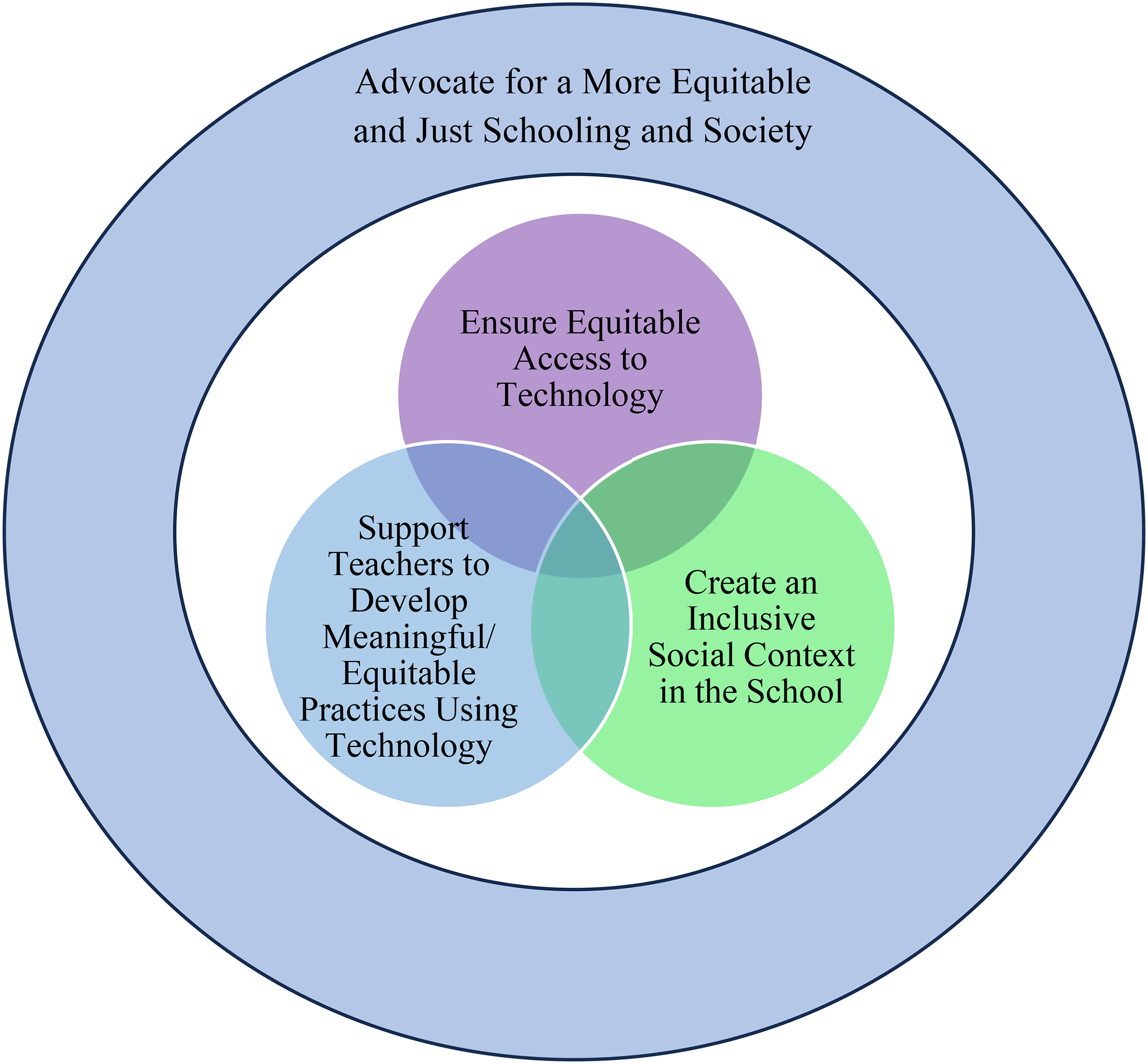
A framework of school leadership for digital equity in K-12 schools.
Conclusion and implications
Much of the academic discourse related to technology implementation focuses on the first aspect of the digital equity framework: technological devices and infrastructure. Teachers and school leaders serve as change agents within their organizations in the adoption and integration of new innovations, such as educational technologies (Liu et al., 2013). In reality, teachers and school leaders attempt to address digital inequities by prioritizing their spending efforts by purchasing materials aligned with their technological needs. Although these beliefs and actions have proven to increase equitable access to technology, they have not addressed the digital divide at its core because of a lack of attention to activities and practices designed around technology as well as the overall inequity issues in the school context, such as institutional racism.
One obvious implication of this model for teachers is that they need to pay close attention to equity in technology-based tasks, avoiding the drill-and-kill activities that reflect a deficit model of student ability, and holding out technology as a reward (or punishment) in a regime of classroom discipline. This can be addressed through teachers’ critical reflection on their use of technology in their classrooms (Miller & Liu, 2023). The social context, however, may be more difficult to address, as it requires an understanding of the larger program of K-12 education in schools and districts as well as the equity issues facing students at home and in larger communities. Recent events (particularly the COVID-19 pandemic, which began in earnest in March 2020) have revealed community-wide digital inequities that have long affected digital equity in the classroom (Miller & Liu, 2023). For example, poor access to the Internet at home as well as to technology with sufficient sophistication to support rich online learning was largely ignored before the pandemic, when it was generally not required to complete homework. Once everything went remote, teachers across the country discovered how much homework had gone unfinished because of the lack of home technology. Teachers must now understand the limits of their students’ home technology if they are going to support any learning at all.
One leadership approach for supporting teachers in developing these abilities is professional development, an area that has a poor reputation among teachers, particularly with regard to educational technology. This is due, in no small part, to the “one-shot,” top-down nature of technology training in both pre-service teacher education and in-service teacher education (Goldenberg & Gallimore, 1991). Scholars agree that the most effective professional development programs are those that reflect the actual needs and voices of teachers in the classroom (Liu et al., 2016; Polly & Hannafin, 2011; Schrum & Levin, 2013), engage them over a relatively long period in incorporating technology into their curricula (Byrom & Bingham, 2001; Liu et al., 2016; Polly & Hannafin, 2011), and reflect a learner-centered and constructivist curriculum (Palak & Walls, 2009; Polly & Hannafin, 2011). Some of the best results come from teachers’ professional development communities, which can be implemented through a significant online presence (Liu, 2012). This type of professional development is more time-consuming than one-shot solutions designed based on simple familiarity with the technology itself. School leaders need to rethink their priorities and emphasize the importance of supporting teachers’ professional development in designing and implementing meaningful activities and practices around technology rather than being driven by corporate technology providers (Miller & Liu, 2023).
The implications of our model for school leaders are clear: Technology integration requires openness and responsiveness from all stakeholders, especially school leaders (Liu et al., 2013). The literature demonstrates that leaders in schools with a large low-SES population believe that they are leveling the playing field by increasing access to digital technology for all of their students, but if they do not place as much importance on equitable activities and practices as well as the social context of the technology, the result is likely to widen the digital divide. Technology-related decisions by school leaders must include not only the technological devices and purposes, that is, the tasks themselves, but also the social context in which the technology will be used within the organization, which requires substantive input from other stakeholders, including teachers, students, and the larger community, to “shape” the resulting implementation and ensure that equity issues are properly addressed. This “social shaping” perspective (Selwyn, 2017) encourages educators to see technology as a series of interactions and “negotiations” rather than a predetermined outcome and helps prevent top-down purchasing decisions that result in inequitably implemented technology. Williams and Edge (1996) confirmed that technology and the organization cannot be treated separately because an organization's social settings shape technology as much as technology has the ability to shape an organization's social setting and structure. More specifically, as Williams and Edge (1996) pointed out more than two decades ago, “… the definition of technology itself must incorporate the social arrangements within which it emerges and becomes embedded” (p. 875). These social arrangements must include people who will teach, learn, and support learning using the technology.
Finally, school leaders must address the nature of schools and districts as racialized organizations (Ray, 2019), including the three areas of technology that Selwyn identifies, but this must extend throughout all aspects of schooling amenable to leadership. This cannot be accomplished through one-shot sensitivity workshops, climate surveys, or even standing Diversity, Equity, and Inclusion committees. Rather, systemic, institutional racism is best approached as a community-wide effort in which the role of leadership may be best limited to creating opportunities for change and then supporting ideas that come from the floor. These ideas should then be reflected in the selection and implementation of educational technology in all three aspects identified by Selwyn, paying careful attention to equity issues at every stage through the structures and practices of distributed leadership that show promise in achieving lasting change (Bingham, 2021). In this way, school leaders can work together with teachers, students, and families to address equity and substantially improve the learning of all students.
Footnotes
Contributorship
Katrina Liu took the lead in developing the ideas and outline of the paper. She covered various aspects of the paper including the abstract, the conceptualization of the digital equity framework based on Selwyn (2017), the methods section, and the reconceptualization of school leadership for digital equity. She was also responsible to address the reviewers’ comments and finalize the manuscript. Rebecca Tschinkel contributed significantly to the paper by conducting literature research and analysis, writing major sections in digital inequity in the school contexts and school leadership. Richard Miller made significant contribution to the paper by situating digital inequity in the context of the pandemic. He also covered aspects of current research in school leadership and digital equity and wrote the conclusions and implications.
Declaration of conflicting interests
The authors declared no potential conflicts of interest with respect to the research, authorship, and/or publication of this article.
Funding
The authors received no financial support for the research, authorship, and/or publication of this article.
