




Abstract
Purpose:
Drawing on distributed leadership and motivation theories, this study investigates teachers’ perceptions of resource and agency distributions and identifies the key factors motivating leadership among teachers.
Design/Approach/Methods:
This quantitative study collected data from 327 teachers in nine schools in Shanghai. Chi-square tests of independence were conducted to examine the associations between leadership structures and power distance, while Spearman’s correlation tests were used to identify changes in leadership resource impact. A nonparametric Friedman’s test was applied to detect discrepancies between the agency of principals, team leaders, and teachers. Finally, Chi-square tests were conducted to discern the associations between teachers’ workload and motivation to lead.
Findings:
Most teachers identified the pyramid and spider’s web structures—which feature one power center and a high power distance—in their schools. The leadership resources and agency distributions corresponded to the school hierarchy: the higher position held by a teacher or a leader, the more resources they received, and the greater the agency they exercised. Results indicate that support from the principal is the most important factor in teachers’ participation in distributed leadership, while extra pay and leadership title are the least effective motivators.
Originality/Value:
This study has theoretical and practical value. First, it demonstrates the value of the resource–agency duality model for analyzing distributed leadership. Second, this study shows that promoting distributed leadership in Shanghai schools requires re-designing organizational resources and individual agency.
Keywords
Introduction
Since the mid-1990s, scholars have emphasized that the success or failure of an organization depends more on the interactions between leaders, followers, and situations than on top-down formal leadership (Bennett et al., 2003; Fullan, 1998; Harris, 2008; Spillane et al., 2004). This argument challenges traditional leader-centric leadership theories, which focus on the traits, behaviors, and leadership styles of formal leaders. As one of the most popular theories examining the dynamics of interactions, distributed leadership has been subjected to significant empirical investigation and theoretical development over the past decade (Bolden, 2011; Harris, 2007; Tian et al., 2016). Studies conducted in Western countries—including Belgium (Hulpia et al., 2012), Canada (Melville et al., 2014), Finland (Lahtero et al., 2017; Tian, 2015, 2016), New Zealand (Timperley, 2009), the United States (Spillane et al., 2007; Spillane & Healey, 2010), and the United Kingdom (Woods & Gronn, 2009; Woods & Roberts, 2016)—tend to depict distributed leadership as a key strategy for school development in the 21st century. These studies endorse the benefits of distributed leadership, including its ability to strengthen school-based management and accountability, increase the autonomy of the principal, and develop the leadership capacities of teachers. Scholars agree that when well-designed and properly implemented, distributed leadership results in better learning outcomes (Leithwood et al., 2007; Robinson et al., 2008; Timperley, 2005). However, some have criticized the tendency of distributed leadership to intensify teachers’ workloads—an outcome Harris (2013) refers to as “distributed pain” (Youngs, 2009). In practice, distributed leadership remains purview of school principals, with most studies focusing on how principals share leadership with teachers while overlooking the motivation of teachers to lead (Torrance, 2013).
According to Feng (2012), despite its popularity in the West, distributed leadership has not been fully explored in the Chinese context. Contextualizing distributed leadership in Chinese schools, Feng (2012) notes the need for an empirical examination of teachers’ viewpoints on distributed leadership. Addressing this gap, this quantitative study investigates Shanghai teachers’ perspectives of distributed leadership. This study asks two research questions: How are organizational resources and individual agency distributed in Shanghai schools? What are the key factors behind the leadership motivation of teachers in Shanghai?
Research context: Shanghai schools
To investigate distributed leadership in Shanghai schools, several salient features of the research context require clarification. Culturally, Confucianism has had a profound impact on the conception of leadership in China. While manifested in patriarchal and hierarchical power dynamics, leadership is also embedded in notions of social harmony and morality (Shah, 2006; Tung, 2002). In the Chinese context, cultural expectation dictates that subordinates are obedient to their superiors, while superiors lead by setting a good example (Chen & Chung, 1994).
Administratively, China has adopted a four-tier educational governance system to govern public education on the national, provincial, municipal, and county levels. Shanghai municipality is the main education provider for residents. Since the 1990s, educational reforms have been decentralizing power to local schools. Under the principal accountability system, the school principal is the highest ranked instructional leader, educational administrator, and resource manager of the school. Under their leadership, other top- and mid-level teachers share the responsibilities involved in leading the school’s pedagogical and administrative work. School-based management was introduced to improve schools and enhance the quality of the education provided. To enact school-based management, principals are expected to incorporate distributed leadership and build a democratic school culture (Lee et al., 2012).
As such, notions of distributed leadership have been introduced to Chinese schools—an educational context shaped by Confucianism and administered by a vertical four-tiered governance system. However, much needs to be done to develop distributed leadership practices in Chinese schools. Indeed, despite the promotion of the decentralization of power and school-based management, results of the 2012 Program for International Student Assessment survey indicate that Shanghai school leaders and teachers have less autonomy than their counterparts in other OECD countries, particularly in terms of resource allocation, teaching, and assessment (OECD, 2013a, pp. 131–132).
Literature review
Distributed leadership
Despite its increasing popularity, distributed leadership remains an elusive concept in the literature (Bolden, 2011). Extant studies suggest four ways to conceptualize distributed leadership. The first definition emphasizes expanding leadership to multiple leaders in what Gronn (2002) calls the “numerical model” and Spillane (2006) terms the “leader-plus perspective.” The second definition regards distributed leadership as the interactions between leaders, followers, and the situation. Spillane (2006) refers to this conception as the “practice-centered perspective,” while Gronn (2002) has termed it the “concertive model.” According to Gronn’s (2008) “hybrid model,” the third perspective views leadership as a combination of different forms and degrees of solo and collective leadership. In this model, the configuration of distributed leadership is in a constant state of flux. This definition distinguishes distributed leadership from shared, collaborative, and collective leadership.
The fourth definition builds on these three views. Tian et al. (2016) define distributed leadership as a process comprising both organizational and individual aspects, namely, leadership as resources and leadership as an agency. First, from the organizational perspective, leadership is distributed across various tiers of a hierarchy in the form of resources and in service to organizational goals. In this respect, resources refer to the fiscal, human, material, or artifactual (e.g., routines, networks, and reputation) resources used by organizational members in leading the daily operations and future development of an organization. Second, from the individual perspective, leadership is exercised by different organizational agents in achieving personal goals. In this context, agency refers to an individual’s ability to make their own choices and decisions, influence others, criticize, and resist power dynamics within an organization (Eteläpelto et al., 2013).
This resource–agency duality model of distributed leadership acknowledges the key attributes of distributed leadership identified in earlier studies, such as the understanding of leadership as an interactive, relational, and fluid process (Gronn, 2002, 2008; Spillane, 2006). More importantly, this model highlights the reciprocal relationship between organizational resources and individual agency when both organizational and individual goals are aligned. Accordingly, it also suggests the possibility of power conflicts when organizational goals do not align with personal goals (Tian, 2016).
Power distance and leadership structures
Hofstede (2003) defines power distance as the extent to which subordinates accept and expect the unequal distribution of power in an organization, institution, or society. This definition indicates that power distance is examined from the perspective of the subordinate rather than the superior. According to the Hofstede country index, China is characterized by high power distance (Hofstede, 2003). Hofstede and Bond (1988) attribute this to the hierarchical power dynamic embedded in Confucian culture.
This study defines leadership structure as the configuration and stability of power distribution and power distance in an organization. Leadership structure visualizes the number of power centers and hierarchy tiers in an organization, as well as the degree of leadership distribution. Extant studies have elucidated the connections between leadership structures and power distance. For example, Yan (1999) shows that small-sized Chinese schools tend to build a hierarchical leadership structure with one power center, while medium- to large-sized schools incorporate both a vertical hierarchy and a horizontal structure. Khatri (2009) found that an organization with a high power distance tends to create a task-based hierarchical structure with top-down communication. In this respect, micromanagement is combined with top-down decision-making and a submissive culture. Meanwhile, Spillane’s research demonstrates an organic community structure featuring multiple power centers and a high degree of structural flexibility that appears to increase a school’s responsiveness toward external demands (Spillane et al., 2003; Spillane, 2006; Spillane & Healey, 2010).
Motivation to lead and perceived workload
Based on Chan and Drasgow’s (2001) definition, teachers’ motivation to lead (MTL) refers to a teachers’ self-inclination to assume leadership roles and responsibilities beyond their classroom teaching duties. Earlier studies divide MTL into two categories, namely, affective and socio-normative MTL. Affective MTL draws upon personal preferences, with teachers’ motivation based on the leadership work itself, the influence they can exert on others, or the personal development opportunities attached to the leadership work. Socio-normative MTL involves teachers’ compliance with social norms, with motivations including the desire to follow social norms, carry out duties, or avoid unwanted outcomes (Brockner & Higgins, 2001; Kark & van Dijk, 2007; Van-Dijk & Kluger, 2004).
Teachers’ MTL is also measured by demotivators—that is, factors that prevent teachers from assuming leadership roles and responsibilities (Herzberg, 1964). For instance, the stress or anxiety produced by the anticipated workload of a leadership position can lead to lower MTL. Organizational studies have produced controversial results regarding workload and motivation. On the one hand, high workload consumes more time, emotion, and energy, thus forcing employees to fall back on automated behaviors. On the other hand, high workload prompts employees to seek out more effective work strategies, resulting in higher motivation and better learning (Kyndt et al., 2013; Van Ruysseveldt & van Dijke, 2011).
Method
Survey design and analysis
In Spring 2014, an online survey titled “Distributed Leadership in Finnish and Shanghai Schools (teacher questionnaire)” was distributed in Shanghai as part of a larger comparative study on distributed leadership. The survey was first developed in English and then translated into Chinese by the first author who is a native Chinese speaker and an educational leadership researcher.
The online survey comprised two sections. The first section focused on respondent demographics, including their gender, school type, and current positions. Two modifications were made to the survey to improve its suitability to the Chinese context. First, the school types were specified according to the Chinese educational system as follows: comprehensive school (Grades 1–9), lower secondary school (Grades 6–9), and upper secondary school (Grades 10–12). Second, two roles were added to the list of current positions: Communist Party secretary and homeroom teacher. In Chinese public schools, the Communist Party secretary is responsible for supervising the school’s compliance with national and local educational policies, as well as the integration of socialist values into the school’s moral education (Bush & Qian, 2000, p. 63). Besides teaching subject content, homeroom teachers also assume other roles, including “an instructor, a leader, a counselor, and sometimes a surrogate parent” (Liu & Barnhart, 1999, p. 381).
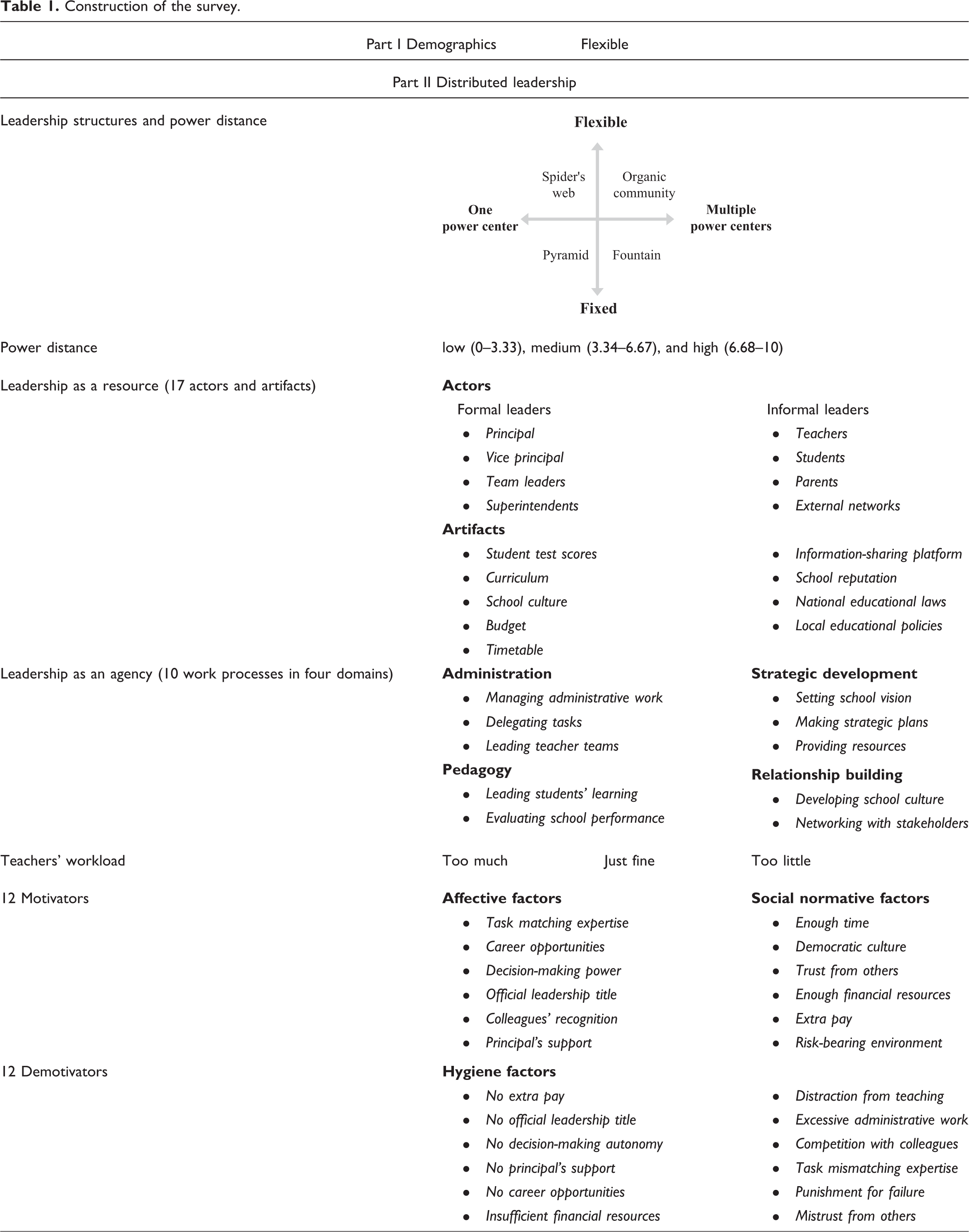
Part II comprised four sections: leadership structures and power distance, leadership as a resource, leadership as an agency, and perceived workload and teachers’ MTL. The survey constructs are summarized in Table 1. The data were analyzed using IBM SPSS Statistics 22.
Construction of the survey.
Shanghai sample and respondent characteristics
The research team was endorsed by the Shanghai Municipal Education Commission in reaching out to local schools. The sampling criteria included medium-sized and medium-level academic performance schools from different districts in Shanghai. A total of nine schools participated in this study; four schools were located in central districts, while five were located in districts on the outskirts of Shanghai. When compared with Shanghai 2013 educational statistics, the demographics of the nine schools met the criteria of having an average class size (about 40 students per class) and medium-level test scores in standardized tests (Shanghai Municipal Development and Reform Commission, 2013).
The web link and Quick Response code of the online survey were posted on the school websites and in the teachers’ offices. In total, 327 Shanghai teachers answered the survey, with a response rate of 68.3%. In terms of school context, 66.5% of respondents were employed in comprehensive schools (four schools), 12.3% were employed in lower secondary schools (two schools), while 21.5% were employed in upper secondary schools (three schools). The gender distribution was 23.7% males and 76.3% females.
In terms of current position, respondents could choose all answers that applied. The largest portion comprised subject teachers (85.0%, n = 278). Among these subject teachers, 32.6% (n = 89) were also homeroom teachers. Approximately 9.0% (n = 25) held seven mid-level team leader positions, including five grade-level head teachers, two teachers’ union chairs, three directors of student affairs, four directors of academic affairs, three directors of general services, five subject leaders, and three Young Pioneer leaders. Only 0.2% (n = 7) of respondents were top-level leaders, including four vice principals and three Communist Party secretaries.
Leadership structures and power distance
The first section of Part II of the survey was intended to identify the most popular leadership structures and their relationships with power distance. Four leadership structure metaphors were constructed according to power sources (one vs. multiple power centers) and structural stability (fixed vs. flexible). The four metaphors include the following: (a) the pyramid, a fixed hierarchical structure with one power center at the zenith; (b) the fountain, a fixed structure with multiple power centers at the bottom; (c) the spider’s web, a flexible structure with one power center at the core and multiple functional teams; and (d) the organic community, a flexible structure with multiple power centers, and teams that emerge in response to specific tasks (Tian, 2015, 2016). In answering questions, respondents were asked to choose one or more metaphors that best represent their school leadership structure.
Respondents were then asked to evaluate the power distance between the principal and teachers on a continuous scale from 0 (none) to 10 (very high). For the statistical analysis, the continuous scale was categorized as three: low (0–3.33), medium (3.34–6.67), and high (6.68–10) power distance. A Pearson Chi-square test of independence was used to examine the associations between leadership structures and power distance.
Leadership as a resource
The second section of Part II examined leadership as a resource. Distributed leadership studies have demonstrated the utility of 17 resources in making school leadership more distributive (Crow & Pounder, 2000; Hall et al., 2013; Heller & Firestone, 1994; Leithwood et al., 2007; Murphy et al., 2009; Scribner et al., 2007; Smylie, 1996). This section examined the impact of 17 resources, including actors on the school level (i.e., principals, Communist Party secretary, vice principals, mid-level teacher leaders, teachers, parents, and students) and district level (i.e., superintendents), as well as artifacts (i.e., student test scores, curriculum, school culture, budget, information-sharing platform, school reputation, national educational laws, local educational policies, and the school’s external networks).
Respondents were asked to rate the impact of 17 leadership resources on school leadership work according to a 5-point scale (1 = none, 2 = little, 3 = some, 4 = a lot, 5 = decisive). The mode of impact for each resource was calculated and then ranked. Respondents then evaluated whether they wanted to increase (2 = increase a lot, 1 = increase some), decrease (−2 = decrease a lot, −1 = decrease some), or maintain (0 = maintain the same) the impact of each resource. Spearman’s correlation was used to identify the associations among these changes.
Leadership as an agency
The third section of Part II investigated leadership as an agency. Respondents were asked to evaluate the amount of agency exercised by principals, mid-level team leaders, and teachers in 10 concrete leadership processes on a 4-point Likert-type scale (1 = none, 2 = very little, 3 = some, 4 = a lot). These 10 leadership processes were divided across four domains as follows: strategic development leadership (setting of the school’s vision, strategic planning, and providing resources), administration (managing administrative work, delegating tasks, and leading teacher teams), pedagogic leadership (leading student learning and evaluating school performance), and relationship building (developing school culture and networking with stakeholders) (Alava et al., 2012; Hulpia et al., 2012; OECD, 2013b). Nonparametric Friedman’s test was employed to detect the discrepancies in agency at the between-group level. At the within-group level, the mean rank of the agency of principals, team leaders, and teachers in the 10 leadership processes was counted.
Perceived workload and teachers’ MTL
The last section of Part II required respondents to assess their workload (1 = too much, 2 = just fine, 3 = too little) and then rate the effectiveness of motivators and demotivators (0 = not sure, 1 = not at all, 2 = very little, 3 = some degree, 4 = quite a bit, 5 = a great deal). Based on MTL theory, the 12 motivators comprised two categories: affective and socio-normative factors. Affective factors included “task matching expertise,” “career opportunities,” “decision-making power,” “official leadership title,” “colleagues’ recognition,” and “principal’s support.” Socio-normative motivators included “sufficient time,” “democratic culture,” “trust from others,” “sufficient financial resources,” “extra pay,” and “risk-bearing environment” (Kark & Van Dijk, 2007; Leithwood, 2006; Murphy et al., 2009; Smylie et al., 2007). The 12 demotivators comprised the absence of the aforementioned motivators. It was hypothesized that overloaded teachers were motivated and demotivated by different factors compared to those with a manageable workload. Chi-square tests were conducted to examine the associations between teachers’ perceived workload and MTL.
Validity and reliability
Content validity refers to the extent to which a measure represents all facets of a given construct (Lawshe, 1975). This study ensured the content validity of the survey in the following ways. First, applying the resource–agency duality model generated from the meta-analysis as the theoretical framework, we generated all survey variables based on earlier distributed leadership studies and motivation theories (e.g., Hulpia et al., 2012; Murphy et al., 2009; Spillane et al., 2004). This ensured that the measured items were relevant to distributed leadership and reflected its different dimensions. Second, a panel of five subject matter experts from Finland, China, and the United Kingdom evaluated the survey content using Lawshe’s (1975) scale (1 = essential; 0 = useful, but not essential; −1 = unnecessary). The mean content validity ratio is 1, indicating that all the items were essential to the study. Third, the translated survey was piloted by 10 Shanghai teachers to check the design of the questions and the accuracy of the translation.
To ensure that the collected data provide a valid foundation for statistical analysis, Little’s (1988) missing completely at random (MCAR) test was conducted to check the missingness mechanism. The MCAR test indicated that the missing value of this study was completely random: χ2(15694) = 15497.051, p = .867.
A reliability test was conducted to examine the survey’s consistency. In this study, the Cronbach’s α values in all sections were above .90, suggesting high internal consistency (leadership as a resource: α = .91; leadership as an agency: principals’ agency α = .91, mid-level team leaders’ agency α = .95, and teachers’ agency α = .93; teachers’ MTL: 12 motivators α = .93, 12 demotivators α = .95, p < .001) (George & Mallery, 2003).
Results
Leadership structures and power distance
According to results, 94.2% (n = 308) of the respondents chose just one metaphor to describe their school leadership structures, while 5.8% (n = 19) considered their school to have more than one type of leadership structure. Of those who chose just one metaphor, the most prevalent structures were the pyramid (40.5%, n = 308) and the spider’s web (37.5%). Both structures reflect one power center at the zenith of the hierarchy or core of the network. In contrast, the organic community structure was identified by 20.4% of the teachers, while the fountain was the least perceived structure (1.6% of the respondents).
Regarding the power distance, 81.2% of the respondents depicted a medium or high power distance in their respective schools. The Pearson Chi-square test of independence revealed statistically significant associations between leadership structures and power distance: χ2(6) = 40.804, p < .001 (Table 2).
Dependency between teachers’ perceived power distance and four leadership structures: The results of Chi-square test.
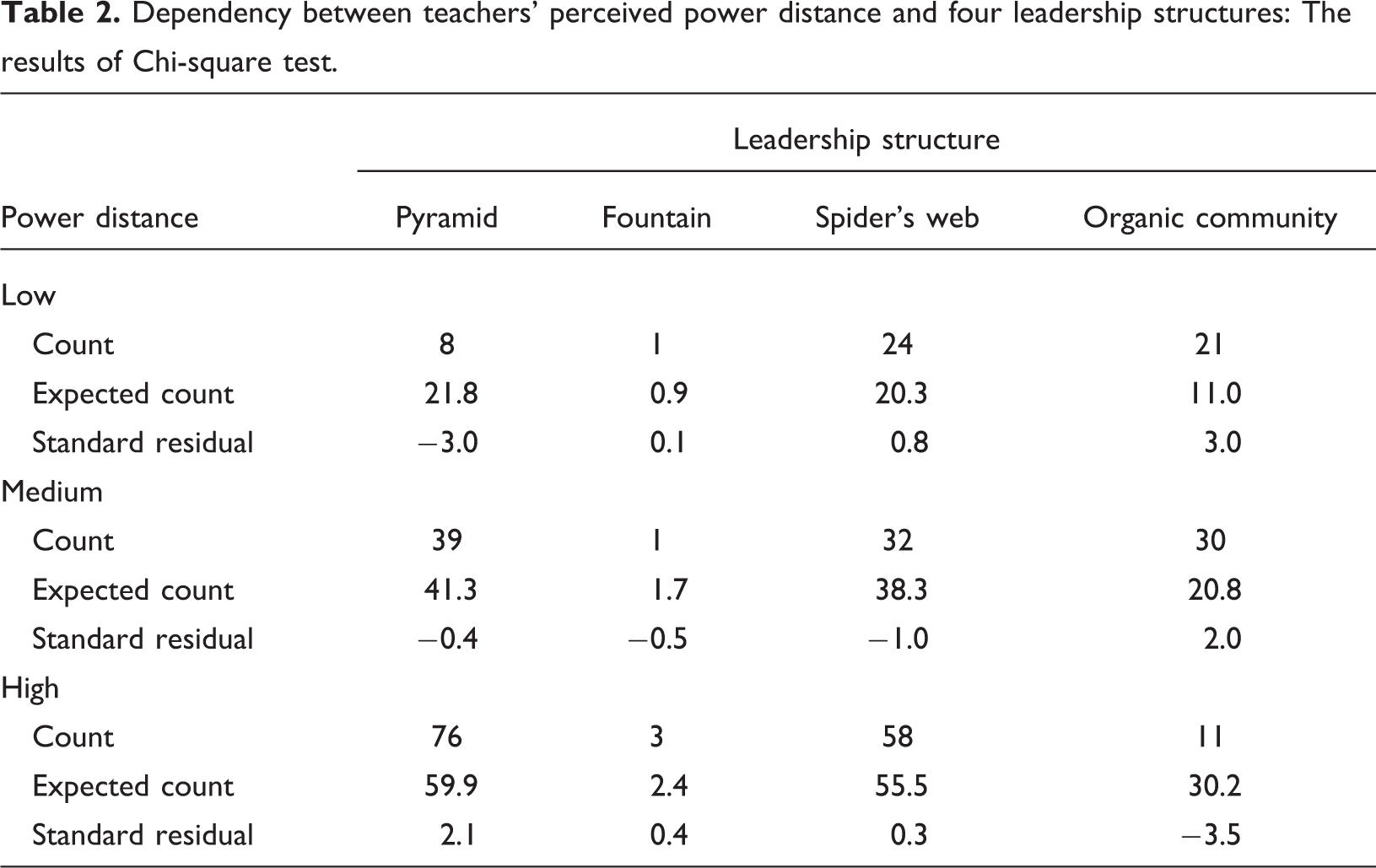
These associations were caused by the pyramid and organic community structures. At the α = .05 level, respondents who linked the pyramid structure with a low power distance and those who associated the organic community structure with a high power distance were significantly underrepresented. In contrast, teachers who considered the pyramid structure as involving a high power distance and those who connected the organic community structure with a low or medium power distance were considerably overrepresented. Accordingly, the most prevalent structure—the pyramid—was associated with a high power distance. Meanwhile, the organic community structure was linked with a low or medium power distance. Respondents who chose the fountain or spider’s web structures do not appear to have linked them with any specific range of power distance.
As noted, 5.8% (n = 19) of the respondents considered their schools as having several leadership structures simultaneously. The most common combination comprised both the pyramid and the spider’s web (47.4% of 19 teachers), followed by a combination of the spider’s web and organic community structure (21.1%). Other combinations included a mixture of all four metaphors, as well as the combination of the pyramid and fountain. Results of the χ2 tests showed that when the combinations included the organic community structure, respondents tended to choose a low power distance. However, if the combinations even partly involved the pyramid structure, the power distance appeared to be medium or high.
Leadership as a resource
Table 3 presents the impact of modes of influence on leadership resource on the school leadership work. All 17 resources exerted at least some influence (mode ≥ 3). Regarding the key human resources, the principal and superintendent were found to play a decisive role in schools. Following the school’s hierarchy, vice principals and mid-level team leaders were shown to exert a lot of impact. In contrast, teachers, students, parents, external stakeholders, and Communist Party secretaries only had impact on the school leadership work to some extent. Moreover, some artifactual resources—such as school reputation, test scores, educational laws, and policies—appeared more influential than budget, curriculum, and school culture.
Influence of the 17 leadership resources: Modes and teachers’ wishes to increase, decrease, or maintain the amount of influence.
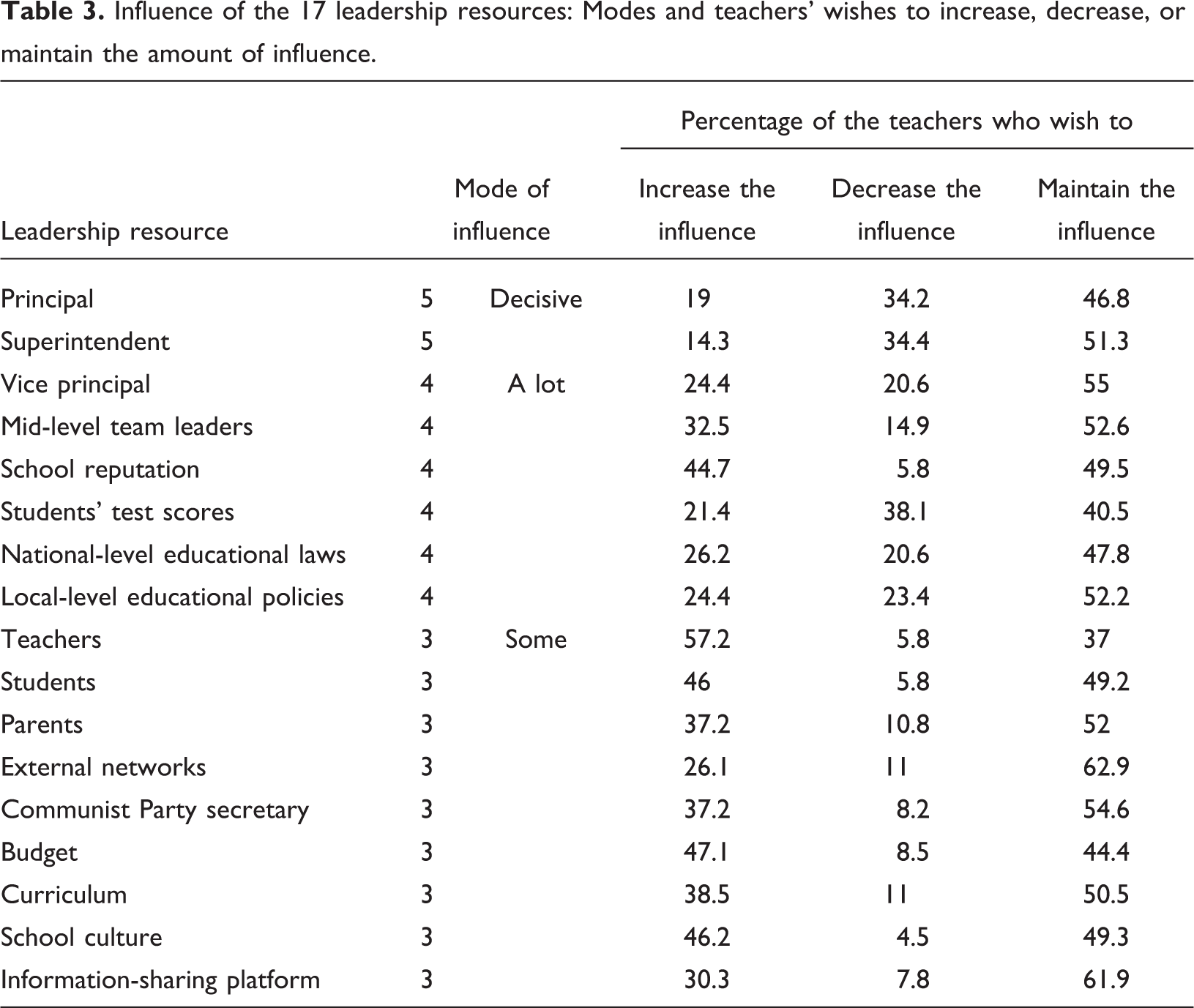
Table 3 also presents the respondents’ desires to increase, maintain, or decrease these impacts. Results indicate that respondents wish to increase teachers’ influence (57.2% of respondents), school budget (47.1%), culture (46.2%), and reputation (44.7%). Over a third (38.1%) of respondents wanted to decrease the impact of student test scores and weaken the influence of superintendents (34.4%) and principals (34.2%). Spearman’s correlation results confirm the associations between respondent desires. More specifically, the respondents wished to increase teachers’ impact while simultaneously reducing the impact exerted by student test scores (ρ = −.11, p < .001), superintendents (ρ = −.19, p < .001), and principals (ρ = −.20, p < .001).
Leadership as an agency
The Friedman’s test results reveal a significant difference in the agency exercised by the principals, mid-level team leaders, and teachers at the α = .05 level (Table 4). At the between-group level, the higher an individual sat in the school hierarchy, the greater the leadership agency they exercised. Therefore, principals were more agentic than mid-level team leaders. Teachers were less agentic in most leadership processes with the exception of leading student learning.
Mean rank of the agency of principals, mid-level team leaders, and teachers in 10 leadership processes.
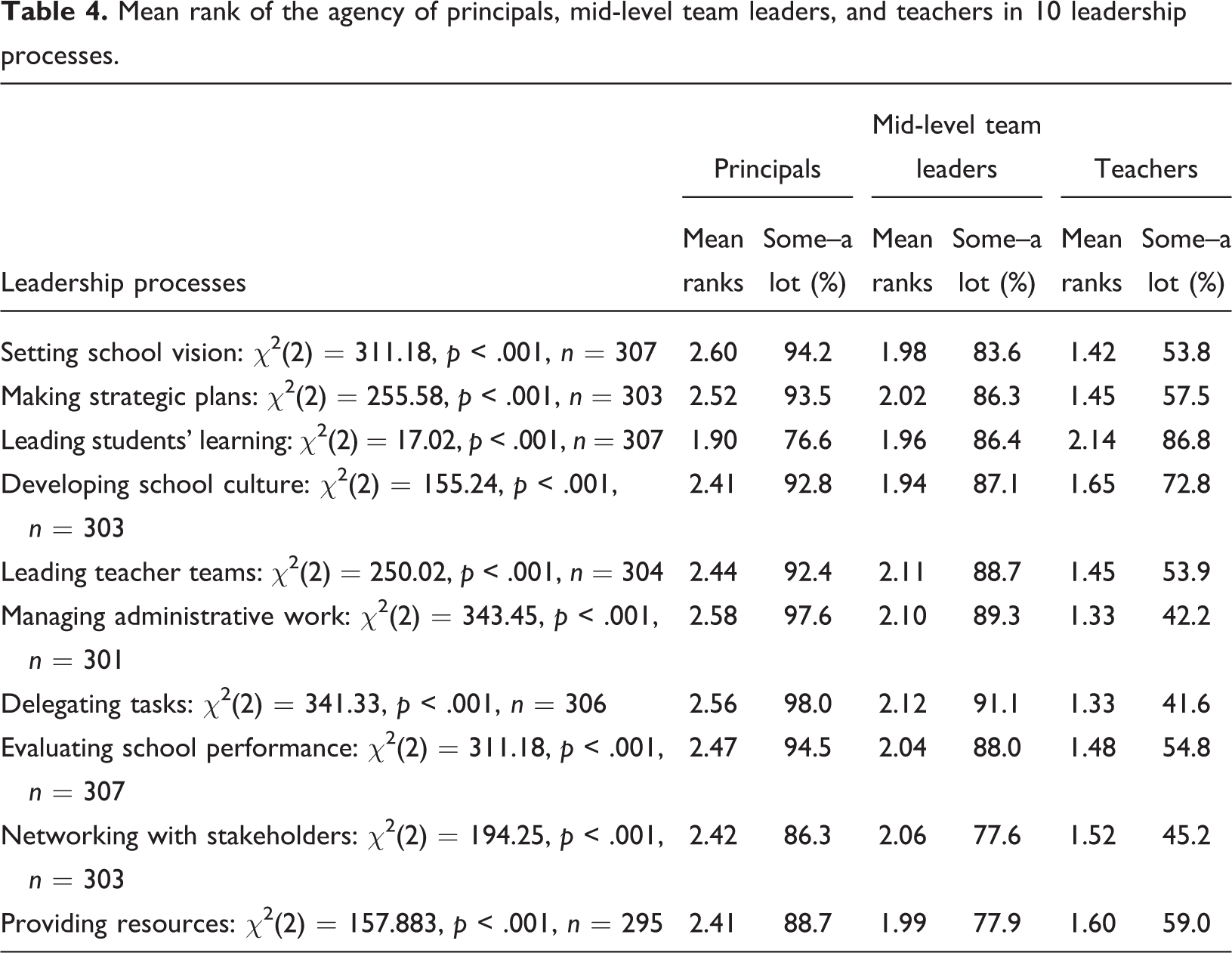
At the within-group level, principals’ agency was strongly presented in delegating tasks, managing administrative work, and evaluating school performance. The agency of mid-level team leaders was mostly observed in delegating tasks, managing administrative work, and leading teacher teams. While teachers’ agency was most visible in leading student learning and developing school culture, it was weakly presented in other leadership processes.
Teachers’ perceived workload and MTL
As Table 5 presents, 53.9% (n = 151) of respondents considered their workload to be “too heavy,” 45% (n = 126) managed their workloads “just fine,” while only 1.1% (n = 3) found they had “too little” work. In the analysis, the latter two were combined into “teachers with a manageable workload” to facilitate comparison with the “overloaded teacher” group. The χ2 test results rejected the hypothesis that the two teacher groups were motivated by different factors in distributed leadership.
Dependency between teachers’ perceived workload and 12 motivators: The results of Chi-square tests.
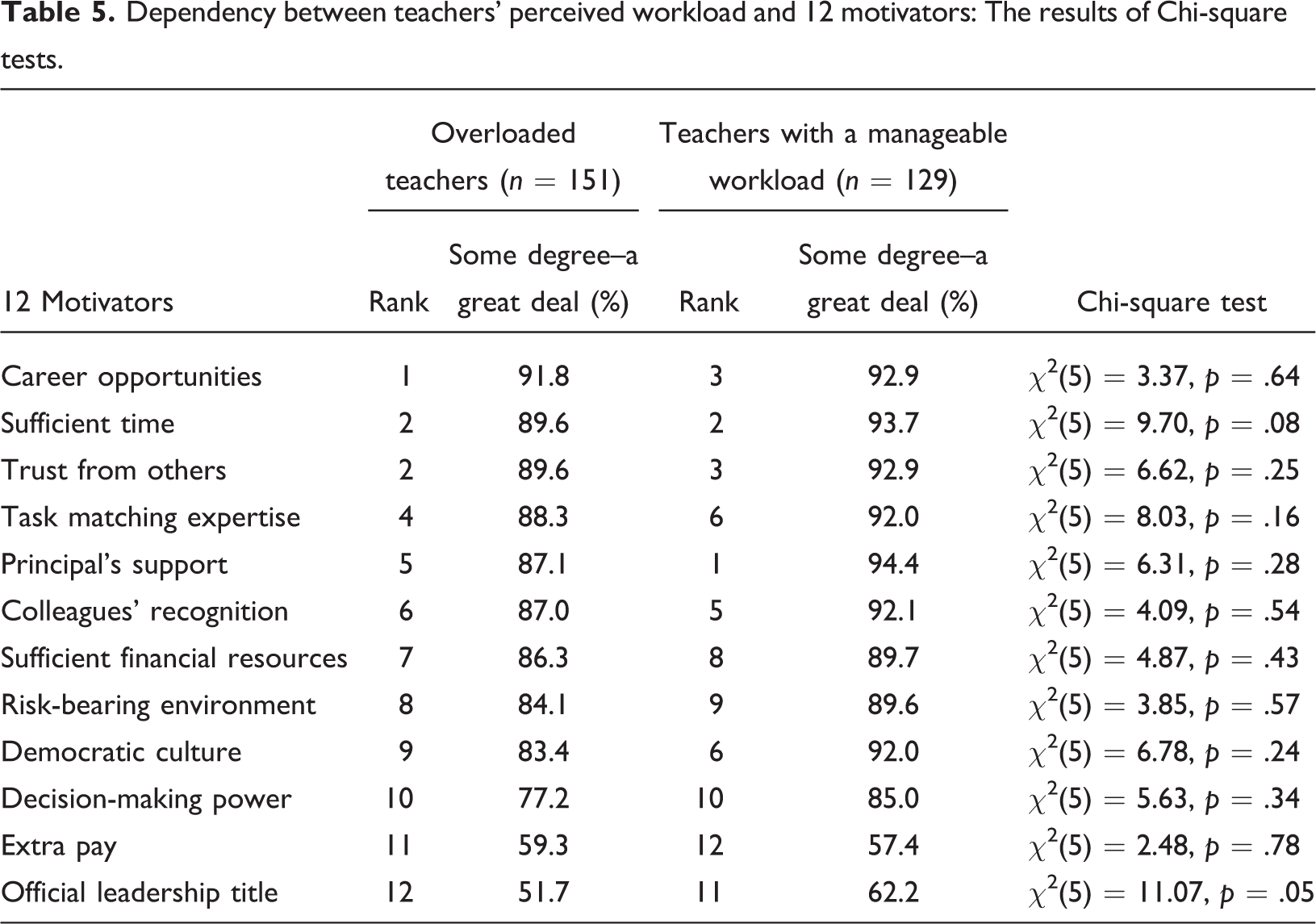
Regardless of the workload, two teacher groups identified the same top six motivators, albeit with a slightly different ranking. Both groups confirmed the importance of the “principal’s support,” “colleagues’ recognition,” and “trust from others,” indicating that distributed leadership can be activated by leaders and colleagues exercising their agency. Teachers tended to assume extra leadership responsibilities if they found that the tasks matched their expertise and recognized potential career opportunities. Having “sufficient time” appeared vital for both groups. In contrast, considerably fewer respondents in either group were motivated by “extra pay” or an “official leadership title.”
Table 6 summarizes the χ2 test results between teachers’ perceived workload and the 12 demotivators. Results show almost no statistically significant differences between groups, with the exception “no extra pay”: χ2(5) = 11.96, p = .04. When leading with “no extra pay,” the overloaded teachers felt more discouraged than those with a manageable workload.
Dependency between teachers’ perceived workload and 12 demotivators: The results of Chi-square tests.
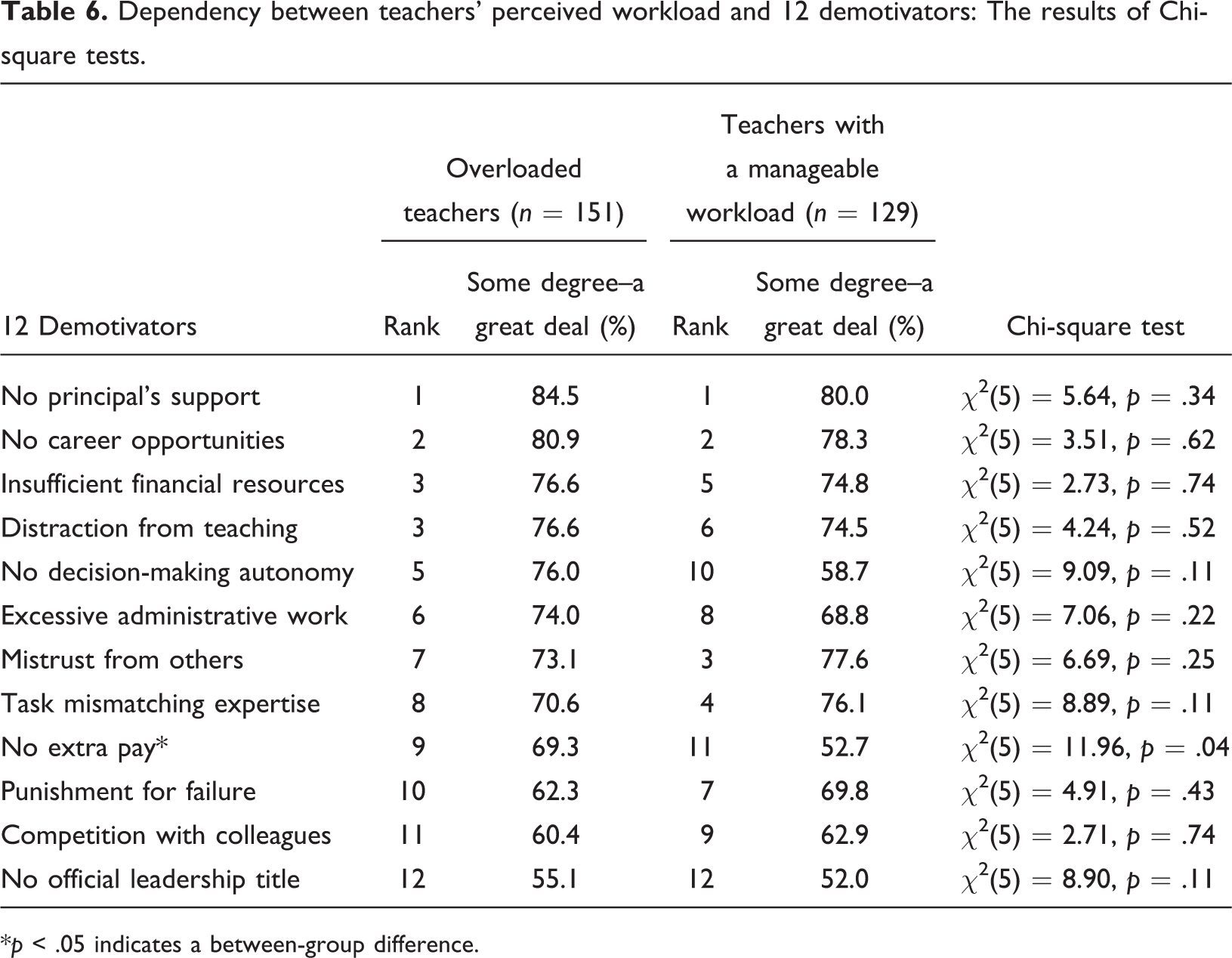
*p < .05 indicates a between-group difference.
Notably, both groups ranked “no extra pay” and “no official leadership title” among the least effective demotivators. Reflecting the results of the least effective motivators, we can conclude that money and leadership titles exert little impact on the promotion of distributed leadership among Shanghai teachers. The absence of support from the principal was the strongest demotivator for both groups. Similarly, respondents tended to withdraw from leadership work if they found no career opportunities, had insufficient financial resources, or found it to be a distraction from teaching. Among the top six demotivators, overloaded teachers emphasized “no decision-making autonomy” and “excessive administrative work.” For the teachers with a manageable workload, the third and fourth strongest demotivators were “mistrust from others” and “task mismatching expertise.”
Discussion
Focusing on teachers’ perspectives, this study investigated the resource and agency distributions in Shanghai schools and identified key factors behind teachers’ MTL. This study has several key findings. First, this study confirms that leadership resources and agency in Shanghai schools are distributed through the pyramid or spider’s web-like structure with one power center and a high power distance. Kennedy and Lee (2008) have claimed that enacting distributed leadership is difficult in Asian schools with a high power distance. This study found that the resources and agency distributions corresponded to the school hierarchy: The higher the position an individual holds, the more resources they possess and the more agency they practice. This reflects Walker’s (2002) observation that “the values of harmony and hierarchy in Chinese societies relate to the maintenance of relationships and power structures” (p. 214).
Despite the dominance of these two structures, another flexible, emergent, and practice-centered distributed leadership model—the organic community structure—was perceived by one-fifth of the respondents. Since the 1990s, school-based management and individualized teaching and learning have become popular trends calling for greater teacher agency (Li, 2008; Meng & Tian, 2007). The organic community structure reflects this transformation by reducing the vertical line of administration and expanding teaching-related units (Yang & Hu, 2008). According to Law (2012, p. 273), this phenomenon has occurred as a result of Chinese school leaders creatively embedding both Chinese and Anglo-Saxon leadership values in a school structure where power centralization and decentralization coexist.
Second, this study shows that different types of leadership are distributed to different actors in a school. From the agency perspective, although principals do not lead the student learning process directly, their agency appears to work through mid-level team leaders and teachers. This suggests that the Confucian view of leading by doing and setting good examples remains prevalent in the 21st century. Additionally, we found that mid-level team leaders exercised their agency by coordinating administration and leading teacher teams. They thus appear to play a pivotal role between the principal and teachers.
A Bangladesh case study on distributed leadership found that, compared to formal leaders, teachers wield more influence on instructional practices and school curricular work (Mullick et al., 2013). This study draws a similar conclusion with respect to the strong agency of Shanghai teachers in leading student learning and relatively weak agency in other school leadership processes. As Murphy et al. (2009) note, structural change by itself is insufficient to bring about positive outcomes. Therefore, to make distributed leadership an authentic and sustainable approach, schools need to make better use of teachers’ agency in their strategic development, administration, and relationship building.
Third, the results of this study indicate that teachers’ perceived workload does not affect their MTL. The presence of support from the principal support was not only the biggest motivator, its absence was the most profound demotivator. This aligns with the findings of earlier distributed leadership studies, which repeatedly underscore the importance of the school principal (e.g., Heller & Firestone, 1994; Hulpia et al., 2012; Leithwood et al., 2007; Murphy, 2006; Murphy et al., 2009; Smylie, 1996; Spillane et al., 2007). Teachers’ MTL was also enhanced by peer recognition, trust, career opportunities, and sufficient time. The teachers surveyed in this study appear to welcome leadership tasks that match their expertise.
Fourth, this study demonstrates that the offer of decision-making autonomy was less effective than creating a supportive and trusting work environment for the Shanghai teachers. This finding aligns with that of Hulpia et al. (2012, p. 1770) who show that teachers’ organizational commitment is positively correlated with the good support of the leadership team, but only slightly less associated with participative school decision-making. In this study, giving teachers extra pay or adding more leadership positions to the school hierarchy were deemed the least effective approaches to promoting distributed leadership. According to Tian (2015), the same results were reported by the Finnish teachers. Based on these findings, we can conclude that there are no simple solutions to making school leadership more distributive. Rather, it requires systematic design incorporating both the organizational and individual levels.
Conclusion
This article has several noteworthy implications. Theoretically, the empirical data further confirms that organizational resources and individual agency are two inseparable dimensions of distributed leadership. The findings confirm the resource–agency duality model as a useful theoretical tool for distributed leadership research.
In terms of practical implications, this study sheds light on the ongoing educational reforms in China. Since the 2010s, a series of reforms have taken place to streamline educational administration and empower local schools. New initiatives such as replacing top-down school inspections and test score-based assessment with school-based development have opened new avenues for distributed leadership practices (Ministry of Education of the People’s Republic of China, 2014, 2015). In this respect, this study reveals the huge leadership potential of teachers, whose agency can be activated by the support of school principals, peer recognition, as well as the provision of sufficient time and fiscal resources. Accordingly, future research needs to investigate how teachers’ leadership capacities can be developed in the era of distributed leadership.
This study has some limitations. First, this study only surveyed teachers from nine schools in Shanghai, impacting the ability to generalize these results to other regions of China. Second, this study was based on a descriptive quantitative analysis and did not examine the internal causal relations among the different factors.
Footnotes
Contributorship
Meng Tian was responsible for the research design, data collection, data analysis, and writing of the article. Tuomo Virtanen contributed to the statistical analysis and quantitative data interpretation. Both authors revised the manuscript before its publication.
Declaration of conflicting interests
The authors declared no potential conflicts of interest with respect to the research, authorship, and/or publication of this article.
Funding
The authors received no financial support for the research, authorship, and/or publication of this article.