




Abstract
Purpose
The number of international faculty members in universities is increasing worldwide, and Japan is no exception. However, despite this quantitative expansion, these faculty remain peripheral. Though recent studies have identified various challenges faced by international faculty, they have focused on international faculty's individual experiences and have lacked perspectives from the host institution. To more accurately understand the challenges facing international faculty, this study aims to uncover compatibility issues between these faculty and their host environment.
Design/Approach/Methods
In this study, I adopted a qualitative case study approach targeting a local national university in Japan. Seven international and six Japanese faculty members were interviewed.
Findings
The analysis revealed various issues underlying the problems faced by international faculty, including new challenges arising from recent national university reforms. The compatibility issues they experienced can be categorized into the following six areas: organizational goals, systems and practices for hiring and evaluating faculty, division of roles between international and Japanese faculty, organizational support for international faculty, organizational culture and atmosphere, and Japanese society's overall system and values.
Originality/Value
This study responds to a crucial academic need to understand the host institution's perspective on international faculty recruitment by providing new evidence of the challenges facing international faculty and their host institution in a low-resource environment in the midst of reforms.
Introduction
The presence of international faculty is becoming increasingly important in the global academic environment. Although there are no precise statistics on the number of international faculty members in universities worldwide, their numbers have grown markedly in recent years (Mihut et al., 2017). 1 Two factors explain this rise in international faculty. First, we often expect international faculty to serve as a spearhead of internationalization, that is, their experience and expertise are meant to provide new insights into research and teaching, and possibly promote changes in their university's ethos (Altbach & Yudkevich, 2017a, 2017b). Second, with the recent rise of world university rankings, international faculty has gained importance as a symbol of internationalization and, by extension, a symbol of excellence in education and research (Brotherhood, 2021). This status boost has motivated many countries and institutions to augment the number of international faculty as a matter of policy.
Japan's higher education system is remarkably homogeneous compared to other matured higher education systems in developed countries, and the ratio of international faculty is extremely low (Brotherhood, 2021; Teichler, 2019). However, since the 2000s, higher education internationalization policies have promoted the recruitment of international faculty. Major policies include the Global 30 project and the Top Global University project. These projects expect international faculty to play a leading role in promoting the creation of university infrastructures and mechanisms for internationalization activities, and even to promote the transformation of their university's on-campus culture through international activities. 2 Partly due to these policy efforts, the number of international faculty at Japanese universities has increased dramatically, although it remains modest compared to other developed countries: International faculty numbers grew from 940 (0.9% of all faculty members) in 1979 to 9,667 (5.1% of all faculty members) in 2022, an increase of more than 10 times in 43 years. 3
However, although numerical indicators of internationalization have improved, internationalization in qualitative terms has not progressed (e.g., Ota, 2018; Watanabe et al., 2018), and international faculty have been unable to demonstrate their presence as leading actors in the way that policies have expected (Brotherhood et al., 2020). How can we bridge the gap between policy rhetoric around promoting internationalization and reality?
Recent studies have identified various challenges faced by international faculty in Japanese universities (Brotherhood et al., 2020; Chen, 2022a, 2022b; Huang et al., 2019). However, these studies have notable limitations in that they have only analyzed the individual experiences of international faculty and did not fully examine factors related to the host environment. The challenges the international faculty faced are caused by incompatibility with their host environment; thus, to solve these problems, grasping the real situation from the perspective of both international faculty and their host environment is essential.
In addition, significant disparities exist among host institutions in Japan. In recent years, higher education internationalization policies in the country have increasingly tended to emphasize support for Japan's top universities, including former imperial universities and prestigious private universities, rather than seeking to support progress in Japanese higher education as a whole. Consequently, there is concern that a small number of top universities will strengthen their function as Japan's internationalization hub while widening the gap between them and the majority of other universities (Yonezawa & Shimmi, 2015). However, the actual status of internationalization at many local universities, which do not have priority government support for internationalization, has not yet been empirically ascertained.
To more accurately understand the challenges faced by international faculty, this study aimed to uncover compatibility issues between their characteristics and their host environment through a qualitative case study of a local national university that is outside the scope of priority government support. The study also elucidates the reality of internationalization in a low-resource environment, which has heretofore rarely been the subject of research. This paper begins with a brief background and literature review, followed by a description of the study's methodology. The next section presents the results of the case study. The paper concludes by summarizing and discussing the key findings and highlighting issues for future research.
Background and literature review
Internationalization of Japan's universities and international faculty
A November 1971 report by the Organization for Economic Co-operation and Development (OECD) Education Research Group, which visited Japan in January 1970, triggered the recognition of the internationalization of Japanese universities as one of the country's policy issues. The OECD Education Research Group emphasized “a need for new attitudes” from Japan, including improvements in the status of international faculty and a reduction of discriminatory treatment against them (Kitamura, 1987). At that time, faculty at national and public universities held the status of civil servants; by law, foreigners were not entitled to the same status as Japanese faculty. They could only be appointed to jobs that Japanese people could not fill by any means; thus, they were mainly employed as teachers of English and other foreign languages (Kitamura, 1987). The OECD Education Research Group's request was an implicit criticism of the discriminatory treatment of foreigners in Japan and was a demand for reform. At the time, national/public universities had little response to this issue; however, they were moved by foreign teachers who appealed for the abolition of university employment discrimination against settled foreigners and the protection of human rights (Kitamura, 1987; Suh, 2005). After a series of twists and turns, the Special Measures Law Respecting the Appointment of Foreign Teachers at National or Public Universities was enacted in September 1982. This law made it possible to accept foreign nationals into national and public universities as faculty members with the same status as Japanese nationals. However, this law had its own set of restrictions, limiting international faculty to management positions and stipulating terms of employment only for international faculty. Despite these restrictions, however, the law had a significant impact on the recruitment of international faculty at national universities (Umakoshi, 1997).
The following year, in 1983, the government announced the “100,000 International Students Plan,” which marked the beginning of the full-scale internationalization of higher education in Japan. This plan was based on the awareness that the number of international students in Japan was notably low among developed countries and set a goal of increasing this number to 100,000 by the beginning of the twenty-first century. This goal was achieved in 2003.
Since the 2000s, Japan has shifted its policy to not only attract international students but also improve international compatibility and commonality and strengthen international competitiveness in both the higher education system and the level of education and research. The “300,000 International Students Plan,” announced in 2008, included an aim to increase the absolute number of international students, as well as the comprehensive promotion of measures to accept international students, from recruitment prior to enrollment to job placement after graduation. In the following year, the Global 30 project, a competitive funding program to realize the plan, 4 was launched, and 13 universities were selected for the program. 5 The project triggered the establishment of English-taught courses and programs and promoted the hiring of international faculty to teach these courses. In 2014, the Top Global University project was launched. Its purpose was to provide priority support for universities that thoroughly promote internationalization, including new initiatives to realize and accelerate exchange and collaboration with the world's top universities, reform personnel and educational systems, and strengthen processes for fostering students’ global responsiveness. 6 A total of 37 universities were selected. This project aimed to change overall university systems, and even the internal culture, through internationalization activities, with international faculty taking a leading role. 7 Notably, however, only 38 out of a total of 807 (MEXT, 2022) four-year universities in Japan were selected for at least one of these two projects.
As previously explained, policy efforts to promote the internationalization of universities have resulted in an over tenfold increase in the number of international faculty at Japanese universities over the past four decades, as well as diversification in terms of their attributes and roles (Huang, 2018a, 2018b; Yonezawa et al., 2013). According to the first national survey of international faculty in Japan conducted by Hiroshima University in 1979, 87.8% of the 371 full-time international faculty at national, public, and private universities in Japan were from Europe and North America, and 77.4% of them were engaged in language teaching (RIHE, 1980). Thirty years later, in 2009, a survey conducted by Yonezawa et al. showed significant diversification of nationality, field of specialization, and country of final degree acquisition compared to the results of 30 years earlier. The survey also revealed an increase in the percentage of faculty members from Asia and non-OECD countries, especially in the STEM field, and that most of them had become faculty at Japanese universities after receiving their graduate degrees in Japan (Yonezawa et al., 2013). Furthermore, a national survey conducted by Huang in 2017 showed that faculty from Asia, especially China and Korea, constitute a major part of the international faculty population in Japanese universities (Huang, 2018a) and that, in addition to their teaching and research roles, international faculty are expected to enhance the international reputation of the institutions to which they are affiliated (Huang, 2018b).
Thus, quantitative indicators show that the internationalization of faculty groups in Japanese universities has progressed. However, these indicators do not necessarily reflect the reality of internationalization. At the institutional level, while the emphasis is on meeting numerical targets, in qualitative terms, the internationalization of universities has not advanced (Ota, 2018; Watanabe et al., 2018). Further, some scholars have pointed out that international faculty are not playing the leading role in internationalization that was expected by government policy (e.g., Brotherhood et al., 2020; Brown, 2019).
Challenges faced by international faculty in Japan
Although studies on international faculty are particularly limited in Japan compared to Western countries, recent studies have identified various challenges that international faculty in Japanese universities must navigate, including precarious employment, the inequitable division of labor, lack of career advancement opportunities, isolation from organizational decision-making, and unfairly low evaluations (Brotherhood et al., 2020; Chen 2022a, 2022b; Huang et al., 2019). These barriers have left junior international faculty, who are expected to spearhead internationalization, disillusioned with their own abilities to contribute (Brotherhood et al., 2020).
The above findings were revealed in studies conducted by international faculty at Japanese universities, who were themselves part of the target population. This facilitated building rapport with the participants and allowed the researchers to depict the realities they were facing (Brotherhood et al., 2020). However, extant studies have focused on individual experiences of being an international faculty member at various universities across Japan, and the perspectives of the host institutions were not incorporated into the analyses, that is, the results of those analyses capture the problems from only one direction. Based on the national survey results from a study they conducted, Huang et al. (2019) evinced that some private universities in Japan have been exploiting young international faculty, especially those who teach languages, due to the financial constraints at their host institutions. This has led to the creation of a website called the “Blacklist of Japanese Universities” (Huang et al., 2019). However, Huang et al.'s study (2019) prioritized a holistic picture at the system level and did not evaluate the perspectives of the host institutions. The prioritization of individual viewpoints and system-level descriptions has marginalized the perspectives of universities as key actors in the recruitment of international faculty (Mihut et al., 2017). Whether international faculty can fully demonstrate their abilities and play an active role depends on a variety of factors, including the institution to which they belong and the relationship between the international faculty and the host institution (Altbach & Yudkevich, 2017a, 2017b). To solve the challenges international faculty must manage and create an environment in which they can reach their full potential, it is necessary to analyze the actual situation from the perspectives of both international faculty and the host environment. The latter perspective, which has been marginalized in previous studies, should be the focus of attention.
Methodology
Conceptual framework and research questions
The challenges facing international faculty stem from incompatibility between themselves and the host environment. For the purposes of this study, compatibility refers to the degree to which the characteristics of the international faculty harmonize with those of their host environment, such as systems, values, and general practices. For example, when a university hires international faculty, its existing systems may need to be adjusted, and values long embedded in the organization may require some compromise by both the international faculty and the host institution. Only through mutual accommodation and willingness to accept some changes on the part of both parties will the international faculty be able to perform to the best of their abilities. However, Brotherhood et al. (2020) argued that host institutions are now satisfied with increasing the number of international faculty, and the institutional commitment to accommodate them is limited. How, then, can the host institution's response to hiring international faculty be examined coherently?
This study used institutional theory as its theoretical basis. Institutions are human-devised entities, consisting of informal constraints such as customs, traditions, and codes of conduct, as well as formal rules such as regulations and laws (North, 1991). Although the institutional approach has many different interpretations, I followed Scott's (2014) institutional theory. Scott's (2014) distinction between the three pillars of institutions (regulative, normative, and cultural-cognitive pillars) has been widely adopted as a framework for analyzing organizations or organizational change. In the context of higher education, the regulative pillar refers to formal rules, regulations, the relationship between the government and higher education institutions, and funding mechanisms, etc. The normative pillar includes underlying norms and values that specify how things should be done and what actions are appropriate—for example, ideas around academic freedom and good-quality education. The cultural-cognitive pillar concerns the shared conceptions that constitute the nature of social reality and the frames through which meaning is made—for example, the dominant higher education policy paradigm and the shared understanding and taken-for-grantedness at the discipline level (Luijten-Lub et al., 2004).
I set the following three research questions using Scott's (2014) distinction between the three pillars of institutions. The research questions were designed to examine the position and participation of international faculty in the host institution in relation to each pillar.
How are international faculty positioned in terms of the official rules, regulations, and organizational structures of the case university? What do organizational members believe should be the roles and contributions of international faculty at the case university? Are international faculty recognized as equal colleagues to Japanese faculty in daily life at the case university?
Case study
Gaining a full understanding of the phenomena around international faculty requires an examination of the interactions between international faculty and the host environment, as well as the interactions among each of them. To this end, this study adopted a case study approach as its research method. The case study approach allows careful observation of a real-life situation (Remenyi, 2002) and increases the possibility of discovering what scholarship has not yet revealed (Merriam & Simpson, 2010).
One university was selected from among medium-sized national universities located in regional cities. It has humanities, sciences, and medicine faculties and is outside the scope of the government's priority support for internationalization. As recruiting international faculty can be a highly sensitive topic, my access to information through acquaintances within the university was an important and realistic selection criterion.
The case university's charter stipulates that it will promote exchanges with other countries in Asia and beyond as an international hub university in the region. The university's mid-term vision includes providing a global education that fosters international awareness and communication skills among students and creating an environment in which diverse members of the university can play an active role. At the time of this study, there were 36 international faculty members (4.3% of all faculty), below the national average of 5.1%. 8 However, a numerical target had been set to increase this number to 46 (5.5% of all faculty) within three years, by 2026. Furthermore, the case university, like all national universities, was undergoing management reform based on government policy. The university had set numerical targets related to the reform items specified by the government; the ratio of international faculty was one of those numerical targets. The level to which these numerical targets are achieved influences the amount of resources allocated to universities by the government.
Participants, data collection, and analysis
The participant pool comprised 13 full-time faculty, including seven international and six Japanese faculty members (see Table 1). In this study, international faculty refers to full-time faculty whose country of birth is not Japan. To ensure diversity among the participants, I selected individuals with different specialist fields, genders, and years of experience working in universities. In addition, for the Japanese participants, I chose individuals with international colleagues or experience in the international faculty recruitment process in order to obtain richer information.
Interview participants.
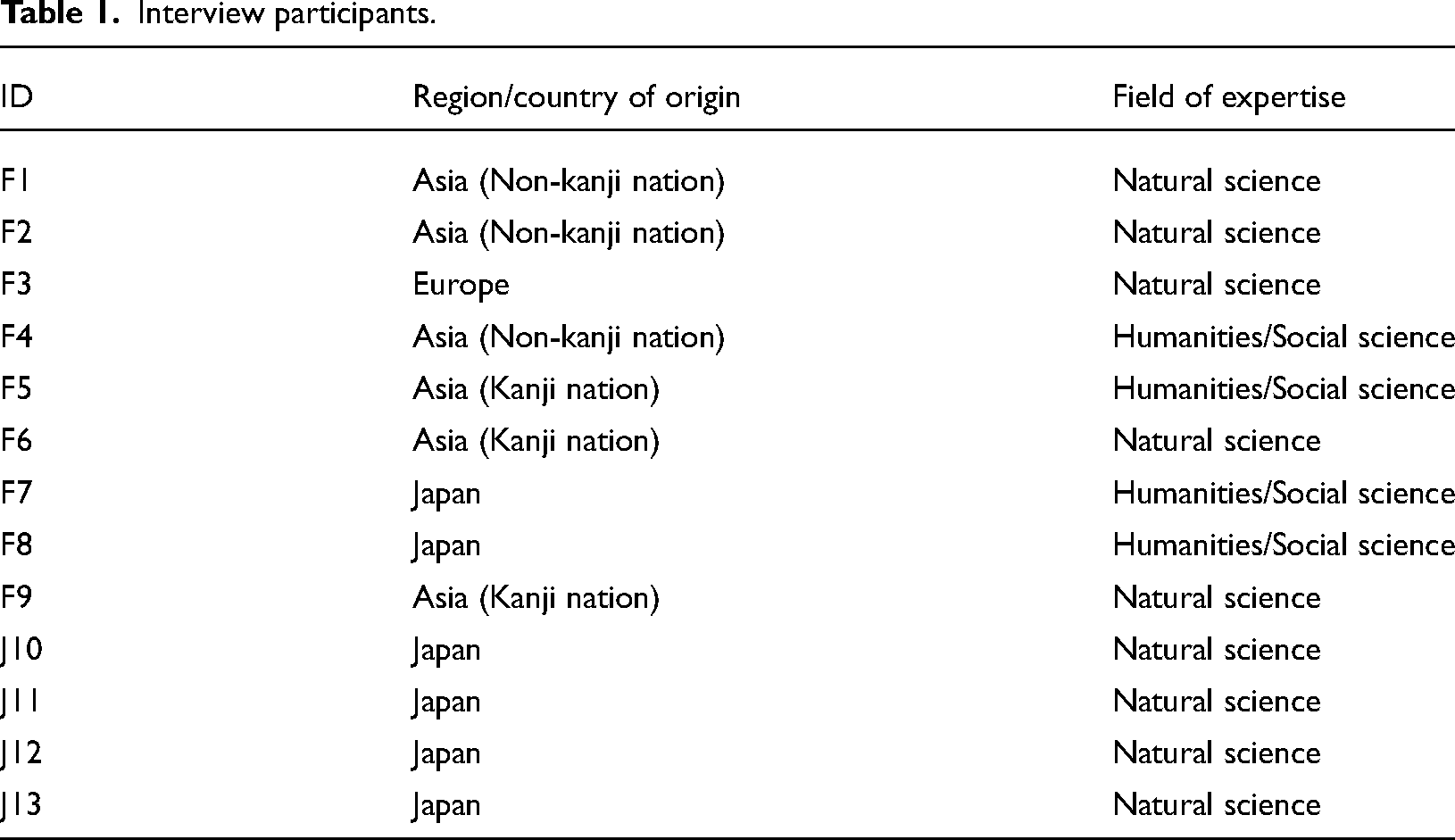
As a result, most of the international participants were in the early-career stages, while most of the Japanese participants were mid-career or higher: The international participants had been teaching in Japan for less than 1 year up to 15 years, and the Japanese participants had been teaching for 8 to 40 years. The gender ratio of the international participants was three men to four women, while that of the Japanese participants was four men to two women. Unlike many other Japanese universities, most faculty members at the case university, whether Japanese or from other countries, are hired without a fixed term. Therefore, all participants in this study were tenured faculty.
This study used three data collection methods: semi-structured interviews, an analysis of relevant documents, and observation. I conducted semi-structured interviews with all 13 participants between November and December 2022. Written consent forms were obtained from all the participants prior to the interviews. Most interviews were conducted face-to-face, in a one-on-one setting between the researcher and the participant. I also used a videoconferencing system such as Zoom, depending on the participant's preference and schedule. Interviews lasted from 40 minutes to 2 hours per participant and were conducted mainly at the participants’ workplaces (e.g., office space). Interviews were conducted in either Japanese or English, depending on each participant's preference. The interview questions were about participants’ motivations and expectations for their current job, the organization's policy and system for hiring international faculty, the current situation of the work and working environment for international faculty, and future prospects.
Documents analysis served to secure insights into the institution's attitude toward hiring international faculty, as well as contextual information about this process. The material reviewed included institutional planning documents, the university's vision, and the university website. Observations were conducted in parallel with the interviews. Through informal conversations with several university members, including interviewees and staff who support international faculty, I collected information on the university environment as it was related to international faculty.
Regarding the analytic process, first, I transcribed the interviews and read the text to generate concepts. Next, I categorized the generated concepts with similar semantic content and replaced them with words that accurately represented them. I read the text repeatedly and carefully reviewed the categories to reflect the participants’ thoughts and perspectives. Once the categorization process was complete, I related the case study research questions to the generated concepts and then formulated the responses to each research question in writing. This writing process comprised the interpretation and final analysis. All procedures described above were approved by the research ethics committee at the Faculty of Education, Shimane University.
Findings
The analysis identified various issues of compatibility between international faculty and their host environment in the following six areas.
Organizational goals
The university's goals for hiring international faculty are not shared among organizational members, nor is the university's desired profile for foreign nationals. For contextual background, the case university had introduced a system a few years earlier whereby the university headquarters manages all faculty hiring for the entire university, in response to the government's national university reform policy. In the past, each faculty/school could proceed with the necessary faculty appointments according to its educational and research needs, subject to the approval of the university headquarters. Today, however, the faculty/school level has less say in faculty appointments. Furthermore, as mentioned earlier, the university has set a numerical target for the number of international faculty to be hired, and achieving such numerical targets affects the institutional evaluations and resource allocation conducted by the Ministry of Education, Culture, Sports, Science and Technology (MEXT). Therefore, in recent years, hiring international faculty at the case university has been increasingly carried out through a top-down model and has tended to be more strongly motivated by managerial needs than by educational and research needs. This arrangement tends to provoke dissatisfaction and animosity among organizational members. The following comment is a simple illustration of this situation. Even if you ask what the definition of “foreigner” is, it's not clear. When I asked the administrative staff, they only answered that it means someone with a foreign nationality. So, this means that someone who is an American and who married a Japanese person and acquired Japanese nationality is treated as a Japanese person, while someone who was born and raised in Japan but is of Korean nationality is considered a foreigner. It seems that the concern is solely with numbers to show the MEXT, and I wonder if they really have the intention to promote internationalization. (J8)
These remarks indicate a growing tendency to hire international faculty based on a numbers-first approach without a concrete plan for their roles in education.
Systems and practices for hiring and evaluating faculty
Systems and practices for hiring faculty
First, there is concern that existing informal practices related to faculty recruitment may disadvantage foreigners. Generally, it is known that there are cases where hiring decisions are made through personal connections, even if universities make open calls for applications. In this regard, some participants expressed concerns that such informal hiring practices may disadvantage foreigners, as shown in the following comment. I also don’t know whether the hiring is conducted properly in the first place. Even if it is an open call, in many cases, someone that they had already been eyeing is ultimately chosen [omission], and in those cases, foreigners are often not included. There are also times when they [foreign applicants] don’t even come into the discussion. (J11)
The sentiment conveyed in this comment is consistent with Chen's (2022b) findings and complements those of Brotherhood et al. (2020) that international faculty are excluded from positions of influence. The lack of an objective and transparent selection system could place international faculty at a disadvantage in the hiring of personnel.
Also absent are policies or standards regarding Japanese language proficiency, which should be required when hiring international faculty. In Japan, it is generally not customary to present job descriptions in advance, and organizational goals for hiring international faculty are not necessarily clear, as abovementioned. In such situations, international faculty could be hired without a clear consensus between themselves and the host institution with regard to their roles and duties when employed and the Japanese language skills required for those responsibilities. A Japanese participant cited the host institution's lack of readiness to hire international faculty as a problem. Of course, I’m not at all opposed to the idea of having international faculty join us, and I think it would be great if it worked out well, because it would really broaden the diversity. But if we are going to hire people who came all the way here, I think we need to clarify the expectations of what they were hired for. I don’t think it will work if we ask them to just choose research and class topics and do them each, like we do with the Japanese. (J13)
Without a clear agreement on what the host expects, international faculty will act according to their own expectations and assumptions. Whether an individual's actions will meet the host's expectations, and vice versa, remains vague as there is no clear agreement even among members of the host university. These circumstances cause frustration and disappointment for international faculty, as the following remarks illustrate. Everybody's working very hard. Everybody is doing whatever they can do. I am saying I can do this. So, the institution should be able to actually take advantage of what I can do. Not only about me, about any individual, the institution should take the best of that particular individual. If somebody is asking me to do something that is completely impossible for me, but simply because if it's required, the position requires to do that, then I should not be hired in that position. It's a waste of human talent I think. (F1)
Systems and practices for faculty performance
The existing faculty performance evaluation system, which assumes that Japanese is staff's native language, must be adjusted to accommodate international faculty. Currently, all full-time faculty members at the case university, whether Japanese or foreigners, are assessed according to the same performance evaluation criteria. Specifically, they are evaluated in the areas of education, research, social contribution, and organizational management, with the weight of each area varying by position level. According to this system, professors must play a larger role in organizational management, such as contributing to various university-wide or faculty-wide committees, admissions-related work, and other organizational matters. However, several participants pointed out that it would be difficult for international faculty to fulfill their roles in these tasks due to their Japanese language skills. There is, consequently, concern that it may be difficult for some international faculty to be promoted to the rank of professor. As one participant explained: Such faculty members are relatively young. What will happen to them as time goes by? Whether or not they can become professor, I think that is, in a way, quite significant. (J10)
All participants in this study were full-time, tenured faculty; therefore, in this case, the issue of unstable fixed-term employment, which previous studies (e.g., Brown, 2019; Chen, 2022b, etc.) have repeatedly evinced, did not apply. Conversely, some international participants talked about recent developments such as marrying a Japanese national or purchasing a residence, indicating their intention to settle down at the case university or in Japan. However, under the current system, their career paths are unclear, and there is a need to establish an evaluation system that can capitalize on the potential of international faculty with diverse backgrounds.
Problems related to faculty evaluation are not limited to international faculty: Middle- and early-career faculty, both Japanese and international, feel the stress of not being promoted or paid more, no matter how hard they work. In the case of international faculty, however, such dissatisfaction is linked to their perception of themselves as “second-order” faculty (Brotherhood et al., 2020). 9
Division of roles between international and Japanese faculty
It is customary that organizational and administrative duties be rotated and shared within a department or faculty. However, these practices are not possible with international faculty due to the language barrier: All internal meetings at the case university, including those related to internationalization, are conducted in Japanese, which limits the participation of international faculty. Organizational and administrative duties are often regarded as “chores” among faculty. If international faculty are automatically exempted from these “chores” because of the language barrier, Japanese faculty feel burdened by such duties. As a result, international faculty may be regarded in a negative light and seen as “temporary” employees. One international faculty member noted the following. You see, this in part could cast a shadow or a negative perspective on foreigners, because others can think that, why is that, that I have whatever this and that duty to do and those other guys don’t? So this automatically raises this issue that we are also part of this faculty, we are probably getting the same salary and then I am in five committees and those foreign guys joining the recreational committee, which sends one email all year. (F3)
To provide some background, the university is undertaking a plan to reduce the overall number of faculty, and as a result, manpower is desperately needed to support the operations of faculties and departments. If the increase in the number of international faculty forces Japanese faculty to do “chores” from which the former are automatically exempted—and are, thus, freed up to concentrate on research—tensions are very likely to arise between Japanese and international faculty. [When international faculty can focus on research, the additional burden placed on Japanese faculty increases.] That's why they don’t make it public or say things like “I achieved this outcome through research” too often. (J8)
Organizational support for international faculty
At the case university, administrative procedures in Japanese are a major source of stress for international faculty. The university has assigned one full-time bilingual staff member to provide language support for the increasing number of international faculty. In addition, very recently, some e-mails and office documents have been translated into English. That the widespread use of AI has facilitated translation by the international faculty themselves was mentioned positively in interviews with the Japanese participants. However, these supports only meet the basic needs that allow international faculty to make do in a Japanese language environment and are far from adequate for enabling them to work on an equal footing with their Japanese colleagues. One international participant commented on the lack of opportunities for international faculty to grow. This result is consistent with the findings of previous studies (Chen, 2022b). If I am able to still survive here and work in Japanese environment is because I have a lot of support. But that support is only to sustain, not grow. Okay. So, there is no support system to grow for non-Japanese faculty members, I think. So if somebody asked me, I would rather say, if you want to come to Japan, you come as associate professor; don't come anything under full professor, then you cannot become [silence] in the foreseeable future. (F1)
However, problems related to administrative procedures are not limited to international faculty. Both international and Japanese faculty felt that administrative procedures eroded much of the valuable time they could spend on more useful things. In some interviews, Japanese participants expressed their opinions that this administrative burden undermines the university's attractiveness as a research environment. For example, I often visit [institution] in the U.S., where there are many Japanese researchers, and I feel that such places are very attractive, with advanced research and a much better working environment compared to Japan. It's an environment where I can really grow and develop as a researcher, without any odd chores. I doubt very much that people from that side would dare to come to Japan to do research here. (J11)
Organizational culture and atmosphere
Some cultural elements have become deeply embedded in the consciousness of the organization and its members. In addition, recent university reforms and management have negatively influenced the organizational atmosphere. Combined, these factors impact international faculty in the host environment.
Cultural elements
Some international participants expressed loneliness during the interviews due to the distance between them and their Japanese co-workers. For example, an international participant who had been in Japan for a long time, including for graduate study, mentioned that in Japanese culture, people keep their distance in workplaces and will never become friends. The participant spent her first years in a graduate school in Japan feeling lonely before coming to understand such cultural differences. Another international participant mentioned the lack of a collegiate and collaborative atmosphere. Several other international participants also expressed hesitation in speaking to their Japanese co-workers. For example, another international participant, who had also lived in Japan for many years and undertaken graduate study there, commented: What's difficult is that no matter how long you live in Japan, you are not completely part of Japanese society, fundamentally. There are still a lot of things I don't know. [omission] With a faculty member from [the same country], I can just knock on the door and ask the co-worker, but, with a Japanese co-worker, I feel that I should refrain from doing that a little. (F5)
In the case of newly hired international participants, these reservations may be due in part to the few opportunities they have had to meet their colleagues in person as a result of the COVID-19 pandemic. However, such cases are not limited to newly hired participants.
In addition, this study found that international participants perceive themselves to be at a disadvantage compared to their Japanese colleagues. If they promote A [an international faculty] to a higher position, we will probably have more voice and influence as foreigners in the future. In that case, [omission] [name] University is still the Japanese [name] University. I don't know if foreigners becoming influential may affect national security, but maybe that is how the Japanese would think. (F5)
This finding underscores those of Brotherhood et al.'s study, which revealed the self-perception of junior international faculty in Japan as “second-order” faculty (Brotherhood et al., 2020).
Recent changes in atmosphere
The recent trend toward a top-down process of hiring faculty generated circumstances that can undermine cooperation and solidarity among peers as a community. As a result of hiring decisions that focus more on achieving numerical targets than on the needs of faculties and departments, there is dissatisfaction at the local level with the increased workload, as well as opposition to the university's upper management. For example, one participant revealed the following situation: In some areas, the international faculty are being neglected [omission]. In particular, because achieving KPI results has been prioritized, the Japanese faculty in the field are currently revolting against top management. They act with the attitude that, “You told me to, so I got some. I don’t care about the rest,” to put it rudely. (J12)
As mentioned above, the overall number of faculty is decreasing, and the roles undertaken by full-time faculty are expanding. As a result, faculty members are becoming increasingly busy and, as a whole, have less room to care for others.
Japanese society's overall system and values
The system and values both within the university and in Japanese society affect the prospects of international faculty. For example, one participant expressed the following opinion regarding the preparation of entrance exam questions, one of faculty members’ main tasks. For example, even in the current entrance exam, it seems to be an extension of what students learn in high school. If the students are told to freely write an essay in English and the international faculty grade them all, that would cause quite a storm. People would question the fairness. However, the entrance exams overseas are like that; the university entrance exam. I wonder whether we could make this OK. If so, we can then leave it to the international faculty [omission]. (J8)
Preparing examination questions requires careful attention to ensure fairness based on the study content up to upper secondary school. As the above participant mentioned, only Japanese faculty are fulfilling this role, considering that it is difficult for international faculty to take charge of this task. Furthermore, many faculty members are involved in implementing the Common Test for University Admissions, which many universities in Japan have adopted as part of their admissions process. This test must be administered simultaneously throughout the country according to the same procedure, following a manual prepared in Japanese. However, because the manual is only in Japanese and most examinees are Japanese speakers, international faculty are sometimes excluded from this work.
In addition to institutional factors, there are some relevant cognitive factors. Several participants raised the issue that neither the university nor the surrounding community is accustomed to diversity. Unlike metropolitan areas, inhabitants of the region in which the case university is located have few opportunities to come into contact with foreigners and are unaccustomed to welcoming them as members of the local community. To create an environment in which foreigners can play an active role and settle, university members and local residents need to broaden their perspectives and change their awareness and attitudes, as the following opinion indicates. The place where I lived before was also like this but there are overwhelmingly fewer foreigners here. [Omission] So many children have never seen a foreigner in the first place, and because they are not used to foreigners, the children probably don't know what is good or bad. They just haven’t seen foreigners. So, they are a little bit afraid. Things like that would exist no matter what [omission]. So, if you really want to talk about globalization, I think you have to make it easier for foreigners to live in rural areas or they won’t settle down. (F9)
The case university and its members generally have limited experience with diversity. During the interviews, some participants talked about the positive effects on students and faculty of having international faculty with diverse linguistic and cultural backgrounds. However, although they mentioned the significance of diversity in general terms, many participants lacked real-life experiences. In addition, although the university has a vision of building an environment in which diverse constituents can play an active role, there is a strong tendency toward top-down decision-making and little opportunity for the opinions and ideas of diverse constituents to be incorporated. Consequently, respect for diversity is perceived as a mere pretext. One participant explained that he found it difficult to build trust among organization members—an essential precondition for the university to glean meaningful feedback from the international faculty. It is important to understand how beneficial it is for the university to build a trusting relationship with them [international faculty] and to provide them with opportunities to play an active role in the university. I don’t think it's good if you think that the committee members come around more often simply because a foreigner came to the university. If you feel that way, I don’t think it will be good for you. (J10)
Conclusion
This study attempted to uncover issues of compatibility between the characteristics of international faculty and their host environment through a case study of a local national university in Japan. The case study revealed various compatibility issues in the following six areas: (1) organizational goals, (2) systems and practices for hiring and evaluating faculty, (3) division of roles between international and Japanese faculty, (4) organizational support for international faculty, (5) organizational culture and atmosphere, and (6) Japanese society's overall system and values. The analysis incorporated the host institution's perspectives, which have been overlooked by previous studies, and, thus, enabled a better understanding of the challenges international faculty face, including the various factors underpinning those challenges. Furthermore, this study identified new obstacles the case university faces in a low-resource environment against the backdrop of recent government reforms of national universities. These emerging challenges can be summarized in the following three major points.
First, recruiting international faculty is increasingly motivated by managerial needs rather than educational and research needs because the presence of international faculty brings benefits to the university in the form of government resource allocation, which might affect its very survival. On the other hand, faculty appointments that are not made to meet educational and research needs could disrupt the existing order and cohesiveness and create a disharmonious atmosphere at the local level.
Second, under the current centralized decision-making system, whether or not international faculty's value to education and research is recognized at the field level, there is no way to provide meaningful feedback to the university's upper management for use in university administration. Faculty members who have lost their voice, both in the hiring of international faculty and in general, have less sense of belonging to the organization (Fujimura, 2022) and become increasingly silent.
Third, the university's attractiveness as a research environment has been undermined by inadequate organizational support for international faculty, increased administrative work due to staff reductions, and a diminished sense of community due to the strengthening of top-down management as part of university reforms. Under these circumstances, one is left with fundamental questions about the rationale for recruiting international faculty and whether the university has the capacity to do so. Currently, clear policies and procedures to address these issues are deficient.
As the findings of this study show, while goals have been set at the national and institutional levels to increase the number of international faculty, there is no specific policy on what and how these goals can be achieved. The findings of this study also facilitate the understanding that for international and local faculty to be equally successful, the host institution must invest a reasonable amount of effort and commitment (Altbach & Yudkevich, 2017a). In this case, the obligatory organizational commitments include clear policies and criteria for the hiring and performance evaluation of international faculty and the transparent administration of these policies and criteria. Specifically, what the host institution aims to achieve by recruiting international faculty will determine the hiring and promotion criteria and the support that should be provided to these employees. Such organizational commitment will allow international faculty to play a more active role and promote the long-term reform process that national policy desires.
Finally, I address some limitations, which can guide future studies. First, the findings of this research are based on a single case study and cannot be generalized to other contexts. However, the study's results indicate that environmental factors within and outside the host institution significantly impact the challenges faced by international faculty. More comprehensive studies of different types of institutions in various contexts will, thus, be needed for further scholarship. Nevertheless, despite its preliminary nature, this study demonstrated a significant academic need for institutional-level policies and practices regarding the recruitment of international faculty since such policies have rarely been the subject of research (Mihut et al., 2017). I hope this study's findings can serve as a valuable step toward more comprehensive investigations of institutional-level policies for recruiting international faculty in Japan and abroad.
Footnotes
Declaration of conflicting interests
The author declared no potential conflicts of interest with respect to the research, authorship, and/or publication of this article.
Ethical statement
All procedures performed in this study were approved (教04-2) by the Research Ethics Committee of the Faculty of Education at Shimane University, Japan. Written consent forms were obtained from all the participants prior to the interviews.
Funding
The author disclosed receipt of the following financial support for the research, authorship, and/or publication of this article: This study was supported by financial assistance from the Japan Society for the Promotion of Science (JSPS), funding number: 19H01640.
