




Abstract
Purpose
The study aims to explore the demographics, perceptions, and predictors of job satisfaction of Chinese/Korean faculty and American/British faculty at Japanese universities.
Design/Approach/Methods
The data from a national survey of these faculty conducted in Japan was analyzed.
Findings
The study suggests that Chinese/Korean faculty tend to be distributed across all the disciplines with senior positions and have higher scientific achievements and Japanese language proficiency, contributing to their better recognition and engagement at Japanese universities. Their job satisfaction was more inclined to be influenced by the intangible factors from the environmental conditions. Whereas American/British faculty were mainly hired in Humanities and Social sciences at mid to high positions, having lower Japanese proficiency and scientific achievement, which results in their perceived lower recognition and participation at Japanese universities. However, they tend to have a higher evaluation of working conditions at Japanese universities and express higher job satisfaction. Their job satisfaction was predicted by various factors, including intangible factors and tangible factors.
Originality/Value
The study was the first attempt to explore international faculty's job satisfaction in Japan. The key findings shed light on the situation of international faculty in Japan and help to better support international faculty practically.
Introduction
Given that international faculty have become an integral part of building human capital and establishing world-class universities, their recruitment has intensified in recent years worldwide (Li et al., 2018). Japan is no exception—it has introduced various policies and strategies, such as the G30 and Top Global University Project, to attract international talents. Since the early 1980s, the proportion of international faculty in Japan has increased significantly, growing from 1.17% in 1983 to 5.17% in 2022 (MEXT, 2023). As the number of international faculty increases, their value is being gradually recognized, including their contributions to maintaining and extending university competitiveness through their academic activities and presence (Cantwell, 2011; Huang, 2018a). In addition, because their own cultures are foreign, they are associated closely with diversity and therefore broaden international horizons and competency in the countries to which they relocate (Altbach & Yudkevich, 2017). Moreover, international faculty are engaged in special roles that Japanese faculty do not wish to or could not achieve in Japanese universities (Huang, 2018b; Tsuneyoshi, 2005).
Despite their perceived value and recruitment, the extent to which they intend to stay and integrate is an equally essential issue that depends largely on the degree of their job satisfaction (Lawrence et al., 2014). Previous studies have confirmed the pivotal role that the work satisfaction of academics plays in their research performance (Albert et al., 2018), perceived positive academic environments, and retention (Chen, 2024). Moreover, the departure of faculty results in economic losses and significant disruptions in research and teaching programs (Kaminski & Geisler, 2012) and student satisfaction (Qudah et al., 2019). Thus, retaining international faculty has become extremely critical for the government and university administrators (Lawrence et al., 2014; Sabharwal, 2011). Therefore, it is worthwhile to explore the job satisfaction of international faculty in order to not only better serve them but also improve their integration and retention (Mamiseishvili & Lee, 2018). However, despite the gradual increase in research focusing on international faculty in Japan owing to the recent recognition of their value, there remains a dearth of studies on their job satisfaction. Given the fact that different attributes largely lead to varied work roles, experiences, and perceptions, previous studies addressed the differences in international faculty depending on their demographics, such as ethnicity (Wu & Huang, 2018), academic rank (Höhle & Teichler, 2013), and academic discipline (Yonezawa et al., 2014). Drawing on this remarkable principle from existing literature to develop a more tailored support system, this study delves into the differences in different categories of international faculty in Japan. Based on the categorization proposed by Huang (2018b), international faculty at Japanese universities can be broadly characterized into three groups based on their demographics and work roles: Chinese/Korean faculty, British/American faculty, and others. Given the distinctive different demographic features between the Chinese/Korean faculty and British/American faculty and the fact that the third group—others—is very diverse, Chinese/Korean faculty and British/American faculty were selected as the research targets of the study.
The categorization of Chinese/Korean faculty and British/American faculty in this study was based on the following considerations. Regarding demographic profiles, Chinese and Korean nationals predominantly consist of doctoral degree holders and professors with very strong Japanese writing skills, concentrated in the natural and social sciences. American and British faculty include more master's degree holders and associate professors; these faculty tend to specialize in the humanities and generally have lower Japanese writing skills. Regarding work roles, Chinese and Korean nationals are characterized as research-intensive international faculty and accordingly show more interest in and devote more time to research. American and British faculty represent teaching-centered international faculty, with a concentration on language teaching. The existing research reveals significant differences in expected work roles between nationalities. Chinese and Korean faculty are more engaged in research, while American and British faculty express a stronger focus on language teaching.
Therefore, the main purpose of the study was to investigate the predictors of job satisfaction across different types of international faculty—specifically, Chinese/Korean faculty and British/American faculty—based on the significant differences in both their demographic and professional characteristics. The data in this study were from a comprehensive national survey in Japan and collected by the first author between 2016 and 2017. According to the MEXT (2018) data, the number of full-time international faculty has grown substantially, increasing from 940 (0.9% of all faculty) in 1979 to 8,262 (4.5% of all faculty) in 2017. This expansion is particularly notable in four-year universities, junior colleges, and colleges of technology. Our sample, though not exhaustive, is representative of this growing and diverse population. The participants in our study were drawn from this broader pool of international faculty, capturing a cross-section of the demographic and professional characteristics that reflect the evolving landscape of international academics in Japanese higher education.
The study first provides the research background and relevant previous studies to better understand the research context in Japan. The study then reviews the main methods, followed by the illustration of research findings. Finally, the study reflects on major findings and offers conclusions, limitations, and implications for university administrators, researchers, and policymakers.
International faculty in the Japanese context
Since the 1990s, the mobility of international faculty has expanded in Japan. In order to combat the new changes and challenges due to diverse factors, such as the globalization of the economy, the internationalization of higher education, and increasing academic competition, a series of policies and strategies have been executed at various levels in Japan.
At an international level, the environment surrounding universities has been rapidly changing in recent years with the development of the economy; in this context, boundaryless mobility is considered the most effective way to meet the diverse requirements of an increasingly changing society and student population (Altbach & Yudkevich, 2017). Moreover, as the proportions of international faculty and students (5% each) are important indicators in university rankings, accepting overseas talent has become one of the effective ways globally to achieve high international status and recognition as a world-class university (Huang, 2018b).
At a national level, since the establishment of the Special Measures Act for the Appointment of Foreign Staff at National and Public Universities by the Japanese government in 1982, international faculty can be hired as full-time employees in Japanese national and public universities and promoted to any academic position; this significantly improved the social status of international faculty (Huang et al., 2019). Moreover, in order to enhance international competitiveness and promote the internationalization of universities, the Japanese government has launched various projects to attract highly skilled international talents, such as G30, the Re-Inventing Japan Project, and Top Global University, facilitating the expansion of international faculty directly and indirectly (Chen, 2022a).
At an institutional level, there are particular missions and traits among the several special universities and colleges in Japan that emphasize the significance of attracting international faculty and students to their institutions (Chen, 2022b). Based on their traits, these universities can be divided into three groups. The first group comprises institutions with special departments with goals related to international issues. For example, Aizu University's mission is to “Advance Knowledge for Humanity.” The second group comprises language-focused universities that seek to produce graduates with several language skills and international competencies. A specific example of this type of university is Kanda University of International Studies, which has the following motto: “Words are the foundation of peace connecting the world.” The third group comprises universities with international liberal arts departments. For example, Akita International University, a new local university established in 2004, aspires to prepare students to be “leaders in a global society” so that they can contribute to “their local communities, their countries, and the world.” In addition to “learning in English and thinking in English” through small-class education in a wide range of fields, education based on cross-cultural understandings and designed to foster foreign language communication skills is also provided. Thus, all of the policies and strategies mentioned above have stimulated the rapid growth of international faculty at Japanese universities over the years (Huang, 2021).
Literature review
Theories of job satisfaction
The definition of job satisfaction is heavily dependent on the main purpose of the researchers addressing the topic. The most-used definition, proposed by Herzberg et al. (1959), situates job satisfaction as an employee's emotional state toward their work or working experiences—this definition is used widely in various fields such as sociology, psychology, and management. Herzberg et al. (1959) also proposed one of the first analytical frameworks exploring job satisfaction. A dual-factor theory was developed to illustrate the potential predictors of job satisfaction from two main dimensions. According to Herzberg et al. (1959), all the factors can be divided into two categories: motivating factors that lead to job satisfaction, such as recognition and collegiality, and hygiene factors that cause job dissatisfaction, such as salary and work environment.
Based on Herzberg's dual-factor theory, Hagedorn (2000) developed a two-type construct to explain faculty job satisfaction, including its mediators and triggers. In addition to the similar motivating and hygiene factors proposed by Herzberg et al. (1959) (e.g., achievement, recognition, and salary), the mediators consist of demographics (e.g., gender, ethnicity, and academic discipline) and environmental conditions (e.g., collegiality, administration, and institutional culture). Triggers are defined as changes in life or work circumstances, such as transfers to new institutions, advancements in academic rank, and significant life events. After the practical application of this framework and the test of its viability with a national database of college and university faculty (Hagedorn, 2000), it has been used widely in the education field.
Drawing on Hagedorn's (2000) two-type construct, Bentley et al. (2013) developed a simplified model specifically for higher education fields, which divided the factors into two categories: mediators, which contribute to job satisfaction, and triggers, which involve academic and life changes.
Review of the empirical literature
Based on the theoretical frameworks mentioned previously, various studies have been involved in the exploration of the predictors of job satisfaction, which can be summarized into three broad categories: demographics, work-related factors, and environmental conditions. Demographics refer to the demographic attributes of employees, such as age, gender, and race/ethnicity. For example, previous studies indicated that female faculty tend to be less satisfied than their male peers (e.g., Seifert & Umbach, 2008) and that White people are more satisfied than people from other racial backgrounds in Western countries (Bender & Heywood, 2006; Glymour et al., 2004).
Work-related factors are those directly associated with an employees’ work, such as salary, achievement, and recognition. For instance, Iqbal et al. (2017) highlighted the effective role of salary in employees’ job satisfaction and retention. Scholars acknowledged that faculty members’ recognition (Ismayilova & Klassen, 2019), research funding (Trower, 2012), and contract type (Castellacci & Viñas-Bardolet, 2021; Lee, 2021) are positively related to their job satisfaction.
Moreover, environmental conditions represent the overall working environment, such as administration, institutional culture, and collegial relationships. Existing evidence indicates that particular contextual factors, such as the institutional climate and collegiality, can positively influence the job satisfaction of university faculty (Ismayilova & Klassen, 2019). Further, their job satisfaction also seems to be influenced by the institutional leadership, mentoring, and collegial support they receive (Bilimoria et al., 2006; Cha & Amrein-Beardsley, 2023).
In addition to the factors reviewed previously, to address the features of international employees, other predictors relating to their foreignness, such as cultural distance and local language proficiency, have also been examined. According to Sabharwal (2011), the more diverse the region in which the international faculty member is located, the higher their job satisfaction. Likewise, Froese and Peltokorpi (2011) clarified the positive relationships between cultural distance, supervisor's nationality, expatriate type, and job satisfaction among expatriates. Proficiency in the local language is also an effective predictor (e.g., Sabharwal, 2011). Moreover, perceived cultural novelty appears to profoundly impact the satisfaction of international faculty (Stoermer et al., 2022). In a related vein, the dissatisfaction of faculty was also examined by previous studies that used similar conceptual theories and empirical evidence and reported similar influential factors. For instance, the institutional administration (Waltman et al., 2012), institutional policies (Hooker & Johnson, 2020), concern with workloads (Fredman & Doughney, 2012), and research agenda (Zhang & Horta, 2023) have been identified as effective drivers of their dissatisfaction.
Applying the indicators reviewed earlier, numerous previous studies have been conducted via a comparative approach to reveal the differences in predictors of job satisfaction caused by the characteristics of faculty, such as their nationality, academic rank, and contract type. For example, evidence suggests that international faculty's lower autonomy and decision-making abilities compared with their local faculty peers causes them to experience lower satisfaction with their work and affiliated institutions than their local faculty peers in many aspects (e.g., Mamiseishvili & Lee, 2018; Sabharwal, 2011). Addressing contract types among faculty, Antony and Valadez (2002) found that the job satisfaction of part-time faculty is largely influenced by teaching opportunities; meanwhile, full-time faculty are more concerned with their research activities and working conditions, such as their job security, tenure, pay, and benefits. Similarly, Lee (2021) also addressed the differences in academic commitment and job satisfaction.
In Japan, the overall academic environment has been depicted as “competitive, exclusionary, and pragmatic” (Chen & Huang, 2023, p. 1); however, university-level support to international faculty seemingly remains insufficient (Brotherhood & Patterson, 2023). Despite the rapid quantitative growth of international faculty, research on the topic remains overwhelmingly limited. As international faculty's value is gradually recognized, relevant research has begun to emerge in recent years. In addition to studies investigating their general outlooks (Huang, 2018a, 2018b; Huang & Chen, 2021; Yonezawa et al., 2014), such as their demographic characteristics, motivations, and work roles, a growing amount of research has recently been conducted on their perceptions of and satisfaction with their affiliations. For example, Huang et al. (2019) clarified the challenges encountered by international faculty at Japanese universities across different levels. Similarly, Chen (2022a, 2022b) identified key issues across work, cultural, interpersonal, and environmental dimensions that impeded their integration in Japan. Many international faculty perceive themselves as tokenized symbols of internationalization (Brotherhood et al., 2020; Chen, 2022a; Chen & Huang, 2022). Given the critical situation, Yonezawa et al. (2014) summarized the characteristics of international faculty's integration in a more detailed way by illustrating that junior international faculty and those in the humanities and social sciences tend to be more dissatisfied. Similarly, Fujimura (2016) explored the impact of relationships with colleagues, autonomy/independence, institutional management/governance, and support for research activities on the job satisfaction of international faculty based on cases of Japanese national universities. Existing research also confirmed the positive relationship between international English instructors’ professional opportunities and job satisfaction at Japanese universities (Kaminski & Geisler, 2012).
Despite the plethora of literature on job satisfaction in other countries, existing research investigating the job satisfaction of international faculty at Japanese universities is extremely limited. There is an overwhelming lack of exploration of the predictors of job satisfaction among international faculty. More importantly, given the significantly varied characteristics of diverse international faculty at Japanese universities, a more detailed investigation according to their specific characteristics and role distribution is urgently needed.
Research design
Research questions
Built on the theoretical frameworks and previous studies reviewed above, this study seeks to clarify the predictors of job satisfaction among international faculty in Japanese universities. Following the principles of existing literature on the features of different groups of international faculty, as aforementioned, this study focused on two specific categories of international faculty at Japanese universities—Chinese/Korean faculty and American/British faculty—owing to their distinctive features of origin, demographics, and work roles (Huang, 2018b). Data from a comprehensive national survey conducted by the first author from 2016 to 2017 in Japan was utilized. This work was approved by the Ethics Review Committee of the Research Institute for Higher Education at Hiroshima University in Japan. The main research questions guiding the study were as follows:
What are the demographic, professional, and perceptual differences between Chinese/Korean faculty and American/British faculty? How do the predictors of job satisfaction differ across Chinese/Korean faculty and American/British faculty?
In order to address the main research questions, the study turned to the most comprehensive and appropriate model for higher education studies (Höhle & Teichler, 2013) and addressed similar independent variables, including the motivating and hygiene factors of achievement, recognition, institutional resource, salary, and Japanese proficiency; the demographic factors of gender, academic rank, academic discipline, and contract types; and the environmental factors of collegiality, administration, institutional openness, and academic freedom. As the data used in the study are not panel data that can address changes over time, trigger factors, such as changes in academic ranks, and marital status and children, were removed from the data analysis.
The dependent variable used in this study is a single-item measure of job satisfaction taken from the original survey by asking the following question: How do you rate your satisfaction with your current overall professional environment? Participants used a five-point rating scale numbered from “1” (very low) through “3” (neutral) to “5” (very high). The scores were coded with a high mean scale score signifying high overall job satisfaction and a lower score indicating lower job satisfaction. The explanation of the variables is shown in Table 1. Figure 1 illustrates the framework of the study.
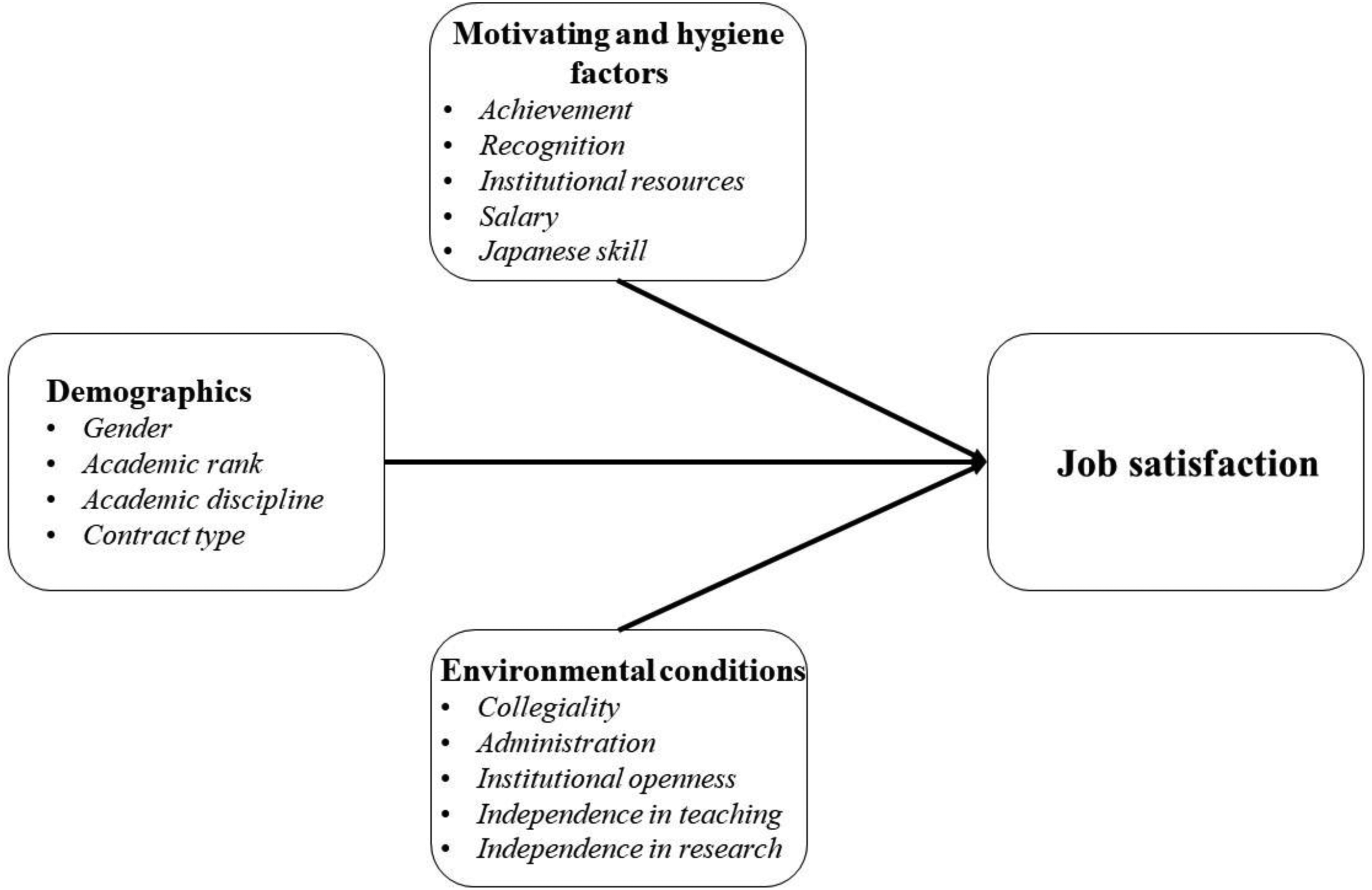
Conceptual framework for investigating the predictors of job satisfaction.
Variables and measures.
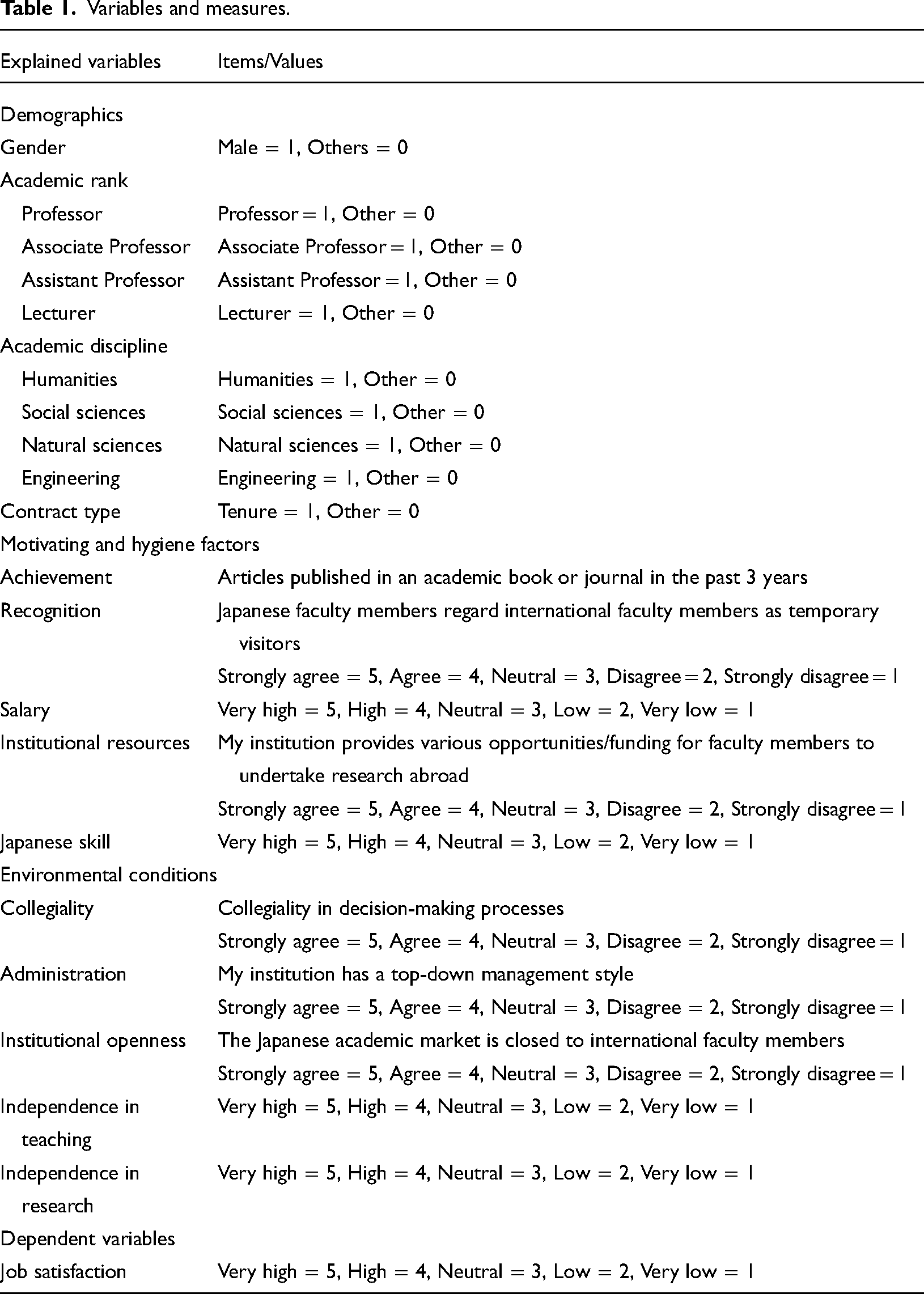
Parameter
In terms of the definition of international faculty in this study, we apply a definition used in previous research (Huang, 2018a, 2018b) and define an international faculty member as a full-time employee at a Japanese university who reported their nationality as non-Japanese and obtained their bachelor's degree outside of Japan. These three criteria eliminate part-time employees and those who obtained their bachelor's degrees in Japan even though they were foreign passport holders.
Data resource
The data used in this study were taken from a representative comprehensive national survey of international faculty working at Japanese universities in all fields. This survey was conducted by the first author from 2016 to 2017. The questions were concerned with international faculty's demographic information, work situation, and perceptions of the governance and administration of their affiliations.
The data collection process for this study involved a multistage approach to identify and survey international faculty at Japanese universities. The study began by examining websites and publicly available sources related to approximately 180,000 full-time faculty at all Japanese universities from October 2016 to the end of March 2017. Profiles of 5,351 faculty members who appeared, based on name, to be of international origin were gathered during this initial stage. In late June 2017, a list of the target group was compiled based on the gathered information. A total of 5,351 paper questionnaires, prepared in both English and Japanese, were sent out to the identified international faculty. After April 1, 2017, it was discovered that approximately 1,300 individuals from the target group were not suitable for the survey. Reasons included retirement, naturalization as Japanese citizens, and mistaken identification as international faculty. By the end of August 2017, these ineligible participants were excluded from the target population. A total of 1,285 valid responses were received from the remaining pool of 4,076 international faculty, resulting in a response rate of 31.5%. Subsequent analysis of the returned responses led to further exclusions based on specific criteria. For example, individuals born in Japan and educated in Japan from pre-school through to doctoral programs were treated differently from other international faculty who came to Japan at later stages of life. The multistage process allowed for a careful selection of the survey participants, ensuring that the sample accurately represented international faculty at Japanese universities. We aimed to capture a diverse group while also recognizing and addressing specific characteristics that could influence job satisfaction (Huang, 2018b). Even though there isn’t a formal written consent form from each survey participant, the survey kicks off with a straightforward introduction on the top of our questionnaire, which clearly outlines the purpose of the projects and emphasizes that completing the questionnaire implies giving consent to take part in the survey.
Findings
The findings of this study are provided in three main sections, comprising the descriptive analysis of Chinese/Korean faculty and American/British faculty, ANOVA analysis of their perceptions, and, finally, the regression analysis of the predictors of their job satisfaction. The first two sections are established primarily to provide a better understanding of the characteristics of Chinese/Korean faculty and American/British faculty, respectively. The third section is concerned with the exploration of the predictors of job satisfaction.
Descriptive analysis
The descriptive and inferential statistics of the valid respondents from the Chinese/Korean faculty and American/British faculty group are shown in Table 2. In the case of Chinese/Korean faculty, 65.3% were male and 33.7% were female. Regarding academic ranks, most Chinese/Korean faculty were hired as professors (41.2%), followed by associate professors (26.7%), assistant professors (22.6%), and lecturers (8.4%). Regarding the distribution of international faculty by academic discipline, there was no big difference between the number of those hired in the humanities (24.9%), social sciences (28.4%), natural sciences (23.3%), and engineering (23.5%). The data analysis shows that over two-thirds of the international faculty (67.9%) were tenured.
Descriptive data analysis.
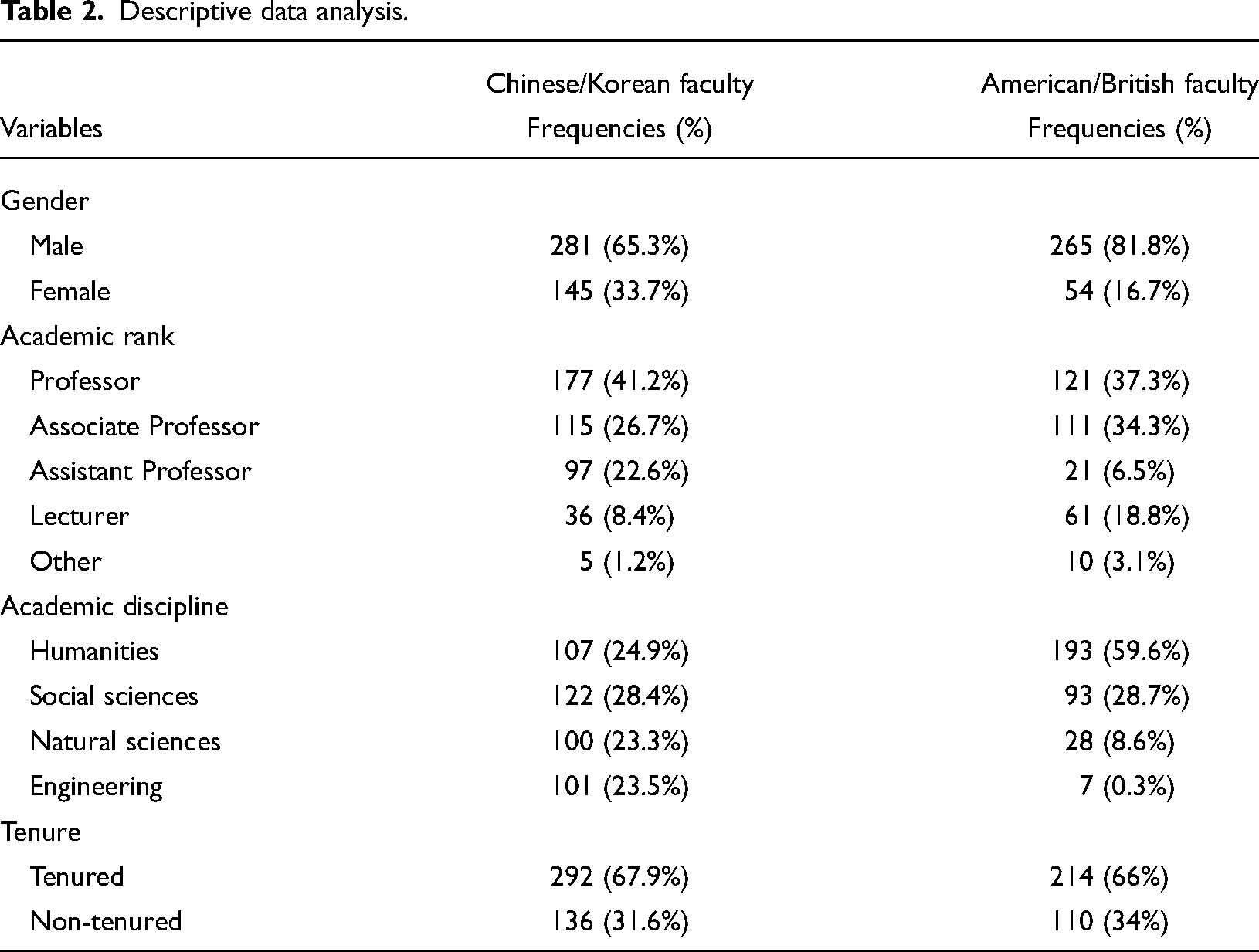
In contrast, most American/British faculty at Japanese universities were male (81.8%). Among these faculty members, 37.3% and 34.3% were hired as professors and associate professors, respectively; notably, there is no significant difference in these numbers. However, regarding their academic disciplines, the majority of them were in the humanities (59.6%) and social sciences (28.7%), followed by the natural sciences (8.6%) and engineering (0.3%). Likewise, approximately two-thirds of them were tenured (66%).
In summary, although the proportions of Chinese/Korean and American/British faculty employed on a tenured contract were similar, Chinese/Korean faculty were more likely to be women and occupy senior professor positions at Japanese universities. They were evenly distributed across the disciplines of the humanities, social sciences, natural sciences, and engineering. Meanwhile, most American/British faculty were men, were mainly affiliated with the humanities and social sciences, and held mid- to high-level academic positions as associate professors and professors.
ANOVA analysis
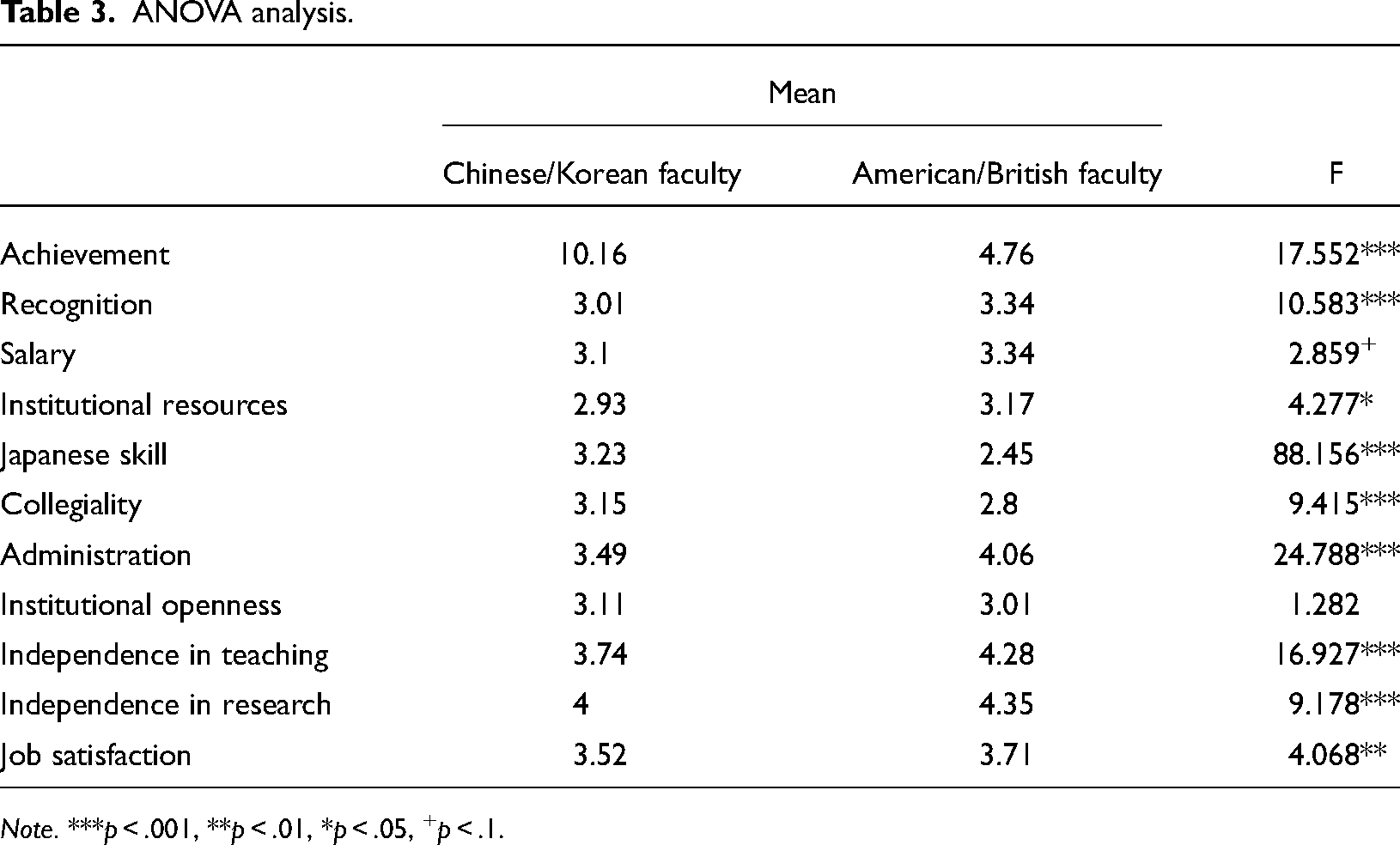
The second section reports the analysis of the variances of international faculty variables in the dimensions of motivating and hygiene factors and environmental conditions. It aims to provide a better understanding of Chinese/Korean and American/British faculty's perceptions of their work and affiliations. The results are detailed below and presented in Table 3.
ANOVA analysis.
Note. ***p < .001, **p < .01, *p < .05, +p < .1.
The statistical analysis illustrates that except for the perceptions on institutional openness, differences can be identified between Chinese/Korean faculty and American/British faculty. As shown in Table 3, Chinese/Korean faculty tend to produce more academic achievement (F = 17.552; p < .001) and thus perceive higher collegiality (F = 9.415; p < .001) than American/British faculty. In addition, their recognition mean (F = 10.583; p < .001) is statistically lower than that of American/British faculty, implying that they are not as likely to perceive themselves as temporary visitors at their institutions. Moreover, a higher level of Japanese proficiency can be observed among them (F = 88.156; p < .001).
In the case of American/British faculty, the data analysis suggests that they are more likely to have better perceptions of their tangible working conditions at Japanese universities, including institutional resources (F = 4.277; p < .05) and academic freedom in both teaching (F = 16.927; p < .001) and research (F = 9.178; p < .001). Surprisingly, weak evidence suggests that American/British faculty tend to rate their salaries more highly (F = 2.859; p < .1); consequently, they tend to express a higher level of job satisfaction (F = 4.068; p < .01) despite also more commonly perceiving Japanese universities as having a top-down administrative style (F = 24.788; p < .001).
Statistically significant differences were found between Chinese/Korean faculty and American/British faculty. In summary, owing to the higher scientific contribution and Japanese language proficiency of Chinese/Korean faculty, they are more likely to be recognized and to get involved in the institutional management and decision-making process at Japanese universities. However, their engagement does not apparently contribute to better perceptions of their working conditions, such as their salary, institutional resources, and academic freedom. Consequently, they tend to express lower job satisfaction than American/British faculty. As for American/British faculty, despite their perceptual absence in university management and administration owing to their disadvantages in scientific productivity and Japanese proficiency, they are more inclined to be satisfied with their working conditions (e.g., salary, institutional resources, and academic freedom), which leads to higher job satisfaction.
Regression analysis
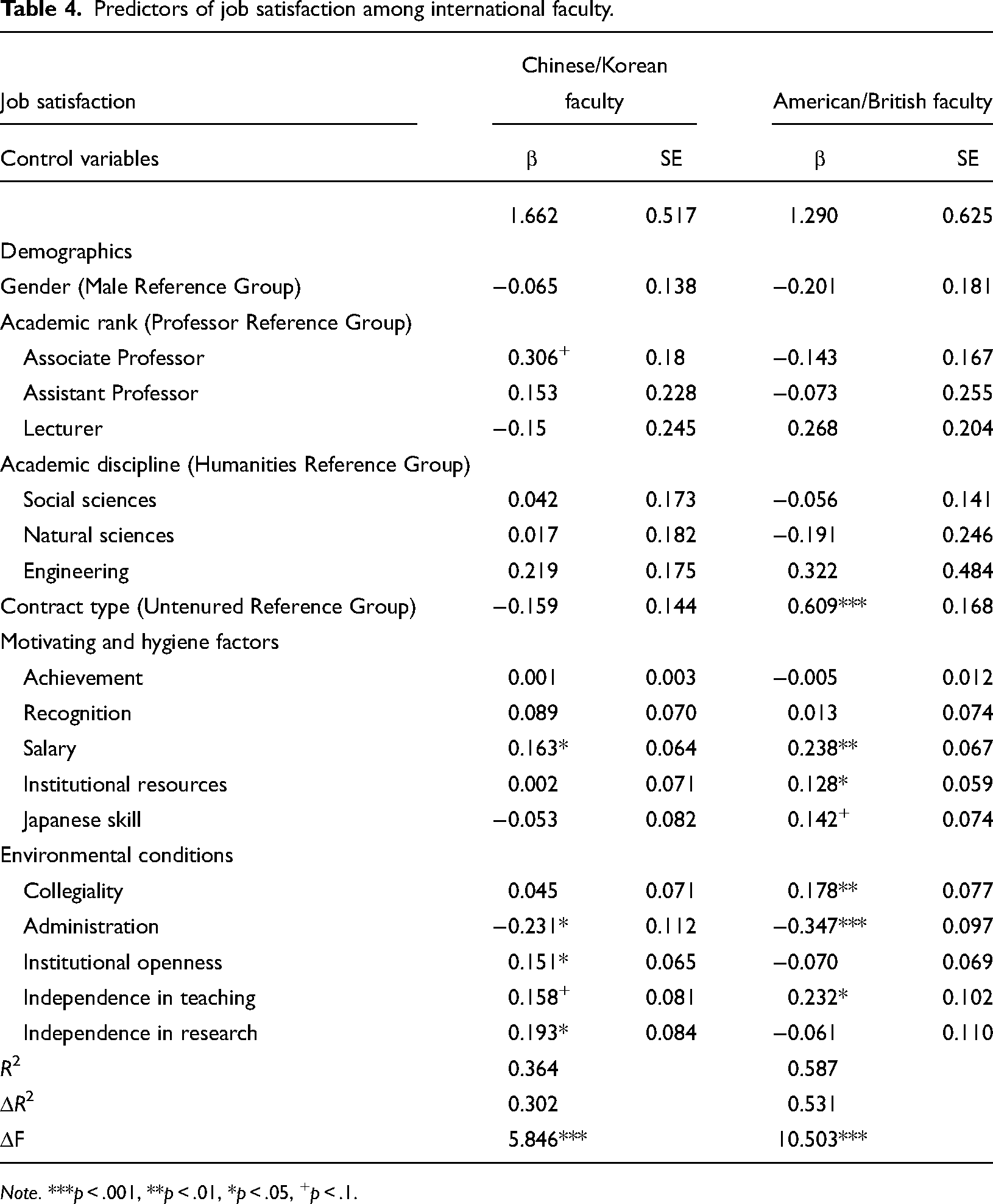
In the third section, linear regression is applied as it is mainly used to predict the value of dependent variables. The regression analysis was conducted using a comprehensive model with all of the potential factors to explore the predictors of job satisfaction among international faculty. The results are provided in Table 4. The predictors of job satisfaction among Chinese/Korean faculty were investigated. The model predicted a 30.2% variance in job satisfaction for Chinese/Korean faculty, with an F value of 5.846, sig. F < 0.001. The data analysis indicates that compared with Chinese/Korean professors, associate professors (β = 0.306, p < .1) are more likely to be satisfied with their overall employment at Japanese universities. In addition, we found that the general environmental conditions, especially administration (β = −0.231, p < .05), independence in research (β = 0.193, p < .05), independence in teaching (β = 0.158, p < .1), and institutional openness (β = 0.151, p < .05), are positively correlated to the job satisfaction of Chinese/Korean faculty. This implies that Chinese/Korean faculty in more autonomous and open-minded Japanese universities tend to have higher job satisfaction. Higher perceived levels of academic freedom in research and teaching activities are more likely to lead to higher levels of job satisfaction.
Predictors of job satisfaction among international faculty.
Note. ***p < .001, **p < .01, *p < .05, +p < .1.
In the case of American/British faculty, the comprehensive regression model explained 53.1% of the variance in job satisfaction, with an F value of 10.503, sig. F < 0.001. The results indicate that American/British faculty holding a tenured position (β = 0.609, p < .001) tend to have higher job satisfaction. Similar to Chinese/Korean faculty, more hierarchical institutional designs (β = −0.347, p < .001) are statistically significant and negatively related to their job satisfaction. However, unlike the job satisfaction of Chinese/Korean faculty (who are concerned with academic freedom in both teaching and research activities), the job satisfaction of American/British faculty is only positively associated with their independence in teaching (β = 0.232, p < .005). In addition, working conditions—specifically, salary (β = 0.238, p < .01) and institutional resources (β = 0.128, p < .05)—positively impact their job satisfaction. Moreover, their involvement in the institutional decision-making process (β = 0.178, p < .01) also contributes to higher job satisfaction. Finally, those with stronger Japanese skills (β = 0.142, p < .1) tend to express higher job satisfaction.
In summary, except for the finding that the academic rank of associate professor was linked to higher job satisfaction (although this was supported only by weak evidence), the main predictors of job satisfaction among Chinese/Korean faculty are environmental conditions, including university administration, academic freedom, and institutional openness. Meanwhile, the main predictors of job satisfaction among American/British faculty are similar to those among Chinese/Korean faculty in terms of environmental conditions, such as university administration; however, the significant influence of contract types and salary perceptions among American/British faculty cannot be underestimated. Additionally, their concerns with independence in teaching and Japanese skills are also statistically significant.
Conclusions and discussion
Given the rapid growth in the number of international faculty at Japanese universities and the close links between job satisfaction and student satisfaction, academic performance, working environment, and faculty retention, this study undertook the first attempt to explore the predictors of job satisfaction among Chinese/Korean faculty and American/British faculty at Japanese universities based on comprehensive data from a national survey in Japan. Specifically, the data analysis investigated differences in their demographics, professional situations, and perceptions to explore the predictors of their job satisfaction at Japanese universities. The key findings were summarized and discussed subsequently.
Regarding the demographic and professional differences between Chinese/Korean faculty and American/British faculty, the research findings indicate that Chinese/Korean faculty tend to be evenly distributed across all the disciplines and hold senior professor positions. They are also more likely to have higher scientific achievement and Japanese language proficiency, contributing to their better recognition and engagement at Japanese universities. Meanwhile, American/British faculty are mainly hired in the humanities and social sciences at mid- to high-level positions as associate professors and professors. They tend to have comparatively lower Japanese proficiency and scientific achievement, leading to their perceived lower recognition and participation at Japanese universities, echoing existing evidence (Horta & Yonezawa, 2013; Huang, 2018b). This is possibly because Chinese/Korean faculty tend to have a similar cultural background to Japanese faculty and tend to be educated at Japanese universities, which informs both their Japanese language proficiency and domestic knowledge of local culture. In addition, their main orientation in research activities helps improve their scientific visibility. Consequently, their professional advantages and cultural knowledge contribute to their higher academic positions and engagement at their affiliations, as suggested by a recent study (Chen, 2022a). Meanwhile, American/British faculty are comparatively more culturally distant from Japanese faculty; this may be because few of them have obtained their educational degrees at Japanese universities (Huang, 2018b), which may explain their relatively low level of Japanese language skills. In addition, many of them are hired as language teachers at Japanese universities with massive teaching workloads, which significantly restricts their professional development. Undoubtedly, these disadvantages make it difficult for them to be well-recognized at and integrate into Japanese universities (Chen, 2022a).
Given the acknowledged demographic and professional background, however, the study surprisingly suggests that compared with Chinese/Korean faculty, American/British faculty tend to have better perceptions of working conditions at Japanese universities, including salary, institutional resources, and academic freedom in teaching and research activities, and express higher job satisfaction. This can probably be attributed to the fact that, as aforementioned, the majority of American/British faculty are engaged in language teaching and tend to recognize their disadvantages in professional development at Japanese universities, which make them more likely to be satisfied with their positions and current social life in Japan (Yonezawa et al., 2014). Alternatively, another explanation may be that many Chinese/Korean faculty are affiliated with national/public universities, where academic competition is increasing while management expenses and grants are decreasing every year. Given a lack of research funding and enormous academic pressure, it is inevitable that Chinese/Korean faculty express lower satisfaction with their positions and working conditions at Japanese universities, echoing existing evidence (Castellacci & Viñas-Bardolet, 2021; Lee, 2021).
As for the factors predicting job satisfaction at Japanese universities, the data analysis suggests that job satisfaction among Chinese/Korean faculty is more likely to be influenced by intangible factors within their institutional environments, such as university administration, institutional openness, and academic freedom in research activities. This is probably because they are likely more concerned as research-oriented faculty about the possibilities of their career development, which is largely impacted by their host environment, including its openness and the degree of research freedom allowed by their institutions. Meanwhile, the job satisfaction of American/British faculty was found to be predicted by various factors, including intangible factors, such as their participation in university management and independence in teaching, and tangible factors, such as their contract type, salary, and institutional resources. This is probably because American/British faculty are in an extremely disadvantageous situation at Japanese universities. Therefore, in addition to the predictors influencing their professional development also experienced by Chinese/Korean faculty, they are also concerned about more pragmatic issues related to staying in Japan. Thus, tangible factors, such as position stability, teaching independence, and salary and funding amounts, were also found to significantly impact their job satisfaction. This is consistent with a recent study (Chen & Chen, 2023) on the concerns of job-hunting language teachers in Japan.
In terms of implications, this study revealed significant demographic and professional differences between Chinese/Korean and American/British faculty. Chinese/Korean faculty, who are more evenly distributed across disciplines and who hold higher academic positions, show a stronger focus on intangible factors, such as university administration, institutional openness, and academic freedom in research. This emphasis suggests a concern for career development influenced by the host environment.
Surprisingly, although American/British faculty face disadvantages, such as lower Japanese proficiency and scientific achievement, they tend to have better perceptions of their working conditions, possibly because many of them are engaged in language teaching and recognize their limitations in professional development. Their job satisfaction is influenced by a broader range of factors, including tangible elements, such as contract type, salary, and institutional resources, indicating that they are focused on pragmatic concerns associated with staying in Japan.
In light of these findings, we acknowledge the need for nuanced and tailored support systems for international faculty in Japanese universities. The implications extend to fostering a more open organizational culture within Japanese institutions, emphasizing the importance of administration, openness, and research freedom. Recognizing the diversity in factors influencing job satisfaction based on demographic backgrounds, we underscore the necessity of a flexible support system that can enhance the satisfaction and retention of international faculty.
The study contributes novel insights to the existing literature on job satisfaction among international faculty, especially within the unique context of Japanese universities. We believe these findings offer a foundation for further research and strategic initiatives aimed at creating a more inclusive and supportive environment for international faculty.
There are also some limitations to the study. First, it is imperative to acknowledge the constraints imposed by the grouping method employed in this study. Our investigation delves into discerning variances in the determinants of job satisfaction among international faculty based on their nationality and role construction within Japanese universities. However, this approach restricts the depth of comprehension and the diversity encapsulated within the realm of international faculty at Japanese universities. The variations among these faculty members, encompassing educational and sociocultural backgrounds, contribute to disparate experiences in cross-cultural adjustment in Japan and consequently influence their job satisfaction. Regrettably, the current research scope did not allow for a more granular examination of these distinctive features of international faculty.
Second, the study's exclusive reliance on a quantitative approach to explore job satisfaction while treating it as a subjective variable poses an inherent limitation. As Freeman (1977) highlighted, satisfaction is subjective and can be perceived differently by individuals. To gain a more comprehensive understanding of job satisfaction among international faculty and unveil factors potentially overlooked by the existing variables, it is recommended to complement the quantitative approach with a qualitative methodology.
Finally, despite recognizing the significance of gender-related concerns in our research context, owing to the constraints of the existing data and the outlined limitations in our study, a more detailed analysis of gender differences within the current scope is not feasible.
Footnotes
Acknowledgment
The authors would like to express their thanks to the Japan Society for the Promotion of Science for providing funding for the article.
Contributorship
Futao Huang and Lilan Chen conceived the research idea together. Huang collected the survey data and wrote the “Introduction” and “International faculty in the Japanese context” sections of the manuscript. Chen wrote the rest of the manuscript. The two authors revised the manuscript together.
Declaration of conflicting interests
The authors declared no potential conflicts of interest with respect to the research, authorship, and/or publication of this article.
Ethical statement
The IRB number of this study is 2021承 005. The study was conducted according to the ethical standards formulated by the Japan Society for the Promotion of Science.
Funding
The authors disclosed receipt of the following financial support for the research, authorship, and/or publication of this article: This article was funded by the Japan Society for the Promotion of Science (Project “A Study of International Academics’ Recruitment in the International and Comparative Perspectives,” 2015–2019, project code 15H05200).
