



Abstract
Keywords
Introduction
Argument skills are fundamental intellectual skills implicated in a variety of higher-order intellectual practices characteristic of the 21st century such as critical thinking (Kuhn, 2018), scientific inquiry (Kuhn, 2010), knowledge construction (Iordanou et al., 2019), and belief revision (Kuhn et al., 2020). The latest educational policies and curriculum standards in multiple countries have recognized the importance of argumentative competence by identifying it as a major objective of elementary and secondary school education. For example, the Common Core Standards Initiative (2010) and the new Next Generation Science Standards of the United States (2013) identified argumentation as the key to cultivating the critical skills they feature. Studies on argumentation as a tool for reasoning can be traced back to Socrates and Plato. Scholars have advanced the development of dialogue theory as a foundation for the analysis and evaluation of argumentation (Billig, 1996; Walton, 2007). Since the 1980s, psychology researchers have begun to explore the manifestations and implications of argumentation in individuals’ everyday reasoning and decision-making processes (Kuhn, 1991, 1993; Weinstock & Cronin, 2003). The past two decades have witnessed the proliferation of educational and psychological research into the development of argumentative competencies of students, the goal of which is to prepare them for the challenges and opportunities of the 21st century.
Dr. Deanna Kuhn works as a professor in the Human Development Department at Teachers College, Columbia University. As a developmental psychologist, she was a pioneer in introducing argumentation into educational research and practice, with the goal of using argumentation to promote and assess students’ thinking and learning skills. In the past three decades, she and her team have conducted extensive research to understand the nature, developmental path, and implications of argumentative competence in both formal (e.g., courtrooms) and informal (e.g., people's everyday decision-making) settings. This interview focused on one major area of her research—the dialogic argumentation method—as an effective tool to cultivate students’ argumentative competence. This method features students’ sustained and purposeful engagement in argumentation with peers on a series of content-rich, social, or social-scientific topics (for details of this approach, see Kuhn et al., 2016, 2017). Thus, the dialogic argumentation method is experiential in its pedagogical emphasis, contrary to approaches that emphasize explicit instructions of higher-order thinking skills (Kuhn et al., 2013). Methodologically, the dialogic argumentation method follows the microgenetic research paradigm, which closely monitors and assesses changes that individuals go through over a period of dense practices (Kuhn, 1995). Implementation of the dialogic argumentation method has been documented with considerable success in many countries, including the United States, China, Singapore, Cyprus, and Brazil. This has resulted in positive changes in students’ collaborative and individual argumentative competencies, manifested in their enhanced use of counterarguments (Crowell & Kuhn, 2014; Shi, 2020), evidence (Kuhn & Crowell, 2011; Shi, 2020), and increased meta-level understanding and regulatory skills (Kuhn et al., 2013).
Against the backdrop of the newly developed New Curriculum Standards of China (Ministry of Education of the People's Republic of China, 2022), we believe that cultivating argumentative competencies in Chinese elementary and secondary students holds great promise in helping achieve the goals outlined in the Standards (Shi, 2022). To achieve this goal, we need an accurate and up-to-date understanding of the nature of argumentative competence, methods to precisely identify and assess it in various contexts, and approaches to best support its development in students. To address these issues, we had a conversation with Dr. Deanna Kuhn at Columbia University in New York, hoping that her insights could inform practitioners and future researchers on these critical questions and support the implementation of argument-based curricula in elementary and secondary school classrooms. The following content was organized based on our conversation with Dr. Deanna Kuhn who has reviewed and consented in writing to share this work for publication.
Developing argumentative competence is a key education objective of the 21st century
The development of argumentative competencies is a social process that requires sustained engagement with peers in a supportive environment that calls for and encourages the practice of such skills (Kuhn, 2019). The dialogic argumentation that students engage with is framed as adversarial with the purpose of convincing the other side of the merits of one's favored position. This adversarial form of argumentation is chosen (as opposed to the coalescent form) because it makes the alternative opinions clear and vivid, and thus allows students to recognize the purposes and values and then apply, develop, and refine their skills of counterarguments and justifications. Once the relevant skills and values are consolidated, students can proceed to engage with coalescent argumentation, which derives its value as a critical knowledge-building activity of scientists and is more challenging for adolescents.
Another feature of the dialogic argumentation approach is its emphasis on students’ reflections on the processes of their discourse rather than its content. Throughout the intervention process, various self-directed and teacher-supported reflective activities are provided for students, such as completing reflection exercises regarding their own and opponents’ arguments and teacher-guided whole-class debrief regarding earlier one-on-one or two-on-two dialogues with a rotating series of partners. The purpose of these reflections is to promote students’ meta-level development, specifically meta-level awareness and regulation of their discourse processes (Kuhn et al., 2013). With time, students’ meta-talk regarding the discourse process becomes more sustained and reciprocal (Shi, 2020). This evolution reflects the formation of norms for what moves are acceptable and how claims should be supported and challenged. These norms are shared by students as members of an intellectual community, who seek to regulate each other's behaviors by calling out unacceptable moves and/or off-topic utterances. In this process, students increasingly hold their own and their opponents’ arguments accountable. What also develops is an appreciation of the values of argumentation and disposition to practice it, even when the instructional contexts are withdrawn.
Finally, the assessment of argumentative competence should be situated within the dialogic context. We draw insights from Walton's contemporary philosophical work on dialogue theory to inform our analysis of argumentation, although the tradition of a dialogic approach to thinking and reasoning can be traced back to Socrates and Plato. According to Walton (2007), an argument should be evaluated on the basis of its collaborative value as a contribution to dialogue. He identified two goals of argumentation: to secure commitment from the other, which can be used to strengthen one's own argument, and to undermine the opponent's position by identifying and challenging the weaknesses of his or her argument. Both emphasize the importance of addressing the other side in the argumentation. Accordingly, students’ abilities to construct counterarguments are a critical indicator of argumentative competence.
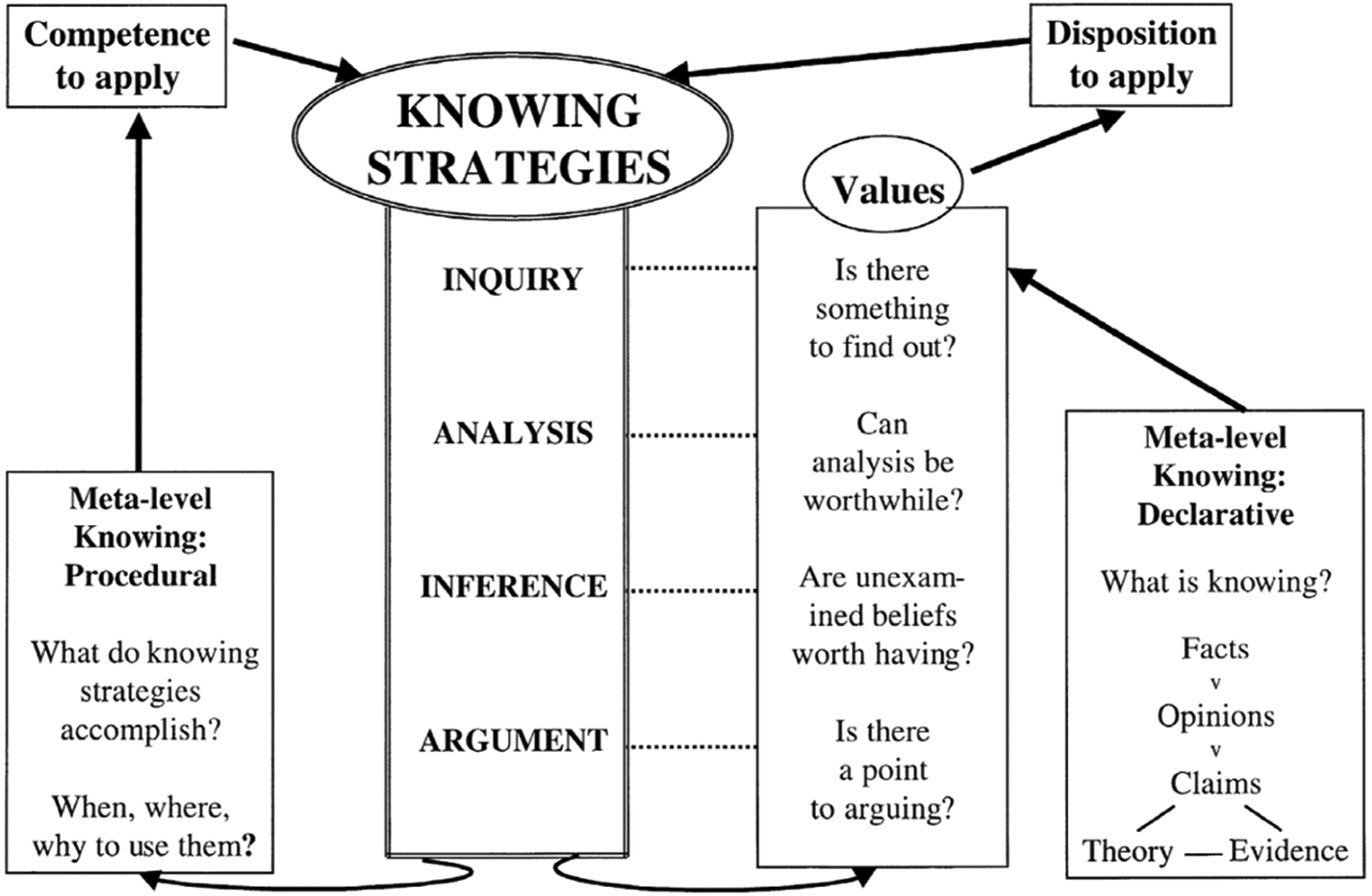
Integrative view of knowledge-seeking strategies (Kuhn, 2001, 2010, 2022).
Dialogic argumentation is a fruitful pathway to developing skills
Our approach is experiential in its pedagogical emphasis as opposed to the explicit instruction of strategies adopted by other approaches as a means of promoting cognitive development. Rather, we focus on engagement and guided practices as the primary means to support the development of skills, dispositions, and values that guarantee students’ sustained efforts to apply and refine their skills. By means of goal-directed and sustained engagement with argumentation within supportive environments, we seek to achieve the purposes of both “arguing to learn” and “learning to argue,” that are the knowledge and strategy goals of learning (Iordanou et al., 2019), and to integrate developments at both the cognitive and metacognitive levels (Kuhn, 2022).
This approach is also a form of guided learning that features implicit scaffolding at the meta-level. The activities students engage in are not intuitive or randomly chosen; rather, they are carefully designed and sequenced, with each of them targeting specific cognitive goals that we want to address (Kuhn, 2010). For example, small-group discussions among same-side students precede and follow peer-to-peer argumentations to promote the generation and evaluation of and reflections on reasons and evidence. The individual essay writing tasks at the end of each topic circle provide additional practice for transitioning skills gained from collaborative contexts to individual minds.
Teachers are also a significant source of meta-level stimulation. Their significance plays out in three respects. First, teachers are critical in creating and maintaining a facilitative environment where the values of argumentation are made salient to students. The goal is to promote such a climate for students to believe that they have something worth saying, and their peers have something worth listening to and learning from. If off-track moves are detected, teachers can use subtle meta-nudges to remind students of the topic they are supposed to discuss or the goals of their activities. For example, they can ask “Is this relevant to the topic?” or “What do you want to achieve by saying this?” Next, teachers help promote students’ reflections on their own and others’ argumentative reasoning by asking facilitative questions at appropriate times during student dialogues as well as in the debriefing sessions. For example, teachers can guide students to evaluate each other's argumentative moves by focusing on whether their arguments address the other side's immediately preceding arguments and whether their arguments are justified by evidence. One caveat to note is that teachers do not intervene directly in students’ dialogues, but rather seek to solicit desired behaviors from students by questioning their actions. Finally, teachers should encourage students to ask questions relevant to their arguments and assist them in securing answers to their questions. This method for obtaining information has two advantages. On the one hand, and most obviously, the content of students’ dialogues is enriched by the addition of relevant information. On the other hand, since information is presented as answers to questions that students perceive as pertinent to the claims they have made, it has the potential to promote students’ awareness of the values of evidence in relation to arguments and their abilities to coordinate arguments with evidence bearing on their correctness, both of which are critical indicators of skilled argumentation. However, this argument-evidence coordination competence has been found to be challenging for adolescents and even adults to master without being provided with proper meta-level support (Hemberger et al., 2017).
Since the emphasis of teachers’ scaffolding is placed on their implicit prompts to solicit and encourage the desired behaviors of students rather than their explicit interventions, the demands on teachers’ skills and resources to intervene are greatly reduced, making the dialogic argumentation approach more accessible and manageable to less experienced teachers. To become skillful in implementing the dialogic argumentation method, teachers themselves should first and foremost be convinced of the values of argumentation if they are to afford it a place in their classrooms. Teachers should be well-informed about the goals of each stage of the program, the developmental trajectories of relevant skills, and accurate and reliable evaluative methods (Kuhn et al., 2017).
How to effectively assess argumentative competence?
By analyzing the evolution of students’ selections of particular strategies to apply when multiple alternative strategies were simultaneously available to them, we observed that development takes the form of distributional shifts of the frequencies of usage of different strategies. Specifically, over time, through practices and reflections, students resort to more effective strategies more frequently and gradually relinquish the use of less adequate ones (Kuhn et al., 2016, 2017). This pattern of change suggests the importance of metacognition in driving developmental change. The more formidable challenge in the process of development, it appears, is not learning new strategies but letting go of older ones that are more familiar and appealing, but less effective. Thus, one major implication of microgenetic research is that, to invoke developmental changes, we must shift our attention from focusing exclusively on the teaching of new strategies to induce students’ meta-level reflections of their selections and executions of various strategies. They not only need to know how but also should be aware of why and when to use particular strategies.
Another influence of microgenetic research is reflected in the growing number of researchers who are mindful of conducting multiple assessments using a variety of methods scheduled over a meaningful period of time. The purpose is to gain a more accurate and comprehensive profile of developmental status and trajectories. For example, if we want to understand students’ masteries of argumentative strategies, a one-shot assessment is very likely to fall short. The specific instrument used as well as other extraneous environmental factors are likely to influence their choices. Only by observing students’ performance over repeated occasions using diverse content can we gain a clearer picture of the range of strategies they possess, and when and where each of them is most likely to be applied. Previously, variances in students’ selection of strategies in response to different tasks tended to be explained simply as the result of inconsistent instruments; however, now we begin to recognize that part, if not most of the variances also have roots that are at the meta-level. Students’ improved meta-level monitoring and management of various strategies leads to more consistent choices that speak to how development takes place.
A major challenge in the study of argumentative competence lies in the gap between research advances in understanding the nature, development, and real-world applications of such knowledge to support students’ development. This problem is partly due to insufficient communication between researchers and educators regarding what is being developed and what still needs to be developed in terms of argumentative competencies. This issue itself suffers from the lack of an integrated and verified theoretical framework that can account for various manifestations of argumentative competencies across different contexts and subject matters. We must develop a roadmap that clearly describes the developmental trajectories of relevant skills that should also encompass the development of epistemological understanding, intellectual values, and dispositions that reciprocate with advances in skills and thus are integral parts of development (Kuhn, 2018, 2020, 2022). Much work remains to be done to fill the uncharted areas of this roadmap, the absence of which often leaves practitioners shying away from engaging students in classroom argumentative discourses, although they may endorse its values. Completing this work will require investigating the dynamic manifestations of argumentative competence in various contexts and subject matters, as well as extracting universals from them.
Takeaways message
An accurate and up-to-date understanding of the nature, development, and evaluation of argumentative competence is fundamental to promoting K-12 students' higher order intellectual skills as outlined in the New Curriculum Standards of China (2022).
Dr. Deanna Kuhn elaborates on her research findings and theoretical underpinnings regarding her 30 years of research in the field of argumentation that combined educational, psychological, and philosophical perspectives to conduct argumentation studies.
She elaborated on the dialogic framework where an argument is viewed as a social practice, in addition to its being an individual one. Engaging in dialogic argumentation holds great promise for developing students' argumentative competence in classrooms.
She reinforced the importance of an integrated framework to advance both the theoretical and empirical research of argumentation and the related classroom practices and reforms concerning curriculum and evaluation.
Footnotes
Authors’ note
This article has been translated into Chinese and published by Global Education in October 2022, and is now authorized by Global Education to publish the original text.
Contributorship
Yu Song wrote the interview questions, conducted the interview with Dr. Deanna Kuhn, subsequently transcribed the interview, and organized and drafted the main bulk of the paper. Yuchen Shi contributed by identifying the topic and inviting Dr. Deanna Kuhn for interview and reviewing and revising the paper.
Declaration of conflicting interests
The authors declared no potential conflicts of interest with respect to the research, authorship, and/or publication of this article.
Ethical statement
Dr. Deanna Kuhn has reviewed and given written consent to publish this article based on our conversation and there is no conflict of interest involved in this work.
Funding
The authors received no financial support for the research, authorship, and/or publication of this article.
