




Abstract
Purpose
Creativity is highly valued by modern society; however, in China, there is a major challenge in creating school-based curricula or courses that promote students’ creativity. This study introduced an interactive learning format called Collaborative Reasoning (CR). The goal was to investigate whether CR would improve a student's ability to generate creative ideas.
Design/Approach/Methods
The data comprised 474 seventh graders from eight classes in a rural middle school in northern China. The eight classes were randomly assigned to two conditions: Four classes participated in CR discussions, and the remaining four classes were taught via teacher-directed Chinese reading classes. After participating in the CR discussions, students completed a Realistic Presented Problem test that was designed to evaluate their creative performance.
Findings
The results indicated that compared to the control students, CR students generated more effective solutions (fluency) and proposed a greater variety of solutions (flexibility) to three realistic problems. The solutions proposed by the CR students were more unique (novelty) and more useful in real-life situations (usefulness) than those proposed by the control group.
Originality/Value
Providing abundant opportunities for the exchange of ideas in a social context can boost students’ performance in creative problem-solving.
In an increasingly digital world, innovation drives social progress and economic growth (Akarakiri, 1998; Stevens & Burley, 1999). Innovation is closely tied to creativity and the ability to solve complex problems in real life (Amabile & Pratt, 2016). In recent years, policymakers worldwide have strongly advocated for the promotion of students’ key competencies, and creativity has been emphasized in almost every competency framework (Care et al., 2018; European Union, 2018; Ministry of Education of the People's Republic of China, 2018; OECD, 2013; Shi et al., 2016). In 2019, the State Council of China issued a document on deepening educational reform and improving the quality of elementary and secondary education. This document recommends that schools adopt a student-centered learning format to promote key competencies such as creativity (State Council of China, 2019).
Although the importance of teaching creativity in primary and secondary schools is widely accepted by educators and policymakers (Hu et al., 2013; Renzulli & Callahan, 1975; Renzulli & Reis, 1997; Treffinger et al., 2012), there is still a considerable challenge in creating school-based curricula or courses that promote students’ creativity in China. One main reason for this is that Chinese secondary school students are constantly under pressure to perform well on high-stakes exams, especially in poor and underserved communities where educational resources are scarce (Niu & Sternberg, 2003; Zhou & Zhang, 2014).
In the past two decades, educators have documented the prevalence of super schools in low-socioeconomic districts in China. A super school refers to a middle or high school that has a large student enrollment and adopts a pacesetting management style of schooling (Tian et al., 2016). There are ongoing controversies about super schools; however, parents and teachers support this military-style schooling because it produces satisfactory academic results and helps students from low-income families to attend college, which can be a life-changing experience, especially for students from rural areas (Guo et al., 2021; Roberts & Hannum, 2018).
Most superschools employ lecture-based instructional formats that focus on knowledge transmission and the delivery of a fixed body of learning content (Yang, 2007). Teachers are seen as providers of knowledge, and students are regarded as receivers of knowledge. Teachers adhere to a strictly arranged instructional plan to impart knowledge that students must follow. Students acquire knowledge from listening to teachers’ lectures and reinforce their knowledge acquisition through reading texts, doing exercises, and memorizing key concepts under teachers’ instructions (Wells, 1998; Wu et al., 1999). Students are frequently evaluated through questions, quizzes, and tests to determine whether they meet instructional goals. Those who fail to keep up with the instructional plan are required to extend their study time or attend after-class tutorial sessions.
Research has shown that students who attend super schools have limited opportunities to develop higher-order cognitive skills, such as creativity, because most school work requires students to memorize conceptual knowledge or repeat fixed procedures (Huang et al., 2016). This phenomenon reveals the disconnection between what students are taught at school and the demands of the real world (Hmelo-Silver & DeSimone, 2013; Tissenbaum & Slotta, 2019). The call for nurturing key competencies, especially creativity, urges educational researchers to develop new instructional approaches that can prepare students to creatively construct their understanding of the world and build the competence to solve complex problems in authentic social and professional settings (Graesser et al., 2022; Palincsar, 1998).
To address this challenge, we implemented an instructional intervention in a rural middle school in China to promote students’ creative performance. The instructional approach is called Collaborative Reasoning (CR; Anderson et al., 1998)—an interactive learning format that features peer-led, open-format collaborative discussions. Unlike explicit instruction, which is specifically designed to teach students the “criteria” of being creative or the “tactics” to produce creative ideas (Runco et al., 2005), our intervention created an open environment for students to practice creative thinking through collaborative learning. Our study aimed to investigate whether participating in open-format, student-centered collaborative discussions would improve students’ ability to generate creative ideas.
Background
The challenge of cultivating creativity in the classroom
According to Plucker et al. (2004), “creativity is the interaction among aptitude, process, and environment by which an individual or group produces a perceptible product that is both novel and useful as defined within a social context” (p. 90). Novelty and usefulness are two key features of creativity in the standard definition—if a product or an idea is considered to be creative, it means that it is both new (original, novel) and useful (effective, appropriate) (Runco & Jaeger, 2012).
Based on this definition, since the 1970s, numerous attempts have been made in the United States (U.S.) to teach students the criteria of creativity or strategies to improve their creative thinking skills (Renzulli & Callahan, 1975). These courses have developed, expanded, and improved over time. The United States Patent and Trademark Office lists approximately 25 courses designed to promote creative thinking—which in total provide hundreds of different activities (United States Patent and Trademark Office, 1990). Creativity training courses have also been integrated into school education in many countries, an example of which is the Schoolwide Enrichment Model (Reis & Peters, 2021; Renzulli & Reis, 1997). Under this model, schools implement a “creativity weekend” or “creativity workshop” in their supplementary education programs; these enable students to engage in creative activities or visit art galleries and museums after school (Cropley, 2011). Scott et al. (2004) conducted a meta-analysis of 70 empirical studies that examined the effectiveness of creativity training and concluded that “well-designed creativity training programs typically induce gains in performance with these effects generalizing across criteria, settings, and target populations” (p. 361).
In contrast, in China, only a limited number of empirical studies have developed evidence-based creativity training programs and examined their effectiveness in the classroom. One representative example is the “Learn to Think” program, which centers on developing children's critical and creative thinking abilities (Hu & Yun, 2006). This program focuses on four aspects of thinking: profundity, flexibility, originality, and agility (Hu et al., 2011). From 2003 to 2013, more than 200,000 Chinese students participated in the “Learn to Think” program, showing significant growth in thinking skills, creativity, academic performance, learning motivation, and self-efficacy (Hu et al., 2013).
Although research and educational practices have indicated that creativity training effectively improves students’ creative performance, teachers face constant challenges when attempting to foster creative performance in class. First, teachers are reluctant to incorporate creativity training into the regular curriculum because their priority is to deliver content knowledge (Beghetto, 2007; Cropley, 2011). Second, outside-the-box thinking tends to be less advocated in middle school classes because it is likely to create unexpected classroom management issues (Amabile, 1998; Sternberg & Lubart, 1995); this is particularly evident in China, where the traditional culture maintains a relatively negative attitude toward rule-breaking behaviors (Niu & Sternberg, 2003). Hence, there is an urgent need to develop learning formats that cultivate students’ creativity and are simultaneously adaptable to the current education system in China.
Collaborative Reasoning: A promising intervention to promote creativity
Sociocultural theory views cognitive development as a process of internalizing social and cultural practices (Vygotsky, 1978). Through social interaction, students form a structural understanding of the world and transfer the context-specific knowledge they have acquired in school to solve context-independent problems in real life (Pellegrino & Hilton, 2013). In a recent review by Kupers et al. (2019), the development of creativity is considered “a complex dynamic system” (p. 96). Kupers et al. (2019) argue that “the primary process is the emergence of novelty from moment to moment” and that “this process of emergence happens over time through continuous interactions between the individual and the environment” (p. 101). Similarly, Csikszentmihalyi (2014) argues that creativity is the product of interaction between the individual, the field of action, and the environment in which the action occurs. From this point of view, creativity is likely to emerge from social environments that provide ample opportunities for children to constantly exchange viewpoints and foster their openness to experience (Jauk et al., 2014).
In the present study, we introduce the CR approach to discussion, which creates an open environment for individuals to exchange thoughts and ideas with their peers. CR was first proposed as a literature-based reading program aimed at promoting children's critical reading and higher-order thinking skills. In traditional reading classes, teachers encourage students to take an efferent stance and focus on the teacher's interpretation of the story characters’ behaviors, feelings, and experiences (Rosenblatt, 1989). CR creates an open atmosphere for students to analyze and evaluate story characters’ behaviors and predict the possible outcomes of such behavior (Waggoner et al., 1995). Instead of the teacher guiding students to locate relevant information in the text, students form heterogeneous groups to engage in a peer-led, free-participating group discussion and deal with a central question that usually contains a controversy or moral dilemma.
CR emphasizes the expression of personal thoughts, the exchange of different viewpoints, peer collaboration, and reflection on one's performance as well as on others’ performance. During the discussion, children present their initial position to the whole group, provide reasons to support that position, look for evidence from the text or personal experience to justify the reasons, and challenge each other's arguments when the assumption is unwarranted, or the other side of an argument is left undeveloped (Anderson et al., 1998). A successful CR discussion relies on collaboration between teachers and students. On the one hand, teachers release the control of interpretation, turn-taking, topic, and content learning to students (Chinn et al., 2001). Students, on the other hand, take responsibility for managing the discussion and articulating their thoughts.
To date, CR has been implemented in several U.S. classrooms (e.g., Chinn et al., 2001; Lin et al., 2022; Zhang et al., 2013) and several Chinese and Korean elementary classrooms (Ding et al., 2016; Dong et al., 2008; Sun et al., 2017). A large and growing body of research has demonstrated that CR promotes various higher-order thinking skills across different cultures, including critical thinking, argumentation, causal reasoning, decision-making, and social reasoning (Lin et al., 2022; Ma, Anderson, et al., 2017; Ma, Zhang, et al., 2017; Ma et al., 2023; Morris et al., 2018; Reznitskaya et al., 2007; Zhang et al., 2016; Zheng et al., 2014). However, few studies have examined whether participation in CR discussions improves students’ ability to generate creative ideas.
The effect of CR on improving students’ creative thinking was demonstrated in one study that examined 252 Chinese fifth-graders’ ability to solve a matchstick puzzle after participating in five CR discussions (Sun et al., 2017). The matchstick game was not a creative problem-solving task in the strict sense but was open-ended, and the task required students to try different ways of thinking to find the optimal solution. Students who participated in CR discussions provided better solutions than those who did not participate in such discussions. In addition, compared to the control students, the CR students had a more positive attitude toward the creative problem-solving process and showed higher social and collaborative skills.
Although CR is not specially designed to teach creativity, its advantages in promoting higher-order thinking and reasoning make it a promising intervention. This is clear when we consider it from the perspective of interpersonal support, as students actively engage in classroom activities with their peers, learn how to interact better with others, and expand their understanding through sharing and negotiation (Clark et al., 2003). Students learn to consider both their own position and opposing positions so that they can better defend their argument or challenge the views of others. The polemical nature of the stories provides students with the opportunity to examine central questions from different perspectives (Morris et al., 2023). Perspective-taking is a fundamental skill for generating creative ideas (Chou & Tversky, 2020). Through perspective-taking, students become more curious and open-minded about new ideas and information, which is considered a critical feature of a creative personality (Furnham & Bachtiar, 2008).
Second, from the perspective of instructional support, CR requires that teachers allow students a higher level of autonomy in the classroom. As a result, students have more freedom to perform creative or even outside-the-box thinking without feeling suppressed or neglected by the teacher. During CR discussions, the role of the teacher changes from leader, organizer, and coach to supporter, observer, and facilitator (Chinn et al., 2001). To successfully enable CR discussions, teachers must give students enough freedom to express their own opinions while simultaneously providing them with support as they encounter challenges and problems (Lin et al., 2015). When the teacher's role is adjusted in this manner, the teacher can focus on observing and creating scaffolding to help students develop “mini-c creativity,” which refers to “the novel and personally meaningful interpretation of experiences, actions, and events” (Beghetto & Kaufman, 2007, p. 73). In contrast, in direct instruction, teachers are compelled to respond immediately to students’ answers and adhere to the teaching goals to impart knowledge. A common result is that teachers are often less willing to give positive feedback on students’ deviant answers and unelicited questions.
Finally, from an environmental support perspective, CR builds a safe and supportive environment for the development of a creative personality. Creativity is not just determined by the individual; it is the result of an individual's interaction with the environment (Amabile, 1996). The environment's suppression or encouragement of creativity directly affects the frequency of creative behavior. In CR discussions, students experience an authentic social environment that builds tolerance for uncertainty and failure (Sun et al., 2022). In this environment, students are encouraged to express their thoughts freely, adopt different perspectives, and not be afraid of challenges and risks (Wu et al., 2013). An open and creative atmosphere is likely to stimulate students to open up and unleash their creativity.
The present study
This study implemented a CR-based intervention in a rural super middle school in China. We designed an eight-day curriculum unit as a platform for implementing CR discussions and examined the effects of CR discussions on students’ creative performance. Our rationale was that by providing ample opportunities for students to interact with peers and build on each other's thinking, the classroom becomes a place that commends a creative personality (e.g., openness to experience, tolerance of challenges and disagreements) and encourages students to show creativity (e.g., expressing novel ideas and taking different perspectives).
Specifically, we aimed to answer two research questions:
Is CR discussion more effective than direct instruction for boosting students’ creative performance? In what aspects does CR discussion affect students’ creative performance?
Methods
Participants
The participants were 474 seventh graders recruited from a super middle school in a low-income county in Hebei Province, China. The school provides seventh- through ninth-grade education for students from nearby villages. Students’ academic ability determines their placement in one of 16 classes. Students with higher admission scores in the middle school entrance exam are placed in eight “fast” classes, while students with lower admission scores are placed in eight “slow” classes. The word “fast” or “slow” refers to the speed by which teachers deliver knowledge to students based on their academic ability. In the “slow” classes, teachers usually spend more time presenting new and challenging materials compared to the “fast” classes.
The students in the present sample came from eight mixed classes; 80% of the students came from a “fast” class (the whole class was included), and 20% came from a “slow” class (students who were ranked in the top 10% of their class for academic ability were included). The mixed classes had been formed before our intervention was implemented. Students from the “fast” classes were rarely acquainted with students from the “slow” classes, with a few possible exceptions. Each mixed class had 56–64 students; hence, the classes were larger than regular Chinese classes, which usually had no more than 50 students. Informed consent was obtained from all individual participants included in the study.
We collected students’ demographic information and social characteristics, including gender, ethnicity, age, whether or not the student was a left-behind child, and whether or not the student took a leadership role in class. In China, left-behind children live in rural areas with relatives (e.g., grandparents), while their parents live and work in big cities to make a living (Duan & Zhou, 2005). The leadership role in class mainly included three types: class monitors, commissaries (specialized in learning, sports, arts, science, etc.), and representatives of different subjects (Chinese, English, Mathematics, etc.). The dataset included 204 boys and 270 girls. A hundred and thirty-eight students (29.1%) held leadership positions in their class. Twenty-one students (4.4%) were left-behind children. The average age of all students was 13.4 (SD = 0.7).
Intervention procedure
Four mixed classes (n = 238) were randomly selected to participate in an eight-day classroom intervention featuring the CR approach, while the other four mixed classes (the control; n = 236) took regular Chinese reading classes during the intervention period. Students in each CR class were divided into eight parallel groups (six to eight students in each group) that were balanced in terms of gender, number of leaders, and academic ability. Each group included one or two students from the “slow” classes and four to seven students from the “fast” classes so that every group was a representative sample of the mixed class.
During the intervention, the students took one session a day for eight consecutive days, and each session lasted for one and a half hours. In each session, the discussion group was provided with two-page reading material with a controversial issue to discuss. The first four sessions presented moral dilemma stories to familiarize students with the format of the CR discussion; these included Doctor De Soto (Steig, 1982), What Should Kelly Do (Weiner, 1980), Pine Wood Derby (McNurlen, 1998), and Crystal's Vote (Nguyen-Jahiel, 1996). All the stories were translated into Chinese for students to read. The last four sessions focused on episodes of a continuous storyline about an environmental issue. The story was recomposed from a court debate about people in a village prosecuting a chemical factory. Students had to decide whether the local government should close the chemical factory, which supported the local economy but may have caused pollution in the area.
Students in the control classes did not study the learning materials used in the CR condition, nor did they participate in collaborative discussions. The control students completed the reading tasks according to the teachers’ instructions. The teachers could use some form of whole-class discussion, but small group work was not adopted in the control classes. Apart from the CR sessions, the treatment and control classes had the same course arrangement.
Implementation of CR in the classroom
The instructional intervention reported in this study was a modified version of the CR approach (Ma & Yang, 2021). To facilitate the free expression of personal thoughts and ideas among Chinese students, we arranged teacher-guided individual reading and thinking before the collaborative discussion and strengthened teacher-directed evaluation and reflection after the collaborative discussion. The following section provides a detailed description of the intervention, which involved seven critical instructional steps: independent reading, taking notes, presenting viewpoints, responding to each other, summarizing as a group, evaluating ideas and arguments, and reflecting on discussion performance.
Assessments
The first problem (Task 1) asked students to generate ideas to deal with a deskmate who was talkative and disturbing in class. The second problem (Task 2) asked students to respond to an unexpected incident—a boy who found his bicycle tire was flat when he had 15 min to get to school, but his home was 30 min walking distance from school. The third problem (Task 3) asked students to utilize resources in the classroom to retrieve a badminton shuttlecock that had landed on a tree. Students were asked to provide as many solutions as possible for the three scenarios. They were given 5 min to write down their solutions for each; thus, the problem-solving task took a total of 15 min to complete.
Coding scheme for effective and ineffective solutions.
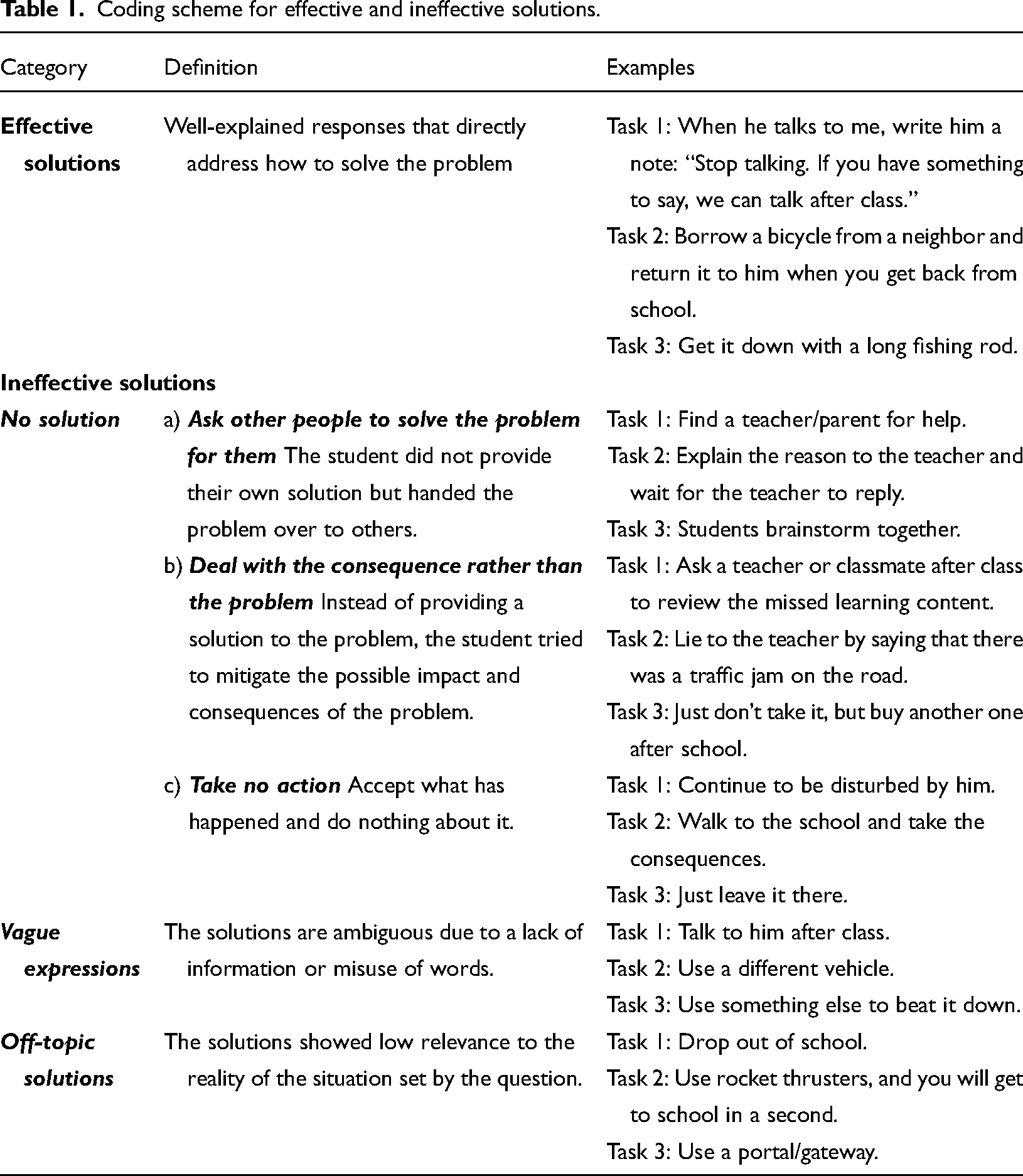
Next, we examined students’ creative performance from four perspectives: fluency, flexibility, novelty, and usefulness. Fluency refers to the total number of effective solutions generated by a student for each problem. To avoid rater bias and fatigue, effective solutions with the same literal meaning were merged into one category. Flexibility refers to the total number of categories (i.e., types) of responses. Novelty was indicated by the number of unusual responses among all the proposed solutions (1 = the frequency of a response type was less than or equal to 10% of the total number of categories; 0 = over 10%). Based on the types of responses, we recruited five graduate students to evaluate the usefulness of each category using the Consensual Assessment Technique (Amabile, 1982); evaluators had high reliability for all three problems (Kappa = 0.84, 0.90, 0.77).
Results
Students’ performance in the pre-intervention assessments
An analysis of variance (ANOVA) was performed with the reading comprehension score as the dependent variable and gender, ability placement (“fast” or “slow”), instructional intervention (CR or control), whether a student was an assigned leader in class, and whether a student was a left-behind child as the fixed effects. The results showed no significant difference between students in the CR and control conditions, F(1, 468) = 0.49, p = .48. However, students from the “fast” classes (M = 37.05, SD = 7.24) scored significantly higher than students from the “slow” classes (M = 33.25, SD = 7.70), F(1, 468) = 24.30, p < .001. Leaders scored significantly higher than non-leaders, F(1, 468) = 8.50, p = .004. No gender difference was found, F(1, 468) = 0.04, p = .84, nor was there a difference between left-behind and regular students, F(1, 468) = 0.07, p = .79.
An ANOVA analysis was performed using the Raven test score as the dependent variable and gender, ability placement (“fast” or “slow”), instructional intervention (CR or control), whether a student was an assigned leader in class, and whether a student was a left-behind child as independent variables. Students from the “fast” classes (M = 53.19, SD = 3.74) performed significantly better in non-verbal reasoning than students from the “slow” classes (M = 50.97, SD = 4.75), F(1, 468) = 25.28, p < .001. Boys (M = 53.26, SD = 4.08) performed better than girls (M = 52.39, SD = 3.98), F(1, 468) = 8.02, p = .005. There were no significant differences in non-verbal reasoning between the CR and control conditions, F(1, 468) = 1.43, p = .23, between leaders and non-leaders, F(1, 468) = 0.14, p = .71, or between students who were and were not left-behind children, F(1, 468) = 0.64, p = .42.
Effect of CR on students’ creative performance
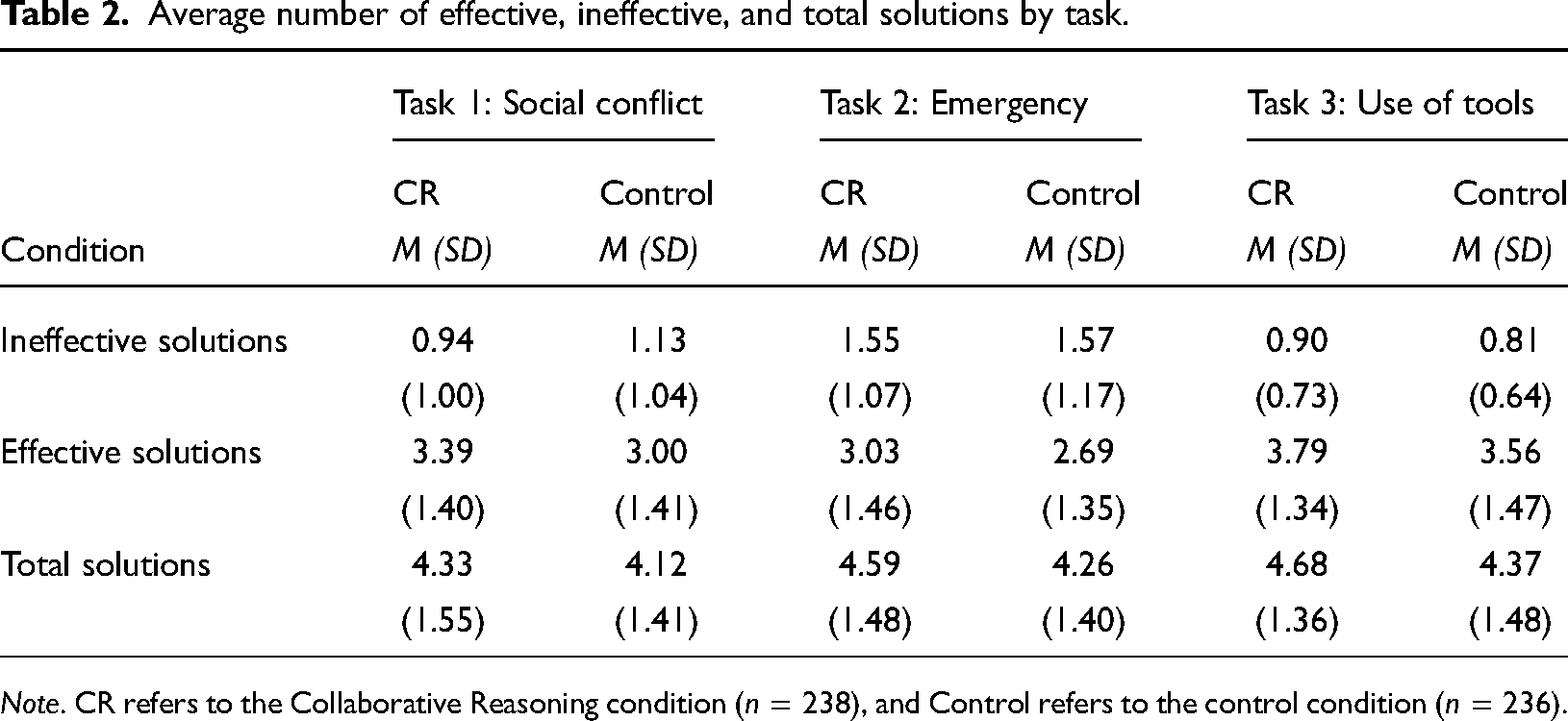
In total, 474 students generated 6,248 responses for three problems, with each student producing an average of 4.39 responses for each problem. Specifically, students generated a total of 2,004 solutions for Task 1, where they were asked to solve a social conflict with a classmate; 2,097 solutions for Task 2, where they needed to deal with an emergency situation; and 2,147 solutions for Task 3, where they had to work out how to recover a badminton shuttlecock that was caught in a tree.
Average number of effective, ineffective, and total solutions by task.
Note. CR refers to the Collaborative Reasoning condition (n = 238), and Control refers to the control condition (n = 236).
We conducted an analysis of covariance with the outcome variable being the proportion of effective solutions to the total number of solutions. Gender, intervention condition (CR or control), ability group (“fast” or “slow”), whether the student was a leader, and whether the student was a left-behind child were used as fixed effects. Reading comprehension, non-verbal reasoning, and whole-school assessment scores were entered as covariates. The results showed that overall, CR students (M = 0.75, SD = 0.12) were more likely to produce effective solutions than control students (M = 0.72, SD = 0.13), β = .13, t (465) = 2.58, p = .010. Students’ reading comprehension significantly predicted the production of effective solutions, β = .13, t (465) = 2.66, p = .008.
When we examined the three problems, CR students (M = 0.80, SD = 0.20) were more likely to produce effective solutions in solving the social problem (Task 1) than control students (M = 0.73, SD = 0.25), β = .15, t (465) = 3.09, p = .002. Boys (M = 0.83, SD = 0.16) produced slightly more effective solutions than girls (M = 0.80, SD = 0.16) in proposing different ways of using a tool to retrieve the badminton shuttlecock (Task 3), β = .11, t (465) = 2.33, p = .020. Students who scored higher on the reading comprehension test were more likely to produce an effective solution to an emergency situation (Task 2), β = .12, t (465) = 2.33, p = .020.
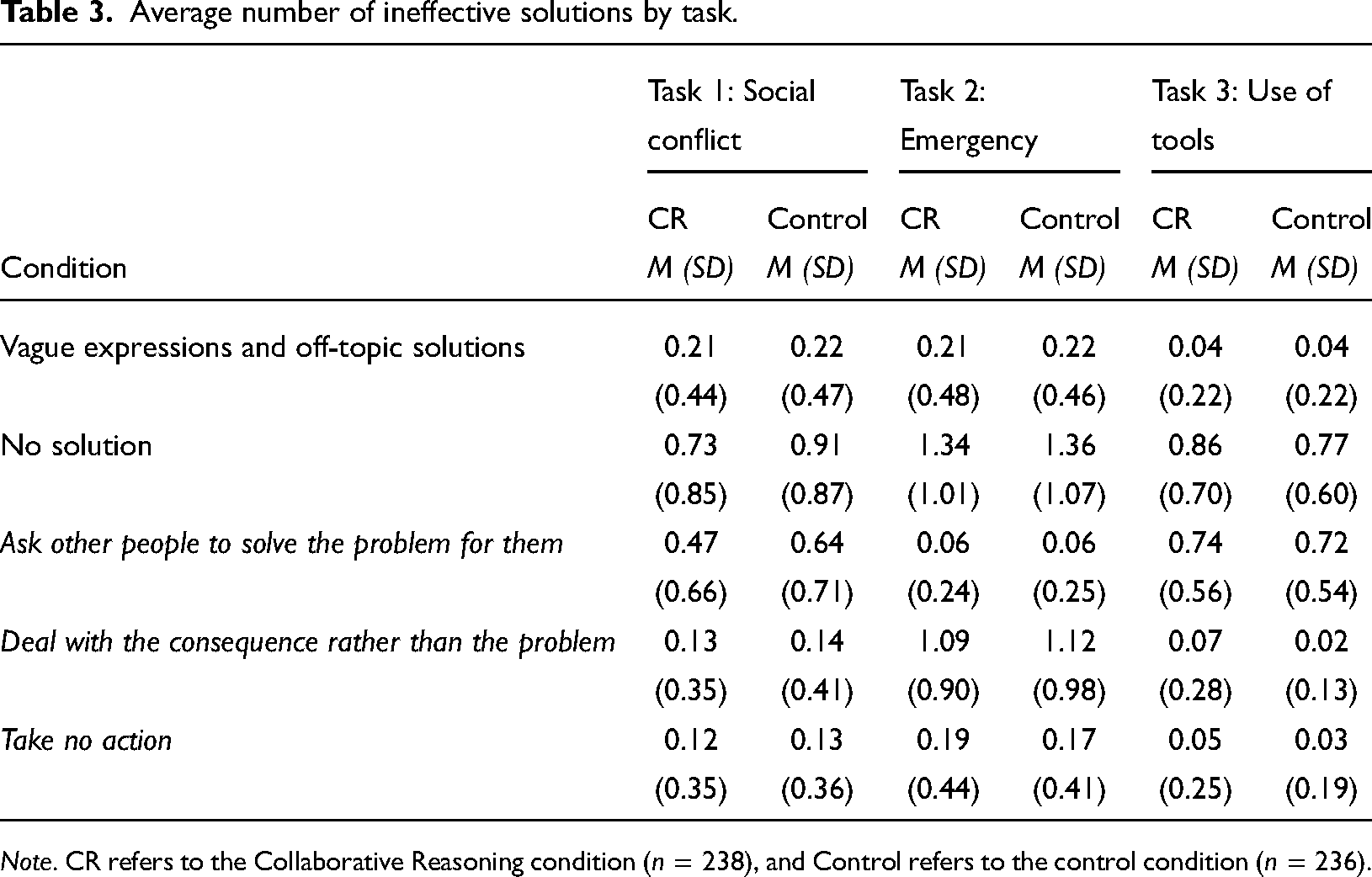
Average number of ineffective solutions by task.
Note. CR refers to the Collaborative Reasoning condition (n = 238), and Control refers to the control condition (n = 236).
For Task 1, a Poisson regression model was created for ineffective solutions that required other people to solve the problem for them, as this variable followed a Poisson distribution. The fixed effects were gender, intervention condition (CR or control), ability group (“fast” or “slow”), whether the student was a leader, and whether the student was a left-behind child. Covariates were reading comprehension, non-verbal reasoning, and whole-school assessment scores. The results indicated that the control students were more likely to ask other people to solve the problem for them compared to the CR students; incidence rate ratio (IRR) = 1.30, Z = 2.10, p = .036.
For Task 2, a Poisson regression model was created for responses that dealt with the consequence rather than the problem, as this variable also followed a Poisson distribution. The same fixed effects and covariates were entered into the model. There was no significant difference between the CR and control groups, Z = 0.60, p = .55.
For Task 3, in another Poisson regression analysis, the number of ineffective solutions that fell into the category of “asking other people to solve the problem for them” was treated as the dependent variable. The fixed factors and covariates were the same as those used in previous regression analyses. The results showed that girls were more likely to ask others for help than boys, IRR = 1.23, Z = 2.73, p = .006. No significant difference was found between the CR and control students, Z = 0.62, p = .53.
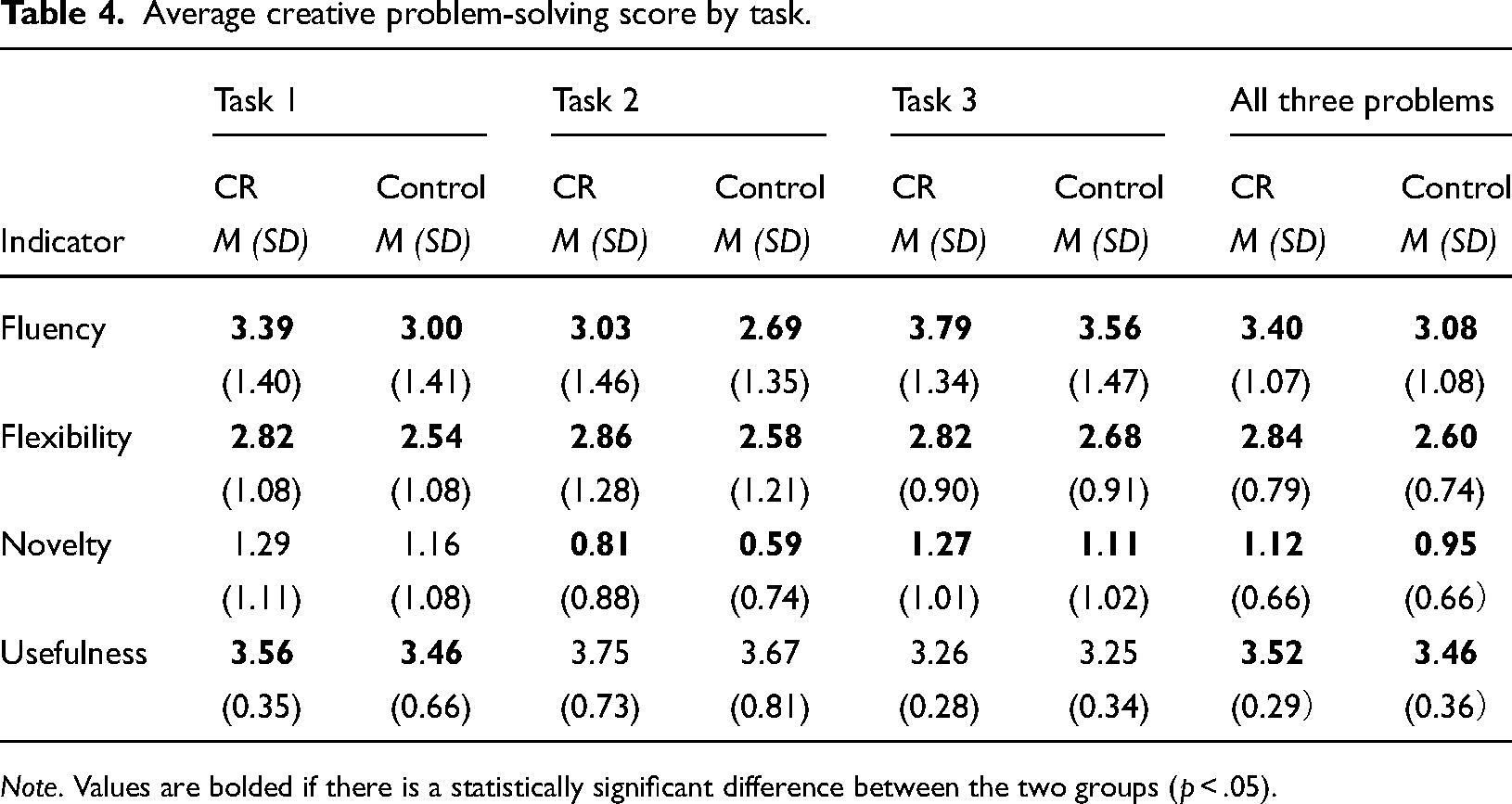
Average creative problem-solving score by task.
Note. Values are bolded if there is a statistically significant difference between the two groups (p < .05).
Next, we conducted univariate analyses to examine the condition differences in four creativity indicators with the same set of fixed effects and covariates as in the MANCOVA. The novelty indicator followed a Poisson distribution; therefore, a Poisson regression model was developed. The other three outcome variables had normal distributions; therefore, we conducted multiple linear regression analyses. The results showed that CR students generated more effective solutions (fluency), β = .22, t(465) = 4.66, p < .001, a greater variety of solutions (flexibility), β = .21, t(465) = 4.43, p < .001, more novel solutions, β = .23, IRR = 1.26, Z = 3.78, p < .001, and their solutions received higher ratings for usefulness, β = .13, t(465) = 2.63, p = .009, compared to the control students. Reading ability and non-verbal reasoning significantly predicted fluency and flexibility (ps < .05) but did not predict novelty and usefulness. The whole-class assessment significantly predicted all the creativity indicators, ps < .05.
When we examined the three problems separately, CR students outperformed control students in fluency, flexibility, and usefulness for solving the social problem (Task 1), while CR students outperformed control students in fluency, flexibility, and novelty for dealing with an emergency (Task 2) and creative use of tools (Task 3).
Girls’ solutions received higher usefulness ratings than boys’ solutions, β = .19, t(465) = 4.12, p < .001. When we examined the three problems separately, girls tended to generate more useful solutions for solving the social problem (Task 1), β = .14, t(465) = 3.05, p = .002, and creative use of tools problem (Task 3), β = .24, t(465) = 5.29, p < .001. However, boys came up with more diverse ways (flexibility) to creatively use a tool, β = .12, t(465) = 2.73, p = .007.
Discussion
The present study revealed that after controlling for basic cognitive ability, students who participated in CR discussions showed better creative performance than those who received traditional teacher-led direct instruction. Students in the collaborative groups generated more effective solutions, proposed more solutions from different perspectives, and produced more novel solutions, which were considered more likely to successfully solve the problems they faced.
The first important finding was that students in the collaborative groups produced a higher proportion of effective solutions to realistic problems than students in the control condition, especially when they encountered an interpersonal challenge. The difference was mainly reflected in the category of “asking other people to solve the problem for them.” A solution was coded as ineffective when the statement did not include any specific actions that were expected of others when seeking help. The lack of clarity in expressing one's needs indicates that the control student may not have properly assessed the predicament of the story character.
In traditional Chinese reading classes, conversations are usually initiated by the teacher through the “Initiate-Response-Evaluate” model (Mehan, 1979). The interaction usually begins with a prepared question asked by the teacher, which they call a student to answer. Students are instructed to provide a short answer to the question, which means that they have limited time to explain their thinking process (Wells, 1998; Wu et al., 1999). In the long periods of real-time interpersonal communication of a CR discussion, in contrast, students learn that only by clearly stating their thoughts and ideas can they achieve mutual understanding (Zhang et al., 2013).
Another important finding was that students in the collaborative groups outperformed the control students in all dimensions of creative problem-solving. Specifically, CR students performed better than control students in terms of fluency and flexibility in all three problems. In terms of novelty and usefulness, the treatment effect differed in two types of problems: For non-social problems, CR significantly improved the novelty of solutions, whereas, for social problems, it enhanced the usefulness of solutions.
Fluency and flexibility are two commonly recognized features of divergent thinking. Previous studies have found that Chinese students underperform compared to U.S. students in divergent thinking tasks, and it has been speculated that this may be due to test-oriented education in China (Niu & Sternberg, 2003). In superschools, testing takes place regularly throughout each academic year (Tian et al., 2016). When solving exam questions, students are trained to use convergent thinking but are seldom asked to rely on divergent thinking. They are required to retrieve prior knowledge to fill in blanks or to carry out fixed procedures to solve problems that have standardized answers. Unlike traditional teaching, CR presents students with open-ended, multifaceted problems (Chinn et al., 2001). Throughout the discussion, students learn to generate different ideas through brainstorming with peers and form multiple perspectives on a given topic by evaluating their own understanding as well as others’ thinking and reasoning (Reznitskaya et al., 2009).
As for the novelty of problem solutions, in this study, CR students were more creative than control students in solving the emergency problem (Task 2) and finding different ways to use tools (Task 3). The creation of new knowledge requires an individual to incorporate new information into their original schema or to construct entirely new schemas (Plucker et al., 2004). When individuals find that others hold different views, they spontaneously examine their own thoughts and reflect on their own reasoning, which leads to the emergence of new ideas (Bell et al., 1985). In CR discussions, students are constantly encouraged to consider a controversial issue from every aspect and angle and to form their own position while thinking about other people's positions and reasoning. The social exchange of thoughts increases the likelihood of producing novel ideas during collaborative discussions (Kupers et al., 2019).
In terms of usefulness, the CR students in this study performed better than the control students in solving the social problem (Task 1), which indicates that having socialization experiences with their peers may improve a child's ability to deal with real-life social conflicts. In addition, analysis of the ineffective solutions in this study showed that CR students were less likely to refer to another person for help when they faced a social problem, in contrast to the control students. Previous studies have found that children learn to resolve conflicts during interactions and fulfill their social roles in maintaining the functional structure of collaborative groups during CR discussions (Li et al., 2007; Sun et al., 2017). The CR students had likely encountered situations similar to those they discussed in the CR sessions, especially those demonstrated in Task 1 (a talkative and disturbing classmate), and this is why they were able to propose appropriate and useful solutions to the problem.
Arguably, the main reason students’ creative performance improved after participating in collaborative discussions is that CR builds a more complex learning environment than traditional teaching. The complex dynamic systems theory posits that “all complex systems can be considered to display creativity, through the processes of emergence, self-organization, and interactions among their various components” (Kupers et al., 2019, p. 96). From this perspective, creativity is likely to emerge from moment-to-moment interactions rather than from training students to practice divergent thinking alone (Sawyer, 1999). In traditional Chinese classrooms, students spend significantly more time receiving instructional messages from the teacher; consequently, they have limited freedom to develop comprehensive thoughts on their own. CR constructs an open-format interactive learning environment in which students can independently organize their idea-generation process and maintain the flow of thinking and reasoning without interruption.
In this study, reading comprehension and non-verbal reasoning significantly predicted the fluency and flexibility of solutions, suggesting that students with higher basic cognitive ability can generate a greater quantity and variety of solutions than their less advanced counterparts. The whole-school assessment significantly predicted all four creativity indicators, suggesting that the mastery of school knowledge is the basis for creative thinking. These results are consistent with previous findings that the development of creativity requires fundamental knowledge and prerequisite cognitive ability (Csikszentmihalyi, 1996; Ericsson et al., 1993; Piirto, 2004) and that richness in the diversity of knowledge is more conducive to creation (Guo & McLeod, 2014; Rietzschel et al., 2007).
An interesting finding in this study was that girls and boys demonstrated different strengths in creative problem-solving—boys generated a greater variety of solutions, while girls produced more useful solutions; girls performed better in solving the social problem, while boys were more flexible about the creative use of tools. This finding suggests possible gender-specific differences in creative problem-solving, but this conclusion should be drawn with caution, as other studies have reported inconsistent results (Hardy & Gibson, 2017).
Overall, our study indicates that providing students with the opportunity to interact with peers in collaborative discussions significantly promotes their creative performance. Future research should continue to examine the sustainability and long-term effects of CR interventions in super schools and identify whether the positive effects of CR can be transferred to a broader context in China.
Implications for creativity training in the classroom
Creativity training requires an environment that encourages both divergent and convergent thinking (Isaksen & Treffinger, 2004). The traditional instructional framework places excessively high emphasis on convergent thinking. Although it is important for students to acquire basic skills and fundamental knowledge, the goal of education should not be limited to preparing students for high-stakes exams. It is necessary to offer an open-format, student-centered learning environment, such as CR, to provide long-neglected interpersonal support (which allows students to hear various voices of support or opposition from different perspectives from peers), instructional support (so that teachers can identify and capture students’ micro-creativity and provide immediate feedback), and environmental support (so that students are immersed in an open, inclusive, supportive, and creative atmosphere) to students.
In the present study, CR was introduced in an educational setting as an add-on module rather than as a replacement for ordinary teaching. Given the societal reasons for supporting high-efficiency, performance-oriented schooling in China's current educational system, it is unrealistic to discuss teaching reform without considering the social and economic environment. Currently, students attach great importance to and strive to achieve excellent results in national exams through hard work. Persuading schools to adopt student-centered instructional formats in their ordinary teaching presents an enormous challenge. In most classrooms, especially in super schools, direct instruction is widely accepted as the most effective teaching method for delivering content knowledge (Stockard et al., 2018). Therefore, the challenge is not to choose one instructional format over another but to coordinate effective learning formats to cover all areas of students’ educational needs.
CR provides a potential format for incorporating creativity training into regular instruction. The successful implementation of the CR approach in superschools could open a new channel for future instructional reform in China. In the early stage of reform, CR might be introduced as a supplementary session (as our intervention was) to ordinary teaching to familiarize students with a student-centered instructional format. Schools can flexibly schedule classes for students to experience CR while ensuring the progress of regular instruction. In the middle stage of reform, teachers might organize CR discussions after regular teaching sessions to stimulate the self-directed generation of creative ideas. As CR presents controversial issues for student discussions, subjects such as language, history, and social studies are all suitable for implementation. In the later stage of reform, schools may create a CR-based curriculum for incorporation into traditional teaching. For example, Jadallah et al. (2009) combined CR with ordinary classroom teaching by designing a six-week socio-scientific curriculum unit on the topic of wolf management and its reintroduction for upper elementary students.
Limitations and future directions
The present study had some limitations. First, it only presented realistic problems in evaluating students’ creative performance in problem-solving. Future research should use a variety of problems and measurements, such as divergent thinking or problem-generation tasks. Second, due to limited time and resources, students in the control condition did not study the learning materials used in the CR condition; instead, they received regular reading instructions. Although the learning materials were not designed for creativity training, they might have had untestable effects on the students. Future studies could include other control conditions in which students study the same learning materials via teacher-led direct instruction. Third, our intervention was not tailored toward problem-solving. Future research can replace the central question with an ill-structured problem so that students can work together to look for possible solutions to the problem instead of persuading others to agree with their position.
Conclusion
The present study revealed that Chinese adolescents who participated in CR discussions showed significantly better performance than control students in creative problem-solving. The advantage was substantiated for both the quantity (fluency, flexibility) and quality (novelty, usefulness) of solutions, especially for the problem (Task 1), which involved social attributes that were similar to the interactive learning setting. The implication is that providing abundant opportunities for the social exchange of ideas can boost students’ creative performance.
Footnotes
Contributorship
Shufeng Ma designed and implemented the instructional intervention, collected the data, developed the coding scheme, supervised data analysis, wrote the original draft, revised the manuscript, and responded to reviewers' comments. Qiannan Zhou assisted with data collection, designed the problem-solving tasks, entered and cleaned the post-intervention data, conducted preliminary data analysis, and assisted with the writing of the first draft. Yaguang Li entered and cleaned the pre-intervention data and reviewed and edited the manuscript and revisions. Senyu Chen entered and cleaned the pre-intervention data and reviewed the manuscript.
Declaration of conflicting interests
The authors declared no potential conflicts of interest with respect to the research, authorship, and/or publication of this article.
Ethical statement
Ethical approval for conducting the study was obtained from the Research Ethics Committee of the Department of Psychology, Tsinghua University, on August 15, 2018. Ethical approval for using the collected data was obtained from the University Committee of Human Research Protection, East China Normal University, on March 3, 2020. Informed consent was obtained from each participant included in the study.
Funding
The authors disclosed receipt of the following financial support for the research, authorship, and/or publication of this article: The research reported in this paper was supported by the Shanghai Sailing Program through Grant 21YF1411400 and the East China Normal University Flower of Happiness Fund through Grant 2019ECNU-XFZH015.
