




Abstract
Purpose:
This study examined the effectiveness of a 12-week mindfulness curriculum for at-risk, urban adolescents. Of particular interest was whether participation in the intervention was associated with gains in self-regulation and self-compassion.
Design/Approach/Methods:
The analytic sample included 217 public high school students from thirteen 11th and 12th grade classrooms; 133 students received one dose of the program, 39 students received two doses, and 45 students served as a control group. The program was delivered by a trained mindfulness instructor who met with the classrooms once a week for 45 min. Adolescents completed self-report measures tapping self-regulation and self-compassion at pretest and posttest.
Findings:
Results indicated significant benefits of the intervention for adolescents’ self-compassion among both intervention groups. The effect was larger among students participating for the first time (one-dose group) than for those who were participating for a second time (two-dose group). There was also evidence that the program supported self-regulation, as students in both intervention dosage groups maintained their levels of long-term regulation relative to their peers in the control group who reported a decline over time.
Originality/Value:
While both self-regulation and self-compassion were supported as mechanisms of change associated with mindfulness-based intervention, the effects of dosage differed across the two constructs. The impacts of timing and dosage need to be examined in future research to better understand the sustainability of program effects for adolescents.
Introduction
Inner-city adolescents from low-income neighborhoods are disproportionately exposed to negative stressors including community violence and economic instability that compromise their educational achievement and psychological well-being (Goldner et al., 2015; Sharkey et al., 2014; Wodtke et al., 2011). Prior research suggests that these youth are at increased risk for behavioral issues, self-regulation deficits, and poor academic performance (Haft & Hoeft, 2017; McBride Murry et al., 2011). One of the most promising approaches both researchers and educators alike have found for reducing student stress and increasing resilience is through mindfulness-based interventions (Felver et al., 2016; Perry-Parrish et al., 2016; Waters et al., 2015). Indeed, the cognitive, emotional, and behavioral benefits of mindfulness for youth are supported across multiple meta-analytic studies (Felver et al., 2016; Zenner et al., 2014; Zoogman et al., 2014). There is also growing neurobiological evidence that mindfulness practice influences brain circuitry and autonomic nervous system processes associated with attention, executive function, and emotion regulation during adolescence (Strawn et al., 2016; Tang et al., 2012). Thus, mindfulness programs have been increasingly introduced into schools to strengthen adolescent’s inner resources and promote their emotional and behavioral regulation (Mendelson et al., 2010; Metz et al., 2013; Schonert-Reichl & Lawlor, 2010).
Mindfulness is defined as “the awareness that emerges through paying attention on purpose, in the present moment, and non-judgmentally to the unfolding of experience” (Kabat-Zinn, 2003, p. 145). Mindfulness-based practices include a variety of meditation, movement, and breathing techniques that enhance our attention to, and acceptance of, present moment experiences (Bishop et al., 2004). More specifically, mindfulness-based practices help individuals observe their internal feelings, thoughts, and physiology, and the external environment with curiosity and nonreactivity, thereby promoting reflective engagement and limiting self-criticism (Greenberg & Harris, 2012; Perry-Parish et al., 2016). The importance of these exercises for student well-being and success has received increased attention within the field of education and several reports of mindfulness-based intervention within education highlight the benefits for both cognitive functioning and socioemotional competence (Maynard et al., 2017; Renshaw et al., 2017). Moreover, mindfulness-based practice is now considered an effective strategy for enhancing key social emotional learning (SEL) competencies proposed by the Collaborative for Academic, Social, and Emotional Learning (CASEL), including self-management, self-awareness, social awareness, relationship skills, and responsible decision-making (Broderick & Jennings, 2012; CASEL, 2015; Lawlor, 2016).
The benefits of participation in universal SEL programs to cultivate students’ social–emotional and academic trajectories are well established (Durlak et al., 2011). Interestingly, however, the majority of SEL programs use an outside-in approach to teach behavioral skills, whereby select cognitive constructs, such as emotion recognition or alternative thinking strategies, are presented to, and practiced by, the students (Lantieri & Zakrzewski, 2015). What makes mindfulness-based programs unique is that they teach from the inside-out, focusing on internal experiences, including thoughts, emotions, breath, and other body sensations, to foster students’ innate abilities for self-awareness, self-management, and relationship-building (Lanteri & Zakrzewski, 2015; Semple et al., 2017). Notably, these embodied practices are the foundation of contemplative education, a holistic approach to education that includes pedagogical exercises designed to “cultivate the potentials of mindful awareness and volition in an ethical-relational context in which the values of personal growth, learning, moral living, and caring for others are also nurtured” (Roeser & Peck, 2009, p. 127).
Contemplative education places the student at the center of his or her own learning by providing experiential learning opportunities that foster introspection and inquiry and promote meaningful connections between their inner and outer worlds (Barbezat & Bush, 2013; Rechtschaffen, 2014). The critical role of mindfulness-based practice in supporting the individual within this context is reflected in contemporary models of contemplative education. Specifically, in her recent text, Cook-Cottone (2017) carefully delineated the associations between two complementary conceptual models of education, the Basic Levels of the Self (BLoS; Roeser & Peck, 2009) and the mindful and yogic self as an effective learner (MY-SEL; Cook-Cottone, 2017). With respect to the BLoS model, the parallels made highlight the critical role of the I-self (the level of self that is volitional and associated with mindful awareness, effortful attention, and nonjudgment) in school-related motivation, self-regulated learning, and self-relating (Roeser & Peck, 2009, as cited in Cook-Cottone, 2017). Mindfulness-based practices can help individuals separate their awareness from their stream of consciousness, thereby creating an opportunity for intentional control over the more automatized ways of responding that originate from temperamental reactivity or biased beliefs about one’s abilities. In this way, an active, alert I-self can facilitate effortful regulation of attention and behavior that is consistent with one’s goals as well as promote the development of compassion for the self and others (Roeser & Peck, 2009).
Similarly, in Cook-Cottone’s (2017) MY-SEL model, the self as effective learner is responsible for promoting integration and attunement across two critical facets of being that have implications for how individuals treat the self and others. Specifically, these facets involve self-regulation and self-care (internal system qualities that reflect independent learner skills), and intentional, reflective engagement (external system qualities that reflect collaborative learner skills) (Cook-Cottone, 2017). Thus, based on Cook-Cottone’s (2017) review, both models support the view that mindfulness-based practices are important tools that empower individuals to hone mental skills and socioemotional dispositions consistent with the educational aims of the 21st century, including self-regulation, self-representation, and prosocial qualities (Davidson & Mind and Life Education Research Network [MLERN], 2012).
The number of mindfulness-based programs in education has grown exponentially over the last decade and their success in promoting cognitive and social emotional competence is supported across multiple meta-analyses (Felver et al., 2016; Waters et al., 2015; Zenner et al., 2014; Zoogman et al., 2014). Collectively, the meta-analyses report small to medium effect sizes of school-based mindfulness interventions across youth outcomes and highlight cognitive functioning and resilience to stress as particularly promising areas for change (Waters et al., 2015; Zenner et al., 2014). As the reviews point out, however, more rigorous evaluations are needed, given the low methodological quality (e.g., lack of randomized control, no follow-up data) and limited replicability (vague curriculum, variations in dosage and delivery) across many of the early studies (Felver et al., 2016; Zenner et al., 2014). Moreover, the mechanisms through which mindfulness-based practices influence academic and social–emotional trajectories need further clarification, particularly given that there may be variation across developmental stages (Felver et al., 2016; Zoogman et al., 2014). Given the increased stressors that youth face during adolescence, elucidating the mechanisms underlying these links during this transitional time is critical for promoting positive development.
Adolescence is a period of development associated with rapid biological, social, and ecological changes (Ernst et al., 2006; Steinberg & Morris, 2001). It is characterized as a stress sensitive period of development that marks a critical turning point for self-regulation and social cognition (Kilford et al., 2016; McClelland et al., 2018; Steinberg, 2008). Specifically, significant neuroplasticity during adolescence reflects the gradual maturation of the prefrontal cortex (PFC), an area of the brain associated with higher-order thinking and decision-making, and changes in neurocircuitry between the PFC and the amygdala, an area responsible for threat detection, vigilance, and emotional processing (Blakemore & Choudhury, 2006; Gee et al., 2013; Swartz et al., 2014; Tottenham & Galvan, 2016). While this time of growth and rewiring of the brain allows for enhanced behavioral and emotional regulation, it also represents a time of increased vulnerability to stress, as toxic stress can negatively influence the rewiring of the brain, resulting in reduced cognitive functioning and poor psychological outcomes (Andersen, 2003; Casey et al., 2008; Dahl, 2004; Walker et al., 2004). Stress during this period is strongly associated with the onset of depression and/or anxiety disorders (Turner & Lloyd, 2004) and its deleterious impact on the brain may explain why the majority of adults with mental disorders were diagnosed before the age of 18 (Kim-Cohen et al., 2003). Thus, adolescence is considered an optimal time for interventions targeting skills that enhance psychological functioning and well-being (Andersen, 2003; Blakemore & Mills, 2016; Romeo & McEwen, 2006).
The potential neurodevelopmental correlates of mindfulness training among adolescents have been carefully delineated and reflect brain regions and connectivity involved in both attentional and emotional regulation (for review, see Sanger & Dorjee, 2015). While there is recent evidence that mindfulness training can impact emotion processing among adolescents (Sanger et al., 2018; Strawn et al., 2016), the social–emotional constructs associated with these neurofunctional changes are still unclear. Two mechanisms targeted by mindfulness that may be particularly relevant during adolescence are self-regulation and self-compassion (Davidson & Mind and Life Education Research Network, 2012; Saksena & Sharma, 2016; Tang et al., 2012). Self-regulation and self-compassion are critical constructs that reflect the self-management and self-awareness facets of SEL, respectively (CASEL, 2015). Specifically, these constructs may help youth manage the increased academic and social challenges typical of adolescence by promoting responsible decision-making and positive identity development (McClelland et al., 2018; Roeser & Peck, 2009). Indeed, research confirms that both constructs are associated with positive youth development and reduced risk-taking behaviors during adolescence (Barnard & Curry, 2011; Lerner et al., 2011; Quinn & Fromme, 2010). These skills may be particularly critical for at-risk minority youth, as there is evidence that they experience disproportionately higher levels of toxic stress and trauma compared to their peers (Choi et al., 2006; Grant et al., 2004; Sacks & Murphey, 2018). As a result, these youth display higher levels of socioemotional difficulties than their economically advantaged nonminority peers, and thus are at higher risk of poor academic performance and school dropout (Gillock & Reyes, 1999; Haft & Hoeft, 2017; McBride Murry et al., 2011).
Self-regulation refers to the process of modulating systems of attention, emotion, and behavior in response to a given contextual situation, stimulus, or demand (Calkins & Fox, 2002; Posner & Rothbart, 2000). Put simply, self-regulation is a multidimensional construct that underlies the ability to control our thoughts and actions. Self-regulation plays an essential role in goal-directed activity and social interactions; it enables youth to make better choices and decisions both within academic and peer contexts. Indeed, the benefits of self-regulation for both academic achievement and social competence have been well established (Buckner et al., 2009; Duckworth et al., 2010; Lerner et al., 2011; Moffitt et al., 2011). Moreover, self-regulation promotes the formation of an adaptive identity (McClelland et al., 2018) and protects adolescents against risky drinking and sexual behavior (Quinn & Fromme, 2010). Notably, self-regulation is associated with adaptive functioning among low-income youth, as these skills distinguished resilient youth from their nonresilient peers across a variety of domains, including academic achievement, social competence, mental health, and coping with stress (Buckner et al., 2003, 2009).
While there are multiple ways to conceptualize self-regulation, an important consideration during adolescence may be temporal context, which distinguishes between proximal and distal goals (Karoly, 1993). Short-term regulation includes both physical (e.g., ability to restrain from fidgeting) and psychological (e.g., being able to calm oneself down) regulation in the immediate context (Moilanen, 2007). Thus, short-term regulation reflects impulse, emotional, and attentional control in the moment, and it is particularly important for managing cognitions and behaviors related to events and goals that are close in time (Demetriou, 2000; Maniar & Zaff, 2011). In contrast, long-term self-regulation reflects impulse control, planning, and direction of effort over several weeks, months, or even years. Thus, long-term self-regulation is instrumental in obtaining long-range goals and aspirations, as it taps persistence, adaptability, and the ability to change one’s actions in an effort to reach an objective (Moilanen, 2007). Given that a long-term, future-focused orientation is thought to increase with age and culminate in late adolescence (Nurmi, 1991), this dimension of self-regulation, associated with distal goals, may be particularly sensitive to intervention. Interestingly, previous work with young adolescents reported benefits of mindfulness-based intervention only for long-term self-regulation, whereas short-term self-regulation was more resistant to change (Bergen-Cico et al., 2015). Thus, additional research is needed to better understand the potential of mindfulness for fostering both short- and long-term regulation during late adolescence.
Self-compassion refers to the ability to “hold one’s feelings of suffering with a sense of warmth, connection, and concern” (Neff & McGehee, 2010, p. 226). According to Neff (2003), self-compassion includes the following three interrelated components that are displayed during times of personal failures or inadequacies: (a) self-kindness, (b) sense of common humanity, and (c) mindfulness. Specifically, these three qualities protect against the opposing negative constructs of self-judgment, feelings of isolation, and overidentification with successes and failures (Neff, 2003). Indeed, self-compassion is an emotionally positive self-view that has been consistently associated with emotional resilience and psychological well-being among adults (Barnard & Curry, 2011; Neff, 2009).
More recently, research has identified self-compassion as a protective factor during the emotionally and behaviorally turbulent period of adolescence when individuals are developing self-identity and navigating peer pressure (Bluth, Gaylord et al., 2016; Neff & McGehee, 2010). Specifically, self-compassion among high school students has been found to be positively associated with lower levels of depression, anxiety, and stress as well as higher levels of social connectedness and well-being (Bluth, Roberson et al., 2016; Neff & McGehee, 2010). Moreover, self-compassion has gained support as a mechanism through which mindfulness influences adolescent emotional health (Bluth & Blanton, 2014). Indeed, there is evidence that mindfulness-based interventions increase self-compassion among adolescents, resulting in reduced levels of depression, anxiety, perceived stress, and negative affect (Bluth, Campo et al., 2016; Bluth, Gaylord et al., 2016). While these findings are promising, there is a need for replication, particularly among at-risk adolescent populations.
Thus, the goal of the present study was to increase our understanding of the mechanisms through which mindfulness-based intervention can enhance resiliency among at-risk adolescents. Specifically, the current study evaluated the effectiveness of a secular mindfulness-based intervention designed specifically to promote self-regulation and self-compassion among urban youth. Our work addresses several limitations highlighted in recent reviews of the literature (Felver et al. 2016; Greenberg & Harris 2012). Notably, the study used a quasi-experimental design (classrooms were assigned to the intervention or a control group based on the period of the school day), incorporated a manual-based curriculum delivered by trained interventionists, and included dosage variation (one versus two doses of program engagement). Based on previous research (Bluth, Campo et al., 2016; Bluth, Gaylord et al., 2016; Schonert-Reichl & Lawlor, 2010), we hypothesized that youth who participated in the intervention would demonstrate significantly greater gains in self-regulation and self-compassion compared to their peers in the control group. We also compared the gains associated with two doses of the program with the gains associated with a single dose of the intervention. These analyses examining dosage variation were more exploratory in nature, as it may be possible that some outcomes show greater initial impacts of the program while others take longer to emerge.
Method
Participants
Participants included 236 eleventh and twelfth grade students (M = 17.46 years, SD = 0.52; 60.6% female) from 13 classrooms at a public high school in a large Northeastern city in the U.S. The school serves an ethnically diverse community of youth who were predominantly African American (54%), Hispanic (19%), and Asian (14%). The majority of students were from economically disadvantaged families; 67% of students at the school are eligible for free lunch. The sample reflects data on three groups of students: 138 who received one dose of the program, 40 who received two doses of the program (i.e., those who had also participated in the program during the previous school year), and 58 students in the control group. It should be noted that we do not have data on students in the two-dose condition that reflect their scores during their earlier (i.e., first dose) participation in the program. Thus, the dosage groups analyzed here reflect two independent groups of students assessed during the same academic year. There were missing data due to attrition, subject ID errors, and incomplete surveys; these participants were not included in analyses, as they did not have both pre- and posttest data. The final analytic sample encompassed 217 students (90.7% of the initial sample); 133 students received one dose of the program, 39 students received two doses, and 45 students in the control group. Analyses indicated that there were no significant differences between students in the analytic sample and those who were not retained in terms of demographic characteristics.
Procedure
Information about the research study was sent home to the parents of the youth in the participating classrooms. Given that the mindfulness intervention was considered part of the school’s curriculum, informed consent was not required for youth to participate in the program. Consent was required, however, for participation in the evaluation of the program. For students under the age of 18, passive parental consent and youth assent were obtained prior to the evaluation. For students over the age of 18, written consent was obtained prior to the evaluation. There were no instances of parental refusal and limited youth refusal (less than 5%) for students to participate in the evaluation. All procedures followed a standard protocol approved both by the school board and the University IRBs.
Participating classrooms were assigned to either intervention (n = 7 one dose; n = 3 two doses) or control status (n = 3) based on the period of the school day. The curriculum was administered by one of three trained Inner Strength instructors over 12 weeks in 45-min sessions for each of the intervention groups. The instructors all completed the 56-hr Inner Strength Teacher Training program that included virtual trainings, conference calls, and a 3-day in-person weekend module. All youth in the study completed two waves of brief assessments via paper surveys administered during the school day. The evaluation assessed self-regulation (both short- and long-term) using the Adolescent Self-Regulatory Inventory (ASRI; Moilanen, 2007) and self-compassion using the Self-Compassion Scale-Short Form (SCS-SF; Raes et al., 2011). The surveys took approximately 20 min to complete at each time point. For anonymity, the instructors assigned a five-digit unique identifier number (ID) to each participant. Rosters of subject unique IDs and corresponding student names were maintained by the Inner Strength instructor to serve as a reference and ensure students used the same subject ID to log into the surveys at both time points. The instructors did not have access to individual student responses or results and the researchers did not have access to the identity of the participants.
Mindfulness intervention
The mindfulness intervention consisted of the 12-week Inner Strength Teen Program which included a scripted 12-lesson curriculum that was designed to be delivered weekly in 45- to 60-min sessions by a trained instructor, with the classroom teacher as a participant/observer (Edelstein, 2016). Each lesson reflected one of four core themes (described below) and included an average of 15 min of mindfulness-based practice per class, 20 min of didactic instruction, and 15 min of peer discussion and/or written exercises. Over the course of the program, students practiced seven mindfulness techniques including awareness of breath, open awareness, thought bubble, sound meditation, body scan, mindful eating, and compassion. Students learned to distinguish between the experience of being aware, the brain functioning (the organ of perception), and thought/feeling (the objects perceived).
The manualized secular curriculum incorporated contextual lessons on cultural development, evolutionary biology, and neuroscience with meditation exercises to promote self-development and encourage systemic thinking among students (Edelstein, 2016). Section one (self-identify) teaches students how to see the arising of thought and feeling as separate from their self-identity; the goal is to promote positive self-regulation, disengagement from negative rumination, and choice over what thoughts to pursue. In the second section (evolutionary neuroscience), students learn about the evolutionary development of the brain and characteristics of the adolescent brain. They analyze survival responses that they have experienced (fight/flight/freeze reactions) and learn about the association between teen risk-taking and adolescent brain development, including physiological triggers and positive safety mechanisms. The third section (cultural development) illustrates how cultural shifts from the modern period to the contemporary postmodern period have influenced individual agency, personal choice, and social support. In this segment, students learn to view their personal stressors in context of larger, historical social changes. In the final section (compassion building), students discover how self-regulation and mindful awareness can promote better relationships and communication and increase their experience of connection, empathy, and care (Edelstein, 2016).
Measures
The ASRI (Moilanen, 2007) is a questionnaire that taps two temporal aspects of self-regulation (short- and long-term). The short-term subscale is comprised of 13 items and the long-term subscale is comprised of 14 items. Example questions from the ASRI short-term subscale are “When I’m bored, I fidget or can’t sit still” and “I forget about whatever else I need to do when I am having fun.” Long-term subscale questions include “If something isn’t going according to my plans, I change my actions and try to reach my goals” and “I can find ways to make myself study even when my friends want to go out.” Respondents rated how true each item was for them, ranging from 1 (not at all true for me) to 5 (really true for me). Items were averaged to calculate the mean for their respective scales. The instrument demonstrated both construct and incremental validity among youth, with high internal consistency for the short-term (α = .70) and long-term (α = .72) subscales (Moilanen, 2007). Similar internal consistencies were reported in the current sample for both the short-term (α = .72 to .76) and long-term (α = .73 to .81) subscales.
The SCS-SF (Raes et al., 2011) is a 12-item measure used to tap self-compassion. The short-form contains items reflecting all six components of self-compassion, including self-kindness, self-judgment, common humanity, isolation, mindfulness, and overidentification. Examples include “I try to be understanding and patient towards those aspects of my personality I don’t like” and “When I fail at something important to me I become consumed by feelings of inadequacy.” Items were scored on a 5-point scale ranging from 1 (almost never) to 5 (almost always). A total SCS-SF composite score was computed by reverse scoring the negative subscale items for self-judgment, isolation, and over-identification (i.e., 1 = 5, 2 = 4, 3 = 3, 4 = 2, 5 = 1) and computing a total mean. The short-form scale has high internal consistency (α ≥ .86 in validation samples) and was almost perfectly correlated (r ≥ .97 in all samples) with the long-form Self-Compassion Survey (Neff, 2003; Raes et al., 2011). The short-form demonstrated high internal consistency (α ≥ .87) in the sample.
Data analyses
A series of one-way analyses of covariance (ANCOVAs) were conducted at posttest to determine whether there were significant between-group differences across the outcome scores post-intervention. For these analyses, the pretest score and a group variable (with 3 levels: 0, 1, 2) were entered into the model. If the group variable was significant, post hoc pair-wise comparisons were conducted on the adjusted means to identify which groups differed. Next, the dosage effect was examined via linear regression models with pretest score and dosage group (single dose, repeated dose) entered as covariates. Specifically, the models included two indicator variables, one to denote students who received one dose of the intervention and another to denote students who received two doses of the intervention. These indicators were entered simultaneously into the regression models, along with the pretest score, and thus allow for a comparison of the effect of the intervention within each group relative to the control group. Class period and the number of days between the pre- and post-assessments were included as covariates in preliminary analyses but were omitted from final models due to their lack of significance. Effect size was estimated using Cohen’s, with d > .20 suggesting a small effect, d > .50 signifying a moderate effect, and d > .80 representing a large effect (Cohen, 1988).
Results
Although 217 youth met the criteria for inclusion in the analytic sample, the number of students who completed the measures varied across the outcomes. We conducted Little’s Missing Completely at Random (Little’s MCAR) test, findings suggested that the data were missing completely at random, χ2 = 40.68 (df = 38, p = .35). Thus, there were no detectable patterns of missingness in the data. To be conservative within the context of an intervention, however, pair-wise deletion was used in analyses.
The means and standard deviations by group are displayed in Table 1. A series of independent t-tests suggested that there were no differences among the groups at pretest. Results of the one-way ANCOVA models examining between-group differences in mean scores at posttest, adjusting for pretest scores, indicated significant advantages for both intervention groups compared to the control group on long-term regulation and self-compassion. Specifically, for long-term regulation, the model indicated that the groups differed by group, F(2, 201) = 2.98, p = .05. Follow-up pair-wise comparisons indicated that the control group scored significantly lower compared to both intervention groups at posttest; the mean differences between the one- and two-dose groups did not differ significantly. Similarly, for self-compassion, the model indicated that the groups differed significantly by group, F(2, 179) = 4.14, p < .05. Follow-up pair-wise comparisons indicated that the control group scored significantly lower compared to both intervention groups on self-compassion at posttest; the mean differences between the one and two dose groups did not differ significantly (see Table 1). There were no significant between-group differences for short-term regulation at posttest, F(2, 213) = 1.01, ns.
Self-regulation and self-compassion scores by group.
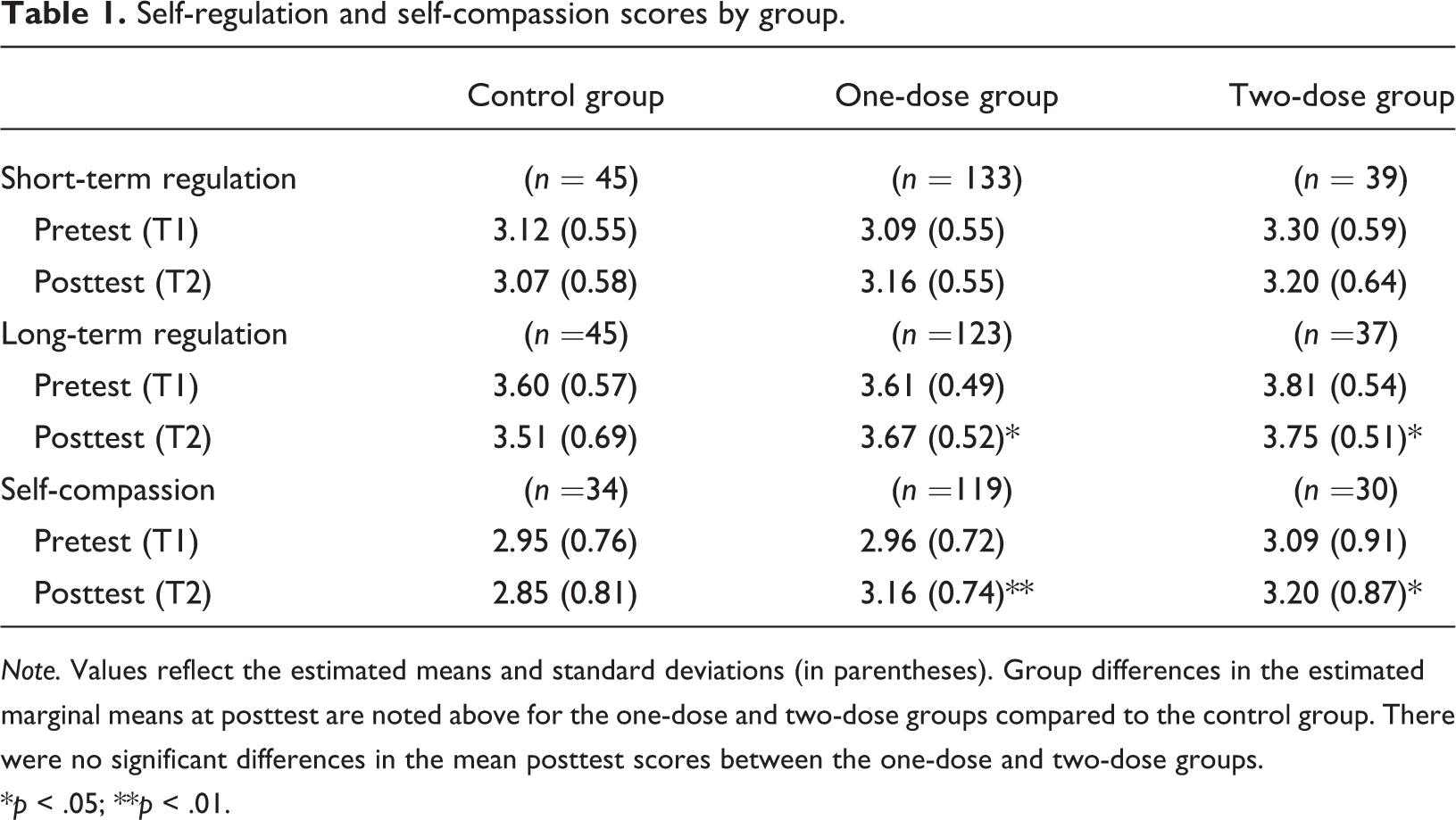
Note. Values reflect the estimated means and standard deviations (in parentheses). Group differences in the estimated marginal means at posttest are noted above for the one-dose and two-dose groups compared to the control group. There were no significant differences in the mean posttest scores between the one-dose and two-dose groups.
*p < .05; **p < .01.
Next, we examined the effect of dosage on the outcomes via linear regression models with pretest score and dosage indicators (one-dose, two-dose) entered as covariates; the control group was the reference group (see Table 2). Using the enter method, it was found that pretest scores and dosage explained a significant amount of the variance in long-term regulation at posttest, F(3, 201) = 7.49, p < .01, R 2 = .34. Specifically, there were significant effects of the intervention for students in both the one-dose (β = .14, p < .05) and two-dose (β = .16, p < .05) conditions. The effect sizes of the intervention for both dosage groups were small and similar in magnitude for long-term regulation, approximately 0.30 in each group. These results suggest that there was a similar incremental effect of the program on long-term regulation among both dosage groups. Likewise, pretest scores and dosage explained a significant amount of the variance in self-compassion at posttest, F(3, 179) = 55.59, p < .01, R 2 = .47. Specifically, there were significant effects of the intervention for students in both the one-dose (β = .19, p < .01) and two-dose (β = .17, p < .05) conditions, such that these students improved in self-compassion relative to their peers in the control condition. The effect size for the one-dose group (d = .47) was slightly below the suggested 0.50 cutoff for a modest or medium effect (d = .47) and was larger in magnitude compared to the two-dose group (d = .35). These results suggest that the intervention had a stronger impact on self-compassion after one dose, with additional smaller benefits associated with a second dose.
Results of regression models examining dosage effects.
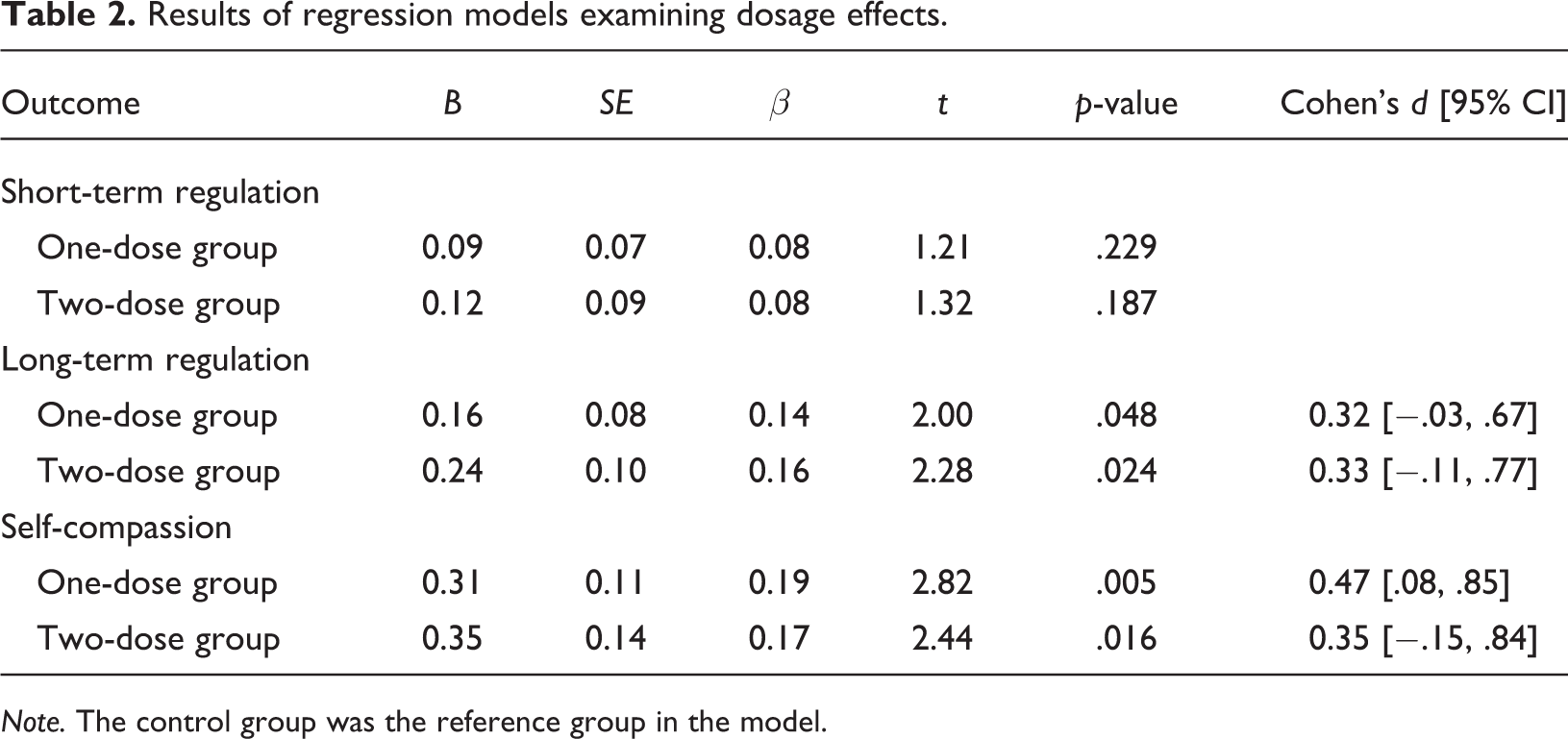
Note. The control group was the reference group in the model.
Discussion
Overall, the results of this study suggest that the Inner Strength Teen Program promoted social–emotional competencies among at-risk youth. Specifically, youth who were in the intervention classrooms experienced benefits in both long-term regulation and self-compassion compared to their peers in the control group, as evidenced by their significantly higher scores on these measures as posttest. The program did not have significant effects for short-term regulation. The magnitude of the intervention’s effect on long-term regulation was small and similar for both the one- and two-dose groups. Thus, in this case, two doses of the program did not have a greater impact on long-term regulation compared to one dose. The dosage effect for self-compassion was also significant. Specifically, the effect of the program was greater for those in the one-dose group compared to the two-dose group, suggesting that the largest benefits were made during the students’ initial participation in the program and increased to a lesser extent during their second dose. Collectively, these findings provide additional evidence of the benefits of mindfulness-based programming for fostering social–emotional competencies that support resilience and provide insight into the underlying mechanisms of change (Bergen-Cico et al., 2015; Bluth, Campo et al., 2016; Schonert-Reichl & Lawlor, 2010).
The current study advanced our understanding of how mindfulness can support social–emotional competencies among urban adolescents as they face a myriad of biological changes and environmental stressors. Mindfulness-based curricula are purported to teach students strategies to control their impulses and foster humanity (Choudhury & Moses, 2016; Rechtschaffen, 2014). The results of the current evaluation support these claims and highlight both self-regulation and self-compassion as key mechanisms underlying the benefits of contemplative pedagogy. These findings align with theories underlying contemplative education as both constructs are inherent in models that emphasize mindfulness as a way to promote the self-regulated (Roeser & Peck, 2009) or effective learner (Cook-Cottone, 2017). Specifically, self-regulation and self-compassion are capacities associated with executive function and mindful awareness, respectively, which are two critical processes through which mindfulness-based practice are purported to influence motivation and self-regulated learning in the BLoS model (Roeser & Peck, 2009). Similarly, self-regulation and self-compassion, a facet of self-care, reflect internal system qualities that support independent learner skills in the MY-SEL model (Cook-Cottone, 2017).
The intervention was particularly beneficial for fostering self-compassion among youth. Students in the program groups (both one- and two-dose conditions) demonstrated increases in self-compassion over the 12-week period that gave them a significant advantage over their peers. These findings are consistent with the results of other mindfulness-based intervention studies with adolescents that have demonstrated benefits for self-compassion (Bluth, Campo et al., 2016; Bluth, Gaylord et al., 2016). They also provide additional support for self-compassion as a mechanism through which mindfulness facilitates adolescent well-being (Bluth & Blanton, 2014; Bluth et al., 2015). For example, mindfulness-based practice may protect students from identifying with their failures by helping them view these challenges as temporary setbacks that can be accepted and overcome. Moreover, these practices may reduce self-criticism and feelings of isolation. Notably, there was an apparent decline in self-compassion among students in the control group, which suggests that they may struggle with maintaining a positive self-view in the absence of mindfulness tools. Thus, later high school may represent a particular period of vulnerability during adolescence. Specifically, given that the pressures and realities of graduation and impending careers are upon them, these adolescents may be particularly struggling with their identities and future selves. This trend may also help explain why the program effects were larger in magnitude for students who had one dose of the program than for those who had two doses. Additional research with larger samples is needed to better understand differences in timing and dosage associated with mindfulness programs during adolescence.
The results also revealed a substantive impact of the mindfulness-based program for adolescent’s long-term self-regulation. Specifically, students in the program groups demonstrated increases in self-compassion over the 12-week intervention that gave them a significant advantage over their peers in the control group. The pattern indicated that students in both dosage groups maintained their levels of long-term regulation while those in the control group experienced a decline over time. These results are consistent with the results of previous mindfulness-based studies that reported minimal change among youth in the program, but significant deterioration among youth in the control group (Bergen-Cico et al., 2015; Khalsa et al., 2012). The effect of the intervention was similar in magnitude for both dosage groups, indicating that the program helped prevent decline in long-term regulation in a similar way for those in the single-dose and two-dose groups. Specifically, these findings suggest that mindfulness-based practice was associated with the preservation of self-regulatory skills that support long-term planning and goal achievement. The maintenance of such skills is particularly noteworthy among at-risk youth who often experience higher levels of stress and negative outcomes, including school dropout, delinquency, and depression, than their more socioeconomically advantaged peers (Haft & Hoeft, 2017; McBride Murry et al., 2011). Given that long-term regulation has the potential to support both academic and personal achievements, future work should examine indicators of these successes, such as school engagement, academic grades, graduation rates, behavioral referrals, and psychological well-being, among students.
Contrary to our expectations, the intervention did not influence adolescents’ short-term regulation. Specifically, short-term regulation did not differ among the groups at posttest and there was no effect associated with dosage. One explanation for the lack of effect is that the program did not support self-regulatory processes involved in managing stressors that require immediate action. In the current study, short-term regulation represented aspects of both attentional and emotional control within the immediate context. For example, items such as “During a dull class, I have trouble forcing myself to start paying attention” and “I can usually act normal around everybody if I’m upset with someone” reflect skills that promote concentration and emotion regulation in the present moment. Thus, the intervention may not have been able to enhance self-regulated behavior among adolescents as they navigated more temporary or transitory academic distractions and social challenges. Interestingly, these results are consistent with previous work examining temporal facets of self-regulation among younger adolescents (Bergen-Cico et al., 2015).
An alternative explanation, however, is that adolescents in the program were more aware of their present-moment attentional and emotional reactions as a result of their participation in the intervention. In other words, the very practice of mindfulness may have changed how the adolescents interpreted or responded to the items, yielding the analysis of change over time futile. In this case, it is possible that the students in the intervention were more critical of their behavior over time and thus had different standards for estimating short-term regulation compared with their peers. This possibility is consistent with multistage models of self-regulation that propose self-monitoring, which involves disengaging from automaticity and moving toward mindfulness and self-reflection, as an initial step in the self-regulatory process (Karoly, 1993). Thus, the program may have influenced adolescents’ self-monitoring, resulting in more informed and authentic representations of their short-term regulation. This prospect should be explored in future research that incorporates behavioral or neurophysiological measures of attentional and emotional regulation, such as those that tap attentional networks or directly assess brain activity.
Limitations and future research
Although the current study furthers our understanding of how mindfulness-based practice supports self-regulation and self-compassion among adolescents, there are several key methodological limitations. First, the sample size was small. As a result, the analyses were restricted to group-level comparisons that did not consider classroom-level effects or examine differences across intervention facilitators. Moreover, the dosage effects should be interpreted with caution given the restricted sample size of the two-dose group. Another limitation of the small sample was the reduced power to detect differences over time. Thus, it is possible that the results underestimated the magnitude of the intervention effects, which were small according to the reported effect sizes. There is also limited generalizability of the findings, as these students were all recruited from one high school. Thus, replication of this program across multiple grades and schools is needed to better understand the potential of this intervention for promoting resilience among at-risk urban youth.
Another shortcoming of the current study was the exclusive reliance on self-report measures of self-regulation and self-compassion. As previously mentioned, self-report measures may be problematic within mindfulness-based research, as the intervention may directly influence how individuals perceive and interpret their behavior (Davidson & Kaszniak, 2015). Moreover, given that mindfulness-based programs purport to influence youth on multiple levels, including cognitive processes and physiological reactivity, there is a need for more objective, targeted measures of self-regulation and awareness. For example, the Attentional Network Task (Fan et al., 2002) is a computerized assessment that taps the three attentional networks including alerting, orienting, and executive control (Posner & Petersen, 1990). The adult literature suggests that mindfulness may initially improve the executive control network as well as orienting, whereas changes in alerting may be associated with later phases of practice (Chiesa et al., 2011). In addition, research with adults has shown that mindfulness training is associated with changes in the structure and function of the brain that foster self-regulation (Jha et al., 2010; Malinowski, 2013). Mindful practices that focus on positive emotional states can also produce lasting neural changes that promote further adaptive thoughts and behaviors like self-compassion (Garland et al., 2010).
The limited specificity of the outcome measures is another shortcoming of the current study. For example, mindfulness has been speculated to influence well-being via a variety of self-regulatory mechanisms, including executive function, attention, and emotion regulation (Broderick & Jennings, 2012; Greenberg & Harris, 2012; Lawlor, 2016). While the ASRI is helpful in differentiating between two temporal aspects of self-regulation, the specific skills tapped by the intervention are unclear. Interestingly, there is also evidence that both mindfulness and selected aspects of self-compassion contribute to executive function during early adolescence (Shin et al., 2016). Thus, there is a need to collect comprehensive measures of mindfulness, executive function, and self-compassion to better understand how these three constructs are developmentally linked during adolescence as well as how these associations are influenced by mindfulness-based practice. The inclusion of qualitative data may be particularly helpful in further elucidating the mechanisms through which mindfulness supports resilience and documenting what these skills mean to adolescents in their own words (Bluth, Campo et al., 2016; Dariotis et al., 2016; Klingle & Van Vliet, 2017).
In summary, this study suggests that mindfulness programming offers benefits for at-risk youth. While previous research has documented the benefits of mindfulness interventions for self-regulatory skills, the current study also reports the benefits of practice for self-compassion. Unlike other curricula that rely on classroom-based tools, these practices are not subject or equipment specific and can potentially be continued long after the end of the program. These tools support students to reach their higher potentials, cultivating self-regulation, compassion, and positive decision-making; enduring values that can be integrated into daily life. Such training can become part of transformative curricula for all high schools, thereby supporting individual well-being and social advancement as we empower students to withstand environmental stressors, avoid aggressive behavior, remain academically engaged in school, and realize the far-reaching interconnectivity of all our actions. These possibilities need to be investigated via larger replication studies that examine diverse mechanisms underlying resilience and explore sustainability of both individual practice and program effects over time.
Footnotes
Contributorship
Rachel Razza designed and implemented the program evaluation, assisted with data analyses, and wrote the paper. Dessa Bergen-Cico collaborated on the design of the study, assisted with measure preparation and IRB applications, contributed to the analytic plan, and reviewed the manuscript and revisions. Staceyann Reid assisted with the selection of measures, entered and cleaned the data, and assisted with preliminary data analyses. Rachel Linsner Uveges assisted with the IRB application, helped with measure preparation, and entered and cleaned the data.
Declaration of conflicting interests
The author declared the following potential conflicts of interest with respect to the research, authorship, and/or publication of this article: They acted as independent evaluators of this program during the time of data collection and analyses. The first author copresented a mindfulness workshop with the Curriculum Developer in 2019 to discuss the evaluation strategy. Informed consent was obtained from all individual participants included in the study.
Ethical statement
All procedures performed were approved by the Institutional Review Board (IRB) at Syracuse University and were in accordance with the ethical standards of the IRB and with the Helsinki Declaration of 1964 and its later amendments. Informed consent was obtained from all individual participants included in the study.
Funding
The author received no financial support for the research, authorship, and/or publication of this article.