



Abstract
Purpose
This study conducted a review of policy reforms of school–enterprise cooperation in China's vocational education and its characteristics at different stages.
Design/Approach/Methods
This study systematically reviewed vocational educational policies on school–enterprise cooperation adopted by the Chinese government since 1978 using textual analysis.
Findings
The development of school–enterprise cooperation in China's vocational education can be divided into four stages: spontaneous development (Stage 1), central position establishment (Stage 2), systematic design (Stage 3), and institutional construction (Stage 4). After years of practice and exploration, China's school–enterprise cooperation has made impressive achievements, but also has several problems that require further improvement.
Originality/Value
This study examined over 40 years of history of the development of vocational school–enterprise cooperation in China, providing a useful reference for learning and understanding Chinese vocational education.
In most countries, vocational education and training (VET) systems are structured according to labor market demand (Özer & Suna, 2020), which is one of the greatest challenges in this area (Rözer & van de Werfhorst, 2020). The development of vocational schools and colleges depends on cooperation with enterprises because of the direct impact of the labor market on vocational education. Cooperation bridges the relationship between vocational schools and the industrial world (Widodo et al., 2020), plays an essential role in providing competencies mostly needed by the workforce (Unsudah & Irianti, 2020), and promotes employer involvement in vocational education (Bolli et al., 2018). According to Bolli et al. (2018), compared to other countries with dual VET, Asian countries such as China, Japan, Singapore, and Korea score lowest in the education–employment linkage.
In China, vocational education development is primarily policy-driven (Fan, 2020). The Chinese government has issued dozens of policy documents to improve the school–enterprise cooperation in vocational education. Under these policy incentives, the cooperation has made gradual, but continuous progress. Since the reform and opening-up in 1978, policies concerning vocational school–enterprise cooperation have experienced roughly four stages: spontaneous development, central position establishment, systematic design, and institutional construction.
Historical review of China's policies for school–enterprise cooperation in vocational education
To begin with, three concepts are used interchangeably in Chinese policies on cooperation: production–education integration, school–enterprise cooperation, and work–study combination. Concepts that are used infrequently, such as production–education combination and school–industry cooperation, have similar meanings to the above three concepts. These concepts demonstrate different levels of cooperation, but with a similar purpose of linking vocational education and the labor market. Among these, school–enterprise cooperation is the most frequently used concept. In the Chinese context, the broader understanding of school–enterprise cooperation includes the meaning of production–education integration, school–enterprise cooperation in a narrow sense, and work–study combination. In a narrow sense, school–enterprise cooperation refers only to the partnership relationship of vocational schools and colleges with enterprises.
Stage 1 (1978–1999): Spontaneous development
Stage 1 (1978–1999) was the spontaneous development of school–enterprise cooperation. Although the government was aware of this type of cooperation, only a few relevant sentences were mentioned in the policies. The Decision of the Chinese Communist Party (CPC) Central Committee on Structural Reform of Education in 1985 was a critical policy in Chinese education history, regarded as the beginning of comprehensive education reform since the reform and opening-up in 1978 (Xu, 2018, p. 19). This policy marked the beginning of rectifying the secondary vocational structure and a new phase in the development of vocational education (Zhang, 2011, p. 272). However, this document did not mention school–enterprise cooperation. When the Decision of the State Council on Energetically Developing Vocational and Technical Education (document no. 55 [1991] of the State Council) was issued in 1991, production–education integration and work–study combination appeared in formal policy for the first time. However, few explanations were provided for these two terms. A similar situation can be found in other crucial educational policies, such as the Outline on Reform and Development of Education in China (document no. 3 [1993] of the CPC Central Committee), and Education for the Twenty-First Century Revitalization Action Plan by the Ministry of Education of 1998. Even when the Vocational Education Law of the People's Republic of China (PRC) was promulgated in 1996, sentences related to school–enterprise cooperation only mentioned that “vocational schools and vocational training institutions shall insist on production–education integration” (Ministry of Education of the People's Republic of China [MOE], 2009) to serve industrial development, without discussing exactly how to establish the relationship between vocational schools and enterprises. The main documents are shown in Table 1.
The documents concerning school–enterprise cooperation in China in Stage 1.
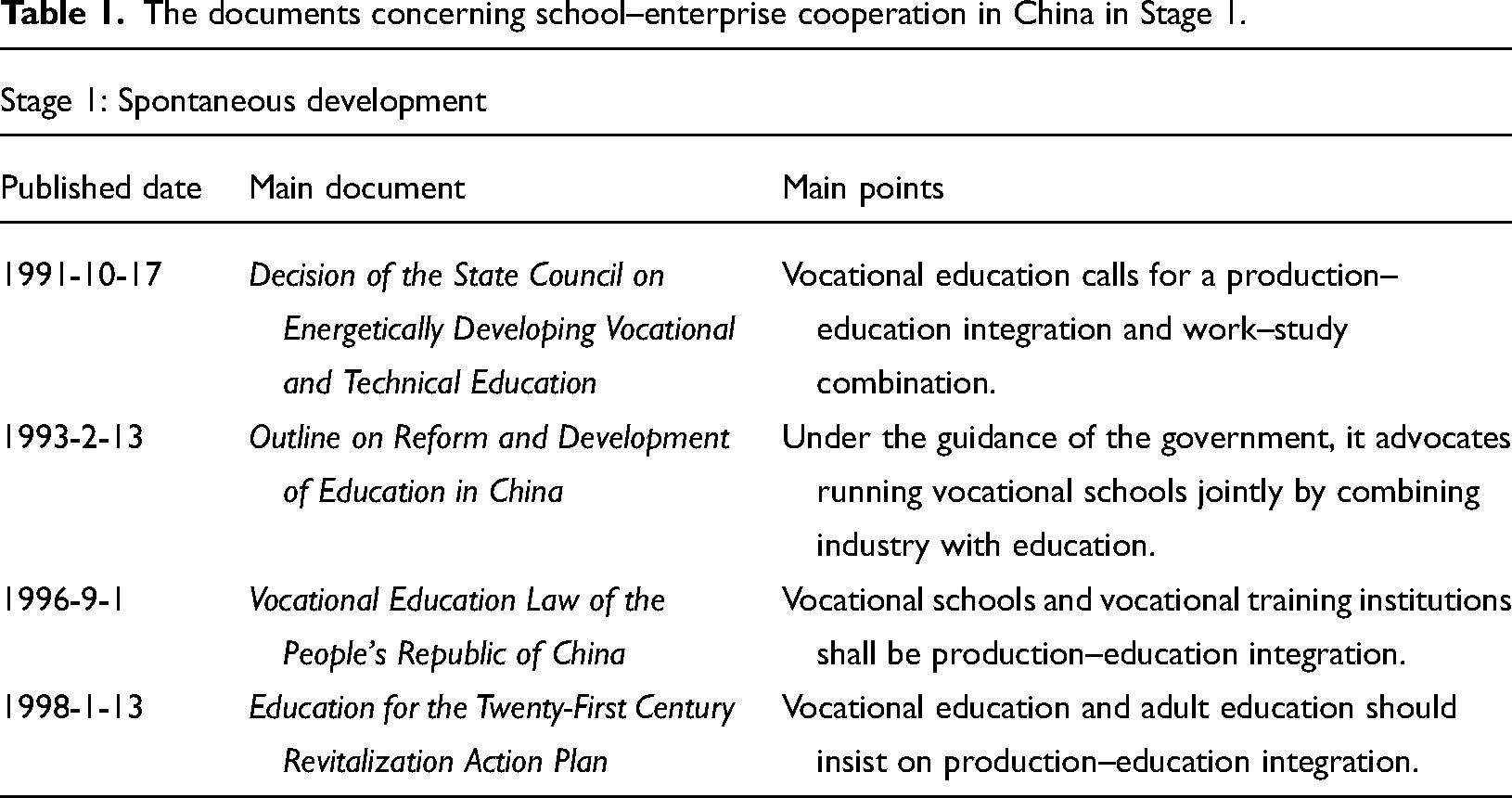
At this stage, it was evident that the Chinese government had noticed the school–enterprise cooperation, but did not further discuss its implementation. There are two possible reasons for this. First, we must consider the impact of the “cultural revolution” (1966–1976) on vocational education. During this decade, many vocational schools were closed because vocational education was viewed as inferior for workers and farmer families (Wu & Ye, 2018). In 1976, secondary vocational and technical schools accounted for approximately 6% of all Chinese secondary schools (Zhang, 2011, p. 259). In the new era of reform and opening-up, the Chinese government had to focus on the scale development of vocational schools and colleges instead of their quality improvement. Therefore, promoting cooperation between vocational schools and enterprises to improve their quality was not a priority. Second, the economy was a vital factor. Since 1978, the Chinese economic system has gradually transformed from a planned economy to a socialist market economy. Vocational schools had a cooperative relationship with enterprises and industries in the planned era due to government arrangements (Xu, 2018, p. 128). China did not establish a socialist market economy system during the first 20 years of its reform and opening-up. Thus, under the “planned” influence on education, vocational schools and enterprises could maintain a relatively ideal relationship. Despite some problems with cooperation, it still did not attract considerable attention from the government (Xu, 2018, p. 129).
Stage 2 (2000–2004): Central position establishment
Stage 2 played a central role in the development of vocational education. The Chinese government became more aware of the significance of school–enterprise cooperation, indicated by its more frequent mentions in educational policies. The Decision of the State Council on Vigorously Promoting the Reform and Development of Vocational Education (document no. 16 [2002] of the State Council) was the first policy to put school–enterprise cooperation in a vital position (Xu, 2018, p. 130). It repeatedly stressed that the development of vocational education should depend on collaboration with enterprises and industries. One measure in this Decision explicitly put forward the task of strengthening vocational schools’ connections with enterprises, industries, and other employers, as well as establishing a close linkage mechanism between vocational schools and the labor market (State Council of the People's Republic of China, 2002). Two years later, the Ministry of Education (MOE) of the People's Republic of China issued Action Plan for Education Revitalization, 2003–2007. This policy was significant because it further specified measurements for vocational school–enterprise cooperation (Xu, 2018, p. 131). Some concepts, such as collaboration between vocational schools and enterprises for customized training, were relatively new at the time. To conduct the plan effectively, in the same year, Opinions of Seven Ministries and Committees of the State Council on Further Strengthening Vocational Education (document no. 12 [2004] of the Vocational Education and Adult Education Department of the MOE) was published. In this policy, the term “school–enterprise cooperation” was used for the first time in a formal policy document. The main documents are shown in Table 2.
The documents concerning school–enterprise cooperation in China in Stage 2.
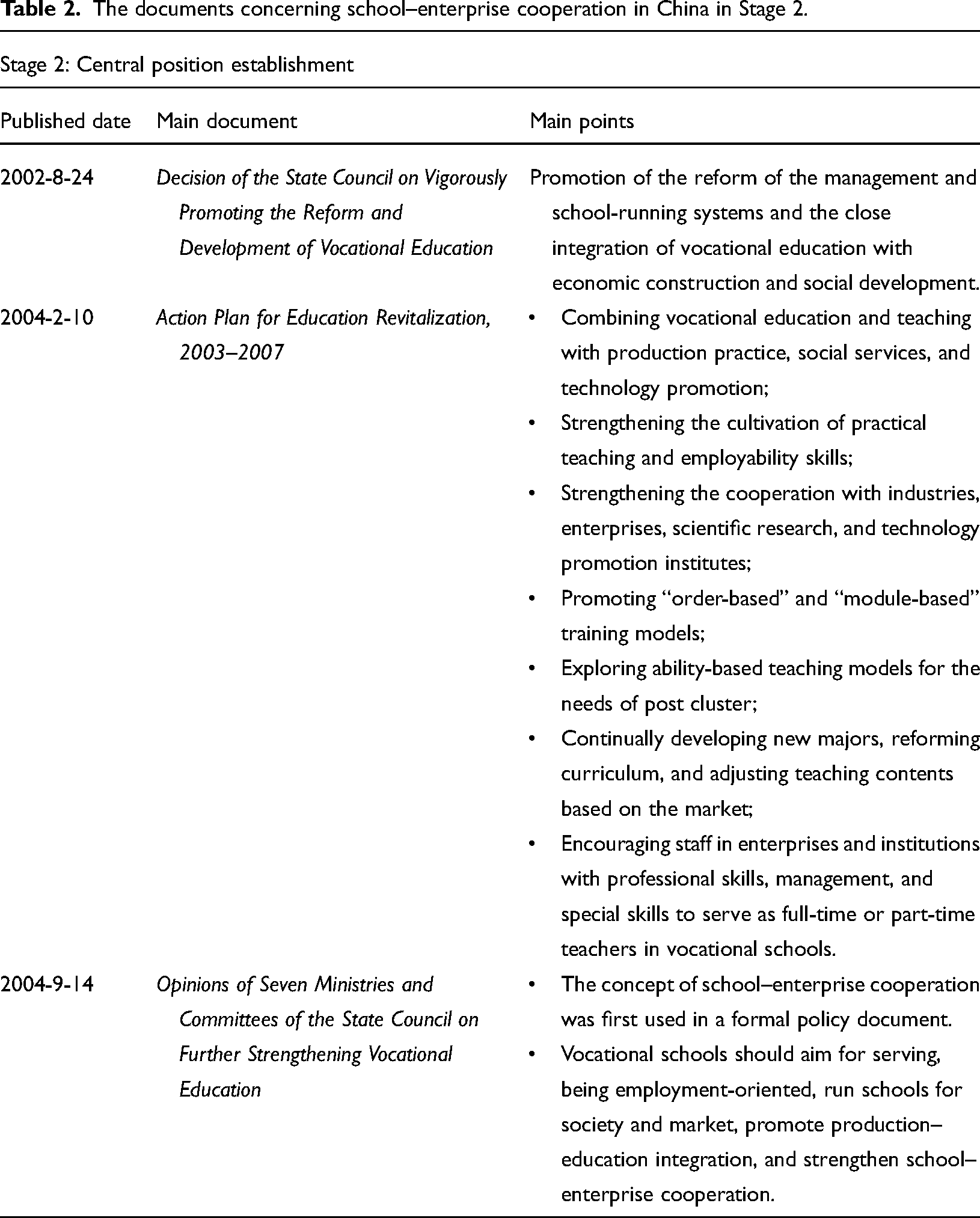
A critical characteristic in this stage was that school–enterprise cooperation played a central role in developing China's vocational education (Xu, 2018, p. 130). Its status had distinctly changed in these critical educational policies and began to occupy an increasingly prominent position with more frequent discussions, detailed tasks, and content descriptions. There are several possible reasons for this change. First, in the twenty-first century, the Chinese government shifted its attention from scale development to quality improvements in vocational education. According to a statistical report on China's vocational education in 2000 (MOE, 2000a), the total number of secondary vocational schools had increased to 16,361, accounting for 17.5% of all secondary schools, and there were 442 higher vocational colleges accounting for 42.5% of institutions in higher education. The overall scale of China's vocational schools was no longer small. Therefore, the Chinese government began to pay more attention to the quality improvement of vocational education. School–enterprise cooperation, as one of the most essential measures to improve vocational schools’ quality, naturally caught the attention of the government. Second, people became profoundly aware of the significance of school–enterprise cooperation in vocational education after an enrollment crisis. According to the data statistics of MOE, the enrollment of secondary vocational schools (including specialized secondary schools, artisan schools, and vocational high schools) increased from approximately 1 million in 1980 to more than 4 million in 1997 (MOE, 1997) and then dramatically dropped to approximately 3 million in 2000 (MOE, 2000b). After several attempts to attract more students, vocational schools finally realized that more enterprise involvement was needed to adapt to the socialist market economy to maintain the characteristics of vocational education. They had to transform the curriculum of the labor market in a planned economy to be strongly related to employment. Third, with the establishment of a socialist market economy system in the twenty-first century in China, economic sectors and enterprises without government arrangements seldom participated in vocational education. However, relying solely on market mechanisms could not generate effective cooperation between vocational schools, industries, and enterprises. Therefore, the Chinese government and vocational schools urgently needed to find other ways to contact the labor market.
Stage 3 (2005–2017): Systematic design
In Stage 3 (2005–2017), under a more systematic design of the Chinese government, school–enterprise cooperation maintained its prominent position in policies with more detailed descriptions. Undoubtedly, this was at the core of Chinese vocational education policies. The Decision of the State Council on Rapidly Developing Vocational Education (document no. 35 [2005] of the State Council) was the first policy to systematically expound school–enterprise cooperation. Although it stipulated several priorities for the development of vocational education in this short but critical policy, the promotion of better links between vocational schools and enterprises was launched at great lengths. Its significant contribution was to mention that school–enterprise cooperation should be conducted systematically and comprehensively from top to bottom. The government should promote the participation of industrial sectors and associations in vocational education. In terms of the school running system, a variety of active enterprise involvement was encouraged. In terms of the teaching reform, it stated that vocational schools should strengthen the cultivation of students’ practical abilities and vocational skills (State Council of the People's Republic of China, 2005). Work plans published between 2006 and 2009 and the subsequent vital documents of MOE all followed the requirements mentioned in the Decision, such as the Outline of the National Medium- and Long-Term Program for Education Reform and Development 2010–2020 in 2010, and Opinions of MOE on Giving Full Play to the Role of the Industry to Promote the Reform and Development of Vocational Education (document no. 6 [2011] of the Vocational Education and Adult Education Department of the MOE). The main documents are shown in Table 3.
The documents concerning school–enterprise cooperation in China in Stage 3.
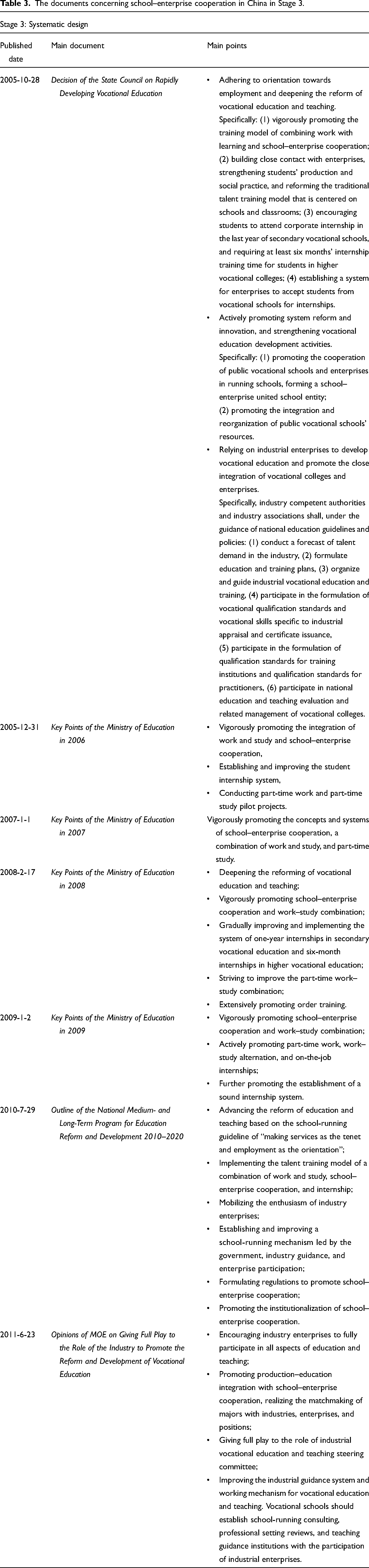
Generally, vocational school–enterprise cooperation had made significant progress at this stage. First, school–enterprise cooperation was recognized as the basic characteristic of vocational education (Xu, 2018, p. 136). During this period, almost all MOE documents on vocational education mentioned school–enterprise cooperation. Furthermore, nearly all vocational schools had introduced cooperation with enterprises when it came to running their schools. Its importance in vocational education had been firmly established. Second, the modes of school–enterprise cooperation diversified. Internationally, there were three typical forms of company integration into VET: company-based VET (apprenticeship), cooperative education, and alternating training (Choy et al., 2018, p. 78). At this stage, the company-based form was not popularized in China, but there were some successful trials, such as the practice of the Taicang Vocational Education Center School in Jiangsu Province. This school imitated the dual VET system of Germany by integrating company-based and contractually regulated training arrangements into their secondary vocational school. The cooperative education model was more frequently encountered. Vocational schools usually cooperated with one or more local companies, based on a particular degree of commitment. It was not governed by nationally institutionalized or regulated duality. Some cooperative education closely integrated the teaching process with the enterprise's production process to increase the practical relevance of the training. Some were encouraged by financial advantages through contributions from tax money. An alternating training model, that is, the coexistence of dual VET (company-based VET system) and school-based VET, was the most prevalent. The study phases at school and the practical phases at the company were alternated, using methods such as practical placements.
Stage 4 (2018–present): Institutional construction
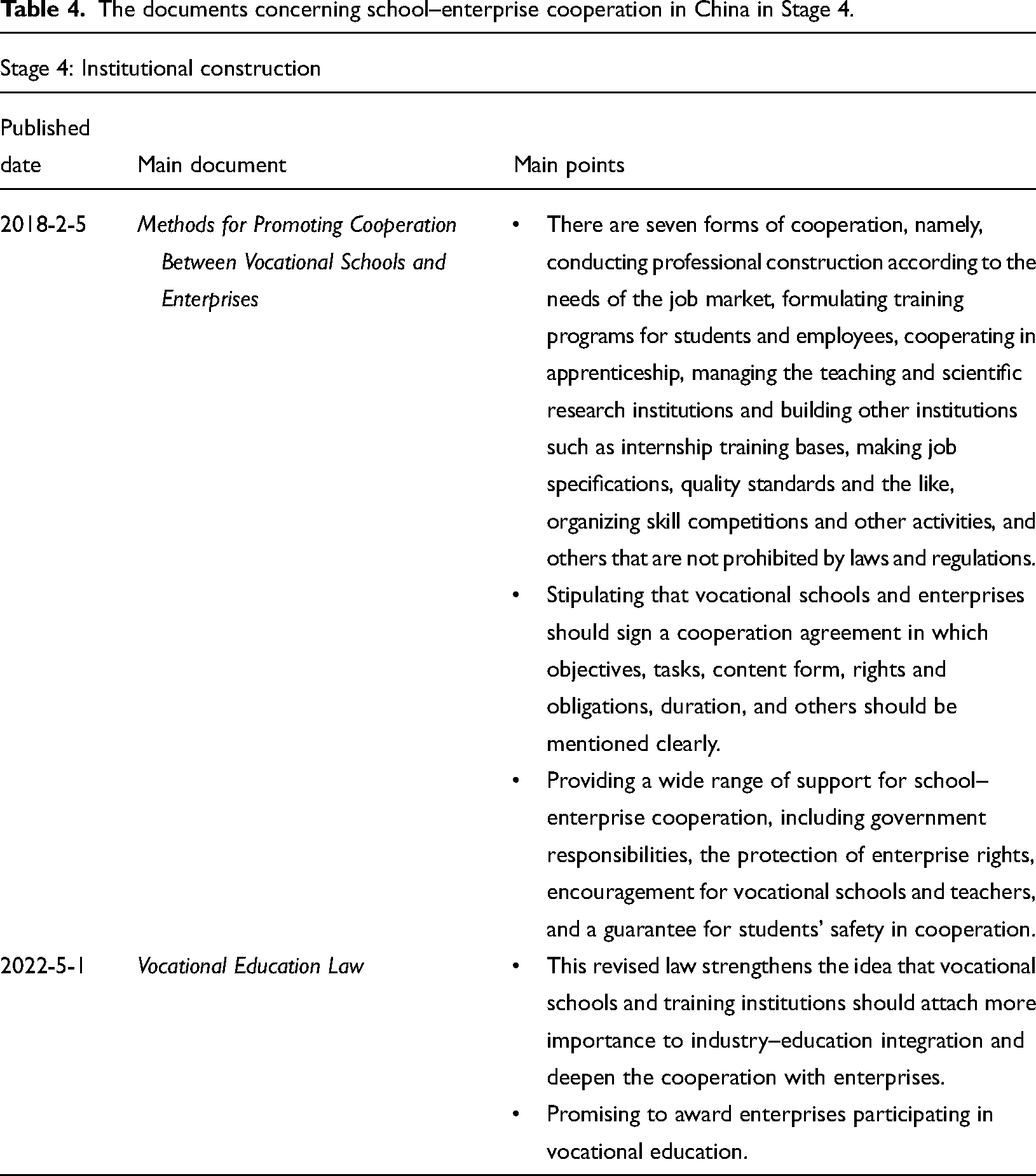
Stage 4 marked the institutional construction of vocational school–enterprise cooperation. The lack of institutional guarantee for the school–enterprise cooperation ushered a series of issues, such as inadequate protection for the interests of companies that cooperated with vocational schools, resulting in the failure of many cooperative projects (Zhao, 2011). To address these problems, a few cities in China implemented policies; for example, the city of Ningbo issued Regulations for Promoting School–Enterprise Cooperation in Ningbo's VET in 2008, which was the first regional law in China. To improve upon this, in 2018, the MOE published Methods for Promoting Cooperation Between Vocational Schools and Enterprises (document no. 1 [2018] of the Vocational Education and Adult Education Department of the MOE) in association with five other departments and ministries. The Methods established forms, promotional measures, and supervision for vocational school–enterprise cooperation, which formed an institutional framework (Vocational Education and Adult Education Department of the MOE, 2018). In 2021, a draft amendment to the Vocational Education Law was discussed by China's top legislature, the Standing Committee of the National People's Congress. In 2022, the revised Vocational Education Law encouraged enterprises to participate in vocational education and promised them an award, such as a tax reduction. The main documents are shown in Table 4.
The documents concerning school–enterprise cooperation in China in Stage 4.
Current problems of school–enterprise cooperation in China
Retrospectively, the Chinese government has made considerable efforts to allow school–enterprise cooperation to adapt to the large shift from the planned economy to the socialist market economy. However, certain problems remain.
First, the enthusiasm of enterprises is not stimulated enough to get them fully involved in VET. Generally, there are three possible motives that drive enterprises to cooperate. The first is to give them priority selection of potential excellent skilled workers from schools. Next is Guanxi, especially when leaders of vocational schools have a cordial personal relationship with managers of enterprises, cooperation becomes relatively easy to build. The final motive is economic profits; for example, enterprises take vocational students as cheap labor during their internships. Although Chinese enterprises are willing to cooperate with vocational schools (Zhang, 2021), the cooperation is unsustainable. Enterprises seldom think about cooperation from the perspective of how to better train technical and skilled personnel and how to establish a talent guarantee for the transformation and upgradation of industrial sectors, not to mention a sense of social responsibility (Xu, 2018, p. 139). Cooperation for the above purposes has no use for vocational education to improve teaching quality, and can even be harmful to vocational students.
Second, the lack of coordination impedes the school–enterprise cooperation, and there is a consensus on this in China. One reason for the lack of coordination is that the vocational education system is different from the market system; thus, coordination between two different organizations is required. Another reason is that enterprises no longer have the responsibility for vocational education as they once had in the planned economy. Thus, the government must follow the laws of the market and cannot command enterprises to cooperate with vocational schools. However, China does not have any communication platform devoted to vocational school–enterprise cooperation at the national and local levels. Unlike in Western countries, where there are numerous independent social organizations playing an intermediary role between vocational schools and enterprises, Chinese social groups have limited power and rely on the government (Pei & Parris, 2020). Even representative social groups such as the Chinese Society for Technical and Vocational Education do not have a systematic plan to invite people in enterprises to participate in their groups. So, who plays this intermediary role? This historical review shows that it is the government, specifically, the vocational education department that leverages the principal role through policy initiatives. This contradicts the second reason that the government cannot command enterprises to get involved in the cooperation. Therefore, the coordination problem appears to be problematic.
Third, the unbalanced development of school–enterprise cooperation in different vocational schools is widespread. On one hand, this imbalance is increasingly apparent in China due to the large economic and social divergence among the eastern, central, and western regions. Cooperation in developed regions is more mature than in less-developed areas. Vocational schools in eastern China take various cooperative measures, such as signing contracts and providing campuses for enterprises to run businesses that are related to the majors of vocational schools. However, vocational schools struggle to survive in poor areas, and it is difficult to find a suitable local enterprise or connect with an enterprise in a developed area. On the other hand, in the same region, the cooperation of specialized secondary schools and artisan schools is usually better than that of vocational high schools. However, higher vocational colleges are better in this regard than secondary vocational schools (Xu, 2018, p. 140).
Fourth, there are some negative factors in these policies. In the 1990s, all the non-productive functions of enterprises were stripped during the reform of state-owned enterprises. This policy adversely affected vocational school–enterprise cooperation, leading to the collapse of the cooperative relationship. Since then, numerous attempts have been made to address this relationship. To date, some similar factors have been identified. For example, an increasing number of vocational schools, once belonging to industries, tend to transfer administrative authority to the MOE. This means that these vocational schools will gradually lose their characteristics by losing their connections with industries. Accordingly, the diversity of vocational schools will be reduced. In the process of policy-driven development (Fan, 2020), the side effects of some policies become disastrous for future school–enterprise cooperation or even negate all previous efforts.
Future outlook
In the future, the importance of school–enterprise cooperation will continue to exist. Reforms related to the problems outlined above are likely to advance in the following aspects:
First, let the school–enterprise cooperation truly serve the talent training of vocational education. The government has implemented several measures to improve cooperative quality. Local governments provide 100-billion-yuan (approximately $14.8 billion) to fund vocational training. Enterprises are encouraged to build vocational training centers. In addition, an academic certificate plus vocational skill level certificate (1 + X) system has been initiated. Several enterprises have been chosen to establish standards for vocational skill level certificates. Driven by these standards, the 1 + X system encourages students to learn more skills while obtaining their diplomas. Moreover, scholars are exploring methods to get enterprises involved in all aspects of talent training in vocational schools, such as developing vocational education curricula and textbooks, by taking advantage of job and competency analysis methods. Over the next five years, a national qualification system will be built. Platforms collecting enterprises’ talent demand will be established so that the data will be organized. In addition, cooperative mechanisms will pay more attention to property rights to guarantee the participation of vocational schools and enterprises (MOE, 2020).
Second, it is necessary to develop intermediary organizations between vocational schools and enterprises. At present, there are 1,500 vocational education groups (MOE, 2020) and 56 vocational education steering committees (MOE, 2019a) aiming to be more open to enterprises and industries. Vocational education groups are designed to provide a platform for communication between vocational schools and enterprises, but they are loosely organized and play a limited role. Overall, intermediaries are still weak in China. For example, although the Chinese government attempts to guide and regulate the development of industry associations, they still cannot play the coordination function in school–enterprise cooperation. Some trade associations have become the tools used by a few interest groups to monopolize an industry. Some are busy with their own financial interests. The development of mature industry associations as in Western countries is a complex process. At present, China stresses the cultivation of 63 enterprises that facilitate industry–education integration. These enterprises enjoy preferential policies for taxes, land, and finance. They are responsible for cooperating with vocational schools in the aspects of apprenticeship, student internship, training bases, and the 1 + X system. They also donate money and equipment to vocational schools. The effects of this should be investigated in the future. Another future trend may be the participation of non-governmental sectors. Although vocational education policies encourage the participation of social forces, such as foundations, social groups, and professional associations, these non-governmental organizations seldom participate in school–enterprise cooperation. Therefore, possible methods of using this social force in cooperation are likely to inspire new research.
Third, it is necessary to achieve a balance in school–enterprise cooperation among vocational schools in different areas. One effective measure that has been adopted is hand-in-hand collaboration between eastern and western vocational schools. The East–West regional cooperation plan established 683 joint training programs during the 13th Five-Year Plan period, offering job skill enhancement for 160,000 people, in which 70% of vocational students were from rural areas (MOE, 2020). In this way, vocational students in less-developed regions can also share in vocational education resources, learn new skills, and find better job opportunities. At present, there is a call for poverty alleviation in China. However, in the future, building a regional coordination system will be listed on the agenda. For example, methods for integrating vocational schools in rural and urban areas and balancing the development of vocational schools at the overall level should be explored.
Fourth, it is necessary to improve the scientific characteristics of vocational education policies. Chinese policymakers constantly adjust strategies according to new problems in school–enterprise cooperation by absorbing new theories and knowledge in vocational education. When the government began to emphasize vocational education, researchers focusing on this field became more prominent throughout the country. In 2019, the Vocational Education and Adult Education Department of the MOE built the Research Base for the Vocational Education Policy at the Institute of Vocational and Adult Education of East China Normal University, one of the leading research institutions in China. Policymakers attempt to listen to suggestions from different scholars and depend on empirical evidence. This represents a considerable improvement in China. However, we must recognize that some negative factors in policies are uncontrollable, especially involving departmental interests, such as the conflict between the MOE and the Ministry of Human Resources and Social Security in China. Since the publication of the National Implementation Plan for Vocational Education Reform in 2019, Chinese policies have shown more result-oriented characteristics (MOE, 2019b) to support the implementation of this Plan. It is foreseeable that future policies concerning school–enterprise cooperation will be more practical and scientific.
Conclusion
After over 40 years of development since the reform and opening-up, the Chinese government now attaches more importance to cooperation. The number of schools engaging in school–enterprise cooperation has increased with the enrichment of cooperation forms and contents, and institutional construction has also started. Through consistent effort, some achievements have generated international implications, particularly for developing countries. The China-ASEAN Education Cooperation Week, which started in 2008, provides a high-end cooperation platform for countries including Kazakhstan, Russia, and Ukraine. They have conducted a series of activities related to youth exchange, vocational school–enterprise cooperation, and the integration of industry and education. Since 2016, China has sponsored eight Luban Workshops in Africa, Asia, and Europe, providing technical and vocational training in cooperation with enterprises. In 2022, the BRICS (Brazil, Russia, India, China, and South Africa) Technical and Vocational Education and Training (TVET) Cooperation Alliance was established, including 63 founding members, businesses, research institutions, vocational education institutions, and associations. These implications have become particularly clear since the Belt and Road Initiative in 2013. For example, the Kenya–China TVET project demonstrates that the Chinese experience that improves the quality of TVET through practical learning has received an increased focus in Kenya (Musyimi et al., 2018).
However, it is notable that although vocational school–enterprise cooperation at the practical level is generally moving forward, China still has a long way to go to achieve high-quality cooperation. First, it is necessary to think more deeply about certain issues, such as stimulating enterprises to participate in VET, coordinating cooperation at the macro and micro levels, maintaining regional balance, and avoiding irrationalities in policies. Second, we must recognize that future reforms are required to build a cooperative system for vocational schools and enterprises in China. Some new possible directions require further research. It is critical to explore methods that allow enterprises to be involved in the entire talent training process. Building intermediary organizations is another urgent task. Third, regional balance is a realistic consideration that China cannot ignore. Fourth, because of the policy-driven power of Chinese vocational education, it is essential to pay more attention to vocational policies.
Footnotes
Contributorship
Guoqing Xu was responsible for research topic selection, history stage division, and characteristics summarization of industry–education integration in China. Yingwen Zhou was responsible for combing policies, finalizing the paper, and responding to reviewers' comments.
Declaration of conflicting interests
The authors declared no potential conflicts of interest with respect to the research, authorship, and/or publication of this article.
Funding
The authors received no financial support for the research, authorship, and/or publication of this article.