




Abstract
Purpose:
This study aims to reveal the recent characteristics of school-based teacher development (STD) in China since it is perceived as a key measure to achieve success in raising educational quality in the country.
Design/Approach/Methods:
A qualitative research approach with in-depth interviews of 18 teachers at two primary schools in Beijing was used.
Findings:
Through the lens of cultural-historical activity theory (CHAT), it was observed that the objectives adaptation of teacher communities was made under the control of the District Education Bureau. STD provides the venue for ordinary teachers to learn, understand, and implement the teaching initiatives promoted by the district. Teacher communities at school level therefore implement continuous professional development initiatives promoted by Education Bureau teaching research officers.
Originality/Value:
This article argues that the administrative style of local government affected teacher community’s object, rules, and division of labor. It also contributes an indigenous interpretation of the CHAT theory.
Keywords
Introduction
In the last two decades, the Ministry of Education of the People’s Republic of China (MOE) has focused on the quality of education. Curriculum reform since 2001 has targeted raising education quality by focusing on students’ all-round development and empowering schools to adopt student-centered teaching (MOE, 2010). School-based teacher development (STD) was viewed as a key element in the success of this curriculum reform. In the meantime, STD is also a key concern of teacher professional development in the international academic arena. This study is guided by three major questions: How do teachers perceive the teaching aims introduced by standardized textbook and teaching initiatives introduced by District Education Bureau? How do teaching and research activities at district level promulgate these initiatives? How does the STD improve teachers’ understanding and implementation of these initiatives?
These three questions reflect the major characteristics and challenges of STD in Mainland China as well as its response to the key concerns in international debate. A qualitative research approach is adopted to gain an in-depth understanding of how helpful the teachers perceived the activities organized by teaching research officers (TROs) and STD activities were in implementing the District Education Bureau’s teaching initiatives. This study is conducted in two primary schools in which one is an outstanding school and one is an ordinary school. Both schools are eager to develop its unique teaching and learning mode or school-based curriculum. STD would help teachers to adopt the new teaching initiatives.
Major issues in teacher development and teacher leadership
Teacher development refers to improving the intimate understanding by an individual in relation to the practice of their profession and influences their professional practice (Evans, 2002). Evans (2002) further identified three major aspects of teacher development as attitudinal, functional, and cultural development. An inquiry structure that supports teachers seeking more effective ways of working with students while collaboratively developing professional knowledge relevant to their individual context, is used (Borko, Jacobs, & Koellner, 2011). Through joint efforts to generate new knowledge and mutual support of their professional growth, teachers form a learning community. Hollins, McIntyre, DeBose, Hollins, and Towner (2004) posited that these changes occur when the learning community focuses on changing teachers’ “habits of mind,” rather than behaviors and pedagogical content knowledge. Snow-Gerono (2005) suggested the community should exercise their judgment to move beyond details and logistics, and “prescribed best practices” by supporting each other in exercising judgment to identify alternative methods and practices.
Cultural-historical activity theory (CHAT) is frequently used to investigate the relationship between teacher’s thoughts and practices. This approach suggests taking productive activity systems as a basic unit of analysis. The activity system encompasses subject (the subjects involved), object (the desired outcome), instruments (e.g., forms of communication, tools, technologies), division of labor (the ways in which work is distributed among members), community (in which individuals operate, and the ways in which work is distributed among members), and rules (including both laws and customs that shape behavior), thus being a collective, artifact-mediated, and object-oriented activity system (Engeström, 2001). Activity is an evolving, complex structure cooperation (Roth & Lee, 2007). A CHAT perspective views human cognition as situated in and distributed across social settings and acting in concert with diverse artifacts. Learning is mediated by social practices and cultural tools, and created by joint participation in activities (Levine, 2010). Learning is the mutual exchange of object and subject just as agents and the nature of their interactions with each other are mutually transformed by modifying the material world. Working across boundaries within separate systems of activity requires a new form of collaborative work (Engeström, Engeström, & Vähäaho, 1999), (see Figure 1) and this boundary crossing between two systems creates a zone of proximal development, a new space for learning. Activity theorists have taken this notion forward in describing how knowledge and expertise transfer between contexts—such as school and work—through a process of “developmental transfer” involving collaboration and the active reconstruction of knowledge between two or more activity systems (Tuomi-Gröhn, Engeström, & Young, 2003). Such a zone is the distance between the actual development level and potential development level as determined through the process of problem-solving (Chaiklin, 2003). The negotiated norms and daily practice within a department greatly influence the engagement and relationships of teachers. Chinese policies promulgated that teachers should have collaborative learning and develop practices suitable for their schools. It is also hoped that teachers in different schools could share their practices. Therefore, the CHAT perspective could help us to investigate the process of how teachers learn together, interact with the school context, and share among schools.
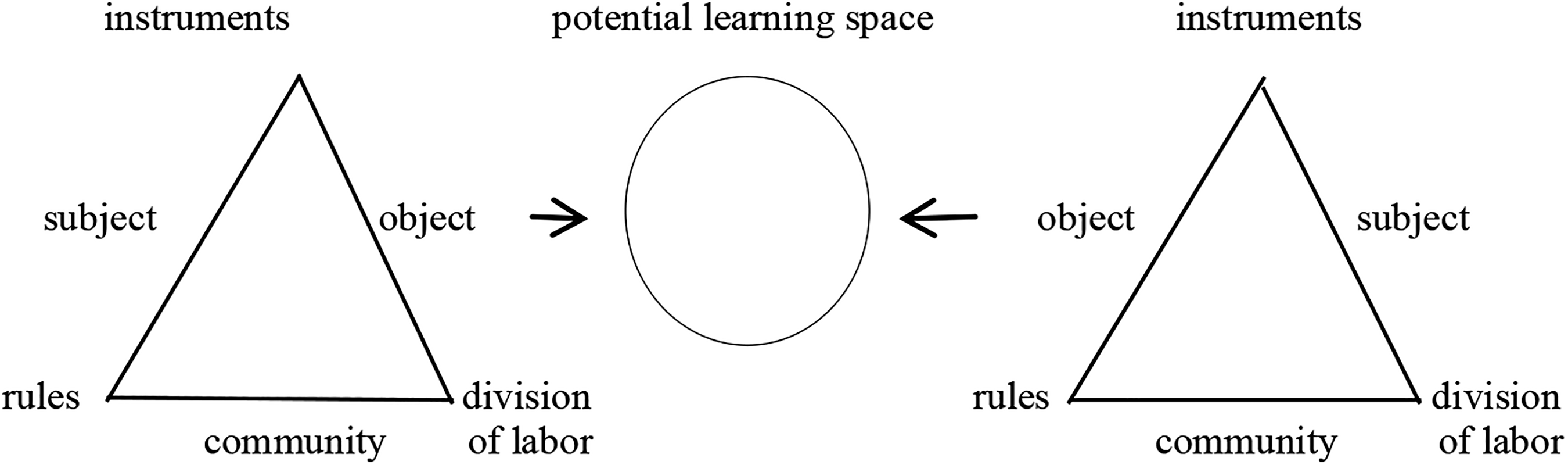
The third generation of activity theory. Source: Engeström, Engeström, & Vähäaho, 1999.
Professional discussion is most fruitful in an environment of safety, trust, care, and common ground. It allows teachers to find and maintain their own voices when working to develop a community vision. The learning community is a space where dissent and disagreement lead to multiple perspectives (Snow-Gerono, 2005). Olson and Craig’s (2001) research emphasized teachers’ autonomy in determining their professional development. Liberman and Miller (2004) found that teacher leadership, as reflexive practitioners, looked to themselves before looking outside for answers. Through engagement with each other, they gained new insights into themselves and their culture, their self-confidence and shared leadership also enhanced in the process (Gonzales, 2004). Learning and leading can be viewed as inseparable (Barth, 2001).
Teacher development and the development of teacher leadership remain contentious fields for discussion, among teachers in different contexts from local to international. In this study, we put the above discussion in the specific context of curriculum reform in Beijing, in order to investigate the characteristics of teacher development in China.
STD in China
In 2010, the Ministry of Education promulgated The opinions on curriculum reform of basic education for promoting quality education stating that teachers should be fully developed as the key agents. Schools should rank teacher professional development as a prominent aim and responsibility. School-based teaching and research mechanisms should be stressed as essential to promote and facilitate teacher’s learning, conducting research, and exchanges (MOE, 2010).
Developing school-based teaching and research activities was identified as a prerequisite to make school a learning organization in which teachers could achieve their goals and continuously improve (Xiao & Hu, 2007).
However, the school-based teaching and research activities emphasized administrative control at the expense of professional development and this led to formality and a narrow focus. TROs, of different subjects working under the Teacher Continuing Education Office in the local Education Bureau, were effectively in control of daily STD. They also managed public examinations at the city level, organized the various teacher competitions, and conducted exemplary lesson demonstrations fortnightly. Activities focused on polishing a lesson (磨课, moke), which is the collective refinement of an open (to teachers) lesson to try and make it match an ideal of best practice (considered exemplary by the TRO). These competitions were a performance of a lesson staged before an audience of teachers and this mode caused teachers to be a follower who carried out instructions rather than an agent who could actively find, analyze, and solve their own practical problems while teaching a class of students. For ordinary teachers, teaching and research activities were mainly the work of the outside experts and a few “backbone” teachers and divorced from their daily work. This in turn dampened their enthusiasm or even led to passive resistance among ordinary teachers. Surveys found that major problems were the disinclination to raise questions and limited discussion during the teaching and research activities including beikezu (备课组) which consisted of discussion among teachers of the same subject in the same grade. The top-down management mode in school and the avoidance of delegation of leadership within subject panels also contributed to “passive participation” in the teaching and research activities (Fan & Tan, 2015; Wang, 2014). The studies conducted by Chinese scholars highlighted some problems in STD. However, the above studies tended to be descriptive and seldom employed rigorous theoretical framework to have in-depth analysis. Further studies which refer to international academic discussion and employ solid conceptual framework to have in-depth investigation are needed.
Research method
Data were collected by semi-structured, in-depth interviews conducted at two primary schools in Beijing selected by purposive sampling. The two sample schools consisted of one outstanding school and one ordinary school. Both schools were eager to develop its unique teaching and learning mode or school-based curriculum. STD was important for teachers to adopt the new teaching initiatives. The characteristics of two sample schools and teachers’ perceptions on STD could help to collect relevant and rich data closely related to the research questions. Although the education system no longer nominates “exemplary schools” with every school now being a good school, residual differences in standards remain. Primary school D had been an exemplary school with a student intake comprised mainly of children of governmental officials and intellectuals. There are 35 taught classes, 1,160 students, and 96 teaching and ancillary staff members. School D promotes its students to be an “international person” (global citizen) with English teaching as its major strength and was developing the “Sunshine school based curriculum,” a “brand name” coined by the school promoting “less teaching, more learning” as the school development aim. It had received an honor from the Beijing Education Bureau for ranking in the top 100 schools for nurturing outstanding young teachers, outstanding school-based teaching, and an advanced teaching and educational research unit.
Primary school X developed in the 1990s. There are 22 taught classes, 795 students, and 78 teachers and staff members. School X emphasizes development of the school through teaching and research activities. The embedding of traditional culture such as cultural games, sports, and arts into classroom teaching had achieved fame as a school-based curriculum. This emphasis of traditional culture was acknowledged and acclaimed as a research project at the city level, a classification which is highly prestigious in Chinese society. The school had collaborated with the National Institute of Education Sciences and the institute had sent a number of experts and graduate students to help develop this school-based curriculum. However, it had not been an exemplary school due to the ordinary family background of its student intake.
Data collection mainly based on in-depth interviews. Additional information would be added by the analysis on relevant policy papers and school documents. The interviews were conducted with 18 informants made up of subject panel heads and regular teachers. All interviews were recorded electronically and then transcribed for later analysis. Purposive sampling was again used, the selection criteria being based on subjects taught, administrative duties, and length of service namely less than 5 years’ experience, 5–10 years’ experience, and more than 10 years’ experience (see Table 1). Teachers in different subjects, with different positions and teaching experiences will have different interpretations on STD. The subjects Chinese, English, Mathematics, and Arts were represented in the selection of informants. Chinese, English, and Mathematics, as key subjects, received the greatest attention in “achieving STD.” Arts was considered a marginal subject and received the least attention in the measure of teacher development. Teachers in these four subjects faced different challenges and had different resources for achieving STD. Please refer to Appendix A for initial interview questions.
After the interviews, a systematic analysis will be done of the transcripts, with the aim of identifying concepts, categories, and themes arising from the data. The first step in the coding process will be an analysis of each teacher’s data to identify codes that have emerged as pivotal to his or her perception on STD. Then, we will begin a cross-case analysis to identify recurring patterns and differences across the cases. By viewing the extracts from all the teachers’ texts together, and periodically stepping back and searching for patterns of meaning within the statements and codes, we will be able to identify extracts that suggest the shared perceptions of the teachers, as well as differences across the code headings. The first and second levels of abstraction will also help to generate major themes emerging from the field data. In addition, coding, memoing, and indexing will be facilitated by using NVIVO [Version NVIVO 11].
Biographical information of 18 informants.
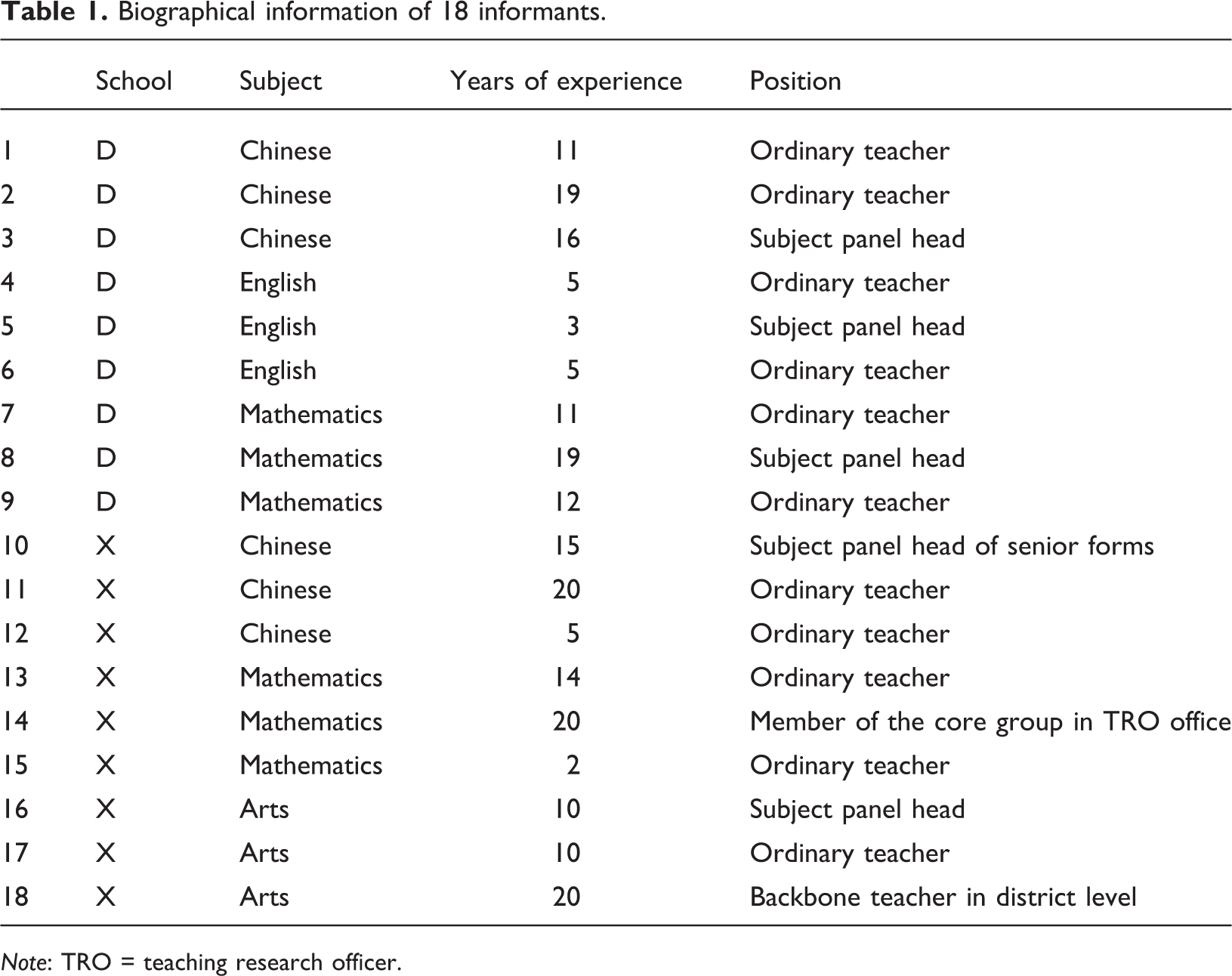
Note: TRO = teaching research officer.
Findings
Developmental aims directed by District Education Bureau
The curriculum aims are set out in a national standardized textbook and the teacher preparation handbook. These form the specified guide for producing the teaching aims of each lesson. A Chinese teacher in School X shared that the curriculum aims are set by the central government…When we have collective preparation for the coming lessons, we have to look at it…For each grade, there are different aims. You could not go beyond the set aims…You have to teach according to this detailed road map.
The curriculum aims including the required knowledge every student should acquire are clearly stated in the standardized textbook and teaching preparation handbook. Ordinary teachers developed the teaching aims of each lesson from this. Another Chinese teacher in School X reported that students in Grade 1 should learn 1,600 words and write 800 words. If teachers within the lesson preparation group (beikezu) allowed too much time for writing words during a certain lesson, then they must agree on adjustment of the time according to the curriculum aims.
The TROs had set ‘Happy Lesson’ (student-centered interactive) for School X and “Integrated Reading” for School D as the key teaching initiatives for Chinese teachers in the year we conducted the fieldwork. A Mathematics teacher in School D said, “All the teachers in the district must attend these activities. Therefore, the major teaching direction (for teachers of the same subject within the district) is the same.” Most of the ordinary teachers perceived that they learnt what teaching approaches they should employ or the clear steps of teaching through the above activities, particularly the lesson demonstration and the comments made by the TRO after the lesson demonstration. Standardized student assignment booklets and standardized tests at the district level also helped to control ordinary teachers’ conformity to the teaching initiatives promoted by TROs. The TRO’s regular lesson supervision and use of the district lesson assessment form, issued to schools to monitor the teachers’ teaching, also ensured conformity with district directives.
Second, teachers have to implement the district directives because the TROs regularly conducted observed lessons for ordinary teachers. A Chinese teacher in School X shared that they (the teaching research officer) taught us (the new teaching initiatives)…If you could not perform well in teaching, measured by the students obtaining the required knowledge and competence set by the teaching research officer, it indicates that you could not implement (the district directives) well in your daily teaching.
Whether teacher’s teaching approach was right was determined by the TRO. A music teacher in School X memorized the experiences after an open lesson observed by a TRO, “He (the teaching research officer) considered my lesson was quite good…He gave me the direction, gave me the strength, and let me know my teaching approach was correct.” In addition, the school also employed the assessment form for lesson observation set by the district bureau for their within-school teaching competition. This further aligned the school with the rational directions promoted by TROs.
Third, throughout the year in which the fieldwork for this study was conducted, most teachers adopted similar teaching steps, based on the TRO’s teaching approach. An English teacher in School D stated, In English, the major teaching approach is definitely conversation…Under this direction…surely your steps of teaching could not be departed from the above control…Our teaching steps include warming up, teaching, doing exercises, and having outcome…You shall (teacher stressed) hold this direction.
Another English teacher in School D shared his lesson preparation experiences, in fact, both of us (the two teachers within the same lesson preparation group) prepare the lesson in the same way…We will not have different approaches…We teach at the same grade that the curriculum aims are standardized…In reality, our teaching plan will not have explicit difference.
Each school may develop its own plan but, teachers stressed, there will be consistency between the district teaching initiatives and school aims. An English teacher in School D said, I think there is no conflict…There are directions set at district level…Then we (the school) shall follow the district line…Basically it (district directives) is a framework, we (our school) can only add things to enrich it within the district framework.
In general, most teachers adopted similar teaching approaches guided by TRO. The extremely limited autonomy for changes teachers may make was only adding local relevant examples and reducing the number of exercises to make the TRO’s teaching initiatives feasible in their schools.
Manifestation of TRO’s initiatives at district level
The TRO’s exemplary lesson demonstration was the key instrument and ordinary teachers tried their best to assimilate it as the rule of the teacher community at the district level. It was “a copy.” A Chinese teacher in School D said, “Finally, we shall grasp the teaching approaches promoted in our district as the key principle.” TROs thought ordinary teachers may not grasp the correct directions of the new curriculum, so they offered seminars to help analyze the textbook, pointing out the teaching aims, key points, and difficult points of each unit and explaining the background of certain pictures and exercises in the textbook. Exemplary lesson demonstrations acted as the major instrument for distributing teaching ideas. Ordinary teachers could understand easily and grasp what they should do on each set step of teaching by observing the exemplary lessons.
A Chinese teacher in School X shared the importance of ordinary teachers imitating exemplary lessons immediately after they were delivered by the TRO and embedding the methods and ideas into their classroom teaching. A Mathematics teacher in School D stressed that “We shall assimilate exemplary lessons…they concentrate experts’ wisdom…recognition by district teaching research officers is important to us. Those lessons are exemplary and we shall copy their teaching approaches.” A Chinese teacher in School X said, The three dimensions of teaching are: knowledge and competence…process and method and finally, emotion, attitude, and value…You have to embed these dimensions into your lessons…These approaches have been promoted for years…the teaching research activities in our district keep emphasizing the quality.
Core teachers who were the 10–15 members of core group selected and guided by TRO also performed exemplary lessons. The core group’s preparatory discussion focuses mainly on clarifying the teaching aims, identifying key or difficult points of the text, sequencing, and such details like blackboard use. The TRO then advised improvements to the lesson during the rehearsal perhaps anticipating difficulties for the students. Then, even if the lesson design appeared good, it was redesigned as it had to be the best example for ordinary teachers. A core Mathematics teacher in School D said, Other suggestions (from core teachers) I will hear, but I will take the TRO’s advice…We work for the TRO (to perform the exemplary lesson)…He (the TRO) is the director…If anything unclear, the TRO will make the final decision.
Many ordinary teachers who were school teachers and compelled to attend the activities organized by TRO used to observe the exemplary lesson seriously and unquestioningly. If teachers raised a question, the core teachers further explained the rationale of the promoted teaching approaches. A Mathematics teacher in School D explained, The core teacher explained the rationale behind the lesson. Ordinary teachers understood the rationale but did not question it beyond the TRO’s theme. Some TROs asked teachers to write down their observations or questions and collected them, but did not respond. Teachers reflected that they had no voice. Experienced teachers showed dissatisfaction by being passive. New teachers (three years or less experience) were not confident to consider their own satisfaction. The TRO guided the discussion and would not let it go beyond his/her promoted themes. Using a CHAT model, in the teacher community at the district level, the community consisted of the teaching research office, a core group, and teachers who taught same subjects within the district as major subjects. The objectives were decided by a teaching research officer. For division of labor, the teaching research officer worked as director, core teachers in core groups worked as performers, and ordinary teachers worked as followers or audience. The exemplary lesson was the major instrument. The rule was mainly introducing the new teaching ideas promoted by the TRO using the exemplary lessons.
In the third stage, ordinary teachers implemented the district directives at school level by dividing students into different ability levels, extending the exemplary lessons into two lessons that fitted their students’ ability, or adjusted the examples so that their students could understand. A Mathematics teacher in School X considered that the major steps of teaching would be similar in every school within a district. The adjustment would be the number of exercises, different strategies, or teachers’ help with the exercises. If their student’s ability was lower than other schools, teachers lowered the degree of difficulty and reduced the number of exercises for each lesson. During the process of implementation, the adjustment may also include the provision of examples closely related to their students’ lives. An ordinary teacher will adopt 70% of the exemplary lesson in one ordinary lesson and finish the remaining 30% in the following lesson. However, they will cover the whole procedure of the exemplary lesson since teachers perceived that the knowledge system of the exemplary lesson at district level was perfect and should be fully adopted.
Art teaching in ordinary schools is one example of such changes. The district requirement was that every student created their own artwork for a lesson about color. Teachers in the schools with lower students’ abilities divided students into high, medium, and low levels. The high-level students created their own artwork. The medium-level students could change teacher’s set design and low-ability students were shown how to use different colors on the teacher’s design. However, though there were minor adjustments, it was definitely clear that teachers in schools with lower student attainment tried their best to implement the teaching approach that had been promoted by the district. Therefore, teachers in ordinary schools perceived that most teachers were able to adopt 80% of the exemplary lesson in their ordinary lesson. The remaining 20% may require adjustment due to the low ability of the students in their own school.
Manifestation of TRO’s initiatives at school level
Teachers’ contribution to teaching at school level is manifestly controlled to reflect that seen at district level. At school level, an additional layer of activities ensures the Education Bureau’s directives demonstrated by the district education research officers are adhered to and these are channeled through the panel head who will ensure teachers implement the teaching approaches promoted by the TRO. A Chinese teacher in School D reflected, There should be directed initiatives from time to time at the district level. Then we shall carry out lesson adaptation to implement the teaching directions set by the teaching research officer…conduct the teaching research activities at school level…The subject panel head shall guide the panel members to have in-depth knowledge of the directives of the TROs.
As teachers cannot immediately digest the teaching directives from district level, STD activities, teaching, and any research activities within subject panels are the venue for digesting and implementation of district directives. Subject panel (beikezu), a group of teachers who teach the same subject in same form, who gather together to discuss lesson preparation, are the major communities for teacher collective discussion. Following the teaching approaches promoted by the TRO and stressed in subject panel meetings, another Chinese teacher in School D shared that she used one third of her lesson for extended reading set by the TRO in addition to the textbook. She explained that she used a certain proportion of her lesson time on extended reading because it was promoted by the TRO that year. Within her lesson preparation group, teachers added one more question for classroom discussion, regarding the extended reading. To accommodate the increased test questions on extended reading in the standardized test at district level, teachers increased the number of extended reading test exercises to familiarize students with that kind of test question.
Secondly, teachers could make only peripheral adjustments during the implementation process. Inexperienced teachers (under 3 years of service) are closely guided in their teaching approach. This ensures common teaching approaches between novice and experienced teachers. A Chinese teacher in School D said, “No matter what we discuss, we could not discard the teaching guidelines directed by national textbooks and the TRO. There shall not be common sense mistakes.” A Chinese teacher in School X said, There should be a principle (teaching according to the direction of the TRO or bases on textbook), therefore, we shall only adopt the principle…In the implementation process…teacher will self-censor his/her own ideas.” She stressed that “he must learn how to look at the cat and draw the tiger, to some extent, ‘jump through hoops’…the first step should be assimilation…then he shall understand why I teach in this way and how I implement different teaching aims.
Therefore, assimilating the mentor’s teaching approach reinforced similar teaching approaches among young or inexperienced teachers ensuring alignment with district directives. Another Chinese teacher pointed out a concrete example of the marginal nature of adjustments. When she taught Chinese characters, she adjusted her lesson by not letting every student participate in reading out the Chinese characters even though every student had participated in reading characters in the district exemplary lesson. However, the teacher adhered to the teaching design which stipulated every student to read, by letting some students read. An English teacher in School D considered that for the selection and delivery of exercises, teachers may have their own ways to show they were both implementing the district directives and accommodating their students’ ability.
Panel activities aimed to align teacher’s thoughts to conform to the national textbook and district directives and panel members seldom had formal meetings for collective lesson preparation in our two sample schools. Within a lesson preparation group, teachers divided up the writing of the lesson plan and preparation of teaching material for different units and then shared it among teachers who taught the same grade. They chatted or exchanged teaching ideas informally in the staff room. In the informal exchanges, teachers respected experienced colleagues’ suggestions as the experienced teachers had encountered different students and problems in the past. Informal chat, respecting the experienced teacher’s suggestion, sharing the workload to prepare the lesson plan and teaching materials were the major avenues for teacher collaboration within the lesson preparation group.
Even though regular collective lesson preparation with other subject panel members was absent, there were two to three teaching research activities (教研活动, jiaoyan huodong) every year for the whole subject panel. Teaching research activities (jiaoyan huodong) is the local term, but in practice the activities can be better understood as a teacher workshop. A Chinese language teacher gave an example of a teaching research activity. All the subject panel members read one article suitable for teaching material. This activity was reading for key points and difficulties to ensure teaching aligned with that promoted by the national textbook and TRO. The teacher shared that “teachers arrived at a consensus after the activity…If I found different key and difficult points, I try to see why I chose incorrectly.” Achieving consensus was the major rule of teacher collective discussions at panel and lesson preparation group level.
Lastly, through collective preparation for an open lesson or lesson competition, ordinary teachers tried their best to learn district directives and produce lessons which conformed to what they had seen. Other than the informal chat among teachers in the staff room, the other important occasion for teachers to communicate was by a formal collective lesson discussion when someone offered an open lesson. Open lessons at school level are lessons that all teachers in the school, regardless of subject, can attend and observe. An open lesson at district level is a lesson that all teachers who teach the same subject in the district must attend and observe. Teachers will have formal discussion when they participate in lesson competitions at school or district level. Preparing an open lesson at school and district level is also the key instrument for distributing teaching ideas promoted at district level. There should be continuous adjustment until the open lesson was unanimously considered to be aligned with the district directives. An Arts teacher in School X explained the details of how colleagues help her with her open lesson. When she showed her lesson plan to colleagues, they mainly confirmed whether her teaching aims, key, and difficult points were aligned with the set teaching aims in the textbook. After confirming the direction was right to meet national and district directives, then colleagues observed her rehearsal to help solve any problems found during teaching. Particular attention is paid to whether her teaching design fits with the set teaching aims and the ability of students in that grade, which has been clearly differentiated by a TRO. If colleagues found that a certain part of her teaching could not align with the set teaching aims and set student ability, then they discuss it and she revises her teaching accordingly. After that, she rehearsed more in other classes. After several rehearsals and changes of the teaching methods of certain parts, the open lesson will become the model lesson within the school. Other teachers would try to assimilate the model lesson if they teach the same subject. A Mathematics teacher in School D shared what to do if there were different ideas on certain parts of the teaching in the open lesson. In the case, one colleague taught a class in one way, and another in another then it was decided which one was better and students were most responsive to. Finally the teacher, for his or her open lesson, will select the approach that better mirrors the teaching approaches promoted by the TRO.
Discussion
First, by employing CHAT as the heuristic tool, this study showed that the objects of the teacher community are directed by the District Education Bureau. The curriculum aims are already set in the standardized textbook and the lesson preparation handbook for teachers also helps to reinforce them. The TRO develops new teaching initiatives every year within the framework of the national curriculum and finds points to help ordinary teachers better implement the national curriculum aims. Therefore, there will be district directives issued regarding new teaching initiatives promoted by the TROs at the district level every year. Regular teaching supervision conducted by the TRO, the standardization of student assignments and uniform tests within the district, and the employment of a teaching assessment form set by the District Education Bureau in school also enforce the implementation of district directives.
Second, under the careful control of the TRO, the teacher community at district level is the venue for ordinary teachers learning and understanding of the teaching initiatives promoted by the District Education Bureau. Based on the observations of the two sample schools, our study showed indigenous interpretations on the key elements and nature of CHAT (Engeström et al., 1999). The teaching and research activities every 2 weeks constituted the teacher community at the district level and ordinary teachers are major subjects to participate. For division of labor, the TRO is the director of the exemplary lesson that helps to promote his or her desired teaching initiatives. The teachers in the core group of the district teaching and research office work as the performers who help guide ordinary teachers on how to implement the TRO’s promoted teaching initiatives through the exemplary lesson. Ordinary teachers fulfill the role of an audience who should carefully learn the promoted teaching initiatives through observing the exemplary lesson, this being the key instrument and discussing it with the core teachers and TROs. The discussion is carefully guided, within the teacher community, at district level, to ensure the discussion would not go beyond ideas promoted by the TRO, who controls the agenda. During the discussion, the questions ordinary teachers raise focus on implementation of the promoted teaching initiatives which constitute the rules of the teacher community at the district level. The discussion guided by TROs is not used to encourage alternative views which may differ from the Education Bureau’s scholars’ expectations on teacher development (Hollins, McIntyre, DeBose, Hollins, & Towner, 2004). In fact, most of the ordinary teachers have little chance to raise questions or to express diversified views in the discussion process.
Third, the teacher community at school level aims to implement teaching initiatives promoted by the TROs of the District Education Bureau. At the school level, subject panel and lesson preparation group constitute the major teacher communities. As there are only three to four teaching and research activities every year in the subject panel, the lesson preparation group is the major community for teacher collaborative discussion. However, teachers in the lesson preparation group mainly discuss lessons through informal talk in the staff room. The panel head and teachers who have earned the honor of backbone teacher (the most outstanding teachers who won many teaching competitions) at district level are responsible for delivering the promoted teaching initiatives specified by the district as the major rules in the teacher communities in school level. Only in preparing an open lesson at school and district level, may ordinary teachers have formal discussion. The open lesson is therefore the major instrument that collects ordinary teachers’ views.
Initially, the potential learning space appears when the ideas of teacher community at district level transfer to the teacher community in school level. Here, the zone of proximity refers to the distance between the actual developmental levels as determined by independent problem-solving and the level of potential development as determined through problem-solving (Chaiklin, 2003). However, this potential learning space is bounded by the District Education Bureau’s control through the work of the TROs. The objects of teacher community at school level and at district level overlap. There are least contradictions between the two teacher communities which differ from Roth and Lee’s (2007) expectations. The overlapping objects of the two communities constrain the possibilities of boundary crossing, as the process of developmental transfer required active discussion on the discrepancies of employing practices in district level to school level. Based on Roth and Lee’s (2007) critical discussion, teachers should be eager to generate new practices collaboratively to suit different school context. Then the knowledge and practice in district level could be transferred to school level through a critical translating process, and finally transformed to be new practices which suit specific school situation. However, the rules of teacher community in school level mainly concern how to implement the district directives well. For division of labor, teachers in the lesson preparation group are implementers of district directives. The changes of teaching approaches in the process of collectively preparing the open lesson strictly follow the teaching initiatives promoted by district. The testing of different teaching approaches by teachers for the open lesson is only designed to compare the best way to better actualize the promoted teaching initiatives. In the above situation, teacher leadership can hardly be nurtured and developed. Teachers’ collaborative discussion for preparing open lessons is not for sharing alternative directions and encouraging diversified views which differs from the discussion of Snow-Gerono (2005). Teachers clearly understand that their collaborative discussion and collaboration are aimed at implementing district directives in a better way.
Conclusion
This study determined that the objects of the teacher community are directed by the District Education Bureau. The teacher community at district level is the venue for ordinary teachers learning and understanding of the teaching initiatives promoted by the District Education Bureau. The teacher community at school level aims to implement teaching initiatives promoted by the TROs of the District Education Bureau. Through the teacher communities at district and school level, ordinary teachers are used as the implementers of district directives. They have very limited space in the implementation process in their daily classroom teaching, such as using different examples or ways to guide students doing certain exercises. When the objects of teacher community are controlled, the other key elements of the community, such as rules and division of labor, would also be seriously distorted and teacher’s agency could not be exercised under such great constraints. Our study observed that the administrative style of local government seriously affected the community’s object, rules, and division of labor. If we aim to develop teacher community for STD, we could not only adopt its superficial form but ignore how the administrative style of District Education Bureau affects authentic teacher collaboration.
Our study revealed that teachers in our two sample schools lacked sufficient understanding of the possible roles for participation in the teacher community. This has some implications for teacher education. First, preservice teacher education should develop more opportunities for student-teacher participation in teacher communities so as to strengthen their understanding of teacher’s roles as reflexive practitioners in the learning community. In a community of inquiry, members are committed to ongoing research, critical reflection, and constructive engagement with others. Second, preservice teacher education should develop student-teachers’ habits of mind for participating in the teacher community. Inquiry in a community challenges the outer limits of each member’s epistemological horizons. This challenge requires vigilant efforts to engage multiple viewpoints, have active professional dialogue with members to look at the limitation of current practices, and eagerness to develop new knowledge and practices. Third, preservice teacher education should help to develop student-teachers’ disposition to persevere in seeking answers to the questions pursued by other members and a willingness to give serious attention to other’s views. Concerted effort should be made in the area of respecting teachers’ voices, empowering teachers, and developing teacher leadership through in-service teacher education programs and continuous professional development.
Footnotes
Declaration of conflicting interests
The author(s) declared no potential conflicts of interest with respect to the research, authorship, and/or publication of this article.
Funding
The author(s) disclosed receipt of the following financial support for the research, authorship, and/or publication of this article: The research for this article was partially supported by “Teacher Studies and Development Project” at the Beijing Normal University and Education University of Hong Kong. Its support has facilitated the collection and analysis of data for this article.
Author’s note
The authors have followed the reseach ethical guidelines of The Chinese University of Hong Kong. The study has got the participants' oral consent.
Appendix A
Initial interview questions: How do you perceive the teaching aims introduced by standardized textbook? How do the teaching research officers (TROs) promote new teaching initiatives in the regular meetings with teachers organized by TRO office? How do you perceive the teaching initiatives introduced by TRO? How you participate in the activities organized by TROs? How do you discuss with teachers among your subject panel and beikezu? How do your subject panel and beikezu conduct the collaborative lesson preparation? How do you and other teachers work together to prepare for open lessons in school and district level? How do teachers among beikezu discuss the teaching initiatives introduced by TROs?
The above are initial interview questions. Additional interview questions will be developed according to the responses of the informants to each question.