




Abstract
Purpose
This study aims to explore Chilean students’ digital technology usage patterns and approaches to learning.
Design/Approach/Methods
We conducted this study in two stages. We worked with one semester learning management systems (LMS), library, and students’ records data in the first one. We performed a k-means cluster analysis to identify groups with similar usage patterns. In the second stage, we invited students from emerging clusters to participate in group interviews. Thematic analysis was employed to analyze them.
Findings
Three groups were identified: 1) digital library users/high performers, who adopted deeper approaches to learning, obtained higher marks, and used learning resources to integrate materials and expand understanding; 2) LMS and physical library users/mid-performers, who adopted mainly strategic approaches, obtained marks close to average, and used learning resources for studying in an organized manner to get good marks; and 3) lower users of LMS and library/mid-low performers, who adopted mainly a surface approach, obtained mid-to-lower-than-average marks, and used learning resources for minimum content understanding.
Originality/Value
We demonstrated the importance of combining learning analytics data with qualitative methods to make sense of digital technology usage patterns: approaches to learning are associated with learning resources use. Practical recommendations are presented.
Introduction
Since the early 21st century, there has been increasing use of digital technology in higher education institutions. This has led, as a consequence, to the fact that the contemporary students’ experience of learning intertwines the more traditional university physical spaces with an array of digital resources (Ellis & Goodyear, 2013). Physical learning spaces encompass classrooms, study rooms, and libraries. In conjunction with these, learning management systems (LMS) and the digital library are the most common digital resources that institutions provide (Ghazal et al., 2018; Montenegro et al., 2016). Besides, students tend to use other non-institutional digital resources for learning activities, such as information searching, communicating with peers, or collaborating (Eid & Al-Jabri, 2016). This implies that, in the everyday learning experience, students navigate between the physical and the digital seamlessly, organizing their learning activity, including interaction with teachers and peers, in manners that combine these spaces and resources differently. With Han & Ellis (2021), we follow the idea that it is hard to find a single method or theoretical lens to study such phenomenon because it combines different elements, which are dynamic and intricately entwined. Accordingly, to study Chilean university students’ contemporary learning experience, we propose integrating three perspectives that illuminate different aspects of this reality: learning analytics (LA), students’ approaches to learning research (SAL), and research on students’ use of digital technology. In this manner, it may be possible to provide a more complete picture of this phenomenon's complex nature. In the following sections, these lines of investigation are briefly described. We then advance to discuss how they are integrated to develop a rationale for the present study.
Learning analytics
Universities around the world have advanced toward the digitization of their processes. Nowadays, it is expected that universities provide LMS and access to electronic bibliographic databases, e-books, and electronic academic journals. Besides, students’ academic and socio-demographic records are also digitized. This implies that vast amounts of data from students are available. In congruence with these developments, approximately a decade ago, LA emerged as an area of research. It aims to work and make sense of the data generated by students’ interaction with institutional digital platforms (Siemens, 2013). In this manner, it has advanced models of students’ behaviors to support their learning processes.
Examples of LA research are the prediction of academic outcomes (e.g., Herodotou et al., 2019; Sandoval et al., 2018), visualizations, and dashboards (e.g., De Laet et al., 2020; Munguia et al., 2020) and learning design improvement (e.g., Pishtari et al., 2020; Sun, 2020). Universities are currently embracing practical LA developments, such as early warning systems for at-risk students, dashboards with student information, or recommender systems.
LA, however, has been criticized for lack of connection with existing learning theory and educational research. Several authors claim that it is not possible to optimize learning without a deep understanding of how learning occurs, what is needed to support it, and the relationship with contextual elements that may influence the learning processes (e.g., Clow, 2013; Ferguson, 2012). Besides, without understanding these elements, there is a risk of getting nothing but students’ clicking patterns (Scheffel et al., 2014). Therefore, a closer connection is required.
Suthers and Verbert (2013) proposed working in a middle space to overcome this issue, combining LA techniques with existing learning theory and educational research. There are already some researchers working in this line. Of particular importance for this article are studies that employ SAL to connect LA with educational research. These studies have employed existing questionnaires (e.g., SPQ; Biggs et al., 2001), together with LMS data. Consistently, they have found an alignment among higher LMS use, better learning outcomes, and deeper approaches to learning (e.g., Ellis et al., 2017; Ellis & Han, 2020; Gašević et al., 2017; Tempelaar et al., 2018).
Students’ approaches to learning
SAL research is helpful to understand why students are more or less successful in their learning outcomes. A key finding is that there is a variation in how students approach learning. This variation is described as students having deep, surface, or strategic approaches to learning. In the deep approach, students engage deeply with the content, make connections with other topics and previous knowledge, enjoy and feel satisfied with learning, and foresee the value of what is being learned for their professional future. On the contrary, in the surface approach, students are less engaged with the content, tend to focus on memorizing for meeting assessment requirements with minimal effort, see learning activities as an external imposition, and are little aware of how their activity relates to their professional future. In the strategic approach, students focus on obtaining the best possible grades by efficiently managing time and learning resources (e.g., Herrmann et al., 2017).
Approaches to learning are not conceived as psychological traits but responses to how students perceive their learning situation. Examples of elements found to influence how students perceive their learning situation are good teaching, clear goals, appropriate workload, appropriate assessment, and freedom for learning (e.g., Yin et al., 2018).
This research line has provided evidence that relates the learning experience elements—approaches to learning and perceptions of the learning situation—with learning outcomes. Deeper approaches tend to be associated with a positive perception of teaching, goals, workload, assessment, and freedom for learning, leading to better learning outcomes.
On the opposite, surface approaches tend to be associated with negative perceptions and lower learning outcomes. At the same time, simultaneously deploying the deep and strategic approaches leads to better learning results (Haarala-Muhonen et al., 2017).
These results have been widely used to understand students’ learning to support them in their learning processes and achievement. It has also been employed as conceptual lenses and practical recommendations for aligning university teachers’ academic development by promoting deeper approaches to learning (Marchant et al., 2018).
Students’ use of digital technologies
Research on students’ digital technology use started in the 21st century claiming a divide between digital immigrants and digital natives (Prensky, 2001a, 2001b). Digital natives, those who were born after digital technologies became pervasive, have been living in a world of ubiquitous technology. Therefore, educational systems have to be reorganized to accommodate the needs of these so-called natives (Oblinger & Oblinger, 2005).
Prensky's ideas have been criticized for their lack of empirical support. More nuanced voices on students’ use of digital technologies have emerged. Research has found that, rather than homogeneous, students use digital technologies for learning in a highly heterogeneous manner, even suggesting a divide between students. Some students may look similar to digital natives. However, others make a rather basic and modest use (Bennett et al., 2008; Kennedy, Judd, Churchward et al., 2008; Kennedy, Judd, Dalgarno et al., 2010). Expanding this line of reasoning, Henderson et al. (2015) classify students’ use of digital technologies as students’ logistics and students’ learning. The first is related to getting information about academic and administrative matters, engaging remotely, or saving time. LMS and library websites are the most relevant resources for these activities.
The second one is associated with researching information for assignments, catching up with missed materials or improving understanding, exchanging information, sharing ideas, working with other students, or expanding course materials (this last one is less widespread). Google engine, Google Docs, YouTube, among others, together with institutional digital resources, are employed for these activities.
Both the logistic and learning uses of digital technologies are to survive academically, resembling strategic use. This reaffirms Selwyn’s (2014, pp. 78–83) perspective, which states that most students present a relatively modest, non-engaged use of digital technology for learning, particularly when they perceive these technologies are peripheral for the aim of obtaining good learning outcomes.
Nowadays, instead of describing students as highly sophisticated, active users of a wide range of digital technologies, there is an agreement on a mixed picture of technology use (Gourlay & Oliver, 2018, pp. 14–27). On the one hand, digital technologies have become an essential part of the university experience of learning. However, on the other hand, it has been acknowledged that uses vary and that a strategic one is common (Henderson et al., 2015). Despite all these debates and evidence, the digital natives’ perspective is still prevalent (Judd, 2018).
The present study
From the above mentioned lines of research, we take specific techniques and concepts. We integrate them to investigate the complex nature of contemporary students’ learning experiences. Thus, from LA, we take the capability of working with and making sense of large sets of student data generated from interactions with institutional platforms. In this study, this is useful to capture observational data from students’ interactions with the LMS, the library (both the digital library and physical items borrowing), and socio-demographic and academic records.
However, as LA has been criticized for not taking proper consideration of learning theory and educational research, we follow the call for working in a middle space (Suthers & Verbert, 2013), in which LA is combined with educational concepts and research methods. Consequently, we conducted group interviews with students with different LMS and library usage patterns. To guide the qualitative inquiry, we take, from SAL research, the fundamental concepts of deep, strategic, and surface approaches to learning to make sense of how students describe their learning. Besides, from students’ use of digital technologies research, we consider descriptions and classifications of digital technology use—for example, students’ logistics and students’ learning.
In this particular study, we worked with an entire cohort of undergraduate students from one Chilean university to explore, in the first stage, their LMS and library usage patterns and their association with academic marks by using LA techniques. Then, in the second stage, we conducted a qualitative study to deepen the understanding of LMS and library usage identified in stage one. Besides, in this stage, we investigated students’ approaches to learning and digital technologies use. The integration of results from both stages provides a richer picture of these students’ learning experience.
Methodology
Aim and questions
This study aims to explore Chilean undergraduate university students’ contemporary experience of learning. Given this phenomenon's complex nature, we combined observational data from students’ interaction with institutional platforms with their accounts on how they learn and how they use digital technologies for learning to develop a more complete picture. Questions guiding this inquiry are the following:
How do students use institutional learning digital technology? How is this related to academic performance? What are students’ approaches to learning and digital technologies (institutional and non-institutional) use?
The investigation was carried out in two stages. In the first one, we employed observational data from LMS and library interaction as well as students’ socio-demographic data to identify groups of students with similar usage patterns. In the second one, we conducted group interviews with students from the emerging groups to explore their approaches to learning and make sense of their digital technology usage. Next, we describe the data sources and analysis for each stage.
Stage one: data source and analysis
The study was carried out at one Chilean metropolitan, research-oriented university where traditional face-to-face undergraduate courses are the norm. Three data sources were employed to answer question one: LMS interaction, library interaction (physical and digital), and students’ socio-demographic and academic records. Table 1 presents a brief description of each database. Data are for the whole undergraduate students’ population from one entire semester.
Description of databases used in this study.
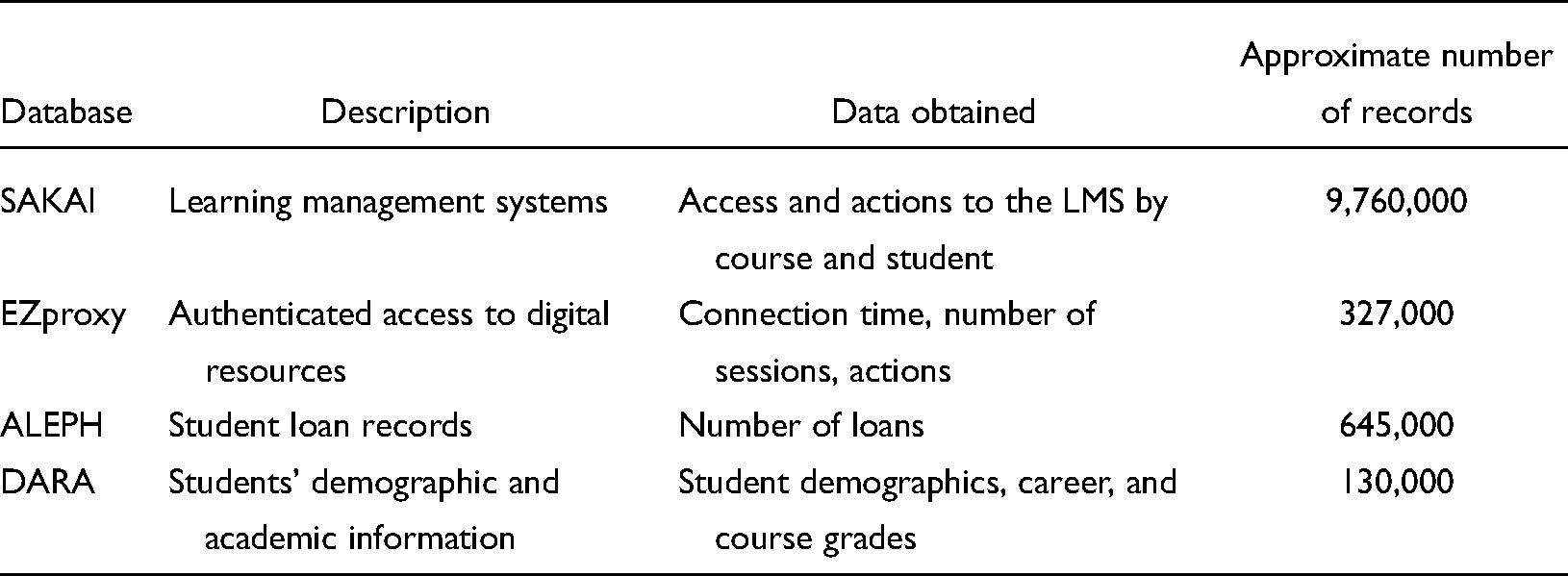
LMS data came from students’ interaction with SAKAI, a common open-source. We collected and pre-processed data from one semester for the whole cohort of enrolled students. SAKAI includes different modules where teachers and students may share course material and information and communicate or participate in evaluations. From these interactions, we developed variables based on classifications elaborated by González (2010), who distinguishes among information, communication, and collaboration-focused activities, and Laurillard (2013), who classifies LMS activity as narrative, interactive, communicative, adaptive, and productive. Thus, in this study, LMS variables are Content Access associated with information-focused, narrative LMS affordances (accessing or downloading resources, using web content tool), Read Comments associated with the communication-focused, communicative features (opening a comment in a forum, reading an email, or reading content created collaboratively in the course [wiki]), and Assessment & Assignment associated with productive LMS tools (doing tests or sending assignments and evaluations). At the time of this study, the LMS was employed as a complement for face-to-face classes. Selected variables are the LMS features that university teachers used in the design of their courses more often. Together, Content Access, Read Comments, and Assessment & Assignment account for 98.4% of students’ actions in Sakai.
The library has a physical and a digital collection. The first one has roughly 1,495,000 items, while the digital collection includes more than 75,000 e-journals, 260,000 digital books, and 250 bibliographic databases. These collections include all Disciplinary Areas and are available to enrolled students. University teachers include, in their course designs, the list of compulsory readings. All of them must be available from the collections mentioned above. Library variables are Print Loan Materials and 10 Minutes Connection Blocks. Similar to LMS data, these came from students’ interaction with the University library services. Print Loan Materials represents the number of paper-based bibliographic material borrowed by students throughout the semester. This data are stored in the ALEPH database, containing detailed information on the number of items borrowed.
On the other hand, 10 Minutes Connection Blocks came from students’ access to the digital library. This access is mediated by EZproxy, a proxy server that acts as a gateway for the students to access electronic databases and digital books, and academic journals. Unfortunately, it is not possible to differentiate the type of resource accessed, and the log files vary depending on the resource. Because of this, we followed the recommendation by Cox and Jantti (2012), who developed a procedure in which, instead of counting the number of entries in the log, they counted the number of 10-min segments in which a student has at least one action.
Student data came from DARA, the university database for socio-demographic and academic student information. We took the database table descriptions and selected variables relevant to this study. University academic variables are:
Average Mark: It is the average mark for all courses that students undertook during the semester considered in this study. We calculated a standardized mark to have a common scale across different degrees. The average mark is a relevant variable because previous research has suggested a positive association with LMS use (e.g., Ellis et al., 2017; Sandoval et al., 2018). Disciplinary Area: Students were classified into four disciplinary groups, based on a simplified OECD classification, Science and Technology, Natural Sciences, Social Sciences and Humanities, and Medical and Health Sciences. The Disciplinary Area influences how LMS are employed (Fathema & Akanda, 2020). Therefore, it is essential to include it. Year: It describes the year at university the student is enrolled in. a) Gender: There has been research indicating differences between males and females regarding approaches to learning (Yin et al., 2018). This, in turn, may influence academic outcomes, which make gender a relevant variable to incorporate. b) High School Dependency (public, private, or charter): It provides approximate information on the students’ socio-economic status—roughly, upper-class students tend to attend private schools; middle-class, charter; and lower-class, public.
Socio-demographic variables are:
We also employed National ID Number and the university-assigned Email to identify students across databases. In order to protect their identities, we applied hashing to National ID Number and the university-assigned Email. In this manner, a unique code was created to match databases, allowing working with the study variables while, at the same time, protecting students’ anonymity.
Cluster analysis was employed to identify groups of students with similar LMS and library usage patterns. In total, the sample comprised 22,483 undergraduate students. In the first place, variables were standardized and outliers were excluded. In this manner, the sample was reduced to 18,042 undergraduate students. Due to the large dataset, we conducted a k-means cluster analysis (Hair et al., 2014) using LMS variables, Content Access, Read Comments, and Assessment & Assignment, and library variables, Print Loan Materials and 10 Minutes Connection Blocks. To define the final number of clusters, we considered 2, 3, and 4 groups. Simple Euclidean distance for measuring similarity was used. The three-cluster solution was selected because 1) it was the one that most disaggregated the data and 2) it presented distinct groups according to the main variables. A one-way ANOVA test was carried out to explore the differences between clusters using LMS and library variables, as well as the Average Mark. Then, Year, Gender, High School Dependency, and Disciplinary Area were used for cluster profiling.
Stage two: data source and analysis
To answer question two, we conducted group interviews with students who belonged to the emerging clusters. Group interviews lend themselves well to be used in conjunction with other data production methods, as the case of this research, for triangulation purposes (Frey & Fontana, 1991). This procedure allows a deeper exploration and understanding of LMS and library usage patterns represented by the cluster analysis. At the same time, it allows introducing other themes: approaches to learning and other digital learning resources use, which cannot be investigated using solely the data employed to answer question one.
We invited students to participate, considering cluster belonging as the primary criterion. Twelve group interviews were carried out with a total of 41 students participating. To keep balance, regardless of cluster size, four focus groups for each of them were carried out—one for each broad Disciplinary Area—Science and Technology, Natural Sciences, Social Sciences and Humanities, and Medical and Health Sciences. Concerning gender, 17 participants were male and 24 were females.
The interview schedule included questions on learning approaches, LMS use, library use (physical and digital), and other digital resources use, that is, those not provided formally by the university but employed for students in their learning processes. Examples are websites for accessing content information (Google, Wikipedia, YouTube, Khan Academy, among others) or communicating and collaborating with peers (Facebook, WhatsApp, Google Docs, among others). Following were the questions: Learning approaches: How do you approach learning? Why do you use these strategies? LMS use: What for do you use the LMS? Why do you use it in this manner? Learning approaches: How do you approach learning? Why do you use these strategies? Other digital resources use: Do you use other digital resources for learning (different from those that the university provides)? Why do you use them in this manner?
Follow-up questions (such as “Could you explain more?” “What do you mean by that?”) were employed for deepening students’ descriptions when necessary. Interviews were carried out in the same campuses where students attended classes to avoid unnecessary interruptions to their everyday routines. They lasted between 45 and 90 min. After verbatim transcription, a thematic analysis was carried out. The thematic analysis starts by becoming familiar with the data, then working with initial “codes,” searching and reviewing themes, naming the themes, and producing the report (Braun & Clarke, 2006). Following these guidelines, we had an initial set of codes from the interview schedule. These were tested against the data. Emerging codes were identified, which helped us to discern specific topics within the initial set of codes. At this stage, codes were transformed into themes, and initial descriptions were developed. We then continuously searched and reviewed the transcripts to see whether the themes were accurately describing students’ experiences. An iterative process was conducted until the themes’ description stabilized, and it was possible to create an accurate description for each of them and select supporting quotations from the group interviews transcriptions. Throughout the process, dialogic reliability checks were conducted to achieve agreement between coders (Kvale, 1996).
Results
How do students use institutional learning digital technology? How is this related to academic performance?
We conducted a k-means cluster analysis using the LMS variables, Content Access, Read Comments, and Assessment & Assignment, and library variables, Print Loan Materials and 10 Minutes Connection Blocks, to identify groups of students with similar patterns of digital learning technology use. Three clusters emerged that also showed a relationship with Average Mark. The first one, cluster 1, labeled Digital library users/high performers, shows a group of students who make markedly higher use of the digital library and borrow more print material than the average. They also present a lower use of LMS than average and tend to obtain higher marks than average. This is the smaller group, with 7% of the cases (n = 1231). The second cluster, cluster 2, labeled LMS and physical library users/mid-performers, represents students who employ the LMS markedly higher than average, borrow print materials more than the average, have a lower connection to the library digital resources, and present near average marks. This group has 34% of students (n = 6179). Finally, the third cluster, cluster 3, Lower users of LMS and library/mid-low performers, shows a group of students who make a lower-than-average use of LMS and library. Also, they tend to obtain mid-to-lower-than-average. This is the largest group (n = 10631). Table 2 presents these results.
Summary of statistics for the digital library users/high performers, LMS and physical library users/mid-performers, and lower users of LMS and library/mid-low performers’ clusters.
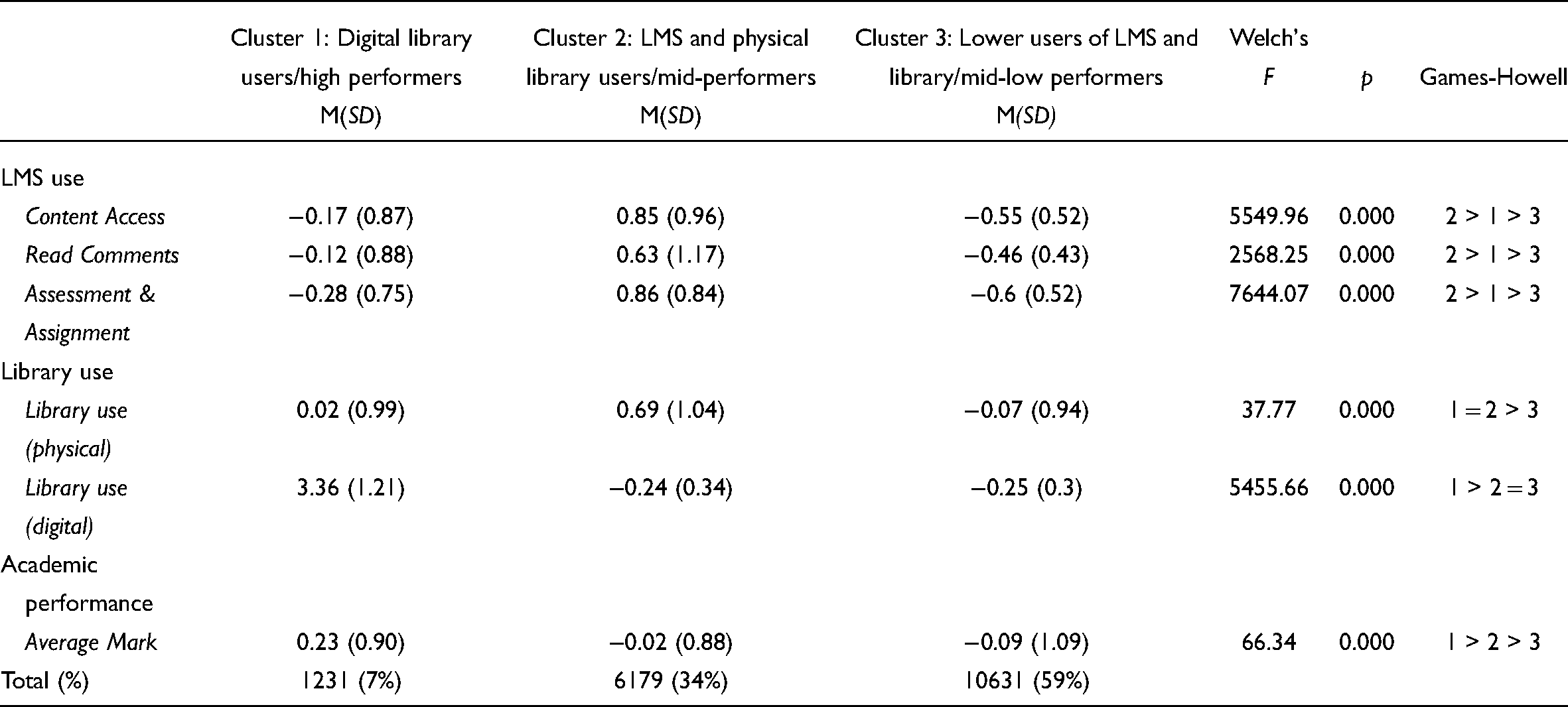
There are significant differences between the three clusters concerning LMS use: Content Access, Read Comments, and Assessment & Assignment. Cluster LMS users/mid-performers presents the higher use followed by Digital library users/high performers and then by Lower users of LMS and library/mid-low performers.
Regarding library use, there are no significant differences in Print Loan Materials between clusters 1 and 2. However, cluster 3 is different from both of them. About 10 Minutes Connection Blocks, cluster 1 is significantly higher than the other two clusters, and there are no differences between clusters 2 and 3.
Finally, there are significant differences between the three clusters in Average Mark. Cluster 1 presents significantly higher marks, followed by clusters 2 and 3.
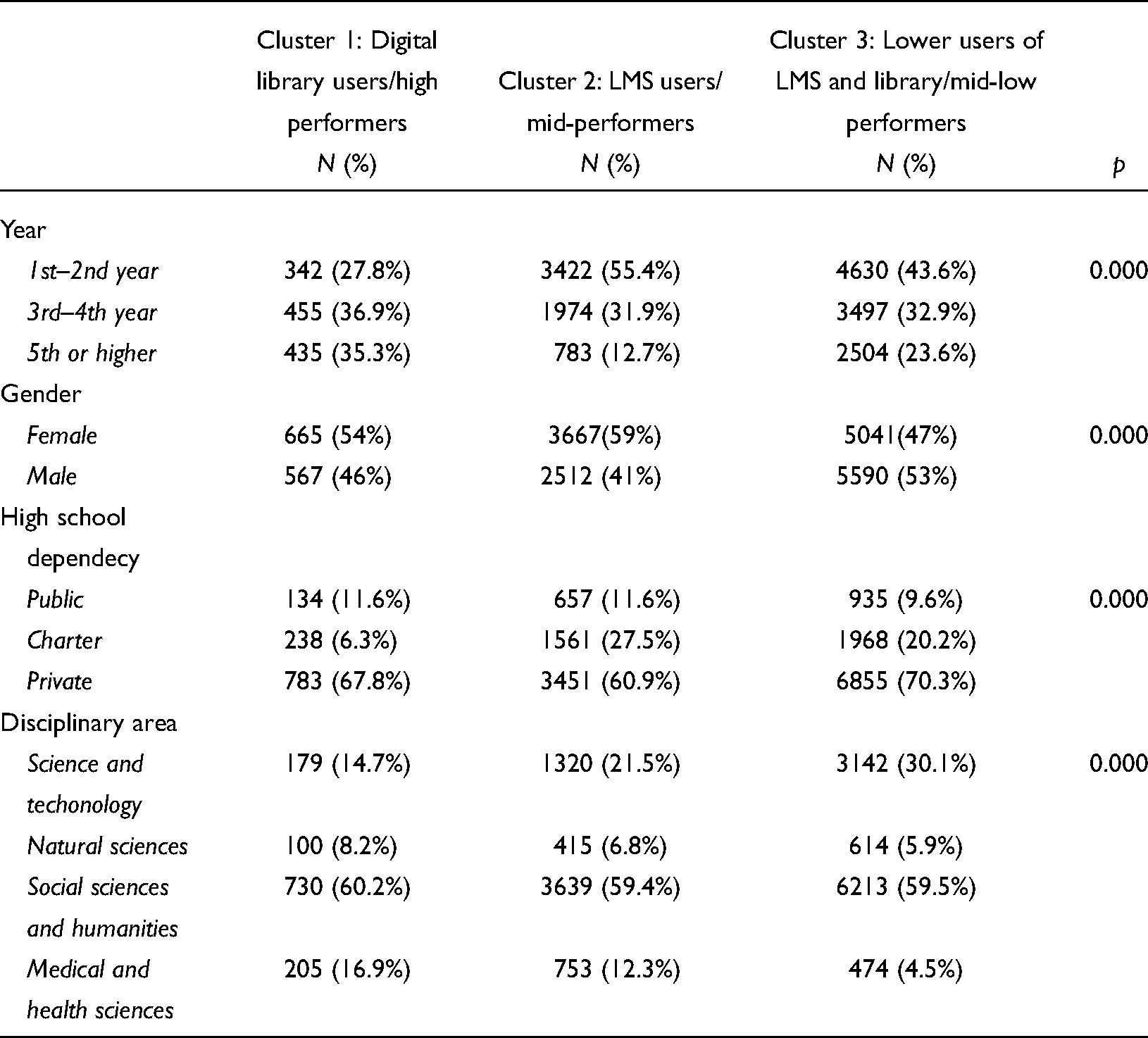
We employed Year, Gender, High School Dependency, and Disciplinary Area for cluster profiling. Table 3 presents a summary of these results. Concerning Year, cluster 1 presents a higher proportion of students in the later years and a lower proportion in the initial years. In contrast, clusters 2 and 3 concentrate a higher proportion of students in their 1st and 2nd Years. Regarding gender, there is a higher proportion of females in clusters 1 and 2. These revert in cluster 3, where there is a higher proportion of males. High School Dependency showed that the proportion of students from Public high schools is higher in clusters 1 and 2, that students from Charter high schools present a higher proportion in cluster 2, and that clusters 3 and 1 tend to have higher concertation of Private school students. Finally, cluster 1 concentrates a higher proportion of Medical and Health Sciences students and a lower proportion of Science and Technology students regarding Disciplinary Area. On the opposite, cluster 3 presents a lower proportion of Medical and Health Sciences students and a higher proportion of Science and Technology students.
Proportion of students in each cluster per year, gender, high school dependency, and disciplinary area.
What are the students’ approaches to learning and digital technologies (institutional and non-institutional) use?
In this section, we present the group interviews analysis results. This allows for a deeper exploration and understanding of LMS and library usage patterns presented in the previous section and the analysis of two relevant themes not possible to investigate with data employed for question one: approaches to learning and other digital learning resources use.
Quotations are presented, for each theme, in a separate table. Information on gender, disciplinary area, and cluster belonging is provided at the end of the illustrative quotations to identify them from different transcripts, while keeping interviewees anonymous.
Approaches to learning
Students’ approaches to learning in this study resemble the deep, strategic, and surface identified in prior research in this area.
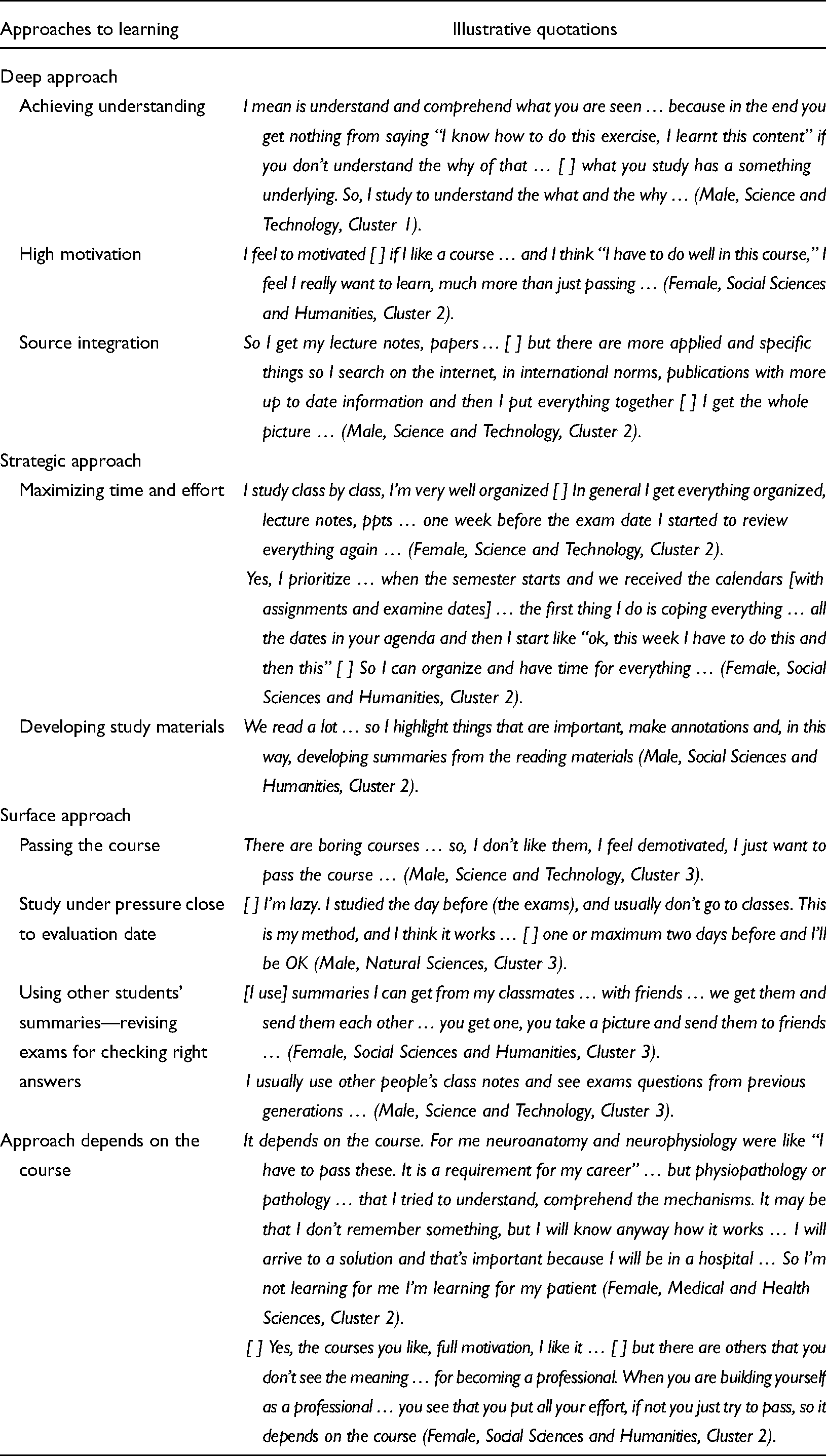
In the first one, closer to a deep approach, the aim is to develop a deep content understanding, which is highly important for their future as professionals. Students report being highly motivated, studying in an anticipated manner, and spending much time in their studies. A vital aspect of this approach is integrating different sources, such as class notes, course bibliography, recommended websites, and expanding what is provided in the courses, by searching academic bibliography or other resources. They first study by themselves and then in groups. This approach is mainly reported by students in cluster 1 and for some in cluster 2.
In the second one, similar to a strategic approach, students declare the aim of maximizing their time and effort in order to obtain the best possible marks. Therefore, they carefully plan and use their time. Their focus is on developing their study materials, identifying the main ideas in their notes, highlighting key concepts or procedures, doing annotations and comments, and summarizing class notes. Similar to the deep approach, they first study by themselves and then in groups. Students mainly report this approach in cluster 2 and some in cluster 3.
Finally, in the third one, a surface approach shows a group of students who intend to pass courses with the minimum effort. They study under pressure very close to evaluation dates—the day before or the same date—using other students’ work (summaries from their classmates or previous years) and/or revising exams from previous semesters to find the right answers. This is the approach mainly reported by students in cluster 3.
One crucial element that emerged in the interviews is that approaches vary depending on the course. Thus, students change their approach depending on whether they like the course or whether they think it is an important one for their development as professionals. In this case, they tend to adopt strategic–deeper approaches. It is also important to note that results suggest that students in their initial years tend to struggle with university learning, tending to adopt a surface approach. On the contrary, as they advance in their careers, they develop more strategic and deeper approaches. This changing feature of approaches to learning is reported in all clusters, although a preferred approach is also evident in each of them.
Table 4 presents illustrative quotations for this category.
Approaches to learning illustrative quotations.
LMS use
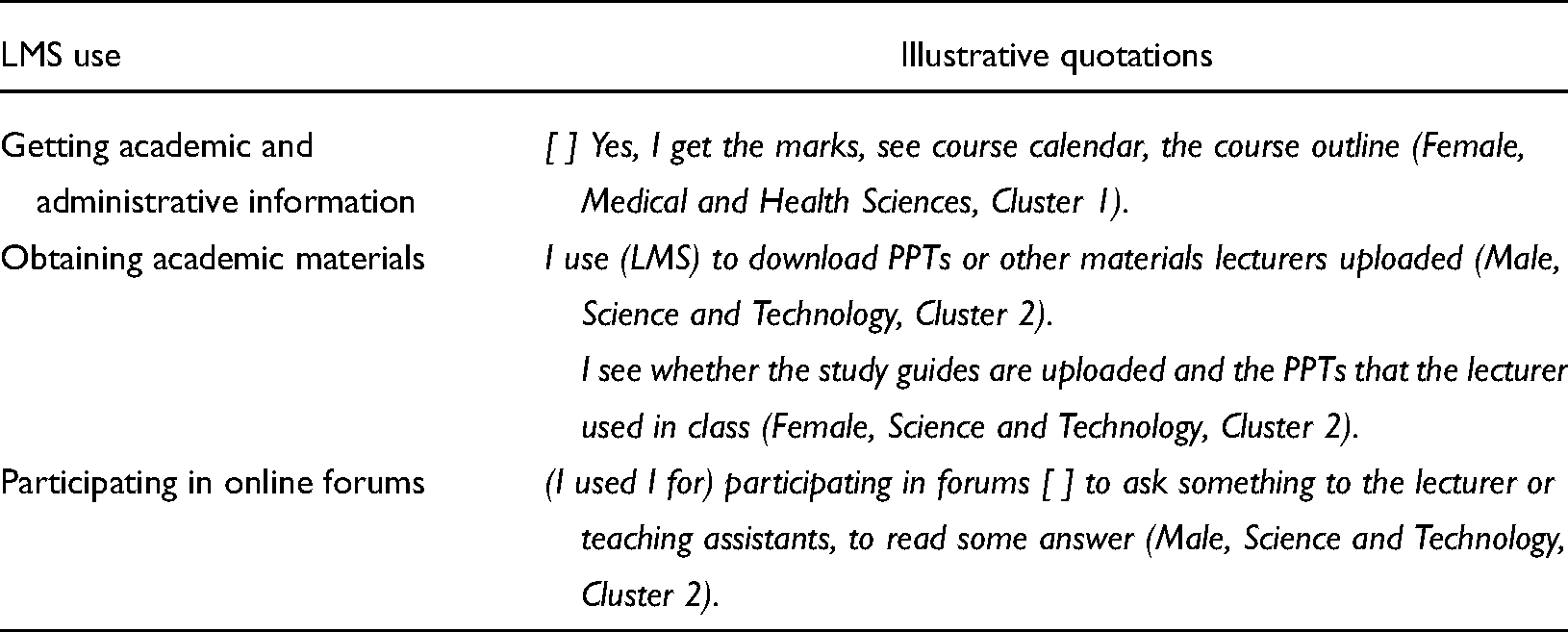
Students described three uses of the LMS. In the first one, the LMS is employed as a medium for getting academic and administrative information, such as course outline, exam dates, information on assignments, and course announcements. The second reported use is obtaining academic materials, such as PPTs, lecture notes, course exercise guides, book chapters, or articles. Finally, students report using the LMS as a medium to interact in online forums, for example, asking academic or administrative questions to their teachers, asking academic questions to their peers, or participating in structured online discussions. Students in all clusters report using LMS for getting information and academic materials. However, with some differences, students in cluster 2 make a more intense-strategic use, while students in clusters 1 and 3 make a less intense one. In the case of cluster 1, the focus is on keeping in touch with their courses. Only students in cluster 2 reported using the LMS for online forums.
Table 5 presents illustrative quotations.
LMS use illustrative quotations.
Library use (physical)
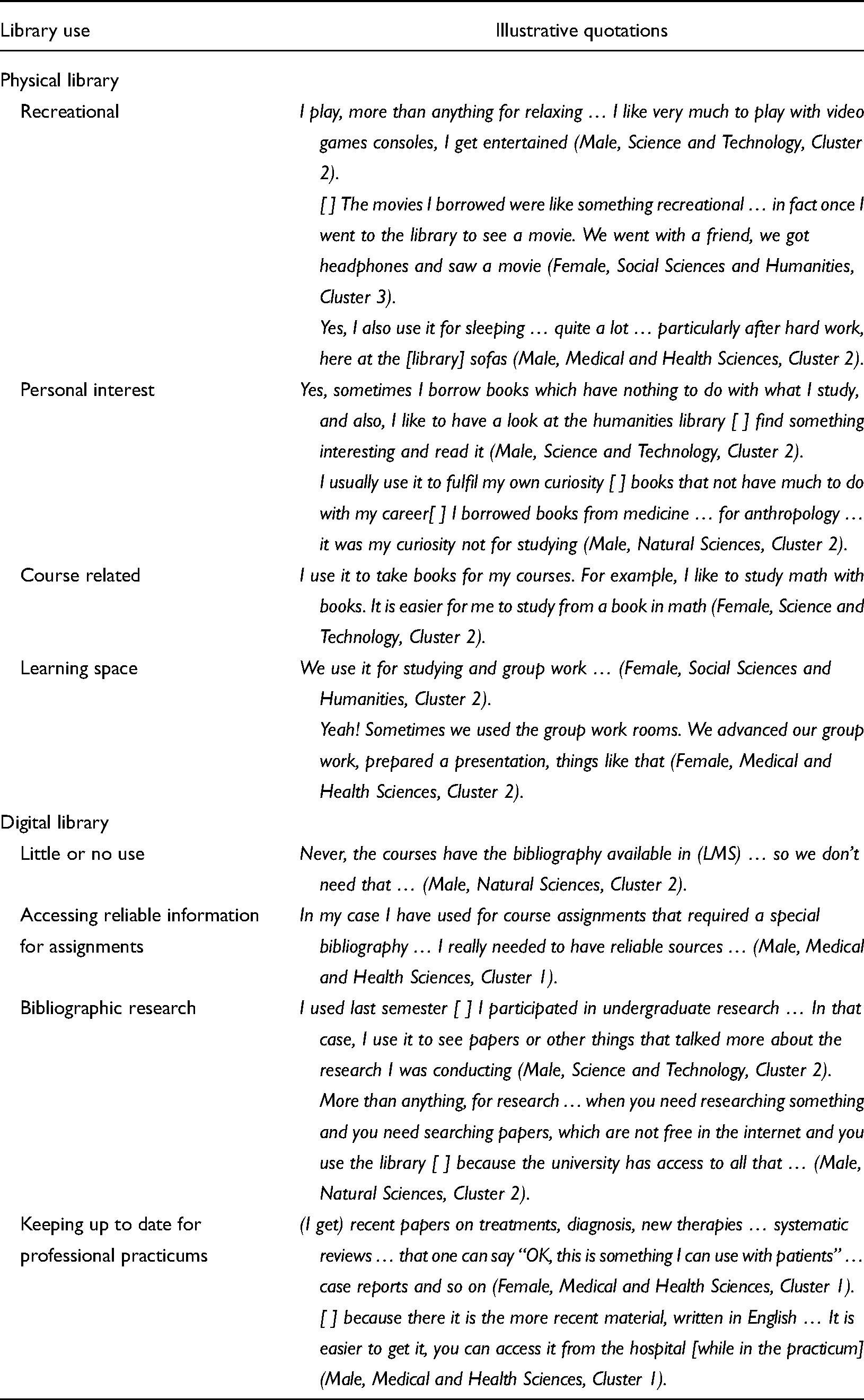
Students reported four manners in which they use the physical library: recreational, personal interest, course related, and learning space. In recreational use, students report resting and borrowing movies or console video games. In this case, the library is employed for resting or entertainment in what they see as a very demanding academic environment. The library also allows students to access books or other materials for fulfilling personal interests—recreational or academic—for example, fiction books or academic books from other disciplines. A more traditional use, for their formal academic learning, is also reported. In this case, students describe using the library for accessing their courses’ bibliography in the form of books, book chapters, or papers. They also describe using the library to access bibliography material to expand what is provided as a minimum in their courses. Finally, students borrow library study rooms for studying or developing assignments individually or in groups. Students in cluster 2 use more intensively the library for course-related activities and as a learning space than students in the other clusters. This is the only group that reports personal interest-related use. Students in cluster 1 use the library in a similar manner, but interviews suggest less intensity. Moreover, the more salient feature in cluster 3 is the library's use for recreational purposes.
Library use (digital)
In digital library use, the first emergent theme is that some students reported little or no use. This is because bibliographic material is accessible through LMS minimum bibliography, and they do not feel they need more than that. Students who used the digital library report can access reliable bibliographic materials for their academic assignments. At the same time, some students use it for conducting bibliographic research, particularly when participating in undergraduate research, or to expand or deepen knowledge in a particular topic, for example, when developing an undergraduate thesis. Also, students use the digital library to keep up to date by reading recent articles, with their discipline in the context of professional practicums. Results suggest students tend to use the digital library more in their final years of their studies. Consequently, students in cluster 1 report a deep and intense use of the digital library, students in cluster 2 report using it only when participating in undergraduate research, and students in cluster 3 almost do not use the digital library.
Table 6 presents illustrative quotations for physical and digital library use.
Library use illustrative quotations.
Other (non-institutional) digital resources use
Students report using other digital, non-institutional resources widely. We discerned information searching, communicating with peers, and advancing group work uses. The first use, information searching, presents various forms. By accessing websites such as Wikipedia or Google, students report they get familiar with new content, obtaining the basic information. Also, they report searching online to expand content already seen in class or learn something related to a particular course autonomously.
On the other hand, there is wide use of online video (e.g., through YouTube or Khan Academy) to find information that allows understanding something not understood in classes. This is particularly salient for math courses. Besides, this type of use appears relevant to see content missed due to non-attendance.
In the second place, students use other digital resources, for communicating with peers, for example, WhatsApp or Facebook. This includes sharing course information, asking and answering, or asking or sharing content summaries. Given that, in most cases, teachers do not have access to these digital spaces, communication tends to be more informal, and students tend to express their views more openly on university authorities, teachers, peers, or resources.
Finally, students advance group work using platforms such as Google Drive or Dropbox. In this case, students participate collaboratively in developing assignments, making contributions through these tools.
Although students in all clusters report using other non-institutional digital resources, the uses are different. For example, in cluster 1, students report, as for the digital library, using them for expanding knowledge. In cluster 2, getting basic information is declared as part of a process in which they then continue with more academic sources. They also use it to understand something and to expand knowledge. Students in this group also use these tools for communicating with peers and for group work. Finally, students in cluster 3 describe using them mainly to understand something or communicate with peers to obtain summaries or other materials to support last-minute study.
Table 7 presents illustrative quotations for this category.
Other (non-institutional) digital resources use illustrative quotations.
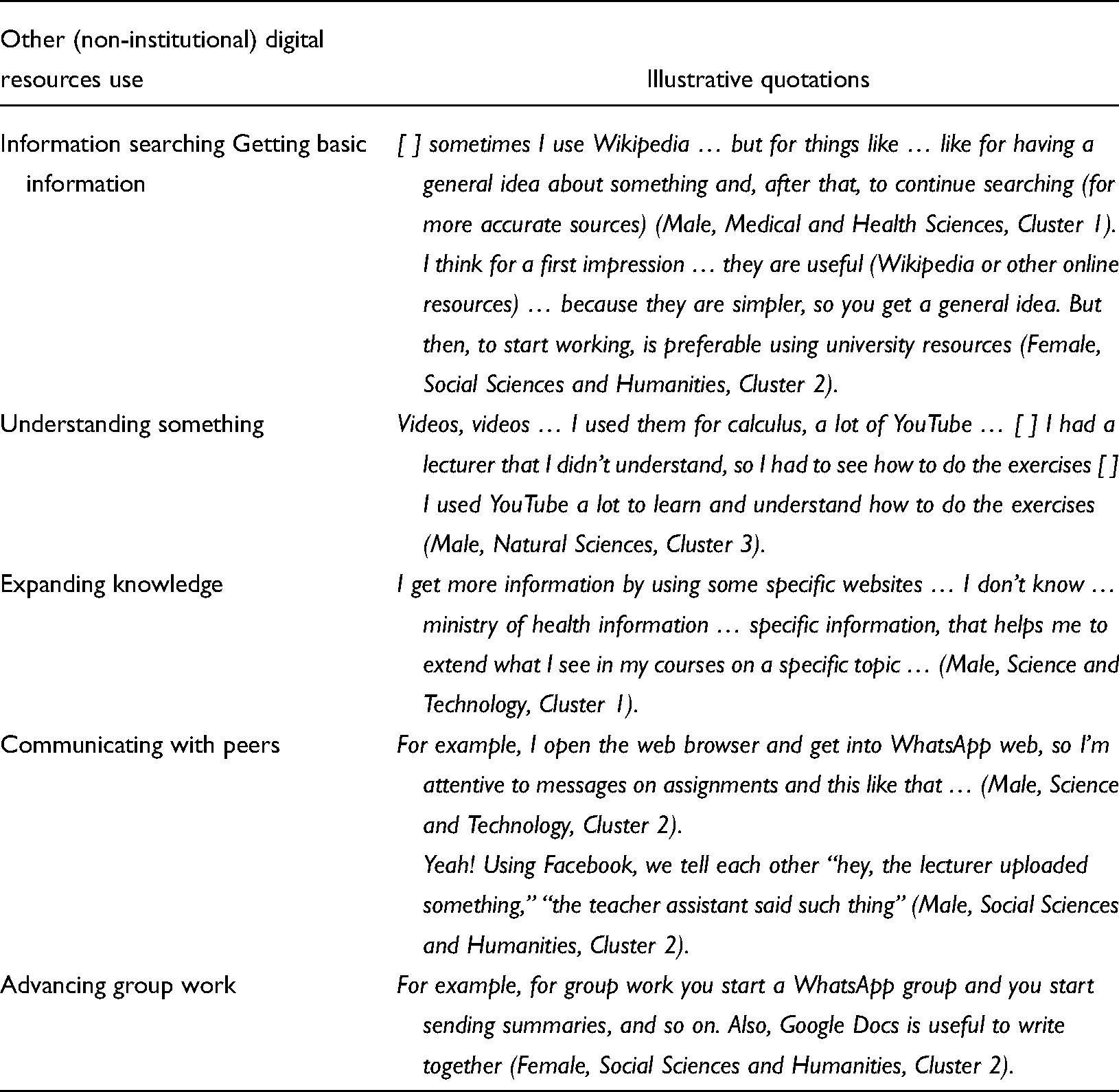
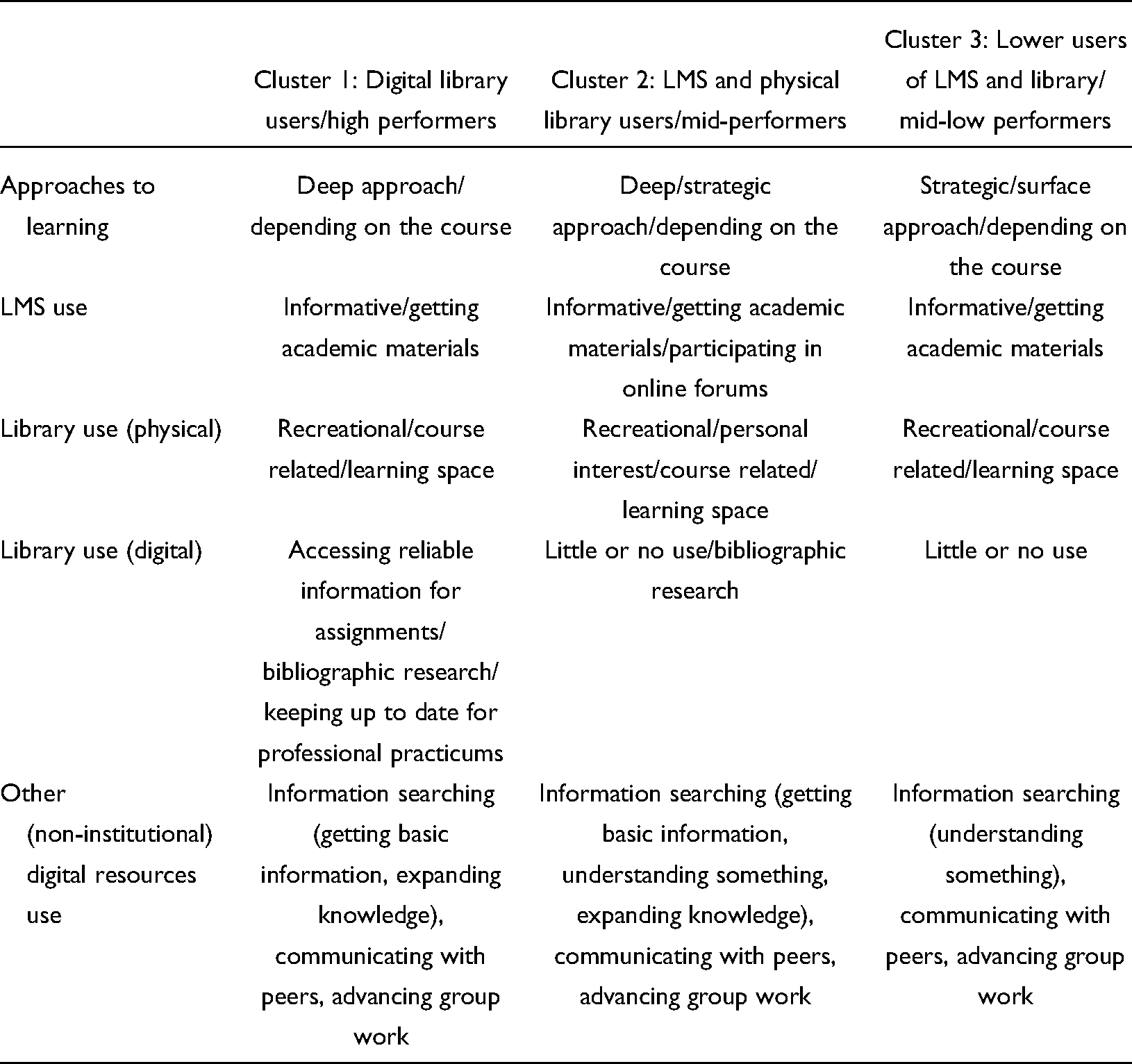
Table 8 presents a summary of qualitative results by cluster.
Summary of qualitative analysis for the digital library users/high performers, LMS users/mid-performers, and lower users of LMS and library/mid-low performers’ clusters.
Cluster and qualitative analysis of students’ approaches to learning and digital technologies integration
In this section, we advance to triangulate quantitative and qualitative data to understand students’ learning experiences better. For each cluster, we provide a narrative that integrates the above-presented results.
Cluster 1: digital library users/high performers
Results from cluster analysis showed that students in this group tended to use the digital library resources more and obtain higher marks. The qualitative analysis allowed a better understanding of the usage patterns that emerged from cluster analysis. Students tended to describe a deep approach to learning. As interviewed students were in the later years of their degrees, they intended to develop a deeper understanding of academic content for becoming good professionals. It is important to note that they claim that how they approach learning depends on the course. In courses considered not relevant for their development as professionals, they do not necessarily adopt this approach. These students use the digital library to expand what they see in their courses and conduct their own research on topics mainly related to their professional practicums or thesis development. They use other non-institutional digital resources for the same aim: for complementing and expanding academic content. At the same time, they use the LMS less than average. This does not represent a pattern of disengagement but the fact that they enroll less in traditional lecture-based courses and spend more time in practicums. Having said that, they still report using the LMS for getting information on their courses or downloading academic materials, but not for participating in online forums. They also report using the physical library in a similar manner than students in the other clusters, but not for exploring resources to fulfill personal interests. The most salient feature of this group is integrating resources to generate a deeper understanding of what is being learned.
Cluster 2: LMS and physical library users/mid-performers
Cluster analysis showed that this group of students tended to use the LMS and the physical library more than average and obtained close to average marks. Qualitative results suggest they adopt different approaches to learning depending on the course. However, they tend to lean toward deep or strategic approaches. Similar to students in cluster 1, the use of digital resources is aligned with their declared approach. They use the LMS as part of their intention of maximizing results or getting a deep understanding of the content. Thus, they are in touch with course information and organize learning materials provided by using this resource. Also, they use other online resources to become familiar with a topic under study, understand something they did not grasp in the class, and expand what is provided. The digital library is not employed, however, with this last aim. This was only mentioned by students who participated in undergraduate research programs, in which they had to conduct bibliographic research. At the same time, they use other digital resources for communicating with peers and for group work. The physical library is highly used by this group: for recreational use, for getting course-related materials, and as a learning space. Notably, they employ the library to fulfill academic personal interests.
Cluster 3: lower users of LMS and library/mid-low performers
The cluster analysis results presented a group of students who used both the LMS and the library less than average and tended to obtain lower academic marks. As in clusters 1 and 2, qualitative analysis suggested that the adopted approach depends on the course. Nevertheless, they leaned toward strategic/surface approaches. They tend to download materials from LMS and get course information, but interview transcripts suggest less intense use. Other (non-institutional) digital technology use is relevant to them. It is the medium for obtaining summaries developed by other students for last-minute learning or seeing a video to understand something they missed in class or due to non-attendance. In terms of the library, considering the physical library, recreational use appears essential for this group. Students enjoy using games or watching movies. In terms of the digital library, they usually do not use them because it is unknown, or they consider that the materials provided by other means, particularly LMS, are enough. Therefore, the use of digital and non-digital resources is also coherent with the preferred approach. They are used as part of a strategy for passing the courses with minimum effort and less for understanding or for expanding provided materials.
Discussion
This study had two research questions: 1) How do students use institutional learning digital technology? How is this related to academic performance? and 2) What are students’ approaches to learning and digital technologies (institutional and non-institutional) use?
An integrated analysis of observational and self-reported data allowed answering these questions by discerning three students’ groups. The first one, Digital library users/high performers, tends to adopt deeper approaches to learning, obtains higher marks, and uses institutional and non-institutional resources coherently with their preferred approach; for example, using the digital library, and other non-institutional online resources, for integrating and expanding learning materials. The second group, LMS and physical library users/mid-performers, tends to adopt mainly strategic, and some deep, approaches to learning, obtains marks closer to average, and uses learning resources for supporting studying in an organized and structured manner. Finally, the third group, Lower users of LMS and library/mid-low performers, tends to adopt a surface approach to learning, obtains mid-to-lower-than-average marks, and uses learning resources in accordance with their approach; for example, watching a video for minimum understanding or trying to get, from online resources, some summary for last-minute study.
This paper integrated three research perspectives as an analytical framework: research on students’ approaches to learning, LA, and research on students’ use of digital technology. From our perspective, it allowed a richer picture of the contemporary students’ learning experience. This is represented in the description of different groups of students that integrated cluster and qualitative analyses. In this manner, LA procedures allowed counting the number of actions students carried out with the LMS and the library and associate them with socio-demographic and academic variables. However, theoretical frameworks from SAL and research on students’ use of digital technology allowed making sense and deepen the understanding of the original clusters. Next, we describe how each of these lines of investigation contributed to this study's results.
Considering previous research, this study identified approaches to learning similar to those identified in prior SAL studies. For the students participating in this investigation, we could discern an approach focusing on expanding understanding, a second one focusing on maximizing time and effort for getting good academic results, and a third one focusing on passing the course with minimum effort. These resemble deep, strategic, and surface approaches widely reported in the literature (Biggs & Tang, 2011; Entwistle & Tomlinson, 2007; Herrmann et al., 2017; Prosser & Trigwell, 1999).
The relational nature of the approaches to learning was confirmed in this investigation. Students who participated in group interviews permanently reported that their approaches to learning depended on the course despite having a preferred approach. Students tended to adopt deeper approaches to learning in courses they recognize as attractive because they match their academic interests. On the contrary, if they find a course “boring” or away from their interests, they tend to move to more surface approaches. Simultaneously, how they perceive the contribution of a particular course in their professional development is critical for the adopted approach.
On the one hand, if they perceive a course irrelevant for their development as professionals, they tend to lean toward an intention of “passing the course” only. On the other hand, if they see a course essential to become good professionals, they lean toward deeper approaches. It is important to mention that results showed that students tend to adopt deeper approaches as they progress in their degrees, suggesting that it is then when they visualize the importance of some courses for their development as professionals.
Moreover, we were able to see that the use of learning resources is coherent with the preferred reported approach. Students tend to use what is available for realizing the form in which they approach learning. This is aligned with previous SAL research, which has combined questionnaires on approaches to learning and LMS usage, finding a coherent pattern among deeper approaches, higher use of LMS, and higher marks (Ellis et al., 2017; Ellis & Han, 2020; Gašević et al., 2017).
Regarding research on students’ use of digital technology, we found usage patterns similar to those previously reported. In this study, there was a highly heterogeneous digital technology use, and this is related to identified clusters. Thus, a higher proportion of students (cluster 3) made modest and non-engaged use of both institutional and non-institutional learning resources (Kennedy et al., 2010). A second higher proportion of students (cluster 2) made strategic use of these resources, focusing on using them to obtain good learning outcomes (Selwyn, 2014, pp. 78–83). Moreover, a smaller group of students (cluster 1) made more intense use of digital technologies, but the ones that helped realize their aim of expanding their materials for further understanding (digital library, other non-institutional digital resources) (Henderson et al., 2015). This is the only group that made a more sophisticated use. However, this is not related to being a digital native but associated with their focus on integrating and expanding knowledge for deeper understanding.
Finally, in relation to previous research, concerning LA, we followed the call for working in a middle space. Consequently, we combined techniques from LA and existing educational methods and theories. Other researchers have also followed this pattern, combining self-reported questionnaires developed within the SAL tradition, with data captured through LA techniques. We took a slightly different approach: Instead of using quantitative questionnaire data, we used a qualitative method to expand and make sense of LA-framed research results. We incorporated data not usually employed in previous middle space studies: students’ use of the library. Therefore, we contributed to this emerging line of research by demonstrating how it is possible to use qualitative data together with LA-framed data and analysis. Simultaneously, we incorporated library data, which had not been employed in previous studies, together with LMS and academic outcomes data.
This research is not exempt from limitations. The most obvious is that the participating population came from only one institution. Therefore, we are not claiming this study to be generalizable. We are also aware that the small number of students who participated in the study's qualitative side may mask variation in approaches to learning and uses of learning resources. Some of them could not have emerged. At the same time, we see it important to expand this study by incorporating socio-economic variables, which may affect how students use digital resources to access a good, stable Internet connection. Further research may replicate this study in other contexts and incorporate variables we did not consider in this one.
Finally, it is important to note the practical implications of this study. Understanding how students learn and, accordingly, developing actions to support their learning has been a long-standing practice. From the above-presented results, it is possible to offer four practical recommendations. Firstly, we found that students who adopt a surface approach tended to be in the initial years of their degrees. Also, students tended to adopt deeper approaches to learning as they advance in their degrees, suggesting a development pattern. Therefore, it is particularly relevant to provide advice to adjust their learning strategies to university study better. First-year workshops and modeling deeper approaches in their initial courses may be helpful at this stage. Secondly, it is important to acknowledge that students make a heterogeneous use of digital technology. This is relevant for not assuming the rhetoric of the digital natives. A more realistic perspective may help using digital technologies to better support students’ learning. A key finding of this study is that learning resources—digital and physical, institutional and non-institutional—are employed coherently with the adopted approach. Therefore, at the same time as promoting deeper approaches to learning, students should learn how these resources can be employed to realize this approach. Finally, results suggest that proper engagement with the digital library only happens toward the end of most students’ degrees. We propose that students get involved in bibliographic research from the very beginning of their university experience. Reading research will help students to understand their disciplinary fields better, providing them with a deeper understanding of their Disciplinary Areas. To accomplish this aim, we see that closer relations between libraries and academic development units may help university teachers understand the role of library collections in developing the students’ understanding of their disciplines.
Conclusion
In this study, we set out to investigate how students use institutional learning digital technology, how this is related to academic performance, and what are students’ approaches to learning and digital technologies use. To achieve this aim, we integrated conceptual and methodological tools from research on students’ approaches to learning, LA, and research on students’ use of digital technology. In the first stage, LMS and library usage records were employed to investigate students with different usage patterns. In the second stage, group interviews were carried out with students who belonged to the emerging clusters to further inquiry and make sense of the stage one results. Results showed coherence between approaches to learning, marks obtained, and digital tools employed to support learning: those who tended to adopt deeper approaches, obtained higher marks, and used digital tools in a more sophisticated manner to integrate and expand their learning materials. On the opposite, students who tended to adopt a surface approach obtained mid-to-lower-than-average marks and used digital tools mainly with the intention of “quickly” getting some material for minimum understanding and “getting by” with course requirements. The study advanced research that intends combining learning theories with analytics to strengthen our understanding of students’ learning.
Footnotes
Acknowledgments
This research was funded by the Agencia Nacional de Investigación y Desarrollo (ANID) through project Fondecyt Regular 1161413 and Millennium Nucleus, Student Experience in Higher Education in Chile: Expectations and Realities.
Contributorship
Carlos González was responsible for the original idea, searching and summarizing relevant literature, coordinating the analyses processes, writing the abstract and the bulk of the main text body, finalizing the paper, and answering to reviewers' comments. Paula Clasing contributed to conducting and reporting the quantitative analysis. Helena Montenegro, Lina Calle-Arangoa, and Dany Lópeza conducted the qualitative analysis, developing initial and consolidated themes and participating in dialogic reliability checks. Dany Lópeza also helped with quantitative analysis.
Declaration of conflicting interests
The authors declared no potential conflicts of interest with respect to the research, authorship, and/or publication of this article.
Funding
The authors disclosed receipt of the following financial support for the research, authorship, and/or publication of this article: This work was supported by the Iniciativa Milenio, Agencia Nacional de Investigación y Desarrollo (ANID)(grant Millennium Nucleus, NMEdSup) and Fondecyt Regular, Agencia Nacional de Investigación y Desarrollo (grant number 1161413).
