




Abstract
Purpose:
Taking läxhjälp/homework support in Sweden as a case, this article aims to further explore shadow education, especially as a pedagogical object from curriculum theory perspective.
Design/Approach/Methods:
Approaches including policy analyses, ethnomethodological work based on video-recorded interaction, and narratives have produced empirically grounded knowledge. We use examples from several substudies and analyze the reentry and regulation of supplementary education and how tutors and tutees interact in tutoring settings and negotiate identities in läxhjälp as well as the relation to regular schooling.
Findings:
Läxhjälp is conditioned by the logic of equality and changes in the governance of läxhjälp. The proliferation of different kinds of tutoring practices provided by various organizations calls for a broad definition of shadow education. With curriculum as boundary object, equality and academic success are foundational. Different settings and spatiotemporal arrangements affect modes of interaction, distribution of epistemic authority, and negotiations of identities.
Originality/Value:
With Sweden as a case, it is possible to explore shadow education in a new context, the Scandinavian welfare state, and its history of comprehensive education. Moreover, ethnomethodological interaction and narrative studies and curriculum perspectives are seldom employed within research on shadow education. A number of critical key boundary objects are identified.
During the last decades, the growth of shadow education has been recognized worldwide (Bray, 2011). At the same time, there are major national differences due to shifting historical and cultural contexts. In this article, we explore shadow education using Sweden as a case. We will employ findings from the research project “Homework Support as Shadow Education” (Forsberg, 2015) to illustrate and problematize different aspects of tutoring policy and practices. Broadly, shadow education can be defined as a set of educational services that are performed outside regular school and are of an optional character. The meaning of the term shadow education is contested (Kim & Jung, 2019) and it is often restricted to fee-based private supplementary tutoring. However, to uncover the interplay of different forms of supplementary educational services in the Swedish context, we argue that we are best served by the broader definition.
We will use the Swedish term läxhjälp, or homework support, for outlining the variety of shadow education practices. Framed by Swedish educational reforms, läxhjälp involves formally organized tutoring to students with teacher-provided assignments or more general and nonassigned homework, for example, preparations for tests and examinations, self-regulated academic exercises, or project work. The term covers educational services provided by either regular school or private for-profit actors or nonprofit organizations, whereas informal support provided by family or friends is excluded. Homework support may take place out of school as well as during recess or after the regular school day in ordinary school settings.
International research on shadow education has seen an increased interest in exploring different aspects of the phenomena conventionally covered by the term. In a review of the international field of research on shadow education between 1999 and 2018, Mikhaylova (2019) identified the three most common questions addressed in the international scholarly literature, namely, (1) the nature of private supplementary tutoring, (2) driving factors underlying the demand, and (3) the impact of shadow education in terms of learning outcomes and equality. The notion of nature refers to a number of characteristics of shadow education such as forms of provision, scale, costs and patterns of participation, as well as conceptualizations of the term itself. Research on the driving forces of shadow education focuses on factors linked to the supra, macro, meso, and micro-level. Studies on the impact of shadow education deal with issues of equality and justice on the one hand and the effectiveness of private tutoring on the other. The question whether tutoring actually increases academic achievement or not is one of the most recurring ones.
To understand the legitimacy and growth of shadow education in Scandinavian welfare states, we explore homework support in Sweden, a so far less researched educational policy and practice. There is only a limited amount of research on “curricula, teaching-learning materials and instructional strategies used in shadow education” (Kim & Jung, 2019, p. 149). Accordingly, we need to study micro processes similar to those concerning regular schooling (see, e.g., Melander & Aarsand, 2017). Examples provided in this article address these calls.
The aim of this article is to contribute to less frequently investigated aspects of shadow education, by providing empirically grounded knowledge about läxhjälp and its relation to regular schooling. We draw on the findings from different substudies conducted within the research project “Homework Support as Shadow Education.” For more elaborate descriptions and discussions of approaches employed in the substudies, we refer to the project articles and chapters listed in the next sections. In this article, we focus specifically on findings that illuminate the boundary objects of shadow education and regular education. However, it should be noted that we will not pay equal attention to all of the existing tutoring practices or attend to the impact of learning outcomes partly because of the restricted access to some practices and the lack of national statistical data. Thus, the notion “logic of equality” in the title refers above all to the legitimacy of the Swedish model of shadow education and its design.
In what follows, we will first argue for a conceptualization of shadow education as a pedagogical object framed by curriculum theory. Then, we analyze policy enactment and drivers of läxhjälp employed to illustrate the legitimacy and logic of homework support in Sweden. We proceed to focus on tutor–tutee relationships in both for-profit and nonprofit settings, by employing data from several studies targeting narratives of different actors. Next, we explore a critical education practice: help-seeking. Analyses of video-recorded settings of homework support illuminate interactional and epistemic challenges incurred by help-seeking, and the discussion of the examples relates both to the identities of actors and to the interaction between them. In the concluding section, we problematize and discuss läxhjälp in Sweden as a pedagogical object.
The framing of shadow education as a pedagogical object
When addressing shadow education and läxhjälp as a pedagogical object, we employ a curriculum theory perspective and analyses of policy, identities, and interaction. Curriculum is a multilevel educational concept that includes the selection and organization of knowledge, norms, and values in both policy and practice, as well as the governance and organization of the school (Lundgren, 1983). Key issues are what counts as valid knowledge, what is considered valid transmission of knowledge, and what counts as valid realization of this knowledge on part of the student (Bernstein, 1977). Equally important are the identities and values ascribed to and negotiated by tutees, tutors, parents, and providers of education. Attention is paid to the formal and intended curriculum as well as the informal, unofficial, and partly hidden curriculum (Jackson, 1992).
While curriculum theory has mainly been developed through studies of regular schooling, lately some scholars have focused on the curriculum of shadow education (see, e.g., Kim et al., 2018; Kim & Jung, 2019) and curriculum as a boundary object (Forsberg, Mikhaylova, et al., 2019). Such objects can inhabit several communities of practice due to their robustness and ability to adapt. Boundary objects are often considered as weakly structured in common use, only becoming strongly structured when they are operationalized within specific social practices. This means that they have different meanings, but still some common structure (Star & Griesemer, 1989). Fundamentally, we understand curriculum as a boundary object of regular and supplementary education. However, the multifaceted character of curriculum leaves open what aspects of the curriculum may function as boundary object and calls for different approaches.
In this article, the complexity of shadow education is illustrated through various approaches including policy analyses as well as ethnomethodological work on identities and interaction. To examine the legitimacy and growth of shadow education in Sweden, we have analyzed changes in policy enactment (Ball, 1993), especially in relation to the emergence of läxhjälp. We approach policy as regulations potentially initiated and enacted by a multitude of actors (providers and users), in various sectors (public, private, and nonprofit organizations) and on different levels (international, national, and local). Economic, cultural, and educational factors are recognized as overall drivers of shadow education (Ireson & Rushfort, 2014). We pay attention to regulation strategies employed by governments (Bray, 2007) as well as to providers’ and users’ motives and claims. From an ethnomethodological perspective, we have explored the shared methods participants use to mutually construct the meaningful orderliness of läxhjälp. Identities will be approached as contextually dependent social processes of identification (Karlsson et al., 2013). These are processes through which participants position themselves, or are positioned by others, as acting as certain “kinds of people” in certain contexts (Gee, 2001, p. 108). The perspective targets how tutoring practices are locally accomplished in interaction in situated activities and in participants’ narrative accounts (e.g., de Fina & Georgakopoulou, 2008). We conceptualize knowledge and processes of learning as being constructed by people in interaction with each other and their surrounding environment and as variable and dependent upon social and cultural contexts (Goodwin, 2018; Lave & Wenger, 1991; Svahn & Melander Bowden, 2019). Together, these approaches allow us to illuminate different levels and layers of shadow education as a pedagogical object framed by curriculum theory. Moreover, integrating them makes it possible to identify and problematize potential boundary objects between läxhjälp and regular schooling.
The return of private tutoring and policy enactment in Sweden
Within the project, the policy analyses of the framing and regulation of supplementary tutoring draw on data including documents relating to state-regulated decision and local actor policy. The former comprise government bills, reports, and regulations (2006–2018) as well as manifests of political parties. The latter include policy documents of for-profit and nonprofit organizations, mostly presented online. This choice of data allows us to identify and illustrate a changed political discourse and legitimation of supplementary tutoring, negotiated between different actors and levels. The policy process is understood as discourse and the analysis is focused on how the framing of the problem shapes possible responses (Bacchi, 2009; Hastings, 1998). This is further elaborated in Hallsén (2021) in this special issue (see also Hallsén & Karlsson, 2019). To contextualize the reformation of supplementary tutoring, we employ research on governing and evaluation of the Swedish education system.
Although private tutoring was common in Sweden throughout the 19th century, it lost its place and scope with the emergence of mass education. For a long time, private tutoring was a political nonissue incompatible with the educational system of the Scandinavian welfare state. In the 1950s, Sweden developed a comprehensive and unstreamed school system, almost exclusively run by municipalities. The notion of equality was one of the expressed guiding principles for reforms and centralization, and standardization was the method for implementing “a school for all.” Students’ need for support was primarily addressed by remedial teaching within regular schooling and school hours (Forsberg, Mikhaylova, et al., 2019). As such, Sweden was characterized as a typical social democratic welfare state (Esping-Andersen, 1996).
Globalization, new technologies, a less stable political situation, better-educated citizens’ call for influence and discussions about the knowledge society promoted changed relations between the state, the market, and the civil society. In the 1980s, the welfare state was criticized for inadequate governance, increased costs, inefficiency, and an overload of tasks (Forsberg & Lundgren, 2010). Moreover, despite educational reforms and resource allocations, the system did not deliver what it promised, as social background remained the best predictor of educational attainment (Härnqvist, 1992).
The governance of the education system was then radically transformed. Marketization of education created a large sector of state-funded independent schools (mainly private) operating alongside municipality-driven schools (Lundahl et al., 2014). An assessment culture of measurable knowledge was introduced through inter/national tests, earlier grading, specified grading criteria, inspections, rankings, and comparisons at different levels. Municipalities and independent schools were made accountable and responsible for outcomes (Forsberg et al., 2017) and a multifold context of parental involvement in schools and as consumers of homework support evolved (Karlsson et al., 2019).
The reformation of supplementary tutoring in Sweden started in 2007 as a bottom-up movement, with a household tax deduction reform increasing a growth of private organizations offering homework support. However, private tutoring is a politically sensitive issue in Sweden, and the tax deduction was abolished and replaced by government subsidies to school organizers and nonprofit organizations. The reform was carried out under the slogan “läxhjälp for all” and aimed at increasing equality. The abolition of the tax deduction was obviously a drawback for many private companies, but various forms of supplementary tutoring, the private included, seem to have come to stay. Although supplementary tutoring now is an integral part of the expanded educational system, there is a lack of data on its scope and scale. Household expenditures and data on the use of private supplementary tutoring indicate low numbers in comparison to elsewhere in the world. At the same time, the optional support provided by regular school and nonprofit organizations together with private tutoring has changed the educational landscape. Today, the notion of “a school for all” encompasses “läxhjälp for all,” that is, supplementary tutoring (see also Hallsén, 2021).
In the Swedish context, there are several variations of läxhjälp that can be divided into three main organizational forms: (1) private organizations offering homework mainly on a one-on-one basis, both face-to-face and online, (2) open homework sessions organized by schools for their own students, and (3) drop-in homework support offered by nonprofit organizations. Within these forms, there are differences in regard to how homework support is organized, ranging from one-on-one tutor–tutee relationships that last over a long period of time, to drop-in sessions where students show up on a voluntary basis and the participants merely meet for help-seeking interactions. While Forsberg, Mikhaylova et al. (2019) have discussed the mimic character of shadow education as well as the types, forms, and spatial settings of shadow education in Sweden, the sociological mapping remains to be done.
At first, the return of private supplementary tutoring in Sweden was related to the assessment culture developed over the last decades and in part to the failure of the school system. Moreover, demands, claims, and motivations can be linked to the overall success of education as an asset of cultural and economic capital and as a device for parents to use in their risk and safety management on behalf of their children. While these motives remain present, the overall legitimacy and governance of läxhjälp is linked to the historical and cultural evolvement of the comprehensive school system and above all the logic of equality.
The governance of läxhjälp involved a move from the economic sector into the governance of education. Further, it included a shift from a laissez-faire approach to a regulation strategy promoting nonprofit supplementary tutoring. At the same time, it is worth noting that supplementary tutoring to a large extent is softly governed. It is optional on behalf of the students and there is no formal curricula or fixed spatiotemporal settings; neither are teaching methods nor assessment tools regulated. The same is true for teacher qualifications, even though support provided by regular schools is expected to be managed by licensed teachers. State regulations mainly concern students’ right to läxhjälp, the obligation of regular schools to provide läxhjälp, and the allocation of subsidies to regular school and nonprofit providers. There are no regulations directed toward private for-profit organizations. They are, however, at present excluded from financial state support (see also Forsberg, Mikhaylova, et al., 2019).
State regulations of supplementary education may be soft, but through local policies, the pedagogical object of läxhjälp is manifested in particular ways. In a former study (Forsberg, Hallsén, et al., 2019), we analyzed local policy and marketization of one of the largest tutoring companies in Sweden with around 1,200 part-time university students serving as tutors. Apart from satisfactory upper secondary knowledge, insights into effective study manner and the ability to motivate learners are considered important qualifications, clearly linked to the mission of the practices. The typical customer is a student in need of remedial teaching or better grades. Subjects most in demands are mathematics, science, national language, and modern languages. Tutors use primarily ordinary school textbooks, assignments, and prior national tests as teaching materials. Tutoring companies emphasize clear objectives, effective work structure, and continuous follow-up. The mode of teaching realizes the idea of individualization and bespoke education. While being at the center of attention, student voices have more of a backstage position. Through tutoring, parents may both more directly impact and take less responsibility for their children’s education.
Tutor and tutee relationships and social identities in different organizational settings
This section of the article draws mainly on findings from interviews with tutors, from both for-profit and nonprofit settings, as well as from a study on online marketing of tutoring services.
In Sweden, most tutors are university students who are employed or volunteer a couple of hours each week for a shorter period, earning no or very little money from it. This makes Sweden stand out in comparison with many other countries, where students and teachers work as tutors for longer periods to make ends meet (e.g., Imtiaz, 2018; Popa & Acedo, 2006; Silova, 2010). An interview study with 27 university students working as tutors in for-profit and nonprofit settings in and around big city areas in Sweden paints a picture of the Swedish tutor as a female psychology student who spends 2–4 hr a week volunteering as a tutor for nonprofit organizations (see Appendix A for sample description).
The twenty-seven 1-hr individual interviews were conducted with university students working as tutors in for-profit and nonprofit contexts. Interviewees were recruited through announcements posted in different campus facilities at an old Swedish university. The interviews were conducted in an open-ended manner in the interviewer’s office and lasted approximately 1 hr each. The following six themes were discussed: (1) reasons for enrollment in supplementary tutoring, (2) first experience of tutoring, (3) experiences of meeting and relating to students and other actors, (4) tutoring methods, (5) rewarding and challenging aspects of tutoring, and (6) own experiences of schooling and education. All interviews were audio recorded and the recordings transcribed verbatim. As this is a very small sample, it can only show a snapshot image of the Swedish tutor working in and around big city areas. Nevertheless, many of the tutoring companies dominating the Swedish market advertise an image of the tutor as a smart young university student (Hallsén & Karlsson, 2019). The interviews also showed that 5 of the 27 participating tutors had worked in both for-profit and nonprofit settings, which signals that they can move between these two settings.
A thematic analysis revealed both similarities and differences between the tutors’ experiences. Often mentioned motives for tutoring were wanting to help others, personal interest in specific academic subjects, gaining work–life experience, and, in the case of for-profit tutoring, making some extra money. There were also similarities in how the tutors in both contexts talked about the pros and cons of tutoring and the importance of tutees wanting to learn. The differences had to do with the social constellations and spatiotemporal settings in which tutors find themselves. Taken together, these themes pointed toward a major difference concerning how the organizational contexts of for-profit and nonprofit tutoring shaped the tutors’ relationships with the tutees.
A variety of social constellations and spatiotemporal arrangements
Both for-profit and nonprofit tutoring organizations are nongovernment actors in the Swedish educational landscape, which provide similar types of services that nevertheless differ in significant ways. Nonprofit providers organize tutoring for groups of students perceived to be in need, often as a means to reach overarching goals of social equality and cultural integration held by the providing organization (e.g., the Red Cross). For-profit providers, on the other hand, sell customized tutoring services to parents of individual students. For-profit companies in Sweden mainly provide one-on-one tutoring in the tutees’ homes, over the Internet, or in other meeting places. In contrast, nonprofit providers mainly operate by offering free support to various tutees in public facilities such as libraries, school buildings after school hours, and over the Internet. An interesting result from the interview study is that different organizational settings of for-profit and nonprofit tutoring condition the relationships between tutors and tutees and thus the identities ascribed to or claimed by them. The narrated experiences of the interviewees make visible both similarities and differences between and within the two organizational settings.
The social constellation of one-on-one is common in both settings, but there are important differences. For-profit tutoring rests on the idea of a tutor–tutee relationship that lasts for a shorter or longer period, while nonprofit tutoring provides services to individual tutees by the tutors available at the time they visit the center. As there are several tutors present at the same time, sometimes they even work together to help tutees. Tutors’ narrated experiences from nonprofit settings sometimes picture other tutors as important sources of support, especially for the newcomers. Those working in for-profit settings often lack this kind of support as they mainly work alone. Although private companies provide support to their employees when needed, tutors rarely meet and never collaborate with each other.
Another difference has to do with the presence of parents in for-profit and their absence in nonprofit settings. Private tutors working in the tutees’ homes often talked about parents as important stakeholders in tutoring arrangements. 1 Parents are customers on the private tutoring market and are often the main targets for marketing (Hallsén & Karlsson, 2019). As consumers, parents sometimes monitored the progress of their children closely and even coached the tutors in their work. Other parents stayed in the background and let the tutors do their work as they saw fit. The interviewees described the parents they had met in their work in very different ways, from carefully supportive to desperately demanding. In contrast, parents are more or less absent from the narratives of tutoring in nonprofit settings. Moreover, different constellations and relationships, tutor–tutee–parent or tutors–tutees, make the tutors more or less accountable for the progress of individual tutees.
Another difference between and within settings has to do with spatiotemporal arrangements. While tutors in for-profit settings decide on times and places together with the tutees’ parents, nonprofit tutoring is organized in public facilities in set time frames on a weekly basis. Spatial arrangements may also vary within and between settings. Tutors’ narratives of home-based services show that sitting together with a tutee at a kitchen table makes the tutoring activities easier to manage than having to create a space for tutoring in a room where computers and other artifacts may draw their attention away from the school assignments. On the other hand, the spatial arrangements of one-on-one tutoring provided in family homes differ significantly from the collective practice of nonprofit tutoring, involving many tutors and tutees. The narratives of tutoring in nonprofit settings show that nonprofit providers arrange spaces in different ways. Some place the tutors at fixed stations to which visiting tutees come and go, while in others, the tutors circulate among tutees who sit studying by themselves and approach the ones asking for help (like in the case described earlier in this article).
Tutor and tutee social identities and relations
Overall, the different social constellations and spatiotemporal arrangements of tutoring in for-profit and nonprofit settings condition the tutor–tutee relationships and thus their respective identities. In other words, different settings produce different kinds of tutors and tutees. The tutors often ascribe tutees as motivated or unmotivated. Stories about motivated tutees identify them as smart and willing to learn, while unmotivated tutees are identified as lacking in basic knowledge or as being lazy. These stereotypical tutee identities figure in narratives from both settings, but the ways in which the identities take shape differ. An unmotivated tutee becomes troublesome in one way for a tutor working alone for a set period in a family home under the surveillance of a demanding parent and in another for a tutor who meets the tutee in a chance encounter at the tutoring center.
As for tutor identities, the social constellations and spatiotemporal arrangements condition how they are perceived by others and view themselves as tutors. A tutor employed by a company is accountable to the company and the parents for the tutees’ success or failure, while volunteer tutors do not formally commit to helping individual tutees. In for-profit settings, companies market tutors as much as the tutoring services. In a narrative analysis of the identities ascribed to tutors in online marketing on the website of one of the major tutoring companies in Sweden, we found that tutors were ascribed identities as both teachers and friends of potential tutees but also as instruments for parents wanting to take control of their children’s schooling (Hallsén & Karlsson, 2019). The identities of volunteer tutors are less dependent on the success or failure of individual tutees. Instead, tutors in nonprofit settings often struggle with meeting many tutees who seek help with different assignments.
The tutor’s narratives illuminate three interrelated tutor identities that mimic, negotiate, and sometimes question the values and practices of formal education. Those are the tutor as time manager, the tutor as interpreter, and the tutor as frustrated critic. The tutor as time manager is an identity claim that clearly mimics the values and practices of formal education as it takes shape in narratives about tutoring as preparations for upcoming tests within formal education. The tutor as interpreter is an identity claim picturing tutors struggling to understand the tutees’ school assignments. Tutors in both settings become interpreters in the sense that they must decode the instructions for school assignments to be able to help the tutees within the social constellations and spatiotemporal arrangements conditioning for-profit and nonprofit tutoring. As interpreters of school assignments, they engage in a negotiation with the tutees about the school assignments at hand to understand what has to be done and how. In some narratives on difficulties in tutoring, tutors openly criticize formal education by questioning the quality or feasibility of the school assignments the tutees bring to tutoring sessions. The tutor as frustrated critic comments on assignments and instructions as indistinct or vague and sometimes as too advanced for the tutees. The identity claims of the tutor as interpreter and as a frustrated critic question practices and values of formal education through the lens of them having trouble understanding and thereby help tutees work with school assignments.
At the same time, tutors and tutees are themselves part of the formal education system as university students and school pupils even before they meet in the joint practice of tutoring. They bring with them their own embodied experiences of teaching and studying and use those experiences as cultural tools in these new educational settings. From this point of view, tutoring practices taking place in both organizational settings mimic formal education to the extent that they can be seen as expanding rather than shadowing its values and practices (Baker, 2014). This expansion of formal education, as shown in findings from our studies, takes different shapes in for-profit and nonprofit settings.
Interactional and epistemic organizations of help-seeking practices
One part of our research project has been directed toward investigations of tutoring practices. This entails a development of empirically grounded knowledge shedding light on some of the forms that homework support may take, in interaction between tutors and students/tutees. In the following, we will provide empirical examples of identified characteristic features of homework support that are based on analyses of video-recorded data from (i) drop-in homework support arranged by a nationwide, nonprofit organization specialized in mathematics and (ii) one-on-one online tutoring organized by a private company, also in mathematics, one of the most common subject areas for homework support in Sweden. Drawing on a multimodal conversation analytic framework (e.g., Goodwin, 2018; Schegloff, 2007), our focus will be on the interactional and epistemic organization of help-seeking practices as a way of exploring the relation between school and homework support settings. Help-seeking is an interesting educational practice to investigate since it has been shown to be an essential resource for students to avert school difficulties, as well as benefiting for academic engagement (e.g., Du et al., 2016; Karabenick, 2004), especially in relation to students’ mathematical learning (Ryan et al., 2005; Ryan & Shim, 2012). Moreover, since the whole idea of homework support rests on its means to offer additional help and support outside of ordinary classrooms, it can be seen as a fundamental part of this educational setting.
A brief introduction to the homework support settings in focus
The drop-in homework support was arranged in the premises of local secondary schools on weekday evenings and was open to any student within the municipality who felt they wanted additional help. The students did not need to give any advance notice, which meant that new students could appear at any time. Contrary to what is the case in student–teacher interactions in regular classrooms, where the teacher presumably knows the students’ work, the tutors in this homework support setting (who were mostly university-level students) neither met the students on a daily basis nor had any prior knowledge concerning the depth of their mathematical knowledge or their assignments. This meant the tutors received questions within a wide range of mathematical areas and levels. Without exceptions, it was also the students who initiated the help-seeking interactions, by summoning the tutors’ attention.
In contrast, the online tutoring took place on a digital platform provided by a private company specializing in homework support. The female tutor in our examples, who was employed by the company on an hour-to-hour basis, performed the tutoring from her apartment. The tutee, a 16-year-old male who attended his first year in upper secondary school, was likewise located in his home during their sessions. Due to having had weekly tutoring online encounters during a year’s time, they have a more developed relationship than the tutors and students in the drop-in form of homework support. Consequently, the tutor is also more informed about the tutee’s problem-solving abilities.
Some epistemic challenges and interactional negotiations of tutor–student identities
In a study focusing on the opening sequence of help-seeking interactions in the drop-in homework support setting, Svahn and Melander Bowden (2019) analyzed how tutors and students arrive at a shared understanding of the students’ problem, that is, what they needed help with. The results show how epistemic framings of the help request matter for the negotiation of tutor and student identities. The interaction in the following example is a case in point (see also Svahn & Melander Bowden, 2019, pp. 15–17). In Figure 1, we encounter the student Omid and one of the tutors (see Appendix B for transcription conventions).
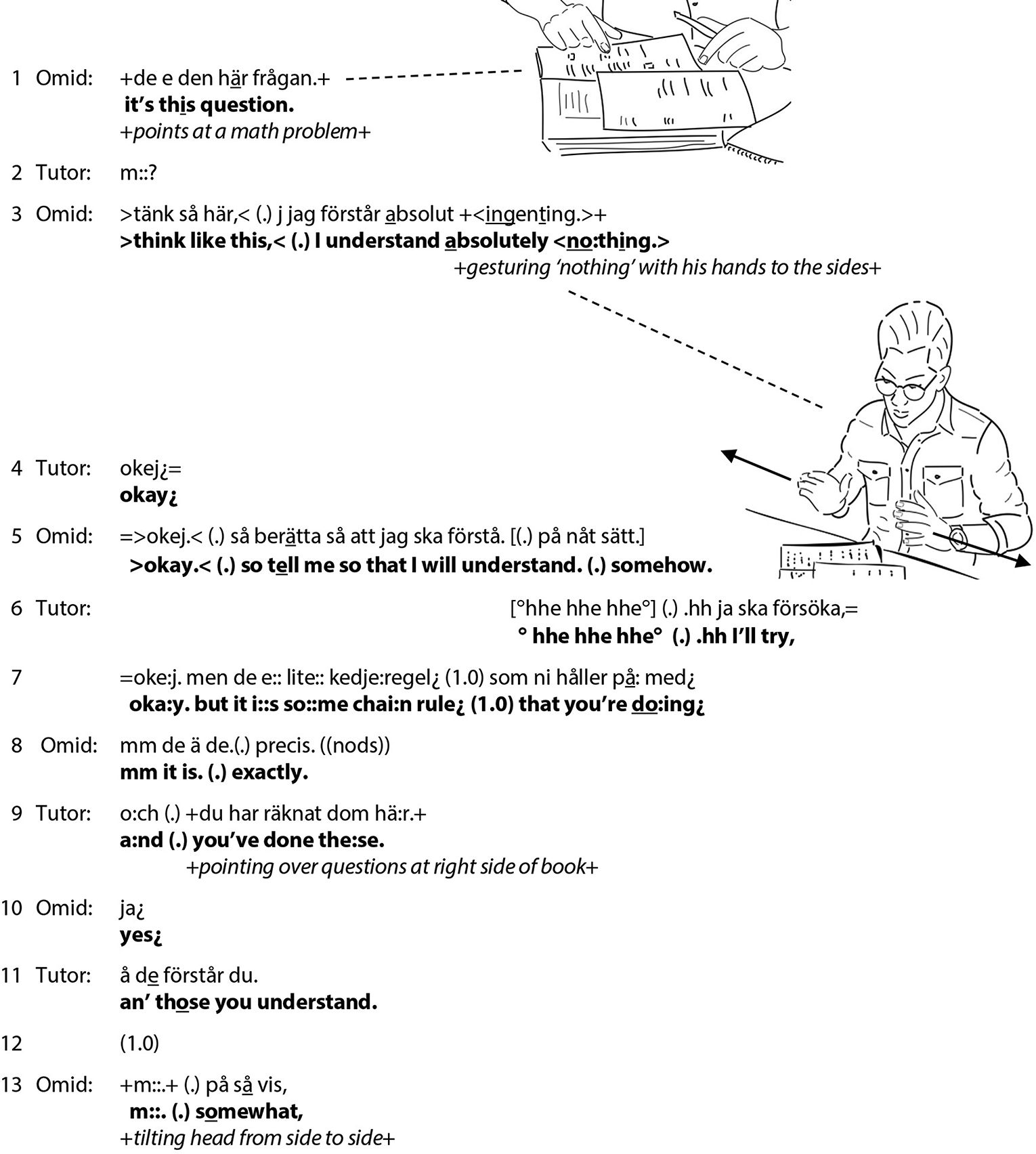
Extract of “I understand absolutely nothing”.
The student initiates the talk about his problem by pointing to a specific assignment in his math book while delivering a deictic expression, it’s this question (line 1), thus navigating the tutor’s attention in a certain direction. When the tutor shifts his gaze in coordination with Omid’s pointing, no more information about the mathematical problem is provided. Instead, the student formulates a suggestion regarding what frame of mind the tutor should enter, performed through an instructional directive: think like this, (.) I understand absolutely <no: thing> (line 3). Together with a stretched-out and emphasized production of the lexical item “nothing” and a gesture depicting emptiness (see image, line 3), this expounds his presumed lack of knowledge and clarifies that there are certain expectations tied to his request. In fact, the initial framing, think like this, creates a hypothetical scenario in which the tutor should treat Omid as a completely unknowledgeable person, which is an extreme position that discards Omid from any form of epistemic responsibility.
Omid then elaborates on what he expects the tutor’s explanation to lead to in terms of his being able to understand (line 5). That the tutor is aware of the rather delicate position this puts him in becomes evident as he chuckles and marks his upcoming turn as a try to do what Omid has requested. Interestingly, rather than the student proceeding to explain what he has problems with, in this case, it is the tutor who becomes responsible for finding out what it is that the student needs help with and what he knows. He does so by an attempt to clarify the type of mathematical problem that the pointed-out assignment entails: but it’s so: me chai: n rule¿ (.) that you’re doing¿ (line 7). The utterance is related to the drop-in form of homework support of the current context, where the tutor is not previously acquainted with the students’ work. Moreover, it shows how the tutoring is organized with respect to what the students are doing in the classroom displayed by the use of a second-person plural “you” that refers not only to Omid but to his classmates and the teacher.
When the student confirms that the chain rule is in fact what he is working on, the tutor next tries to discern how far Omid has come ‘an you’ve done the: se (line 11) before performing a more direct “pistemic status check” (Sert, 2013) formulated with a positive polarity (cf. Koshik, 2002): an’ those you understand (line 13). So far, we can see how the tutor is the one performing most of the work necessary for establishing a common ground for both formulating and understanding the student’s problem. This example thus demonstrates the consequences of a transfer of accountability from the student to the tutor occasioned by the student’s epistemic framing of his request for help.
In Figure 1, the tutor was oriented to as an expert, namely, as someone who can explain a complex math problem to someone who understands “absolutely nothing.” However, as our next example will show, tutor–student identities are sometimes made relevant in more ambiguous ways, not only related to what students are doing in school, but to what their epistemic domains may be. In Figure 2, taken from the same drop-in homework support setting, a tutor is helping the student Maya with a problem related to derivatives. The tutor has just sat down and is working to find out what the student is having problems with.
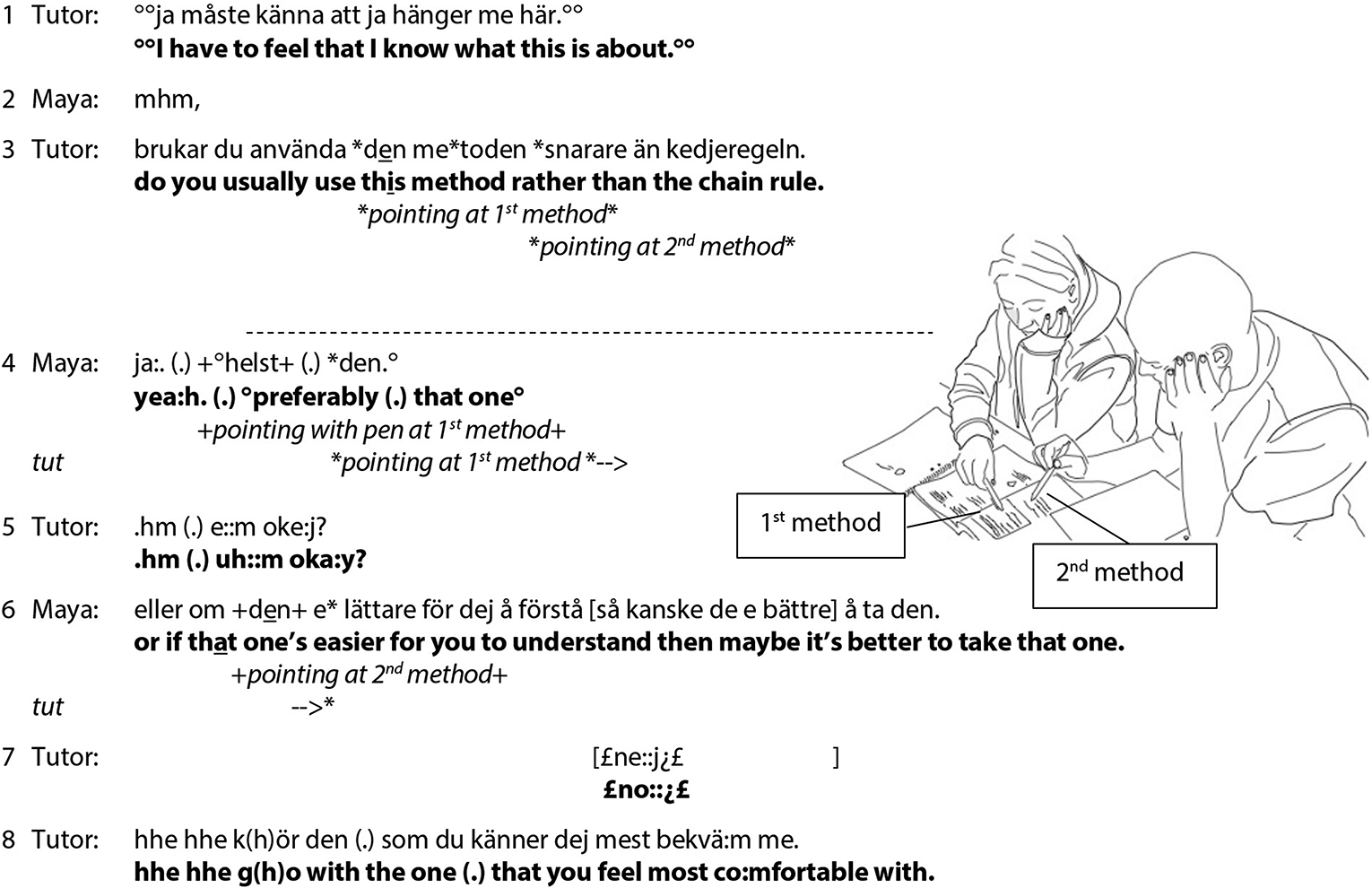
Extract of “If that one is easier for you to understand”.
The tutor is reading in the math book as he comments in a silent voice I have to feel that I know what this is about in a way that explains to the student why no instructional work is initiated. Maya responds with a flat “mhm,” and the tutor asks her which method she prefers: do you usually use this method rather than the chain rule, as he points at the different methods that are presented on the book page. The design of the question has a preference toward responding with the first rather than the second method, displaying that the tutor makes the assumption that this method is the one that Maya will prefer. She confirms that this is indeed the case: yea: h (.) ° preferably (.) that one.° as she points at the 1st method (see image 1, line 4). The tutor continues gazing at the math book, as he reads and produces an .hm (.) uh:: m oka: y?. Maya interprets this as a display of hesitance and a possible lack of epistemic access to her preferred method, visible in her suggestion or if that one’s easier for you to understand then maybe it’s better to take that one that targets the tutor’s possible varying understanding of the two methods at hand. The utterance could be seen to question the tutor’s epistemic authority by challenging the “normative expectations related to the epistemic rights and obligations of some social categories” (Mondada, 2013, p. 598), here the categories of teacher/tutor. That this social negotiation is indeed in play is evidenced by how the tutor responds with an emphasized no::¿ already when having heard the first part of the “if-then-construction,” projecting what is to come and emphatically disagreeing. The tutor moreover treats the suggestion as somewhat laughable, as he, with an initial production of some laughter particles, instructs the student to hhe hhe g(h)o with the one that you feel most co: mfortable with (line 8). He thus reclaims his position as a knowing participant that, on the contrary, is oriented toward the student’s needs as determinative of the design of instructions and explanations.
In these few lines, we see how the participants negotiate their respective epistemic roles and identities, where what is particular to this setting is that a student may orient to the tutor as not knowing everything about the math domains that they are working on. In this particular instance, the tutor deflects this possibility and instead links the manner of explaining the problem to the student’s epistemic domain, here expressed in terms of what she feels most comfortable with. At the same time, the figure shows an example of how the tutor works to find out within what framework to interpret the student’s mathematical assignment.
Alternative tutor–tutee relationships and math books as boundary objects
As a contrastive example, we next turn to the one-on-one online tutoring homework support. In this case, the tutor and the tutee Michael have been working together for a long time, always online and in sessions with a duration of approximately 1 hr. Already in the very first turns at talk (Figure 3), a radically different situation from the ones previously analyzed is made relevant, visible in how the tutor requests a report (line 1), rather than the interaction being initiated by a request from the tutee.
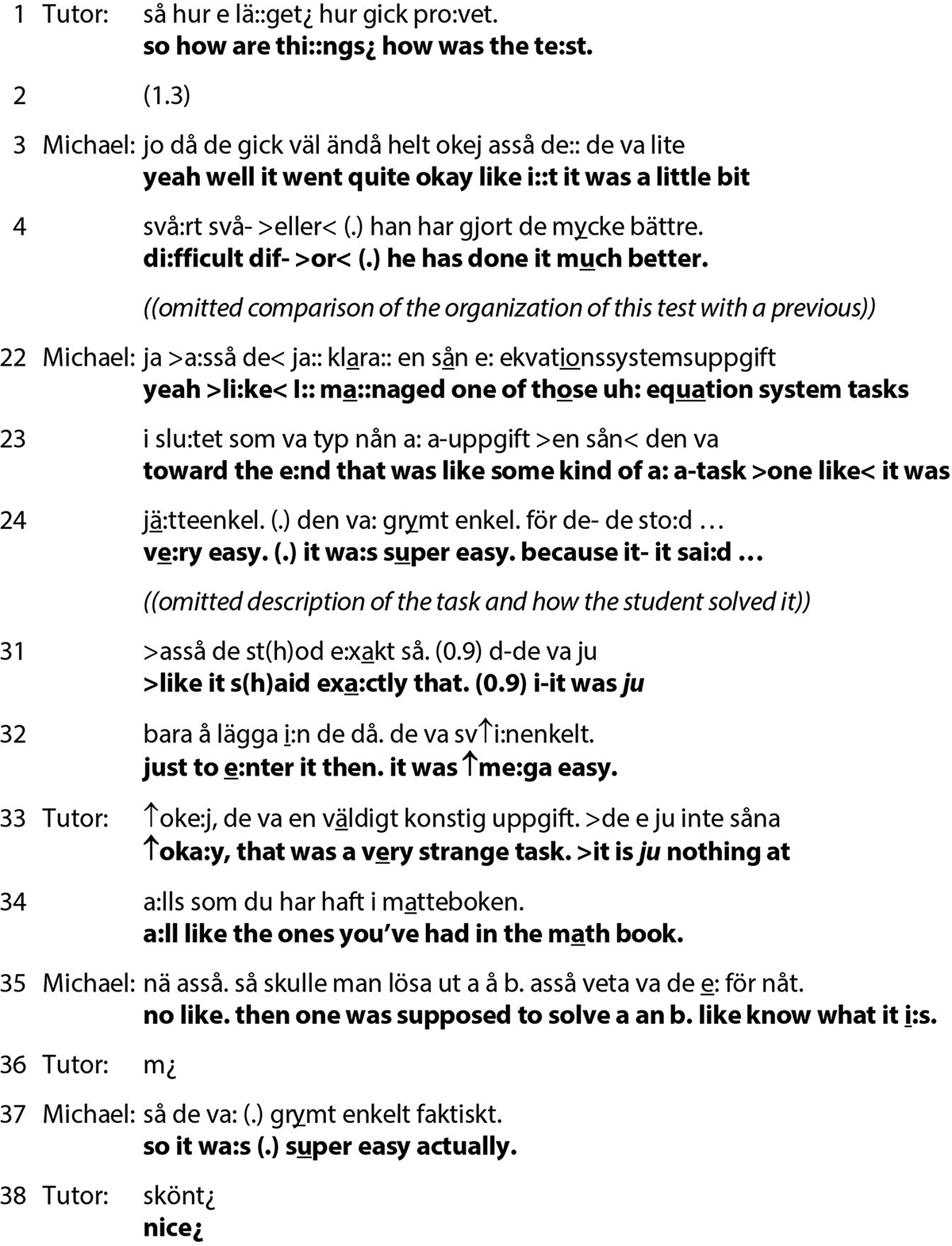
Extract of “How was the test”.
The tutor question opening the sequence consists of two parts: so how are thi: ngs¿ how was the te: st. The first part opens up for a report about life in general; however, this possibility is immediately curtailed as the tutor asks about a recent test. The format of the second part of the question displays a high degree of task-orientation, characteristic of institutional talk (Drew & Heritage, 1992). It reveals that the participants have previous knowledge about each other, their institutional relationship as tutor and tutee, as well as what the topic of this conversation is going to be. At stake for the tutor is the fact that she has helped the tutee prepare for his test and that the success or failure of the tuition is related to how he performs on the exams.
After an interactionally rather long silence of 1.3 s, indicating some troubles in answering, Michael initially responds with a yeah well it went quite okay (line 3). The evaluation of his performance is framed in a neutral way, at this stage indicating neither a strong negative nor positive assessment. Moreover, he initially seems to be on his way to express that the exam was difficult: it was a little bit di: fficult dif-. However, he restarts and instead a positive assessment of the teacher (line 4) introduces an account, in which the test is compared with a previous one, by focusing on the structure and degree of difficulty of the test (not in transcript). Next the tutee announces that he has managed to solve one of the “a-tasks,” that is, one of the most advanced assignments that may render the highest grade. When the tutee assesses the task as ve: ry easy (.) it was super easy, he consequently appears as a knowledgeable and competent student.
Michael proceeds to explain the organization of the exam question and claims that the solution was present already in the assignment (not in transcript), thus presenting himself as someone who has outsmarted the task. The tutor, who has up until this point merely produced minimal acknowledgment tokens displaying her listening, exclaims: oka: y, that was a very strange task. >it is [ju] nothing at all like the ones you had in the math book. By this negative assessment, the tutor takes a critical stance toward the task and by extension the teacher who has constructed the test. The ground for critique is based on a comparison with the problems that they have worked on in the math book. When the tutee responds, he does not align with the negative assessment of the task. Instead, his turn restores some of his capacities as a clever student not only copying information that was available in the task but actually solving a problem: like know what it i: s. The repeated assessment so it wa: s (.) super easy actually positions him as a knowledgeable student and as someone who indeed did know “what it is” and believes it was easy. At this stage, the tutor chooses to align with the tutee’s assessment and producing an appreciation of having succeeded nice¿ she affiliates with his feelings rather than opposing the task or the teacher.
Given that one of the reasons for engaging in homework support is to get higher grades, this telling is interpretable as a success story. At the same time, the tutor’s response to the telling displays the outside position of tutors. When designing their explanations and instructions for the tutees and in making assumptions about which mathematical areas to work on and how, they are highly reliant upon the information in the math book (cf. Figures 1 and 2). This points to the math book as a boundary object that travels between the school and homework support settings.
A preference to remain until the problem is solved
Our last example illustrates another characteristic feature of the documented homework support practices, namely, the preference to remain with the student until the task is completed and, if possible, the student has changed their understanding of the identified problem. In regular classrooms, research has shown that teachers tend to merely explain parts of a student’s problem to prompt them to move forward on their own and then attend to the next student (e.g., Koole, 2012). However, in the classroom, the participants can always resume where they left things the last time, as they can rely upon long-term relations, and the possibility of asking and explaining again. In contrast, in the drop-in homework support setting, the tutors tend to remain by the students’ side until both parties agree upon the problem-solving activities having come to a close. As we join Figure 4, the tutor and student (same as in Figure 2) have been working on a problem during approximately 6 min, when the student suddenly realizes how to solve it.
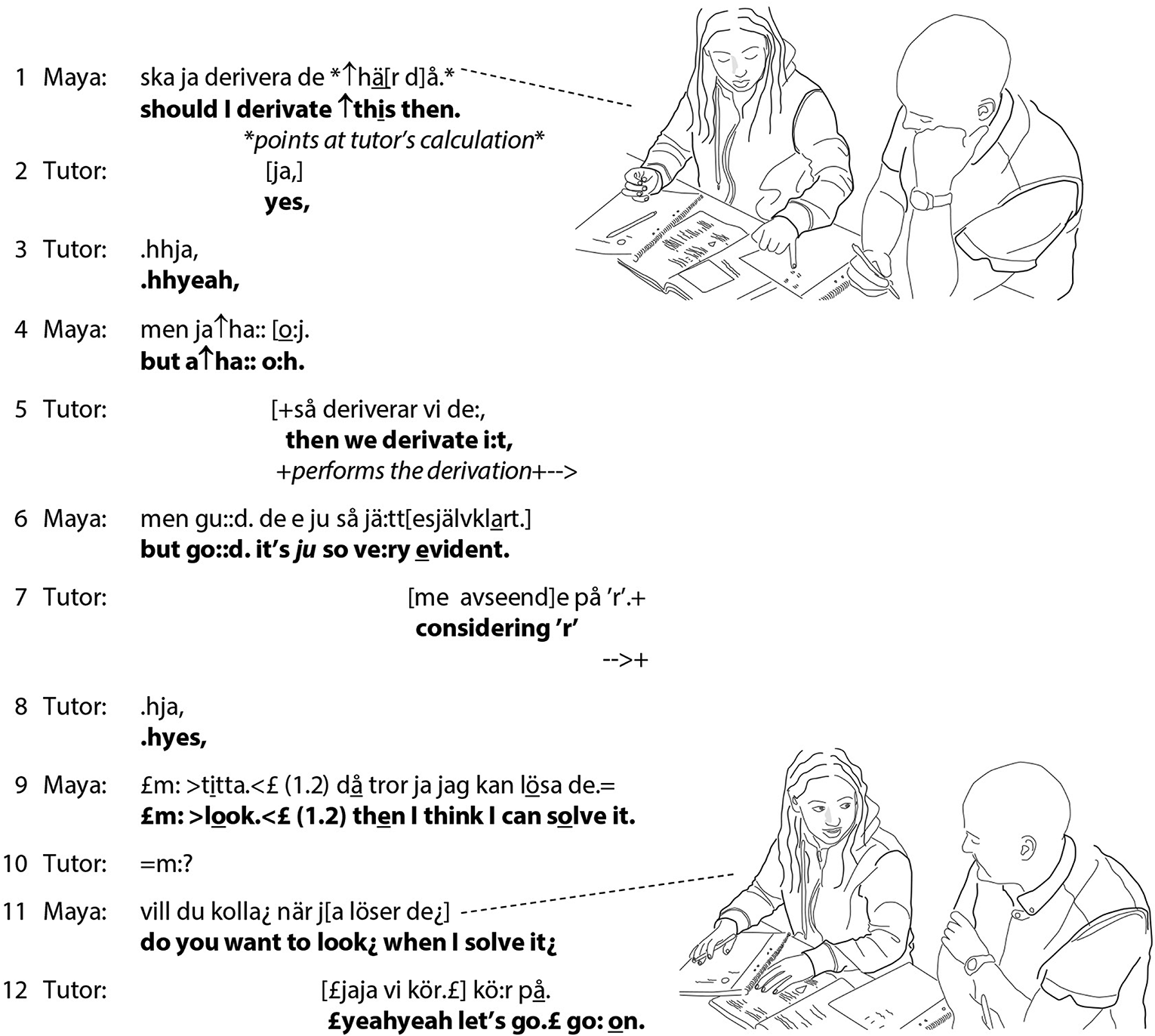
Extract of “Do you want to look when I solve it”.
In line 1, Maya asks a clarification question should I derivate ↑this then, as she points at the teacher’s calculation (see image 1, line 1). When the tutor has confirmed the correctness of her proposal, she produces a change of state token suggesting that she has undergone a change in her “locally current state of knowledge” (Heritage, 1984, p. 299). This epistemic realization is further underlined by the turn in line 6, where she, as she watches the tutor perform the derivation on his notepad, exclaims but go:: d. it’s ju so ve: ry evident. The design of the declarative indicates that the realization is of the kind that she did not understand what was readily available for understanding. The epistemic adverbial ju, that indicates that something is treated as shared knowledge among copresent participants (Heinemann et al., 2011), here underscores the evidentiality of the solution. When the tutor has completed the derivation, Maya exclaims with a smiley voice m: >look.< and states then I think I can solve it. (line 9). When the student declares that she can solve the problem (line 9), she takes a knowing stance making the tutor’s further help redundant. The statement displays an orientation toward a closing of the help-seeking sequence and the imminent departure of the tutor. However, the tutor responds with an acknowledgment token and disaligns with the closing aspect of the student’s utterance. Now orienting toward the possibility of the tutor remaining, the student (slightly reluctantly) asks if he wants to look: do you want to look¿ when I solve it¿ (line 11). In fact, the Swedish word “kolla” is a vernacular version of “look” that has connotations of “checking” and, in other words, controlling what the student is doing, in all contributing to Maya’s cautious stance. At this stage, both participants, who have hitherto been looking at the math book and calculation, look at each other (see image 1, line 11), thus displaying a disengagement from the task at hand. However, the tutor responds in a smiley voice that he intends to stay: £yeahyeah let’s go.£ go: on. The smiling production of the utterance is interpretable in terms of the delicacy of this moment, with a possible orientation toward challenged participant roles and identities, as the tutor encourages the student to continue working with him by her side.
Homework support in the shadow of school
The analyses of interactions between tutors and students/tutees show the intimate yet complex relations between school and homework support settings. The participants are entangled in negotiations over epistemic identities as well as access to mathematical contents. The tutors’ dilemma is that they are at an epistemic disadvantage in the sense that they have limited insight into the assignments as well as the teachers’ planning and manner of presenting the mathematical content. Depending on the specifics of the homework support setting, the tutors may be more or less acquainted with the students’ work. However, in all cases, they occupy an outsider’s position while simultaneously designing their instructional and explanatory work in relation to the activities in the students’ classrooms. As we have shown, the math book comes to play an important role as a boundary object in this respect. The students’ dilemma, on the other hand, is that they have to design their requests for help in ways that as efficiently as possible make clear what their problems are. Indeed, the students are oriented to as having full epistemic authority over their problems, with no focus on the tutors evaluating the students’ knowledge or accomplishments beyond the mathematical problems that they are working on. As such, the relation between the tutor and student/tutee is accompanied by more ambiguous rights and obligations, leading their “contractual expectations” (Mondada, 2013) to become vaguer and in some ways more symmetrical than that of teachers and students.
Läxhjälp as a pedagogical object
The tutoring practices that recently entered the Swedish educational landscape have shifting objectives, content, interaction modes, and assessment tools. To more fully grasp shadow education as a pedagogical object and the variety of tutoring practices and their intersections with regular schooling, we have argued for a broad conceptualization of shadow education and curriculum perspective, which requires different approaches. In this article, we have discussed policy and practices of läxhjälp and their manifestation in different settings. The analyses refer to various tutoring practices in for-profit and nonprofit organizations as well as those provided by the ordinary school or at its premises.
Läxhjälp emerged as a bottom-up movement of private organizers and customers and became later regulated by the state, which enabled schools and nonprofit organizations to offer homework support for all students free of charge. In this way, policy shifted from the laissez-faire approach to regulations of some aspects of shadow education. However, the regulations mainly concern state subsidies and the obligation of schools to provide läxhjälp. Accordingly, for-profit organizations became excluded from financial support and formal regulations.
As shown in the analysis, compulsory education and state-funded läxhjälp are differently regulated. While the former is characterized by hard governance with specified regulations, the latter is more softly governed. Overall, state policy treats supplementary tutoring as a question of student rights and access and not as a pedagogical object, thus, making other aspects of läxhjälp not explicitly articulated, and therefore in part hidden or tacit at the level of policy (see also Forsberg, Hallsén, et al., 2019; Forsberg, Mikhaylova, et al., 2019).
The notion of shadow education suggests a mimic character between regular school and supplementary tutoring. We have further elaborated this by employing curriculum theory and the concept of boundary object. While it seems obvious that tutoring practices reflect ordinary school, the notion of “shadow” evidently refers to some rather than all aspects of the curriculum. As illustrated above, in shadow education, the weight is put on some objectives, subjects, teaching methods, and forms of assessments. This makes the curriculum of shadow education more restricted.
In a curriculum perspective, shadow education practices are enacted and negotiated in local policies and practices and vary in terms of curricula, pedagogy, and evaluation. Tutoring organizations often clarify their own vision of the offered services and what they expect from tutors and clients (see also Hallsén & Karlsson, 2019). In this way, they reflect and influence what knowledge is considered of most worth as well as the social constellations, the modes of interaction, and the distribution and negotiation of epistemic authority and responsibility on the part of the tutor, tutees, and parents.
Kim and Jung (2019) identified several characteristics of the curriculum of shadow education, many detectable also in Swedish homework support. One of them is the orientation toward academic success, competition, school grades, and exams. Another one is the emphasis on personalized learning and bespoke education, as shown both in the video-recorded practices of help-seeking in ordinary school, in local policy of for-profit support, and the narratives of tutors in nonprofit support. Even in collective settings in ordinary classroom with many students present, the mode of interaction is more focused on individualized learning. The prevalence of these characteristics is in itself not surprising, given the prevalence of the performance culture with continuous follow-ups, quantifications, and comparisons. Also emphasized are clear objectives and effective work structure. Prominent in the Swedish curriculum of shadow education are also an emphasis on social equality and cultural integration in nonprofit organizations and the enhancement of student motivation and development of study skills, stressed particularly in for-profit tutoring.
In the Swedish case, läxhjälp gained legitimacy by implementing the principle of mass tutoring. Hence, the boundary object par excellence is the logic of equality articulated in “a school for all” translated to läxhjälp for all, which itself is embedded in the performance culture (Forsberg, Mikhaylova, et al., 2019). This notion nurtures the idea of läxhjälp as the public good. However, whether this is the case or not is an empirical issue that remains to be explored.
Other critical boundary objects are teacher and student roles and identities, teaching materials, school provided assignments, and tests (see also Forsberg, Mikhaylova, et al., 2019). While these are directly linked to the regular school, they take on different shape and meaning in tutoring practices. The analyses of identities and interaction revealed a nuanced and multilayered picture of how different organizational and spatiotemporal arrangements allow for different tutor identities and different relations between tutor and tutee. As shown, normative expectations of epistemic rights and obligations of the tutor as a teacher are sometimes challenged because of the wide range of topics and restricted knowledge of student assignments and ability. Tutors claim and are ascribed a broad variety of identities, such as teacher, friend, time manager, interpreter, frustrated critic of ordinary school, and tools for parental control. Tutees are foremost referred to as motivated or lacking in engagement and interactions show tutees interchangeably as initiators or respondents; accordingly, the tutor–student relations may be asymmetrical in one setting and more symmetrical in another. The identities of parents vary from a distant and silent actor of nonprofit tutoring practices to a present, demanding and controlling participant in for-profit activities.
Through analyses of policy, narratives about and interaction in situated practices of homework support, we have identified both foundational characteristics and more context-dependent elements of läxhjälp as a pedagogical object. Further research on supplementary curricula, tutoring interaction in diverse settings, and more actor narratives is needed worldwide. In the Nordic countries, we also welcome more statistics on and mapping of various forms of shadow education and their impact on educational objectives, outcomes, student achievements, and equality.
Footnotes
Contributorship
Eva Forsberg and Tatiana Mikhaylova were responsible for writing the introduction, literature review, theoretical framing of shadow education and the concluding discussion. Together with Helen Melander Bowden they also responded to the reviewersˈ comments. Marie Karlsson and Stina Hallsén conducted interviews with tutors and wrote the section on tutor and tutee relationships and social identities in different organizational settings. Helen Melander Bowden and Johanna Svahn collected video-recorded data and contributed with the analysis of interactional and epistemic organizations of help-seeking practices.
Declaration of conflicting interests
The author(s) declared no potential conflicts of interest with respect to the research, authorship, and/or publication of this article.
Funding
The author(s) disclosed receipt of the following financial support for the research, authorship, and/or publication of this article: This research is supported by the Swedish Research Council Grant 2015-01754 awarded to Eva Forsberg.
