




Abstract
Purpose:
This article examines the adverse impact of international economic sanctions on pedagogy. The article considers the contemporary times as a period of misinformation, false news, and untruths. Utilizing anti-hegemonic literature, international economic sanctions are viewed as neoliberalism’s instrument of coercion, a Western weapon used to enforce Western values on those with different perceptions toward the free market system.
Design/Approach/Methods:
This article utilizes critical scholarship to unmask authoritarian neoliberalism and a scoping review of sanctioned societies. Critical analytics are deployed to interpret and make sense of the dominant educational policy framework that appears to be against diversity.
Findings:
Neoliberalism has caused a crisis in pedagogy. Education is under siege as academics and scientific evidence are being disregarded. The call is for pedagogues from all over the world to continue to avail evidence to power by practicing critical education. Literature is utilized to propose critical pedagogy when scientific evidence is disputed, and non-Western epistemologies are considered anachronous.
Originality/Value:
Linking sanctions and neoliberalism is relatively novel, as is the contribution of the same lenses to authoritarian neoliberalism. The assault on divergent epistemologies is critical, and the defense of critical scholarship is every academic’s duty. The article joins conversations on the neoliberal assault on education and society.
Keywords
Introduction
The rationale behind the use of international economic sanctions is that economic pressure on civilians translates into pressure on the government for policy change (Gutmann et al., 2018; Hafner-Burton, 2014). International economic sanctions have become an important instrument of global governance, and many countries are under some form of economic sanctions (Fabre, 2018; Jones, 2015; Leyton-Brown, 2018). According to the Office of Foreign Assets Control (2019), the U.S. has 30 countries under some form of economic embargo. Teaching and in general education in many countries of the world has come under immense pressure because of international sanctions. The literature on economic sanctions mainly deals with effects on political governance, economic meltdown, and sometimes human rights (Andreas, 2005; Drezner, 2015; Peksen, 2009). The impact on social services such as education has not been an area of interest to scholars and researchers, despite the immense impact sanctions have on their work.
Economic sanctions have become an instrument of coercion by world powers with economic muscles. The U.S. and the European Union (EU) have increasingly relied upon (targeted) financial sanctions as their preferred instrument of statecraft. For many decades, the U.S. has been the undisputed financial hegemon of the world, and the international financial system and operations require access to the U.S. capital markets and U.S. dollars to conduct transnational business (Drezner, 2015). Consequently, economic sanctions have come to be viewed as a neoliberal coercive instrument, an alternative to war (Bali, 2018; Drezner, 2003, 2015; Zarate, 2013), and in many cases, they are illegal and against international law (Chipanga & Mude, 2015).
When one considers the way pedagogy and education, in general, have been impacted by the neoliberal ideology, the importance of specifically slicing the state of education in societies that are under sanctions becomes pertinent. The major impact of neoliberalism on education, neoliberalism as the system being globalized by the continued interconnectedness of modern societies, has been the idea that Western knowledge is universal and for sale (Ball, 2012; Carnoy, 2016; Marginson, 2016). Moreover, accompanying that line of thinking is the hidden curriculum message that Western epistemology is supreme, for example, the English language (Adjei & Dei, 2008; Adu-Febiri, 2014), and by implication all other knowledges and ways of knowing are to a certain extent unscientific, not appropriate to achieve industrialization and modernity. In the struggle to attain development, in other words in catching up with the European/Western Global North, the non-Western nation-state’s governance systems at many times are perceived and described as authoritarian and failing to respect freedoms for humans and the market and hence must be reformed (Harisson, 2019). This implies that the use of economic sanctions is a double-edged sword that aims to ensure the “Other” (Said, 1994) government’s compliance with the imposer’s economic interests and the annihilation of non-Western epistemological systems.
Some scholars have lamented about the neoliberal West’s “dream of the universality of a single logic” (Smith, 2000, p. 15), the idea that there is no alternative to neoliberalism (Berliniski, 2008) that is driving globalization processes in education. Dussel (1999) referred to it then as the pedagogical violence at the heart of Euro-American modernity that today is employing economic sanctions against societies that attempt to be different. At one point, the U.S. government explicitly declared as its international mandate and mission to install “freely elected democracies” all over the world, under “one standard for the world,” which is “the free market system…practiced correctly” (McMurtry, 2002, p. 28). From a pedagogical sense under the dream of singularity, students and their education become “problems” to be remediated through controllable, predictable, and manageable Western interventions. Anything outside of the purview of such monitorable remediation becomes deeply suspect (Smith, 2006) and deserves to be punished with punitive economic sanctions. Educators 1 have observed this line of thinking with great alarm, and recent education research annual conferences like the Comparative International Education Society (CIES) held in Mexico City in 2018 under the theme of Remapping Global Education and American Education Research Association (AERA) hosted in Toronto in 2019 that ran under the theme, Leveraging Research in a Post-Truth Era: Multimodal Narratives to Democratize Education, spoke these evidence-based concerns to the modern neoliberal empire. Smith (2006) described the contemporary period as the season of great untruth as scientific evidence is disregarded by political and business leaders, and untruths in some cases lead to some countries being placed under economic sanctions or even war. The issue then is how to educate in such an environment?
It is against these critical observations that this article assesses the impact of economic sanctions on education, especially of the vulnerable populations in targeted societies. More specifically, the article addresses the challenges of educating or teaching in circumstances where scientific research-based evidence is disregarded. Facts on poverty, the environment, climate change, and socioeconomic and political realities in “peripheral” nation-states are disregarded as long as they do not feed into the autocratic demands of the market system. The article utilizes anti-hegemonic perspectives (Andreotti, 2010; Fanon, 1963; Grosfoguel, 2007; Mignolo, 2000; Quijano, 2000) to analyze, critique, and situate international economic sanctions in the wider framework of neoliberal globalization and in the process viewing economic sanctions as a weapon of mass destruction on those who would like to think outside the neoliberal domain and pursue a different system of development, an alternative to neoliberalism. The article, therefore, aims to achieve the following: situate international economic sanctions as a neoliberal instrument that is devastating the education of targeted countries, highlight the devastating long-term impact of economic sanctions on human capital development, amplify the challenge the modern educator faces in a dominant environment that promotes the market and one line of thinking, and support and propose pedagogical refocusing on the part of modern educators of all regions of the world as is being advocated by critical international pedagogues.
To achieve these tasks, the next section of the article will give a brief exposition of economic sanctions illustrating how rampant they are employed as well as how unsuccessful they are in most cases in achieving their stated objectives. A scoping review of international studies that have considered the topic will then follow and, in the process, highlight the thinness of the literature on this fundamental issue of our time. The following section of the article will then discuss the implications of international economic sanctions on pedagogy, mostly in the non-Western regions of the world in this period of neoliberal hegemony or authoritarian neoliberalism (Bruff, 2014; Bruff & Tansel, 2018; Harisson, 2019). The conclusion will be a call for the West and the East or the North and the South to realize that for too long, the very question of what constitutes knowledge, its nature, and character has been posted and answered for today’s world almost exclusively by Western scholars. Equally pertinent and to be noted is that education today has become a valuable export commodity for America and Britain, in particular, culminating in some critical voices observing coloniality as the permanent tenet of education in the non-Western world.
Slicing the post-truth era: The season of sanctions
In the call for submissions for AERA 2019, Wells et al. said: Indeed, we see daily examples of policy issues from climate change to immigration—in which appeals by powerful leaders to personal beliefs and emotions hold more sway than objective facts and evidence…Juxtaposed, Arendt and Du Bois teach us that research evidence can be either used or rejected by those who seek to maintain a racial hierarchy in their quest for power. The question for education researchers is how, in a so-called post-truth political era, when evidence is shunted, and emotion is exploited, can we make our research matter to lessen inequality and increase educational opportunities? How do we have an impact when our most conscientious methodology—measuring, understanding, and communicating material and experiential realities—is increasingly discredited by those who construct alternate truths to serve their agendas? Furthermore, how can our findings speak to and of emotions such as fear and anxiety, which are regularly scapegoated onto the most marginalized individuals rather than attributed to their economic and social causes? (2019, p. 1) …the enfraudening of the public sphere meaning not just simple or single acts of deception, cheating, or misrepresentation (which may more accurately fall under the term defrauding), but a more generalized active conditioning of the public sphere through systematized lying, deception, and misrepresentation. (p. 490)
Economic sanctions have become neoliberalism’s army and police force. In the age of untruths and the supremacy of the free market (McMurtry, 2002), the secondary impact of economic sanctions is hitting hard on many innocent people in the non-Western world, as seen in Figure 1. It is important to note that the first country to have sanctions imposed on it was Rhodesia (now Zimbabwe) when in 1966, the United Nations Security Council took a historic step and imposed comprehensive sanctions to undermine Ian Smith’s White supremacist regime (Ogbonna, 2018). In 2001, the U.S. imposed sanctions on Black independent Zimbabwe, and in 2002, the EU followed suit. This means, in total, Zimbabwe has been sanctioned in seven sanction-episodes, 1966, 2001, 2002, 2003, 2005, 2008, and 2009, making it one of the most sanctioned countries in the world (Ogbonna, 2018, p. 32).
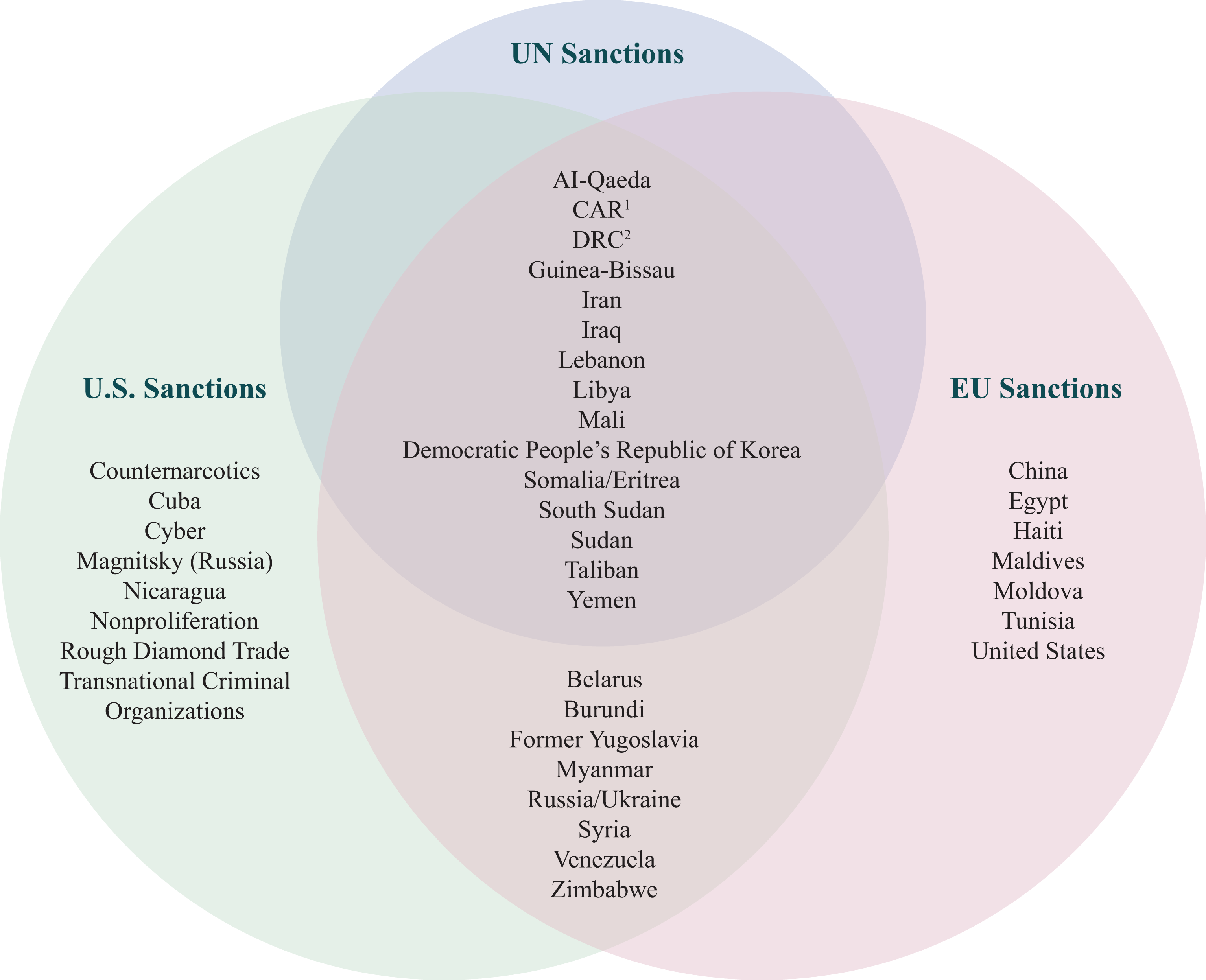
Global sanctions regime.
International economic sanctions are defined here as “the threat or act by a sender government or governments to disrupt economic exchange with the target state unless the target acquiesces to an articulated demand” (Drezner, 2003, p. 644). The major senders today are the U.S. and the EU, two great geographical institutions of our time where so many people dream of calling home. It has to be mentioned that the U.S. and EU’s leadership role in the reconstruction of the world order after World War II has mostly been anachronic and to many nation-states dangerous for being so. It merely ignores some basic facts: The EU and U.S.’s version of economic development is a product of their own time–space configuration as frontier New World cultures that privilege geography over history, seeing the rest of the world in terms of spatial conquest with little regard for other people’s historical sensibilities (Smith, 2006). They are using economic sanctions to force their will, to colonize other people without firing a gun. This discussion employs the standard definition of sanctions in the literature that means “government-inspired restrictions on customary trade or aid relations designed to promote political objectives” (Marinov, 2005, p. 566). It goes further to note the limited effectiveness of sanctions for ending apartheid in South Africa, proceeded to denounce them by pointing out that “…in the more typical cases of Iraq, Haiti, Cuba, and the Democratic People’s Republic of Korea, sanctions have seemed only to empower dictators” (Marinov, 2005, p. 575) while destroying the livelihoods of the ordinary citizens. Zimbabwe can be added on this list (Zembere, 2014).
Neoliberalism as hegemonic
Many have observed the association between neoliberalism and transnational state coercion. Harvey called neoliberalism “a hegemonic discourse” (2007, p. 22), while Bruff observed “the co-existence of free-market policies and strengthened security apparatuses” (2016, p. 106) and that neoliberalism “allocates the state a strong predisposition towards the enforcement of privatized and marketized social relation” (Harrison, 2019, p. 275). While these tenets of neoliberalism are observed even in industrialized countries, the use of force by the state to enforce neoliberal socioeconomic policies is more overt and rampant in the peripheral developing countries. The absence of a strong propertied class or bourgeoisie in some developing countries is proffered as the reason by some (Radice, 2008). It is critical to mention that the dominant version of development and education is capitalist (Berliniski, 2008; Best, 2018). Capitalism is identified within the dominant paradigm of development as the real progress, as having replaced decadent nonproductive systems while installing modernity (Mielants, 2007). Some indigenous and rural villagers in some parts of the world, as well as some government systems, are seen from this perspective as enemies of development (Abdi & Guo, 2008; Bello, 2009), monsters of the free market (McNally, 2012), and they are stumbling blocks that “obstruct the route to progress with their regulations and prohibitions which are detrimental to the increasing wealth of nations within a free market” (Stabel, 2004, p. 188). This is corroborated by Hegel, who took development to be the crux of the West’s identity. He conceived the modern West as the epitome of development, a masterful civilization, and as such, the model for mankind: “…the future is liberal for all, via conquest and development” (Hegel, 1956, p. 54). These values of economic development have become global, and hence the idea of neoliberal globalization. The practice and method of teaching that entails pedagogy is supposed to achieve these values of economic development.
The thesis in this article utilizes critical postcolonial perspectives that interrogate knowledge production of the west (Andreotti, 2010; Carbin, 2016). Crucial to these critiques is the concern that with low-income countries, the literature on the impact of neoliberalism on education often lacks a relevant theoretical basis (Tikly, 2001) grounded in the historical and contemporary struggles of the people. A critical postcolonial approach germinates into critical pedagogy that takes into account the historical background to the adoption and deployment of neoliberal policies in education. Critical pedagogy focuses on issues of culture identity and inclusion and how these influence what goes on in education and shapes the purpose of education (Rana & Culbreath, 2019). The article borrows from critical pedagogy sensibilities to analyze the narratives to develop a discourse of care, empowerment, and participative democracy that is authentic.
Pedagogy as a casualty of international economic sanctions: A global scoping review
Economic sanctions, comprehensive or targeted (Brady, 2018; Leyton-Brown, 2018), affect the normal operations of a country. Studies have shown how international economic sanctions can have unintended, catastrophic consequences, often creating widespread suffering among the populace of a targeted state (Cashen, 2019; Mueller & Mueller, 1999), what others have referred to as collateral damage (Jones, 2015). Even when sanctions are employed to discourage human rights abuse, their severe humanitarian impact can cause further harm to the vulnerable populations they initially set out to protect. Studies have further shown how the human rights situation deteriorates with the government trying to remain in power and transferring resources from social services to security and defense (Andreas, 2005; Drezner, 2015; Peksen, 2009). Education is one of the social services that has become a casualty of economic sanctions. The poor tend to be impacted more than the wealthy as the latter have better access to scarce resources and can even afford to go abroad for education or other needed services (Neuenkirch & Neumeier, 2016; Sen et al., 2013).
A scoping review was done to examine research studies that exist and are relevant to the issue of economic sanctions and education. A scoping review is a critical research question aimed at mapping key concepts, types of evidence, and gaps in research related to a defined area or field by “systematically searching, selecting and synthesizing existing knowledge” (Colquhoun et al., 2014, p. 67). The central concepts or variables considered were international economic sanctions, comprehensive sanctions, targeted sanctions, education, academia, children’s welfare, and teaching. The electronic databases that were used were Academic Search Complete, JSTOR, ERIC (via EBSCOhost), Google Scholar, and Sage Publications.
The scoping review showed that very few studies had been carried out on the impact of economic sanctions on education. The thin literature available on this topic illustrates, to a certain extent, the negative impact of economic sanctions on all levels of a nation-state’s education system. Relevant research studies have been carried out mostly on Iran, Iraq, and the Sudan and Zimbabwe, notable candidates of contemporary sanctions regimes. In Iran, research showed that due to negative income shock, children’s total years of schooling decreased by 0.2 years, and the probability of attending college by 8.7% (Moeeni, 2018). Families respond to the reduction in income by substituting away from higher quality private schools toward lower quality public schools for their children. Also, economic sanctions introduce barriers in many areas of academic activity and can be seen to influence what research is done, how it is disseminated, and how students are educated (Bezuidenhout et al., 2019). Another study in Sudan found out that U.S. sanctions negatively impacted Sudanese citizens’ access to Information and Communication Technologies (ICTs) in a number of sectors, including educational institutions, pro-democracy civil society, and humanitarian efforts that utilize geographic information system technology (Haj-Omar, 2014). Furthermore, no Sudanese inside the country could purchase original software online. Regular citizens, as well as universities, relied heavily on pirated software that could not be updated online automatically and was often ridden with malware. The research also established that computer science students were unable to obtain certificates after taking and passing online courses affiliated with U.S. institutions such as Massachusetts Institute of Technologies (MITx). The reason given is that certificates are not issued for countries under comprehensive U.S. sanctions. Additionally, online educational websites, such as Khan Academy, Google Scholar, and Audacity, remain blocked to users in Sudan (Haj-Omar, 2014). In Iraq, several government, United Nations Educational, Scientific and Cultural Organization (UNESCO), and United Nations Children’s Fund (UNICEF) reports portray the quantitative adverse effects of the sanctions on the country’s education system and are described as “…an unparalleled educational catastrophe” (Santisteban, 2005, p. 61). Due to economic sanctions, UNICEF’s “Analysis Situation” on Iraq captured the following details: Regarding primary school, 23.7% of children of primary school age (6–11) are not in primary school, with nearly twice as many girls staying out of school as boys—31.2% of girls and 17.5% of boys. The erosion of attendance has affected rural areas more than the urban areas. Regarding secondary school, drop-out rates have increased at the intermediate and preparatory levels of education (ages 12–17, and levels 1–6). The number of boys enrolled at the third intermediate level in 1997–1998 was only 68% of those who enrolled at the first intermediate level. Regarding literacy campaigns, there has been a sharp decline in adult female literacy rates since the mid-1980s, from 87% in 1985 to 49% in 1990 and 45% in 1995. (Santisteban, 2005, p. 64)
This scoping review also found out two studies on the impact of economic sanctions on education in Zimbabwe. The sanctions were meant to influence a change in the government of Robert Mugabe, but they have “failed to achieve their set goals; instead, there are daunting records of their gloomy impact on the rights and well-being of ordinary and otherwise innocent civilians” (Ogbonna, 2018, p. 31). The harsh economic climate, mostly created by economic sanctions, has made it difficult or impossible for many parents to afford school fees and other related costs. Educational institutions lack facilities like electricity, libraries, computers, textbooks, and a good transport network (Zembere, 2014). As of January 2009, about 94% of public schools in the rural areas of Zimbabwe were closed (Hove, 2012). The reason cited by the government for this unfortunate decision is the inability to fund its public schools due to financial restrictions imposed by sanctions (Ogbonna, 2018, p. 39).
The four cases of Sudan, Iraq, Iran, and Zimbabwe provide a snapshot of the impact of economic sanctions on education. Many countries have been sanctioned, but there is not much research that has been done in the area of education. The reason could be that it is difficult to measure the impact on education as compared to health or other human rights indicators. However, the few studies available give us a picture of the deleterious impact economic sanctions have caused. It is easy to quantify the impact, but there is also the need to consider the qualitative nature of the impact, consequences that cannot be measured by figures today but will be permanent scars that will affect these societies for generations to come. One has to locate the use of sanctions in the authoritarian neoliberal era, sanctions as a Western instrument of financial warfare that has replaced military warfare (Chipanga & Mude, 2015; Drezner, 2015). Economic sanctions, as a Western instrument of coercion, must further be seen as there to enforce Western ways of life, in most cases pressuring those who seek alternatives to a market-oriented societal order. This poses a considerable challenge to education, from all corners of the world. The following section examines what it calls the crises of pedagogy as practice in this kind of environment has become not only problematic and challenging but, at times, dangerous.
Implications of the dictatorship of the market for pedagogy
Indeed, economic sanctions have come to be employed as a tool mostly to discipline the non-Westerners, the “Others” who have considered having a societal arrangement that is different from the rules-based liberal order, to the logic of the market (Smith, 2019). While this kind of characterization of the sanctioned countries may not be accurate in all instances, the fact that untruths, nonevidenced decisions have been used to impose sanctions on certain countries is now common knowledge (Fabre, 2018; Gutmann et al., 2018). This then gives credence to the description that educators are operating during a season or the era of fake news, untruths, or post-truth where nonscientific decisions reign supreme (Smith, 2006, 2019; Wells et al., 2019). The fundamentals of education are challenged, in the process creating what has come to be referred to as the crises for pedagogy (Smith, 2006; Wells et al., 2019) that is demanding Freirean critical literacy or critical pedagogy (Smith, 2019). The questions then are, how do you teach in a country being forced to comply with neoliberal tenets? How do you teach if you are in Iran, Zimbabwe, Somalia, Yemen, Syria, Afghanistan, Venezuela, and all other societies that are reeling under international economic sanctions? Even more significant to be asked is how pedagogy in the liberal Western countries, the countries that mainly impose economic sanctions, is supposed to respond. How do teachers go about their work in the classroom, knowing that the multiracial class in front of their eyes is because of economic problems in the countries where the “Other” originated, mostly wrought by enforced adoption of neoliberalism? A Canadian scholar, David Smith, explained it in this way: The Cold War has been replaced by a war on human diversity, on cultural pluralism, on the right of peoples to pray and worship in their own way, on the right to speak openly, or to teach one’s children in ways that may offend the relentless logic of the new Caesars (p. 489)…because under the assumption of its (the West) inherent superiority, the myth of emancipative reason is actually incapable of registering the experience of those falling outside of its own operating paradigm, and most especially those suffering under it (p. 495)…the myth of sacrifice means play it our way, or we will kill you, because you stand in the way of the necessary unfolding of what we know to be universally true, and of which truth we are the bearers. (2003, p. 496)
The crisis in education can also be observed in the dilapidation of resources in sanctioned countries. The shortage of basic resources required for any basic learning process even for elementary schools is shocking as illustrations from Zimbabwe and other countries showed (Bezuidenhout et al., 2019; Ogbonna, 2018; Rezaee-Zavareh et al., 2016; Zembere, 2014). As the authoritarian arm of the neoliberal order, international sanctions have led to poor working conditions for teachers and poor funding for educational institutions. The motivation to teach the idea that education is a common good is challenged, and many educators leave their countries due to the strains wrought by sanctions. The brain drain further negatively affects the quality of education in the sanctioned countries (Ogbonaa, 2017; Zembere, 2014), leaving students helpless. While in some countries, the issue is about the loss of professional authority on the part of educators due to privatization, in countries under sanctions, it is about a basic resource. And as they experience “their poverty,” the desire to migrate grows every day, and the view of Western Europe and North America as the desired place to live develops (Aslund & Djankov, 2017). This has created many cases of human tragedy as young people from Africa, Asia, and East Europe attempt to get to the West illegally as often reported by the press. The challenge faced by the critical educator is “to work out the implications of demythologizing Eurocentrism and to bring that work back to a consideration of how pedagogy might proceed” (Smith, 2006, p. 77). This is because “the reign of Europe is through its intellectual traditions as much as through its more naked aggressions” (Smith, 2006, p. 78), such as the unilateral use of international economic sanctions. Andreotti had to pose the question: “How can we respond educationally and ethically to the collective phenomenon of denial of complicity in systemic harm, including its hegemonic and counter-hegemonic manifestations?” (Andreotti, 2014a, p. 383). A pedagogical “practice that challenges single stories of progress, development and human evolution” (Andreotti, 2014b, p. 39) is proffered as an alternative.
The pedagogical alternative must be anti-hegemonic and enable students to move from “the desire for absolute certainties, fixed identities/communities, and predictable and consensual futures towards being comfortable with contingent and provisional certainties, complex and hybrid identities/communities and open co-created futures” (Andreotti, 2014b, p. 40). In this contemporary culture of falsehoods and immiserating economic sanctions, “decolonizing discourses that emphasize the recognition and complexity inherent in a politics of difference, along with the amelioration of poverty and other forms of social, political and economic inequalities are required” (Darder, 2012, p. 417) though deemed unnecessary by the neoliberal market profit logic. The human suffering in societies under economic sanctions must effectuate in any moral educator the conviction to challenge economic Darwinism as it is played out on non-Western peoples under the masks of big concepts such as freedom, democracy, and human rights. Henry Giroux’s (2011) analysis observed economic Darwinism “as a theater of cruelty and mode of public pedagogy…that extends its reach throughout the globe, undermining all forms of democratic solidarity and social structures” (p. 165). As nation-states are placed under excruciating international economic sanctions, education professionals, such as university professors, are bullied by the hegemonic capital to research and publish in support of corporatization, economization, and the instrumentalization of education, key tenets of the neoliberal ideology. As is observed in countries under economic sanctions, publications went down in Iran, research cooperation outlawed in Sudan, and no critical scholarship is coming out of Zimbabwe.
International economic sanctions are anchored in neoliberal ideology, authoritarian neoliberalism—an ideology that sees the supremacy of the West over all other regions of the world, a belief in the supremacy of Western epistemology, and hence the Western way of life as the only viable one for the modern times, and hence the idea that there is no alternative (Berliniski, 2008) and that we have come to the end of history (Fukuyama, 1989). According to Andreotti (2010, 2014b), utilizing post-critical narratives can help modern educators to navigate the crises they find themselves enmeshed in. Post-critical analytics claim that the consensus on human progress, based on modern development, is manufactured by elites and imposed around the world as a form of imperialism that eliminates other conceptualizations and possibilities of progress and development; therefore, they challenge the idea of social engineering. This again is another indictment of international economic sanctions as a weapon of coercion. This means there is a need for educators to help in the creation of a new social order that includes the ideas of those who have been silenced or exploited by the current dominant system. It involves interrogating unequal power relations, distributions of labor and wealth, and the politics of representation and knowledge production. For educators in the societies under economic sanctions, the challenge has never been this open and gigantic. As Darder (2012) argued, freedom and human dignity are never guaranteed nor given, especially for the “Others” and as regaining human dignity and self-determination: …entails an ongoing emancipatory struggle for political voice, participation, and social action…education continues to exist as a formative contested terrain of struggle, given the potential of public education to serve as a democratizing force for the evolution of critical consciousness and democratic pubic life. (p. 424)
For the educator in the West who is not “affected” by economic sanctions, an understanding of the modern society is required, a dialectic between reading the word and reading the world as was articulated by Freire (1971) and Smith (2019). The pedagogic approach to adopt would entail an unmasking of the Euro-American versions of capitalist-development not “as being the solution to but as the possible cause of, impoverishment, marginalization, exclusion, and underdevelopment which neoliberal education purports to address” (Kapoor, 2014, p. 210). Ahistorical and partial approach obscures the past or current complicity of a colonial and/or modern capitalist Transnational Corporations (TNCs), the chief drivers of neoliberalism and the main actors in international economic sanctions regimes. Education in the liberal industrialized societies should not fail to focus on colonial capitalist development as being the cause for problems its advocates purport to seek to address. Education must historicize and politicize development and not reproduce the dominant discourses. At the moment, education in the developed world is failing to challenge development, Westernization, and modernization as possible causes of immiseration, impoverishment, control, inequality, and persisting systems of (neo)colonization. There is no space for deliberations on international economic sanctions; in fact, they are viewed as benevolent leadership that avoids bloody wars and adopts peaceful approaches to international diplomacy (Fabre, 2018; Jones, 2015). The silent collateral damage they cause is glossed over. There is no critical regard to the massive destruction caused by sanctions and the long-term impacts on young people in countries that are placed under sanctions. The Western pedagogue must view economic sanctions as a vehicle to externally impose neoliberalism, and this discourse is absent at the moment.
Conclusion: Critical pedagogy speaking truth to the logic of the market
Education is both a human right in itself and an indispensable means of realizing other human rights. As an empowerment right, education is the primary vehicle by which economically and socially marginalized adults and children can lift themselves out of poverty and obtain the means to participate fully in their communities. Education has a vital role in empowering women, safeguarding children from exploitative and hazardous labor and sexual exploitation, promoting human rights and democracy, protecting the environment, and controlling population growth. (UNESCO, 2003, p. 7)
These statements from the United Nations reiterated the importance of education. It is a human right, and any measures that are placed on a country that disrupts the education of young people must be illegal by international law as well as immoral. Many countries under sanctions are failing to provide education for their young people, as was seen by alarming statistics from Zimbabwe (Ogbonna, 2018; Zembere, 2014). There is no access to the classroom for thousands of young people throughout the world. Without access to education, the young grow up with no access to the truth. The others who manage to get an education, they find themselves in classrooms that are not first and foremost places of truth-seeking, truth discovering, and truth sharing but face a curriculum that is already packaged from developed countries (Smith, 2000, p. 19). The pressure is growing for teachers to narrow their efforts; to focus on what is testable, teachers’ capacity to develop curricula appropriate to their actual pupils is undermined (Connell, 2013). These observations lead one to realize the complexity of practicing as an educator in the modern era. As was demonstrated at AERA and CIES, two prominent and respected North American education research societies, educators from the West and East, North and South agree that they are undermined and ignored professional communities, and despite their scientifically produced evidence, the drivers of the open market ideology demand universalism in knowledge and an education system that is for profit and that can produce a graduate with skills demanded by TNCs. TNCs fronted by economic and political elites, the destruction of labor, and the unskilling of millions of young people growing up in countries under crippling economic sanctions, further promote the hegemony of the West and the continued underdeveloping of countries in Asia, Africa, the Middle East, and other peripheries as they continue to be subjected to economic sanctions. For the moral educator, the dilemma is how to practice your calling during these trying times? How do critical educators confront the exigencies wrought by an amoral international political economy, that is, neoliberalism? (Carrier, 2018; Götz, 2015; Sayer, 2000).
The need to politicize and historicize education and development in all learning spaces should be an envisioned goal for critical educators. Both basic and higher education should promote critical literacy that should also occupy the neoliberal spaces available and promote some form of Fanonism, “Oh, my body, make me always a man who questions” (Fanon, 1952), and to further give meaning to educational practice in this crisis, adopt the following: Respect for fellow humans, regardless of race, gender, age, religion, or political views across all education levels. Appreciation for diversity and multiple perspectives should be promoted by both basic and higher education. A view that no single society or culture is inherently superior to any other. This should be emphasized from the early stages of education through role modeling by pedagogues and collaborating classroom texts. Think globally and act locally in eradicating inequality and injustice in all their forms should be the refrain particularly among the engaged upper secondary and higher education students (Guo, 2014, p. 2). To examine the origins and implications of their own and other people’s assumptions. These could be popular topics of research inquiry by students from both the dominating and hegemonized societies. To negotiate change, to transform relationships, to dream different dreams, to confront fears and to make ethical choices about their own lives, and how they affect the lives of others by analyzing and using power and privilege in ethical and accountable ways. To establish ethical relationships across linguistic, regional, ideological, and representational boundaries (i.e., to be open to the “Other”) and to negotiate principles and values “in context” (Andreotti, 2010, p. 241). The world is changed through love, patience, enthusiasm, respect, courage, humility, and living life in balance. The world cannot be changed through wars, conflicts, racism, anger, arrogance, divisions, and borders (Andreotti, 2014b, p. 46), and consequently, for pedagogues, is there not a cause?
Footnotes
Note
Declaration of conflicting interests
The author declared no potential conflicts of interest with respect to the research, authorship, and/or publication of this article.
Funding
The author received no financial support for the research, authorship, and/or publication of this article.