




Abstract
Purpose
This paper provides a detailed analysis of inclusive education policies in the context of major system reform in Wales, United Kingdom. Wales is currently undergoing the most significant changes to its education system since political devolution from the U.K. Government in 1999. Key to these changes is the new Curriculum for Wales and the Additional Learning Needs (ALN) regulations; alongside these and wider system-level reforms, there is an ambition to create an inclusive education system in Wales. This paper explores how inclusion is articulated and communicated within the key policy and guidance documents, using two continuums—“practice” and “values”—to map and interpret these documents.
Design/Approach/Methods
This paper uses critical policy analysis to make sense of these various inclusive education policy reforms in Wales.
Findings
The analysis reveals that despite a foregrounded commitment to inclusion, there is disparity both within and between the policy and guidance documents.
Originality/Value
The paper highlights the lack of coherence of key messages articulated through education policy documentation in Wales, providing insight into the emerging national education system reforms, as well as developing an approach for evaluating inclusive education systems in other jurisdictions.
Keywords
Introduction
Inclusive education has established itself as a key aim of education research, policy, and practice globally. Broadly defined, “the central message is simple: every learner matters and matters equally” (UNESCO, 2017, p. 12). Yet, the discourse around what constitutes as inclusive education is complex. In 2006, the United Nations General Assembly confirmed the Convention of Rights of Disabled Persons, which included a significant commitment to inclusive education (United Nations, 2006). As of April 2021, 164 countries have signed the convention and 182 had ratified it. While many countries have shown significant steps toward inclusive education in their political rhetoric and their legislation, acknowledging that learners with specific needs have a right to be educated alongside their peers who do not have special needs, their resulting cultures and practices often fall short (Mitchell & Sutherland, 2020).
Wales, one of the four constituent nations of the United Kingdom, is currently undergoing major education system-level reforms and initiatives, from curriculum and qualifications, to initial teacher education and significant investments in practitioner in-service training and professional learning (Harris, Jones, & Crick, 2020; Welsh Government, 2020a). The new Curriculum for Wales, published in January 2020 and phasing in from September 2022, is committed to providing high-quality education for young people in Wales (Welsh Government, 2020b). Whilst there have been various political, social, and economic drivers for the development of the new Curriculum for Wales over the past ten years, there is an explicit sociocultural imperative. While Wales shares some of its recent political and social history with England, the country has retained a distinct cultural identity, including the Welsh language (one of two official languages, alongside English).
There have been long-standing calls for developing a new curriculum and qualifications system in Wales; one that was made in Wales, for Wales (Donaldson, 2015). This is not only to address the specificity of challenge and opportunity but also to explicitly embed and embody the unique cultural characteristics of Welsh history and heritage (Welsh Government, 2013). Alongside the design and construction of the new Curriculum for Wales from 2016 to 2020, we have also seen the development of the Additional Learning Needs (ALN) 1 system—a new statutory support system for children and young people aged 0–25 years with a learning difficulty or disability; the ALN system has been enacted from September 2021 (Welsh Government, 2018). Furthermore, these major education system reforms in Wales are now being undertaken during the COVID-19 global pandemic, alongside the shift to “emergency remote teaching” (Watermeyer, Crick, Knight, & Goodall, 2021; Shankar et al., 2021; Watermeyer, Shankar, et al., 2021) from March 2020 onward and the resulting demands of online learning, teaching and assessment across all settings, ages and contexts, in Wales and internationally (Crick, 2020, 2021; OECD, 2021; UNESCO, 2021; Welsh Government, 2020c).
In this paper, we use Wales as a national case study and education policy testbed to outline how inclusion can be looked at through the lens of two continuums—practice and values. Building on recent preliminary work (Knight & Crick, 2020a, 2020b, 2021), we suggest that policy-prescribed practices fall on a continuum from medical to social practices, while the values communicated through the policy documents sit on a continuum from deficit to diversity. This paper uses critical policy analysis to map Welsh education policy and guidance onto these continuums, examining the coherence between national policy and practitioner guidance, and the impact on emerging educational culture and practice. Using our framework, we argue that while these new reforms have significant potential to make progress toward an inclusive education system in Wales, there is a lack of consistency in the practice and values that are communicated both within and between these documents.
Wales: A devolved nation in the United Kingdom
Wales is one of the four constituent nations of the United Kingdom, with a population of 3.12 m, out of a total U.K. population of 66.8 m (Office for National Statistics, 2020). It has a rich and distinct history, grounded in a Celtic cultural identity and the Welsh language (Cymraeg, alongside English as one of the two official languages), with 29.1% of the population able to speak Welsh (Welsh Government, 2021a). Its south coast became pre-eminent during the United Kingdom’s industrial revolution due to extractive mining and metallurgical industries, as well as associated heavy industries, transforming the country from an agricultural society into an industrial nation (see Davies, 2007). Outside of the major population centers in the south and north of the country, Wales is largely rural and mountainous and suffers from post-industrial socio-economic challenges, seasonal employment focused on the tourism industry, and the dependence on the public sector for a significant proportion of jobs (StatsWales, 2019). Wales also faces issues regarding inequality; almost a third of children live in poverty, and its proportion of employees who are the lowest paid is the highest in the United Kingdom (Office of National Statistics, 2019). Overall, the poverty rate has been higher in Wales than for England, Scotland, and Northern Ireland in each of the last 20 years (Joseph Rowntree Foundation, 2018). Prior to the United Kingdom's exit from the European Union at the end of 2020, the majority of the country (apart from the southeast corner, including its capital city Cardiff, and the regions bordering England) had historically been designated by the European Union as so-called “Convergence areas,” meaning the per-capita GDP was less than 75% of the European Union average, making it eligible for a range of European strategic funding initiatives, resulting in large investments in skills and infrastructure (Wales Governance Centre, 2016).
In 1997, Wales held a referendum, which determined the desire for self-government, leading to the Government of Wales Act 1998, which created the National Assembly for Wales—to which a variety of powers were devolved from the U.K. parliament on July 1, 1999. In particular, education—which until then was a U.K.-wide government portfolio (minus Scotland, which, for historical reasons, has had a distinct legal and education system from England and Wales)—came under the control of the National Assembly for Wales (now, Senedd Cymru or Welsh Parliament).
This ability to make laws specifically for Wales in areas of devolved responsibility allows the pursuit of innovative policy agenda, especially in the wider context of U.K. policymaking. A key example of this distinct cultural and legislative context in Wales is the Well-being of Future Generations (Wales) Act 2015 (National Assembly for Wales, 2015). The Act is unique to Wales, attracting interest internationally as it provides a significant opportunity to make long-lasting, positive changes to current and future generations. The Well-being of Future Generations Act enshrines the principles of sustainable development, requiring public bodies in Wales to think about the long-term impact of their decisions, to work better with people, communities, and each other, and to prevent persistent problems such as poverty, health inequalities, and climate change (Future Generations Commissioner for Wales, 2021). The Act puts in place seven well-being goals: A Prosperous Wales; A Resilient Wales; A More Equal Wales; A Healthier Wales; A Wales of Cohesive Communities; A Wales of Vibrant Culture & Thriving Welsh Language; and A Globally Responsible Wales.
Education in Wales
Education reforms are complex and embed contextual, cultural, and historical stories (Luke, 2011); this is particularly true for Wales. Prior to 1999, the education system in Wales was largely identical to that in England and was in a healthy state, outperforming other regions in the United Kingdom in the years prior to and immediately following devolution (Machin et al., 2013; OECD, 2014; Reynolds, 2008). However, it then suffered a decline, as measured by international measures such as the OECD’s Programme for International Student Assessment. Evans (2015) presents a detailed analysis as to the causes of this, citing a multitude of policy changes and interventions, further evidenced by a hard-hitting report from the OECD (2014) (Egan, 2017). However, due to the ways in which education policy and provision in Wales differs from that of its large neighbor, England, how these differences have historically been represented in both the media and by members of the educational research community constitute a form of misrecognition. It has been tempting to counter this misrecognition with assertions of the superiority of the “Welsh way”—and indeed pronouncements of a “crisis” in Welsh education appear in parts to be as much politically driven as evidence-based (Power, 2016).
Wales is currently undergoing the most significant changes to its education system since political devolution in 1999. Previously, Wales largely followed the same national curriculum as England, which did not reflect or represent Welsh culture, language, and heritage (Evans, 2021; Johnes, 2019). The English curriculum takes a broadly “prescribed” approach in its design. However, since 2015, Wales has taken a “democratic” approach to curriculum design (Kelly, 1999) and has been developing a new purpose-led curriculum (Donaldson, 2015, 2020), in line with international trends toward school autonomy in determining curricular content, learner-centered pedagogy and a focus on so-called “21st century” competencies (OECD, 2020; Priestley et al., 2021; Sinnema et al., 2020), with implications of the transformative curriculum being developed for tackling educational inequalities (Power et al., 2020). The 2015 independent review of curriculum and assessment arrangements in Wales followed on from a number of discrete consultations and reviews, including a review of the ICT curriculum in 2013 (Arthur et al., 2013).
Whilst identifying strengths in the current education system—for example, the early years Foundation Phase (Taylor et al., 2016; Wainwright et al., 2016) and the commitment to Welsh language and culture (Welsh Government, 2013)—the 2015 review identified a number of shortcomings in the current curriculum and assessment arrangements in Wales. It argued that the curriculum had become overloaded, complicated and, in many parts, outdated (Donaldson, 2015). It articulated four overriding purposes for the new curriculum, recommending that the entirety of the curriculum should be designed to help all children and young people to become (i) ambitious, capable learners, ready to learn throughout their lives; (ii) enterprising, creative contributors, ready to play a full part in life and work; (iii) ethical, informed citizens of Wales and the world; and (iv) healthy, confident individuals, ready to lead fulfilling lives as valued members of society (Donaldson, 2016; Gatley, 2020).
Acknowledging the societal importance of digital skills, the new curriculum includes digital competence as a new statutory cross-curricular skill (Crick & Beauchamp, 2017; Moller & Crick, 2018), alongside literacy and numeracy. Moving away from the traditional structures of the dominant English curriculum model, individual curriculum subjects are replaced with six broader “areas of learning and experience”: Expressive Arts; Health & Well-being; Humanities; Languages, Literacy & Communication; Mathematics & Numeracy; and Science & Technology. Within these six areas, subjects should service the curriculum but not define it, and all learning and teaching would be directed to achieving the four overarching purposes of the curriculum (Donaldson, 2015). With this move away from single subject disciplines to more thematic areas of learning and experience, diverging from the curriculum approach in England, there are a number of similarities to Scotland's Curriculum for Excellence (Priestley & Humes, 2010).
Opting for a co-construction approach to curriculum design in Wales was in stark contrast to the more “top-down” and centrally driven approach to policymaking to which teachers had become accustomed (OECD, 2017). The selection of expert practitioners and leading schools—the “Pioneer” model—was unique in the Welsh context and had at its core a commitment to subsidiarity and local autonomy for curriculum-making, as well as empowering and supporting teachers to develop their own practice and that of others (Arad Research, 2018). It was designed to increase teacher agency and professionalism (Hughes & Lewis, 2020) as a means of achieving successful change across the diversity of settings and contexts in Wales (Chapman, 2020; Crick & Golding, 2020; Newton, 2020). The final version of the Curriculum for Wales was published in January 2020 (Welsh Government, 2020d), with a phased implementation for learners from September 2022 (Taylor & Power, 2020). Alongside the emerging curriculum implementation, there are ongoing consultations regarding the future of assessments and qualifications in Wales into 2021, with recognition of the limitations of the current assessment-driven system, which has encouraged performative practices in pedagogy and is governed by external accountability (Titley et al., 2020).
While there exists concerns and critiques of the ongoing curriculum reforms in Wales (Lemke & Zhu, 2018; Power et al., 2020), the ambitions of these wider system-level reforms are best articulated by the Welsh Government's Minister for Education in October 2020, as part of the “Education in Wales—our national mission” strategy: Taken together, our reforms and new curriculum will support young people to develop higher standards of literacy and numeracy, to become more digitally and bilingually competent, and to be confident, capable and compassionate citizens—citizens of Wales and citizens of the world. The four purposes of the curriculum are the shared vision and aspiration for every young person. In fulfilling these, we set high expectations for all, promote individual and national wellbeing, tackle ignorance and misinformation, and encourage critical and civic engagement (Welsh Government, 2020a).
Policy reform around inclusion in Wales
Our focus on inclusive education policy in Wales centers around the dual development of the new Curriculum for Wales and the ALN system—a new statutory support system for children and young people aged 0–25 years with a learning difficulty or disability, which will be enacted in 2021 (Welsh Government, 2018). Whereas the previous system has been criticized for being segmented and inconsistent (Chaney, 2012), the new system will bring together early years (pre-3-years-old), 3−16, and further education (16 + ) to create a unified system for ages 0–25. This aims to ensure greater consistency and continuity in provision and, unlike the current system, ensures that rights are protected regardless of the severity or complexity of needs (Welsh Government, 2018).
However, while the new ALN system in Wales focuses on support for individuals with identified ALNs, it currently does not place focus on the need for inclusive education for every child (Knight & Crick, 2020a). Therefore, it is necessary to look to the curriculum in order to question how the needs of all children are met within the Welsh education system, more so in the context of major education system-level reforms.
The new Curriculum for Wales is competency-based, advocating a developmental, experiential approach to teaching and learning. It has therefore been developed and articulated in a way that should allow these goals to be met with the same aims and programs running across the mainstream and special sector. Furthermore, it aims to provide practitioners with the autonomy and agency to adapt both their content and delivery to provide the differentiation needed to create an inclusive classroom, with the potential to create truly inclusive teaching practices across the curriculum.
Consequently, there is the possibility of creating a rounded inclusive system as part of these reforms, whereby individual needs are catered for within a truly inclusive national curriculum. However, what remains unclear is whether these reforms have been designed in a coherent way, which will allow the education system to function as desired. Therefore, using evidence from relevant policy and guidance documents, this paper critically evaluates the potential opportunities and shortcomings of these education reforms and any discontinuity between these new policy initiatives in Wales.
Inclusive curricula
Making adjustments to the curriculum is central to the understanding of inclusive education; a noninclusive curriculum would be a significant barrier to inclusive classrooms. Opertti and Brady (2011) suggest that in order for a curriculum to be inclusive, it should
… combine the density and strength of key concepts (i.e. the value of diversity, the right to lifelong learning, comprehensive citizenship education) through options, flexibility, and consideration of all learners within schools and classrooms, to guarantee their individual right to education. (p. 462)
As a result, an inclusive curriculum should move away from a standardized approach, which may focus on the needs of the “average” learner. Instead, a curriculum should be designed to encompass the diversity of needs of all learners, rather than including individualized actions that compensate for specific groups.
Competency-based curricula have been proposed as a way to respond more effectively to diversity (Roegiers & de Ketele, 2000). A competency is “knowledge, skills, values, and attitudes, accompanied by the ability to use them in a certain context” (Opertti & Brady, 2011, p. 463). Therefore, rather than setting knowledge that is required, a competency-based curriculum has adaptability to real-life settings. This approach has helped diversify learning objectives to be more relevant and flexible to learners, as competencies allow learners to progress regardless of their different starting points (Roegiers & de Ketele, 2000). Furthermore, teachers can adapt what they teach depending on the pace of their learners.
However, Osberg and Biesta (2010) argue that as long as the main function of a curriculum is to guide people toward an “educated state,” it consequentially “becomes an obstacle to inclusive education: because there is no longer a place for those who do not conform or cannot confirm to its specifications” (p. 594). Therefore, having “ends-orientated” curricula, such as a competency-based curriculum, means that children are included into a framework of values that have been “already defined by those on the ‘inside’, which means it is inevitable (and unavoidable) that certain interests are promoted at the expense of others” (Osberg & Biesta, 2010, p. 602). Thus, although competencies may be more adaptable in supporting learners with diverse needs, in their nature, they could be argued to be naturally exclusive.
Critical policy analysis approach
To make sense of these recent major policy reforms in Wales, in the context of inclusive education, this paper draws upon the principles of critical policy analysis. In contrast to more traditional forms of policy analysis, which view policymaking as a linear process to “solve” a problem (Diem et al., 2014; Harman, 1984), critical policy analysis centers the “problem” as intrinsic to the policy document. As a result, critical policy analysis suggests that “specific policy texts, contexts and consequences are inherently political, and identifying how particular issues are conceptualized in policy, and enacted, are essential to determining those groups in society who are advantaged or disadvantaged” (Hardy & Woodcock, 2015, p. 142).
Young and Diem (2017) identify five main concerns for researchers who employ critical policy analysis: (i) concern regarding the difference between policy rhetoric and practiced reality; (ii) concern regarding the policy, its roots, and its development (e.g., how it emerged, what problems it was intended to solve, how it changed and developed over time, and its role in reinforcing the dominant culture); (iii) concern with the distribution of power, resources, and knowledge as well as the creation of policy “winners” and “losers”; (iv) concern regarding social stratification and the broader effect a given policy has on relationships of inequality and privilege; and (v) concern regarding the nature of resistance to or engagement in policy by members of nondominant groups (Young & Diem, 2017, p. 4). While some aspects of all five of these concerns relate to our work, we predominantly focus our critical policy analysis on the policies, their roots, and their development; the potential for policy “winners” and “losers”; and the broader effect given policies have on relationships of inequality and privilege, especially in the context of inclusive education in Wales. Diem et al. (2019) reflect on the use of critical policy analysis in education. They state that critical policy analysis “offers the promise of broader, deeper, and potentially more complex understandings of educational policy issues” (p. 7). Thus, the aim of our critical policy analysis is to explore the ideologies and paradigms, which underpin the policy reforms in Wales.
On policy around inclusive education, Slee (2013) summarizes that: Education jurisdictions around the world have adopted the vocabulary of inclusive education (it is a flawed vocabulary, but it is distinctive and recognisable) and invested significant resources into the production of policy texts, the development and renewal of capital and human infrastructure, and modified curriculum programmes to make schools and higher education more inclusive. (p. 896)
Yet, he argues that despite the growing reference and perceived importance of inclusion “exclusion remains a real and present danger” (Slee, 2013, p. 896). Thus, critical policy analysis will allow examination of how inclusion and exclusion are constructed in Welsh education policy.
Hardy and Woodcock (2015) conduct critical policy analysis across 28 international, national, and subnational inclusive education policies. While more inclusive policy settings advocate for valuing diversity, less inclusive settings have a larger focus on mainstreaming and hold a deficit approach to students and their learning. They conclude that “there is relatively little consistency about how issues of inclusion are understood and portrayed in policy within and across many national settings” (p. 158). A detailed critique of the specific Welsh policy texts and how inclusion is discursively constructed across these documents is critical for making sense of whether there is consistency in how values and practices of inclusion are interpreted and understood.
Mapping and interpreting inclusive policy
The academic literature describes competing discourses regarding the nature of inclusion; for example, Artiles et al. (2006) describe contradicting perspectives of inclusion in relation to social justice. Graham and Slee (2006) suggest that “talk of ‘including’ can only be made by those occupying a position of privilege at the centre” (p. 20), therefore, by suggesting that there are learners who need to be “included,” we are contradicting the aims of “inclusion.” Artiles and Kozleski (2016) further document the conceptual limitations on the definition of inclusion stating that the “scholarly community has produced multiple discourses about inclusion that rely on alternative assumptions and stress disparate views of justice” (p. 17). Therefore, in light of the complexities around the concept of inclusion, we propose two continuums to map how policy and guidance documents frame inclusion. Here we distinguish between the values that they communicate and the practices that they prescribe (Figure 1).
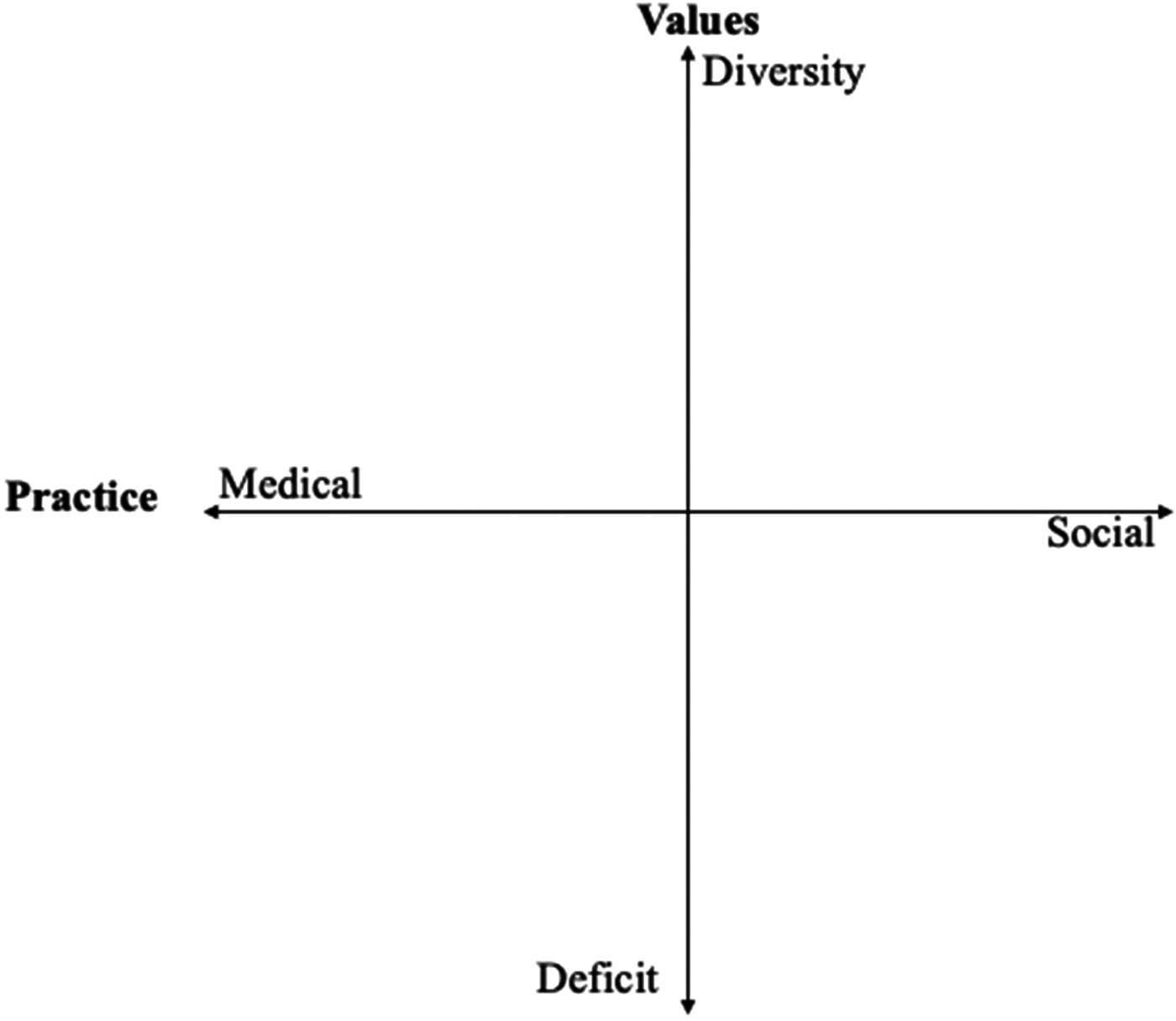
Practice and values continuum.
The “practice” continuum: Medical–social
Historically, we have relied upon a medical model of disability. Within this approach, special needs are seen as a deficit to be diagnosed and subsequently fixed or cured. This model of disability recognizes impairments to be deficits that reside within the individual. In practice, this paradigm leads to individual approaches and interventions, which focus on addressing the identified need. The medical model's focus on diagnosis and labeling implies that students with the same diagnosis will have the same learning need. Within this understanding of disability, students with similar diagnoses will receive similar treatment, for example, placing all students with autism spectrum disorders (ASDs) in the same classroom (Nes & Stromstad, 2003).
Over the last 50 years, practices around disability have aimed to move toward a social model of disability. While there are many variants to the social model, common among them is the belief that “disability” is a socio-political construct. Viewing disability from the perspective of the social model would suggest that it is the inaccessible physical environment, along with the negative social attitudes, which disable people. Thus, individuals are disabled by barriers in society, rather an impairment or difference (Oliver, 1996, 2013). From this perspective, rather than focusing on individual labels and impairments, practice should involve restructuring educational environments, so, rather than being disabled by the environment, children with ALN can flourish within them. A social model of disability, therefore, will focus on creating environments that support all learners.
The “values” continuum: Diversity–deficit
Similarly, while looking at the medical
Methods
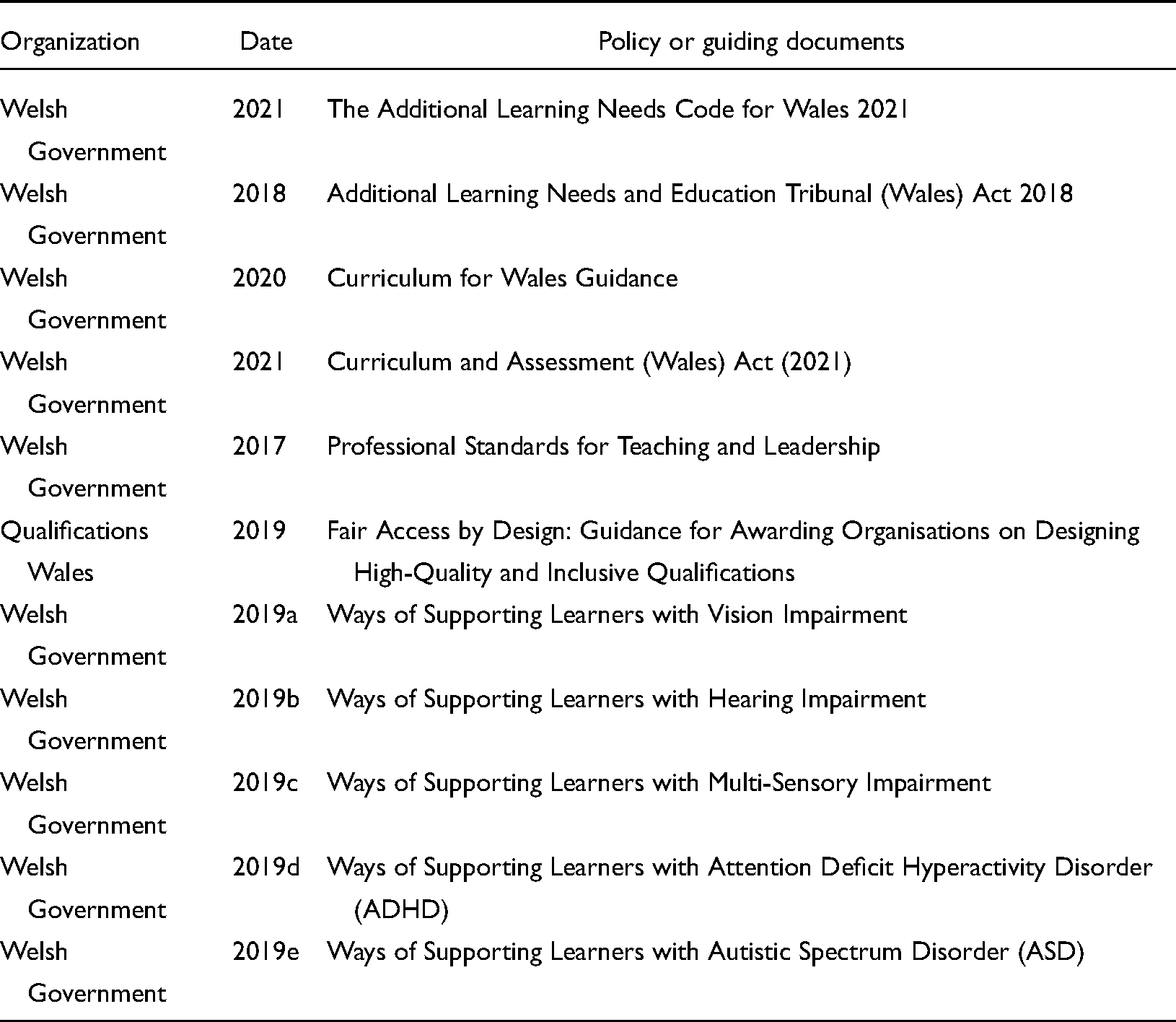
To make sense of how inclusion is interpreted across policy reform in Wales, we identified and analyzed national policy documents and associated texts; in total, the research draws upon ten key policy and supporting documents. These documents are the most recent documents (as of April 2021) that make reference to inclusive practice and ALN. These policies were analyzed in keeping with the principles of critical policy sociology to identify how inclusion is framed. The policies were mapped against the practice and values model as presented in Figure 1. Key extracts that situate the policies within these continuums are discussed below. Table 1 shows the documents that were included in the analysis.
Relevant Welsh education policy documents and guidance.
Policy extracts
The ALN Code for Wales 2021
The ALN Code contains statutory guidance for public bodies in Wales. It is stated that the Code “is aimed at ensuring that children and young people's ALN are identified early and addressed quickly to enable them to achieve their full potential” (Welsh Government, 2021b, p. ii). Within the Code (and Tribunal Act p. 3), ALN is defined as:
A person has ALN if he or she has a learning difficulty or disability (whether the learning difficulty or disability arises from a medical condition or otherwise) which calls for additional learning provision (ALP). A child of compulsory school age or person over that age has a learning difficulty or disability if he or she
has a significantly greater difficulty in learning than the majority of others of the same age, or has a disability for the purposes of the Equality Act 2010 which prevents or hinders him or her from making use of facilities for education or training of a kind generally provided for others of the same age in mainstream maintained schools or mainstream institutions in the further education sector. (p. 28, emphasis added) (EXTRACT 1)
This definition mirrors the definition of special educational needs from the U.K.’s Education Act (1996) (section 312), which predates devolution of education in Wales. Runswick-Cole and Hodge (2009) argue that this definition “emphasises individual deficits and, therefore, plays a part in constructing and sustaining exclusionary practices” (p. 200). Indeed, on the practice continuum, this definition sits at the “medical” end. Suggesting that a child needs to have “significantly greater difficulty” implies that a form of standardized testing is needed to identify those who have an ALN while suggesting that there is a “norm” of children at the same age for which to compare against. Furthermore, on the values continuum, the definition depicts the deficit paradigm whereby the words “difficulty,” “prevents,” and “hinders” are used to define ALN. For children who meet these criteria, ALP is advocated. ALP is described as “educational or training provision that is additional to, or different from, that made generally for others of the same age” (p. 29) (EXTRACT 2). This again depicts medical practices, where learners experience different provision to their peers.
However, the code does not depict the “medical” practices and “deficit” values throughout. While the code mostly focuses on individual-level provision for learners with ALN, it states that this should operate within an inclusive system, which it defines as: “where all pupils access common opportunities in ways relevant to their needs, and which ensures that they fully belong to the school community, is of benefit to all” (pp. 41–42) (EXTRACT 3). This highlights the “benefit to all” and suggests alignment with the “diversity” values of ALN, depicting the positive elements of including those with ALN. Furthermore, it is stated that the system takes
A rights-based approach where the views, wishes and feelings of the child, child's parent or young person are central to the planning and provision of support; and the child, child's parent or young person is enabled to participate as fully as possible in the decision-making processes and has effective rights to challenge decisions about ALN, ALP and related matters. (p. 38) (EXTRACT 4)
This person-centered approach to decision making sits at the “social” end of the practice continuum as the aim here is to work with the individual and their families to identify barriers in their environment, which may prevent them from accessing education, and to consider how they can be removed.
In addition, the Code states that “improvements in the teaching and learning of children and young people with ALN cannot be isolated from improvements in the teaching and learning for children and young people across a school or further education institution as a whole” (p. 42) (EXTRACT 5). Thus, suggesting that system-level approaches that address barriers in the environment will benefit all learners, again this depicts practices at the “social” end of the continuum.
Curriculum and Assessment (Wales) Act (as passed) (2021)
The Curriculum and Assessment Act is the legislation that was passed by the Welsh Parliament in April 2021, which sets out the legal framework for the new curriculum. On the surface, the curriculum has inclusive aims stating, for example, that
The adopted curriculum must be implemented in a way that
enables each pupil to develop in the ways described in the four purposes, secures teaching and learning that offers appropriate progression for each pupil, is suitable for each pupil's age, ability and aptitude, takes account of each pupil's ALN (if any), and secures broad and balanced teaching and learning for each pupil. (p. 10) (EXTRACT 6)
Here it refers to each “learner” and states that learner needs will be accounted for within the curriculum. However, the legislation then goes on to state that for children with ALN:
The ALP described in an individual development plan prepared or maintained by a local authority under Part 2 of the Additional Learning Needs and Education Tribunal (Wales) Act 2018 may include provision
that disapplies sections 27, 28, 29, and 30, or any of those sections, in relation to a pupil; that applies sections 27, 28, 29 and 30, or any of those sections, in relation to a pupil with the modifications specified in the plan; that disapplies sections 34, 35, and 36, or any of those sections, in relation to a child; (d) that applies sections 34, 35, and 36, or any of those sections, in relation to a child with the modifications specified in the plan. (p.16, emphasis added) (EXTRACT 7)
As a result, the legislation, which sets out to apply to all learners, is subsequently disapplied or modified for learners with ALN, with the potential to become exclusionary and portray a deficit value for these learners.
Curriculum for Wales Guidance (2020)
The Curriculum for Wales Guidance released in 2020 was designed to help schools to design and implement their own local curricula. It sets out the proposed curriculum requirements that aim to ensure all schools cover the same core learning and to provide a foundation for developing a consistency of approach for learners across Wales. On the whole, the curriculum's aims align with the diversity paradigm on the “values” continuum. It is stated that: “The Framework reflects Wales, its cultural heritage and diversity, its languages and the values, histories and traditions of its communities and all of its people” (p. 30) (EXTRACT 8). The guidance goes on to state that “creating a curriculum which recognises the diverse culture of their society enables learners to celebrate the diverse nature of all societies. This promotes equality, inclusion, social cohesion and a feeling of being valued” (p. 42) (EXTRACT 9). Thus, while these aims do not refer to practice, they suggest that the curriculum for Wales values diversity.
Yet, it could be argued that by providing curriculum prescribed learning outcomes at five progression steps (broadly corresponding to expectations at ages 5, 8, 11, 14, and 16), the curriculum is not as inclusive in practice, as the values it depicts suggest. The progression steps for each of the six areas of learning and experience include a number of “I can” statements. For example, “I can interact with others, talking and writing about my thoughts, feelings and opinions showing empathy and respect” (p. 148) (EXTRACT 10) yet, this progression step would clearly exclude certain learners who may have difficulty with expressing empathetic behaviors. By setting these aims, the approach is naturally exclusionary in its nature. Thus, the curriculum (specifically the “I can” statements) constructs a “normality” through these statements, that is, an ideal vision of a human being. However, the document does point out that “where this guidance makes reference to specific verbs such as ‘talk’, ‘move’ or ‘create’, these should be interpreted according to the needs of the learners” (p. 33) (EXTRACT 11). Therefore, acknowledging that there may be differences in how learners may progress. It is also stated that
Learners with additional learning needs (ALN) will progress at a rate individual to the learner and this may not correlate with the broad two-to-three-year progression step. Pace of progression should be evaluated by the professionals working with learners with ALN. (p. 28) (EXTRACT 12)
Yet, despite this, the values portrayed by these statements depict a deficit view for those who may not be able to meet these targets.
Professional Standards for Teaching and Leadership (2017)
The professional standards are a set of regulatory standards for practitioners in Wales. They provide a set of descriptors “that exemplify how the standards could apply to a teacher's work depending on where that teacher is in terms of their role and career” (p. 4). Specifically relating to inclusion, these standards regularly refer to meeting the needs of “all learners.” For example, at Qualified Teacher Status (QTS) level, a teacher should
demonstrate a knowledge and understanding of the needs of all learners in planning, preparation and teaching, ensuring that the four purposes are the drivers for learners’ experiences. (p. 29) (EXTRACT 13)
and that they should also “demonstrate knowledge, understanding and experience of high expectations and effective practice in meeting the needs of all learners, whatever their different needs” (p. 35) (EXTRACT 14). At the leadership level, it is stated that “leadership ensures that all learners, including those with ALN, gain full access to opportunities and achieve” (p. 80) (EXTRACT 15). However, in places, a more “medical” model is presented, for example under “enable improvement” it is stated that “areas of concern are accurately identified and examined in own and others’ practice. Support is sought and offered readily, and a plan enacted to secure improved performance” (p. 46) (EXTRACT 16). Under this descriptor, it is suggested that at QTS level, “there are examples of improvement in outcomes for learners following the teacher's seeking and adoption of advice” (p. 46) (EXTRACT 17). This suggests a practice of seeking intervention should learners not be meeting the proposed outcomes, thus aligning with the medical paradigm.
Inclusion and Pupil Support 2016
This document was produced by the Welsh Government to provide guidance on inclusion and support for learners in compulsory education. Within this document, inclusion is defined as: a process through which all pupils access common opportunities in ways relevant to their needs, and which ensures that they fully belong to the school community. Inclusion requires the active involvement of all concerned. It places the onus on schools to adapt their organisation and their ways of responding to both meet the needs and value the development of all children and young people in all areas of school life. In particular, inclusion of pupils involves much more than the placement of a child or young person in a mainstream or a special school. It requires an inclusive curriculum and measures to improve teaching and other staff's awareness of inclusive learning and equality issues. (p. 2, emphasis added) (EXTRACT 18)
This emphasis on the providing for “all learners,” and suggesting that inclusion is a process of adapting the environment to meet the needs of all learners, aligns with the social practices paradigm. Furthermore, person-centered approaches are foregrounded: “All children should be involved in making decisions, where possible right from the start of their education” (p. 9) (EXTRACT 19), also portraying the social paradigm.
The document also highlights a demographic of pupils who “require extra support” (p. 30). It is stated that “pupils who are at risk of disengagement and social exclusion are more vulnerable, have more diverse needs and require more support than their peer group” (p. 30) (EXTRACT 20). It could be argued that this sits within a “deficit” understanding of ALN. Indeed, in the discussion of learners that require support, there is little reference to the value that diverse learners can bring to the classroom. For example, with reference to special needs, the document regularly refers to a child's “difficulties” (p. 36) also highlighting a deficit perspective.
Support documents for specific ALN (2019)
In 2019, the Welsh Government published a number of documents providing guidance on “vision impairment,” “hearing impairment,” “multi-sensory impairment,” “attention deficit hyperactivity disorder,” and ASD. These documents are based on rapid evidence assessment of educational interventions to support children with the different needs. These reports are medical in their nature as they refer to interventions that seek to “fix” the problems associated with the different needs. Furthermore, they make the assumption that all learners with the same need will respond in the same way to intervention. Medical language such as “condition,” “intervention,” and “diagnoses” are consistently used when talking about each need.
Furthermore, the reports sit at the “deficit” end of the values spectrum, with a lack of acknowledgment of the diversity perspective that values learners with additional needs within educational settings. This is notably lacking from the ASD report, given the autism rights movement in this area. An example of the deficit values is shown in the following extract: It is very common for children and young people with ASD to have sensory issues, alongside impairments in social imagination, and a narrow repetitive pattern of interests and activities. These challenges can cause higher than average levels of stress, anxiety and depression. (p. 5) (EXTRACT 21)
Discussion
It is clear from examining the key Welsh policy and guidance documents that the messages of inclusion in practice and values vary both within documents and between them. There is relatively little consistency about how issues of inclusion are understood and communicated within the policy and guidance documents. This raises challenges for policymakers and clarity of future policymaking in Wales, for enactment and implementation from a practitioner perspective, as well as comparability for researchers across different nations and jurisdictions. The following discussion will explore this in relation to the practice and values continuums.
Practice
As discussed previously, practice around inclusion can be viewed on a continuum from medical practices on the one end, to social on the other (LoBianco & Sheppard-Jones, 2007) (see Figure 1). How ALN is defined in the Code and Tribunal Act (see EXTRACT 1) suggests medical practices for ALN whereby individuals are identified as having significantly greater difficulty than their peers. This medical definition likely results from the fact that the definition of what constitutes an ALN is the same as defined in the U.K.’s Education Act (1996) and dates from 25 years ago; the definition of ALP is also medical in nature (see EXTRACT 2). Other examples of more medical practices are seen in the Professional Standards where it is suggested that teachers should be able to identify and seek support for “areas of concern” (see EXTRACT 16, 17). The support documents for different needs also depict medical practices of interventions whereby the assumption is made that all learners with the same need will display the same “symptoms” and benefit from the same interventions. The above extracts demonstrate an understanding of ALN whereby the genesis of the need lies within the individual, rather than within the environment, and that these issues are ones that need to be “resolved” through specific and differentiated practices to those for the “majority of others of the same age” (Runswick-Cole & Hodge, 2009). Furthermore, the disapplication of inclusive aims for learners with ALN in the Curriculum and Assessment (Wales) Act (2021) implies more medical practices for these students, whilst the “I can” statements in the Curriculum for Wales Guidance (2020) could be seen as being naturally exclusionary in their nature.
However, the documents also show alignment with the “social” side of the continuum where practices are targeted toward removing barriers in the environment for all pupils. The definition of inclusion in the “Inclusion and Pupil Support” guidance has a focus on the education environment required for a school to be inclusive. Furthermore, the ALN Code goes on to discuss how there cannot be improvements for those with ALN without improvements for the whole school community (see EXTRACT 3, 4, 5). This shows a social alignment that acknowledges environmental barriers that may lead to societal disablement (Oliver, 1996). The Professional Standards also acknowledge the needs of “all learners” (see EXTRACT 13, 14) and that leaders should ensure that all students have full access to education opportunities (see EXTRACT 15). As the curriculum is competency-based, it aligns with a more inclusive model that allows learners to progress regardless of their different starting points (Opertti & Brady, 2011).
There are examples of where a person-centered approach to provision is advocated (see EXTRACT 4, 19) and the child and their family are included in the decision-making processes. This also aligns with the social model where the aim is not to identify and “fix” their impairment, but to work with the individual to identify barriers in their environment, which may prevent them from accessing education, and to consider how they can be removed (Kattari et al., 2017).
Overall, in the practices that these documents outline, there are examples of both medical and social paradigms. While there appears to be some noteworthy attention given to the more inclusive social paradigm, there remains underlying elements of a more medical paradigm in the identification and “intervention” of learners with ALN.
Values
In their discussion of international policy documents around inclusion, Hardy and Woodcock (2015) propose a deficit-diversity continuum, across the various documents. A similar spectrum of values is portrayed across the Welsh policy and guidance documents, with a notable acknowledgment of diversity values. Within the curriculum guidance recognizing Wales’ diverse cultures as an underpinning foundation of the new curriculum (see EXTRACT 8, 9). Yet, despite this, the documents regularly depict a deficit discourse. This is notably portrayed in the Curriculum and Assessment Act where despite stating that the curriculum must be implemented in a way that is suitable for “each pupil” (see EXTRACT 6), it then goes on to say that for learners with ALN, this may be “disapplied” or “modified” (see EXTRACT 7). This presents deficit values about learners with additional needs. It could also be argued that the “I can” statements within the Curriculum Guidance are also naturally exclusionary (see EXTRACT 10). The particular emphasis and singling out of students with ALN throughout the documentation also suggest a homogenizing of this group of students, reflecting the deficit paradigm. A deficit discourse is also clearly communicated in the support documents for specific needs with language portraying the negative “symptoms” associated with each need.
Even when the documentation does not present a deficit paradigm, it could be argued that acknowledgment of the benefits of including all students is lacking across the documentation. Only in the ALN code is it acknowledged that inclusion is of “benefit to all” (see EXTRACT 3). As a result, while at the surface there appears to be a step toward an acknowledgment of the diversity paradigm, looking deeper shows how both legislation and guidance fail to meet these values. Therefore, these documents fail to support a neurodiversity perspective (Armstrong, 2010, 2012), which embraces diversity both within education and beyond.
Conclusion
We have used critical policy analysis to explore the roots of these policies in Wales and to expose relationships of inequality and privilege within the named policy documents that have been examined (Young & Diem, 2017). The lack of consistency across the policy documents exposes how inequalities may become apparent when these reforms are fully implemented, thus providing a deeper understanding of the challenges of developing an inclusive education system in Wales.
Recent interviews conducted with practitioners and key education stakeholders in Wales indicated “different ideas exist about the basic principles in reform” in the context of inclusive education in Wales (Conn & Hutt, 2020, p. 164). From our critical analysis of the key policy and reform documentation, this result is perhaps unsurprising. Given the importance of teachers’ understandings about ALN (Knight, 2018; Knight, 2021), it is imperative that clear and consistent messages are communicated. Within the documents studied, medical and deficit paradigms underlie the social and diversity messages. Hardy and Woodcock (2015) state that “respect for difference can only be cultivated in educational systems if those responsible for enacting educational practices are supported by consistent and coherent policy messages which value diversity and challenge deficit” (p. 162). The results from our analysis suggest that this is not currently happening consistently in Welsh policy messaging.
This paper has reflected on the distinct cultural context of Wales, offering a valuable case study of emerging national-scale education system reforms. Within Wales, while there are clear steps being taken toward both social practices and the valuing of diversity, this is lacking in coherence and consistency. While there are significant political, social, cultural, and even legislative levers for driving this, it yet remains to be seen if these steps toward education reform will create a more inclusive education system in Wales. Furthermore, at the time of writing, the longer term impact of COVID-19 on education systems globally has yet to be understood (Crick, 2021; Marchant et al., 2021; Siegel et al., 2021; Watermeyer, Crick, et al., 2021); this is of particular relevance for Wales due to the impact on preparation for the major system-level reforms over the coming years (Harris et al., 2020), including both the new curriculum (Crick & Golding, 2020; Crick & Priestley, 2019) and the changes to the ALN system (Knight & Crick, 2021). More broadly, this research provides a tractable framework and approach for developing further insight into the challenges of moving from policy to practice in the development of inclusive education systems in other regions and jurisdictions.
Footnotes
Contributorship
Cathryn Knight and Tom Crick jointly conducted the critical policy document analysis. Knight led on developing and writing the methods, results, and discussion sections. Crick conducted the literature review and wrote the introduction and conclusions, as well as the wider framing within the current and emerging education policy context in Wales.
Declaration of conflicting interests
The authors declared no potential conflicts of interest with respect to the research, authorship, and/or publication of this article.
Funding
The authors received no financial support for the research, authorship, and/or publication of this article.
