




Abstract
Purpose:
This article aims to explore how suburban public schools in Shanghai of China have implemented the top-down equity-minded migrant policies of free compulsory education and equal access to public education.
Design/Approach/Methods:
This qualitative study focuses on public schools in the suburb of Shanghai, one of the top migrant-receiving metropolitan cities in China. Using personal network, referral, snowballing, and “guerrilla interviewing,” the researcher recruited 13 migrant parents that represent 11 cities of 9 provinces and collected interview data between early January and late June of 2015. Data sources include 10 face-to-face interviews, 3 telephone interviews, 6 follow-up interviews, and supplementary policy documents.
Findings:
It finds that local public schools have fully implemented free compulsory education, but have not supported equal access, revealing an inconsistent and arbitrary policy enactment pattern. Although all the interviewees have worked and lived in Shanghai for an average of 10 years, only those that afford a real property, receive exceptions, or have personal connections can have children enrolled in public schools. Further, parents’ perceptions of the policy implementation vary across cases with most of them not demonstrating an awareness of education equality.
Originality/Value:
This study synthesizes stories shared by migrant parents and reports an interesting policy implementation pattern. It contributes to the field of migrant education study and confirms that top-down equity-minded reform is likely to encounter challenges.
Introduction
Migrant education in China has been the focus of the international literature (Qian & Walker, 2015). Existing research largely investigates migrant children’s educational experiences within private migrant schools (Chen & Feng, 2013; China Labour Bulletin, 2009; Goodburn, 2009; Han, 2004; Human Rights in China, 2002; Tan, 2010; Wang & Holland, 2011). A small number of studies examine the practice of migrant education policies in public schools (China Labour Bulletin, 2009; Ren & Yang, 2011; Zhu, 2001) and even fewer of them are empirically based studies (Wang, 2008; Xiao, 2011; Yiu, 2014). Only a few studies examine the migrant education policies unfolding in Shanghai (Qian & Walker, 2015; Yiu, 2014). More research effort needs to be focused on migrant education policies to disclose whether or not current migrant education policies have worked as expected in promoting education equality. The findings of this type of study can help local governments plan migrant education in cities.
The qualitative study aims at contributing to the growing body of knowledge about migrant education policies unfolding in public schools of China. The following research questions guide the study: (a) How have public schools in Shanghai implemented free compulsory education and equal access policies for migrant children? (b) What are migrant parents’ perceptions of the policy implementation? By directly listening to migrant parents’ voices, the researcher explored how various public schools implemented the policies of free compulsory education and equal access to public education in Shanghai and how parents perceived the policy implementation.
Selecting Shanghai with a large number of migrant students 1 allows for revealing the status of migrant education and shedding light on the disparity between research findings and official stories. In contrast to the ineffective policy implementation documented in some research, the official media in China reports that Shanghai provides free compulsory education to 100% of migrant children and admits more than 70% of them into public schools. It is also said that eight urban administrative districts accept all migrant children in the public schools.
Overall, the researcher find that while public schools have fully implemented the free compulsory education policy, they did not support the equal access policy. There displays an inconsistent and arbitrary policy enactment pattern among schools in adopting the latter top-down equity-minded policy. Although all the interviewees have worked and lived in Shanghai for an average of 10 years, they are not residents and most of them must submit additional documents to register their children in public schools. Poor migrant children are kept from public education and forced to leave parents to go back to hometowns. Only those that afford a real property or receive exceptions or have personal connections can enroll their children in public schools. Further, participants’ perceptions of the policy implementation and additional documents’ requirement vary a lot. Most parents did not demonstrate an awareness of education equity and equality, a few reported it was unfair, and few even viewed the conditional access as reasonable. This study contributes to the field of migrant education study and confirms that top-down equity-minded reform is likely to encounter challenges, making it hard to benefit the targeting disadvantaged group. It calls for local authorities to take the lead in enacting concrete enforcement plans and provide support for local districts to accept all migrant children in public schools. It also suggests parents work with local nonprofit organizations to develop innovative and strategic plans to ensure local governments to implement the equal access policy.
This article consists of nine sections. The first two sections outline the background information on migrant education and the shifts of migrant education policies in China during the last two decades. A review of migrant education policy implementation follows up and the discussion of the conceptual framework constitutes the fourth section. Then, the research methodology of this study is presented. The significant findings of this study are displayed right afterward. Finally, the discussion of the findings is followed by a conclusion that highlights the contributions, limitations, and policy implications.
Migrant education in China
Over the past two decades, the economic reform in China mainland has led to the relaxation of the household registration (hukou 2 ) system, culminating in the explosion of rural-to-urban migration (Guo, 2007). A few metropolitan cities in China, such as Beijing, Shanghai, and Guangzhou, are more developed in every aspect compared to all other cities, as a result of historical reasons and the central government’s preferential policies. During the economic boom, these cities have invariably become top priority destinations for migrant workers. A mass of rural farm workers has migrated to these cities in search of higher income jobs and better lives (Fan & Peng, 2008; Loveless, 2013). These cities are also the destinations of a great many college graduates who are originally from rural and other urban areas.
Both rural workers and college graduates face similar challenges in educating their children in the public schools of these host cities, in that most of them are not residents. Migrant workers’ households are even more disadvantaged because they possess limited resources to tackle system barriers. The hukou system determines one’s access to 9-year compulsory public education (Schuler, 2011; Yuan, 2013). Since migrant workers’ rural status does not change and hukou status is hereditary, they are denied access to social benefits available to residents in the host cities (Branigan, 2010; Chan, 2010) and their children are excluded from attending local academic public schools (Guo, 2007; Human Rights in China, 2002). Some migrant children must return to hometown for schooling, becoming separated from their parents. Others stay with parents, dropping out of public schools, going to segregated and low-quality migrant schools, or attending middle-level vocational schools. For those who manage to attend public elementary and middle schools, the majority cannot proceed to academic high schools after 9-year compulsory education. Vocational high schools would be the best alternative. Even after completing academic high school in host cities, those students without local hukou are not allowed to take National College Entrance Examination there. They must go back to hometown to take the examination for admission to college. Since 2012, the Central Government of China has started to address migrant children’s eligibility to take National College Entrance Examination at the local city, but only a few regions responded positively to the direction of the Central Government by the time of the study completion.
Additionally, high school fees and tedious procedures of documentation have become obstacles preventing migrant students’ access to public education. When some public schools can accommodate additional enrollment, migrant students are allowed to register in these schools by providing complicated documentation and paying higher fees than local resident students (Chen & Yang, 2010; China Labour Bulletin, 2009; Dong, 2010; Fan & Peng, 2008; Goodburn, 2009; Han, 2004; Human Rights in China, 2002; Irwin, 2000; Kwong, 2004; Li, 2006; Wang, 2008; Xia, 2006; Xinhua News Agency, 2002; Yan, 2005). Administrative procedures tend to discourage parents from obtaining required documents to enroll children in public schools (Zhu, 2001). High temporary schooling fees and other miscellaneous fees are not affordable for many migrant families (Xia, 2006). Consequently, migrant children are forced to enroll in migrant schools which are usually unlicensed and generally of low quality (Deng, 2010; Goodburn, 2009; Human Rights in China, 2002; Roberts, 2013; Rural Education Action Project, 2009; Tan, 2010; Wang, 2008; Xia, 2006; Xinhua News Agency, 2002; Yan, 2005).
Since the late 1990s, the Chinese Central Government has passed a series of national policies, urging provincial and municipal governments to be responsible for educating migrant students and to ensure equal access to local public schools. In the late 2000s, the Central Government mandated free compulsory education in urban public schools and reiterated that the local governments grant migrant children equal access to public education (The General Office of the State Council of the People’s Republic of China [GOSC], 2003b; Ministry of Finance of the People’s Republic of China [MOF], 2004). Local governments have been slow in responding to the Central Government’s direction, while on the other hand asking for more stringent documents from parents. Despite later guidelines to prohibit public schools from charging additional fees, many migrant children are still unable to get into public schools because public schools set other additional barriers for them.
Migrant education policy changes in China
While the migrant education problem emerged in the early 1990s, the Central Government started adopting correction measures in the late 1990s (China Labour Bulletin, 2009; Guo, 2007). Since then, different government agencies have developed an array of laws and policy statements that touch upon the issues of equal access and extra fees. In 1998, Ministry of Education of the People’s Republic of China issued a notice of Provisional/Interim Measures for the Education of Migrant Children, clarifying the responsibility of the host cities and urging them to provide public education for migrant children (Deng, 2010; Goodburn, 2009; Guo, 2007; State Education Commission and Ministry of Public Security of the People’s Republic of China, 1998). However, as local educational budgets 3 did not include migrant children, the 1998 regulation authorized urban public schools to charge extra fees to migrant children (Deng, 2010; Dong, 2010).
The State Council of the People’s Republic of China (hereafter “State Council”) has addressed the migrant education problem at different times. In 2001, the State Council, in its National Programme of Action for Child Development in China (2001–2010) (State Council, 2001a) and Decision of the State Council on the Development and Reform of Elementary Education (State Council, 2001b), identified the responsibilities of hosting cities that operate public schools in educating migrant children. In 2001, the State Council Rectification Office specified that elementary and middle schools should admit temporary students and collect educational fees in accordance with local provincial regulations, and should not collect other miscellaneous fees aside from temporary student fees (The State Council Rectification Office of the People’s Republic of China, 2001). In 2003, the State Council circulated the Opinion of the Ministry of Education and Other Departments on Further Improving the Education of Migrant Children, reiterating that migrant-receiving cities should provide migrant children with the same educational rights as local students and reinforcing that the urban public schools are major channels for educating rural migrant children (GOSC, 2003b). Furthermore, the State Council stated that public schools should not collect fees other than those officially approved and that host cities should guarantee migrant children’s education expenses and subsidize schools to accept a certain portion of these students and set aside a proportion of the city’s additional budget amount to educate these children (GOSC, 2003a). In the Circular of the State Council on Further Improving the Conditions for Peasants Who Seek Employment in the Cities (GOSC, 2004), the Council specified that primary and middle schools’ admission requirements for migrant children should be the same as for local children and that schools should not collect fees otherwise required by state regulations.
Different offices of the Central Government repeatedly stressed the issue of school fees. MOF (2004) stipulated that in addition to state-approved fees, these children should not be asked to pay temporary student fees and schools’ solicitation of donations would be prohibited. MOF (2004) continued to stress that migrant children should be entitled to the same education rights as their urban peers, all fees shall be standardized, and schools shall not collect temporary student fees or school selection fees. In the same vein, the 2005 revised Compulsory Education Law, which took effect in 2006, reiterated that school-aged children could receive compulsory education in places where their parents work and reside. In addition, the new law stipulated that local schools would only collect state-approved fees and could not charge miscellaneous fees or textbook fees (Wang, 2009; Xia, 2006). In Some Opinions of the State Council on Resolving the Problems Faced by Migrant Workers, the State Council not only reinforced the role of migrant-receiving cities in educating migrant children in local public schools but also stipulated that migrant children should pay the same fees as local resident students and temporary schooling fees and other fees are to be prohibited (Xinhua News Agency, 2002). The State Council’s 2008 Circular of the State Council on the Abolition of Tuition and Miscellaneous Fees for Students in Compulsory Education in Urban Areas continued to urge local governments not to collect temporary student fees and suggested local governments to waive the tuition and miscellaneous fees for migrant students (GOSC, 2008). MOF (2008) also included many miscellaneous fees and temporary student fees on the list of abolitions.
Starting in the 2010s, dramatic changes are occurring. As the local population control policy, a new directive from the Central Government for the megacities such as Shanghai and Beijing, was issued (The Central Committee of the Communist Party of China, 2013), migrant workers and migrant education policies bear the brunt. In Shanghai, the municipal government’s policy is shifting from “accepting all” to “social control,” according to an insider working in a community-level Communist Party division. In 2014, the property title requirement for registration was found in many, if not all, schools. Since Beijing and Shanghai had population capping plans approved in late 2017, the two cities have slashed a large number of migrant workers. According to authorities, the capital city aims to bring its air quality in line with international standards, and the goal of the financial hub and port city is to avoid “big city disease” such as pollution and shortage of services. Although the current study sets the time range until 2015, it is worth updating the policy trend as it is very likely that the equal access policy will be further restricted as a result of the policy shift since 2017 and future research will generate distinct findings.
Review of migrant education policy implementation
As the proceeding section shows, between the late 1990s and the late 2000s, the Central Government has clarified local governments’ responsibilities in guaranteeing migrant children’s equal access to public schools. Especially between 2004 and 2008, MOF and the State Council urged local schools to stop collecting temporary student fees. A couple of studies found that authorities were not indifferent to migrant education. They found that education agencies, both at the municipal and district levels, had increased education funding for migrant children (Branigan, 2010; Xia, 2006). However, the situation of migrant children in compulsory education has not substantially improved. Some public schools continued to charge temporary student fees (China Labour Bulletin, 2009; Xia, 2006) and collected donation fees from migrant families (Chen & Yang, 2010). Despite the favorable policy shift, migrant children still found it hard to access public education due to additional barriers “creatively” set up by local governments (Rural Education Action Project, 2009). For instance, the local governments in certain areas permitted some schools to enroll migrant children and some public schools assigned migrant children to separated classes (Fan & Peng, 2008). Additionally, given the various local interpretations and implementations of national policies, the percentage of migrant children eligible for free compulsory education varies from region to region, ranging from 10% (China Labour Bulletin, 2009) to 20% (Xiao, 2011) to 50% (Ren & Yang, 2011; Wang, 2008) and to 70% (Ren & Yang, 2011).
The reason for the decoupling of policy and reality is twofold. On the one hand, the government efforts to secure the education rights of migrant children are inadequate (China Labour Bulletin, 2009). Concrete implementation enforcement plans and financial support are lacking (China Labour Bulletin, 2009; Dong, 2010; Xia, 2006). Despite the long trial period of the 1998 Provisional Measures for the Education of Migrant Children, as of 2008, the Central Government has not passed any permanent law that would hold local governments accountable for educating all children regardless of the hukou status (Goodburn, 2009). The inherently low-stakes policies with no specified consequences attached are not binding for the local governments. On the other hand, local governments have enjoyed considerable discretionary powers to decide whether to include migrant students (China Labour Bulletin, 2009; Xia, 2006). The local governments have claimed that they possess insufficient public education resources and limited enrolling capacity to educate migrant students (Chen & Yang, 2010; China Labour Bulletin, 2009; Wang, 2009; Xia, 2006). Furthermore, local governments stick to the hukou (local residency)-dependent school finance system and fail to count migrant children into education budget plans (Chen & Yang, 2010). To minimize the potential migrant expansion, many local governments in the developed areas delayed the implementation of Central Government’s equal access policy or limited school enrollment to migrant children (Goodburn, 2009; Ren & Yang, 2011; Zhu, 2001). The following sections present how three large migrant-receiving cities previously responded to the national policies that aim to better educate migrant education.
Beijing
The situation in the capital city does not change much in favor of migrant students. Since the fall of 2010, Beijing has implemented the free compulsory education policy, but only half of the migrant children in public schools enjoyed this benefit (Ren & Yang, 2011; Wang, 2008). Some schools required stringent admission documents beyond the regulation of the Beijing Education Commission and some only accepted migrant children who started from kindergarten or Grade One in Beijing (Ren & Yang, 2011). Schools on the outskirts or with decreased enrollments were more likely to be open to migrant students and high-quality schools were hardly accessible to migrant families and usually charged high donation fees (Ren & Yang, 2011). A great many under-enrolled elementary and middle schools were closed or consolidated rather than enrolling migrant children into these schools (Goodburn, 2009; Ren & Yang, 2011). Other researchers confirm that most migrant students in Beijing chose to attend for-profit migrant schools (Lai et al., 2014).
Shenzhen
Literature shows that migrant children in this city do not have an equal opportunity to receive compulsory education as their local peers. Requiring additional documents excludes many migrant children from local public schools (Ren & Yang, 2011; Xiao, 2011). Migrant children do not automatically benefit from the fee waiver policy and they must satisfy the local Education Department’s requirements to be eligible for the fee waiver (China Labour Bulletin, 2009). Complicated procedures and limited quota for the waiver discouraged migrant parents to fulfill the requirements and in late 2008, migrant children in Shenzhen paid three times as much as local students for compulsory education (China Labour Bulletin, 2009). Research also finds that tuition and miscellaneous fees in migrant schools and low-quality public schools were nominally waived, and these fees were built into the payments for extra entrance fees (Xiao, 2011). Shenzhen public schools charged migrant children for a lump-sum school-entry payment between 20,000 and 50,000 Yuan in the forms of sponsor fees, school choice fees, study place fees, or temporary schooling fees (Xiao, 2011). The local government was unable to provide free compulsory education for migrant children and shifted the burden to private schools which received little government subsidy and must charge high fees to migrant families (Ren & Yang, 2011; Xiao, 2011).
Shanghai
While earlier research indicates that the Shanghai municipal government attempted but failed to provide the same educational opportunities to migrant children (Zhu, 2001), recent secondary data-based studies show that the municipal government has improved migrant education in some way (Qian & Walker, 2015; Ren & Yang, 2011). Since 2008, education officials have become supportive of migrant education and the government allocated funding to public schools based on the actual number of migrant children (Ren & Yang, 2011). The municipal government established education resources based on the number of real property and permanent residents, simplified admission requirements, and enlarged class size to accept more migrant students (Ren & Yang, 2011). In 2010, Shanghai planned to offer free compulsory education to children of migrant workers that would benefit a large majority of migrant households (China CSR, 2010). In the same year, Shanghai invested US$0.5 billion to broaden migrant children's enrollment in public schools, becoming the first city to provide free compulsory education to nonresidents (Yiu, 2014). This city also authorized migrant schools to offer free compulsory education and allocated basic compensation to these schools (Ren & Yang, 2011).
Although the quality of migrant schools has been enhanced, migrant children generally do not enjoy the same educational resources as their local peers and access challenges remain (Qian & Walker, 2015; Ren & Yang, 2011). A nonprofit organization’s report echoes that while Shanghai has done a better job of educating school-aged migrant children than other metropolitans, the quality of migrant schools are incomparable to public schools and it remains difficult for migrant children to attend local public schools due to the requirement of additional documents (Ren & Yang, 2011). Yiu’s (2014) empirical study reveals that Shanghai’s free compulsory education policy did not really advance rural migrant children’s educational status, and guanxi (personal connection) is the prevalent channel for migrant children to access quality public education.
To sum up, the review of previous studies indicates a decoupling of policy talk and policy reality in the past few years. But there is scanty recent empirical research into the implementation of free compulsory education for migrant children and equal access policies in recent years. The present study fills this void in the literature by exploring how those policies have unfolded in local public schools in metropolitan areas of China.
Conceptual framework
To understand how the top-down equity-minded migration education policies play out in expected or unexpected ways in the local public schools of Shanghai, China, the researcher draw on Oakes et al.’s (2005) theory of implementation of equity-minded change. The theory of Oakes et al. (2005) calls on researchers, in understanding the implementation of equity-minded reform, to examine the broader normative beliefs and political dynamics undergirding or undermining educational change. Focusing on data from a study of de-tracking in racially mixed secondary schools, the researchers note the roles of macro social and political forces in the process of implementing equity-minded change. They find that reformers face challenges when they attempt to achieve equality for a small group of students (Oakes et al., 2005).
This theory suggests that the equity-minded migrant education policies in China might not be fully implemented because of the normative belief in local governments’ exclusive responsibility for local students. It also implies that migrant parents would encounter challenges when registering their children in public schools. The normative belief derived from the Chinese hukou system posits that students should be at their or their parents’ original hukou place to receive the 9-year compulsory education. The socially accepted tradition that is upheld by local stakeholders sparks a heated debate over “local schools for local children” in Shanghai (Li, 2013). Apparently, the imposed equity-minded policies collide with the macro social and political forces. However, different agencies of the Central Government have stressed migrant education issues in recent years, constantly requiring local governments to be responsible for educating migrant children. Local education agencies are pressured to provide these students with equal educational opportunities. Consequently, public schools are very likely to respond to the policy imposition defensively by coming up with a way to filter migrant students’ registration, such as requiring different documentation. There is, however, little empirical evidence within the literature regarding how local education agencies and schools wrestle with macro normative and political forces and policy compliance. The current implementation study seeks to explore these dynamics using the qualitative method as detailed below.
Method
To answer the research questions, this qualitative study focuses on Shanghai and collects policy documents and interview data from a range of parents. The research site is in the suburb of Shanghai. Shanghai is one of the top three migrant-receiving metropolitan cities in China (the other two are Beijing and Guangzhou). As opposed to Beijing, the capital city, Shanghai used to progressively approach migrant education. As previously discussed, Shanghai does better in educating migrant children than other cities, but migrant children are still disadvantaged compared with their local peers. This makes the municipal city an interesting case to study. The selection of the suburban area is not only out of its proximity to the researcher’s residence but also because the suburb is where many migrant workers work and reside.
The city and migrant education
The migrant population without permanent Shanghai hukou, also known as temporary residents, has increased dramatically over the years. This population was less than three million in 2000, around five million in 2005, and more than eight million in 2010 (Shanghai Statistics Bureau, 2015). By 2014, temporary residents reached approximately 10 million, of the total population of 24 million people (Shanghai Statistics Bureau, 2015). It is noteworthy that most of the temporary residents come from rural areas and take up low-ranking jobs. The rest of them are college educated that stayed in the city after graduation or moved here from other cities.
Increasingly, migrant children in Shanghai are receiving 9-year compulsory education in local public schools owing to the policy shift and government support. Ren and Yang (2011) report that by the fall of 2010, Shanghai public schools enrolled 70% of the migrant children and basically offered free compulsory education to all migrant children. The 2012 official data show that the figure went up to 75% (Shanghai Education Commission, 2012). Explaining Shanghai’s success on the 2009 Programme for International Student Assessment, Cheng (2011) notes that Shanghai public schools mix urban and migrant children and this policy produces positive academic effects.
The most recent number of migrant children that are eligible for compulsory schooling is 500,000 (Stepping Stones, 2016). While over 70% of these students attend local public schools, these schools tend to be “non-elitist, ordinary schools” (Qian & Walker, 2015, p. 77). About 30% go to one of the 151 migrant schools funded and managed by the municipal government (Leigner, 2016; Stepping Stones, 2016). Originally established by migrants, these schools tend to be overcrowded and lacking in facilities (Stepping Stones, 2016). With the support of the local education authority, they now provide a decent education for primary school-aged migrant children, but they are inconveniently located and incomparable to local public schools in terms of educational resources and quality (Leigner, 2016; Stepping Stones, 2016).
Participants and recruitment
Migrant parents are the target participants the study recruited to collect interview data. Recruiting strategies are a combination of the personal network, referral, snowballing, and “guerrilla interviewing” (Gold, 1989). The first three strategies did not work as expected in that the researcher has few connections to migrant parents and some interviewees changed their mind and decided not to participate in the study. To speak with as many parents as possible, the researcher resorted to the “guerrilla interviewing” technique, “a form of picking persons for research interview by spontaneously engaging in seeming idle, friendly conversation” (Solinger, 2006, p. 161). The researcher went to a nearby school serving elementary and middle school students and spotted parents when they were walking children back home or waiting to pick up children. If the person did not back off, the researcher proceeded to ask about their hukou status, made an interview request, explained the research purpose, presented a business card, and then started the interview. The response rate was high and almost 50% of the interviewees were attributable to the “guerrilla interviewing” method. Data collection ended when saturation occurred, that is, when interviews did not generate additional information.The resulting interviewees are 13 migrant parents who represent 11 cities of 9 provinces (see Table 1). They answered the same semi-structured interview questions such as registration requirements and policy impact on their children. Their demographic information was also collected, including place of origin, education level, the number of school-aged children, students’ grade level, and their length of residence in Shanghai. As presented in Table 1, participants have worked and lived in Shanghai for an average of 10 years. Seventy-seven percent of the parents (10 of the 13) are mothers and 54% (7 of the 13) received 2-year or 4-year college education. Most of them have one child, which reflects the one-child policy effective as of 2015. Those having two to three kids are either minorities or from rural areas; by law, these two situations allow a household to have more than one child.
Participating parents.
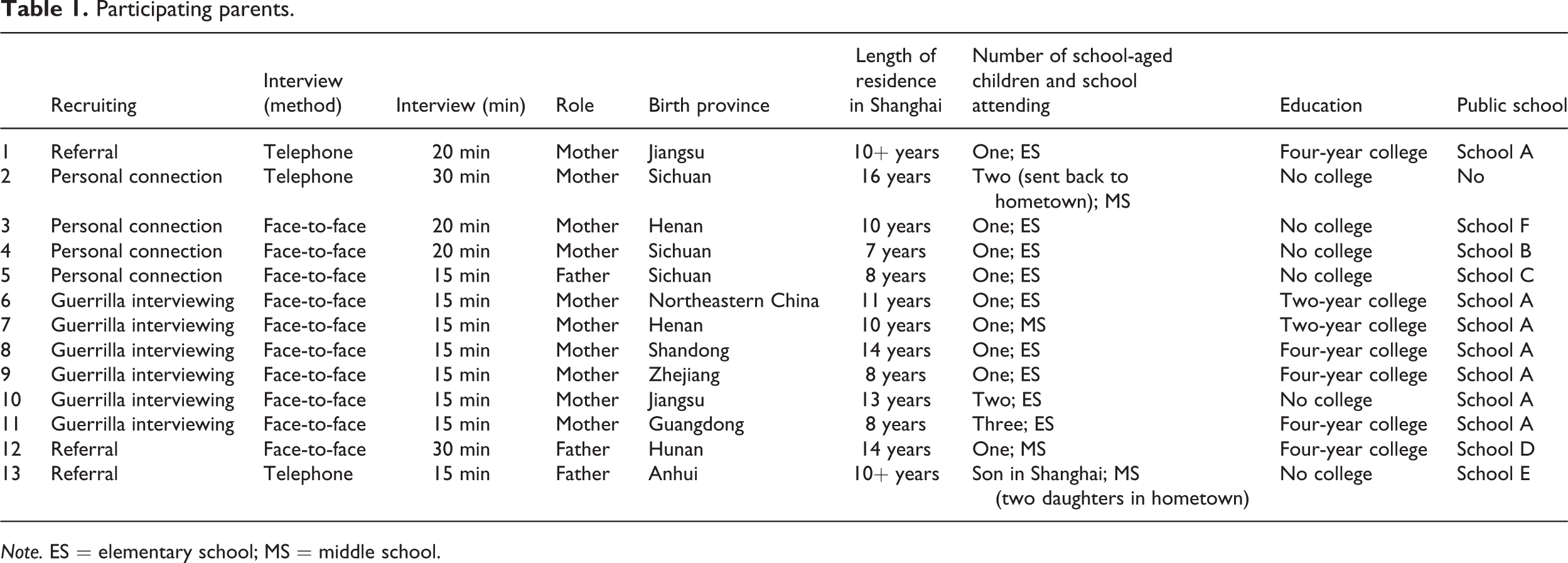
Note. ES = elementary school; MS = middle school.
It is striking that all but one parent (12 of the 13) report that their children are attending public schools. These are the six schools located in the two sub-districts and one town affiliated with the selected suburb. The only parent (Parent 2; see Table 1) who cannot enroll children in public schools are from the rural and their education level is less than high school. Since the nearby migrant middle school is of low quality and access to the public middle school is out of the question, this mother had no choice but to send two of her children back to hometown and her children had been away from Shanghai for 2 years by the time of the interview.
Data collection and analysis
The interview data collection spanned between early January and late June of 2015. It consists of 10 face-to-face interviews, 3 telephone interviews, and 5 follow-up interviews. Another follow-up with Respondent 3 occurred in the fall of 2015. People participating in “guerrilla interviewing” were extremely cautious and did not leave contact information, making it impossible to ask follow-up questions. The audio recording was not requested primarily due to the interview context constraints. The concern about lowering participation rates is another reason.
Interview data inform the analytical approach of this study. The data were manually coded for cross-case comparison using descriptive codes. The codes are consistent with the literature and particularly the two policies under study—the policy of free compulsory education and equal access to public education. For the first policy, the researcher adopted the code of “fees” and analyzed data associated with the interview question about tuition and fees. For the second policy, the researcher included codes that refer to documents required by public schools for nonresident children’s registration, such as employment certificate, residence permit, social security payment records, and real property title. With regard to the second research question, the researcher started with assigning codes to each response. The researcher created an excel matric table to import all the codes and examine them by case and synthesized findings across cases. Using the matrix, the researcher wrote memos about key patterns and themes that arose from the coding. The memo writing helped report the findings and connect the results to previous literature in the discussion section of this article. In addition to interview data, official documents of school registration associated with the municipal government policy and other districts were also analyzed for discussion purposes.
Result: How public schools implemented equity-minded migrant education policies?
Analysis of the interview data shows that the policy of free compulsory education has been fully implemented in public schools. All the respondents verify that public schools within the selected suburban area do not charge migrant (i.e., nonresident) students extra fees. Even the parent who cannot send their children to public schools is aware of the free compulsory education policy. Several parents answered the questions about additional fees without hesitation, saying, “We don’t. Of course, not.” Apparently, the local policy for higher fees for migrant students in public schools is no longer implemented, and the Shanghai municipal government seems to be keeping the promise of providing free compulsory education to all.
However, the findings in this study indicate that public schools do not fully support the policy of equal access to public education. Although one parent (Parent 2; see Table 1) was unable to send her children to public schools mainly because they do not own real property, the other 12 interviewees who enrolled their children in public schools must submit a range of 1–5 additional documentations, such as employment certificate, parents’ and children’s residence permit, social security payment records, and ownership of real property. And these documents should indicate a record up to a certain number of years. Seven of them were asked to present a real property title, four were not required to do so (Parents 3, 4, 12, and 13; see Table 1), and one was given a chance to submit his residence permit over evidence of real property (Parent 6 with college degree; see Table 1). Parents 4 and 6 expressed concerns that they might be asked to present a real property title when their children move from elementary school to middle school in a few years.
The data analysis uncovers an inconsistent and arbitrary pattern of the implementation of the equal access policy among schools. By 2014, a real property title was not a must for school admission, but some schools did require it. It makes sense that the three parents (Parents 4, 12, and 13; see Table 1) could enroll their children without having to show property titles in 2005, 2008, and 2013, respectively. However, Parent 2 could not register two of her children in 2007 when the proof of real property was not a requirement. Thus, she and her husband made a hard decision to send their two sons back to hometown as the local migrant schools are of low quality. During the time of the interview, the couple was with their children, but they would return to Shanghai in the fall of that year, leaving children behind. In response to the probe question regarding the inconsistent requirement of property title by schools, Parent 12 with college education background and profound knowledge of the Chinese educational system thought that in the past when property proof was not required, schools might have discriminated some parents by appearance and made arbitrary decisions. His speculation somehow matches the case of Parent 2. The couple from the rural did not go to college and look unsophisticated. They told me that they went to a nearby school for inquiry in 2007, 7 years before the property title requirement was required, and were rejected right away due to the lack of property ownership and not offered to submit an alternative document as the case of the college-educated parent (Parent 6).
Another unique case is the third parent, a mother whose son was able to attend a public elementary school in the fall of 2015 without submitting a property title. By the time of interview in the spring of 2015, her son was transitioning from kindergarten to the first grade. The mother expressed her concern that her child might have to go to a migrant school or back to hometown because she cannot fulfill the requirement of real property ownership. She noted that she could seek a personal connection that would waive the property title requirement, but would cost her to additional RMB30,000–50,000, which is beyond her financial capability. Thus, she was struggling with registering her son in a migrant school that is of lower quality than public schools, and her only other option would be to send the child back to her hometown school. In the fall of 2015, however, this mother updated me saying that her son is attending a public school without paying additional fees with the help of a personal connection who sought exceptions for her from that local public school.
To summarize, the findings of the implementation of the two equity-minded migrant education policies are inconsistent. On the one hand, the public schools under study have fully implemented the free compulsory education policy. Parents whose children attending public schools note that they do not pay any temporary schooling fees that used to be legalized. On the other hand, analysis of the interview data finds that public schools do support the policy of equal access to local public schools toward migrant students, which is consistent with previous studies (Goodburn, 2009; Liu et al., 2017; Qian & Walker, 2015; Ren & Yang, 2011; Zhu, 2001). The Shanghai public schools under study ask for additional documents from migrant parents. Only those who can afford a real property or receive exceptions can register their children in public schools. The study echoes previous research that suggests some migrant children rely on guanxi (personal connection) to access quality public education (Yiu, 2014). One parent told the researcher she gamed the system by using a personal connection to register her child in public schools and another parent who received the exception when the real property title was required did not confirm the existence of personal connections. However, a few parents shared anecdotes of the function of personal connections in their friends’ experiences.
While the relevant documents on migrant education published on the websites of the Shanghai Municipal Education Commission do not specify any financial requirement, the education authority at the suburb area where the study was conducted did require migrant parents to submit ownership proof of real property along with other registration documents. An examination of other administrative districts’ public documents and literature shows that other suburban and urban districts in Shanghai make stringent requirements for migrant students to attend public schools as well (Qian & Walker, 2015).
Result: What are migrant parents’ perceptions of the policy implementation?
On top of the implementation questions, participants were given opportunities to share their perceptions of school registration requirements, in particular, the real property ownership proof. Responses range from “no comment” (n = 3), to “never think of it” (n = 3), to “I don’t care” (n = 1), to “have no choice but to follow” (n = 1), to “understandable/reasonable” (n = 2), to “it is unfair” (n = 3). The only parent (#2) who was forced to send children back to hometown is the “have no choice” category. The family did not talk about it with friends as nothing would change and they just know they must follow the school’s requirement. The lady even mentioned she could be offered a slot through a personal connection and the family cannot afford to pay additional fees. The one who thought it understandable has no college degree and the person who said “reasonable” received a 4-year college education.
The makeup of the “unfair” group (Parents 3, 5, and 12; see Table 1) is mixed. It includes the mother who used personal connections to get her son to a public school and expressed strong negative feelings toward the property title requirement. The other two are among the three male participants with one being a restaurateur and the other having a bachelor’s degree. The former expressed that “asking for a property title is obviously unreasonable as the majority are the poor, while all migrant parents want their kids to go to public schools.” The latter held that “the unreasonable implementation is to force people out and reduce the local population.”
Discussion
This study does not find that the policies of free compulsory education and equal access to improve educational opportunities for all migrant children. The finding is consistent with the current literature (Qian & Walker, 2015; Ren & Yang, 2011; Yiu, 2014; Zhu, 2001). The presumed positive free education policy does not take effect when local districts require additional and stringent registration requirements, such as a real property title. This single requirement would disqualify a great many migrant parents and force them to send children back to hometown. As previously noted, however, more than 70% of migrant children attend public schools. The speculation is that the high enrollment rate of migrant students only counts the migrant children staying in both public and migrant schools rather than the original school-aged migrant population, some of whom are drop-outs and others were forced to go back to hometown. It is also noteworthy that the review of several districts’ enrollment policy texts reveals that school-aged children whose parents are from Hongkong SAR, Macau SAR, and Taiwan China, and are overseas Chinese can attend public schools in Shanghai without submitting the paperwork as required for migrant households.
Additional requirement for migrant students to access public education confirms the theory that equity-oriented reform is likely to encounter challenges, which makes it hard to benefit the disadvantaged group (Oakes et al., 2005). Apparently, additional paperwork is the backlash that prevents migrant parents from enrolling children in public schools. What are the underlying reasons for such restrictions, then? A popular official explanation is that local schools lack space and resources (Goodburn, 2009; Liu et al., 2017). Excluding migrant students may also be due to the local budget system that is only accountable to local students (Dong, 2010) and makes education resources inflexible for governments to serve migrant students (Liu et al., 2017). In reality, new schools are being established at the research site to provide quality education to local students. Further, many schools in metropolitan areas serving large numbers of migrants are under-enrolled due to the one-child policy which was implemented from 1979 to 2015 (Ren & Yang, 2011). Another reason for barriers facing migrant children is the claiming from local officials and educators that the overall quality of urban education might decline in the wake of accepting many migrant children (Goodburn, 2009; Liu et al., 2017). However, it finds that there were no significant variations in academic performance between local and migrant students (Guo, 2007), making local schools’ exclusion of migrant children to maintain city education quality groundlessly.
Other reasons might be more plausible in accounting for the policy implementation problem with equal access and resulting barriers toward migrant families. That is, local governments in metropolitans attempt to discourage further flows of migrants by forcing migrant students out of public schools (Ren & Yang, 2011). New evidence notes local priority of economic prosperity over education issues is a reason for not educating all migrant children in public schools (Liu et al., 2017). It is also possible that the migrant population flow becomes unpredictable as China’s economy is shifting from labor-intensive to knowledge-intensive, thus the local sees risks of building new schools for migrant students (Liu et al., 2017). The findings of the study strengthen literature that tries to explain why local schools fail to open doors to migrant students. It posits that an inherent reason is that equal access contradicts the normative belief that local schools should serve local children. Relatedly, in the research site and the city of Shanghai, many residents’ hostility toward migrant parents’ presence and attempt to enroll children in public schools constitutes a strong political force that pressures education authorities to maintain the normative belief and circumvent the equity-minded policies rather than fully implementing them. These reasons apply to the context of the present study and might be applicable elsewhere.
In addition to the normative belief and pressure from local residents, it is probably the new national population control policy trend triumphs over the equity-minded migrant education policies, granting the Shanghai municipal government and the local education authority a window of opportunity to increasingly raise the enrollment bar to keep migrant children out of public schools. As previously discussed, although the harsh population control occurred in 2017, since 2013 the local population control directive from the Central Government for the megacities has been brought up. When the Shanghai municipal government’s policy shifts from “accepting all” to “social control” schools started requiring proof of property ownership from migrant parents in 2014, one year prior to the data collection time of this study. The interconnection between the policy shift and the tightened equal access implementation is highly plausible. It is noteworthy that with the implementation of the two-child policy in China since January 1 of 2016, there will be a surge of school-aged children in 6 years to come. Coupled with the 2017 population control in full effect, it is likely that migrant children will face more challenges to access local public schools.
Finally, most of the interviewees (10 of the 13) did not explicitly demonstrate an equity awareness and have not questioned the conditional implementation of the equal access policy. This does not mean the inequity issue does not strike many migrant parents. This qualitative study’s findings cannot generalize. It is possible that many chose not to disclose their real perceptions due to the sensitivity of the questions and the social culture. As a matter of fact, some parents in and out of Shanghai have a keen awareness of the problem and have been fighting for migrant children’s educational rights. It happens that none of my participants are the activists. Further studies might be carried out by interviewing activist parents. Also, it is unknown what could account for the various responses of people’s perceptions of the policy implementation and additional documents’ requirement. It is beyond the capacity of this study but warrants future research.
Conclusion
The results of my study reinforce and update existing literature on the study of migrant education policies in China. They will also extend the knowledge of international migrant education and inform governments of possible policy changes. People concerned with migrant education and education equity might utilize the results of this study for advocacy and further studies. As with Heimer and Thøgersen (2006), the study will facilitate future insider and outsider researchers’ international study on China. However, it warrants studies on different metropolitans with large migrant-flows to better understand the challenges facing migrant children’s equal access to public schooling.
The implementation of equal access migrant education policy seems to be laissez-faire, hinging entirely on the action of local districts and schools. Largely due to that, the equity-minded policy does not work as expected but forcing some migrant students outside of public education or out of the host city. Based on the researcher’s observation over the years, the majority of the affected parent population has not really considered challenging the actions of the local districts and schools. Regardless, to fully implement the equal access policy for migrant or nonresident students, the Shanghai municipal government and local authorities must take the lead in enacting concrete enforcement plans and provide support for local districts to accept all migrant children into public schools. Parents can also work with local nonprofit organizations, such as Stepping Stones and New Citizen Program, to develop innovative and strategic plans to ensure local governments to implement the equal access policy.
Footnotes
Acknowledgements
The author is grateful for the feedback received from the reviewers of the ECNU Review of Education. The author also wants to extend her sincere gratitude to Dr. Tak Cheung Chan for his editing suggestion before the manuscript was submitted.
Declaration of conflicting interests
The author(s) declared no potential conflicts of interest with respect to the research, authorship, and/or publication of this article.
Ethical approval
This study was approved by the Institutional Review Board of the University of Texas at Austin.
Funding
The author(s) received no financial support for the research, authorship, and/or publication of this article.