



Abstract
This article introduces an original methodological contribution to inclusive research design: the Neuro-Cognitive Trait Interaction Model (NCTIM). Developed to address the exclusion and misunderstanding of neurodivergent people in traditional research, NCTIM provides a flexible, values-based framework that centres lived experience. Building on earlier work on neuro-cognitive trait interaction and inclusive research methods, NCTIM encourages researchers to respond to how neurodivergent people process information, interact, and communicate, rather than relying on diagnostic labels. Grounded in the neurodiversity paradigm and informed by epistemic justice, NCTIM focuses on how cognitive processing traits such as communication preferences, executive functioning, sensory processing, and attention styles shape research participation. It follows a three-stage process: mapping study demands, identifying potential trait interactions, and embedding inclusive features. The model’s application is demonstrated through my doctoral research with autistic women in the workplace. NCTIM offers a timely, neurodivergent-led contribution to reimagining research design, supporting greater inclusion, authenticity, and respect for neurodivergent expression and engagement in research.
Introduction
Research has often struggled to meaningfully include neurodivergent people in research, with traditional methods viewing participants as passive sources of data rather than active contributors of knowledge (Aldridge, 2016). The importance of inclusion is increasingly recognised, but discussions tend to focus on participatory approaches, research methods in which participants are included as co-producers of knowledge (Aldridge, 2016; Brown, 2022; Fletcher-Watson et al., 2018; Nicolaidis, 2019) rather than on how inclusion can be embedded within research design more broadly.
While participatory methods offer valuable models of collaboration and shared authority (Fletcher-Watson et al., 2018), research environments that engage neurodivergent participants must also be designed with inclusion at their core, regardless of the methodological approach adopted. Inclusive design requires more than tokenistic adjustments (Milton, 2019). It calls for a deep, contextual understanding of the communities that researchers seek to centre and a commitment to creating environments that foster trust, dignity, and meaningful engagement (Dark, 2024). Responding to these limitations, this article introduces the Neuro-Cognitive Trait Interaction Model (NCTIM): a structured yet flexible framework for inclusive research design with neurodivergent participant groups. NCTIM offers a new approach to inclusive methods with neurodivergent participant groups, particularly those who fall within developmental differences such as dyslexia, dyspraxia, ADHD, and autism. As an adult-recognised neurodivergent scholar and doctoral student, I draw on my lived experience to inform both the development and application of NCTIM. Developed through my doctoral research on autistic women’s experiences of diagnosis disclosure in the workplace, NCTIM offers an inclusive design tool that affirms neurodivergent ways of processing, relating, and engaging in research. Building on my earlier work on neuro-cognitive trait interaction (Dark, 2023), and my call for more inclusive research methods (Dark, 2024), NCTIM moves beyond diagnostic categories to centre neuro-cognitive traits, such as communication preferences, executive functioning, monotropic attention (Murray et al., 2005), and sensory processing (Ayres, 1979), as valid, embodied dimensions of neurodivergent experience and participation. In doing so, this model offers a practical, ethically grounded structure for inclusive research design that guides researchers through a three-stage process: mapping study demands, identifying potential neuro-cognitive trait interactions, and embedding responsive features to reduce participation barriers.
The development of NCTIM is grounded in the neurodiversity paradigm (Walker, 2021) and further shaped by the principles of epistemic justice (Fricker, 2007), epistemic enablement (Catala et al., 2021), and relational ethics (Ellis, 2007). These foundations position neurodivergent cognitive and relational differences as vital sources of knowledge that actively shape the research process. To support conceptual clarity from the outset, the following table outlines the key theoretical influences underpinning NCTIM, highlighting each concept’s core meaning and its role in the model’s development and application (Table 1).
Theoretical foundations of the neuro-cognitive trait interaction model (NCTIM).
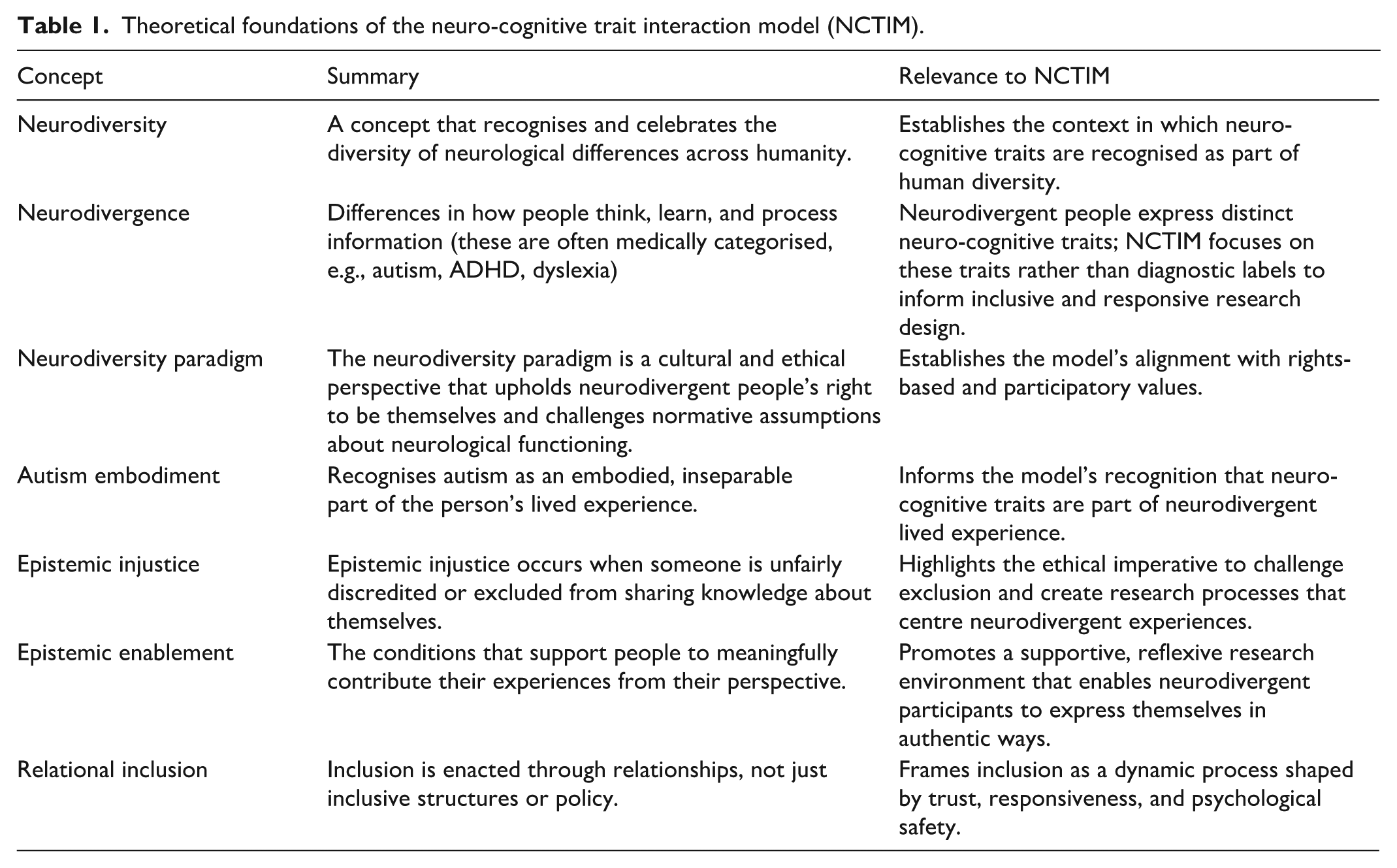
Together, these ideas challenge the exclusion of marginalised voices and create space for diverse ways of participating and expressing knowledge. They also provide the philosophical foundation for NCTIM’s three-stage process, discussed later in the article.
In the next section, the theoretical foundations of NCTIM are explored in greater depth, followed by a critical positioning of NCTIM within existing inclusive design frameworks. I then present the model’s three-stage structure, drawing on my doctoral pilot study to illustrate its application. The article concludes with reflections on the model’s limitations, practical implications, and potential for future research.
Foundations of the model: Values and concepts that shape NCTIM
To build a deeper understanding of the foundations of the Neuro-Cognitive Trait Interaction Model (NCTIM), this section examines the key concepts that shaped its development. NCTIM is grounded in interrelated ideas that reframe neurodivergent participation as relational, embodied, and ethically significant, drawing on the neurodiversity paradigm (Walker, 2021), epistemic justice (Fricker, 2007), epistemic enablement (Catala et al., 2021), relational ethics (Ellis, 2007), and autism embodiment (De Jaegher, 2013). Together, these concepts challenge conventional research norms and provide the model’s philosophical and ethical grounding. As an inclusive research method, NCTIM aims to increase the meaningful participation of neurodivergent people in research by centring neuro-cognitive traits, distinct patterns of perception, cognition, and interaction, and the relational conditions that support engagement. The sections that follow explore these values and concepts in more depth, highlighting how they inform the model’s commitment to inclusive research design.
Neurodiversity and the neurodiversity paradigm
The concept of neurodiversity originated within autistic community spaces in the 1990s (Botha et al., 2024). The term was later popularised by Judy Singer in her master’s thesis (Singer, 1998, 2016) and through the journalistic work of Harvey Blume (1998). At its core, neurodiversity recognises neuro-cognitive differences as natural and valuable forms of human variation.
Walker (2021) builds on these foundations to position the neurodiversity paradigm as both a cultural and ethical orientation, one that affirms the right of neurodivergent people to exist authentically while actively challenging the social and institutional structures that marginalise them. Walker further argues that the paradigm necessitates a fundamental reconceptualisation of cognitive variation, distinct from the deficit-based assumptions of the pathology model. In alignment with this perspective, Chapman (2023) highlights the paradigm’s contribution to scientific inquiry, noting its potential to generate new ways of understanding cognitive difference beyond the pathology paradigm.
In the context of research, recognising neurodiversity requires more than acknowledging difference; it demands a relational and epistemic shift towards valuing neurodivergent ways of being as integral to research design. As such, the neurodiversity paradigm calls researchers to move beyond tokenistic inclusion (Milton, 2019) and towards the creation of research spaces that actively affirm neurodivergent ways of processing, communicating, and relating.
The Neuro-Cognitive Trait Interaction Model (NCTIM), with its focus on cognitive traits rather than diagnostic labels, aligns closely with the neurodiversity paradigm by reframing how cognitive variation is understood and discussed. Furthermore, this perspective also fosters epistemic respect by adapting research environments to better align with participants’ processing needs.
Epistemic justice and epistemic enablement
The principle of epistemic justice, introduced by Fricker (2007), is essential to NCTIM’s commitment to neurodiversity principles. It calls for researchers to recognise all people as credible in the knowledge held about themselves and to avoid misconceptions drawn from medicalised views, which can silence or distort marginalised voices (Chapman and Carel, 2022). In neurodivergent contexts, this involves rethinking who is seen as a legitimate source of knowledge and how that knowledge is communicated. Communication preferences, cognitive processing styles, and embodied ways of participating are often overlooked or devalued in traditional research designs. For me, as a neurodivergent researcher working with neurodivergent participants, epistemic justice is not just conceptual; it is a methodological commitment that must be accompanied by inclusive design practices grounded in dignity, agency, and interpretive respect.
Building on Fricker’s work, Catala et al. (2021) introduce the concept of epistemic enablement, which shifts attention to the conditions that foster epistemic agency. Whereas epistemic injustice reveals the harms caused by structural marginalisation (Chapman and Carel, 2022), epistemic enablement focuses on how environments can be actively shaped to support diverse ways of knowing and views knowledge production as relational and contextual rather than purely individual (Catala et al., 2021). In research with neurodivergent participant groups, this involves moving away from frameworks that expect participants to adapt to dominant norms and instead encouraging researchers to adapt their methods, expectations, and environments to better meet the processing needs of neurodivergent people. These ideas are further deepened by the concept of autism embodiment, as described by De Jaegher (2013), which views autistic ways of engaging with the world as shaped by internal experiences of processing differences. NCTIM adopts this perspective by recognising the role of neuro-cognitive traits in shaping research participation and by guiding the design of environments that are responsive to sensory, emotional, and cognitive ways of engaging.
Relational ethics: Connecting the foundations of NCTIM
Translating the commitments discussed so far into practice requires relational inclusion, a term drawn from relational ethics (Ellis, 2007). Unlike traditional models of inclusion that rely on procedural checklists or abstract principles, relational inclusion centres the lived experience of participation. It asks not only whether someone is included but also how it feels to be included, whether the environment fosters emotional safety, sensory comfort, and interpersonal respect. It further invites researchers to reflect on how trust is built, how power is negotiated, and how mutual understanding can be nurtured throughout the research process (Aldridge, 2016; Nicolaidis et al., 2019; Dark, 2024).
Recent studies reinforce the need for approaches grounded in relational practice. For example, Plamondon et al. (2023), highlight that meaningful inclusion in health research depends on prioritising relational work, particularly when involving participants with lived experiences of exclusion. Participants who had encountered exclusion across diverse social contexts expressed concern that academic institutions often prioritise individual prestige, funding, and productivity, creating barriers to genuine inclusion. These findings reflect broader concerns about how inclusion is conceptualised and resourced in research, highlighting why relational considerations must be treated as a central part of the research process.
The ideas of autism embodiment (De Jaegher, 2013), epistemic enablement (Catala et al., 2021), and relational inclusion (Ellis, 2007) are deeply interconnected within NCTIM. The embodiment of autism reminds us that participation is shaped by how people experience the world through their bodies, senses, and emotions. Epistemic enablement builds on this by offering ways to support and recognise those experiences as valid forms of knowledge. Relational inclusion brings both together, creating the conditions where this exchange of knowledge can happen safely, respectfully, and with trust. When viewed together, these ideas enable NCTIM to move beyond symbolic gestures of inclusion towards a genuinely transformative research practice.
In the following section, I position NCTIM in relation to existing approaches to inclusive design to further clarify its distinct contribution.
Positioning NCTIM within inclusive research design frameworks
To reflect on how the Neuro-Cognitive Trait Interaction Model (NCTIM) contributes to inclusive research design, it is helpful to consider its positioning alongside other inclusive design approaches. Inclusive approaches have evolved to address barriers to participation across multiple domains, including education, health, work and social care. Several established frameworks, such as Universal Design (UD), Universal Design for Learning (UDL), the Social Model of Disability, and Participatory Action Research (PAR), have shaped how inclusion is conceptualised within academic contexts, each offering valuable insights that have informed the development of NCTIM. The following headings explore these approaches in greater depth, reflecting on their contributions, limitations, and how NCTIM builds upon and differs from each.
Universal design (UD)
Universal Design (UD) helps shift thinking from reactive fixes to planning for inclusion from the start. It encourages creating spaces, tools, and systems that work for as many people as possible from the outset (Connell and Sanford, 1999). UD often has a focus on technical and structural features, such as walkways, layout, and signage, with a level of standardisation, rather than adopting holistic approaches that address the diverse needs of all users (Nielsen and Landa-Mata, 2025). As Nielsen and Landa-Mata (2025) emphasise, UD must move beyond physical adjustment and recognise the full spectrum of human variation, including ‘cognitive, intellectual, and psychosocial impairments, as well as those with respiratory conditions (asthma, allergies, COPD), gastrointestinal issues, pain, and seizure disorders, in addition to the classical impairments’ (Nielsen and Landa-Mata, 2025, p. 157). This broader understanding is essential for UD to realise its full potential as a genuinely inclusive design framework. In contrast, NCTIM offers a more relational and embodied approach, recognising that true inclusion requires more than standardised access; it demands an attunement to the sensory, cognitive, emotional, and interpersonal experiences that shape how neurodivergent people engage with research environments and then similarly to UD, NCTIM demands adjustment and mitigation of challenges within the design process.
Universal design for learning (UDL)
Universal Design for Learning (UDL) takes the principles of UD into the cognitive and educational domain. Developed primarily within education, UDL promotes flexibility in how people access information, engage with content, and demonstrate knowledge in learning. UDL recognises that learners differ in how they perceive, process, and respond to instruction, and it offers multiple means of representation, engagement, and expression to address these differences (Dalton et al., 2019). In research, UDL-informed approaches have been used to make materials more accessible, for example, in my earlier work (Dark, 2024) I highlight how adapting traditional methods can support participant engagement, such as through walk-and-talk interviews (North, 2021) or the use of creative techniques that enable participants to share their views in non-traditional ways (Lewis et al., 2023).
While NCTIM shares UDL’s commitment to flexibility and accessibility, it moves beyond learning contexts to focus on the relational, sensory, and emotional dimensions of research participation. NCTIM complements UDL by centring neuro-cognitive traits and the lived experience of engagement, offering a more dynamic, context-sensitive approach to inclusive research design.
The social model of disability
The Social Model of Disability has played a foundational role in shifting the focus of disability discourse from individual impairment to the structural and societal barriers that disable people. This reconceptualisation has empowered disabled communities and influenced significant policy, educational, and legal reforms (Oliver, 1996). It addresses people with different participation barriers as a collective, focussing not on individual differences but on the shared challenges experienced within societal structures and systems (Lawson and Beckett, 2021). However, while the model has laid essential groundwork, it offers limited practical guidance for addressing the nuanced, context-specific experiences of neurodivergent people in research. Often regarded more as a political or social construct than a framework for implementation (Owens, 2015), the model rightly emphasises the need for systemic change but remains broad in scope and application. The Neuro-Cognitive Trait Interaction Model (NCTIM) builds on the Social Model of Disability by offering a more detailed, trait-informed framework. It supports researchers to notice and respond to what neurodivergent participants experience during the research process and to adapt their methods accordingly.
While the Social Model of Disability reorients the understanding of disability at a systemic level, Participatory Action Research (PAR) shifts attention to who generates knowledge and how power is distributed in research practice.
Participatory action research (PAR)
Participatory Action Research (PAR) is a social justice–oriented methodology that centres power-sharing and co-production, positioning participants as equal partners in the research process (Aldridge, 2016; Brown, 2022; Fletcher-Watson et al., 2018; Nicolaidis, 2019). It reframes knowledge production as a relational and context-sensitive endeavour, particularly valuable when working with marginalised groups. While PAR isn’t a design tool, it shares NCTIM’s emphasis on relationships and the importance of lived experience. The key distinction lies in their focus: PAR redistributes power and captures neurodivergent voices in authentic ways, while NCTIM focuses on aligning research environments with embodied neuro-cognitive traits. Used together, these concepts are complementary; NCTIM can act as a preparatory tool to adapt research settings before participatory models are implemented, ensuring the space is both accessible and affirming from the outset. While these frameworks establish critical foundations for inclusion, there remains a need for approaches that specifically address neuro-cognitive variation as it is lived and embodied within research participation. This is where NCTIM offers a distinctive contribution.
Introducing the neuro-cognitive trait interaction model (NCTIM)
When these foundational approaches are viewed together, they highlight the growing momentum for inclusive and participatory practice across research design. Each framework offers valuable contributions: Universal Design and Universal Design for Learning emphasise proactive accessibility; the Social Model of Disability shifts systemic understandings of barriers; and Participatory Action Research centres shared ownership of knowledge production. Yet despite this progress, none directly address the embodied realities of neuro-cognitive variation within the research design process.
Inclusive research design is not only about improving participant experience; it also has the potential to shape how researchers approach analysis and interpretation. A growing body of work highlights the importance of this shift. For example, Haar et al. (2024), in their study exploring autism community members’ perspectives on autism research, call for a move away from overly narrow, deficit-based views of autistic people towards a greater focus on the broader contexts that shape people’s experiences and well-being. Emerging evidence also suggests that researchers who include autistic people in research demonstrate fewer ableist biases within their research outputs (Botha and Cage, 2022). By designing from a participant-centred perspective, researchers are encouraged to maintain an experience-first orientation that carries through to later stages of the research process, helping to preserve the authenticity and nuance of participant knowledge and respect for neurodivergent people’s participation requirements.
This is where the Neuro-Cognitive Trait Interaction Model (NCTIM) offers a distinctive contribution. By centring neuro-cognitive traits, environmental demands, and relational responsiveness, NCTIM introduces a dynamic approach to inclusive research design. It encourages researchers to gain a deep, lived understanding of neurodivergent experiences and to translate this understanding into actionable design decisions. While this introduction outlines its conceptual foundations, the following sections explore how NCTIM differs from existing frameworks and how it can be practically applied.
To further situate NCTIM within the landscape of inclusive methodologies, Table 2 presents a side-by-side comparison of the frameworks discussed, highlighting both shared aims and important differences.
Comparative overview of inclusive frameworks.
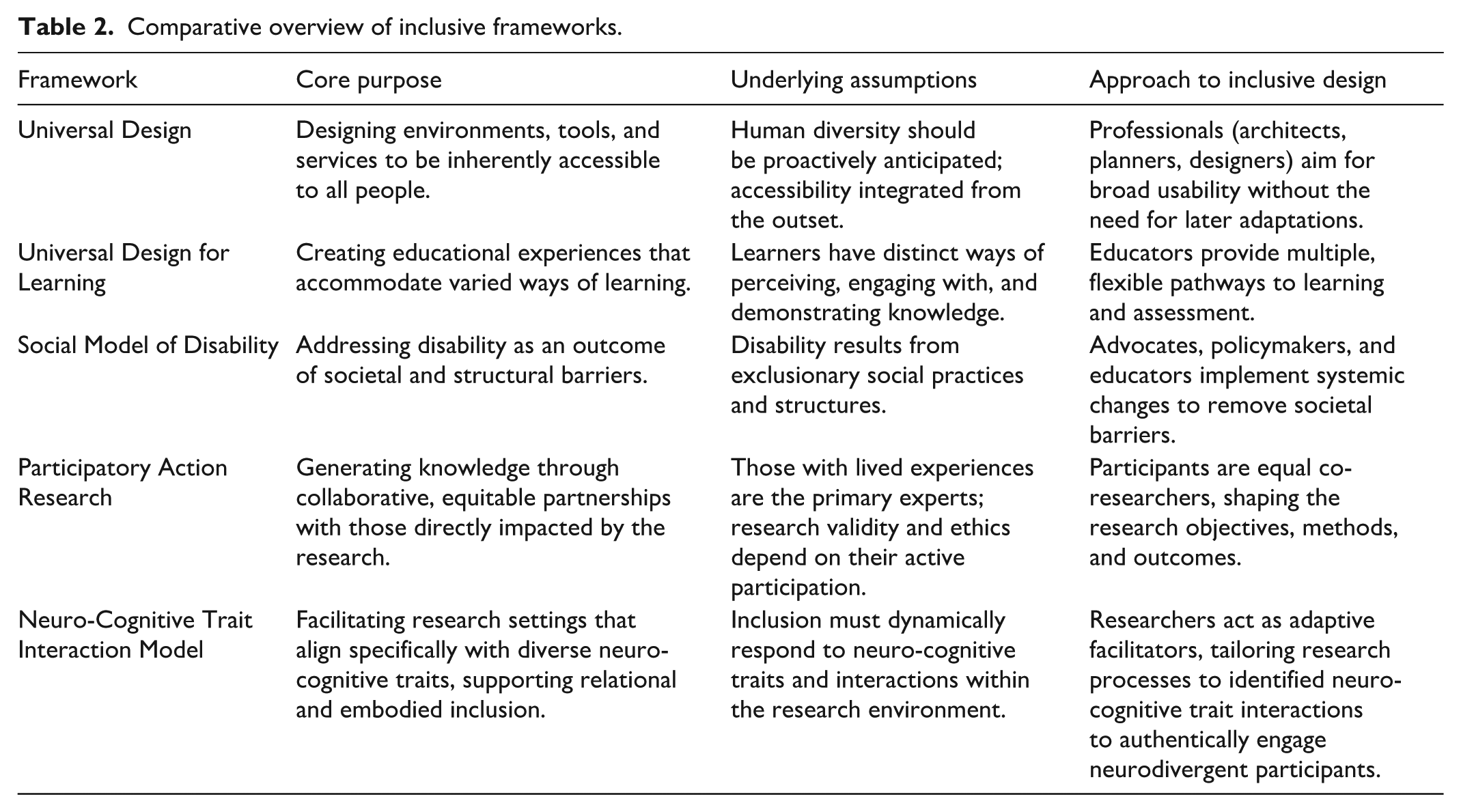
Table 2 illustrates how NCTIM stands out from other inclusive frameworks by explicitly recognising how neuro-cognitive traits shape people’s experiences within the design process. Rather than designing research settings based on diagnostic assumptions, NCTIM invites researchers to work responsively with the real-life differences, needs, and ways of being that shape neurodivergent participation. Supporting researchers to take ethical responsibility for creating attuned research spaces, NCTIM moves beyond generalised notions of inclusion towards a dynamic, context-sensitive approach that centres the nuanced interaction between neuro-cognitive traits and research demands (Dark, 2023; Catala et al., 2021). In turn, NCTIM provides a trait-based consistency to research design that can be evidenced and built upon across different research domains. As such, NCTIM supports researchers to create environments where neurodivergent participants can engage in ways that feel meaningful, safe, and empowering. It reflects the understanding that genuine inclusion is not simply about who participates, but how participation itself is structured, experienced, and valued.
The following section outlines how NCTIM can be applied through a practical three-stage process: mapping study demands, identifying neuro-cognitive trait interactions, and embedding inclusive design features.
Implementing the neuro-cognitive trait interaction model (NCTIM)
The Neuro-Cognitive Trait Interaction Model (NCTIM) outlines a three-stage process to guide inclusive, responsive, and relational research design. Each stage actively puts the model’s core ethical values into practice, building on the ideas introduced earlier in this article.
Visualising the model: Three stages of NCTIM
To support a deeper understanding of the dynamic interactions within NCTIM, Figure 1 presents a visual overview. This illustration clarifies the model’s three sequential yet recursive stages, demonstrating how each step strengthens an inclusive, relational research design.
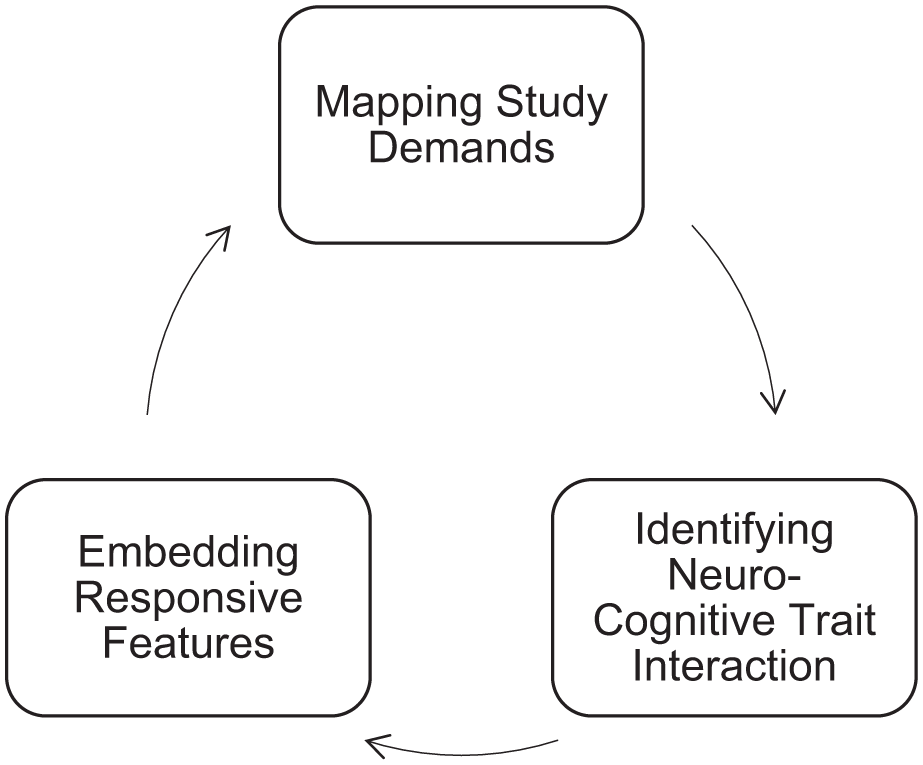
The neuro-cognitive trait interaction model (NCTIM): A three-stage framework for inclusive research design.
Figure 1 illustrates the NCTIM process, providing a visual overview of its three-stage structure. It supports researchers to reflect, adapt, and align their methods with the lived experiences and processing needs of neurodivergent participants, strengthening inclusion and accessibility at every stage. The model guides researchers through a recursive and reflexive design process, aligning research practices with neuro-cognitive traits to strengthen inclusion, accessibility, and relational ethics.
Stage 1: Mapping the study
The first stage focuses on understanding the study’s goals, methods, and any fixed institutional, ethical, or epistemological constraints. This includes how data will be collected, what participants will be asked to do, how long the study will last, and how communication will occur. It also requires recognising fixed elements, such as standardised measures, ethical approval conditions, or funder and institutional stipulations, that may limit flexibility. The aim here is to clarify what the study expects from participants so that these expectations can be fully evaluated in Stage 2. Understanding which aspects of the research process are fixed and which are adaptable enables researchers to anticipate potential barriers to participation and consider where adaptations may be required.
Stage 2: Identifying neuro-cognitive trait interaction
This stage involves identifying key neuro-cognitive traits associated with the participant demographic, alongside traits linked to neurodivergence more generally, and reflecting on how they might shape participants’ experiences of the study. It helps researchers examine whether any aspects of the research design might unintentionally create barriers for neurodivergent participants.
My research explored the experiences of autistic women. As such, traits such as communication preferences, executive functioning, monotropic attention (Murray et al., 2005), and sensory processing differences (Ayres, 1979) offered valid insights into how the participant group experienced the research process. It is important to recognise that neuro-cognitive traits are varied across participant groups, dynamic, and may interact differently across contexts and stages of participation. Researchers are encouraged to reflect on how these traits influence participants’ engagement with the specific activities and structures of their study design.
For example, time-limited interviews might be challenging for people who need longer to recall information or organise their thoughts. Similarly, expectations around eye contact, spontaneity, or emotional reciprocity may cause discomfort. This step helps researchers identify potential challenges early, allowing them to be addressed in Stage 3 through responsive and inclusive design decisions.
Stage 3: Embedding responsive features
Building on insights from the earlier stages, researchers can now embed responsive features that reduce barriers, enhance clarity, and support sustained engagement throughout the research process. This stage focuses on making research processes more flexible to support access to research and engagement. Researchers may find the Eight Principles of Neuro-Inclusion (Dark, 2024) and associated literature useful for guiding ethical and practical decision-making. These principles emphasise autonomy, trust, and epistemic respect, helping researchers translate inclusive intentions into tangible design features.
Case example: applying NCTIM in practice
In my doctoral research, I used the Neuro-Cognitive Trait Interaction Model (NCTIM) to reduce barriers at every stage of the study, from recruitment and consent through to data collection. The study explored how autistic women experience diagnosis disclosure in the workplace. It was based in the field of Organisational Psychology, which often favours quantitative methods over more flexible, inclusive approaches (Wilhelmy and Köhler, 2022). As participatory methods were discouraged in this context, I adapted the research design from my perspective as a neurodivergent researcher. This helped ensure the study remained aligned with the model’s values. Looking ahead, further development of NCTIM should prioritise co-production with neurodivergent scholars and communities. The following section explains how NCTIM was implemented, using the same three-stage process outlined earlier, which offers a way to uphold neuro-affirming principles within the methodological constraints of the discipline.
Stage 1: Mapping the study
In this stage, I mapped out the study design and its limits. It included a two-part pilot: first, written responses, followed by an online interview. Fixed elements, such as consent forms and timelines, shaped the boundaries within which adaptations were reflected upon. Although those parts could not be changed, this stage helped show where I could make adaptations to support participants’ comfort and autonomy. Starting with written responses gave participants more time to reflect before the interview. It also shaped later design choices, like adapting the interview questions to align with individual experiences.
Stage 2: Identifying neuro-cognitive trait interaction
Drawing on autistic-led research and community insights, I identified key neuro-cognitive traits likely to shape participants’ experiences of the study. These included communication preferences, executive functioning, focussed attention (Murray et al., 2005), and sensory processing differences (Ayres, 1979). Rather than applying fixed diagnostic categories, I reflected on how specific aspects of the study environment might interact with these traits to create barriers or best facilitate participation.
For example, recognising that communication differences are common for autistic adults (Cummins et al., 2020), I anticipated the need for clear, structured communication. Awareness of sensory processing differences (MacLennan et al., 2022) also highlighted the importance of managing environmental demands such as sensory overload or fatigue. Considering challenges with episodic memory recall and linear narrative structure (Brimo et al., 2021; Ocak et al., 2018), I considered how interview questions could be presented and supported. This reflective stage helped surface potential barriers early and guided the later design of supportive features that aligned with participants’ natural ways of processing, relating, and engaging.
Stage 3: Embedding responsive features
Building on insights from the trait interaction mapping stage, I embedded responsive features to support participants’ cognitive, sensory, and social needs throughout the study. Materials were shared in both written and audio formats, using clear language and visual markers to reduce cognitive load and support visual thinkers. Interviews were conducted online, offering participants the flexibility to respond either verbally or via text box depending on their communication preferences and processing needs.
Interview schedules were personalised using participants’ pre-interview written responses, incorporating gentle prompts to aid memory recall and accommodate non-linear storytelling. Scheduled sensory breaks and regular check-ins were built into interviews to support pacing, energy regulation, and participant autonomy. Consent was treated as ongoing: participants were offered a pre-written withdrawal statement and post-interview signposting to support agencies to ensure a supportive, ethical experience.
Some participants mirrored the relational care shown during the interviews by checking in with me as the researcher, reflecting an ethic of mutual understanding and neuro-affirming connection. Together, these features operationalised NCTIM’s core principles: centring neuro-cognitive variation, attending to interactional fit, and fostering a relational, trust-based research environment.
Limitations and future considerations
The Neuro-Cognitive Trait Interaction Model (NCTIM) was developed and applied within a small-scale qualitative pilot study with autistic participants. As such, it is currently best suited to relational, inclusive, and participatory research environments where flexibility, dialogue, and relational reciprocity can be meaningfully embedded. Its initial application demonstrated benefits in reducing barriers and enhancing participant experience; however, further testing is needed to evaluate its utility across other research disciplines and scales.
Challenges in other settings
Although NCTIM is designed to be adaptable, certain research contexts present structural limitations. In quantitative, clinical, or institutional settings, where procedures are standardised and researcher–participant interaction is limited, core features such as co-regulated pacing, multimodal communication, or sensory awareness may be harder to implement. These environments often prioritise uniformity and efficiency, which can restrict the relational and iterative practices central to the model. Nevertheless, NCTIM’s trait-informed principles remain relevant as a guide for context-sensitive adaptation. Its core value lies in supporting reflexive and ethical decision-making, even in less flexible settings, enabling researchers to embed respect, responsiveness, and participant-centred thinking wherever possible. In this way, NCTIM functions both as a framework for inclusive design and as a guide for ethical reflection across diverse methodological contexts.
Ethical considerations
The ethical application of trait-informed design requires careful attention to interpretation and intent. There is a risk that neuro-cognitive traits may be misconstrued as diagnostic markers or applied reductively. NCTIM is not a diagnostic tool; rather, it provides a relational framework that promotes inclusion through thoughtful, embodied design. Researchers must ensure that trait-based adjustments enhance rather than constrain participation, safeguarding emotional safety, autonomy, and authenticity. Effective implementation depends on cultivating a nuanced understanding of the neurodivergent populations, critically reflecting on research processes, and remaining responsive to participants’ diverse cognitive-processing styles and participation needs.
Broader applicability
NCTIM adopts a neurodiversity-informed stance that intentionally narrows its immediate scope while prioritising methodological integrity. By systematically mapping inclusive design decisions to neuro-cognitive traits and articulating the rationale behind these choices, it establishes a transparent and replicable structure that strengthens the rigour and inclusivity of research practice. While the model has been applied in an exploratory context, its trait-informed principles have potential value across a broader range of methodologies. With empirical testing and contextual adaptation, NCTIM could inform the design of inclusive survey instruments, longitudinal frameworks, and accessible recruitment processes, thereby extending its reach beyond relational settings.
Future directions
As a novel approach in this field, NCTIM warrants further research to validate and refine its applications. Future work should examine its adaptability across large-scale and mixed-methods studies and explore how interdisciplinary collaboration can support ethical scalability and enhance contextual responsiveness. Continued development should also investigate how neuro-cognitive traits intersect with other dimensions of marginalisation, including race, gender, and socio-economic status (Catala et al., 2021; Crenshaw, 1989). Understanding these intersections can deepen insights into how structural inequities shape participation and data quality in research involving neurodivergent people.
Moreover, applying NCTIM across different disciplines and research cultures offers an opportunity to challenge dominant assumptions and advance more inclusive epistemologies. For example, exploring how researchers can signal cultural alignment, particularly during early stages of recruitment and consent, may help strengthen trust and relational safety among participants who are minoritised or underserved in conventional research contexts. Collectively, these directions point to the model’s potential not only as a methodological innovation but also as a catalyst for broader cultural change in inclusive research practice.
Discussion
When neurodivergent people are meaningfully considered in relation to how they process and engage with the world, new possibilities for authentic participation in research emerge. This shift moves inclusion from a procedural consideration to an ethical and relational practice that recognises the complexity of neurodivergent experiences.
The Neuro-Cognitive Trait Interaction Model (NCTIM) offers a flexible approach to inclusive research design, supporting researchers to move beyond standardised accommodations. Rather than categorising participants by diagnostic labels, NCTIM redirects focus to the dynamic interaction between neuro-cognitive traits and research environments. It reframes inclusion, demonstrating that accessibility is not achieved by adapting individuals to existing processes, but by adapting the research process itself. In doing so, the model challenges deficit-based assumptions and embraces a foundation grounded in the neurodiversity paradigm (Walker, 2021), epistemic justice (Fricker, 2007), and relational ethics (Ellis, 2007).
At its core, NCTIM translates key theoretical foundations, such as autism embodiment (De Jaegher, 2013), epistemic enablement (Catala et al., 2021), and relational inclusion (Ellis, 2007), into a practical methodology. By attending to how traits such as communication preferences, executive functioning, monotropic attention (Murray et al., 2005), and sensory processing differences (Ayres, 1979) interact with study demands, the model helps researchers design environments that are not only accessible but actively welcoming.
NCTIM’s three-stage structure, mapping study demands, identifying neuro-cognitive trait interactions, and embedding responsive features, provides a clear yet adaptable framework for inclusive research design. Rather than relying on generic accessibility checklists, the model promotes reflexivity, ethical responsiveness, and a deep understanding of neurodivergent participants’ processing needs. For researchers unfamiliar with inclusive methodologies, NCTIM offers a grounded entry point into relational practice. It supports the translation of neuro-affirming principles into repeatable, meaningful actions that centre the participant experience. This reflective process strengthens both the implementation of study design and the analysis of findings, providing an experience-based perspective that helps preserve participant authenticity.
Adopting a participant-centred design approach, such as NCTIM, may also positively influence the researcher’s mindset during later stages of the study. Emerging evidence suggests that researchers who adopt neurodiversity-informed approaches demonstrate fewer ableist biases in both research design and the interpretation of findings (Botha and Cage, 2022). By embedding inclusive practices from the outset and immersing themselves in the participant perspective, researchers may be better equipped to maintain an experience-first approach during analysis. This reflective stance can help resist unconscious bias, preserve the authenticity of participant narratives, and support more nuanced, contextually grounded interpretations. Importantly, these practices are not intended to replace critical steps such as member checking or collaborative analysis, but to complement them as part of a holistic, inclusive research process that remains grounded in lived experiences. Although developed and piloted through qualitative research with autistic women, the principles underpinning NCTIM are broadly transferable. Acknowledging the philosophical and methodological tensions inherent in the model is essential for maintaining transparency and credibility in this development. By making explicit its grounding in a neurodiversity-informed and critical disability stance, researchers can situate their work within a clear theoretical framework. This reflexive awareness enhances methodological integrity and fosters dialogue on how inclusive design principles can be adapted across diverse research contexts. With continued evaluation and adaptation, NCTIM holds promise for application across disciplines and settings, including education, healthcare, workplace assessment, and policy research. Its strength lies in its responsiveness to context and its foundation in the lived expertise of neurodivergent communities, ensuring that research approaches become more inclusive across disciplines. Ultimately, NCTIM represents more than a research tool; it signals a broader shift towards relational, neuro-affirming scholarship grounded in epistemic justice. Its continued development must remain rooted in the communities it seeks to serve, recognising neurodivergent people as authoritative knowers of their own experiences. By aligning theory, method, and community knowledge, NCTIM contributes both conceptually and practically to the future of inclusive research. Most importantly, it reminds us that meaningful change does not come from frameworks alone, but from a sustained commitment to valuing and respecting the knowledge held within the communities that inclusive frameworks are built to support.
Footnotes
Acknowledgements
This article draws on research conducted as part of my doctoral thesis on autistic women’s experiences of diagnosis disclosure in the workplace. I would like to thank Professor Almuth McDowall (Birkbeck, University of London) and Professor Harriet Tenenbaum (University of Surrey) for their supervision during my doctoral studies. I also wish to thank Professor Hanna Bertilsdotter-Rosqvist for sharing resources that informed and enriched the development of this article.
Author note
Please consider this article in line with student and early career researcher processes and feedback.
Declaration of conflicting interests
The author declared no potential conflicts of interest with respect to the research, authorship, and/or publication of this article.
Funding
The author disclosed receipt of the following financial support for the research, authorship, and/or publication of this article: Financial support was received for the article’s research, authorship, and/or publication. -I-received payment of doctoral fees through a Graduate Teaching Assistant contract (2020-2023)-from-the-School of Business, Economics, and Informatics at Birkbeck, University of London.
Consent for publication
Not applicable.
Consent to participation
Not applicable.

Data availability Statement
Not applicable.