




Abstract
Video game scholars examining the shortcomings of previous video game research reference the need for new and innovative methodologies. Existing video game research seemingly inhibits organic learning experiences by setting specific research targets or providing players with gameplay instructions, hence utilising methodological approaches that study the learning process from the outside. With the increasing popularity of both serious and mainstream disaster video games, a necessity exists for innovative research to explore how video games can be used as learning tools. Based upon the researchers’ own enquiry, this article demonstrates the potential use, benefits and challenges of participatory methodologies for the conduct of video game research. This article pushes back upon traditional video game research methods, reviewing the methodological approaches of existing video game literature and demonstrates how participatory methodologies are currently being used for disaster video game research. An examination of participatory methodologies, being used in disaster video game research, reviews the strengths and challenges of each research approach. Rationalising the potential of participatory methodologies, in the context of constructivist learning theory and active participation, to foster the learning process and explore learning from the inside. As such this article provides an innovative methodological framework, which can be used as a template when considering future video game research.
Keywords
Introduction
Video game research largely focuses on examining the effects of video gameplay on cognition and behaviour (Buelow et al., 2015). Numerous studies explore the negative aspects of violent video games surrounding aggression (Anderson, 2004; Anderson et al., 2010; Hasan et al., 2013), with a smaller number of studies highlighting the benefits of playing video games (De Freitas and Neumann, 2009; Prensky, 2002). Video game studies consider the possibilities for video games to be used as learning tools. However, such studies chiefly focus on the different components of a video game like game development, video game content and/or player motivations (see Rebolledo-Mendez et al., 2009; Tsai et al., 2015). While these studies seek to investigate the effectiveness of the gameplay on players’ learning, the methodological approaches that are frequently employed by researchers often do not match up with the central tenets of learning theory (specifically constructivism) that underpin such research. Therefore, a gap exists in current scholarship surrounding what are the most appropriate research methodologies to employ, and how to ensure research methodologies are in alignment with learning.
At present, researchers use a variety of methodologies to conduct their particular area of video game research as no standardised approach exists. Lankoski and Björk (2015) and Mäyrä (2015) observe that new areas of game research, like disaster video game research, are often void of previous successful research frameworks to provide systematic guidance. The methodological implications of how to undertake such specific enquiries are therefore lacking. This means innovation is required by video game researchers when looking to explore new research dimensions (Mäyrä, 2015). However, in order to generate paradigm shifts within scholarship, researchers require intimate knowledge of previous research, including of their strengths and shortcomings (Mäyrä, 2015). This is especially important within disaster video game research, as the researcher requires knowledge of not only the methodological approaches within disaster studies but also how to ensure such approaches are also appropriate for video game research. The utilisation of diverse methodologies is of critical significance within such transdisciplinary research that incorporates different disciplinary traditions and the perspectives of users and practitioners (Popa and Guillermin, 2015). This article is therefore directed at drawing connections between a diversity of methodological approaches and demonstrating how such methods can be brought together within a methodological framework. This framework provides an innovative approach to video game research focused on learning.
Video games hold a significant role and influence in society as popular culture products. Video games frequently feature disaster scenarios, with disasters defined as events involving natural/human-made hazards that inflict harmful consequences upon infrastructure, livelihood and/or lives, due to resulting human actions which affect the social, political, environmental and economic sectors (Gaillard, 2015; Mercer, 2010; UNISDR, 2017; Wisner et al., 2012). Video games like FROSTPUNK, the FALLOUT or METRO series or serious disaster games like EARTHGIRL2 or SAI-FAH: THE FLOOD FIGHTER, offer insights into different conceptualisations of disaster that exist within society, as well as what those differences mean in terms of how people learn about and potentially respond to disaster events (Gampell and Gaillard, 2016; Quarantelli and Davis, 2011; Wachtendorf, 1999; Webb, 1998, 2007). The ever-increasing popularity of both serious and mainstream disaster video games from various international NGOs, governments, researchers and global game development studios necessitates a critical examination of how such games can be used as disaster learning tools. Previous disaster video game research indicates that disaster video games can instil disaster awareness through their portrayals of concepts such as hazards, vulnerability and capacities as well as actions for disaster risk reduction (DRR) (Gampell et al., 2017; Gampell and Gaillard, 2016). However, limited understanding exists surrounding how such disaster video games actually contribute towards learning beyond trying to raise risk awareness.
The growing importance of researching video games for DRR is situated within the context of wider social change. Digital and technological advancements over the last three decades have resulted in information being available at the touch of a button. The changing availability and consumption of information, in combination with the persistent need for DRR, requires reconsideration of traditional education and learning methods. As young people grow up in an ever-increasing digital world, their familiarity of information technologies requires their learning space to transcend the limitations of the physical space (Chau et al., 2013). Hence, the immersive environments presented by video games provide players opportunities for personalised learning experiences and higher learning autonomy (Chau et al., 2013). This evolution involves a shift away from traditional deductive learning strategies (involving a concept being given to a learner to use on examples) (Amory and Seagram, 2003) towards more inductive learning strategies (focused upon learner discovery) (De Freitas and Neumann, 2009). Taking such an approach allows for engaged learning experiences and opportunities to construct concepts and rules based upon the learner’s personal interpretations (Amory and Seagram, 2003), which in the case of this article, learner refers to the video game player and/ or playing companion.
This article commences by reviewing the broad methodological approaches currently utilised in video game research. Following this review, a rationale for using participatory methods for video game research is presented and connected to constructivist learning theory. Based upon the researchers’ own disaster video game research a case is presented for how participatory approaches could be used by other video game researchers investigating the ability of video games to be used as learning tools. The participatory tools used in the research process are detailed while simultaneously examining the strengths and challenges of each tool. In conclusion, an innovative and novel methodological framework for disaster video game research is presented, with a critical engagement and reflection upon the discussed methodologies and broader scholarship regarding research practices.
Conventional video game research methodologies
Video game research can draw upon a broad selection of research methods and approaches of both a quantitative and qualitative nature, where deemed appropriate for the specific research investigation. The methodological diversity employed, reflects both the different researchers’ disciplinary backgrounds (Lankoski and Björk, 2015), as well as the emergent nature of video game research which often requires scholars to develop original methods to proceed with their research into relatively uncharted territories. Mäyrä (2015) argues that an understanding of previous research and its shortcomings are necessary for video game researchers to suggest innovative methodologies to investigate new research areas. While the field of disaster studies documents numerous methodological approaches for researching disasters and DRR (e.g. Phillips, 2014), the specific field of disaster video game research is relatively undefined (in terms of methodological approaches). This position supports Mäyrä’s (2015) notion that video game researchers need to be innovative to explore new areas of video game research. However, having intimate knowledge of previous research and its shortcomings is not as straightforward. Limited disaster video game research explores the strengths and limitations of different methods and assess a player’s learning. This article investigates how researchers may overcome this challenge and limitation. It is argued that by exploring the commonly utilised methodologies within disaster research alongside those of video game studies with a learning focus, can enable the generation of a reflexive and appropriate methodology that can align with and facilitate opportunities for constructivist-based learning. By addressing both the current research approaches and the gaps within the current literature enables the formulation of an appropriate methodological framework to conduct, not only disaster video game research but also potentially any form of video game research with a focus upon education and learning.
However, video game scholars find the concept of methodological and conceptual diversity problematic, as no one conceptual and methodological video game framework exists to allow for the interpretation and comparison of results and effects (Rebetez and Betrancourt, 2007). Scholars like Aarseth (2001) argue that video games should be given their own branch of theory, however in itself this is also highly contested, due to differing research focuses ranging from narratology, ludology (Aarseth, 2001) or interdisciplinary approaches (Wolf and Perron, 2003). Due to the expansive collection of potential methodologies and research topics, elaboration of all possible methods in specific detail is nearly impossible. Therefore, this article examines common conventional approaches utilised in video game research as a contextual foundation to introduce a participatory methodological framework for the conduct of video game research, informed by the researchers own disaster video game research process.
Most video game research concerned with the examination and exploration into the effectiveness of, or potential for, video games to be positive learning tools utilises quantitative approaches. Quantitative methods of data collection aim to collect data, objective in nature, limiting the ability for subjectivity and finding based upon the interpretations of patterns revealed in the data (Landers and Bauer, 2015). Studies from Buelow et al. (2015), Chau et al. (2013), Miller et al. (2011), Pilegard and Mayer (2016), Shute et al. (2015) and Yang (2012) collect or generate quantitative data to run various statistical analyses and generate conclusions. These studies employ a range of quantitative tools, including but not limited to, questionnaires (Buelow et al., 2015; Chau et al., 2013; Miller et al., 2011; Pilegard and Mayer, 2016) and knowledge tests (Chau et al., 2013; Miller et al., 2011; Pilegard and Mayer, 2016; Shute et al., 2015; Yang 2012). A control group is often arranged to allow a comparison between the use of a video game and other teaching tools. For example, Chau et al. (2013) had the control group watch a video of the SECOND LIFE game environment compared to the video game group who interacted with the SECOND LIFE game environment. The primary advantage of such quantitative research is the ability for future researchers to replicate the research and compare results to generate a scientific consensus.
Winchester and Rofe (2016) review the perceived dualistic relationship between quantitative and qualitative research, suggesting qualitative research methods as defining the research problem, hypotheses development, research design, data collection and deriving meaning through analysis. However, acknowledging the subjectivity and value-based nature of all research methods, in line with Popa and Guillermin’s (2015) call for reflexivity, in turn reduces the gap between quantitative and qualitative methods (Winchester and Rofe, 2016). In the context of video game research, qualitative research focuses upon two main areas, understanding the video game and understanding players and their gameplay experiences. Interviews (Pitkänen, 2015) and focus group activities (Eklund, 2015) aimed at narrative extraction from players regarding gameplay experiences, can also fall under the broader ethnographic research approach (Creswell, 2007). Qualitative research was employed by Nilsson and Jakobsson (2011) to explore the ways in which real worlds provided by SIMCITY 4 could be a potential facilitator for science learning contexts. Nilsson and Jakobsson (2011) utilised focus groups, alongside video recordings of both participants’ explanations and interactions with their respective group’s future city model, to encourage participants to discuss different experiences and views with each other. Focus groups can be advantageous for observing everyday behaviour, jokes, arguments and discussions surrounding video games in a more social environment (Eklund, 2015), while simultaneously allowing for fact checking between respondents compared to results attained from one on one interviews (Nilsson and Jakobsson, 2011). Ultimately, the rich collection of information acquired from qualitative methods can be analysed to extract trends and broad themes from participant responses (Landers and Bauer, 2015) demonstrating how the material is conceptualised and perceived by people.
Connecting participatory approaches to DRR and constructivism
Video game research often utilises quantitative approaches or quantifies qualitative data to generate statistically analysed conclusions to derive a scientific consensus. Mayoux and Chambers (2005) review of research approaches for the consideration of participatory approaches found quantitative research is generally considered more credible and superior to both qualitative and participatory methods. Qualitative data are often depicted as explanations for research findings (Mayoux and Chambers, 2005), though these data are often focused and reflective of the researcher’s research agenda. While quantitative and qualitative methodologies have their respective strengths, opportunities for more accurate quantitative and qualitative data may be possible from using participatory methodologies (Chambers, 2007; Mayoux and Chambers, 2005).
DRR aims to reduce disaster risk and increase people’s awareness, especially among the vulnerable, by preventing hazards, reducing vulnerability and enhancing capacities to reduce the impacts of a disaster (Solecki et al., 2011; UNISDR, 2017). A hazard refers to a natural or anthropogenic phenomenon that may cause loss of life, injury, property damage and disruption to the functioning of society in a given location at a given time (UNISDR, 2017). Vulnerability mirrors the susceptibility to suffer from harm and damage in the event of a hazardous phenomenon or the condition of a society which makes it possible for a hazard to become a disaster (Cannon, 1994), while the term ‘capacities’ refers to the combination of knowledge, skills and resources a group of people or individuals resort to in managing and reducing the potential impacts of a hazard (Gaillard et al., 2019).
Given the complexities and structure of daily life in different environments for individuals, means successful DRR requires the actions, approaches and knowledge transfer to build upon and complement the other (Gaillard and Mercer, 2013). DRR cannot just address the hazard, respond to disaster, focus solely upon vulnerability, or be only top-down or bottom-up (Wisner et al., 2012). While disaster research utilises the same conventional quantitative and qualitative methodologies, disaster research increasingly utilises participatory methodologies and approaches as an alternative to the top-down technocratic approaches that often dominate the process of DRR (Le De et al., 2015; Pelling, 2007). While top-down technocratic initiatives rely upon scientific knowledge (Hewitt, 1983), bottom-up participatory actions attempt to collaboratively foster knowledge, perceptions and priorities of a large collection of stakeholders across all scales. Petal (2007) notes risk reduction education is frequently conducted from the top-down, without the inclusion of bottom-up perspectives from teachers and students. As such, participatory methodologies can concurrently empower those considered voiceless and provide a platform for top-down and bottom-up convergence (Chambers, 2008).
Research reinforces that video games have strong links to constructivist learning theory (Adams, 2007; Chau et al., 2013; Klopfer et al., 2018; Ray et al., 2014), though such research does not always take into consideration how the research methodologies may influence the research outcomes. Participation is not only a crucial element to participatory tools but is also fundamental to the nature of both video games and constructivist learning theory. Klopfer et al. (2018) adopt a constructivist approach towards resonant game development noting ‘An idea central to our development of resonant games is that learners will best develop knowledge and skills by doing things in the world – knowledge is not delivered but constructed by the learner through and during activity and discovery’. Constructivist learning theory considers learning to be an active process whereby learners actively construct, build and test new ideas or concepts against existing and past knowledge (Adams, 2007; Chau et al., 2013). Garrison and Anderson (2003) believe education has two purposes. First, the learner constructs meaning based on personal experience, supported by Amory and Seagram (2003), and second, the learners confirm ideas collaboratively within a community of learners, supported by Chau et al. (2013). Hence, constructivism is guided by two core pedagogical principles, the first suggests that the learning should be authentic, active and student-centred (Splan et al., 2011). Video games, by nature, require active player participation. Players are required to self-navigate and make active decisions, often reflective of the player’s cultural, moral and behavioural understandings. Dede (1995) suggests virtual environments can provide such learning opportunities without real world repercussions, personalising individual learning experiences. However, when comparing the first pedagogical principle of constructivism to existing video game research (Buelow et al., 2015; Pilegard and Mayer, 2016; Van Lankveld et al., 2017), participants are often provided with information, or requirements which removes the authenticity of any potential self-regulated learning.
The second pedagogical principle of constructivism suggests learning should also be simultaneously facilitated through social negotiation (Splan et al., 2011). Social negotiation allows learners to progressively test their constructed knowledge (Adams, 2007), and evaluate the viability of this constructed knowledge against alternative views, simultaneously enhancing the learning experience through collaborative learning and group activities (Chittaro and Ranon, 2007) or guided further by mentors and/or models, referred to as the more knowledgeable other and zone of proximal development (Meece and Daniels, 2008; Splan et al., 2011). Vygotsky emphasises the importance of social interactions upon learning, whereby knowledge is co-constructed between two people and not individually (Meece and Daniels, 2008). Chau et al. (2013) highlight the importance of knowledge sharing in constructivist learning. The interactions between the player and the video game, by performing various tasks, and the player with other players, through discussions among themselves, allow for learners to build personal knowledge while simultaneously sharing knowledge, experiences and activities. This knowledge sharing process enables the flow of new information or to build ideas during discussions to help enhance understandings of the material.
Klopfer et al. (2018) reflect upon the five-stage experiential learning model from Joplin (1981), whereby students are focused upon skills and information before a challenging activity, debriefing the experience of the activity as a group of learners with mentors providing feedback and support throughout the process. Klopfer et al. (2018) note that while games provide in-game feedback and support to players, their development of resonant games attempt to engage players with real life human support and interaction where possible. However, existing video game research at large, seemingly inhibits the potential possibility to foster the process of such learning to occur, as the learning process is studied from the outside. Hence, consideration of participatory approaches towards video game research could enable opportunities to foster authentic, active and player-centred learning while facilitating collaborative discussions and a space for social negotiation.
Outlining a participatory methodological framework for video game research
The majority of existing video game research focuses on player exposure to game content, specifically negative or violent content, and its potential impacts of behaviour (Ivory, 2013; Schuurman et al., 2008). However, limited research exists that examines the possible behavioural impacts of game mechanisms, player motivations, skill building and social interactions from the perspective of the research participants also known as video game players. This gap in knowledge is particularly noticeable in the context of scholars’ understandings of how video games directly foster learning. Evidently, not all research initiatives are aimed at directly fostering the learning process, but instead choose to explore the possible learning instilled by video games. Hence, Beyond Stop Disasters 2.0 (BSD2.0) aims to address whether if and how disaster-based video games, both serious and mainstream, have the potential to facilitate and foster participation in learning about disaster and DRR.
Various international NGOs, governments and researchers are producing serious disaster video games alongside mainstream disaster video games. However, despite the growing prevalence of disaster-themed video games, little research has been specifically conducted upon disaster video games for learning and almost no research considering the effectiveness for such games to build disaster and DRR awareness. Such disaster video games are utilised throughout various situations and settings, ranging from museums, schools and for personal use. Table 1 presents a condensed version adapted from the larger disaster video game typology by Gampell and Gaillard (2016). The disaster video game typology by Gampell and Gaillard (2016) works to confirm the intended goals of each game, like a focus upon preventive actions, by aligning the games content to DRR actions included within prevention (the actions taken on hazards to avoid potentially adverse impacts through advance action (Cuny, 1983; UNISDR, 2017)), mitigation (the actions on vulnerability to limit the adverse impacts of hazards (Cuny, 1983; UNISDR, 2017)) and preparedness (the actions on capacity to effectively anticipate, respond to, and recover from, the impacts of hazard events or conditions (Cuny, 1983; UNISDR, 2017)). Like Gampell and Gaillard (2016), Klopfer et al. (2018) note game content alone cannot inform whether a game resonates with the target audience for the chosen context, more appropriate data are required to measure the learning outcomes (Klopfer et al., 2018). Therefore, Table 1 serves a greater purpose than simply acknowledging what a disaster video game achieves in terms of DRR content and whether the intended game development goals of incorporating specific DRR actions are satisfied. Table 1 allows disaster video game researchers to consider the potential learning outcomes from such disaster video games and then select appropriate participatory tools through which to explore whether the disaster and DRR material resonates with participants. This methodological approach extends beyond simple acknowledgment of disaster content and instead reveals how participants/players connect the virtual and their surrounding environment. The approach ultimately presents an opportunity to consider whether such games could indeed foster participation in learning about disaster and DRR.
Abridged version of previous disaster video game research connecting games to a DRR framework.
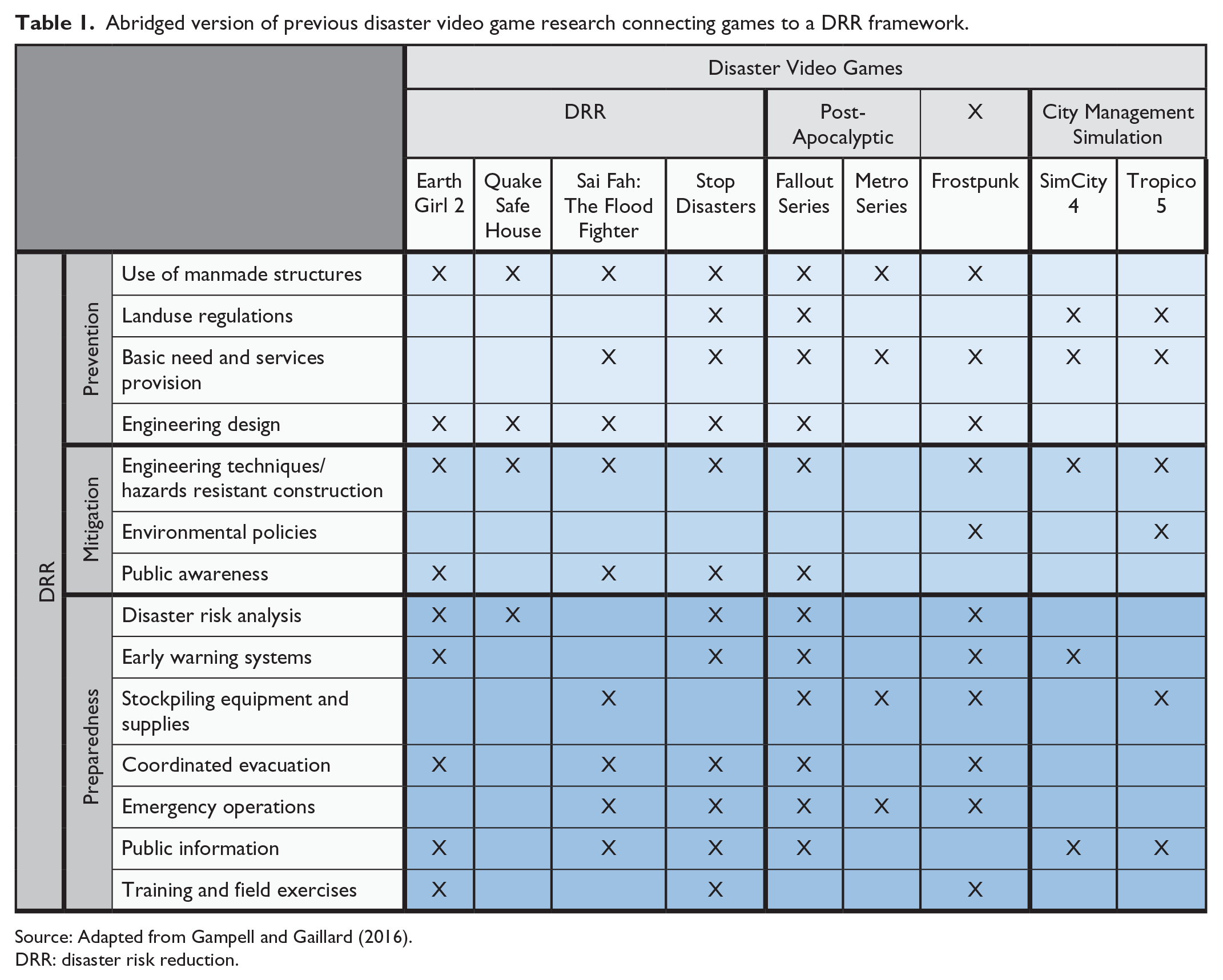
Source: Adapted from Gampell and Gaillard (2016).
DRR: disaster risk reduction.
BSD2.0 worked to incorporate participants from various educational institutions including New Zealand schools (intermediate to high school), secondary school social science teachers, a stage three geography university course and museums alongside perspectives from individual gamers. BSD2.0 selected several serious disaster-based video games from the disaster video game typology including EARTHGIRL 2, STOP DISASTERS, SAI FAH: THE FLOOD FIGHTER and QUAKE SAFE HOUSE, with mainstream titles like FALLOUT 4 in the case of individual gamers. The range of participants involved, alongside the utilisation of participatory tools, generated an opportunity to investigate the use of video games in various situations, locations and whether such video games could be used to foster participation in learning about disaster.
As video game scholarship previously emphasised, understanding the research material including clarity around the research question is a significant requirement to determine methodological approach. Therefore, to adequately address the main research aim of BSD2.0, Table 2 outlines the six research objectives and associated methodological approaches, which have informed the construction of a participatory methodological framework for video game research.
The six research objectives of BSD2.0 with associated methods.
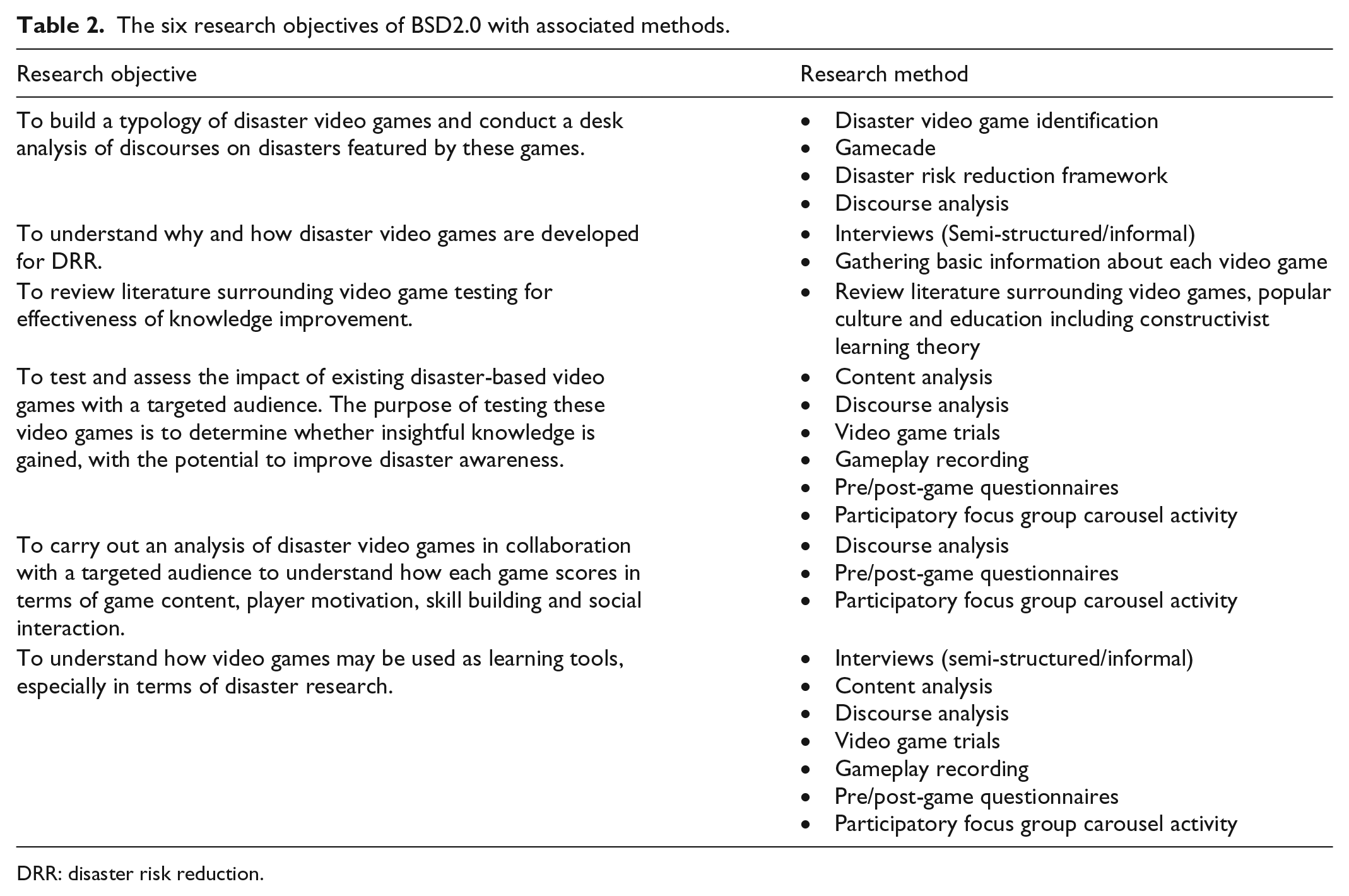
DRR: disaster risk reduction.
Participatory methodological framework for video game research
A significant omission from the existing video game literature is a critical examination of participatory methods to investigate learning. In contrast, participatory methodologies which are increasingly utilised in disaster research (Le De et al., 2015; Pelling, 2007) were naturally incorporated into the methodological framework for BSD2.0, supporting the sentiment by Lankoski and Björk (2015) that methodological approaches reflect the researchers’ disciplinary backgrounds. However, the variation in study locations and situations like schools or museums, mean not all participatory methodologies are suitable, requiring more conventional approaches. This section briefly details the processes behind each of the methodologies utilised within these locations, with reference to the researchers own research process to demonstrate how the tools can be used. Table 3 concludes this section by outlining a participatory methodological framework for conducting video game research alongside the identified strengths and challenges to these methods.
Participatory methodological framework for video game research, outlining approaches including purpose, strengths/challenges and research group.
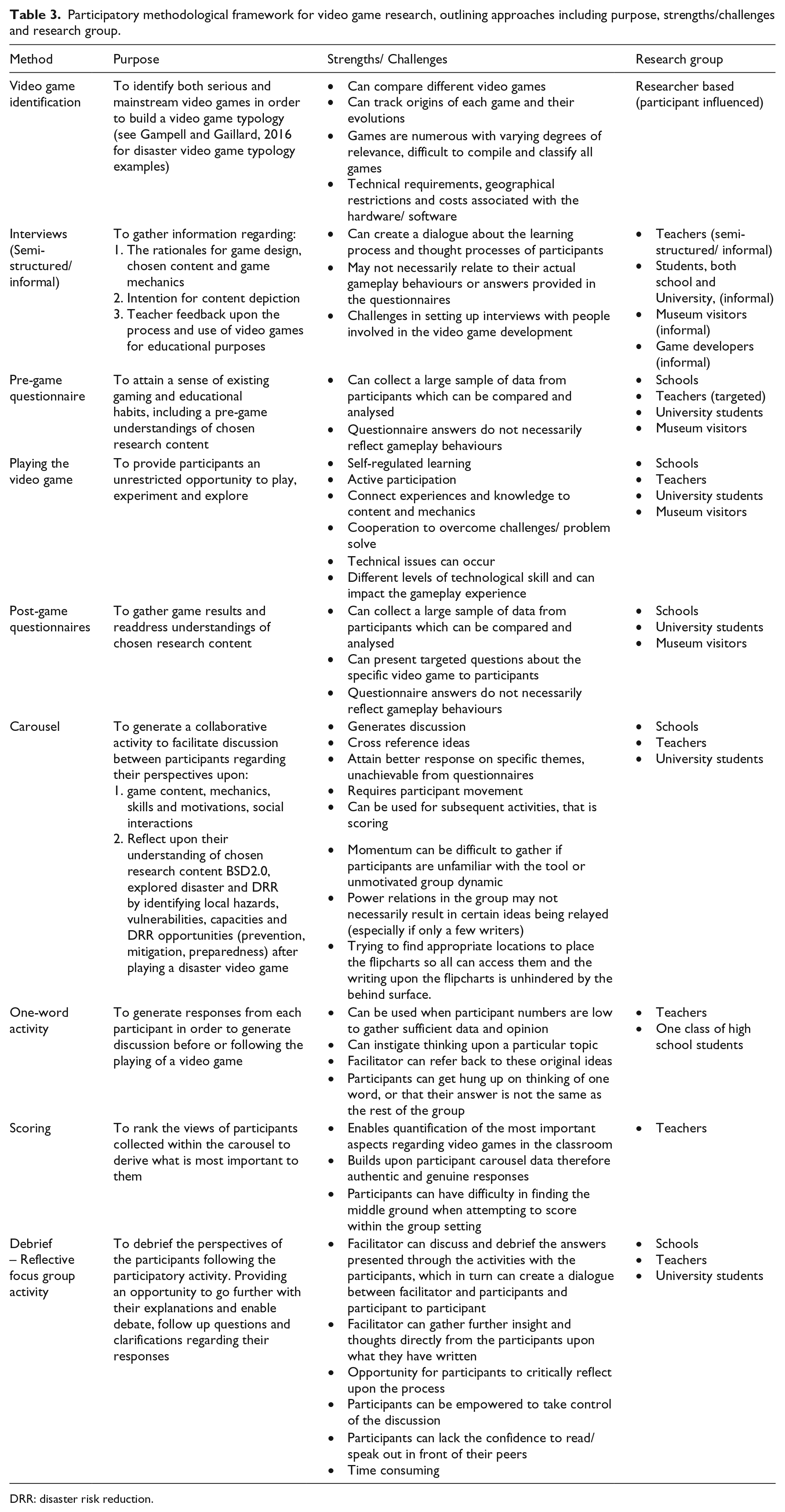
DRR: disaster risk reduction.
Pre/post-game questionnaires
Questionnaires are commonly used for both quantitative and qualitative video game research. BSD2.0 still included questionnaires in all video game trials to observe how the questionnaire answers collected, compared to those collected through participatory tools. Pre-game questionnaires were identical and used to gather individual perspectives and information relating to the participants existing gaming and educational habits, along with determining their understanding of disaster and DRR. Post-game questionnaires were specific to the video game played and gathered game results, alongside a second opportunity for participants to revisit and reflect on any new disaster knowledge. Social science teachers attending the New Zealand Social Sciences Conference (SocCon) 2017 were given one questionnaire of 12 questions that focused upon their past video game experiences, their perspectives on using video games in the classroom and identifying any pre-existing experience with disaster or DRR education. Teachers who supervised video game trials within the classroom were presented the same set of questions as semi-structured interviews. All questionnaires were designed by the researcher based upon assumptions made from existing literature or information provided by the video game developers.
Playing the game
Video game research (see Chow et al., 2011; Yang, 2012) often provides participants with set tasks to carry out or gives participants information regarding game controls among other material. Unlike the research of other scholars, participants involved in BSD2.0 were not provided with any information regarding how to play the game, a list of controls or specific researcher-based objectives to achieve. The overarching rationale was to create a moment in time where participants could play the video game as authentically and organically as the participants wanted. This meant that a participant could play through a tutorial, skip the tutorial and play the game, try to win a game level or alternatively they could just experiment and explore. Hence, game play was defined by the player rather than the researcher, reflective of constructivist principles.
Carousel activity – collecting participant generated information
In the case of school and university-based video game trials, the carousel method involved six self-formed groups of participants along with six flipcharts each titled with a specific topic (game content, mechanics, skills/motivations, social interactions, hazards and vulnerabilities) in the study area and capacities and DRR for the study area. The flipcharts were placed upon walls or on the floor, with each group allocated one of the six flipcharts. Participants were asked to provide written or picture feedback upon the titled flip chart. After 5 minutes, the groups rotated clockwise to a new flipchart providing an opportunity to discuss, add or alter to the previous group’s comments. Participants discussed their experiences, as well as the previous group’s flipchart contributions with their fellow group members before they themselves contributed to the flip chart.
This carousel exercise served two main purposes. First, to gather participants’ ideas, enjoyments, frustrations or improvements to each of the four video game components rather than focusing solely upon content. Second, to generate discussion and connections between the video game and the participant’s local area. Participants listed, as earlier defined, the potential hazards, individual, family or community vulnerabilities, capacities and any possible DRR methods for preventing a hazard, mitigating a hazard or preparing for a hazard, in their local area. The approach also allows a comparison between the individual questionnaire responses gathered surrounding knowledge of disaster and DRR and the group-based carousel activity, reflecting the importance of social interactions and knowledge sharing in constructivist learning (Chau et al., 2013; Meece and Daniels, 2008).
The SocCon 2017 teachers’ carousel process was identical to the previous carousel, with minor changes being that the carousel involved four self-formed groups of participants along with four flipcharts focused upon game content, mechanics, skills/motivations and social interactions. Unlike the previous carousel activity, the teachers were asked to reflect upon their needs and requirements for video games to become a part of the education and learning process, especially within a classroom environment. This approach emphasises the lack of bottom-up perspectives from those on the frontlines of education, like teachers and students in risk reduction education (Petal, 2007) and video game development. The carousel therefore teased out perspectives on what is required to better integrate video games into the teaching curriculum and to make video games successful learning tool. Such information can gathered directly from participants to directly inform future video game development.
One-word activity – identifying participant expectations
One-word activities are short and engaging activities, where participants are provided post-it notes and asked to write one word or sentence about a given topic. One-word activities were used when participant numbers were too low to conduct a carousel, resulting in responses from each of the participants involved and gathering a similar sized data set to that of other conducted carousels. SocCon 2017 teachers generated one-word perspectives and expectations of what a video game should be before playing a disaster-based video game.
Scoring activity – quantifying the carousel data
To continue building upon the teachers existing perspectives and knowledge, on completion of the SocCon 2017 carousel, the teachers involved carried out a scoring activity upon their completed flipcharts. Within their same four groups, participants were given sticky dots and asked as a group to review the answers provided and place dots next to the comments and perspectives which most highly resonated with them and their views for video games in the classroom. Participants were told two dots translated as most important, one dot was important, and no dots meant not as important. After 5 minutes, the groups moved clockwise until they had visited each of the flipcharts and placed their sticky dots onto the flipcharts. Following the activity, participants were involved in a debrief activity, reflecting upon their original ideas of the carousel and explore their rationale for scoring certain ideas over the others. The complete process allowed participant-based quantification of their own qualitative answers, rather than the researchers placing their own values upon qualitative data.
Debrief – reflective focus group activity
Reflecting Joplin’s (1981) final step of the five-stage experiential learning model, a debrief activity is necessary following each of the participatory activities, in this case carousel, carousel and scoring, one-word activity, to allow participants to reflect upon not only the overall process but also the information that they have provided. Debriefing not only allows the researcher/facilitator to gather insightful information or seek further clarifications regarding the participants’ ideas, but also provides participants with opportunities to discuss with one another and the researcher/facilitator regarding their experiences. The debrief activity is run by participants reading out aloud their opinions and comments from the flipcharts, post-it notes or tally the number of sticky dots with the facilitator or researcher guiding the participants in their discussions. The debrief design provides participants an opportunity to critically reflect on the process, often empowering participants to take control of the activity. Therefore, participants could critically reflect upon the information they provided and interact with or question each other, creating participant-regulated discussion and limiting facilitator directed conversation.
Methodological strengths of participatory tools for video game research
This section aims to detail the main strengths associated with each of the participatory tools used to conduct disaster video game research, as shown in Table 3. As suggested earlier, participatory tools align closely to the underlying foundations of constructivism, that learning is an active process and facilitated through social negotiation, with learners actively constructing, building and testing new ideas against their existing knowledge, while progressively testing their constructed knowledge through social negotiation (Adams, 2007; Chau et al., 2013; Splan et al., 2011). Therefore, the participatory tools and approach utilised in the research process generated an opportunity for participants to self-regulate their learning through active knowledge and skill building.
While most participants throughout the research process were comfortable with how to navigate through the game environments and use the technology, some participants including school and university students, teachers and museum visitors struggled. The frustrations around gameplay and usability often filtered into the corresponding game content and mechanics flipcharts or featured in questionnaire answers and informal discussions. However, nearby participants or bystanders often provided help to those who required it. These individuals offered suggestions towards how others could complete various in-game tasks, understandings of the game rules or even suggestions towards how to use in-game tools, acting as the more knowledgeable other. In some cases, those students who offered help were not necessarily those who, within the everyday classroom environment, would be referred to as experts. However, through this process these participants were empowered, providing their knowledge and experiences to help their classmates and were given a sense of achievement as their classmates turned to them for advice. Some participants, decided to work co-operatively upon one device to better utilise their knowledge and attain a high score, connecting to the second principle of constructivism. Thereby, the process not only facilitated an opportunity for social negotiation but also allowed participants to actively construct, build and test new ideas within the game environment.
Importantly, gameplay using the outlined approach contrasts common gameplay methods in video game research (Buelow et al., 2015; Pilegard and Mayer, 2016; Van Lankveld et al., 2017), where participants are provided with information or requirements, removing the authenticity of any potential self-regulated learning. Informed by the first principle of constructivism, that the learning should be authentic, active and student-centred (Splan et al., 2011), the approach allows participants to play without restrictions, fostering active player participation requiring players to self-navigate and make active decisions. While providing participants with information may minimise issues around usability, the gameplay approach outlined also provides greater opportunity to observe the second principle of constructivism, as detailed in the preceding paragraph.
Petal (2007) acknowledged that risk reduction education was generally conducted by scientific, academic and technical experts, emergency managers and NGOs, with minimal teacher, student and player engagement in this process. While the vast range of stakeholders may have good intentions at heart, ultimately these parties also have an agenda they want to achieve. An issue arises here as often this agenda does not correspond to that of the users, in this case the teachers and students/players. Therefore, the scoring activity enabled the participating social science teachers, to quantify what was most important to them to enable the use video games within the classroom. By building upon the answers generated in the carousel activity and ranking the most important concepts results in authentic and genuine responses from those who are on the frontlines of education, versus researchers placing values upon what they believe to be most important.
The main strength of the carousel was the ability to generate discussion around particular topics/concepts. Such discussions involved the participants cross-referencing ideas with each other within their group before adding the information to the flipchart. Subsequent groups could assess the previous information, either agree with the statements or disagree before presenting their personal insights, shown in Figure 1. The carousel also asked important questions regarding local hazards, vulnerabilities and capacities (Figures 2 and 3), reflecting a section of the pre- and post-game questionnaire. Often, through their discussion, participants would generate answers to these topics along with further thought and insights associated to their social and cultural beliefs, not seen within the questionnaire responses. As Klopfer et al. (2018) suggest applying knowledge learnt in one context is difficult to transfer to another context. However, the socially interactive dimension of the carousel suggests with peer feedback and support from people participating in the carousel, can draw out ideas which can enable a pathway for better transfer of knowledge and applications to other contexts. Additional benefits of the carousel include, movement to help keep participants engaged, and the ability to be continued upon with another activity, like scoring to generate quantifiable information.
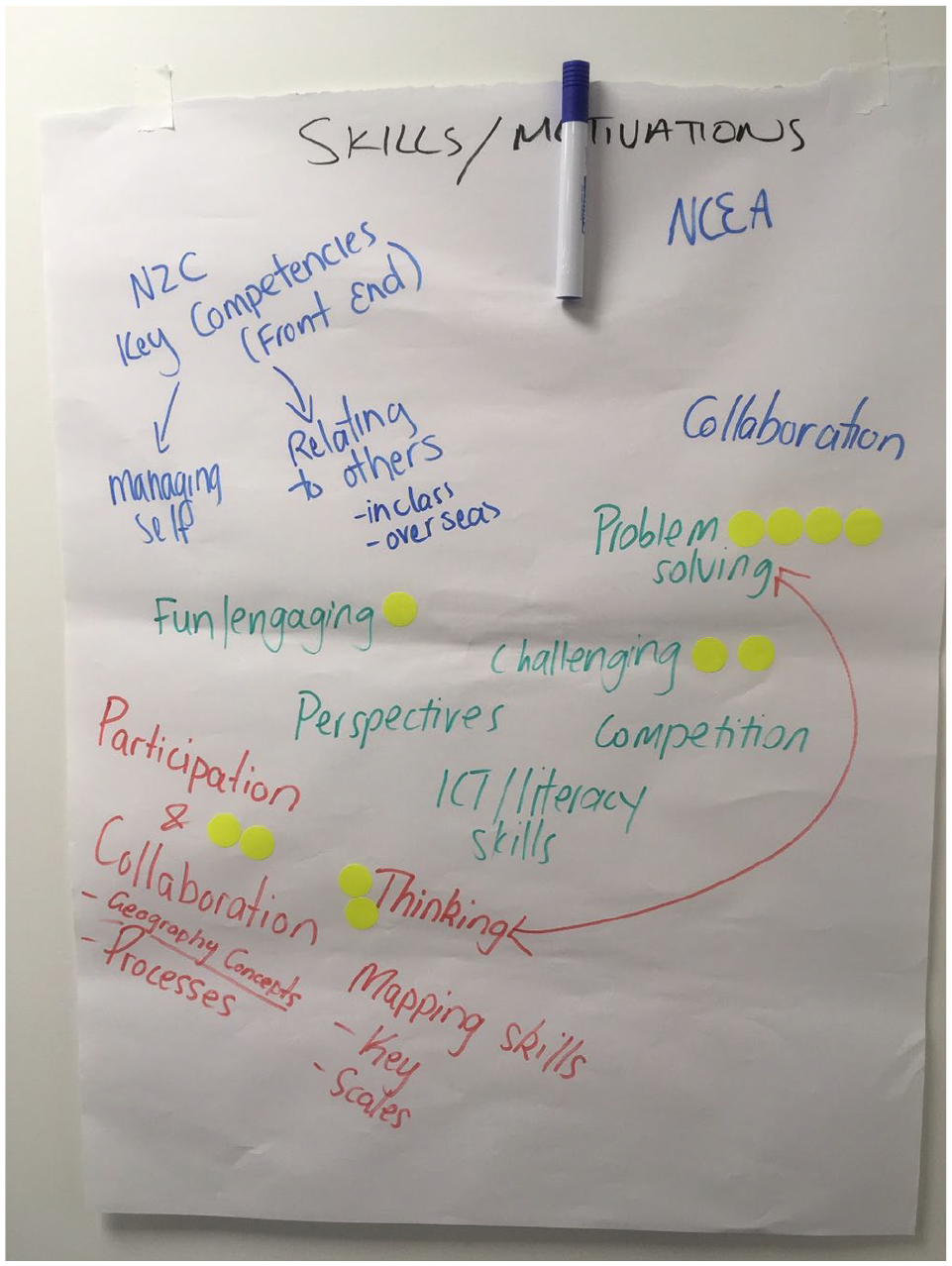
Skills and motivation flipchart identified by social science teachers.
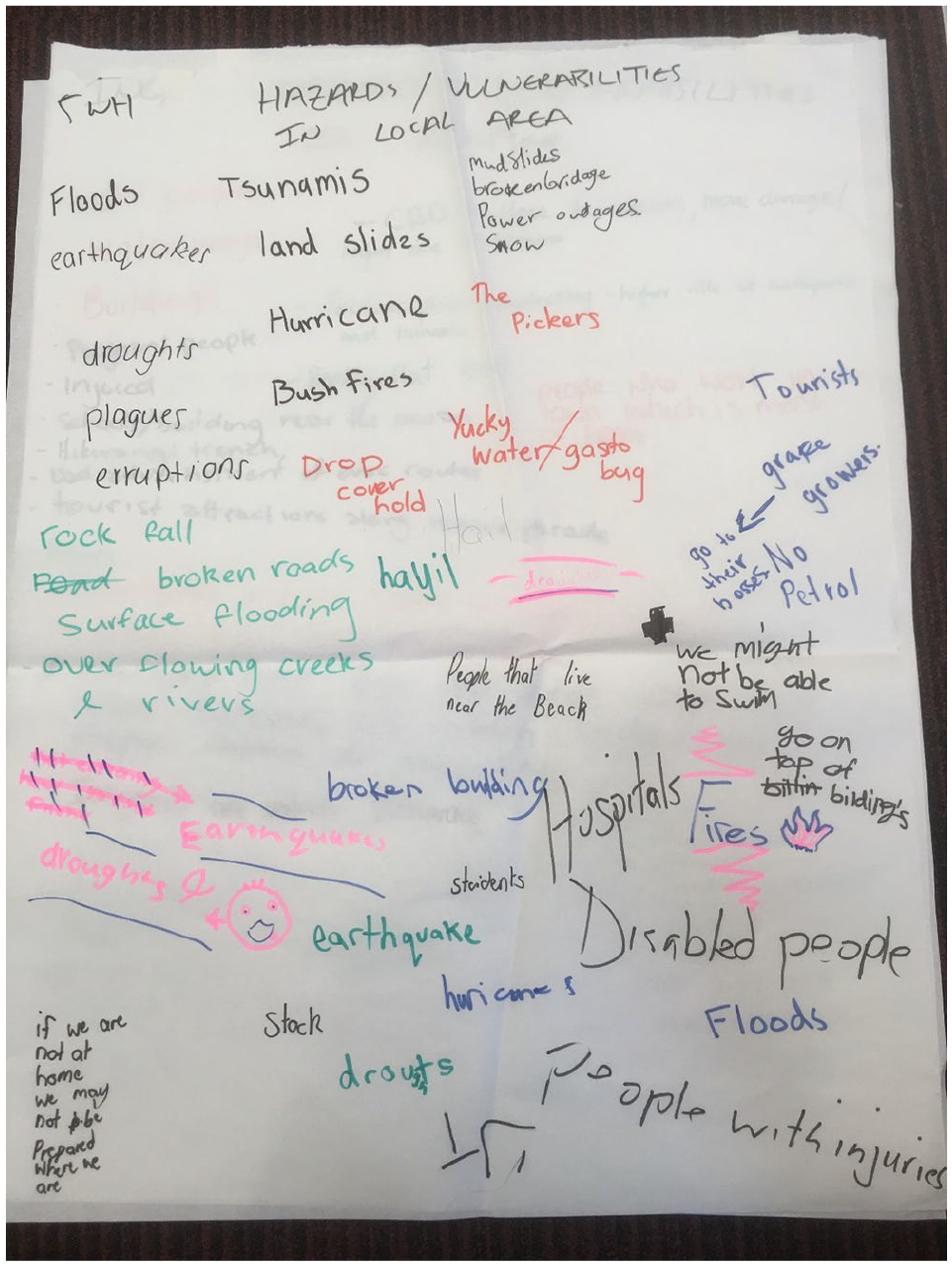
Hazard and vulnerabilities in local area identified by intermediate school students.
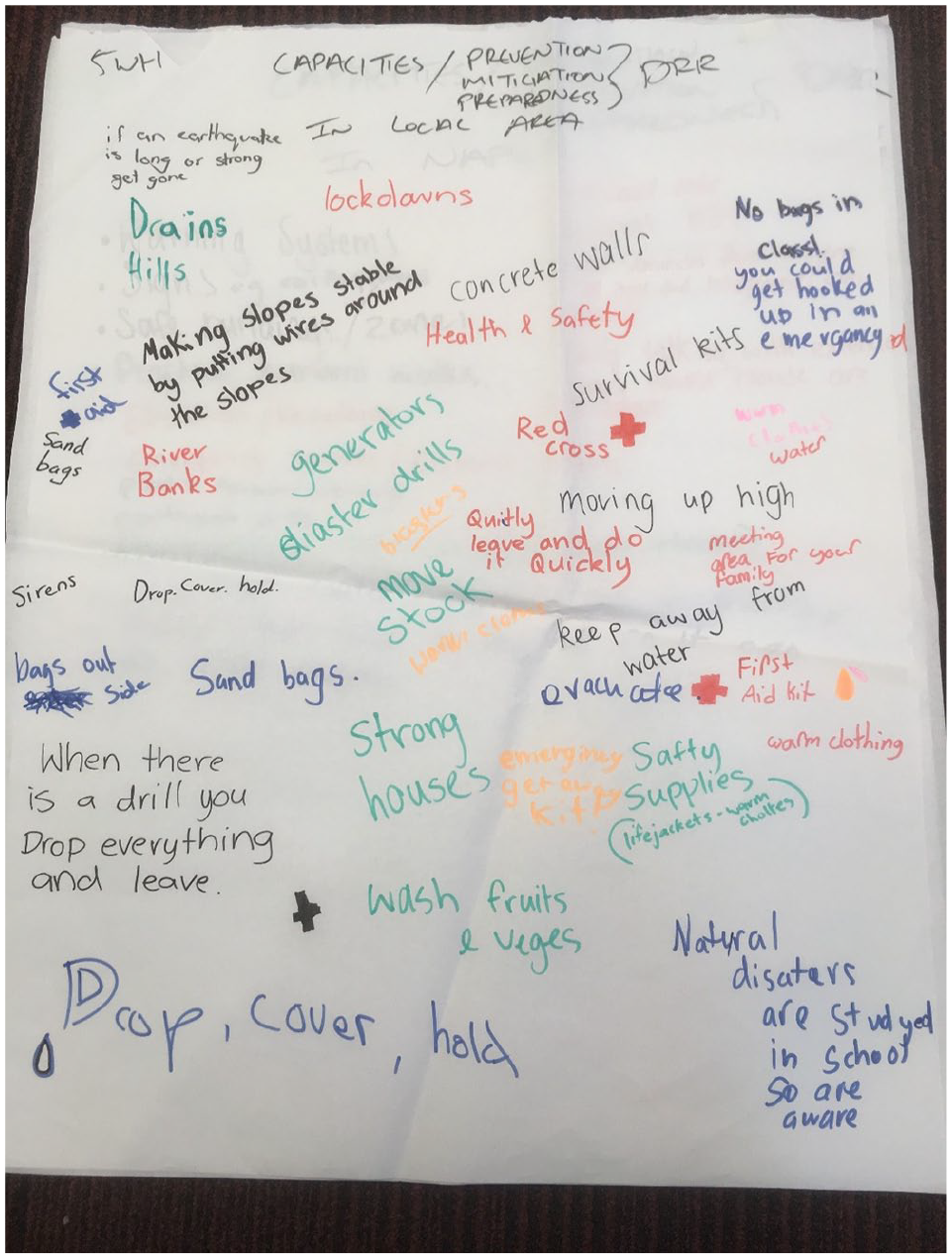
Capacities and DRR actions in the local area identified by intermediate school students.
The one-word activity had two purposes in the research process. Primarily, the activity was used in the case that participant numbers were too low to operate the usual carousel activity. In this case, every participant placed a post-it note with their contribution to each of the six flipcharts. In doing so, the flipcharts had numerous and varied responses from each participant, an outcome that may not have been otherwise possible. The responses given were also by nature those which resonated most strongly with the participants, reflecting Klopfer et al. (2018). The debrief activity gave participants a chance to discuss their responses and further reflect upon the answers given. Second, the activity helped initiate the discussion of expectations for video games in the classroom with social science teachers during SocCon 2017. The strength of the one-word activity in this capacity was to provide a short and punchy introduction utilising the teachers’ own expectations of video games in the classroom/for learning. By having these one-word responses, the workshop facilitator could refer back to the teachers’ original expectations throughout the duration of the workshop and demonstrate the possibilities of video games in a learning setting through the teachers’ own expectations. In addition, such one-word activities generated, in a simplified format, information of teacher expectations, which could be delivered to video game developers working within the space of video games for learning.
Methodological challenges of participatory tools for video game research
While participatory tools demonstrate genuine strengths for conducting video game research, Table 3 demonstrates methodological challenges still exist which require researcher reflection and consideration. This section considers some of the practical challenges and epistemological issues to conducting video game research with participatory tools, though further reflection upon the methodological limitations is warranted. However, to our knowledge a near complete participatory approach towards video game research has not been conducted. Therefore, focusing upon the practical challenges allows future researchers to reflect upon these challenges when integrating such participatory approaches, and with further utilisation of these tools, a better-informed discussion around the methodological limitations may be possible.
While participatory tools can work in parallel with the aims of constructivist learning, the process is not genuinely participatory due to the researcher’s requirement to gather information for the completion of their own research and thereby shaping the research direction (Madsen and O’Mullan, 2018; Weaver et al., 2009). Allowing research participants to design their own questions and focus, could better serve the principles of constructivism surrounding authentic and self-regulated learning. However, one needs to be mindful that the participants would need to learn how this process works, and through their learning, experiences and knowledge to create their own research questions and focus could lead participants in a biased direction (Allan, 2012; De Block and Buckingham, 2008).
Power issues can also become apparent during the participatory process. The facilitator needs to be aware of participant social/class positions and the possible impacts of such relationships, not just between researcher and participant but also participant to participant. Power through the participatory process can reflect hierarchical positions, whereby the more privileged may be in a better position to control access to the process and be deemed more knowledgeable (Allan, 2012) which may result in one individual influencing the overall discussion (Weaver et al., 2009). The facilitator may need to encourage the ‘passing of the stick’ and help empower those with less dominant personalities within the participatory process. The facilitator can make use of the debrief activity to support the ideas of those who may be marginalised within the process. For example, a teacher crossed out the ideas of an international student with limited written English on the flipchart. The debrief activity allowed the student to elaborate further, revealing their idea to be of both importance and relevance, especially surrounding gender perceptions. Hence, an important reminder of power positions when using participatory research methodologies and the position of human supports/ facilitators when engaging with participants.
Issues of confidentiality can arise as activities are of a group-based nature and can compromise confidentiality. Such challenges are not only limited to focus group discussions, carousels or interviews but are also valid concerns for questionnaire surveys. Such activities therefore require careful consideration by the researcher and/or facilitator on the appropriateness of conducting such activities (Petrova et al., 2016). Concerns may be related to interviewer/moderator relationships with participants, confidentiality issues, ethical considerations, participant selection and level of participant ability. Petrova et al. (2016) suggest that researchers have a responsibility to engage with appropriate research methodologies, to minimise any possible detrimental effects upon the research participants and strengthen the overall trust of the research process. The researcher may potentially determine a particular research method inappropriate and therefore could employ a different research method to better serve and protect sensitive or confidential participant information.
The majority of video game research utilises conventional research methods for the basis of providing statistically significant results. Often such conventional methods require participants to think through questions and provide either verbal or written answers. However, for participants with oral, visual or written communication difficulties, including people taking part in research in their non-native language, as well as people with physical and/or learning disabilities, such approaches limit their ability to contribute. Participatory tools can offer a solution to this challenge as such tools can require less dependency on participant literacy and language skills (Allan, 2012). While such an approach may demonstrate participant knowledge and experience in an alternative way, the challenge for studies taking a participatory approach is the fact statistically significant data sets may not be achievable. Mayoux and Chambers (2005) defend such participatory data sets by suggesting that larger sample sizes do not necessarily correlate to better information but could instead reflect bad data. However, as previously mentioned, participatory methods have an ability to also generate quantitative information, referred to as participatory numbers or participatory statistics. Participatory numbers can be generated for numerous purposes through various participatory activities (Chambers, 2007). Chambers (2003) notes the process of generating participatory numbers can allow participants to define their own indicators, analysing and monitoring these indicators themselves, thereby generating numbers that most likely reflect their realities. The visual element of such activities can transcend language, cultural and literacy barriers (Chambers, 2010). Therefore, while participatory methodologies may struggle to gather statistically significant data, they can have strengths, as outlined in the preceding section, with regard to providing more accurately detailed information and help to empower participants, among other strengths.
Conclusion
Despite the growing prevalence of disaster-themed video games, little research explores this genre of video games and even less that examines the effectiveness for such games to build disaster and DRR awareness. This article highlights that in order for video game research that assesses the contribution of video games for building awareness, it is critical that an appropriate methodology (which fits within the parameters of video games and context of the research outcomes) is selected. In this context, video games are deemed an activity requiring active participation and play which correlates to the defining principles of constructivism learning theory, namely that learning is authentic, active and student-centred, while simultaneously facilitated by social negotiation. Understanding the broader contextual information, strengthens the appropriateness for utilising participatory tools to collect research data, when the research outcomes are for assessment of learning outcomes in participants.
This article provides an overview of some of the participatory tools currently used to assess to what extent disaster video games foster learning about DRR. In addition, the associated strengths and challenges with using these participatory tools for disaster video game research are also outlined. While participatory tools can provide an opportunity for participants to self-regulate their learning experience and provide more authentic responses towards the pre-defined research questions, statistically significant data for scientific validity is not necessarily collected, though participatory numbers may be an option to overcome this challenge. It is critical that researchers consider potential power dynamics within the research process and consider the appropriateness of both conventional and participatory methods. Participatory methods provide pathways that enable direct communication with frontline individuals, for example addressing the needs and concerns of teachers regarding video games in the classroom, or empowering marginalised individuals in the case of school students. Participatory approaches are not always suitable, and therefore reinforce researcher responsibility to determine the most appropriate methodological frameworks, dependent upon context and reflection of appropriateness of more conventional approaches. The need to bridge different methodological approaches, which are contextually appropriate, can provide a more robust, authentic, and complete analysis, not only for disaster video games but also for questions about the learning outcomes of video games at large. Therefore, the participatory approaches explored in this article present a novel approach for conducting video game research and a methodological framework that could present a more meaningful research option for investigating video games as learning tools.
Footnotes
Acknowledgements
This research was approved by our institution’s research ethics committee.
Declaration of conflicting interests
The author(s) declared no potential conflicts of interest with respect to the research, authorship, and/or publication of this article.
Funding
The author(s) disclosed receipt of the following financial support for the research, authorship, and/or publication of this article: This research was supported by the Earthquake Commission, New Zealand (Grant Number to be added).
Author biographies
 .
.