



Abstract
The foremost challenge in mixed methods research is not simply to align data or findings from different analytical procedures but to find an approach that makes it possible to integrate them in an informed way. The article engages more than 40 years of collective conversations with colleagues and students to describe and illustrate a mixed methods way of thinking and the dialectical logic associated with it as one approach to mixed methods research. The article synthesizes more than 20 years of methodological literature to pinpoint five ways that a mixed methods way of thinking has been conceptualized in the literature. This includes as a mindset or stance, an analytic logic that promotes complex thinking, a theoretical framework, a philosophical paradigm that influences collaboration, and a multi-level approach to integrating data and/or findings to produce original insight. Implications for practice are juxtaposed with each of the conceptualizations to consider how a mixed methods way of thinking embodies an inquiry logic that engages complexity, provides an organizing framework to inform design choices, informs establishing a purpose that is committed to understanding diverse perspectives and experiences, contributes a philosophical grounding for productive collaboration, and, finally, provides a logic and rationale for integrating data from diverse sources. The article closes with an example to illustrate that when the different facets of its expression are considered together, a mixed methods way of thinking can provide an organizing framework to guide in the planning, conducting, and reporting of a mixed methods research study.
The expression a mixed methods way of thinking and its attribution to Greene (2007) is a familiar one to members of the mixed methods research community but is less understood outside of that community as the conceptual grounding for one approach to mixed methods research. Introduced in 2001 by Greene, Benjamin, and Goodyear, the expression is linked to engaging complexity and honoring diverse perspectives. A mixed methods way of thinking openly invites diverse ways of thinking, knowing, and valuing to promote more nuanced understanding of complex social phenomenon (Greene and Caracelli, 2003). It includes multiple and diverse methods for gathering and representing phenomenon (Greene, 2005). Explorations of the expression in the literature have yet to fully consider its implications for research practice.
In what now amounts to more than 20 years of discussion, a mixed methods way of thinking has been positioned primarily as a philosophical orientation or stance (e.g. Greene, 2005, 2006, 2007, 2008; Greene and Hall, 2010; Hall, 2024; Johnson, 2008, 2017). Greene (2007) considers a mixed methods way of thinking to be one element of a mental model or stance that a researcher might bring to a project. The practical implications of a mixed methods way of thinking to the choices a researcher makes in planning a mixed methods research project, such as how it informs the purpose of the study, the selection of methods, and how to approach analysis and integration, have not been widely addressed.
The literature about mixed methods research has been dominated by the pragmatic approach (Adu et al., 2022). Framing procedures within the context of a theory and philosophy is one of the four core characteristics identified by Creswell and Plano Clark (2018) in their pragmatically grounded definition of mixed methods research. The three other elements of their definition of mixed methods research include that it collects and analyzes qualitative and quantitative data rigorously, integrates the two forms of data or their results, and thirdly uses a specific design as the logic to organize procedures. A philosophy or theory can “help practitioners make the mixing of methods more intentional, multi-level, and thoughtful and thus yield more compelling results,”Greene and Hall (2010) observe (p. 121). Whether it emerges from a theoretical, conceptual, or philosophical model, an organizing framework is linked to quality when it provides connections and cohesion between the constituent parts (Greene, 2006, 2008).
Purpose
The purpose of this article is to leverage our collective insights to provide an extended discussion of the literature surrounding that expression a mixed methods way of thinking and to elaborate its diverse implications for research practice. The article adds to the literature about a mixed methods way of thinking by juxtaposing five different ways of conceptualizing a mixed methods way of thinking with implications of its expression to the practice of mixed methods research. It synthesizes more than 30 years of methodological literature produced by those who share its philosophical orientation, including where it has been framed as an attitude of mind or stance, an analytic logic that promotes complex thinking, a theoretical framework, a philosophical paradigm, and an approach to mixing.
The methodologically oriented discussion is intended to extend the audience of an approach to mixed methods that reflects a mixed methods way to thinking to readers outside of the community of mixed method methodologists who are its avid champions to academic fields and disciplines, such as psychology, where mixed methods research is still a novelty. The essay is also addressed to those new to mixed methods research who seek to ground their research practice in a theoretical framework as well as those searching for a framework to that is useful to manage complexity in the phenomenon they are studying. The summary of different ways that the expression can be conceptualized and how these extend to practice provides an instructional tool to help students grapple with ways to develop a theoretically grounded proposal for a mixed methods research project.
Figure 1 summarizes five inter-related ways that a mixed methods way of thinking has been conceptualized in the methodological literature: (1) as a stance or attitude of inquiry; (2) as a theoretical framework that informs choices about research design; (3) as a purpose that reflects an interest in the multiplicity of social phenomenon, (4) as a philosophical orientation or paradigm that influences the collaborative process, and (5) as a rationale for mixing. A different implication for practice is aligned with each of the conceptualizations in the right column of Figure 1. The figure is designed to provide an overview of literature, rather than to itemize steps in the process of designing a research study.
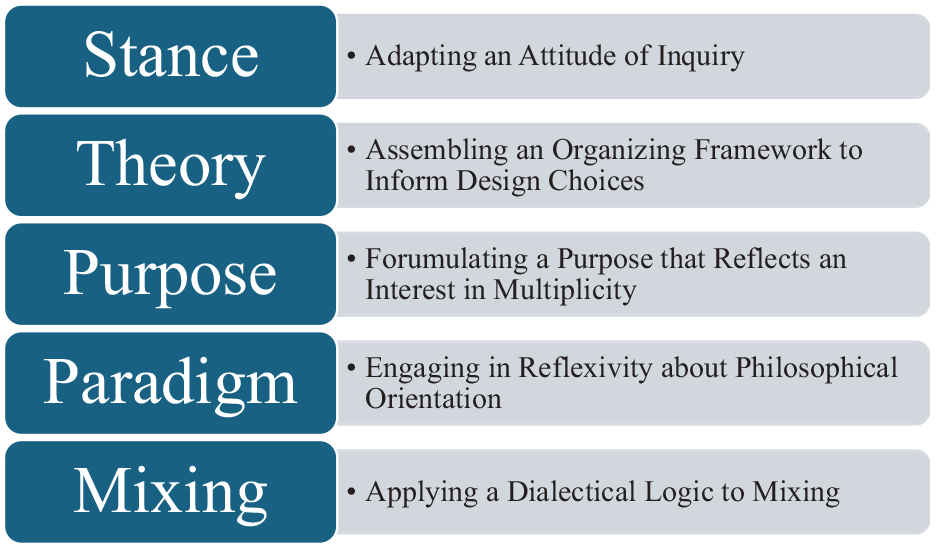
Linking five conceptualizations of a mixed methods way of thinking to research practice.
Figure 1 reflects the structure of the main body of the article, which is divided into five sections, each formatted in the same way. Each section introduces a way a mixed methods way of thinking can be conceptualized by, first, summarizing related literature and, secondly, by exploring some implication to best practices in mixed methods research related to it. The five conceptualizations are pulled together in the final section to present an example that illustrates how a mixed methods way of thinking can provide an organizing framework to plan a mixed methods research project informed by this approach.
Framing of a mixed methods way of thinking in the literature
Conceived initially in terms of evaluation of social programs and interventions, an overtly value-infused context where there are multiple stake holders, a mixed methods way of thinking is an orientation to social inquiry that is linked to a dialectical stance (Hall, 2024). The dialectical stance departs from post-positivism in its conviction about the importance of awarding comparable weight to both convergent and divergent findings during analysis (Greene, 2007). At its core is the conviction that there is the potential for original insight that disrupts conventional understanding when divergent findings are systematically explored (Creamer and Edwards, 2019). The usefulness of this approach to mixed methods extends from evaluation research to research designed to compare the views of different constituent groups to research that explores the differential impacts of an educational or medical activity or program. It also extends to research designed to investigate health and educational inequities by using more advanced designs that pair mixed methods research with other methodologies like community participatory action research, case study, or grounded theory.
Key tenets that distinguish a mixed methods way of thinking and the dialectical stance that is associated with it as a distinct approach to mixed methods, as identified by Greene (2005, 2006, 2007, 2008), Greene and Caracelli (2003), Greene and Hall (2010), and Hall (2024), include:
The priority placed on multi-level mixing of data or findings from different methods.
The conviction that social phenomena are complex, multi-faceted, and multi-layered.
Prioritization of a value-infused research committed to democratic values and designed to embrace diversity and promote social good.
The conviction that philosophical assumptions influence design choices.
An engagement with difference is related to research quality in at least two ways. Greene and colleagues describe the potential for an engagement with difference to be both constitutive and generative (e.g. Greene, 2005; Greene and Caracelli, 2003; Greene et al., 2001). Generative refers to producing an outcome that is greater than the sum of its parts. Something is constitutive when it has the power to establish or give an organizational existence to something. Although not the only way it is approached, a mixed methods way of thinking can be thought to be constitutive when it is used as an organizing framework to guide choices that are made about how to design a mixed methods research study.
Linking ways of conceptualizing a mixed methods way of thinking to practice
A mixed methods way of thinking has often been framed in an abstract way in the literature as an orientation, stance, lens, or as a set of philosophical assumptions associated with the paradigm adopted by an individual researcher. The next section switches to a more applied or practical approach by linking each of five ways of conceptualizing a mixed methods way of thinking to some of the practical implications associated with it. The five different conceptualizations and the implications associated with it are: (1) as a lens or stance that establishes an attitude of inquiry that orients the research; (2) as a theory that provides an organizing framework to inform design choices, (3) as a purpose that prioritizes an interest in the multiplicity of social phenomena, (4) as a philosophical paradigm that prioritizes as set of ontological, epistemological, and axiological assumptions, and (5) as a logic and rationale for mixing. The different facets of the expression are inter-related in that they expose different facets of the same complex expression. The organization of the section embodies a mixed methods way of thinking during reporting in that it awards comparable weight to diverse ways of understanding the expression.
Adapting an attitude of inquiry
Writing at about the same time with the cadre of scholars first influential to shaping the literature about mixed methods as a distinct methodological approach, UK scholar, Nigel Fielding, shares Greene’s (2007) view of mixed methods research as an orientation or stance. He positions mixed methods research not as a procedure or technique but as an “attitude of inquiry” (Fielding, 2008: 50) that is linked to quality in its ability to aggregate a set of inferences into a comprehensive explanatory framework. Fielding (2008) joins Johnson (2008, 2017) in defining a dialectical approach to analysis as one that awards comparable attention to findings from qualitative and quantitative procedures.
Fielding (2008) extends the argument for the contribution of mixed methods to research quality by emphasizing its implications to analysis. An approach to analysis is dialectical when it invites the juxtaposition of opposed or contradictory ideas and, subsequently, engages with the uncertainty they introduce with further analysis (Greene and Caracelli, 2003). Fielding (2008) considers mixed methods research as an approach to analysis that requires a critical stance, frequently entails revisiting initial assumptions, and generates “more sophisticated analysis that results from deeper engagement with the phenomenon” (p. 39). This approach to analysis can extend to envisioning tables or figures that align qualitative and quantitative data and/or findings to generate a more comprehensive explanatory framework or model (Creamer, 2024; Moseholm and Fetters, 2017).
Assembling an organizing framework to inform design choices
One implication of a mixed methods way of thinking is in its application to planning a mixed methods research study or project. Greene et al. (2001) observed that a “major premise of our mixed method way of thinking is that good mixed method practice is achieved by thoughtful mixed method planning” (p. 29). The first step in launching a project with this perspective is to assemble an organizing framework. Linking this to reflexivity about paradigm, Greene et al. (2001) observe that an important initial step in a mixed methods way thinking “is to figure out one’s stance on the ‘paradigm issue’ and to adopt an organizing framework that is consistent with it” (p. 3). An organizing framework can be shaped by one or more substantive theories, emerge from the assumptions of an established methodology, or be developed in a way that combines the two. One advantage of an organizing framework, Greene (2006, 2008) maintains, is in its capacity to generate a logic that provides connection and coherence among the design elements of a research project.
Some authors have characterized a mixed methods way of thinking as a theory of inquiry (e.g. Greene, 2005; Hall, 2024). Hesse-Biber (2018) advances the idea that an established methodology can serve a role that is comparable to a substantive theory in generating a logic to guide choices that a researcher makes about research design. Hesse-Biber encourages theorizing about mixed methods, arguing that “There remains in the mixed methods field an undertheorizing of just what a role a methodology plays across the research process” (Hesse-Biber, 2018: 446). In her reporting of diverse examples that pair mixed methods research with feminist theory, Hesse-Biber maintains that a well-articulated methodology is a theoretical framework. A methodology can be described as theoretical when it provides a coherent framework that informs many facets of a mixed methods research study from the framing of a purpose to choices that are made about elements of its research design (Hesse-Biber, 2018). Hesse-Biber’s (2018) and Greene’s (2007) views align in prioritizing a theoretical model or inquiry logic as one of the first decisions to be made in the framing of a mixed methods research project.
Walsh (2015) uses a different type of language to describe this type of inquiry logic. She refers to it as a context specific methodology. Walsh expresses the view that each research project is like an ecosystem that develops its own idiosyncratic, situation-specific methodology over its lifespan. Explaining her view of a research project as creating its own ecosystem, Walsh (2015) observes: “a methodology is the specific combination of research methods and techniques used in a research project; each research project might be considered as having a specific methodology” (p. 4). Collin’s (2018) views about dimensions of quality in a mixed methods study link to Walsh’s (2015) in the suggestion that the dimensions are tailored to the context. Positioning it as an important element of planning a research project, Collins (2018) writes that embedding validity in research design “requires researchers to consider thoughtfully the particular criteria that are relevant and important for each study” (p. 259).
Collins et al. (2012) highlight the importance of philosophical clarity when developing an organizing framework for a mixed methods research project. They define philosophical clarity "as the degree that the researcher is aware of and articulates her/his philosophical proclivities in terms of philosophical assumptions and stances in relation to all components, claims, actions, and uses in a mixed research study” (Collins et al., 2012: 855). Subsequently, clarity of a researcher’s philosophical assumptions and stances relative to the study’s components facilitates transparency surrounding design decisions. In a dialectical approach to mixed methods this extends to intentionality about how thoroughly the qualitative and quantitative components will be integrated in its design. Transparency about philosophical orientation adds to the coherence of the study’s organizing framework, another characteristic of a mixed methods way of thinking, and elevates the degree that the researcher’s conclusions are viewed as credible by the stakeholders impacted by the research.
Formulating an aim and purpose to reflect an interest in multiplicity
One of the most direct applications of a mixed methods way of thinking is to embed an interest in the multiplicity of the phenomena and the methods in the purpose of a research study. Multiplicity can be achieved by framing a study in more than one substantive theoretical framework or by setting out with the intention to investigate similarities and differences between stakeholders or constituent groups. In research designed to test the efficacy of an intervention, an interest in multiplicity can be embedded in the aims of research by including both anticipated and unanticipated outcomes in the analysis, by establishing an intent to investigate variables that moderate or mediate outcomes, or by deliberately planning to explore diverse pathways for how or why an outcome of an intervention was achieved (Johnson and Schoonenboom, 2016). As this list suggests, the intent to pursue multiplicity can take different forms in laying out the purposes of a mixed methods research study.
In an article that has become a hallmark in the mixed methods literature, Greene et al. (1989) single out engaging difference as one five major reasons for mixing data, methods, and/or analytical procedures. Referring to it as the initiation rationale because of its potential to introduce new insight, Greene et al. (1989) describe research with this intent as initiatives that “seek the discovery of paradox and contradiction, new perspectives and frameworks, the recasting of questions or results from one method with questions or results from another method” (p. 259). They extend the application of this rationale to research seeking to make meaning of gaps and silences in findings as well.
The intent to embed an interest in multiplicity in the aims of a research project extend beyond research shaped by a purpose to investigate counterintuitive or nonsignificant findings emerging unexpectedly from an initial phase of analysis. An interest in multiplicity can extend to mixed methods research designed to generate, test, elaborate, and/or contest a substantive conceptual framework (Creamer, 2021; Johnson and Schoonenboom, 2016).
Examples of studies from different academic fields that reflect the priorities of a mixed methods way of thinking in establishing a purpose designed to generate an explanatory framework include:
A health equity study from the field of nursing designed to generate a theory to encapsulate the views about the needs for health care services reported by different immigrant groups in Canada conducted by Westhues et al. (2008).
A multi-level study from school psychology conducted by Ceánat et al. (2018) explored options to provide social support for children living on the streets of Haiti following a major earthquake. The authors found that despite its many perils, that the children assessed their chances of survival were better on the streets than returning to live with family members or relatives where violence was prevalent.
A multi-level study by authors from fields in psychology by Bussing et al. (2012) explored differences among adolescents, parents, teachers, and health professional about different treatment options for attention deficit disorder.
Additional examples of mixed methods studies that reflect a dialectical perspective by establishing a purpose to test the applicability of one or more theoretical perspectives from the literature to a new setting or population, include:
From disciplines in business, Angeles et al. (2019) elaborated a theoretical framework from the literature by plotting how key determinants of viability changed over life span of small businesses.
From fields in education, Gasson and Waters (2013) compared patterns of involvement in the discussion board associated with an on-line class to challenge long-held assumptions that learning requires active engagement. The data they had access to made it possible to demonstrate that learners who were not active contributors to on-line discussions were, nevertheless, reading and learning from posts made by others to the discussion board.
In a study from social work that explored cultural assumptions surrounding caregiving for the elderly, Evans et al. (2009) challenge the Western, individualistic assumption that responsibility for caregiving is generally shouldered by single person. They documented that in the Mexican American immigrant community they studied, responsibilities for caregiving were shared across an extended circle of family members and friends.
The aims of each of the examples listed above reflect a dialectical logic and an interest in multiplicity. This declares a purpose for mixing methods that extends beyond the intent to establish validity by seeking corroboration and convergence that is so common to post-positivism (Greene, 2007).
Engaging in reflexivity about philosophical orientation
R. Burke Johnson is among those who squarely position a mixed methods way of thinking and a dialectical stance as a statement that reflects a philosophical paradigm that is referred to as dialectical pluralism (Johnson, 2017). Paradigms have been conceptualized in a variety of ways, but they are generally conceived as a shared set of beliefs held by a community about the nature of knowledge and how it is constructed (McChesney and Aldridge, 2019). Along with pragmatism, transformative-emancipatory, and critical realism, Shannon-Baker (2016) singles out dialectics as one of the four philosophical orientations most evident in mixed methods research.
Johnson (2017) demonstrates how the core tenets of dialectical pluralism align with the four domains of a paradigm identified by Guba and Lincoln (1994). Johnson (2017) distinguishes the assumptions of dialectical pluralism as (1) ontological in its framing in pluralism and a view of reality as inevitably dynamic and multiple, (2) epistemological in its commitment to a view that knowledge is constructed through “the continual process of interpretation and building on past interpretations” (p. 157), (3) methodological in prioritizing multiple methods, and (4) axiological in the reflection of a value system that prioritizes social justice in its research aims.
Johnson (2017) positions dialectical pluralism as a meta-paradigm that can on occasion involve mixing different philosophical paradigms within a single study or program of research. This can include mixing attributes of different paradigms (Greene and Hall, 2010). Greene and Caracelli (2003) maintain that the dialectical stance is compatible with diverse paradigms, including critical realism and pragmatism. Examples of mixed methods research that is explicit about engaging more than one philosophical paradigm include those that combine the transformative paradigm with critical race theory (e.g. White et al., 2019) or feminist theory (e.g. Hesse-Biber, 2010). Alexander et al. (2016) linked a dialectical approach to elements of three different philosophical paradigms (post positivism, pragmatism, and participatory/emancipatory) in the approach they developed to discourse analysis.
One of the most direct implications to research practice of the dialectical stance is to the dynamics between collaborators or among members of an interdisciplinary team (Cronenberg, 2020, Johnson and Stefurak, 2013). Paradigm influences how collaborators navigate differences in perspectives and the priority they place on the need to reconcile them (Creamer, 2004, 2018b). In a rare example where the application of a mixed methods way of thinking as a theoretical foundation for mixed methods research is explicitly acknowledged, Cronenberg and Headley (2019) include passages of text that document what a dialectical exchange among collaborators can look like. Polyvocal texts resist the expectation for a single authorial voice (Creamer, 2011). Cronenberg and Headley (2019) accomplish polyvocality by reporting passages of their dialectical exchanges that reflect, not two, but three voices: the voice of each of the collaborators and a third voice that reflects the shared understanding generated over the course of their conversations. Their text differs from other pluralistic texts that reflect a constructivist paradigm in that the different viewpoints of collaborators are reported without an intent to generate new insight by excavating the implications of commonalities or differences (e.g. Chamberlain et al., 2011). Creating a culture on a team that invests time in substantive dialog that engages diverse explanations about findings is an important way to reflect a commitment to a dialectical framework (Creamer, 2004; Johnson, 2017; Poth, 2019).
Applying a dialectical logic to integrating data or findings
The intention to meaningfully mix or integrate data and/or findings from different sources distinguishes mixed methods research from other research that executes both quantitative and qualitative methods in a parallel or sequential manner without mixing (Moseholm and Fetters, 2017). In their discussion of different approaches to mixing during analysis, Moseholm and Fetters (2017) point to how it can alternate between an exploratory and a confirmatory analytical logic either sequentially or interactively. They underscore the importance of being transparent during reporting about the intent or the over-riding analytical logic for mixing. “Being clear on the intent entails clarity of the merging analytical framework used in integration,”Moseholm and Fetters (2017) advise (p. 9).
Greene and Hall (2010) resist the idea of mixed methods research that applies a single analytic logic during analysis or that envisions mixing as occurring through a single procedure. They champion the idea of mixing at multiple levels, suggesting that it is “integral to the character of a mixed methods approach to social inquiry” (Greene and Hall, 2010: 607). Their idea of multi-level mixing extends from mixing philosophical assumptions of different paradigms or by pairing mixed methods with another methodology. Context, purpose, and paradigm are among the factors that influence how thoroughly mixing or integration is embedded in the design of a mixed methods study (Greene and Hall, 2010).
Above and beyond its contribution to establishing the purpose of a research study and the questions that guide it, there are several ways that a dialectical logic can be embedded during the process of designing a mixed methods research study. For example, during data collection, the dialectical logic could involve combining open- and close-ended questions about the same construct in a questionnaire or an interview protocol. During sampling, a dialectical logic could be applied that combines both qualitative and quantitative indicators to identify both commonality and differences between individuals or groups. Assembling qualitative and quantitative data about the same construct or theme in a joint display for the purpose of identifying similarities and differences is an example of how a dialectical logic could be applied to mixing during analysis (Fetters and Guetterman, 2021). Mixing is theoretical when choices that are made about how to accomplish it are linked to a conceptual or methodological framework.
Positioning the cornerstones of dialectical research design
When it is conceived expansively, different perspectives about what is meant by a mixed methods way of thinking can generate a framework that informs the planning of many practical aspects of a mixed methods research study. This aligns with Maxwell and Loomis’ (2003) definition of research design as a set of inter-connected parts that coalesce to create a type of logic system. Maxwell and Loomis (2003) position purpose, research questions, a conceptual framework, methods, and quality criteria as the core components of research design. When it is understood in a multi-dimensional way, a mixed method way of thinking can provide a system of logic to make choices related to research design, including about how to collect and analyze data strategically.
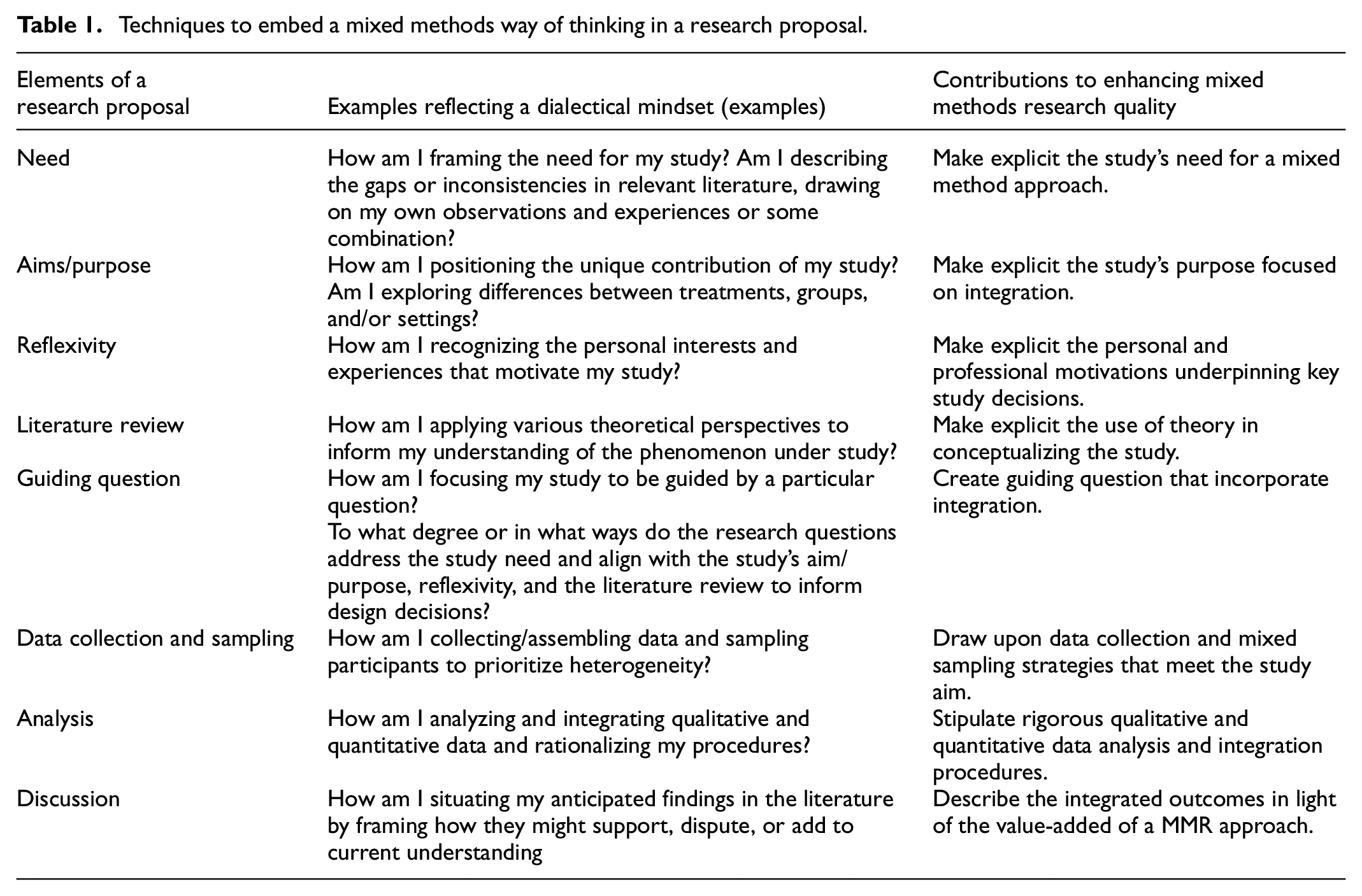
Tables 1 and 2 each embody how a mixed methods way of thinking can be manifested in practice. The first of the two inter-related tables, Table 1, itemizes some generic ways that a mixed methods way of thinking can be embedded in a research proposal. Table 2 models the way the logic of a mixed methods way of thinking could be reflected in the context of an example. Each of the tables could be adapted to a context where the research is being conducted by a team.
Techniques to embed a mixed methods way of thinking in a research proposal.
An example of the application of a mixed methods way of thinking to a mixed method research study about homeless children.
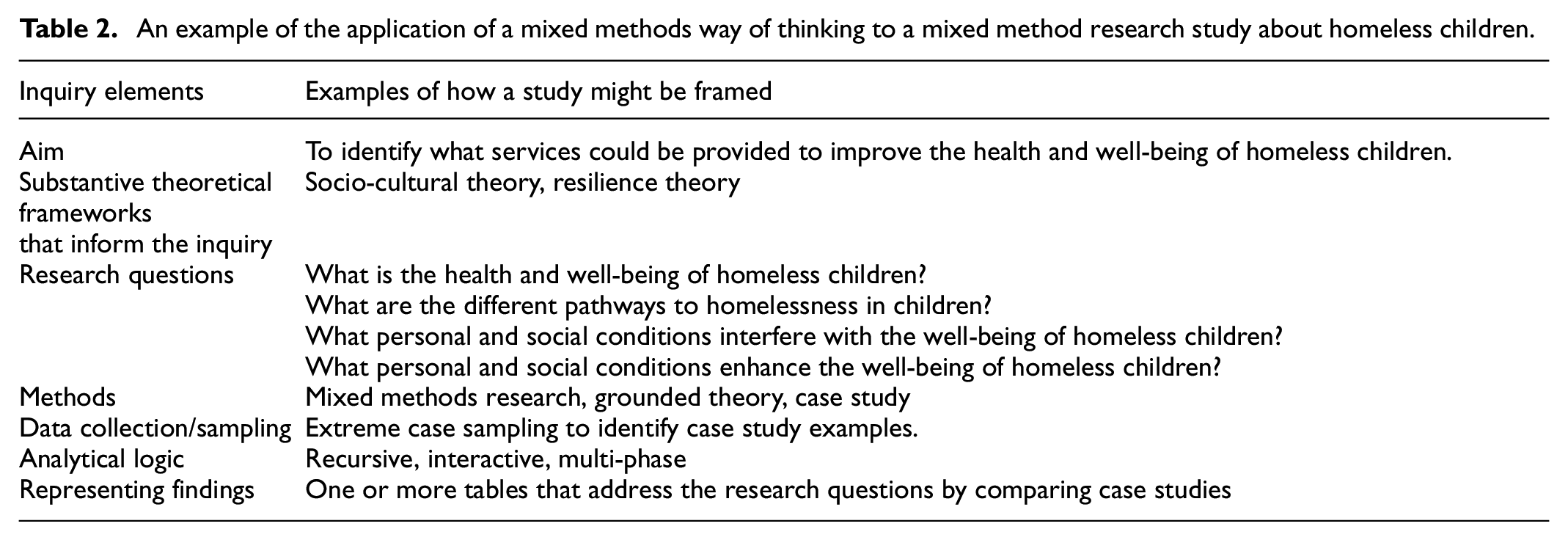
Table 2 summarizes a hypothetical example of how the logic of a mixed method way of thinking could be applied to shape key elements of an initial organizing framework for a mixed methods research project. Inspired by a mixed methods study about street children in Haiti by Ceánat et al. (2018), Table 2 propose some of the contours of what an initial plan might look like for a study about homeless children that reflects a mixed methods way of thinking and the opportunities for mixing it introduces. The study’s aim is consistent with the value commitment of a mixed methods way of thinking to promote social good. In real-world practice, the table would be fleshed out with more details about data collection and analysis.
Tables 1 and 2 model how to construct an initial framework for a mixed method research project that is comprehensive in that it is framed as a whole, rather than as a set of discrete components without a clear logic to connect them. It could embody a theoretically grounded, fully integrated mixed methods research design (Creamer, 2018a) when the rationale to engage difference was infused as one of the reasons for mixing across all phases of the research design.
Discussion
The authors adopted a dialectical stance to enlarge thinking about the implications of a mixed methods way of thinking to mixed methods research by highlighting the interplay between five different conceptualizations of it. The argument presented is that when views of it as a stance, a paradigm, an analytical logic, a purpose, and a rationale for mixing are engaged simultaneously, they can coalesce into an organizing framework for mixed methods research that links theory and practice. Unlike postpositivist approaches that place less emphasis on reality as multiple and complex (i.e. Teddlie and Tashakkori, 2009), or a pragmatic approach that links the choice of procedures to a set of pre-determined core designs (i.e. Creswell and Plano Clark, 2018), this is an approach to mixed methods research that places the most emphasis on mixing and the divergence in the data and results it often produces (Shannon-Baker, 2016). It shares with the transformative approach (e.g. Mertens, 2007, 2010), a commitment to promote social justice in the shaping of the purpose and design of a mixed methods research project. A mixed methods way of thinking and the dialectical logic associated with it can provide both a rationale for mixing methods and an organizing framework to guide its design.
The notion of complexity has been embedded in the discussion of mixed methods way of thinking from its first conceptualizations by Greene and colleagues who frame its benefits in embracing the multi-faceted nature of social phenomenon (Greene, 2007; Greene and Caracelli, 2003; Greene et al., 2001). Sanscartier (2018) and Poth (2018) add to the understanding of complexity in research practice by underscoring that research practice is far less predictable and controlled than textbooks lead us to believe. Poth (2018) encourages researchers to embrace complexity, writing, “As mixed methods researchers, our responses to complex problems pose dilemmas and opportunities. All too often, our responses involve attempts to reduce, control, or simply ignore the effects of complexity rather than considering new approaches including adapting new research designs and integration strategies” (p. 4). Poth’s (2018) encouragement to embrace complexity in research extends to the complex thinking that is required with a dialectical analytic logic that is robust in the thoroughness by which it pursues its findings.
Points of contention exist about the dialectic approach to mixed methods research (Johnson, 2008). Most prominent among these is a long-standing debate about how strong the relationship is between research methods and philosophical paradigm (McChesney and Aldridge, 2019; Teddlie and Tashakkori, 2009). Also at issue is the feasibility of a single researcher mixing paradigms in a study (Hall, 2024) or as Alexander et al. (2016) illustrate, the possibility that a dialectical stance can involve mixing components of several paradigms. An additional topic about the dialectical approach subject to dispute is the assertion that it is compatible with all paradigms (Fielding, 2008; Johnson, 2017). For example, both Fielding (2008) and Johnson (2017) express reservations about the compatibility between a dialectical stance and constructivism, relativism, and post-positivism. McChesney and Aldridge (2019) discuss the potential of pairing a dialectical and interpretivist stance. The general absence of reflexivity about philosophical orientation during reporting makes it challenging to gauge the prevalence of mixed methods research that reflects a dialectical perspective.
The implication of a mixed methods way of thinking to research practices extend beyond its use in the context of evaluation research. Others have considered the implications of a dialectical approach in other domains. This includes using joint displays to advance analysis (Creamer, 2024; Fetters and Guetterman, 2021), as an approach to teaching (Onwuegbuzie and Frels, 2013), as a framework for group discussion (Onwuegbuzie and Frels, 2015), and as a strategy to embed in reporting (Creamer, 2025). The implications of a mixed methods way of thinking to these areas of practice merit additional exploration.
Conclusion
Theory and methods are generally treated in the methodological literature as if they are two entirely different domains. In mixed methods, as in other fields, one body of literature addresses methods and design and an entirely different one tackles questions of theory and philosophy. The principal contribution of this article has been to advance a more expansive view of a mixed methods way of thinking that extends its conceptualization beyond a philosophical orientation to framing it as the theoretical basis for a distinct approach to mixed methods research whose utility extends to diverse disciplinary contexts.
By advancing a framework that simultaneously considers five expressions of a mixed methods way of thinking, we contribute to diversifying ways of thinking about mixed methods practice. Leveraging our own experiences, we have engaged questions about how to bridge theory and practice, including, but not limited to, the choices we continually make and re-make about what literature to feature in our teaching. In synthesizing two decades of writing from a cluster of scholars who share its philosophical orientation, we have aspired to make the construct, a mixed methods way of thinking, more accessible to an audience of novice and more experienced researchers in disciplines outside of the literature from evaluation where discussion about the construct has primarily found a home. By drawing attention to a mixed methods way of thinking as a multi-faceted construct with a broad range of implications to everyday practice, our principal contribution to the field of mixed methods research to demonstrate its potential to provide a coherent logic to pursue mixed methods research theoretically.
Footnotes
Declaration of conflicting interests
The author(s) declared no potential conflicts of interest with respect to the research, authorship, and/or publication of this article.
Funding
The author(s) received no financial support for the research, authorship, and/or publication of this article.
