



Abstract
This article describes a series of experimental method workshops that invite participants to enact speculative, craftful, multisensory and performative research techniques. The workshops have taken place across different European university venues with graduate students in a variety of disciplines such as digital humanities, sociology, design, media and art. Drawing on these experiences, the article argues that these workshops serve as an avenue for widening the repertoire of pedagogies for interdisciplinary qualitative inquiry through engagement with material, experiential and embodied ways of knowing. The article articulates the need to widen the repertoire of pedagogies for interdisciplinary qualitative inquiry.
Introduction
Researching the social world today might sometimes entail interacting with complex, fleeting, and multi-layered material contexts, as well as dealing with hidden relations between human and non-human realms (Law and Urry, 2004; Lobo et al., 2020). This requires a varied set of interdisciplinary methodological orientations and literacies. Method workshops that draw on collaborative and experiential pedagogical approaches provide a fruitful way of conveying these to students, as they learn how to to inquire and act in emerging research contexts.
Since 2018, I have been organising a series of workshops on research methods in different European university venues with graduate students in a variety of disciplines such as digital humanities, sociology, design, media and art. These workshops invite participants to enact speculative, craftful, multisensory and performative research techniques and methods through hands-on group activities.
Drawing on the experiences of organising these workshops, I argue that they serve as a useful avenue for widening students’ repertoires of interdisciplinary qualitative methods through making, sensing and exploring space and things. Enabling students to experience a variety of research techniques from the arts, social sciences and design is a valuable starting point for developing creative methodological practices that transcend disciplinary boundaries. These creative practices build on understandings of methods as events that articulate as well as form problems (Lury, 2020). They require students to consider research problems as emergent, contingent and circulating spaces that engender methods in a complex series of interlinked processes.
The article begins by introducing the rationale for equipping students with a widened repertoire of methods from other disciplines. It proceeds to introduce the conceptual framework that guided the pedagogical design of the workshop activities. It describes three workshop cases, each accompanied by a sample of the student work produced in order to discuss the process and the insights into methods. Through sample descriptions of a sensory walk, a speculative exploration of trash objects, and paper prototypes of technology devices, I examine the methods and techniques that participants experienced and applied, the affordances of methods, and what we were able to learn from the process. The article concludes with a discussion of the strengths and weaknesses of the workshop approach and the methods that learning tasks employed and suggests wider implications.
Towards a methodological agenda
A central argument that I want to make in this article is that students and researchers going out to learn and act in the world need to be equipped with a wide and diverse toolbox of research methods. Developing a wider repertoire of methodological literacies is a key aspect of building the types of transdisciplinary knowledges necessary to deal with societal challenges varying from military conflict, climate change and poverty to racism.
The drive towards methodological engagements across disciplinary boundaries is evident, for example, among researchers in disciplines such as design, architecture, and engineering. These disciplines are increasingly incorporating concepts and methods from sociology and anthropology, phenomenology, cultural studies, and science and technology studies to help understand how people respond to designed objects, the broader contexts in which designers and users work, and the ways in which the affordances designed into object systems and services are the product of sociocultural norms and assumptions (Forlano, 2016; Kimbell and Julier, 2012; Smith et al., 2016). The digital turn in the humanities has brought increased interest in the use of methods from the mathematical and computational sciences, such as statistical methods, visualisation and programming, allowing archivists and researchers to classify and spot trends in large collections of digitised visual sources in radically new ways (Wevers and Smits, 2020).
In the social sciences, the visual, sensory and digital turns have engendered increased interest in arts-based research methods. Anthropologists and sociologists are also seizing opportunities to take up methods and techniques from design (Lupton, 2018; Smith et al., 2016). These developments are underlined by the belief that exploring such transdisciplinary methodological synergies opens possibilities to generate imaginary questions and new perspectives and equips researchers to tackle ‘wicked problems’. Lupton (2018) suggests that design methods have relevance to a wide range of emerging sociological concerns, particularly to research that seeks to understand people’s engagements with objects, systems and services. Design methods are equally useful in facilitating processes of collaboration with publics and other stakeholders, work towards social change and in making futures imaginaries tangible.
Diversifying and widening methodological repertoires in the social sciences aligns with the various turns such as deconstructive, feminist, post-humanist, nonrepresentational, post-qualitative and decolonial. In this regard, methodological innovation is positioned as emerging amid new social questions and insights that require the recourse to ‘live methods’ (Back and Puwar, 2012), speculative techniques (Wilkie et al., 2017) or ‘inventive methods’ (Lury and Wakeford, 2012). It is also partly inspired by older methodological techniques such as breaching experiments (Garfinkel, 1967) within ethnomethodology, and interaction syntaxes (Goffman, 1971) within symbolic interactionism. These align with approaches that ‘enable the happening of the social world – its ongoingness, relationality, contingency and sensuousness – to be investigated’ (Lury and Wakeford, 2012: 2). These developments have also been accompanied by increasing calls for methods that enable the study of more-than-human society (de Freitas, 2017), and making devices for exploring latent futures that matter (Wilkie et al., 2017) within the context of widening interest in the Anthropocene. This has been parallelled by an increased emphasis on co-creation, participatory and action research, and indigenous methods.
Some critics, however, have warned against the sometimes-exaggerated hype in the discourse on innovation in interdisciplinary methods, and the novelty trope in narratives of qualitative research methods deployed as part of the marketisation of research (Travers, 2009: 174). In addition, the discourse of transformative research and social impact results in institutional pressures on researchers to develop novel methodological approaches. Research funders and publishers increasingly view methodological novelty as an important element in decisions about the funding of research and its subsequent publication. Some have suggested that the hype of methodological innovation can create an ‘over emphasis on discontinuities and change’ leading to the dismissal or under-development of established social research methods (Delamont and Atkinson, 2001: 277).
In relation to this debate, Jewitt et al. (2017) suggest understanding methodological innovation as a continuum with different levels of novelty, but also considering the transfer of methods across contexts and disciplines as a source of innovation. They understand methodological innovation as simply referring to novel research practices within and across disciplines outside the mainstream and propose four categories of methodological innovation across this continuum: expansion of methods within a discipline; re-situating methods across contexts within a discipline; the transfer of methods, concepts, knowledge and practices across disciplinary borders to be adapted, reformed or remixed; and the generation of new methods through inter-disciplinary mixing (Jewitt et al., 2017: 107).
I suggest that widening the methodological repertoire of master’s and doctoral students by introducing them to methods from other disciplines serves to strengthen their capacity to address complex societal problems by learning to ask new questions, develop new perspectives and intervene in new ways. This means adopting a ‘remix methods’ approach (Markham, 2013), going across disciplinary boundaries to experience unexplored methodological trajectories and teasing out new lively and productive qualities. It is an invitation to think creatively about the types of techniques of inquiry that could generate not only interesting and novel responses but also new ways of conceptualising ‘problem spaces’ (Lury, 2020) for research. Moreover, it is ultimately enabling collaboration with people from other disciplines, where they exchange and build on their respective areas of expertise in the process of working together.
A conceptual framework for teaching methods
In this article I suggest that constructivist and experiential approaches offer a fruitful basis for developing pedagogical strategies for the research methods. I build on collaborative and cooperative learning approaches comprised of problem-based learning (PBL) along with discovery-based and inquiry-based learning.
Studies within the cognitive sciences into the preferred learning styles of students have underscored the need to diversify approaches to teaching and learning and to incorporate opportunities for experiential learning and peer collaboration (DeZure, 2012). There is some evidence that students have negative experiences with social research methods courses, that they are ‘uninterested and therefore unmotivated to learn the material’ (Earley, 2014: 245), and that these courses are therefore irrelevant to their lives. Research has equally highlighted the value students perceive in self-directed activities such as interactive group work, and this can contribute to developing a sense of being prepared for future research (Purdam, 2016). Although there is some consensus about pedagogical approaches such as active learning, problem-based learning, service learning and experiential learning, research has largely ignored the specific design of methods pedagogies and how these might contribute to engagement (Howard and Brady, 2015).
The design of research methods instruction discussed in this article draws pedagogically on situated learning and problem-based approaches that focus on the use of crafted problem spaces as a stimulus for authentic activity (Duffy and Cunningham, 1996). These approaches situate themselves within epistemological principles of social constructivism and situated cognition. They draw principally on concrete experience, reflective observation, conceptualisation and active practical experimentation (Purdam, 2016). They integrate principles of learning embedded within realistic and relevant contexts, social negotiation and the use of multiple perspectives and multiple modes of representation (Dabbagh and Bannan-Ritland, 2005). The crafted problem spaces can reveal underlying techniques, principles and concepts of the knowledge domain, in this case the method. They involve activities that promote free exploration and self-directed inquiry, allow multiple solution pathways, appear as real to the learner, and promote ownership of the problem (Dabbagh and Dass, 2013).
The design of the workshops that I describe in this article draws on elements of cooperative learning (Johnson et al., 1991) using an interactive framework in which students work in teams to accomplish a common goal, and includes the following elements: (1) positive interdependence – team members rely on each other to realise a goal; (2) individual accountability – all students do their share of the work and master all the material to be learned; (3) face-to-face promotive interaction – group members provide one another with feedback, challenging one another’s conclusions and reasoning, and teaching and encouraging one another; (4) appropriate use of collaborative skills – students develop and practice trust-building, leadership, decision-making, communication and conflict management skills; and (5) group processing – team members set group goals, periodically assess what they are doing well as a team, and identify changes.
The pedagogical design of the research methods workshops draws partly on the model of the design studio. The core components of the design studio method include: (1) project-based work on complex and open-ended phenomena; (2) rapid iteration of proposed solutions; (3) frequent formal and informal critique; (4) consideration of heterogeneous issues; (5) the creative use of constraints; and (6) the central role of design media (Kuhn, 1998: 65). The archetypical setting for running such processes and activities is the design workshop (Rosner et al., 2016).
Designing workshops
The workshop is a creative space for collaborative problem-making and problem-solving. The design of the workshops that I have developed consists of some key elements such as hands-on group activities, reflections and presentations. The workshops have varied in length from 1-day sessions to multiple sessions spread across weeks. They consist of three main parts: an introductory lecture, group work and presentations of the outcome of group work followed by discussions.
Group activities usually revolve around a brief. In design, briefs are tasks or problem statements that serve to orient the activities of participants (Sosa et al., 2018). They are often open-ended and prompt participants to generate original ideas. They should involve a good balance of structure and flexibility, with the intention to provide enough structure to foster focussed creativity. In design the brief constitutes a form of constraint that makes certain mental structures possible (Boden, 2004). This draws on a reflective practice notion of design, based on the idea that each creative design problem constitutes a unique ‘problem space’ not given by the presentation of the design task (Schön, 1992: 11). Schön stresses the active role of the designer whereby ‘the designer constructs the design world within which he/she sets the dimensions of his/her problem space and invents the moves by which he/she attempts to find solutions’ (1992: 11). Working with constraints in a creative task implies working towards a creative event when a unique problem–solution pairing emerges, through a process of ‘problem framing’ (Schön, 1983).
In a spirit of mutual learning, I engage in joint reflection with the participants beyond the confines of the workshop, sometimes long after they have moved on to other research projects.
Multisensory explorations
Since 2018 I have been running a series of workshops with master’s students in an international course on sociology at the Paris Descartes University. The aim of the workshops was to introduce students to arts-based methods as preparation for their master’s thesis work. The students had received training in traditional methods in sociology such as interviews, observation and surveys. However, the course coordinator felt that the introduction of arts-based methods would enable the students to develop new approaches to the subject of their inquiry and ask more interesting questions. In each of its iterations, the participants in the workshop were a rich mix of international students from Europe, North America and Asia, and local students from Paris and other regions of France. The international students who participated in the workshops often chose research topics related to urban space and everyday culture in the city of Paris but found the methods they were familiar with insufficient to address their topics of inquiry. The course coordinator felt that multimodal and multisensory arts-based methods would be a useful addition to their existing repertoire of methods for exploring the city.
Each workshop took place over two class meetings spread over several weeks, and the participants worked in groups in-between the meetings. To kick off the workshop I would give a short lecture in which I introduced multisensory research methods and illustrated their use in research through a series of examples from research projects demonstrating playful, imaginative and exciting fieldwork.
After the introduction, students would split into groups and each group would choose a field research brief. One of the research briefs asked the students to walk to a chosen street and to capture and draw a map of smells while reflecting on the meanings that the smells evoked and the stories that they could tell. In another brief, the task involved following and conveying the meanings of sounds on a street. In a third, the instruction was to explore symbolic and embodied meanings of public space by drawing a map of ‘hidden borders’, of a place that felt ‘comforting’, or of a place that might evoke memories of ‘home’.
The tasks in these briefs were meant to introduce the students to multimodal and multisensory methodological approaches that reach beyond verbal language to seek close-up knowledge through multiple meaning-making activities. These techniques and methods have been explored in interdisciplinary research that includes sound (Gallagher and Prior, 2014; Hall et al., 2008; Pedersen and Vilmar, 2021), smell (Henshaw, 2014), embodied emplacement (Vacchelli, 2018) and interactions with things (Woodward, 2020). These methods sometimes appear in the literature under appellations such as sensescapes, soundscapes, smellscapes and bodyscapes (Dowling et al., 2018). They serve as a good response to calls that some authors have made for more viscerally aware research practices (Sexton et al., 2017). The thinking and doing of such visceral work involves bodily, affective and emotional interaction with material and discursive environments and it is well-suited to coping with ‘more-than-human, more-than-textual, multisensual worlds’ (Lorimer, 2005: 83).
Smells of a Parisian market
One of the groups in the workshop held in Paris in February 2018, L, I, and R, chose the brief on the mapping of smells. Smell has a considerable role in how people perceive places. However, it is a challenge to capture and convey the sense of smell methodologically because it is difficult to record and analyse. The chosen venue for their smell exploration was the Marché des Enfants Rouges in the third arrondissement of Paris. The Marché des Enfants Rouges, or in English ‘The Market of the Red Children’, opened in 1615 under the reign of Louis XIII and inherited its name from a nearby orphanage that was known for dressing its young residents in red coats.
They met at the entrance of the market. Since the temperature was minus 5°C, they decided to discuss plans for the exploration over lunch in a stand in the market with a heated interior. The first smell that struck them was of black truffle. They followed that smell, which led them to an Italian stall. L and I ordered the dish of the day, a pumpkin and truffle risotto. In the class presentation, L described how the smell evoked memories of a Valentine’s Day dinner where she had pasta with truffles in a restaurant. Truffle reminded R of a trip to Lisbon, where he ate by chance in one of the best Italian restaurants in the world. I thought of the time when her father loved truffle so much. Truffle Camembert, pasta with truffle, became his new thing. After lunch, armed with pen, paper and the smartphone camera, they proceeded separately to conduct individual tours of the market to capture smells.
McLean (2020) suggests that there are multiple somatic rhythms during a smellwalk including breathing, sniffing, walking and stopping. On that day only 10 stalls were open, each of which the group associated with the culinary specialities of different parts of the world. They observed that because of the cold weather, some smells were subdued. In some places the smells were so mixed that they came up with the term ‘smell sandwich’ to describe them (Figure 1).
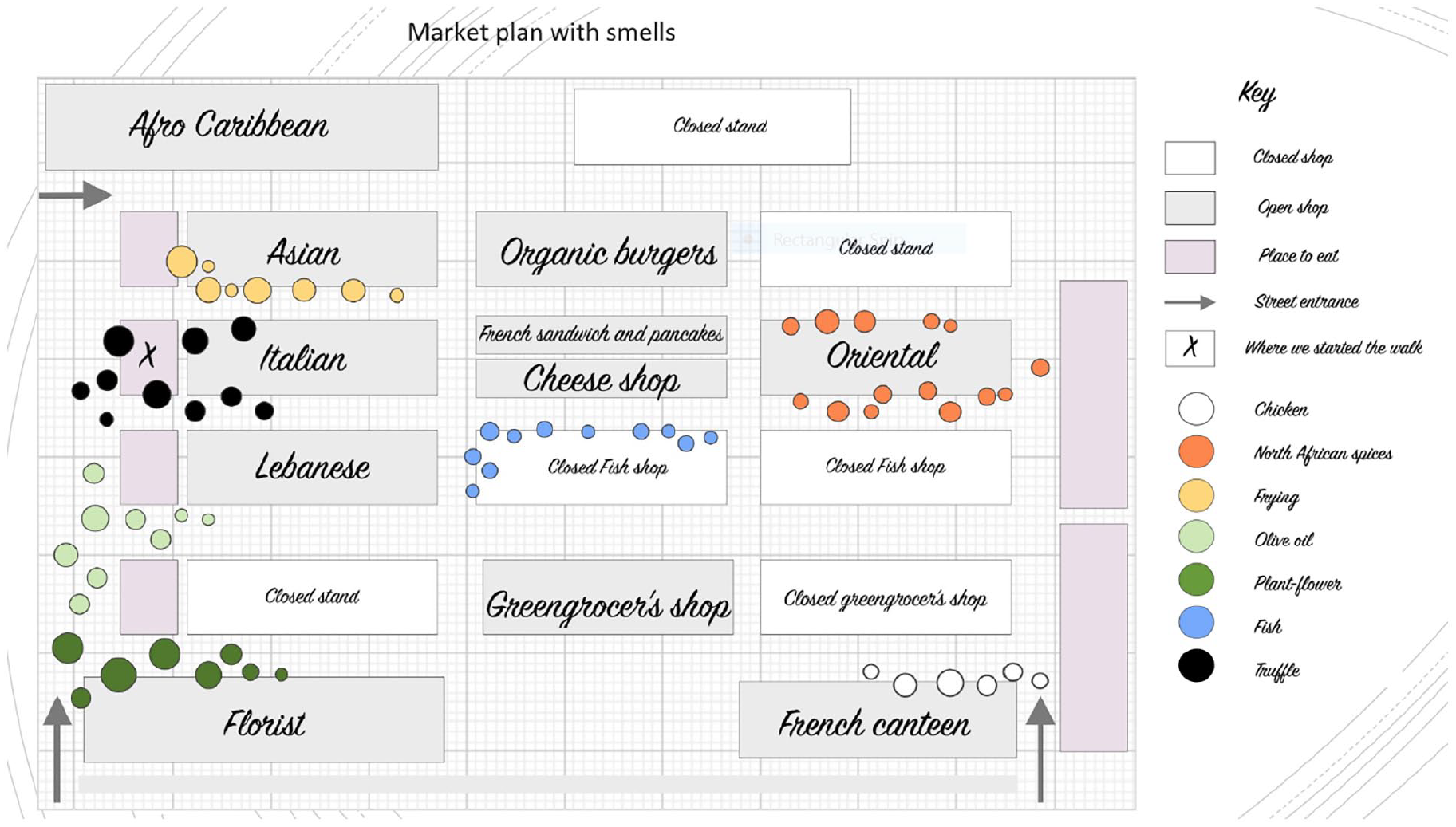
A screen grab of L, I, and R’s smell map, a spatial reconstruction of the market with dots of different colours representing different smells.
They were enacting the practice of walking as a multisensory method. Ingold and Vergunst (2008) describe walking as an activity in which the body is engaged in perceiving the environment through multiple sensory registers such as seeing, hearing, touching, smelling and tasting.
Enacting smelling or other sensory registers as a place-making technique involves breaking with the hegemony of the visual, the perceptual habits that draw the eye towards the habitual, the spectacular and the interesting and attending to that which is ever-present but usually goes unnoticed. It involves attuning the body’s multiple sensory registers, enabling one to ‘notice new colours, discern details previously ignored, hear extraordinary sounds, as familiar landscapes of sense sharpen and intensify’ (Bennett, 2001: 5). It brings about recognition of the ways in which memories and traces of previous experiences shape sensory perceptions.
Representation is a major methodological challenge in the research prompt to capture smells. One of the ways in which scholars, designers, urban planners and artists have visualised smellscapes has been through mapping (McLean, 2020). This usually involves marking which smells are located where, using spatial descriptions of the odours located, their range and their combinations. The students addressed the task of representing the smellscapes of the Marché des Enfants Rouges through the use of pictures and digitally drawn maps. In one example, they used a collage of an apron-clad chef stirring a pot of food with a close-up of Moroccan tile and tagines to convey the smell sensations of North African spices. The smells of these spices evoke memories of Istanbul’s grand bazaar, sun and the kitchen of an aunt in Morocco. The map in Figure 2 shows the smells that they found most prominent, which includes truffle, fish, olive oil, frying, flowering plants, chicken, cheese and North African spices. It also visually evokes the scents of chilli, ginger, basil, charcuterie, cheese and flowers that the students had sniffed. The map represents a cartographic visual spatialisation of the smellscape qualities of the market rendered visible through modified cartographic symbols to show the relationship between smell, place and space at a given time.
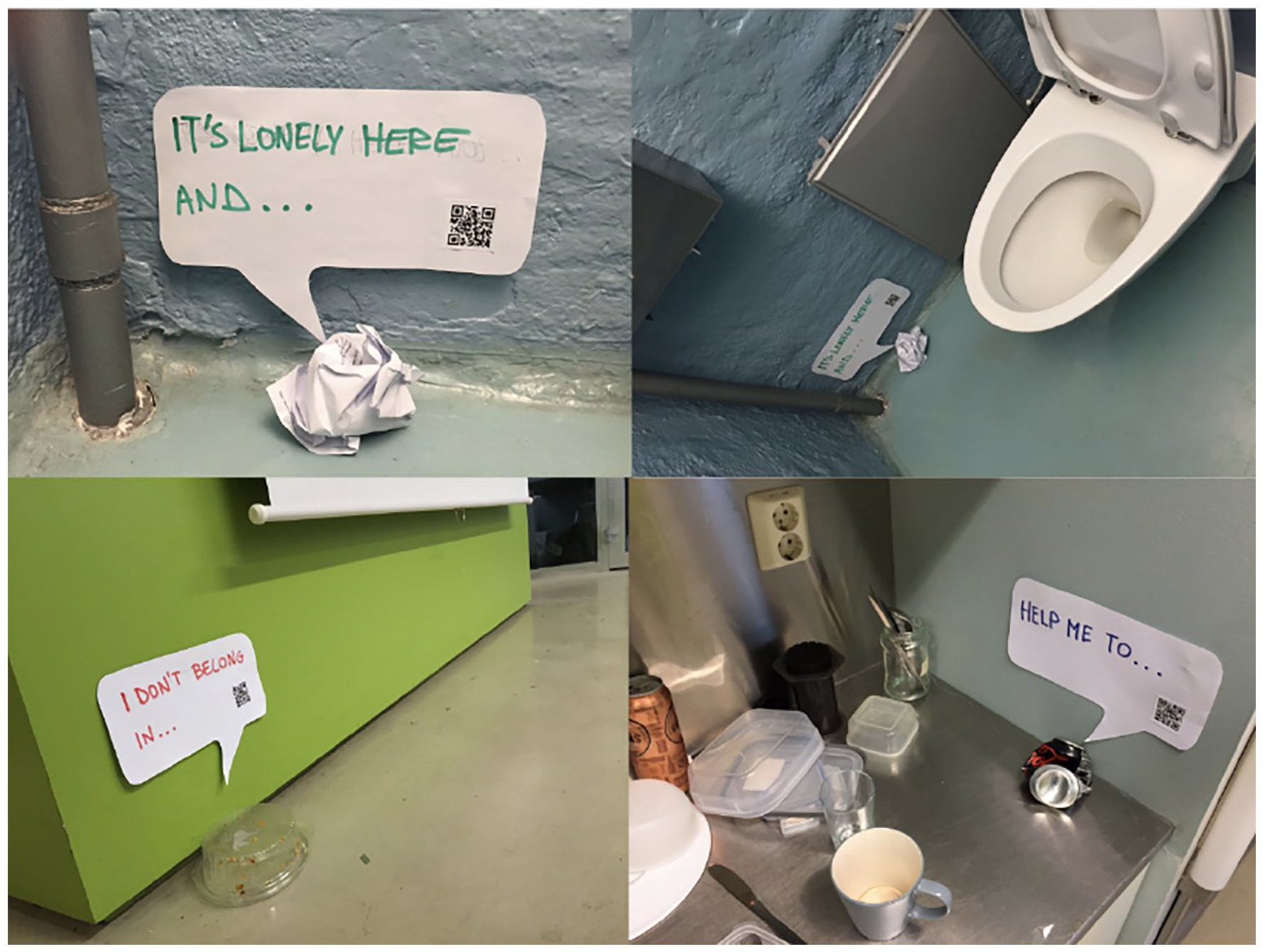
A collage of photos illustrating the design concept that emerged from ‘The Hidden Life of Trash’. Speech bubbles shaped out of paper with statements and requests on them are used to give voice to trash objects, and to invite the public to perform certain actions.
Speculative encounters
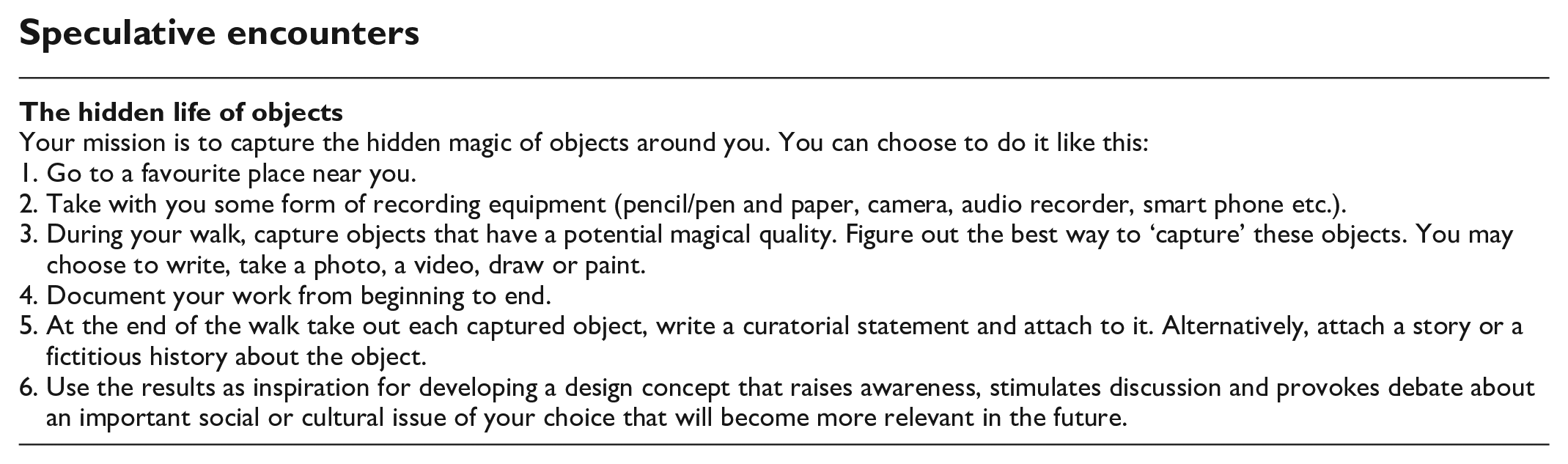
The second workshop case took place as part of a research methods course in a doctoral program at a design university in Oslo. The workshop was introduced in an attempt to fill a gap in the curriculum regarding social science methods. The interest in teaching social science methods was motivated by the fact that designers are increasingly being called upon to address challenges in social, cultural, political and economic contexts that are undergoing rapid change globally. In order for designers to position themselves in significant roles – in defining agendas rather than just working on their implementation – there is a need to learn to understand and address complex and intricate societal challenges; and to this end, designers need to understand people and their relationship to technological, cultural and social environments of everyday life. In this regard, devising methods to understand how people relate to objects, systems and services and how humans and non-humans are entangled in more-than-human assemblages (Fox and Alldred, 2017; Wilkie et al., 2017), was seen as a useful part of the design researcher’s methods skill set.
The brief 1 for this workshop defined a two-stage framework for action. The first part of the brief instructed participants to observe, interact with and record seemingly mundane aspects of their everyday environment through participant observation. The brief however challenged them to move beyond traditional ways of conducting ethnographic research through acts of invention, which opened creative opportunities or revealed obscure aspects of the everyday.
This task aimed to challenge the participants to engage with the world in unusual ways. Such research prompts are akin to what Harold Garfinkel named breaching experiments (1984/1967), where commonly accepted, but unwritten social rules or norms are deliberately broken to generate reflection about the nature of the practice behind the uncovered convention.
Understanding the hidden life of trash
One group of participants in the course chose the task of capturing the hidden life of inanimate objects. They chose to explore trash as an inanimate object with hidden qualities. The title of their group project was ‘The Hidden Life of Trash’ (Figure 3).
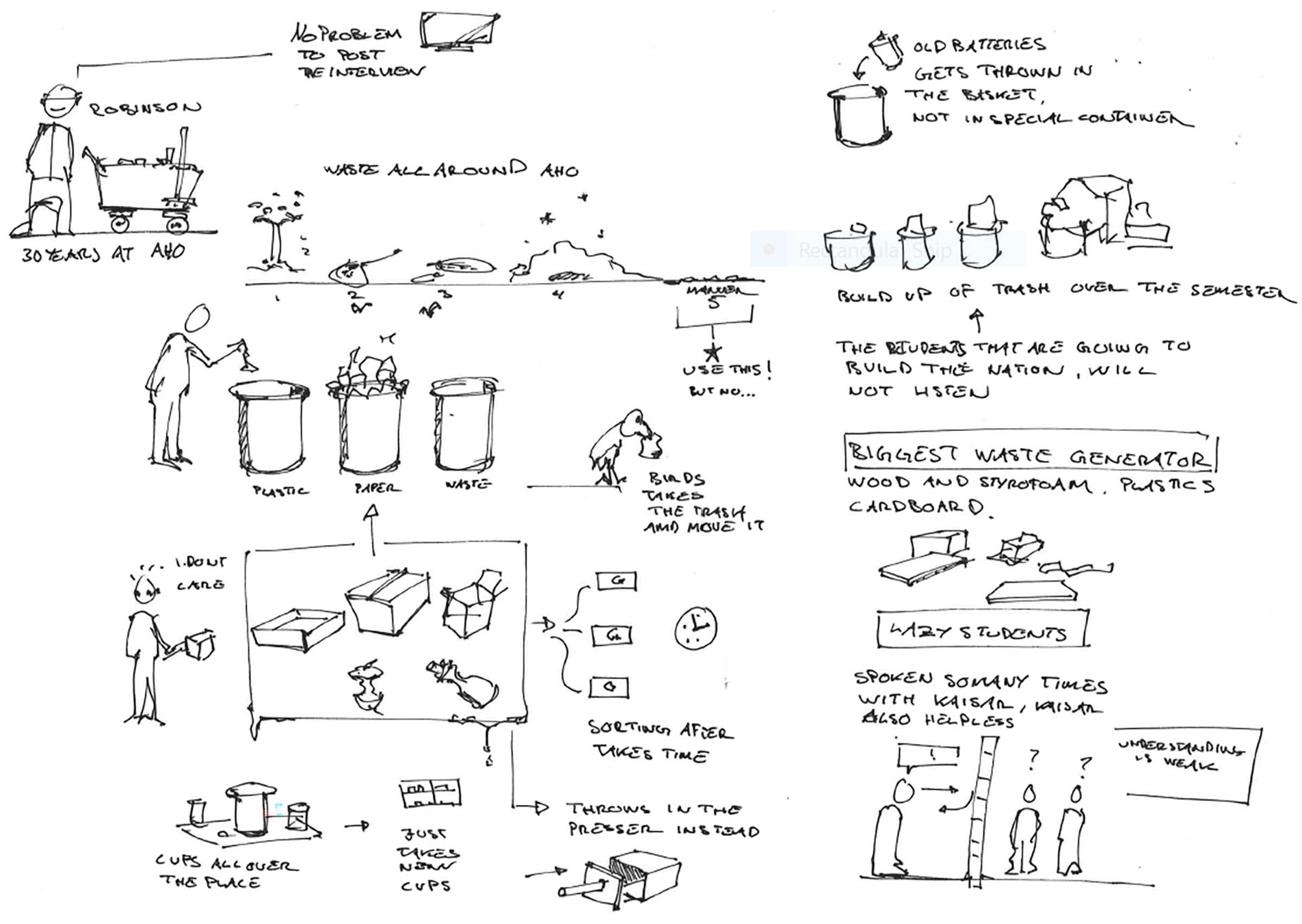
During all stages of the group work, the participants, who were all designers, made active use of their visual representational skills, such as drawing, sketching, mapping and photography. They used these to reflect on, analyse and represent insights emerging from their research.
To understand the hidden life of trash, they devised a way to interact with it – a technique to interview inanimate objects, to engage in direct dialogue with trash, in order to better understand the life cycle of the object. The group enacted the method of role-playing, similar to the practice of improv theatre (Johnstone, 1999). Role-playing depicts ‘the process of group physical and spatial pretend where individuals deliberately assume a character role in a constructed scene with, or without props’ (Simsarian, 2003: 1012). The technique of role-playing helped generate a heightened feeling among the group of ‘being in the moment’, in the process of enacting dialogue with objects. The technique also enabled them to explore the subject of trash on their campus in a vivid and focussed manner, using their entire bodies in the generation of reflections and ideas.
With the campus janitor playing the role of research participant, they went on a trip around the campus to dialogue with objects considered as trash. During the tour of waste management points, they invited the research participant to imagine what the trash items would say, what they may feel or dream about. Playing the role of dialogue counterpart, the janitor described how he could hear the trash ‘crying’ when placed in the compactor. When they asked what the trash objects might be thinking, the janitor stated that it would be to ‘never come back and be compacted again’.
The group noticed that the role-playing exercise and interview style elicited a whole new layer of information different from previous exchanges. During an earlier conversation, the janitor had talked about obvious things about waste management. In role-playing mode, he went further in his description of the objects like their recycled past, their multiple origins (such as the difference between light bulbs from Sweden and China), their desire to be with their friends and objects from the same culture. The role-playing interview exercise enabled the group to gain a fuller understanding of the life cycle of objects that are brought onto campus.
The second part of the brief asked workshop participants to draw on insights from their mini-fieldwork to develop a design concept that ‘raises awareness, stimulates discussion, and provokes debate’ about an important social or cultural issue of their choice that will become more relevant in the future. The group chose to develop a concept related to waste recycling. Drawing inspiration from the role-playing interview, the group developed a campaign for raising awareness about trash and waste management by giving a ‘voice’ to trash objects. The campaign utilised a similar imaginary to that used in the interview phase, namely giving voice to the waste items and allowing humans to then participate via social media in a creative exploration of what trash objects may be saying or feeling or dreaming about. The simple tactic was to focus on the desire of the waste items to be recycled and their need for humans to help them reach their nirvana by separating the waste properly.
Prototyping
The theme of prototyping has been the focus of a couple of research methods workshops that I have co-facilitated with staff and postgraduate students at the Royal College of Art London’s School of Communication and at the Department of Language and Literature, Norwegian University of Science and Technology, Trondheim. The aim of the workshops was to use the prototyping of technology devices as a space enabling students to experience and learn about research methods and techniques of making (Ingold, 2013). For humanities and social science students previously unfamiliar with such methodologies, this was meant to help them ‘connect two modes of engagement with the world that are often held separate – critical thinking, typically understood as conceptually and linguistically based, and physical “making”, goal-based material work’ (Ratto, 2011: 253).
Prototypes within the field of design are rapidly made and disposable mock-ups that aid the clarification of the feature requirements and functionalities of a system or technology (Bødker and Grønbæk, 1991; Wilkie, 2014). They act as socio-material mediators between designers, users, and other stakeholders during the development of technologies and systems, serving as both literary devices in which system specifications are abstractly described, and as socio-material configurations that embody existing and future practices in durable artefacts (Suchman et al., 2002: 166). As a process, it involves collaboration between individuals working together at the intersection of hands-on practice and critical making (Ratto, 2011) to develop, open out or reappraise functional objects and material forms beyond their utilitarian design (Mauro-Flude, 2017). It embraces a methodology of risk and encourages probing into the inexplicable and the enactment of radical play and speculation through continuous and iterative experimentation. In the workshops, our main interest was in making particular forms of prototypes, ‘provotypes’, where the focus is neither to develop a functional system nor to address a research question but rather to ‘challenge presuppositions, break down stereotypical understandings, and generally produce changes in the way people think about a particular topic or situation’ (Ruecker, 2015: 3).
As a prelude to the group activities, we introduced the workshop with an exposé on prototyping, critical making and speculative design as modes of research. We referred to examples such as Wilkie et al. (2015), who describe a speculative method involving the creation of a series of ‘Twitter-bots’ to engender discussions on sustainable energy through provocative and nonsensical interventions. We also mentioned WATCHA, a design fiction project (Morrison, 2015) that investigates the relations between humans and technological products and their everyday use. It is a ‘disobedient wearable object’ that tracks time not as we know it, but time as it is felt by the wearer of the time device and others nearby.
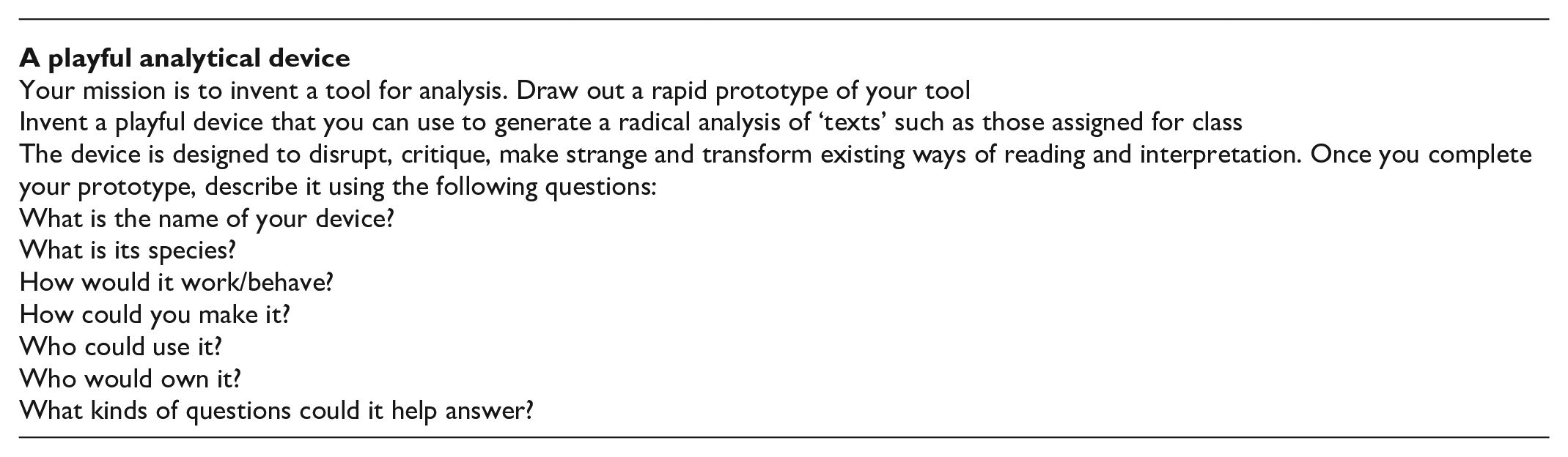
The group research tasks in one of the briefs included a request for participants to choose from a group of key words (such as symbiosis, transspecies storytelling, extinction, toxicity, time, extraction) and use these words as inspiration to invent something that could ‘raise awareness’, ‘stimulate discussion’, or ‘provoke debate’ about an important issue in the future. Another brief contained a prompt to invent a device that can be used to generate a radical analysis of ‘texts’. The device was to be able to disrupt, critique, make strange and transform existing ways of reading and interpretation. The participants had to give the device a brand name, describe how it would work, who would use it, and what questions it could address.
Glasses and fake news detectors
The participants developed a variety of prototypes of devices. In both workshops in London and Trondheim, one group of students chose intelligent reading glasses as the theme of their inventions in response to the brief about the radical reading device, producing Alice and Reading Prism (Figure 4).
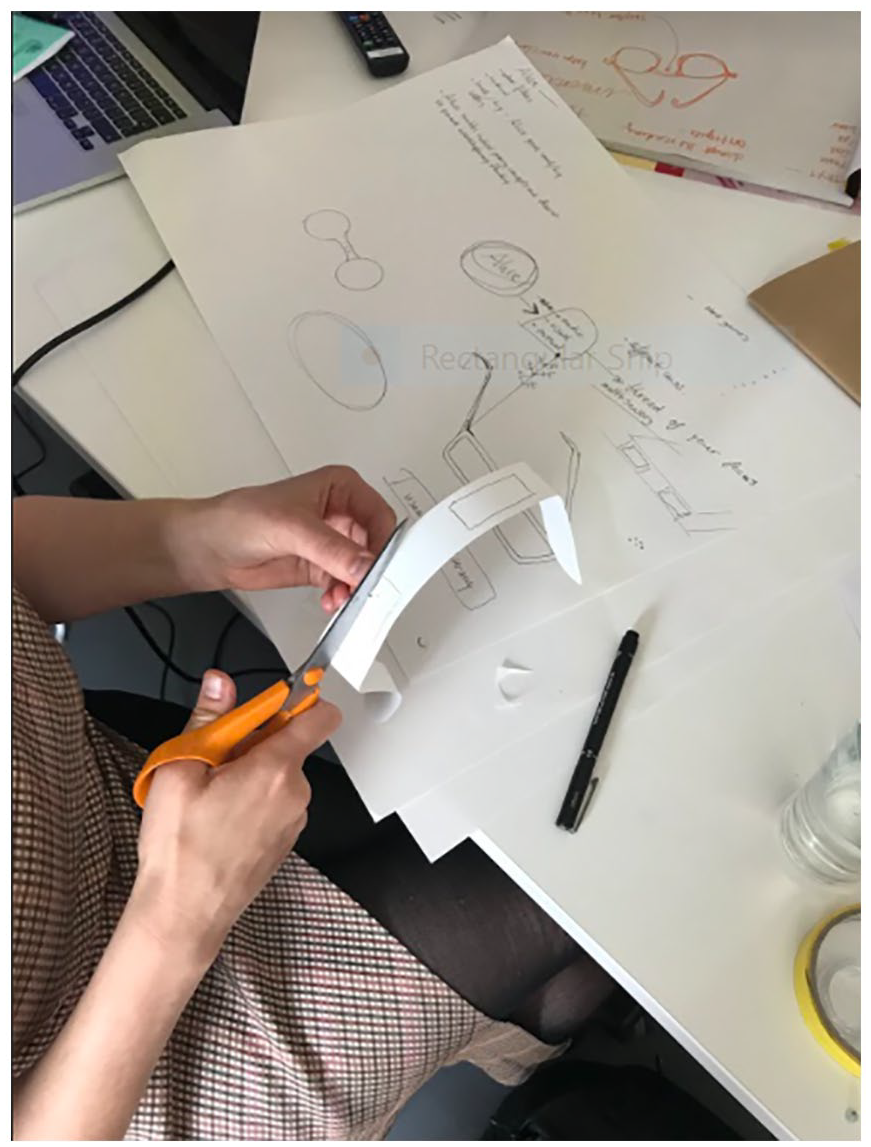
A picture showing the cutting of paper into the shape of the prototype of the reading device Alice. © Photo Larissa Nowicki.
Reading Prism was a prototype of virtual reality glasses that could make visible the emotional or affective qualities of a text in the form of representative colours. These glasses would exist in a future where there would be a new language of affect, Lingua Chroma, represented by colours in a spectrum. The creators drew inspiration from reader-oriented theories that highlight associations between words, colours and emotions.
Another group who responded to the brief about the awareness-raising discursive device invented the Fake News Cockatiel®©, an internet-connected artificial-intelligence voice assistant in a plastic housing shaped like a cockatiel. Its main function was to go online, search for fake news and report this to its owner. It was also morally ambiguous, as it would secretly go online in search for spaces to spread fake news.
Through these speculative enactments the students engaged with a series of design techniques such as brainstorming for generating ideas and concepts. To visualise and demonstrate their inventions they used drawing, scenario-building, fiction, model-making and persona enactment as research methods. They made use of standard ‘low-fi’ craft and stationary materials, pen and paper. Laying emphasis on practical problems of craft can promote deeper engagement with internal technical mechanisms and the socio-cultural realities of the contexts that we intervene in. The practice of craft involves engaging in the act of thinking through making (Ingold, 2013: 6). It draws on notions such as ‘the reflective practitioner’, ‘reflective practice’ and ‘reflection in action’ (Schön, 1983). Much of this activity constitutes embodied knowledge, not usually articulated, sometimes indescribable, and relies on improvisation learned in practice. In this regard it is not the product or finished design that is so much of interest, but rather the knowledge that is gained through our engagement with materials, people and contexts in a process of making.
Conclusion
This article builds on and contributes to methodological innovation through the remix and adaptation of methods across disciplines. It also contributes to existing work on the use of collaborative and experiential learning approaches in the teaching of methods.
A significant methodological observation from the workshops described in this article is that the activities highlighted bodily and materially oriented forms of exploration and discovery as important ways of learning and experiencing creative methods. Activities such as walking tours, building and wearing paper models of glasses, and exhibiting objects gave participants multisensory and multimodal opportunities to use their bodies as devices for conducting inquiry.
In addition, the collaborative context of group work enabled participants to draw on a variety of repertoires of experiences, memories, imaginations and skills in the performative enactment of research methods and techniques. Ideas and insights emerged through dialogue and engagement with their own bodies and a range of materials. The methodological practices enacted in these workshops demonstrate diverse forms of ‘artful craftiness’ (Back and Puwar, 2012: 9). They invoke possibilities for different ‘artful kinds and combinations of skills, crafts and technologies’ (Wilkie et al., 2017: 113) pertaining to an ‘ecology of practices’ (Stengers, 2013: 184) with unexplored research potential. They connote at the same time skill, embodied knowledge and a critical stance towards the ways in which such skills and knowledge are framed.
At this juncture, it is hard to tell what the result would be if the workshops were carried out in other venues with different groups of participants. Thus, it would be inopportune to make any sweeping generalisations about the use of such methods in other contexts. However, experiences from the workshops have led me to understand the importance of taking into consideration the types of capacities, skills and knowledge that students and researchers need to apply creative methods. Some of the methods required drawing skills, model-making and the use of digital visualisation tools. The practice of creative and inventive methods is contingent on the abilities of their potential users. This thus raises the question of who might be excluded and whom they might be used with, and the appropriate contexts in which they can be used (Jewitt et al., 2020).
More room needs to be provided in the design of such workshops to carry out reflections on key questions related to any method introduced, such as: What is the ontological and epistemological status of these methods and what forms of knowledge do they embody? What differences and similarities do these methods have with other approaches? What are the technical and cultural affordances inscribed in these methods? What skills and competencies do they require? Which ethical questions do they raise? What formative role and responsibilities does the use of these methods require of the researcher? And how should we interpret or analyse the forms of data that they can generate? Addressing such questions is a key part of understanding the methodological status and potential of the methods and techniques that participants experience in the workshops.
It is still unclear what value and meaning the participation in these workshops actually had for those who participated. A few months after one workshop, I received an email from one of the participants who wrote the following: I truly enjoyed learning about your research and the methods that you've been exploring. These experimental methods had a great influence on my research on the quartiers asiatiques of Paris last semester. The smell maps helped me identify the cuisines and consumption patterns of the neighborhood, which in turn helped me, identify the region and origin of both the business owners and the customers. The sound maps were used to map the languages that were spoken and how they changed from street to street, neighborhood to neighborhood. This was used to again determine the origins of the local population — for example, I heard more Vietnamese in the 13th arrondissement than I did in others, as expected. I also informally used the hidden borders technique, mainly looking at how the commercial offerings and signage changed from place to place. For instance, the Belleville neighborhood has a high concentration of signs that show services offered in Chinese and the physical concentration of these signs changed drastically from block to block. (Personal communication, 22 July 2019)
One thing that was discernible was the excitement and enjoyment that the participants displayed in the process. This, I would argue, provides inspiration for active learning and an enhanced sense of discovery, which in turn facilitates the acquisition of new skills that participants might find useful in future research or professional practice (Phillips, 2015).
Footnotes
Declaration of conflicting interests
The author declared no potential conflicts of interest with respect to the research, authorship, and/or publication of this article.
Funding
The author(s) disclosed receipt of the following financial support for the research, authorship, and/or publication of this article: Work on this article was partly funded by the European Union’s Horizon 2020 research and innovation program under the Marie Sklodowska Curie, Grant Agreement No. 707706.
