




Abstract
Workshops provide a flexible approach to studying complex issues. This paper discusses the methodological considerations involved in doing research through workshops and aims to further the understanding of how workshops can facilitate interactive and creative knowledge practices in case study research. The paper builds on two research projects - where workshops were used to study the practices of professionals’ use of digital tools at a consultancy firm and the everyday life of residents in a newly built city district. In the project about professional practices, three workshops were carried out with professionals from different disciplines and focused on their use of a specific digital tool, BIM. Post-its were used to introduce, explore and discuss different topics around everyday practices and digital tools, both individually and in various group arrangements. The three workshops built on each other and resulted in a concrete action plan for developing the company’s work regarding BIM. In the research about the everyday life, the participants in five workshops were asked to draw a map of their home and other meaningful places in the city district. These individual “mental maps” were then used as a starting point for discussing the residents’ everyday practices in a group setting. While the workshops in the two research projects targeted different groups and had different forms, they both made use of visual materials as a central aspect of workshops. Therefore, we analysed the workshops with a relational material framework to further understand how design choices affect research practice and research outcomes. From this lens, we analyse our choices in designing the workshops, the analytical processes and the consequences these choices have on what knowledge we create in interaction with the participants.
Introduction
The use of workshops is a widespread method in professional practice for achieving organizational change, professional development, and training (Awonuga et al., 2000; Candelo et al., 2003; Roos & Nilsson, 2020; Shamsuddin et al., 2021; Wilkinson et al., 2019). Workshops are also argued to be a suitable research method to produce empirical data about forward-oriented processes and can be used to study particularly unpredictable phenomena characterised by interaction (Benson et al., 2021; Ørngreen & Levinsen, 2017). Given the global societal challenges we face today and their unequal distribution, there is an urgent need to think creatively and collectively in new ways. In light of these challenges, workshops could be a fruitful research method to involve different stakeholders and support creative processes as they come with a wide range of design opportunities and include collaborative elements. Workshops can in addition be used to trigger and facilitate creativity, which can be a useful tool when researchers work to find new ways to contribute to a more sustainable living. Lupton and Watson (2022) used online workshops and creative writing prompts to explore personal data and “to create speculative imaginaries around the futures of personal digital data and the devices that generate these data” (Lupton & Watson, 2022, p. 754). There is also a democratic potential of workshops according to Alminde (2020). Marginalised groups such as the elderly, children and young people could benefit from getting a voice by being included in workshops and the method is suitable to address silenced and sensitive topics in vulnerable situations (Furman et al., 2019; Rasweswe, 2023; Thomas et al., 2021). In workshops, researchers should acknowledge what is made present, absent and othered in the workshops’ productive and communal spaces (Tarr et al., 2018).
While methods such as interviews and focus groups are useful for individual feedback and group consensus, they are reactive and might limit idea generation and spontaneous insights beyond predefined questions or topics (Benson et al., 2021; Witell et al., 2011). In contrast, methods focused on co-creation, where stakeholders are engaged in an open, active and creative process, are argued to open for new discoveries and insights (Benson et al., 2021; Boone et al., 2023). Co-creation methods can aid in taking in stakeholders’ perspectives and engagement in different parts of a research project (van Dijk-de Vrie et al., 2020). Furthermore, these methods have been seen to increase participant satisfaction (Ribes- Giner et al., 2016; van Dijk-de Vrie et al., 2020) and can be a way to create legitimization and readiness for organisational change (Roos & Nilsson, 2020). Unlike other co-creative methods, such as human centered design (c.f. Vagal et al., 2020; Shrier et al., 2020) which has a clear purpose and often a predefined process, workshops contain a wide variety of setups and have few restrictions. The many different forms of workshops make the method difficult to define for academic purposes (Shamsuddin et al., 2021). Lacking a clear definition in the literature, we find the three understandings of workshops from Ørngreen and Levinsen (2017) as a useful starting point. From their literature review, Ørngreen and Levinsen (2017) argue that workshops are discussed as a means to a goal (authentic workshops aimed at domain-specific issues), as a practice (where studies focus on the relationships in the workshop, its form and the outcomes) and as a research method (as a way to produce reliable data). What they found as shared features of workshops was that they were arranged events of a limited duration targeted to participants who shared some form of characteristics, such as shared experiences, shared interests or agendas. The events promote participation and are designed to fulfil a pre-defined but not predictable purpose (Ørngreen & Levinsen, 2017). We agree with this rather loose definition of workshops and our focus in this article is on workshops as a research method as we focus on methodological considerations when using workshops in science.
Howe (2016) contributed to our thinking about workshops as societal processes, in her case the creative writing workshop: “The workshop, like theatre, is a place where voice is always already under construction[…] It is what we owe to our students, ourselves, and to society; if we strive for democracy, the written history of our people must be inked in all our voices, not only those of a fortunate and powerful few.” (Howe, 2016, p. 499). Likewise, Gorman et al. (2023) described workshops as a creative process when participants learnt together, which foregrounded different emotions and narratives. These studies have shown that workshops have the potential to be a method that promotes creativity and inclusiveness which is vital to find fair solutions to complex societal problems. Recognizing this potential, this article aims to further the understanding of how workshops can facilitate interactive and creative knowledge practices in case study research. In doing so, we hope to inspire others to make use of workshops as a research method to face our current challenges with a collaborative and inclusive approach.
Research using co-creative methods have focused on a wide array of fields, such as education, marketing and health care (Benson et al., 2021; Boones et al., 2023; Ribes- Giner et al., 2016; Roos & Nilsson, 2020; van Dijk-de Vrie et al., 2020) but the literature on workshops is primarily focused on workshop design and in line with Ørngreen and Levinsen (2017), we argue that there is a need of discussing broader methodological aspects in relation to workshops. Workshops are often used together with various forms of materials and creative tools to challenge the participants’ preconceptions and to facilitate reflections and discussions. Participants can be challenged with unfamiliar tasks, such as drawing (Cornwall & Jewkes, 1995) roleplay, acting, or using visual art (Tanggard & Stadil, 2014). Bringing in material components as part of the research design changes workshop practices and relations between the involved actors. Inspired by Mol’s (2002) view of knowledge as enacted in practices, we see workshops as a flexible approach to studying complex issues through relational-material practices. Practice is handling, acting and coordination of relational-material relations that are located in time and space (Mol, 2002). Mol´s work emphasizes the interdependent relationships between material and human actors, focusing on how these elements are constantly shaping and reshaping each other. This relational materialism approach will aid in understanding how the material and human participants co-produce knowledge in workshops and how they might matter in epistemological terms. Bringing in relational material theory will thus further our understanding of how the researchers’ choices influence what kind of knowledge workshops can create as the theory accounts for the intricate relations between humans and materiality. Highlighting these relations will add to the discussions on workshops as a research method by making the connection between methodological considerations and epistemological outcomes visible. This will in this article be done by exploring the relational material aspects in two case studies where workshops were central to the research design.
Theoretical Framework
Within the field of Science and Technology Studies (STS), Law (1999) introduced the notion of relational materialities as a way to understand how relations with other entities shape objects and realities. Thus, from a relational materialism approach to knowledge, the interaction between humans and non-human actors are central to the analysis. According to Mol (2002) knowledge is co-created not only by the human participants but also by the materials, tools, and spatial arrangements present. Thus, with workshops, every element, from the layout of the room to the specific activities conducted, contributes to how knowledge is shaped and understood. Focusing on how the world is performed (enacted) in practice, instead of seeing it only as socially constructed, Mol (2002) argues that reality is not singular but multiple as it is enacted in different settings by different actors. Thus, in workshops, it is important to observe how different realities of a concept or problem are enacted and what inferences it creates. When an object is enacted in different ways by participants in a group setting tensions will arise and by focusing on these tensions we can understand the different realities at play. For example, an engineer can enact a product as a tool to solve a problem, while the environmental manager instead brings forward the environmental impact of the product. The tensions that arise in this setting can be analysed as different realities with conflicting values, knowledge etc., which are being enacted simultaneously. In contrast, the engineer’s version of the product might not raise tension when enacted in a meeting with a marketing manager, as their realities in this context more easily co-exist. When analysing workshops as a research practice in this article, we explore when and how different enactments of objects and realities coexist and when they create friction. Materiality plays a role in all research methods but in workshops material objects are often used as a vital part of knowledge production. Therefore, it is especially important to explore the relations involving materiality when it comes to workshops.
In line with a focus on human and material relations, we approach our research with an “ethnographic attitude” inspired by Haraway (1997). Haraway describes an ethnographic attitude as not being confined to doing fieldwork in situ but putting oneself at risk in the meeting with others and being careful and accountable when doing so. In our studies, we engage with an ethnographic attitude to learn how we as researchers, and our methods, affect participants and their interaction. An ethnographic attitude is useful when working with diverse empirical material as it takes seriously the generative connections articulated with different methodologies and it makes a multi-layered approach possible (c.f. Lindén, 2016). Thinking in terms of an ethnographic attitude means to care for inclusions, responsibility, and to centre on the mutual dependencies in material relations, as we revisit our methodological decisions. This approach will aid us in understanding when and how workshops can make space for collaboration and creativity.
Methodology
The paper builds on empirical material from two research projects with case studies where workshops were a central part of the methodology (Andersson & Eidenskog, 2023; Eidenskog, 2021; Eidenskog & Glad, 2024). Case studies are open for a range of methods, such as interviews and observations, (Flyvbjerg, 2006; Yin, 2018) but rarely explicitly include workshops. One researcher was participating in both research projects and when discussing methodological considerations in the projects, it became clear that the projects shared several interesting methodological challenges and learning outcomes. These methodological considerations inspired the work with this article as we saw an opportunity to contribute to the academic literature on workshops as a research method.
Project 1: The Introduction of Building Information modelling (BIM)
The aim of this project was to study the changes in organisation and work practices following the introduction of new working practices for modelling buildings in construction projects. Building information modelling (BIM), provides a new way of sharing information as professionals from different disciplines work on the same platform. The research project followed how employees at a large, international consultancy firm within the construction industry in Sweden experienced the change through workshops and interviews.
Three workshops were conducted in the early phase of the research project and focused on the professionals’ use of BIM. The company invited their employees to the workshops by sending emails and encouraging them to attend. Each workshop consisted of 7–10 participants, from different professions (engineers, middle managers and environmental managers) and with various levels of experience (between 1 year to 20 years). However, most participants were relatively newly employed and had worked for about a year in the company. While some participants knew each other, most of them had never met before. Slightly more men than women participated in the workshops and there was a large variation in age. The three workshops were held separately but were designed to build on each other. During the first workshop, the participants were tasked with agreeing on a specific aim related to BIM for the workshops. The aim they decided was to identify the conditions, challenges, and good examples of co-operating around BIM. From this starting point, the two researchers facilitated a discussion in smaller groups where the participants established what they found to be interesting focus areas. These were written down on Post-its and the groups then discussed each other’s focus areas. In workshop two, the researchers related the focus areas to current research and there were joint discussions on developing ideas for how to improve the company’s work with BIM. Some of these ideas were chosen for further development, using feasibility and impact factor as criteria. Finally, in workshop three, based on the researchers’ synthesis of ideas and critical input, the participants worked in smaller groups with creating hands-on action plans for developing the company’s work regarding BIM. Since we wanted to create an open and relaxed atmosphere in the workshops and several of the workshop activities were held in smaller groups, we decided not to record them.
Following the workshops, interviews were conducted with other employees from different disciplines (i.e. architects, engineers and managers) which focused on work practice changes and difficulties and opportunities related to working with BIM.
Project 2: Residents’ Experiences of Living in a Neighbourhood with a High Sustainability Profile
This project focused on a newly built neighbourhood in Sweden with a high sustainability profile to understand how the sustainability agenda in the built environment affected the residents’ everyday lives. The project started with document studies of planning documents and interviews with municipality urban planners to understand the ideas behind the design of the neighbourhood. Following this, we conducted workshops with residents to collect data about residents’ relation to their homes and their neighbourhood and in the wider context analyse if and how sustainability was part of their everyday lives. In total, we met with five different groups of residents which we recruited through a Facebook group connected to the neighbourhood and through personal contacts. Some of the groups were more homogeneous, when we for example invited students living in the same dormitory, and some more heterogeneous, as when we invited residents of different ages and housing tenure. We aimed for 4-6 participants in each workshop, but due to late cancellations between 2-4 residents and a total of 15 people participated in the workshops. We started with a pilot workshop to try out the design of the workshop and the questions. This first occasion was documented with both audio and video recordings but as we found the participants somewhat bothered with the recording, we did not record the following workshops. We designed the workshops in three steps: 1) initial questions to get to know each other and learn about the participants’ relations to their homes and the neighbourhood, 2) individual drawing, and 3) group discussions. The initial questions focused on the contentment of their house and the surroundings, their reflections on what “home” meant to them, what the residents had done to make their house more homely, if they have created relations with other residents in the same neighbourhood, and if they had used the places designed for social activities. After the round of initial questions, we introduced the drawing exercise and asked the participants to draw their home and their neighbourhood.
Combining the Two Projects
When starting to discuss the methodological considerations in both projects we focused on how the design of the workshops differed and what they shared, and what we could learn from combining the projects. The designs of the workshops differed as in Project 1 the workshops were designed to build on each other while in Project 2 the workshops’ design stayed the same. Likewise, the roles of the participants differed as in Project 1 they acted in the role of employees and in the other project the participants had the role of residents. However, both workshop methods focused on everyday life and everyday practices, either at home or at work, and focused on relations between entities, both human and material. Material objects, that is Post-its and drawings, were central to the workshop designs and while locations differed, we found more overlap than difference when discussing the workshops.
We analysed the workshops with a relational material framework (Law, 1999; Mol, 2002) and focused on how participants engaged with each other, the material, and us as researchers. This focus created a thematic analysis where the different relations became central themes. Attending especially to the materiality of the workshops, the venue and the materials used in the workshop (Post-its and drawings) were analysed as themes. Likewise, focusing on knowledge as created in interaction, both the relations between participants and us, as well as the relations between the data as the analysis became central themes. These themes were used to structure the following results section.
In our cases we have aimed to design workshops to make it possible to let the respondents professional and everyday practices shine through and we carefully listened to the participants and provided space for different voices to be heard. In line with our ethnographic approach (Haraway, 1997) we argue that the choices researchers make in the design and delineation of a study is an analytical work that makes us responsible and accountable for our research and its inclusions (Suchman, 2011). The university research ethics guidelines did not require ethical approval for the workshop as no sensitive topics were covered. The participants had the capacity to give informed consent at the start of the workshops and they were informed that they could at any time redraw their participation in the project. To create a relaxed and open atmosphere, all workshops but one were intentionally not recorded.
Results and Analysis
The following section discusses our methodological choices and illustrates various challenges during workshops and their relevance for creating inclusive and creative discussions. First, we reflect on different aspects of how we created space for inclusion and interaction and their consequences for our research studies. Then we focus on the material objects used in the workshops and how these foster different forms of relations. Finally, we discuss how we analyse the knowledge-making processes involved in the workshops.
Finding Suitable Places for the Workshops
We chose the places for the workshops with care and intent for each workshop (cf Howe, 2016) to facilitate communal and productive spaces (Tarr et al., 2018). With the professionals, the workshops were held at the company. The first workshop took place in a relatively small conference room with only one table intending to provide close co-operation. We created three visible spaces in the room for discussing the three focus areas. During the workshop, all participants were involved in all three areas but were not allowed to see the other groups’ contributions until every group had been in every area. The idea was to create an atmosphere where participants would feel comfortable to generate and express their perspectives, without giving any thought on other groups’ views. However, the participants gave the impression of feeling nervous and supervised in the beginning as they looked to us for answers and had some difficulties getting the conversations flowing, which we in hindsight think was partly due to the proximity in space. While a small room provided an overview of all the discussed topics and facilitated summarizing discussions, it did not give space for privacy in discussions. This can be compared to the other two workshop sessions when a large conference room was used instead. There were several tables available for the groups to sit more separately during discussions and a larger space for organizing activities. However, this arrangement made it difficult for us facilitators to take part in all discussions. We had to choose where to contribute and had a more limited overview of the group processes as several activities took place simultaneously.
The workshops with residents had different challenges, also with creating space but in a different way. We aimed to find suitable spaces for workshops close to the participants' homes, a place that all would have some connection to and within the neighbourhood we studied. We identified shared community buildings as such places since almost all residents were co-owners of a community building in the vicinity of their homes. However, few residents had access to these spaces and thus most of the workshops were carried out in the homes of our residents, although it was not our initial intention. This setup made the homes present through the material context. The residents felt at ease to invite us as researchers and their neighbours to their homes as we all were welcomed in, and the discussions flowed freely from the start. Being in homes or community buildings sparked discussions not only during the workshops but also before and after the formal workshops. Through the very present connection to the neighbourhood, we aimed to make the discussions more grounded in the built environment and how it affected everyday life.
Situating the workshops in their context, either in the company or in the neighbourhood, was a deliberate choice to make the practices we were interested in more present through their material connections. The relational material network in which the workshops were situated allowed for materiality and humans to interact in different ways. In the workshops located in the neighbourhood, the participants pointed towards their homes or other places during the workshops and discussed spaces connected to the rooms we were sitting in. In one workshop, the street outside the apartment became central to some of the discussions as the residents in that apartment felt that people outside were almost present in their living room as there was almost no space between their home and the public spaces. We could all understand the feeling as we watched passersby right outside the window and the materiality of the situation created different discussions than we could have had in any other space. Likewise, the material aspects of the choice of rooms for the sessions with the professionals shaped how participants engaged with each other, for example, looking what other groups were doing in the smaller room. Thus, in terms of creating space for inclusion and creativity, the researcher must consider how the workshop space shape interactions. Smaller rooms can create closer relations between groups, which can be beneficial for certain discussions, but can also hinder the forming of closer relations within the group.
Encouraging Participation
An important aspect of workshops is to create interaction between participants (Eriksson, 2013) and enable participation (Chambers, 2012). Workshops can be conducted with different levels of participation. The research project focused on professional practices built on a collaborative approach to workshops (c.f. Cornwall & Jewkes, 1995). In other words, while we as researchers designed the setup of the workshops, participants and researchers worked together to achieve the mutually agreed aim of the workshops. By zooming in on an agreed topic through discussions in workshops, we could foreground practices that are usually bracketed (such as everyday practices that are so common, that they become invisible for the respondent) (Nicolini, 2009). Despite our ambition to create an open and relaxed environment, there were some initial challenges to creating participation. One of these challenges was that the participants had difficulties in formulating their ideas and writing them on the Post-its. Especially difficult seemed to be to express a critical perspective and describe challenges. We believe that a possible reason for these difficulties could be that the professionals involved were not used to thinking and writing critically about BIM as it was part of the company’s future strategy. To express critical views about BIM might be interpreted as a critique towards the company strategy or the overall positive narrative about BIM in the construction industry. In hindsight, we could have used more practical cases and other material artefacts, such as photographs (see Hultin, 2019), to illustrate issues with the technology and thereby make it easier for the participants to express critique in relation to their everyday practices. Even so, critical voices about the technology came up later in the workshops. As a result, the impact of this challenge was of limited importance for the research study.
Another challenge that arose in both research projects was regarding group interactions. In the workshops with professionals, some individuals were in groups where they had difficulties in expressing themselves. Since workshops are built on participation, it is central that the workshop facilitators make sure that all participants are given the chance to contribute, so-called “interactive equity” (Chambers, 2012). For example, Denney et al. (2018) found the unequal conditions for the participants to have a large impact on the outcomes and silencing of critical voices in their workshops, despite an outspoken inclusivity agenda. This does not mean that all participants should be given equal time to talk. Instead, it is more of a matter of helping those who are more withdrawn and silent to speak and those who are more dominant and outspoken to speak less. Thus, as workshop facilitators, it was important for us to handle those group situations as fast as possible and during the workshops we changed the workshop set up slightly and arranged more suitable groups constellations. Chambers (2012) notes that there is a paradoxical element to participatory processes and suggests being “optimally unprepared”. While planning is important, participation involves unpredictability, making a flexible approach just as valuable. “Good workshops are more like a sea voyage than putting up a building. There is less a syllabus to tick off, and more a direction to travel in and a process to experience”. (Chambers, 2012, p. xiv).
At the workshops with residents in the neighbourhood, there were several challenges with group interactions, both between the participants and between the participants and facilitators. We started each session with a classic Swedish “fika” with coffee, tea, cinnamon buns (or similar pastries) and cookies, to show our appreciation for the participants spending an evening to contribute to our research project. “Fika” can also make people more relaxed to start a conversation with unfamiliar people and the act of sharing drinks and food can bring people together. The relaxing atmosphere we aimed to bring about was also intended to create a joint experience where hierarchies and differences did not matter for the interaction. After this introduction, we opened the workshop with some questions about moving to the neighbourhood and how they felt about their homes and neighbourhood. The facilitator of the workshop could ask questions to each of the participants and in that way make sure everyone had the opportunity to present their view. This approach did, however, restrict the conversations as it became more of a group interview with limited discussion between participants. In the later parts of the workshop, we discussed the different drawings, and this spurred more interaction between the participants. They could join in each other’s despair over the non-functioning garbage disposal and nod in recognition over the appreciation of the varied architecture. There were many laughs and moments of understanding between the participants in these workshops. Starting with individual questions and moving on to more collaborative elements fit the aim of the research project as the format allowed for both shared experiences as well as individual enactments of home, which created a space for multiple realities (Mol, 2002) to coexist side by side. The ways these multiple realities were enacted showed the strong individual connection to the home as a private sphere, still allowing space for the shared realities where garbage disposal was a common issue.
Considering the described challenges with interaction, we also see that both larger and smaller group constellations have their benefits in workshops. Concerning the knowledge gained from the two research projects’ workshops, we can see that smaller groups provided more space for each participant, which we think was important as they shared their view of their private life, which sometimes can be a sensitive topic. Therefore, the small group created a safer space than a larger group might have. In contrast, the larger groups in the workshops with professionals created new types of discussions as the employees from different departments in the company came together and learned from each other. The workshops were not only a learning opportunity for us, but they also became an appreciated social activity for the employees. Their exchange of experiences from within the company also gave us access to a deeper understanding of the inner workings of the company. This knowledge was crucial for us to understand the context in which BIM was situated. We see digital technologies as carriers of work practice conditions since digital tools are both an outcome and a prerequisite of the practices at the workplace (Goldkuhl & Röstlinger, 2015). The entanglement of BIM with the, more or less, standardised practices in the company was made visible not only in discussions around BIM, but also in discussions about working in different departments. In smaller groups, the contact between employees from different departments would have been less and therefore a combination of larger groups with group work in smaller groups facilitated both many new contacts as well as possibilities to deepen discussions.
Managing the Material Outcomes of Workshops
A central methodological question for both projects was how to document the results from workshops and what type of material the workshops would produce. Tarr et al. (2018) highlighted issues with “difficult-to-record phenomena of affective engagement, ambiguity, or discomfort, whose traces were recorded in experience, memory, or skill development” (p. 37). The material outcomes from workshops would provide parts to an ethnography, but not a comprehensive picture.
In the professional workshops, we foremost made use of Post-its. Due to their characteristic of different colours and sizes, these materials offered the possibility of creating various visual patterns, and structures, and the ability to move them around. These were also easy materials for us researchers to keep and use in flexible ways in our analytical work. Although Post-its were useful for expressing short and concise ideas through text, they had limitations in illustrating more complex processes. Writing down ideas in a few words was not a common practice for the professionals and thus forced them to commit to the limits of the small piece of paper. The work to bring large ideas or narratives down to a few letters required another type of creativity than they needed in their everyday practices. The unease some participants expressed for trying to catch a dilemma on Post-its took different forms. Here comes an example from when the participants discussed good examples of using BIM in projects (Image 1). Picture from a Post-it workshop.
As the above picture shows, the participants made use of the whiteboard in the discussion of good examples of using BIM as a visual aid to illustrate the different stages of a project. Writing down ideas on Post-its was clearly not sufficient when discussing the various areas and the background allowed them to move beyond the small Post-its. Other groups were not so fortunate as they had a white wall as a background and therefore had to make do with organizing Post-its in other ways. This use of materiality in creative ways shows how participants felt a need to express complexity and relationships beyond the small pieces of paper. The workshops with professionals were further documented through fieldnotes, pictures of the categorizations made by the participants and written down into a report after all three workshops. Together, this material could tell how the different versions of BIM were enacted in the workshops, both through our perspective and through the materiality organised by the respondents.
The Swedish expression of starting with “an unwritten sheet of paper” (English: a clean slate) literally was the prerequisite in the exercise of individual drawing that we asked all residents’ workshop participants to take part in. As facilitators, we provided white A3-sized sheets of slightly thicker paper and crayons of multiple colours. The setup focused on open discussions inspired by the respondents’ drawings. Some respondents felt restricted by the challenge of drawing, something they might not have done for many years. Most participants made an image that turned out to look like a map, even though we did not specifically mention maps. We just introduced the exercise with a more general line like “draw your neighbourhood and your home”. Others enjoyed the opportunity to create something creative and some were more used to drawing.
The participants’ drawings took different shapes as to what was included in the drawings and how to visualise different practices. Some drawings included activities they performed in the neighbourhood (walks with dogs in Image 2) and digital activities related to the neighbourhood (writing posts in the Facebook group, symbolised by the Facebook logo in Image 2). Some included specific features they especially appreciated such as the colourful bridges over the brook (Image 2) and animals, both wildlife (Image 3) and grazing sheep in fenced pasture (Image 2). Drawing from workshop participant 1. Drawing from workshop participant 2.

Although most drawings included what generally could be categorised as “structures” or “infrastructure” such as buildings, streets and the waterway, some drawings included nothing but these structures (image 4). Some included details like windows and balconies, especially in the building they themselves reside in. Other details that were made present in the drawings were for example the multi-coloured wall-mounted photo-voltaic on the car park building (Image 3). Image 4 Drawing from workshop participant 3.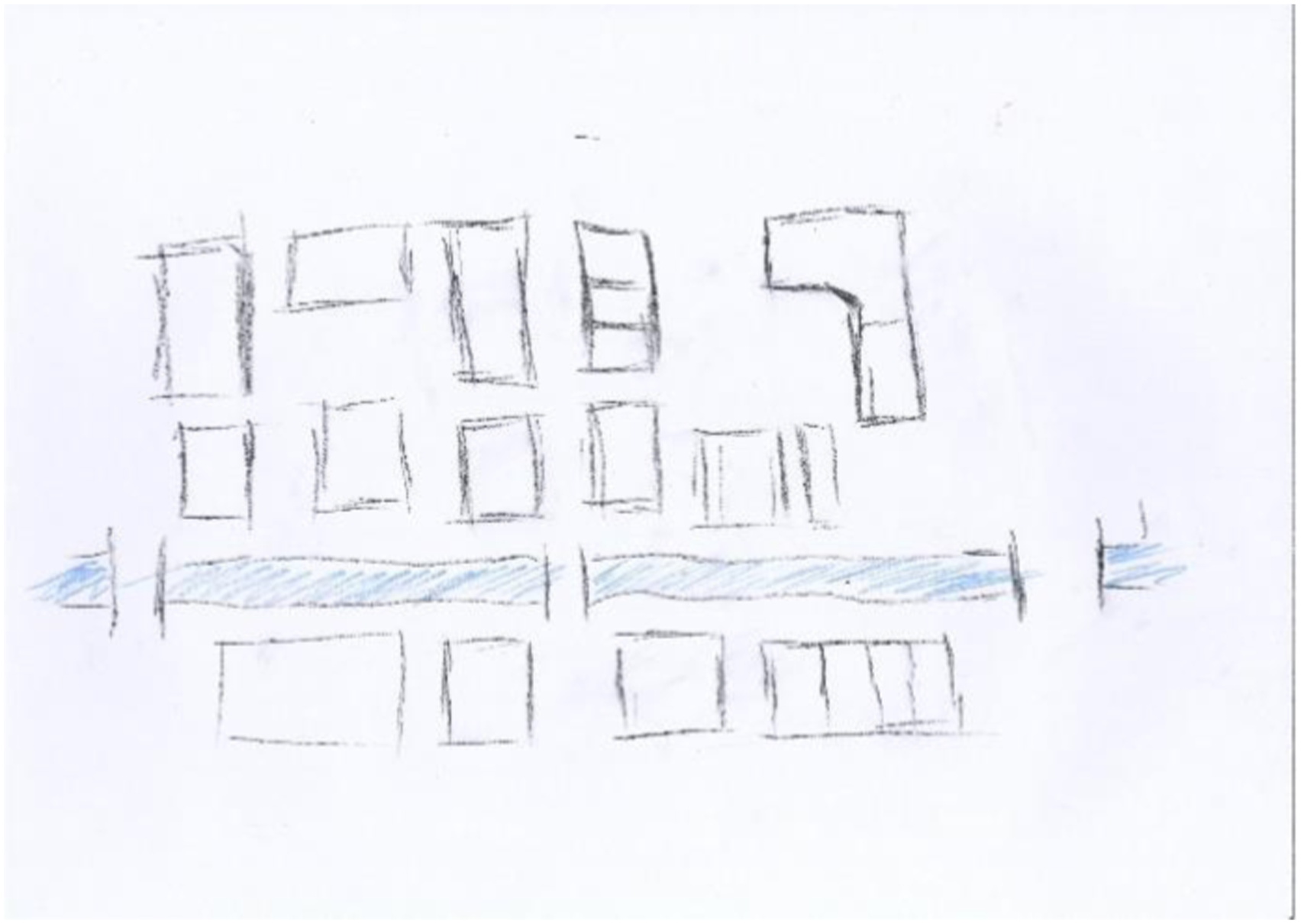
Almost all drawings included the brook, in many cases drawn with blue colour even if the rest of the drawing was single-coloured. The brook was in several cases portraited as a backbone of the neighbourhood. The practice of drawing the neighbourhood also comes with drawbacks as some things are more difficult to draw. How does one draw community and social connections? The social aspect can be difficult to visualize in this type of situations and might therefore receive less attention. As the focus on these workshops was on the built environment this was a rather straightforward choice for us to make, but nevertheless needs to be brought to attention as it will affect what kinds of result we get.
Field notes were also used in the workshops with residents and were useful for understanding the events that took place. As one of the researchers asked questions and steered the conversation, the other researcher took as accurate notes as possible of interactions. Note-taking has the advantage that it does not bother the participants and feels less of an intrusion in the interactions. However, it has the limitation that it is impossible to correctly write down all conversations that happen word by word, instead the research must focus on catching the topics and relaying them in the style the participants would use, as close to the ongoing conversations as possible. Afterwards, we found the notes useful in recalling the events on the workshops and together the researchers could recreate conversations that felt true to the way it unfolded during the workshops.
Analysing Workshop Materials
Interpreting the empirical materials of the workshops (our experiences and the material results such as Post-its, notes, pictures, and drawings) needed us to make use of different methods and theories for interpretations. Visual materials were important in both projects but due to their different character, had to be handled in different ways.
The pictures of Post-its and the Post-its themselves were brought together and analysed by both researchers. We look for ways that BIM came into being, how it was described, its relation to other technologies, buildings and organizations. We were especially interested in our experiences in relation to the Post-its – what happened when the participant made these choices and who was involved? This analytical stance was grounded in our ethnographic attitude (Haraway, 1997) as we made ourselves open to other possibilities and stayed with the potential of different possibilities in understanding the material before us. Discussing, laying bare our understandings, and challenging each other’s explanations created an openness for difference and new ways of categorizing. Theoretically, we asked how BIM ordered practices in the everyday work of the professionals and what consequences this had for how knowledge was created and accepted. Inspired by work in knowledge infrastructures (Edwards, 2010; Edwards et al., 2013) we analysed how some knowledge-making practices were enacted as obsolete, and how others became the new norm due to digitalization. In practice, our analytical work with the empirical material – moving and rearranging our categorizations of the empirical material – was similar to the workshops that we conducted with the respondents.
Likewise, we analysed the drawings by focusing on the central aspects of them concerning the discussions in the workshops. Firstly, we looked at the images to understand them with their context. We related them to the discussions in the workshops and the participants and their homes to situate the images. Inspired by Nawrocki (2017) we worked with categorization of the elements in the images as “mental maps”, looking for nodes, landmarks, paths, and borders. We found that the brook was present in all images, and it became the centre of the drawings. Following this we looked at other common themes, for example, many of the participants added animals to their images (dogs, birds, snakes, spiders and sheep) and what kind of representation they brought. Snakes for example, was a negative feeling connected to the parking garage where one respondent once met a snake. One participant explained how the snake added a negative feeling on top of the already negative view he had about the, in his eyes, ugly parking garage. Several of the participants drew sheep from the nearby sheepfold and explained how the sounds of the sheep and their connection to nature experiences made them feel calm. In this way, we connected categories that we found in the drawings with the discussions in the workshops. Our theoretical approach, building on Mol’s (2002) understanding of the world as multiple and a focus on what is made present and what is left out, together with attention to how every day was portrayed was a constant companion in our analysis.
One common challenge in the analysis of the two types of workshops was the connection between the empirical materials (Post-its, pictures, notes, and drawings) and the events and discussions in the workshops. The researchers can’t remember everything that took place in the workshops but our method of moving between our notes and our analysis of the material outcomes made it easier to connect the two. Another way of doing this analysis would have been to film the workshops and watch them together with analysing the material. This would probably strengthen the connection but it also risk neglecting the feelings and understandings of the workshops from the researchers’ point of view, as the film could potentially become more important than the notes and the researchers’ experiences. Furthermore, in relation to the workshops with professionals, several parts of the workshops were done in small groups which would have been impossible to film at the same time due to the number of groups being higher than the number of attending researchers.
Conclusion
Workshops provide space for interaction between participants and materiality in research and the creative format pushes participants to approach their mundane, everyday practices with new eyes (Tarr et al., 2018). In this article, we have discussed the reasons behind and the outcomes of our design choices to bring forward how these choices affect what kinds of knowledge is being produced in, and through, workshops. To conclude, we focus on what we argue are some of the most important aspects to consider and reflect on when designing workshops to foster creativity and inclusion.
Our primary reason for using workshops in our studies was their usefulness in studying complex problems through relational-material practices. Workshops have been fruitful in giving us new insights about the studied professional and everyday practices in both studies and contributed to the research projects’ aims. In the study with professionals, the workshops provided a space for shared experiences and the relations between different professions, BIM and their work practices became visible both in discussions and in the Post-its. When studying everyday life in the sustainable neighbourhood, workshops contributed with a close connection to the materiality of the neighbourhood, both in the drawing exercise and through the choice of venue, which together with the discussion made the material relations visible. These relations would have been difficult to study in interviews or focus groups as the more structured format can limit idea creation (Benson et al., 2021). However, workshops can be designed with different levels of structure, which determines how material relations take form and shape the knowledge creation. We believe that it lies in our responsibility for both respondents and research outcomes to create inclusive workshops and thereby make sure that there is space for all participants to express their views. This was done by using smaller groups and being attentive to conversations and directing questions to those who were quieter to expressly invite their expertise or experiences. In workshops targeting participants’ readiness for change, Roos and Nilsson (2020) suggest researchers ensure that participants feel the workshops add value and value their skills, that the group is united towards a shared and clear goal and connect the emerging insights to how the group can do an even better job. Likewise, “future workshops” have a stepwise process using backcasting to both handle present situations and ideas about the future (Alminde & Warming, 2020) and design thinking workshops provide a clear model for workshops to promote creative design collaborations (Geissdoerfer et al., 2016). Unlike these studies, our workshops focused on understanding the participants’ everyday practices rather than on improving work efficiency or solving a specific problem and therefore we argue that a more explorative and open format suited us best.
While workshops provide space for creativity and collaboration, they also come with their own limitations. A Post-it could only fit a certain content, as they are designed for brief and almost “taken out of context” messages to create reminders to oneself. A white A3-sized paper, as in the workshops with residents, probably signals something else. For some participants it was intimidating to be presented with this paper and crayons and asked to draw “your home and neighbourhood”. Some hesitated and excused their lack of ability to draw. After conducting the workshops, we noticed a pattern of women generally showing more confidence in the drawing exercise and they presented more details in their drawings. This challenge needs to be considered when designing workshops to create inclusion for a broader range of participants. Even so, the introduction of unfamiliar tasks to challenge participants is a way to foster new forms of creativity (c.f. Cornwall & Jewkes, 1995; Tanggard & Stadil, 2014). In line with our workshops and previous research, we argue that it is exactly these types of new and somewhat demanding activities that helped the participants to reflect on their everyday practices and reach insights beyond their regular patterns of reasoning. There is thus a need to balance the risk of participants having trouble engaging with the presented task with the possibility of these tasks generating a productive setting to talk about otherwise backgrounded subjects.
Workshops also have been shown, in our study as well as in other research, to bring unintended consequences and new relations (Tarr et al., 2018). In the workshops with professionals, the inclusion of employees from different departments and professions resulted in the participants getting in contact with people they would otherwise not meet. It also made visible the absence of a common ground between the various parts of the company and the need of better networking possibilities. This was also the case in the workshops with residents: people who were neighbours had never met before but could extend their networks in the neighbourhood and found it rewarding to learn about different ways of solving problems that came with being a resident in this area. Workshops are used to enhance stakeholder relationships and promote trust (Ngo et al., 2018) and the relation-building potential between participants needs to be considered when designing inclusive workshops.
Knowledge in workshops is enacted through a complex web of choices regarding the research aim, workshop design, the carrying out of workshops, analytical work, and the presentation of materials. As we have shown in this text, choices come with consequences and responsibilities, and it is vital that these choices are made visible to understand how knowledge is enacted through workshops. While this article has shown examples of how the workshop method shaped material and human relations, more research on the role of materiality in workshops are needed to deepen this knowledge. The use of cards and toolkits in workshops has gained scholarly attention (c.f. Peters et al., 2021; Galabo & Cruickshank, 2022) but the analytical understanding of the relations between the research, the participants and all the material entities (rooms, workshop materials and other material objects) are rarely discussed jointly. To understand these complex relations in more depth, more studies are needed to make use of the inclusive, creative and democratic potential of workshops. With workshops for academic purposes becoming more rigorously described and discussed in methods’ literature, workshops should be included as a knowledge-creating practice in case study method literature.
Footnotes
Acknowledgements
We are thankful for the time and effort the residents and employees of our project partners spent during the respective research processes. We are furthermore grateful for the advice from the reviewers who’s comments were greatly appreciated.
Declaration of Conflicting Interests
The authors declared no potential conflicts of interest with respect to the research, authorship, and/or publication of this article.
Funding
The authors disclosed receipt of the following financial support for the research, authorship, and/or publication of this article: Eidenskogs work has been funded through the project REIMAGINE-ADM from the European Union’s Horizon 2020 research and innovation programme under grant agreement No 101004509 and by FORTE, project number 2021-01660.
