



Abstract
Definitional problems in the area of organized crime have traditionally led to measurement problems that trickle down the criminal justice system. This study quantifies the broad conception of organized crime in the Canadian legal context and examines the types of crimes in which criminal organizations (and organized criminals) are involved. To estimate incidents potentially related to organized crime, we combine police-reported data from Montreal, Canada, with the three components of organized crime as prescribed by the Criminal Code of Canada: size, offence severity and continuity. The strategy of combining models on a continuum, varying in co-offending unit size, as well as offence severity provides both restrictive and inclusive estimates, accounting for the main discrepancy dividing scholarly and policy assessments of organized crime. Results showed that from 2005 to 2009, the extent and severity of incidents potentially related to organized crime that emerged from the three family of models proposed varied, ranging from 184 to 2086 incidents. The models also showed variations in incident rates across crime classification types with most organized crime incidents attributed to property and violent offences. This study is one of the first to propose a set of methods to detect incidents potentially related to organized crime using police data and to illustrate the potential implications of restrictive and inclusive measures for estimating its prevalence.
Introduction
Organized crime (OC) has routinely been the subject of major legislative initiatives and policy interventions for over 40 years. Since the introduction of the Racketeer Influence and Corrupt Organization (RICO) Act in 1970, which targeted two or more individuals jointly involved in a pattern of racketeering in the United States (Morselli and Kazemian, 2004), similar policies in Australia (Ayling, 2011), Europe (Dorn, 2009) and Canada (Beare and Martens, 1998; Desroches, 2013) have been followed. In line with such efforts around the world, the current legislation in Canada defines a criminal organization as
a group, however organized, that (a) is composed of three or more persons in or outside Canada; and (b) has as one of its main purposes or main activities the facilitation or commission of one or more serious offences that, if committed, would likely result in the direct or indirect receipt of a material benefit, including a financial benefit, by the group or by any of the persons who constitute the group. (Criminal Code of Canada RSC, 1985)
It goes on to exclude ‘groups of persons that form randomly for the immediate commission of a single offence’. 1
This definition is not unlike many others around the world in adopting a broad view of what a criminal organization could be. These inclusive views allow for flexible approaches to crime control; however, they also risk extending assessments of OC to a wide variety of crimes and groups. Within the Canadian legal context, size can be as small as three co-offenders; the definition goes on to exclude, to an extent, the notion of organization (‘however organized’) but does specify that the group must show signs of continuous, serious criminal involvement. The definition encapsulates some of the issues scholars and policy-makers always have in defining OC. Too broad of a view dilutes the substance of what we think OC should be, at face value. Theoretically, if it could include everyone, then what is so special about OC? Alternatively, too narrow of a view (e.g. a criminal organization only exists when it controls an illegal market) may not be more satisfying, forcing the exclusion of what seems to be the typical configuration of OC within naturally competing illegal markets (Bouchard and Morselli, 2014).
It would be tempting to dismiss the problems of definitions altogether. Critics have suggested that OC is a social construct, with laws promoted by politicians and law enforcement agencies that have vested interest in conceptualizing and then tackling the phenomenon. In reality, however, formal definitions are needed and used by the criminal justice system, and particularly law enforcement agencies tasked with combating OC. For instance, the size of OC task forces and the budget they receive to tackle OC are dependent on that initial definition or, alternatively, on an internal understanding of what constitutes OC. A misguided definition will either not be used or lead to the prosecution of groups that fit a too narrow or too broad view of what constitutes OC. This has been the case in Canada where there has been limited use of the criminal organization statute in criminal proceedings (Desroches, 2013). Discrepancies in defining and applying this definition lead to uncertainties about the frequency of incidents related to OC and even greater uncertainties about the allocation of police resources in dealing with such incidents.
In this study, we do not suggest a new definition of OC, nor do we take sides on the issue of defining OC altogether. Rather, the questions at the core of this work are much more pragmatic: How does the legal definition translate into actual measurements of criminal organizations in police data, and what do the numbers look like? One of the tests for the utility of formal, legal definitions of OC is the possibility of detecting these cases in actual police data. This study is one of the first studies to use the definition of OC, as prescribed by the Criminal Code of Canada, to examine the proportion of OC incidents found in arrest records. Despite the vague definition of OC and criticism of its ability to capture the reality of the phenomena, we select the Criminal Code of Canada’s definition for three reasons: due to (1) its inclusive parameters of OC; (2) its similarity to OC definitions adopted by the United Nations and other Western countries (e.g. the United States), allowing for comparisons across contexts; and (3) the nature of the current data, which is Canadian-based. While an inclusive approach likely captures a range of groups that may not at face value fall into the category of OC, the inclusive nature of the definition is well suited for the proposed methodology, providing a continuum that allows us to experiment and see how various definitions influence the scope of potential OC-related offences.
To assess the range of events that could potentially be attributed to OC, we propose a variety of methods to estimate the number of incidents using section 476.1 of the Criminal Code as a baseline. Analyses are based on three units: offenders, co-offenders and offences, all of which are explicitly defined as units of measurement across models. Our methods are based on the three fundamental elements of OC as stated in the legal definition: (1) group size; (2) involvement in serious offences with the potential to generate material or financial gain; and (3) continuity. Variations across these three variables allow us to distinguish criminal organizations from ad hoc partnerships and compare the impact that different thresholds have on estimating the prevalence of OC.
Co-offending groups, continuity and crime types
In order to establish a measure of OC, we have to first identify the typical configurations that constitute OC groups. Because criminal organizations operate in hostile environments, where size is positively associated with the probability of detection and apprehension, a majority of criminal organizations are small, flexible and ephemeral (Reuter, 1983). As Bouchard and Morselli (2014) recently argued, these volatile groups coming together for specific crime ventures are not necessarily independent of the OC category. Rather, individuals cooperating in such groups pool resources and adapt to such structures to survive longer.
The operationalization of criminal organizations in police data requires an examination of these co-offending patterns and, in particular, those involving three or more individuals. Extant research has shown that co-offending generally takes place in groups of two or three individuals (Bouchard and Morselli, 2014; Bouchard and Nguyen, 2010; Carrington and Van Mastrigt, 2013; Reiss and Farrington, 1991; Weerman, 2003). Furthermore, studies that examined co-offending patterns of detected offenders in police data found that co-offending groups are usually not stable or continuous (Morselli et al., 2015; Reiss and Farrington, 1991; Weerman, 2003).
Groups of three or more co-offenders that offend over time are the suitable starting point to identify the presence of criminal organizations in police data. Yet, formal definitions of OC typically consider certain types of crimes that should also be taken into account. Specific types of illicit activities are more likely to involve co-offenders. In Carrington et al.’s (2013) analysis of co-offending patterns in Canada, group crimes were most common among market offences (drug-related) and property offences, while also having the highest seriousness scores according to Statistics Canada’s crime severity weights. This is consistent with a recent study of co-offending patterns in Quebec, in which property and market crimes were more likely to be conducted with co-offenders (Morselli et al., 2015). These results were also found in past research on general co-offending (Reiss and Farrington, 1991; also see Piquero et al., 2007).
Operationalizing OC in the Canadian context
The problem with using the Criminal Code of Canada’s definition of criminal organizations is in its ‘mechanical aspect’, that is, trying to fit a way of doing crime into a rigid definition. To an extent, studies in Canada have attempted to overcome these limitations by proposing various methodologies for operationalizing its legislative meaning (Glässer et al., 2012; Saunders and Lawrence, 2013). For instance, Saunders and Lawrence (2013) used police-reported crime data from the incident-based Uniform Crime Reporting (UCR2) survey to develop an Organized Crime Severity Index (OCSI). In doing so, they designed a framework to measure the extent and severity of OC-related activity based on the Criminal Code of Canada. To extract OC incidents, they recommended an exclusive focus on incidents comprising three or more offenders, where two or more of the offenders re-offended with one another on at least one other occasion. In doing so, Saunders and Lawrence created a list of 192 offences that were considered serious (indictable or potentially indictable offences with a maximum punishment of 5 years of imprisonment or more) and that were likely to result in material benefit, either for financial or for reputational gain. Despite operationalizing the legal definition, Saunders and Lawrence (2013) did not actually apply or provide what they would consider an accurate measure of OC-related activity. Rather, they laid the groundwork for the development of subsequent methods for estimating OC-related offences using the UCR2. However, Glässer et al. (2012) used official police data obtained from the Police Information and Retrieval System (PIRS) to estimate the extent and severity of criminal organizations. From 2001 to 2006, the authors found 236 groups (with three or more members) that could be classified as criminal organizations having committed at least one serious offence for material benefit. They also identified 39 groups that were classified as serious criminal organizations in select areas of British Columbia (excluding Vancouver). Glässer et al. (2012) relied on a mix of social network analysis, mathematical computations and data mining techniques to identify structurally similar co-offending groups and suggested adjustable thresholds for determining non-random group formation and potential criminal organizations. While their methodology illustrated the potential effectiveness of applying network analysis for computing and extracting information from a larger dataset, it cannot easily be replicated, nor is it practical from an enforcement perspective. While data mining algorithms are an efficient means for extracting mass amounts of data, they are restricted to the information coded within the given dataset and may result in incomplete data or inaccurate estimates.
The current study
Definitional problems in the area of OC research and policy create practical challenges for estimating the extent and severity of the phenomenon. This study provides a framework that can feasibly be replicated across different databases, geographical locations and time periods. Specifically, the study: (1) provides a measure of the proportion of criminal incidents that are associated with organized criminal activities in a large Canadian city (Montreal); (2) examines crime types in which criminal organizations are involved; and (3) situates OC offenders in Montreal within the wider provincial population of offenders. This general approach is meant to relativize the broad conception of OC in the Canadian legal context. To do so, three families of models are constructed to provide a range of estimates that vary in accordance with the number of offenders participating in a criminal incident, the seriousness and types of crimes that are included in the definition and the relational features that unite co-offenders directly or indirectly during a crime commission process. The strategy of combining models that vary the size and form of co-offending units while considering offence severity is consistent with the main discrepancy dividing scholarly and policy assessments of OC. While the former have been traditionally restrictive when defining OC, the latter have been generally inclusive. The study is not meant to prescribe a single view of what criminal organizations should look like. Rather, the goal is to propose a set of methods to detect OC (using the legal definition as a baseline) in police data and to illustrate the consequences of restrictive and inclusive views of OC on estimating its prevalence.
Data and methods
Module d’information policière
This study is based on data obtained from the Module d’information policière (MIP), provided by the Sûreté du Québec (SQ), Quebec’s provincial police force. The MIP details data on all crime incidents in which one or more individuals were accused or arrested, but not necessarily convicted. Unlike other traditional crime reports, the MIP assembles information on all crime incidents comprising suspects or offenders across time. These incidents can be categorized into offences (criminal incident), offenders (an individual arrested for a specific offence) and offence participations (criminal involvement of one person in one incident). All incidents have an event number, event date, anonymized suspect ID, number of offences committed (offence 1, offence 2, offence 3, etc.), municipality of incident, place of incident, and the date of birth and sex of suspect or accused. In any event, there may be more than one offender involved; hence, the number of offenders range and overlap across criminal incidents. This study’s research design focuses on the subset of criminal incidents that occurred in Montreal from 2005 to 2009. Concentrating specifically on Montreal allows us to pursue the study’s main research questions and scrutinize the proposed methodology in what may be described as an ideal setting. Montreal has traditionally been identified as a pivotal point for smuggling, trafficking and other forms of crime generally associated with OC. Served by a municipal police force (the Service de Police de la Ville de Montreal), but with consistent collaboration from the SQ and Royal Canadian Mounted Police (RCMP), data are extensive and consistent when it comes to crime markets and more general co-offending trends.
Operationalizing the Criminal Code definition
To operationalize a criminal incident as ‘OC-related’, the definition provided by section 467.1 of the Criminal Code of Canada is applied, with specific attention placed on groups of three or more persons who facilitate or commit one or more serious offences that result in direct or indirect material benefits for the group or anyone in the group. A serious offence, under section 467.1, is defined as an indictable offence under this or any other Act of Parliament for which the maximum punishment is imprisonment for 5 years or more or another offence that is prescribed by regulation. This definition excludes a group of persons that forms randomly for the immediate commission of a single offence.
The definition of OC under section 467.1 falls into three, broadly defined, components: number of offenders, seriousness of the crime with direct/indirect receipt of a material benefit and continuity. While we do not strictly conform to the definition of OC as prescribed by the Criminal Code in all three models, we use the components described in the Criminal Code as a starting point. It is necessary that all three components converge, in some form, before an offender or criminal incident can be categorized as OC-related. We propose three families of models that comprise an intersection of methodologies for estimating the prevalence of incidents potentially related to OC-related incidents and OC-related incidents as proposed by section 467.1. The three models presented in Table 1 are subjected to a variety of threshold conditions with each following a different approach to estimating the proportion of incidents:
The ‘wide net model’ considers criminal incidents where two or more co-offenders are involved;
The ‘standard definition model’ considers criminal incidents in which three or more co-offenders are involved, thereby using the same threshold as section 467.1;
The ‘post hoc flag model’ shifts the scope of the unit of analysis from ‘groups’ to ‘individuals’ associated with these groups. Offenders who commit an offence in groups of three or more at one point in the 5 years of study are flagged. The database comprising all offences within the city of Montreal from 2005 to 2009 is searched for any incident involving these flagged offenders. Whether or not the flagged incidents included co-offenders, they are added and counted as ‘OC-related’ under the post hoc flag model.
Three models for estimating organized crime–related incidents.
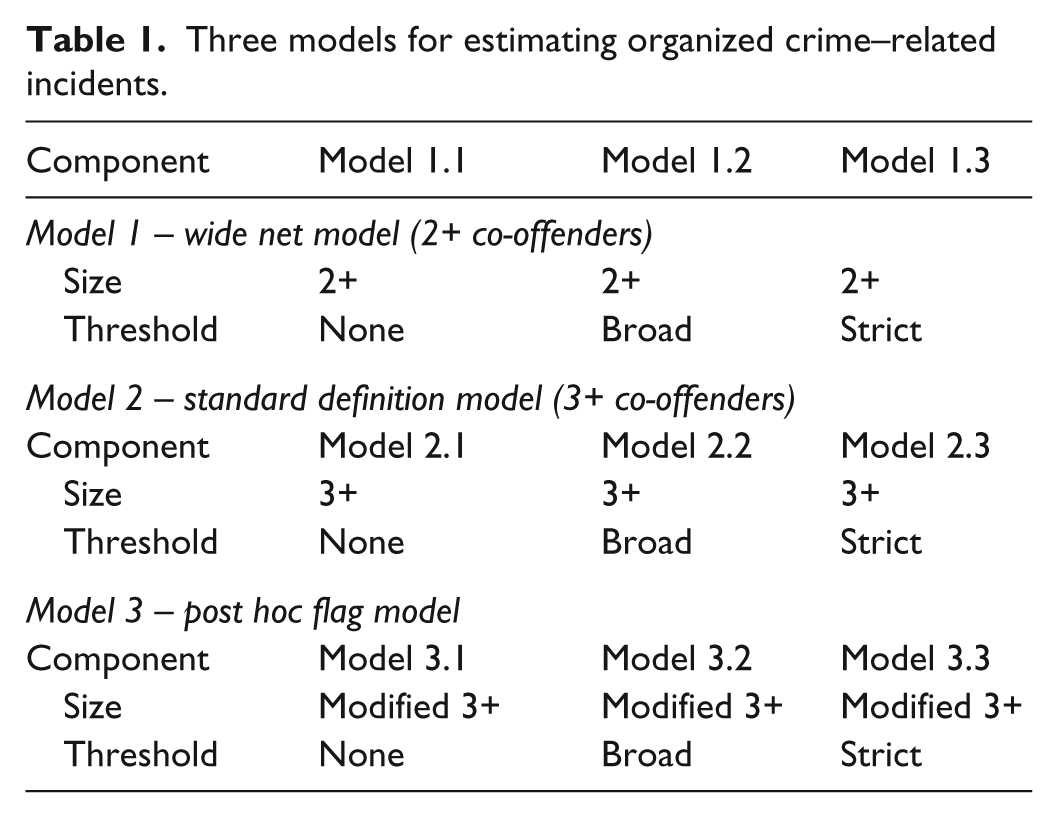
These three models are each subjected to three thresholds for the classification of serious offences, producing nine estimates. Details on each component of the model, such as group size (two or more, three or more co-offenders), definition thresholds for the classification of offences, as well as continuity that is applied to each of the nine estimates, are provided in Table 1.
Component 1: group size
To meet the first standard, we consider the size of the group, differentiating between solo offences and co-offending incidents. Two models for the minimum number of offenders required are put forth: the wide net model (2+ co-offenders), which captures a wider net of offences, and the standard definition model (3+ co-offenders), which prescribes to the definition of group size in the Criminal Code.
1. Wide net model: Co-offending offences with two or more persons involved in the commission or facilitation of the offence
The co-offending threshold is lower than the minimum required by the Criminal Code, but it recognizes the fact that many more co-offenders are usually involved in specific crimes than the ones officially detected by the police (Bouchard, 2007; Bouchard and Nguyen, 2010; Tremblay, 1993). The threshold for a smaller group size (2+) helps avoid false negatives and illustrates how the proportion of incidents vary when adjusting the number of detected offenders from two or more to three or more offenders per incident. At the same time, it is likely to produce higher than desired estimates for the purposes of estimating OC-related incidents. For this reason, it is considered the ‘wide net’ model.
2. Standard definition model: Co-offending offences with three or more persons involved in the commission or facilitation of the offence
This definition adheres to the criteria noted in section 467.1 in the Criminal Code. For this reason, it is labelled the ‘standard definition’ model for estimating the proportion of OC-related incidents.
Component 2: seriousness of the offence 2
To meet the second standard prescribed by the Criminal Code, commission of one or more serious offences, this study considers three different thresholds of seriousness using a list provided by Carrington et al. (2013). The three thresholds provided are: (1) none; (2) broad; and (3) strict. These are to be considered on a continuum for establishing the severity of offence ranges. In instances where there are multiple offences committed across a single incident, the most serious offence is considered.
1. Strict
The ‘strict’ threshold comprises a list of 75 serious offences as identified by Carrington et al. (2013), who used the 2011 UCR2 data to estimate the prevalence and seriousness of co-offending incidents in Canada. In doing so, they categorized all offences as ‘serious’, ‘unclassified’ and ‘not serious’. Serious and not serious offences were categorized using the UCR coding manual of violation codes and relevant Criminal Code of Canada sections, supplemented by Martin’s Annual Criminal Code (Greenspan, Rosenberg, and Henein, 2012). For each UCR violation code, they identified how many Criminal Code offences it referred to. They categorized all offences into indictable offences and summary offences, seeking the maximum prison sentence for all offences pertaining to the specific violation code. A total of 207 offences listed in the Criminal Code and coded in the 2011 UCR survey were identified. Of the 207 offences, 75 (36%) were ‘serious’ (indictable offences with a minimum penalty of 5 or more years in prison, thus providing a strict view of what could be argued to fit under section 467.1), 33 (16%) were ‘not serious’ (summary offences or offences where the maximum penalty was less than 5 years in prison) and 99 (48%) were ‘unclassified’.
2. Broad
To provide a broader threshold, a list of 99 unclassified offences, as identified by Carrington et al. (2013), constitutes the ‘broad’ estimate. Unclassified offences are arguably candidates for being considered ‘serious’ as some offences under this category have a minimum penalty of 5 years in prison (or more). However, when averaging the specific violation code, offences under the code varied in terms of whether they were classified as indictable or summary offences and subsequently in their maximum penalty length.
3. None
The last method for estimation considers the broadest approach, that is, not to apply any threshold and examine the nature of all crimes for which co-offending groups were involved. The ‘no threshold’ scenario is not simply a useful benchmark from which to compare estimates that do attempt to apply a seriousness threshold, but there are also empirical reasons to examine every offence carried out by stable co-offending groups. Most group offences of this kind require at least some level of planning, coordination and execution (Bouchard and Nguyen, 2010; Carrington and Van Mastrigt, 2013; Tremblay, 1993; Weerman, 2003). The estimates provided under this scenario would not necessarily match the definition of a criminal organization, but it is useful to examine how sensitive estimates are to variations in the nature of thresholds, including instances where no thresholds are applied.
Component 3: continuity
The last condition prescribed under section 467.1 of the Criminal Code requires that the group not be randomly formed for the commission of a single offence. To exclude such co-offending groups, only offences in which at least two of the offenders commit more than one offence across time periods (two separate incidents) are considered. If two or more offenders re-offend, with each other or with a differing third offender, it illustrates a pattern of co-offending over time, suggesting that the group was not randomly formed. Prescribing to the minimum threshold of two offenders across at least two incidents is the most effective measure given the nature of official police data (e.g. it underestimates the number of offenders involved per crime) and co-offending trends. It should be noted that the likelihood that the same two offenders are formally detected across two separate criminal incidents is relatively rare.
The post hoc flag model
The last model is treated separately as it follows a different logic for measuring incidents that could potentially be related to OC and its implications for the measurement of OC. The unit of analysis changes from the group to the individual. The idea is to reproduce, albeit imperfectly, the practice of some law enforcement agencies to ‘flag’ offenders based on their gang/OC affiliations. For an offender to be flagged under this category, two steps are taken. First, offenders who have been involved in the facilitation or commission of at least one group crime (three or more offenders, including the offender) that involved two offenders who have co-offended with each other on a previous occasion (meeting the continuity aspect) are noted. These offenders are flagged as ‘potentially associated with a criminal organization’. In the second step, the full data are revisited, and every criminal incident a flagged offender has been involved in is considered under the post hoc model. We do not suggest, however, that every subsequent offence a flagged offender is involved in is necessarily ‘OC-related’, rather the post hoc model provides an alternate way of illustrating the data by extracting the prevalence and the types of offences in which individual offenders interact with the police outside of a ‘group activity’ per se. The post hoc flag model is subjected to the same threshold requirements considered with the previous two families of models (see Table 1).
Classifying crime types
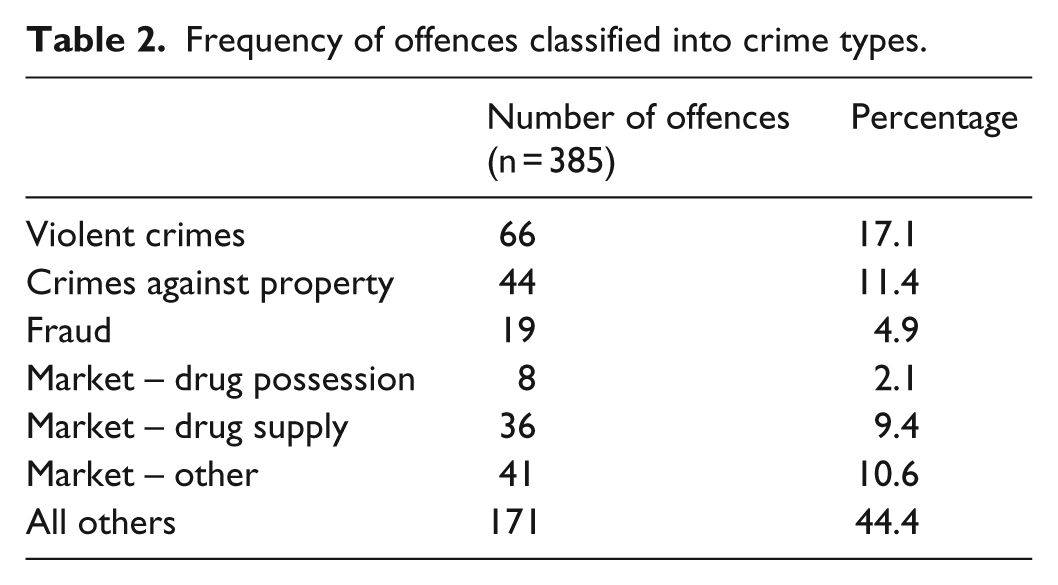
To examine the prevalence of various crimes, all criminal incidents were classified into seven crime types: violent; property; fraud; market – drug possession; market – drug supply; market – other; and all others. 3 Table 2 shows the number of different offences classified in each category. Of the 385 unique offences listed in the MIP data, 17% of offences were classified as violent crimes, 11% of offences as crimes against property, 5% of offences as fraud-related offences, 22% of offences as market offences (2% drug possession, 9% drug supply and 11% other), followed by all other offences (44%). Whereas six of the seven crime types were based on relatively traditional classifications, the ‘all others’ category comprises more general offences that are typically non-serious such as disturbing the peace and indecent action. Additionally, the category comprises offences that were in violation of liquor laws and municipal- or provincial-related offences.
Frequency of offences classified into crime types.
Extracting criminal incidents
For clarity and replication purposes, Figure 1 presents the multiple stages of data extraction and the process of operationalization of the various models. To start, all criminal incidents within the city of Montreal from 2005 to 2009 were extracted for analyses from a provincial policing dataset using the municipal code. This involved removing all duplicate incidents, consisting of incidents that occurred on the same day with the same co-offenders. 4 Initially, the Montreal database comprised 300,446 criminal incidents. However, 14.6% were identified as duplicates, creating a final sample of 256,722 incidents. The second step required extracting co-offences within the city of Montreal. Because the minimum number of offenders required for all models was two, every criminal incident involving two or more offenders was considered. Overall, 4.4% of incidents within the city of Montreal were co-offending instances of two or more offenders (n = 11,417). On average, there were approximately two offenders per criminal incident (standard deviation (SD) = 1.5), with a range of 2–40 offenders.
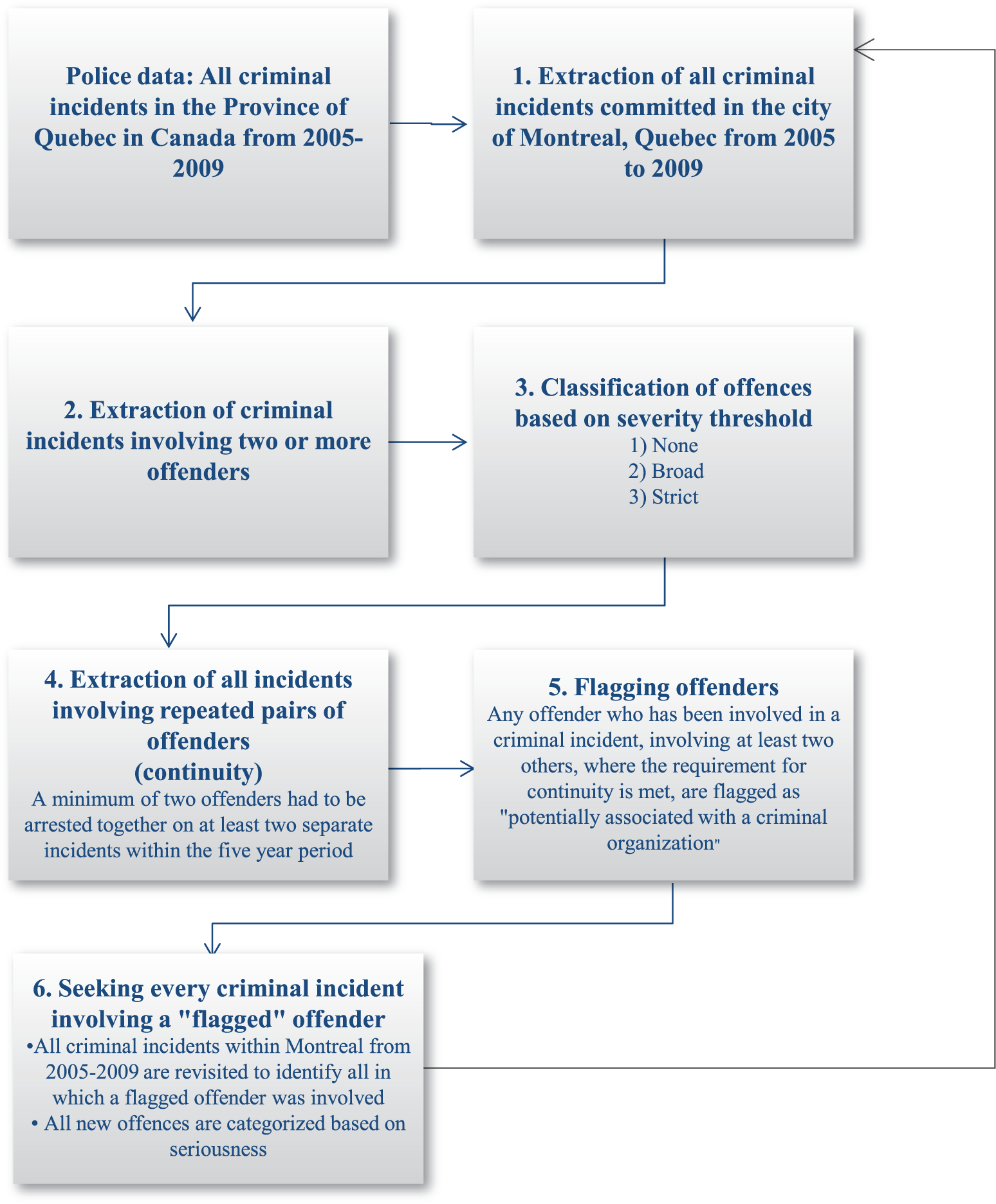
Data mining and the extraction of criminal incidents.
Third, contingent on the seriousness of the offence(s), all co-offending incidents were classified and matched with one of the three threshold categories (none, broad and serious). Where an incident comprised multiple offences, the classification was based on the most serious offence. The fourth step took into account a constant condition for all three families of models – continuity – finding all repeated dyads of offenders (pairs) among the 11,417 cases of co-offences. In other words, incidents in which at least two offenders had offended together across two different periods were extracted. A social network analysis software, Organizational Risk Analyzer (ORA), was used to sift through and identify repeated dyads (Carley et al., 2013). ORA provided a list of all repeated pairs of offenders (involved in two or more offences) based on their Unique ID. In sum, there were 1193 repeat dyads (a pair of offenders being arrested together at least twice during the 5-year period). These pairs appeared 4287 times across 11,417 incidents.
Post hoc flag model
For the final two steps, instead of using incidents as the main unit of analysis, the post hoc model considers the individual – that is, any offence committed by an individual identified with ‘OC’ is ‘OC-related’, whether or not that offence actually involved co-offenders. In operationalizing the post hoc model, the data were restructured from the incident level to the offender level. Offenders involved in incidents meeting the OC definition in model 2.1 (incidents in which individuals at some point were found in the same group of three or more offenders at least twice between 2005 and 2009) were flagged and checked for their presence in the larger initial Montreal data that included solo offences. This took the analyses back to the incident level.
Results
We start with a general overview of co-offending patterns in the data. Consistent with the previous literature (Carrington et al., 2013; Stolzenberg and D’Alessio, 2008; Van Mastrigt and Farrington, 2009), co-offending in Montreal is relatively uncommon in police-reported data with only 4.4% of all criminal incidents involving two or more co-offenders (11,417 of 256,722 incidents). While the raw number of co-offending incidents increased in 2008 and 2009, the proportion of co-offending incidents remains relatively stable at around 4.5% over that time period. Alternatively, when assessing the potential for incidents to be classified as OC, it is useful to consider an alternative unit of measurement: the number of co-offenders per incident. As seen in Figure 2, co-offending occurs in small groups, comprising two or three offenders. Of the 11,417 co-offences within the city of Montreal, 76.2% involved two offenders (n = 8699), 15.4% involved three offenders (n = 1753) and 8.4% comprised groups of four or more offenders (n = 965).
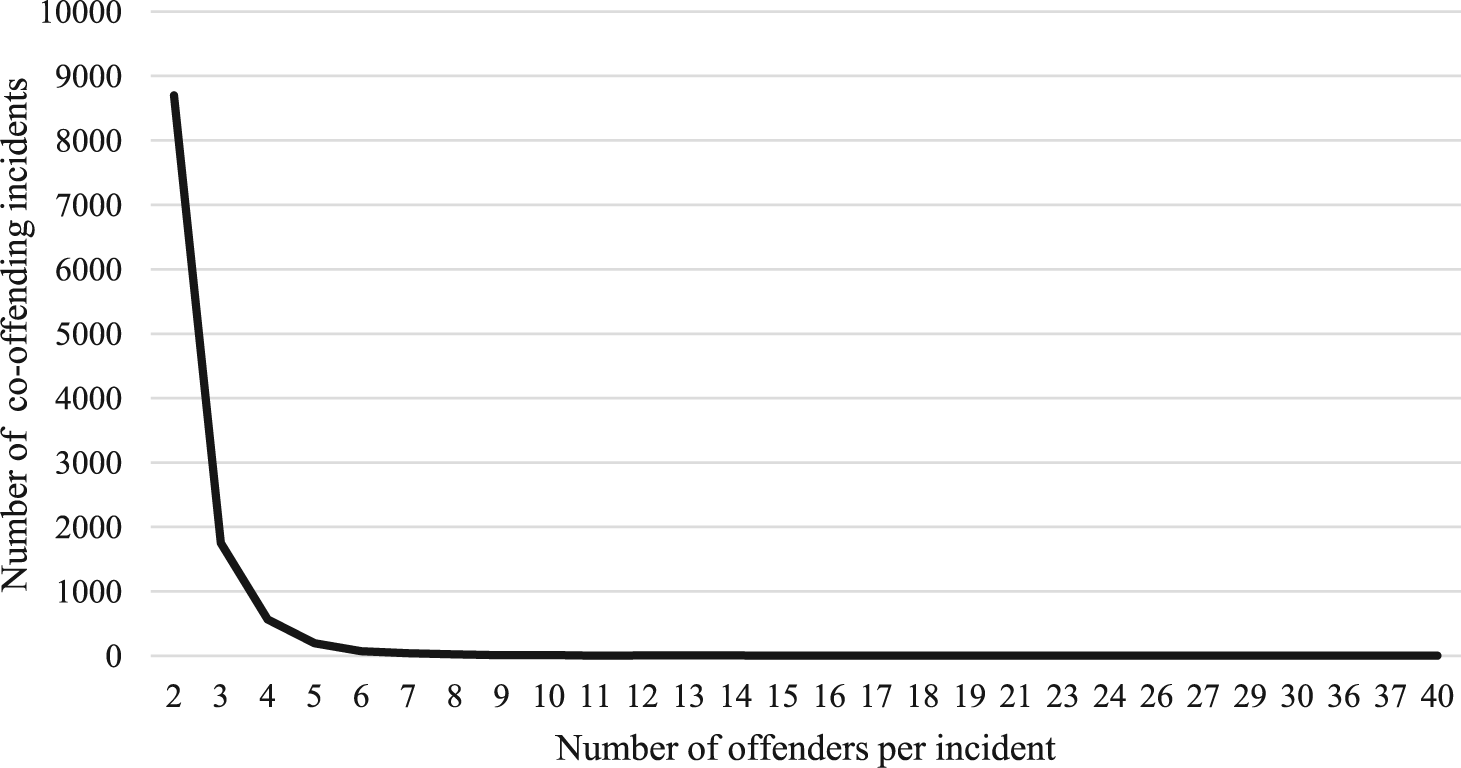
Number of offenders per co-offending incident within Montreal, 2005–2009.
Co-offending incidents do not take into account the continuity component of the official definition of a criminal organization. From the 11,417 co-offending incidents involving two offenders, 2608 comprised pairs that co-offended more than once. This represents 23% of all co-offending incidents in the data. These repeat dyads form the basis of what can potentially be considered ‘OC-related’ offences.
Estimating the proportion of OC-related incidents
Table 3 presents the proportion of OC-related incidents among all co-offending incidents (n = 11,417). In the context of this particular table, the denominator (all co-offending incidents) provides the only suitable comparison point to start assessing the proportion of those incidents involving both repeat dyads and serious criminal offences (i.e. those dyads and groups that made the cut compared to those that could have, but did not make it). The proportion of OC-related incidents to all criminal incidents are, of course, much lower and provided in-text where relevant. Using the standard definition model, the results provide a range of 1.6% (strict) to 6.9% (no threshold) of co-offending incidents fitting the definition of OC. It is important to note that if we follow the definition prescribed in section 467.1 of the Criminal Code of Canada, only 1.6% of co-offending incidents fall under the definition of OC, making the prevalence of OC-related incidents relatively low (0.3% per year). The average group size per OC-related incident is four co-offenders, showing that most criminal organizations, under this model, are relatively small. On the other hand, if the wide net model threshold is used, and we incorporate criminal incidents that involve two offenders, the range is extended from 3.9% (strict) to 22.8% (no threshold).
Proportion of incidents potentially related to organized crime within Montreal, 2005–2009.
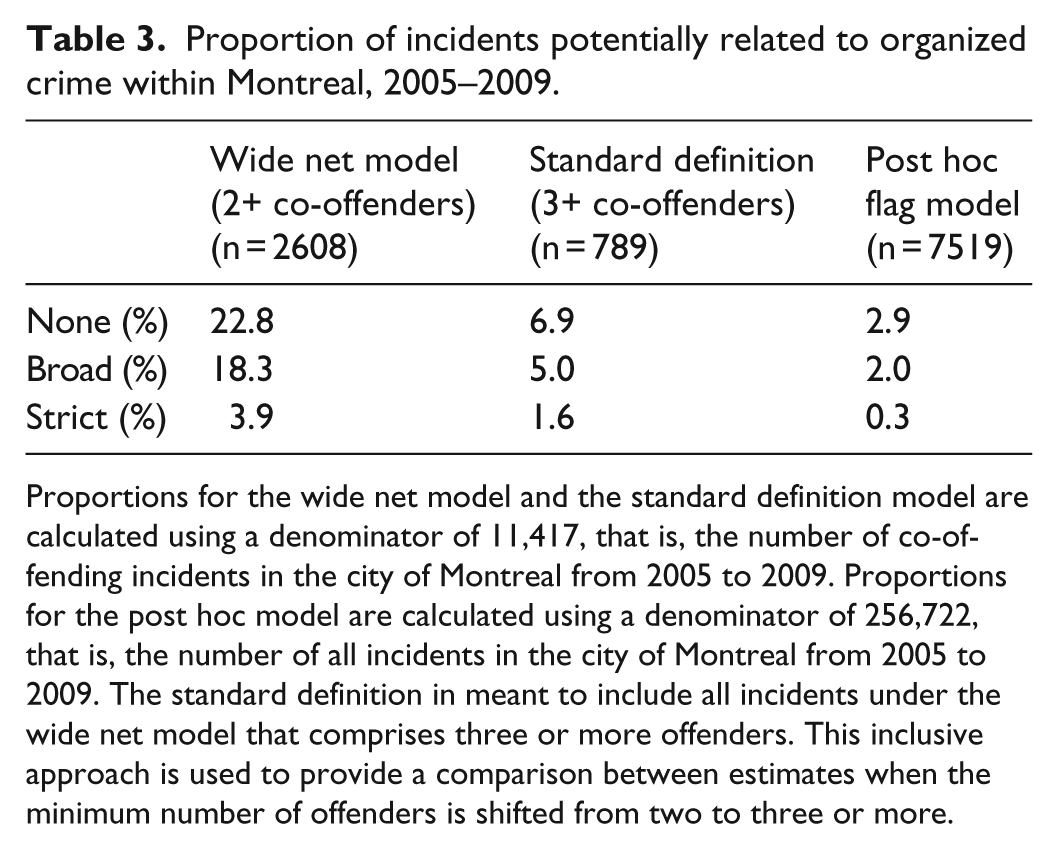
Proportions for the wide net model and the standard definition model are calculated using a denominator of 11,417, that is, the number of co-offending incidents in the city of Montreal from 2005 to 2009. Proportions for the post hoc model are calculated using a denominator of 256,722, that is, the number of all incidents in the city of Montreal from 2005 to 2009. The standard definition in meant to include all incidents under the wide net model that comprises three or more offenders. This inclusive approach is used to provide a comparison between estimates when the minimum number of offenders is shifted from two to three or more.
The logic of the post hoc flag model requires that the total number of criminal incidents in Montreal for 2005–2009 be used as the denominator, which provides numbers that are more modest. Table 3 displays a range of proportions that go from 0.3% to 2.9% when no thresholds are used. Results from the post hoc model suggest that offenders involved in group crime, and subsequent offences thereafter, do not necessarily partake in serious crimes (0.3%). In fact, the crimes that these flagged offenders commit, outside of the incidents for which they are detected within a continuous group, are relatively minor and account for 2.9% of all incidents in Montreal.
OC offences by crime type
Findings also suggest that there is variation in incident rates across crime classification types. Table 4 presents the proportion of crime across criminal incidents involving solo offenders (n = 245,305), co-offences comprising two or more offenders (n = 8809) and incidents potentially related to OC (n = 2608). A distinction between co-offences and incidents potentially related to OC is that, in the latter category, the incident includes the continuity component, involving a pair of offenders who have offended in two or more incidents together. In general, incidents involving two or more offenders, notwithstanding continuity, were most likely to be violent (34%) or property crimes (34%). However, there is diversity in crime types with solo offences. Unlike offences involving more than one offender, solo offences represent greater diversity in that they fall primarily into the ‘all others’ category (45%), an amalgamation of various non-serious incidents. Also representing a different crime repertoire, incidents identified as OC-related consisted primarily of property (57%) and violent crimes (22%). Across all categories, there was consistency in the number of offences involving drug possession and other market-related offences, with low detected rates of market and property offences.
Proportion of crime types across all types of incidents within Montreal, 2005–2009.
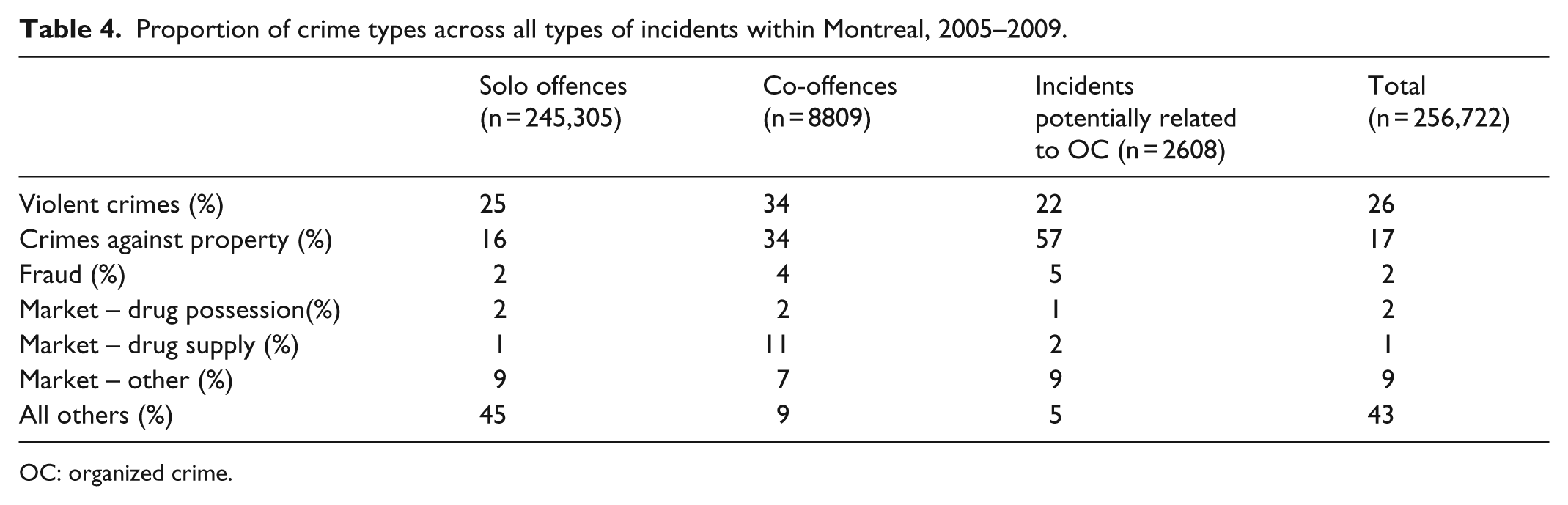
OC: organized crime.
Proportion of crime types across the models: wide net, standard definition and post hoc
Table 5 presents the three OC models developed in this study, aggregating crime types by the severity threshold. Examining across models demonstrates that when using a ‘broad’ offence severity threshold, property crimes are most prevalent, particularly within the wide net model (which considers incidents that involve at least two offenders who co-offended at least twice in the period under study (n = 2608)). In contrast, if a ‘strict’ offence severity threshold is applied, violent crimes consistently emerge as the most prevalent across the three models. For instance, when a strict definition of severity is applied to the wide net model, the proportion of violent crimes increases from 8% to 91%. This trend emerges whether it is framed in the wide net, standard definition or post hoc flag model. The decision, then, to choose a ‘broad’ or ‘strict’ severity threshold when considering what falls under the umbrella of OC-related offences is far from trivial. Considering the activities of criminal organizations, if one is inclined to select strict severity thresholds (serious offences), the results suggest focusing on violent offences and drug supply (to a lesser extent). Furthermore, across models, it is notable that market offences and what are typically considered OC-related offences are generally low regardless of model or offence severity thresholds.
Proportion of incidents aggregated by crime type and seriousness of offence within Montreal, 2005–2009.
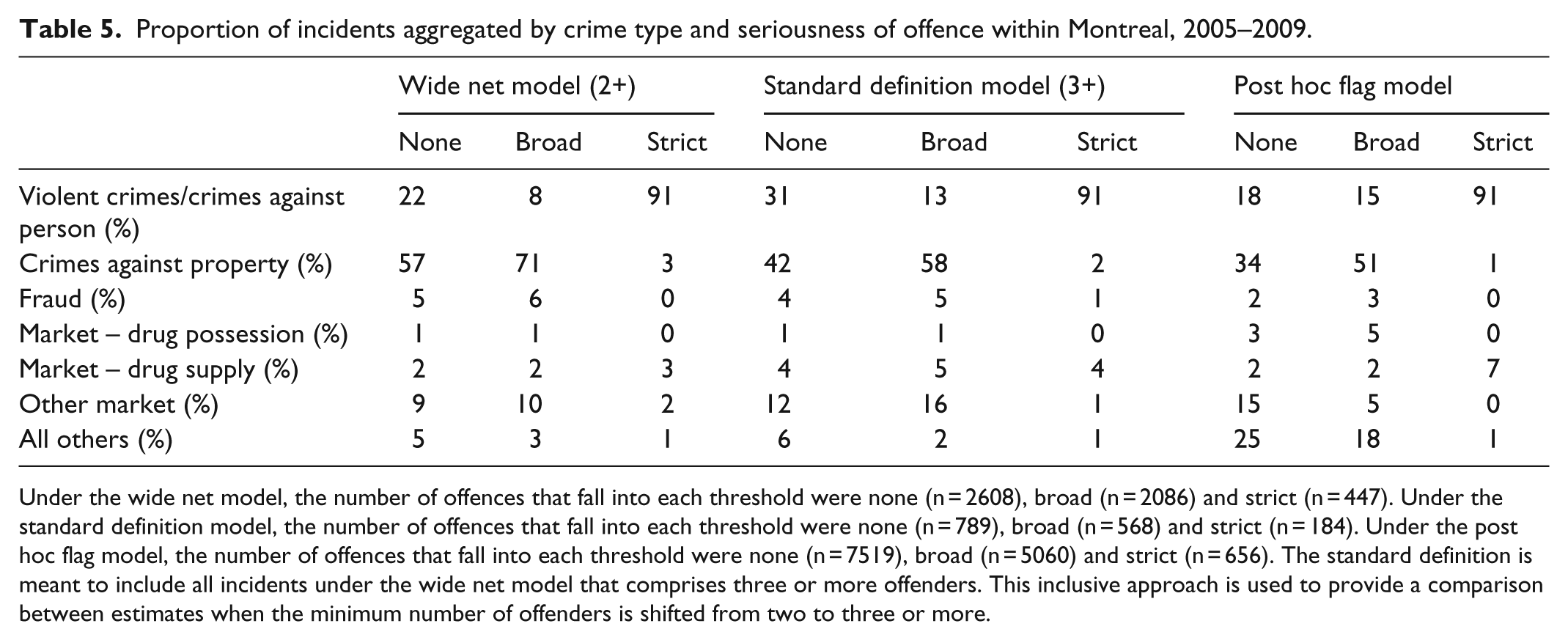
Under the wide net model, the number of offences that fall into each threshold were none (n = 2608), broad (n = 2086) and strict (n = 447). Under the standard definition model, the number of offences that fall into each threshold were none (n = 789), broad (n = 568) and strict (n = 184). Under the post hoc flag model, the number of offences that fall into each threshold were none (n = 7519), broad (n = 5060) and strict (n = 656). The standard definition is meant to include all incidents under the wide net model that comprises three or more offenders. This inclusive approach is used to provide a comparison between estimates when the minimum number of offenders is shifted from two to three or more.
Assessing validity: Montreal-based OC offenders in the Quebec criminal population
This analysis aims to situate all of offenders who were found in a repeat dyad in the larger criminal scene in Quebec. Situating OC offenders within the wider provincial population of co-offenders is crucial as it offers an assessment of the opportunity structures available to such offenders within and beyond the Montreal context. It also offers an opportunity to validate the results from the study’s previous estimates.
Do offenders involved in events fitting the potentially OC model differ in expected ways from non-OC offenders? To assess the network positioning of OC and non-OC offenders, the current Montreal-based subpopulation results were situated within the more general Quebec-based co-offending population that was the focus of analysis in a recent study by Morselli et al. (2015). In that prior study, co-offenders were divided into three separate groups: (1) the top 5% of co-offenders with the most co-arrests (the core); (2) co-offenders beyond the core who were directly connected by co-arrests to core members (the periphery); and (3) the remaining population of co-offenders who were neither part of nor directly connected to the core (the mass). We would expect OC-related offenders to be more likely to be part of the core network of offenders compared to others.
Table 6 compares the two subsamples on a number of characteristics available in the MIP data for all of Quebec and Montreal. First, considering all of Quebec, OC offenders were slightly younger than non-OC offenders. Men were also more likely designated as OC offenders. The most important distinction, however, was found when examining the network features of these two groups. Individuals who were classified as OC offenders were much more likely to be part of the core or periphery segments of the wider Quebec-based co-offending population than the remainder of the Montreal-based offenders. 5 Overall, 23% of OC offenders were part of the core segment of the provincial co-offending network (compared to only 5% for non-OC offenders). In addition, 26% of the OC cases were part of the periphery of the provincial network (compared to 13% for non-OC offenders). Thus, roughly half of these OC offenders are either part of the core subpopulation of the most connected offenders (based on co-arrests) in the province or directly connected to that core. Finally, OC offenders had twice as many co-offending contacts (four vs. two) than non-OC offenders.
Designations of organized crime offenders in core and peripheral segments of Quebec’s and Montreal’s co-offending network. a
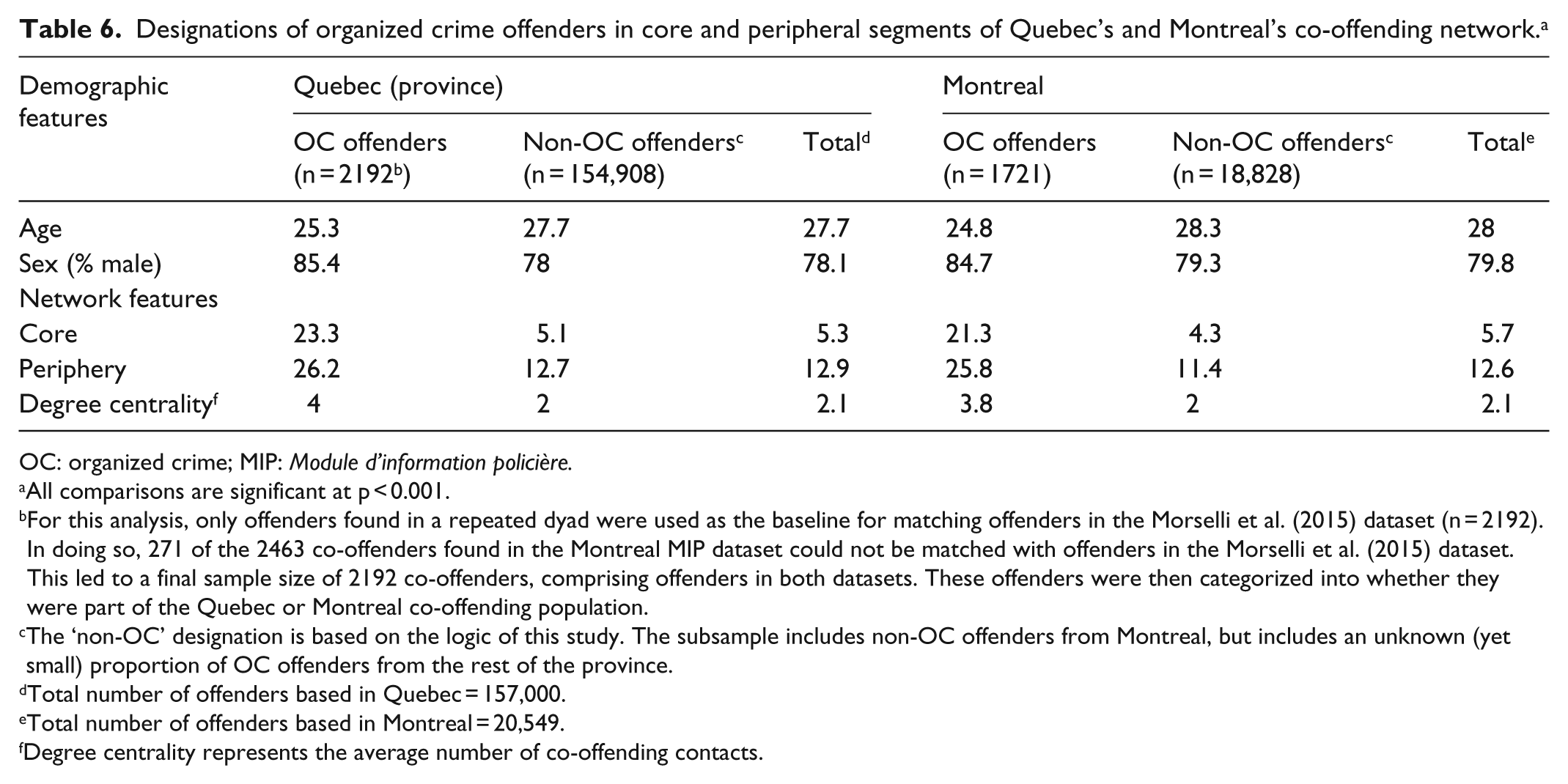
OC: organized crime; MIP: Module d’information policière.
All comparisons are significant at p < 0.001.
For this analysis, only offenders found in a repeated dyad were used as the baseline for matching offenders in the Morselli et al. (2015) dataset (n = 2192). In doing so, 271 of the 2463 co-offenders found in the Montreal MIP dataset could not be matched with offenders in the Morselli et al. (2015) dataset. This led to a final sample size of 2192 co-offenders, comprising offenders in both datasets. These offenders were then categorized into whether they were part of the Quebec or Montreal co-offending population.
The ‘non-OC’ designation is based on the logic of this study. The subsample includes non-OC offenders from Montreal, but includes an unknown (yet small) proportion of OC offenders from the rest of the province.
Total number of offenders based in Quebec = 157,000.
Total number of offenders based in Montreal = 20,549.
Degree centrality represents the average number of co-offending contacts.
Second, we present the same demographic and network features for the Montreal-based subpopulation. Overall, distinctions between OC and non-OC offenders are similar as for the larger provincial population. The age gap is slightly wider, with Montreal-based OC offenders being about 4 years younger than Montreal-based non-OC offenders and about a year younger than OC offenders within the provincial population. Men continue to be more prominent. As for the network features, Montreal-based OC offenders are slightly less represented in the core and peripheral segments of the Quebec co-offending network. However, their presence in these segments of the network remains substantially higher when compared to non-OC offenders. These analyses offer some face value validity to analyses in the preceding sections: the offenders considered as potentially part of criminal organizations under the Criminal Code definition are indeed more likely to be key players in the wider Quebec criminal scene.
Discussion
This study’s research design was intended to provide a series of estimates and general outlooks on the scope and structure of OC in Canada. The general aims were to take a first step towards quantifying the broad conception of OC in the Canadian legal context and examine the crime types in which criminal organizations (and organized criminals) are involved. The incentive for this study was guided by two parallel developments in past research and policy. On one hand, there is a lack of consensus in academia on what constitutes OC. On the other hand, there has been a strong willingness (and ability) of many countries to develop their own formal definition of OC for prosecution purposes. The variations in definitions have led to irregular control efforts and questionable legislative constructs that span countries (Ayling, 2011; Desroches, 2013). Having opted for an inclusive formulation of a criminal organization has placed Canada in line with countries that sought more flexible strategies for containing OC. At the same time, expanding the parameters of the phenomenon for the sake of control efforts may also lead to serious collateral damages that extend from such judicial imprecisions (see Naylor, 1997). In any case, the problem with applying any sort of legislative definition to a type of crime that is in itself a fluid phenomenon is not easy. The problem with the definition of OC provided by the Criminal Code, and with our own study as well, is that it attempts to identify and mechanically measure a phenomena that cannot easily be placed in rigid categories.
The approach followed in this study was meant to relativize the broad conception of OC in the Canada’s and most other legal context. The strategy of combining models that vary the co-offending unit size and form with thresholds that vary offence severity is consistent with the main discrepancy dividing scholarly and policy assessments of OC. While the former have been traditionally restrictive when defining OC, the latter have been generally inclusive. This break between the two distinct settings can be traced back to the onset of the RICO statutes in the United States, the main inspiration for Canada’s section 467.1 and for criminal organization or criminal enterprise statutes across the world. RICO was designed to be flexible and interpreted liberally (see Blakey, 1994, for a defence of this feature; see Lynch, 1990; Morselli and Kazemian, 2004; Naylor, 1997 for more critical assessments). The differences in estimates are indeed telling, and such an effort to sort offenders, co-offending instances and crimes that may be associated with OC proved to be very effective. Using the current method, and the definition of OC prescribed by the Canadian Criminal Code, we do not miss any OC-related offences reported in police data; however, we do get false positives especially when the criteria become inclusive. When it comes to the combinations of the three models and thresholds that were devised, one stands out in particular. The representation of OC that emerges from the broad threshold (wide net model, n = 2086; standard definition, n = 568) is vastly different from that obtained from the strict threshold (wide net model, n = 447; standard definition, n = 184). What the current approach offers is a complete overview of what one should expect in terms of the proportion of incidents linked to OC across all variations. Thus, a good start to identifying OC-related incidents using the current method would be to hone on the identified cases filtered from the masses of police data and to screen through the files to better understand the scope and extent of each criminal incident.
While there is some consensus regarding the continuous and durable features of OC, a definitional challenge concerns the type of crimes that fall within the OC repertoire. Honing in on diversity among crime-type distinctions, our variations across models reflected the types of offences that could potentially be related to OC. For instance, under the wide net model, with the broad definition of crime severity, the considerable majority of criminal incidents fell in the property crime category but reversed when a strict definition of offence severity was applied. Another distinction emerged with the diversity between solo-type offending and co-offending. Solo offenders were most likely to partake in ‘all other’ offences, an amalgamation of typically non-serious offences, where offenders in groups of two or more (OC-related or non-OC-related) were more likely to partake and be detected for crimes against property and violent crimes. Why? Traditional definitions of OC have restricted the scope of crime to what are generally referred to as market crimes (Naylor, 1997, 2003). Such crimes cover the supply of illegal goods and services or the illegal supply of legal goods and services (see Vold and Bernard, 1986, for such a general appraisal). Our findings on market offences deviate from the more traditional views of incidents involving co-offending, and particularly, criminal organizations, where market offences have typically dominated. This could be due to two reasons. The first concerns the methodological approach. To classify crime types, we considered the first and most serious offence; therefore, if an event had multiple offences associated with it, violent types of crimes often took precedence in terms of its severity (murder, attempted murder and robbery with a weapon). Second, it may be due to the nature of market crimes. For instance, those who get involved in market offences require skill as it constitutes some degree of planning and organization. Not all offenders are exposed to these opportunities (Desroches, 2005; Shover, 1996), which may reduce their prevalence in police data. Nor do market crimes often involve a victim, influencing detection rates and the risks of being arrested (Bouchard and Tremblay, 2005). In all aspects, violent crimes are detected more often than other types of crimes. In the eyes of law enforcement, they pose greatest harm to society, and they are generally associated with more severe penalties and are reported in official police data. Thus, a detection strategy, such as the one used in the study, that only considers the most serious types of offence within a criminal event is bound to capture these types of crimes in particular.
Traditional definitions of OC where market crimes are the focus are radically different from legislative and general criminal justice definitions of OC in which there subsist long lists of predicate crimes that offenders may find themselves involved in. The inclusion of predatory crimes, such as robbery, fraud or homicide, blurs the boundaries of OC by orienting the phenomenon towards a more general organization in crime framework, thus shifting the emphasis away from the supply-demand market dimensions and more towards the organizational dimensions (e.g. Varese, 2011). From a law enforcement perspective, if the inclination is to converge on the most serious offences (strict threshold), under any model, focusing on violent offences will take precedence as the propensity and the capacity to use violence are often necessary for criminal groups to maintain their market position (Caulkins et al., 2006; Desroches, 2007; Reuter, 1983).
Thus, an extension of the findings is the creation of a new classification that would situate the likelihood that a group phenomenon is (or is not) OC. A recommendation would be in favour of a tripartite classification that varies from co-offending groups that are: (1) purely non-OC; (2) mid-range/crime groups; and (3) criminal organizations. Mid-range crime groups are represented in the difference between the wide net and standard definition models, and they would comprise an assortment of continuous and semi-serious crime groups. Such groups may not be criminal organizations, but they matter considerably because their offences call for more criminal justice resources. As such, linking the definition of OC to the structure or the extent of the organization may not be the most effective measure for legislation. Instead, examining the contextual surroundings of the organization (e.g. their control of the market or use of violence to maintain that control beyond what is expected from individual criminals) should be given greater consideration (Curry and Mongrain, 2009).
In line with this suggestion, investments should also be made to regularly track the network features of OC and non-OC offenders. The identification of OC offenders with the co-offending data proved to be effective when examining the structural features of the overall Quebec co-offending network. Whether the focus was on the entire province or the specific Montreal-based segment of co-offenders, the OC flag was a determinant for distinguishing age differences, sex differences and especially networking positions among the most connected offenders in wider co-offending patterns across the entire province. Monitoring the network features of non-OC offenders is essential since many individuals falling in the non-OC category at one point in time may find themselves among the OC offenders in a later point in time.
Conclusion
This study uses official police-reported crime data to provide a method to estimate the frequency and proportion of incidents related to OC. It is a start to getting at the core and extent of OC using police-reported data. The assumptions of each model are explicit and can be further refined in future work. It should be noted that there are limitations to the current methodology, and more work is needed to approach the level of confidence needed to make concrete recommendations on which model is better suited to represent OC.
First, the estimates provided in this study only consider criminal incidents within the city of Montreal from 2005 to 2009, which were the most recent and complete years available to the researchers. These restricted data clearly affect the level of generalizability to other cities and provinces. Our findings may not be generalized to other settings where criminal organizations may be less active. In addition, a 5-year window is relatively small when looking at the continuity of offenders involved in OC. Second, we recognize the limitations of using police-reported data that often lead to an underestimation of the total volume of criminal incidents committed. Our proportions rely on data that are already under-representative of the number of crimes and offences that exist in the total population. This holds particularly true for certain types of crimes such as market offences that often go undetected and/or take many years to investigate before arrests occur. Furthermore, co-offending incidents, in general, rarely account for all individuals involved in a criminal group or organization. This, in turn, affects the number of criminal incidents that can be attributed to OC as prescribed by section 467.1. However, an advantage of police data, rarely emphasized, is that it allows us to look at the bigger picture, diverting from a ‘unique case study’ approach that is more detailed in nature, but unable to provide a macro-level perspective that we aim to provide when measuring the scope of OC. Finally, a component of incidents related to OC is that it generates some type of material benefit. Currently, in the Criminal Code of Canada, there is no prescribed definition of material gain; rather, material gain may have various outcomes (e.g. reputational or financial; Saunders and Lawrence, 2013).
Despite these limitations, this study contributes to policing and OC research by providing a framework and set of methods to estimate the proportion of OC incidents in any jurisdiction. The methods take into account the strengths and weaknesses of police data when applied to the current Criminal Code definition of a criminal organization. Future work requires the incorporation of intelligence and investigative data to describe in finer (and ‘networked’) terms the structure and the criminal activities of the small groups and large organizations populating the Canadian criminal scene.
Footnotes
Acknowledgements
The authors would like to thank Anton Maslov and Austin Lawrence from Public Safety Canada for their helpful comments on an earlier version of this article.
Declaration of conflicting interests
The author(s) declared no potential conflicts of interest with respect to the research, authorship and/or publication of this article.
Funding
The author(s) disclosed receipt of the following financial support for the research, authorship, and/or publication of this article: This work was supported by Public Safety Canada. The content is solely the responsibility of the authors and does not represent the official views of Public Safety Canada.