




Abstract
Background:
In contrast to fetal scar tissue, adult scar tissue presents with visible scarring. Topical silicone creams have been shown to improve the appearance of scars. This case series compares the genetic expression of post-surgical scar tissues that received topical scar treatment with silicone cream, SKN2017B, or no treatment. SKN2017B is a recently formulated silicone-based scar cream that contains selective synthetic recombinant human growth factors, hyaluronic acid, and vitamin C. We hypothesise that scars treated with silicone-based scar creams have a more favourable genetic expression resembling a well-healing scar.
Methods:
Women who had undergone an abdominoplasty were included in this investigation and randomly assigned to treat part of the scar with topical silicone, another part with SKN2017B, and to leave a third part untreated. After four weeks, punch biopsies were taken and the RNA sequenced. Healthy abdominal skin was biopsied as baseline data. Genes of interest were identified and median values were calculated for the samples.
Results:
SKN2107B-treated scars demonstrated the lowest collagen type I to collagen type III ratio. Other key genes of interest in wound healing showed the lowest (favourable) expression of fibroblast activation protein alpha, lysyl oxidase and cartilage oligomeric matrix protein; the highest (favourable) expression of fibronectin type III domain containing 1 and matrix metallopeptidase 9 were found in scars treated with SKN2017B.
Conclusion:
The results of this small case series demonstrate a trend that those scars treated with topical silicone cream, notably SKN2017B, display the most favourable gene expression for wound healing.
Lay Summary

Silicone scar creams have been shown to improve the appearance of scars. In this case series, we evaluated the genetic expression of post surgical scars that were treated with SKN2017B (a silicone-based cream incorporating novel growth factors and ingredients), silicone scar cream or skin left untreated. We hypothesised that scars treated with a silicone-based scar cream would demonstrate a more favourable genetic expression trending toward the profile of a well-healing scar, as seen in fetal scar tissue, which undergoes scarless healing. For this case series, we included women who had undergone an abdominoplasty. They were instructed to treat part of the scar with silicone cream, another part with SKN2017B and to leave a third part untreated. After four weeks, punch biopsies were taken and the RNA sequenced. The genes of interest for the samples were identified due to their roles in wound healing based on peer-reviewed literature. The median expression levels of the genes of interest were calculated and compared between the 3 patients. The results of this case series demonstrate a trend that those scars treated with silicone cream, notably SKN2017B, display the most favourable gene expression for wound healing. Future studies should employ larger samples of scar tissues for gene expression analysis with longer followup period time.
Background
Topical scar creams have been shown to reduce the appearance of scars, which can be a cosmetic concern to patients. Topical silicone gels and/or creams are considered to be both safe and effective in improving the appearance of cutaneous scars.1–5 Topical silicone gels and/or creams work by a mechanism of hydration and occlusion, which reduces water loss from the scar, restores homeostasis to the scar and reduces capillary hyperaemia. The reduction in capillary activity reduces collagen deposition via modulation of keratinocytes which act on skin fibroblasts.1,2,5 In addition to topical silicone, other ingredients have also been shown to improve the appearance of scars, such as vitamin C, high molecular weight hyaluronic acid and Centella asiatica.2,6–11
We are aware that fetal scars have a unique ability to heal without visible scarring; this can be attributed, at least partly, to higher levels of hyaluronic acid (HA) and transforming factor beta-3 (TGF-β3) within fetal scar tissue. 8 Furthermore, fetal scar tissue demonstrates a low production of collagen type I to collagen type III ratio.9,10
Despite an increase in the study of genetic factors involved in wound healing, there has been a lack of genetic expression analysis in evaluating scars and, more specifically, evaluating scars being treated with different products. RNA sequencing has become an accessible means of sequencing, identifying and quantifying gene expression. In this case series, we set out to compare the genetic expression in scar tissues that have not received topical scar cream treatment to those that have. Furthermore, this case series evaluates genetic expression between topical silicone cream and SKN2017B, a recently formulated silicone-based scar cream that also contains synthetic recombinant human TGF-β3, HA and vitamin C as key ingredients. The cream also contains several other synthetic recombinant human growth factors, Aloe vera extract and Centella asiatica extract, all of which have been individually shown to positively influence wound healing. A large, randomised multicentre double-blind clinical trial comparing SKN2017B to topical silicone cream showed that SKN2017B demonstrated a 73% improvement in the appearance of scars when compared to silicone cream. 11
We hypothesise that a genetic expression analysis of skin biopsies of individuals with recent scars treated with SKN2017B will express genes that are more favourable towards a well-healing scar than regular silicone cream and untreated scars.
Methods
This case series investigated gene expression in post-surgical scars that were treated with topical SKN2017B, treated with topical silicone cream (dimethicone 10%) or left untreated. The protocol for the case series was approved by an Institutional Review Board and was conducted according to the Declaration of Helsinki and the Health Insurance Portability and Accountability Act.
Participants were randomly instructed to treat one-third of their scar with topical SKN2017B, one-third with topical silicone cream and the remaining one-third of the scar was left untreated. The evaluators and individuals were blinded to which topical treatment was being used in which area. Individuals applied both creams to the assigned areas twice daily for four weeks starting four weeks postoperatively. After four weeks, 2-mm punch biopsies were taken from the untreated scar, the scar treated with SKN2017B, the scar treated with topical silicone cream and healthy skin near the scar but unaffected by the abdominoplasty. Healthy skin served as the individual’s baseline as little to no gene expression of RNA involved in wound healing should be expressed. The samples were stored in RNAlater Stabilized Solution (Ambion Inc., Foster City, CA, USA). All samples were transferred to the John Wayne Cancer Institute at Providence St. John’s Health Center in Santa Monica, California where RNA libraries were sequenced on an Illumina HiSeq 2500.
Once the raw sequencing reads were obtained, they were screened for adapters and trimmed using the Trimmomatic program. 12 The trimmed reads were then mapped to the GENCODE version 19 human genome reference sequence using STAR version 2.4.2a with default parameters. 13 Read counts, which were used to quantify the level of gene expression, were obtained ‘–quantMode GeneCounts’ function in STAR. From this information, a list of all genes expressed was compiled. Using a Wald’s test, genes with statistically significant difference in expression between the four samples (P < 0.1) were identified using the DESeq2 Bioconductor package. 13 A literature search was used to narrow the genes of interest to those whose effects on healing had been previously studied.9,10,14,15
Results
Three women (average age = 34.3 years ± 5.5) were included in the case series and biopsies were obtained from their abdominoplasty incisions. After RNA sequencing analysis, a total of 25,371 genes were found to be expressed in the biopsied tissues and 86 demonstrated statistically significant (P < 0.1) expression between the four types of tissue samples: healthy skin; untreated post-surgical scar; post-surgical scar treated with topical silicone cream; and post-surgical scar treated with topical SKN2017B. Of the statistically significant genes identified, seven genes were found to be associated with wound healing and supported by previous literature. The genes identified were: collagen type I alpha 1 chain (COL1A1) and collagen type I alpha 2 chain (COL1A2);8–11,14,15 collagen type III alpha 1 chain (COL3A1);8–11,14,15 fibronectin type III domain containing 1 (FNDC1);8–11,14,15 matrix metallopeptidase 9 (MMP9);10,14,15 lysyl oxidase (LOX);8,10,14 fibroblast activation protein alpha (FAP);8–11,14,15 and cartilage oligomeric matrix protein (COMP). 15 A low collagen type I to collagen type III ratio is considered to have the best healing outcomes for scars. Additionally, high FNDC1 and MMP9 expressions are associated with well-healing scars.8–10,14,15 In contrast, low LOX, FAP, and COMP expressions are implicated as important trends in well-healed scars.8–11,14,15
The visual representation of median expression counts reported for each of the four samples (healthy skin, untreated scar, topical silicone cream-treated scar and topical SKN2017B-treated scar) are summarised in Figures 1 and 2. The ratio for the medians for collagen type I to collagen type III are as follows: 2.09 for healthy skin; 1.34 for untreated scar; 1.08 for topical silicone gel-treated scar; and 0.90 for SKN2017B-treated scar (Figure 1). SKN2017B-treated scars demonstrated the highest FNDC1 and MMP9 median expression counts in these factors for all healing tissues biopsied. SKN2017B-treated scars demonstrated the lowest median LOX, FAP and COMP of all healing tissues biopsied (Figure 2). These results support that skin biopsies treated with SKN2017B demonstrated a trend toward optimal wound healing more so than the scars treated with topical silicone cream and untreated scars in our case series.
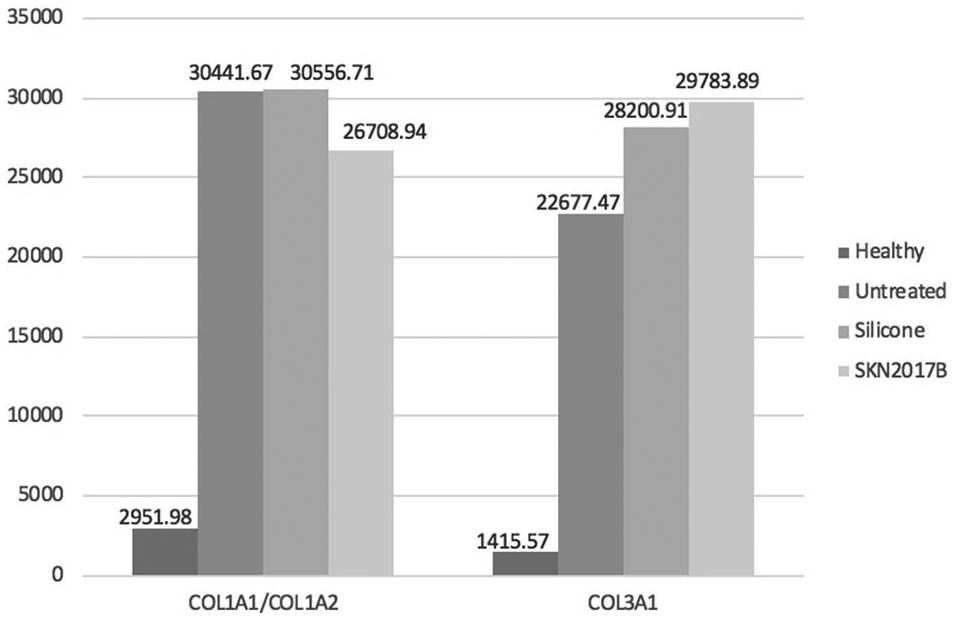
Median gene expression counts for collagen type I alpha 1 chain/collagen type I alpha 2 chain (COL1A1/COL1A2) and collagen type III alpha 1 chain (COL3A1). A low collagen type I to collagen type III ratio is considered to have the best healing outcomes for scars and is demonstrated in fetal scarless healing. SKN2017B demonstrates the lowest ratio, 0.90.
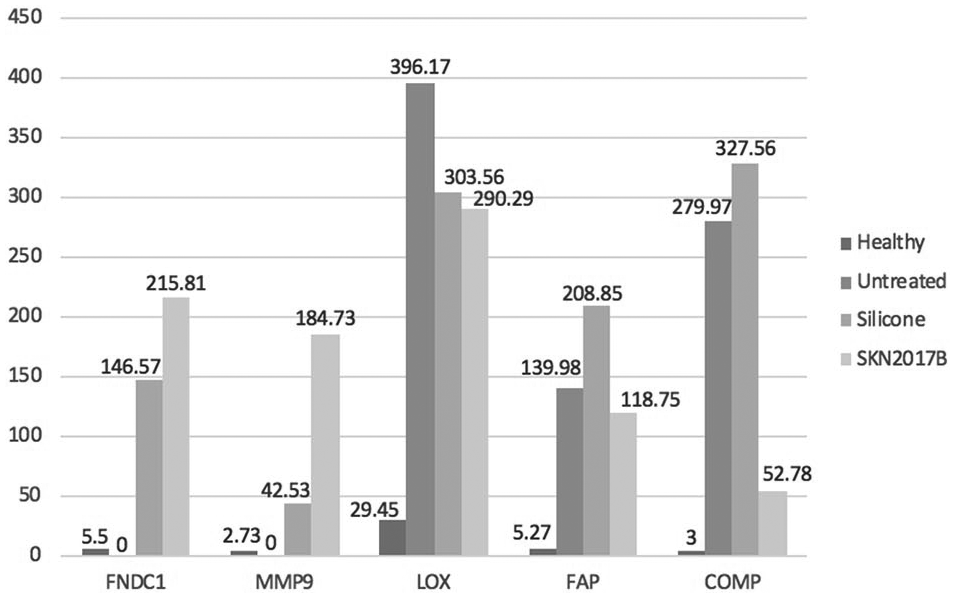
Median gene expression counts for fibronectin type III domain containing 1 (FNDC1), matrix metallopeptidase 9 (MMP9), lysyl oxidase (LOX), fibroblast activation protein alpha (FAP) and cartilage oligomeric matrix protein (COMP). High FNDC1 and MMP9 expressions are associated with well-healing scars; SKN2017B-treated scar biopsies demonstrated the highest median expression. In contrast, low LOX, FAP and COMP expressions are implicated as important trends in well-healed scar; SKN2017B scar biopsy demonstrated the lowest median expression.
Discussion
The results of this case series have demonstrated a trend that scars treated with topical silicone cream, most notably SKN2017B, resemble the closest genetic expression to that of a well-healing scar when compared to no treatment. A low collagen type I to collagen type III ratio is considered to have the best healing outcomes for scars and is demonstrated in fetal scarless healing.8–10 SKN2017B demonstrates the lowest ratio, 0.90, of the all the scar tissue biopsies. Additionally, low FAP, LOX and COMP expressions are implicated as important trends in a well-healed scar.8,10,14,15 The SKN2017B-treated scar biopsy demonstrated the lowest median expression compared to the regular topical silicone cream and untreated scar biopsies in the expression of all three of these factors. High FNDC1 and MMP9 expressions are also associated with well-healing scars.14,15 SKN2017B-treated scar biopsies demonstrated the highest median expression counts in these factors.
Although we are seeing trends that the scars treated with SKN2017B have favourable gene expression toward optimal wound healing, there are limitations in this case series. Our case series only evaluated three individuals with a one-month follow-up; a larger study needs to be performed with a longer follow-up period to better evaluate the differences between topical scar creams on scars in gene expression. Our rationale to evaluate our scars after one month of topical scar cream application is based on our previous studies that we were able to detect changes in scars even within one month of using SKN2017B.11,16
Conclusion
The three cases examined demonstrate a trend that the scars treated with topical silicone cream, notably SKN2017B, display the most favourable gene expression for wound healing. Future studies should employ larger samples of scar tissues for gene expression analysis with a longer follow-up period to further explore the preliminary results of this case series.
Footnotes
Acknowledgements
The authors thank Cristina Luna for her help in coordinating the study.
Declaration of conflicting interests
CIZ is the founder of MD Medical Designs, Inc. and has been involved in the clinical development and testing of SKN2017B. SKN2017B has undergone extensive testing and it has recently been published in a large multicentre study in the Aesthetic Surgery Journal ( ). In the present study, gene expression analysis was performed at an outside molecular genetics facility, where the authors provided samples to them. CIZ was only involved in performing the punch biopsies. The other authors declared no potential conflicts of interest with respect to the research, authorship, and/or publication of this article.
Ethical approval
The authors confirm that the necessary written, informed consent was obtained from patients for this article
Funding
The author(s) disclosed receipt of the following financial support for the research, authorship, and/or publication of this article: Funding was provided by MD Medical Designs, Inc.