



Abstract
The COVID-19 pandemic and ensuing lockdowns disrupted social connectivity, prompting individuals to seek alternative sources of socioemotional support. This study investigated whether beat-based music, characterized by the Spotify danceability feature, served as a surrogate for social reward during the first European lockdown (March–May 2020). We integrated large-scale Spotify streaming data with psychological measures of socioemotional support from the COVIDiSTRESS global survey and governmental stringency indices across 11 European countries. Results from a linear-mixed effects model indicate that people listened to music with higher danceability during social distancing after the COVID onset (30 March – 30 May 2020) compared with the same pre-COVID period in the year before. A quasi-Bayesian multilevel mediation analysis further revealed that stricter social distancing policies predicted lower perceived socioemotional support, which in turn was associated with increased listening to more highly danceable music. This effect was specific to certain facets of socioemotional need, namely emotional attachment and reassurance of worth, which delineates the instantaneous rewarding nature of social recognition, often encountered during common activities, such as dinner parties, (band or dance) rehearsals, or (themed) excursions. These findings suggest that individuals may intuitively gravitate toward rhythmically engaging music to compensate for diminished social affirmation and bonding, highlighting beat-based music as a potential non-pharmacological tool for addressing transient socioemotional deficits during social isolation.
Introduction
Music Listening and Socioemotional Coping
Music listening has the physiological potential to induce dopamine-mediated pleasure (Ferreri et al., 2019; Mas-Herrero et al., 2018; Salimpoor et al., 2011), the oxytocin-linked feeling of social connectedness (Tarr et al., 2014), and the cortisol-mediated reduction of emotional stress (Khalfa et al., 2003; Ooishi et al., 2017). Therefore, it is not surprising that music is used as a surrogate for unfulfilled socioemotional needs, defined as fundamental psychological requirements for belonging, attachment, and emotional support, which are essential for well-being and social functioning (Bowlby, 1969; Deci & Ryan, 2000). The role of music might become particularly relevant during periods of social distancing, such as during the lockdowns and physical distancing measures implemented throughout the COVID-19 pandemic, as shown by multiple studies (cross-culturally: Ferreri et al., 2021; Fink et al., 2021; Granot et al., 2021; in Israel: Ziv & Hollander-Shabtai, 2022; and Spain: Cabedo-Mas et al., 2020; Martín et al., 2021). While Sim et al. (2022) observed a decrease in music listening during the pandemic, a cross-cultural survey conducted during the first lockdown (April–May 2020), by contrast, found that music listening was the activity that increased the sixth most in importance during lockdown compared to before – ranking just behind activities such as calling people, reading or watching news, watching movies/series, cleaning, and cooking (Fink et al., 2021). Participants of their study who experienced increased negative emotions reported using music for solitary emotional regulation, whereas those who experienced increased positive emotions reported using music as a proxy for social interaction. Correspondingly, Granot et al. (2021) found that out of different coping strategies, music engagement, such as listening or performing, was most effective in obtaining COVID-related well-being goals of enjoyment, mitigating negative emotions, and enhancing self-connectedness. Also, it was the second-best-rated strategy (following socialization) to induce a feeling of togetherness. While reports of socioemotional coping through music listening are consistent, Ferreri et al. (2021) demonstrated that sensitivity to musical reward positively correlated with increased music-based coping during the first lockdown, whereby changes in music listening behavior were subjectively more prominent than other music-related coping strategies, such as playing music or dancing. Finally, a study by Mas-Herrero et al. (2023) suggested that the negative relation between depressive symptoms and music engagement during the first lockdown was mediated by reward-related mechanisms.
With respect to distinct socioemotional needs, such as attachment or recognition, being addressed by music listening, research literature is relatively sparse. Previous work on the role of music as a socioemotional surrogate nevertheless repeatedly highlights the feeling of social connectedness. For example, Schäfer and Eerola (2020) and Schäfer et al. (2020) found that music can reduce loneliness (i.e., an affective signal of unmet socioemotional needs; Cacioppo et al., 2006), evoke social memories, and enhance empathy, offering a sense of companionship even in solitary contexts. Moreover, Groarke et al. (2022) showed that older adults relied on music during the COVID-19 pandemic for emotional regulation and social connection, and Paravati et al. (2025) demonstrated that music can also buffer against social threats, such as exclusion, by reinforcing feelings of belonging and social security. Finally, a study conducted by Spotify and Qualtrics in the U.S. found that “quaranteaming” during the first lockdown led to people listening more in groups and to connecting to remote friends and family via collaborative playlists, Zoom dance parties, and long-distance karaoke (Spotify editorial team, 2020).
Musical Choices in COVID Times
Although the aforementioned studies confirm the subjective relevance and effectiveness of music listening for socioemotional coping during the COVID-19 pandemic, it remains unclear why music is effective in driving socioemotional benefits or, in other words, which music features (i.e., their acoustical properties) and their combination are favorable in this regard?
In this context, Eden et al. (2020) observed that positively valenced and humorous music was linked to reduced anxiety during initial social distancing periods of the COVID pandemic. It has even been proposed that positively valenced music played a privileged role in socioemotional coping during lockdown (Hansen, 2022). Indeed, qualitative and quantitative surveys have shown a prominence of positivity and humor in coronamusic (Hansen et al., 2021, Hansen, 2022), and a subsequent empirical study has found that listening to happy music during the pandemic was associated with lower stress levels, better mood, and greater calmness (Feneberg et al., 2023). A study by Yeung (2020, 2023) further provides evidence that the lockdown significantly increased music consumption on Spotify in terms of (positively and negatively valenced) old songs and associated nostalgia. Maloney et al. (2021) performed a thematic analysis of metadata entered by listeners into their Spotify playlists, which revealed strong differences between optimistic or socially minded playlists compiled for personal and collective benefit, and heavily pessimistic, negatively-valenced descriptions of plague and worldwide disaster. Finally, Kalustian and Ruth (2021) showed that mood clusters of listening behavior in Germany, Austria, and Switzerland (identified based on a multitude of available Spotify features and potentially representing the four quadrants of the arousal-valence-circumplex model; Russell, 1980) changed over the course of the COVID pandemic.
Beat-Based Music, Reward, and Social Bonding
It is widely recognized that different types of music are associated with distinct physiological and cognitive benefits. For example, music with strong rhythm may entail dopaminergic modulations in reward-associated brain regions, while songs with lyrics may entail cognitive reappraisal. Dotov et al. (2021) observed that listening to rhythmically engaging, beat-based music elicits positive affective responses that correlate with larger movement tendency and emotional engagement during collective listening, suggesting an embodied link between danceable music and felt emotional intensity and social experience. The authors further observed that beat-based music promoted interpersonal movement coordination in group settings, a process that is tied to mechanisms of social entrainment, greater affiliation, and social cohesion among listeners. Recent research by Pring et al. (2024) on music-induced emotions more broadly indicates that rhythmic features such as tempo, pulse clarity, and event density predict perceived socioemotional dimensions like affiliation, underscoring the capacity of musical structure to impact social affective processing during listening.
Empirical findings by Keller et al. (2014) further suggest that sensory-motor coupling and synchrony during joint rhythmic actions might be responsible for an increased experience of togetherness and trust. In this context, it is assumed that (action) predictions, interpersonal coordination, and thus enhanced social bonding might be particularly facilitated by temporal regularities of music. These regularities include beat, meter, and “groove.” Groove could be defined as the pleasurable desire to move to the beat, elicited by a combination of medium rhythmic complexity, medium levels of syncopation, beat-related as well as overall regularity or repetition, and tempo in music (Janata et al., 2012; Stupacher et al., 2013). This assumption is in line with the Music and Social Bonding hypothesis (Savage et al., 2020) suggesting that, from an evolutionary perspective, human musicality coevolved with biological mechanisms supporting interpersonal coordination as well as cooperation and strengthening affiliative bonds.
A recent theoretical brain model on the social neuroscience of music making moreover claims that oxytocinergic pathways share a bidirectional relationship with dopaminergic ones contributing not only to the feel-good aspect of social engagement and bonding but also to the pleasurable feeling of social connectedness during music performance (Greenberg et al., 2021). While those theoretical considerations and empirical findings have been gained in the domain of music making, several lines of research suggest that similar processing pathways, especially the reward and motor system, are involved in simply listening to regular, beat-based, and groove-based music as well (Matthews et al., 2020; Teki et al., 2011a; Teki et al., 2011b).
Research Gaps, Aims, and Hypotheses
Taken together, the aforementioned literature highlights that although music clearly supported socioemotional coping during the COVID-19 pandemic, targeted research is needed to pinpoint which specific acoustic features reliably drove socioemotional benefits during the pandemic. We moreover argue that there is still a research gap regarding the question of which distinct socioemotional needs can be surrogated by music. In line with previous research, socioemotional needs might include reducing loneliness, enhancing the sense of connection, and fostering empathy and perceived companionship (Schäfer & Eerola, 2020; Schäfer et al., 2020). Moreover, we follow the notion by Paravati et al. (2025) who extend the role of music as a social surrogate that protects against social threats in general, such as social rejection, exclusion, isolation, and other forms of diminished social inclusion.
Finally, we argue that, with the exception of various studies (e.g., by DeNora, 2007, Groarke & Hogan, 2016; Morinville et al., 2013, Pelletier, 2004) that studied the effects of music listening on subjective well-being outside the clinical context, research on behavioral evidence for the direct link between socioemotional needs and actual changes in everyday music listening behavior (i.e., in terms of specific musical features) is still scarce.
Considering the physiological overlap of key rhythm and reward processing sides and recent studies by Dotov et al. (2021) and Pring et al. (2024), we tested whether the relationship between beat-based music and socioemotional needs translates into naturalistic behavioral settings, that is, whether unfulfilled socioemotional needs are associated with a higher engagement with beat-based music. Under the assumption that the general population has acquired an implicit knowledge of the physiological and psychological effects of music listening throughout their lifetime, our primary hypothesis was that the lack of social interactions during social distancing (i.e., during the first lockdown of the COVID-19 pandemic) would predict increased listening to beat-based music (as measured by the Spotify audio feature danceability) to specifically alleviate this socioemotional need and to approximate the feeling of social connectedness.
To that end, we examined music streaming data across Europe during the first lockdown (26 March 2020–30 May 2020) and applied linear mixed-effects modelling to test whether an increased level of beat-based music measured by the Spotify audio feature danceability was specific to music listening behavior during social distancing after the COVID onset (30 March–30 May 2020) compared with the same pre-COVID period in the year before (H1). We further anticipated that socioemotional needs, formalized as objective stringency measures of both COVID-related governmental restrictions and subjectively experienced socioemotional support, predict the degree of danceability (H2). To test this, we triangulated open-source datasets and performed a quasi-Bayesian multilevel mediation analysis estimating indirect effects in hierarchical data by simulating uncertainty in the fitted mixed-model coefficients and propagating it to the mediation effect. The mediation analysis included (a) the stringency index, a factor derived through the COVID-19 hub (Guidotti & Ardia, 2020) implying a deprivation from social interactions and gatherings with a peer group or a group sharing the same interest(s), (b) introspective reports of social provisions, a psychometric measure capturing experienced structural and functional support from a social network, accessed through the COVIDiSTRESS database (Yamada et al., 2021), and (c) the level of Spotify danceability among the top 200 songs the general population preferably listened to across 11 European countries.
Methods
Databases and Materials
To address our research questions, we integrated three large-scale open datasets by aligning them at the day–country level: Spotify Top-200 streaming data (population-level danceability), COVIDiSTRESS survey responses (aggregated daily within country to index socioemotional support), and governmental stringency measures from the COVID-19 Data Hub. “Participants” thus comprised two complementary populations: anonymous Spotify users captured via national listening behavior and COVIDiSTRESS respondents from 11 European countries. While both groups shared exposure to the same national lockdown contexts, they diverged in measurement modality and sampling (passive behavioral traces vs. active self-report; population-level vs. convenience sample), enabling a naturalistic multilevel linkage between policy, perceived social support, and music listening.
COVID-19 Hub and Stringency of Social Distancing Measures
The COVID-19 Hub does not contain data from human participants. Instead, it provides data on epidemiological and political developments across different geopolitical regions, acquired through several international research projects (Guidotti & Ardia, 2020; https://covid19datahub.io/). We were particularly interested in the stringency index as a comprehensive measure of the strictness of lockdown and social distancing measures set in place by the respective governmental system. The index (min = 0, max = 100), more precisely takes into account the submeasures of containment and closure policies, such as workplace closing, cancelling public events, restrictions on gathering, or stay at home requirements, as well as of health system policies, namely public information campaigns.
COVIDiSTRESS and Social Provision Scale (SPS-10)
The COVIDiSTRESS database (Yamada et al., 2021) is a large, international survey dataset designed to aggregate psychological and social responses to the COVID-19 pandemic through global online surveys from 125,306 people (recruited via snowball and convenience sampling methods) between 26 March and 30 May 2020 across 42 countries (from which 11 countries were included in our analysis). The database comprises measures of stress, resilience, vaccine attitudes, trust in government and scientists, compliance, and information acquisition and misperceptions regarding COVID-19. In our analysis, datasets of varying sample sizes of n = 615–22,933 survey responses from 11 countries (mean age = 40.3 years, SD = 14.6 yrs, 72% female) were included. Because survey responses varied by day and country, individual-level data was aggregated at the day–country level to align with Spotify and policy indicators.
To assess experienced socioemotional support, we extracted scores of the short version of the social provisions scale (SPS-10), which has only recently been tested for its ecological validity (Steigen & Bergh, 2019). The SPS-10 is a psychometric measure (min = 10, max = 60) capturing experienced socioemotional support on five subscales, namely social integration, reassurance of worth, attachment, sense of reliable alliance, and guidance. Each dimension is captured by two items of the inventory. While the social integration dimension reflects structural support, and thus the subjective feeling of connectedness to a social network of friends or to a group sharing the same interest(s), all other dimensions represent functional support, such as emotional, instrumental, or informational aid received from members of that social network (Steigen & Bergh, 2019). The sum scores of the SPS-10 and its subscales were computed as the sum of its individual factors. Loneliness (SLON-3, min = 3, max = 9) and perceived stress (PSS-10, min = 0, max = 40) were moreover retrieved from the COVIDiSTRESS database and considered in control analyses (see below). The SLON-3 is a brief three-item questionnaire that measures perceived loneliness by assessing feelings of social isolation and lack of companionship. The PSS-10 is a 10-item instrument that measures the extent to which individuals perceive their lives as stressful, unpredictable, and uncontrollable.
Spotify Database and Music Streaming Behavior
Retrospective data of daily music listening behavior between 01 January 2019 and 30 May 2020 was retrieved from Spotify, the biggest online music streaming service, available in 178 countries. First and foremost, we obtained the (stream-weighted) average level of danceability of the top 200 songs streamed on a day-country level, as retrieved from Spotify's charts list. That is, daily country-level danceability was computed as a stream-weighted mean across the Top-200 tracks, such that each song's Spotify danceability score was multiplied by its corresponding daily stream count and divided by the total number of streams for that day. For this data, no individual-level demographic information (e.g., age, gender, socioeconomic status) was available through Spotify Charts or the Spotify Web application programming interface (API), as these services provide only population-level, anonymized streaming counts.
The audio feature danceability (measured continuously on a scale from min = 0 to max = 1) was chosen as a proxy for beat-based music since it measures “how suitable a track is for dancing based on a combination of musical elements including tempo, rhythm stability, beat strength, and overall regularity” (https://developer.spotify.com/documentation/web-api/reference/get-audio-features). Spotify danceability has been shown to be associated with listeners’ tendency to select music for movement-related and emotion-regulatory purposes, with danceability reliably higher in tracks chosen for the functional context of dancing and arousal modulation (Duman et al., 2022). It thus can be regarded as a behavioral proxy for rhythm-driven, embodied musical reward rather than a purely acoustic descriptor.
For the control analyses, additional musical features including valence (positive vs. negative emotional expression; min = 0, max = 1) and energy (i.e., arousal, Vidas et al., 2025; min = 0, max = 1) were retrieved from the Spotify API, which were also stream-weighted across the Top-200 on a day–country level.
Data Preprocessing and Inferential Statistics
Country Selection
Our data was restricted to European countries based on several criteria: First, seasonal and diurnal aspects, including day length and daylight, have previously been associated with changes in music choice behavior (Park et al., 2019), so that we intended to consider a geographically homogenous region in favor of avoiding potential confounds. Second, we focused on a Western sample, not only because the relation between music and reward processing has primarily been consolidated on WEIRD (white, educated, industrialized, rich, democratic) research cohorts, but also given that music listening behaviors and predictability or perceived complexity in musical structure are prone to cross-cultural differences. Finally, the data quality of the COVIDiSTRESS database was heterogeneous with respect to the number of samples available across days and countries (see below), which determined the final country selection within Europe. Our preprocessed database encompasses the following countries: Belgium, Denmark, Finland, France, Germany, Italy, the Netherlands, Portugal, Spain, Switzerland, and the United Kingdom. The countries Austria, Norway, and Sweden were originally included as well but were filtered out during data preprocessing.
Data Preprocessing
Data on the stringency of lockdown and social distancing measures was accessed through the COVID19 package in R studio (RStudio Team, 2022) (date of retrieval: 11 February 2022). Prior to data analysis, the variance in the variable of interest (stringency index) was inspected. Given that Sweden did not implement any lockdown restrictions in our time window of interest, data for this country was excluded from our dataset.
Data from the COVIDiSTRESS database was retrieved via the open-source OSF repository (https://osf.io/z39us/, date of retrieval: 27 April 2021), and data cleaning was carried out in compliance with the error correction template provided by the authors of the repository. Accounting for the heterogeneous number of acquired datasets per day (min = 0, max = 4,400), we preselected European countries for which more than 50 questionnaires were available on at least one day of the study period (26 March–30 May 2020) to ensure sufficient statistical power for averaging responses per day. Therefore, data for the countries Austria and Norway was also excluded from our dataset.
Audio features were retrieved through the Spotify API (https://beta.developer.spotify.com/documentation/web-api/reference/tracks/get-audio-features/), via its publicly available charts website (https://spotifycharts.com; date of retrieval: 17 May 2021), and by customized scripts employing the spotifyr package in R Studio (Charlie Thomson et al., 2021). The overall danceability score for each date was computed by weighting the track-wise danceability scores by the number of streams that a given song had received on that day. The same was performed for the control variables valence and arousal. In the event that the top 200 charts were not available for a specific day (which applied for n = 6 cases), values were imputed with those of the previous day.
After preprocessing, our dataset for the remaining European countries comprised 1,364 observations covering the periods 30 March–30 May in 2019 and 2020 for testing H1. For H2, the dataset included 509–726 observations for the period 30 March–30 May 2020, depending on the mediator and path considered in the mediation analysis.
Control Variables
As a potential confound, temperature measures were retrieved from the USA National Centers for Environmental Information using the GSODR package in R studio (H Sparks et al., 2017). This measure might both reflect seasonal patterns (Anglada-Tort et al., 2023; Krause et al., 2021; Park et al., 2019; Zhou et al., 2022) and associated psychological effects as well as general cultural differences (Hanquinet & Taylor, 2025; Mihelač & Povh, 2025).
The GSODR package provides daily temperature data by country, weather station, and date. Only weather stations that had less than 10 missing days per year were included. From there on, country-specific averages were calculated. Mean temperature was considered a covariate of the linear mixed-effects models and of the dependent variable in our mediation model (see below).
Inferential Statistics
In a first step, we tested whether increased day–country-level danceability was specific to music listening behavior during social distancing in terms of an increased level of beat-based music. To that end, we implemented a linear mixed-effects model (LMM, two-sided) on danceability post-COVID onset (30 March–30 May 2020) relative to pre-COVID times (30 March–30 May 2019), with countries as random intercept and temperature as fixed effect.
In a second step, we tested our hypothesis that governmental measures of social distancing during the first lockdown (26 March 2020–30 May 2020) would be correlated with a decrease in experienced socioemotional provisions, that were in turn correlated with increased listening to danceable music. All computed and filtered measures were z-transformed prior to the data analysis to ensure comparability across datasets. The quasi-Bayesian Monte Carlo multilevel mediation analysis was performed using the mediation package for causal analyses in R studio (Tingley et al., 2014) with 1,000 simulations. With the use of this approach, we followed the work by Imai et al. (2010) who provided a causal mediation framework independent of traditional statistical models, such as structural equation modelling. We were thus able to perform a mediation based on mixed-effects models to preserve their advantages in the context of hierarchical data structures, that is, the partial pooling in mixed-effects modeling to account for unbalanced data. The mediation inference is “quasi-Bayesian” because it draws model parameters from a normal approximation to the estimates’ asymptotic sampling distribution (like a posterior) without priors or Bayes’ theorem, and Bayesian-like because it uses Monte Carlo simulation to obtain interval estimates rather than analytic formulas.
Given that country-specific variance explained a considerable amount of the total variance, we tested whether path-specific effects hold using LMMs. The LMMs were subsequently fed into the mediate function to calculate quasi-Bayesian confidence intervals (CIs) for the mediation effects and were then assessed using residual and random-effects diagnostics to evaluate whether model assumptions for the a and b paths were violated. Note that we collapsed data across countries to ensure statistical power and again included countries as a random intercept as well as temperature as a fixed effect to account for its daily variations across countries potentially impacting music choice behavior. P-values were calculated via Satterthwaite's degree of freedom method and bootstrapped confidence intervals for LMMs via 1,000 simulations. Regression assumptions were checked through visual inspection. Finally, and as an effect size measure for LMMs, the marginal R2 was calculated for fixed effects deploying the Performance package (Lüdecke et al., 2021) as well as the intraclass correlation coefficient (ICC) for random effects.
Given that the sum score of the social provisions scale only informs us about the overall satisfaction of socioemotional needs, we further performed quasi-Bayesian multilevel mediation analyses on its five subscales to better discern the distinct contributions of each dimension to the total effect.
Control Analyses
To ensure that potential effects are due to structural features of danceability and not confounded by the choice of positively valenced music per se – the mere choice of music might inhere a bias towards pleasure induction – we computed control analyses for Spotify's valence (Supplementary File S1) and energy (Supplementary File S2) features, again including temperature (fixed effect) and country (random intercept) as control variables. Moreover, we considered further indicators of mental health (i.e., loneliness, perceived stress) to ensure that a potential mediating effect on enhanced choices of danceable music is not elicited by a generalized decrease in mental well-being, but is rather specific to the lack of socioemotional support (Supplementary File S3).
Results
Increased Choices of Beat-Based Music during Social Distancing
In line with our hypothesis H1, results suggest that the level of danceability among the top 200 songs streamed on a daily basis indeed increased on average during the lockdown (pre: −0.09 ± 0.04 [s.e.m. 1 ], post: 0.09 ± 0.04 [s.e.m.]; pre vs. post: β = 0.17, CI = [0.12–0.21], t(1351.09) = 7.73, p < .001. Also, the effect of the control variable “temperature” was significant, indicating that the degree of danceability was positively associated with the temperature in a country at a given day: β=0.09, CI = [0.06–0.12], t(1354.94) = 5.87, p < .001. Both fixed effects (pre vs. post, temperature) together explained 2% of the variance in danceability (R2m = .02), whereby country-specific variations accounted for the largest amount of variance in our outcome variable (ICC=.84, R2m = .85).
Stringency of Social Distancing Measures and Perceived Socioemotional Support Predict Increased Listening to Beat-Based Music
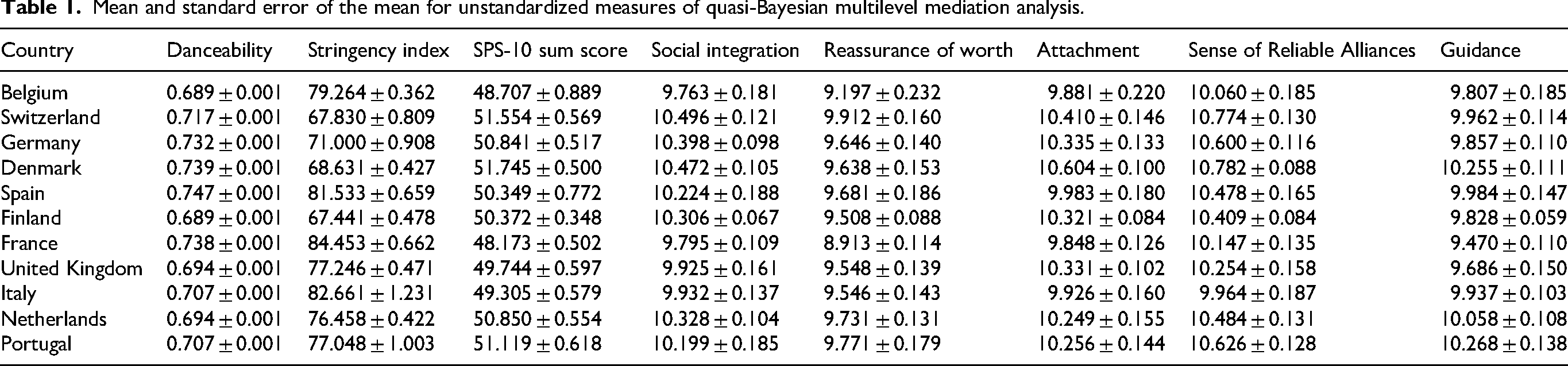
Furthermore, as expected by H2, a quasi-Bayesian mediation analysis revealed that the stringency of lockdown measures (predictor; M = 76.6 ± 1.8 [s.e.m.]; min = 56.5, max = 93.5) is predictive of the overall perceived social provisions (mediator, n = 509; M = 50.3 ± 0.4 [s.e.m.]; min = 34.0, max = 60.0; β = −0.15, p = .012; cf. Table 1 for descriptive statistics), and that social provisions covary with preferences for danceable music (outcome variable; β = −0.03, p = .027; total indirect effect: β=0.004, quasi-Bayesian CI = [0.00–0.01], p = .038). Note that effect directions are negative for all individual indirect paths so that more severe lockdown measures correlate with less experienced social provisions, which are in turn linked to elevated levels of day–country-level danceability. The direct effect between stringency index and listening to danceable music (n = 726) also holds significant, just as the total mediation effect, with β = −0.14, quasi-Bayesian CI = [–0.18– −0.10], p < .001.
Mean and standard error of the mean for unstandardized measures of quasi-Bayesian multilevel mediation analysis.
With respect to the SPS subdimensions, emotional attachment was best predicted by the stringency index (n = 511; β = −0.23, p < .001, cf. Figure 1) and also predicted choices of listening to danceable music (β = −0.03, p = .028), with a total indirect effect of β = 0.006 (quasi-Bayesian CI = [0.005–0.01], p = .028). Here again, factors were inversely correlated, indicating that lower availability of emotional attachment due to social distancing measures elicited increased choices of danceable music. The link between predictor and outcome variable was also significant with a total effect of β = −0.12 (quasi-Bayesian CI = [–0.18– −0.09], p < .001).
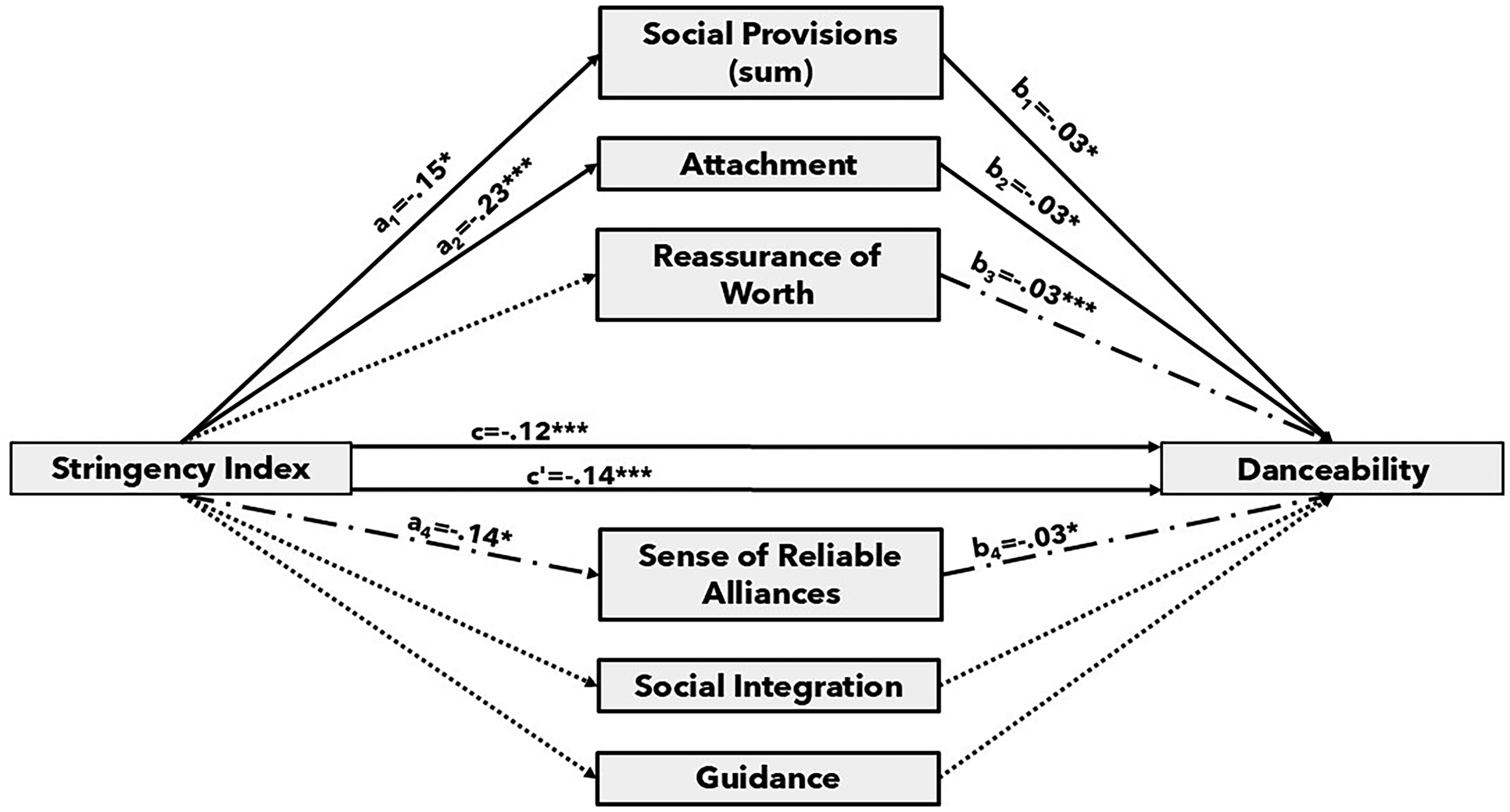
Quasi-Bayesian multilevel mediation analysis between stringency index (predictor), the sum score of the Social Provisions Scale (SPS) as well as its subscales (mediators) and the level of day–country-level danceability (outcome variable) during the first lockdown of the Covid-19 pandemic. Note: Time window of interest: 26 March 2020–30 May 2020. The SPS dimensions encompass social integration (“I feel part of a group of people who share my attitudes and beliefs”, “There are people who enjoy the same social activities I do”), reassurance of worth (“I have relationships where my competence and skills are recognized,” “There are people who admire my talents and abilities”), attachment (“I have close relationships that provide me with a sense of emotional security and well-being,” “I feel a strong emotional bond with at least one other person”), sense of reliable alliances (“There are people I can depend on to help me if I really need it,” “There are people I can count on in an emergency”), and guidance (“There is someone I could talk to about important decisions in my life,” “There is a trustworthy person I could turn to for advice if I were having problems”) (Steigen & Bergh, 2019). Each path was tested for its significance using LMMs in addition to the quasi-Bayesian multilevel mediation analysis. Effect sizes and significance levels are indicated on each path line. Bold uniform lines indicate significant paths and significant total or indirect effect. Dotted lines indicate nonsignificant paths. Dash-dotted lines indicate significant individual paths but nonsignificant indirect effect. *** p < .001, ** p < .01, * p < .05.
Moreover, reassurance of worth best predicted choices of listening to danceable music (n = 509; β = −0.03, p = .009), suggesting that the lack of social recognition of one's personal qualities and capacities is linked to the observed preference for danceable music. Although an indirect link between the stringency of lockdown restrictions and reassurance of worth was not found (β=0.003; p = .10), the total mediation path yielded an effect of β = −0.14, quasi-Bayesian CI = [–0.18– −0.09], p < .001.
Also, a significant negative link between objective measures of governmental restrictions, listening to danceable music, and the need for a sense of reliable alliances was revealed (n = 510; indirect path predictor-mediator: β = −0.14, p = .019; indirect path mediator-outcome variable: β = −0.03, p = .035). The variable sense of reliable alliances denotes functional, and more precisely instrumental, support received from a social network such as family and/or friends. However, the total indirect path was found to be nonsignificant (β = 0.004; p = .052) while the direct path was, again, significant (β = −0.14, p < .001).
The link between stringency index, listening to danceable music, and social integration was found to be nonsignificant (β = 0.002; p = .21) on all individual indirect paths. The functional support of guidance, which denotes informational aid provided by members of one's social network, also showed no indirect effect (β = 0.0004; p = .69).
Control Analyses
Results suggest that neither musical valence (β = −0.003; p = .13) nor energy (i.e., arousal; β = 0.0006; p = .70) share an indirect relation with the stringency of lockdown measures and experienced socioemotional provisions. Other indicators of mental health, including loneliness (β = 0.0003; p = .77) and perceived stress (β = 0.0001; p = .88), did not function as mediators, indicating that danceable music and socioemotional support do not share a comparable relationship. However, the direct connection between stringency index and both energy and valence was highly significant (p < .001) in both cases (see Figures in the Supplemental material).
Discussion
The present study investigated whether music listening, and more specifically engagement with beat-based music, functioned as a surrogate for unfulfilled socioemotional needs during the first COVID-19 lockdown. By triangulating large-scale music streaming data from Spotify with objective governmental stringency measures and subjective reports of socioemotional support, we examined this question in a naturalistic, cross-national context across 11 European countries.
Three main findings emerged. First, listening to beat-based music, operationalized via Spotify's audio feature danceability, increased significantly during the lockdown period compared to the same seasonal time window in the pre-pandemic year. This effect remained robust after controlling for seasonal influences (i.e., temperature) and showed substantial country-level clustering. Second, stricter lockdown measures were associated with lower perceived socioemotional support, as measured by the Social Provisions Scale (SPS-10), replicating previous findings that social distancing policies reduced both structural and functional aspects of social support (e.g., Sommerlad et al., 2022). Third, and most importantly, reduced socioemotional support predicted increased engagement with danceable music. Mediation analyses further demonstrated that socioemotional support partially mediated the relationship between lockdown stringency and listening to beat-based music, suggesting that music listening behavior systematically adapted to socioemotional deprivation during social distancing.
Analyses of the SPS subdimensions revealed that this effect was particularly pronounced for functional components of socioemotional support, namely emotional attachment and reassurance of worth. In contrast, social integration and guidance did not mediate the relationship between lockdown stringency and music listening behavior. Control analyses indicated that these effects were specific to beat-based music and could not be explained by changes in musical valence, arousal, loneliness, or perceived stress. Taken together, these findings provide behavioral evidence that music listening, and specifically engagement with rhythmically regular music, may serve as a compensatory mechanism for unfulfilled socioemotional needs during periods of social isolation.
The present findings extend prior survey-based research on music as a coping strategy during the COVID-19 pandemic by demonstrating that socioemotional coping is reflected not only in self-reports but also in large-scale behavioral music consumption data. Consistent with previous cross-cultural studies (e.g., Ferreri et al., 2021; Fink et al., 2021; Granot et al., 2021), music listening increased in subjective relevance during lockdown and was associated with emotional regulation and well-being. Importantly, the current study goes beyond these descriptive accounts by identifying specific musical features that appear to be preferentially engaged under socioemotional deprivation.
Our findings align with the notion of music as a social surrogate (Paravati et al., 2025; Schäfer & Eerola, 2020), suggesting that music can partially substitute for unmet social needs when direct interpersonal interaction is restricted. While previous work has largely focused on perceived feelings of connectedness, loneliness reduction, or empathy, the present results provide evidence that music listening behavior adapts in a targeted manner to specific socioemotional deficits. In particular, the observed associations with emotional attachment and reassurance of worth suggest that music listening may compensate for the lack of emotional security and social recognition typically provided by close social relationships. This pattern aligns with social surrogacy accounts proposing that music primarily substitutes particular relational functions (e.g., acting as a friend, Schäfer et al., 2020) rather than diffuse negative affect. During lockdown, digital communication may have buffered feelings of loneliness while simultaneously disrupting embodied and spontaneous sources of attachment and recognition, such as shared activities, informal affirmation, and collective enjoyment. This selective erosion of socioemotional rewards may explain why attachment and reassurance of worth – but not loneliness or social integration – mediated changes in music listening behavior. More broadly, these results suggest that pandemic-related social distancing produced a temporary dissociation between loneliness and functional socioemotional support, with rhythmically engaging music partially compensating for the loss of everyday social reward.
A central contribution of this study lies in linking socioemotional needs to engagement with beat-based music. Previous research has shown that rhythmically regular and groove-based music reliably activates both reward-related neural circuits (Ferreri et al., 2019; Mas-Herrero et al., 2018; Salimpoor et al., 2011) and motor and predictive timing networks (Matthews et al., 2020; Teki et al., 2011b). These neural systems overlap substantially with mechanisms implicated in social bonding and interpersonal coordination (Greenberg et al., 2021; Savage et al., 2020). The observed increase in danceability during lockdown may thus reflect an attempt to access the socioaffective benefits typically afforded by social interaction. Beat-based music is known to facilitate sensory-motor coupling, entrainment, and action prediction, processes that are central to joint action and social synchrony (Keller et al., 2014). Even in the absence of actual co-presence, engaging with temporally regular music may evoke embodied simulations of social coordination, thereby fostering a subjective sense of togetherness and social connectedness.
The mediation effects observed for emotional attachment further suggest that beat-based music may be particularly effective in alleviating deficits in emotional security. From a neurobiological perspective, this interpretation is consistent with models proposing bidirectional interactions between dopaminergic reward pathways and oxytocinergic systems involved in social bonding (Greenberg et al., 2021). While direct evidence for oxytocin release during music listening remains limited, prior work has shown that rhythmic synchrony and collective musical engagement can enhance affiliative feelings and trust (Tarr et al., 2014). The present findings suggest that similar, albeit attenuated, mechanisms may operate during solitary listening to beat-based music.
An important aspect of this study is the demonstrated specificity of the effects. Control analyses showed that neither musical valence nor arousal mediated the relationship between lockdown stringency and socioemotional support, despite prior evidence that positively valenced or energetic music can support mood regulation (Eden et al., 2020; Feneberg et al., 2023; Hansen, 2022). This finding suggests that the observed increase in danceability cannot be reduced to a general preference for pleasurable or uplifting music during stressful times. Similarly, loneliness and perceived stress did not function as mediators, indicating that the effects are not merely driven by global declines in mental health. Instead, the results point toward a more specific link between socioemotional support, particularly attachment-related needs, and engagement with rhythmically regular music. This distinction is theoretically important, as it suggests that music listening behavior may selectively target different psychological needs depending on its structural features.
Despite the study’s strengths, several limitations should be acknowledged. First, the use of aggregated Spotify chart data limits the ability to draw conclusions at the individual level. While the triangulation of behavioral, objective, and subjective data sources is a major advantage, the mediation analyses necessarily rely on aggregated measures, precluding causal inference at the level of individual listeners.
Second, the Spotify audio feature danceability represents a composite measure derived from multiple musical attributes, including tempo, rhythm stability, and beat strength. Although it serves as a useful proxy for beat-based music, it does not allow for fine-grained analyses of specific rhythmic features such as syncopation or meter. Future research could benefit from more detailed computational analyses of musical structure.
Third, the study focuses on a Western, European sample. Given known cultural differences in music perception, rhythmic preferences, and social norms, the generalizability of the findings to non-Western contexts remains an open question. Cross-cultural replication using comparable behavioral data would be an important next step.
Finally, while the temporal alignment of lockdown measures, survey data, and music streaming behavior strengthens the plausibility of the proposed mechanisms, the observational nature of the study precludes definitive causal conclusions. Experimental or longitudinal designs at the individual level would be required to directly test whether unmet socioemotional needs causally increase engagement with beat-based music.
Notwithstanding, the present study provides converging behavioral evidence that music listening, and specifically engagement with beat-based music, functioned as a socioemotional surrogate during the first COVID-19 lockdown. By demonstrating that reduced socioemotional support predicted increased listening to danceable music, the findings advance current theories of music as a social surrogate and extend them to the level of large-scale, real-world behavior. From a practical standpoint, these results have implications for public health, music-based interventions, and digital music platforms. Understanding that specific musical features may help alleviate unmet socioemotional needs opens new avenues for targeted music recommendations during periods of social isolation, such as pandemics, long-term hospitalization, or aging-related social withdrawal. More broadly, the findings underscore the importance of considering music not merely as a tool for mood regulation but as a meaningful resource for maintaining socioemotional well-being when social connection is constrained. We encourage future research to continue integrating behavioral data with psychological theory to better understand how everyday music listening supports fundamental human needs in times of social disruption.
Supplemental Material
sj-docx-1-mns-10.1177_20592043261442373 - Supplemental material for The Vibe of Musical and Social Reward: Listening to Beat-Based Music as a Surrogate for Socioemotional Support During the COVID-19 Pandemic across Europe
Supplemental material, sj-docx-1-mns-10.1177_20592043261442373 for The Vibe of Musical and Social Reward: Listening to Beat-Based Music as a Surrogate for Socioemotional Support During the COVID-19 Pandemic across Europe by Lena Esther Ptasczynski, Patrick Blättermann, Fabian Greb, Philipp Sterzer and Jochen Steffens in Music & Science
Supplemental Material
sj-png-2-mns-10.1177_20592043261442373 - Supplemental material for The Vibe of Musical and Social Reward: Listening to Beat-Based Music as a Surrogate for Socioemotional Support During the COVID-19 Pandemic across Europe
Supplemental material, sj-png-2-mns-10.1177_20592043261442373 for The Vibe of Musical and Social Reward: Listening to Beat-Based Music as a Surrogate for Socioemotional Support During the COVID-19 Pandemic across Europe by Lena Esther Ptasczynski, Patrick Blättermann, Fabian Greb, Philipp Sterzer and Jochen Steffens in Music & Science
Supplemental Material
sj-png-3-mns-10.1177_20592043261442373 - Supplemental material for The Vibe of Musical and Social Reward: Listening to Beat-Based Music as a Surrogate for Socioemotional Support During the COVID-19 Pandemic across Europe
Supplemental material, sj-png-3-mns-10.1177_20592043261442373 for The Vibe of Musical and Social Reward: Listening to Beat-Based Music as a Surrogate for Socioemotional Support During the COVID-19 Pandemic across Europe by Lena Esther Ptasczynski, Patrick Blättermann, Fabian Greb, Philipp Sterzer and Jochen Steffens in Music & Science
Supplemental Material
sj-png-4-mns-10.1177_20592043261442373 - Supplemental material for The Vibe of Musical and Social Reward: Listening to Beat-Based Music as a Surrogate for Socioemotional Support During the COVID-19 Pandemic across Europe
Supplemental material, sj-png-4-mns-10.1177_20592043261442373 for The Vibe of Musical and Social Reward: Listening to Beat-Based Music as a Surrogate for Socioemotional Support During the COVID-19 Pandemic across Europe by Lena Esther Ptasczynski, Patrick Blättermann, Fabian Greb, Philipp Sterzer and Jochen Steffens in Music & Science
Footnotes
Acknowledgements
We would like to thank the researchers who have provided their data and resources as open source as well as the two reviewers for their thorough evaluation and valuable feedback on earlier versions of this manuscript.

Ethics Statement
The study has been conducted in compliance with the Declaration of Helsinki. Ethical approval was granted by the ethics committee of the Medical Faculty of the University of Duisburg-Essen, Germany (20-9257-BO).
Author Contributions
LEP conceptualized the study, derived the theory, analyzed and visualized the data, and wrote the first draft of the manuscript.
PB analyzed and visualized the data and contributed to the writing of the manuscript.
FG conceptualized the study and performed data acquisition and pre-processing.
PS contributed to the data analysis.
JS conceptualized the study, analyzed the data, and contributed to the writing of the manuscript.
All authors reviewed the manuscript and approved its final version.
Funding
This research was kindly supported by a Mind & Brain scholarship to LEP from the Berlin School of Mind and Brain, Humboldt-Universität zu Berlin. The publication costs were funded by the Open Access Publication Fund of Hochschule Düsseldorf University of Applied Sciences.
Declaration of Conflicting Interests
The authors declared no potential conflicts of interest with respect to the research, authorship, and/or publication of this article.
Data Availability
The data is publicly available through the COVID-19 hub (Guidotti et al., 2020), the COVIDiSTRESS database (Yamada et al., 2021), and the USA National Centers for Environmental Information (NOAA National Centers of Environmental Information, 1999). Data analysis scripts are available on OSF: https://osf.io/7dz62. (Ptasczynski et al., 2026)
Supplemental Material
Supplemental material for this article is available online.
Notes
References
Supplementary Material
Please find the following supplemental material available below.
For Open Access articles published under a Creative Commons License, all supplemental material carries the same license as the article it is associated with.
For non-Open Access articles published, all supplemental material carries a non-exclusive license, and permission requests for re-use of supplemental material or any part of supplemental material shall be sent directly to the copyright owner as specified in the copyright notice associated with the article.


