




Abstract
Language and music are closely tied in singing. It has even been argued that without language there is no song. However, can music and language learning through singing also be seen as being closely tied without first highlighting the boundaries between these disciplines? This study emphasizes a nonhierarchical approach to music and language learning by intertwining musical and linguistic activities in a choir context. The study explores the extent to which singing in a language-responsive choir can encourage productive second language use and enhance the sound hearing, phonological processing, pronunciation, and spoken language skills of adult choir participants with culturally and linguistically diverse backgrounds. The research material consists of individual pre-, middle-, and post-interviews and Phonology pre- and post-tests that were conducted with volunteer choir participants during 2019–2020. The analysis encompasses both thematic and statistical approaches. The findings are reflected through a hybrid choir practice that draws on a three-way dialogue between choir participants, the choir conductor, and the second language teacher. The results suggest that active and holistic second language use in a language-aware choir context decreases phonological challenges in second language auditory processing and verbal production, including spoken language. The findings of the interviews and the Phonology tests were in line with each other.
Keywords
Introduction
The world as we know it is undergoing major changes, ranging from the constant expansion of digitalization and artificial intelligence to ongoing global crises such as environmental warming and geopolitical conflicts causing, in turn, various interrelated changes such as increasing famine, energy crises, or the over two-year corona pandemic (e.g., Dufva & Rekola, 2023; WHO, 2022). Increasing immigration is clearly one of these interrelated changes, one which creates both new demands and possible benefits related, for instance, to ageing populations and declining birth rates in countries receiving immigrants. A critical challenge facing newly arrived residents is learning the official language of the country they immigrate to. The growing number of second language learners with a variety of new needs also requires the development of new pedagogical approaches to second language (henceforth L2) teaching and learning, in particular approaches that can facilitate major challenges in language use and everyday communication.
In Finland, the context of this study, the number of foreign citizens grew by about 87% (Tilastokeskus (Statistics), 2022) in the decade 2011–2021. Most foreign citizens (75%) immigrating to Finland are working-age adults (15–25 years; Tilastokeskus (Statistics), 2022). Adults, however, face different kinds of challenges in their Finnish-as-L2 learning process than children who are integrated into the official schooling system and are thus exposed to L2 teaching soon after entering their new country. Children also learn pronunciation easier than adults, for whom learning structures and grammar is often quicker (Pietilä, 2014; Virkkunen & Toivola, 2020). Adult immigrants in Finland often also lack social contexts where they could actively use and practice Finnish, and especially become familiar with the spoken language, which is significantly different from the written Finnish (e.g., Lehtonen, 2015) that they typically learn in L2 classes. Public discussions and media point out that Finns typically use English when communicating with immigrants, and for adult immigrants who do not speak the same native language, English is also most often the common language. A lack of Finnish skills, however, creates multiple barriers for inclusion. For instance, newly arrived residents are easily excluded from cultural and arts services.
The Learn-Finnish-by-Singing (henceforth LFBS) choirs, the focus of this study, reflect the growing diversity in Finland, with adult choir participants coming from different parts of the world and having different first (L1, native) languages. These choirs were originally created in response to the direct social needs of the newly arrived immigrants in Finland and the wishes of L2 teachers who had had positive experiences of singing related to L2 learning. The language-sensitive choir practice was developed to enable adult immigrants to actively practice their second language use in a natural social environment while at the same time participating in meaningful musical activity (cf. arts service).
Finnish, a Finno-Ugric language, is often considered as a particularly difficult language because it differs markedly from the Indo-European languages traditionally spoken in Europe (see more Dahl, 2008). At the global level, Finnish is a marginal minority language, spoken only by around 4.8 million people mainly in Finland. As a quantity language, a typical feature of the Finnish language is phonemic vowel and consonant length, which has been found to be particularly challenging for L2 speakers of Finnish regardless of their language of origin (Aho et al., 2016).
This study explores whether musical activity in a linguistically responsive choir context can enhance the choir participants’ sound hearing and production of Finnish as L2. Studies in psychology and linguistics suggest that musical skills, such as pitch and rhythm perception could be “transferred” to L2 phonological skills (e.g., Chobert et al., 2014) and to vocabulary learning (e.g., Chan et al., 1998; Kang & Williamson, 2014). The study of Zhang et al. (2023) extends the idea of “transfer effect” (e.g., Besson et al., 2011) to encompass the actual singing activity that can activate “brain networks that facilitate auditory motor mapping procedures” (p. 14) and, therefore, also speech production (see also Gordon et al., 2018). In turn, the dual integration hypothesis (e.g., Thiessen & Saffran, 2009; see also Ginsborg & Sloboda, 2007) proposes that “related aspects of a complex stimulus” (Thiessen & Saffran, 2009, p. 226), such as simultaneous input of melodic and lyrical structures through singing, can reciprocally facilitate learning of both music and language, not only in adults but also in infants. In addition to the suggested cognitive effects of musical activity, positive effects of collaborative singing on wellbeing and on psychological and physiological health (see Clift et al., 2015; Heydon et al., 2020) are widely emphasized in research of different fields (e.g., psychology, education, psychobiology, epidemiology, ethnomusicology). These effects refer, for instance, to enhanced social bonding (e.g., Davidson & Leske, 2020; Fancourt & Perkins, 2018; Launay & Pearce, 2020) and emotional resources that musical experiences provide (e.g., Dingle et al., 2017; Gabrielsson, 2011; Warran et al., 2019).
In the context of foreign language learning, numerous studies in linguistics and psychology have shown that listening to and singing songs can contribute to syllable, word, and sentence perception and pronunciation, and to memorizing and recalling them (e.g., Good et al., 2015; Ludke, 2018; Ludke et al., 2014; Schön et al., 2008). Studies of kindergarten and primary school children have shown how different musical actions related to singing and rhythmics (clapping, tapping, body percussion) support children's phonological awareness and auditory perception (e.g., Anvari et al., 2002; Bolduc, 2009; Dege & Schwarzer, 2011; Gaboury et al., 2020; Gromko, 2005; McCormack & Klopper, 2016; Moritz et al., 2013; Standley & Hughes, 1997). Moreover, a growing number of studies that acknowledge language teaching and learning as an embodied (holistic) process (e.g., Atkinson, 2010; Kosmas & Zaphiris, 2020) indicate how engaging bodily and material resources facilitate challenges in L2 pronunciation in multiple ways, for instance as related to perceiving syllables, word stress, and rhythm of language (e.g., Nguyen, 2016; Smotrova, 2017). However, research in linguistics, phonetics, and psychology focusing on L2 pronunciation often lacks evidence-based research related to actual practices and teaching strategies in authentic learning contexts (e.g., Aho et al., 2016; Baker, 2011, 2014; Derwing & Munro, 2015; Virkkunen & Toivola, 2020).
The language-aware perspective in LFBS practice acknowledges earlier research on important factors of L2 and foreign language phonetics and pronunciation highlighting analytic and conscious hearing (e.g., Saito et al., 2022; Thomson, 2011; Yule et al., 1987), the active practice of motor skills (e.g., Aho et al., 2016; Kissling, 2013), motivation (e.g., Saito et al., 2017, 2018; Yousofi & Naderifarjad, 2015), having a supportive and mistake-tolerant learning environment (Baran-Łucarz, 2017; Horwitz et al., 1986; Wrember, 2001), and taking into account different needs related to individual challenges in pronunciation (Aho et al., 2016; Munro et al., 2015; Suzukida, 2021). Unlike ordinary choirs, where the focus is more on music than on language learning and on clear articulation of already existing lyrics at the most, the LFBS choirs’ focus is on music and language learning through multiple musical activities (including inventing new lyrics, translating intercultural songs) that support language learning and not simply musical outcome. This kind of hybrid choir practice has not been systematically explored before.
Languages are traditionally taught with an emphasis on cognitivist approaches (Atkinson, 2010). Although research on language education already acknowledged the potential of embodied approaches (e.g., Atkinson, 2010; Kosmas & Zaphiris, 2020) in the beginning of the 21st century (Nevile, 2015), they have only recently found their way into language classroom practices (Macedonia, 2019; Macrine & Fugate, 2021). Since the late 2010s there has been a notable growth of empirical studies related to embodied approaches in language learning in diverse fields such as education, linguistics, and neurosciences (Jusslin et al., 2022). Teaching and learning music in the context of music education naturally promotes the holistic and embodied nature of making and experiencing music; however, studies on language learning through music have not been acknowledged as embodied because “they did not explicitly use an embodied framework” (Jusslin et al., 2022, p. 17). This study draws attention to the holistic (embodied) nature of language use and learning in a music education context.
The theoretical underpinnings of this study draw on the concept of “change” central to activity theory and activity systems thinking (Engeström, 1999, 2001) in the context of education. The underlying pedagogical principles of the investigated LFBS choir practice – the six fields of action – interweave musical and linguistic activity and together form a boundary object (Lehtinen-Schnabel, 2023) for the dual-meaning choir practice. The six fields of action are in constant “change,” developing further during the choir activity and reflecting the emerging needs and here-and-now experiences of the choir participants. That is, the constant negotiation with choir participants in the transprofessional and interdisciplinary collaboration between the choir conductor and L2 teacher creates a triadic (three-way) dialogue in which the restructuring of the choir practice evolves into “something emergent, unpredictable, and always rethinkable and redoable” (Jackson & Mazzei, 2017, p. 717). This collaborative ongoing process underlines the equal and nonhierarchical nature of the LFBS choir practice into which the experimental and creative mindset is integrated.
Figure 1 shows the three-way dialogue between all parties of the choir community related to the “dual-meaning” object of the LFBS choir activity. The triadic dialogue also foregrounds the use of translanguaging (e.g., García & Wei, 2014; Wei, 2018) within a multilingual choir context, in which all possible linguistic (e.g., L1 languages of the choir participants) and other resources (e.g., embodied, spatial, material) are harnessed to support communication and overcome the monolingual bias in teaching and learning (e.g., Hua et al., 2020).

Three-way dialogue in and through the dual-meaning LFBS choir practice (figure adapted from Lehtinen-Schnabel, 2023).
Research Focus and Methodology
This mixed-method study highlights choir participants’ experiences and usage of Finnish as L2 – sound hearing and pronunciation in particular – in relation to the musical activity in LFBS choirs. The focus of the study is L2 production 1 learned through holistic musical activity in LFBS choirs over one year. We ask: What kind of changes in the challenges of their Finnish language expression do choir participants with culturally and linguistically diverse backgrounds experience and demonstrate after singing in a language-aware choir?
Design of the Study
The empirical part of the study was implemented between September 2019 and December 2020 (Figure 2). During this time, individual semi-structured pre-, middle-, and post-interviews as well as Phonology pre- and post-tests were administered to the volunteer choir participants who provided their written informed consent for inclusion, collection and use of data, and publication.

Design of the study.
Owing to the sudden Covid-19 pandemic, the choir practice was held online from the middle of March to the middle of May 2020, that is, until the end of the spring semester. Therefore, the original intention to compare choir participants’ Phonology test results with those of adult learners in the normal L2 class was not carried out. The timing of the Phonology post-test was postponed from the end of May to December 2020 to enable more live (face-to-face) choir rehearsals, where L2 sound hearing and pronunciation could again be actively practiced in collaboration with others.
Participants
The participants in the two LFBS choirs who volunteered for this study spoke 20 different first (native) languages, and some had bilingual backgrounds. The native languages of the volunteers included Georgian, Russian, Ukrainian, Dutch, Portuguese, Spanish, French, Chinese, Taiwanese, Vietnamese, Japanese, Lithuanian, Latvian, Telugu, Hindi, Malay, Italian, German, Turkish, and English. The participants were 21 to 70 years old and had diverse economic, educational, and social backgrounds. The choirs were open access, that is, there was no requirement to have music or Finnish-as-L2 skills. The participants included both newly arrived residents with very little exposure to the Finnish language as well as individuals who had already been living in Finland for 2–16 years. However, all of them had immigrated to Finland as adults and had not learned (or in some cases even heard) Finnish before that. Thirty-eight of the 41 participants had previously participated in Finnish-as-L2 classes at diverse levels of the CEFR. 2 The musical experience of the participants was also varied. Some participants had never attended any music lessons, while others were advanced singers or musicians. Attendance in these choirs was voluntary, free of charge, and a leisure occupation once a week. The teaching was subsidized by the National Board of Education and the city of Helsinki. Table 1 describes the background of the participants with respect to years of living in Finland (less or more than one year) in relation to the time of joining a LFBS choir (beginners or continuers in autumn 2019).
Participants grouped based on the time living in Finland vs. singing in LFBS choirs.

LFBS Choir Practice
The Setting
The two choirs in this study held 1.5-h rehearsals once a week. One choir had evening rehearsals in a normal music classroom, the other in a music hall in the afternoons. The first choir was split into two separate groups (beginners and continuers) because the size of the music classroom was too small to fit all of the participants. The physical space of both choirs was organized to enable the use of multisensory (all senses) and embodied (movements, gestures, and mimics) approaches. In the rehearsal space, the chairs were placed so that the choir participants were able to see the images and lyrics projected on the wall, and to stand up and have space for bodily expression. The space was also used for moving around and for forming a circle. A piano was placed up in front so that the participants could see the choir conductor’s movements (and vice versa) while accompanying the singing. Technical equipment, such as a computer, smartboard, Bluetooth loudspeakers, and musical instruments were all placed near the piano so as to be reachable and easy to handle by the choir conductor. The Finnish-as-L2 teacher helped with the technical equipment when participating in the choir rehearsals, which was every second time.
During the Covid-19 pandemic online rehearsals, the support of being able to hear, see, and move together with other choir members disappeared, and each choir participant sang alone in front of their own digital device in varying domestic conditions, muted from each other, and hearing only one person singing or talking at a time.
Six Fields of Action Underpinning the Choir Practice
LFBS choir practice has a dual-meaning purpose: to create meaningful and responsive musical experiences for the choir participants, while at the same time supporting their L2 use. In other words, in this art-based context L2 is approached in and through musical activity with a language-aware perspective. Both input (hearing, listening, and sensing) and output (language production) of language are actively nurtured throughout the choir rehearsal. Different challenges in language production experienced by the choir participants are acknowledged and constantly collaboratively negotiated. This process involves the continuing search for new musical approaches through which to tackle these difficulties.
The underlying pedagogical principles of the LFBS choir practice are divided into six “fields of action” (Lehtinen-Schnabel, 2023) that are diversely approached during the choir rehearsals. They emphasize the intertwining of musical and linguistic actions and the natural relationship of music and language in singing. From the perspective of learning L2, warm-ups (the first field of action), which typically start the choir rehearsals, focus on hearing and producing challenging speech sounds such as single phonemes, double consonants and vowels, and difficult combinations of single phonemes such as diphthongs (two different vowels in a syllable) in playful and creative ways while opening voice, body, mind, ears, and other senses for singing at the same time. Collaborative choir improvisations (the second field of action) encourage the choir participants to explore linguistic expressions together using various ways and modes of communication (e.g., vocal, verbal, bodily, emotional) and highlighting languaging, 3 sensitive listening to others, and the encouragement of language ownership even with limited L2 abilities. Singing songs in different genres and themes (the third field of action) underlines active and collaborative (social) language use, where the focus is on the articulation of song lyrics at the phrase and verse level, and on the word stress and rhythm of language. Singing songs in different genres also enables familiarization with diverse sublanguages such as spoken language and the different dialects of Finnish. The creation and re-creation of song lyrics (the fourth field of action) encourages the expression of personal experiences, supports intercultural dialogue, and promotes using spoken utterances and thus everyday communication. Immersing in the stumbling blocks of Finnish with “Funny Finnish language songs” (the fifth field of action) utilizes songs created by the choir conductor (music) and L2 teacher (lyrics) focusing on the most challenging phonetic peculiarities and grammar (e.g., consonant gradation) 4 of Finnish through humorous lyrics integrated to gripping melodies. Familiarizing with songs brought by the choir participants and translated into Finnish (the sixth field of action) raises the awareness of relationships and differences between choir participants’ native languages and Finnish in line with musical features that typically follow the particularities of the specific languages.
In summary, LFBS choir practice approaches L2 use from diverse perspectives and aims to encourage active and holistic L2 use by offering the choir participants an authentic and meaningful social situation (Lehtonen, 2015) into which emotional and motivational benefits of collaborative musical activity (Siljamäki, 2021) are integrated.
Research Methods
This mixed-method study combines both qualitative (interviews) and quantitative (Phonology tests) research methods to explore the LFBS choir participants’ Finnish-as-L2 learning from experienced and test-based perspectives.
Interviews
We used semi-structured interviews (Kvale & Brinkmann, 2009) to explore the choir participant's experienced challenges in learning and speaking Finnish, and the possible changes they faced after singing in a LFBS choir for five to nine months. Semi-structured interviews seek “to obtain descriptions of the interviewees’ lived world with respect to interpretation of the meaning of the described phenomena” (p. 27). The individual interviews were carried out three times (cf. Figure 2) by the researcher/choir conductor. The interviews were conducted either before or after the choir rehearsals, in a peaceful space in the same building where the choir rehearsals took place, in order to make them reachable for the choir participants in terms of time and place. Owing to the second corona lockdown, the third/post-interviews took place online (in Zoom).
The interviews were conducted in English. All interviewees were able to speak English at a level that made communication manageable. In addition, the interviews utilized holistic communication such as bodily (gestures and movements) and vocal (singing and sound) expression to expand their verbal expression when needed. That is, the communication and interaction in interviews was facilitated in all possible ways and with all available resources, including other possible common languages.
The first and second interviews were audio/sound recorded, and the third interviews video and audio/sound recorded. All interviews were transcripted, two of them by the researcher and the others by a company specialized in audio recorded research transcriptions, from which a nondisclosure agreement was received.
Phonology Test
We used Phonology tests (Kunnari et al., 2012) to evaluate the participants’ challenges in Finnish pronunciation (pre-test) and the possible changes in these challenges after actively participating in the LFBS choirs (post-test). The Phonology test was designed to evaluate phonetic development in Finnish and was chosen because foreign language tests do not acknowledge the specific structure of Finnish in a sufficient way (Kunnari et al., 2012, p. 6). The Phonology test was originally created for monitoring the development and possible problems in phonetic skills of Finnish children (p. 15). During such tests, children are asked to name pictures shown to them; the pictures can also be named by repeating them after the administrator of the test does so. The test is always audio recorded and transcribed onto a standardized test form. The test has two versions: one for 2-year-olds and another for 3–6-year-olds. The former (and shorter) test has 36 pictures that are related to the child's world of experience, including 31 nouns, 3 verbs, and 2 onomatopoeic expressions imitating animal voices. The latter test consists of 90 pictures representing 76 nouns, 9 verbs, 3 adjectives, and 2 onomatopoeic expressions. The pictures were chosen based on their identifiability and the prevalence of the sounds and sound combinations in Finnish.
We chose the shorter 10-min version of the Phonology test, since it could be quickly presented to the participants before, during, or after the weekly choir rehearsals. It was also considered suitable for adult individuals with little experience in Finnish by logopaedics students, and speech and language therapists use the test regularly.
The Phonology test evaluates two types of phonetic skills: phonotactic and paradigmatic skills. The evaluation of phonotactic skills includes: 1) the length of sounds and syllables (double vowels and consonants) and short and long (two- and three-moraic) first syllables; 2) the length of words (two- and three-syllables); and 3) combination of sounds (separate consonants in a word, diphthongs, and combinations of consonants). Paradigmatic skills are evaluated but not scored, and include articulation of individual phonemes (consonants at different positions in words and vowels).
Although we used the test material of the Phonology test, we changed the scoring of the test completely to better suit the aims of this study. First, since we were interested in the difficulties that adult immigrants face in Finnish pronunciation, we scored the sounds that were not pronounced correctly, whereas in the original Phonology test only sounds pronounced correctly are scored. Second, we added one new sound category to the phonotactic skills (two double consonants in a word), and also scored the paradigmatic skills with four new categories (wrong sound, sound left out, an extra sound, and [ŋ] sound represented by the letter combination “ng” in written words). Third, we evaluated and scored all sound categories in every word instead of focusing on only one or a few of them in a given word, as is done in the original test. Altogether we scored 14 sound categories, of which nine were based on the Phonology test (Kunnari et al., 2012) and five (in bolded text) on our added sound categories (see Figure 3).
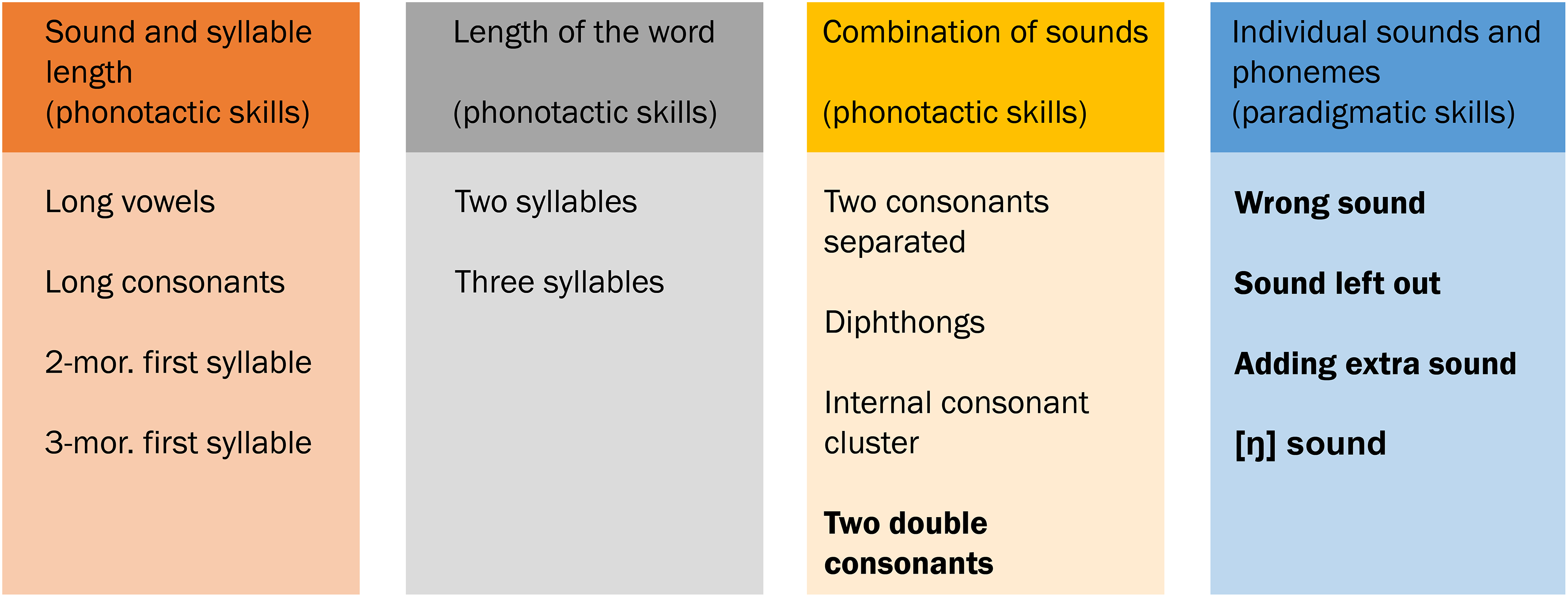
Fourteen sound categories (variables).
The Phonology test was presented to the choir members either before or after the choir rehearsals, either by the researcher (first author/choir conductor) or by a student from the Helsinki University Department of Logopedics, who also used parts of the pre-test results in her master's thesis titled ‘The Suitability of the Phonology test for assessing the Finnish pronunciation of adult immigrants’ (Ihalin, 2020). In the master's thesis, the Phonology test was compared with a Sentence test developed for the thesis, and the results showed that the Phonology test in its current form is moderately suitable for assessing adult immigrants’ pronunciation of the Finnish language. The tests were administered in a quiet space suitable for the purpose near the choir rehearsal space. The post-tests were administered online (via Zoom) by the first author/choir conductor. All tests were audio recorded and transcribed on the standardized test form (see Appendix 1).
Analysis
We analyzed the empirical material both qualitatively (interviews) and statistically (Phonology tests). Twenty-three interviews of 11 choir participants (see Table 2) were analyzed using thematic analysis (Braun & Clarke, 2006) “which can potentially provide a rich and detailed, yet complex account of data” (p. 5) to report “experiences, meanings and the reality of participants” (p. 9), in this case, the self-reported articulations of language-related challenges and changes in Finnish-as-L2 learning and use. All instances across the interviews referring to these particular analytic interests were included. In relation to the first interviews, we identified and coded the choir participants’ experiences of the most difficult aspects of the Finnish language, and based on those that were experienced by the majority of participants, five main themes were selected. These main themes showed strong coherence among the interviewees and no subthemes emerged. Related to the second and third interviews, we thematically identified and coded the choir participants’ experiences of change in their L2 challenges and expression, and on a more general level in L2 use in their daily lives after joining the LFBS choir. Based on this analysis, we formed six overarching main themes out of the related subthemes called “themes-within-a-theme” (Braun & Clarke, 2006, p. 22).
Interview participants.

The Phonology pre-test was administered to 41 volunteer choir participants, and 16 of them also participated in the Phonology post-test. The corona pandemic and the subsequent lockdowns had an influence on the number of participants. The results of the Phonology tests were analyzed using IBM SPSS Statistics. First, we evaluated the means and standard deviations of the different sound categories (variables) in the whole participant group. Second, ANOVA tests were used to assess whether there were significant differences in the test scores between participants, who were divided into three subgroups according to how long they had lived in Finland and when they had joined the LFBS choirs (see Table 1). Third, a paired samples t-test was used to analyze the significant differences between the Phonology pre- and post-tests. All results were considered statistically significant, at significance level of p < .05. Although the pre- and post-test groups were small for reliable statistical analysis, we were interested in knowing whether the results would indicate any changes between the pre- and post-test scores.
Results
The results are divided into two sections: 1) difficulties in Finnish pronunciation; and 2) changes in phonological processing and Finnish-as-L2 use after singing in LFBS choir.
Difficulties in Finnish Pronunciation
Experienced Challenges: First Interviews
All 11 interviewees described Finnish language systematically as “very difficult,” “complicated,” “strange,” or “different” in relation to their own first (native) languages and other languages they knew. Finnish was regarded, for instance, as “an alien language” (Interviewee 1), “a fairy-tale language” (Interviewee 10), “Euscara spoken by Basques” (Interviewee 6), and “an Elf language created by J. R. R. Tolkien” (Interviewee 3).
The main phonetic difficulties were associated with “hearing and implementing double consonants and vowels” (Interviewee 1), “pronunciation of some letters” (Interviewee 11), and “hearing the [a] and [æ] and those of the [ø] and [o]” (Interviewee 2). In other words, the main challenges in phonology and pronunciation were described in relation to 1) the length of sounds (especially double consonants and vowels), 2) single unfamiliar sounds such as [æ], [y], [ø], [h], and [r], and 3) hearing the difference between vowel sounds such as [a-æ], [o-ø], and [u-y]. In addition, some difficulties were associated with combinations of sounds such as two different vowels in a syllable (diphthongs). In the words of one interviewee, “Finnish is the most challenging of all languages I know, because of so many challenging sounds that we need to do in one word. The two consonants and one consonant. I can’t hear a and ä and those sounds” (Interviewee 7). The feeling of strangeness when producing the “unfamiliar” sounds was experienced as a barrier which, in the words of one interviewee, was only possible to deal with by learning “words by heart, so you repeat them and repeat them and repeat them” (Interviewee 10). Hearing and pronouncing sounds were also considered difficult due to “words which are really familiar, and the difference is that kind of phonetic difference” (Interviewee 10), referring to the essential but very challenging feature of Finnish, its quantity nature (e.g., Vihanta, 1990), in which the relative duration (length) of vowel and consonant sounds separate word meanings from each other (e.g., [tili], [tiili], [tilli] / account – brick – dill) (Hakulinen et al., 2004).
All interviewees also mentioned significant challenges in the “constructs of the words,” emphasizing the constant change in the word body due to the use of affixes (endings) that in Finnish replace prepositions, and typically create difficulties in comprehending the language. This change, which often makes the original word difficult to recognize, was constantly described and wondered about, with comments such as “It's amazing how one word change so many types. Difficult to me” (Interviewee 9), “The letter changes…or the letter disappears” (Interviewee 11), and “There is too much change” (Interviewee 8). In addition, long words were explained as being phonologically challenging to perceive and produce: “Sometimes the words are so big that there is no breathing space and I need to breathe in the middle of a word” (Interviewee 7).
Spoken language seemed to cause extra difficulties for speech comprehension due to its marked difference from the written language, which was more familiar to most interviewees: “It is difficult to understand so-called normal speaking when they use that ‘puhekieli’ (spoken language)” (Interviewee 10). For many, the most difficult aspect of Finnish as L2 was “hearing spoken language when I have learned the written language” (Interviewee 1). This difference also seemed to create a barrier to starting using the language (speaking) in real life. In the words of one choir participant, Finnish as L2 is typically “not taught as a communicative language” (Interviewee 6) but focuses on the written language, leading to the fact that “I can’t use it in the streets” (Interviewee 6). In addition, a couple of interviewees highlighted the lack of possibilities for speaking Finnish because “the most difficult thing is the social environment and the fact that people speak English” (Interviewee 4).
Figure 4 summarizes the main aspects (the five main themes) that caused the phonetic challenges (both hearing and producing of L2) reported by most of the 11 interviewees in the first interviews.
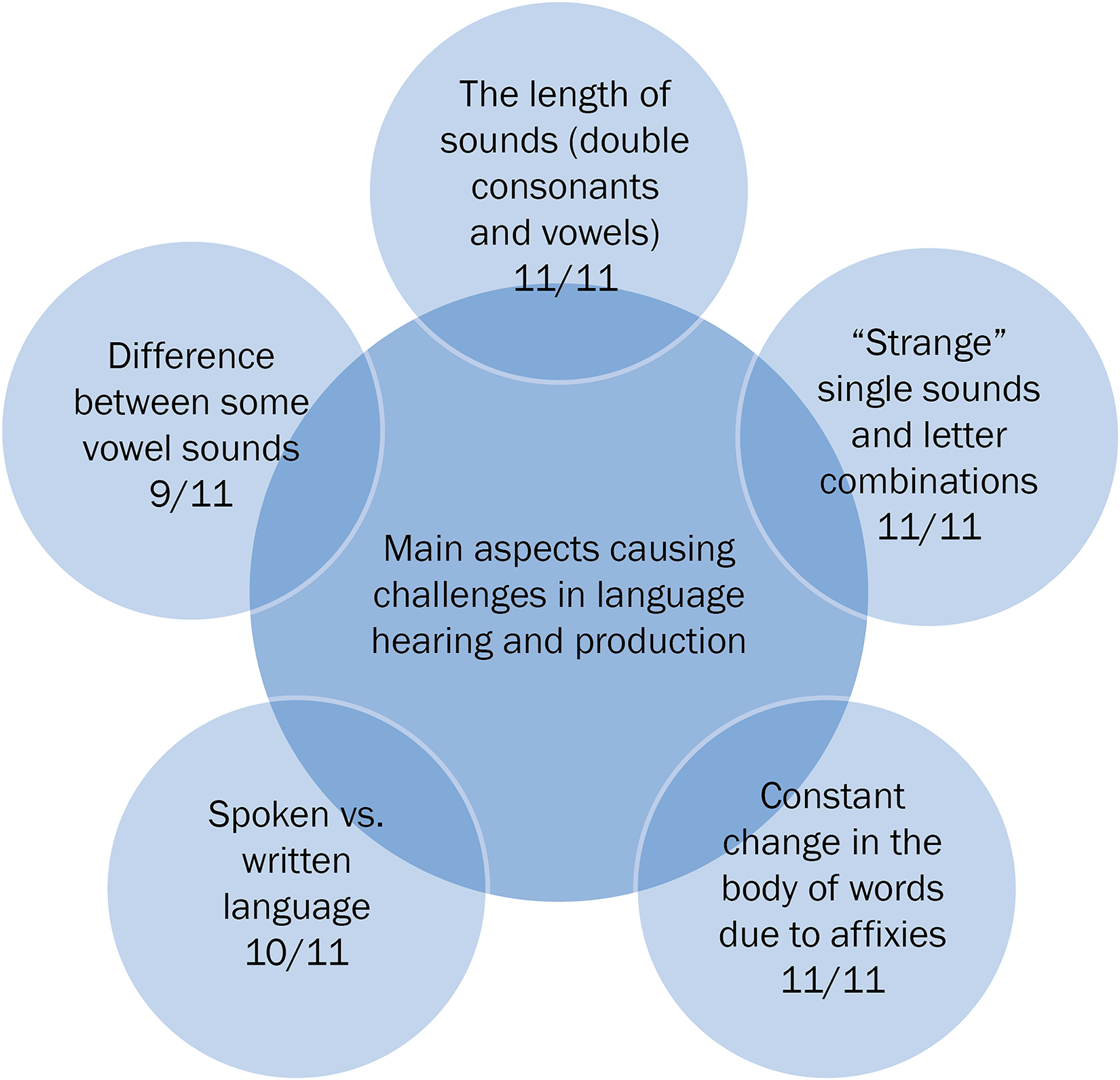
Main aspects causing challenges in hearing and producing Finnish language reported by the 11 interviewees.
Error Frequencies: Phonology Pre-Test
The error frequencies in the Phonology pre-test (see Table 3) demonstrated that the main phonological difficulties occurred in sound lengths. Double consonants (118 errors in 14 words of the test) were the most challenging, and were often left out in the shorter two-moraic first syllables, in the longer three-moraic first syllables, and in the second syllable of three-syllable words. Long vowels were also challenging (46 errors in eight words of the test), especially when at the end of two-syllable words. Perception of the length of two- and three-syllable words did not show considerable challenges for most choir participants of this study. The combination of sounds, especially different consonant sounds inside a word (47 errors in 14 words of the test), was somewhat challenging. Diphthongs (15 errors in six words of the test) did not demonstrate a particular difficulty in the Phonology pre-test, even though it is considered as a typical challenge in Finnish pronunciation (Aho et al., 2016). However, the 36-word version of the test that was used did not include diphthongs with difficult sounds such as [ie, øy]. The most typical single sound errors were related to perceiving the difference between vowel phonemes such as [a] and [æ].
Error frequencies in the 14 sound categories.

Note. N = total number of cases; M = Mean; SEM = standard error of the mean; SD = standard deviation; Min. = minimum number of errors; Max.= maximum number of errors; Sum = all errors.
Altogether, difficult sounds were mostly left out (293 errors). In double consonants and vowels, the other sound was typically left out or shortened. Single consonant sounds were also left out, in particular at the end of the word. Challenging sounds were replaced with other (wrong) sounds (203 errors) or pronounced with extra sounds (69 errors).
Differences between Participants
A one-way analysis of variance (ANOVA) was run to evaluate differences in the Phonology pre-test scores between the choir members (N = 41), who were divided into three subgroups (N = 9, N = 15, N = 17) based on the time they had lived in Finland and when they had joined the LFBS choirs (cf. Table 1). In the tests of Homogeneity of Variances (Levene), the assumption of homogeneity was not met (p > .05) in three sound categories (two-syllable words, two double consonants, and wrong sound). In one-way ANOVA, the assumption of equal variance needs to be met in order to avoid spurious findings. Thus, these three categories were excluded from ANOVA.
The results of one-way ANOVA (see Table 4) using all other 11 sound categories showed that the main effect of the subgroup (F(2,38) .030 ≤ F ≤ 2.610, p > .05) was not statistically significant. The partial eta squared value showed small and medium effect sizes (.002 ≤ η2p ≤ .121), indicating that only 0.2–12.1% of the variability in the scores could be explained by subgrouping the participating choir members. Post hoc comparisons (e.g., Scheffe, Games-Howell) indicated no significant differences between the subgroups in the 11 sound categories (p > .05).
Differences in the Phonology pre-test scores between the participant subgroups (ANOVA).

Note. N = number of subjects; F = variation within the test scores; p = probability; η2p = partial eta squared (effect size); M = Mean; SD = Standard deviation.
Changes in Phonological Processing and Finnish-as-L2 Use after Singing in a LFBS Choir
Experienced Changes in Finnish-as-L2 Use: Second and Third Interviews
Getting together with a group of people who are in the same situation. From the different countries to new country. And maybe don’t know so many people. Um… So, they can share experiences, um… also learning the language, of course, and through singing. It's about singing, yeah. It's just learning the language in a different way. Instead of sitting in a classroom with a book. It's active, it's not passive. It's a real active way of learning and having the words in your mouth; using the words, speaking the words. Thinking because, uh, yeah, sometimes you get us into the right of our own words… Um, coming up with diverse sounds. And yeah, just being with other people in the same situation and learning something and having fun. (A choir participant describing LFBS choir practice, Interviewee 11)
In the second and third interviews, held in the middle of March and at the end of May 2020 (12 interviews), eight choir participants described their experiences in Finnish language production after singing in a LFBS choir for 5–9 months. Only one of them had sung more than a year in an LFBS-choir. To varying degrees, they all had experiences in Finnish-as-L2 classes. In line with the thematic analysis (Braun & Clarke, 2006), the six overarching themes (see Figure 5) emphasizing the experienced changes in L2 learning and use comprised specific aspects of pronunciation (prosody), specific aspect of phonetics, understanding L2 more holistically, increasing motivation, the difference between spoken and written language, and the courage to use language. The subthemes (see the outermost circles in Figure 5) revealed different perspectives related to the main overarching themes. For example, subthemes “language as emotion” and “language as embodied” were related to the overarching theme “understanding L2 more holistically.”
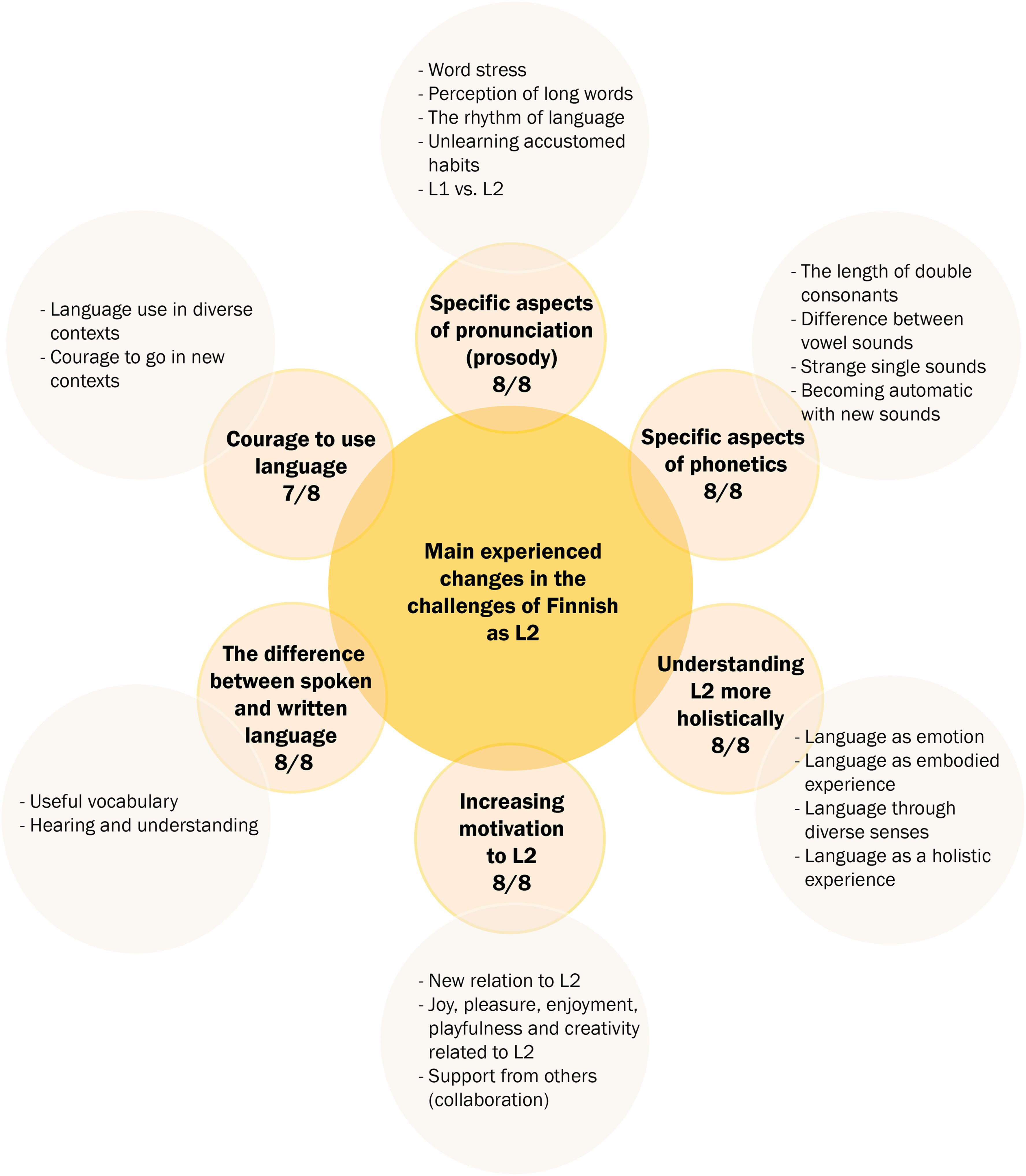
Main experienced changes in the challenges of Finnish as L2 reported by the eight interviewees. Both the main and subthemes are presented in the figure.
Interviewees revealed that there had been changes in their pronunciation by becoming phonetically aware of the challenging sounds and words, and word stress: “I think that I, yeah, at the phonetic level. I just see that the choir has made great…like really really a big difference” (Interviewee 6). Another interviewee referred to the same by saying: “We learn how to pronounce words while we sing and also learn the meanings. And at the same time, we have fun singing together, so I think it has all these qualities. It has the pronunciation. I would say it's the big, big thing here” (Interviewee 7). Singing was also reflected in relation to learning double consonants: “Yeah, because sometimes, yeah, my pronunciation is bad. Especially when it comes to double consonants. So, it really helps” (Interviewee 1).
Becoming familiar with Finnish as L2 was also seen as a process of unlearning accustomed habits: “Now I know this accent and why you are doing that. It's sort of like they go to this automatic mode. Then they just go, fall back to the previous, like to the natural mother tongue whatever. And I think that with the choir because you sort of, you change that sort of system where it doesn’t fake anymore, and you sort of like it somehow moves from a conscious level to a more automatic level” (Interviewee 6).
The development of pronunciation also emerged through the growing awareness of the differences between the choir participants’ first (native) language and Finnish: “And it's really different than when I’m trying to speak normally. So it's basically, I see that I’m stretching in a way that I wouldn’t when I would use my mother tongue for instance” (Interviewee 5). In addition, some interviewees discussed the importance of encountering the differences between different languages and Finnish as an eye-opening aspect of their process of trying to overcome the phonological challenges in Finnish, as one interviewee emphasized when discussing their meaningful experiences: “I have a big one with that part that you asked me to make the native language version of that song. That was very special to me” (Interviewee 7). In terms of this interviewee, interfacing L1 and L2 through singing had been holistically motivating and helped with identifying the relationships between native and L2, as well as how they were reflected in music.
Phonetic changes were also recognized with respect to sound hearing, in terms of better understanding and, especially, hearing the difference between sounds: “I can now distinguish some sounds that I couldn’t distinguish before. I think for example the time before for me [a] it was the sound [æ], then I started to get it, yeah. And then now, one of the big differences I’m noticing is on the double consonants. I thought it was the same thing” (Interviewee 6). Some interviewees mentioned that music engenders a kind of “phonetic memory” for them: “So now I understand that what I notice is the pronunciation. Very much in this. Some words that I memorise and then suddenly realise oh, I know this, and I know that and oh, I know that word. It's really like that with the pronunciation and, but there's some kind of memory connected with the music in that. I don’t know how to explain this” (Interviewee 7). The memory was also connected to words that had a slight phonemic 5 difference but sounded very similar (e.g., [tuli], [tuuli], [tulli] / fire – wind – customs) when they were practiced, for instance, with specific language songs in the LFBS choir rehearsals. In the words of one interviewee, this difference is easier to comprehend through singing and repeating “because you concentrate on how it sounds musically and at the same time linguistically” (Interviewee 3). The same experience was also expressed like this: “I think it's really this singing because we put it out. We put it out there, so then it's easier to put it out somewhere else. It's really this talking. Well, in this case it's singing, but many times I understand in the courses we are just there sitting, taking notes or we speak very little, but in the choir classes we are all the time doing this. It's like a memory it's created, yes, in fact” (Interviewee 7). Interestingly, the change in phonetic skills was also referred to as becoming familiar with the “proper” and “right” pronunciation in comparison to other experiences: “In a normal language class half of the time I’m listening, instead of talking. And, then if I am talking, half of the time I’m talking wrongly” (Interviewee 6).
The interviewees also emphasized that the active and holistic (embodied) language use related to different kinds of musical approaches that they encountered throughout the 1.5-h choir rehearsal had helped them become more confident with their language use (speaking) and understanding (hearing and perceiving) of Finnish, including spoken language. The choir context was seen as “motivational” (Interviewee 1), “energy giving” (Interviewee 6), and an “environment that really welcomes” (Interviewee 10) because “music is there to pull you forward. To make the journey a bit easier, I think” (Interviewee 5). In particular, the interviewees highlighted that music and singing “makes easier the sounds of the language, the…the phonetics” (Interviewee 2). The LFBS choir context was described as filled with “fun,” “joy,” and “pleasure,” as well as “full of enthusiasm,” a place where language learning and enjoying are interwoven: “I really get pleasure during learning, and this is the most important thing. I just feel better, and I feel better about language also. I can’t say that it's something logical. It's just feeling” (Interviewee 10). The choir participant's active and constant language use “with open heart, open mind and open body” (Interviewee 1) leads to a very “different way” of language learning in comparison to “just regurgitating the same thing whatever the teacher says from the textbook, and just copy-paste, copy-paste, copy-paste” (Interviewee 1). One interviewee summarized the experienced difference between a typical language class and the LFBS choir this way: “So in this sense this is basically almost turning around the situation. I’m actively using my voice” (Interviewee 5).
According to the interviewees, the experiences of active language use intertwined with musical activity had, in a broader sense, contributed to their courage to start using Finnish in other social contexts as well. As one interviewee described: “I can now more easily accept the challenge of speaking in Finnish, because I have already internalised the voice for Finnish speaking. So, I think it makes it easier for the mouth to go to the Finnish language. Yeah” (Interviewee 5). Another interviewee expressed her increasing courage to use Finnish in her working environment: “I have pushed myself to it, yeah to try to formulate it in Finnish and it was easier for me, not in terms of like knowing language, but in terms of not being so shy about looking stupid, taking too long time for formulating something and everybody else should be waiting. Yeah, so I just feel more relaxed in that way” (Interviewee 10). Their experiences in language use had also lowered the threshold to participate in other Finnish-speaking activities, as one participant emphasized: “It just encourages me more to do other Finnish things and, and…and in that sense it just gets more and more you do things in Finnish, and you think that you are welcome. You feel less shy” (Interviewee 6).
Some interviewees described that their whole relationship with the Finnish language had changed because of doing and experiencing language in holistic ways with joy, fun, and emotional expression. An interviewee described this change as getting better at hearing the word stress: “I wasn't like attentive enough to hear it before, but now I can hear it because it's kind of new way of processing language for me” (Interviewee 10). Thus, it was explained that the Finnish language does not feel so “weird,” “forced,” or “fake” anymore, instead, “when you have been doing it in the choir…you sort of internalise. Like this position of the mouth doesn’t feel like weird anymore” (Interviewee 11). The change in the relationship with the Finnish language was also explained like this: “I always rely on logical things and ordering systems. And I need to process it all the time. When we sing, I just cancel these kind of brain operations and start to just have fun and joy and pleasure and yeah it changes somehow the relationship with language. So I don’t feel it is so, ah, alien now. It's not so far from me. It's closer…Bit closer. Got closer” (Interviewee 10).
By and large, the interviews revealed changes in the choir participants’ use of Finnish as a spoken language, with which many of them were not familiar before. One interviewee said that “I think most useful for me was in choir I get to learn spoken language, which I don’t learn in language class” (Interviewee 1). Becoming aware of the features of spoken language was seen as important because “it is this sort of vocabulary that is learned only by hearing them and repeating them” (Interviewee 6). Also, hearing, using and knowing helped with the use of new spoken (everyday) words, sentences, and sayings in songs: “I think actually many of these words, they don’t come up usually during the normal Finnish classes. So many of the words that can be used also in regular conversation” (Interviewee 5). Another interviewee described the same by saying: “Because we don’t use spoken language in Finnish class. What I learn in class is very formal. Very textbook. So, in the choir it's more the words that people use in real life” (Interviewee 1).
Changes in Phonological Skills: Phonology Pre- and Post-Tests
A paired samples t-test was conducted to see if there were significant mean differences between the Phonology pre- and post-test sound category scores. The results (Table 5) showed that there was a significant (p < .05) mean difference in 9 out of 14 sound categories. In the categories of “two-syllable words” and “three-syllable words” the differences were not evaluated because there were no errors in the pre- and post-tests. The effect size (d = 0.8 and higher) was large in eight sound categories (Table 5), moderate (d = 0.5 to 0.8) in categories 7, 8, and 14, and small (d = 0.2 to 0.5) in category 10.
Paired samples t-test of Phonology pre- and post-tests scores in 16 participants.

Note. M = Mean; SD = Standard deviation; SEM = Standard error of the mean; t = the difference between the mean of pre- and post-tests / the size of difference; p = probability, d = Cohen’s d (effect size).
The largest significant differences (p < .05) in phonotactic skills were evident in the categories “Long consonants” and “3-mor. (long) first syllable” demonstrating the decrease in errors in sound length (double consonant), and in the length of the first syllable related to double consonants, long vowels, and single consonant sounds. The largest significant differences (p < .05) in paradigmatic skills were in the categories of “Sounds left out” and “Wrong sound.”
No significant differences between the pre- and post-tests (p > .05) were evident in the categories “diphthongs” and “[ŋ] sound.” In these sound categories, however, the average number of errors was also smaller in the Phonology post- than the pre-test.
Discussion
This study examined the extent to which singing in a language-aware choir can encourage the Finnish-as-L2 perception and production of adults with linguistically divergent backgrounds. Empirical research on L2 learning and use in a choral context is very scarce. The study of Scheckel and Kula (2021) tentatively showed that a choir as an elective course for sixth graders in a school context can create a conducive and stress-free environment for long-term English language learners (LTELs), especially related to speaking in English. Another study of native speakers and learners of Italian in Australia (Kennedy & Miceli, 2017) found that a choir context has potential for nurturing foreign language input and output as well as intercultural competence (see also Ilari et al., 2013).
The present study contributes to the research field on integrating music and L2 learning by introducing a new context – a multilingual choir – that highlights the possibilities of an authentic and meaningful social situation for L2 learning in an “out-of-a-language-class” environment (see also Hua et al., 2020; Lilja et al., 2020). This new choir context enables a specific approach to L2 learning that is based on holistic learning (e.g., Dewey, 1916, MW 9, p. 254) through an arts-based activity (see also Haught & McCafferty, 2008; Scally, 2019), and the direct needs, wishes, and here-and-now experiences of the choir participants (cf. Aho & Toivola, 2008; Munro et al., 2015; Suzukida, 2021), as opposed to top-down curriculum learning.
Main Challenges and Changes in Finnish-as-L2 Perception and Production
The main linguistic challenges in language production brought up by the interviewees and confirmed by the Phonology pre-test scores were related to sound lengths (especially double consonants), unfamiliar single sounds, and discrimination of vowel sounds. These challenges are in line with the pioneering findings of Aho et al. (2016) on pronunciation difficulties in Finnish as L2 among adults with linguistically diverse backgrounds living in Finland (see also Ullakonoja & Dufva, 2016) and highlight the impact of different native (L1) languages as well as other individual differences (e.g., Derwing & Munro, 2015) in L2 phonological processing. In the present study, the challenges in hearing and pronouncing unfamiliar single sounds (i.e., [æ], [ø], and [y]) and short versus long consonant and vowel sounds seemed to have a close relationship with challenges in sound discrimination (i.e., [a-æ], [o-ø], and [u-y], [kuuma – kumma / hot – strange]) which is in line with recent studies on L2 speech acquisition that emphasize the specific role of auditory discrimination in L2 pronunciation (e.g., Zheng et al., 2022). Moreover, the phonological challenges expressed by the interviewees in this study were related to unfamiliarity with the spoken language (see also Vihanta, 1990) and the ever-changing body of Finnish words, which makes them hard to hear and perceive (e.g., Karlsson, 1977, 1982).
For the interviewees, these difficulties in language production had become more approachable after actively focusing on sensitive language hearing together with music hearing, and actively practicing “proper” L2 pronunciation through singing in a supportive, motivational, and enthusiastic social context where learning and enjoying were intertwined (see also Scheckel & Kula, 2021). These findings are in line with previous studies on L2 pronunciation underlining the importance of active auditory-motor training (e.g., Aho et al., 2016; Kissling, 2013, 2018; Munro et al., 2015; Shao et al., 2023; Tierney & Kraus, 2014; Yule et al., 1987) and a mistake-tolerant and motivating learning environment (e.g., Baran-Łucarz, 2017; Saito et al., 2017, 2018; Wrember, 2001; Yousofi & Naderifarjad, 2015). According to Fonseca-Mora and Machancoses (2016), music fosters willingness and a positive attitude toward language learning by eliciting positive emotions (see also Engh, 2013).
A plethora of studies on choral singing highlight the benefits of a choir context in reducing anxiety and stress, strengthening social bonds, and promoting wellbeing, health, and inclusion (e.g., Bailey & Davidson, 2005; Dingle et al., 2012; Judd & Pooley, 2014; Livesey et al., 2012; Siljamäki, 2021). According to the interviewees of this study, learning Finnish holistically through choral singing also changed their relationship with Finnish as L2, because embodied/holistic learning was associated with feelings of pleasure and shared joy while using the language. Moreover, becoming more confident with Finnish phonetics and pronunciation encouraged the interviewees to start using Finnish in new contexts and to participate in other Finnish services outside the home (see also Passiatore et al., 2019). In the light of these findings, the affordances that musical and other arts-based social contexts can provide for L2 learning and use should be explored in more depth.
In addition to the improvements in phonetic awareness (sound hearing and discrimination) and production (pronouncing), the interviewees underscored that spoken language, a language that is primarily learned through oracy, had become more familiar after singing in LFBS choirs for over a year. Although the participants had lived in Finland for different amounts of time (from two months to 16 years) before joining the LFBS choir, all of them dramatically improved their skills and confidence related to L2 spoken language and communication. The interviewees pointed out that they previously had little or no experience of the spoken language and its vocabulary, because their earlier experiences of learning Finnish had focused on written language. Although the differences between written and spoken language (e.g., Lehtonen, 2015) have been acknowledged in Finnish-as-L2 research for decades (cf. Vihanta, 1990), according to the interviewees, spoken language typically is not harnessed sufficiently in the traditional L2 class practices. Our results suggest, however, that incorporating spoken language into L2 learning is important for everyday communication and social contacts, and that it can be approached through music and musical activity in various ways (see p. 00).
Despite the small sample size in the Phonology post-test, the results were in line with the experiences of the interviewees and showed a clear tendency: the scores in 12 out of 14 sound categories improved, nine of them statistically significantly, and eight of them with a large effect size. Importantly, the greatest improvements occurred in sound categories that were rated as the most difficult ones by the participants in the pre-interviews. That is, the perception of sound lengths, especially the length of double consonants but also double vowels, improved significantly. Based on these results, a language-aware choir has the potential to facilitate perception of phonetic (what the language sounds like) and phonemic (how sounds such as long and short consonants create different meanings) features, as well as prosody 6 of Finnish (e.g., Brown, 2004; Nenonen, 2001; Vihanta, 1990). These features are particularly challenging for Finnish-as-L2 learners regardless of their L1 background (e.g., Aho et al., 2016), but are also important for the comprehension of speech of others as well as the comprehensibility of one's own speech (e.g., Tiermas, 2008; Venkatagiri & Levis, 2007; Vihanta, 1990).
To our knowledge, the learning of these L2 phonological features has not been explored before in a choir context. Moreover, studies on Finnish-as-L2 pronunciation in general are rare (e.g., Aho et al., 2016; Tiermas, 2008; Virkkunen & Toivola, 2020). However, the improved Phonology test results of this longitudinal study are partly consistent with a study in the context of an L2 class (Tiermas, 2008) stressing that the essence of developing skills in vowel quantification (length difference) lies in providing sufficient time for active practice. In addition, earlier research on teaching L2 phonetics (e.g., Virkkunen & Toivola, 2020; see also Jones, 1997) underscores that explicit instructions should be meaningfully integrated into the overall language learning processes, with an emphasis on features of prosody rather than as a separate phonetic component without a broader context (see also Derwing & Munro, 2009; Kissling, 2018). By considering both articulation and pronunciation 7 of Finnish as salient parts of singing and musical activity in the LFBS choirs, the challenging aspects of L2 phonetics could be meaningfully embedded into the overall L2 learning and use. The present results are also in accord with earlier findings of Tierney and Kraus (2014) suggesting that the repetition in musical practice has a potential to support L2 phonological learning by enhancing the sensibility of fine-grained auditory-motor timing. Phonology test results showed that the number of errors related to wrong sounds decreased statistically significantly with a large effect size between the pre- and post-tests, indicating that the choir participants had become more familiar with difficult sounds, especially in differentiating unfamiliar vowel sounds ([pollo (meaningless nonword) – pøllø (owl)]). These significant improvements in L2 Finnish sound discrimination and pronunciation skills could be partly related to the positive emotions and joy experienced through singing together (e.g., Bailey & Davidson, 2005; Davidson & Leske, 2020; Daykin et al., 2020; Judd & Pooley, 2014), a suggestion that was also confirmed by the interviewees. Similarly, bodily (cf. physical) orientation as part of the more general embodied approach to language learning in the LFBS choirs may also have contributed to the improvements in L2 pronunciation (see Jusslin et al., 2022). In the LFBS-choir practice (see the six fields of action p. 5), sensing, hearing, pronouncing, and comparing challenging sounds were approached by exaggerating mimicry (e.g., lips, mouth), adding supporting gestures, movements, rhythmics, body percussion and clapping while singing, and by moving around the rehearsal space in order to put the rhythm of music and language holistically in the body.
Owing to the sudden corona pandemic, the results of the Phonology tests could not be compared with those of the normal L2 class participants. However, although the choir members had different levels of L2 classroom experience, they all had phonetic challenges in the pre-test that improved in the post-test, and there were no statistically significant differences in the pre-test scores between the three participant subgroups. Thus, the positive changes in pronunciation shown in the post-test were not explained by the time lived in Finland or the time engaged in singing in the LFBS choirs. However, all participants were singing voluntarily in the LFBS choirs, which might have had a positive impact on the findings (e.g., Tierney & Kraus, 2014; Zheng et al., 2022). More research with a larger sample and an appropriate control group is needed for statistically more reliable analyses of the gains of choral singing on L2 phonetic and spoken language learning.
The main changes in Finnish-as-L2 perception and production (including spoken language) are discussed next, through the lens of LFBS choir practice (cf. the six fields of action, see p. 5). This allows us to consider how the linguistic challenges expressed by the choir members during the choir rehearsals were addressed and linked to the ongoing choir practice.
Sound Hearing, Discrimination, and Pronunciation in and through the LFBS Choir Practice
Hearing sound lengths and differentiating the unfamiliar (vowel) sounds of Finnish were the main challenges and perceived changes after joining the choir rehearsals. As Vihanta (1990, p. 200; see also Kachlicka et al., 2019) states, learning to pronounce a foreign language primarily requires learning to hear it, which in turn is closely related to music learning, where hearing and listening are an irreducible part of music making. Recent multidisciplinary studies on L2 speech acquisition also emphasize the importance of promoting auditory processing (e.g., Saito et al., 2022). During the LFBS choir rehearsals, the essence of hearing (including sensing) was emphasized in relation to both music and language expression, highlighting their intertwining and holistic experience while singing. Importantly, challenges in L2 perception were approached both at the segmental level, by focusing on single sounds and phonemes, and at the prosodic level related to larger entities such as sound lengths and durations, word and sentence stress, and the rhythm and fluency of language (see, e.g., Ullakonoja & Dufva, 2016; Vihanta, 1990).
In warm-ups (1st field of action), it was possible from the very beginning of the choir rehearsals to orientate sound hearing and differentiation together with pronunciation, especially emphasizing the segmental level. The challenges in hearing and pronunciation of difficult sounds and sound lengths identified by the choir participants were, for instance, used as the basis for developing new vocalizations and vocal and breathing exercises. For instance, a phonetically challenging word suggested by a choir participant was used as an impetus and was worked on through vocalizing, singing, and rapping it sound-by-sound, syllable-by-syllable, and finally as a whole word. In that sense, challenges in double consonants, for instance, could be emphasized by singing an interval in-between the double sound ([kuk-ka] / a flower) and rhythmically highlighting the difference between long and short vowel sounds. On the other hand, the discrimination of unfamiliar vowel sounds could be implemented by underlining the difference (e.g., [a-æ, u-y, o-ø]) with exaggerated articulation (the active use of mouth, lips, and tongue), focusing on sensing not only how they sound but also how they feel and resonate in the body, and by collaboratively creating supporting gestures and movements that illustrate the nature of the vowel sounds (wide / narrow) while singing. Challenging sound combinations could be focused on, for example, challenges in diphthongs (cf. Aho et al., 2016), by singing them as a single syllable (([æi]) or part of a word ([æiti] / mother)) embedded in a simple vocal exercise. Moreover, the diverse use of call-and-response (CAR) and showing-in-front (SIF) approaches were used to enable choir participants to hear how the choir conductor or the L2 teacher, as native speakers, pronounce Finnish, as well as to see their mimicry and gestures at the same time (see also Smotrova, 2017). In relation to collaborative choir improvisations (2nd field of action), CAR was used to communicate through all available modes of expression, highlighting the sensitive listening to, hearing, and sensing of others, and responding to their verbal, vocal, and embodied initiatives by imitating or creating new initiatives. In the context of a language classroom, choral repetition methods of speech such as shadowing (cf. CAR) and tracking (cf. SIF) have been found to nurture the development of L2 pronunciation by emphasizing their auditory-motor integration (see Shao et al., 2023).
At the prosodic level (cf. suprasegmental, see Derwing & Munro, 1997), the phonological challenges of L2 could be approached by focusing on the clear articulation and pronunciation of song lyrics while singing songs from diverse perspectives (3rd, 4th, 5th, and 6th fields of action). That is, singing songs enabled the emphasis on the sentence-level pronunciation, utilizing support from musical phrasing at the same time. The experienced challenges in words and sounds of the song lyrics were also used as the basis for generating warm-ups (1st field of action) in the next rehearsals. In addition, while singing songs pronunciation and articulation were supported visually by projecting the lyrics on the wall to enable the choir members to simultaneously hear and see, for instance, the length of the double sounds and difficult vowel sounds. This visual coupling was also highlighted by the interviewees. Furthermore, rhythmics such as clapping, body percussion, and embodiment (gestures and movements), as well as musical expression were integrated into the singing to add a bodily and emotional “feel of the language” in order to enhance the experience of differences between sounds and their lengths, and of word and sentence stress. While singing songs, the length of sounds and perceiving long words (another challenging feature of Finnish, see e.g., Aho et al., 2016) were denoted by varying tempos, stopping in the middle of double consonant sounds, and holding the sound in the mouth until the song continues, and by highlighting word stress (always on the first syllable of Finnish words). Accordingly, singing funny language songs (5th field of action) enabled the choir participants to immerse themselves in playful ways into differences in sound and word lengths and the changing body of words (cf. consonant gradation) with the help of rhythm that closely followed the pace of spoken language, and with lyrics where the meaning varied according to the length of the phoneme. Moreover, in Finnish songs it is common that the melody progresses syllable per tone, meaning that in order to sing the melody of a song, each syllable (with its challenging sounds) of the word needs to be articulated. This syllabic way of singing makes it easier not only to hear and pronounce, but also to memorize and recall words and sentences and the phonetics of a foreign language (see, e.g., Ludke et al., 2014; Schön et al., 2008). Repetition, the most essential feature of music (cf. the repetitive nature of songs), and musical activity (cf. immersion in musical repertoire from various perspectives) were highly emphasized in the LFBS choir activity, where sheet music was not used, and repetition enabled choir participants to gradually become familiar with and automate the strange and unfamiliar phonetic aspects related to hearing, sensing, discriminating, perceiving, and pronouncing Finnish as L2. The importance of musical repetition in L2 learning was also underlined in the interviews.
Spoken Language in and through the LFBS Choir Practice
The other challenging linguistic issue hindering L2 learning and use expressed by the interviewees that was subjectively improved during the LFBS choir activity was spoken language. In the LFBS choirs, spoken language was considered a sublanguage (cf. dialect) with its own vocabulary and utterances, including the subtleties of grammar (e.g., Lehtonen, 2015), thus stressing its difference from the written language.
In the LFBS choir practice, spoken language was approached in many ways, for instance by singing Finnish pop songs, including rap (the 3rd field of action). The lyrics of pop songs are typically based on the spoken Finnish and its idioms, and they also rhythmically follow its natural pace, which is not always the case in songs of other music genres. Importantly, when singing pop songs, the differences between spoken and written language were constantly discussed and negotiated, and were facilitated visually by projecting the lyrics on the wall. In folk songs and traditional music, the language related to spoken utterances of dialects or old Finnish were collaboratively translated to modern and more usable forms of spoken Finnish. Accordingly, by creating and re-creating song lyrics (4th field of action) reflecting the choir participants’ own thoughts and experiences, the use of spoken language was encouraged. It was also supported when singing funny language songs (5th field of action) that utilized the vocabulary and the rhythm of spoken language, and when improvising (2nd field of action) or composing songs collaboratively. Moreover, when translating the songs brought by the choir participants (6th field of action), the use of spoken language was nurtured, enabling intercultural dialogue between Finnish and the native languages of the choir participants, as well as identifying the differences between them.
Conclusion
This transdisciplinary, mixed-methods study explored adult choir participants’ experienced and test-based challenges in Finnish-as-L2 hearing and production focusing particularly on the changes in these challenges after participating in the LFBS choir for one year. The findings indicate that the choir practice where dynamic L2 use is entwined with meaningful musical activity can help the participants to overcome phonological challenges in L2 auditory processing and oral language production, both significant aspects of successful L2 learning and use, despite the fact that the participants had arrived in Finland at different times and had diverse experiences of learning Finnish before joining the choir. The research shows that participants of the LFBS choir can significantly improve their performance and confidence in L2 sound hearing, pronunciation, spoken language, and communication – aspects of language skills that can be more challenging to teach and learn in traditional classroom settings. Moreover, the findings indicate that translating choir members’ needs, wishes, and experiences into musical actions makes both the choir practice and the L2 learning more meaningful for its participants. It is important to note, however, that these improvements in Finnish-as-L2 skills are not direct “transfer effects” of music to language since music and language were equally and reciprocally focused throughout the LFBS choir practice.
As a whole, the study advocates new approaches and opportunities to music education where the educational potential goes beyond “learning within single domains and practices” (Akkerman & Bakker, 2011, p. 150), and the choir practice beyond mere “performing” music well. The study contributes to the evidence-based research on L2 learning by contextualizing the empirical findings of actual practice in its authentic learning context. Importantly, the double meaning (Lehtinen-Schnabel, 2023) of the LFBS choir requires constant rethinking and restructuring of the taken-for-granted habits and principles underlying music education, choir practices, and L2 teaching. In addition, the natural social context of the choir encourages and motivates L2 learning through musical activity that promotes joy, enjoyment, and enthusiasm. The findings of this study cannot thus simply be transferred to other contexts without considering the specific nature of the given language, contextual and cultural differences, and the needs of the choir participants.
Supplemental Material
sj-docx-1-mns-10.1177_20592043241244542 - Supplemental material for Singing Language – Integrating Second Language Learning into Choir Practice
Supplemental material, sj-docx-1-mns-10.1177_20592043241244542 for Singing Language – Integrating Second Language Learning into Choir Practice by Johanna Lehtinen-Schnabel and Sari Levänen in Music & Science
Supplemental Material
sj-docx-2-mns-10.1177_20592043241244542 - Supplemental material for Singing Language – Integrating Second Language Learning into Choir Practice
Supplemental material, sj-docx-2-mns-10.1177_20592043241244542 for Singing Language – Integrating Second Language Learning into Choir Practice by Johanna Lehtinen-Schnabel and Sari Levänen in Music & Science
Supplemental Material
sj-docx-3-mns-10.1177_20592043241244542 - Supplemental material for Singing Language – Integrating Second Language Learning into Choir Practice
Supplemental material, sj-docx-3-mns-10.1177_20592043241244542 for Singing Language – Integrating Second Language Learning into Choir Practice by Johanna Lehtinen-Schnabel and Sari Levänen in Music & Science
Footnotes
Action Editor
Isabel Martinez, Universidad Nacional de La Plata, Facultad de Bellas Artes.
Peer Review
Philip Salmon, Royal College of Music, Karen Ludke, Edge Hill University, The Language Centre.
Contributorship
Johanna Lehtinen-Schnabel gained ethical approval, participant recruitment and data analysis, wrote the first draft of the manuscript. Sari Levänen involved in study design, reviewed and edited the manuscript and approved the final version of the manuscript.
Data Availability Statement
Statistical data in anonymized form is available. Owing to its sensitive nature, qualitative data (interviews) cannot be shared.
Declaration of Conflicting Interests
The authors declared no potential conflicts of interest with respect to the research, authorship, and/or publication of this article.
Ethical Approval
The ethics committee of the University of the Arts Helsinki approved this study. The construction and handling of unpublished data for this research adhered to the Ethical Instructions of the University of the Arts (UNIARTS 2015), the code of ethics of the European Commission (EC 2010), and the Responsible Conduct of Research (RCR) guidelines of the Finnish Advisory Board on Research Integrity (TENK 2012). The study has received research permissions from the related organizations according to their research integrity guidelines. In addition, DPIA (Data Processing Impact Assessment) has been processed and approved by the Data Protection Officer at the University of the Arts Helsinki. The participants have provided their written informed consent to participate in this study.
Funding
The authors disclosed receipt of the following financial support for the research, authorship, and/or publication of this article: This work was supported by the Koneen Säätiö, (grant number 202007315).

Supplemental Material
Supplemental material for this article is available online.
Notes
Appendix 1
References
Supplementary Material
Please find the following supplemental material available below.
For Open Access articles published under a Creative Commons License, all supplemental material carries the same license as the article it is associated with.
For non-Open Access articles published, all supplemental material carries a non-exclusive license, and permission requests for re-use of supplemental material or any part of supplemental material shall be sent directly to the copyright owner as specified in the copyright notice associated with the article.
