




Abstract
Musical pleasure stems from an interplay of social, emotional, and cognitive factors. In adults, there are large individual differences in musical reward, with some individuals (deemed “hyperhedonic” to music) reporting very high reward and others (deemed “anhedonic” to music) reporting very low reward. Musical anhedonia is, therefore, a selective lack of pleasure in response to music, defined by self-reported low musical reward in the absence of generalized anhedonia. While this phenomenon has been investigated in adults in recent years, little is known about musical anhedonia or musical reward more generally in children. To address this, we investigated parents’ perceptions of musical reward in their children. We adapted a questionnaire of musical reward (the Barcelona Musical Reward Questionnaire [BMRQ]). Parents (N = 500) responded to the adapted questionnaire (children’s BMRQ [cBMRQ]) and a widely used questionnaire of temperament (Children's Behavior Questionnaire—Very Short Form) concerning their 3- to 7-year-old children. As with adults, there was large individual variation in musical reward. A subset of participants rated their children’s experience of musical reward as very low, but did not rate them as having temperamental negative affectivity. Results point to substantial individual variation in musical reward in early childhood and suggest that musical anhedonia may already be apparent in early childhood.
Most people find listening to music a highly pleasurable activity. Perhaps unsurprisingly, one of the most frequently reported reasons for listening to music is because of its influence on mood and ability to evoke pleasant feelings (Panksepp, 1995), or, more simply, because people like it (Sanflippo et al., 2020). More recently, researchers have begun investigating exactly what it is that makes music pleasurable. A number of factors have been identified as contributing to music-evoked pleasure, or musical reward. For example, musical “chills” tend to be elicited in response to salient features, such as increasing loudness (Grewe et al., 2007). Research from a predictive coding framework has shown that the predictive processes contribute to musical reward (e.g., Gold et al., 2019; Huron, 2006; Vuust et al., 2018), both via musical anticipation and musical surprise (Cheung et al., 2019). In addition to the influence of musical features, personality features have also been found to relate to musical pleasure. For example, reward related to musical surprise varies with personality (Omigie & Ricci, 2023), as does enjoyment of sad music (Taruffi & Koelsch, 2014).
While researchers in the field have been making swift progress investigating the musical and individual features that drive musical reward, there has been simultaneous progress in a complementary area of research studying individuals who do not feel pleasure when listening to music. Musical anhedonia is the term used to describe individuals who do not have pleasurable responses to music, but still have normal reward responses to other pleasurable activities. Musical anhedonia was initially identified in individuals who sustained neurological damage and subsequently reported that they no longer enjoyed music (the term was first coined by Satoh et al., 2011 to refer to a case study). This type of musical anhedonia has been referred to as “acquired musical anhedonia” (Belfi et al., 2017; Belfi & Loui, 2020), meaning that individuals have acquired musical anhedonia following brain damage (similar to “acquired amusia,” e.g., Särkämö et al., 2009).
However, in a complementary stream of research, musical anhedonia has also been identified in healthy individuals with no history of brain damage (around 5% of the general population; Mas-Herrero et al., 2013). In an initial study, researchers developed the Barcelona Musical Reward Questionnaire (BMRQ), which has become the gold standard for identifying the range of musical reward and classifying individuals as musically anhedonic (Mas-Herrero et al., 2013). The BMRQ measures distinct facets of musical reward, which include Emotion Evocation, Sensory-Motor, Mood Regulation, Musical Seeking, and Social Reward. To be considered musically anhedonic, individuals must score at the low end of the BMRQ but not report generalized anhedonia (as measured by general anhedonia scales, such as the Physical Anhedonia Scale; Chapman et al., 1976). Additionally, individuals with musical anhedonia show normal reward responses to other rewarding stimuli, such as monetary gain (Mas-Herrero et al., 2014) and visual arts (Mas-Herrero et al., 2018). Recent work has indicated that individuals with musical anhedonia even show reduced pleasure to isolated, unfamiliar timbres, suggesting that musical anhedonia is not due solely to rhythmic or melodic processing deficits (Kathios et al., 2024). To summarize, musical anhedonia is a lack of musical pleasure (either in response to a brain injury or naturally occurring in healthy individuals), without a lack of pleasure for other highly rewarding activities.
Typically, musical reward and musical anhedonia have been studied in young or middle-aged adults. However, recent research has investigated potential changes in musical reward across the lifespan. For example, recent work indicated that increasing age is associated with decreasing scores on the BMRQ (indicating decreased musical reward), but that this was primarily driven by the music-seeking subscale of the BMRQ (Belfi et al., 2022). Other work has shown that people's ability to process musical expectancies changes as they age (Halpern et al., 2017), potentially contributing to developmental changes in reward. While age-related changes are apparent in older adulthood, little is known about musical reward in early childhood.
Some components of musical reward are evident early on. Emotion Evocation and Mood Regulation refer to the propensity for music to induce particular emotions and to be used as a method for regulating mood, respectively. These are common functions of music in caregiving, apparent as early as infancy. Infant-directed singing is a ubiquitous caregiving activity, with most North American parents reporting singing daily (Yan et al., 2021). Caregivers’ singing both delays and reduces infant distress more effectively than speech, particularly when the song is familiar (Cirelli et al., 2020; Corbeil et al., 2016). Infants respond differently, both physiologically and behaviorally, to a singer’s lullaby than to a play song (Bainbridge & Bertolo et al., 2021; Cirelli et al., 2020; Rock et al., 1999). Musical features that characterize play songs, such as fast tempi, elicit more positive affect from infants than the features that characterize lullabies (Kragness et al., 2022, 2023a). Children as young as 4 years can distinguish between songs for sleeping and songs for dancing (Hilton et al., 2023), and children's emotional responsiveness to music is cited as one motivating feature of music-based interventions (e.g., Lense & Camarata, 2020).
Likewise, there is early evidence for sensorimotor aspects of musical reward, that is, the tendency for music to motivate motor responses. Approximately 90% of North American parents report that their children observably dance to music by their 1st birthday (Kim & Schachner, 2023), and infants move more rhythmically in response to music than in response to nonmusical auditory stimuli (Zentner & Eerola, 2010). Studies of children's movements and affective responses to music suggest a relation between movement and reward; for both infants and children, the amount of time children spend moving to music tends to correlate positively with the amount of time they spend smiling to it (Cirelli & Trehub, 2019; Kragness et al., 2022, 2023b; Zentner & Eerola, 2010). Although the direction of causality is unclear, the overall picture points to a close link between movement to music and positive feelings.
Social reward, which refers to musical experiences that strengthen relational bonds, is also apparent early in life. Infants and children alike have more prosocial interactions with people they have moved synchronously with than asynchronously (Cirelli et al., 2014; Kirschner & Tomasello, 2010; Rabinowitch & Meltzoff, 2017), and share more smiles after a synchronous activity (Tunçgenç & Cohen, 2016). Although music is not strictly necessary for this prosocial effect of synchrony in children, music is well-suited to facilitate synchronous movement through its regular, predictable beat structure. Interestingly, researchers also found that music facilitates infants’ compliance (Cirelli et al., 2017), reinforcing its important role as a mood regulator. Group music training has been shown to promote social abilities in third and fourth graders compared with passive control (Schellenberg et al., 2015), and children use familiar songs as a social signal to shape their interactions with and judgments of strangers (Cirelli & Trehub, 2018; Soley & Spelke, 2016).
The final BMRQ subscale, Musical Seeking, is associated with choosing to listen to, spend money on, and become more informed about liked music. Compared with the other four factors, there are relatively fewer clear parallels with the developmental literature, since children usually do not have the option to either purchase or inform themselves about music in the ways probed by the BMRQ. However, choosing to listen to preferred music, and requesting preferred music, are behaviors that even young children are capable of. By their 1st birthdays, infants prefer to listen to highly familiar songs over unfamiliar songs (Kragness et al., 2022), and to music with culturally familiar over unfamiliar metrical structures (Soley & Hannon, 2010), in infant-controlled listening paradigms. Whether such preferences stem from reward mechanisms versus other motives (for instance, aversion to novelty) is unknown. Although there is little empirical research on the frequency of children's requests for music, viral videos of toddlers requesting Baby Shark or other favorite songs from smart speakers, such as Amazon’s Alexa, suggest that these behaviors occur frequently.
Altogether, there is substantial evidence that reward responses to music are present early in development, across the five factors identified in the BMRQ. At the same time, factors that are known to contribute to musical reward—such as expectations, motor abilities, and socio-emotional abilities—are immature well into teenage years. Although most North American caregivers report that their children dance by their 1st birthdays (Kim & Schachner, 2023), children are poor beat synchronizers into middle childhood (McAuley et al., 2006), potentially affecting both sensorimotor and social aspects of reward to music. Prediction-based reward is also probably immature: adult-like expectations for musical sequences have a long developmental trajectory (e.g., Corrigall & Trainor, 2009, 2010; Kragness & Trainor, 2018). Although music can evoke emotions in childhood, children's abilities to identify emotions in music in an adult-like way also develops over childhood (e.g., Dalla Bella et al., 2001). It is therefore possible that, for children, musical reward may differ from the adult experience. Additionally, while these previous studies point to links between music and reward in children, there are currently no comprehensive methods available to measure individual differences in children's musical reward.
To address the question of whether children display similar patterns of musical reward (including musical anhedonia) to adults, we investigated musical reward in early childhood, using an adapted BMRQ (the children’s BMRQ [cBMRQ]). We adapted this questionnaire to be filled out by parents of 3- to 7-year-old children. To assess whether lack of musical pleasure was associated with low pleasure in other domains, we also administered a childhood temperament survey to parents. We selected 3- to 7-year-old children because this age range corresponds to that used in a widely used early childhood temperament questionnaire (the Children's Behavior Questionnaire - Very Short Form; Putnam & Rothbart, 2006), and because many of the behaviors and attitudes probed by the BMRQ could be more readily adapted for this age group than for younger age groups. Given that studies of musical anhedonia have thus far been conducted in adults, this study was exploratory in nature; therefore, we did not test specific hypotheses. In sum, the purposes of this study were to (1) assess individual differences in children's musical reward, and (2) identify whether a reward profile resembling musical anhedonia can be observed in childhood. We also sought to provide a tool for future research to assess musical reward in children, namely, the cBMRQ.
Methods
Participants
Participants were recruited online from Prolific, and were only eligible to participate if they reported having at least one child in the age range and were living in the U.S. Participants consented to participate using a check box on Qualtrics, before completing a survey. Participants consented to their anonymized data being used in the study and retained for use in potential future studies. There were 505 respondents. Of these, five reported that their child was out of the age range (3–7 years old). These respondents were excluded. Of the remaining 500 participants, the reported average child age was 4.88 years (SD = 1.10, range 3.00–7.83 years, 272 girls, 228 boys). The average parent respondent was 33.62 years old (SD = 5.54, 21–56 years, 4 parents not responding; 275 women, 223 men, 2 nonbinary; 85% white). No information was collected about socio-economic status or wealth, but participants reported a variety of education levels (≈1% no high school degree or general educational development test (GED), ≈10% associates or technical degree, ≈11% high school degree or GED, ≈19% some college, 38% bachelor's degree, 22% graduate or professional degree). Of the 496 participants who responded to this question, 186 indicated having never taken any music lessons. The average respondent had taken 3.57 years of music lessons (SD = 4.55, 0–25 years). Parents reported that their children had taken, on average, 0.49 years of music lessons (SD = 0.81, 0–5 years).
Materials
cBMRQ
We adapted the 20-item BMRQ (Mas-Herrero et al., 2013). The item wording was altered as little as possible to reflect the child's behavior, attitude, or experience, rather than one’s own. For example, the item “When I share music with someone I feel a special connection with that person” became “When my child makes music with someone, they appear to have a special connection with them.”
Some items did not translate as readily. For example, changing “I inform myself about music that I like” to “My child informs themself about music that they like” is unlikely to be appropriate for most children. For those items, we altered the items to reflect the same underlying construct (music seeking) but in a more age-appropriate way, to the best of our judgment. For instance, in this case, the item given was “When my child likes a song, they ask for more music from the same performer.” Adapted items were selected by agreement between the first and last author. For all items, see the Supplemental Material.
Temperament
To investigate general pleasure, we administered the Children’s Behavior Questionnaire—Very Short Form (CBQ-VSF; Putnam & Rothbart, 2006). The CBQ-VSF is a widely used, 36-item instrument in which parents indicate how well a statement describes their child (e.g., “My child seems always in a big hurry to get from one place to another.”). The instrument produces scores for three temperament dimensions: surgency, negative affect, and effortful control. Surgency corresponds to extraversion and positive emotionality. Negative affect corresponds to fear, anger, or sadness. Effortful control reflects the ability to initiate and to inhibit actions.
Procedure
Participants completed the demographic questionnaire first, the cBMRQ second, and the CBQ-VSF last. Participants were given $1.80 compensation for their participation; on average, it took participants around 7 min to complete the study.
Results
Factor Structure
We first sought to examine whether the five-factor structure of the original BMRQ (Mas-Herrero et al., 2013) was a good fit for the cBMRQ. To do this, we conducted a confirmatory factor analysis using the lavaan package in R (Rosseel, 2012). We first subjected the data to a Kaiser test to determine whether factor analysis would be an appropriate method for our data. The Kaiser–Meyer–Olkin (KMO) statistic, which can vary from 0 to 1, indicates the degree to which a dataset is suitable for factor analysis. A value of 0 indicates that factor analysis is likely to be inappropriate, while a KMO close to 1 indicates that factor analysis should yield distinct and reliable factors. Here, we found that the dataset was appropriate for analysis (KMO = .88). As in prior work validating the fit of confirmatory factor analyses (e.g., Mannino et al., 2024; Wang et al., 2023), measures of fit were computed using the comparative fit index (CFI) and Tucker–Lewis Index (TLI). For both the CFI and TLI, values above .85 are considered a good fit. The original factor solution, however, did not reach acceptable levels of fit (CFI = .798, TLI = .761).
Because the original factor structure of the BMRQ did not appear to be a good fit for our data, we next conducted an exploratory factor analysis to investigate the latent structure of the data. As in prior work validating new versions of the BMRQ (Mannino et al., 2024), we first split the data into two separate samples for exploratory and confirmatory factor analysis (N = 250 in each sample). The sample was first ordered by child age, then split by selecting odd- and even-numbered participants based on this order. This was done so that the samples for exploratory and confirmatory factor analysis were evenly matched on child age. A t test indicated that the distributions of age across the two samples were approximately similar, t(498) = −0.135, p = .893 (Modd = 4.88 years, SDodd = 1.10 years; Meven = 4.88 years, SDeven = 1.11 years), and the interitem polychoric correlation matrices for both samples were deemed suitable for factor analysis via a Kaiser test (KMOodd = .85, KMOeven = .88).
We next iterated the exploratory factor analysis until the factor solution met the criteria: omitting items with communalities <.2 (Child, 2006), omitting items that strongly cross-loaded on several factors, and retaining only factors with at least three items. For each iteration, the number of factors to explore was assessed by examining the eigenvalues and scree plots (Kaiser method), and by running parallel analysis. This process required three iterations before converging on a structure. There were initially two items with communalities that did not meet the criterion: Item 1 (“When my child makes music with someone, they appear to have a special connection with them.”) and Item 7 (“When my child likes a song, they ask for more music from the same performer.”) (see Table S1). Both the Kaiser method and parallel analysis indicated that four factors would be ideal. The four-factor solution included two items that cross-loaded strongly on several factors, and were therefore omitted (see Table S2): Item 6 (“Music makes my child bond with other people.”) and Item 20 (“When my child hears a tune they like a lot they can’t help tapping or moving to its beat.”). One additional item had relatively strong cross-loading (Item 3, “My child likes to listen to music that contains emotion.”) but the ratio of cross-loading (.78) was very close to the recommended threshold (.75) and the item was retained.
After this omission, the exploratory factor analysis was conducted again. In this iteration, the factor analysis and Kaiser test both indicated the ideal number of factors to be four. However, the fourth factor included only two items: Item 5 (“My child doesn’t like to dance, not even with songs they like.”) and Item 10 (“Music often makes my child dance.”). Therefore, these items were omitted and the remaining data were submitted to a final analysis. The final iteration resulted in three factors and all the item loadings remained satisfactory (Table 1). The three factors explained about 52% of the total variance, exceeding the recommended threshold of 50%.
Loadings for three-factor solution (exploratory factor analysis).
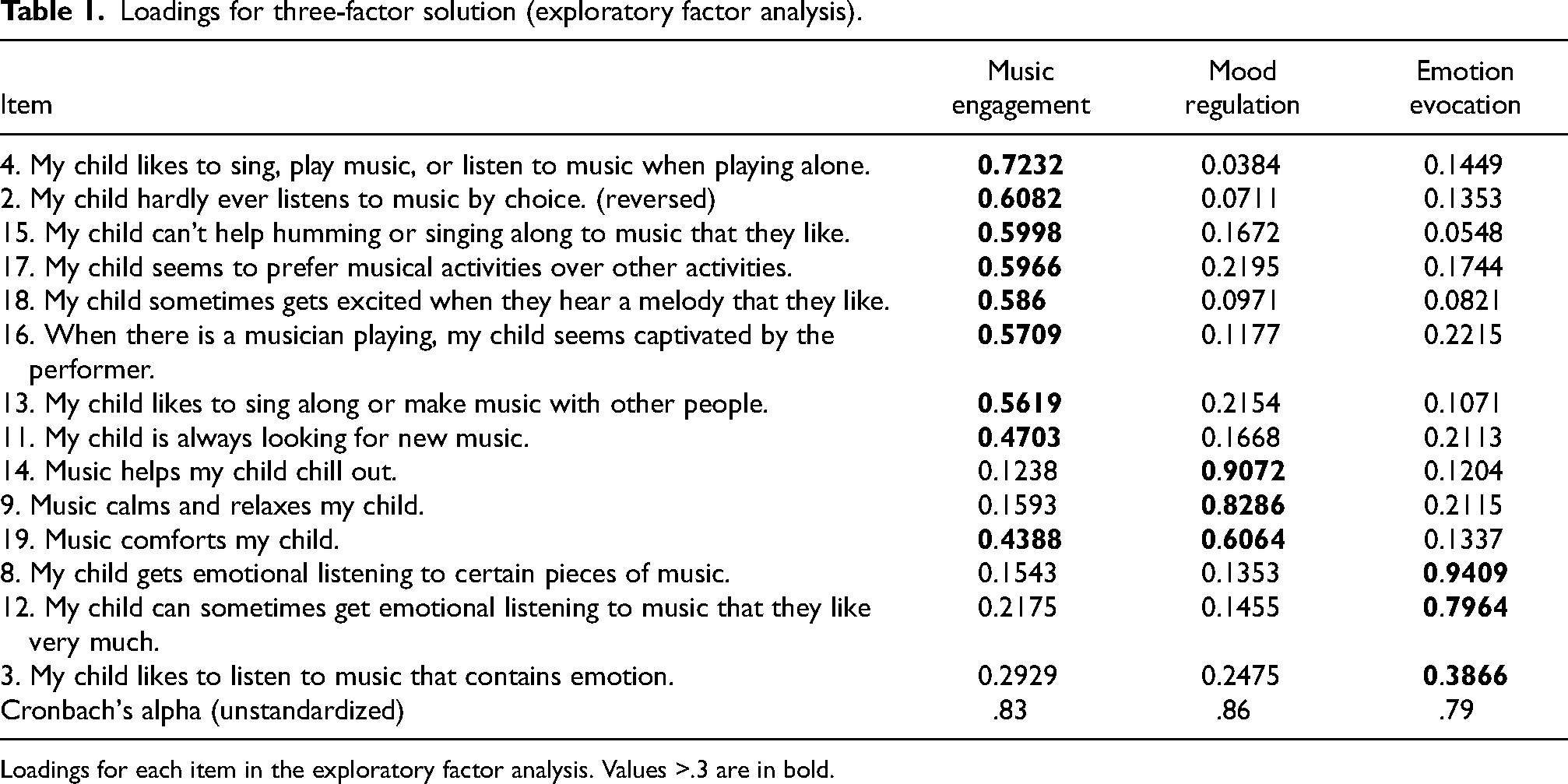
Loadings for each item in the exploratory factor analysis. Values >.3 are in bold.
Thus, the final version of the cBMRQ contains three factors: the first factor, which does not directly correspond to any of the original BMRQ factors, we call Musical Engagement. The two remaining cBMRQ factors correspond closely to the BMRQ factors Mood Regulation and Emotion Evocation. Specifically, the first factor contained Items 2 (reversed), 4, 11, 13, 15, 16, 17, and 18. We interpreted this item to reflect a Musical Engagement factor. It contained three of the four items analogous to the original BMRQ's Musical Seeking subscale (Items 2, 11, and 17), which all relate to choosing or asking for musical activities. The factor additionally included items related to a child's behavioral engagement with music: making music when alone, singing or humming along to music alone or with other people, and being captivated or excited by musical performances and familiar melodies. The second factor contained Items 9, 14, and 19, which all relate to Mood Regulation (three of the four analogous items on the original BMRQ). The third factor contained Items 3, 8, and 12, which all relate to Emotion Evocation on the original BMRQ (three of the four analogous items). Cronbach's alpha indicated that reliability was good for all three subscales (.79–.86). The full scale of all 14 items had relatively strong reliability, with Cronbach's alpha = .87.
Finally, a confirmatory factor analysis (CFA) for this new three-factor solution was conducted on the other half of the sample. Unlike the CFA for the original BMRQ factor structure, the goodness-of-fit measures indicated that this solution provided acceptable fit (CFI = .914, TLI = .894; root-mean-square error of approximation [RMSEA] = .086, 90% CI = [.073–.100]). See the Supplemental Material for the original 20-item and final 14-item versions of the cBMRQ.
Descriptive Statistics and Relationship With Musical Training
The average overall cBMRQ score was 51.40 (SD = 8.17). See Table 2 for descriptive statistics for each factor. There was no correlation between child age and total cBMRQ score, r(498) = −0.014, p = .752 (Figure 1; for histograms broken down by age, see Figure S4 in the Supplemental Material). There were significant positive correlations between all factor scores (all ps < .0001, see Table S3). Parent musical training was highly variable (0–25 years). There was no significant correlation between years of parent musical training and child musical reward, r(494) = 0.072, p = 0.111. The association between child musical training and musical reward was also nonsignificant, r(496) = 0.075, p = 0.092, potentially due to a restriction of range (0–5 years of training reported).

(A) Distribution of cBMRQ scores. (B) Association between age (months) and cBMRQ score.
Descriptive statistics for cBMRQ factors.

Musical Reward and Temperament
One goal was to investigate indications of musical anhedonia in children. In previous studies, individuals have been classified as having musical anhedonia if their total raw BMRQ score was less than 65, which corresponds to approximately the lowest 10th percentile. Here, we also calculated the cutoff cBMRQ using this 10th percentile criterion. The bottom 10th percentile in our data resulted in a cutoff score of 41; this is much lower than the BMRQ cutoff, given that our cBMRQ has 14 items (versus 20 items on the original BMRQ). In addition to scoring below this cutoff on the cBMRQ, to be classified as musically anhedonic, individuals also have to display normal scores on generalized anhedonia scales. Here, we used the Children's Behavior Questionnaire - Very Short Form (CBQ-VSF) Negative Affectivity scale as a measure of general anhedonia in children (Putnam & Rothbart, 2006). We identified individuals as musically anhedonic if they scored below the 10th percentile on the BMRQ, while also scoring less than one standard deviation above the mean on the CBQ Negative Affectivity subscale. This resulted in a cutoff score of 5.29 for the CBQ Negative Affectivity subscale. From this, we identified 40 participants who would be classified as musically anhedonic based on these criteria; this is 8% of our total sample. This fraction is roughly in agreement with previous research on musical anhedonia in adults (e.g., Kathios et al., 2024, which identified 6% of a sample of 500 adults as meeting the criteria for musical anhedonia). These data are depicted in Figure 2. There was no difference in age between participants identified as musically anhedonic (M = 60.20 months) and those who were not (M = 58.44 months), t(498) = −0.807, p = .421.

Scatter plot of total cBMRQ scores and CBQ Negative Affectivity scores. Cutoff points for cBMRQ (red dashed line) and CBQ (blue dashed line) indicate those participants classified as musically anhedonic (lower left quadrant).
Additionally, we calculated correlations to investigate the relationships between cBMRQ scores and subscales on the CBQ. If participants score particularly high on negative affectivity or particularly low on surgency, that would suggest a generalized anhedonia, rather than musical anhedonia. Participants with low musical reward (<41) did not score higher on negative affectivity than those with high musical reward, t(498) = 0.474, p = .636; in fact, they scored lower on average (4.27) than those with relatively high musical reward (4.34), though not significantly lower. Likewise, participants with low musical reward did not score lower on surgency, t(498) = −1.769, p = .078, and in fact scored higher (4.81) than those with typical musical reward (4.59), although not significantly higher. Likewise, there was no significant association between scores on the cBMRQ and negative affectivity, r(498) = .023, p = .602, nor an association between cBMRQ scores and surgency, r(498) = −0.032, p = .481 (Table 3). Therefore there is no evidence to suggest that the participants with low musical reward had more general negative affectivity. Interestingly, the Mood Regulation subscore of the cBMRQ correlated significantly with the surgency subscale of the CBQ, r(498) = −.126, p = .004, but this correlation would not exceed a Bonferroni-corrected threshold for significance (.05/16 comparisons = .003) and should therefore be interpreted with caution.
Correlations between cBMRQ subscales and CBQ-VSF factors.

** <0.01, *** <0.001.
Surprisingly, however, musical reward scores were positively correlated with effortful control, r(498) = .503, p < .001. Follow-up tests indicated that effortful control was positively associated with all subscales. Close examination of the CBQ-VSF items revealed three items referring to musical activities, behaviors, and preferences (9, “likes being sung to”; 21, “likes nursery rhymes”; and 33, “enjoys rhythmic activities, such as being rocked”). Omitting these items did not change the significant positive correlation between effortful control and musical reward.
Discussion
Musical reward is a multifaceted phenomenon, involving a number of factors that change across childhood. Here, we examined caregivers’ reports of their 3- to 7-year-old children's musical reward. Responses suggest that substantial individual differences in musical reward are apparent even in early childhood. Like adults, some children score very low on musical reward, but do not have generally negative affectivity, potentially pointing to the early onset of musical anhedonia.
Comparing data with adult BMRQ scores, we observed very similar distributions (compare Figure 1 with distributions shown in Belfi & Loui, 2020). However, responses to individual items and subscales were somewhat different in children than adults, as indicated by the different factor structure of the cBMRQ compared with the BMRQ. For example, the Mood Regulation subscale of the BMRQ includes responses to four items, three of which target musical relaxation. Notably, these three items emerged as a latent factor in our exploratory factor analysis, perhaps unsurprisingly, given the global use of lullabies to elicit relaxation in young children (Bainbridge & Bertolo et al., 2021; Cirelli et al., 2020; Rock et al., 1999). The fourth item proved to be among the items with the least clear analog between adults and children (“Music keeps me company when I’m alone” became “My child likes to sing, play music, or listen to music when they are playing alone”). Interestingly, the adult analog of this item was also observed to load with Musical Seeking rather than Mood Regulation in an Italian validation of the BMRQ (Mannino et al., 2024). Overall, our interpretation is that mood regulation is a relevant target for musical reward in this age group and that it largely manifests similarly in responses to the cBMRQ and the BMRQ.
Items on the Emotion Evocation BMRQ subscale deal with appreciation for music and the likelihood of feeling emotions in response to music. Again, three of the four BMRQ analogs loaded on a single latent factor in our exploratory factor analysis. As with the Mood Regulation subscale, the fourth item was that with the least direct analog; “I sometimes feel chills when I hear a melody that I like” became “My child sometimes gets excited when they hear a melody that they like.” This change was made because there is no previous research on the developmental onset of musical chills, and because we felt that it was not clear that an adult would be able to identify whether their child experienced chills. While this item did not load on the Emotion Evocation factor, it did load on the Musical Engagement factor. Overall, the Emotion Evocation factor manifested similarly in the cBMRQ and the BMRQ.
Two BMRQ factors were not represented in the final three-factor structure of the modified cBMRQ: Social Reward and Sensory-Motor reward. Early iterations of the factor structure revealed a factor that comprised two of the four Sensory-Motor items; Items 5 and 10, which both had to do with dancing. However, the other two items, which probed humming or singing and tapping to a beat, both loaded most heavily on the Musical Engagement factor. The Sensory-Motor subscale was omitted for the final structure, given that factors with fewer than three items are known to be unreliable. However, the emergence of dance behaviors as a latent variable in the cBMRQ is consistent with early observations of dance-like behavior, and the tight relationship between early dancing and smiling previously discussed. Social Reward also did not emerge as a unique factor in the cBMRQ. We found this somewhat surprising, considering that there is robust literature describing social engagement and social implications of musical participation in children.
As with adults, there is a tail on the left-hand side of the cBMRQ score distribution, potentially indicating musical anhedonia. No evidence supported groupwise or correlational differences in negative affect with musical reward. Approximately 8% of parents reported experiences of musical reward for their children that scored in the lowest 10th percentile, but without corresponding temperamentally negative affect. This suggests that participants’ low reward is music-specific, and therefore, resembles musical anhedonia. An alternative explanation for these results could be that perhaps these children might have had perceptual deficits (i.e., amusia) that could contribute to their lack of musical pleasure. As we did not assess music perceptual skills in this work, this explanation cannot be ruled out definitively. However, adults with musical anhedonia do not typically also exhibit amusia, and amusia scores do not typically correlate with musical reward (Belfi et al., 2017; Loui et al., 2017). Recent work has even indicated that adults with musical anhedonia report normal movement to music, while still reporting a lack of pleasure (Benson et al., 2024). This suggests that musical anhedonia occurs independently of deficits in perceptual abilities. Therefore, though not determinative, it is unlikely that our results would be due to perceptual deficits in children. Given this, our results instead suggest that musical anhedonia is present in childhood in a similar manner and with a similar prevalence as observed in adults.
Surprisingly, although there were no significant associations between reported reward and negative affectivity, children with higher scores for musical reward scored higher for effortful control. Effortful control describes children's ability to regulate emotions and behaviors, is related to inhibitory control (Eggum-Wilkens et al., 2016), and is associated with a myriad of positive outcomes later in life, such as better health and financial success (Moffitt et al., 2011). Previous studies have suggested a relationship between inhibitory control and music training (Jamey et al., 2023, but see Linnavalli et al., 2018), although the causal direction is unclear (see Schellenberg, 2020). This association may point to musical reward as a factor that facilitates the relationship between music training and inhibition; children who find music rewarding may have better effortful control and be more likely to engage in music training.
It is worth acknowledging that the findings reported here rely on parents’ reports, rather than direct assessment of children's feelings or behaviors. Parents’ reports are widely used in investigating child development, especially for preschool children, who typically do not have sufficiently strong reading abilities to fill out surveys themselves, nor potentially the working memory, expressive vocabulary, or receptive vocabulary abilities to respond accurately to verbal queries. One possible source of bias is a parent's propensity toward positivity—for instance, some parents might be more likely to score their children in a socially favorable way across behavioral contexts. Given the lack of a general correlation between the cBMRQ and the negative affect subscale of the CBQ, such a positivity bias seems unlikely.
Another potential source of bias could be a parents’ own musicality or musical reward. More musical parents, for instance, might be more sensitive to their children's musical behaviors. However, parents’ music training was not significantly associated with total cBMRQ scores. In general, research comparing parents’ assessments with direct assessments of children's behavior has indicated that parents can report accurately on such constructs as language and motor development (Dale et al., 1989; Garibaldi et al., 2021; Miller et al., 2017; Sachse & von Suchodoletz, 2008), and especially on those constructs that rely on clear, observable behaviors. Accordingly, our altered items focused on probing adults’ assessments of observable behaviors, rather than unobservable responses, such as chills. Relatedly, recent work with adults has probed a sixth dimension related to musical reward, Musical Absorption (Cardona et al., 2022), which reflects feelings of immersion and transcendence in listening to music. The items probing absorption ask participants to report the extent to which they feel altered consciousness or one with the music, for instance. Unlike items in the original BMRQ, such feelings are unlikely to result in clear, observable behaviors on which another individual could report. For this reason, we opted not to include the absorption subscale in this study. It would be beneficial for future studies to examine how tightly parents’ cBMRQ reports correlate with direct assessments of children's musical behaviors, such as music class engagement, naturalistic singing and dancing, and smiling during music.
A childhood BMRQ opens the door to future investigations of childhood musical reward; among them, questions related to heritability and stability over time. Recent studies have uncovered genetic contributions to musical abilities; for example, propensity to practice (Hambrick & Tucker-Drob, 2015), amusia (Peretz et al., 2007), and self-reported beat synchronization ability (Niarchou et al., 2022). Musical reward may likewise have genetic components: for instance, neural circuitry involved in musical reward—namely, structural and functional connectivity between auditory perceptual and reward systems (for a review, see Belfi & Loui, 2020)—may be genetically linked. Relatedly, recent work has indeed identified a genetic component to musical reward, as measured by the BMRQ in a large-scale twin study (Bignardi et al., 2024). In addition, caregivers may shape their children's early musical environments through song and movement, and children's responsiveness probably changes the likelihood of these experiences occurring again (e.g., Dou & Cirelli, 2023; Kragness et al., 2023b). Jointly testing children and their caregivers’ musical reward, as well as longitudinal studies of the same children over time, would shed additional light on questions of heritability and stability.
Musical activities have been proposed as potential intervention targets for developmental disorders (e.g., Chang et al., 2021; Fiveash et al., 2021; Lense & Camarata, 2020), partly owing to the high level of reward typically associated with musical engagement. These results suggest that not all children find music highly rewarding. An important question for future research is whether music-based interventions are equally effective, or even potentially detrimental, to children who find music unrewarding.
Supplemental Material
sj-docx-1-mns-10.1177_20592043241293902 - Supplemental material for Musical Reward in Young Children
Supplemental material, sj-docx-1-mns-10.1177_20592043241293902 for Musical Reward in Young Children by Haley E. Kragness, Kendra Mehl and Amy M. Belfi in Music & Science
Footnotes
Action Editor
Kelly Jakubowski, Durham University, Department of Music
Peer Review
Erin E. Hannon, University of Nevada, Las Vegas, Department of Psychology Two anonymous reviewers
Contributorship
The study was jointly conceived, designed, and carried out by HEK and AMB. HEK, KM, and AMB were involved in data processing and data analysis. HEK and AMB jointly drafted the manuscript, and all authors reviewed, edited, and approved the final version.
Declaration of Conflicting Interests
The authors declared no potential conflicts of interest with respect to the research, authorship, and/or publication of this article.
Ethical Approval
This study was conducted in compliance with APA ethical principles and approved by the Institutional Review Board of the University of Missouri.
Funding
The authors disclosed receipt of the following financial support for the research, authorship, and/or publication of this article: This work was supported by the National Institute on Aging (grant number, R15AG075609).

Data Availability Statement
Supplemental Material
Supplemental material for this article is available online.
Notes
References
Supplementary Material
Please find the following supplemental material available below.
For Open Access articles published under a Creative Commons License, all supplemental material carries the same license as the article it is associated with.
For non-Open Access articles published, all supplemental material carries a non-exclusive license, and permission requests for re-use of supplemental material or any part of supplemental material shall be sent directly to the copyright owner as specified in the copyright notice associated with the article.
