



Abstract
The playing of historical woodwind instruments poses challenges for museum conservation practices due to the hygroscopic stress introduced by musicians during performance. To mitigate this, many music museums produce playable facsimiles for use in concerts and cultural events. This article explores the potential of 3D printing to create flute copies suitable for historically informed performance. The study focuses on a traverso attributed to Jacques Martin Hotteterre (c. 1707–1727), from the collection of the Musée de la Musique in Paris. While a wooden facsimile was traditionally crafted by a contemporary maker in 2001, the museum began investigating 3D printing in 2020 as an innovative method for producing copies using polymer materials. This approach raises important questions about the fidelity of 3D-printed replicas in terms of timbre, playability, and other musical characteristics. Our study seeks to inform this discussion by characterising perceptual differences between the wooden facsimile and its 3D-printed copies through playing and listening tests.
Introduction
Although the Musée de la Musique in Paris is dedicated to maintaining instruments in playable condition and showcasing the national collection it oversees, less than 5% of the instruments in its collection are preserved in a playable state due to the ethical conservation standards set internationally by the ICOM (International Council of Museums). These conservation constraints particularly affect wooden wind instruments, for which the moisture induced inside the bore by the musician's breath can lead to irreversible damage and fractures. However, in response to public demand, the Musée de la Musique has consistently followed a policy of creating facsimile instruments (Le Conte & Clarke, 2010; van Baarsel et al., 2022), which are regularly used to design musical events both within the museum and beyond. These instruments result from a close collaboration between researchers, curators, and instrument makers, and they play a crucial role in preserving and transmitting the craft of instrument making.
Today, digital resources are paving the way for new research opportunities and greater accessibility, challenging traditional methods in the design and production of musical instruments. Numerous projects have emerged that use 3D printing to replicate or create musical instruments, some of which have been documented (Simian, 2023). In the field of wind instruments, Zoran (2011) represents one of the first published attempts to outline the complete methodology of 3D printing as a fabrication technique for musical instruments. Subsequent studies have explored the potential of 3D printing to produce low-cost wind instrument geometries, such as optimizing the acoustic properties of flutes (Ritz et al., 2015) or saxophone mouthpieces using various manufacturing techniques such as PolyJet, FDM, SLS, and EBM (Doubrovski et al., 2012). Other projects have focused on reconstructing ancient wind instruments (Celentano et al., 2017; Howe et al., 2014; Savan & Simian, 2014).
In a museum context, institutions such as the Royal College of Music in London (Rognoni et al., 2024), the Hochschule für Musik in Basel (Domínguez, 2024), Birmingham University (Savan & Simian, 2014), and the Musée de la Musique in Paris (Vaiedelich et al., 2023) have explored the use of 3D printing to create cost-effective and accessible facsimiles of historical instruments. These initiatives share a common goal: to produce original or facsimile instruments at a lower cost, increasing the accessibility and dissemination of instruments that are typically played by a small group of musicians.
However, 3D printing processes – such as scanning, analysis, and printing – can introduce geometric distortions in the final copy, potentially affecting the sound produced by the musician. Despite this, the suitability of 3D-printed wind instruments for historically informed performances has not been sufficiently studied. While some studies include evaluations in playing situations, they are often conducted quite informally with a very small number of musicians (Bacciaglia et al., 2020; Doubrovski et al., 2012).
Our proposal is part of a museum-centered approach that explores the relevance of using 3D-printed copies for historically informed performances in a museum context. The key questions we aim to address are: How do musicians perceive these new instruments? Are 3D-printed instruments aurally suitable for historically informed concerts? In other words, can 3D-printed copies be distinguished from their traditionally crafted counterparts by players and listeners?
We address these questions by comparing a traditional facsimile of a historical Baroque flute by Jacques-Martin Hoteterre (Musée de la Musique, E.999.6.1, 1707-1727, Paris, France) with two 3D-printed copies of this facsimile through perceptual playing and listening tests. The playing test explores the perceptual (visual, auditory, sensory) evaluation by players of the facsimile and the 3D-printed copies. However, these tests cannot be conducted under blind conditions, as players can feel the material under their lips and fingers, which introduces bias in their responses. To mitigate these biases, we designed a listening test using recorded sound samples. This second test raised additional challenges related to the reproducibility of the musician's performance, which we addressed by employing a new methodology in musical acoustics: the tetrad test (Ennis & Jesionka, 2011).
The flute used as a case study, along with its wooden facsimile and the 3D-printed copies of the latter, is described in the second section. The playing and listening tests are presented, respectively, in the third and fourth sections.
The Case Study: A Flute Attributed to Jacques Hotteterre, Known as le Romain
The Historical Flute and its Wooden Facsimile
Among the Museum's collection of wind instruments, several transverse flutes and recorders attributed to members of the Hotteterre family hold significant historical and musical value, both for their rarity and their craftsmanship. Although some members of this prominent 17th-century dynasty remain relatively obscure, they first appear in 1657 in records from the King's household (preserved in the Archives Nationales). These documents indicate that they regularly served as court musicians, performing on a range of upper wind and string instruments. Jacques Hotteterre, known as le Romain (1674–1763), was the most celebrated member of the dynasty. A distinguished flutist highly esteemed at court, he was even addressed by the monarch as his “beloved Jacques Hotteterre” in the privilege for Première suitte de pièces à deux dessus, sans basse continue pour les flûtes-traversières, flûtes à bec, violes, Op. 4 (1712). As a prolific composer, Hotteterre produced numerous works for one or more flutes. In 1707, he also published the first treatise devoted to the transverse flute, Principes de la Flûte Traversière, ou Flûte d’Allemagne, de la Flûte à Bec ou Flûte Douce, et du Hautbois, Divisez par Traitez. While his later renown suggests that he may have distanced himself from instrument making, several surviving instruments are still attributed to him, including flute E.999.6.1 from the Museum's collection, which we selected as the model for reproduction in our project (Figure 1 top). Made around 1720 by Jacques Hotteterre and bearing his iron mark, this instrument is in exceptional condition. Although the foot is not original, both the body and the mouthpiece remain intact and unaltered, testifying to Hotteterre's craftsmanship. Furthermore, this instrument offers a unique opportunity to investigate the potential of new technologies, since a traditional facsimile was already produced by Claire Soubeyran in 2001 (Figure 1, middle). This playable facsimile provides a valuable point of comparison for the version we aim to reproduce using 3D printing (Figure 1 bottom).

Top: Hotteterre flute: original (E.999.6.1); middle: facsimile made by Claire Soubeyran in 2001; bottom: 3D-printed copy. Collection of Musée de la Musique © Cité de la Musique-Philharmonie de Paris, J.-M. Angles.
The 3D-Printed Flutes
Geometry Obtained by X-ray Tomography
The first stage in producing our prototype involved a metrological survey of both the interior and exterior of the instrument, carried out using X-ray tomography 1 at the Centre de Recherche et de Restauration des Musées de France (C2RMF). This imaging technique enables the 3D digital reconstruction of an object from a series of X-ray images. The object, kept stationary under controlled temperature and humidity, is placed on a turntable that rotates in half-degree increments between the X-ray source and the flat detector, with a radiograph recorded at each step. These images are then processed using specialized algorithms and tomographic software (VG Studio Max developed by Volume Graphics) to reconstruct the 3D volume of the object. The resulting model can be visualized either as a textured surface rendering (Figure 2, top) or as virtual cross-sections at any chosen angle, allowing precise internal measurements to be captured (Figure 2, bottom). From this geometric survey, a computer file in STL format was generated and subsequently used for 3D printing.
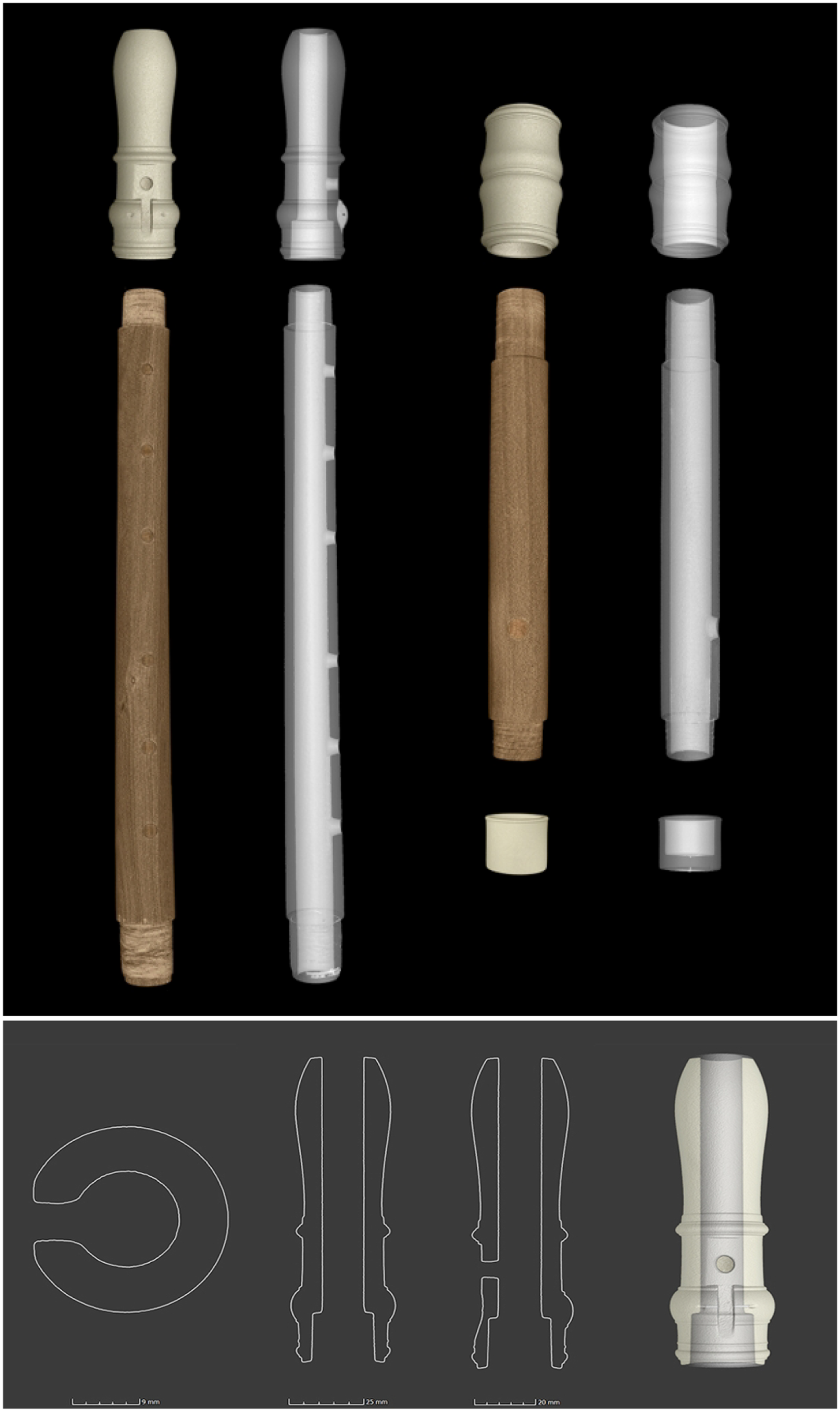
Top: textured rendering of tomography of the facsimile. Bottom: transversal and longitudinal sections of the flute foot. © C2RMF, E. Lambert.
Choice of Material and the 3D Printing Technique
While the primary source of sound in a wind instrument is the vibration of the air within its internal cavity, the influence of the material itself – particularly surface roughness and porosity – has also been emphasized (Boutin et al., 2017). For our prototype, we chose the stereolithography (SLA) technique, with a 16-µm layer thickness in epoxy resin, cured under ultraviolet light. This technique was selected for its ability to produce highly accurate components with smooth surfaces, while remaining relatively cost-effective.
As early as 1636, in his Harmonie Universelle, Marin Mersenne emphasized the importance of selecting “wood that is usually of a good color, and that receives a good polish, so that beauty accompanies the goodness of the instrument, and so that the eyes in some way share the pleasure of the ear…” (Mersenne, 1636, p. 241: “ordinairement du bois d’une belle couleur, & qui reçoit un beau poli, afin que la beauté accompagne la bonté de l’instrument, & que les yeux soient en quelque façon participants du plaisir de l’oreille”). Indeed, the visual appearance of an instrument can influence how it is perceived musically (Vaiedelich et al., 2023; Vaiedelich & Fritz, 2017). In our case, the chosen resin produced a white finish (Figure 1 bottom), a hue consistent with historical practice, as suggested by André Bouys's painting from around 1710, which depicts Jacques Hotteterre holding an ivory flute.2
The Two Copies
Two flutes were printed. The first was a raw 3D-printed copy, meaning that no hand refinement was carried out after printing. The second was slightly adjusted: The modification consisted of a very light shave of the embouchure hole with a knife, just enough to make it marginally wider, since the printed version was slightly smaller than the facsimile.
Playing Test
Protocol
A playing test was devised to evaluate how the 3D-printed copies compared with the wooden facsimile. Since players’ assessments are inevitably influenced by the material qualities of the instruments, the ideal protocol would have been a blind test. However, because the material can be readily felt under the lips and fingers, complete blindness was not feasible. To strengthen the reliability of the evaluations nonetheless, we presented the same flute twice, under the guise of two different instruments.
In the first half of the experiment, participants were presented with four flutes, although in reality only three different instruments were involved: Flute 1, the raw 3D-printed copy (labeled 3Draw); Flute 2, the 3D-printed copy slightly refined at the embouchure (labeled 3D); Flute 3, which was in fact Flute 1 presented again; and Flute 4, the wooden facsimile (labeled W). The flutes were handed to the players successively, one at a time, while the remaining instruments were kept hidden behind a folding screen (see Figure 3). For each flute, participants were given approximately 10 minutes of playing time and asked to describe the instrument and their playing experience, without making direct comparisons among the flutes.

Playing test with the three flutes. One of the flutes is played by the flutist, and the two others are hidden behind the screen. The flutist's face has been blurred for anonymization.
In the second half of the experiment, participants were presented with Flutes 2, 3, and 4 simultaneously and asked to compare them freely. They were then invited to select three evaluation criteria of their own that they felt best captured the differences among the instruments. For each chosen criterion, participants ranked and rated the flutes on a numerical scale from 1 to 10. Finally, they were asked to rate the instruments once more on a 1–10 scale based solely on “loudness,” a criterion we consider the least ambiguous. Loudness is frequently used in comparisons between new or plastic instruments and their older counterparts, the former often being perceived as louder, albeit sometimes at the expense of timbre.
Participants
The protocol was carried out with nine professional baroque flutists. Some were in the early stages of their careers or still completing their studies, while others were established performers holding university-level teaching positions. None of the participants had prior knowledge of the project, and they were instructed not to discuss it with others until the conclusion of the month-long experiment.
Results
Semantic Categories
The discourses recorded during the first part of the protocol were subjected to semantic analysis, which involved tallying the occurrence of specific words, or microconcepts, frequently employed by participants to describe the flutes. The method, inspired by previous studies (Paté et al., 2015; Saitis et al., 2017), was designed to establish semantic relationships among the terms, such as synonymy. The words reported by the flutists are presented in their original language (French) and translated into English for communication purposes. The English translations are not intended as exact equivalents of the players’ intended meanings but are provided solely as an aid to interpreting the results.
The identified microconcepts were grouped according to semantic proximity and organized into broader semantic categories (Table 1). Within each category, the terms were further classified as either synonyms or antonyms, depending on whether their meaning aligned with or opposed the category label.
Semantic categories extracted from the participants discourses. Original French microconcepts are left in italics for information.

These categories were then used to compile the evaluations made by the players at the microconcept level. Depending on the syntactic context, each evaluation was classified as “positive” or “negative” with respect to the corresponding semantic category. These labels do not imply any value judgment; rather, they indicate the presence (“positive”) or absence (“negative”) of the property denoted by the category label. For example, the statement “The sound of Flute 1 is not very windy” is counted as one occurrence in the “+” column of the category F
Number of positive and negative evaluations for each semantic category (as defined by the microconcepts in Table 1), grouped by flute. Categories in which a flute stands out are highlighted in bold blue. Flutes 1 and 3 correspond to 3Draw (the same instrument), Flute 2 to 3D, and Flute 4 to W.

The results presented in Table 2 indicate that Flute 1 (3Draw) appears to stand out in terms of ease, flexibility, and reactivity. Interestingly, Flute 3 – although identical to Flute 1 – was evaluated differently: It was described as less easy and flexible, and characterized as lacking reactivity. By contrast, Flute 4 (W) was consistently noted for its richness.
Free Rating Criteria
The three criteria selected by each flutist to rank and rate the flutes are shown in Table 3 along with their associated semantic category based on Table 1. While the criteria used to differentiate the flutes varied greatly, all nine flutists chose R
Criteria chosen by each flutist and ratings attributed to the three Flutes 3D, 3Draw, and W. For each rating criterion, the scale goes from 1 (criterion not present/very low) to 10 (criterion very present/very strong). A semantic category (third column) is associated to each criterion based on Table 1.

Loudness Ratings
Finally, the participants’ ratings of loudness are shown in Figure 4. Although the ranking order of the three flutes varied among the players, Flute W was consistently rated relatively high in loudness, with values ranging from 5 to 9. Moreover, seven of the nine musicians rated it higher than Flute 3Draw.

Loudness rated by the flutists for each of the three flutes. The scale goes from 1 (not loud at all) to 10 (very loud).
Discussion
When first introduced as Flute 1, the 3Draw copy was frequently described as highly homogeneous and easy to play. Surprisingly, these qualities were not judged positively: Participants believe that a traditional Hotteterre flute is expected to be inhomogeneous and demanding, and thus the copy was perceived as unauthentic. One musician even remarked that it felt “like playing a Yamaha,” while another observed, accurately, that the instrument was a copy of a copy and that the first copy had already been adapted (the original facsimile had effectively been adapted from the historical flute). Interestingly, when the same instrument reappeared later in the protocol as Flute 3, evaluations shifted. This time, players described it more favorably, characterizing it as warm and nuanced, and associating its relative difficulty with greater authenticity. This explains why the semantic analysis revealed a decrease in the E
The evaluations of the wooden facsimile (W) are particularly interesting. Likely because it was made of wood, it was praised for its warmth, richness of tone, and even its “agentive” qualities, with several participants remarking that “it finds the nuances and it guides me in how to play.” At the same time, some noted its tonal homogeneity across registers. Unlike with Flute 3Draw, however, this quality did not undermine its perceived authenticity. Homogeneity, in this case, was welcomed in Flute W, whereas it was deprecated in the 3D copies, since instability of intonation and uneven timbre across keys and registers are believed to be markers of historical flutes. This contrast underlines the subtle ways in which material, context, and expectations interact in shaping perceptions of authenticity, adding complexity to the very notion of historically informed performance.
Listening Test
The bias against the plastic flutes observed during the playing test, which led to divergent evaluations, prevents us from drawing definitive conclusions about the sound differences between the wooden facsimile and its 3D-printed counterpart. To address this limitation, a discrimination listening test was designed to allow a truly blind evaluation, based on recordings of the two flutes, 3D and W.
Choice of Methodology
Listening tests for instrument discrimination often involve evaluating the same musical excerpt performed by one musician on different instruments, which raises the question of reproducibility. How can we ensure that the perceived differences arise from the instruments themselves rather than from variations in the player's interpretation?
In psychophysics, various discrimination tests have been developed to investigate perceptual thresholds and categorical judgments of stimuli. One of the most widely used methods in room and musical acoustics is the ABX test (Munson & Gardner, 1950), where listeners hear two reference stimuli (A and B) followed by a third stimulus (X) and must determine whether X corresponds to A or B. However, it seems less operationally efficient compared to other tests like the triangle or duo-trio tests, commonly used in sensory science, which allow for greater sensitivity in distinguishing between subtle perceptual differences, at least for sound stimuli as recently shown by de la Prida et al. (2021). In any case, these methods require large sample sizes to achieve statistical significance (Ennis, 1993). The tetrad test, in contrast, has gained attention for its efficiency and robustness, with smaller sample sizes (Ennis & Jesionka, 2011). In this test, listeners are presented with four stimuli and asked to pair them based on perceived similarity. By allowing listeners to use their own criteria for grouping, the tetrad test reduces cognitive biases and enhances statistical power. Another advantage of the tetrad test is its adaptability to stimuli with multiple perceptual variations (Ishii et al., 2014). It allows taking into account variations in the musician's playing during the analysis as it allows mixing, within a trial, recordings on two different flutes that are as similar as possible in terms of interpretation and recordings deliberately done with musical variations.
Two types of variation were selected, as they could be considered independent: richness of timbre and articulation. Each was manipulated at three levels (less, normal, more). The test was divided into two parts. The first consisted of four unspecified trials, presented in random order for each participant. The second consisted of three specified tetrad trials, also randomized. The specified trials were conducted after the unspecified ones in order to avoid instruction bias (Castura et al., 2018; Rousseau and Ennis 2013). Each trial was designed to address a specific question, as summarized in Table 4.
Design of the listening test, consisting of eight trials, aiming at addressing different questions.

Stimuli
The stimuli were obtained during a single recording session with a professional flutist (Mina Jang) at the studio of the Cité de la Musique. Recordings were made using a Sennheiser MKH-40 microphone positioned 1 m from the performer and 1.70 m above the floor, aligned with the musician's mouth. The performer's position remained fixed throughout the session, marked on the floor to ensure consistency.
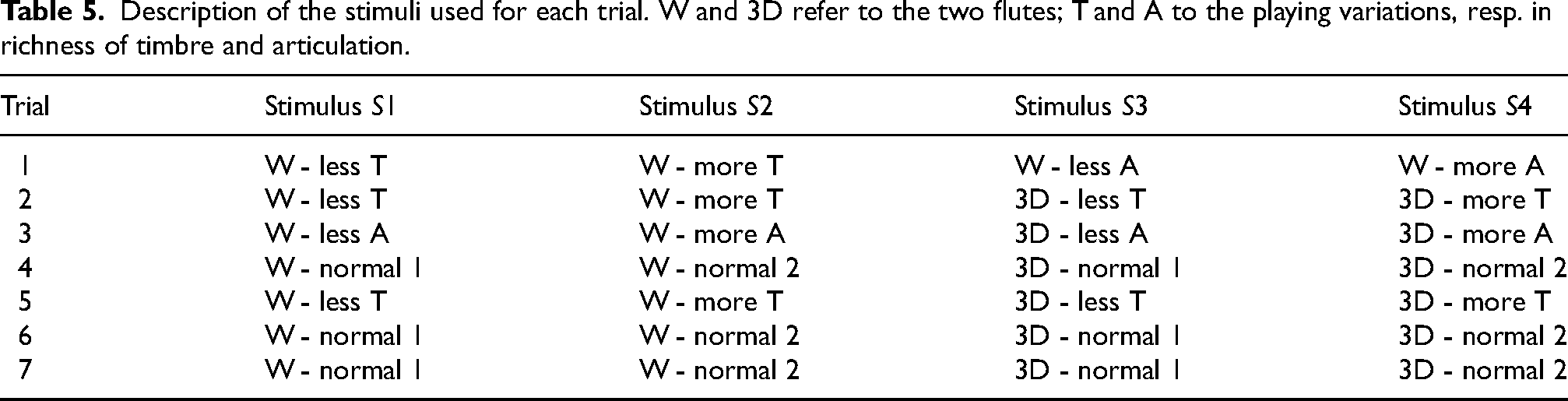
The recorded melody (Figure 5) was selected by the flutist to meet the following criteria: (i) covering a wide range of nearly two octaves; (ii) having a duration appropriate for listening tests (approximately 5 s); and (iii) allowing the intended variations in timbre and articulation. Each excerpt was recorded multiple times for each level of interpretation on both flutes. The stimuli used in the test, presented in random order for each trial, are detailed in Table 5.

Melody inspired from the 5th variation in chapter II of L’Art de Préluder by Hotetterre.
Description of the stimuli used for each trial. W and 3D refer to the two flutes; T and A to the playing variations, resp. in richness of timbre and articulation.
Implementation
We opted for an online test, which allows a larger number of participants without necessarily compromising the results due to a lesser control (Parizet et al., 2021). As the differences between the stimuli can be subtle, the participants were recommended, at the beginning of the test, to use the best audio equipment possible (good quality headset). We developed an interface within the Web Audio Evaluation Tool (WAET) (Jillings et al., 2015) (see Figure 6).

Tetrad test interface developed within the WAET. This specific page corresponds to an unspecified trial.
Participants
The listening tests were conducted with a panel of 69 participants (mean age: 32.6 years, SD = 11.3), divided into two groups according to musical expertise: experts and non-experts. The 35 non-expert participants were amateur musicians or music enthusiasts, whereas the 34 expert participants were professional musicians or instrument makers. This classification allowed us to examine potential differences in discrimination sensitivity as a function of expertise.
Results
Sensitivity Index:
To evaluate participants’ discrimination ability, we used
In this study, we computed multiple Grouping by timbre variation: stimuli grouped according to richer vs. less rich timbre, irrespective of flute type, yielding Grouping by articulation variation: stimuli grouped according to more vs. less articulated playing, regardless of flute, yielding Grouping by flute type: stimuli grouped according to whether they were produced on the wooden or the 3D-printed flute, yielding
For example, in Trial 2 (Table 5), two correct pairings are possible: (
To estimate
Discrimination of Timbre and Articulation on the Wooden Flute (Trial 1)
The first unspecified tetrad test evaluated participants’ ability to discriminate between intentional timbre and articulation variations on Flute W. As shown in Figure 7, the sensitivity index

Discrimination of Type of Flute Versus Different Playing Variations, Either Intentional (Trials 2&3) or Unintentional (Trial 4)
Figure 8 shows that intentional variations – timbre in Trial 2 and articulation in Trial 3 – were not discriminated above chance level in either group. Both

In Trial 4, where variations on each flute were smaller (unintentional), discrimination by flute type was no better than in Trials 2 and 3: The values of
Discrimination of Type of Flute Versus Timbre Variations Under Specification of Either Timbre or Flute
The results of the specified tetrad tests (Trials 5, 6, and 7) presented in Figure 9 indicate how explicit grouping instructions (specifications) influence discrimination performance.

In Trial 5, where participants were explicitly instructed to group stimuli by timbre, including intentional timbre variations on both flutes, an improvement in timbre discrimination was observed compared to the unspecified Trial 2. For non-experts, this improvement remained modest, with the confidence interval still including 0. For experts, however, the effect was more pronounced: they achieved a
In Trial 6, discrimination by flute type did not improve when the variations were smaller (unintentional) while the instruction remained focused on timbre. However, when the specification shifted to flute type, discrimination increased among experts (from a mean value of 0 to just above 1). This improvement, however, was not statistically significant due to the wide confidence intervals.
Discussion
Significant differences between experts and non-experts were observed in only two trials. In Trial 1, timbre variations on Flute W were contrasted with articulation variations on the same instrument, and in Trial 5, timbre variations were contrasted with the same type of variations on Flute 3D. In both cases, experts were able to discriminate timbre variations above chance level, whereas non-experts were not. This finding aligns with previous research on auditory expertise, which suggests that trained musicians develop enhanced sensitivity to timbre perception (Chartrand & Belin, 2006).
Regarding our main question – whether the type of flute can be discriminated – the results show that
Conclusion
An original protocol was developed to assess the relevance of 3D-printed replicas of historical wooden flutes for use in historically informed concert performance within heritage collections. The study focused on three instruments related to a Baroque traverso by Hotteterre from the Musée de la Musique (inventory number E.999.6.1): a wooden facsimile of the original flute and two 3D-printed copies of this facsimile, one of which was modified at the embouchure. The protocol combined a playing test, conducted with 9 professional flutists, and a listening test involving 69 participants (34 professional musicians or instrument makers and 35 amateur musicians or music enthusiasts).
The playing test was structured in two parts. In the first, the flutes were presented successively, with the first instrument repeated later in the sequence (without the players’ knowledge) to test the robustness of their evaluations. The unmodified 3D-printed copy, presented first, was described by musicians as flexible, easy to play, homogeneous, and highly responsive. However, when the same instrument reappeared in the third position, it was not evaluated in the same way. This divergence likely reflects a combination of factors, including order effects, increased familiarity with the 3D-printed copies through repeated playing, and potential biases against plastic instruments. The wooden flute, presented last, was consistently rated as richer than the other flutes.
In the second part of the test, musicians were asked to rank the instruments according to criteria of their own choosing, including loudness. The results revealed considerable variability in the ranking criteria employed. Nevertheless, the wooden flute was widely favored for its richness and overall sound quality. It remains open to question, however, whether this perceived superiority is linked to entrenched preconceptions that wooden instruments are inherently richer than plastic ones, since the test could not be conducted under blind conditions due to the perceptible tactile differences between materials.
To eliminate potential visual biases, an online listening test was conducted to compare recordings of the wooden facsimile and the modified 3D-printed copies. The test employed the tetrad methodology, which controls for the possible influence of performance variations on discrimination between instruments. The aim was to assess whether any perceptual distinction between the flutes would persist despite larger interpretive variations within the normal range of musical performance. The results showed that the two flutes could not be discriminated above chance level, whether under intentional or smaller unintentional variations, even within the most expert listener group.
The listening test could be extended to include a larger number of participants, which would reduce confidence intervals and might reveal discrimination above chance level. However, given the low upper limits observed in this study (close to or below 1), any perceptual difference between the two flutes is likely to remain near the threshold of detection. These results therefore provide auditory validation for the use of 3D printing to replicate, within a museum context, the sound of historical instruments that can no longer be played.
If the perceived superiority of the wooden flute in terms of sound richness during the playing test were based solely on acoustic qualities, the listening test results suggest a potential bias against plastic flutes, since no clear differences were detected. However, this perceived richness may also be tied to playing characteristics that can only be fully assessed by flutists. To draw definitive conclusions about performance-related differences between the two instruments, a new protocol explicitly designed to address these bias issues would be required.
This investigation opens new opportunities for museums, musicians, and researchers to engage with historical woodwinds, offering valuable perspectives for the dissemination of historical knowledge, musical practices, and performance traditions.
Footnotes
Acknowledgments
The authors would like to thank Thierry Maniguet, curator in charge of the Hotteterre flute, for granting access to the instrument, as well as the museum registrars for their assistance. We are also grateful to Bertrand Busson, director of Wischap3d, for carrying out the 3D printing, and to Damien Philipidhis for the coordination of the recording session. Our thanks extend to the professional flutists who participated in the playing test, and to flutist Chiara Caramia for her contribution to the recordings and to the analysis of the musicians’ discourse.
Action Editor
Gabriele Ricchiardi, University of Turin, Department of Chemistry.
Peer Review
Two anonymous reviewers.
Contributorship
CF and MJ were in charge of the whole study (design of the perceptual study, data analysis, interpretations of the results) and the writing of the paper. CB conducted the listening test and analysed the results. He contributed to the writing of the last two sections. LC was in charge of the playing test and analysed the results. She contributed to the writing of the third section. MJ was involved in the analysis of the playing test results and the design of the listening test. SV was at the origin of the project and was involved in the full manufacturing process of the 3D flute (described in the second section). EL was involved in the imaging of the facsimile in order to build the 3D printed copy (see second section).
Data Availability Statement
The data are available from the corresponding author on request.
Declaration of Conflicting Interests
The authors declared no potential conflicts of interest with respect to the research, authorship, and/or publication of this article.
Ethical Approval
This research was approved by Sorbonne Université ethical committee (CER-2023-JOSSIC-Flute3D).
Funding
The authors disclosed receipt of the following financial support for the research, authorship, and/or publication of this article: This work was supported by the Musée de la Musique, Ministère de la Culture et de la Communication, LAM – Institut Jean le Rond d'Alembert and Agence Nationale de la Recherche (grant number ANR-23-CE10-0015-01).
