



Abstract
Sound art in public spaces can shape visitors’ experience, yet few studies have explored the impact of curated sound installations on soundscape. We report on the evaluation of the soundscape of a small urban public space in Montreal, Canada in the presence of different compositions designed for a sound installation, Les Madelinéennes by Charles Montambault. Residents familiar with the site (N = 25) evaluated various soundscapes in laboratory settings, combining Ambisonics field recordings of the site with spatialized simulations of compositions featuring coastal sounds. Participants rated the resulting soundscapes along semantic scales, identified significant moments, and described them in follow-up interviews. Results revealed that more evocative sounds (boat horns, seagulls, cormorants) were perceived as less appropriate and pleasant, while less evocative sounds (wind, sparrow) were more pleasant and soothing. Interviews also revealed a diversity of associations to the added sounds. The study was well received by the local community and led to design recommendations for the installation on site.
Introduction
Art can shape the human experience of urban public spaces in various ways, for instance by improving their aesthetics, increasing social cohesion, or stimulating critical reflection (Hoop et al., 2022). Within this broad umbrella, public space sound installation art emerged as an artistic practice in the second half of the 20th century (Ouzounian, 2021). Sound installations, which involve the articulation of curated sounds in space (Bandt, 2006), have the potential to reconfigure the auditory experience of a site and expand its affective potential (Lacey, 2016).
Soundscape has developed in parallel into a research field (Guastavino, 2020), with a focus on human auditory experiences in context (ISO TS 12913-1, 2014), considering sound as a resource that can be designed and planned (Brown & Muhar, 2004; Cerwén et al., 2017; Moshona et al., 2024). Yet integrating the sonic experience into urban design is complex, requiring context-specific decisions and collaboration across diverse stakeholders (Tarlao et al., 2024), and the application of the soundscape approach in urban practice remains limited (Steele et al., 2023). To bridge this research-practice gap, there is a growing interest in integrating sound into urban design projects through soundscape interventions, i.e., “site-specific design[s] that improves or preserves a soundscape” (Chen et al., 2024, p. 2).
Public space sound installations, as a specific kind of soundscape intervention, seem particularly well positioned to address this gap. Because sound installations—defined here as “place[s], which ha[ve] been articulated spatially with sounding element for the purpose of listening over a long time span” (Bandt, 2006, p. 353)—are embedded into the (pre)existing space, their design necessitates contextual awareness, a principle that is also central to soundscape studies (Herranz-Pascual et al., 2010). In public space specifically, the relation of the artwork with its context, known as site-specificity, is usually an essential part of the artist’s creative process (Tittel, 2009). Second, the audience—passers-by—usually does not visit the public space to experience sound art, so the reception of the work (e.g., psychosocial outcomes; social acceptability) is of great importance to the artists (Volcler, 2022). However, while sound artists often express the need to better understand the reception of their work, they generally don’t have the resources needed to collect feedback from the audience (Robson et al., 2023). In short, sound artists, who are familiar with the soundscape approach and concerned with the experience of public space users, can propose practical solutions for (re)designing sound environments (Cobussen, 2023).
Despite converging interests in soundscape research and sound art practice, the artistic perspective seems to have received scant attention in the last two decades of academic soundscape research, and in turn recent advancements in the soundscape field seem to hold minimal relevance for sound artists. For instance, only a handful of studies have investigated how sound installations can shape public space users’ experience. Previous studies have shown that installations can lead to improvements in the overall auditory evaluation of urban public spaces (Fraisse, Tarlao, et al., 2024; Jambrošić et al., 2013), improve the perception of traffic noise (Pink et al., 2019), encourage specific behaviors (Adhitya, 2017; Arroyo et al., 2012), or foster social interaction (Franinovic & Visell, 2007; Gronbæk et al., 2012; Steele et al., 2019). In a laboratory study by Hellström and colleagues (2014), participants reported a mild preference for sound art installation when compared to a control condition, although the added sounds were often confused with the pre-existing sound environment. Conversely, Oberman et al. showed improvements in soundscape ratings in the presence of three sound installations in different public spaces, through laboratory simulation of soundwalks (Oberman et al., 2020). Given the scarcity of studies on the subject, we recently proposed a simulation tool (Fraisse et al., 2022) to investigate the impact of a public space sound installation in Paris (Fraisse, Schütz, et al., 2024). The study showed that added sounds altered the pre-existing soundscape's familiarity and variety, and that the effect of the compositions was stronger in the presence of sounds which were not clearly identifiable (i.e., abstract sounds, see Landy, 2007).
While there is little research on the impacts of sound installations on soundscape, there is extensive literature on the effects of music (e.g., Aletta et al., 2016; Meng et al., 2018; Steele et al., 2021) and natural sounds such as water or birds. The positive effects of water sounds and their propensity to reduce the perceived loudness of traffic noise have been broadly demonstrated (e.g., Galbrun & Ali, 2013; Hong, Lam, et al., 2020; Hong, Ong, et al., 2020; Jeon et al., 2012; Lee & Lee, 2020; Nilsson et al., 2010), although some results are more nuanced, especially in the presence of traffic noise from small to medium roads (Axelsson et al., 2014; De Coensel et al., 2011; Trudeau et al., 2020). Introducing bird sounds usually improved the soundscape quality of urban spaces (e.g., Chau et al., 2023; Chen & Kang, 2023; Hong, Lam, et al., 2020; Van Renterghem et al., 2020), but these potential benefits vary across bird species (Hong, Ong, et al., 2020; Jeon et al., 2010; Zhao et al., 2020) or based on the congruence of the birds’ presence (Franěk et al., 2019; Hong, Ong, et al., 2020). Apart from a reduction of perceived loudness and improvements in overall soundscape evaluations, a key variable is the restorative potential of natural sounds: studies overall converge to show restorative outcomes associated with listening to natural sounds (Ratcliffe, 2021).
Building upon these bodies of literature, we report on the laboratory evaluation of a sound installation involving natural sounds and soundmarks (as defined in Schafer, 1977) evocative of the coastline and the sea. This research was conducted as part of a research-creation collaboration between the authors of this paper relative to the design of the permanent sound art installation Les Madelinéennes. Created by sound artist and second author Charles Montambault, Les Madelinéennes is currently deployed in the Parc des Madelinots, a small urban public space in the Verdun borough of Montreal, Canada. Verdun was a major destination for emigrants from the Magdalen Islands (an archipelago in Quebec), resulting in a significant socio-cultural relationship between Verdun and the Magdalen Islands. As Brabant (2024) explains, more than a thousand families emigrated from the archipelago in the last century and up until the 1960s, mainly to work in nearby factories in what was then a working-class neighborhood. Nowadays, direct emigrants from the Magdalen Islands are mostly older adults, since the last waves of immigrants occurred during or shortly after World War II. In parallel, the borough recently underwent important social transformations (see Léouzon, 2024), evolving into a coveted neighborhood with ample green spaces, amenities, and cultural events. Les Madelinéennes highlights the cultural heritage of the Magdalen community through compositions based on field recordings from the Magdalen Islands, with the aim of bringing both territories together and raising public space users’ awareness of their surroundings. Inspired by the concepts of acoustic ecology (Schafer, 1977), ambiance (Bégout, 2020), and ecology of attention (Citton, 2017), but also the aesthetic and functional codes of ambient music formulated by Brian Eno (1978), the sound installation seeks to foster experiences of reconnection—consciously or unconsciously—with Verdun's atmospheric and cultural identity by alluding to the Magdalen Islands. The objectives of Les Madelinéennes are two-sided: (1) offer a more pleasant, soothing and restorative listening experience to passers-by and public space users; and (2) evoke the Magdalen atmosphere.
The laboratory evaluation was designed to inform the composition of the 2025 iteration of the sound installation. Twenty-five residents familiar with the space were invited to evaluate soundscapes in laboratory settings using ambient sound recordings of the small park with the addition of spatialized composition prototypes, simulating different sound installations in the public space. The composition prototypes featured combinations of sounds recorded in the Magdalen Islands including sea waves, wind, sea birds and mammals, and boat sounds. During the experiment, participants were invited to evaluate the different soundscapes along semantic scales, identify soundmarks in each soundscape, and listen back and describe these soundmarks during follow-up interviews in an approach inspired by the reactivated listening method proposed by Augoyard (2001).
Beyond informing the design of Les Madelinéennes sound installation, this evaluation represents a unique opportunity to investigate the soundscape effects of natural sounds and soundmarks of a coastal location transposed to a different context, in an urban location. In comparison to other studies investigating the soundscape effects of natural sounds, which usually involve factorial designs (e.g., Nilsson et al., 2010) or sound sequences (e.g., Han et al., 2023), the conditions investigated here are prototypes of the sound installation pertaining to different composition strategies: they involve more complex combinations of natural and human sounds, have an intentional narrative, and can be seen as design prototypes rather than strictly controlled stimuli (Stappers & Giaccardi, 2014). Here we seek to investigate the soundscape effects of these sound sources’ dominance in the compositions, in the presence of a background sound environment representative of the studied site, but without manipulating each sound source individually. In relation to the pre-existing sound environment, we seek to evaluate the influence of the added sounds on the perceived dominance of sound sources, and whether the compositions align with Les Madelinéennes’ artistic intentions to provide a more pleasant and restorative soundscape by evoking the Magdalen Islands. As there are few studies on the soundscape effects of sound installation art, we also expect to capture soundscape effects that may not have been previously observed. On methodological grounds, this study seeks to extend a soundscape simulation tool developed in a previous study (Fraisse et al., 2022) and further investigate the relevance and productivity of describing significant moments in interviews following soundscape evaluation to better understand the complexities of the listening experience.
Method
This study is part of a greater research-creation collaboration involving the design and evaluation of Les Madelinéennes. Researchers and the sound artist interacted throughout the research project to design the study together. Specifically, joint decisions were made about the field recordings, experimental conditions and procedure, including the data collection instruments (questionnaire and interview guide), the selection and mastering of the composition prototypes, as well as the recruitment procedure. The nature of the research-creation collaboration itself is framed in a previous publication (see Fraisse, Wanderley, et al., 2024). The current methods were preliminary validated and fine-tuned with a pilot study involving five participants, whose data is not reported here because it led to significant changes in the instruction sheet and interview procedure described below.
Soundscape Simulation
Laboratory conditions were created using a soundscape simulation tool previously developed and experimentally validated (see Fraisse et al., 2022; Fraisse, Schütz, et al., 2024). The tool consists of two elements: (1) the reproduction of Ambisonics field recordings of the public space's sound environment—the Baseline; and (2) the auralization of the sound installation—the Added Sounds—using a 3D acoustic model of the site (simulating early reflections and late reverberation). Both elements are converted to a Higher-Order Ambisonics (HOA) stream before being presented over a loudspeaker array for real-time evaluation. All components of the experiment, including the auralization, Ambisonics decoding and playback, and the graphical user interface, are implemented in Cycling ’74 Max, v8.5.1 (What Is Max?, 2023).
Baseline Sound Environment
Parc des Madelinots is a small urban public space (around 600 square meters, see Figure 1) located in the Verdun borough of Montreal, Canada. Overall, the public space is exposed to high levels of traffic noise from two adjacent mid-sized streets (Wellington Street and Lasalle Boulevard), is sparsely used by residents, and is mostly perceived as a transit space.

Map of the Parc des Madelinots public space, showing the position and orientation of the sound installation’s speakers and recordings position, also corresponding to the simulated listening position.
The laboratory evaluation focuses on the evaluation of a Baseline corresponding to Parc des Madelinots’ pre-existing sound environment, in the presence and absence of several prototypes of the sound installation. The Baseline is a 3 min 10 s excerpt edited from in situ recordings and repeated over the different conditions (see Figure 2). The Baseline is based on six 30-min to 1-h measurement sessions performed in a period representative of an average activity level (from 11 am to 4 pm) in the middle of the public space (see Figure 1), using a Soundfield ST350 First-Order Ambisonics (FOA) microphone together with a B&K 2250 sound level meter for calibration. The measurements were made during weekdays, across three weeks between June and July 2023. All measurements were oriented towards the north (which also corresponds to the listeners’ orientation during the listening test), at a height of 1.30 m, roughly corresponding to ear level in a seated position.

Power spectrogram of the W (omnidirectional) canal of the Baseline condition in dBFS, made with Python’s librosa library. FFT size: 2048; Hanning window; hop length: 512. Colors represent the RMS energy, in dBFS. The Baseline sound environment is dominated by traffic (high energy in the low and medium frequencies), which peaks at two periods (roughly at 30 s and 2 min 15 s).
The Baseline condition was edited from these recordings during joint listening sessions with two of the authors, including the sound artist. Before creating the Baseline excerpt, we listened and annotated all the recording materials. Then, excerpts were selected from the recordings along several criteria. First, we selected moments that were representative of the public space (i.e., filtering out moments that were calmer or noisier compared to the rest of the recordings, or sounds that were not consistently heard throughout the sessions). Second, we excluded moments containing too many salient sounds (e.g., intelligible voices, sirens) that could reinforce the identification of repetitions between the conditions. The selected excerpts were then edited to remove the remaining salient or unusual sounds and concatenated—using a 3-s crossfade to provide short yet smooth and unnoticeable transitions—in a sequence representative of the sound environment. Notably, we included traffic noise fluctuations representative of the acceleration/deceleration cycle of vehicles, at the nearby traffic light (see Figure 2). Overall, the Baseline condition has an equivalent level of 57.6 dB(A). This level was determined after calibrating the recordings’ Ambisonics playback using A-weighted equivalent levels, through measurements performed in the sweet spot of the listening room, at a height of 1.30 m and for a measurement time of 2 min 55 s, with a B&K 2250. Three other recordings were similarly edited to provide a background sound environment during the training phase, the introduction phase, and the transition between trials (see Procedure).
Added Sounds Auralization and Mastering
The auralization method is briefly presented here, further detailed in (Fraisse et al., 2022). The Added Sounds from the sound installation are spatialized using IRCAM's EVERTims framework (Poirier-Quinot et al., 2017) from Max's spat∼ library (Spat | Ircam Forum, 2023). This auralization unit simulates the sources’ early reflections and late reverberation according to the space's geometry. The output of the auralization unit is encoded into fourth-order HOA streams with spat∼. Since the simulation tool had been fine-tuned for a different case study (see Fraisse et al., 2022), some parameters of the tool's late reverberation unit were adjusted by ear to fit with Parc des Madelinots. To master the added sounds’ sound levels, the loudness of the different excerpts was first normalized with Reaper (Reaper, 2023) based on LUFS values, and then adjusted by ear in the presence of the Baseline sound environment by the composer (the second author), to mimic the protocol carried out during sound installation's deployment. Preliminary normalization was set as a point of departure to make the mastering undertaken by the composer easier. Please note that the sound installation is in a dual stereo setup: in the simulation, one channel is auralized through the two top virtual speakers, and another channel through the two bottom virtual speakers, as shown in the map in Figure 1.
Ambisonics Reproduction
The experiment was conducted at CIRMMT's Performance Research Laboratory (PeRL), an acoustically treated listening room, over a hemispherical dome of 37 Genelec 8030 speakers placed on five height levels beginning at 30 cm (see Figure 3). Both the auralized added sounds (HOA) and the baseline sound environment (FOA) were decoded with spat∼ using energy-preserving method with max-re weighting function (Zotter et al., 2012).

Photograph of the CIRMMT’s PeRL listening room. Credits: CIRMMT.
Conditions
Participants were asked to evaluate a total of 12 conditions: the Baseline condition and 11 conditions with a composition superimposed on the Baseline sound environment.
All conditions except the Baseline involved field recordings from the Magdalen Islands with a Sennheiser MKH 418-S microphone (Sennheiser, 2024) equipped with a Røde Blimp-R windshield (Røde, 2024), and using a Sound Device Mix Pre-10 Field recorder. They show different dominances of waves, wind, beaches, ports, seabirds, and sparrow sounds (see Table 1). All conditions present a diversity of sound sources that make up the soundscapes of the Magdalen Islands. However, because the goal of the experiment was to investigate the role of specific sound sources and of their combinations on soundscape, the dominance and variety of sound sources differ across conditions, as shown in Table 1. Please note that around 300 bird species can be found in the Magdalen Islands (Bird Checklists of the World, 2024) and not all of them were identified in the different excerpts, so only families of birds are mentioned: namely, cormorants (Phalacrocoracidae), seagulls (Laridae, and especially Larinae), or sparrows (Passeridae). Sound level measurements for each condition are reported in Table 1. Finally, the main sound sources described in Table 1 only correspond to sources selected and perceived as dominant by the authors. The perceived sound source dominance reported in the rest of this article corresponds to the dominance reported by participants during the experiment. Spectrograms for each of the conditions are available in the appendix (Figures A1.–A3.).
Description of the main sound sources present in each condition. Other sounds can be sometimes present in the background as the conditions are based on field recordings in outdoor environments. Equivalent levels of the conditions (added sounds with the Baseline) in dB(A). Measurements were performed in the sweet spot of the listening room, at a height of 1.30 m and for a measurement time of 2 min 55 s, with a B&K 2250.

Soundscape Evaluation
Participants and Their Relationship with the Parc des Madelinots
Twenty-five participants were recruited for the laboratory evaluation (age = 43.6 ± 12.5) by distributing flyers and posting announcements on social media. Because Montreal is a bilingual city, the experiment was provided either in French or in English, depending on participants’ preference (language: FR = 16; EN = 9). They had to have self-reported normal hearing and be familiar with the space to ensure representativity of the target population for ecological validity. As shown in Table 2, participants use the Parc des Madelinots because they either live nearby, work nearby, or visit the neighborhood on a regular basis (passers-by). Finally, one participant identified as a member of the Madelinean diaspora.
Participants’ profile and attendance of the Parc des Madelinots.

Procedure
Participants were seated at the sweet spot of the speaker dome (see Figure 3) and evaluated the excerpts through a Max interface displayed on a 24″ monitor using an external mouse (see Figure 4). Participants were first presented with two photographs of the public space for 80 s, while being asked to recall the space (see Figure 5). They were then asked to listen to the 12 conditions and, for each, evaluate both the perceived dominance of sound sources and the soundscapes through a set of continuous scales (see Figure 4, Table 3, and Table 4). We opted for momentary evaluations to minimize potential memory effects (see Steffens et al., 2017). In addition, participants could optionally click on a button at any time during a trial to indicate the presence of a significant moment that struck them for a reason or another (see Figure 4—top right). All conditions and all questionnaire items were presented in a fully random order, with the exception of the “Other sounds” sound source. On each trial, the condition was presented for 3 min. Participants first listened for 15 s, then the questionnaire appeared, and they had 2′45 to fill it out. Three minutes has been determined as an optimal condition duration to allow a narrative evolution of the composition prototypes while being representative of the public space's soundscape (ISO TS 12913-2, 2018). A 15-s transition using a different field recording at a lower level was set to allow participants to rest between conditions while preventing abrupt transitions to silence.

Screenshot of the Max interface during soundscape evaluation (a full description of the scales is available in Section Questionnaire). Participants are made aware of uncompleted scales 30 s, 20 s, and 10 s before the end of a condition.

Screenshot of the Max interface showing two pictures of the Parc des Madelinots at the beginning of the experiment.
Scales relative to the perceived dominance of sound sources for each of the 12 laboratory conditions. French and English versions. Scales are continuous from 0 to 100 (0: not at all/pas du tout; 25: a little/un petit peu; 50: moderately/modérement; 75: a lot/beaucoup; 100: dominates completely/complètement dominant).

Soundscape scales for each of the 12 laboratory conditions. French and English versions. Scales are continuous from 0 (Negative end) to 100 (Positive end). Participants were provided with a definition of soundscape which can be translated into: “The soundscape is the collection of all the sounds and noises that you hear around you.”

Written informed consent was first obtained from participants for data collection and publication. Participants were then provided with an instruction sheet (see supplementary materials). After that and before starting the experiment, participants ran a practice trial in the experimenter’s presence to familiarize themselves with the task. An optional break was automatically triggered halfway through the experiment (after the sixth excerpt).
At the end of the experiment, the experimenter conducted a recorded semi-structured interview (DeJonckheere & Vaughn, 2019) with the participants through 13 questions (see the interview guide in Table I.1. in the appendix). Participants were able during the interviews to listen back to each of their significant moments and to discuss them with the experimenter: they were invited to explain why a given moment was significant for them, how they feel about this moment, and whether this would be a desirable experience on site. Significant moments’ offsets and global descriptions are available in Fraisse (2025).
Questionnaire
The questionnaire included 16 continuous bipolar semantic scales, including seven relative to the dominance of sound sources (derived from method C of the ISO/TS, 12913–2 [2018], with a focus on nature sounds, shown in Table 3), and nine scales for soundscape evaluation (derived from [Fraisse, Schütz, et al., 2024], shown in Table 4) measuring pleasantness, variety, and familiarity. Scales relative to pleasantness (Pleasant and Soothing) are derived from the Perceived Affective Quality Scales (PAQS) presented in the ISO/TS 12913–2 (2018) and a set of semantic differentials proposed by Welch et al. (2019). They focus on the hedonic properties of the sound installation. Scales related to familiarity (Character, Appropriate, and Coherent) are partly derived from the PAQS and the Perceived Restorativeness Soundscape Scales (PRSS, see Payne, 2013), and focus on the capacity of the sound installation to reshape or reconfigure existing soundscapes (Fraisse, Schütz, et al., 2024; Lacey, 2016). Variety (Varied, and Emergence) is comparable to eventfulness proposed in the PAQS but aims at measuring the influence of the sound installation on the perceived variety, number, and potential motion of sources rather than the presence of sources denoting human activities (Tarlao et al., 2023). In addition, Being-Away measures the restorative quality of the soundscape in line with the artistic intention of evoking the coastline.
Data Analysis
Statistical analysis was performed using R v4.3.0 on RStudio v2023.06.0 with a p-value of 0.05. Participants’ mean value was imputed over four missing values. For many conditions and scales, the data was non-normal, and there were some outliers. For these reasons and given the relatively small sample size, we ran non-parametric analyses when relevant.
To categorize conditions, we applied an interval Multidimensional Scaling (MDS) algorithm on the scale ratings for the dominance of sound sources, for all conditions excluding the Baseline. An 11 × 11 Euclidean distance matrix was first computed from an 11 × 175 matrix of individual answers using the package cluster (v2.1.3). Then, a two-dimensional representation of the distances between the conditions was computed using the Symmetric SMACOF algorithm from the package smacof (v2.1.6), minimizing Kruskal's normalized stress-1 to a value of 0.13 after 14 iterations. This solution was retained because of its relatively low stress value and its good interpretability (Mair et al., 2016).
To investigate the impact of the sound installation on the Parc des Madelinots’ soundscape, we ran Wilcoxon signed-rank exact tests using the package rstatix (v0.7.2) to compare each of the 11 excerpts with the Baseline on the nine soundscape scales, with Benjamini–Hochberg p-value correction over the scales. For each Wilcoxon test, we report p-values, r effect size, and the associated 95% confidence interval based on percentile bootstrap with 1,000 iterations, also computed with the package rstatix.
Follow-up interviews were transcribed and analyzed using NVivo v12.1.115 for Windows (NVivo, 2024) using open coding to identify emerging themes.
Results
Baseline Evaluation
As shown in Table 5, the 25 participants rated the Baseline soundscape as mildly pleasant, neither soothing nor arousing, while there was no consensus on whether this soundscape allowed them to take a break from their day-to-day routine. The reproduced soundscape was rated as appropriate for the space, and somewhat reflected the character of the space. Ten participants spontaneously commented on the representativeness of the Baseline in the interviews (e.g., “it accurately reflected the space”), but 13 participants mentioned that it lacked human sounds, which might explain the lower scores on Character (e.g., “I was surprised I wasn’t able to hear or there weren’t more sounds reflecting people”). Finally, the Baseline was perceived as not too loud, mildly Varied and Emergent.
Scales for the Baseline condition: median and inter-quartile range.

Categorization of Conditions According to the Perceived Dominance of Sound Sources
The composition for each condition is described in Table 1, the sound source dominance per condition is shown in Figure 6, while results of the MDS are shown in Figure 7. Figure 6 shows that Traffic noise was the most dominant sound source, followed by Bird sounds (with a high variability across conditions). Wind, Water, Other, and Passers-by were consistently rated as less dominant across conditions. As shown in Figure 7, the MDS revealed three condition clusters described and compared to the Baseline condition as follows:
Birds dominant conditions, which contain prominent bird sounds (mostly seagulls, cormorants, and sparrows) and water/wind sounds in the background, are associated with a stronger perceived dominance of birds. The condition Cormorant/Mast also includes sounds of steel cables clanging against a boat's mast, leading to an increased dominance of other sounds. Boat dominant conditions, which contain prominent sounds related to maritime traffic (boat horn, boat engine, public announcement), leading to an increased dominance of traffic and other sounds, and a reduced dominance of birds. Water/wind dominant, hybrids, which contain only water or wind sounds (Waves and Waves/Wind conditions) or a combination of bird, water, wind, and boat sounds (conditions Waves/Horn, Waves/Seagulls, and Waves/Sparrow). These conditions were either associated with an increased dominance of wind or water sounds (conditions Waves/Wind, Waves/Horn and Waves/Seagulls), and/or a decreased dominance of Birds, with no effects on the dominance of other sounds (conditions Waves and Waves/Wind).

Perceived sound source dominance per condition: median, 25 and 75 percentiles.

Multidimensional scaling on conditions (excluding the Baseline) by sound source dominance (stress-1 = 0.13). Three clusters were identified and highlighted.
Impact of Compositions on Soundscape Evaluation
A first exploration of soundscape ratings collapsing conditions over the three clusters (see Figure 8) and compared to the Baseline shows that nature dominant conditions (Birds dominant and Water/wind dominant, hybrids) did not strongly affect the existing soundscape on the Being-Away, Pleasant, Soothing, and Emergent scales, but led to an increase in perceived Loudness, changed the Character of the space, made it less Appropriate and Coherent (especially the Bird dominant conditions), but also less Varied (especially the Water/Wind dominant, hybrids conditions). On the other hand, Boat dominant conditions more strongly affected the existing soundscape in terms of Loudness, Character, Appropriate, and Coherent scales, while they led to a decrease in ratings for Being-Away, Soothing and Pleasant, and an increase in perceived Emergence.
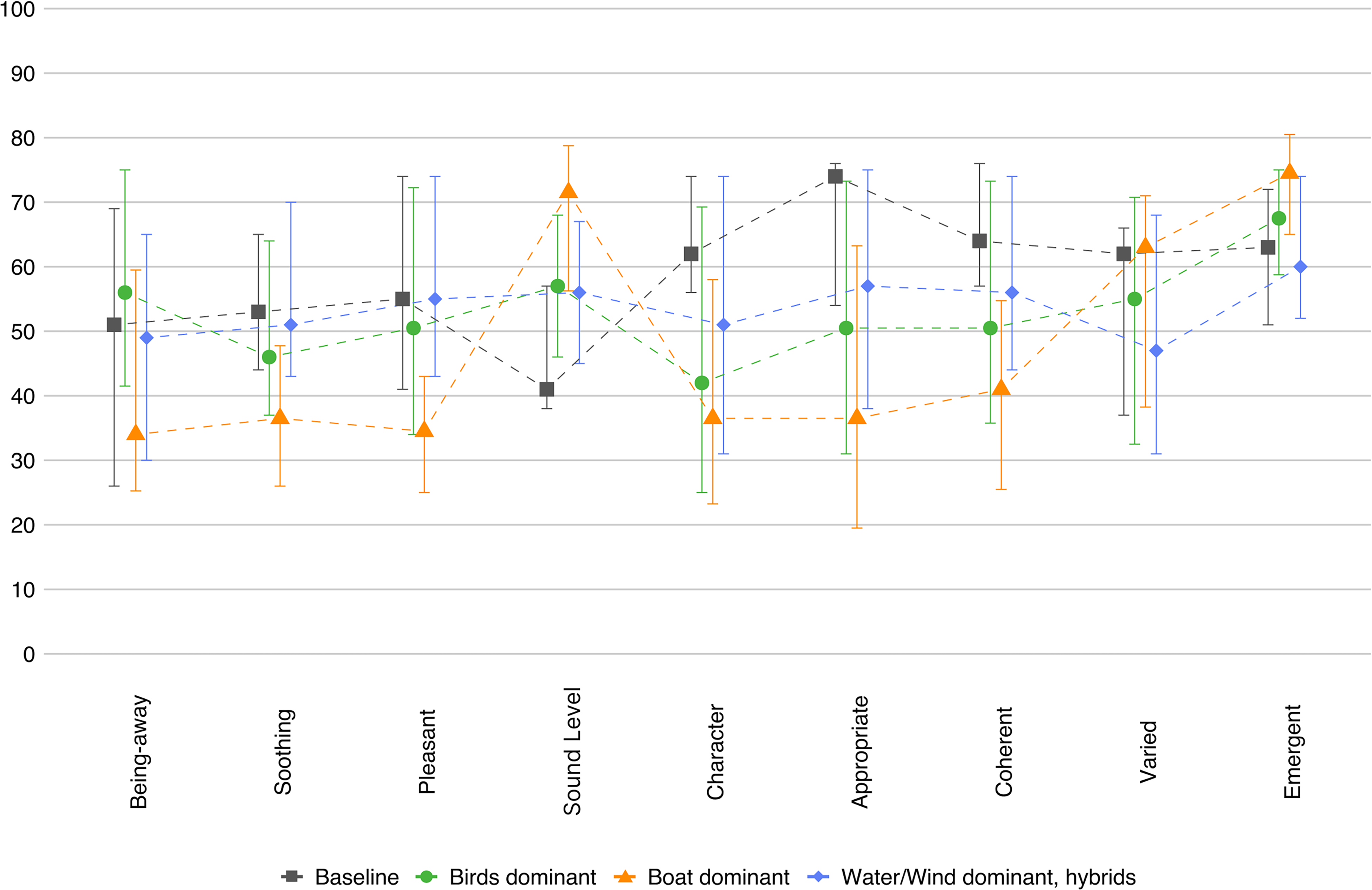
Soundscape ratings collapsed over groups of conditions: median, 25 and 75 percentiles (error bars).
Since the compositions and the associated sound source dominance remained substantially different within each cluster, a finer-grained comparison is necessary to properly characterize the impact of the different compositions on soundscape evaluation. In the following sections, we report on pairwise comparisons between the Baseline condition and the different compositions within each condition cluster, for each semantic scale.
Compositions with a Dominance of Bird Sounds
For the Birds dominant conditions, boxplots are shown in Figure 9 while results of the comparisons with the Baseline condition are shown in Table 6. Together, they reveal that Birds, Seagulls and Cormorant/Mast led to a decrease in the soundscape's character, appropriateness, and coherence, Birds and Cormorant/Mast to an increase in perceived loudness, while Seagull and Cormorant/Mast led to more emergence. The condition Sparrow did not lead to significant differences with the Baseline, despite moderate effect sizes and a p-value between .05 and .1, suggesting that this excerpt led to a more pleasant (r = .50) and soothing (r = .49) soundscape.

Birds dominant group: boxplots for the soundscape ratings. Stars indicate a statistically significant difference when compared to the Baseline condition (p < .05).
Birds dominant group: statistical significance in the change of the soundscape ratings with the compositions when compared to the baseline: Benjamini–Hochberg Wilcoxon signed-rank exact tests (italic text: p < .1; bold text: p < .05), r effect size estimate and associated 95% confidence interval based on percentile interval bootstrap (N = 1000).

Compositions with a Dominance of Water/Wind Sounds and Hybrid
For the Water/Wind dominant, hybrids conditions, boxplots are shown in Figure 10 while results of the comparisons with the Baseline condition are shown in Table 7. Together, results reveal that Waves/Horn, Waves/Sparrow and Waves/Seagulls led to a less appropriate soundscape, that Waves/Horn also modified the character of the space and increased the perceived loudness, while Waves also led to an increase in the perceived loudness. While not reaching statistical significance, effect sizes and p-values between .05 and .1 suggest that Waves also led to a soundscape that is less conducive to Being-Away (r = .39), modified the character of the space (r = .39), and was perceived as less appropriate (r = .50) and coherent (r = .39). Similarly, moderate effect sizes and p-values suggest that Waves/Horn and Waves/Seagulls also led to a less coherent soundscape (r = .46 and r = .47, resp.). No effects of the Waves/Wind condition were observed.
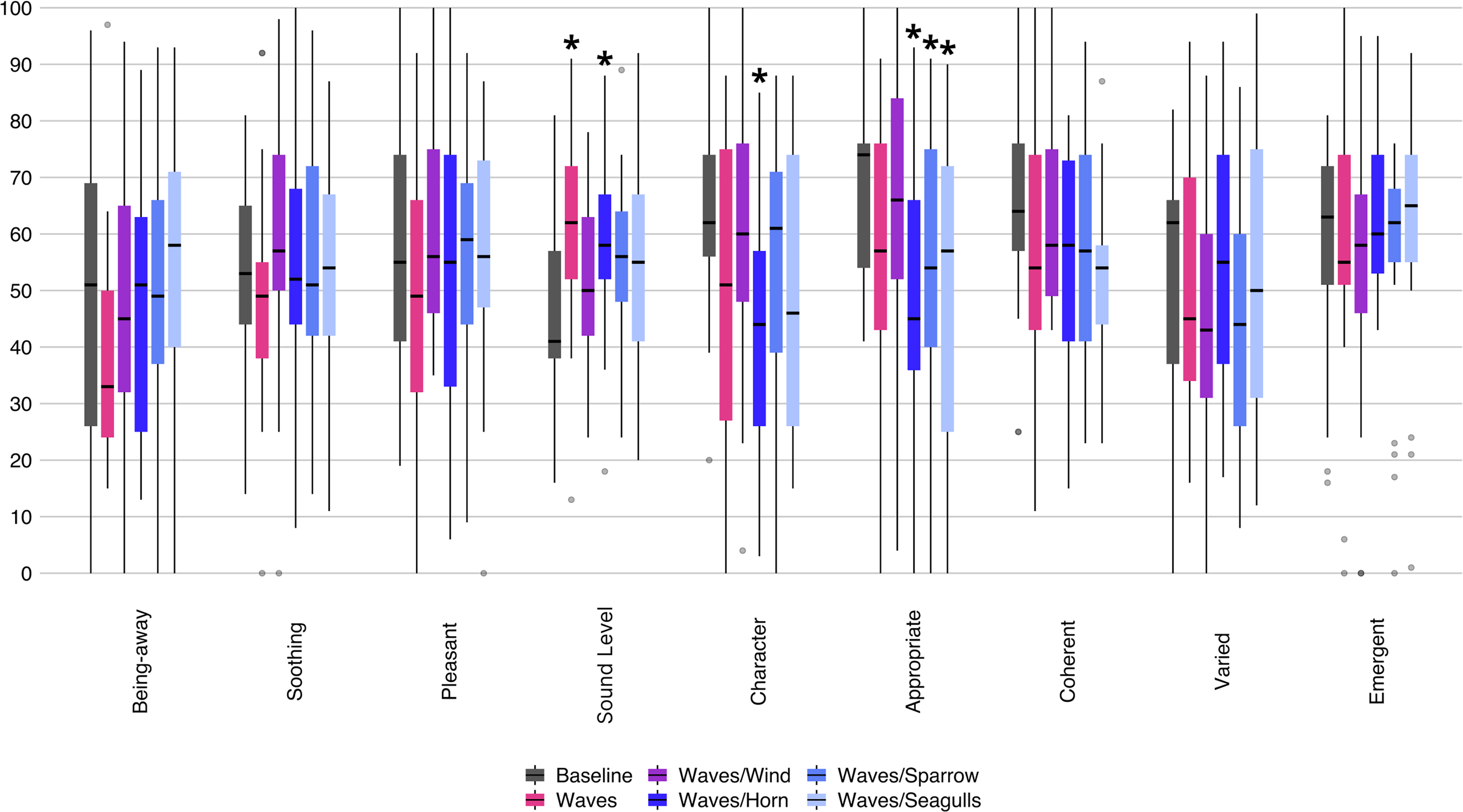
Water/Wind dominant, hybrids group: boxplots for the soundscape ratings. Stars indicate a statistically significant difference when compared to the Baseline condition (p < .05).
Water/wind dominant, hybrids group: statistical significance in the change of the soundscape ratings with the compositions when compared to the baseline: Benjamini–Hochberg Wilcoxon signed-rank exact tests (italic text: p < .1; bold text: p-values < .05), r effect size estimate and associated 95% confidence interval based on percentile interval bootstrap (N = 1000).

Compositions with a Dominance of Boat Sounds
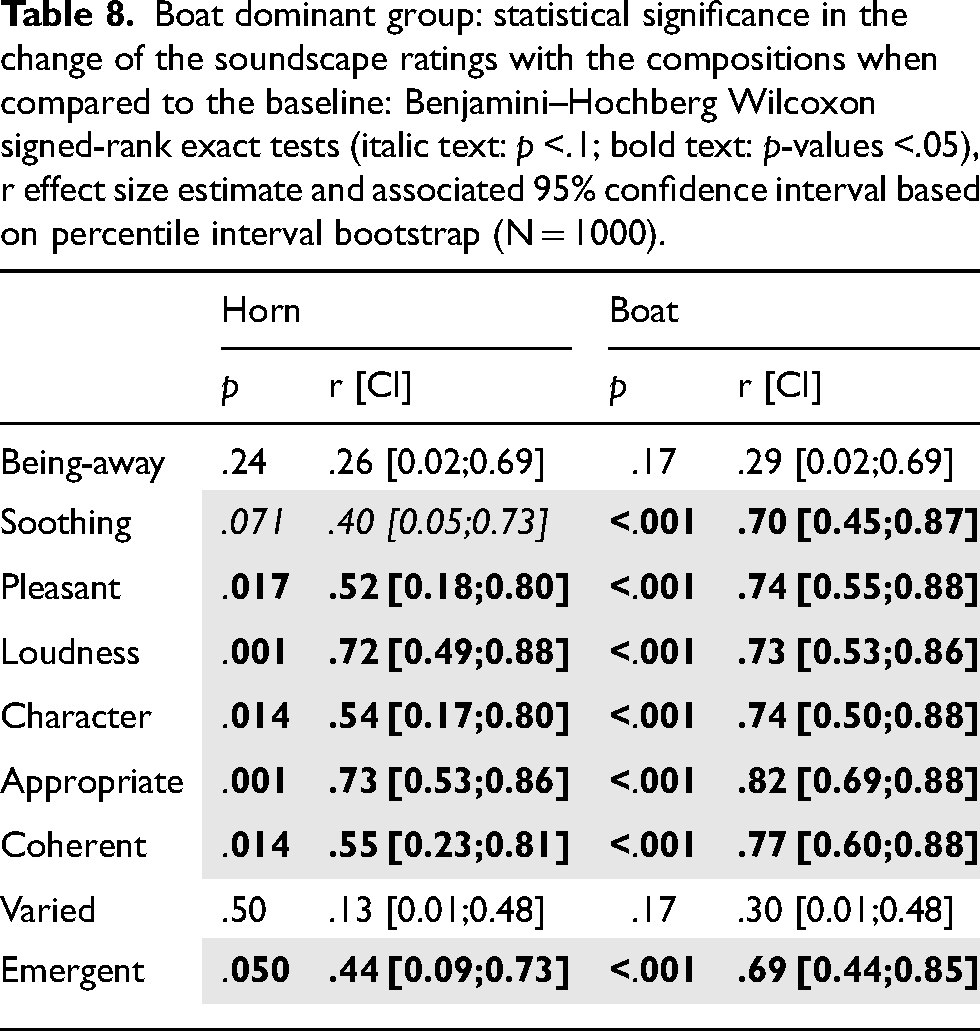
For the Boat dominant conditions, boxplots are shown in Figure 11 while results of the comparisons with the Baseline condition are shown in Table 8. Together, they show that both Boat and Horn condition strongly affected the existing soundscape, leading to a less pleasant, louder and more emergent soundscape, while modifying the character of the space, and leading to a less appropriate and more chaotic soundscape. Boat also led to a less soothing soundscape, while effect sizes and a p-value between .05 and .1 suggest that Horn also led to a less soothing soundscape (r = .40).

Boat dominant group: boxplots for the soundscape ratings. Stars indicate a
Boat dominant group: statistical significance in the change of the soundscape ratings with the compositions when compared to the baseline: Benjamini–Hochberg Wilcoxon signed-rank exact tests (italic text: p <.1; bold text: p-values <.05), r effect size estimate and associated 95% confidence interval based on percentile interval bootstrap (N = 1000).
Significant Moments and Follow-up Interviews
Overview of the Significant Moments
During the experiment, 22 participants identified 161 significant moments that were grouped by condition (collapsing across participants). In the following sections, N represents the number of participants and M the number of moments related to a given category of source. An overview of the nature, valence, and desirability associated with each moment in the follow-up interviews is provided in Table A.1 in the appendix. Significant moments most often elicited a positive or negative valence (negative: M = 69, positive: M = 57, neutral: M = 35). They were more often associated with specific sound events (M = 138) from the sound installation (Added sounds, M = 91) or the Baseline (Background, M = 47) than with an overall impression of the existing soundscape or of a combination of sound events from the Added Sounds and the Baseline (Overall, M = 22).
Moments Associated with the Baseline
Moments associated with the Baseline condition, shown in Figure 12, were primarily related to two specific vehicles (truck and motorcycle) passing by (M = 19, e.g., “the motorcycle, yeah, the vehicle that rumbles, that's what strikes me”), described as unpleasant (N = 5), stressful or uncomfortable (N = 3), and/or disruptive (N = 4, e.g., “it disturbs the global ambiance”). Two other sound events were often mentioned: a voice towards the end (M = 10; N = 5), noticed because it was the only audible voice, and the sound of someone passing by with a shopping cart (M = 9; N = 5) which could not easily be identified (e.g., “every time I heard it, I was hooked, wondering what it was”).
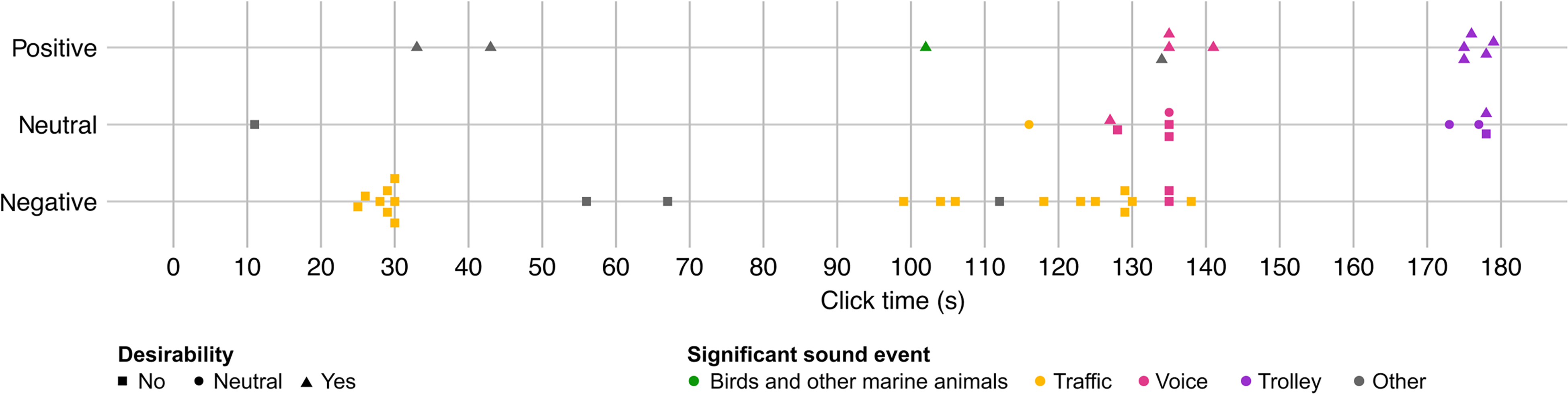
Significant moments related to the Baseline: nature of the sound that led the participants to identify a significant moment and valence associated to it in relation to the position of the moment in the Baseline.
Moments Associated with the Compositions
Moments associated with the Added Sounds can be grouped into five broad categories, displayed in Figure 13 and described as follows:

Significant moments related to the Added Sounds: nature of the sound that led the participants to identify a significant moment and valence associated to it in relation to the position of the moment in the excerpt. For each condition, each moment is associated to a unique participant since participants were only exposed once to each condition.
Associations and Representations
Throughout the interviews, participants related added sounds to a wide range of sceneries and sound sources. Twenty-nine different associations were identified, which did not always correspond with the veridical sound source present in the compositions. For instance, while seagulls were sometimes associated with beaches (N = 2), ports (N = 2), the sea (N = 3), or the nearby river (N = 1), three participants associated them with Canada geese migrating, and the nostalgic feeling of passing time, while two other participants referred to garbage cans that attract these birds. Some associations were more exotic; one participant associated seals and birds with a tropical rainforest, another with a farm. As discussed under “Moments Associated with the Compositions”, some participants associated added sounds with sources more likely to be heard in the public space: cormorants identified as frogs (N = 2), seals as weeping dogs (N = 2), the boat's PA as coming from the nearby metro station (N = 3), and the boat horn as a truck horn (N = 2). These associations relate to past experiences (e.g., one participant enjoyed hearing the boat horn because they were nostalgic for the time when they lived close to a port) and illustrate the wide range of evocations, extending well beyond the initial goal of the artist to evoke the sea (e.g., seagulls evoking garbage cans).
Discussion
Synthesis of Findings
The different compositions elicited a wide range of evaluations and reactions, from more soothing and pleasant soundscapes (e.g., with Sparrow) to less pleasant and familiar ones (e.g., with Boat). An analysis of the dominance of sound sources across the 11 compositions revealed three clusters of conditions: Birds dominant conditions, Water/wind dominant, hybrid conditions, and Boat dominant conditions, which served as a framework for analyzing the effects of the different compositions when compared to the Baseline sound environment.
Bird dominant conditions had strong effects on the soundscape's familiarity, with a significant reduction in ratings for Character, Appropriate, and Coherent, while Sparrow led to an increase in ratings for Pleasant and Soothing. Two compositions also led to an increase in perceived loudness (Birds and Cormorant/Mast) and the Birds composition a decrease in pleasantness. Although follow-up interviews revealed that bird sounds were overall appreciated, some species, such as Sparrows, were unanimously appreciated, while others, such as Seagulls, received mixed responses. Species that were unlikely to be heard in an urban public space (Cormorants, Seals), were sometimes perceived as incongruent or surprising. These results complement previous research and show that the potential impact of bird (and other animals) sounds on soundscapes varies across species (Jeon et al., 2010; Zhao et al., 2020), and as a function of the congruence with the context (Franěk et al., 2019; Hong, Lam, et al., 2020).
The effects of Water/Wind dominant, hybrid conditions were more subtle, with Waves, Waves/Horn, Waves/Sparrow and Waves/Seagulls reducing ratings for familiarity (Character, Appropriate, and/or Coherent) and Waves, Waves/Horn and Waves/Sparrow increasing the perceived loudness. Otherwise, we did not detect significant effects of Waves/Sparrow on soundscape ratings. Follow-up interviews reveal that when identified as significant, water and wind sounds were mostly positively connoted and reportedly led to more desirable, pleasant, or soothing soundscapes. However, participants also reported confusing water or wind sounds with traffic sounds (which could explain the relatively low dominance of wind and water sounds)—and sea wave sounds were sometimes perceived as incongruent. Confusions between water/wind sounds and traffic noise have been previously reported and could be attributed to common spectrotemporal characteristics, such as spectral overlap (Axelsson et al., 2014; Hellström et al., 2014; Rådsten Ekman et al., 2015), the absence of visual cues suggesting the presence of water (Hong, Lam,et al., 2020), or the temporal variability of the Baseline traffic noise (see De Coensel et al., 2011). These potential factors would need to be confirmed in situ, as the reproduction system as well as the auralization of the added sounds might have an impact on the frequency content of the simulated soundscape.
Boat dominant conditions led to a strong alteration of the Baseline soundscape, reducing pleasantness (Pleasant and Soothing) and familiarity (Character, Appropriate, and Coherent) while increasing perceived loudness and emergence. Follow-up interviews show that sounds related to boat traffic (boat horn, public announcement, mast) grabbed attention, but were perceived as highly incongruent or disruptive and sometimes misidentified as additional traffic noise. Some participants still recognized and appreciated the evocative power of boat horns. We conclude that highly evocative sounds can decrease the overall soundscape pleasantness and are at risk of misidentifications when deemed incongruent, rather than provide psychological restoration (Payne, 2013). Further, this highlights the challenges of transporting culturally significant soundmarks from one space to another (see Parker & Spennemann, 2022; Schafer, 1977).
To summarize, the different compositions affected the soundscape's familiarity (Appropriate, Character, and Coherence) and the most evocative sounds (e.g., boat horn, seagulls, cormorants) were perceived as less appropriate, if not disruptive. Results also illustrate the tight balance that has to be struck between traffic noise and added sounds: the compositions often increased the perceived loudness, did not seem to affect the dominance of traffic noise (some added sounds were even sometimes misidentified as additional traffic), and sometimes masked non-dominant sound sources such as bird sounds present in the Baseline, or sounds from passers-by. Although many studies report on the energetic or attentional masking of traffic noise by water or bird sounds (e.g., Deng et al., 2024; Hong, Lam, et al., 2020; Lee & Lee, 2020), our results are consistent with the more nuanced findings on the effects of water sounds in urban environments exposed to small to medium roads (Axelsson et al., 2014; De Coensel et al., 2011; Trudeau et al., 2020), or on the effects of sound art with an auditory texture similar to the pre-existing sound environment (Hellström et al., 2014). This is also in line with previous field observations that sound installations—which are typically not designed to dominate a soundscape, nor as energetic maskers—are more likely to mask non-dominant sounds than dominant ones (Fraisse, Tarlao, et al., 2024). Further investigation is required to investigate the temporal features of traffic noise (see Morel et al., 2012), signal-to-noise ratio of the added sounds (e.g., Hong, Lam, et al., 2020), or their psychoacoustic features such as their loudness, pitch, or saliency (e.g., see Bouvier, 2024; Filipan et al., 2019). Furthermore, the different sounds elicited a wide variety of associations influencing participants’ perceptions, which can be considered as evidence for anamnesis (Augoyard & Torgue, 2006). This highlights the critical role of past experiences and idiosyncrasy in soundscape evaluations.
However, the relatively small sample size in this study might limit the generalizability of these findings. For instance, we could not assess the impact of the installation on the Magdalene diaspora (most are older persons who could not come to the laboratory), nor compare the impact across different communities, e.g., based on the socio-economic status and in relation to the recent social evolution of the borough. Further work is required to assess the impact of this installation on more diverse communities. Still, our results highlight perceptual effects that can be expected from creative projects involving transposing coastal sounds to a city, and could also be useful to help inform the methodological development of other research-creation collaborations, as discussed below.
Methodological Implications
In this study, the soundscape simulation tool was used to compare different compositions presented over the same baseline condition, as commonly done for comparing soundscape interventions in repeated-measures designs (e.g., Calarco & Galbrun, 2024; Deng et al., 2024; Hong, Lam, et al., 2020). The results highlight the limitations of these repetitions as participants reported identifying a clear narrative in the baseline loop and seven noticed repetitions between the conditions. Further, the Baseline loop was only representative of Parc des Madelinots’ average level of activity, and 19 participants reported that they heard fewer human sounds during the experiment compared with their memories of the place. For these reasons, we recommend using different yet comparable background sound environments for each condition, as we did in a previous study (see Fraisse, Schütz, et al., 2024) where we generated random combinations of ambient sound. Finally the protocol did not allow to evaluate the influence of prolonged exposure of public space users to the installation, or the influence of visual cues (Hong, Lam, et al., 2020) or other sensory modalities.
The proposed soundscape scales were informed by previous research evaluating soundscapes in the presence of public space sound installations (Fraisse, Schütz et al., 2024; Fraisse, Tarlao et al., 2024), while the sound source scales were derived from ISO 12913-2:2018 (ISO TS 12913-2, 2018). Overall, the different compositions mostly impacted the soundscape's familiarity—Appropriate, Character, and Coherence. In line with a previous study (Fraisse, Schütz, et al., 2024), this shows that the familiarity dimension, previously identified in several studies (e.g., Axelsson et al., 2010; Kawai et al., 2004; Viollon & Lavandier, 2000) but currently not included in the ISO protocols (ISO TS 12913-2, 2018), remains crucial for evaluating soundscapes, especially in presence of unusual sounds, such as with the introduction of sound installations. In short, we provide further evidence that familiarity is critical to evaluate how sound installations can reshape or reconfigure urban soundscapes (Lacey, 2016), and that a model solely based on pleasantness and eventfulness (as in the current ISOs 12913 series) might not be sufficient to assess sound installations or other unconventional/unfamiliar sounds. Also, we did not observe an effect on the Being-Away component of Attention Restoration (Kaplan & Kaplan, 1989) of any of the compositions, suggesting that it might be difficult to measure in laboratory settings. Incidentally, we could not detect significant effects in situations where the effect sizes were small to moderate. This lack of statistical power could be due to the sample size, limited by the inclusion criteria requiring that participants be familiar with Parc des Madelinots.
We would also like to highlight the efficacy of asking participants to identify significant moments during soundscape evaluation and describe them back during follow-up interviews. These significant moments provided insights into specific elements in the soundscape that attracted attention. The reactivated listening allowed participants to elaborate on the associated meanings, feelings, and evocations without interfering with soundscape evaluations (as could occur in a think-aloud protocol, see Baxter et al., 2015). It further enabled an excerpt-by-excerpt interpretation of the soundscape evaluations, which turned out to be crucial to derive design guidelines for the composer. Altogether, the interviews provided more nuanced insights than the scale ratings alone and showed that participants tended to reach consensus more easily when evaluating soundscapes in the presence of the least preferred composition prototypes or sounds (e.g., Boat) than preferred ones (e.g., Sparrow), a trend already observed in previous research (Fraisse, Schütz, et al., 2024). Further, the interviews enabled us to identify phenomena that span multiple experimental conditions, such as associations elicited by certain sound sources, or confusions between water sounds, wind sounds, and traffic noise. To the sound artist, interviews combined with significant moments were highly beneficial to guide the installation's design. They not only provided interpretative guidance to the quantitative results but also helped pinpoint the diverse impacts that specific sound events in the compositions had on participants, along with their related suggestions and preferences. Together, these were instrumental in informing the next iteration of the sound installation (see the section below).
It should also be noted that we did not disclose the purpose of the experiment to the participants, mainly to minimize bias related to participants’ opinions on sound installation art, as prior awareness could influence responses positively or negatively, and might also incentivize participants to politely express their approval (Robson et al., 2023). Further, the sound installation is using ambient sound to reshape the public space's soundscape without drawing too much attention, and evaluating its impact on soundscape without disclosure aligned with this intent. Nonetheless, we acknowledge that a more reflexive approach could also bring interesting perspectives (Gough & Madill, 2012). Further research is required to investigate how disclosing the artistic intent would affect the reception of public space installations, and whether such an approach would be more ecologically valid depending on the artwork's visual presence in situ and the communication around it. Similarly, it would be interesting to assess whether and how the local residents’ experience of the sound installation changes over longer periods of time, especially regarding the familiarity and congruency of the added sounds.
Overall, the present study highlights the need to complement methods provided by the ISO/TS 12913 series in an effort to standardize soundscape evaluations (ISO/AWI TS 12913-4, 2023), particularly by considering soundscape familiarity. This study further demonstrates the importance of triangulating scale ratings and free-format verbal descriptions in the evaluation and comparison of soundscape interventions (Botteldooren et al., 2023; ISO TS 12913-2, 2018).
Practical Implications for the Design of the Sound Installation
The results informed the composition of the Les Madelinéennes installation based on the evaluation of different combinations of sounds relevant to the installation's intentions: to provide a more pleasant and soothing soundscape to Parc des Madelinots by evoking the coastline. Results showed that a compromise had to be found between these different goals: traffic noise is dominating the existing sound environment, and its combination with the most evocative sounds (such as boat sounds or seagulls) might lead to an inappropriate, loud, or even disruptive sound environment.
To help inform the new iteration of the sound installation in 2025, results were communicated with the sound artist across multiple stages. These were interspersed with regular meetings and discussions between the research team and the artist. First, a selection of verbatim from the follow-up interviews, along with emerging themes, allowed the artist to have an overall picture of the reception before discussing the interpretations of the researchers. Second, a detailed report of the results was provided, including detailed descriptive statistics and an analysis of the interviews, synthesized here. Finally, a summary of the results and a set of recommendations were provided and then discussed with the artist. Recommendations can be streamlined as such: (1) for bird sounds, the researchers suggested favoring a balance between seagulls, cormorants, and sparrows, in a trade-off between disconnection (seabirds) and relaxation (sparrows); (2) because water and wind sounds were at risk of being confused with traffic, the researchers recommended avoiding spectral overlap with traffic noise by emphasizing high frequencies, while making sure that wave sounds were clearly recognizable, for instance through their distinguishable temporal cycle; (3) mechanical sounds from the boat (such as the motor sounds presented in the Boat condition) should generally be avoided, while sparing use of the boat horn may reinforce associations with the sea, as long as it is not too loud.
Given that the initial purpose of the sound installation was both to evoke the Magdalen Islands while providing a more soothing and pleasant atmosphere to the public space, the results and recommendations provided to the artist resulted in a simplification of the composition with less evocative soundmarks (almost no boat sounds with the exception of distant boat horns, less seagulls, seals, or cormorants), and reworking water and wind sounds to minimize confusion with traffic noise. Despite the nuanced results, the experiment demonstrated the potential for the sound installation to help revitalize an underused public space and was well received by the local community. Notably, 17 participants mentioned their willingness to spend more time in the park in the presence of the sound installation. In addition, better communication with residents on the nature and purpose of the project could help increase the acceptability of the artwork, as some soundmarks were sometimes disliked only because of their incongruity. This highlights the challenges of communicating and raising awareness to the audiences of situated sound art (see Robson et al., 2023). Overall, we believe that the lessons learned from this experiment might constitute useful feedback for other sound installations and situations. Still, the potential impacts of a sound installation are highly situated and specific to the artistic project. Hence, we advocate for the use of similar methodologies for the design and evaluation of public space sound installations throughout the creative process (see Fraisse, Wanderley, et al., 2024).
Conclusion
In this laboratory study, we evaluated various compositions to inform the design of a public space sound installation, specifically investigating the soundscape effects of transposing coastal soundmarks to an urban area.
Consistent with previous research, our study confirms that sound installations can alter the familiarity of soundscapes and are more likely to (partially) mask non-dominant sounds than dominant ones. In addition, water and wind sounds had nuanced effects because they were often confused with background traffic noise; the impact of bird sounds was likely to be species-dependent, and boat sounds, despite their evocative potential, were generally disruptive. Furthermore, the experiment elicited many idiosyncratic associations, reflecting manifestations of anamnesis.
Our findings further support the use of soundscape scales related to familiarity alongside standard soundscapes scales. However, we were unable to observe effects on the restorative quality of the sound installation, questioning its applicability in laboratory settings. Beyond theoretical and methodological contributions, the study informed the next iteration of the sound installation, scheduled for deployment in summer 2025. Future work includes a field evaluation of the installation with the local community.
Supplemental Material
sj-pdf-1-mns-10.1177_20592043251384052 - Supplemental material for Bringing the Coastline to the City: Laboratory Evaluation of Urban Soundscapes in the Presence of Ambient Sound art
Supplemental material, sj-pdf-1-mns-10.1177_20592043251384052 for Bringing the Coastline to the City: Laboratory Evaluation of Urban Soundscapes in the Presence of Ambient Sound art by Valérian Fraisse, Charles Montambault, Marcelo M. Wanderley and Catherine Guastavino in Music & Science
Footnotes
Acknowledgments
We would like to thank Laëtitia Matrat and Marie-Flore Dérival from the Institut de tourisme et d’hôtellerie du Québec's ExperiSens for their help with participant recruitment, and Daniel Robinson, who took photographs that were included in the notice of recruitment. We would also like to thank all the participants who contributed to this study.
Action Editor
Sebastian Klotz, Humboldt-Universität zu Berlin, Institut für Musikwissenschaft und Medienwissenschaft.
Peer Review
Francesco Aletta, University College London, The Bartlett School of Environment, Energy and Resources.
Author Contributions
Valérian Fraisse: Writing—review and editing, Writing—original draft, Visualization, Software, Project administration, Methodology, Investigation, Formal analysis, Data curation, Conceptualization. Charles Montambault: Writing—review and editing, Writing—original draft, Methodology, Conceptualization, Resources. Marcelo Wanderley: Writing—review and editing, Validation, Supervision, Resources, Project administration, Methodology, Funding acquisition. Catherine Guastavino: Writing—review and editing, Validation, Supervision, Resources, Project administration, Methodology, Funding acquisition.
Data Availability

Declaration of Conflicting Interests
The authors declared no potential conflicts of interest with respect to the research, authorship, and/or publication of this article.
Ethics Approval and Informed Consent
This research has been approved by McGill Research Ethics Board (REB #23-05-049). Informed consent was obtained from all participants.
Funding
The authors disclosed receipt of the following financial support for the research, authorship, and/or publication of this article: the study in this paper was funded by grants from the Social Sciences and Humanities Research Council of Canada [SSHRC, #890-2017-0065 to CG, Sounds in the City], the Natural Sciences and Engineering Research Council of Canada [NSERC, Discovery Grant #2019-04551 to MW; Discovery Grant #2019-06121 and Acceleration Supplement #0035-2019 to CG], as well as an internship program with ExperiSens funded by the Fonds de Recherche Nature et Technologies of Quebec's [FRQNT, #323293 to VF].
Supplemental Material
Supplemental material for this article is available online.
Appendix
Interview guide for the follow-up interviews (English and French versions).

| Question (EN) | Question (FR) |
|---|---|
| Generally speaking, how do you feel about these listening sessions? | De manière générale, quel est votre ressenti par rapport à ces écoutes ? |
| Were there any remarkable, out of the ordinary soundscapes during your listening? | Durant vos écoutes, est-ce qu’il y a eu des moments marquants, qui sortent de l’ordinaire ? |
| Now we will listen again to the significant moments you identified during the experiment: | Nous allons maintenant réecouter les moments marquants que vous avez identifié lors de l’expérience : |
| Why was this a significant moment for you? | Pourquoi ce moment a été marquant pour vous ? |
| Could you describe how you feel about this moment? | Pouvez-vous décrire votre ressenti sur ce moment ? |
| Does this moment correspond to a desirable experience in the Parc des Madelinots? | Est-ce que ce moment correspond à une expérience souhaitable sur le Parc des Madelinots ? |
| The next questions are no longer about the significant moments, but about all the experiment and the Parc des Madelinots itself. | Les prochaines questions ne concernent plus les moments marquants, mais l’ensemble des écoutes que vous avez faites ainsi que le Parc des Madelinots. |
| Are the added sounds harmoniously integrated with the existing sound environment? | Est-ce que les sons ajoutés si vous en avez remarqué s’intègrent de manière harmonieuse avec l’environnement sonore existant ? |
| Do you belong to the Madelinean community, or have you any significant link with the îles-de-la-Madeleine? If yes, do the added sounds evoke the îles-de-la-Madeleine to you? If so, which ones? Would these sounds help you reconnect with the îles-de-la-Madeleine? | Est-ce que vous appartenez à la communauté Madelinéene ou possédez un lien particulier avec les îles-de-la-Madeleine ? Si oui, est-ce que les sons ajoutés vous évoquent les îles de la Madeleine ? Si oui, lesquels ? Est-ce que ces sons pourraient vous aider à vous reconnecter avec les îles de la Madeleine ? |
| What would you like to hear in this space that was missing in this experiment? | Qu’aimeriez-vous entendre dans cet espace, et qui manquait dans cette expérience ? |
| What brings you to the Parc des Madelinots? | Qu’est-ce qui vous amène sur le Parc des Madelinots ? |
| Would any of the soundscapes you heard incite you to spend more time or to do activities in the Parc des Madelinots that you don’t already do? | Est-ce que les ambiances entendues pourraient vous inciter à passer plus de temps ou à faire d’autres activités sur le Parc des Madelinots ? |
| What do you think about the Parc des Madelinots? | Que pensez-vous du Parc des Madelinots ? |
| Do you know about the sound installation Les Madelinéennes located in the Parc des Madelinots? If so, are you aware of its artistic intentions? |
Avez-vous connaissance du projet d’installation sonore Les Madelinéennes qui se trouve au Parc des Madelinots ? Si oui, connaissez-vous les intentions artistiques de
cette œuvre ? |
| Do you have any comments, anything to add? | Avez-vous des commentaires, quelque chose à ajouter ? |
References
Supplementary Material
Please find the following supplemental material available below.
For Open Access articles published under a Creative Commons License, all supplemental material carries the same license as the article it is associated with.
For non-Open Access articles published, all supplemental material carries a non-exclusive license, and permission requests for re-use of supplemental material or any part of supplemental material shall be sent directly to the copyright owner as specified in the copyright notice associated with the article.
