



Abstract
Timbral blend is a phenomenon that occurs when two or more concurrent acoustic events produced by distinct sources fuse perceptually and give rise to new timbres. Auditory scene analysis proposes that concurrent grouping cues of onset synchrony, harmonicity, and parallel change in pitch and dynamics are involved in the perceptual fusion of events, but research has also shown that several timbral cues can affect concurrent grouping. We investigated potential factors that may cause different degrees of instrumental blend in orchestral excerpts using rating scales ranging from “unity” to “multiplicity” and from “strongly blended” to “not at all blended.” With linear mixed effects modeling, the factors found to affect ratings included the rating scale used, musical training, timbre class (instrument families involved), the degree of parallelism and onset synchrony of melodic lines involved in the blend, the number of different notes present simultaneously, and several acoustic features related to timbre. Musicians differ from nonmusicians in the use of the multiplicity scale, rating excerpts as more multiple, even if they are fairly well blended, whereas nonmusicians ratings are similar for both scales and to musicians’ ratings of blend. Excerpts with bowed strings and/or woodwinds blend the strongest, followed by combinations involving brass instruments, with excerpts involving percussion and plucked strings blending the least. The important finding of this study on real musical excerpts is in demonstrating the relative roles of the score-based and acoustic factors that are associated with the perception of multiplicity and blend in complex orchestral sonorities as well as the influence of musical training.
Keywords
Orchestration involves the selection, combination, and juxtaposition of sounds to achieve a particular sonic goal. Historically speaking, composers started paying attention to the choice of combinations of instruments, and the resulting effect it had on their music, in the late Baroque era (Chon et al., 2018; Kendall & Carterette, 1993; Reuter, 2018). Traditionally, musicians, musicologists, and composers have relied on orchestration treatises to learn about instrumental combinations. These treatises generally present a plethora of examples from the repertoire, commenting on which combinations of instruments sound good and which do not (e.g., Adler, 2002; Piston, 1955; Read, 1979, 2004). However, Berlioz and Strauss’s (1948) and Koechlin's (1954–1959) treatises challenged this conservative approach by putting forward a new vision of orchestration with an emphasis on sonic goals and desired perceptual effects. Instead of imposing rigid rules that would make a piece of music sound better (or worse), Berlioz and Koechlin proposed a multidimensional process by which different combinations of instruments may result in a variety of perceptual and acoustic effects. One important orchestration technique is the scoring of the same musical line in two or more instruments (traditionally called “doubling”), resulting in the creation of new timbres from the blending of simultaneously occurring instrument sounds. We investigate the musical conditions under which instrumental blending occurs and in particular how the timbral homogeneity or heterogeneity of combinations of instruments from the same or different families affect the perceived strength of the blend and the perception of unity of the resulting blend. Reflecting on orchestral balance in late 19th-century orchestrations, Rimsky-Korsakov (1912/1964) notes: “It is not always possible to secure proper balance in scoring for full wood-wind. For instance, in a succession of chords where the melodic position is constantly changing, distribution is subordinate to correct progression of parts. In practice, however, any inequality of tone may be counterbalanced by the following acoustic phenomenon: in every chord the parts in octaves strengthen one another, the harmonic sounds in the lowest register coinciding with and supporting those in the highest. In spite of this fact, it rests entirely with the orchestrator to obtain the best possible balance of tone; in difficult cases this may be secured by judicious dynamic grading, marking the wood-wind one degree louder than the brass.” (p. 94)
Albert Bregman's (1990) book Auditory Scene Analysis has been very influential in the world of music cognition and eventually became one of the foundational works in the field of auditory psychology generally and music psychology more specifically. We know from Bregman's theory that music perception arises in part from two types of principles that group sound information into events and streams of events: concurrent grouping (perceptual fusion) and sequential grouping (formation of continuous streams). To this, McAdams et al. (2022) have added segmental grouping (chunking into perceptual units). These grouping processes can be thought of as correlates of Gestalt principles (Koffka, 1922; Köhler, 1969). Auditory scene analysis proposes that auditory fusion occurs as a result of concurrent grouping processes. Four important concurrent grouping cues predict the perceptual fusion of sound events (McAdams, 1984): onset synchrony, harmonicity, coherent frequency behavior, and common spatial origin. Onset synchrony refers to the synchronization of the onsets of different acoustic components. This information can be largely gleaned from the score by seeing how the musical lines have been scored in rhythmic synchrony or not, but also depends on microtiming (i.e., musically precise synchronicity) in performance. Sound events or frequency components that start at the same time perceptually have a higher tendency to fuse perceptually (Bregman & Pinker, 1978; Dannenbring & Bregman, 1978; Lembke et al., 2017; Wright & Bregman, 1987). Harmonicity refers to the case in which all frequency components of a sound share a common period; they have a higher tendency to fuse perceptually (Bregman & Pinker, 1978; de Cheveigné et al., 1995, 1997; Hartmann et al., 1990). The occurrence of pure harmonicity in orchestral excerpts is rare, with notable exceptions being Boléro (1928) by Maurice Ravel and works of the French spectral style such as Partiels (1975) by Gérard Grisey or Claude Vivier's creation of les couleurs in Lonely Child (1980). Coherent frequency behavior refers to the synchronized and parallel motion of a component's frequencies and can be thought of as an instance of the Gestalt principle of common fate. One example occurs in vibrato, where all frequencies are shifted in a coherent fashion maintaining the intervals (ratios) between components. This in turn creates an effect of perceptual unity (McAdams, 1989). This factor can also be gleaned from the score in terms of melodic motion. Common spatial origin refers to the location of the different instruments in space. Sounds coming from the same place tend to fuse more than sounds coming from different places. However, this cue is considered weak in that it can be overridden by the others, allowing for the blending of instruments at different locations on a concert stage (Darwin & Hukin, 1999; Hukin & Darwin, 1995). In the current study, we focus on the cues of onset synchrony and pitch parallelism.
In music, instrumental blends result from the fusion of two or more concurrent events produced by different sound sources, giving rise to new timbres. Sandell (1991, 1995) has theorized on instrumental blends and proposes several perceptual categories of instrument combinations. He labels the case in which different timbres are heard independently of one another timbral heterogeneity because the listener can identify and name the different instruments that are being played simultaneously (Kendall & Carterette, 1993). Second, when instrumental blend does occur, two cases may be distinguished. A timbral emergence consists of a new timbre emerging from the fusion of its constituent timbres. A timbral augmentation occurs when one or several “embellishing” timbre(s) highlight(s) the perceptual qualities of another timbre referred to as the “dominating” timbre. McAdams et al. (2022) distinguish two subcategories of these two types of blend: stable and transforming. The main difference between these subcategories is that the transforming versions involve a change in instrumentation over time, nonetheless maintaining a blended sonority, whereas the stable versions have a consistent instrumentation over the duration of the orchestral effect. McAdams et al. (2022) introduce other notions related to blend as well. A blend may be sustained over time, or it may be punctuated when synchronous sounds with short duration are perceptually fused into a blended event, which doesn't leave time for a listener to analyze the compound event into its constituent events. In the current study, we focus on stable, sustained blends.
Timbre is an example of a perceptual attribute that arises from concurrent grouping. What is perceived as timbre depends on what spectral components are fused perceptually (Bregman & Pinker, 1978; McAdams & Bregman, 1979). Once formed, timbre then contributes to sequence structuring by affecting sequential grouping through the segregation of auditory streams played by different instruments and segmental grouping through timbral contrasts (McAdams et al., 2022). Several timbral cues contribute to the fusing of different sounds into one event. Sandell (1995) had listeners rate the blend of unison dyads of sounds drawn from Grey's (1977) stimulus set of resynthesized sustaining instruments on a scale from “oneness” to “twoness,” where “oneness” referred to a perfect instrumental blend, and “twoness” referred to timbral heterogeneity. He found that similar spectral centroids (the center of mass of the frequency spectrum), similar temporal envelopes, and a lower spectral centroid of the combined sounds resulted in higher blend ratings. Tardieu and McAdams (2012) extended this work with combinations of unison sustained and impulsive instruments (including pitched percussion and string pizzicati). Participants rated the degree of instrumental blend strength of dyads on a scale from “not blended” to “very blended.” Results revealed major effects of differences in the logarithm of the attack time and spectral centroid of the two sounds and suggested that impulsive sounds contributed more to perceptual blend in a manner that was inversely proportional to the sharpness of the attack, whereas sustained sounds contributed more to the emergent timbre.
Fricke (1986) addressed the issue of partial masking between concurrent instruments. Following from Schumann's (1929) theories of pitch- and playing-effort-independent resonance regions in the spectra of instrument sounds, which he conceived in terms of formants by analogy with vowel sounds, Fricke considered instruments with nonoverlapping formant structures and proposed that instrument sounds presented concurrently could be individually distinguished by detecting the formant peaks of one instrument in the spectral valleys of the other instrument. Reuter (1996) tested this hypothesis with pairs of instruments playing concurrently. He found good, but not total, correspondence with the support for timbral heterogeneity being strongest with woodwind and brass instruments that have clearly defined first formants when playing in low to middle registers. He also noted that timbral blending was associated with overlapping formant areas of concurrent sounds playing in unison. Reuter (2002) then established the correspondence between timbral blending and heterogeneity in the descriptions of their resulting orchestrational effects in many orchestration treatises from the 19th century onward. Following on from Reuter's work, Lembke (2014, Appendix B) estimated the pitch-generalized spectral envelopes of orchestral instruments and found that although some instruments do display some formant structure, such as the double reeds, French horn, and trombone, many other instruments have essentially low-pass spectral envelopes with barely discernable formants, notably strings and C trumpet. This leads us to propose that a more general way to conceive of this is in terms of degree of spectral overlap. Lembke and McAdams (2015) found that the degree of spectral overlap between constituent sounds enhanced blend perception. Lembke et al. (2019) extended the work from dyads to triads with string, woodwind, and brass combinations, including impulsive sounds of string pizzicati. The primary factors involved in blend were the absence of impulsive sounds (differences in attack slope) in triads and whether the instruments were playing in unison or other intervals. Non-unison sounds were less blended than unisons. A secondary role was played by several spectral descriptors that captured the degree of spectral overlap between concurrent sounds.
Kendall and Carterette (1993) investigated the degree of instrumental blend strength in pairs (dyads) of orchestral wind instruments with different conditions (unison tone, unison melody, tones at an interval of a major 3rd, harmonized melody). They asked participants to rate the strength of instrumental blend on a scale from “oneness” to “twoness.” The main result from this experiment was that greater instrumental blends were associated with a diminished ability to identify the different instruments playing simultaneously. Another finding was that “nasal” combinations (e.g., involving oboe) blended less well than “brilliant” combinations (e.g., involving trumpet) or “rich” combinations (e.g., involving saxophone). Finally, Fischer et al. (2021) studied the blends of multi-instrument streams in the context of orchestral stream segregation in predominantly Romantic orchestral excerpts. They found that within-family instrument combinations blended better than between-family combinations. They demonstrated the role played by overlap in timbre correlates of spectral flatness (a measure of the tonalness/noisiness or density of the spectrum), spectral skewness (related to the shape of the spectral envelope), and spectral variation (evolution of the spectral envelope over time), as well as cues derived from the scores such as onset synchrony and the consonance of concurrent pitch relations.
Neither the standard concurrent grouping cues of onset synchrony, harmonicity, and parallel change in pitch and dynamics nor acoustic properties related to timbre that affect concurrent grouping are sufficient to achieve blend on their own; they must work together. Tardieu and McAdams (2012) and Lembke et al. (2017) demonstrated that combinations of sustained and impulsive instruments blend less well. Lembke and McAdams (2015) showed that overlap of spectral envelopes increases blend ratings. For example, Debussy's combination in the third movement of La Mer of English horn and horn playing in unison, and with glockenspiel three octaves higher (a harmonic relation) in perfect rhythmic synchrony and parallel motion in pitch and dynamics, does not result in a blend of the glockenspiel, because of its different temporal envelope (percussive vs. the sustained envelopes of the wind instruments) and the nonoverlapping spectral envelopes. Overall, the literature suggests that instrumental blend is not an all-or-nothing phenomenon: Blend strength can vary from zero (complete segregation of simultaneous events) to strongly fused. These degrees of instrumental blend strength are the object of the current study as found in orchestral excerpts rather than isolated sounds.
Current Study and Hypotheses
Our goal was to investigate the factors that cause different degrees of instrumental blend strength in the context of stable timbral augmentations and emergences in orchestral excerpts involving different combinations of instrument families. One difference with most of the studies introduced earlier was that we studied instrumental blends with more than two instruments and with excerpts drawn from the Classical, Romantic, and early Modern orchestral repertoire. This necessitated expanding the notion of “oneness–twoness” used in previous studies by Sandell (1995) and Kendall and Carterette (1993) to the notion of “unity–multiplicity” in one session. A second session with different participants used the same stimuli but employed ratings of degree of blend as in Tardieu and McAdams (2012) and Lembke and McAdams (2015), because the results for some stimuli that seem blended to our ears but which were judged as “multiple” in the first session required further exploration. We pose four main hypotheses:
We also explore the role of various acoustic features related to loudness and timbre in multiplicity and blend perception to determine the underlying sensory processing of blend. Of particular interest based on previous work on perception of orchestral excerpts are descriptors of signal energy (frame energy), spectral center of gravity (spectral centroid), the spread of the spectrum (spectral spread), spectral density or tonalness vs noisiness of the spectrum (spectral crest and spectral flatness), and the degree of variation of the spectrum over time (spectral variation). Of additional interest are eventual divergences between excerpts previously identified by analysts as representing timbral augmentation or timbral emergence.
Method
Two separate groups of participants used different rating scales for the experiment: a scale from unity to multiplicity for one group and a scale from strongly blended to not at all blended for the other group. All other experimental factors were identical for the two groups.
Participants
Forty participants from the McGill University community (half musicians and half nonmusicians) participated in each group. Participants were required to pass a hearing test with auditory thresholds at or below 20 dB HL in both ears for seven octave-spaced frequencies starting at 125 Hz (ISO 389–8, 2004; Martin & Champlin, 2000). All participants passed the hearing test and provided written consent to participate in the experiment.
For the multiplicity scale group, 20 participants were musicians with at least two years of music training at the university level (undergraduate or graduate) (9 female, 11 male; aged 22–43 years, M = 26.7, SD = 5.4) and 20 were nonmusicians with less than one year of formal training in early childhood and no longer actively participating in musical activities (15 female, 3 male, 2 preferred not to answer; aged 19–28, M = 22.1, SD = 2.7). For the blend scale group, 20 participants were musicians (11 female, 7 male, 2 preferred not to answer; aged 20–45 years, M = 26.1, SD = 6.3) and 20 were nonmusicians (13 female, 7 male; aged 19–30, M = 22.2, SD = 3.5).
Stimuli
The stimuli were all short excerpts of orchestral music extracted and simulated using the following five-step procedure.
Step 1: Creation of a database of augmentations and emergences. Composers and music researchers had previously analyzed and annotated 65 movements from the Classical, Romantic, and early Modern repertoire in terms of the Taxonomy of Orchestral Grouping Effects (McAdams et al., 2022). Annotations were done while listening to a commercial recording to focus the analysis on perception. The database includes 628 timbral augmentation blends and 155 timbral emergence blends that are stable in instrumentation and sustained over time. The perceptual annotations included a rating of relative strength of blend on a scale from one to five within the full orchestral context. All instrumental blends were referenced with metadata including the composer's name, work title, movement, the reference recording, measure numbers of the effect, start and end times of the passage in the recording, and specific combinations of instruments involved in the instrumental blends of interest.
Step 2: Selection of the specific excerpts of interest. The aim of this study was to investigate a wide range of instrumental blends, necessitating the selection of excerpts from a variety of timbre classes (instrument families involved) and of various blend strengths as noted by the annotators on a scale from one to five (see Appendix), as well as from different orchestration styles across epochs and countries (Austria, England, Finland, France, Germany, Italy, Russia). There were eight different classes of timbral combinations: Strings (S) including violin, viola, cello, and contrabass sections; Brass (B) including horn, trumpet, alto trombone, tenor trombone, bass trombone, and tuba; Woodwinds (W) including flute, piccolo, oboe, oboe d’amore, English horn, clarinet, bass clarinet, bassoon, and contrabassoon; combinations of brass and strings (BS); combinations of woodwinds and strings (WS); combinations of woodwinds and brass (WB); All (A) combinations of brass, woodwinds, and strings; Other (O) combinations including impulsive instruments such as harp, pizzicato strings, glockenspiel, xylophone, timpani, drum, tubular bells, gongs, celeste, vibraphone, and bass drum. The two types of stable and sustained blends were timbral augmentation and timbral emergence. Eight stimuli were originally classified in each timbre class with from three to five augmentations and emergences. The stimulus selection was constrained in part by the pieces that had been annotated and the simulations available in the OrchPlayMusic Library (see below). This yielded a total of 64 stimuli. We note after the fact that due to these constraints, there is a preponderance of late Romantic era excerpts (50 from Verdi, Rimsky-Korsakov, Bizet, Bruckner, Mahler, R. Strauss, Sibelius, D’Indy, Debussy, and Mussorgsky) with a few Classical (eight from Haydn and Mozart), early Romantic (two from Schubert), and Modern (four from Vaughan Williams) excerpts on either end. We return to the implications of this distribution in the Discussion. After perceptual data were collected, it was noticed that two excerpts had been misclassified: One emergent BS included harp, and one emergent A included timpani, both impulsive instruments, so they were reclassified as O. Another emergent A excerpt was found to include timpani in the score, but the instrument was inaudible, so it was left in A. Table 1 displays the distribution of stimuli across type of instrumental blend and timbre class. The Appendix gives a complete list of all stimuli sorted according to type of instrumental blend and timbre class.
Distribution of stimuli across blend type and timbral combination class.

Step 3: Extraction of each excerpt's audio file. The excerpts were extracted from the reference recordings to serve as a model for the orchestral simulations.
Step 4: Simulation of the excerpts. In the commercial recordings, all instruments are playing simultaneously in the orchestra. Because our study only investigates timbral blends between specific combinations of instruments, it was necessary to extract the combinations of instruments of interest from the full context in the original recording. The orchestral simulations were realized by Denys Bouliane and Félix Frédéric Baril using their OrchSim system (Bouliane & Baril, n.d.). OrchSim provides a multichannel audio package from which relevant instrument tracks can be extracted from the full context, after having been realized in the full context. OrchSim draws its samples from numerous commercially available virtual instrument libraries. Working from a score in the Finale engraving software (Make Music, Inc., Boulder, CO), each instrument is shaped in dynamics, intonation, and timbral nuance to correspond as closely as possible to what is heard in the reference excerpt. This is a complex multi-step procedure that aims to confirm the accuracy of the simulation by measuring the interpretation of each instrument in relation to other instruments and their roles. Each instrument, or section for strings, forms a separate track in the output file.
Step 5: Rendering of the completed simulations. After completion of the initial simulations, all excerpts were improved and rendered using Logic Pro X (Apple Inc., Cupertino, CA). For each rendering, instruments of interest were selected, and each excerpt was trimmed according to the annotations’ time start and time end. All excerpts were faded in and out, and a room ambiance option was used to reinforce the realism of each excerpt. The room ambiance was designed as a large concert hall in Altiverb (Audioease, Netherlands). Its primary purpose was to harmonize the samples from different audio libraries, as some libraries are recorded with microphones that are closer to the sound source than others. The reverberation tail length was approximately 100 ms. The final exported mix is in a stereo format, and the instruments are placed in stereo space as they would be in an orchestra onstage. In a study by McAdams and Goodchild (2018), orchestral simulations created with OrchSim were compared perceptually to commercial recordings and were shown to be of high quality. (See Supplementary Materials for scores and sound files of the excerpts).
Procedure
Prior to starting the experiment, all participants read an instruction sheet that introduced them to the main task. Three practice stimuli were used to familiarize participants with the rating task and experimental interface. The practice stimuli were always played in the same order, and included Mahler, Symphony 1, first movement, m. 3 (Woodwinds), D’Indy, Choral Varié, op. 55, mm. 70–78 (Woodwinds and Strings), and Haydn, Symphony 100, third movement, mm. 57–64 (Woodwinds and Strings). The 64 stimuli of the main experiment were presented in random order for each participant and were presented in two blocks of 32 with the possibility of a break between blocks. For each excerpt, participants were allowed to replay the audio file once by clicking on a button underneath the scale. At the end of the experiment, participants completed a questionnaire that asked them about listening habits and specific musical training.
For both scale groups, a continuous scale was presented on the screen with a cursor that could be positioned with the computer mouse along the scale depending on the perceived degree of blend. For one group, the end points of the scale were labeled “Unity” (coded 0), which suggested perfect instrumental blend, to the left and “Multiplicity” (coded 1), which suggested perfect timbral heterogeneity, to the right. For the other scale group, the end points of the scale were labeled “Very blended” (coded 0), which suggested perfect instrumental blend, to the left and “Not at all blended” (coded 1), which suggested perfect timbral heterogeneity, to the right. The orientation of the two scales was such that they represented “Multiplicity” and “Not at all blended” equivalently.
Equipment
Listeners were all seated in an IAC model 120act-3 double-walled audiometric booth (IAC Acoustics, Bronx, NY) and heard all stimuli amplified through a Grace Design m904 monitor (Grace Digital Audio, San Diego, CA). Excerpts were presented through Dynaudio BM6a loudspeakers (Dynaudio International GmbH, Rosengarten, Germany) arranged at ±45°, facing the listener at a distance of 1.5 m. The experiment was run on a Mac Pro 5 computer running OS 10.6.8 (Apple Computer, Inc., Cupertino, CA). The experimental session was run with the PsiExp computer environment (Smith, 1995).
Data Analysis
Studying instrumental blends extracted from orchestral excerpts necessitates considering the complex interactions between timbre, pitch, and rhythm present in real music. Therefore, to test the effect of these properties on perceived multiplicity, a mixed-effects analysis was performed on the fixed effects listed in Table 2. The main dependent variable was degree of blend measured on two different continuous scales (multiplicity and blend). In one session, this corresponded to the scale from “unity” to “multiplicity.” In another session, this corresponded to the scale from “very blended” to “not at all blended.” The repeated-measures independent variables were blend type and timbre class. Blend type was a categorical variable with two classes: augmentation and emergence. Timbre class was a categorical variable with eight classes (S, B, W, BS, WS, WB, A, O). The between-subjects independent variables were rating scale (multiplicity, blend) and musicianship group (musicians, nonmusicians). Covariates tested included number of concurrent notes, degree of melodic parallelism, proportion of synchronous onsets, frame energy, spectral centroid, spectral spread, spectral flatness, spectral crest, and spectral variation. The number of notes was an integer variable indicating the total number of different instruments playing simultaneously in each excerpt and the number of different pitches played by a given instrument type. All instruments were playing different parts for any given excerpt. Two or more players of the same instrument playing the same pitch were counted as one—for example, violin section or first and second flute in unison doubling—whereas violins playing divisi on two or more pitches were counted separately. Two different instruments playing the same pitch were counted separately. The degree of parallelism was a dummy variable indicating the degree to which instruments were playing in parallel melodic motion. All excerpts were coded on an ordinal scale from 1 to 4, where 1 signifies “other motion” (contrary motion in which some parts rise in pitch while others descend or mixed motion types), 2 signifies “oblique motion” (some parts remain in place or move relatively little while others move more actively), 3 signifies “similar motion” (the parts move in the same direction without necessarily keeping the same pitch interval between them), and 4 signifies “parallel motion” (the parts move in the same direction keeping exactly the same interval between them). To compute an index of onset synchrony, we first created a composite rhythm from the score combining all instruments in the excerpt. This involves deriving a rhythm that takes into account every instrument attacking a note at a given moment in the score. The proportion of common onsets between independent parts across all events in this composite rhythm was taken as the onset synchrony score. So for example, if Instrument 1 plays on beats 1 and 3, Instrument 2 on beats 2 and 4, and Instrument 3 on beats 1, 2, 3, and 4, the composite rhythm would have events on beats 1, 2, 3, and 4. There would be 2 out of 3 instruments on each of these beats and so the proportion would be .67.
Factors and covariates used in the analysis of multiplicity and blend ratings.

Several audio descriptors were used to represent loudness- and timbre-related features of the excerpts as covariates. They were computed with the revised version of the Timbre Toolbox (Peeters et al., 2011; revised by Kazazis et al., 2021). The auditory model of Moore and Glasberg (1983) was used as an input representation for the extraction of the audio descriptors. This model outputs the signal in several different auditory channels to simulate the filtering in the auditory periphery. The included descriptors, taken as the median value over the whole excerpt, were chosen based on previous work. Median frame energy was included as an indication of the relative level of the excerpts. It was computed as the sum of squared amplitudes in each time frame in each auditory filter, and the median of the resulting time series was calculated. Sandell (1995) found that the global spectral centroid, the center of mass of the spectrum, plays a role in blend. Several other spectral and spectrotemporal descriptors were found to play a role in blend perception in orchestral works by Fischer et al. (2021). These include spectral flatness and spectral crest (different measures of the degree to which the spectrum is denser or has more emergence of spectral components), and spectral variation (the degree of variation of the spectral shape over time). There is an inverse relation between spectral flatness and spectral crest. High values of spectral flatness indicate a noisy or dense spectrum, which sounds harsh. Spectral crest measures the peakiness of the spectrum, so high values indicate greater tonalness and low values greater noisiness or spectral density. We also included spectral spread (the standard deviation of the spectrum around the mean). The absolute values of correlations between these audio descriptors ranged from .120 to .681 (M = .281). Fischer et al. also included spectral skewness, but for our excerpts, skewness was strongly correlated with spectral centroid, r = –.728, and very strongly correlated with spectral flatness, r = –.830, so it was not included.
Results
To examine inter-participant agreement, Cronbach's alpha and intraclass correlation coefficient (ICC) were computed for all excerpts and by timbre class separately for musicians and nonmusicians (Tables 3 and 4). Both measures were high for the large majority of cases, and the 95% confidence interval (CI) only included zero in 4 of the 36 cases for alpha and in 1 case for ICC. The 95% CIs were based on population values for ICC and on a bootstrap of alpha with 1000 samples.
ICC and Cronbach’s alpha (α) measures and 95% confidence intervals (CI) for multiplicity ratings for all excerpts (Global) and for each timbre class (TC), separately for musicians and nonmusicians.

Note: Bold italic values indicate that zero is included in the 95% CI.
Linear mixed effects modeling was used to analyze the data. We used model selection to identify the most parsimonious model of how independent variables and acoustic and score-based covariates affect blend-related ratings. We first computed a base model that contains all possible main and interaction effects (scale, musical training, timbre class, blend type) with random intercepts for participants. No other random intercepts or random slopes were included because they led to singular models, that is, the models would not converge. Then we used the dredge function in R to select the model with the lowest BIC (Schwarz, 1978). We specified that we wanted the model to include the three-way interaction of scale × musical training × timbre class in line with the hypothesized interaction in our second hypothesis. A model with the following effects was selected: scale (SC), musical training (MT), timbre class (TC), blend type (BT), SC × MT, SC × TC, MT × TC, TC × BT, and SC × MT × TC. The improvement in BIC between the full model and the selected model was 161.5. A model with a BIC value that is lower than the previous model by 10 or more typically indicates very strong evidence for the current model (Raftery, 1995). Type III (Wald) tests of fixed effects are reported using Satterthwaite's method (Satterthwaite, 1946) (Table 5). Eta-squared is not a reliable statistic for evaluating a local effect size in mixed-effects models because of the presence of random effects (and therefore shared/partitioned variance). Therefore they are not reported. However, pseudo-R2 values (Nakagawa & Schielzeth, 2013) for the whole model can be computed and compared across models, which we do in introducing the covariates into the base model. Conditional R2 (
ICC and Cronbach’s alpha measures and 95% confidence intervals for blend ratings for all excerpts (Global) and for each timbre class, separately for musicians and nonmusicians.

Note: Bold italic values indicate that zero is included in the 95% CI.
Type III tests of fixed effects for the selected base model.

The main effect of timbre class was highly significant. Boxplots of the distribution of mean ratings of excerpts for each timbre class are shown for multiplicity in Figures 1a and 1b. To test our first hypothesis that single-family instrument combinations (S, B, and W) would be more unified and blended than double-family combinations (BS, WS, and WB) and then other combinations involving three families, percussion, or plucked strings (A, O), we computed contrasts on the estimated marginal means of timbre class across all other factors. These tests yielded significant differences between the other category (M = .564) and the single (M = .436) and double (M = .451) categories, z-ratio = 6.258, p < .0001 for single and z-ratio = 7.859, p < .0001 for double, but not between single and double, z-ratio = 1.649, p = .099. Contrasts between all timbre classes reveal an interesting pattern that suggests a reinterpretation of the simplistic first hypothesis based on timbral homogeneity (Figure 2). Globally it appears that combinations of strings and/or winds blend the best and are perceived as more unitary, followed by combinations including brass, and then those with impulsive instruments blending the least and being most multiple. These general trends across rating scales vary considerably within the two ratings scales. For both rating scales, partially overlapping clusters emerge with S, W, and WS having lowest multiplicity, B, BS, WB, and A having intermediate multiplicity, and O having the highest multiplicity, although A is judged as more multiple but still moderately well blended. Blend ratings are globally lower than those for multiplicity. When blend is range-normalized to multiplicity, it appears that the timbre classes that are most strongly affected by the difference in ratings are those containing woodwinds (W, WS, A: solid arrows in Figure 2b), suggesting that the presence of woodwinds leads to an even greater perception of blend even when they are perceived as multiple within the sonority.
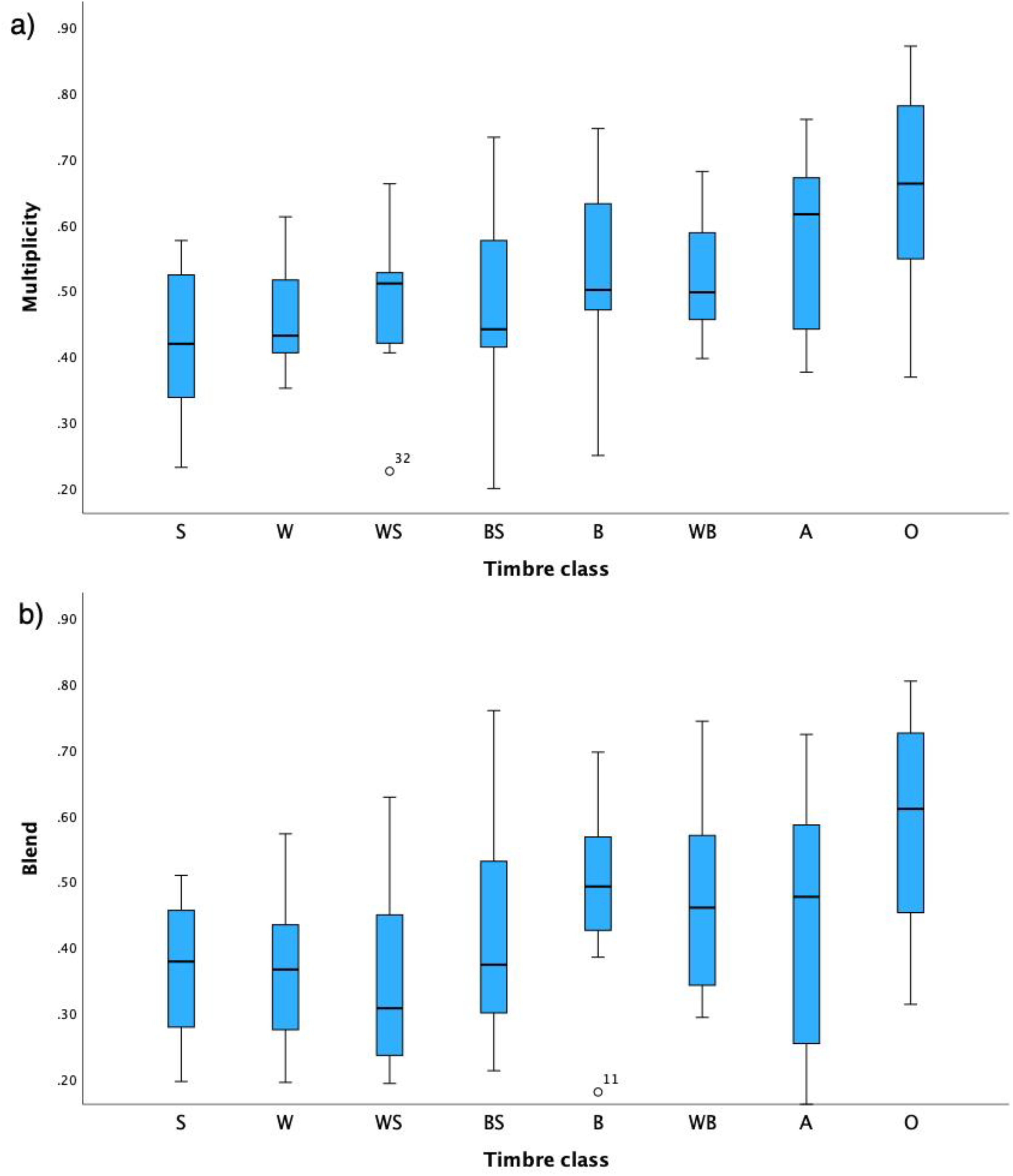
Boxplot of distribution of mean multiplicity (a) and blend (b) ratings of the excerpts within each timbre class. Solid bars are medians, boxes represent the interquartile range (IQR), and whiskers represent minimum and maximum ratings excluding outliers more than 1.5 IQRs above the third quartile or below the first quartile.

a) Estimated marginal means for timbre classes with ratings for multiplicity and blend scales. Nonsignificant differences between timbre class means are enclosed in boxes. b) Indication of relative change from multiplicity to blend. Blend means have been range-normalized to multiplicity means to visualize the relative change after having accounted for the generally lower ratings for blend. S = strings, B = brass, W = woodwinds, A = all three families, O = includes plucked strings and percussion.
The main effect of scale was significant with multiplicity ratings being higher than blend ratings—on average a given excerpt was judged as less unitary than it was judged as blended. However, this factor interacted with both musical training and timbre class. Post-hoc contrasts reveal that the scale × musical training interaction is due to differences between multiplicity and blend ratings for musicians. Musicians rated excerpts as less unitary with multiplicity ratings but more blended with blend ratings, z-ratio = 3.821, p = .0001. There was no difference between the scales for nonmusicians, z-ratio = 0.370, p > .10. Musicians thus appear to rate some excerpts as more blended even though they are rated as less unitary. The difference between the two scales can be gleaned from Figure 3 plotting mean multiplicity and blend ratings for each excerpt against each other. The dashed line represents the linear regression between the two and the solid line represents identity between them. Note that the two lines converge as the excerpts become more multiple and less blended, but they diverge at the lower end, suggesting that strongly blended musical excerpts can still be perceived as containing multiple sound sources.

Scatter plot of blend against multiplicity ratings. The regression line is dashed, and the reference identity line is solid.
The scale × timbre class interaction is due to significantly higher multiplicity ratings than blend ratings (multiplicity ratings were less unitary than blend ratings) for only three of the eight timbre classes: W (z-ratio = 2.817, p = .0049), WS (z-ratio = 3.738, p = .0002), A (z-ratio = 3.900 p = .0001), and marginally for O (z-ratio = 1.929, p = .054). Note in Figure 3 that the means for these classes are above or on the dashed regression line, whereas the others are closer to the solid identity line. The musical training × timbre class interaction was highly significant. The ratings are similar for both groups for four of the eight timbre classes. However, nonmusicians gave higher (less blended, more multiple) ratings than musicians for S (z-ratio = −3.932, p = .0001) and B (z-ratio = −1.959, p = .050), whereas the reverse is true for W (z-ratio = 3.292, p = .0010) and O (z-ratio = 2.754, p = .0059).
Of particular interest is the significant three-way interaction between scale, musical training, and timbre class to test our second hypothesis (H2). The interactions between scale and timbre class are displayed separately for musicians and nonmusicians in Figure 4. For nonmusicians, there were no significant differences between the two scales across the eight timbre classes. For musicians, by contrast, multiplicity was rated higher than (non)blend for all timbre classes except S and B. Musicians rated multiplicity higher than nonmusicians for five of the timbre classes, but the reverse was true for the S class. Blend ratings were much more similar between the groups, except for S and A, where nonmusicians rated the excerpts on average as less blended than did musicians. So, the source of the three-way interaction is essentially due to a distinct treatment of the difference between the two rating scales across timbre classes by musicians.
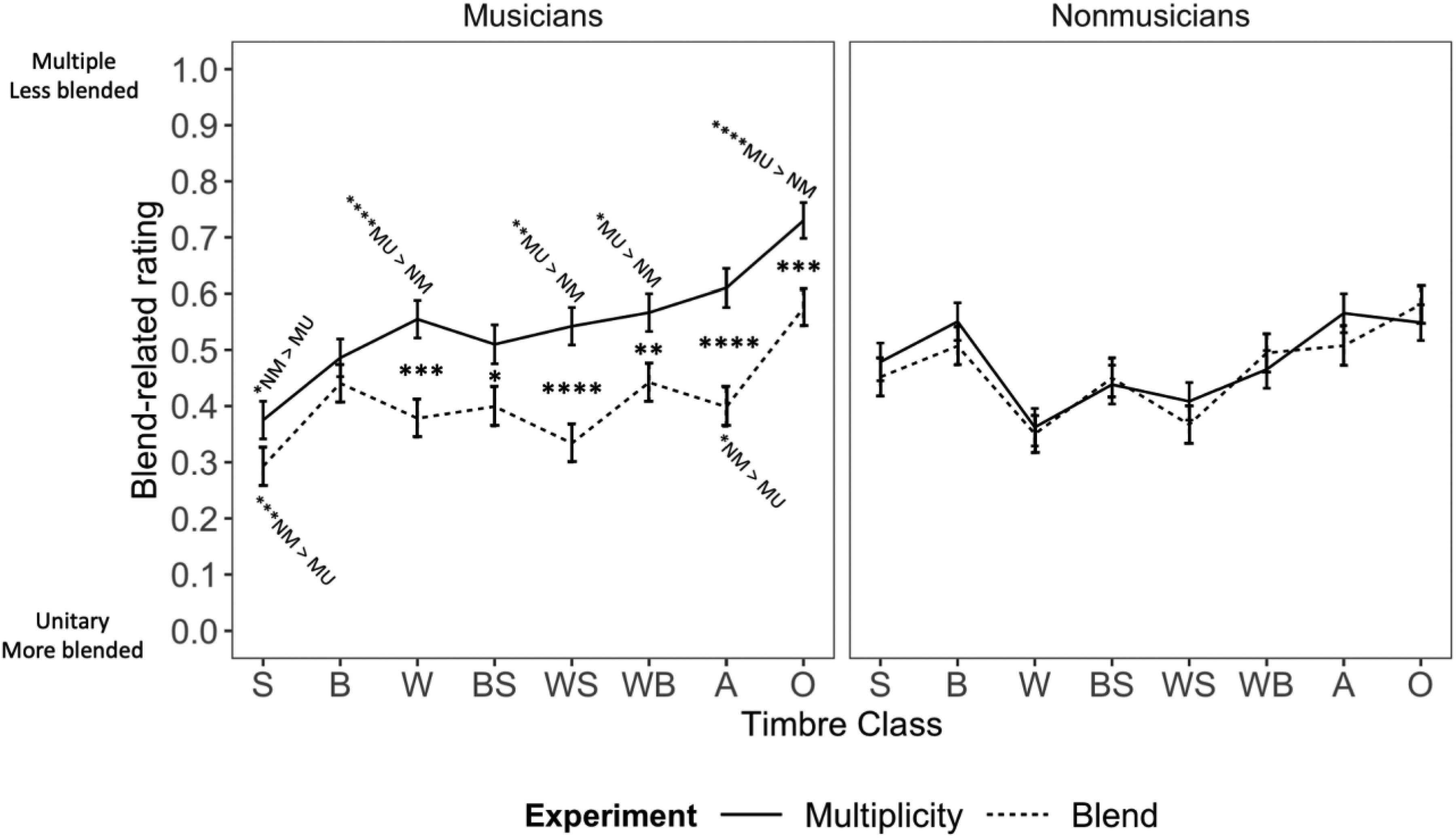
Average ratings for the eight timbre classes for the two rating scales for musicians (left panel) and nonmusicians (right panel). Error bars are 95% confidence intervals around the mean. Black asterisks between the curves represent significance of contrasts between scales. Asterisks above and below the curves represent significance of contrasts between musical training groups and indicate the direction of the difference. MU = musicians, NM = nonmusicians, S = strings, B = brass, W = woodwinds, A = all three families, O = includes plucked strings and percussion.
A final significant interaction of interest is between timbre class and blend type (Figure 5). For excerpts with multiple families and/or impulsive instruments, timbral emergences are rated as more multiple and less blended than timbral augmentations. The reverse is true for single- and double-family combinations, although there is no difference between blend types for W and WB.
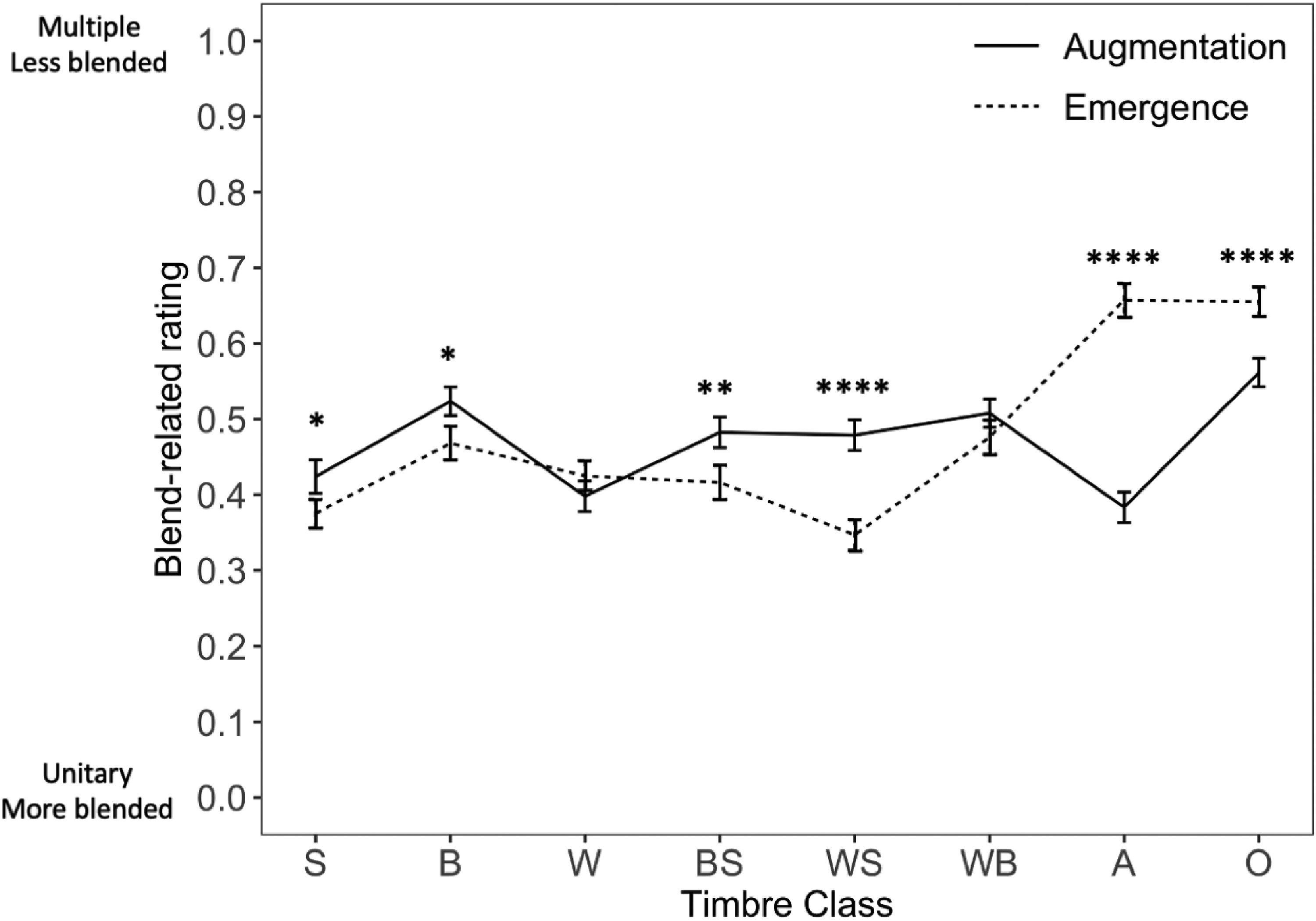
Average ratings for the eight timbre classes for the two blend types. Error bars are 95% confidence intervals around the mean. Asterisks represent significance of contrasts between blend types. S = strings, B = brass, W = woodwinds, A = all three families, O = includes plucked strings and percussion. * p < .05, ** p < .01, *** p < .001, **** p < .0001.
Analysis with Covariates
Each score-based or acoustic covariate was entered independently as a main fixed effect and as an interaction with timbre class. The results are shown in Table 6. In all cases,
Wald Type III statistics for effects, linear trend statistics (z-ratio) of covariate with ratings, pseudo-R2 values, and decrease in BIC (ΔBIC) compared to base model without the covariate.
Note: TC = timbre class. The parallelism analysis was conducted removing W, as all the values were the same for that timbre class. For the base model,
Seven of the nine covariates had significant main effects, excluding spectral centroid and spectral spread. All nine covariates had significant interactions with timbre class. Interpretations of many of these interactions need to be conducted with caution given the small number of items per timbre class (7–10). The three score-based covariates had similar significant linear trends for all timbre classes. In support of hypothesis H3, increases in the degree of pitch parallelism (Fig. S1) and onset synchrony (Fig. S7) tend to result in increased unity and blend ratings. However, the result concerning onset synchrony should be taken with caution as excerpts were not selected on this basis and three quarters of them were perfectly synchronous in the score. In contradiction to hypothesis H4, increases in the number of notes at different pitches or on different instruments resulted in increased multiplicity and decreased blend ratings (Fig. S2). Among the acoustic covariates, a decrease in spectral crest (Fig. S3) and increases in spectral variation and spectral flatness (Figs. S4 and S5, respectively) were associated with increased multiplicity and decreased blend ratings. The opposite direction of influence of spectral crest and spectral flatness is puzzling as they are both measures of spectral peakiness or noisiness. Three other acoustic covariates—spectral centroid (Fig. S8), spectral spread (Fig. S9), and frame energy (Fig. S6)—are more difficult to interpret, because for different timbre classes, ratings were associated in opposite directions with variations in these features.
Discussion
This experiment investigated the degree of blend on two different rating scales, one related to the perceived unity or multiplicity of the sonorities carrying the musical excerpt and the other related to perceived blend rated directly. Several factors were included to explore the perception of blend and multiplicity in orchestral excerpts in which the potential blending instruments were extracted from the full orchestral context using the multitrack OrchSim orchestral simulator. Using orchestral excerpts extends previous work using isolated tone dyads or triads or simple melodies (Kendall & Carterette, 1993; Lembke et al., 2019; Reuter, 1996; Tardieu & McAdams, 2012). We tested the effect of several factors directly evident in the scores, such as the timbre class of instrument family combinations and cues known to affect concurrent grouping, such as onset synchrony and parallelism of melodic motion. An additional score-based factor examined was the number of different pitches played by different instruments. We also tested two groups of participants, musicians with formal training in music at least at the second year of university and nonmusicians with less than a year of formal training in early childhood. Finally, we also analyzed the potential contribution as grouping cues of loudness- and timbre-related descriptors derived from the audio of the excerpts. These cues would include effects related to dynamics, instrumentation, and register, noting that differences in register and dynamics also affect the acoustic cues underlying timbre perception.
The linear mixed effects modeling revealed a base model with significant contributions of main effects rating scale and timbre class and two-way and three-way interactions among scale, training, and timbre class, plus a timbre class × blend type interaction. Post-hoc tests on the main effect of timbre class found that the classes with a combination of strings, woodwinds, and brass or the inclusion of impulsive instruments (percussion and plucked strings) were rated as more multiple and less blended than single-family and double-family combinations, in partial support of hypothesis H1. This finding was further refined by contrasts among all classes, which showed that strings, woodwinds, and their combination were the most unitary and blended, suggesting a refinement of hypothesis H1. Combinations involving brass (single-, double-, and triple-family combinations) had intermediate multiplicity and blend ratings, and, again, combinations of sustained and impulsive instruments were most multiple and least blended. These results confirm with orchestral excerpts the findings of studies on isolated tones with dyads or triads of instruments in which the presence of impulsive instruments reduces the perception of blend (Lembke et al., 2019; Reuter, 1996; Tardieu & McAdams, 2012). However, the fact that brass excerpts were perceived as less blended and more multiple than woodwind excerpts is somewhat surprising given that there are smaller timbral differences among brass instruments, which all have lip-valve excitations, than among woodwind instruments, whose excitation mechanisms vary from air jet to tongued or untongued single or double reeds. Given that there were differences in ratings among excerpts within each timbre class (Figure 1), it would be instructive to examine the differences between the lowest-rated and highest-rated excerpts. This reveals a potential contribution of the interval complexity of vertical sonorities demonstrating the importance of harmonicity in blend. The majority of the lowest-rated (strongly blended) excerpts in terms of blend have unison or octave spacing, with one excerpt having parallel thirds. With one exception, the excerpts with the highest ratings (weakly blended) have more complex stacked intervals of fourths, fifths, thirds, sixths, and even rather dense clusters of 13 intervals in the case of m. 162 from Debussy's Images. So deviations from harmonicity in these complex sonorities seem to weaken blend perception along with onset asynchronies and deviations from parallelism, the latter also working against harmonicity in addition to facilitating segregation of parts due to a lack of common trajectory. The deviations from harmonicity are also present at a within-instrument level for O excerpts including pitched metal percussion (celesta, glockenspiel, tubular bells, gongs), all of which have inharmonic spectra.
These results differ, however, from the blend experiment by Fischer et al. (2021), who found that single-family combinations were most blended, followed by double- and triple-family combinations and the impulsive class, except for the strings–brass combination, which was the least blended. However, the comparison between that study and this one should be considered with caution given that they had few excerpts for most of the classes and a larger number of excerpts that varied greatly in blend ratings for strings and woodwinds. The BS, WS, and O classes, for example, were represented by just three or four excerpts in their study. So the stimulus selection was too skewed to address this issue. The main aim in their study was to determine whether the degree of blend of the individual streams affected the degree of segregation of the two constituent streams in their main experiment.
The interaction of rating scale, musical training, and timbre class (Figure 4) summarizes the main findings. The primary factor responsible for this interaction, in support of hypothesis H2, is that musicians gave higher multiplicity ratings than nonmusicians across most of the timbre classes but were very similar to nonmusicians in their blend ratings. Also, musicians gave higher multiplicity ratings than blend ratings, whereas nonmusicians gave similar ratings on both scales. We conclude that musicians adopted a more analytical listening and rating strategy when judging multiplicity than did nonmusicians. Speculatively, one might think that when judging multiplicity, musicians are listening to cues that signal differences (i.e., analytical listening) more so than do nonmusicians due to their training as practicing musicians in ensembles. But when judging blend, they are perhaps focusing more on synthetic, or more holistic, listening, as are nonmusicians, bringing the two groups more in line with each other.
Two of our initial hypotheses (H3 and H4) concerned the role of score-based covariates in blend-related ratings. We confirmed the role of melodic parallelism and onset synchrony (H3). A greater degree of parallelism generally results in stronger blends and a more unitary percept in line with the Gestalt principle of common fate (Bregman, 1990). There was nevertheless a great deal of diversity of ratings for some of the perfectly parallel excerpts (Fig. S1), suggesting that this factor alone does not explain the ratings. Also, an increase in onset synchrony was accompanied by increased blend and unity ratings (Fig. S7). However, the excerpts were not initially chosen to have a uniform distribution of onset synchrony values. Three-quarters of them are perfectly synchronous based on the score. So this result should be interpreted with caution, although it provides additional support for its significant contribution to blend in Fischer et al. (2021). This result may be due to the fact that excerpts were not selected to include a uniform distribution of degrees of synchrony, and indeed only 14 of the 64 excerpts had onset synchrony proportions less than .9. However, the effect of the number of notes goes in the opposite direction to our prediction, with more notes creating a greater sense of multiplicity and less blend (H4). Generally, the more varied the pitch and instrument content of a sonority, the more it is judged as multiple and less strongly blended. But there is a non-negligible diversity in ratings for sonorities with a smaller number of notes, suggesting that other factors are at play for those excerpts (Fig. S2). The divergence of blend ratings for smaller numbers of instruments suggests that although the independent note count is not a good predictor of instrumental blend for small ensembles, it may nevertheless account for greater degrees of multiplicity and decreased blend in the case of larger groups of instruments with more diversely pitched sonorities.
Three of the acoustic covariates had similar linear trends across all timbre classes: spectral crest, spectral flatness, and spectral variation. Greater noisiness in the spectrum or spectral density is associated with higher multiplicity and lower blend ratings (increased flatness, decreased crest) (Figs. S5 and S3, respectively). Note that these two acoustic features are negatively correlated, but only weakly (R2 = .206). Greater spectral variability over time is also associated with higher multiplicity and lower blend ratings (Fig. S4). These results suggest that greater blend and unity result from less spectrally variable stimuli with a stronger tonal component (clear harmonics and less dense spectrum).
The other three acoustic features are more difficult to interpret given that their relation depends on timbre class. Sandell (1995) had found that blend was stronger when the spectral centroid of combined sounds was lower. His study used sounds that had been analyzed and resynthesized by Grey (1977), including bowed strings, woodwinds, and brass presented as isolated tone dyads. However, his result follows for only three of the timbre classes in the current study: BS, WS, and A (Fig. S8). There was no effect of spectral centroid on blend-related ratings for S. For B, W, WB, and O, the opposite was the case: Increased centroid was associated with higher multiplicity and lower blend ratings. A similar situation exists for spectral spread, with BS, WS, and A giving stronger blend and unity ratings for greater spectral spread, the opposite being the case for S, B, WB, and O (Fig. S9). W excerpts only covered a very narrow range of spread values. With frame energy, S and BS tended toward greater blend and unity with increased energy, whereas the opposite was true for B, W, WS, WB, and O (Fig. S6). The values of A were quite dispersed and didn’t result in a significant linear trend. However, these results need to be considered in light of the small number of cases for each one, and a greater number of excerpts in each category with more dispersed values along these acoustic features would be needed to draw clearer conclusions.
It is worth noting that the limitations imposed by the available annotations in the database and the available simulations through OrchPlay Music Library led to a preponderance of excerpts by Romantic composers in our sample. Romantic composers had access to published orchestration treatises at the time and thus would have had models for the combinations of instruments, and particularly woodwind instruments, that would blend well based on the register- and dynamic-dependent timbre behavior of woodwinds and strings. Their combinations were described in detail in many treatises (e.g., Gevaert, 1885; Marx, 1847/1851; Prout, 1902; Riemann, 1888/1890; Sundelin, 1828; Widor, 1904, to name just a few; see also Reuter, 2018). Nevertheless, selecting a range of annotation strengths across the different categories (to the extent possible) provided variability in the factors contributing to or detracting from blend in each timbre class (see Figure 1). And indeed there was a spread in the multiplicity and blend ratings within each timbre class. The important finding of this study is thus to be found in the relative roles of the score-based and acoustic factors that are associated with the perception of multiplicity and blend in complex orchestral sonorities.
To summarize our findings in the context of traditional Western orchestral repertoire—with a predominance of Romantic era excerpts in which instrumental combinations are purposely crafted to blend or not blend depending on the musical material—sustained strings, woodwinds, and their combinations provided the strongest blending and unitary percepts. Combinations involving impulsive sounds (plucked strings and percussion) in combination with sustaining instruments were perceived as the most multiple and least blended. In addition to the combinations of instrument families, parallel pitch motion, onset synchrony, and the number of different pitches on different instruments also affected ratings of multiplicity and blend, with globally greater parallelism and synchrony and a smaller number of notes giving stronger blends and a perception of unity. Several spectral factors related to timbre, as computed across the whole excerpts, also affected blend and multiplicity, demonstrating the role of timbre-related acoustic properties as a concurrent grouping cue. Greater spectral density or tonalness and greater spectral variation were associated with increased multiplicity and lower blend ratings. The effect of other acoustic factors such as spectral centroid, spectral spread, and frame energy depend on the timbre class.
Further research is needed to shed light on the complex interactions among musical training, concurrent grouping cues (including timbre-related properties), pitch relations, rhythm, musical genre, and era. In addition, other factors such as dynamics, harmony, register, playing techniques, and the voicing of vertical sonorities across instruments should be investigated, as they may also play a role in the blending of groups of instruments, as well as in the emergent timbral properties of the blends. This would require a large-scale study to control for all these factors. We modeled onset synchrony in terms of what was written in the score, but another factor that could be studied in more depth is the role of microtiming of onsets across concurrently sounding instruments. This would involve determining perceptual attack times (PAT) for individual notes, whether attacked or played legato, but to do so would require the development of reliable models for PAT, which could be particularly problematic in legato passages. We elected to start with presenting blend passages isolated from their full context because of the inherent difficulties in getting nonmusicians in particular to pay attention only to the target instruments in the full context. However, future work will also need to address the issue that blends removed from the full orchestral context may be perceived differently than within that context, although getting listeners to focus on a subgroup of instruments in a complex orchestral texture to judge their degree of blend will not be without its challenges.
Supplemental Material
sj-pdf-1-mns-10.1177_20592043251326391 - Supplemental material for Factors Contributing to Instrumental Blends in Orchestral Excerpts
Supplemental material, sj-pdf-1-mns-10.1177_20592043251326391 for Factors Contributing to Instrumental Blends in Orchestral Excerpts by Stephen McAdams, Pierre G. Gianferrara, Iza R. Korsmit, Meghan Goodchild and Kit Soden in Music & Science
Supplemental Material
sj-zip-2-mns-10.1177_20592043251326391 - Supplemental material for Factors Contributing to Instrumental Blends in Orchestral Excerpts
Supplemental material, sj-zip-2-mns-10.1177_20592043251326391 for Factors Contributing to Instrumental Blends in Orchestral Excerpts by Stephen McAdams, Pierre G. Gianferrara, Iza R. Korsmit, Meghan Goodchild and Kit Soden in Music & Science
Footnotes
Authors’ Note
PGG is now at the Department of Neurobiology, Physiology and Behavior, University of California, Davis. IRK is now at the Institute of Psychology, Cognitive Psychology Unit, Leiden University. KS is now at the Faculté de musique, Université de Montréal. MG is now at Queen's University and Scholars Portal of the Ontario Council of University Libraries. The authors thank Bennett K. Smith for programming the experimental interface, OrchPlayMusic, Inc. for granting us access to the original simulated orchestral excerpts, Félix Frédéric Baril for extracting the excerpts from the full orchestral context, and Marcel Montrey for help with data analysis.
Action Editor
Trevor Agus, Queen’s University Belfast, SARC, School of Arts, English and Languages.
Peer Review
Christoph Reuter, University of Vienna, Department of Musicology; Daniel Pressnitzer, École Normale Supérieure, Département d’Études Cognitives.
Author Contributions
PGG, SMc, MG, and KS conceived the study and selected the orchestral excerpts. PGG and SMc researched the literature, developed the conceptual and theoretical framework, and designed the experiments. PGG and IRK ran the participants in the study. IRK analyzed the data and contributed to the Methods and Results sections. SMc and PGG wrote the manuscript. All authors reviewed, edited, and approved the final version of the manuscript.
Declaration of Conflicting Interests
The authors declared no potential conflicts of interest with respect to the research, authorship, and/or publication of this article.
Ethical Approval
The study was certified for ethical compliance by the McGill University Research Ethics Board II (Certificate 162-0817).
Funding
The authors disclosed receipt of the following financial support for the research, authorship, and/or publication of this article: This work was supported by grants from the Canadian Natural Sciences and Engineering Research Council (grant number RGPIN 2015-05280), the Fond de recherche du Québec—Société et culture (grant number 2017-SE-205667), the Canadian Social Sciences and Humanities Research Council (grant number 895-2018-1023), and a Canada Research Chair (grant number 950-223484) awarded to SMc.

Data Availability Statement
The data are available on the Borealis Canadian public repository (McAdams et al., 2025).
Supplemental Material
Supplemental material for this article is available online.
Appendix
Distribution of stimuli across type of instrumental blend and timbre class with strength of blend as annotated by analysts. The correlations with annotated blend strength were R2(62) = .26 for multiplicity ratings and R2 (62) = .28 for blend ratings. Instrument combination abbreviations: S = strings, B = brass, W = woodwinds, BS = brass and strings, WS = woodwinds and strings, WB = woodwinds and brass, A (All) = woodwinds, brass, and strings, O (Other) combinations including impulsive instruments such as plucked strings, glockenspiel, xylophone, timpani, snare drum, tubular bells, gongs, celeste, vibraphone, and bass drum. Piece abbreviations: Sx = Symphony x, LT = La Traviata, DG = Don Giovanni, LM = La Mer, PE = Pictures at an Exhibition, TV = Tod und Verklärung, CV = Choral Varié, ORT = Overture on a Russian Theme.
Timbre class
Blend type
Composer
Piece
Movement
Mm.
Duration (s)
Annotated strength
S
Augmented
Mahler
S1
I
1–6
24
5
Sibelius
S2
II
160–162
9
4
Verdi
LT
Prelude
18–25
34
3
Emergent
Bruckner
S6
I
205–216
27
3
Debussy
LM
I
12–19
9
5
Debussy
LM
III
51–52
15
4
Haydn
S100
III
51–56
12
2
Mozart
DG
Overture
31–35
6
5
B
Augmented
Bruckner
S6
I
208–216
18
1
Bruckner
S6
I
361–369
24
2
Debussy
LM
III
51–52
6
4
Mahler
S1
I
357–361
9
3
Mussorgsky
PE
Promenade
3–4
10
2
Emergent
Mussorgsky
PE
The Gnome
76–81
16
4
Mussorgsky
PE
The Gnome
103–104
6
3
Mussorgsky
PE
Catacombs
4–7
13
4
W
Augmented
Debussy
LM
III
51–52
7
4
Haydn
S100
II
45–48
9
4
Mahler
S1
I
5
7
4
Strauss
TV
—
456–458
9
1
Emergent
Mahler
S1
I
18–21
16
4
Mozart
DG
Overture
24–26
13
4
Schubert
S9
IV
543–558
12
4
Vaughan Williams
S8
IV
59–66
13
5
BS
Augmented
Debussy
LM
III
175–178
9
4
Debussy
LM
I
89–90
21
5
Debussy
Images
Gigue
5–9
6
5
D'Indy
CV
–
70–74
24
3
Emergent
Mussorgsky
PE
The Gnome
68–69
4
2
Rimsky-Korsakov
ORT
—
59–60
9
4
Schubert
S9
III
306
6
5
WS
Augmented
Mussorgsky
PE
S. Goldenberg
1–2
15
5
Sibelius
S2
II
179–182
22
4
Vaughan Williams
S8
IV
59–67
13
4
Verdi
LT
Prelude
29–36
31
5
Emergent
Debussy
LM
III
171–178
12
5
Haydn
S100
II
24–28
12
4
Mozart
DG
Overture
23–26
18
5
Mussorgsky
PE
The Gnome
70–76
18
5
WB
Augmented
Debussy
LM
I
71—72
12
3
Mahler
S1
I
361–363
6
1
Mozart
DG
Overture
38–39
4
4
Mussorgsky
PE
Catacombs
12–13
12
4
Sibelius
S2
II
156–162
19
4
Emergent
Debussy
LM
I
12–17
24
5
Mussorgsky
PE
The Gnome
61–63
10
4
Mussorgsky
PE
Catacombs
5–6
7
4
A
Augmented
Bizet
Carmen
Overture
131–138
27
4
Sibelius
S2
II
190
7
2
Strauss
TV
—
434–437
19
4
Verdi
Aida
Moorish dance
45–52
13
3
Emergent
Debussy
Images
Gigue
162
19
3
Mozart
DG
Overture
1–4
19
3
Verdi
Aida
Moorish dance
53–57
9
3
O
Augmented
Debussy
LM
III
179–182
7
1
Mussorgsky
PE
The Gnome
66
4
4
Mussorgsky
PE
The Gnome
86–89
7
4
Mussorgsky
PE
The Gnome
95–97
6
4
Vaughan Williams
S8
IV
81–86
10
5
Emergent
Debussy
LM
I
73–75
6
3
Mussorgsky
PE
Baba Yaga
110–111
7
5
Mussorgsky
PE
Baba Yaga
110–115
21
5
Rimsky-Korsakov
ORT
—
1–3
9
4
Vaughan Williams
S8
IV
19–22
10
1
References
Supplementary Material
Please find the following supplemental material available below.
For Open Access articles published under a Creative Commons License, all supplemental material carries the same license as the article it is associated with.
For non-Open Access articles published, all supplemental material carries a non-exclusive license, and permission requests for re-use of supplemental material or any part of supplemental material shall be sent directly to the copyright owner as specified in the copyright notice associated with the article.
