



Abstract
Orchestration is an established topic in various music disciplines yet is a rare focus in ethnomusicology. This paper offers a modest remedy by asserting that culturally expected timbral interactions are orchestration. McAdams et al. (2022) define orchestration as the selective combination and juxtaposition of instruments to achieve sonic goals. With this case study, I reorient orchestration towards cultural goals. I also assert that any sonic event can be orchestrated (not just music). Furthermore, I argue that any event participant can be an agent of orchestration. Among Luvale (and related) communities in Zambia, there exist similar traditions of recounting one's recent journey through an oral briefing: kutanga and mujimbu. Although related, these events have different social functions, participants, and orchestrations. Kutanga is a dance prelude for a specific group of makishi (manifest ancestral spirits) or boy initiates and involves the alternation between vocalizer and drum. Mujimbu, featuring loosely coordinated clapping and alternating speakers, is enacted when a different set of makishi or men arrive somewhere. Both events involve expectations of vocal, clap, and drum timbres participants should employ. Whether these timbral decisions are deliberate or tacit (Arom 1981; Brinner 1995; Polanyi 1966), I interpret them as results of encultured behavior (Eidsheim 2019). In this paper I contend that orchestration is culturally informed, helps define and differentiate events, and links makishi to their living counterparts. To accomplish this, I delineate events in terms of orchestration, performers, and social function (Arom et al., 2019; Fürniss 2006, Nzewi 2008), analyze interviews, and culturally contextualize timbre. Although Kubik has conducted extensive research on kutanga (1971, 1974, 1977, 1994, 2008, 2010), his findings do not address orchestration or its ability to connect the ancestral to the living. An ethnomusicological approach to these events offers timbre studies a window into the cultural components and ramifications of orchestration.
Prologue
July 28, 2022 – Kabompo, Zambia
It is the second day of the Chivweka traditional festival of the Luchazi-speaking people in Zambia. We are gathered in the open plain slightly outside of the town center. Hundreds of people are arranged in a large circle, collectively outlining the dancefloor for the spirits. Along one arc of the circle are five drummers and about 30 onlookers who have happily fallen into the role of choir. The drummers organize themselves and prepare for the next spirit while the onlookers catch their breath and eagerly await the opportunity to sing again. I try to occupy as little space as possible as I crouch in front of the drums.
The circumference of the circle sounds alive with the chatter of a crowd anxiously anticipating another ancestral spirit to manifest. Beyond the human boundary, I hear the negotiations of vendors, laughter of running children, and whooshing of wind as it passes through air I personally find too hot for the present cold season. Suddenly, the circle erupts with jingunda: the trilling ululations of celebrating women 2 . I turn my attention away from my percussive friends and notice a tall figure slowly entering the circle. From this distance, it is tough to see who is in our midst. But then the figure lets out a guttural, shrill scream and my curiosity is immediately quelled. There is no longer any doubt; I am in the presence of the ancestral spirit Chikuza.
His arms and legs consist of horizontal bands that alternate the colors of the Zambian flag. The rest of his body is covered in fibrous, bark-cloth strips. These striking features are boldly complimented by the long, conical head that extends about four feet to the sky. As soon as I take in this ancestral sight, the crowd grows even more frenzied: two more Vikuza (plural of Chikuza) enter right behind the first. When the spirits finally reach the center of the circle, a hush falls over the audience. They know what to expect.
Behind me the lead drummer breaks the silence with a few booming flams. The quick alternation between muted and open strokes exploits the drum's resonant potential. Mbu! Mbu! Mbu! He abandons the rest of the drummers and takes a few steps into the circle. The Chikuza in front begins pointing and speaking, yet his voice is barely audible. As the crowd intensely concentrates, I can just make out a croaky, inhaled, gravelly voice. This is a stark departure from the screams that previously announced Chikuza's presence. Were this my first time at an occasion like this, I would have trouble believing that this one spirit had such a wide timbral range. Chikuza is describing the journey he took from the graveyard to Kabompo. Though most of us are unable to fully hear his words, the encultured know what he is saying. This is because Chikuza is performing kutanga – a well-known event in this culture.
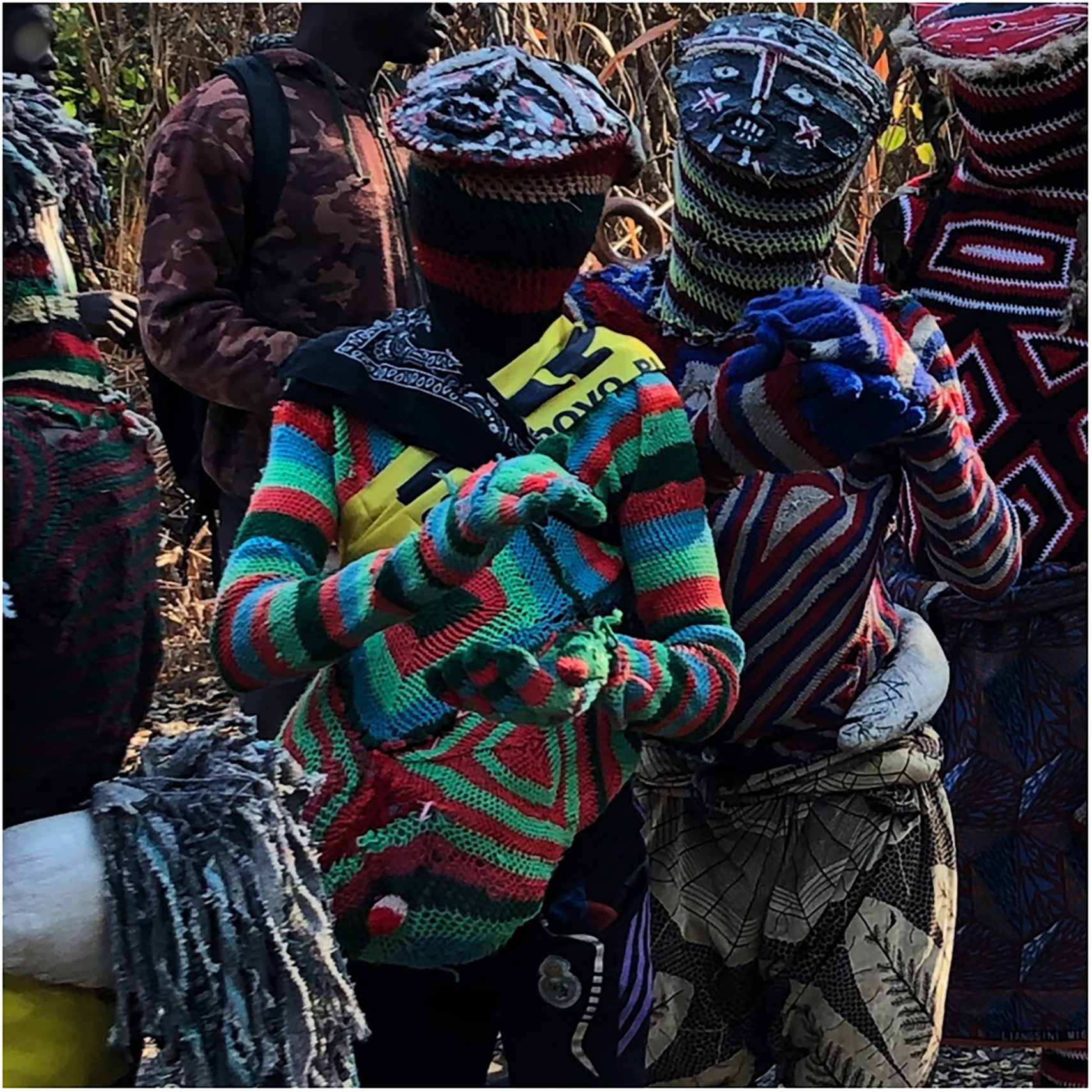
With every pause in the spirit's tale, the lead drummer expertly interjects a short, percussive phrase. This alternation continues as the Vikuza gradually move closer to the drums. Whenever the spirits are especially pleased with the drummer's response, they momentarily pause to shriek with delight. Then they return to the kutanga. A handful of women approach the Vikuza and escort them while ensuring they keep a safe distance from the spirits they are forbidden from knowing the secrets of. When the ancestors are just a few feet away from us, the Vikuza dramatically and unexpectedly drop to the ground. The crowd erupts once more (Picture 1).

Vikuza performing kutanga at the 2022 Chivweka festival in Kabompo, Zambia 9 .
The spirits are crawling the last leg of their journey towards the drums. The lead Chikuza speaks with his labored voice. I can hear his characteristic tone clearly now; he sounds simultaneously old, aggressive, protective, and wise. The drummer responds. Mbu mbu mbu. He speaks again. The Vikuza are but inches away from me now. The drummer hurriedly backs into his place in the musician arc as the spirits stand up and praise the drummers with an arm motion. Jingunda fill the air 3 . The kutanga is complete. The supporting drummers quickly weave together interlocking and cyclical parts, someone starts up a song, and the other 29 clap and sing the response. Just like that the music and ensuing roar of the audience fill the air. The Vikuza run to the center of the circle. The dance can now begin.
Introduction
Orchestration is an established topic in music theory and musicology yet is a relatively rare focus in ethnomusicology. In this article I offer a modest remedy by asserting that culturally expected timbral interactions are orchestration. The concept extends beyond music; any sonic event can be orchestrated. In her seminal book on Kpelle music in Liberia, Stone (1982) argues that the study object and theoretical concept of “an event” lies between the two historic poles of ethnomusicology: (1) music as sound and (2) music as behavior. She consequentially advocates for scholarly focus on events as that will allow the researcher to bridge the disciplinary divide and utilize methodologies from both poles.
With this extended focus, the list of those participating in the orchestration process need not be restricted to composers, arrangers, and performers; anyone involved in a sonic event (from formal participants to onlookers) can affect its orchestration. I thus widen the scope of orchestration to fully include what Turino (2008) terms “participatory performance.” I do this by accepting both (1) the variety of roles participants may fill and (2) the belief that “there are no artist-audience distinctions, only participants and potential participants” (Turino, 2008, p. 28). This aligns with Stone's assertion that all who experience an event and share in its interactions are participants (1982, pp. 4–5). Vitally, this framing eliminates the composer as the sole catalyst for orchestration and diminishes the connotations of Western art music often associated with the term; instead, anyone can be an agent of orchestration. This, in turn, allows us to recognize similar timbral and orchestrational ways of musicking across cultures. It is this uncovering of sameness that, as Agawu (2017) argues, helps circumvent unethical ethnotheoretical analyses.
Spitzer and Zaslaw define orchestration as “the division of a musical composition among the instruments of the orchestra for artistic [emphasis added] effect” (2004, p. 439). McAdams et al. define it as “the skillful selection, combination, and juxtaposition of instruments [or sounds] at different pitches and dynamics to achieve a particular sonic [emphasis added] goal” (2022, p. 1.1). With this case study situated among the Luvale of Zambia, I reframe orchestration as a means of achieving cultural goals. While I believe this reorientation away from the purely aesthetic expands the concept of orchestration in important ways, applying a Western term to a Luvale case study has inherently complicated implications worth addressing, especially since Zambia was formerly colonized by these same Western powers.
Though big jazz ensembles have expanded the conception of orchestration beyond Western art music, this is a relatively recent development in a long history that almost inexorably links orchestration with specific European locations, time periods, people, ensembles, instruments, and schools of practice. The conventional history of orchestration is driven by developments in Western orchestral instrument technology (Carse, 1964, pp. 1, 335; Spitzer & Zaslaw, 2004, p. 30). It thus follows that orchestration is historically tied to the specific ensemble of a Western orchestra. This coupling is present, among other places, in definitions of orchestration such as Spitzer and Zaslaw's: “how composers have written for instruments as an orchestra” (2004, p. 14). This definition also exemplifies another common trend in this research: attributing orchestration to a composer. The history of orchestration is conventionally presented in a tripartite periodization: Renaissance, Baroque, and Classical. Though historians mark these boundaries in different ways such as by style (doubling of parts, basso continuo, four-part string layout), major composers (Haydn and Mozart, Spontini and Beethoven), ensemble type (separate ensembles, nested ensembles, sections), or chronology (late 16th/early 17th century, mid-17th through mid-18th century, mid-18th century through early 19th century), these classification schemes essentially align and result in the same demarcations. These models present orchestration with a historic specificity and in solely European terms. Furthermore, some orchestral gestures or effects (the typical unit of orchestration) became standardized by region (Spitzer & Zaslaw, 2004, p. 29). In other words, not only is orchestration viewed as a concept seeped in Western history and aesthetics (Carse, 1964, p. 4), but certain ways of orchestrating are tied to specific European nation-states. These localized standards of practice have been (and continue to be) passed down through treatises, conservatories, music programs, and courses across the globe. In these contexts, Western practice is presented as the model of proper orchestration.
Despite orchestration's documented history within Western art music, European orchestras from the 19th century are just one setting for this concept. This is especially true if we embrace Dolan's more flexible description of the term as “an active art of developing and manipulating instrumental sonority” (2013, p. 135). It would be wildly inaccurate and problematic to suggest that members of the Western tradition are the only people who have artfully developed and manipulated instrumental sonority. This type of suggestion contains harmful rhetoric that views Western culture as the superior zenith in a unidirectional artistic evolution. It is a suggestion that only allows one to orchestrate on the West's terms. Thus, by recognizing orchestration in all the diverse shapes it comes in and places it is practiced, we decenter Europe and disrupt the colonial hegemony of Western orchestration criteria. Scholars will benefit from this move; African (and other non-Western art music) case studies can help us learn more about how humans develop and manipulate our sonic environments and creations. Inversely, an orchestration focus can teach us about cultures for whom this type of inquiry was previously withheld from. It can also help undo the damage of other colonial musical practices.
As such, with a focus on orchestration (and thus, inherently, timbre), this article also seeks to counter decades of rhythm-centric African (ethno)musicology. For as long as Westerners have been interacting with African music (broadly defined), it has been characterized as primarily rhythmic. This has resulted in an excessive othering of Africans and their music. Scholars, missionaries, and the general public frequently employ tropes of rhythmic complexity to differentiate those within and outside of the continent. Agawu (1995; 2003) defines this process and ensuing situation as “the invention of African rhythm.” With this invention comes a sidelining of non-rhythmic sonic parameters such as timbre.
I consequently join a small cohort of scholars of African music who have shifted the conversation towards timbre and orchestration. Among these, Driver, Fales, and McAdams are interested in the concept of masking, whether that be timbre's role in the masking of simultaneous sounds (Fales & McAdams, 1994) or how buzzy timbres mask an instrument or vocalizer's “natural” sound (Driver, 2017). Others investigate timbre in drums through studies on composites (Kalinde, 2022; Winikoff, 2021), mnemonic vocables (Tsukada, 1997a, 2002), timbral heterogeneity (Wilson, 1992), and drum technique (Winikoff, 2018). Kalinde is also interested in the intersections between performer gender and timbre. Fales (2002) and Olwage (2004) have focused on vocal timbre: (respectively) how it creates timbral effects in conjunction with a zither and the social ramifications of Black choralism. Perhaps the strongest advocate for a timbral focus in African music, Andile Khumalo (2023) demonstrates how this parameter can both structure a piece and invoke spirits. He also explains how timbre connects music, language, and culture in his analysis of AmaXhosa bow music (2019). In her survey of West African music culture, Stone (2005) briefly touches on many of the preceding topics.
Orchestration, though a function of timbre, has received much less explicit attention in African music scholarship. Khumalo (2023) articulates the relationship between timbre and orchestral layering in South African contemporary classical music. Obijiaku (2022) is concerned with how orchestration contributes to stylistic hybridity in Igbo choral art music. Olúrántí (2024) explains how Yorùbá language tonality can serve as a basis for orchestration in Nigerian art music. I contribute to this burgeoning body of literature by discussing timbre descriptors, culturally informed timbral choices, the orchestration of sonic events, and orchestration's ability to connect the living and spirits. Though some of these scholars have demonstrated how orchestration, timbre, and culture are related, I go a step further by explicitly defining orchestration as a cultural practice.
Methodology
Because I am a guest in Luvale culture, forming deep relationships with knowledge keepers is vital to the development of my critical listening positionality (Robinson, 2020, p. 68). I have been traveling to Zambia to study under, perform alongside, and work with various Luvale musicians, culture groups, and organizations since 2013. Most of my data was gathered in the Zambian locales of Zambezi, Lusaka, Kabompo, Chavuma, Chikenge, Chinyingi, and Mongu. Since 2017, I have been a partner of the Likumbi Lya Mize Cultural Association (LLMCA) – an organization appointed by the royal Ndungu chieftainship and tasked with the protection, preservation, and promotion of traditional Luvale culture. They have overseen my work and connected me to vital research collaborators 4 . Among them are my primary teachers and the groups they lead (see Table 1): Kapalu Lizambo, Josephine Sombo Muzala Chipango, William Vunda, and Douglas Mwila.
Primary teachers of the author.

Our collaboration has included a range of activities that fall into the realm of participant observation, the hallmark methodology of ethnomusicology. Amongst the four possible roles of the participant observer that Phillips (1971, p. 135) outlines, I primarily acted as a participant-as-observer. Research activities included formal music and dance lessons, performance in ceremonies, individual and group interviews, recording sessions, collective reflection on these events, translation sessions, living with teachers, participation in daily life, long walks (which Aduonum (2022) argues is a legitimate ethnographic method), deep conversation, and close friendship. Among the rich data set produced by this methodology is my own lived experience. It is vital to acknowledge this type of data since, as Lochhead (2015) contends, the analysis can never be distanced from the analyst. But in an effort to center practitioners’ voices, minimize my footprint, and emphasize emic opinion, I feature interview excerpts and prioritize this type of qualitative data over the quantitative.
However, as the reader may notice, the words “timbre” and “orchestration” are absent in the excerpts and, to my knowledge, the Luvale language. But this does not equate to a lack of Luvale timbral sensibility. Scholars (Agawu, 1995, pp. 387–388; Ames & King, 1971; Charry, 1992, p. 210; Keil, 1979; Monts, 1990) have acknowledged that many African languages do not contain a word that translates to “rhythm.” As Nzewi asserts, though, this “does not imply that Africa has no concept of what this European term implies. After all, its evidence is available in the practice of music” (1997, p. 32). Similarly, the proof that Luvale practitioners (and Africans, in general) conceive of timbre and orchestration is the music itself. If a musical phrase is performed with poor timbre or an event is orchestrated incorrectly, musicians and participants will address this. This aligns with Khumalo's assertation that AmaXhosa musicians are conscious of and value timbre despite not using “the language of ‘partials’ and ‘overtones’” (2019, p. 155). He argues that “music analysis need not be grounded in concepts or language particular to that of the musicians” (2019, p. 155). Similarly, although the word “orchestration” did not come into use until the 19th century (Dolan, 2013, pp. 15–16), composers of previous eras had already been creating effects that would retroactively be characterized as orchestration (Spitzer & Zaslaw, 2004, p. 501). In other words, one can perform a musical act with or without it being named.
This is especially true in Sub-Saharan Africa where many languages do not have a word for “music.” This reflects how, within those cultures, this Western construct may be inexorably linked to other concepts (such as dance, a specific instrument, or an event). The lack of a Luvale word for timbre, then, may also reflect its intertwining with other dimensions of sound. After all, timbre is often tied to other sonic parameters and truly segregating them, even just for analytical purposes, is impossible. In one of the most influential pieces of timbre scholarship, Fales (2002, p. 92) acknowledges that it is difficult to completely isolate timbre from other aspects of sound it works in tandem with, is influenced by, and influences. This is demonstrated by Stone (1982, pp. 76–77) in her analysis of Kpelle musical terminology. She draws our attention to the fact that most Kpelle timbre descriptors simultaneously address non-timbral Western attributes (for example, by also referencing pitch or dynamics). This is not a problem I must overcome in this article, but it is necessary to address before bringing in interview excerpts and timbre descriptors.
Tacit Orchestration
In her analysis of Haydn, Dolan (2013) explicitly differentiates instrumentation and orchestration. To her, instrumentation involves the distribution of musical material among available instruments while orchestration involves the manipulation and combination of instrumental timbres. Whether these timbral maneuvers are deliberate or the unnoticed products of what Arom (1981) labels “implicit theory,” I interpret them as results of encultured behavior 5 . This follows Eidsheim's (2019) framing of vocal timbre recognition and production as the results of encultured behavioral knowledge. The implicit awareness of culturally preferred timbral aesthetics and the unnoticed decisions to enact them are musical examples of what philosopher Michael Polanyi calls “tacit knowledge” (1966). With this concept, Polanyi recognizes knowledge about particular actions, components, and how they relate to a whole even if we are unaware of them. In his analysis of Javanese musical competence, Brinner (1995, p. 36) calls this way of knowing “intuitive knowledge.” The concept of implied, tacit, intuitive knowledge underlines a key point of this article: successful orchestration does not always require deliberate action, intent, or awareness. Put another way, tacit orchestrational tendencies are a type of intuitive knowledge. I am thus proposing the term “tacit orchestration” to refer to participants’ deliberate and/or unnoticed timbral actions that are a products of enculturation.
Tacit orchestration is a term that is intentionally widely applicable. By expanding from the composer focus of orchestration's traditional orientation, tacit orchestration can potentially exist in most sonic events with performers. Drastically different examples of tacit orchestration could be (1) a symphonic oboist naturally utilizing one embouchure over another because of the way they were trained, (2) the decision to use a certain EQ style when mixing a track because that is the unmarked norm in the engineer's scene, (3) audience members adhering to expectations by employing what are known as “golf claps” when watching the sport in person, (4) an activist's subconscious inclination to shout when delivering a speech at a protest, (5) the technician's choosing of the loudest speaker with subpar quality because a blown-out timbre is preferred within their culture, (6) a rock drummer's utilization of moongel to reduce what they consider undesirable overtones in a boomy venue, (7) an arranger scoring a melody in the clarinet's low register with hopes of evoking “Mood Indigo,” or (8) a guitarist's decision to play a phrase on the higher frets of lower strings (as opposed to lower frets of higher strings) because of timbral preferences. Whether deliberate or subconscious, each of these examples is a culturally catalyzed decision with timbral repercussions. And when a series of these decisions are made by the various participants in an event, they collectively and tacitly orchestrate it.
In many ways, the preceding examples resemble those provided by Small when demonstrating his concept of musicking (1998, pp. 1–2). This is because tacit orchestration shares much with his term. Small defines the verb: To music is to take part, in any capacity, in a musical performance, whether by performing, by listening, by rehearsing or practicing, by providing material for performance (what is called composing), or by dancing…It covers all participation in a musical performance, whether it takes place actively or passively. (Small, 1998, p. 9)
This timbral (or, more generally, sonic) orientation also distinguishes tacit orchestration from recently expanded conceptions of choreography which are concerned with movement. Yet important parallels between choreography and tacit orchestration exist which can help further explicate the latter term. If choreography theorizes physicality (Miller, 2015, p. 945), tacit orchestration theorizes timbral musicking. Choreography has exceeded dance as its sole study object to embrace any structured movement (Bench, 2020, p. 13; Morris & Giersdorf, 2016, p. 6). Tacit orchestration can similarly be found not just in (narrowly defined) music, but within any sonic event. Dance scholars acknowledge that choreography has been used as a universalizing concept while also recognizing that it is not a neutral term; it has historical ties to specific cultural practices. As such, its current use can either continue colonial agendas or be used as resistance to them (Morris & Giersdorf, 2016, pp. 7–8). As I noted earlier, orchestration is similarly entrenched in a very specific history of Western aesthetics, tradition of practice and knowledge dissemination, and cultural hegemony. It is my hope that the introduction of tacit orchestration – which decentralizes the composer, embraces non-Western art music, acknowledges the intersection of culture, and has the potential to subvert the problems of excessive attention to non-timbral parameters – functions as a decolonial move.
Although acts of tacit orchestration are (timbral) responses to cultural stimuli, they still allow for individual agency. In other words, an event participant can respond to cultural cues in any timbral manner they choose (regardless of whether those decisions are subconscious or deliberate). Any timbral response will tacitly orchestrate the event. However, this does not imply that all tacit orchestration is culturally accepted. Every culture has its own beliefs about the type of agency permitted and in what setting(s). Aligning with or straying from these beliefs may elicit positive or negative responses from other participants. Some of these responses are themselves also tacit orchestral gestures: jingunda, clapping, laughter, cheering, vocalized corrections, booing, hissing, awkward silence, etc. Cultural expectations will determine the appropriate response to these acts of individual agency. Thus a framing of orchestration as culturally expected patterns of timbral interaction still allows for the individual agency that inherently comes with tacit orchestration.
Background
The Luvale are a matrilineal, Bantu ethnolinguistic group who trace their lineage to the Luunda kingdom (Papstein, 1978; Sangambo, 1982). Murdock (1959, p. 293) classifies the Luvale as members of the Lunda Cluster of the Central Bantu. They are part of a relatively homogenous cultural grouping consisting of the Chokwe, Luchazi, Mbunda, and other smaller, related tribes. This grouping is spread across present-day northwestern Zambia, eastern Angola, and southern Democratic Republic of the Congo. Gluckman (1974) and Mubitana (1971) note how these groups are often collectively referred to in Zambia as “Mawiko” or “Wiko,” meaning “people of the west.” Kubik (1981) acknowledges that Ovimbundu (another Bantu ethnolinguistic group who were major traders in the region) and Portuguese traders have also used the term “ngangela” to group various tribes (including the Luchazi and Mbunda) found in eastern Angola. These examples demonstrate that numerous communities have considered these tribes culturally similar for decades. Intermarriage has been commonplace amongst these groups for generations, resulting in ethnically heterogenous communities with a shared culture.
Practitioners frequently note the vitality of treating these peoples and cultures as united. Thus, even though this article specifies Luvale heritage, much of the analysis also applies to these other groups. However, most of my primary teachers identify as Luvale, I collaborate with Luvale organizations, Zambezi (a Luvale stronghold) is a main research location, my work has been approved of by the late Luvale Senior Chief Ndungu VIII, and Luvale was the primary language of my fieldwork. For these reasons, I still emphasize Luvale heritage.
Among other things, these communities share cultural practices such as mukanda – boys’ initiation school (Kubik, 1971, 1981; Mwondela, 1972; Tsukada, 1988; Turner, 1967; Wele, 1993) – and makishi – ancestral spirit manifestation (Bastin, 1993; Jordán, 2006; Kubik, 1981, 2000; Mwondela, 1972; Phiri Chitungu, 2013; Vrydagh, 1977; Wele, 1993). Although many English-speaking Luvale often invoke the word “masquerade” when describing makishi, I instead follow Nzewi's (1997, p. 39) lead by labeling the practice as “spirit manifestation.” The main reason for this semantic choice is that the mask (or “mutwe” – head – as Luvale prefer) is but one component of the spirit. Physical appearance alone does not make the ancestor; the spirit is only present through the combination of performed action, personality, vocal timbre, and physical appearance. During mukanda, initiates travel to a camp in the bush where they are circumcised and undergo traditional education in seclusion for up to a year. The makishi spirits emerge from the grave during choice moments of this initiation and other ceremonies. Importantly, I only engage with the public parts of mukanda and makishi performance. This allows me to avoid committing cultural taboos, revealing secret information, and placing my collaborators in compromising positions.
Within Luvale culture, various events – ranging from the mundane to the ceremonial – are tacitly orchestrated by formal participants and spectators alike through adherence to cultural norms. Scholars like Arom et al. (2019), Fürniss (2006), and Nzewi et al. (2008) have depicted the relationship between African music, orchestration, and social purpose through circular graphs 6 . I follow this practice with my delineation and categorization of the Luvale sonic event world (Figure 1). Here the outermost circle contains notes on instrumentation and timbre of each event. The next level indicates the formal participants. Names of events are listed in the next concentric circle. The following level catalogs social purpose. A slice of this chart is empty to represent how this graphic is not, and can never be, considered complete. This is because any cultural interaction with sound could theoretically be included. Avoiding cultural taboos, I have never stepped foot inside of a mukanda. Thus the information for both the “common mukanda purposes” and “special mukanda purposes” sections of this figure do not come from personal experience; instead, most of this information is sourced from Tsukada (1988, pp. 188–197).

The Luvale sonic event world.
Some social purposes (such as “kulovola” and “chilende”) can simultaneously or alternatively be categorized as events. I place them in the social purpose circle, though, because they are comprised of smaller events, such as specific dances. This is important because it (1) elevates dances from mere musical occurrences to the more culturally significant level of event and (2) represents how events can themselves be comprised of other (sub-)events.
Within this shared culture, there exist similar traditions of recounting one's recent journey through an oral briefing: kutanga and mujimbu (these events are circled in Figure 1). These are important events in daily life, mukanda, and the performance of makishi. Although kutanga and mujimbu are related – with Kubik (1981, 1987) even labeling the former a type of mujimbu – these events have different participants and orchestrations. Kutanga is a dance prelude for a specific group of spirits or initiates and involves the alternation between vocalizer and lead drum (called shina, ngoma ya shina, ntangi, or chipwali) 7 . It usually involves rehearsed text which is especially predetermined for initiates. Mujimbu (meaning “news” or “story”) is enacted when a different set of spirits or men arrive somewhere and features loosely coordinated clapping and alternating speakers. As this event is grounded more in conversation, the textual content is improvised.
Because of the public nature of kutanga and mujimbu, the LLMCA has assured me that I (a guest listener) am allowed to engage with them
8
. However, to ensure ethical engagement with the more secretive aspects of these practices (involving makishi and initiates), we staged controlled performances. A staged kutanga can be seen from 0:00–1:22 of Lenga Navo's performance of Kuhunga (makishi)
I have had trouble understanding, transcribing, and translating the exact words uttered in kutanga. This is because of (1) the use of sometimes symbolic and metaphorical language, (2) the speed of recitation, and (3) utilization of some words and phrases not common in present conversational Luvale. My teachers and collaborators have politely declined to help me with this text since I have not passed through mukanda initiation. As Robinson asserts, though, this situation “is not to be understood as lack that needs to be remedied but merely as incommensurability that needs to be recognized” (2020, p. 53). This type of recognition of the limits of my guest permissions is vital to a critical listening positionality. However, my teachers were comfortable paraphrasing and explaining kutanga's textual content.
In kutanga, initiates tell the village how they were kept in the bush and their struggles during that period (consult Kubik (1974) to better understand the initiate kutanga textual content). This event also acts as a request for permission to dance. During initiation, the practicing of kutanga recitations is also a pedagogical tool. This is underlined by the fact that the word “kutanga” means “to read.” This word, however, did exist before the introduction of Western-style alphabetic writing (Kubik, 2010, p. 285). Kubik posits that in those pre-colonial times, “kutanga” could be translated as “to recite,” “to speak aloud in a formal matter,” and/or “to teach.” Horton (1990, p. 385) offers a similar definition in his Luvale dictionary. When spirits kutanga, they also explain the journey they took from the grave and the obstacles they overcame to arrive at the present location with their descendants. Their kutanga is also a request for permission to dance. When spirits perform mujimbu, they similarly recount the events of the day and their recent travels that led them to this moment. Symbolically, the spirit is respectfully requesting permission to be a visitor or conduct business (loosely defined) in the land of the other mujimbu participant. When a human performs mujimbu, he similarly outlines the journey that led him to the current location, obstacles he overcame, and symbolically requests permission to be a visitor. Table 2 summarizes these similarities and differences.
Social Purpose and Textual Content for kutanga and mujimbu.

Although both events – regardless of participants – involve the reporting of journeys, tales of overcoming challenges, and the symbolic requesting of permission, they utilize different timbres which index specific things. For example, the use of a drum directs kutanga's requesting of permission towards dance.
Tacit Orchestration of Kutanga and Mujimbu
By employing culturally expected vocal, clap, and drum timbres, participants tacitly orchestrate events such as kutanga and mujimbu. For example, tacit knowledge informs the clap timbre of mujimbu. In Luvale culture, there are at least two different types of clap. The first involves parallel, flat hands striking each other and results in a loud, resonant pop. This clap timbre is heard in musical settings, as applause, and to emphasize joyful exaltations (see, for example, the clapping throughout Lenga Navo's staged performance of Fwifwi
Two Ndondo makishi demonstrate the second type of clap in Cazombo, Angola on July 21, 2019. This is a rare moment of respect from an otherwise notoriously impolite likishi.
Spirits also tacitly orchestrate kutanga through their manipulations of vocal timbre. Chikuza (see left of Picture 3) is one of the few spirits who performs kutanga. An important figure in initiation ceremonies, Chikuza appears frequently. In most appearances, his voice is perceived as a shrill, dried out scream. In multiple interviews, Luvale culture bearers described this timbre as “kukanguka chikuma” (to be very dried out, loud, carrying, high), “katenda” (shrill, loud), and “kulikuwa” (to scream, cry out). During kutanga, however, Chikuza drastically alters this vocal timbre to what has been described to me as “lyamukuluntu” (elderly or boss-like, in the Luchazi language), “yayindende na mwishi” (small and low), “lizu lyakusweka” (hidden voice), and “yakuhanjikila mujimo” (speaking from the stomach). Both videos of Chikuza on the

Makishi who kutanga.
Emic timbre descriptors and their English translations for Chikuza's possible voices.
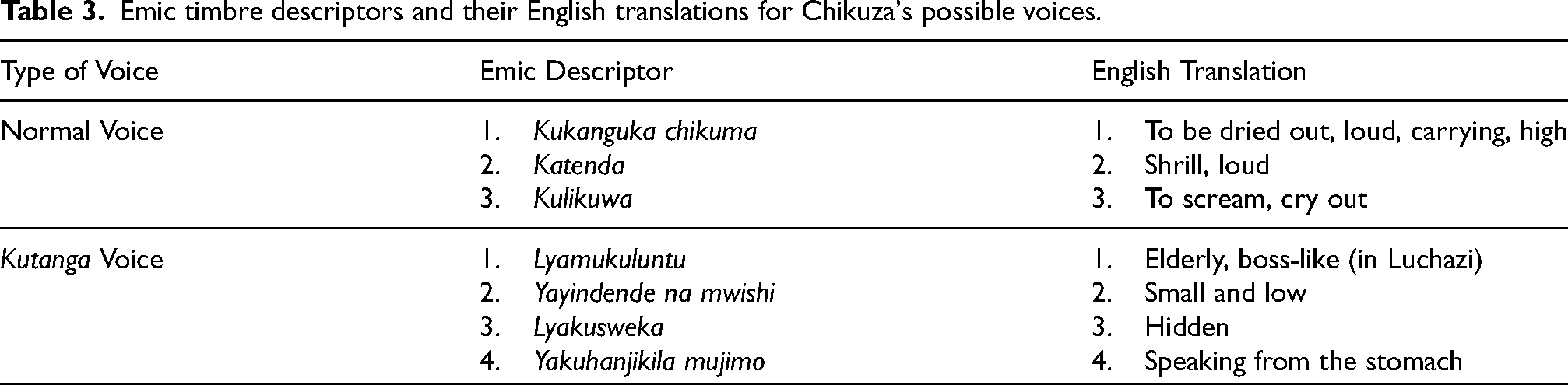
Chikuza thus has timbral options for his voice. During an interview, Kavanda Chaila (co-leader of the Likumbi Lya Mize Chibolya dance group) discussed this timbral duality in a mix of Luvale and English.
Original Quote (in Mix of Luvale and English)
“Chikuza apwa kulikuwa. Then atwama na voice mwalikuwa mwalikuwa. Mwevwikana na voice kavevwikana chikumakoko naivwikanyina kaha mwishi kaha. Oloze ize kulikuwa unonyi mwaitambakana chikuma. Then the other voice naipwako yayindende. Kaha muze mwishi kaha vene kavechi kuhasa kwivwa, numba vaze vali kaha kakusuku, uh-uh, navevwa kaha vaze vanamuhate mukamwihi. There is a voice for screaming. Then there is also a soft voice whereby those who are far away from that Chikuza they cannot get what he is saying. But those who are nearby, they can hear what he is saying.” (K. Chaila, personal communication, February 18, 2022.)
English Translation
Chikuza is a screamer. Then he has a voice in which he just screams. You hear his [other] voice, it does not sound that loud and you just hear it down. But that scream now you [must] shout very much. Then the other voice is just small. Then that [voice] is just low, those who are far away cannot hear it, uh-uh, only those who are close to him [can hear]. There is a voice for screaming. Then there is also a soft voice whereby those who are far away from that Chikuza they cannot get what he is saying. But those who are nearby, they can hear what he is saying.
McAdams and Goodchild note that a single instrument does not just have one timbre, but instead has “a constrained universe of timbres that co-vary with” (2017, p. 129) other musical parameters. Importantly, this accounts for the timbral changes that arise from volume or spatial orientation (as is partially the case with Chikuza). Fink, Latour, and Wallmark (2018, p. 11) similarly argue that an instrument does not have one timbre; instead, there are a range of timbres associated with one instrument. Soden labels this constrained universe or timbral range a metatimbre: the “sum-total of individual timbres belonging to one instrument” (2020, p. 116). Each of Chikuza's several vocal timbres belong to his metatimbre. Kalelwa and Kapapa (center and left, respectively, of Picture 3), two of the only other makishi spirits who perform kutanga, have similar metatimbres and make timbral choices akin to Chikuza's during this event.
These ancestral timbral choices are clearly on display in the
Differentiating Events Through Orchestration
Interviews also demonstrate how practitioners differentiate kutanga and mujimbu. Douglas Mwila (leader of the Likumbi Lya Mize Western Province Mongu cultural troupe) drew attention to the similar events yet differentiated them by instrumentation.
Original Quote (in Luvale)
“Ngwololeho aha homa. Tunakufutula vyuma vivali, kuvifutula kumbata nge chuma chimwe kaha. Kuli kutanga: makishi vakutangisa na ngoma – makishi vakutanga na ngoma vapwa vatatu…Kaha uno, Sakashivi ikhiye kutanga mujimbu, kechi na ngomakoko, uh-uh, nduma. Chize kechi kutangako kuta mujimbu. Kuli kutanga, kuli kutwa mujimbu. Oloze vanakutanga, vanakutanga na ngoma. Achize kutanga. Kechi kuta mujimbuko, uh-uh. Kutanga chize. Kuta mujimbu kavechi kuta na ngomako, uh-uh, chiku. Vauta ngana vene kunahu. Kachaliseze nakuta mujimbu na kutanga.” (D. Mwila, personal communication, April 12, 2022.)
English Translation
I want to correct something here. We are mixing two things, mixing and taking as if just one thing. There is kutanga. Makishi who kutanga with a drum – there are three makishi who kutanga with a drum…Then now, Sakashivi [another spirit, see Picture 4] he recites mujimbu, not with a drum, uh-uh, no. That is not kutanga, but mujimbu. There is kutanga, there is reciting mujimbu. But those who kutanga, they kutanga with a drum. That is kutanga. It is not reciting mujimbu, uh-uh. That is kutanga. They do not recite mujimbu with a drum, uh-uh, no. They recite just like that. There is a slight difference between reciting mujimbu and kutanga.
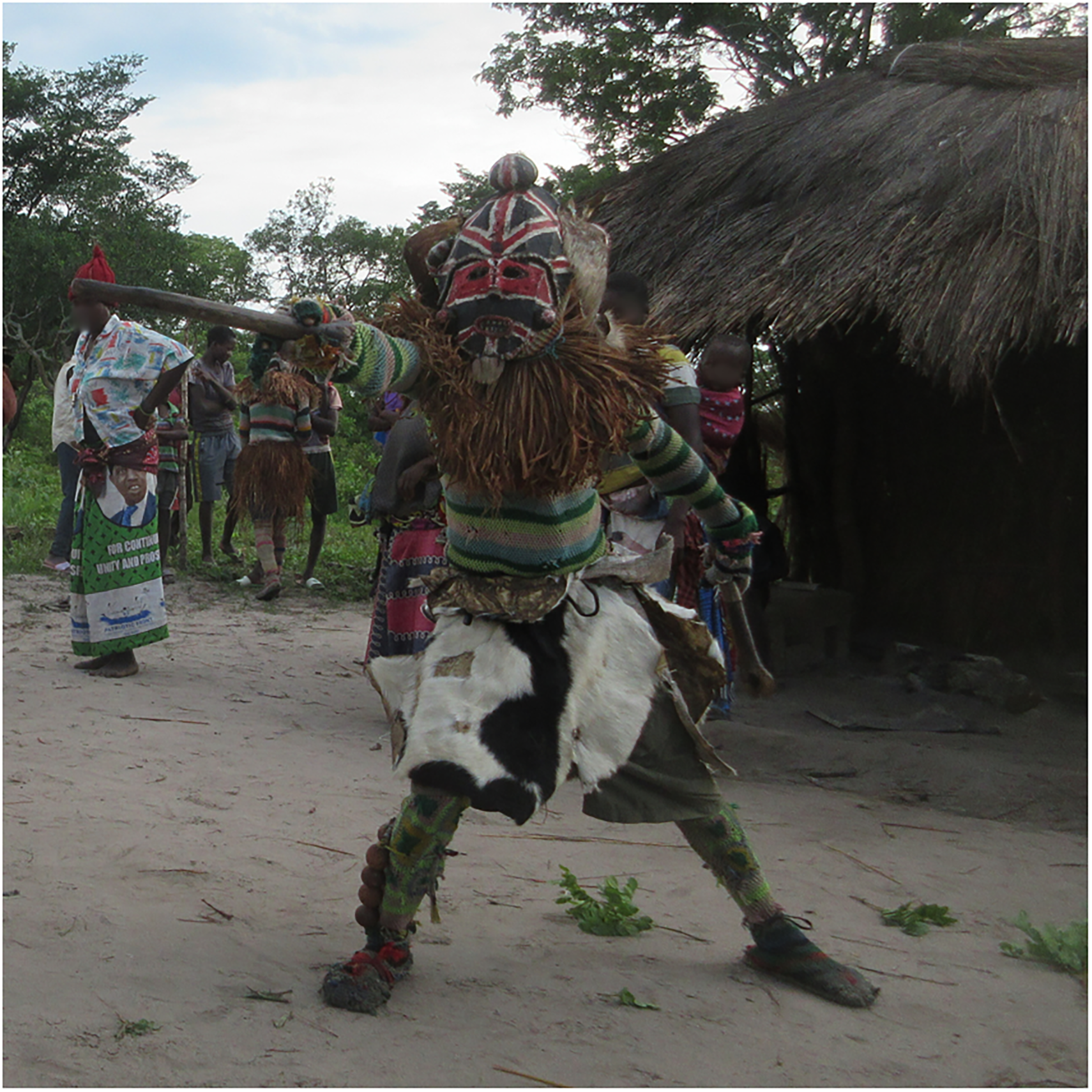
The likishi Sakashivi in Chavuma, Zambia on November 18, 2021 10 .

Kutanga orchestration graph archetype.
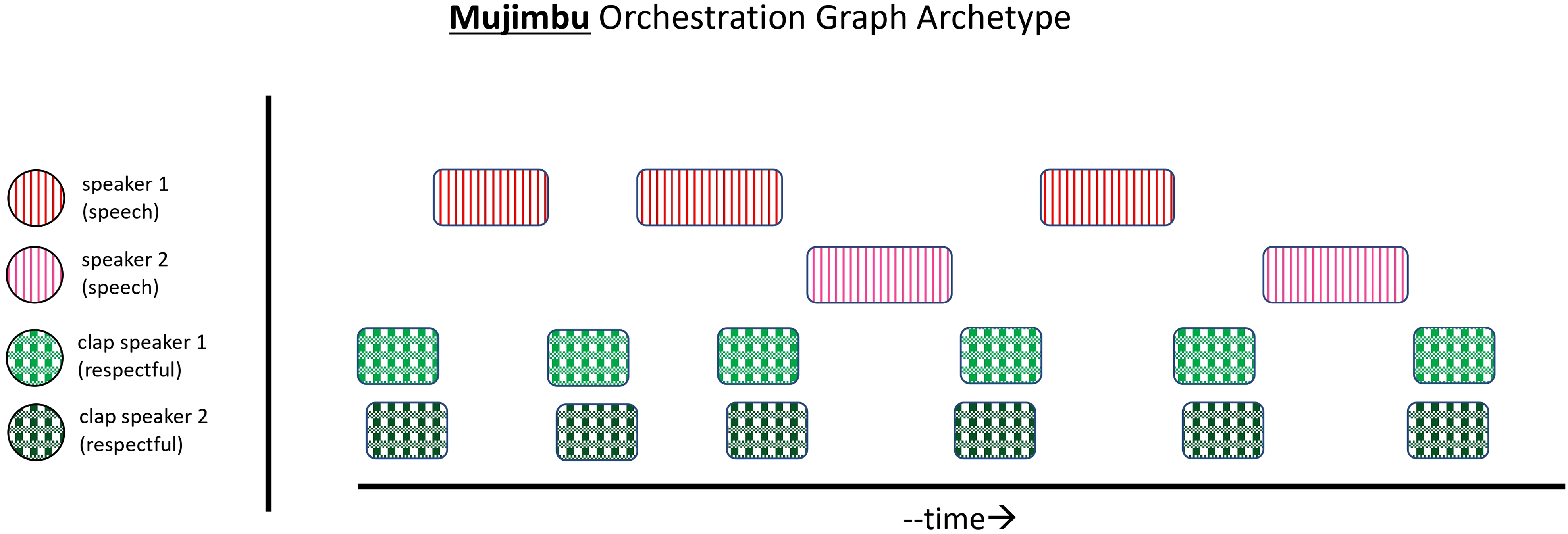
Mujimbu orchestration graph archetype.
Although both events (regardless of participants) involve the reporting of journeys, tales of overcoming challenges, and the symbolic requesting of permission, they are defined by different tacit orchestrations.
Orchestration Connecting the Spirits to the Living
In his writings on Igbo music, African musicologist Meki Nzewi coined the term “ensemble thematic cycle” (or ETC), which he claims to be the fundamental unit of form and composition in traditional Sub-Saharan African percussion ensembles. The ETC “is the span of an ensemble gestalt…which recurs in essentially the same shape and time but with continually changing sound quality” (1997, p. 44). Due to the potentially varying lengths of ETC components, ETCs may be comprised of cycles within its larger cyclical unit. For example, the ngoma yahakachi (lowest support drum) repeats its phrase twice per ETC in the dance of Chiyanda (see Notation 1). These ETC spans are usually quite short, lasting only a few bell cycles at most. Each item of musical repertoire usually has its own recognizable ETC (though items with several sections may have several ETCs). Vitally, Nzewi conceives of the ETC as “an orchestration of a single fundamental ensemble line” (1997, p. 50). Thus each item of repertoire has a characteristically orchestrated ETC consisting of multiple instruments’ contributions. With this framing, we are essentially concerned with how ensembles collectively orchestrate a single repeating phrase (or slightly more) of music.
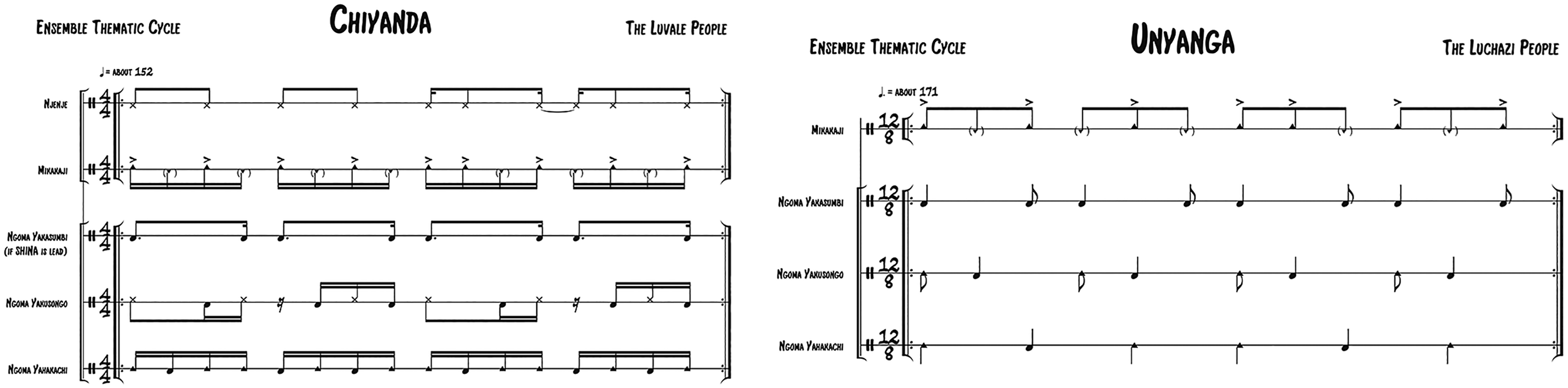
ETCs for the dances Chiyanda and Unyanga.
Many makishi have connections with humans. Some are the spirits of former chiefs; Kubik (1977, p. 272, 1994, p. 39) lists Chikuza as the spirt of the 18th-century Chokwe king Mwene Kanyika. Others embody idealized characteristics of a specific type of human. For example, Mwana Pwevo embodies young feminine beauty. Some makishi are still shaped by a job they once held when they were human. The likishi Sakashivi wears animal skins – showcasing the continuation of his former life as a hunter. Other makishi-human relationships are more parallel (as opposed to direct). For example, Kayipu rules over all makishi as king in the same way that a Luvale chief presides over the tribe.
Though many encultured Luvale may be aware of these relationships, the connections are also made explicit through timbre and the tacit orchestration of events. The Mwana Pwevo-woman relationship is demonstrated through her perceived feminine voice. Furthermore, both Mwana Pwevo and female initiates alike dance to the orchestrated ETC of Chiyanda (left of Notation 1). Both human hunters and makishi who once hunted perform the Unyanga dance, which is defined by its own ETC orchestration (right of Notation 1). Makishi and certain humans are tied together by performing to the same orchestrated ensemble lines of music. In other words, tacit orchestration also helps link spirits to their living counterparts.
So how is the spirit-human connection reified in events that lack an ETC form? To address this, let us return to kutanga and mujimbu. During the Likumbi Lya Mize (the major Luvale traditional festival), dozens of makishi spirits cross the Zambezi River to the chief's royal village. At this important moment, the royal spirit Kapalu and a chief's advisor perform mujimbu together. Kapalu is the son of Kayipu, the king of makishi. According to tradition, the spirits must recount their journey to the owners of the land at which they have arrived. However, both Kayipu and the chief do not publicly speak. As such, their vocalizing subordinates perform mujimbu on their behalf. These relationships are visualized in Figure 4.

Diagram visualizing the relationships of the Likumbi Lya Mize festival mujimbu.
Through the practice of muffled, loosely coordinated clapping, alternating speech, and the absence of a drum, the Kayipu-to-chief and Kapalu-to-advisor connections are manifest. Whereas the spirits Mwana Pwevo and Sakashivi are connected to women and hunters (respectively) through the sharing of orchestrated ETCs, Kayipu and Kapalu are connected to their human counterparts through the orchestration and performance of mujimbu. The reader can watch this mujimbu in the Kapalu section on the
Orchestration similarly links spirits to their living counterparts in kutanga. The three makishi spirits who can perform kutanga (Chikuza, Kalelwa, Kapapa) all have the same role in mukanda initiation ceremonies: to instruct the tundanji (male initiates). A key lesson these ancestors impart to the initiates is how to dance. At choice moments in festivals and mukanda graduation ceremonies, both spirits and initiates will perform their respective versions of the Kuhunga dance. However, spirits and initiates dance Kuhunga to different musical accompaniment. As a result, these items of repertoire are colloquially labeled “Kuhunga Makishi” and “Kuhunga Tundanji.” It is before this dancing that makishi and tundanji alike perform kutanga. In the dance prelude of kutanga, performers recount their recent journey. For the spirits, this recounting describes their expedition from ancestral homelands throughout the region until ultimately reaching the current village of their living descendants. The initiates recount their recent passage through the mukanda school and reference the challenges they overcame. Although mujimbu and kutanga contain similar textual content, their unique tacit orchestrations help connect the performers who only participate in one of the two practices. For example, a spirit who performs mujimbu (such as Kapalu) would not perform kutanga because he is not connected to the initiates and does not dance Kuhunga. Alternatively, a spirit who performs kutanga (such as Kapapa) would not perform mujimbu since he has no connection to royalty. The practice of recitative vocals alternating with a drum links the three makishi teachers to the initiates they educate.
Penoni (2018) highlights the relationship between makishi dances, costume/props, procession order, and order of performance. She astutely notes that Chikuza, Kalelwa, and Kapapa all dance Kuhunga, wear jizombo (bark-cloth skirts), appear towards the middle of the procession lineup, and dance in the middle of a chilende (dancing event). I expand her point by acknowledging how these makishi also share social purposes, have similar vocal metatimbres, make similar timbral decisions, and can participate in the same special events. In this way, dance, costume, procession order, order of performance, social dance, timbre, tacit orchestration, and event are often related in Luvale makishi performance.
Orchestration does not inherently link spirits to the living in every culture, nor does that ability solely belong to the Luvale. For this connection to be made through timbre and its processes, a spirit must first have the opportunity within that culture to manifest in a sonic environment. This could be through spirit possession, healing rituals, masquerade theatre, mediumship, or a variety of other practices. Alternatively, if that spirit does not physically manifest, that culture must allow that spirit to be sonically represented. For example, a specific instrument, timbre, type of music, or combination of sounds may be understood as signifiers of certain spirits. Furthermore, this type of orchestrated connection also requires that spirits have living counterparts. This kind of relationship could take the form of spirits and their respective healers, spirits and their descendants, spirits and those afflicted by them, spirits and their devoted worshippers/servants, spirits and the initiates dedicated to them, spirits and the living with similar attributes/habits/lifestyles, and myriad other associations. Finally, the living must also have (or, at least, had) an opportunity to partake in sonic events. The Luvale can orchestrate a connection between makishi and the living because these ancestors manifest in sonic events, many of the spirits have living counterparts, and those counterparts also have opportunities to participate in sonic events (whether that's historically as hunters or presently as initiates, for example). Within these events, expected timbral interactions allow participants to tacitly orchestrate their culture.
Conclusion
Through the case study of traditional Luvale events including kutanga and mujimbu, I have made several assertions about timbre and orchestration. These may be summarized as follows. (1) Culturally expected timbral interactions are orchestration. As such, (2) any event can be orchestrated and timbrally organized, not just those that fall into the (oftentimes narrowly defined) category of “music.” It thus follows that (3) anyone can be an agent of orchestration, not just composers or those formally considered “performers.” (4) Participants can orchestrate an event simply by choosing one timbral possibility over another. While many of these choices are deliberate, they do not need to be. Regardless of intentionality, an event will still be orchestrated because these choices were made. In other words, (5) successful orchestration does not always require awareness of the agent. (6) An absence of words for “timbre” and “orchestration” does not equate to a lack of timbral sensibility, especially in the presence of timbral theory such as semantic descriptors. (7) Timbral decisions may be tacitly informed by culture. Conversely, (8) timbre can order culture; orchestration can help differentiate similar or related events. Furthermore, (9) orchestration can help connect spirits to the living.
This article highlights the cultural ramifications of and intention behind both timbre and orchestration. Not only are these two related aspects of sound culturally informed, but they can also help achieve cultural goals. As timbre scholars increasingly utilize ethnographic methodologies and expand their analyses to include non-Western case studies, I expect that these types of conclusions will be corroborated in fascinating ways across cultures. For I do not believe that the Luvale are unique in their exploitation of timbre's expressive and communicative potential. However, they are clearly sensitive to this sonic parameter and an orchestration focus does provide new insight into these rich traditions.
Existing literature on kutanga (Kubik, 1971, 1974, 1977, 1994, 2008, 2010) focuses on tundanji and its place within mukanda. With this article I additionally offer commentary on makishi manifestation, the related practice of mujimbu, timbre, orchestration, and its ability to connect the ancestral to the living. In Luvale tradition, tacit orchestration can order the performance of culture.
Glossary
Footnotes
Action Editor
Nina Eidsheim, University of California Los Angeles, Herb Alpert School of Music
Peer Review
One anonymous reviewer
Mike D'Errico, Albright College, Music Department
Declaration of Conflicting Interests
The author declared no potential conflicts of interest with respect to the research, authorship, and/or publication of this article.
Ethical Approval Statement
The University of British Columbia Behavioural Research Ethics Board approved this study (approval number: H19–00939). This study was also approved by the University of Zambia Humanities and Social Sciences Research Ethics Committee (reference number: HSSREC-2021-OCT-022).
Funding
The author disclosed receipt of the following financial support for the research, authorship, and/or publication of this article: This work was supported by the Social Sciences and Humanities Research Council of Canada (Insight Grant), University of British Columbia (Public Scholars Initiative), and the American Philosophical Society (Lewis and Clark Fund for Exploration and Field Research).

Data Availability Statement
Data sharing not applicable to this article as no datasets were generated or analyzed during the current study.