



Abstract
This essay has been conceived as an invitation into the workshop of the contemporary music analyst. It aims to familiarize scholars who are interested in but unfamiliar with the practices of music analysis by discussing one of our most important challenges: how can we integrate features such as texture, timbre, and space into our analytical discussions? After a brief presentation of an analytical problem concerning Claude Vivier's Zipangu (1980)—the limitations of “traditional” analytical tools that focus on pitch distribution when studying a work emphasizing timbre and texture—and an introduction to some aspects of the music analyst's practice, the first part of this essay (“How to Seize the Life of Sounds?”) presents essential theoretical foundations. On the one hand, it deals with the rationale behind my choices, my rejection of a signal-analysis-based approach (sometimes considered more “objective”), and my adoption of Pierre Schaeffer's ideas and analytical propositions as discussed in his Traité des objets musicaux (1966), as well as the graphical adaptation proposed by Lasse Thoresen in Emergent Musical Forms: Aural Explorations (2015). On the other hand, it summarizes key concepts necessary to fully appreciate the analysis that follows—from Schaeffer's notion of a new solfège and its associated typomorphology to Thoresen's principles of symbolic annotation. In the second part, “Towards a New Conception of Form in Claude Vivier's Zipangu (1980): A Spectromorphological Perspective,” I demonstrate the existence of a (latent) multidimensional space within which the piece operates by applying this analytical framework to several excerpts from Zipangu.
Keywords
I think that interdisciplinarity never works as well as when it is embodied in the same person. There are already communication difficulties within myself between the musician and the scientist, even though I can be both but not necessarily at the same time. But then if it's about getting around a table… For instance, interdisciplinarity with specialists if each one of them doesn’t go part of the others’ way, it seems extremely heavy to me.
Jean-Claude Risset (Tiffon, 2021, p. 664)
Introduction
To honor the interdisciplinary endeavor of the journal Music & Science, this article has been conceived as a “double essay” that presents a music analyst's perspective on timbre studies. Any scholar engaged in interdisciplinary research will undoubtedly have encountered some communication difficulties: the different ways each discipline looks at an object, determined by specific goals, practices, methods, concepts (which can be misleading), and even writing styles are often the source of deep misunderstandings and frustration. My own experience has led me to conclude that, driven by the desire to facilitate interdisciplinary discourse and expand our perspectives, methods, and toolboxes, we tend to overlook the fact that interdisciplinary work emerges from a recognition and profound understanding of the epistemological foundations of different disciplines. 1 While reading works developed in other disciplines is necessary for those seeking interdisciplinary insight, it may not be sufficient as the texts are often written with a specialist readership in mind, a readership that shares those epistemological foundations and implicit knowledge and codes. Thus, perhaps the best way to communicate within the interdisciplinary community lies in our ability to bring our colleagues to observe the world through our own perspective.
* * *
“The task of the [music] analyst is ‘merely’ to point out things in the piece that strike him as characteristic and important (where by ‘things’ one includes complex relationships), and to arrange his presentation in a way that will stimulate the musical imagination of his audience” (Lewin, 1969, pp. 63–64). As I discovered these thoughts, I was amused by Lewin's sarcasm, for we all know the amount of hard work, efforts, doubts, and creativity that is required “‘merely’ to point out things in the piece.” Nowadays, music analysts’ practices have undergone numerous reconsiderations concerning their methods, tools, scopes, and objects of study, and the myth of the “objective analysis” has long been obsolete. Analysis should not be equated, though, with some sort of freewriting activity or storytelling exercise, for the analyst's intuition and subjectivity are only a starting point at best. Lewin doesn’t need to state the obvious: an important part of the analyst's activity concerns the consolidation of arguments, the gathering of evidence that will efficiently convince peers of the new proposition's validity and relevance. The whole analytical process serves as an experimental laboratory within which the analyst will test, abandon, or adjust their initial hypothesis and explore its implications for the field. What truly grasped my attention, though, is Lewin's awareness of an often underestimated part of our activity: the necessity for the analyst “to arrange his presentation in a way that will stimulate the musical imagination of his audience,” or as he later reformulates it, to choose “what to point out, in what order, in what way, and at what length to discuss what he is pointing out,” in order to convey “what ‘engages him’ about the work” (pp. 63–64). Who could have better understood than Lewin, one of the most important music theorists of the past century, that behind the search for adequate musical illustrations (e.g., a diagram, a score reduction, or a visual representation of any sort) often lies the secret of disciplinary evolution and, at times, subversion? To better understand this last thought, let us dive into one of my latest preoccupations: the analysis of the Canadian composer Claude Vivier's work Zipangu.
In 1980, Vivier composed a piece for an ensemble of 13 solo strings, Zipangu, which he introduced to the world with the following words: ZIPANGU was the name given to Japan during the time of Marco Polo. Building around a melody, I explore different aspects of “colour” in this piece. I have tried to veil my harmonic structures by using different bow techniques. A colourful sound is obtained by applying exaggerated bow pressure on the strings as opposed to pure harmonics when returning to normal technique. In this way, melody becomes “colour” (chords), grows lighter and slowly returns as though purified and solitary. (Vivier, 1985, p. 2)
Given my personal experience of Zipangu, I resisted hearing the work as an expression of a theme-and-variations form, despite strong evidence in the score and archival materials that corroborated Braes and Donaldson's interpretations. Looking at Donaldson and Braes's analyses on the one hand while thinking of a way to “arrange [my] presentation in a way that will stimulate the musical imagination of [my] audience” brought me to reflect on Lewin's definition of the analyst's role. What if my difficulty accepting their evidence for their formal classifications—i.e., the pitch structures of Vivier's music—was actually the expression of a deep disciplinary crisis? In the past decades, music analysis has gone through tremendous changes as a discipline. This has contributed to the broadening of its repertoire, methods, tools, and research questions as well as exposing its weaknesses: the music analysis curriculum unevenly focuses on European “art music” repertoire, which results in the development of habits that can compromise investigations of music that does not share the same compositional paradigms. All analytical investigations of Vivier's music thus far have taken a score analysis approach. This type of visual representation works best when engaging with a music in which the score plays both prescriptive (for the performers) and descriptive (for the listeners, readers, and analysts) functions. However, like many contemporary music composers, with the decline of tonal traditions and their implied rules and hierarchies, Vivier has explored new ways to delve into the sonic realm by giving timbre, texture, and spatialization structuring functions. 5 However, these musical phenomena often rely on what I consider invisible techniques: unlike pitches and rhythms, they are not clearly shown the score and are thus less immediately tangible for the analyst. If we base our analytical discussion on the visual trace of the score only, our discourse may be influenced by its own boundaries.
* * *
This two-part essay aims to show how, as a music analyst, I “seize the life of sounds”—or in a less poetic manner, how I understand the mechanisms behind a work when they rely on sonic phenomena that are not visible in the score. My investigations led me to what is now known in the field of electronic music studies as spectromorphological analysis. However, due to its unconventional nature even for many music analysts and the implicit Husserlian epoché (discussed further below) that it requires, my analysis of Zipangu is preceded by an important theoretical discussion which aims to introduce some basic principles. First, after clarifying my position towards signal analysis approaches (one of the numerous commonalities I share with Pierre Schaeffer, a seminal theorist of spectromorphology), I introduce some key concepts and ideas of Schaeffer's ambitious “new solfège” project, which should prepare listeners to transform their internal listening. This is followed by a synthesis of Schaeffer's typologie and morphologie, two fundamental stages of his Programme de la Recherche Musicale (PROGREMU, described later on) which should give an idea of the efforts and listening discipline required of any analyst interested in this method. While Schaeffer's ideas have not yet found fruitful soil in the realm of acoustic music analysis, they have sparked a lot of interest within the realm of electronic music studies. Since my project aims to consider potential visual representations to support my analytical insights, I will close this first essay with a presentation of Thoresen's graphic presentation of Schaeffer's typology. Readers should be warned, though: some of these concepts—“typology,” “morphology,” and Thoresen's revision of these ideas—are challenging to follow on a first reading. Their relevance will become clear when readers engage with the analytical application. Thus, I would suggest that readers should first read this section to have an overall understanding of their implications, and then go back to it if necessary as the analytical discussion unfolds. A semi-closing discussion, in which I present the historical and theoretical relevance of applying Schaeffer-based analytical ideas to Vivier's music as well as methodological considerations related to my analytical choices, leads to the second essay: “Towards a New Conception of Form in Claude Vivier's Zipangu (1980): A Spectromorphological Perspective.” Readers already familiar with Schaeffer and Thoresen's ideas might want to start directly with the second essay, while readers less interested in Vivier's music and aesthetics but curious to understand how a music analyst thinks when developing an analysis should have all the required information in the first essay. However, the two parts are deeply interconnected, each shedding light on the other.
Part 1: How to Seize the Life of Sounds?
In his 1912 essay “Mémoires d’un amnésique. Ce que je suis,” the French composer Erik Satie responded to his detractors with a rather poetic and creative humor, embracing the many accusations regarding his lack of musical talent and making them his own: From the start of my career, I immediately classified myself as a phonometrographer. My work is pure phonometry. […] Scientific thinking dominates. Besides, I get more pleasure from measuring a sound than I do from hearing it. With my phonometer in hand, I work happily and surely. What have I weighed or measured? Everything by Beethoven, everything by Verdi, and so on. It's all very curious. The first time I used a phonoscope, I examined a medium B-flat. I assure you, I have never seen anything more repulsive. I called my servant to show it to him. On the weighing machine, an ordinary F-sharp, very common, reached 93 kilograms. It came from a very large tenor whose weight I took.
6
(Satie, 1912, p. 327)
Representing the Human Auditory System
I will start this investigation by anticipating a frequent question I receive when presenting my work: the absence of signal analysis approaches which, for several decades now, have become the most frequently used visual representations of sound. After all, the desire “to reveal a structural aspect of musical shapes and forms that until now has remained hidden” was already at the center of Robert Cogan's seminal 1984 monograph New Images of Musical Sound, which introduced a new technology based on signal analysis: spectrum photos, better known today as spectrograms (Cogan, 1984, p. 3). These three-dimensional representations of the evolution of sonic events’ spectral structures over time, highlighting their frequency organization and changes in amplitude, were meant to become the basis for a new theory of music, one that would emphasize “invisible” phenomena like timbre and be applicable to a wide range of musical genres, breaking down the traditional boundaries between popular, traditional, and art music. Although Cogan's theoretical proposals received relatively little attention, spectrograms have become a valuable analytical reference providing a visual trace of music that can be used for both analytical and communicative purposes, particularly in the field of electronic music studies and contemporary instrumental music (as exemplified by this essay's Example 1 below). However, such visual representation is not adequate for the present project as spectrograms do not take into consideration the complexity of the human auditory system (McAdams, 2019) and thus ultimately become an obstacle to our analytical goals. 7

Spectrogram analysis of Claude Vivier’s Zipangu first section (mm. 1–114, 0′00″–5′28″) with Braes’s, Donaldson’s and my own corresponding formal divisions.
To address this limitation, we could turn to another type of signal analysis, the extraction of audio descriptors, as suggested by recent scholarship (Couprie, 2020; Lalitte, 2011; Malt, 2015; Malt & Jourdan, 2015). Audio descriptors are objective measures of audio signals derived from either the spectrum or the waveform, conceived with the aim of condensing audio information by representing it an acoustic, psychoacoustic or musical model (Peeters et al., 2011). Initially developed and used within the context of music information retrieval for audio classification, speech recognition, automatic music tagging, audio segmentation, and source separation (Boyer, 2019), they also play a crucial role in timbre studies (McAdams, 2019), live electronic music (Bullock, 2008; Porres, 2012), and computer-aided composition/orchestration (Monteiro, 2012; Simurra & Manzolli, 2016). Appealingly for our project, many audio descriptors can be tied to perceptual correlates (Beauchamp, 2011; Caclin et al., 2005) and can track the evolution of separate layers of sonic information, which enables music analysts to focus on specific sonorities or a sound parameter's evolution over time. However, descriptors are usually correlated with perceptual meanings that can be acoustic (low level) or perceptual (medium level), but they are less relevant when the analytical scope concerns a musicological/semantic/hermeneutic investigation (high level), which is our concern here (Bullock, 2008).
Pierre Schaeffer, the French broadcaster, engineer, musicologist, acoustician, and composer, shared a similar suspicion towards scientific and technological approaches to music studies. In his monograph, the Traité des objets musicaux (Schaeffer, 1966; Schaeffer, 2017), he frequently refers to contemporary technologies and scientific approaches, usually reaching more or less the same conclusion: that they do not offer a comprehensive understanding of sound phenomena as experienced by listeners (see for example his repeated critiques of spectrum-oriented scientists who discuss timbre without taking into consideration the effect of attacks). However, what is most interesting in Schaeffer's monograph is his proposition of a “new solfège” that would subvert all the “preconceptions” and biases we may have developed through our cultural conditioning. The result of more than 20 years of hard work and experimentation in the Groupe de musique concrète (founded in 1951) and Groupe de recherche musicale (founded in 1958), this complex, dense, labyrinthine, if not hermetic monograph sets the ground for a renewed perspective on sound phenomena from a phenomenological approach. Music scholars often are familiar with the general ideas, analytical methods, and concepts proposed by Schaeffer, but these can only take on their full meaning once we consider the fundamental ideas which sustain the entire Traité des objets musicaux (henceforth abbreviated as TOM): the development of a “new solfège,” an inspiration for my own project of liberating our analytical hearing from the biases arising from a pitch-centered enculturation. Because of the extreme complexity of the TOM, our perspective on Schaeffer's work relies on the remarkable synthesis offered by Michel Chion in Le guide des objets sonores : Pierre Schaeffer et la recherche musicale (Chion, 1983; Chion, 2009). 8
Questioning the Way We Observe the World: Pierre Schaeffer's New Solfège
Schaeffer's analytical suggestions result from his own experience in the studio and are tightly linked to technological advances offered by musical recordings, their related sonic transformations, and the possibility to listen to a sound or a piece multiple times, focusing on selected aspects and becoming aware of details that might not be perceived the first time. However, even though the ground for his investigation was the realm of acousmatic music, Schaeffer's approach was intended to be applicable to any organization of sound phenomena with musical intentions. In order to transform the way we listen to music, we must both revise our understanding of the past tradition and become aware of our listening habits (and their implications).
Rethinking the Past: Western Music and Fundamental Dualisms
The scope of Schaeffer's study is not limited to “contemporary music” aesthetics and paradigms, though a common misconception about Schaeffer's work is its supposed dissociation from the music of the past—a incorrectly attributed notion of tabula rasa—as well as the imagined limitation of his theoretical propositions to electronic music. According to Chion, nothing is “more foreign to Pierre Schaeffer's cast of mind than the doctrine of the ‘tabula rasa,’ the ‘elimination of heritage’—he concentrated on tradition, seeking to grasp it with a new ear” (Chion, 2009, p. 39). Schaeffer thus scrutinized this tradition from a phenomenological perspective to identify the underlying principles on which tonality and its related laws of sound organization laws were built. Throughout the TOM, readers encounter many “dualisms” which, according to Schaeffer, reflect “the basis of all music” (Chion, 2009, p. 9). Dualism in this context can refer either to broad and abstract notions, such as Nature/Culture, Making/Hearing, and Abstract/Concrete (Chion, 2009, pp. 34–39), or to more specific and concrete ones, such as Context/Contexture, Value/Characteristic, and Permanence/Variation (Chion, 2009, p. 63; 74–78; 79–80). These can be the expression of opposing forces or strongly related concepts that can be considered in a complementary relationship. According to Schaeffer, these dualisms are phenomenological laws that play a crucial role in our auditory experience and our recognition of musicality. By applying a phenomenological perspective to the well-known concepts of traditional music theory, Schaeffer identifies fundamental processes that can be transposed and re-enacted in different musical situations. For instance, the concept of Context/Contexture refers to our ability to organize musical information hierarchically. A sound unit (the context) is defined by lower-level sound units—its contexture (internal activity)—while also contributing to the shaping of a broader context, becoming a higher-level sound unit's contexture defining element. The complementary Value/Characteristic dualism, which is central to our analysis of Zipangu, plays a role in our ability to perceive some sound objects as a group and to identify features that are crucial to the structuring forces: Values are the relevant features, which emerge from several sound objects placed in a structure and form the elements of the abstract musical discourse properly speaking; the other aspects of the objects which are not relevant in the musical structure but which form its concrete substance, its matter, are grouped together under the name of characteristic. (Chion, 2009, p. 75)
The “liberation” of these principles from the narrow tonal frame had to be accompanied by a further activity: the questioning and “deconditioning” of our relationship to (and preformed expectations of) some strongly fixed traditional concepts in order to broaden our perspectives. For example, Schaeffer's discussion of the predominance of pitch in most musical cultures led him to consider how other sonic dimensions might be influential in musical structure. For him, such a hierarchy is the result of the ability of the pitch domain to create “‘vectorial tensions’ (the tension between consonance/dissonance, phenomena of attraction, etc.)” and to be highly organized (Chion, 2009, pp. 42–43). This organization benefits from a triple reinforcement linked to (1) its immediacy of aural perception, as it is “often, what amongst all the characteristics of sound, most immediately strikes the ear”; (2) its ordinal relationship, “its special capacity to be put into scales and calibrations organized according to ordered relationships”; and (3) its “capacity for cardinal evaluation, i.e., to be understood very precisely as an absolute value (absolute pitch), in contrast to other characteristics of sound which can only be evaluated relatively” (pp. 42–43). One way to discover previously unknown facets of sonic space, Schaeffer argues, might be to create or reveal “calibrations” for each parameter of sound (pp. 45–47).
This theoretical project was soon confronted with the limitations and constraints imposed by reality: one cannot bluntly apply the principles of pitch to other parameters, as they all participate in the creation and transformation of sound in different ways. Nevertheless, the experience had an impact on Schaeffer's approach to sound and music, sparking a focused interest in the micro-variations of sound and their articulative forces. However, to explore the potential of this new approach to sound, Schaeffer argued that it was necessary to reconsider concepts developed in the context of tonal music, such as pitch, note, timbre, and instrument (Chion, 2009, pp. 42–57). Becoming aware of their contextualized meaning, dependent on the tonal paradigm, leads the music analyst to observe their inherent biases and limitations, which must be abandoned to engage with new ways of conceiving musical creation. Schaeffer's discussion and revision of the concept of “timbre” illustrates this process, which is particularly important for our analysis. Within the tonal tradition, Schaeffer quotes the French music theorist Adolphe-Léopold Danhauser, “Timbre is that particular quality of sound that makes it impossible to confuse one instrument with another, even when they are playing a note of the same pitch and intensity. The least expert ear can easily distinguish the timbre of a violin from a trumpet or an oboe” (Schaeffer, 2017, p. 123). However, to Schaeffer, this definition of timbre was clearly not sufficient, for a wide range of timbres can be associated with a single instrument and, most importantly, timbre is the result of complex phenomena including spectral structures, internal dynamic changes and attack types, among others (Chion, 2009, pp. 50–53). The limitations inherent in the concept of timbre have already been intuitively challenged by composers who have sought original and innovative ways of exploring these perceptual nuances within the tonal paradigm. Thus, relying on a concrete experience of sounds allows analysts to decompose this formerly fused concept into distinct criteria, each potentially articulated according to independent logics.
Epoché, Reduced Listening, Sound Objects
This type of investigation, which relies on a phenomenological posture, draws on a principle that Schaeffer later related to Husserl's concept of epoché (Chion, 2009, pp. 28–30). As Chion reminds us, “this phenomenological term […] describes an attitude of ‘suspending’ and ‘putting in parentheses’ the problem of existence of the external world and its objects, as a result of which consciousness turns back upon itself and becomes aware of its perceptual activity in so far as the latter establishes its ‘intentional objects’” (Chion, 2009, p. 28). This, however, requires some preparation by listeners, as they first must be aware of the impact of different listening attitudes on the way they perceive the world. In the TOM, Schaeffer identifies four listening modes: ouïr (perceiving), which means “perceiving by ear, being struck by sounds, the crudest, most elementary level of perception” and implies a “passive” attitude bereft of any attempts to listen or understand; entendre (hearing), which “means showing an intention to listen, choosing from what we perceive what particularly interests us, in order to make a ‘description’ of it”; comprendre (comprehending), which “means grasping a meaning, values, by treating the sound as a sign, referring to this meaning through a language, a code”; and écouter (listening), which “means listening to someone, to something; and through the intermediary of sound, aiming to identify the source, the event, the cause, it means treating the sound as a sign of this source, this event” (Chion, 2009, pp. 19–26; p. 192 for the diagram of “Four Listening Modes”). 9 To activate the epoché process, Schaeffer argues that one needs to develop an artificial listening attitude known as reduced listening (Chion, 2009, pp. 30–32). Broadly speaking, this listening mode requires listeners to suspend any interpretative tendencies that may lead to perceiving the sound as carrying referential or semantic meanings in order to focus on the sound “for its own sake, as a sound object” (Chion, 2009, p. 30). Sounds perceived as sound objects are interpreted as resulting from the convergence of multi-parametrical encounters, eliminating preconceptions and expectations.
Sharpening One's Analytical Tools: Basic Principles of Schaeffer's Typo-Morphology
To guide listeners in their epoché, Schaeffer developed a “Programme pour une recherche musicale” (PROGREMU), a five-stage analytical protocol ranging from the mere identification of sound objects to the analysis of their implications in a musical context (Chion, 2009, pp. 95–116). As discussed by Chion, the three final stages are not fully developed and lack consistency. However, the first two stages, Typology and Morphology, also known under the compound term Typo-morphology, offer valuable clues for developing an analysis based on the contexture of sound objects. Those two procedures are intensely scrutinized by Schaeffer, which can make it ponderous and confusing to read, setting a challenge to anyone who attempts a synthesis. However, anyone who aims to engage with Schaeffer's ideas must confront the density of this material in order to embrace Schaeffer's thinking process and understand his analytical frame.
Typology
Typology is defined by Schaeffer as “a process of selection from which sound material will emerge cut into pieces, categorized into (musical) types of (sound) objects” (Chion, 2009, p. 108). To operate this selection process (also known as “identification”) of sound objects, one relies on the coupled criteria of Articulation/Stress which segment the sonic flux into sound objects based on principles of discontinuity and continuity (Chion, 2009, pp. 125–127). Once the segmentation procedure is complete, sound objects can be identified and classified according to three pairs of criteria, broadly related to their morphological, temporal and structural properties: Mass/Facture; Duration/Variation; Balance/Originality. As summarized in Schaeffer's “Tableau récapitulatif de la typologie” (TARTYP), which I have reproduced here in Figure 1, 30 types of sound objects emerge from this initial classification procedure, each of which Schaeffer has assigned a specific symbol. I will only comment on the two first pairs, for Balance/Originality, the final pair, concerns “the structural dimension of the object, considered qualitatively.” As Chion notes, “these two criteria, in this sense, explicitly introduce a value judgement into typological classification,” which is not important for our work (Chion, 2009, pp. 136–37).

Summary diagram of Typology (TARTYP) (Chion, 2009, p. 172).
The morphological pair Mass/Facture combines respectively a criterion relating to the “capacity for a sound object to be heard as pitch” with another relating to “the manner in which energy is communicated and displayed in duration.” This pair can be seen as the fundamental axes of the TARTYP scheme. Mass, which represents the y-axis, is subdivided into four main types. Two of these belong to the “fixed mass” (masse fixe) category—the tonic mass (N), characterized by its “definitive pitch” (hauteur définie) and complex mass (X), characterized by unidentifiable pitch (complex mass, X). The third type, tonic-variable mass or complex-variable mass (Y), belongs to the “not very variable mass” (masse peu variable) category and is characterized by identifiable or unidentifiable pitch that varies moderately in an organized manner, and the fourth type is nondescript mass (W), the expression of “unpredictable variation of mass” (variation de masse imprévisible), meaning identifiable or unidentifiable pitch that varies in a disorderly and excessive manner (Chion, 2009, p. 135; Schaeffer, 1966, p. 459). Facture, which represents a first layer of organization of the x-axis (see arrows below the table), is a qualitative criterion closely linked to the sustainability of the sound object and is divided into three types: continuous sounds, where the energy is sustained without interruption, placed in the “held sounds” (sons tenus) side of the table; instantaneous sound, which refers to sounds articulating a mere impulse, expressed by the central column of the table; and iterative sounds, where the facture is sustained by repeated impulses (symbol: "), found in the “iterative sounds” (sons itératifs) side of the table (Chion, 2009, p. 135; Schaeffer, 1966, p. 459).
The Duration/Variation pair also deals with the temporal dimension of sound objects, adding extra layers of details to the x-axis classification. Duration represents “the time of sound objects as it is ‘psychologically experienced’” and can be either short, medium, expressed by the central part of the table “measured duration, temporal unity” (durée mesurée, unité temporelle), or extended, expressed by the external parts of the table: “disproportionate duration (macro-objects) with no temporal unity” (durée démesurée (macro-objects), pas d’unité temporelle). More specifically, short duration refers to the central column “impulse” (impulsion) and is expressed with a ′ symbol. Medium durations refer to “formed sustainment” (tenue formée), which use no specific symbol, and “formed iteration” (iteration formée), expressed with a (") symbol. Variation, defined as “something that changes over time,” refers to an impression of speed and can be either non-existent, reasonable or unpredictable (not shown in the table) (Chion, 2009, p. 136).
Morphology
The PROGREMU's second stage of analysis, the morphological analysis, allows us to describe sound objects in more detail and with greater specificity. This procedure relies on seven criteria (Chion, 2009, pp. 117–118), each characterized by specific types, and further detailed into distinct classes (Chion, 2009, p. 111). 10 Each criterion allows the analyst to engage with the sound object from a specific angle tightly connected with a perceptual category: its matter, expressed by Mass texture, Harmonic timbre, and Grain; its temporal dimension, expressed by Grain and/or Allure; its form, expressed by Allure and/or Dynamic; its variation, expressed by Melodic profile and/or Mass profile. To offer an exhaustive discussion and description of all the morphological descriptive process would bring us beyond the scope of this essay (Chion, 2009, pp. 159–187), thus I will focus on the two criteria that are central to my analysis: Mass texture and Grain.
The Mass texture criterion, which engages with the matter of the sound object and can be described as the “mode of occupation of the field by the sound,” is particularly important to us. Mass texture is expressed by classes which can be ordered to articulate continua ranging from the thinnest to the thickest applied to the two main types of mass (tonic and complex). Thus, on one side, we move from pure sound (tonic without harmonic timbre) to the tonic group (mass composed of several different tonics), passing through the tonic (mass represented by a locatable pitch). On the other side, we move from node (mass formed of an aggregate of non-locatable pitches) to white noise (complex mass occupying the entire pitch-field) passing through nodal group (mass formed of “bands” of mass formed of several distinct nodes). These two continua are mediated through the channeled sound type, an ambiguous mass composed of tonics, tonic groups, nodes, and nodal groups. (Chion, 2009, pp. 162–168). Grain, “the signature of matter,” pertains to the “micro-structure of the matter of the sound” and can be interpreted as either referring to the matter of sound objects or its sustainment over time, even though its quality and classes remain the same. Grain can be resonant, rubbing, or iterative, each of which can be expressed in three different classes, ranging from the largest to the tightest : quivering, shimmering, limpid for resonant grain; rough, matt, smooth for rubbing grains; and coarse, medium, fine for iterative grain (Chion, 2009, pp. 171–173).
Looking for Visual Support: From Schaeffer's Typo-Morphology to Thoresen's Spectromorphological Graphics
Despite its complexities, Schaeffer's typo-morphology has found a fertile ground in the field of electronic music analysis. Numerous analytical approaches drawing on his ideas have been developed to engage with new sonorities and to identify principles behind organized sounds in acousmatic works without any scores (Couprie, 1999; INA-GRM, 1999; MIM, 1996; Roy, 2003). For our analytical purposes, the spectromorphological tradition is of particular interest. The term “spectro-morphology” (later reworded as spectromorphology) was first introduced in 1986 by Denis Smalley in his pioneering essay “Spectro-morphology and Structuring Processes” (Smalley, 1986). Smalley proposed an approach that focuses on “find[ing] out what happens in the life of a sound or sound structure, or what attracts us about a sound quality or shape.” To do so, one must “temporarily ignore how the sound was made or what caused it, and concentrate on charting its spectro-morphological progress” (Smalley, 1986, p. 63). Smalley's analysis practice is based on a revision of Schaeffer's typo-morphology. The first step is the identification of all sound objects that contribute to the musical structure through the analysis of their spectral structure (spectro) and their temporal evolution (morphology). Smalley's propositions have been developed through a series of publications (Smalley, 1993, 1994, 1996, 1997) and have led to various analyses and further developments (Hirst, 2011; Landy, 2011; Palacio-Quintin, 2013; Sköld, 2022). However, it may not be the most suitable approach for our project. Smalley proposed a significantly reduced version of Schaeffer's theoretical approach, which also primarily verbal and lacked a notation system for expressing the developed concepts. Furthermore, Schaeffer's analysis is significantly reduced in Smalley's analytical considerations. His underlying aim is to demonstrate the logic and “humanity” behind electronic music. Smalley has refined concepts and a theoretical framework that enable analysts to understand overall gesture and musical structures rather than the specificity of the sound objects. Bullock noted that this corresponds to a “high” level of analysis that deals with contextual elements such as formal and semantic considerations (Bullock, 2008, pp. 40–41). This certainly fits our final analytical goal which is to engage with this level of analysis. However, to get there, we first need to scrutinize and focus on the “micro” level of sound objects as constituents of musical structures, which is the goal of Lasse Thoresen's spectromorphological approach presented within the context of his large-scale research project, Aural Sonology.
Lasse Thoresen's Graphical Adaptation of Schaeffer's TARTYP
Since the 1970s, Thoresen has worked through ways to turn Schaeffer's TOM ideas and concepts into practical analytical tools, a project that recently culminated with the publication of a synthetic monograph titled Emergent Musical Form: Aural Explorations (Thoresen & Hedman, 2015). 11 Thoresen's work focuses on developing visual aids for each stage of an analytical practice that could be applied to all music genres. This involves the first level of analysis, “that of sound objects,” the second level, “that of elementary patterns (i.e., organizations, structures) combining sound objects,” and the third level, “that of patterns of patterns (the last one being an analysis of musical form)” (Thoresen & Hedman, 2007, p. 130). For analytical purposes, the most insightful aspect of Thoresen and Hedman's work is a “set of conceptual and graphical tools for the aural analysis of music with an enriched morphology” (Thoresen & Hedman, 2007, p. 130). 12 Even though Thoresen has developed a complete graphical notation for both Schaeffer's typology and morphology concepts, I will limit my discussion here to Thoresen's revision of the TARTYP as presented in Figure 2 (Thoresen & Hedman, 2007, p. 134; 2015, p. 266).

Thoresen's revison of Schaeffer's TARTYP (Thoresen & Hedman, 2007, p. 134; 2015, p. 266).
Comparing Figures 1 and 2, readers may notice that Thoresen has not just translated Schaeffer's TARTYP into graphical notation. As he explains, his adaptation relied on a two-stage process, one that first simplified Schaeffer's TARTYP, by eliminating qualitative criteria which do not concern music analysts (e.g., the distinction between facture and sustainment, or considerations concerning well-formedness, excentricity, or redundancy) and temporarily removing some criteria. Maintaining the criterion of sound spectrum (mass) 13 for the y-axis, the reduced version of the TARTYP retains the distinction between pitched (tonic) sound, represented by a plain circle, complex sound, represented by a plain square, and variable sounds, represented by a plain circle or plain square followed by an oblique line. The x-axis displays information regarding energy articulation, including impulsion (indicated by a dot above the sound spectrum symbol), sustained continuity (indicated by a straight horizontal line after the sound spectrum symbol), and continuous iteration (indicated by a dotted horizontal line after the sound spectrum symbol). Unpredictable objects such as vacillating or accumulated sound objects are included on the outer left and right sides of this new TARTYP diagram (Thoresen & Hedman, 2007, p. 131).
This basic structure was then expanded in the final diagram (Figure 2) through the integration of elements that belonged to the Schaeffer's theory of morphology. On one hand, the sound spectrum axis is enriched by the inclusion of elements from the spectral width (mass texture) criterion: pitched and complex sounds are now joined by dystonic (channeled) sounds, represented by a plain diamond shape. In addition, three categories have been duplicated to represent different harmonic situations: empty circles represent pitched sound without harmonics (i.e., sinusoidal sound), empty diamonds refer to whisper-like sounds, and empty squares represent unvoiced complex sounds (i.e., white noise). On the other hand, the energy articulation axis is expanded by including composite (composed) sound objects consisting of “distinct and successive elements” and stratified (composite) objects composed of “distinct and simultaneous elements.” Both techniques have different levels of expression and facilitate a smooth transition between iterated sounds and accumulated sounds, as well as sustained sounds and vacillating sounds (Thoresen & Hedman, 2007, p. 131).
Evaluating the Relevance of Using Schaeffer's Ideas (and Their Extensions) to Analyze Vivier's Zipangu
Part of the rationale behind my choice of an analytical approach based on Schaeffer's theories and their later extensions is my desire to engage with the musical material as perceived and processed by human ears and brains. However, that is not the entire story. Even though Schaeffer's work was developed within a specific creative and technological context—the GRM and the development of experimental acousmatic music in studios—many points he addresses echo the trajectories of other avant-gardes. The subversion of parametrical hierarchies, emphasizing timbre and texture as structuring and shaping forces, is perfectly illustrated by the works of György Ligeti, Iannis Xenakis, and, later, spectralists (e.g., Gérard Grisey, Tristan Murail). However, despite Schaeffer's criticism towards the presumed scientific and arithmetic turn expressed by the 1950s post-war European serialism, most of his claims are reminiscent of their claims, too—e.g., the necessity to break away from concepts closely related to the tonal paradigm, the reconsideration of sound from a multidimensional perspective in order to find new ways to structure and articulate a musical discourse, and the development of a new listening mode focusing on sonic properties. As I have demonstrated elsewhere, the oft-repeated critiques of post-war European serialism claiming that it was conceived as a denial of humanity, emotions, and laws of perception or based on the fetishism of a unifying compositional procedure relying on arithmetic principles are the result of a misunderstanding. Early theoretical writings of Pierre Boulez, Karlheinz Stockhausen, and Henri Pousseur did focus on the necessity of breaking away from any preformed musical material and concepts through the application of an organizing principle applied equally to all sound parameters in order to explore new ways to sculpt the sonic space. However, as one scrutinizes the evolution of Stockhausen's or Pousseur's 1950s compositional theories alongside their compositions, it becomes evident that each work brought composers closer to the recognition of perceptual mechanisms that they intuitively perceived and reacted to, adjusting (and personalizing) their musical project. Discussions relating to potential discrepancies between structural parameters, the elaboration of new musical forms emerging from those new considerations, and the necessity of deeply transforming the attitude of listeners became central to the serial odyssey and should be considered as among its significant contributions to successive avant-gardist propositions (Gioffredo, 2021).
This point of view seems to have been shared by Claude Vivier himself, who once wrote to his friend and composer Serge Garant during his studies under the supervision of Stockhausen (1972–74) that “serialism taught us depolarisation, and the independence of a sound's parameters led us to the atom but also opened our consciousness to the broadening and deep significance of parameters other than pitch […] the composer has at his disposal highly rich tools, why couldn’t he use them in order to compose some music?” 14 (Mijnheer, 1991, p. 94). One could think that by the time Vivier composed Zipangu his ideas had evolved, and he had then (re)turned to a musical conception essentially built on harmonic structures. However, looking into the scholarship on Vivier as a whole, one understands that Braes's and Donaldson's analytical angles should be understood as to do with the expression of a fundamental issue on which the composer's scholarship has been built: where in the contemporary musical scene, which was then still heavily dominated by the European avant-gardes, is Vivier's work situated?
For a long time, one of the most challenging aspects of engaging with the Canadian composer's oeuvre was the lack of information concerning his theoretical and aesthetic ideas. How can an analyst proceed when little information is available and the composer's archives are not yet accessible to the public? A well-known fact about Vivier's compositional strategy was his fascination for his mentor Karlheinz Stockhausen's formula principle, the extraction of the formal unfolding, structural harmonies, and melodic content of an entire piece from a fundamental melodic Kern. Some would argue that Vivier's interest for melodic-based generative processes antedate the his study with Stockhausen (Braes, 2000; Harman, 2013; Tilley, 2000). However, no one will argue with the fact that after Vivier's studies from 1972–74 in Cologne (Gilmore, 2009, 2014; Lesage, 2008), his style was transformed. The composer himself emphasized many times the role of the melody in the generative process of the harmonies. Thus, even though most analyses do point out the importance of non-pitch-based features in our experience of Vivier's music (e.g., orchestration, textural effects, and spatialization), an increasing number of studies have focused on understanding the mechanisms behind Vivier's development of his material, monitoring every change in compositional procedure as a potential sign of an aesthetic shift. (Braes, 2000, 2003; Gilmore, 2007; Levesque, 2004, 2008; Rhéaume, 2008; Tilley, 2000; Tremblay, 2000).
Archival studies have confirmed the initial and structural function of pitch distribution decisions in Vivier's compositional process, and this approach has been particularly insightful. Identifying some common features in Vivier's compositional strategies and observing its evolution has provided evidence allowing scholars to start writing about Vivier's stylistic evolution within the context of his own life experiences and musical encounters. Some have looked at Vivier's music from the perspective of his biography to better understand the making of his écorché vif sensitivity: his desire to create an almost ritualistic music which explores “uncharted” sonic territory and invented language and his integration of existential themes such as love, death, loneliness, alienation, and childhood could all be traced back to Vivier's complex and tormented childhood and formative experiences (Christian, 2014; Drees, 2010; Gilmore, 2014; Gilutz, 2016; Goldman, 2016; Rhéaume, 2021). Others have looked into Vivier's cultural and educational context to understand his aesthetics and music-theoretical vision. For example, to engage with pieces composed between 1974 and 1977 scholars have found it productive to investigate Vivier's music from the perspective of his mentor Karlheinz Stockhausen's compositional theories, whether the aforementioned formula principle, the use of spatial distribution and orchestration techniques as textural agents, the attraction to mysticism and ritualistic expressiveness, or the search for a unique blending of cross-cultural musical features (Gilmore, 2009; Goddard, 2023; Lesage, 2008). For similar reasons, to engage with works composed after his “personal study trip” to Bali between September 1976 and January 1977 (Gilmore, 2014, p. 110), scholars have considered his integration of melodic, harmonic, and rhythmic patterns from Balinese gamelan music (Marandola, 2008). However, when engaging with the “last” stylistic turn—an engagement with French spectral ideas and techniques—looking exclusively at pitch organization is no longer enough. To some scholars, Vivier's late stylistic transition might be explained by an aesthetic association with the French spectral aesthetics that were then taking over in Europe: one aspect of Vivier's late style is an interest in finding the liminal zone between chordal and timbral entities, and it has been suggested that his late harmonic generation strategies were inspired by the spectral techniques (particularly frequency addition and subtraction) he discovered during his 1979 trip to Paris (Donaldson, 2021; Gilmore, 2007, 2014). To other scholars, though, an analysis of the development of Vivier's style over time has identified evidence which points towards a much more independent path (Braes, 2003; Levesque, 2004, 2008; Rhéaume, 2008; Tilley, 2000; Tremblay, 2000). To Levesque, Vivier's late compositional techniques including the “dyad” system—a principle of harmonic generation based on the coupling of each the main melody's pitches with another pitch, with the resulting interval giving rise to a harmonic structure—are still the echoes of his Balinese encounters. Braes's work tends to confirm this hypothesis, for what he identifies as jeux de timbre techniques represent an intermediary stage which casts some light on the compositional issues facing Vivier which may have led him to look into new techniques.
Behind Braes and Donaldson's seemingly innocent disagreement thus lies a much more important issue: identifying the overall aesthetic context through music analysis practices, which will also give us insights on how to perform Vivier's work. While Donaldson's interpretation clearly points toward associating Vivier with the French spectralists, which is justified given his exploration of liminality between harmonic and melodic entities, Braes's investigation sets the ground for a research that emphasizes Vivier's singular and independently developed compositional theory. Now, if we would only take the pitch distribution principle as a “proof” of aesthetical implications, the question would be easily solved: Braes has demonstrated that Zipangu is the expression of much more independent logic. However, what should we make of Donaldson's still convincing demonstration that Vivier does seem to work towards liminality as he moves between melodic and harmonic structures? I would suggest that, even though it does not reflect Vivier's actual compositional strategies, it might be taken as an important indication that we should look at Vivier's music as transcending the aesthetic opposition that a classification as either serial (through Stockhausen) or spectral might suggest. To use Schaeffer's theories supported by Thoresen's graphical adaptation will make it possible to discuss elements of Zipangu's sonic form which might contradict the apparent form suggested by the score (and its easily quantifiable pitch and rhythm parameters) alone.
Part 2: Towards a New Conception of Form in Claude Vivier's Zipangu (1980): A Spectromorphological Perspective
To demonstrate the contribution of a spectromorphological approach supported by efficient visual representation to our analytical practice, my discussion focuses on what I have identified as Zipangu's first large section (mm. 1–114, 0′00″–5′28″) 15 . This segmentation relies on two important cues: (1) a remarkable and sudden move from the opening E pedal/drone, that we interpret as a tonic, towards a new tonic C pedal/drone, a gesture reinforced by what Braes identifies as one of Vivier's characteristic cadential patterns (Braes, 2003, pp. 47–50), and (2) the important change in the fundamental principles underlying the textural organization, shifting from a rather homophonic tutti logic—even though, we will see, the ensemble is at times divided in two groups—to a contrapuntal logic which explores different sub-ensemble layering strategies. Focusing on the opening section offers the opportunity to show the influence of analytical tools on our perception of the formal structure, for both Donaldson and Braes have discussed excerpts drawn from this section of the work.
Example 1 shows a spectrogram analysis of Zipangu's first section, 16 to which I have added my reconstruction of Braes's and Donaldson's formal diagrams, followed by my own (I have deduced Donaldson's identification of the first and third variations from his text). These will be discussed throughout the analytical demonstration that follows, but one can already notice the discrepancies between Braes's and Donaldson's segmentations, even though they both rely on a pitch-based analysis. While they agree on the boundaries of the theme (mm. 1–39, 0′00″–2′18″) and Variation 1 (mm. 40–68, 2′19″–3′48″), they differ on the remaining part. To Braes, the entire segment represents the second variation (mm. 68–98, 3′49″– 5′28″) while Donaldson proposes an internal division which articulates Variation 2 (mm. 68–81, 3′49″–4′27″) and Variation 3 (mm. 82–98, 4′28–5′28″). Based on a spectromorphological approach, my formal analysis corresponds only partially with these two propositions: their “theme” segment corresponds to what I identify as Sound Pattern 1 and my analysis agrees with Donaldson's identification of two distinct segments—my Sound Patterns 4 and 5—where Braes heard a unified segment. However, my analysis differs from both the others as far as variation one is concerned: I hear it as being made of two distinct sound patterns: Sound Pattern 2 (mm. 40–54, 2′19″–3′01″) and Sound Pattern 3 (mm. 55–68, 3′02″–3′48″). These differences in formal analysis serve as a red thread for my analytical unfolding, for I first discuss the most controversial segments—Sound Patterns 2 and 3—followed by Sound Patterns 5 and 4, to conclude with Sound Pattern 1. But first, I must clarify few methodological points.
Methodological Considerations
Anyone who wishes to use Schaeffer's and Thoresen's analytical and graphical tools must first clarify their position on a few methodological issues concerning the choice of the recording used to perform the analysis as well as the definition of analytical boundaries. First, while in the realm of electronic music analysts rarely need to think about the choice of the recording they use for analytical reference, this becomes a significant issue when engaging with an instrumental piece: each recording offers a unique vision on the work due to performance choices as well as studio sound processing strategies. At times, a contemporary composer identifies a certain performance as being the closest expression of his or her musical vision. However, Vivier's premature death prevented him from participating in or even hearing a recording of Zipangu. Secondly, analytical tools always bear the risk of distorting our perception of the musical phenomena, thus potentially bringing us to misleading conclusions and interpretations. In the case of a typo-morphological/spectromorphological approach, the danger lies in the temptation to offer an overly detailed description of sound objects and their organization in time. Readers might want to test this assertion for themselves: listening to a sound object ten times will not lead to the same analytical result, for the repetition of the sound object creates a “zooming” effect, prompting us to dive into the sound's micro-details and to identify criteria that might not have a significant function when the object is heard without repetition. Moreover, our perception of a sound object might change when we shift from studying a sound object as an isolated phenomenon to its role within a broader structure, where it relates to other sound objects which play an important role in the identification of parametric hierarchy: some features will become characteristics, other values, and others simply collateral sonic features. Finally, even if the analysis does not offer a distorted representation of the work, one must always keep in mind David Lewin's words: “The analyst chooses what to point out, in what order, in what way, and at what length to discuss what he is pointing out” (Lewin, 1969, pp. 63–64). This corroborates the observations of many scholars interested in the transcription process: it is important to carefully consider transcription choices in order to accurately convey what attracts their attention and gives meaning to their experience (Couprie, 2015; Delalande, 2009). To show “what ‘engages [them]’ about the work” (Lewin, 1969, pp. 63–64), analysts must carefully select the essential aspects of the sonic experience and exclude any non-essential elements.
Even though Braes argued that Zipangu's true existence lies in the performance and not the score, a comparison of the three existing recordings tends to contradict such an assertion (Vivier et al., 1988; Vivier et al., 1996). Of course, one will notice some differences between performances, but they are not as radically divergent as one might believe. As I compared the recordings to make an informed choice, I realize that most interpretations go through “micro-variations,” but that these are not sufficient to prevent us from recognizing the piece. However, one recording—the performance of the Asko Ensemble under the baton of Reinbert de Leeuw (Vivier et al., 1996)—seems to offer both a close interpretation of Vivier's score and a clearly nuanced interpretation of the textural and timbral explorations, which led me to focus on this recording for the present discussion. This preliminary listening exercise also was useful to engage with the second methodological issue mentioned above, the question of how much detail to include in the transcription and which elements were most essential. Indeed, to set analytical boundaries and limit my investigation to main structuring features, I first defined the elements that I considered as essential for each section of the piece. Those initial analytical decisions served as an analytical guide, preventing me from over-analyzing the piece.
To maintain my freedom in analytical and transcription practices, I have chosen not to use Pierre Couprie's EAnalysis software (Couprie, 2020), which now includes analytical tools related to Thoresen's Aural Sonology. Instead, I have created my own template for each excerpt. My spectromorphological analysis is based solely on my aural experience of the piece. However, to accurately identify the timing of events as well as the position of specific sound objects within the texture, I used a combination of preparatory spectrogram analysis and score study. For all transcriptions, the horizontal axis represents the temporal unfolding, and the timing of the recording is indicated above the graph. The vertical axis has several functions. Most examples first present a spectromorphological transcription applied to the first violin melody contour to help listeners familiarize themselves with the change of perspective. In this case, the vertical axis is the expression of pitch distribution: the higher the graphic notation, the higher the sound, and the lower the graphic notation, the lower the sound. When we turn to ensemble spectromorphological transcription, the vertical axis broadly represents the pitch organization with additional information: the spatial distribution, shown by a division into two spatial “channels,” the left situated above the right. The ensemble's spatialized setting is expressed by dividing the graphical space into two parts: the upper group represents the left side of the stage (the first six violins), and the lower group represents the right side (the seventh violin, three violas, two cellos, and the double bass situated on the right). The spatialization sometimes mirrors the distribution of pitch space, with the higher pitch range on the left and the lower pitch range on the right, separated by a dotted line. However, this is not a general rule, for sometimes the pitch distribution is changed and the group on the right plays higher pitches than the group on the left. In those cases, though, my focus being on transcribing non-pitch attributes of sound, I have not accounted for this in the transcription. When the boundary between the two groups is less distinct, it is represented by a straight line separating the two groups. In general, unless specified, I strongly discourage readers from associate the vertical axis with a strict pitch distribution logic: it is mainly the expression of textural density and spatial distribution. At times, I have encoded the individual lines of the ensemble when they articulate an individual trajectory. At other times, for homogeneous and homophonic situations, I have reduced the graphical notation to one or more voices based on the overall texture’s density.
Sound Patterns 2 and 3
In Braes's analysis, Variation 1 introduces Zipangu's main jeux de timbre, the set of 15 chords which serves as basis for most of the piece's harmonic structures. First, the variation is characterized by the straightforward presentation of the entire harmonic set in a homophonic tutti (mm. 40–54, 2′19″–3′01″). Then, the tutti focuses on a single harmonic entity, the first chord of the set, onto which various sonic effects are superimposed (e.g., granular sonorities resulting from overpressure bowing and tremolo with increasing dynamics, followed by rhythmic figures such as triplet sixteenths). The passage articulates a progressive crescendo which culminates in a fortissimo before suddenly receding back to the initial sustained but granular sonorities. According to Braes, pitch-based analysis, the first segment displays the characteristics of a variation while the second could be understood as a harmonic prolongation blurred by Vivier's veiling strategies (Braes, 2003, pp. 178–181). Such an interpretation implicitly suggests a hierarchy between the two segments, as prolongations are often considered as “expansions” of an object's function, and thus of lesser importance than what they precede or follow. However, one of the most important characteristics of a prolongation is its ability to either sustain and arouse or decrease tension. In a pitch-based paradigm, this is often articulated through local harmonic variation (e.g., emphasizing the tension of a “standing on dominant” by inserting local dominant function chords or the cadential harmonic patterns above a tonic pedal in a “post-cadential gesture”) or melodic movement. One is left to wonder: where does this tension that makes Braes (and many of us) hear this entire passage as a prolongation come from?
Example 2a shows my transcription of Sound Pattern 3 up to 3′40″, the final seconds (from 3′37″) being the unpredictable harmonic resonance emerging from the pressurized bowing sounds. The sound pattern begins with a sustained homogeneous texture consisting of groupings of noise-like sounds with a certain granularity. I have represented this texture using a combination of three symbols: one for the complex sounds, another to indicate a grain with a small coarseness and fast velocity, and a simple straight line to express the sustained (and continuous) energy articulation. The homogeneity of the sound gradually dissolves as individual trajectories activate the texture, a transitional feature which is represented in the graph by the small arrow added to the right end of all energy articulation lines. At 3′07″, a first sound object detaches itself from the dominating texture before returning to its original state: the performer reduces the pressure of the bow, which transforms the complex sound into what as a dystonic sonority as well as enlarges the grain structure, while playing a tremolo sound which transforms the grain with small coarseness and fast velocity to a grain with moderate coarseness and middle velocity. The gesture, reinforced by a “delta” dynamic profile (i.e., a crescendo immediately followed by a decrescendo), is followed by an overall explorative process, as the transitional “wave” spreads throughout the entire ensemble. Each gesture is reinforced by dynamics, and contrasts in spatial location (right or left) which generate a sort of multidimensional polyphony that transforms the initial texture internally in a desynchronized and alternating manner. At circa 3′20″, the two sub-ensembles progressively synchronize themselves, the overall texture now dominated by dystonic sounds and a grain of moderate coarseness and middle velocity. Returns to the original texture are now heard as local disturbances. After a brief silence (between 3′27″ and 3′28″), the whole ensemble reaches the end of the process: the desynchronized complex and dystonic sound movements give way to a homophonic tutti of highly articulated iterative pitched sounds in a fortissimo dynamic (3′28″–3′31″). Past this point, the texture quickly dissolves, for individual trajectories return to the initial texture, sliding from sustained and smooth pitched sounds to complex sounds with small coarseness and fast velocity grain and piano dynamics).

Spectromorphological analysis of Zipangu’s Sound Pattern 3, 3′02″–3′40″.
While a score-based analysis led Braes to identify each sonic change as belonging to a separate category—pressurized sounds, tremolo and rhythmical features—disregarding the changes of sound spectrum, a spectromorphological approach brought me to rethink the entire sound pattern through the lens of two underlying structuring forces. As summarized by Example 2b, which offers a synthetic perspective of the overall process, one could describe Sound Pattern 3 as being articulated by a progressive exploration of the sound spectrum continuum, moving from complex sounds to pitched sound through a long intermediary stage gradually inserting dystonic sounds. A reduced listening activity, which not only focused on the “sound object” as an independent phenomenon but thought through its function within the shaping of the entire sound pattern, brought me to reinterpret the three aforementioned separate categories within the same morphologic criterion: a grain continuum. In a way, Vivier pedagogically introduces us here to what Smalley once identified as the continua of the “pitch-effluvium” (the “blurred buffer zone between note and noise”) and the “attack-effluvium” (the blurred buffer zone between attack and effluvial state where the hear can no longer discriminate the sound component), which are built out of a priori distinct sonic items which, due to their organization in time, bring listeners “to change focal strategy” (e.g., a rhythmic pattern or a tremolo gesture being heard as a type of grain) to interpret coherently the musical action that unfolds (Smalley, 1986, p. 67, pp. 71–72).
Furthermore, a spectromorphological analysis of Sound Pattern 3 perfectly illustrates how Vivier subverts the traditional relationship of pitch and timbre in Schaeffer's Value/Characteristic dualism. The pitch structure, left unchanged throughout the excerpt, takes on a characteristic function (providing the concrete substance of the sound but not relevant to the “abstract musical discourse”) while the value function is assigned to the multidimensional timbral polyphony described above. Locally, one could be tempted to think this polyphony is at the origins of the perceived tension which transform the harmonic pedal into a prolongation. Such a reading is reinforced by the “release” effect provoked by the abrupt return to the sound pattern's initial texture once the double transformation climax has been reached. On a broader scale, this multidimensional polyphony laid over a static harmonic structure draws listeners' attention to the potential of each dimension to structure the sonic space, which will be further explored as the piece unfolds, as well as to the existence of liminal zones which connect sound objects that one might first perceive as disconnected (noise vs. pitch; grain vs. rhythmic iteration). These observations, which bring out the importance of Sound Pattern 3, call for a revision of the hierarchical distribution between Sound Patterns 2 and 3 implied by Braes's pitch-based formal interpretation.
Example 3 is my transcription of Sound Pattern 2 (2′19″–3′01″). To help the reader, I have designed a two-part transcription: Example 3a presents a spectromorphological analysis of the melodic contour of the first violin which also gives a sense of the pace of harmonic changes: each pitch represents one of the 15 chordal entities of the main jeux de timbre. Example 3b concerns the entire ensemble but does not address the pitch movements, focusing instead on spectromorphological features. Due to the homogeneous texture, I have chosen to reduce the ensemble by grouping pairs of adjacent instruments with similar materials into one, except for the two lowest voices which represent the individual progressions of the second cello and bass.

Spectromorphological analysis of Zipangu’s Sound Pattern 2, 2′19″–3′01″.
Sound Pattern 2 shares much in common with Sound Pattern 3 as they both start with the same texture type, which is transformed through time by the variation of similar spectromorphological features: sound spectrum, grain, spatial distribution, and dynamic. However, one cannot confuse the two sound patterns as they are not organized in a similar manner. First, the pitch dimension that was almost absent in Sound Pattern 3 is central to Sound Pattern 2, which makes it difficult to argue against an interpretation that pitch distribution—melodic and/or harmonic—holds the value function here. Second, while Sound Pattern 3 was characterized by a complete textural transformation, here the initial texture (complex sounds with a small coarseness and fast velocity) remains dominant throughout. Once again, the textural movements detach themselves for a moment from the overall texture, locally morphing into dystonic or pitched sounds and modifying the size and speed of the grain, first in the low register and articulated by individual lines (2′19″–2′31″), then followed by the higher register in a homophonic gesture combining several instruments (2′31″–2′35″). These inner movements, reinforced by dynamic curves, culminate in a morphologic counterpoint articulated through spatial distribution (2′35″–3′01″), but this never dominates the entire texture, nor do we hear an entirely homophonic gesture involving the whole ensemble as observed in Sound Pattern 3 (except for the final return to the initial texture which characterizes the beginning of Sound Pattern 3). As we first hear Sound Pattern 2, the strength of the movement of the pitch structures draws our attention and might bring us to interpret these simultaneous morphological transformations as superficial “blurring” effects playing a role in the variation logic. However, this interpretation can be retrospectively reconsidered as we take into consideration Sound Pattern 3, for what was perceived as secondary in Sound Pattern 2 (i.e., the sound spectrum, grain, spatial, and dynamics fluctuation) then takes on a primary function. On this basis, I would join Braes in his higher-level segmentation, for spectromorphological articulations of Sound Patterns 2 and 3 can be heard as creating a single formal unit at a higher formal level (see Thoresen's concept of “pattern of patterns”). However, I would not use this label for this unit: it is possible that Braes intuited what my spectromorphological analysis has revealed, but by focusing on the pitch-based concept of variation, that interpretative frame did not reflect the “cross-fading” strategy which flips the hierarchy of parameters (pitch and timbre) from one sound pattern to the other which undoubtedly gives them equal importance in the piece's unfolding.
Sound Patterns 4 and 5
As mentioned above in the discussion of Example 1, the “theme and variations” formal frame is also questionable because it does not provide an unambiguous segmentation of the work. Both Braes and Donaldson consider what follows Sound Pattern 3 as the beginning of Zipangu’s Variation 2, a segmentation probably influenced by the renewed presentation of the original melody and its associated jeux de timbre as well as the strong textural change which neatly breaks with the previous section. However, their agreement only concerns the beginning of the segment, which they both place at m. 69. Donaldson locates the end of this segment (corresponding to my Sound Pattern 4) at m. 81 (Donaldson, 2021, [6.2]), while Braes's analysis implies that it lasts until m. 98. Based on their analytical suggestions, it can be inferred that Donaldson considered bars 82–98 as Variation 3 because it starts with a new variation of the opening melody. Braes's decision to consider these two sound patterns as belonging to the same segment is less obvious. Looking at these excerpts from a spectromorphological analysis offers new insights.
Let us start the investigation with Sound Pattern 5 (4′28″–5′28″), the “lightest” of the two excerpts, transcribed in Example 4. Example 4a shows my analysis of the first violin part which includes the melodic contour (implicitly expressing the pace of harmonic changes) and Example 4b presents a transcription of the whole ensemble with a special focus on the morphological criteria. Up to 5′02″, the entire excerpt is characterized by a rather homogeneous and homophonic texture: the ensemble plays in a uniform manner in terms of sound spectra, grain, dynamics, and spatial distribution. To express the textural and harmonic thickness as well as the spatial movements (for the final part of the sound pattern), my transcription includes two groups of respectively four (left) and three (right) voices, progressively subdivided into individual lines near the end of the sound pattern to reflect the division of the ensemble.

Spectromorphological analysis of Zipangu’s Sound Pattern 5, 4′28″–5′28″.
Like Sound Patterns 2 and 3, Sound Pattern 5's opening texture is made up of a group of complex sounds with a grain of small coarseness and fast velocity superposed on the jeux de timbre of the first harmonic structure. The melodic/harmonic unfolding, which echoes that of Sound Pattern 2 with some ornamentations (e.g., accumulations and impulse groupings), clearly articulates the beginning of the theme up until a brief disruption at 4′34″ due to the introduction of string harmonic sonorities, here represented by Thoresen's open-circle sinusoidal sound symbol, even though violin harmonics are not quite as pure as sine tones. This disruption projects the expected melodic pitch (cf. Example 4a, gray symbol) an octave higher (cf. Example 4a, black symbol) before bringing the melodic and harmonic unfolding back to the original register and sound texture. This gesture, emphasized by stark dynamic contrasts and granularity changes, hints towards the existence of an expanded version of the sound spectrum continuum ranging from complex to sinusoidal sounds. 17 When the melodic/harmonic disruption is further repeated twice, what at first appeared to be a momentary deviation becomes the signal of a value and characteristic subversion process: the repeated disruption turns listeners’ attention away from pitch-based listening and brings them to focus on the sound spectrum's expanded continuum, which is soon further articulated within the melodic/harmonic unfolding as it progressively introduces intermedial classes of sound spectra (i.e., pitched sounds and pitched sounds with a saturated spectrum). This subversion process, which resembles a compressed version of the “cross-fading” principle observed earlier, culminates with the fourth and final disruption at 5′02″, which starts a “multidimensional” final gesture: over a melodic and harmonic semitone-motion loop which articulates Vivier's cadential signature (Braes, 2003, pp. 47–50), there is a strong textural shift as the entire ensemble takes on whisper-like sounds (represented in Example 4b by open diamonds). As the melodic and harmonic structures oscillate back and forth, the texture progressively brightens: one by one, from the lowest to the highest, all the instruments make a transition to sine-like sounds (harmonics), a sound spectrum shift that also structures the left-right spatial domain. As represented in Example 4b, the textural transition begins in the right group and spreads to the left group, culminating with short, homophonic, bidirectional glissandos leading to a final sine-sound-based texture.
At first, listening to Sound Pattern 4, one might be tempted to suggest that Braes's choice to consider Sound Patterns 4 and 5 together might be linked to their introduction and use of what I have identified as being Thoresen's expanded version of the sound spectrum continuum. This is only partially true, though: in Sound Pattern 4, the sound spectrum continuum takes on a characteristic function, leaving the value function to a less common dimension: spatial distribution. From the beginning of the sound pattern, listeners are immersed in a highly fluctuating, almost statistical texture 18 that creates a strong contrast with the surrounding sound patterns. This textural effect is the result of the gamelan music-inspired kotekan technique, which became central to Vivier's musical style since its first use in Pulau Dewata (1977). The basis of this compositional principle involves interlocking two “independent” melodic structures, played by two distinct groups, to form a “unifying” melody (Marandola, 2008). The kotekan technique, which is always a source of energetic textures, can be used in many ways. For example in Pulau Dewata, this compositional technique is mostly used as an orchestration tool—groups can be identical or divergent, thus playing on timbre specificities—while in Zipangu, the kotekan is primarily a spatial distribution technique.
Due to its textural complexity, I have prepared two transcriptions for this sound pattern, each emphasizing one aspect that could not be properly expressed in the other transcription (Examples 5a and 5b). Both graphs have in common the same spectromorphological transcription, which I have limited to three items in the sound spectrum continuum: sine sounds, pitched sounds and complex sounds. These are mainly offered as “indicators” for listeners, though, as they might hear a much more nuanced sonic reality. Similarly, even though granularity is also part of the sonic experience, its secondary role led me to not include it for legibility reasons. With Example 5a, I aimed to convey the homogeneity and density within each sub-ensemble—represented by three lines for the group on the left, four lines for the group on the right—as well as the changes in dynamics which, reinforcing the spatial distribution, take on a structural function here. In Example 5a, to express three-dimensionality and to add some depth (i.e., to express the distance at which we perceive the sounds) to the spatial exploration, I have integrated new symbolic information. In the previous example, this dimension of changing dynamics was already lightly encoded through the use of symbol font sizes matching the dynamic level indication (i.e., mapping the dynamic continuum from pianissimo to fortissimo onto a size continuum of smallest to largest). Here, that mapping is visually reinforced by a color code and changing the size of the morphological symbols: small, dark symbols represent background and piano dynamics, larger and lighter symbols represent foreground and forte dynamics. Example 5b sets the emphasis on the spatial movements. The spectromorphological transcription is reduced to a single line per group for reference only. The dynamic alternation between the two groups is noticeable when they are desynchronized: the left group plays forte while the right group plays piano, and vice versa. Segments that are synchronized are played unanimously at a stable and forte dynamic.
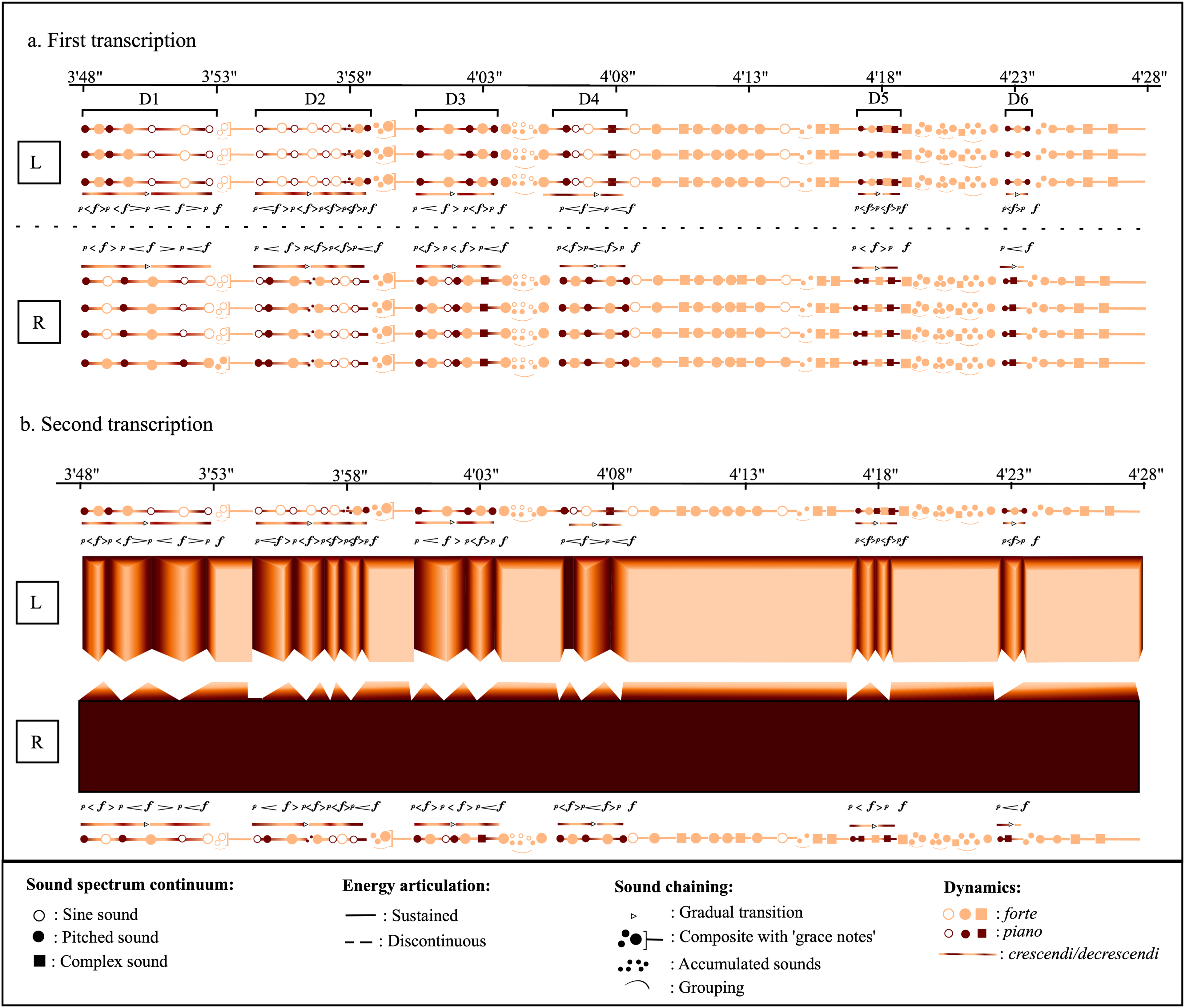
Spectromorphological analysis of Zipangu’s Sound Pattern 4, 3′48″–4′27″.
Some readers may wonder why I refer to the Balinese kotekan technique instead of the Western technique of hoquetus or hocket. After all, the description of a hocket is very similar to that of kotekan, for it also is a rhythmic technique resulting in a single melody divided between two (or more) voices. In addition to reflecting my desire to be faithful to Vivier's unique musical background, using the term kotekan also underscores a feature that strongly impacts our perception of the excerpt. The hocket technique relies on the alternation of two voices, one resting while the other sounds. If Vivier had used this technique in Sound Pattern 4, this would only have affected what I identify as “lateral” spatialization: the melody (and its related harmonic structures) would have traveled from right to the left (and back again) throughout. However, both graphs show that when one voice takes over in Sound Pattern 4, the other voice is not reduced to complete silence, but only a reduction in dynamics. The difference lies in the fact that in a kotekan, the two participating homophonic groups maintain their independence and trajectories, each articulating their own melody, and the emergence of the unifying melody results from the stark dynamic shifts or attack effects applied in alternation to the two group melodies. In addition to articulating a spatial counterpoint, this detail is important, for it contributes to a reduction in the listener's ability to identify the underlying melodic and harmonic entities but above all adds to the sense of spatial depth: forte sections are perceived as closer, while piano sections are perceived as further away, shifting distances that are reinforced by the constant liveliness of the texture. Within this context, the shifts of sound spectrum throughout the sound pattern can be considered as spatial structural agents, too. As argued by Stockhausen in one of his 1971 lectures, timbral modifications participates to what he referred to as “multi-layered spatialisation composition” (Stockhausen, 1989, pp. 105–108): complex, pitched, and sine sounds played at the same intensity level are thus perceived at different distances (information that I could not integrate within the graphs for the density of the texture does not allow for a precise description).
Looking closer at Sound Pattern 4's overall structure, one notices that the kotekan texture is only one part of the sound pattern, for its six desynchronized episodes (indicated as D1, D2, D3, and so forth on graph 5a) are interrupted several times by homophonic tutti. At first, the synchronized interruptions appear as short but strong disruptions which create stark textural contrasts with the textural liveliness surrounding them. However, further into the musical excerpt, the synchronized interruptions become longer and the desynchronized episodes shorter, to the point of a complete inversion of the process: from 4′08″ to the end of the sound pattern, synchronicity and complete homophony take over with only brief desynchronized interruptions. One could speculate that to disrupt the statistical texture with stark and loud homophonic tutti might be a way for Vivier to prevent the development of a “timeless” texture: as described by Jason Noble, a texture which “subverts or exceeds human information processing and embodiment points outside of human time, to timelessness” (Noble, 2018). Thus, I would argue that some sense of temporality is reintroduced through the stark contrasts as well as the progressive domination of homophonic tutti textures. This hypothesis is further reinforced when we take into consideration the nature of the synchronized interruption: the homophonic tutti progressively reduce the spatial dimension as structural agent to bring melodic and harmonic entities to the forefront as energy drivers and structural forces.
I would argue that this cross-fading process, which is reminiscent of the one articulating Sound Pattern 5, is the key to understanding how one can perceive Sound Patterns 4 and 5 as a unified “pattern of patterns” despite their highly distinct sonic identities and the new melodic/harmonic variation process observed at the beginning of Sound Pattern 5. First, both sound patterns use a cross-fading strategy to quickly evolve from one textural position towards another that was first introduced as “disruptions” before its morphological features take over and become structural agents. Second, Sound Pattern 4's cross-fading process prepares the listeners for Sound Pattern 5's opening by reaffirming the melodic-harmonic dimension as momentarily structurally dominant, narrowing if not annihilating the spatial movements, and slowing down the rhythmic pace. Finally, both of these sound patterns focus on similar sonic phenomena (i.e., an expanded sound spectrum continuum and spatialization), even though they are presented and articulated differently. The overall sound spectrum organization presents a mirroring strategy: Sound Pattern 4 first sets the emphasis on pitched and sine sounds and moves towards pitched sounds and complex sounds, while Sound Pattern 5 first displays stark contrasts with a strong emphasis on complex sounds, complemented by intermedial items, and then focuses on sliding the brighter part of the continuum from whisper-like sounds to sine sounds. The dimension of spatial distribution is also central, whether activated through a counterpointing strategy (i.e., kotekan), neutralized by a homogeneous and dynamically balanced tutti, or explored in a continuous gesture as presented in the final shift towards sine-like sounds at the end of Sound Pattern 5. Once again, since I consider that non-pitch-based sound features are essential to the structural organization of these sound patterns and influence the way we interpret their form, I cannot agree with Braes's label of this “pattern of patterns” as Variation 3.
Sound Pattern 1
The interpretation of the form as a theme and variations strongly relies on the opening melodic statement. Both Braes and Donaldson have emphasized the significance of the opening melody in shaping the listener's experience, and not just because it introduces the fundamental pitch material upon which the entire work is built. To Braes, this melody is structured in a way that evokes “non-occidental” imaginary lands through modal inflection, Indian rāga-like structures, and the long E pedal drone (Braes, 2003, pp. 41–43). Donaldson, interestingly, sees in the opening bars “an example of how the listener's attention moves from harmony, to pitch, and finally to melody, conceived as separate entities in a differential manner” (Donaldson, 2021, [5.3]). I also believe in the importance of this introductory melody.
Example 6 is my transcription of this segment, Sound Pattern 1. It represents the “relative” melodic contour which is played by the left group (six violins) in octaves above a low E drone played across four octaves by the right group (one violin, three violas, two celli and one bass). The drone is held throughout the sound pattern and keeps sliding back and forth from pitched sounds to complex sounds, which already introduces the granular dimension, with one exception: from1′07″–1′25″, the drone is played piano without granularity, a radical change emphasized by framing silences (1′05″–1′07″and 1′25–1′30″). The melodic unfolding also presents some of the morphological criteria discussed in my analyses above of the subsequent sound patterns. First, concurrent with the melodic expansion through stable and bending (variable) pitches, the first 30 measures explore rhythmic flexibility, culminating in a fast iteration produced by tremolo. As the melody grows, its formal segmentation and its development through repetitive patterns are reinforced by the use of stark dynamic contrasts (0′30″–0′50″). From 0′55″ to 1′40″, the melodic articulation pushes towards the attack-effluvium continuum, as it moves from pitched and straight sounds to complex and granular sonorities, passing through tremolo as well as towards sound spectrum variation with the insertion of a whisper-like sound. At this point, two interpretations are possible: either we hear these movements as “ornamental” events, or we recognize that Vivier subtly brings to our attention the existence of the underlying multidimensional space within which Zipangu operates. The rest of the melody pushes towards the strong cadential gesture (2′14″–2′19″), which I have graphed as a granular phenomenon of large coarseness with variable velocity. Because of the strength of the melodic unfolding, listeners might not be aware of the structural importance of these transformative strategies. Awareness will be retrospective, as the entire piece can be heard as an exploration of the sonic dimensions subtly alluded to in this first sound pattern. For this reason, Sound Pattern 1 could be considered as the starting point of the processes spanning the subsequent four patterns that I have discussed above.

Spectromorphological analysis of Zipangu's Sound Pattern 1, 0′00″–2′19″.
Conclusion
The problem of scholarship on Vivier is not a lack of awareness of the sonic complexity of his music, but rather that analytical demonstrations have mostly been developed based on visual supports (scores) that do not encourage the exploration of this complexity. Somehow, Vivier's fascination for melodic Kerne has benefited from this analytic bias, for it provided a fertile soil for scholarly explorations while at the same time delaying the moment when we would realize that the frame was not exactly fitting. Thus, before the music analyst follows Lewin's approach of “point[ing] out things in the piece that strike him as characteristic and important (whereby ‘things’ one includes complex relationships), and arrang[ing] his presentation in a way that will stimulate the musical imagination of his audience,” I would argue that the analyst's first task should be to go through an Husserlian epoché and let his experience (informed by related research) define the tools, methods, and visual representations he feels are necessary. This is especially important since certain tools have become so natural to us, a second nature, something that now is part of our “identity.”
This issue is certainly not new, and I would even be tempted to admit that this challenge is part of what makes the practice of analyzing contemporary music so stimulating. For a few decades, it has become commonplace to use signal analysis to overcome the limitations of score-based analysis. Spectrograms and audio descriptors offered (and still offer) a visual support which prevents analysts and listeners/readers from relying too much on scores, bringing the analyst to focus on the sounds as phenomena and revealing aspects that were, for a long time, not graspable. However, given their inability to take into consideration human perception as well as their tendency to offer only representations that are either too global (spectrograms) or too selective (audio descriptors), I could not use these visual representations to develop analytical comments linked to the formal implications of the distribution of non-pitched material. In addition, it would be an epistemological misunderstanding to consider that to be accepted as “scientific” and reliable, music analysis needs to rely on the most “objective” tools. As I mentioned earlier in this essay, subjectivity (and the ability to express it) is inherent to (and required for) music analysis practices: analysis always expresses specific points of view. To me, objectivity in music analysis is expressed through the analyst's choice of methods and ability to argue and find strong support for interpretations that will convince his peers to endorse part or all of his proposition. Thus, with its reliance on phenomenological procedures and its acknowledgedly subjective nature on the one hand and its ability to offer a new way to conceptualize musical phenomena on the other, Schaeffer's new solfège and its related analytical methods appear to have anticipated all the challenges that we, as music analysts, are facing now. Being conceived at a time of sensory and aesthetic revolution, it offers means to help listeners become aware of their cultural and educational biases, to momentarily take distance from the score, and to engage with music “on its own terms.” By reconsidering the very fundamentals of our practices, theories, and concepts, Schaeffer successfully gave us the tools we need to “deconstruct” it and to “unlearn” if necessary.
Schaeffer's project is not a theory, and that is exactly its strength. It recognizes cultural, geographical, and historical diversity, and thus does not aim to reveal a secret about “music” as a whole. Anyone interested in analyzing music and sounds from any origin should find in Schaeffer's typomorphology a fertile ground to start engaging with the material with “fresh ears.” What has often been dismissed as overwhelming and ponderous is, to me, a necessity. Music analysts must go through this process for it broadens our perspective on the sound object and refines our listening attention. Moreover, Schaeffer's rigorous description offers a new vocabulary, and its quest for exhaustiveness emulates a scientific approach which compensates for its phenomenological and thus subjective aspects: the more detailed and refined the analytical proposition, the more the analyst will be able to reconstruct his auditory experience and communicate it to a third party. It could be interesting to work towards the elaboration of a corpus of sounds that could serve as audio illustrations for each observed phenomenon. However, one must accept that those samples (I would imagine several illustrations for any one phenomena) might only be “indicators,” for no quantitative measures can be imposed for many of those phenomena. Furthermore, anyone interested in such a pioneering project should also keep in mind that our perception of sonic qualities is not absolute, but relative.
The TOM project being left incomplete, one of the music analyst's key tools—visual representation—has been missing for a long time. “One's person's misfortune is another person's happiness,” though. The strength of Schaeffer's proposition has been recognized for a long time by the field of electronic music. I would argue that this is not merely due to Schaeffer's pioneering role in the development of electronic music. The general lack of visual support and analytical tools made the challenge of developing transcription tools more pressing for electronic music scholars, leaving them little choice than to turn to Schaeffer (and later Chion's synthesis) despite the language barrier. The TOM's ideas have been explored in many ways and, thanks to this pioneering work, we now have inestimable resources. Among these propositions, the spectromorphological approach and symbolic notation developed by Thoresen is—to my knowledge—the most specific and flexible while maintaining a remarkable ability to present quite complex and sophisticated sound descriptions.
It is true that developing an analysis with these tools requires time for the analyst to transform his relationship to sounds and music, as well as to learn the symbols. However, this should not stop us, for we have all already had to go through a long training to master what has now become “traditional” notation. To evolve and to open new discussions, I would strongly advocate for the new solfège (perhaps in a lightened version) becoming part of conservatory and university curricula alongside “traditional” training. “Alongside,” for I recognize that “traditional solfège” (and its related concepts) will never fully disappear, for they have become—even when denied—part of the DNA of occidental music. Complexity is often what attracts us in any musical phenomenon and often is, at least to me, the catalyzer of the analytical process. Thus, one must be ready to resist any “smoothening” of musical reality and to embrace the challenge set by its irreducibility in order to “seize the life of its sounds.”
Adopting a spectromorphological perspective on Zipangu's first section has revealed the multidimensional counterpoint which articulates the piece's sonic richness. In addition to the pitch distribution, features such as sound spectrum, granularity, dynamics, and spatialization have been strictly organized and actively contribute to our appreciation of Zipangu's energetic drive and formal unfolding. The term “counterpoint” is borrowed from traditional musicology to express the idea that while most sound patterns in Zipangu engage with a plurality of morphological criteria, these criteria do not hold a definitive and fixed hierarchical function throughout the entire piece: rather, each sound pattern expresses a journey from one textural situation created by a specific hierarchy of structural forces to another textural situation resulting from a reordering of this hierarchy. Thus, my segmentation of Braes's Variation 1 into two distinct sound patterns is based on their distinct spectromorphological structure and deployment of criteria: in Sound Pattern 2, priority is given to melodic and harmonic elements, with granularity and sound spectrum heard as “secondary” gestures supported by dynamics and spatialization, while in Sound Pattern 3, this hierarchy between pitch on one side and granularity and sound spectrum on the other side is reversed. And if I propose to group these two sound patterns together into a pattern of patterns, this choice does not rely solely on a harmonic prolongation. It depends heavily on the trajectories of the multidimensional counterpoint, for the subversion of the Value/Characteristic dualism in Sound Pattern 3 can be heard as the result of a process initiated in Sound Pattern 2. Similarly, while I do agree with Donaldson's segmentation of the next section into the implicit labels Variation 2 and Variation 3, the rationale behind my choice again does not rely on pitch distribution only: Sound Pattern 4 first sets the emphasis on spatialization—in both lateral (left/right) and depth dimensions—through dynamics and sound spectrum extension with granularity and pitch structures as secondary characteristics, a hierarchy that is reversed for the second part of the pattern. Finally, sound spectrum (extended) and pitch distribution are central to the opening of Sound Pattern 5, with the dynamic shifts emphasizing the contrasts in sound spectrum, while the final gesture focuses on shades of sound spectrum shades and a spatial “slide” as the spectral change spreads progressively from one side of the stage to the other. Because both sound patterns share similar structural features and Sound Pattern 5 can be heard as a consequence of Sound Pattern 4's textural transition, I propose to group those two sound patterns into a new pattern of patterns. However, this new segment should not be confused with Braes's designation as Variation Two, for while our segmentations may share the same boundaries, they do not refer to the same features.
Even though my segmentation does partially align with the segmentations proposed by Braes and Donaldson, either as sound patterns or patterns of patterns, my analytical observations show the limitations of conceiving Zipangu's form solely from the perspective of a theme-and-variations model. This can be further demonstrated as we look at sound patterns’ connections beyond the boundaries created by a division into variations. For example, if we decide to listen to the four sound patterns in sequence while paying attention to a sonic feature other than pitch—let's say sound spectrum, spatial distribution, or even granularity—we will notice the strong continuity that connects all of the patterns together and contributes to bringing listeners into a state of active listening. One way to listen to this group of sound patterns is to focus on its progressive enlargement of the sound spectrum continuum, first playing with the three “fundamental” types of sound spectrum—pitched sounds, dystonic sounds, and complex sounds (Sound Patterns 2 and 3)—then extending the continuum to include sine sounds and intermediary positions such as pitched sounds with saturated spectrum and whisper-like sounds. Throughout this journey, these features are organized according to different strategies that reveal the different functions of sound spectrum: its ability to explore liminal zones (Sound Patterns 2, 3, and the second part of 5), to carve out spatial depth (Sound Pattern 4), or to create strong expressive contrasts (Sound Pattern 5). Alternatively, we could decide to focus on the spatial distribution, which starts to really take on a structural function in Sound Pattern 3. Starting in a secondary function (supporting other morphological transformations in Sound Pattern 2), it reaches a sort of climax with Sound Pattern 4's initial energetic texture, whose rhythmicity is mostly due to the fast alternation between sub-ensembles. Within such an interpretative frame, the return to a homophonic texture, which could be heard as presenting the extreme opposite end of the spatial dimension's continuum, emulates a “release” gesture that prepares the listeners for the final right-to-left spatial gesture of Sound Pattern 5. Finally, granularity can also become a phenomenon shaping the way we interpret the entire group of patterns: as mentioned above, Sound Patterns 2 and 3 could be perceived as articulating Smalley's attack-effluvium continuum, which connects noise structures to rhythmic ones through the intermediary stages of grain and/or iterations. This process recalls Stockhausen's “zoom-in” strategies developed in the mid-1950s, introduced through his now famous metaphor of a swarm of bees (Stockhausen, 1963a, pp. 77–78) describing how the imperceptible “grains” progressively become distinct rhythmical phenomena. The highly energetic and rhythmic texture created by the kotekan could be heard as a further enlargement of this sound characteristic, and a point of rupture as well, since after this stage listeners go back to an auditive rescaling: when the homophonic texture settles in and lengthy sonorities are played, the focus returns to the granularity of sound objects. In sum, it would be possible to consider the entire group of sound patterns as a unified segment, one that progressively unfolds different structuring and formal agents of the piece to listeners. My analysis of Sound Pattern 1 confirmed this proposition, for alongside the presentation of the melodic material, it also subtly introduces spectromorphological features that become central to the auditory experience offered by Zipangu.
Should we then totally abandon the idea of “theme and variations” as we speak about Zipangu's form? And if so, how should we understand or label the piece's form? As demonstrated by Braes's thorough investigation, it is undeniable that Vivier's initial compositional strategy consisted of the elaboration of a structural skeleton based on a “theme and variations” procedure articulated by the melodic and harmonic content. However, such an interpretation does not acknowledge an important aspect of the piece's sonic identity nor, I would argue, its multidimensional energetic drive. At this stage of the analysis, it would be premature to propose a new formal frame, for it would first require engaging with the entire work before offering a new interpretation. Nevertheless, as a music analyst specialized in contemporary music, especially post-war European serialism as developed by Henri Pousseur and Karlheinz Stockhausen, my future investigation would follow two leads: one would be the concept of formal “bidimensionality” or “two-dimensional” form; the other would be Stockhausen's concept of vieldeutige Form or polyvalent form. The concept of bidimensional form is traditionally used to describe compositions which can be interpreted from two formal perspectives. The most common expression of this formal ambiguity is what Steven Vande Moortele identifies as “two-dimensional sonata form,” which is “the combination of the three or four movements of a sonata form within an overarching single movement sonata cycle,” an approach that was quite common in the late nineteenth and early twentieth century occidental music repertoire (Vande Moortele, 2009, p. 268). This formal flexibility, as well as many features observed in the previously discussed excerpts—multidimensional counterpoints and the exploration of liminal zones—points toward the 1950s–early 1960s compositional theories of Vivier's mentor, Karlheinz Stockhausen, especially his concept of vieldeutig Form which embraces the multiplicity of formal interpretations (Stockhausen, 1963b). Either way, instead of choosing one formal interpretation over the other, perhaps we should accept this formal ambiguity and complexity as being part of Vivier's Formenlehre.
Footnotes
Acknowledgment
I would like to thank the two anonymous reviewers of this article manuscript for their comments, questions and suggestions which have contributed to bring my work to its final shape. I would also like to express my gratitude to Robert Hasegawa for his diligent proofreading. This research draws on research supported by the Excellence Initiative of Aix-Marseille University, A*Midex, a French Programme d’Investissements d’Avenir, AMX-19-IET-005.
Action Editor
Kai Siedenburg, Signal Processing and Speech Communication Laboratory, Graz University of Technology.
Peer Review
Christopher Goddard, University of Florida One anonymous reviewer.
Ethical Approval
This research did not require ethics committee or IRB approval. This research did not involve the use of personal data, fieldwork, or experiments involving human or animal participants, or work with children, vulnerable individuals, or clinical populations.
Declaration of Conflicting Interests
The author declared no potential conflicts of interest with respect to the research, authorship, and/or publication of this article.
Funding
The author disclosed receipt of the following financial support for the research, authorship, and/or publication of this article: This work was supported by the Programme Investissements d’Avenir, Initiative d’Excellence d’Aix-Marseille Université – A*Midex, (grant number AMX-19-IET-005).

Data Availability Statement
Data sharing not applicable to this article as no datasets were generated or analyzed during the current study.