



Abstract
In this close analysis of the song “ringtone” by 100 gecs, I unpack the dialectic of noisy and clean timbres, exploring this theme narratively, acoustically, and cognitively. My account, which serves as both a music theoretical and methodological case study, explains how two opposing timbral qualities—the clear, clean sound of the ringtone motive and the noisy, distorted timbres in the bass and voice—underscore the dynamic emotional contour of the lyrical narrative, at first supporting it and later, undermining it.
I apply music theoretical approaches in conjunction with Wallmark's ASPECS model (Act, Sound, Perception, Experience, Conceptualization, Sign) as a framework for integrated analysis. First, I offer a timbral reading of “ringtone” using formal and functional layer analyses. Correspondences between my perceptions as an analyst and measurable features of sound are then examined via audio feature extraction using Timbre Toolbox and MIR Toolbox, revealing relationships between perceptual and acoustical noisiness, as represented by inharmonicity, auditory roughness, and normalized spectral centroid. Next, I adopt perspectives from embodied cognition and psychology to illustrate timbre's multivalence, explaining how the distortion in “ringtone” can simultaneously signify emotional distress and be experienced as pleasurable for listeners. I address conceptualization and signification through discussion of the contrast between the corporeality of inharmonic, noisy timbres and the immateriality of the virtual world as represented by the sine quality of the ringtone motive.
More broadly, the analysis demonstrates how timbre conveys meaningful information that can engage with a lyrical narrative. Integrating methods from multiple disciplines (music theory, cognitive science, music informatics, and semiotics) provides emergent insight into the semantic flexibility of timbre that is not available via any single disciplinary perspective.
Keywords
Introduction
In 2019, Dylan Brady and Laura Les of the duo 100 gecs released their first studio album, titled 1000 gecs. 1 One trip through this 23-minute eclectic musical adventure is all it took for me to develop an obsession with the timbral pandemonium of the sonically dense world of 100 gecs. Reviews for the album and interviews with the artists are preoccupied with the duo's unrestricted palette of sounds. Critic Anthony Fantano of The Needle Drop deemed 1000 gecs to be “one of the weirdest and wildest combinations of sound I’ve heard all year” (2019), while a writer for MTV fondly characterized the album as a “sonic clusterfuck” (Roth, 2020). A review for Pitchfork described 100 gecs as sounding “like a bunch of fireworks stuffed into a fax machine, or human beings singing in the key of dial-up” (Fitzmaurice, 2019), and Paper Mag explained the band as “a little bit of everything and the kitchen sink rolled into an auditory meme-coated taquito” (Moen, 2019). Reviews inevitably reference the album's unabashed potpourri of musical styles, mentioning genres including bubblegum pop, Eurohouse, hip-hop, trance, J- and K-pop, emo, metal, pop-punk, indie pop, nightcore, ska, dubstep, deconstructed club, happy hardcore, screamo, and more (e.g., Enis, 2019; Fitzmaurice, 2019; Moen, 2019; Watson, 2020). This attention to genre-hopping is further evidence of the perceptual importance of timbre in the album. While multiple musical parameters are at work in successful genre signification, timbre is the most immediately evident: previous research has demonstrated that listeners are able to categorize musical excerpts by genre in less than half a second (e.g., Gjerdingen & Perrott, 2008; Krumhansl, 2010).
Critics widely consider 1000 gecs to be exemplary of the genre of hyperpop. Initially scene-led rather than genre-led, hyperpop is often associated with internet culture and queerness, with many artists and fans identifying as part of the LGBTQ + community. Regarding hyperpop's status as a genre, however, Spotify is responsible for the commercial codification of the style via playlists (Madden, 2021). The Independent describes hyperpop as, “a self-referential, humorous, and excessive brand of pop music…enthralled with taut, squeally synth melodies and Auto-Tuned earworm hooks, but also surrealism, nostalgia for the apparently bygone internet age of the Noughties, and distortion” (Pritchard, 2020). Larson (2023) identifies stylistic markers of hyperpop, including vocal manipulation and the subversion of normative formal, harmonic, rhythmic, and metric conventions, demonstrating how queer aesthetics are musically manifested in the style through these practices.
Hyperpop is also associated with the use of harsh and distorted production techniques. Such timbres are ostensibly employed for various compositional purposes and result in diverse phenomenological responses. Here, I focus on how noisy and clean timbres engage with narrative meaning in a case study of the song “ringtone” from the album 1000 gecs. With this analysis, I aim to unpack the semantic flexibility of such timbres within the song, identifying how timbral signification can take place on multiple levels.
I ground this analysis in Wallmark's ASPECS model (2022), a representation of sound production and timbre cognition. ASPECS (Act, Sound, Perception, Experience, Concept, and Sign) comprises six “distinct but overlapping moments…in more or less their order of phenomenal unfolding” (p. 17; cf. Figure 0.3, p. 18).
Wallmark observes that humanistic approaches tend to focus on act and sign, whereas scientific methods tend to address sound, perception, experience, and conceptualization. Unpacking this further, we can loosely identify some sub-disciplines that are associated with various elements, for example: musicology, semiotics, cultural theory (act, sign), acoustics (sound), psychoacoustics (perception), cognitive science (experience), and music cognition and cognitive linguistics (conceptualization). Each of these fields offers a multitude of potential methods. As such, the ASPECS model provides a structure for interdisciplinary music analysis—a framework for connecting results from divergent methods and insights from a range of disciplines.
Scholarly interest in timbre is relatively new. Research in psychoacoustics, psychology, and other related fields during the last half-century has contributed to our understanding of timbre perception and cognition, while timbre scholarship within Western music theory has only gained traction even more recently. Although interest in timbre analysis has risen in the past few years, published analyses of individual musical works are still rare. As music theorists increasingly engage with timbre and develop relevant analytical methods, we should consider how scientific knowledge of sound and timbre informs and is informed by humanistic pursuits in music analysis. Applying methods from across multiple disciplines provides emergent insight into the semantic flexibility of timbre and the complexity of timbral signification that is not otherwise available via any single disciplinary perspective. Interdisciplinary analysis allows for the observation of converging evidence from multiple approaches, which can yield more robust accounts.
This analysis serves as both a music theoretical and methodological case study. First, as a music theoretical case study, the work is distinctive in its attention to timbre, engagement with hyperpop, and novel integration of methods. My music theoretical analysis aligns with Lochhead's philosophy in Reconceiving Structure in Contemporary Music (2015, pp. 68–102). Central to Lochhead's account of productive analysis is the concept of a musical mapping, which is the product of personal engagement with a work; such analysis produces new knowledge about the work and generates, “new forms of musical behavior.” The purpose of this paper is to trace a path from sound through signification, using my music theoretical reading of “ringtone” as a reference point. The account provides both a close reading of a particular song and, more generally, exemplifies how timbre can convey meaningful information that can engage with a lyrical narrative. To articulate the scope of the analysis, I will clarify that my aim is not to make claims about composer intent. I do not intend to offer a prescriptive hearing, or to propose that I am representing the experiences of any listeners other than myself. I do not argue that the specific case I make for structure, timbre, and meaning in “ringtone” is generalizable; this analysis represents only one of many ways in which these elements can interact. While I recognize that mechanisms similar to those I identify here may be at work in other songs, I leave this topic to future research.
The second main contribution of the paper is to demonstrate a novel approach to integrating concepts from music information retrieval and cognition in analysis. The methods I use to analyze “ringtone” in this paper borrow acoustic and timbral analysis techniques from music theory, informatics, cognition, and semiotics. As a methodological case study, the paper offers insight into how analysts can connect individual musical experience with measurable properties of sound and a more general understanding of cognitive processes. This work illustrates some of the many complexities of the journey from sound to meaning, taking into account the critical roles of culture and experience.
In addition to providing a detailed analysis of “ringtone,” which I hope will inspire more timbre-centered analysis in scholarship and the classroom, I intend for this paper to open a space for critical discussion of interdisciplinarity in timbre research, particularly with regard to music analysis. Throughout the course of this timbral analysis of “ringtone,” I engage with multiple facets of the ASPECS model from different disciplinary perspectives. This strategy increases understanding of the complexity of timbral experience by revealing how, in a given work, the elements of ASPECS may be aligned or at odds with one another—a productive interaction that contributes to the richness of musical experience.
Analysis I: Timbre, Form, and Meaning in “ringtone”
The lyrics of “ringtone” reflect the protagonist's roller coaster of emotions about a crush, from happiness to obsession, frustration, anxiety, and disgust—and, questionably, back to happiness. Though the emotional narrative is clear, the text remains ambiguous as to whether the protagonist 2 is ever romantically involved with the love interest, or whether this cycle of emotions happens in the context of an unrequited crush. Two opposing characteristic timbral qualities—the clean sine quality of the ringtone motive and noisy, distorted timbres in the bass and voice—underscore this lyrical narrative. Timbral and textural changes also help to define large-scale formal sections, while timbral continuities and discontinuities within textural layers reinforce the hierarchical phrasing of the lyrics. Other musical parameters remain relatively constant throughout: the manically upbeat tempo, the obsessive harmonic loop, and the perfectly regular phrasing. Nearly everything of musical interest happens with timbre and texture, which both drive the track's energy and interact with the emotional narrative of the lyrics. The intense, surface-level repetition of melodic, harmonic, and rhythmic elements contrasts with a developmental emotional trajectory, as reflected in the text, that is shaped by timbre and texture.
Timbre at first supports the lyrics: timbres in the bass line and voice reflect the singer's emotional journey, where noisier timbres are associated with greater tension and more negative emotions, parallel to those expressed in the lyrics. These more distorted timbres contrast with the electronic sine timbre of the ringtone motive, a short melodic fragment imitating a phone notification. This sonic element complements the story told by the distortion: the clean sound of the ringtone appears often through the happier sections of the song, becomes less frequent as lyrical anxiety is introduced, and disappears as emotional tension rises. The reinforcement of these connections throughout the song—sine timbres with positive emotions and distortion with negative emotions—enables timbre to subvert the lyrics at the end of the song. Whereas the text of the final chorus suggests a return to a positive emotion, increasing distortion—the addition of timbres previously associated with angst and bitterness—suggests an alternative interpretation, which is also supported by the disappearance of the ringtone motive.
To illustrate this interplay of timbre, texture, and lyrical content throughout “ringtone,” I use functional layers as introduced by Moore (2012) and augmented by Lavengood (2020). Moore proposed four functional layers that tend to be present in popular music genres, including the explicit beat layer, functional bass layer, harmonic fill layer, and melodic layer. Lavengood adds to this model a fifth layer, called the novelty layer. The novelty layer, which typically contains melodic material and is used for coloristic effect, functions in opposition to the melodic layer. Figure 1 visualizes the form of the song in parallel with my formal, textural, and timbral analyses, accompanied by the lyrics as quoted from genius.com. More saturated colored boxes represent textural layers with higher perceptual noisiness as compared to other sounds within that layer.

Formal and functional layer diagram of “ringtone”. The bubble diagram on top represents the song's formal structure, with the lowest level corresponding to four-bar phrases. The functional layer chart underneath aligns with the bubble diagram. Within the novelty layer, phrases are parsed into individual bars, to identify the location of the ringtone motive, as represented by the asterisk. More saturated colors indicate increased perceptual noisiness throughout the phrase. Color saturation in the melodic and explicit beat layers represent two levels of noisiness, whereas I have summarized the functional bass layer with three general levels of noisiness.
The lyrics of the first chorus (C1), first verse (V1), and second chorus (C2) are positively valenced, expressing the excitement of receiving messages and calls from a love interest. As illustrated in Figure 1, these first sections are musically characterized by relatively little distortion and regular interjections of the ringtone motive. The song's introduction is sparse: the eventual bass line, evocative of the elongated push of a phone keypad, is layered over kick drum and snare in the explicit beat layer. As the voice enters in C1a, the ringtone motive first appears. The electronic, clean timbre of this motive, created with sine tones, is placed in a higher register than the eight-note bass pattern that opens the song. Lyrics in C1 and V1, paired with upbeat musical features and clean texture, suggest giddiness as the artist expresses a positive response to the crush's unique ringtone. In C2, the bass timbre is varied for the first time (pitched up an octave), a “stomp” effect is added to the articulation of the bass, and the hi-hat enters. The timbral and textural changes in these first three sections are relatively subtle, creating musical interest but not yet following a narrative trajectory.
Lyrically, the next three sections of the song take an emotional turn, underscored by the notable addition of distorted timbres. 3 Bridge 1 (B1) destabilizes the previous elated mood, revealing that the custom ringtone is not the product of a happy relationship as a listener might be likely to assume (from the possessive “my boy”), but rather is evidence of an obsessive crush. The ringtone even seems to be part of a ploy to draw the crush's attention (“it's my way of trying to let you know / I’ve got a little thing for you, I’ve got a little crush or something…”). This section represents the first major shift in the song, both timbrally and affectively. The familiar bass timbre gives way instead to electric guitar with distortion, creating a harsher, crunchier sound. Ringtone fragments are less common in B1, now only appearing once in each four-bar phrase, another clue as to the disintegrating emotional stability of the narrator.
V2a reverts narratively to the positive affect of the beginning of the song, supported musically by a return to the initial timbres and textures. However, the lyrics are quickly drawn back into increasing levels of anxiety in V2b: “Talkin’ to myself again, Falling on broken glass / 29 missed calls, never leave the basement, I don’t wanna tell you what I’m really thinking.” This anxiety approaches its climax as the kick drum punctuates each eighth note, evoking a pounding heart, and the bass leaps up an octave. V2b marks the first time that the ringtone motive fails to appear, perhaps signaling a lack of response from the singer's crush.
This negative momentum carries into B2a, where the emotion expressed is now disgust at the sound of the ringtone (“I used to love that ringtone when you called me / now it makes me sick”). In parallel, distortion amplifies the emotional charge of this section. In the functional bass layer, the synth bass takes on an increased quality of grittiness. The melodic layer—the voice—is also highly distorted, suggesting more intense negative emotions. In B2b, these timbral cues are exaggerated even further. A harsh stomp effect blends with the articulation of the sustained bass, creating an emergent timbre in the functional bass layer that, on my hearing, registers as noisier than the previous bass variant. Another “clap” effect joins the kick drum in the explicit beat layer, also contributing to the overall crunchy feel of this section. The impression of an increase in timbral noisiness is complemented by the complete absence of the clean electronic sound of the ringtone motive.
The song ends by abruptly recapitulating the happy chorus (“My boy's got his own ringtone / it's the only one I know, it's the only one I know”), potentially indicating a resolution or return of feelings. The distortion lifts as the song swerves back to the optimism of the chorus, supported by a full timbral and textural return. C3a pairs Laura Les's autotuned voice with the octave version of the bass, without percussion. The texture of this chorus iteration is the lightest within the song, identical to that of C2a, and includes two instances of the ringtone motive. Lyrically, the song simply finishes with three iterations of the chorus—attending solely to the text, it is as if nothing ever happened. However, although the lyrics give us no further narrative information, the timbre does. As the chorus repeats, the texture thickens with edgier timbres, and the ringtone disappears. C3b adds hi-hat and the stomp effect from B2b. Distortion in the voice and bass are layered back in for C3c, the final repetition of the chorus, which is timbrally most similar to B2b (“Used to love that ringtone when you called me / Now it makes me sick”). Thus, the song ends with competing emotional cues: the positive lyrics of the chorus are set to the timbres and textures of the angst-ridden second bridge, betraying the singer's frustration and resentment. In sum, the clean, clear, electronic timbres of the ringtone and the gritty, harsh, rough timbres of the distortions work together throughout the song to underscore—and eventually undermine—the lyrical narrative.
In the following sections, I bolster the account above with perspectives from informatics and cognition to further elucidate timbre's functionality. I first closely consider the context and likely mechanisms by which my interpretation takes place. How are perceptions, experiences, and concepts directly related to the sounds themselves? How are acoustical properties connected with processes of music cognition? How does context frame semantic interpretation and musical experience? Which forces drive the creation of meaning, from embodied experience to society and culture?
To address these questions, I use analysis of audio features to uncover specific connections between properties of sounds and my music theoretical analysis. To examine links among sound, perception, and experience in “ringtone,” I analyze the timbral variation of the bass line with respect to relative perceptual and acoustic noisiness. I then more broadly consider experiential and conceptual aspects of clean and noisy timbres, citing work by Wallmark (2022) to explain how the processing of noisy sounds via bodily image schematics can signify arousal, exertion, and corporeality. In contrast, cleaner timbres such as the sine wave are void of evidence of their physical origins; here, I discuss the ringtone motive's flexibility in signifying both the virtual world and a physical phone. These considerations demonstrate how clean and noisy timbres, as linked to embodied meaning, can vary in signification depending on context and the listener.
Analysis II: Connecting Semantics and Acoustics
In carrying out my initial analysis, I was intrigued by the way in which timbre and texture motivated energetic differentiation and progression against a relatively static melodic and harmonic background. I conjectured that the levels of noise I perceived in each section of the song were driven in large part by the varied timbres of the bass, added distortion in the voices, and to a lesser extent, the density of noisier percussion timbres.
To investigate this idea, I identified and labeled eight versions of the bass line, presented in Table 1. In the introduction of the song, the timbre of the bass pattern is clear, clean, and electronic—the same sine tones used soon thereafter for the ringtone motive. 4 The most common version of the bass line, which I refer to as “standard,” is instantiated as a round, dark, quasi-plucked sounding timbre, either synthesized or heavily processed. Other versions of the bass line include a variant of the standard bass, labeled “octave,” which is higher in pitch register, brighter, and somewhat more metallic. The “sustained” version of the bass line is in the same register as the standard sound but sustains note to note with perceptually relatively darker and noisier qualities. The electric guitar occurs only in the first bridge as functional bass, which is also the only place where the contour of the bass line changes. The second iteration of this guitar line is doubled, resulting in increased timbral noisiness; I have labeled these two versions “electric guitar 1” and “electric guitar 2.” Both the standard and sustained versions of the bass have a variant in which a percussive “stomp” synchronized with the beginnings of the notes blends with and augments the attacks of the bass notes. 5 The eight timbral iterations of the bass line are presented in Table 1, where they are ordered from cleanest to noisiest, based on my subjective assessment as music analyst. 6
Timbrally distinct variants of the functional bass layer. The table includes a semantic description of the timbre and a list of the sections in which the variant is heard. Timbral variants are listed roughly in order of perceptual noisiness, from least to most noisy, as determined during music theoretical analysis.
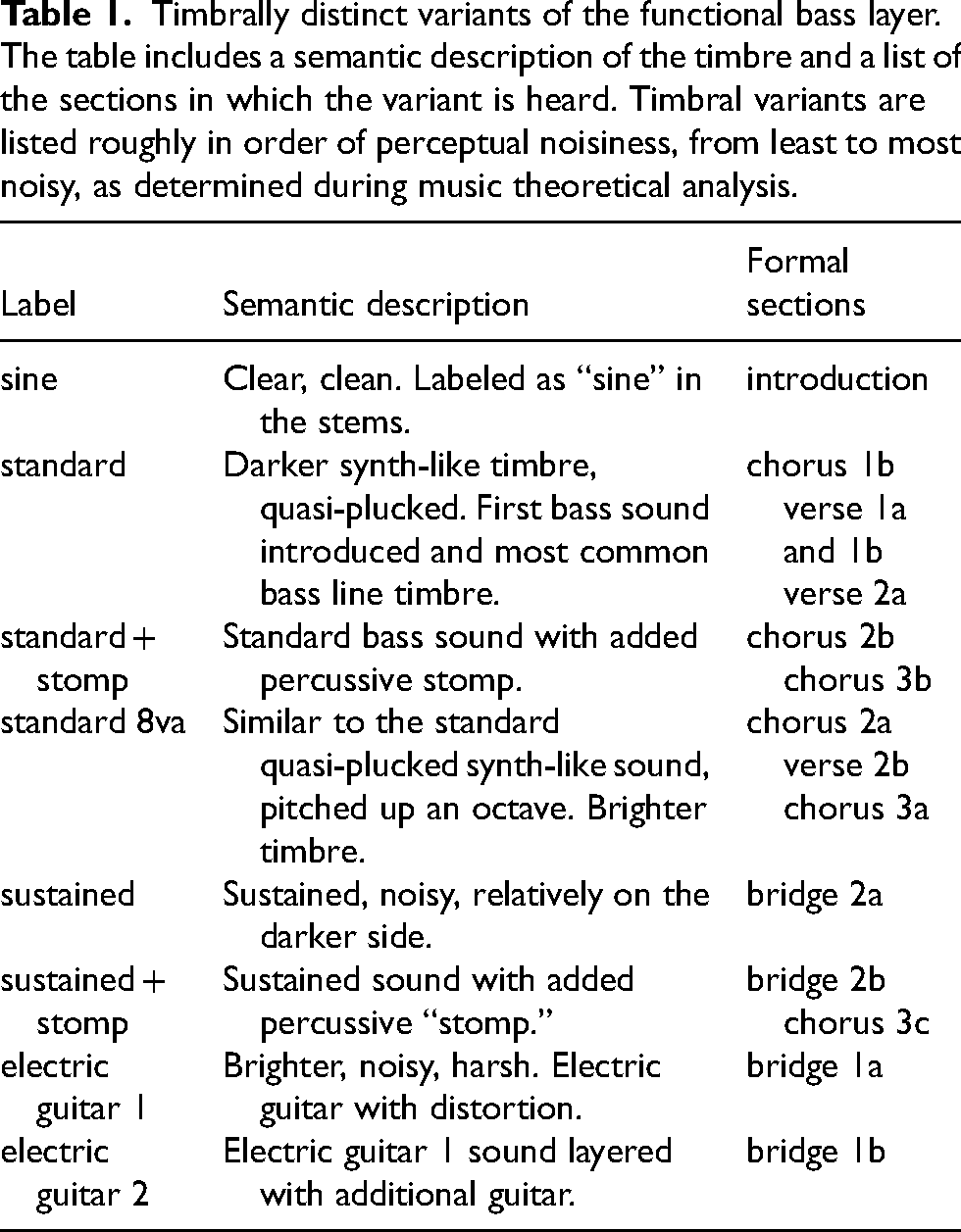
For the most part, I felt confident in these rankings, with the exception of the relative positions of the sustained and electric guitar timbres. In isolation, I hear the electric guitar timbres as the harshest, yet the sustained bass has a dynamically gritty, buzzy quality—with headphones, panning creates the effect of this buzziness swirling around from ear to ear, amplifying the sensation of noise. In their musical contexts, the sustained bass timbres contribute to the perceptually noisiest sections of the song, as they are augmented by highly distorted vocal timbres.
Comparing bass variants and lyrics in associated formal sections, it became apparent that the timbres that I heard as noisier are associated with more negative emotions in the lyrics, particularly in the bridges and final iteration of the chorus. Previous research has identified connections between musical timbres semantically characterized as noisy, harsh, or rough and acoustic noisiness as measured by audio features such as inharmonicity, auditory roughness, and spectral centroid (e.g., Reymore et al., 2022; Saitis & Weinzierl, 2019; Wallmark, 2022, pp. 18, 43; Zacharakis et al., 2014). These audio features have been implicated in judgments of valence, exertion, and tension. For example, studies have identified correlations between acoustically noisy sounds and valence as well as perceived physical exertion for isolated instrument sounds (Reymore et al., 2022; Wallmark et al., 2018). Using synthesized sounds, Farbood and Price (2017) found evidence that sounds characterized by higher inharmonicity and roughness elicited higher ratings of perceived tension. Similarly, Zacharakis and Pastiadis (2021) observed an effect of inharmonicity on perceived tension; the authors also identified a relationship between tension and judgments of perceived roughness. That is, research in timbre cognition has demonstrated general links between audio features and semantic judgments in certain contexts, suggesting that these audio features may reflect perceptual assessments. Accordingly, the goal of the next stage of my research was to determine whether analysis via audio feature extraction would be consistent with my initial music theoretical analysis.
Following the release of 1000 gecs, 100 gecs posted the stems for the songs online. 7 Figure 2 shows the individual stems imported as separate tracks, which I used to listen to and analyze individual functional layers, sound sources, and combinations thereof. The isolated stems also allowed for direct processing of single sound sources, circumventing the need for a sound source separation program. Audio feature analysis here focuses on a single, monophonic layer: the bass. The eight-note bass line appears in various timbral guises and repeats through almost the entire song, making it an excellent candidate for direct comparison of audio features. Using the stems, I created separate audio files of each version of the isolated functional bass line. For non-sustained bass lines (variants of the standard bass), I eliminated silence between notes, so as to extract audio features based only on the notes themselves.

Stems and labels for “ringtone.”.
I extracted time series data for spectral centroid and inharmonicity in Matlab with the Timbre Toolbox (Kazazis & McAdams, 2023; Peeters et al., 2011; PowSTFT representation for spectral centroid and HARM representation for inharmonicity) and roughness with the MIR Toolbox (Lartillot & Toiviainen, 2007; Lartillot et al., 2023). 8 These toolboxes analyze signals with input representations such as the short-term Fourier transform, then calculate audio features that reflect spectral, temporal, and spectrotemporal properties of the signal.
Inharmonicity, as calculated by the Timbre Toolbox, represents how much the partials deviate from a harmonic spectrum: it is “the weighted sum of deviation of each individual partial from harmonicity” (Peeters et al., 2011, p. 2909). As spectral centroid varies with fundamental frequency, I normalized spectral centroid by dividing spectral centroid by estimated frequency. Spectral centroid expresses how energy is distributed in the partials—it identifies the center of gravity of the spectrum—and has been associated with perceived brightness in previous research (e.g., Almeida et al., 2017; Saitis & Weinzierl, 2019). However, research by Zacharakis et al. (2014) suggests that the normalized spectral centroid, which I used here, may be more closely aligned with roughness than with brightness. 9 Roughness, from the MIR Toolbox, is an estimate of sensory dissonance in a sound based on behaviorally-derived models; here, the algorithm computes peaks of the spectrum and averages predicted sensory dissonance between all possible pairs of peaks.
I applied statistical analysis to identify significant differences among bass variants with respect to roughness, inharmonicity, and normalized spectral centroid. Kruskal–Wallis tests compared differences among median values, 10 revealing that at least one of the bass variants differed significantly from the others in terms of roughness, inharmonicity, and normalized spectral centroid (p <<.0001 for all three tests). Table 2 shows the bass variants ordered according to median, from low to high, for each of the audio features, with my initial perceptual rankings (least to most noisy) for comparison.
The eight bass variants, ordered with respect to four different criteria. “Perceptual ranking” shows my perceptual ordering for the variants, from least to most noisy. The same eight variants are ordered in the following columns by median values on each audio feature, from low to high.
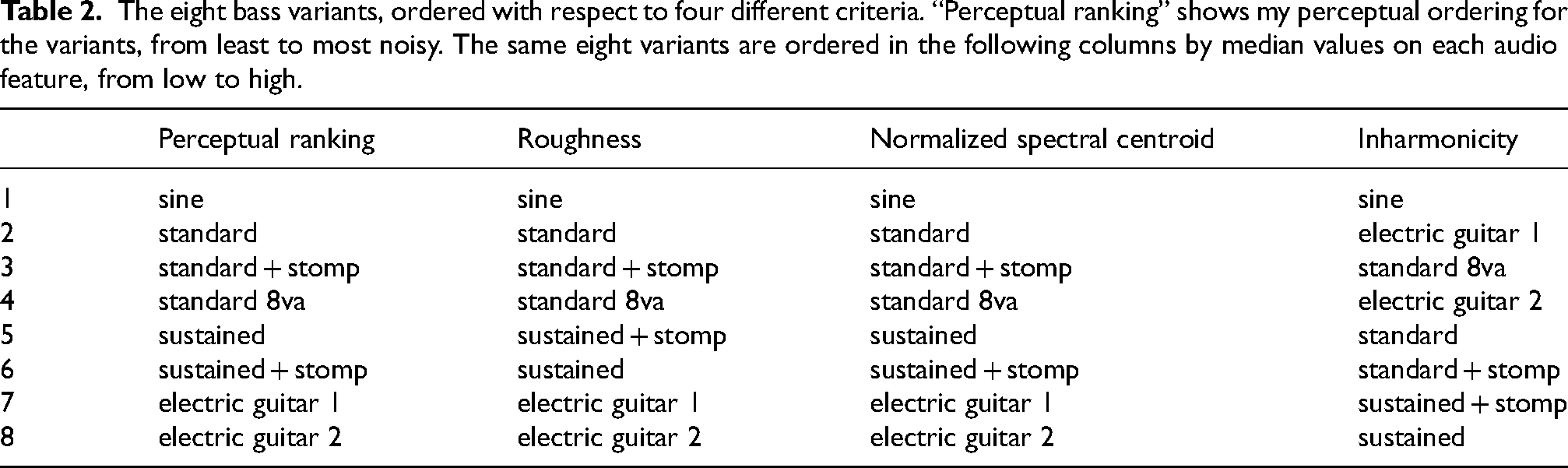
Pairwise Wilcoxon rank-sum tests assessed the significance of successive pairs within the rank-ordered lists in Table 2. 11 The Wilcoxon tests revealed significant differences between all successive rank-ordered median values for normalized spectral centroid and roughness. Adjacent pairs for inharmonicity were significant except for standard/standard + stomp (ranks 5 and 6) and sustained/sustained + stomp (ranks 7 and 8). The rank orderings for roughness and normalized spectral centroid correspond closely with the proposed perceptual ordering. Generally speaking, as my perceptions of noisiness increase, so do measurements of roughness and normalized spectral centroid.
The relationship between the perceptual rankings and inharmonicity is more complex. To simplify discussion, I refer here to electric guitar 1 and 2 as the electric guitar timbres, and sustained and sustained + stomp together as the sustained timbres. For roughness and normalized spectral centroid, electric guitar timbres rank highest, followed by sustained timbres. The sustained timbres also have the highest inharmonicity, whereas the electric guitars rank relatively lower in inharmonicity. Reymore et al. (2022) found that while spectral centroid was more relevant for participants’ perceptions of harsh/noisy, inharmonicity was more relevant for models of rough/raspy/grainy. Both categories seem to describe some kind of timbre with texture or grit. Yet, previous semantic studies suggest that these two categories are conceptually distinct (Reymore & Huron, 2020; Reymore, 2022; Reymore et al., 2023), which may relate to differences in audio feature profiles. Thus, the relative rankings of the guitars and sustained timbres in each of the three feature orderings offer a post-hoc explanation of my hesitation in deciding which of these timbres should be ranked as the “noisiest,” perceptually. Both are noisy-sounding timbres, in a general sense, but they exhibit two different types of noisiness, plausibly explained with the semantic categories harsh/noisy and raspy/grainy/rough.
In sum, audio feature analysis demonstrates that my perceptions of relative timbral noisiness in the bass line correspond with characteristics of the audio signal—specifically, normalized spectral centroid, roughness, and inharmonicity. To better understand these connections between sound and semantics on a perceptual and experiential level, the following section incorporates concepts from embodied cognition and psychology to elucidate how sound perceived as timbre can hold multiple, and even contradictory, meanings.
Perception and Cognition of Acoustically Noisy Timbres
The relationship between timbre and embodied cognition offers insight into the semantic flexibility of timbre in “ringtone.” Wallmark (2022) argues that the perception of timbre is motor mimetic, and that we thus experience timbre in terms of implied bodily actions. Because physiological arousal and exertion both cause vocal timbre to become acoustically noisier, noisy timbres may often act as an acoustical index for increased bodily effort. Beyond mere association, the mimetic hypothesis suggests that hearing vocal timbres (and potentially, by extension, instrumental timbres) involves subvocalization. Succinctly put, “If timbre is a perceptual aspect of tone, and if perception is inseparable from subject-environment interaction and sensorimotor engagement, then there is always already a material, corporeal quality to timbre perception, no less than in timbral production” (p. 38).
Associations between perceived noisiness and exertion have been observed in experiments with isolated sounds; Wallmark et al. (2018) and Reymore et al. (2022) found that participants associated noisier sounds with higher physical exertion and negative valence. However, context is critical. For example, Van Hedger et al. (2019) observed over the course of multiple experiments that preferences were not inherent to acoustic features: the recognition of a sound source as natural or urban affected the relationship between aesthetic preferences and perceptual features. With respect to music, many beloved genres are known for their frequent use of characteristically noisy sounds. 12 Wallmark calls on the psychological theory of appraisal to help explain the diverse range of reactions listeners can have to acoustically noisy sounds in music (2022, pp. 9, 35). Appraisal theory proposes that emotions result from evaluations, or appraisals, of our perceptions, explaining how the same physiological effect can be experienced as positive or negative in different contexts. As embodied listeners, noisy timbres may affect us in common ways, evoking a kinesthetic association with exertion and arousal, and physiological reactions in response to noisy acoustic properties may be appraised as positive or negative.
In everyday life, exertion and arousal can be appraised as either negative or positive. Exertion and arousal disrupt homeostasis, and they are useful in motivating survival by alerting us to threats and helping us to face or escape threatening situations. Yet physical arousal and exertion are frequently associated with activities that are deemed by many to be pleasurable, such as dancing, running a marathon or lifting weights, or screaming your lungs out at a 100 gecs concert. Similarly, even as noise may perceptually default to negative valence out of context, as suggested by Reymore et al. (2022) and Wallmark et al. (2018), variance in appraisal across different contexts leads to disparate emotions for listeners, affecting conceptualization and the generation of musical meaning.
The music of 100 gecs, and hyperpop more generally, is replete with perceptually noisy timbres; for fans, appraisal and context meet such that experiences of noisy timbres are highly pleasurable. “ringtone” is by no means unusual on the album for its use of distortion and noise—more extreme examples include “800 db cloud,” particularly during the last minute of the song, and the outro of “money machine.” This observation reveals an inherent dialectic at the core of my analysis: if fans appraise noisy timbres positively, how can timbral noisiness also act in “ringtone” as a signifier of emotional distress, a negatively valenced state? This apparent opposition can be accounted for by the potential for differentiation between embodied perception and conceptualization through appraisal, which allows for the flexibility and complexity of timbral meaning. If timbre perception is motor mimetic, acoustically noisy timbres are processed via bodily schemas and are thus associated with exertion and arousal. Accordingly, even when the noisy timbres in “ringtone” are appraised positively and are experienced as pleasurable by a listener in a musical context, embodied perceptions of noisy timbres still mimetically evoke tension and exertion; thus, from this more nuanced perspective, it is possible for noisy timbres to both contribute to a valued musical aesthetic and to signify imbalance and distress in a particular context.
The Virtual and the Corporeal
Timbre provides information about sound sources; we learn from experiences with the environment to interpret timbral cues and infer characteristics of sound sources. The ability to learn these connections is beneficial to our survival and flourishing, from being able to discern whether the animal rustling in the nearby bushes is threatening or not to construing emotion from the tone of a person's voice. Wallmark (2022, p. 175) emphasizes that we are fundamentally oriented to perceive sounds as indicating the presence of material things, and that timbre perception is circumscribed by and bound to our perception of its material source (see also McAdams, 1993).
Leydon (2012) addresses the narrative potential of the dialectic between pure harmonics and noise in the context of compositions in the 20th century, referring to works by Crumb, Stockhausen, and Varèse. She illustrates how transparency and purity associated with the sine wave are juxtaposed with the turbidity and corporeality of complex, and particularly noisy, timbres. In discussing the sinusoidal nature of isolated harmonics, Leydon writes that a harmonic is, “a sound that no longer bears any evidence of the physicality of its origins, since that evidence—resonances, formants, impedances—is only audible as a spectral feature, across a span of frequencies” (4.3). In contrast, musical sounds containing inharmonic partials recall their physical origins in a specific sounding object. From such contrasts, she identifies a narrative of purification that can be heard in works in a circumscribed contemporary style, where sinusoidal purity is the principal goal of the musical process. Spiritual transcendence is one shape this narrative may take.
At the conceptual level, both “ringtone” and the music considered by Leydon leverage a shared metaphorical mechanism: the corporeality of inharmonic noise v. the disembodiment insinuated by the sine wave. Although the contrast of sine and noise motivates narrative meaning in both, the significance of these timbres and their contexts are wildly different, allowing for the same contrast of corporeal and virtual timbral properties to generate distinct meanings and narratives.
In the 21st century, ringtones are infinitely customizable. 13 However, the ringtone motive in this song is crafted from sine tones; this simple timbre is evocative specifically of ringtones from the 90s and early 2000s, imbuing it with an element of nostalgia. In “ringtone,” sine timbres cut two ways. First, as Leydon describes, the sine is void of information about its materiality. This is a timbre that is impossible to reproduce vocally; while we might be able to mimic it, it ultimately resides outside of our schema of embodiment. Experientially, the sine bloops are incorporeal—or rather, in the context of this song, they are virtual, associated with the non-physical world of the internet. In general, sine waves do not evoke properties of the material that produces them. Yet, at the level of signification for the 21st-century listener, the clearly electronic sine bloops, along with the melodic and rhythmic properties of the ringtone motive, suggest a material sound source: our omnipresent cell phones. We thus have the capacity to simultaneously understand sine waves in this context both as virtual and as a symbol of a physical cell phone.
This dialectic between the physical and the virtual also reflects themes in the album related to the complexity of contemporary digital life. 100 gecs have described themselves as “super online,” a characteristic not only of the duo, but of their fan base as well. The album 1000 gecs was created in large part via email, and the group's first shows were in the Minecraft universe (Walker, 2020). Their music and lyrics are steeped in internet culture. Dylan Brady and Laura Les have made it clear in interviews that the theme of virtual life in their music is not intended as a critique or cultural commentary—rather, the internet is simply part of their lived experiences, which are expressed in their music. In an interview with The Outline, Dylan Brady is quoted with respect to the album's virtual themes, saying, “I think it's a comment on our own social media behaviors more so than trying to be some big social commentary.” Laura Les supports this point, saying, “I think a lot of people read that into the album. They think that it's a grand statement about the internet. If there is something like that there it's just because that's how we are. We’re just trying to be completely earnest—even if we’re being silly I think we’re being earnest” (as quoted in Enis, 2019).
As much as the gecs love the virtual world, their music addresses its challenges, too, as in “ringtone.” Laura Les is quoted in an interview with Rolling Stone as stating, “Phones being extremely overwhelming is something that we sing about a lot. Being frustrated a lot comes from an overload” (Blistein, 2019). This idea is affirmed even more explicitly in the remix of “ringtone” on the album 1000 gecs and the Tree of Clues, where Sarah Bonito sings, Throw away my phone, hide it somewhere no one knows Buried it in the ground, so it can never be found But I still hear it, I hear the sound of your ringtone It's a crime, why can’t I get you outta my mind?
In “ringtone,” the tension between technology's affordances for connection and its capacity to induce social anxiety is underscored by the two timbral characteristics considered in this analysis. On one hand, the ringtone timbre can signify technology and virtual connection. On the other, distortion can connote an interruption in communication, as manifested in the glitchy and garbled sounds that result from a weak signal. Thus, in “ringtone,” distortion can signify the particular 21st-century flavor of anxiety that surfaces when we become too obsessive over texts, notifications, and likes, feelings that are easily amplified when they involve matters of the heart.
Conclusions
In this close analysis of “ringtone,” I addressed the dialectic of noisy and clean timbres, exploring this theme acoustically, psychologically, and narratively. Wallmark's ASPECS model provided an advantageous framework to conceptualize and account for the complex and sometimes apparently contradictory roles timbre can play in musical experience. Interdisciplinary methods suggested by ASPECS demonstrated multiple facets of timbre's semantic flexibility—for example, the affective contrast between the pleasurable listening experience and the signification of emotional distress, or the dual capacity of the sine tone to represent both the immateriality of the virtual world and the physicality of the cell phone.
Ultimately, this analysis represents only some of many ways in which noisy and clean timbral qualities can function in music. Dimensions of timbral noisiness can contribute to perception of form, signify specific genres and sub-genres, or represent other high-arousal emotions. The visceral relationship between acoustically noisy sounds and physical exertion and arousal offers a natural connection between noise and tension, but the flexibility of appraisal means that noisy timbres can be experienced and interpreted in many ways and can contribute to diverse musical goals.
I anticipate this reading of “ringtone” will contribute to our search for meaningful ways to understand timbre's function in music, and I hope that it encourages scholars to explore novel interdisciplinary methods in order to better understand how timbres function constructively in diverse musics. In addition to providing an example of what timbre-forward analysis can look like, this work also demonstrates one possible form that interdisciplinary analysis can take. While my analysis began methodologically as a music theoretical analysis, approaches from informatics, psychology, and semiotics were integral in building an account of the song that can meaningfully grapple with timbre's complexity. As timbre research advances, wide interdisciplinary interest in this parameter offers an unparalleled opportunity for researchers from many fields to address questions from different perspectives using varied methods and to seek converging evidence from multiple approaches.
Supplemental Material
sj-zip-1-mns-10.1177_20592043241288333 - Supplemental material for An Interdisciplinary Timbral Analysis of “ringtone,” by 100 gecs
Supplemental material, sj-zip-1-mns-10.1177_20592043241288333 for An Interdisciplinary Timbral Analysis of “ringtone,” by 100 gecs by Lindsey Reymore in Music & Science
Footnotes
Action Editor
Asterios Zacharakis, Aristotle University of Thessaloniki, School of Music Studies.
Peer Review
Eric Smialek, University of Huddersfield, Music & Design Arts; One anonymous reviewer.
Data Availability Statement
Data sharing not applicable to this article as no datasets were generated or analyzed during the current study.
Declaration of Conflicting Interests
The author declared no potential conflicts of interest with respect to the research, authorship, and/or publication of this article.
Ethical Approval
This research did not require ethics committee or IRB approval. This research did not involve the use of personal data, fieldwork, or experiments involving human or animal participants, or work with children, vulnerable individuals, or clinical populations.
Funding
The author received no financial support for the research, authorship, and/or publication of this article.

Supplemental Material
Supplemental material for this article is available online.
Notes
References
Supplementary Material
Please find the following supplemental material available below.
For Open Access articles published under a Creative Commons License, all supplemental material carries the same license as the article it is associated with.
For non-Open Access articles published, all supplemental material carries a non-exclusive license, and permission requests for re-use of supplemental material or any part of supplemental material shall be sent directly to the copyright owner as specified in the copyright notice associated with the article.
