



Abstract
Musical absorption is a multi-dimensional phenomenon that has been understood in various ways, but is related to strong, immersive, and transformative musical encounters. For this exploratory article, we used a phenomenologically and psychologically informed questionnaire to measure audience members’ reports of musical absorption and affective experiences at the MusicLab Copenhagen research concert with the Danish String Quartet (DSQ). We aimed to examine the relation between musical absorption and (1) attention, mind-wandering, and senses of transformation; (2) affective phenomena of feeling moved or touched and awe; (3) social context, as determined by technological mediation of a livestream; (4) musical context (Beethoven, Schnittke, and folk music); and (5) motion. There were 91 participants in the live audience and 43 participants in the livestreaming audience, who completed questionnaires after each piece in the concert and who had their motion measured through an application that recorded accelerometer data from their smartphones. Drawing on methods from experimental psychology, we found that (1) being “absorbed in the music” was not related to mind-wandering, but it was related to a sense of positive transformation; (2) musical absorption was related to experiences of feeling moved, awe, connectedness, and enjoyment, and to being an “admirer” of the DSQ, as well as to being familiar with the music; (3) being at the live concert facilitated more musical absorption than watching the livestream; (4) the final concert section, containing a collection of folk tunes, promoted the most musical absorption; and (5) within the restrained movement dynamics of the live audience, motion trended as an indicator of an embodied experience of musical absorption. We use these results to engage in a phenomenologically informed and empirically enriched discussion of musical absorption and related affective and attentional dynamics.
Keywords
Introduction
The MusicLab Copenhagen with the Danish String Quartet (DSQ) research concert—an event combining music, science, and public outreach held in 2021—provided a unique opportunity to survey audience members’ subjective experiences (for more information about the event, refer to RITMO, 2024). Building on recent studies in music psychology and phenomenology (i.e., the philosophical study of the fundamental structures of the mind; Gallagher & Zahavi, 2008), the work detailed in this article responds to the need for further ecologically valid conceptual and empirical scrutiny of audience absorption and related experiences. We aimed to explore the relations between musical absorption and other subjective experiences, mental states, audience behavior, and concert and audience characteristics. Therefore, we formed an interdisciplinary team of phenomenologists, musicologists, and psychologists to accomplish this aim. This combination determined a novel focus on features that have been overlooked when examining absorption, notably resonances with motion, transcendental and affective experiences, and technologically mediated social context.
Musical absorption is a multi-componential phenomenon (Vroegh, 2024) that resists easy conceptualization and has been variously discussed in relation to deeply engaged musical experiences, altered consciousness (Herbert, 2019), agency, action (Høffding, 2019), senses of time (Silvia & Nusbaum, 2011), presence, musical meaning (Danielsen, 2019), attention, and mind-wandering (Høffding et al., 2024; Lange et al., 2017; Vroegh, 2019).
In this article—and in the dialogue between several pieces in the MusicLab Copenhagen special collection—absorption in the live concert setting is also brought into contact with affective concepts, notably kama muta (i.e., the emotion commonly labeled feeling moved or touched; Fiske et al., 2019), which has gained recent popularity in psychology research, and awe (Yaden et al., 2019). Absorption, kama muta, and awe are related through their ability to provide strong, transformative, experiences (Gabriellson, 2011; Yaden et al., 2017).
Conceptual Background
In this section, we present the conceptual background of key terms used in the article. We aim to provide an overview of how absorption, mind-wandering, self-transformation, and affect are related, and how these may affect audience experiences and behavior.
Absorption and Mind-Wandering
By musical absorption, we refer to a peculiar set of experiences when listening to music, in which one is both attending fully to the music and simultaneously experiencing a sense of being altered or strongly affected by it. Vroegh (2024) describes absorption as a “discrete-like state of consciousness” (Vroegh, 2024, p. 47) on the basis that while its characteristic dimensions—including heightened and effortless attention, diminished awareness of time, body, surroundings, and self—are only “temporarily stable” (Vroegh, 2024, p. 49), they are stable enough to maintain an integrity as a recognizable phenomenological system. A classic trope of musical absorption is that one is focused solely on “the music,” letting nothing else disturb one. At the same time, perceiving music can lead one to mind-wander—an attentional dimension that can be understood as a subcomponent of, or at least vitally related to, musical absorption (Vroegh, 2024). Listeners can mind-wander in ways that are essentially coupled to music and find that this can provide imaginative, emotional, and existential reorientation to their lives. Herbert has focused on micro-episodes of everyday music listening, and—also building on the original work of Tellegen and Atkinson (1974)—showed that musical absorption can be characterized by both a heightened sense of attention toward the musical display, and a heightened sense of mind-wandering, in which the music is not at one's attentional center (Herbert, 2011, 2019). Further, in their extensive analysis of attention in musical absorption, Høffding et al. (2024) build on the works of both Vroegh and Herbert, and examine why it would be the case that musical absorption, paradoxically, can include processes of both focused attention and mind-wandering. The answer lies—they suggest—in how musical engagement enables a specific coupling between intensive and selective aspects of attention. They offer a model of experiential modes that shows different kinds of mind-wandering and different allocations of attention. Departing from previous accounts of musical absorption, they argue for adopting the novel concept of mind surfing, to better explain the coexistence of intense attention and the split of attention into simultaneously occurring plural foci in musical engagement (Høffding et al., 2024). Taking these recent debates into account, it is clear that musical absorption is a multifaceted and complex phenomenon that allows for seemingly very different modes of attentional focus to co-occur.
Recent empirical work on musical absorption and mind-wandering (Schooler et al., 2011; Taruffi & Küssner, 2019) points to several key modes of attentional engagement. A first primary mode relates to attentional focus on environmental stimuli (in the context of the live concert, this includes aspects of the musical performance, audience activity, and other ambient elements), while a second concerns how attention can be decoupled from the environment and inwardly directed. In agreement with previous findings (Herbert, 2011), Vroegh's psychometric network analysis of musical consciousness points to vital associations between listener absorption and internal-directed attention that elicit visual imagery (Vroegh, 2024). Given that absorption and internal-directed attention can co-occur in musical contexts, “at least some forms of absorption and mind-wandering might be conceptually related” (Vroegh, 2024, p. 64)—a claim also found in Lange et al. (2017) (see Høffding et al., 2024 for an extensive discussion). An example of this at a concert could be that an audience member is attentive to and absorbed by the music and simultaneously daydreaming about memories or imagery evoked by the music. In a useful review of literature on music-evoked visual imagery, Taruffi et al. consider possible conceptual distinctions between several key terms used to understand imagination and internal-directed attention, notably music-evoked mind-wandering (Martarelli et al., 2016; Taruffi et al., 2017), musical daydreams (Herbert, 2011, 2018), and music-evoked autobiographical memory (Janata, 2009; Janata et al., 2007). These authors contribute to a pertinent discussion of the relations between different forms of internally and externally directed attention, mind-wandering dynamics, and musical absorption. Currently, there is little clarity and little consensus in this discussion (just as there is little agreement on the nature of mind-wandering, see Høffding et al., 2024; Seli et al., 2018). We explored these relations with the MusicLab Copenhagen audience. Despite the lack of consensus on a definition, there are consistencies between conceptualizations of musical absorption that can be used in its empirical measurement through the use of its label (i.e., feeling absorbed in the music), and other aspects of the experience, addressing attentional focus and temporal sense. With regard to mind-wandering, we chose to concentrate on aspects of internally directed focus, described as being absorbed in one's own world and the experience of daydreaming, though we recognize that this leaves gaps in operationalization when it comes to attentional dynamics and particular aspects of the experience, including autobiographical memory and personal concerns and goals.
Self-Transformation and Affect
Bringing absorption into contact with related concepts from psychology enables a richer exploration of embodied, affective, and perceptual dimensions of aesthetic experience. Recent publications investigating “aesthetic emotions” (Merrill et al., 2021) and “body perception” and awe (van Elk et al., 2016) in relation to absorption are noteworthy for this reason. Music can be a source of powerful affective experiences, at times accounted for as an altered state of consciousness (ASC), characterized by an either subtle or profound shift in the sense of self. The affectivity that characterizes self-transformation through musical absorption can be perceived as positive or negative (Herbert, 2011, p. 8). Furthermore, it can be spontaneous or volitional. Such strong musical experiences can occur as part of everyday listening, but can also emerge through situated, focused musical encounters, such as concert going. Although absorption has from its inception been characterized as an ASC, it is only recently that ASC has been properly explored within music studies (as summarized by Herbert, 2019, p. 234).
One music-evoked affective experience commonly reported by listeners is that of feeling moved or touched. Even though the concept of being moved has been central to the study of aesthetics since the eighteenth century (e.g., Konečni, 2005; Menninghaus et al., 2015), efforts to conceptualize the phenomenon as a distinct psychological construct have only recently emerged (Cova & Deonna, 2014; Fiske et al., 2019; Menninghaus et al., 2015). One of the central theoretical conceptualizations of being moved is the kama muta framework (Fiske et al., 2019). In the kama muta framework, the feeling of being moved or touched is considered as the subjective feeling component of a social–relational emotion that is evoked by the sudden intensification of communal sharing relationships (Fiske et al., 2019). Situations that evoke kama muta often involve an increase in interpersonal closeness and moral or prosocial acts (Seibt et al., 2017), and the subjective feeling of being moved or touched is accompanied by a characteristic pattern of sensations, such as tears, chills, having a lump in the throat, and/or a warm feeling in the chest (Zickfeld et al., 2019).
Recent findings from the field of music psychology suggest that kama muta is also experienced in musical settings. Using the short kama muta scale (KAMMUS-S; Zickfeld et al., 2019), Swarbrick et al. (2021) demonstrated that observers of both livestreamed and recorded concerts experienced kama muta, and that the degree of social connection (operationalized as both experiences and behaviors) was strongly correlated with the intensity of kama muta (r = .60). Similarly, Vuoskoski et al. (2022) discovered that listeners’ continuous ratings of feeling moved or touched (by recorded music) have a high degree of consistency, and have a characteristic pattern of strong cross-correlations with perceived beauty, perceived happiness and sadness, and feeling a sense of connection.
Another emotion that has been central to the philosophy of aesthetics and the concept of the sublime is awe (e.g., Keltner & Haidt, 2003; Konečni, 2005). Konečni (2005) considers both being moved and awe as part of an “aesthetic trinity” (along with chills), and argues that the three experiences often co-occur, with awe being the rarest and chills the most common of the three. However, while kama muta experiences are related to appraisals of interpersonal closeness and prosociality, the experience of awe, in contrast, is associated with perceived vastness (i.e., perceiving something to be larger or grander than oneself), and is characterized by a need, whether satisfied or not, for cognitive adjustment, or, in Piagetian terms, accommodation (Keltner & Haidt, 2003).
Audiences have reported that what makes concerts special is the opportunity to become fully immersed in the experience (Radbourne et al., 2016). In concert research studies, state absorption (Vroegh, 2018, p. 150 and p. 203) has also been labeled engagement (Merrill et al., 2021). In another analysis from the same concert study, concentrating fully on the music and feeling moved were grouped together in a factor labeled by the authors as immersion (Tschacher et al., 2023). While both affect and absorption were examined in these studies, they did not examine how these experiences relate to each other.
In research related to virtual environments, the concept of presence may also be considered as linked to experiences of absorption. Items measuring presence in the multimodal presence scale (Makransky et al., 2017) include aspects related to absorption, such as “I was completely captivated by the streamed concert,” and “During the streamed concert there were times where the computer interface seemed to disappear, and I felt like I was actually at the concert with the audience and performers.” Previous concert research from virtual (i.e., livestreamed and prerecorded) concerts revealed that presence and attention are important predictors of emotional experiences of kama muta and social connectedness (Onderdijk, Swarbrick et al., 2021; Swarbrick et al., 2021). Technological mediation might reduce experiences of absorption, as previous concert research suggests that live classical music fosters more engagement than recordings (Merrill et al., 2021).
When examining experiences of musical absorption, it is also important to investigate how individual characteristics of the audience members can influence these experiences. Trait absorption influences emotional responses to music, facilitating the alleviation of stress through calming music (Sandstrom & Russo, 2010), stronger arousal in response to music-evoked emotions (Kreutz et al., 2008), and greater preference of music with negative emotions (Hall et al., 2016). Sandstrom and Russo (2013) developed the Absorption in Music Scale (AIMS) with the purpose of predicting the degree of emotional responses to music; indeed, scores on the AIMS were correlated with experienced valence. Thus, researchers claim, and data suggests, that the trait of becoming absorbed in music is inextricably linked to emotional responses to it. Indeed, propensity for musical absorption can also facilitate awe (van Elk et al., 2016). Empathic concern is another personality trait that influences the propensity to experience affect, as measured by the emotional experience of kama muta (Zickfeld et al., 2017). Therefore, the collection of trait-based measures of absorption and empathy can illuminate how these individual differences influence the concert experience's effect on the state-based measures of kama muta, awe, and musical absorption.
Motion and Stillness
Aesthetic experience arises in bodies that are interacting through movement in an environment with social and cultural constraints, affordances, and expectations (Martin & Nielsen, 2024, in this special collection). The 4E framework of cognition directly addresses these contexts by recognizing the embodied, embedded, enacted, and extended components of cognition (Newen et al., 2018; see also Martin & Nielsen, 2024). Embodiment is a perspective in cognition that places emphasis on the body in interactions, musical and otherwise (Leman, 2008). Classical concerts provide sociocultural contexts in which audiences are generally expected to sit still and quietly so as to facilitate their own and their peers’ pleasurable immersion in the music (Wald-Fuhrmann et al., 2021). This is in contrast to other genres, such as some traditional folk music, in which motoric participation with the music is encouraged (Haugen, 2021). In investigating relations between affective experiences and movement, therefore, one should consider the embedded sociocultural frameworks in which concert-goers move—or do not move. Movement may be constrained or facilitated, depending on the genre-specific expectations. For example, much like in classical concerts, in contemporary dance performances, there are expectations on the audience that they pay attention to the performance in stillness (Theodorou et al., 2019). Indeed, collective stillness was used as a cue by raters to determine levels of engagement in contemporary dance audiences (Theodorou et al., 2019). Therefore, motion may be an indirect measure of musical engagement. In contexts where there are expectations of stillness, movement may indicate restlessness (Pasquier, 2015). In other live music settings, such as pop and rock concerts, more movement may be an important signal of engagement. For example, Swarbrick et al. (2019) observed that a live rock concert audience moved more than an audience listening to a recording of the performer's album, and fans of the rock star moved more and more in time to the music than neutral listeners. In an experimental setting, being absorbed in pop music was related to reduced reaction times in a motor task; this suggests that absorbed listening in pop music increases propensity for movement (Vroegh et al., 2021). There are also musical features across several genres that can act as cues for evoking more or less motion, or indeed that compel bodies to still, such as ritardandos and decrescendos. Thus, musical genres and features, and their associated sociocultural and embodied expectations, are important when considering how motion and stillness relate to affective experiences, such as absorption, kama muta, and awe.
This Study
The aim of this work was to examine how absorption relates to other aspects of audience experience, how it may be facilitated by individual characteristics, and how it is affected by the concert characteristics of social and musical context. Specifically, the main aim was to explore audience members’ experiences of absorption, and their relation to attention, mind-wandering, and transformation during the DSQ's performance. The secondary aim was to explore how experiences of musical absorption relate to other affective experiences of kama muta and awe. Individual differences of trait absorption, trait empathy, musical training, familiarity with the music, and relations with the performers were also explored as components that might be related to absorptive experiences. We examined audience survey responses to musical performances of a piece by Beethoven, a piece by Schnittke, and a collection of folk tune arrangements, and whether differences in responses could be attributed to these pieces of music. Audience members either attended the live concert or watched the livestreamed concert and this served as a manipulation of social context. Finally, we examined behavioral correlates of absorption by examining actual audience motion, stilling, and audience members’ perceptions of their own movement. This exploratory article contributes to the aforementioned ongoing conceptual discussions on musical absorption because it enables further clarification of the affective, attentional, motional, and relational dynamics involved in musical absorption.
Methods
Concert Characteristics
As part of the DSQ Festival 2021, the MusicLab Copenhagen research concert presented a unique opportunity to collect data on forms of absorbed attention in an ecologically valid setting where the program, as is convention, was designed (and announced) in advance by the ensemble. The concert's repertoire was stylistically diverse and included performances of Beethoven's String Quartet No. 16 in F major, Alfred Schnittke's String Quartet No. 3, Bach's Contrapunctus 14, and a collection of folk tunes (arranged by the DSQ). The audience filled out questionnaires immediately after the pieces of Beethoven and Schnittke and the folk tune collection. Thus, the reports were retrospective and minimally intrusive to listening experiences. The performance of the Beethoven string quartet was approximately 27 min in length, the Schnittke 20 min, and the total duration of the folk music section of the concert was approximately 30 min. Specifically, the folk music section was broken up by applause and short spoken introductions (delivered by a member of the DSQ) into six shorter parts: Part 1 was approximately 9:00; Part 2, 2:30; Part 3, 3:30; Part 4, 5:00; Part 5, 3:00; and Part 6, 3:30.
The location was a large hall in Musikhuset København in Copenhagen, Denmark, that was converted into a concert venue for the occasion. The concert was livestreamed to YouTube (Danish String Quartet, 2021), where it can still be viewed. Specific instructions related to participating in the experiment—including reminders to fill out the questionnaire, and instruction for phone app synchronization—were given to audience members in advance of the first performance (Beethoven) and following each piece. Further details on the research concert are provided in other articles in this special collection (e.g., Swarbrick & Vuoskoski, 2023; Upham & Rosas, accepted).
Participants
Audience members consented to attending a research concert when they purchased their concert tickets and by being present in the concert hall, as posters alerted them that they were being video recorded. Audience members who chose to participate filled questionnaires and measured their motion using the MusicLab App. Consent for being a participant was collected in the app or using a paper consent form. This experiment was approved by the Norwegian Centre for Research Data (NSD), reference number 915228.
Participants (n = 136; live: 91 [53 women, 37 men, 1 chose not to identify; age: M ± SD = 56 ± 18, range = 19–84]; livestreaming: 45 [19 women, 16 men, 10 chose not to identify; age: M ± SD = 44 ± 16, range = 21–75]) responded to the questions at least once during the concert. Several participants did not respond to the items measuring absorption, attention, mind-wandering, and transformation (live: 2 for Beethoven, 2 for folk; livestreaming: 6 for Beethoven, 11 for Schnittke, 14 for folk). Surveys were administered in Danish and English (live: 76 Danish, 15 English; livestreaming: 9 Danish, 36 English).
We measured participants’ predisposition to being absorbed by music (i.e., trait absorption) using the AIMS (Sandstrom & Russo, 2013), which was administered in the post-concert survey. The AIMS scores were not significantly different between audiences, though they trended toward the live audience reporting lower trait musical absorption than the livestreaming audience; however, in contrast to 91 live audience members, only 31 livestreaming audience members completed the AIMS scale (M ± SDLive = 112.0 ± 26.2; M ± SDLivestreaming = 120.9 ± 19.8; t(68.4) = −2.0, p = .05). We collected other personal characteristics, including fanship (how much a participant admired the performers), relationship to the performer (as relative or friend), musical sophistication (Zhang & Schubert, 2019), and empathic concern (Interpersonal Reactivity Index [IRI]; Davis, 1980). The live audience reported significantly higher fanship than the livestreaming audience (M ± SDLive: 5.6 ± 2.1; M ± SDLivestreaming: 3.7 ± 2.6; χ2(1) = 12.0, p < .001). There was no statistically significant difference between the audiences in reports of personal relationships as relatives or friends of the DSQ (nLive = 17; nLivestreaming = 4, χ2(1) = 0.51, p = .48). The live audience reported lower musical sophistication than the livestreaming audience (χ2(1) = 22.4, p < .001), and the live audience reported slightly lower empathic concern than the livestreaming audience (t(1) = 2.29, p = .025).
Questionnaire Design
To measure the phenomena of absorption and other aspects of the audience experience, we developed a questionnaire. Conducting in-depth phenomenological interviews with hundreds of audience members would be too time consuming and unsuitable for integration in a research concert that involved an extensive range of live data collection methods. By using a questionnaire to collect responses about the audience experience after each piece, we aimed to gather a smaller, more specific, amount of information from a larger number of people. Most questions had response options of Likert scales. The questionnaire was used to measure the audience experiences of musical absorption, attention, mind-wandering, and transformation. It was also used to measure social connectedness (Swarbrick et al., 2021), kama muta (Zickfeld et al., 2019), and awe (Awe Experience Scale: Bannister & Eerola, 2021; Yaden et al., 2019; Aesthetic Experience Scale admiration and wonder item; Silvia & Nusbaum, 2011). Furthermore, we asked about participants’ familiarity with the pieces of music and how much they enjoyed each piece. Refer to Swarbrick and Vuoskoski (2023), in this special collection, for a more extensive overview of the questionnaire content. Here we report primarily on the items that were developed to measure absorption, attention, mind-wandering, and transformation, as well as their relation to behavior (motion), and other affective experiences (kama muta, awe, and connectedness).
Questions aimed at measuring absorption have previously been developed by several researchers of musical aesthetics. The Aesthetic Experience Scale in Music (AES-M) includes an absorption factor that measures the phenomenon with the items (i) feel absorbed and immersed, (ii) completely lose track of time, (iii) feel like you are somewhere else, (iv) feel detached from your surroundings, and (v) feel a sense of awe and wonder (Silvia & Nusbaum, 2011). A variation of this scale was used in a live performance setting of a conductor competition (Chabin et al., 2020). Vroegh (2018) developed the State Absorption in Music Scale, which was heavily inspired by the Phenomenology of Consciousness Inventory (Pekala, 1991) and contains three factors: (i) visual imagery (four items), relating to the amount and vividness (e.g., “I experienced a great deal of visual imagery”); (ii) altered awareness (five items), such as sense of time, awareness of surroundings, and altered experience (e.g., “I completely forgot that I took part in a study”); and (iii) attentional focus on the music (four items) (e.g., “I was able to maintain focus for the entire length of the music”). Eight items from this scale were used in a concert experiment by Merrill et al. (2021) to measure the factors of altered awareness (“I was completely absorbed by the music,” “Time passed quickly”), dissociation (“I did not notice the surroundings,” “I forgot being at a concert”), attention (“I focused completely on the music”), and what they termed control items (“My mind was wandering,” “I was totally bored”).
The direct use of an established scale was discussed, although the ecological constraints of this concert, and the need to include further terms and particular groupings of phenomena, led to the design of modified items (Table 1). The response scale ranged from 0 (not at all) to 6 (a lot).
Questionnaire items that aimed to measure musical absorption, attention, mind-wandering, and transformation.
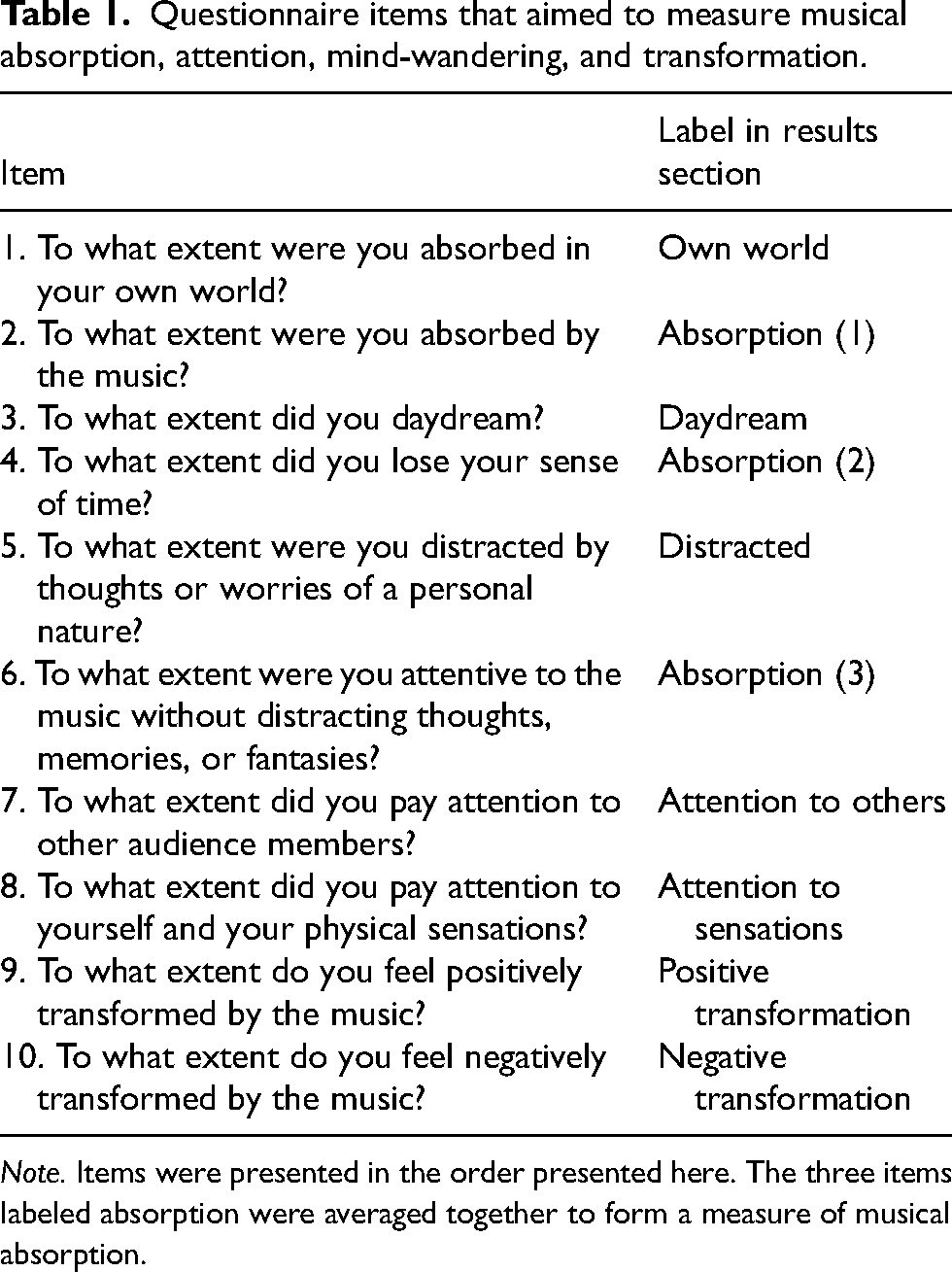
Note. Items were presented in the order presented here. The three items labeled absorption were averaged together to form a measure of musical absorption.
Musical Absorption
We operationalized musical absorption as the average responses to the questions “To what extent were you absorbed by the music?” (Item 2), “To what extent did you lose your sense of time?” (Item 4), and “To what extent were you attentive to the music without distracting thoughts, memories, or fantasies?” (Item 6). In this way, we captured three aspects of musical absorption through a measure of its label (Item 2), an experience of altered awareness (Item 4), and attentional focus on the music (Item 6). A clear distinction was made between an inward directed absorption and outward musical absorption by having Items 1 and 2 side by side in the questionnaire. Indeed, the data reflect that the participants understood the distinction, as these items were not correlated for any of the pieces (Supplementary Figure 1).
Reliability
These items showed large positive correlations with each other (see Table 2; p values are corrected for false discovery rate [FDR] based on the full correlation matrices provided in Supplementary Figure 1).
Kendall correlations between musical absorption measure items with p corrected for false discovery rate (FDR), based on correlation matrix of items in Supplementary Figure 1.

Note. * p < .05; ** p < .01; *** p < .001.
Reliability refers to the ability of several items to measure a single construct in a dependable way. Internal consistency of the three items measuring musical absorption was measured with multi-level reliability (Revelle & Wilt, 2019). The absorption items showed a good reliability, of 0.91 (reliability of the average of all ratings across all items and times).
Attention Away From the Music, Mind-Wandering, and Transformation
The other items, developed to examine attention away from the music, mind-wandering, and transformation, were not averaged, and analyses were conducted on the individual items. We chose not to average items because they measure different aspects of these phenomena. To probe internal-directed attention, social attention, and distraction, we asked to what extent participants were paying attention to their own bodily sensations or the audience, and to what extent they were distracted by thoughts or worries of a personal nature. The term mind-wandering refers to the two items “To what extent were you absorbed in your own world?” and “To what extent did you daydream?” To probe other aspects of musical experience, notably self-awareness and the sense of being transformed by the music, we asked whether the audience experienced self-transformation as part of their musical engagement. To help nuance our understanding, we further asked whether the self-transformation was experienced as either positive or negative. By comparing reports of musical absorption with reports of self-transformation, we have aimed to understand their relation. Comparing reports of attention to the physical and behavioral aspects of the musical experience (e.g., one's own body, movement, other audience members) with reports of self-transformation, we have aimed to ascertain the extent to which embodied attention (the awareness of physical movement and bodily sensations) might have either an enhancing or a diminishing effect on the sense of ASC.
While individual Likert items can mean that construct measurements are less precise, they are more efficient than scales during data collection and less ambiguous in meaning, because the inclusion of more items may result in greater risk of low face validity and items that measure other related constructs (Allen et al., 2022). For example, the aesthetic experience in music scale factor of absorption includes an item that is actually more a measure of the emotion of awe, which we believe is a separate construct (Silvia & Nusbaum, 2011).
Motion
Motion was measured using the MusicLab App (RITMO, 2022), a smartphone application available on Android and Apple devices, which records data from the accelerometer in the inertial measurement units of participants’ own smartphones (Swarbrick et al., 2022). Phone holders similar to necklaces were used to position participants’ phones horizontally on their chests, screen down (Upham & Rosas, accepted). Livestreaming participants were provided with instructions to make a phone holder for use at home and to position it similarly. Live participants who could not use the smartphone application were fitted with small accelerometers (Axivity AX3s) that were positioned in the same way with the phone holders. More information on the technical specifications and preparations is given by Upham and Rosas (accepted).
Motion analyses included quantification of the amount of motion and the amount of stilling at key musical moments. Quantity of motion (QoM) was calculated as the instantaneous magnitude of jerk (i.e., the first order difference across all three dimensions of the accelerometer), which represents a rate of change of acceleration (Upham & Rosas, accepted). To calculate the QoM per piece for each participant, the instantaneous magnitude of jerk displayed by the participant during a piece of music was averaged. For a more detailed signal processing description, refer to Upham et al. (2024).
Stilling represents an individual audience member's propensity to reduce motion at musically relevant moments. Upham et al. (2024) conducted a musicological analysis to determine moments during the concert where the music seemed to audibly “still”. These points in the concert were subsequently assessed for the proportion of audience participants reducing their QoM from 3 s before the relevant moment. In this musicological analysis, 247 moments were identified, unevenly distributed across the four sections of the program; participants showed a significantly greater propensity to reduce motion at these musically identified moments than on average. Additional analyses found that about half of the musically identified points that did not show a majority of participants reducing motion occurred during extended intervals of extremely low movement, suggesting that the audience was already maximally still and could not show a collective reaction to local musical cues. Using only the time points that did show a collective stilling response (157 moments: 87 points in the Beethoven, 31 points in the Schnittke, and 39 points in the folk music arrangements), we aimed to evaluate each individual's level of participation in stilling in each of these pieces by counting the number of time points at which they stilled. The stilling ratio used here is the proportion of these points per segment of the music program in which the participant showed a reduction of QoM from 3 s earlier, capturing how coherently the participant reacted with the majority of the measured audience. Further details on the quantification of the stilling ratio are presented in another article in this special collection (Upham et al., 2024).
Analysis
We used the statistical software R (R Core Team, 2022) for all analyses. The code and detailed results, along with assumption checking, can be found in GitHub (Swarbrick, 2024).
To examine the relation between musical absorption and other constructs, we used repeated measures correlations to understand intra-individual variability, using the rmcorr package (Bakdash & Marusich, 2017, 2022). Repeated measures correlations were determined between the measures of absorption, distraction, attention to others, attention to sensations, positive and negative transformation, feeling absorbed in one's own world, daydreaming, and other repeated measures variables, including the kama muta scale, awe experience scale, and the individual items of connectedness, enjoyment, and familiarity with the piece (see Supplementary Material S1). P-values were adjusted using the FDR method.
To understand the influence of individual characteristics on absorption, we conducted multiple regression analysis. To examine the relations between piece, social context, motion, and absorption, we used linear mixed effects modeling with the lme4 package (Bates et al., 2015). Note that the label piece is used to describe the different musical sections of the concert, including the pieces of Beethoven and Schnittke and the collection of folk arrangements. Extreme outliers were identified as <quartile 1 − 3 × interquartile range or >quartile 3 + 3 × interquartile range and were excluded from the mixed modeling analyses unless otherwise stated (e.g., see the results section for the number of extreme outliers excluded from each analysis). Assumption checking is described in Supplementary Material S2.
The relation between musical absorption and motion may be different across pieces and social context groups because the genres and social contexts set up different sociocultural expectations for how audience members should behave (see Upham et al., 2024 in this special collection for a more thorough explanation). Therefore, a correlation analysis was deemed inappropriate for the motion and stillness measures; instead, these data were analyzed using linear mixed effects modeling in lme4 (Bates et al., 2015). Each linear mixed effects model included a random intercept and slope of participant that allowed the slope of the effect of motion on absorption to vary by participant. Model comparisons were conducted by fitting models using maximum likelihood estimation; the best model was refitted with restricted maximum likelihood to report more accurate effect estimates (Arnqvist, 2020). We built the models by starting with piece and group as fixed effects and adding motion measures and their corresponding interactions as fixed effects one at a time. Separate models were built to examine the contribution of measures of QoM and stilling separately. No group fixed effect was examined in the stilling model because the measure of stilling was only calculated for the live audience, not the livestreaming audience.
Results
The datasets generated and analyzed during this study are available in the OSF repository (Høffding et al., 2021).
People generally reported high levels of being absorbed in the music and attentive to the music (Table 3). They reported a slightly above-average experience of feeling positively transformed and losing a sense of time.
Items designed to measure musical absorption, attention, mind-wandering, and transformation.

Note. The number of each item refers to the order it appeared in the survey. The response distribution visualizes the raw data for each piece. Response distributions are provided for each piece (left to right): Beethoven, Schnittke, folk. The response scale ranged from 0 (not at all) to 6 (a lot), as visualized in the histograms (left to right, respectively).
What Is the Relation Between Musical Absorption, Attention, Mind-Wandering, Transformation, and the Other Affective Variables?
Figure 1 is the correlation matrix between musical absorption and other variables of interest; however, correlations between variables distinct from those related to absorption are reported in another article in this special collection (Swarbrick & Vuoskoski, 2023). (See Supplementary Figure 2 for correlation matrices separated for live and livestreaming groups.) Musical absorption was negatively correlated with being distracted and negative transformation and positively correlated with positive transformation. It was not correlated with paying attention to one's own sensations or other people, being absorbed in one's own world, or daydreaming. Positive transformation was negatively correlated with being distracted, being absorbed in one’s own world, and being negatively transformed, yet attention to others and positive transformation were weakly positively correlated.

Repeated measures correlations computed on survey responses from both live and livestreaming audiences. rmcorr values with false discovery rate adjusted p values are visualized. * p < .05, ** p < .01, *** p < .001. Distracted, Attention others, Attention sensations, Positive transformation, Negative transformation, Own world, Daydream: single items with response options ranging from 0 (not at all) to 6 (a lot). Kama muta, Awe: average scores from the kama muta and awe scales. Connected musicians, Connected audience, Enjoyment, Familiar: single items for which participants reported how connected they felt to the musicians, to the audience, how much they enjoyed the performance, and whether they were familiar with the piece of music, respectively.
To double check whether musical absorption is distinct from the items that measure mind-wandering (being absorbed in one’s own world and daydreaming), we examined Kendall correlations between scale items separately for each piece (see the Supplementary Material S3). We found that being absorbed by the music, attentive to the music, and losing a sense of time (items making up the measure of musical absorption) rarely correlated positively with being absorbed in one’s own world and daydreaming. The only instance of this was when daydreaming and losing sense of time were positively and weakly correlated during the Beethoven piece, r = .18, p = .024. Daydreaming and positively transformed were correlated during the Schnittke piece, r = .18, p = .034, and the folk music, r = .21, p = .012, albeit weakly. Thus, it is possible that daydreaming can be positively transformational despite being distinct from the phenomenon of musical absorption.
To better understand participants’ interpretation of transformation (“To what extent do you feel positively transformed by the music?”, “To what extent do you feel negatively transformed by the music?”) and its distinctions from affect (“I had positive feelings,” “I had negative feelings”), we included these affect items in the Kendall correlation charts provided in Supplementary Figure 1. These items were moderately to strongly correlated in the Beethoven piece (positive: τ = .40, p < .001; negative: τ = .43, p < .001), Schnittke piece (positive: τ = .52, p < .001; negative: τ = .46, p < .001), and folk music (positive: τ = .62, p < .001; negative: τ = .38, p < .001), though not perfectly (τ < 1). Therefore, questions on transformation and affect may be capturing distinct, though highly related, phenomena. Participants reported lower levels of transformation than feelings; this implies that participants interpreted being positively or negatively transformed as a stronger experience than positive or negative feelings (Supplementary Table 1).
When examining absorption scale factors and the phenomena of kama muta and awe, we found that musical absorption and kama muta were positively correlated, as were musical absorption and awe (Figure 1). Kama muta was also strongly (positively) correlated with positive transformation and negatively correlated with negative transformation and being distracted. Awe was positively correlated with being in one’s own world.
Previous literature suggests that the trait-based measures of absorption predict awe experiences as well (van Elk et al., 2016). Therefore, we explored this in our own data by building a linear mixed effects model to examine the influence of trait absorption (using the AIMS) as a predictor of awe. The model indicated that the AIMS predicted awe positively (β = 0.012, χ2(1) = 11.22, p < .001). This indicates that experiences of awe are related to listeners’ levels of trait absorption.
Musical absorption was positively correlated with being familiar with the music, enjoyment, and feeling connectedness with the musicians and the audience (Figure 1).
What Is the Influence of Individual Characteristics on Musical Absorption?
We conducted multiple regression analysis to examine which personal characteristics explain musical absorption levels. Musical absorption was averaged across the three pieces for each participant, to enable examination of the influence of these individual characteristics. The personal characteristics were added to the model in the following order: absorption in the music scale (trait-based musical absorption; AIMS; Sandstrom & Russo, 2013), fanship (how much participants admired the performers), relationship to the performer, musical sophistication (Zhang & Schubert, 2019), and empathic concern (IRI; Davis, 1980). Because there was missing data, the model included data from 85 live audience members and 22 livestreaming audience members. The best model for explaining average musical absorption included significant effects of fanship (β = 0.159, 95% CI [.091, .227], p < .001), and AIMS, (β = 0.010, 95% CI [.004, .017], p = .002, R2 = .27, F(2, 99) = 19.31, p < .001) (Figure 2). None of the other personal characteristics was a significant predictor of average musical absorption.
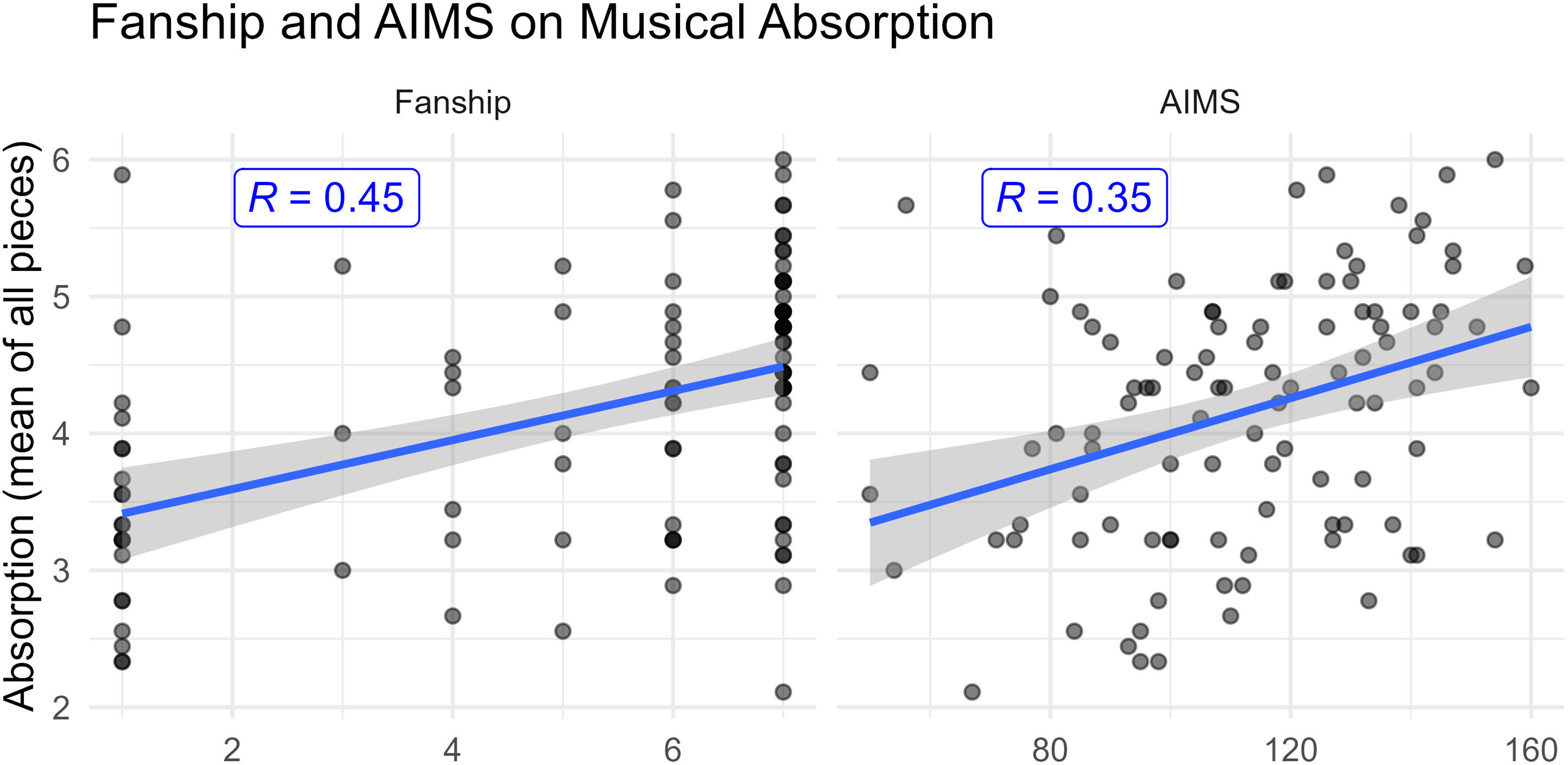
Influence of fanship and trait-based musical absorption (Absorption in Music Scale [AIMS]) on musical absorption.
What Is the Influence of Social Context (Live, Livestreaming) and Piece of Music (Beethoven, Schnittke, Folk) on Musical Absorption?
To assess the influence of social context (group; live versus livestreaming) and piece (Beethoven, Schnittke, folk) on musical absorption, we conducted linear mixed effects modeling (Table 4). Not all participants responded to all absorption questions; therefore, there were uneven sample sizes between pieces, with Beethoven having 88 live and 38 livestreaming participants, Schnittke with 90 live and 32 livestreaming participants, and folk music with 89 live and 31 livestreaming participants. However, linear mixed effects modeling handles unbalanced data well (Pinheiro, 2014). Information on assumptions can be found in the Supplementary Material and at the GitHub repository (Swarbrick, 2024). There was a main effect of piece, χ2(2) = 12.66, p = .0018, and group, χ2(1) = 5.81, p = .016, but no interaction between piece and group, χ2(2) = 1.44, p = .49 (Figure 3).

There was a main effect of piece and concert audience group on musical absorption. Participants were more absorbed during the folk tunes than the Beethoven and Schnittke pieces and the live concert audience was more absorbed than the livestreaming audience. The mean and standard error of the mean are visualized with points and error bars. Raw data are visualized as transparent jittered points. The live group is shown with a solid line while the livestreamed group is shown with a dashed line. * p < .05, ** p < .01.
Restricted maximum likelihood estimates of effects based on the linear mixed model with outcome measure of absorption, fixed effects of piece (Beethoven, Schnittke, folk) and group (live, livestreaming), and a random intercept of subject.

Marginal contrasts with p values adjusted using the Holm method indicated that the folk tunes facilitated more musical absorption than the Beethoven piece (Mdifference = .32, 95% CI [.07, .56], t(244.3) = 3.14, p = .006) and the Schnittke piece (Mdifference = .30, 95% CI [.06, .55], t(241.97) = 2.99, p = .006); however, there were no significant differences between the Schnittke and Beethoven pieces (Mdifference = .01, 95% CI [−.23, .26], t(244.72) = 0.14, p = .89). Being in the live audience also facilitated more musical absorption (Mdifference = .42, 95% CI [.08, .77], t(144.56) = 2.42, p = .017).
The live audience reported higher fanship than the livestreaming audience, and fanship was also a predictor of absorption; therefore, the main effect of group could be confounded with fanship. Therefore, we conducted an additional analysis with fanship as a predictor. There was a main effect of fanship (χ2(1) = 25.19, p < .001), such that as fanship increased, so did reports of musical absorption. Estimating model marginal contrasts and adjusting p values using the Holm method indicated that there was still an effect of piece, such that the folk tunes still facilitated more absorption than the Beethoven piece (Mdifference = .29, 95% CI [.03, .54], t(228.0) = 2.72, p = .20), and the Schnittke piece (Mdifference = .29, 95% CI [.03, .55], t(225.5) = 2.74, p = .020). However, there was no longer an effect of group when accounting for the effect of fanship (Mdifference = .04, 95% CI [−.34, .41], t(133.8) = 0.21, p = .84). Therefore, the effect of fanship might have confounded the effect of group.
What Is the Relation Between Musical Absorption and Motion?
Quantity of Motion (QoM)
Linear mixed effects modeling with random intercept and slope of participant was conducted to examine the effect of mean QoM in addition to the effects of group (live, livestreaming) and piece, and their interactions, on musical absorption (Table 5). We removed extreme outliers on the measures of QoM (Beethoven, 2; Schnittke, 1; folk, 3). No extreme outliers were identified in the measure of absorption. Sample size varied across pieces and group (Beethoven: live = 80, livestreaming = 23; Schnittke: live = 77, livestreaming = 16; folk: live = 74, livestreaming = 17). There was no significant main effect of QoM (χ2(1) = 0.03, p = .86). Importantly, there was a significant interaction between motion and group (χ2(1) = 6.21, p = .013); however, there was no significant interaction of piece with motion (χ2(2) = 2.46, p = .29). The three-way interaction between motion, group, and piece was not significant either (χ2(6) = 5.14, p = .53). Assumption checking is described in Supplementary Material S2. Model-based marginal effects indicate that the effect of QoM on absorption in the live group was positive (β = 4.8, 95% CI [−0.01, 9.60], t(134.2) = 1.97, p = .054), and that in the livestreaming group was negative (β = −3.4, 95% CI [−10.22, 3.43], t(5.85) = −1.22, p = .27), though neither effect was significant on its own. This indicates that the live audience tended to move more when they were more absorbed, and the livestreaming audience tended to move less when they were more absorbed. This is indicated in Figure 4, which suggests that the relation between QoM and absorption is neutral to slightly positive for the live audience, but negative for the livestreaming audience.

Relation between motion and absorption separated by group, collapsed across pieces. QoM, quantity of motion.
Restricted maximum likelihood estimates of effects based on linear mixed model with outcome measure of absorption, fixed effects of piece (Beethoven, Schnittke, folk), group (live, livestreaming), mean quantity of motion (QoM), interaction of QoM and group, and random intercept and slope of subject, where the effect of motion on absorption was allowed to vary by participant.

Stilling
We conducted linear mixed effects modeling in the same way as for QoM, with a random intercept and slope of participant that allowed the slope of the effect of stilling on musical absorption to vary by participant. Fixed effects of piece (factor) and Stilling (continuous) were included to examine their effects on the outcome of absorption. No group fixed effect was examined because stilling was only calculated for the live and not the livestreaming audience. Extreme outliers were removed for the stilling measure (folk, 1). There were uneven sample sizes between pieces (Beethoven, 80; Schnittke, 77; folk, 76). There was a trend for a main effect of stilling when added as a predictor of absorption alone (χ2(1) = 3.44, p = .064), and as a predictor with piece (χ2(1) = 3.02, p = .08) (Supplementary Figure 3). There was no interaction between stilling and piece (χ2(2) = 0.64, p = 0.72). All model assumptions were satisfied. Examination of model-based marginal effects indicates that the relation between stilling was positive, but not statistically significant (β = 1.29, 95% CI [−0.31, 2.89], t(37.64) = 1.63, p = .11).
Subjective Experience of Movement
Participants were asked to report on their awareness of their bodies, their movement, and others’ movement. We examined whether awareness could explain absorption more than piece (Beethoven, Schnittke, and folk music) and group (live and livestreaming) alone. We conducted linear mixed effects modeling using three separate models for the three awareness items, which were added as fixed effects to a model containing the fixed effects of group and piece. We also included interaction terms between awareness items and group and piece. A random intercept of participant was included in each model. The measures of awareness were treated as factors because the response options were not equidistant. There was no main effect of awareness of one's body (χ2(3) = 5.92, p = .12) or interaction between awareness of one's body and group (χ2(3) = 3.69, p = .30); however, there was an interaction between awareness of one's body and piece (χ2(6) = 14.41, p = .025). Participants were typically less aware of their bodies when they reported feeling absorbed during the Beethoven and the Schnittke pieces; however, in the folk section, both people who were not aware at all and people who were continuously aware reported more absorption (Supplementary Figure 4). Post-hoc testing indicated that participants reported more absorption when they were continuously aware of their bodies in the collection of folk arrangements than in the Beethoven piece (t(276) = 2.83, p = .014), and the Schnittke piece (t(266) = 2.62, p = .025), and they also reported more absorption when they were intermittently aware in the folk music, as compared with the Schnittke piece (t(261) = 2.91, p = .011). There was no main effect of awareness of one's own movement (χ2(3) = 3.68, p = .30), and no interaction between awareness of one's own movement and group ( χ2(3) = 1.06, p = .79) or piece (χ2(6) = 11.34, p = .079). There was no main effect of awareness of others’ movement (χ2(3) = 6.46, p = .091), and no interaction between group and being aware of others’ movement (χ2(3) = 4.55, p = .21), but there was an interaction between piece and awareness of others’ movement (χ2(6) = 18.00, p = .006). Post-hoc testing indicated that participants reported more absorption in the folk music even when they were aware of participants’ movement and they moved a normal amount as compared with the Beethoven piece (t(275) = 3.17, p = .005) and the Schnittke piece (t(284) = 3.61, p = .001) and when they thought others moved more than usual when compared with the Schnittke piece (t(277) = 2.55, p = .031) (Supplementary Figure 5).
Discussion
The DSQ performed a concert with pieces by Beethoven and Schnittke, and a collection of folk music arrangements to a live and a livestreaming audience. Our aims were (1) to examine experiences of musical absorption and how they relate to experiences of attention, mind-wandering, and transformation; (2) to explore musical absorption's relation to kama muta and awe; and (3) to explore the impact of musical and social context, and how individual characteristics shape aesthetic experience.
Musical absorption was measured using three items, probing participants’ reports of their absorption in the music, their attention to the music, and how much they lost their sense of time. Absorption in the music co-occurred with positive transformation and was inversely related to negative transformation and being distracted; therefore, musical absorption is an experience that is interpreted as highly enjoyable. Audience musical absorption was distinct from mind-wandering, as it did not correlate negatively or positively with being absorbed in one’s own world, or daydreaming. This corresponds to accounts of music listening (Merrill et al., 2021; Vroegh, 2018), but is in contrast to other accounts of musical absorption in performing musicians, who may be experiencing musical absorption while simultaneously being lost in thought (Høffding, 2019). Whether mind-wandering and musical absorption are part of the same mode of experience may relate to which kinds of thoughts are labeled as mind-wandering or absorption (Vroegh, 2018). A personal memory evoked by the music may be labeled absorption by some (Vroegh, 2018), but mind-wandering by others (Høffding, 2019). Furthermore, absorption may be used in certain circumstances to refer to experiences that are wholly immersive and engaging, while to be only a little absorbed might be better described as low engagement (Vroegh, 2018; see also Høffding et al., 2024).
Daydreaming and positive transformation were weakly correlated during the Schnittke piece and the folk music; therefore, daydreaming may be positively transformational despite being distinct from musical absorption. The findings of Deil et al. (2022) would seem to support this speculative point. In their exploratory study of mind-wandering during contemporary live music, it is suggested that live concert experience can afford audience members beneficial forms of mind-wandering, promoting positive moods and senses of inspiration. However, this could arise from the overall live music experience (Deil et al., 2022).
Musical absorption was positively correlated with kama muta and awe. Being attentive to and immersed in the music may have facilitated these other aesthetic and affective experiences that are fostered by music. Similarly, in related research, higher concentration was related to feeling more connectedness to the performer during livestreamed concerts (Onderdijk, Swarbrick et al., 2021). Therefore, audience attention and engagement may be necessary for experiencing the intensification of closeness that is theorized to produce the emotion of kama muta (Fiske et al., 2019). Previous research has demonstrated tight links between feeling touched, awe, and absorption, and even suggested that the labels awe and wonder may be incorporated in a conceptualization of absorption (Silvia & Nusbaum, 2011), though we believe that these experiences are distinct while highly interrelated. In agreement with our findings, other research also indicates that trait-based measures of absorption predict awe, and instructing people to be absorbed in their experience also appears to increase the experience of awe (van Elk et al., 2016). It could also be that the affective allure (see Martin & Nielsen, 2024; Rietveld & Kiverstein, 2014) of the concert environment grabs listeners’ attention and pulls them into a more absorbed state of listening. A one-way directionality of absorption facilitating affect may be overly simplistic for explaining the dynamic interactions between absorption and affect.
Musical absorption was also correlated with being familiar with the music, enjoyment, and feeling connectedness with the performers and audience. Thus, previous experience of a piece of music, and enjoying that particular piece, may allow an audience member to be more absorbed in the music and possibly facilitate greater feelings of connectedness. Audience members’ individual characteristics also influenced their experiences of musical absorption. Participants reported more absorption the more that they reported admiring the DSQ before the concert and the higher their trait-based musical absorption. This hints at a connection with the finding of Deil et al. (2022) that participants familiar with the artist tended to retain a focus on the concert, rather than having external thoughts. Other individual characteristics of trait-based empathy, musical sophistication, and relationship to the performer did not help explain musical absorption.
Being a member of the live audience facilitated more musical absorption than being a member of the livestreaming audience. This reinforces claims that attending live musical events can afford higher levels of musical absorption and engagement (Merrill et al., 2021). Indeed, peak experiences with music most frequently occur during live music listening (Lamont, 2011) and the level of absorbed attentional engagement facilitated by live performances may be an important contributing factor to these affective aesthetic experiences. The live audience reported greater fanship before the concert than the livestreaming audience, and fanship explained reports of musical absorption better than the audience group. The relation between fanship and musical absorption corroborates previous research that found that people with more musical and cultural knowledge are able to maintain an engaged and absorbed listening experience for a greater proportion of a concert (Dearn, 2017, p. 234). Concert attendees who are fans of the performers are likely to have more knowledge of the cultural norms of the genre and the performers’ repertoire that may allow them to achieve these absorptive states. Fans in other genres also experience more engagement than their neutral listener counterparts (Kang et al., 2021). It could also be a relation in the reverse direction—that participants reporting higher fanship are bigger admirers because they have rewarding and absorbing experiences when listening to the DSQ's music.
The collection of folk tunes facilitated more musical absorption than the Beethoven and Schnittke pieces. The collection of folk arrangements also inspired the most live audience movement (Upham & Rosas, accepted). This may be explained by the defined shift in stylistic tradition, which introduced a new range of sonic-gestural figures and possibilities for audience interaction and affective resonance. For example, in Carrolan's Quarrel With the Landlady, accompanimental interplays between violin and viola on beats two and three added a playful, bouncing (a gestural specification enhanced by the percussive, bouncing bow technique employed), ping-pong rhythmic effect. The light, almost throwaway, downbeat pizzicato tonic which brought the final iterations of the main tune of Carrolan's Quarrel With the Landlady to a close was met by audience laughter, applause, whistles, and cheering. The lively Stedelil and Halling efter Haltegutten were met with similarly enthusiastic audience responses. During both of these pieces and the final tune of the concert, Frederik Sjölin's Halling, foot stomping initiated by the quartet was clearly audible. The use of localized cyclical patterns is also noteworthy, with the syncopated, riff figures used as accompanimental material (Halling efter Haltegutten) and elsewhere foregrounded in homophonic designs (Halling), likely appealing to embodied engagement and synchrony.
Previous research suggests that a listener's ability to become absorbed in music may be most influenced by the repertoire and the listener’s familiarity with it, as unfamiliar, new music may provide a challenging listening experience (Dearn, 2017, p. 113 and p. 116). The concert design and (scientific) format might also have affected the amount of absorption during the Beethoven piece, as its performance followed an extensive opening address, which explained the scientific aims of the event and provided instructions for the audience. The Beethoven piece was longer in duration, while the folk tunes were broken up by applause and talking; therefore, it is also possible that the format of the pieces led to audience members feeling more absorbed during the folk music, as they could rest during applause breaks, while their attention might have been strained in the Beethoven. Audience awareness of, and their own responsibility for, data collection might have been a barrier to achieving states of absorption, especially in the early stages of the concert. It is possible that, rather than the music evoking absorption, the audience had acclimatized to the scientific elements of the research concert by the end, and the absorption trajectory was a result of the order effects.
There was a significant interaction between motion and group on musical absorption, though when examining the marginal effects of being in the live and livestreaming audience, neither group showed a significant effect of motion on absorption. This indicates that there was a significant contrast between the groups, but not when examining each group separately. There was a trend for the live audience to move more when they were more absorbed. The live audience was very still throughout the concert and moved less than the livestreaming audience (Upham & Rosas, accepted). The live classical concert frame informs modes of spectatorship, of which motoric restraint is a typical characteristic. This is not passive behavior, but rather an exercising of autonomy and cooperative agency in order to sense together; it is an effortful attempt by the audience members to create ideal conditions for an immersive experience and to enact a stillness that avoids disturbing the perceptual and affective experience of others (Ehrenreich, 2006; Martin & Nielsen, 2024; Wald-Fuhrmann et al., 2021). As live audience members became more absorbed in the music, they may have relaxed into a more embodied experience of the music, permitting themselves to move more throughout the pieces. However, when examining key musical moments that were expected to cause stilling responses, such as phrase boundaries or pauses, live audience members who were more absorbed also stilled more, although this did not reach statistical significance. This nonsignificant finding hints toward how being absorbed by the music may not simply cause greater motion in a live concert setting but causes an audience member to respond more dynamically to the unfolding of the music. Indeed, another article in this special collection reports that this stilling was also related to participants’ reports of how connected they felt to other audience members (Swarbrick & Vuoskoski, 2023). Together, these findings show that the classical concert audience responds to and is actively aware of the music and their social environments even when absorbed. Furthermore, this points to the issue of the rhythm of aesthetic experience (Barker, 2016, p. 30) and, with this, calls into question the temporality of absorption. There is more to be understood of the temporal profile and vitality of absorption in live contexts, including whether it arises and is sensed gradually or whether its intensification is rapid (for an excellent empirical study of experiences of absorption in relation to self-chosen music, see Vroegh, 2019).
The results hint toward a role of bodily action in experiences of musical absorption. These relations between absorption and motion could be attributed to absorbed mental states facilitating further attunement to motional affordances, or the fact that motional engagement enables absorption. We suggest that these aspects are dynamically related, influencing each other. These aspects point to a need to investigate why and how heightened musical absorption and increased movement might relate to each other. Further, the findings lend empirical substance to a recent theoretical endeavor in scholarship, which aims to capture the many facets of musical absorption through a new concept: mind surfing (Høffding et al., 2024). This work argues that the ways in which the temporal qualities of music dynamically and forcefully engage the whole perceiving system enable and encourage a rethinking of musical absorption as (embodied) mind surfing.
Limitations
Several findings point to a limitation of the questions, which inquired “to what extent” audience members experienced particular affective phenomena. Framed in this way, it is not clear whether participants should report based on the frequency or strength of experience, and as such is a limitation in understanding the phenomenological profile of experiences of absorption (Vroegh, 2019). Focusing responses on the strength or frequency of target phenomena should be considered in future research. The issue of clarity and specificity is also relevant to audience reports of transformation. Aesthetic transformation—an especially rich and contested phenomenon—is reduced in this study to a Likert scale response on binary affective representations of experience (i.e., positive or negative). Without further qualitative explanation, it is unclear how audience members chose to understand the experience being probed by these items. Indeed, correlation of positive transformation with positive affect (and likewise negative transformation with negative affect) may suggest an understanding of transformation primarily in terms of affective valence rather than, for instance, particular senses of altered subjectivity. The lack of qualitative explanation is a constraint of all of the items that were designed by the experimenters, who have expertise and “divergent technical vocabularies” drawn from their domains of philosophy and psychology (Danielsen et al., 2023). It is also important to recognize the audience's own vernacular when interpreting their responses (see Swarbrick & Vuoskoski, 2023 for an example of how the audience's mother tongue informed their questionnaire responses).
In addition to the interdisciplinary approach of this article, the MusicLab Copenhagen project, as a whole, was a collaboration involving even greater breadth in researcher backgrounds and interests (Danielsen et al., 2023). Given that several research teams were collaborating to accomplish diverse goals, the demands of each research question needed to be balanced with the demands placed on the audience filling the questionnaires. To avoid making the questionnaire overly disruptive, the length of the questionnaire was constrained so that few questions specifically probed each construct of interest. This means that the questionnaire was not optimally designed to investigate the relations between mind-wandering and absorption in a focused way. The operationalization of absorption was limited to three items, tapping into being absorbed by the music, being attentive to the music, and losing one's sense of time, meaning that other aspects relating to the experience of absorption (such as diminished awareness of one's surroundings) were omitted. The operationalization of mind-wandering was measured using only two items, which aimed to gather participants’ levels of being absorbed in their own worlds and daydreaming. This operationalization of mind-wandering does not explicitly address other aspects potentially relating to the experience, such as autobiographical memories, future thoughts, or personal concerns or goals. In a laboratory-based experiment with greater experimental control and greater focus on fewer research questions, the relations between absorption and mind-wandering could be examined. Nonetheless, it is important to explore relations in real-world music listening environments to achieve ecologically valid and meaningful results. Therefore, future research should aim to replicate the distinction of absorption and mind-wandering in both controlled research environments and other ecologically valid settings.
Single items are more vulnerable to measurement error than averages; however, they are less ambiguous and more efficient than scales (Allen et al., 2022). Caution should still be used when interpreting results from the single items; indeed, even concepts measured using only two items might not sufficiently capture all aspects of these experiences. Future research could be designed with the aim of comparing how the questions used to measure musical absorption and mind-wandering in this study relate to other measures of musical absorption and mind-wandering. Additionally, further research is necessary to explore the causal dynamics between absorption, the transcendental emotions, and aesthetic transformation.
Conclusion
The MusicLab Copenhagen research concert was a fruitful, real-world venue for exploring the phenomenology of absorption, attention, and mind-wandering, their relation to affective experiences of kama muta and awe, the influence of motion and collective stilling, and differences between the social contexts of live and livestreaming concerts. The relation of musical absorption to experiences of positive transformation and the transcendental experiences of kama muta and awe illuminates important affective resonances. The results suggest that audience experiences of musical absorption and mind-wandering are distinct. Other contextual factors were considered, and we found that musical absorption was enhanced in audience members who reported being admirers of the performers before the concert. The experiences of the live and livestreaming audiences were different, with the live audience reporting more musical absorption and tending to move more when they were more absorbed, hinting toward an embodied attunement. These findings were achieved with an exploratory, interdisciplinary approach, combining phenomenology with methods from experimental psychology in a naturalistic context, which demanded methodological and epistemological negotiation (Danielsen et al., 2023). This research contributes to current discussions in philosophy, musicology, and psychology and offers insights into how interdisciplinary collaboration can enable rich critical and empirical engagement with important dimensions of aesthetic experience.
Supplemental Material
sj-docx-1-mns-10.1177_20592043241263461 - Supplemental material for Audience Musical Absorption: Exploring Attention and Affect in the Live Concert Setting
Supplemental material, sj-docx-1-mns-10.1177_20592043241263461 for Audience Musical Absorption: Exploring Attention and Affect in the Live Concert Setting by D. Swarbrick, R. Martin, S. Høffding, N. Nielsen and J. K. Vuoskoski in Music & Science
Footnotes
Action Editor
Niels Chr. Hansen, University of Jyväskylä, Department of Music, Art and Culture Studies, Centre of Excellence in Music, Mind, Body, & Brain.
Peer Review
One anonymous reviewer.
Thijs Vroegh, Netherlands eScience Center, Social Sciences and Humanities.
Contributorship
SH organized the concert with the DSQ. All authors were involved in the study design. DS conducted data analysis. All authors contributed to writing the introduction. DS wrote the methods and results. DS and RM wrote the discussion. All authors reviewed and edited the manuscript and approved the final version of the manuscript.
Declaration of Conflicting Interests
The authors declared no potential conflicts of interest with respect to the research, authorship, and/or publication of this article.
Ethical Approval
This experiment was approved by the Norwegian Centre for Research Data (NSD), reference number 915228.
Funding
The authors disclosed receipt of the following financial support for the research, authorship, and/or publication of this article: This work was partially supported by the Research Council of Norway through its Centres of Excellence scheme (project number 262762). DS is supported in part by funding for a doctoral fellowship from the Canadian Social Sciences and Humanities Research Council.
Data Availability Statement
The datasets generated and analyzed during this study are available in the MusicLab Copenhagen Dataset repository (Høffding et al., 2021, https://osf.io/ac6yt/), and the scripts used for analyses are available in the Audience Musical Absorption repository ( ).
).
Supplemental Material
Supplemental material for this article is available online.
Notes
References
Supplementary Material
Please find the following supplemental material available below.
For Open Access articles published under a Creative Commons License, all supplemental material carries the same license as the article it is associated with.
For non-Open Access articles published, all supplemental material carries a non-exclusive license, and permission requests for re-use of supplemental material or any part of supplemental material shall be sent directly to the copyright owner as specified in the copyright notice associated with the article.
