



Abstract
Live concerts normally involve gathering at the same time and place. In livestreamed concerts, participants may gather in time but not in space, providing a natural comparison for studying live concert experiences. Previous research suggests that livestreamed concerts promote more social connectedness than pre-recorded concerts and that live concerts promote more movement than listening to recorded music in a group. However, to the best of our knowledge, a comparison between live and livestreamed concerts has not been conducted. The Danish String Quartet is a critically acclaimed music group who performed a live concert that was also livestreamed. The live and livestreaming audiences’ emotions were measured with surveys that collected data on connectedness, feeling moved, and awe after each piece. In addition, audience motion was measured with an application that recorded from the participants' own smartphones’ accelerometers. Survey responses were collected from 91 live and 32 livestreaming participants. Motion data was collected from 82 live and 25 livestreaming participants. While the live audience felt more connected to other audience members than the livestreaming audience, both live and livestreaming audiences felt similarly connected to the performers. Feeling moved and awe were influenced by the piece of music, but not by the audience condition (i.e., live or livestreaming audience). During the classical Beethoven and Schnittke pieces, the live audience moved less, while during the folk tunes, the live audience moved more. The differences between pieces were smaller in the livestreaming audience. The live audience reported more connectedness to the audience when their neighbors moved more during the folk and less during the Beethoven and Schnittke. Connectedness with other audience members was also related to the amount that an individual stilled in response to key musical moments in the pieces. Together, these findings show that the classical concert audience actively engages with the music and the associated socioemotional experience based on genre-specific norms and expectations.
Keywords
Introduction
Concerts are fundamentally social experiences in which an audience and musicians gather to create and participate in an aesthetic experience. Based on the music and social bonding hypothesis, music may be such a ubiquitous human activity precisely because of its social nature and because it has the power to connect us (e.g., Savage et al., 2020). Given that music serves bonding functions in much of its practice, concerts could serve as venues for fostering togetherness. Classical concerts are a special type of musical situation, or frame, in which audiences gather with a shared intention of listening to and being immersed in classical music along with like-minded peers (Wald-Fuhrmann et al., 2021). Generally, classical music audiences are more behaviorally restricted than audiences of other contemporary genres, sitting still and in silence to enable absorption into the aesthetic experience, and seeming to participate only rarely, for example through applause at genre-appropriate moments. While classical music audiences are more motorically restricted, there is some evidence that they may cough more during concerts than during normal daily life, which indicates that the restrained social setting may afford other kinds of behaviors (Wagener, 2012). Classical music audiences tend to be older, more reserved, and are described as more highbrow or conservative than other musical audiences, such as those in popular music genres (Dearn & Pitts, 2017). There are also fewer opportunities for interaction between audience members at classical music concerts than in other genres (Dearn, 2017, p. 125). However, concertgoers still report social motivations for concert attendance (Dearn & Price, 2016). Social interactions can occur in a variety of ways at a classical concert—before and after the music and during the intermission, through discussion with fellow attendees—however, there are relatively few opportunities for these interactions (Dearn, 2017, p. 125). During the music, audience members may engage in social perception by observing the audience members around them and the musicians; however, these activities are not necessarily interactive (Dearn, 2017, p. 85). Despite these limitations, music listening in the live classical concert is still viewed as participatory because attendees feel that they are a part of an audience community (Dearn, 2017, p.114). There has been much attention on the classical concert recently as various stakeholders try to understand how they can promote further classical music consumption despite aging and dwindling audiences (e.g., the Experimental Concert Research group 1 , the Maastrict Centre for Innovation in Classical Music 2 , and the Sheffield Performer and Audience Research Centre 3 ). Given that classical concerts provide a frame in which engagement is communicated with less activity during music listening than other contemporary musical genres, classical concerts are unique events for examining musical social experiences.
Social connectedness is an important component of the experience of concerts because one of the defining features of concerts is their social nature. Recent work by O’Neill and Egermann (2022) aimed to understand the social experience of concerts better through the development of a scale that combines measures grounded in parasocial interaction and in-group bonding (Horton & Richard Wohl, 1956; Leach et al., 2008). They found that the social experience of concerts was related to concert enjoyment, but not the emotional experience (O’Neill & Egermann, 2022). The personal listening experience of classical concertgoers is shaped by the audience group because there is an established set of conventions upheld by regular attenders to promote attention on and engagement with the music that needs to be learned by newcomers, through education or copying regular attender behavior (Dearn, 2017, p.116). Furthermore, audience members may be attentive to and influenced by other audience members’ or the musicians’ emotional facial expressions (Dearn, 2017, pp.111–112). During a classical concert research experiment, an audience completed a survey that included questions on boredom, concentration, and absorption, and they reported that recorded music is less engaging than live music (Merrill et al., 2021). Research that examined several concert genres at the same time found that livestreamed concerts promote more feelings and behaviors of connectedness than pre-recorded concerts (Swarbrick et al., 2021). Livestreamed concert viewing styles can foster varying degrees of connectedness toward the audience and performers, such as with video conferencing, which enhances intra-audience connectedness, and virtual reality, which enhances audience–performer connectedness (Onderdijk et al., 2021).
Social connectedness may also be an important component of the emotion commonly labelled “feeling moved/touched.” This emotion has been operationalized through a construct named “kama muta,” a Sanskrit term meaning “moved by love” (Fiske et al., 2019). The experience of kama muta is characterized by positive valence, physical sensations (e.g., chills, feeling choked up, warmth in the center of the chest), appraisals (e.g., feeling a sense of closeness or feeling welcomed), motivations (e.g., wanting to hug someone or tell someone how much you care about them), and labels (in addition to feeling moved and touched, nostalgia and love are other labels that may reference this emotion in English) (Zickfeld et al., 2019). Situations that typically evoke this emotion are often social in nature and include, but are not limited to, reunions, communal sharing, and witnessing acts of altruism (Fiske, 2019). Cross-cultural research has shown that across many different languages, the labels used to describe it seem to infer passive motion (e.g., to feel moved) or bodily contact (e.g., to be touched) (Zickfeld et al., 2019). Kama muta has repeatedly been correlated with trait empathy, which indicates that individual differences may contribute to the variability in the experience of this emotion (Swarbrick et al., 2021; Vuoskoski et al., 2022; Zickfeld et al., 2017).
Particular pieces of music consistently evoke similar continuous ratings of feeling moved/touched across different listeners, which indicates that the emotion may be evoked as a result of the music itself even without a social context (Vuoskoski et al., 2022). While research has shown that feelings and behaviors of connectedness differ between livestreamed and pre-recorded concerts, reports of kama muta are not different between these events (Swarbrick et al., 2021). Therefore, the music alone may give rise to this emotion, without the need for a live social context. Indeed, music may evoke this emotion even when listening in solitude because music may imply others’ presence, and listeners may empathize with, or feel empathized by, the music (Lee et al., 2013; Schäfer et al., 2020; Van Den Tol & Edwards, 2013). The experience of feeling moved/touched during music listening is correlated with feeling a sense of connection (Vuoskoski et al., 2022). These results align well with the theoretical framework on this emotion, which suggests that it is evoked by a sudden intensification of closeness (Fiske et al., 2019). In the context of virtual concerts, social connectedness mediated the influence of coronavirus salience on kama muta (Swarbrick et al., 2021). An experience of social connection may thus be a precursor for kama muta.
Kama muta is considered one of several transcendental emotions, or emotions that motivate attention being directed outwards or away from the self (Haidt, 2003; Van Cappellen et al., 2016; Yaden et al., 2017). Awe is another transcendental emotion that is characterized by bodily sensations (e.g., vigilance chills, jaw dropping, or gasping), perceiving vastness, and difficulty with comprehension (Bannister & Eerola, 2021; Yaden et al., 2019). Kama muta and awe share overlapping outcomes, such as chills and a sense of connection. Awe is also evoked by music, in particular in cases where the music has increasing loudness, which makes it seem as though the sound source is approaching (Bannister & Eerola, 2021). Given music's ability to promote self-transcendence in the form of emotional experiences such as kama muta and awe, shared listening situations such as those provided naturalistically in concerts may promote the outward attention necessary to become connected to others.
Connectedness between concertgoers may also be established as a function of the individuals’ shared identities and group membership. The link between musical preferences and personal identity is well-established (Frith, 1996; Gosling et al., 2003; Rentfrow & Gosling, 2003, 2006). Musical preferences for both genres and artists are used to form personal and group identities (Bennett, 1999; Weiner, 1999), and musical preferences also correlate with personality and values (Rentfrow & Gosling, 2003). Therefore, based on musical preferences alone, individuals can make judgements of personal characteristics, including belief systems (Edwards & Singletary, 1989; Rentfrow & Gosling, 2006). In classical concert communities, where attendees repeatedly go to concerts at the same venue, a sense of shared identity can develop (Dearn, 2017, p. 136).
Musical genres can set up expectations for behavioral norms including how audience members should behave, dress, and speak. When compared to other contemporary genres, classical concerts may provide fewer opportunities for applause, movement, and interaction, though the experience is social nonetheless (Dearn, 2017). Newcomers to the classical concert frame may struggle to understand the conventions and culture given how much it contrasts with popular musical genre concert norms (Dearn & Pitts, 2017; Dobson & Pitts, 2011; Pitts, 2016). It can thus be easy to identify outgroup members—for example, if a newcomer applauds between movements, they are readily identified as an outsider. Classical concert norms typically include that audiences applaud at the end of pieces, not when the musicians pause between movements; audience members demonstrate their engagement with the music by being quiet and attentive; and they may show appreciation for the music by closing their eyes or expressing emotion on their faces (Dearn, 2017, pp.116–117).
Identifying as a fan of an artist can also be used to affiliate (Chadborn et al., 2017). Fanship, (i.e., identifying as a fan, in contrast to fandom: identifying with others who are fans), is known to influence social experience and behavior at concerts. For example, fans move more vigorously and more in time with the music than neutral listeners at a rock concert (Swarbrick et al., 2019), which could possibly signal their in-group status. Fanship has also been correlated with a number of social experience measures collected from virtual concerts, including social connectedness, kama muta, and concert quality (Swarbrick et al., 2019). One of the cultural norms of classical music in Denmark is that listeners may not identify with the word “fan” and instead prefer the word “admirer” (correspondence with Simon Høffding). Nonetheless, previous research has applied critical fandom theory to classical concert audiences and found that classical concert attendees are a listening community who demonstrate fan-like behaviors (Dearn, 2017, pp. 130–141). Their fan-like behaviors may be demonstrated by their interactions with other audience members, feeling a sense of entitativity and identity with other audience members, by technical and musical knowledge, and by a desire to meet performers (ibid.). Therefore, being an admirer of a classical artist/ensemble may promote identification with fellow admirers and thus affiliation among the classical concert audience.
Being an admirer may also influence experienced connectedness toward the performers and kama muta. The relationship between fan and artist can be conceptualized within the parasocial interaction theory framework (Horton & Wohl, 1956). Parasocial interactions describe the unidirectional information flow between a real or fictional person, who may be a TV or performing personality (e.g., actor or musician), and their admirers (Horton & Wohl, 1956). Theory on kama muta and fanship suggests that fanatical consumption of an artist's media may be a continued search for new kama muta experiences (Fiske, 2019). Kama muta is a pleasurable emotion, and people will continue to seek it out and try to share it with those whom they care about. It is also believed that the emotion may be adaptive in that it strengthens devotion to communal sharing relationships. Communal sharing relationships are characterized by feelings of social equivalence, identification, and belonging and behaviors of care, trust, and shared responsibility (Fiske, 1992). Kama muta theorists posit that the fan–artist relationship is one of communal sharing, given that kama muta experiences are thought to result in greater devotion (Fiske, 2019). However, they may lack some of the usual communal sharing relationship features, such as social equivalence, shared responsibility, and any real bidirectional structure. Further critical reflection and investigation is necessary to understand whether fan–artist relationships are indeed communal sharing relationships, even in cases of parasociality, and whether kama muta is thus only evoked by a strengthening of these kinds of relationships, or always leads to devotion to them.
According to the embodied music cognition framework, the body and its motion is central not only to the production of music but also to its perception (Leman, 2008). Given that classical music audiences are so still while they are listening at concerts, some might be dismissive of using this framework for understanding classical concert audiences. On the contrary, this natural stillness makes the classical concert the perfect object of study for embodied music cognition because questions on the involvement of movement in social bonding can be investigated. There is much literature that suggests that when people move in the same way at the same time, engaging through a process of entrainment that may lead to synchrony, the actors may experience social bonding through enhanced social feelings, cognition, and behaviors (Rennung & Goritz, 2016; Vicaria & Dickens, 2016). However, the processes of affiliation involved in classical concerts may differ from that in other musical genres. Alternatively, the relative stillness may make any motion more detectable to concertgoers.
In the concert under study, the Danish String Quartet (DSQ) performed four pieces, namely Beethoven's String Quartet No. 16 opus 135, Schnittke's String Quartet No. 3, Bach's Kunst der Fuge, Contrapunctus XIV, and a selection of six folk tunes, which will be referred to as the musical “pieces’’ of Beethoven, Schnittke, Bach, and Folk, respectively for the remainder of this manuscript. (Refer to Lartillot et al., this special collection for the for results pertaining to the Bach piece). The folk tunes were a selection of Irish and Nordic folk tunes arranged by the Danish String Quartet, namely (i) a set of three by Turlough O’Carolan: Mable Kelly, Planxty Kelly, and Carolan's Quarrel with the Landlady; (ii) Stædelil; (iii) Halling efter Haltegutten; (iv) Unst Boat Song; (v) Lovely Joan; and (vi) Halling by Fredrik Sjölin, the DSQ cellist. The folk genre is often associated with folk dances that co-develop as music–dance styles, and engagement through movement is often a characteristic feature of folk performances (e.g., with Norwegian telespringar; Haugen, 2021). Watching past performances by the Danish String Quartet provided insights into how an audience might experience the concert. A DSQ performance video of the Beethoven piece's 3rd movement included comments from viewers that indicated that they found it beautiful and emotional, with quotes like “this recording touches me so bad” and “one of the most achingly beautiful pieces of music ever written,” 4 which suggests that at least this movement in this piece is likely to evoke experiences of kama muta in the listener. The DSQ have a music video in which they perform the Schnittke piece, which is a haunting and introspective work full of dissonance and stark contrasts, as a backdrop to scenes of a man running around and acting as if something is chasing him or as if he has gone insane. The audio alone gave the first author chills all over her body, not in response to kama muta but rather in response to fear and awe, and the artistic depiction in the video also implies that anxiety and fear are the most salient emotions being communicated and induced. The specific folk pieces were first heard by the researchers on the evening of the concert, and they communicated a variety of emotions ranging from tenderness to liveliness and induced varying degrees of wanting to move. The DSQ performed live to an audience in a concert hall in Copenhagen, Denmark and livestreamed to an online audience across the world. The livestreamed video is available on YouTube and can help provide context to the results presented herein. 5
We aimed to measure the audiences’ social and emotional experience, individual and relational characteristics, and motion to understand how these variables relate to each other in a classical concert context. We hypothesized that the live concert audience would experience more social connectedness than the livestreaming audience. We expected that the different musical pieces would evoke different emotional responses from the audience, for example with the Schnittke evoking more awe. Based on the framework of kama muta, and our previous work with virtual concerts, we also hypothesized that fanship level and empathic concern would be related to more connectedness and kama muta (Zickfeld et al., 2017; Fiske et al., 2019; Swarbrick et al., 2021). Finally, we hypothesized that the different pieces would evoke different levels of movement and that conforming to the genre-specific norms of behavior would result in more connectedness. We further explored relations between concert emotions and found differences in the way that English and Danish speakers use labels to represent kama muta.
Methods
The Danish String Quartet performed in Musikhuset København on October 26, 2021, in Copenhagen, Denmark. The concert was promoted by both the Danish String Quartet and the researchers, as part of the annual Danish String Quartet Festival and the MusicLab Research Concert series. The live, in-person audience was seated in staggered rows facing the performers, who were seated in a semi-circle on a stage. The concert was livestreamed by a professional who mixed the video with multiple cameras and dynamic camera views and angles, ranging from long shots from the back of the room that included the in-person audience to close-ups of performers’ faces, to create a sophisticated livestreamed video. The full concert livestreamed video is available on YouTube. 5 The live audience is occasionally visible in the livestream. The concert host (researcher Simon Høffding) provided introductions in Danish and research participation instructions in both Danish and English. The Danish String Quartet spoke to their audience occasionally in English to accommodate the livestreaming audience, but mostly in Danish to introduce the research concert and some of the pieces. Program notes (see Supplemental Material) were distributed to the live audience along with the questionnaire booklet that collected the audience's subjective experience. The livestreaming audience watched in near real-time because the livestream with YouTube's normal latency setting leads to a 15–60 s delay. Further concert procedure details are presented in other articles in this special collection (e.g., Upham et al., this special collection, a).
Participants
All participants provided informed consent. The consenting process was conducted visually with information provided to audience members at ticket purchasing and again with signs at the concert hall. Participants who completed questionnaires or had their motion measured additionally filled consent in the MusicLab App or filled paper consent forms. Gender, age, and other demographics are presented in Table 1. The audience was similar in age to other classical concert audiences in Scandinavia (40–60-year-olds being the largest audience group; Tovslid & Salvesen, 2023).
Audience demographics separated by live and livestreaming audiences listed as counts unless otherwise stated as mean ± SD.

Variables with significant differences between groups are marked with asterisks (*p < .05, **p < .01, ***p < .001). Ten participants in the livestreaming group did not respond to the pre-concert survey, and their responses are missing for gender, musical sophistication, and relationship with musicians.
Participants were excluded if they only filled survey 1 and had no usable motion data (n = 11) or if their music response section did not have more than a few answers (n = 1). Surveys were administered in Danish and English. There were 91 participants (76 Danish surveys, 15 English surveys) who responded to the survey in the live audience and 45 participants who responded to the survey in the livestreaming audience (9 Danish surveys, 36 English surveys). Motion data was collected from 82 live participants and 25 livestreaming participants. Not all participants completed all surveys or recorded motion for all pieces, which is why sample sizes vary by piece in the analyses.
There were significantly more Danish-speaking participants in the live audience than in the livestreaming audience and vice versa for English-speaking participants, chi-square test: χ 2 (1) = 49.2, p < .0001. The live audience reported lower musical sophistication than the livestreaming audience, Kruskal–Wallis test: χ 2 (1) = 22.4, p < .001 (see Table 1), and the live audience was older than the livestreaming audience, independent samples t-test: t(75) = 3.73, p < .001. More participants were watching alone in the livestreaming group, χ 2 (1) = 53.8, p < .0001. The live audience reported slightly lower empathic concern than the livestreaming audience, t(1) = 2.29, p = .025. The Absorption in Music Scale (AIMS) results indicate that our sample overall (M = 114.3, SD = 25.0) was very similar to the original sample collected by Sandstrom and Russo (M = 113.5, SD = 23.8; 2013), and there was no statistically significant difference between groups, t(68.42) = 1.99, p = .05. There was no difference between the audiences in the number of members with a personal relation as a family or friend to the DSQ, χ 2 (1) = 0.51, p = .48 and the live audience reported higher fanship level than the livestreaming audience, χ 2 (1) = 12.0, p < .001. The livestreaming audience consisted of participants from 16 countries, mostly from Europe (Denmark: n = 5, Norway: n = 5, Russia: n = 3, Sweden: n = 2, Austria: n = 2, Germany: n = 2, Romania: n = 2, France: n = 1, Hungary: n = 1, Netherlands: n = 1, Portugal, n = 1, Switzerland: n = 1, UK: n = 1) and the Americas (USA: n = 5, Canada: n = 2, Ecuador: n = 1), while 10 participants did not report their city so their country was not identified. The researchers who were involved in recruitment consisted of an international group with ties to a variety of countries including North American and other European countries. Therefore, if a participant decided to attend the concert due to promotion from a non-Danish researcher, they were likely to attend the livestreamed concert.
Survey
The survey was developed in collaboration with the other researchers involved in the MusicLab Copenhagen project (see Swarbrick, Martin et al., this special collection; Lartillot et al., this special collection). We were primarily interested in examining the phenomena of social connectedness, kama muta, and awe. We aimed to use established scales and measures where possible and developed new items when necessary to capture phenomena of interest. The English survey was translated into Danish by a native speaker. The in-person audience responded to the survey via a paper booklet, while the livestreaming audience responded using surveys hosted in the MusicLab App smartphone application, which was also used to record motion from both the in-person live and livestreaming audiences.
The survey consisted of a pre-concert survey, post-piece surveys that were identical for the Beethoven, Schnittke, and Folk pieces, and a post-concert survey. For the entire survey, see the OSF repository 6 (other data from other publications including video recordings, performer pupillometry and ECG data is also available in the OSF repository). After the Bach, the questions pertained mostly to the visualization of the fugue (see Lartillot et al., this special collection, for more details). The pre-concert survey collected information on participants’ age, gender, musical sophistication category (Zhang & Schubert, 2019), level of fanship (Swarbrick et al., 2019), and trait empathic concern (one of the four subscales of the Interpersonal Reactivity Index; Davis, 1980). The survey also collected relational information, including their relationships to those seated around them (e.g., stranger, friend, family, and relation of parent, child, partner) and whether they had a personal relationship with the Danish String Quartet.
The post-piece surveys contained questions on social connectedness and scales of kama muta and awe, which will be described further in the sections below. The surveys also measured enjoyment, musical familiarity, felt valence (positive and negative feelings) and tension (tense and relaxed) (Schimmack & Grob, 2000; Vuoskoski & Eerola, 2011), and whether participants thought others around them were moved. The survey also contained questions pertaining to musical absorption, attention, and transformation (developed specially for this project) and questions on the perception of participants’ own and others movement; however, these results will be covered in other papers in this special collection (see Swarbrick, Martin, et al. for absorption results; Upham et al., a, for movement results).
Social Connectedness
Social connectedness was measured with single Likert scale items relating specifically to the connectedness participants felt toward the audience and the performers (Onderdijk, Swarbrick et al., 2021). The livestreaming audience was asked to report the connectedness that they felt to both the livestreaming and physically attending audiences separately. Responses were recorded on a Likert scale with response poles of 0 = Not at all to 6 = A lot.
Kama Muta
The post-piece questionnaire for the Beethoven, Schnittke, and Folk collected information on participants’ experiences of kama muta using a modified Kama Muta Scale (Zickfeld et al., 2019). The Kama Muta Scale consists of five sections measuring bodily sensations, appraisal, motivation, valence, and labels. The short Kama Muta Scale was modified to include only those items that were deemed relevant for the classical concert context, and so the motivation items were omitted. Bodily sensation items included tears; chills or shivers; a warm feeling in the center of the chest; feeling choked up; and feeling refreshed, energized, or exhilarated. Appraisal items included feeling an extraordinary sense of welcoming or being welcomed and feeling an exceptional sense of closeness appear. The measure of valence was an item measuring the presence of positive feelings. Both moved and touched (Danish: bevæget, rørt) were included as label items. Responses were collected with Likert scales with response poles 0 = Not at all to 6 = A lot.
Awe
Awe was measured with the two highest loading items from three subscales (perceived vastness, physical sensations, and need for accommodation) of the Awe Experience Scale (Bannister & Eerola, 2021; Yaden et al., 2019) that were unique to the scale and not already in the survey. Specifically, items from the Awe Experience Scale subscales of time perception, self-diminishment, and connectedness were not included because these items may be related to the other phenomena of interest (i.e., absorption and social connection). The translation of “awe” in Danish (ærefrygt) contains strong religious connotations; therefore we aimed to measure awe without explicit reference to this word. One item from the Aesthetic Experience Scale in Music (Silvia & Nusbaum, 2011) “I was full of awe and wonder” was adapted to “I was full of admiration and wonder” to avoid the religious connotations that are attached to “awe” in Danish and had response options of 0 = Not at all to 6 = A lot. Including the item of admiration and wonder in the awe scale (comprising seven items) did not substantially change measures of internal consistency, so the item was retained. Responses to the Awe Experience Scale were the same as that provided on the original scale and were Strongly Disagree, Moderately Disagree, Somewhat Disagree, Neutral, Somewhat Agree, Moderately Agree, and Strongly Agree.
The post-concert survey contained questions asking participants to rank the pieces on their engagement, how visually stimulating they were, how absorptive they were, and how touching they were. It measured trait-based absorption with the Absorption in Music Scale (Sandstrom & Russo, 2013). Participants were also provided with a comment box where they were encouraged to write their impressions of the concert research experience.
Motion
Motion was recorded from both audiences using the MusicLab App, which leverages the inertial measurement unit sensors in participants’ own smartphones (Swarbrick et al., 2022). In-person audience participants were fitted with a phone holder that positioned their smartphones on their upper chests. Livestreaming participants were instructed to secure their smartphones to their upper chests in a similar fashion (see instructions for livestreaming participants in the Supplemental Material). If participants came to the live concert and either did not have a smartphone or did not want to use their own to download the MusicLab App, they were provided with an accelerometer sensor (AX3, Axivity). Motion sensor data were analyzed to quantify the mean quantity of motion (mQoM) of each participant for each piece. This measure is representative of the relative amount of time spent moving rather than a sustained displacement because participants generally moved very little (Upham et al., this special collection, a). Upham conducted a musicological analysis to identify moments where the audience might still as a result of the music (Upham et al., this special collection, b). Stilling was defined as the proportion of these moments in which each participant actually reduced their motion past a defined threshold. See Upham et al. (a, b), this special collection, for a more in-depth overview of motion analyses.
We also quantified participants’ neighbors’ motion by averaging the mean quantity of motion of their neighbors to their left and right, and the two participants directly in front. The seating arrangement in the hall was prepared in a windowed style such that each row was slightly shifted to allow the row behind to see between the heads of the audience members in the row in front.
Analysis
The analysis of the survey data was conducted in R (version 4.2.2; R Core Team, 2020) with help from the “tidyverse” package collection (Wickham et al., 2019) and the “easystats” package collection (Lüdecke et al., 2022). Other packages that were used are listed in the results section. In the spirit of open and reproducible science, the analysis script is available in a public repository. 7 Imputation of missing values is described in the Supplemental Material.
Results
Scale Reliability
We assessed the internal consistency of the scales with McDonald's Omega from the “psych” package, which is a well-regarded measure of reliability (McDonald, 1999; Revelle, 2022; Zinbarg et al., 2006). The kama muta scale demonstrated good reliability with high omega values for each piece (Beethoven: .92, Schnittke: .90, Folk: .92). The awe scale also demonstrated good internal consistency with high omega values (Beethoven: .82, Schnittke: .88, Folk: .90). Including the item of “I was filled with admiration and wonder” adapted from the Aesthetic Experience Scale did not decrease the values of omega, so we included it in the measure of awe (Beethoven: .86, Schnittke: .88, Folk: .90).
Effect of Concert and Individual Characteristics on Emotions
We aimed to examine the contribution of concert, relational, and individual characteristics on the outcome measures of social connectedness, kama muta, and awe using mixed effects modeling. The scale measures of kama muta and awe were examined with separate linear mixed effects models with the “lme4” and “lmerTest” packages (Bates et al., 2015; Kuznetsova et al., 2017). The Likert scale items of connectedness to the musicians and audience violated the proportional odds assumption necessary for ordinal regression (cumulative link mixed model), and therefore they were fitted with Bayesian multilevel ordinal regression models in the R package “brms” (Bürkner, 2017). All models included a random intercept of participant. Random slopes were not necessary because repeated measures were accounted for with the inclusion of the piece as a main effect in all models.
Predictors
We included predictors of concert variables, relational information, and individual characteristics in every model. Concert predictors included concert group (live, livestreaming) and piece of music (Beethoven, Schnittke, and Folk) (Recall that analyses from the Bach piece are presented in another paper in this special collection, Lartillot et al., under revision). Relational predictors included their fanship level, group size, and if they had a relationship with the Danish String Quartet musicians as a friend or family member. Individual characteristic predictors included trait empathy, trait absorption in music, and musical sophistication level. Given that trait absorption is known to correlate with trait empathy (e.g., Garrido & Schubert, 2011; Sandstrom & Russo, 2013), we included only trait empathic concern in the models for social connectedness and kama muta and only trait absorption in the model for awe.
Model Fitting
We fitted models with all predictors and reported effect estimates for all predictors, including non-significant results. For the linear mixed modeling, models were fitted with restricted maximum likelihood (REML), and significance (p < .05) was calculated with Satterthwaite's method for estimating degrees of freedom and p-values in mixed models (Satterthwaite, 1941) because this method may be more accurate than likelihood ratio tests (Luke, 2017). We chose to not remove non-significant predictors to avoid overfitting, inflated effect estimates, and reduced p-values (Babyak, 2004; Rencher & Pun, 1980; Thompson, 1995). To ensure good model fit, influential observations were detected by Cook's distance (>.94) and removed during model fitting (Cook, 1977). Model fit was visually inspected using the “performance” package from “easystats” (“check_model” function; Lüdecke et al., 2021). Standardized effect estimates (ß) were obtained by fitting standardized versions of the models using the “parameters” package from “easystats” (Lüdecke et al., 2020). Marginal contrasts were calculated in cases where a predictor with more than two groups was statistically significant using the “emmeans” and “modelbased” packages (Lenth, 2023; Makowski et al., 2020). P-values of these contrasts were adjusted with the Holm method (1979).
Bayesian model fitting was conducted with the “brms” package (Bürkner, 2017). Examining posterior effects and “significance” was conducted with, and following recommendations from, the “bayestestR” package (Kruschke & Liddell, 2018; Makowski et al., 2019a, 2019b).
Social Connectedness
Social connectedness was measured from each participant with questions of “To what extent did you feel connected to the musicians?” and “To what extent did you feel connected to the other audience members?” with Likert scale responses of 0 (Not at all) to 6 (A lot). These responses were collected after the Beethoven, Schnittke, and Folk pieces. Participants in the livestreaming audience were asked to report their feelings of social connectedness towards the audience who was physically attending (M = 1.3, SD = 1.6) and the audience who was streaming the concert with them separately (M = 1.6, SD = 1.8). We tested for differences between these livestreaming audience responses with a Kruskal–Wallis test and found no significant differences in the pieces Beethoven: χ 2 (1) = 1.04, p = .31, Schnittke: χ 2 (1) = .37, p = .54, or Folk: χ 2 (1) = .17, p = .68; therefore we used their reports of connectedness to the livestreaming audience because this is the audience they could have interacted with in the chat function.
The outcome measure of connectedness included both the connectedness to the musicians and the audience, and the differences between these measures were modeled by including a factor of target of connectedness (musicians, audience) in the model. We expected that this target of connectedness predictor could interact with the effects of group and the relational predictors, so we included interactions between target and group, and target and the relational predictors of fanship, relationship with the musicians, and group size. There were no outliers detected in the connectedness measure by the z-score robust (3.09) method. The data included 89 participants from the live audience (Beethoven = 89, Schnittke = 83, Folk = 88) and 32 participants from the livestreaming audience (Beethoven = 32, Schnittke = 26, Folk = 23). Recall that not all participants filled all surveys or recorded motion for all pieces, which is why the sample sizes vary by piece in the analyses. Data were standardized with z-scores prior to model fitting. We conducted Bayesian multilevel ordinal regression by fitting a cumulative model with a probit link. The probit link assumes that the latent variable is normally distributed. The model was fitted with 6 chains, each with 2,000 iterations and 1,000 warmups per iteration, leaving a total of 6,000 post-warmup draws. The “brms” model formula was specified as Connectedness ∼ Piece + Target + Group + Target:Group + Fanship + Target:Fanship + Relationship_Musicians + Target:Relationship_Musicians + Group_Size + Target:Group_Size + Trait_Empathy + Musical_Sophistication + (1|Participant). Generic weakly informative priors were specified for all fixed effect estimates as normal distributions with a mean of 0 and a standard deviation of 1 (Gelman, 2020). The model was fitted with initial values of all parameters set to 0. The model demonstrated satisfactory effective sample sizes and Rhat values (Bürkner, 2017; Vehtari et al., 2019). Description of the meanings of variables presented in Table 2 is located in the Bayesian model section of the Supplemental Material.
Parameter estimates from fixed effects with probability of direction estimates greater than 97.5% from the Bayesian model with connectedness as the dependent variable.

Mdn: Median, 95% CI: 95% Credible Interval computed with high density intervals, pd: probability of direction, % out of ROPE: percentage of posterior outside the region of practical equivalence. Rhat: values near 1 but not greater than 1.01 indicate that Markov chains were consistent. ESS: effective sample sizes; values greater than 1,000 indicate stable estimates. % out ROPE values higher than 99% have further been italicized to highlight effects that are practically significant.
The Folk pieces evoked substantially more connectedness than the Beethoven piece, while the Schnittke evoked less connectedness than the Beethoven. There was an effect of target such that both the live and livestreaming audiences reported more connectedness to the musicians than to the audience (Figures 1–3). Being in the livestreaming audience had a negative effect on connectedness. The effect of relationship with the musicians on connectedness was positive and significant. There was an effect of trait empathy, with higher empathy leading to greater connectedness. The interaction between target and group indicates that the livestreaming participants reported feeling more connected with the musicians than the audience (see Figure 3A). The live audience did not have as great a difference between their reports of connectedness to the musicians versus the audience. When the other effects are considered, the livestreamed audience actually reported more connectedness to the musicians compared to the live audience (see Figure S3). There was a positive and significant effect of the interaction between fanship and connectedness to the musicians, indicating that participants who reported being greater admirers reported more connectedness to the musicians, and this influence was not so great for connectedness to the audience (see Figure 3B).
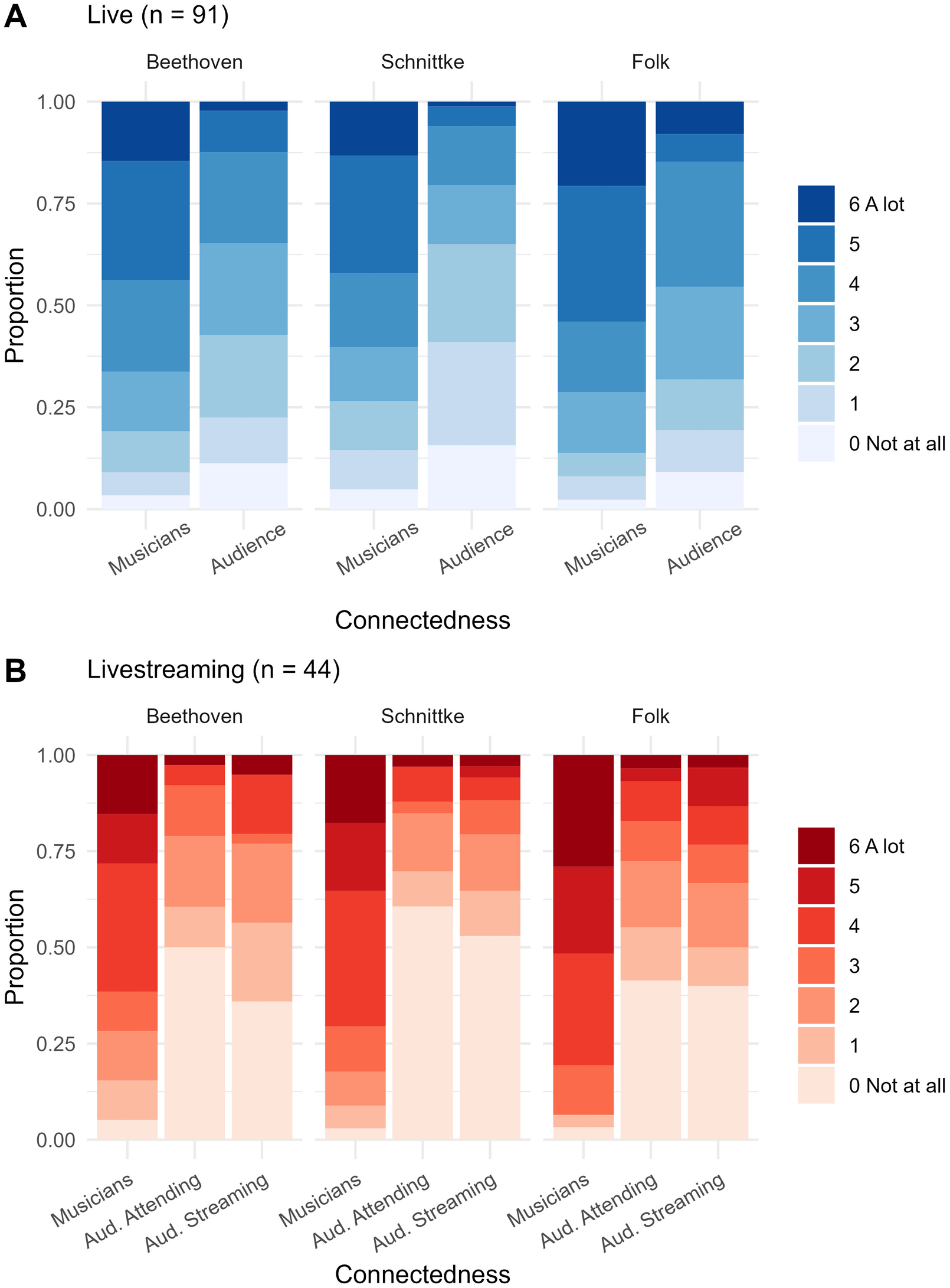
Reports of social connectedness towards the musicians and the audience from the (A) live and (B) livestreaming audiences. The two-way interaction can be observed by noticing how the connectedness to the musicians is similar between the live (A) and livestreaming (B) audiences, but the live audience reported higher connectedness to the audience than the livestreaming audience. Note that the livestreaming audience members reported connectedness to both the audience that was attending the concert and the livestreaming audience.

Fixed effect medians and credible intervals representing 95% of the posterior probability distribution. There is a 95% chance that the real effect of the variable lies in that range. Intervals not crossing 0 are 95% likely to have a positive or negative direction, and their variable names are marked with an asterisk (*).

Raw data showing the interactions between (A) Target and Group, which shows that the livestreaming participants reported feeling more connected with the musicians than the audience, while the difference was not as great for the live audience, and (B) Target and fanship, which shows that participants who reported being bigger admirers reported more connectedness to the musicians and this influence was not so great for connectedness to the audience. Fanship was collected with the item “Are you a fan or admirer of the Danish String Quartet's music?” with a response scale of 1 (Neutral Listener) to 7 (Big Fan/Admirer). (A) Error bars represent standard error of the mean. (B) Error shading represents smoothed conditional means of the linear model relationship between fanship and connectedness.

The effect of piece on (A) kama muta indicates that the Folk piece evoked more kama muta than the Beethoven and the Schnittke pieces and the Beethoven more than the Schnittke, and (B) awe showed a reverse pattern, with the Schnittke evoking the most, then Beethoven, then Folk. Dot and error bars represent mean and standard deviation of the emotion per piece (includes both concert groups). Standardized fixed effect parameter estimates and their confidence intervals for linear mixed effects models of (C) kama muta and (D) awe. Significance values were calculated by Satterthwaite approximation. *p < .05, ** < .01, *** < .001, **** < .0001.

Responses from both audiences to the questions probing their valence and tension reactions to the pieces. Error bars represent standard error of the mean. The Schnittke piece evoked fewer positive and relaxed feelings and more negative and tense feelings than the Beethoven and the Folk pieces. The Folk pieces evoked fewer negative and tense feelings than the Beethoven.

Raw data (see Figure S4 for conditional effects). (A) The interaction of piece and group on motion indicates that the live group demonstrated differences in their quantity of motion between pieces, with motion being greatest for the Folk, then the Schnittke, then the Beethoven. The livestreaming group did not demonstrate any significant differences. Error bars represent standard error of the mean. (B) The interaction of piece and motion indicates that more awe led to less motion only in the Schnittke and Folk pieces. Error shading represents the smoothed conditional means of the linear relationship between awe and motion. *p < .05, **p < .01, ***p < .001.

Standardized fixed effect parameter estimates and their confidence intervals for linear mixed effects models of (C) log mean quantity of motion and (D) stilling. Con.Aud.: Connected Audience, Con.Mus.: Connected Musicians, KM: kama muta. Significance values were calculated by Satterthwaite approximation. *p < .05.
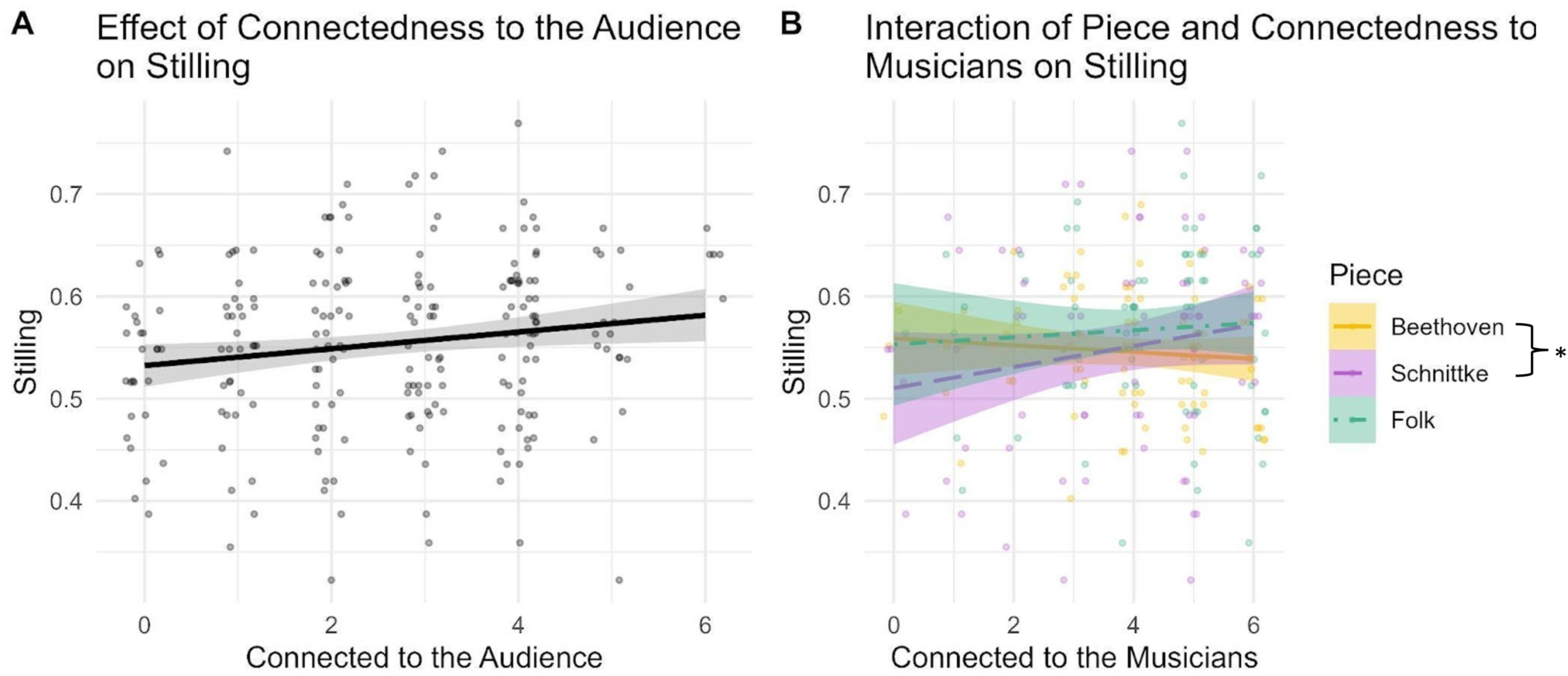
Raw data (see Figure S5 for conditional effects). (A) The effect of feeling connected to the audience on the proportion of stilling was positive, which indicates that the more a person exhibited stilling, the more connected to the audience they felt. (B) The interaction between piece and connectedness to the musicians on stilling was significant when contrasting the Schnittke and the Beethoven, which indicates that during the Schnittke, as connectedness to the musicians increased, the participant stilled more at key musical moments, but this was only significant when contrasting with the Beethoven. *p < .05.

(A) Standardized fixed effect parameter estimates and their confidence intervals for the linear mixed effects model on neighbors’ motion, and (B) the interaction between piece and connectedness to the audience on motion seen. The relation is negative during the Beethoven and positive during the Folk. *p < .05.

Significant repeated measures correlations between the concert experience variables of kama muta, awe, connectedness to the musicians and audience, familiarity of the music, enjoyment, positive feelings, negative feelings, feeling relaxed, and feeling tense. *Variables marked with an asterisk should be interpreted with caution as they represent single Likert items and may not satisfy the assumptions of repeated measures correlations. Note that the item “Positive Feelings” is also included in the kama muta scale. Note that correlations are not duplicated in the chart. *p < .05, **p < .01, ***p < .001.
Kama Muta
There were no influential observations; therefore, the data included 91 participants from the live audience and at most 32 participants from the livestreaming audience (Beethoven: 32, Schnittke: 26, Folk: 23). The lme4 model formula was specified as Kama Muta ∼ Group + Piece + Fanship + Group_Size + Relationship_Musicians + Trait_Empathy + Musical_Sophistication + (1|Participant). There were statistically significant effects of piece, relationship with the musicians, fanship, and trait empathy (see Figure 4A, Figure 4C and Table 3). See Table S2 in the Supplemental Material for all model parameter estimates. Marginal contrasts for the main effect of piece indicated that the Folk pieces evoked more kama muta than the Beethoven, estimated marginal difference = .29, 95% CI [.04, .55], SE = .11, t(232.93) = 2.75, p = .006, and the Schnittke, estimated marginal difference = .64, 95% CI [.38, .90], SE = .11, t(231.50) = 5.97, p < .001, and the Beethoven evoked more kama muta than the Schnittke, estimated marginal difference = .35, 95% CI [.09, .60], SE = .11, t(234.41) = 3.30, p = .002. Having a personal relationship with the performers and higher trait empathy led to greater kama muta experiences. The model had substantial explanatory power with a conditional R2 of .54 of which .18 was related to the fixed effects alone (marginal R2). FDR: False Discovery Rate (Benjamini & Hochberg, 1995).
Statistically significant standardized fixed effect parameter estimates for mixed effects models of kama muta (top) and awe (bottom), p < .05.

Significance values were calculated by Satterthwaite approximation. See Table S2 in the Supplementary Material for all model parameter estimates.
Awe
The sample size for this analysis was 91 live audience participants in the Beethoven and the Folk and 84 for the Schnittke (7 live audience participants failed to complete the page with the awe and connectedness items for the Schnittke piece) and at most 32 in the livestreaming audience (Beethoven = 32, Schnittke = 26, Folk = 23). The lme4 model formula was specified as Awe ∼ Group + Piece + Fanship + Group_Size + Relationship_Musicians + Trait_Absorption +Musical_Sophistication + (1|Participant). There were statistically significant effects of piece and trait absorption (see Figure 4B, 4D and Table 3). See Table S2 in the Supplemental Material for all model parameter estimates. Marginal contrasts for the main effect of piece indicated that the Schnittke evoked more awe than the Beethoven, estimated marginal difference = .20, 95% CI [.00, .41], SE = .09, t(226.49) = 2.36, p = .019, and the Folk, estimated marginal difference = .56, 95% CI [.35, .77], SE = .09, t(224.05) = 6.47, p < .001, and the Beethoven evoked more awe than the Folk, estimated marginal difference = .36, 95% CI [.16, .56], SE = .08, t(223.60) = 4.27, p < .001. Higher trait absorption was associated with greater experiences of awe. The model had substantial explanatory power with a conditional R2 of .69 of which .18 was related to the fixed effects alone (marginal R2).
Language Influence on Feeling Moved (Bevæget) and Touched (Rørt)
In Danish, the kama muta emotion is labeled with the terms bevæget, which translates to “moved,” and rørt, which directly translates to “stirred” and was used as the equivalent to “touched”. The term rørt may be perceived more strongly in Danish than “touched” is in English. An aligned ranks transformation analysis of variance (ANOVA) revealed a main effect of Label, F(1, 130.7) = 45.58, p < .0001, Language, F(1, 134.55) = 10.64, p = .0014, and a two-way interaction between Language and Label, F(1, 130.74) = 12.93, p = .0005 (Elkin et al., 2021; Kay et al., 2021; Wobbrock et al., 2011). Bonferroni-corrected contrasts on the interaction between Language and Question indicated that the Danish speakers reported feeling more bevæget than rørt, t(123) = 8.46, p < .0001, while English speakers reported similar levels of feeling moved and touched, t(135) = 2.00, p = .28. See the Supplemental Material for a more detailed report and a visualization (Figure S6).
Valence and Tension of the Pieces
Participants reported the extent to which they had positive or negative feelings and how relaxed or tense they felt to provide a measure of valence and tension (Vuoskoski & Eerola, 2011; Schimmack & Grob, 2000). We used an aligned rank transformation ANOVA to examine the effects of, and interactions between, the pieces, groups, and emotions. A random effect of participant was included. There was a main effect of emotion, F(3, 1301.49) = 476.6, p < .0001, and an interaction between emotion and piece, F(6, 1299.02) = 36.3, p < .0001 (see Figure 5). There were no differences between groups. Post-hoc contrasts with Bonferroni correction and Kenward–Roger-corrected degrees of freedom indicated that the Schnittke produced less positive feelings and relaxation and more negative feelings and tension than the Beethoven and the Folk (all p < .002, see Github for exact test values). The Folk also produced fewer negative emotions and less tension than the Beethoven piece (p < .003). This indicates that the Schnittke piece produced more mixed emotions.
Motion and Emotion
We examined the effects of group (live, livestreaming), piece, and the emotions of connectedness, kama muta, and awe on the outcome measures of quantity of motion, stillness, and neighbors’ motion. We used linear mixed effects modeling with “lme4” and “lmerTest” to examine this (Bates et al., 2015; Kuznetsova et al., 2017). Separate models were fitted for the outcome measures of quantity of motion, stillness, and neighbors’ motion. Standardized effect estimates (ß) were obtained by fitting standardized versions of the models. Outliers were identified both as values above or below 1.5x the interquartile range and using Cook's distance (>.94), and they were excluded prior to model fitting. Models were visually inspected with diagnostic plots to assess violations of assumptions. There were some violations; however, linear mixed effects models are generally robust against violations to distributional assumptions (Schielzeth et al., 2020). Results should still be interpreted with caution. Models were fitted with REML, and significance (p < .05) was calculated with Satterthwaite's method for estimating degrees of freedom and p-values in mixed models (Satterthwaite, 1941). We chose to not remove non-significant predictors to avoid overfitting, inflated effect estimates, and reduced p-values (Babyak, 2004; Rencher & Pun, 1980; Thompson, 1995). All models contained interactions with piece and the other independent variables (group and the four emotions). All models contained random intercepts for the participants. The lme4 formula was specified as Motion Outcome Variable (log_mean_QoM, Stilling, Motion_Seen) ∼ Group* + Piece + Group:Piece + Connected_Musicians + Connected_Audience + Kama_Muta + Awe + Piece:Connected_Musicians + Piece:Connected_Audience + Piece:Kama_Muta + Piece:Awe + (1|Participant). *Stilling and Motion seen were only calculated for the live audience, so only an effect of Group was included for the quantity of motion model. Standardized effect estimates (ß) were obtained by fitting standardized versions of the models.
Mean Quantity of Motion
Predictors of group (live, livestreaming), piece (Beethoven, Schnittke, Folk), the emotions of connectedness to the musicians, connectedness to the audience, kama muta, and the interactions between piece and the emotions and piece and group were included in the model. Examining diagnostic plots indicated that the models did not meet the assumptions of homogeneity of variance and normality of the residuals. Transforming mean quantity of motion with a log transformation improved the model assumptions greatly. After the removal of outliers, the model was fitted on a dataset that was rather sparse for the livestreaming group but included sample sizes as follows. Beethoven: nLive = 80, nLivestreaming = 22, Schnittke: nLive = 72, nLivestreaming = 15, and Folk: nLive = 73, nLivestreaming = 15. The model's explanatory power was substantial (conditional R2 = .65) with the fixed effects explaining 28% of the variability alone (marginal R2). There were statistically significant main effects of piece and group, and interactions between piece and group, and piece and awe, but no other significant effects of interactions with kama muta or connectedness (see Figure 7A and Table 4). Estimated marginal contrasts and effects were used to examine the interactions between piece and group and piece and awe. The live audience moved more during the Folk pieces than the Beethoven, difference: .24, 95% CI [.14, .33], t(184.7) = 5.93, p < .001, and the Schnittke, difference: .15, 95% CI [.05, .26], t(199.0) = 3.55, p < .001, and more during the Schnittke than the Beethoven, difference: .08, 95% CI [−.00, .17], t(166.48) = 2.31, p = .022 (see Figure 6A). This interaction finding is also reported in the Supplemental Material of another paper in this special collection (Upham et al., a). The livestreaming audience did not demonstrate any statistically significant differences across pieces in terms of log mean QoM (though when analyzing mean QoM without log transformation, the livestreaming audience does appear to move more during the folk tunes; Upham et al., this special collection, a). The livestreaming audience moved more than the live audience during the Beethoven, difference: .40, 95% CI [.25, .55], t(220.56) = 5.35, p < .001, and during the Folk pieces, difference: .19, 95% CI [.03, .36], t(243.26) = 2.29, p = .023, though there were no differences between the audiences during the Schnittke piece, difference: .13, 95% CI [−.03, .30], t(248.46) = 1.57, p = .12. This finding is also reported in the paper covering motion analyses from the concert (Upham et al., a). Awe had a negative effect on motion that was statistically significant during the Schnittke, ß = −.08, 95% CI [−.13, −.02], t(237.04) = −2.88, p = .004, and the Folk pieces, ß = −.11, 95% CI [−.17, −.05], t(239.64) = −3.47, p < .001, but not during the Beethoven, ß = −.03, 95% CI [−.09, .03], t(237.55) = −1.10, p = .27 (see Figure 6B).
Statistically significant standardized fixed effect parameter estimates for mixed effects models of mean quantity of motion (top), stilling (middle), and seen motion (bottom).

Significance values were calculated by Satterthwaite approximation.
Stilling
To examine the effect of piece and emotions on stilling, we fitted a linear mixed model with the emotions (connectedness to the musicians and the audience, kama muta, and awe) and their interactions with piece. Stilling was only calculated for the live audience; therefore, no effects of group were included. Examining diagnostic plots indicated that the models did not meet the assumptions of homogeneity of variance and normality of the residuals. After the removal of outliers, the sample sizes were: Beethoven: n = 80, Schnittke: n = 72, and Folk: n = 73. Even after the removal of outliers, the model was heteroscedastic, mostly at the tails. Linear mixed effects modeling may be robust against violations to distributional assumptions; however, these results should still be interpreted with caution. The model's explanatory power was low (conditional R2 = .22), with the fixed effects only explaining 7% of the variability (marginal R2). There was a statistically significant positive effect of connectedness to the audience such that the more a person exhibited stilling, the more connected to the audience they felt (see Figure 7B and 8A). There was a significant interaction between connectedness to the musicians and stilling when the Schnittke was compared to the Beethoven, which indicates that the effect of connectedness to the musicians on stilling was more positive during the Schnittke than the Beethoven (see Figure 8B). The effect of the slope itself (rather than the contrast between pieces) was only trending when examined with estimated marginal effects (p = .07). A reduced model with only the interaction between connectedness to the musicians and piece suggested that this interaction was not significant (p = .09). However, when connectedness to the audience was included and accounting for some of the variance in stilling, then the interaction between connectedness to the musicians and stilling becomes significant in the contrast between the Schnittke and the Beethoven (p = .049).
Neighbors’ Motion
To examine the association between others’ motion and felt emotions, and how the relations differed by piece, we fitted a linear mixed model with motion seen as the dependent variable, and emotions (connectedness to the musicians and the audience, kama muta, and awe) and their interactions with piece as fixed effects. Motion seen was only calculated for the live audience; therefore, no effects of group were included. Examining diagnostic plots indicated that the models did not meet the assumption of homogeneity of variances. After the removal of outliers, the sample sizes were: Beethoven: n = 79, Schnittke: n = 73, and Folk: n = 73. Even after the removal of outliers, the model was heteroscedastic, mostly at the high tail. Therefore, results should be interpreted with caution despite the robustness of linear mixed effects modeling. The model's explanatory power was substantial (conditional R2 = .68), with the fixed effects explaining 39% of the variability alone (marginal R2). There were main effects of piece, connectedness to the audience, and an interaction between piece and connectedness to the audience (see Figure 9A). There was a negative relation between motion seen and connectedness to the audience during the Beethoven, std. ß = −.23, 95% CI [−.44, −.02], t(189.93) = −2.12, p = .035, and a positive relation between motion seen and connectedness to the audience during the Folk, std. ß = .21, 95% CI [.03, .39], t(190.71) = 2.31, p = .022 (see Figure 9B). There was no significant relation of connectedness to the audience and motion seen during the Schnittke.
Relations between Concert Emotions
To examine the relations between the concert experience variables, we conducted repeated measures correlations with the package “rmcorr” (Bakdash & Marusich, 2017; 2022) on measures of connectedness, kama muta, awe, familiarity with the music, enjoyment, estimates of neighbors feeling moved (i.e., “Others Moved”), positive feelings, negative feelings, feeling relaxed, and feeling tense (see Figure 10). Repeated measures correlations represent the variability attributable within subjects rather than between subjects. Much of the socioemotional experience was interrelated with strong correlations between kama muta, connectedness to the musicians and audience, familiarity, and enjoyment. Interestingly, while most of the other variables were positively correlated, awe was positively correlated with kama muta, connectedness to the musicians, enjoyment, tension, and negative feelings and negatively correlated with feeling relaxed. Therefore, awe may have been experienced as a negative or a mixed affect yet resulted in greater connectedness and an intensification of closeness towards the musicians.
Others Moved
We aimed to examine whether participants at the live concert could detect to what degree the audience members around them were moved (for a longer description see the Supplemental Material). Participants were asked “To what extent do you believe audience members around you were moved?”. Participants’ neighbors were defined as those in a clear line of sight: the audience members directly to the left and right and the two participants directly in front of the participant. Neighbors’ responses were averaged to provide each participant with a score for how moved their neighbors actually were. The same procedure was conducted for the kama muta scale scores. We fitted separate linear mixed effects models to examine the outcome measures of neighbors’ feeling moved and neighbors’ kama muta. Given the previously reported effect of piece on kama muta, we included fixed effects of piece and participants’ own reports of feeling moved and kama muta because they could use their own feelings to estimate others. There were no statistically significant fixed effects in the Moved model, which is why we also report trending parameter estimates in Table 5. There was a trend for an effect in the Schnittke piece and a weak trend for an effect of participants’ reports of how moved others were feeling when explaining how moved neighbors actually felt. There was a significant effect of piece on neighbors feeling kama muta.
Statistically significant standardized fixed effect parameter estimates for mixed effects models of neighbors’ feeling moved (top) and neighbors’ kama muta (bottom).

Significance values were calculated by Satterthwaite approximation.
Discussion
On October 26, 2021, the Danish String Quartet performed four pieces of music for a live and livestreaming audience. Both audiences had their motion measured with accelerometers and they completed surveys to report their personal characteristics and their socioemotional experiences after each piece. We examined the effects of concert variables (live versus livestreamed, and musical piece), relational characteristics (fanship level, group size, and relationship with the musicians as family or friends), and individual characteristics (trait empathic concern, trait absorption in the music, and musical sophistication) on the emotions of connectedness with performers and the audience, kama muta, and awe after three of the pieces: Beethoven's String Quartet No. 16 in F Major Op. 135, Schnittke's String Quartet No. 3, and a collection of six folk tunes arranged by the performers. We examined the relation between emotions and motion by quantifying motion in three ways, with mean quantity of motion, frequency of stilling to key musical moments (see Upham et al., this special collection, a, b), and the motion of participants’ neighbors.
We found that the live audience reported more connectedness toward other audience members than the livestreaming audience, but both groups reported similar levels of connectedness to the musicians. Across both the live and livestreaming audiences, participants reported more connectedness to the musicians than to the other audience members. This is contrary to our hypothesis, which was that the live audience would have a superior social experience compared to the livestreaming audience and would rate connectedness to both the audience and musicians higher; however, only the connectedness to the audience was higher for the live audience. In fact, when the effects of fanship level, relationship with the musicians, and trait empathic concern were taken into account, the livestreamed audience actually reported more connectedness to the musicians compared to the live audience. Research in live classical concerts also indicates that being able to see the musicians closely leads to greater engagement and enjoyment (Dearn, 2017, pp.110–112); however, not all audience members could see the performers closely, as seating ranged from the front of the hall to the back. The livestream was professionally conducted and featured dynamic camera views and angles that allowed an intimate view of the performers that was often closer and clearer than many of the live audience members’ own views. This closeness, though mediated through video and a screen, may have afforded feelings of connectedness. Indeed, research on films suggests that closer shots may lead to more emotional engagement, possibly because they provide greater visibility of facial expressions (Benini et al., 2022). Previous research on livestreamed concerts found that a more immersive field of view with virtual reality glasses promoted greater feelings of physical presence and connectedness to the performers as compared to a regular YouTube livestream (Onderdijk, Swarbrick et al., 2021). Therefore, livestreamed concerts may be just as good or better at facilitating connectedness between audience members and performers as live concerts, thanks to their ability to provide intimate views of the performers.
There were no differences in reports of awe and kama muta between the live and livestreaming audiences. This replicates and extends previous research showing that the technological mediation of livestreaming versus pre-recorded concerts could result in differences in feelings and behaviors of connectedness but not in kama muta (Swarbrick et al., 2021). These results have great implications for livestreamed concerts and show that musicians can still connect with, emotionally move, and awe their audiences through these kinds of mediated experiences.
The pieces of music also influenced the socioemotional experiences, with feelings of connectedness and kama muta (feelings of being touched/moved) being greatest for the folk tunes, then the Beethoven, then the Schnittke, while awe had an opposite pattern, with greatest awe experiences reported during the Schnittke, then the Beethoven, then the Folk. The Folk tunes were arranged by the Danish String Quartet, and the audience was aware of this, which could have played a role in the greater level of connectedness towards the musicians being experienced in these pieces, but it does not explain the greater level of connectedness to the audience. The Folk tunes varied greatly in their styles, occasionally communicating tenderness through slower melodic lines, and at other times energetic tunes with a strong beat compelled the audience to stomp their feet along with the performers’ own foot-stomping (for further information on motoric responses to the individual folk pieces, see Upham et al., this special collection, a). Engaging in collective rhythmic movement in time with the music could have led to greater connectedness with the audience as well as with the performers.
The Schnittke piece is also deserving of further description to explain the results and why it contrasted so greatly with the Beethoven piece and the Folk tunes. Schnittke's String Quartet No. 3 is frequently highly dissonant, with the tonal scheme being related to the tritone (the “devil's interval”) (Herndon, 2018). The piece seems to communicate sadness, despair, and fear and may thus induce vigilance chills that are distinct from chills related to feeling moved (Bannister & Eerola, 2021). While we did not ask the participants to report the emotional origins of their chills, the audience did report a distinctly different emotional profile in response to the Schnittke piece, with greater negative feelings and tension, and fewer positive feelings and relaxation, than the other pieces. Interestingly, the emotional profile of this concert matches that of related concert research in which a contemporary piece performed in the middle evoked more negative feelings from their audience (Merrill et al., 2021). We invite readers to appreciate this piece themselves in the performance recording. 8 The wonders of live performances may originate in that the events therein unfold in a non-predetermined way. This performance was no exception, and in the Pesante movement of the Schnittke, a siren crescendoed outside as the quartet reached a moment of silence. Some members of the string quartet made facial expressions and the audience whispered giggles because the siren was perfectly in tune with the music. This amusing situation was an unexpected consequence of the live nature of this concert experiment.
The relational variables that had the greatest impact on emotional reports were having a relationship with the musicians as a friend or family member and being an admirer from before the concert (i.e., fanship level). Having a relationship with the musicians had a positive effect on connectedness and kama muta. Concert audience research often involves some members of the audience knowing the performers personally. Therefore, it is important to collect this information to account for extra-musical influences on music-induced emotions. The more that participants reported that they admired the Danish String Quartet before the concert (fanship level), the more they felt connected to them during the performance. We did not observe a relation between fanship and connectedness to the audience. This could be attributed to the cultural norms of the classical music genre. A single concert may not have been sufficient to form a group identity among concertgoers. In other research on classical concert audiences, a sense of shared identity formed among regular attendees throughout a year (Dearn, 2017, p.136).
The individual characteristics with the greatest impact on emotional reports were trait empathy and trait absorption. Trait empathy facilitated greater connectedness and kama muta, and trait absorption facilitated greater awe. This replicates previous research that showed that empathic concern, social connectedness, and kama muta are related (Swarbrick et al., 2021; Zickfeld et al., 2017) and that awe and trait absorption are related (van Elk et al., 2016). While previous research found evidence for musical training effects on performance ratings (Thompson, 2006), in the present study, musical sophistication did not relate to any emotional outcomes. Emotional outcomes may be unrelated to performance evaluation, so an exploratory analysis on the effect of musical sophistication on enjoyment was conducted (see Supplemental Material). We found an interaction between musical sophistication and the piece on enjoyment ratings, which shows that greater musical sophistication led to more enjoyment of the Schnittke, while less musical sophistication led to greater enjoyment of the Beethoven piece. The Schnittke piece was highly dissonant and may have required a higher level of musical sophistication or stylistic familiarity to appreciate. This same previous research found no relation between familiarity with the music and enjoyment (Thompson, 2006), while we did find a correlation. This could be because the pieces in the present study were so varied in terms of style.
The livestreaming audience moved physically more than the live audience. This could relate to how the live audience was restricted to their seats while the livestreaming audience was free to move about their viewing environments without disturbing others’ experiences. Personal communication between some of the audience members and the first author indicated that some participants were multi-tasking, such as making food or eating while viewing the livestream. The differences both in the social context as well as the physical space could explain the differences in motion between the audiences.
The live audience moved most during the folk, then the Beethoven, then the Schnittke, while the livestreaming audience did not demonstrate differences in quantity of motion between pieces (also see Upham et al., this special collection, a). The genre of the piece of music itself, and not simply the classical concert frame, was important for establishing the behavioral norms that permitted the audience to be “rowdy” during several folk tunes but restrained during the classical pieces (cf. Wald-Fuhrmann et al., 2021). Motion measures were most related to the emotions of awe and social connectedness. Experiencing more awe was related to less motion during the Schnittke and Folk pieces but not during the Beethoven (which was performed first). Participants were most still during the Beethoven (Upham et al., this special collection, a), therefore it is possible that there were floor effects during this piece such that the relation between motion and awe was unobservable. Reduced motion as a result of an awe experience corresponds with concepts of being awestruck and speechless, implying being shocked into inaction. This finding is in line with previous literature showing that awe is related to bodily immobility in the context of perceiving architectural vastness (Joye & Dewitte, 2016). Awe might inspire restrained motion in a similar way to freezing in response to fear (Huron, 2008, p. 32). Awe is characterized by distortions in perceptions of space and time, judging oneself as smaller than normal, and judging time to move more slowly (Rudd et al., 2012; van Elk et al., 2016; Yaden et al., 2019). Future research could use an embodied cognition perspective to examine the body's role in the experience of awe by assessing if the body's immobility causes the perceptual changes of time and space.
A higher frequency of stilling was related to more feelings of connectedness. Stilling was quantified as the frequency with which the live audience participants demonstrated reductions in motion in response to musically quieting moments (Upham et al., this special collection, b). The more frequently participants stilled in response to these key musical moments, the more social connectedness they reported toward the audience. However, the causal directionality of this relation cannot be determined based on the findings of the present study. It could be that the feeling of connectedness led to the behavior such that those participants who felt more connected to the audience conformed more to the cultural norms of the classical concert frame and demonstrated more restrained behavior during moments of quieting. It could also be that the act of stilling together with others was perceived as a coordinated, entrained “in”-action and led to a stronger feeling of being part of a group. Indeed, Upham et al. found that participants coordinated with those that they knew (friends and family) during non-musical concert activities (e.g., speeches); however, during music, social barriers lifted and people moved together based on proximity more than on personal relationship (Upham et al., this special collection, a). These findings align well with other research showing that entrained actions in musical contexts lead to more social bonding (Stupacher et al., 2017a, 2017b; Tarr et al., 2016). Could it be that entrained restrained action can also lead to more connectedness? It is conceivable that shared moments of stillness at musically meaningful points were experienced as shared attentiveness, for example. Finally, it could be that there is a third variable explaining the relation of stilling and connectedness, such that individuals who are most in tune with their external environments may report more connectedness to people around them and may still more as a result of the musical structure, simply because of their heightened responsiveness. Indeed, music perception and social perception go hand in hand, as music is most often experienced as a product of social interactions between the music-makers, and they even share neurobiological circuits (Maes et al., 2014; van’t Hooft et al., 2021; Wallmark et al., 2018).
Neighbors’ motion was related to more connectedness to the audience during the folk pieces, but there was a negative relation during the Beethoven and the Schnittke. It is probable that neighbors’ motion caused the changes in connectedness, since two out of the four neighbors included in the variable were seated in front of the participant, and thus are unlikely to have been influenced by the participant's behavior. The folk music created an expectation where the audience was invited to participate motorically with the music, with some people stomping their feet along to the music (Upham et al., this special collection, a). On the contrary, the Beethoven and Schnittke pieces were from the classical repertoire, a genre where motor restraint is the cultural norm so as not to disturb the experience for others (Wald-Fuhrmann et al., 2021). This relation shows that when neighbors behaved as expected within the cultural norms of the musical genre, or when neighbors misbehaved by not conforming to those norms, then audience members noticed and reported their connectedness accordingly. This finding also helps to demonstrate that even a single item measuring connectedness can show a robust relation with behavior.
Many of the emotions and aspects of the concert experience were related to each other. Social connectedness, kama muta, familiarity with the music, enjoyment, positive feelings, and feeling relaxed were all correlated. Awe stands out as one exception because it was positively correlated with feeling connected to the musicians and enjoyment, along with negative feelings and feeling tense. Awe is a complex emotion with many different facets to its experience. We only measured three of its facets in this study: perceived vastness, physical sensations, and need for accommodation (Yaden et al., 2019). The physical sensations included jaw-dropping and gasping because while chills are an important component of awe, they also overlap with kama muta. Awe and kama muta are both self-transcendent emotions, meaning that they direct attention outward and away from the self (Pizarro, 2019). It is possible that the emotions led to outward direction of attention and then subsequently connectedness; however, future research should aim to examine the directionality of these effects.
In support of Fiske's arguments for using the term kama muta to represent the emotion commonly labeled feeling moved and touched in English, we found evidence that Danish respondents were less likely to report feeling rørt (touched) than bevæget (moved), and English respondents were equally likely to report each response. Using a scientific term over the colloquial labels is important to encompass all aspects of the experience and to recognize that labels do not capture all aspects of the emotion (Fiske, 2019, p. 138). Seibt et al. (2017) reported that Norwegian participants reported more occurrences of physical sensations in response to kama muta experiences than American participants. Norwegian and Danish are very similar languages, and thus our findings allow us to interpret their findings in a new light: It might not be that Norwegians feel this emotion more strongly compared to Americans but rather that when asked to think of rørende (touching) experiences, the experiences that they draw upon may be stronger instances of the kama muta emotion or may involve more physical sensations.
Limitations
Concert research has inherent limitations because with increased ecological validity comes a loss in experimental control. The livestreaming audience could have been distracted, moving about their homes, which could explain the increased motion from this group. Measuring online concert participants often involves significant levels of noise in the data and more participant attrition through technological challenges or short attention spans, and it can be challenging to recruit these samples (e.g., Swarbrick et al., 2022). The livestreaming group had a small sample size, which limits the statistical power to detect group differences and means that reported group differences should be interpreted with caution. Future research should aim to replicate this research with a larger livestreaming audience. Concert research also tends to be observational, making the interpretation of effect directions challenging.
Survey-based methods during concerts have limitations because there needs to be a balance between duration of response collection and the number of items necessary to measure phenomena robustly. Single items are fragile to noise but are convenient for measurement and likely reflect their underlying constructs; however, all results based on single items (i.e., the results including connectedness, enjoyment, familiarity, moved, and touched) should be interpreted with caution (Allen et al., 2022; Carifio & Perla, 2007). However, the finding that there was a relation between neighbors’ motion and connectedness to the audience is compelling evidence that this single item (“to what extent did you feel connected to the audience?”) may have actually captured the intended latent variable. Since the present concert experiment was conducted, a scale for measuring social connectedness at Western art music concerts has been developed and validated (O’Neill & Egermann, 2022). Future research should certainly employ this 17-item scale when possible, within time constraints; however, the scale was developed for post-concert use and not for repeated measurements during a concert. Furthermore, measuring connectedness explicitly with questions could be subject to demand characteristics. Given the observed relation between stilling and connectedness, stilling could be harnessed as an implicit measure of social connectedness in classical concerts. However, the measure of stilling relied on experimenter-informed musicological analysis (Upham et al., this special collection, b). Future research should aim to determine musical moments of stilling prior to data collection.
Single Likert-scale items do not meet the assumptions of parametric statistics. We used Bayesian ordinal regression modeling and aligned ranks transformation ANOVAs to analyze the single Likert items. Bayesian analyses are gaining greater popularity for their ease of interpretation and low reliance on arbitrary p-values; however, their acceptance is not yet widespread in the psychological sciences. We encourage readers to investigate the variety of R packages for Bayesian regression, including “brms,” as there is a clear introduction on Bayesian ordinal regression specially written for psychologists (Bürkner & Vuorre, 2019).
Several live audience members mentioned that completing the survey detracted from their concert experience. For example, one participant reported that “It was unfortunately very disturbing to the concert experience to contribute to this survey. I didn't globally have the same effect as if I wasn’t supposed to answer questions.” However, others reported that the questions they were asked helped them to reflect positively: I think this evening was of course about music and science and their theories, but most of all I felt it was about playing, being connected, and having precious and joyful moments. This has shown me what I strongly believe: music has the power to kick down all barriers (cultural, religious, and so on) and create something that cannot be other than beauty itself. Thank you very much for this incredible experience!
It is certainly a limitation that participants are pulled out of their experience of the concert to respond to questions; however, their survey responses have given us rich insights. Future work could try to fine-tune the balance between probing audience experience and permitting their engagement with the music.
Conclusion
The findings on motion and emotions reveal that the classical concert audience does not consist of passive listeners but active participants (e.g., Bishop & Goebl, 2018) who communicate their feelings through their behavior. Their motion and stilling reflects their attunement to the musical genre, their experiences of awe, and connectedness with the audience. They actively perceive their surroundings and are affected emotionally not only by the music but also by other audience members’ behavior. Their prior relationships with the musicians, as fans, friends, or family, enhance their emotional experience. In her book, Dancing in the Streets: A History of Collective Joy, Ehrenreich (2007, p. 212) put it best: So the well-behaved audience member—who does not snap her fingers or nod her head in time to the music—is not really at rest; she is performing a kind of work—the silent, internal work of muscular inhibition.
Perhaps most remarkably, we found that livestreaming audiences can feel just as much connectedness with the performers as live audiences, which has great implications for performers who can aim to connect with their fans through technological mediation. The livestreamed concert is not just a symptom of the coronavirus pandemic but a tool that musicians should continue to employ to engage their audiences around the world.
Supplemental Material
sj-docx-1-mns-10.1177_20592043231207595 - Supplemental material for Collectively Classical: Connectedness, Awe, Feeling Moved, and Motion at a Live and Livestreamed Concert
Supplemental material, sj-docx-1-mns-10.1177_20592043231207595 for Collectively Classical: Connectedness, Awe, Feeling Moved, and Motion at a Live and Livestreamed Concert by Dana Swarbrick and Jonna Katariina Vuoskoski in Music & Science
Footnotes
Acknowledgments
Nanette Nielsen translated the survey from English into Danish. Maria Lokna transcribed the paper surveys into a digitized format. Finn Upham conducted the motion analyses. Beate Seibt provided valuable feedback on the manuscript. The entire MusicLab team was helpful at the concert and with participant preparation. Simon Høffding coordinated the project and liaised with the musicians. We are grateful to the Danish String Quartet and the audience for letting us measure their incredible interaction.
Action Editor
Simon Høffding, University of Southern Denmark, Department of Sports Science and Clinical Biomechanics.
Peer Review
Sarah Price, University of Liverpool, Department of Music. One anonymous reviewer.
Author Contributions
DS and JKV contributed to survey design. DS conducted data collection and analysis. DS wrote the first draft of the manuscript. JKV and DS reviewed it critically for content and approved the final version to be published.
Declaration of Conflicting Interests
The author(s) declared no potential conflicts of interest with respect to the research, authorship, and/or publication of this article.
Ethical Approval
This experiment was approved by the Norwegian Centre for Research Data (NSD), reference number 915228.
Funding
The author(s) disclosed receipt of the following financial support for the research, authorship, and/or publication of this article: This work was partially supported by the Research Council of Norway through its Centres of Excellence scheme, project number 262762. DS is supported in part by funding from the Canadian Social Sciences and Humanities Research Council Doctoral Fellowship.

Supplemental Material
Supplemental material for this article is available online.
Notes
References
Supplementary Material
Please find the following supplemental material available below.
For Open Access articles published under a Creative Commons License, all supplemental material carries the same license as the article it is associated with.
For non-Open Access articles published, all supplemental material carries a non-exclusive license, and permission requests for re-use of supplemental material or any part of supplemental material shall be sent directly to the copyright owner as specified in the copyright notice associated with the article.
