



Abstract
The presented study compares conventional live concerts to digital streams on multiple audience experience dimensions in ecologically valid settings. Furthermore, it includes an analysis of the audience's previous expectations regarding certain aspects of concert experience. Data from pre- and post-concert questionnaires from concertgoers of 12 concerts in physical co-presence of musicians and audience (with a total sample size of N = 1,133 participants) were compared with those from four digital stream concerts. The concert program included Western classical music by van Beethoven and Brahms and a contemporary piece by Brett Dean. We found that the live concerts were rated significantly higher in three out of four experience dimensions, especially in terms of social experience. Furthermore, those concertgoers who had a priori high expectations toward social experiences rated these even more intensively at the live concerts compared to digital streams. We also observed that the felt interaction of musicians and audience was stronger in live concerts. These results strongly support theory about concert experience and bring new indications of what is unique about live concerts, distinguishing their experience from that of the digital stream concerts.
Keywords
Introduction
It is generally understood that a live concert is characterized by the spatial and temporal co-presence of musicians and audience. However, recording and broadcasting technologies have helped to call this spatiotemporal connection into question: When a live concert is broadcast on radio or television or streamed on the internet, the spatial co-presence is suspended. Temporal co-presence of musicians and audience vanishes in presentations of recorded performance whereby co-presence within an audience group can remain. Moreover, the range of concert formats is evolving through modern streaming or immersive technology. Spaces of musical experience are expanding toward more virtual variants. In addition to spatial aspects, on-demand media features reveal an expanding spectrum of the temporal dimension as well. There are many different practical scenarios, leading to a wide span of spatial-temporal combinations for concerts, which have been referred to, primarily by Auslander (1999, 2008a, 2008b), as modes of Liveness. But how is the concert experience affected by these modes of liveness within which the concert is presented?
The aim of our study is to contrast two opposing poles of concert scenarios in terms of space and time. Conventional live concerts in spatiotemporal co-presence of musicians and audience are thus compared with a pre-recorded audio-visual concert stream of a live performance. The comparison of the two concert formats is intended to provide insights into how the concert experience differs multidimensionally, including how the experience of affective qualities change over the course of the concert. We also test whether the expectation regarding a particular dimension of concert experience has an influence on the actual experience.
For a better understanding within this study, we define “live” as music performed in spatiotemporal co-presence of musicians and audience (“absolute liveness” according to Mazierska et al., 2020), although the live term has evolved to multiple meanings and covers various qualities within the realm of music presentation and formats (Auslander, 2022).
Coexistence of Music Performed in Physical Co-presence and Mediatized Music
The experience of mediatized music in contrast to its traditional (Sanden, 2017) form in physical co-presence is not new to empirical research and has been explored for decades (e.g., Belfi et al. 2021; Coutinho & Scherer, 2017; Finnäs, 2001; Keil, 1984; Lindau, 2010; Reinecke, 1978; Vaughan, 1983; Wheeler, 1985). Walter Benjamin described the mechanical reproduction of art as a “shattering of tradition” (1935/1998), although he was not explicitly addressing music. It would separate the work of art from its aura, “its presence in time and space, its unique existence at the place where it happens to be” (c.f. Benjamin as cited in Conty, 2013). Even more deprecating, a good friend of Benjamin's, Theodor W. Adorno, expressed skepticism about the reasons for owning and using phonographs (Adorno, 1927/1984; Adorno, 1934/1984). He believed that in middle-class families it compensated for the inability to make music oneself. Therein lies the idea that genuine music-making has an inherent “realness” that is inviolable in comparison to a recorded form. This statement also serves a competitive idea that the traditional performance is somehow better, higher, or more real than any kind of recording. This perspective has been common since the advent of mediatized music (Auslander, 2022). Nevertheless, mediatized music, and especially mediatized Western classical music, has not just been considered as a coexisting form of music consumption but also as a threat to the traditional concert (ibid.).
There is a controversy in the external determination of the perceptual focus in mediatized audio-visual concert formats (except for virtual reality simulations) due to perspective-related visual limitations and a post-produced audio mix. On the one hand it is described as “hyperrealistic” through camera close-ups and optimized sound (Barker, 2013; Baudrillard, 1981/2006); on the other hand the reduction in mediatized formats would also be driven by the restriction of visual freedoms (setting one's own focus when watching a concert) (Grossberg, 1993). A desire for freedom also seems to unfold in the behavioral conventions within a concert. In contrast to the behavioral conventions established in the classical live concert over centuries (Heister, 1983), young concertgoers insist on their “right to daydream” (Pitts & Robinson, 2016), to not be required to constantly concentrate during a concert. Digital formats and social media seem to evoke other levels and legitimation of behavioral freedom that the classical live concert does not currently offer (Auslander, 2022). In this course, the demands on participation and engagement opportunities in a concert might have changed (Hilvert-Bruce et al., 2018). There is more room for alterations and exploration of new features within digital concert formats, as they do not share the challenge of breaking with the solidified behavioral conventions in live concerts. An overview of current digital concert formats and their features is provided by Weining et al. (in review.). This is not to say, however, that there are no alteration attempts regarding the traditional live concert format to explore the break with behavioral conventions (e.g., Schröder, 2014; Theede, 2007; Tröndle, 2011). These approaches to changing the classical concert and the consideration of new formats such as digital streams are also part of a reaction to a frequently reported ongoing concert crisis in Western classical music (Kramer, 2007; Noltze, 2013; Reuband, 2005). According to this crisis narrative, the classical concert is suffering from aging audiences and declining audience numbers (Pitts, 2017). Many scholarly publications on this topic have focused on demographic and sociological aspects as well as on individual audience experience and characteristics (e.g., Burland & Pitts, 2014a; Dobson & Pitts, 2011; Tröndle, 2018) rather than quantifying the actual concert experience. The present study not only approaches this gap and contributes to existing concert research but also brings expectation and experience together in an ecologically valid concert setting. Thus, it also makes an empirical contribution to the development of solutions for the concert crisis of Western classical music.
State of Research
Only a few studies so far have compared live concerts to concert streams. According to Swarbrick et al. (2024), audience members of a string quartet live concert reported more musical absorption than its livestream audience, reinforcing indications of Merrill et al. (2023) that live concerts of contemporary classical music fostered more engagement than recordings (analyses of one movement). Within the same research project, Swarbrick and Vuoskoski (2023) found that the audience in the live concert felt more connected to each other than a livestream audience, whereas both audience groups felt similarly connected to the performers. Among those who reported to be fans of the quartet, the feeling of connection to the performers increased more strongly. In a prior study, Swarbrick et al. (2021) found stronger feelings of social connection within the audience in livestreams compared to a pre-recorded stream. Furthermore, Swarbrick and Vuoskoski (2023) analyzed acceleration data of the audience of that string quartet concert and found that the livestream audience moved more than the live concert audience, possibly because they had no restrictions due to established seating behavior in Western classical concerts. Outside the realm of Western classical music, Swarbrick et al. (2019) found that a live concert audience moves more vigorously than an audience of pre-recorded music. Shoda et al., (2016) detected a stronger physiological entrainment for live performances compared to recordings of them. Moreover, embedded chat and avatar features in a livestream can further enhance the social experience (Wald-Fuhrmann et al., 2023; Yakura & Goto, 2020), matching results from Onderdijk et al. (2021) who found that chatting via Zoom during a livestream increased the feeling of social presence. A Zoom condition in the same study where participants were able to see the other audience members’ faces facilitated more social presence and social connectedness to the audience but less toward the performers.
While previous research has extensively examined the social aspects of live concerts in comparison to digital concerts (Swarbrick et al., 2021; Swarbrick & Vuoskoski 2023, 2024) and within various forms of digital concerts (Wald-Fuhrmann et al., 2023; Yakura & Goto 2020), they have not greatly examined appreciation of the musical program and intellectual stimulation through the concert. Immersion-related or relevant aspects such as presence and musical absorption have only been analyzed in a few studies (Onderdijk et al., 2021; Scorolli et al. 2023; Swarbrick et al. 2024). Experienced affective qualities have been analyzed rather within digital concert streams (Wald-Fuhrmann et al., 2023). Moreover, most of these studies did not take the audience's pre-concert expectations toward the concert experiences into account. There are both qualitative and quantitative studies exploring inter-individual differences in expectations and motivations for attending a concert (e.g., Brown & Knox, 2017; Dobson, 2008; Mulder & Hitters, 2021; Swarbrick et al., 2021), but hardly any that link different expectations before a specific concert with the actual experience gathered after the concert. In respect to that, this study approaches the concert experience in those two opposing poles of liveness (live concert vs. digital stream) multidimensionally, including the audience's expectations on the corresponding dimensions of concert experience.
Qualities of Liveness and Dimensions of Concert Experience
The interaction processes between musicians and audience and within these groups differ not only due to the physical distance but also due to environmental and situational aspects of the concert experience (e.g., watching a concert in the living room at home). In that regard, Reason and Lindelof (2017) argue that liveness is more about the relationship between audience and performers and less about identifying single idiosyncrasies of liveness. According to Reason and Lindelof (2017), performances whether in physical co-presence or not, feel rather “deadly” (p. 2) and leave no lasting impression of a special experience. Scannell (2017) characterizes experience in this context as “immediate encounter with existence (with being alive and living in the world),” (p. 77) placing particular emphasis on the aspect of “meaningfulness,” as we indeed attend concerts in order to experience something. Thus, the authors believe that the experienced liveness is based on the quality of the encounter (“aliveness”) between the performers and the audience (Barker, 2017; Reason & Lindelof, 2017). This develops under the conditions that the audience deliberately participates and pays a high degree of attention (“audiencing”), while the performers offer a rousing performance and thereby possibly trigger emotional responses in the audience. Although an online stream audience can also experience a strong encounter in this respect, the audience and musicians can constantly or more directly influence each other at on-site concerts, according to feedback-loop theory (Fischer-Lichte, 2021). For many concertgoers, the social encounter with the musicians or with each other may be one of the more important reasons for attending a concert (Dearn & Price, 2016). The social dimension of live concerts is often described as a relevant element compared to mediatized formats (Onderdijk et al., 2021).
But there is of course more to concert experience than the Social dimension (D). In the context of this study, we want to consider three further dimensions of concert experience: A) Appreciation, B) Intellectual Stimulation and C) Immersion.
The indulgence of a virtuoso interpretation of a musical work by a world-class ensemble and the associated A) Appreciation as well as the accompanying B) Intellectual Stimulation through the work are probably not necessarily bound to a physical location but are perhaps still experienced differently because the influence of the situational characteristics of the concert. Wald-Fuhrmann et al. (2021) introduce the “concert frame” concept to consider the aesthetic concert experience as the result of an interaction of the individual with his or her personal (concert) socialization (expectations, prior experiences, states, traits) with the musical stimulus and the environmental and situational characteristics. Thus, each individual concert setup is possibly priming certain (emotional) expectations and might furthermore shape the psycho-social experience of music in a concert. The many individual aspects of the different frames in terms of liveness may also influence C) Immersion. Immersion is more of a technical concept to describe the potential to be captivated (Oh et al., 2018). It is reflected in feelings of being present (ibid.) and can also be linked to being absorbed by the music. The authors speculate that being attentive and immersed in music may facilitate aesthetic and affective experiences. Hyperrealism and the influence of behavior during a concert might also be immanent factors here.
As concertgoers ascribe great “value” (Mulder & Hitters, 2022) to actually “being there” (Radbourne et al., 2014) at a concert rather than watching it mediatized somewhere somehow else, we assumed that the concert frame of our live concert condition in our study generally facilitates a richer set of stimulations than the digital concert frame. As a first step, we examined this based on a general change in experienced affect over the concert. If the concert experience differs in the two conditions, it can be assumed that this is also reflected in affect and pleasantness. More specifically we then compared the four dimensions of concert experience (Appreciation, Intellectual Stimulation, Immersion, and Social Experience) between the two concert conditions and subsequently aligned them with their corresponding audience expectations collected in the pre-concert questionnaire.
This Study
As we have outlined, the current state of research and liveness theory suggests that live concerts are more stimulating in many aspects than mediatized formats. Therefore, it can be assumed that the concert experience is also stronger for the live concerts in this study.
We therefore tested the following hypotheses H1 and H2 in a series of several concerts that were presented either live or as a pre-recorded concert stream:
Furthermore, it can be assumed that different audience members with different expectations toward the concert will experience the different liveness modes differently. We therefore also tested the Hypothesis H3 in this study:
In the following section we describe that the concerts within this study differed slightly from another. Regarding our hypotheses, we expected that if general liveness effects on experience exist, they would emerge here regardless of differences between the concerts.
Methods
A concert series for both the live concert and digital stream conditions form the basis for comparison of the concert experience (see Table 1). The first series includes 12 live concerts (from the Experimental Concert Research project – ECR), which are compared with a series of 4 digital concert streams (Digital Concert Experience – DCE).
Study design: Concert settings.

All the concerts were very similar as they included the same program and the same concert venue (Radialsystem in Berlin), and the digital concert streams always featured the same recording in this particular venue (one of the 12 live concerts). There were some variations of the concert frame within the group of live concerts (e.g., subtle changes in the lighting, a small amount of sound amplification) and the group of digital concerts (e.g., short or long version, introduction or not, on-demand or fixed date on-demand), which are described in detail in Wald-Fuhrmann et al. (2023; in review) and Kreuzer et al. (2023). Here, the effects of these other concert frame variations on concert experience are also tested.
Participants
Recruitment varied by concert type. The sample for the digital concert streams was recruited through an independent online survey that asked classical music listeners about their experience with concert streams and about feature preferences within those streams, (N = 1,619; Egermann et al. 2024). Participants were subsequently asked whether they wanted to attend a follow-up experiment. Finally, 404 persons actually participated in the DCE. For the live concerts at the ECR, recruitment was realized by an open ticket sale, but with the information that these concerts were part of a scientific experiment. This resulted in a total of N = 757 participants for the live concerts. Removing drop-outs in the questionnaires resulted in 729 participants for the live concerts and 404 participants for the digital concert streams. Here, no specific instructions were given to participants to increase ecological validity. Therefore, the stream audience watched the concert unobserved as they normally would. Accordingly, there were no behavioral restrictions. Participants provided informed consent (either online or written on paper), and their data was anonymized.
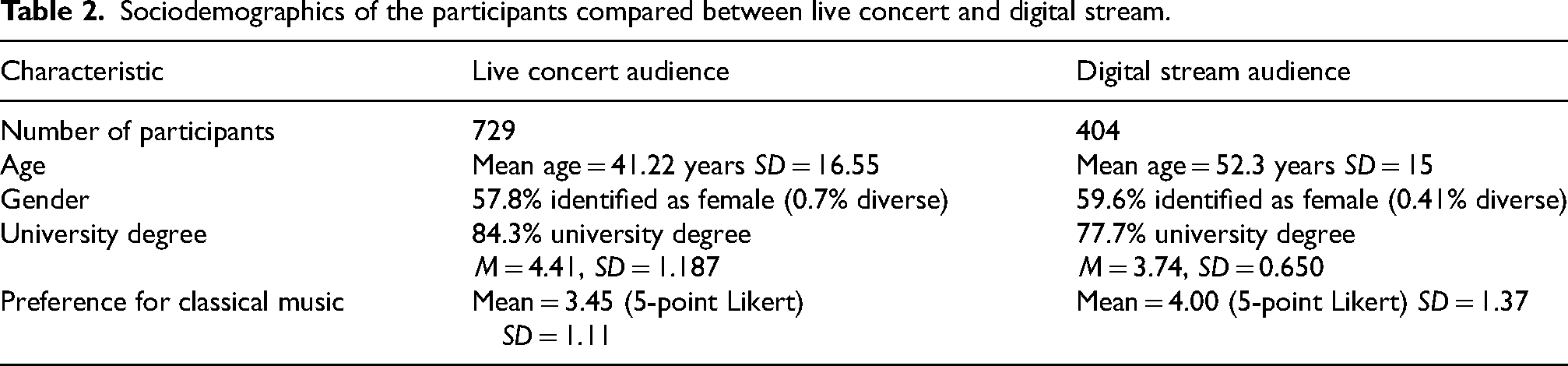
The sociodemographic characteristics of the two participant samples are presented in Table 2 including means and standard deviations. In our subsequent ANOVA analyses of the effects of liveness mode on audience experience, we use the following nine variables as control variables/covariates, because there were significant differences between the two participant groups: (1) Age was significantly different between the live sample and the digital stream sample (t(1101.3) = 12.063, p < .001, Cohen's d = .695). (2) The educational level (University degree) was distributed significantly higher in the live concert audience (t(1234) = 10.669, p < .001, d = .647). (3) A preference for listening to classical music was significantly higher within the stream audience (t(918.982) = 7.463, p < .001, d = .450). (4–9) The two audience groups also differed in terms of the Big Five personality traits: Openness, Conscientiousness, Extraversion, Agreeableness, and Neuroticism (McCrae & Costa, 1990; Gosling et al., 2003). These all turned out to be significantly different between the live and digital audience groups (see Supplemental Material I). A χ²-test showed no significant difference between the proportion of participants identifying as female or male in the two live and digital stream samples (χ²(1) = .100, p = .752, φ = 0.752). Gender was therefore not included in our subsequent analysis models as a control variable.
Sociodemographics of the participants compared between live concert and digital stream.
Musical Stimulus
The music program comprised performances of string quintets by Ludwig van Beethoven (C minor, op. 104, first movement only), Brett Dean (“Epitaphs” – a contemporary piece), and Johannes Brahms (G major, op. 111). It was curated regarding the shared topic of remembrance and the end of life. The contemporary piece by Dean was composed in dedication to deceased friends and colleagues. The other works (Beethoven and Brahms) are both from their composers’ late period and reflect upon the artist's own oeuvre. All concerts were performed by professional musicians with instructions to interpret the pieces as similarly as possible on each evening.
The stream audience watched the digital concerts on a device of their choice (see Wald-Fuhrmann et al., 2023, for more details). The concert stream video material was filmed according to standards for Western classical concerts. Recordings of three cameras (Lumix GH4, GH5, and Panasonic HC-X2E) resulted in a video containing long shots of the whole ensemble alternating with close-ups of individual performers. We deliberately left it up to the participants to choose the technical setup used to experience the concert, although audio quality can be an important contributor to the social and emotional experiences of digital concert streams (Swarbrick et al., 2021; Onderdijk et al., 2021). But with regards to ecological validity, they utilized the devices that they are used to and would normally watch a stream on.
Questionnaire Design
Pre- and post-concert questionnaires each started with an item battery to survey the participant's present affective states and pleasantness reflected in three dimensions: positive activation (PA), negative activation (NA) and valence (VA; PANAVA-KS; Schallberger, 2005). This is a domain-independent and indirect way to evaluate the affective quality of participants’ concert experience.
In the pre-concert questionnaire, the items asked about the reasons for going to the concert (13 items) and what participants hoped to experience in a classical concert in general (17 items). We used responses to these items to explore audience expectations regarding the concert. Items in the post-concert questionnaire evaluated concert aspects (14 items) and experience (18 items). Several items were identical in the pre-concert and post-concert questionnaires, allowing us to measure expectation and experience of the same characteristics (all of the relevant items are listed in Supplemental Material XIII-XV). Most of the items were rated on five-point Likert scales. The questionnaires also included demographic information and relevant personal characteristics and were presented in both settings (live and stream) via Lime Survey. The live concert audience completed the pre- and post-concert questionnaires on an iPad, while the stream audience used a personal device of their choice. It took the participants approximately 10 minutes per questionnaire. The questionnaires were available in English and German.
Dimensions of Concert Experience
Within our research project, Wald-Fuhrmann et al. (2023) used principal component analysis (PCA) to condense different dimensions of concert experience from a plethora of items, which then functioned as dependent variables in a study on digital concert streams. Accordingly, our aim was to adopt these to our study to subsequently test for liveness effects multidimensionally: Appreciation (items regarding, e.g., evaluation of the musicians, their interpretation), Immersion (e.g., connection to the music, concentration on the music), Intellectual Stimulation (e.g., confrontation with new impressions), Extramusical Social Experience (e.g., togetherness, meeting other concertgoers), Intramusical Social Experience (e.g., interaction between musicians and audience) and Venue (e.g., quality of acoustics, seating comfort). After we calculated the mean from the responses regarding concert experience to reconstruct the dimensions of concert experience according to Wald-Fuhrmann et al. (2023), we ran a reliability check. The values for Cronbach's alpha were not sufficient for the two dimensions Intramusical Social Experience and Venue (see Table 3), which is why these two indices were not used in the later analyses. Instead, three of the individual items from these dimensions were considered to broaden our insights: Felt Interaction, Seating Comfort (originally part of Intra-musical Social Experience) and Quality of Acoustics (originally part of Venue).
Reliability for dimensions of concert experience.

Note. Valid cases N = 1,156; 92.1%; excluded N = 99; 7.9%; total N = 1,255; 100%.
From the pre-concert survey we were able to survey the participants’ respective expectations for the same dimensions to analyze moderation effects.
Results
First, we considered the differences in affect and pleasantness using the PANAVA measurements from the two types of concerts (H1). This was followed by an analysis of more specific concert experience dimensions (H2). Subsequently, dimensions of audience expectation were brought in as additional independent variables and moderators to address H3. In all the analyses, comparisons were always made between the live concert condition and the digital stream condition. To control for any differences between these two groups of audiences, age, preference for classical music, education, and the big five personality dimensions were included as control variables (see Methods section). However, due to the focus of this analysis on the effects of liveness modes (live vs. stream), we will not present any effects of the control variables on the dependent variables.
Experienced Affect and Pleasantness – PANAVA
We conducted a mixed ANOVA to test for effects of liveness mode (live vs. digital stream) and time (pre- vs. post-concert) on each of the three PANAVA-KS dimensions (positive activation vs. negative activation vs. valence). The alpha values were adjusted via Bonferroni correction. (5/3 = 1.67). We could not observe any significant main effect for any PANAVA dimension, but we found a statistically significant interaction between liveness mode and time for positive activation (Greenhouse–Geisser F[1, 1121] = 10.780, p = .001, partial η² = .01). The respective plot (see Figure 1) shows how the positive activation for the two concert conditions cross over the course of the concert. The initial PA value was substantially higher in the live concert condition but drops over the concert, while it increases in the stream condition. The positive activation level after the concert is therefore higher in the stream condition and shows a stronger change over the concert. The PA change for each concert condition was significant (live: t(731) = 2.827, p = .005 ; digital: t(409) = -6.755, p = .001). Between- and within-subject effects for all dimensions are listed in Supplemental Material (III–V).

Pre- and post-concert measures of positive activation for the two liveness modes (live vs. digital stream). Error bars: 95% CI. ***: p = .001. (Values of covariates appearing in the model are listed in Supplemental Material II.)
Effects of Live Concert versus Digital Concert Conditions on Concert Experience
Within a MANOVA, there was a significant multivariate main effect for the liveness mode variable live concert vs. digital stream on the four different dimensions of concert experience (F[7,1116] = 63.373, p < .001, partial η2 = 0.284, Wilk's Λ = 0.716). Between-subjects effects within separate ANOVAs show that the influence of liveness mode was significant for all concert experience dimensions (Immersion: F[1, 1122] = 26.967, p < .001, partial η2 = .023; Intellectual Stimulation: F[1, 1122] = 27.523, p < .001, partial η2 = .024; Extramusical Social Experience: F[1, 1122] = 266.878, p < .001, partial η2 = .192) except for Appreciation (F[1, 1122] = 3.305, p < .069, partial η2 = .003). Ratings were all higher for the live concerts (see Figures 2a–2d), but the effects for the significant dimensions of Immersion and Intellectual Stimulation were small except for a large effect for Extramusical Social Experience.
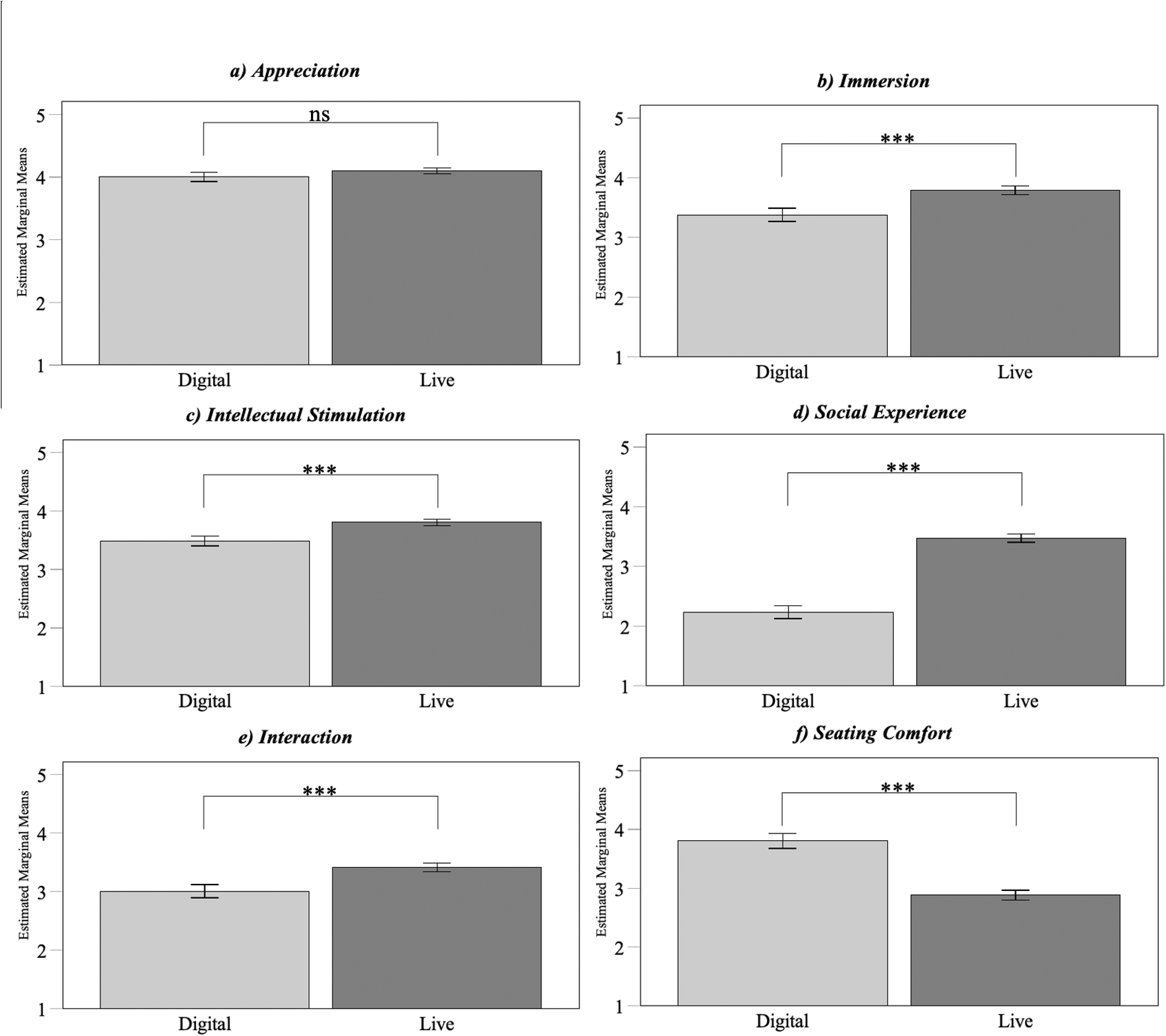
Figure 2a–2f: Bar plot comparison between digital stream and live concert condition for each dimension of concert experience and single items (except Quality of Acoustics). Error bars: 95% CI. (Values of covariates appearing in the model are listed in Supplemental Material II.)
The liveness mode effect (live vs. stream) on Felt Interaction between audience and performers (single item) was small but significant (F[1, 1122] = 25.191, p < .001, partial η2 = .022). People felt a stronger connection to the musicians in the live concerts (see Figure 2e). Seat Comfort ratings (see Figure 2f), on the other hand, were significantly higher for the digital concerts with a medium effect (F[1, 1122] = 104.283, p < .001, partial η2 = .085). Ratings on Quality of Acoustics did not differ (p = 0.128). Details of all MANOVA and ANOVA models are presented in Supplemental Material (VI–XIII).
Moderation Effects of Expectation
The post-concert item batteries on concert experience correspond to expectational item batteries in the pre-questionnaires. Therefore, indices computed based on the pre-questionnaires (expectation items) were used to quantify different types of expectation corresponding to the individual dimensions of concert experience from the post-questionnaire. By applying a median split, participants were classified into a low and a high expectation group according to the four dimensions of concert experience. Through this classification, we were able to analyze whether the expectation regarding the concert had an influence on the actual experience. We conducted a between-subjects ANOVA with the liveness mode and the expectation using one of the concert experience dimensions as factors and the respective concert experience dimension as the dependent variable for each of our concert experience dimensions.
The expectation variable was a significant predictor of all four dimensions of concert experience (see detailed univariate ANOVA models in Supplemental Material, X–XIII). Higher reported expectations related to higher reported experiences on the corresponding dimensions. The interaction of liveness modes and expectation was not significant for Appreciation, Immersion, or Intellectual Stimulation (expectation groups did not differ significantly between co-presence and digital) but had a small effect on Extramusical Social Experience (F[1, 1120] = 6.287, p = .012, partial η2 = 0.006, see Figure 3). This result indicates that the liveness effect increases if the visitors have high expectations of having social experiences at the concert compared to those with low expectations (H3).

Extramusical Social Experience scores for low and high expectation group in digital stream and live concert condition. *: p = .012 (Values of covariates appearing in the model are listed in Supplemental Material II.)
Discussion
We found several differences in the experience of live concerts and digital streams in ecologically valid concert settings (H1 & H2).
The relationship between positive activation and time is moderated by liveness mode. Over the course of the concert, positive activation of both liveness modes converged. While PA in live concerts fell slightly, it increased in the digital streams. This might be explained by the circumstances for the live concert audience. They might have been confronted with a somehow richer set of stimuli already before the concert, such as commuting to the concert venue, arriving, and meeting people (Burland & Pitts, 2014b). This initial stimulation might have decreased during the concert leading to a reduction in positive activation. Another explanation could be that participants were positively anticipating the event and then this activation subsided into peaceful contentment during the event. In contrast, the digital concerts were presumably mostly viewed in settings familiar to the participants, leading to less intensive positive activation before the concert, which was followed by an increase due to the stimulation evoked by the concert. A more private listening setting might be linked with a stronger increase in positive activation. However, negative activation and valence seem to be unaffected by the concert format.
Concerning the second hypothesis, all concert experience dimensions differ between the two liveness modes except for Appreciation, suggesting that people's evaluation of musical pieces and performances is not affected by the liveness mode. Especially Extramusical Social Experience (large effect) but also the dimensions Immersion and Intellectual Stimulation were rated significantly higher in the live concerts. In this respect, the assumption that coming together on site and having a shared concert experience is perceived as somewhat generally more intense than watching a stream at home (as also proposed by Wald-Fuhrmann et al., 2021) is supported by our findings. Although effects were all small for the dimensions other than Extramusical Social Experience, there is a clear tendency toward a more intense experience in live concerts. Our findings regarding intellectual stimulation support the results of previous fMRI studies that found higher brain stimulation during live piano performances in contrast to “comparable recorded music” (Trost et al., 2024). Moreover, our findings correspond to the results of Swarbrick et al. (2024), that musical absorption is related to immersion. The authors found that a live audience reported more musical absorption than a livestreaming audience. A reduction of experienced absorption when listening to recordings instead of live concerts was also suggested by Merrill et al. (2023).
Up to this point, a conclusion could be that the live concert setting seems to have provided a potentially richer concert frame compared to the digital stream setting in terms of experiential opportunities, so that our live concert setting might have offered a more intense stimulus spectrum overall than the digital streams. This is compatible with reported results of more vigorous movement at live concerts (Swarbrick et al., 2019). The conclusion is additionally supported in our study by the result of the single-item analysis regarding Felt Interaction between audience and performers as it was rated significantly higher for the live concerts as well, but again with a small effect. This suggests that stronger encounters between the two parties might be enabled at live performances (Barker, 2017; Reason & Lindelof, 2017), but as the effect was quite small, it may be somewhat surprising how strongly this encounter develops even when it is mediatized. The aspect of “audiencing” (the audience participates actively and pays a high degree of attention, Reason & Lindelof, 2017) and the theory of a feedback loop between audience and performers (Fischer-Lichte, 2021) are both supported based on this result. The characteristics of the live as described by Auslander (2022) largely apply to both live concerts and digital streams, except that, according to our findings, the social aspect still seems to make a decisive difference. Nevertheless, it is remarkable how social interaction in the context of concerts can also be realized digitally, for example during the pandemic (Upham et al., 2024). However, our results provide less support for the theory of hyperrealism (Barker, 2013; Baudrillard, 2006) as the digital streams were rated significantly lower for three of the experience dimensions. However, it remains unclear if focusing and highlighting of performance features are factors strong enough to substantially shape the concert experience (e.g., the audio-visual focusing of leading instruments and musicians, highlighting of certain musical events to account for a consistently good view of the action without any distraction). Regarding this, Swarbrick and Vuoskoski (2023) found no difference between a live concert audience and a livestream audience regarding their connection to the performers (when not considering other effects). Nevertheless, since we did not address hyperrealism theory directly within this study it should not be completely discarded. Various aspects of experience in other concert setups might still be affected by hyperrealism.
As for the Quality of Acoustics ratings, a good sound image on a decent home hi-fi system and real hall acoustics might have compensated for each other in the ratings, so that there were no significant differences. The familiar seating (e.g., on a couch) at home and the probably cozier ambience, on the other hand, are rated significantly better than being seated in tier arrangement of non-upholstered wooden chairs in the Radialsystem.
The concert frame concept also includes the formation of different expectations for various aspects of a concert, for example through prior concert experiences (Wald-Fuhrmann et al., 2021). Regarding hypothesis H3, we found that expectation had an impact on all dimensions of concert experience. Those who had higher expectations regarding a certain concert experience dimension also rated the respective experience significantly higher compared to the group with lower expectations. The liveness effect for Extramusical Social Experience increases even more in live concerts if the visitors have high expectations regarding Social Experience, as indicated by a significant interaction effect (H3). This result corroborates the assumption that it is especially the social component of live concerts that separates them from digital streams or maybe even from other concert formats that lack physical co-presence.
Limitations and Future Considerations
Since this study explores ecologically valid concerts instead of those in laboratory conditions, certain parameters could not be tested. First, the study design could produce different results in other genre contexts as this study relates to Western classical music only. Another limitation was our decision to ask participants to fill in self-reports of concert experience only after the concert. Accordingly, we measured experiences that are no longer present and must be reported from memory. However, in this way, our participants were able to immerse themselves in the music experience, instead of being distracted by questionnaire completion during the concert.
Although the different concert settings were all quite similar, there were several concert frame variations within the concerts. These variations might have had an impact on concert experience, which was beyond the scope of this study to explore and is reported elsewhere (see Wald-Fuhrmann et al. 2023; in review). Nevertheless, we believe that the different concert settings provide ecologically valid measurements of the experience of the same music presented in the same concert venue in different live and digital modes, which increases the generalizability of the findings reported here.
The dimensions of concert experience in this study were developed beforehand within a study comparing streaming concerts (see Wald-Fuhrmann et al., 2023). Although the items were designed to survey live concerts in the first place, the PCA to factorize them to dimensions of concert experience was executed on the data of the streaming concerts. Still, we decided to rely on these factors to ensure a better comparability within the research project.
Furthermore, we were not able to exactly track the behavior of the stream audience participating online. We do have some qualitative data though (see Modestini & Weining, 2025). Especially at home, opportunities arise for the audience to engage in additional activities during the concert instead of completely focusing on the performance. Due to being unobserved and the lack of typical established behavioral conventions in a digital concert, the question arises as to whether additional activities during the concert (e.g., knitting, see Modestini & Weining, 2025) make a difference regarding concert experience. Future study designs within concert research are encouraged to create solutions here.
The individual audio quality for each participant in the stream condition may also have had an influence, as indicated through other studies (Onderdijk et al., 2021; Swarbrick et al., 2021). Within our study we opted for ecological validity and consumption habits of the participants instead of controlling for the listening situation.
The last limitation we want to address here is our single item analysis. Single items are less ambiguous and can be seen as more efficient than scales (Allen et al. 2022), but indices are less vulnerable to measurement error. Single items might not capture all detail of an experience aspect sufficiently. Thus, interpretation should be approached cautiously.
Conclusions
We were able to empirically compare concert experience in two different liveness modes in an ecologically valid way using a large sample and have arrived at the following conclusions. While a statement cannot be made with regard to affective qualities, live concerts seem be more stimulating in terms of multidimensional concert experience (live in this study was defined as the spatiotemporal co-presence of musicians and audience during the performance), which is in line with theoretical reasoning by Auslander (2022) and Wald-Fuhrmann et al. (2021). In particular, the social component is experienced more intensively, specifically, among those co-present audience members who have high expectations regarding a social experience. Our study contributes to the validation of the concepts of audiencing and feedback loop, and explores the idea of the quality of the encounter between audience and performers being responsible for a special live experience. There are also some indications to discard the hyperrealism theory. The results form a basis for in-depth studies but at the same time already provide some important insights for the concert (stream) industry as to what format features the audience really values.
Supplemental Material
sj-docx-1-mns-10.1177_20592043251333995 - Supplemental material for Western Classical Music Concerts Are More Immersive, Intellectually Stimulating, and Social, When Experienced Live Rather Than in a Digital Stream. An Ecologically Valid Concert Study on Different Modes of Liveness
Supplemental material, sj-docx-1-mns-10.1177_20592043251333995 for Western Classical Music Concerts Are More Immersive, Intellectually Stimulating, and Social, When Experienced Live Rather Than in a Digital Stream. An Ecologically Valid Concert Study on Different Modes of Liveness by Martin Kreuzer, Melanie Wald-Fuhrmann, Christian Weining, Martin Tröndle and Hauke Egermann in Music & Science
Footnotes
Acknowledgments
Principal funding for Experimental Concert Research by Volkswagen Stiftung.
The concert series was supported by Aventis Foundation.
Action Editor
Emily Payne, University of Leeds, School of Music.
Peer Review
Dana Swarbrick, University of Jyväskylä, Department of Music, Art, and Culture Studies.
Sara D’Amario, University of Oslo, RITMO Centre for Interdisciplinary Studies in Rhythm, Time, and Motion.
Declaration of Conflicting Interests
The authors declared no potential conflicts of interest with respect to the research, authorship, and/or publication of this article.
Ethics Approval
All procedures were conducted in accordance with the 1964 Helsinki Declaration and its later amendments, and approved by the Ethics Council of the Max Planck Society (number 2702_12).
Funding
The authors disclosed receipt of the following financial support for the research, authorship, and/or publication of this article: This work was supported by the Volkswagen Stiftung and the Aventis Foundation.

Data Availability Statement
The datasets generated and analyzed during this study are available in the main author's GitHUB repository (Kreuzer et al., 2024).
Supplemental Material
Supplemental material for this article is available online.
References
Supplementary Material
Please find the following supplemental material available below.
For Open Access articles published under a Creative Commons License, all supplemental material carries the same license as the article it is associated with.
For non-Open Access articles published, all supplemental material carries a non-exclusive license, and permission requests for re-use of supplemental material or any part of supplemental material shall be sent directly to the copyright owner as specified in the copyright notice associated with the article.
