



Abstract
The notion of contrast is integral to both aesthetic and psychological accounts of attention and interest. It therefore represents a useful heuristic for understanding contrasting slow movements in Western art music. Based on the observation from music theory that within-movement tonal contrast (mode and key) increased during the 19th century, we assumed that a corpus of symphonic slow movements (n = 246) composed between 1800 and 1913 would exhibit increasing between-movement tonal contrast when compared to a sample of symphonies composed between 1757 and 1795 (n = 141). Synchronic analysis confirmed that slow movements contrast with their key-defining first movements. Diachronic analysis confirmed that within-symphony tonal contrast increases after 1800. Each of five style parameters observed for era comparison (changes in use of mode, key, meter, form, and structure) conformed to musicologically distinct yet plausible historical boundaries. Cluster analysis of the post-1800 corpus generated three clusters, with mode (non-)match between slow movement and symphony, printed tempo marking, and key relationship (measured by tonal distance) as the three strongest predictors. Since discussions of style naturally raise questions of influence, we also examined the relationship between prototypicality and composer prominence. To that end, analysis of clusters suggests the possibility of multiple, distinct “Beethovenian prototypes.” Finally, we found that, with the exceptions of Beethoven and Brahms, the most statistically typical pieces lack enduring impact, from today's perspective. Conformity to general stylistic norms thus seems to predict against the cultural longevity of a 19th-century symphony.
Keywords
Introduction
The “contrasting slow movement” is a ubiquitous phenomenon in multi-part Western art music that is nevertheless rarely defined. While it is true that enculturated listeners seem to associate “slow” music or songs in various genres with low arousal, often affectively sad, states (Juslin, 2013; Kivy, 2002), a conceptually rigorous description of slow movements would point to specific “prototype effects” or shared “family resemblances” (Rosch & Mervis, 1975; Weitz, 1956; Zbikowski, 2002). Without characterizing what those commonalities are among slow movements, we will never get closer to the concept than generalities. In order, therefore, to lend some structure to the concept, we investigated a specific corpus of Western music: the 19th-century symphony. We wanted to describe slow movements typologically, that is, by analyzing statistical features of individual movements, as well as those movements’ relationship to their symphony. Building upon the idea of “contrast” which slow movements are said to embody, we also wanted to see if such contrast extends to parameters beyond tempo, especially mode/key, and to assess how the use of those parameters changed over time.
Slow-Moving and Slow Movement
How is music heard as slow? Musical tempo is not a measure of absolute speed in terms of beats per minute (London, 2011). Rhythm, meter, and tempo involve interdependent rates of change at multiple hierarchical levels (Hasty, 1997; Jones, 1987; Lerdahl & Jackendoff, 1983), and each of these factors may influence subjective tempo, individually or in combination (Epstein, 1995; Repp, 2011). For example, fast inter-onset intervals within relatively static harmony or slow melody may still be perceived as slow (London, 2012). Furthermore, listeners can exert autonomous control over attendance to metrical level, even in ways that can alter their perception of time (Hammerschmidt & Wöllner, 2020; Wöllner & Hammerschmidt, 2021).
If there is thus some play at the joints when it comes to hearing music as slow, that does not mean slow-moving music is a fiction, or that it is dependent solely on individual listening strategies. It merely implies that there are multiple factors at work. In this way, analogies of musical speed to physical motion are instructive. Not only does this metaphor have a long history (Behne, 1976; Shove & Repp, 1995; Spitzer, 2004), it is also a recognized psychophysiological phenomenon. Listeners often schematize musical parameters—primarily rhythm, but also dynamics and texture—as moving objects or artifacts of motion (Eitan & Granot, 2006; Friberg & Sundberg, 1999; Truslit, 1938). They also entrain to expressively performed music at a longer temporal period (Drake, Jones & Baruch, 2000), so it is possible that specific timing profiles (rubato) also condition listeners’ expectations of how slow music unfolds (Clarke, 1999; Repp, 1998; Shaffer, 1981).
By convention, Western classical composers indicate performance tempo with standardized terms, like adagio or allegro. These are usually in Italian, but German and French equivalents are also common. Tempo terms may be modified by diminutives (e.g., -etto), superlatives (e.g., -issimo), and various qualifiers (e.g., molto). The speed of this music is impossible to know in any objective sense because it is determined by multiple factors, including context, tradition, subjective taste/mood of the performers, instrumentation, and acoustics (Auhagen, 2017; Grant, 2014; Weber, 1817). There is some disagreement among contemporary scholars and historical treatises, alike, regarding basic tempo terms. For example, it is debated whether andantino is faster or slower than andante in 18th-century music (Brown, 1999).
These debates notwithstanding, slow movements are theoretically identifiable within a multi-movement work such as a symphony by virtue of their written tempo. We have therefore chosen to define a slow movement simply as the one with the slowest tempo term relative to the other component sections of the symphony. Perhaps being the slowest movement is neither necessary nor sufficient to be perceived subjectively as slow, but we will assume that our contrastive sampling method yields recognizable tokens of the slow movement type. By our measure, for example, the Allegretto of Beethoven's Seventh Symphony is the slow movement of the piece because it is the slowest of its four movements, while the Allegretto of Brahms’ Second is not, on account of the Adagio which precedes it.
Contrast: Aesthetic Function and Compositional Strategy
Slow movements seem to satisfy a psychological predilection for aesthetic diversity (Berlyne & Boudewijns, 1971; Cheung et al., 2019; Konečni, 1986; Schellenberg et al., 2012). Huron's “tension-related contrastive valence” (2006, p. 367) suggests that the delayed fulfillment of expectation exhibited by slow music can invoke a specific kind of pleasure. Empirical research confirms that, within multi-themed Western classical music, high-energy passages are often followed by slower, quieter ones in a new key (Warrenburg & Huron, 2019); and Konečni (2009) posits that composers “intuitively realize the importance of change and modulation in the ‘arousingness’ (including through tempi) of their compositions” (p. 24). Theorists of symphonic form suggest slow movements introduce aesthetically desirable tempo contrast at the highest structural level (Berry, 1976; Caplin, 1998); and historical theorists, too, describe varieties of contrast beyond the melodic/thematic as essential to compelling composition (Marx, 1841; Quantz, 1752).
We assume, then, that a baseline function of a symphonic slow movement is to introduce tempo contrast at a relatively long timescale. Yet contrast may also extend to parameters in addition to tempo, such as harmony, dynamics, articulation, and instrumentation. Furthermore, conventions regarding the kind, degree, and even purpose of generalized contrast in symphonic music have changed over time. Mid-18th-century authors emphasized uniformity of Affekt within movements (Marpurg, 1760) and, between them, contrast “appropriate to the dignity of the symphony” (Schulz, 1774, vol. 4, p. 479). In 19th-century musical aesthetics, sudden, sometimes violent, polarities are common features (Agawu, 2009; Rosen, 1995). The use of contrast—fragmentation, even—as a marker of formal boundaries is also widespread in music of the 19th century (Hepokoski and Darcy, 2006; Schmalfeldt, 2017).
One especially overt agent of affective musical contrast is the opposition of major/minor mode (Caplin, 1998; Hevner, 1935; Justus, Gabriel & Pfaff, 2018; Lester, 1978). Here, too, there appears to be difference between historical periods, whereby the number of minor-mode movements increased during the 19th century (Horn & Huron, 2015; Post & Huron, 2009). This trend might be attributed to the novel harmonic strategies minor mode affords the composer (Rosen, 1995, p. 342) or to the purely “sonic contrast” it offers the listener (Meyer, 1989, p. 291). In either case, the increased use of minor mode has been posited as a distinguishing feature of so-called “Romantic” style.
A related form of harmonic contrast is key, which is most simply characterized by a tonic note and the mode of the scale built upon it (for a more detailed discussion, see Hyer, 2001). Slow movement key can be contextualized within the overall tonality of the symphony. For example, an F-major slow movement may be described as subordinately “on/in the subdominant key” when the first and last movements of a symphony are in C Major. Such relationships among keys are often described in terms of “distance” (Krumhansl & Kessler, 1982), whereby dissimilar keys are considered more remote from one another (e.g., the subdominant slow movement above represents a less distant/contrastive relationship than one built on a non-scale tone, such as Eb or Bb). If contrast increases in the 19th century, we can expect slow movements in more distant keys. That said, compared to the binary of major/minor, key modulation is not perceptually obvious to most listeners after long temporal spans (Cook, 1987; Marvin & Brinkman, 1999; Tillmann, Bigand & Madurell, 1998). Thus, if composers wanted to ensure harmonic contrast at the highest altitude of musical structure (i.e., that of the movement), mode would have been the more perceptually conspicuous contrast parameter.
In the interest of situating these and other 19th-century stylistic parameters within symphonic practice, we compared our primary corpus (1800–1913) with a sample of “Classical” symphonies by Haydn and Mozart (1757–1795). Finer-grained periodization is certainly possible for the 18th century (Gjerdingen, 2007) and a diversity of compositional idiolects may also be found within defined timeframes (Morrow, 2013). Nevertheless, we felt that having Haydn and Mozart symphonies stand metonymically for a comparison sample of “Classical symphonies” was justified for several reasons: (1) musicology and music theory point to those composers’ representativeness (e.g., Brown, 2003; Irving, 2013; LaRue & Wolf, 2006; Riley, 2014); (2) the recombination of conventional materials (e.g., schemata, topoi) as employed by Haydn and Mozart is a defining feature of 18th-century styles (Gjerdingen, 2007; Ratner, 1980); (3) to the 19th-century concertgoer (and indeed to most of their contemporary counterparts) Haydn and Mozart were/remain synonymous with Classical symphonies (Bonds, 2006); and (4) Haydn and Mozart are the only two 18th-century symphonists who widely influenced compositional thought throughout the 19th century (Botstein, 2012; Klorman, 2018).
Typicality and Prominence
“For all its outward variety, the 19th-century symphony exhibits remarkable coherence as a genre,” writes Bonds (2006, para. 1), adding that its “identity rests in part on external criteria of size and structure.” It should be instructive to see from surface data what characterizes a truly typical 19th-century slow movement. The statistical occurrence of features associated with 19th-century music—distant tonal relationships, metric instability, novel approaches to form and movement structure—might also provide insights about contested chronological boundaries (Brook, 1970; Gjerdingen, 2007; Samson, 2001). While musicologists and theorists take their emergence as givens, they rarely offer precise accounts of when such phenomena emerged. One reason for this is that these disciplines tend to describe style based on a selective subset of compositions without comparison to a large swath of repertoire. Analysis of a larger corpus can address this limitation, testing prior assumptions and even revealing hitherto unnoticed relationships within musical corpora (London, 2013; Neuwirth et al., 2018). That said, given the interpretive complexity of high-level musical concepts such as harmony and form, as well as the difficulty of extracting corresponding data from musical recordings or printed scores, purely data-driven methods are not yet sufficiently fine-grained. Our approach combines empirical methods with annotation and inference from historical musicology.
While it is possible to depict style as an aggregate of widespread practices, the picture is likely incomplete unless it also considers influential prototypes. In this context, Beethoven's nine Symphonies would seem to demand inclusion, given their preeminence in 19th-century symphonic aesthetics (Burnham, 2005; Dahlhaus, 1989) and their enduring popularity down to the present day (Lowe, 2020; Street, 2013). We propose a “Long 19th Century” from 1800 through 1913 as a chronological frame (cf. Kirby [1995], whose corpus analysis encompasses 1800–1914); it begins with the year of Beethoven's First Symphony and ends with the last full calendar year before World War I. One of the aims of our diachronic analysis was to observe further periodization boundaries within this larger timeframe.
To strike a balance between data-driven assessments of stylistic typicality on the one hand, and close analysis of prototypicality on the other, we compiled a sample corpus of all relevant works by composers considered “prominent” today, as well as works by lesser-known 19th-century composers. We enlisted four expert raters to provide present-day prominence scores for the composers in our sample. While we do not attach any a priori qualitative value to typicality or to prominence scores, the latter are a useful reflection of the situation today as judged by experts.
The Current Study
Our research covers four areas. (1) Typology. Using descriptive statistics and cluster analysis of data extracted from musical scores, we compare slow movements to each other. (2) Contrast. We compare slow movements to the symphonies in which they appear, particularly their opening/closing movements, which define overall key/mode. (3) Style. We compare trends for specified parameters to theoretical historical boundaries. (4) (A)typicality and Prominence. Using the foregoing analyses, we can characterize some immanent relationships in our data between a symphony's typicality and its relative staying power.
Our typology and typicality/prominence analyses represent statistical aggregates, while our discussion will situate empirical findings within broader perspectives from historical musicology. With respect to synchronic contrast, we assume that 19th-century slow movements will contrast with their symphony in parameters beyond tempo, specifically the following two: (1) Modality—such slow movements will frequently differ in mode from the overall mode of the Symphony; and (2) Tonality—they will be built on a different tonic note from that of the symphony.
Finally, our analysis of diachronic change traces the distribution of the following phenomena: (1) more use of minor mode, overall; (2) more distant key relationships between movements; (3) instability of meter within movements; (4) new movement forms; (5) novel symphony structures (i.e., greater variety of number/arrangement of movements than the four-movement fast-slow-fast[dance]-fast archetype). These five parameters are included because they are assumed as identifiable features of 19th-century style.
Methods
Inclusion and Exclusion Criteria
We gathered a geographically and chronologically diverse sample of symphonies (n = 242) from Europe (including the present-day Schengen area, Russia, and the British Isles) and the United States. For comparison between our primary corpus and the Classical era, we collected keys/modes, number/position of movements, and tempo marking for all recognized symphonies by Haydn and Mozart (N = 141). We further coded form and opening dynamic for the slow movements of a sample of well-known Haydn and Mozart Symphonies (n = 35). Every symphony analyzed had to: (1) be a multi-movement work published as a symphony (i.e., tone poems, symphonic dances, suites, serenades, extended concert overtures, and other symphony-adjacent pieces were excluded); (2) be available as a published score; (3) be publicly performed since 1970 and commercially recorded; and (4) have a slowest movement inferable from printed tempo marking. There were four symphonies (2%) with slow movements at both the second and fourth position in a five-movement piece. We decided to include these unusual cases because both movements were offset by surrounding fast ones, bringing the total number of post-1800 slow movements analyzed to n = 246. Published symphonic scores meeting the inclusion criteria were accessed for analysis primarily using the Internet Music Score Library Project (www.imslp.org). At the time of data collection, this database included 178,000+ works from 22,000+ composers.
Measures
For each of the symphonies in our sample, we collected the following data:
Mode. Major, minor, or mixed. There are numerous minor-mode symphonies that end in major yet are still classifiable as minor. Mixed refers to pieces that consistently alternate between major and minor such that it was impossible to decide a predominant mode.
Tonic. Represented as a letter (with sharp or flat sign where applicable) of the Western 12-note scale, excluding from analysis the pieces whose tonic is unspecified and/or differs between first and last movements.
Year of first performance. Dates were drawn from a variety of sources, including biographies, CD liner notes, program notes, IMSLP, and other online databases. There are instances in which the year of first performance is uncertain. In these cases, we applied our best judgment based on available sources. We decided to accept the uncertainty inherent in this dating procedure because other criteria (such as composers’ birth or death years) struck us as inadequate alternatives. In the instances for which there is a gap between first performance and publication of the score used for coding, we preferred a later date only if we were able to determine that a piece was extensively revised for publication.
Total number of movements. Movements succeeding one another without pause (attacca) were counted as discrete.
For each of the slow movements in our sample, we collected the following data:
Tempo marking. We decided to code tempo on a six-point ordinal scale from slowest to fastest. We collapsed three terms among which tempo differentiation cannot be categorically determined. Thus, on our scale: largo, grave, and lento = 1; larghetto = 2; adagio = 3; andante = 4; andantino 1 = 5; allegretto = 6. The occasional German and French tempo terms were classified by their closest Italian language analogue (e.g., langsam = adagio).
Dynamic at opening. We focused on printed scores rather than (measurable-but-unreliable) intensities of recorded performances. A limitation in discussion is that we coded dynamics only at the beginning of the slow movement. The dynamic (Italian term or abbreviation, such as piano, pianissimo, mezzo forte, fortissimo, etc.) was coded from printed scores on a six-point ordinal scale from quietest to loudest. Movements beginning in transit from loud to soft or vice versa (10%) were coded toward the middle of the scale, one step below or above initial printed dynamic, depending on direction of volume change. Thus: ppp/pp = 1; p = 2; mp/increasing = 3; mf = 4; f(decreasing) = 5; f(sustained)/ff = 6.
Key/mode of slow movement. Coded as for symphonies, see above.
Key relationship. We coded keys as tonic (same key and mode as first movement); relative; parallel; dominant (scale degree 5); subdominant (scale degree 4); submediant (6th scale degree, excluding relative minor); mediant (3rd scale degree excluding relative major); supertonic (2nd scale degree); subtonic (lowered 7th scale degree); leading tone (raised 7th); or tritone (augmented 4th or diminished 5th). Further distinctions are possible involving mode or alteration of scale degree. These were accounted for by measuring the tonal distance between keys.
Tonal distance. Tonal distance is an ordinal measure adapted from Krumhansl & Kessler (1982). In major mode, a distance of 1 includes the keys of the parallel minor, IV, V, and vi (relative minor); for minor, a tonal distance of 1 includes the parallel major, iv, v, and III (relative major). Distance of 2 in major: iii, iv, v, ii; in minor: IV, V, VI, VII. Of 3 in major: II, bIII, III, VI, bVI, bVII; in minor: bII, ii, #iii, biii, vi. A distance of 4 denotes remote keys, and a distance of 0 means the slow movement is in the same key and mode as the symphony.
Duple or triple meter (at opening). Duple meter refers to the perceptual rhythm of alternating strong-weak pulse (e.g., 2/4, 4/4, 6/8 when subdivided 3 + 3) as opposed to strong-weak-weak pulse (e.g., 3/4, 9/8, 6/8 when subdivided 2 + 2 + 2).
Meter change within movement. A binomial measure of whether notated meter changed during the movement. We acknowledge that there are other forms of metric instability (e.g., hemiola) that cannot be identified this way; but we felt that this coarse measure was an adequate indicator of pronounced instability (i.e., of a kind not assimilable into one meter).
Generalized form of slow movement. Although there are many nuanced variations of musical form (Hepokoski & Darcy, 2006; Rosen, 1980), some low-level generalizations are nevertheless possible. We used five broad formal groups to classify slow movements: sonata, sonatina (i.e., sonata without development), alternating sections (e.g., ternary, rondo), theme-and-variation, and free (e.g., fantasia).
Ordinal position of slow movement. Where the movement occurs overall in the piece (e.g., 2nd).
Composer prominence. Four experts (active professional musicians with master's degrees in performance and/or musicology) provided prominence scores on a 3-point scale. Their averaged scores indicate that our repertoire constituted 87 symphonies by composers widely known and performed today (e.g., Brahms, Mahler, Tchaikovsky), 51 symphonies whose composer a present-day audience member might recognize (e.g., Cherubini, Spohr, Dukas), and 108 whose composer an average listener would likely not recognize (e.g., Jadassohn, Radecke, Noskowski).
Atypicality. For further exploratory analysis, we coded an ad-hoc “Atypicality Index” (AtI) for each piece. AtI is a raw count (from 0 to 9) of the following statistically typical criteria that a given symphony/movement pair does not satisfy: tempo (e.g., Largo; Allegretto), opening dynamic (e.g., forte), mode of movement, key of symphony, key relationship (e.g., subtonic; tonic), meter change, form of movement (e.g., fantasia; theme and variation), number of movements in the symphony, and position of movement within symphony.
Data Analysis
All musical scores were analyzed and coded by author GM, a professional conductor closely familiar with the symphonic repertoire. A two-step cluster analysis was carried out on the post-1800 corpus. The one movement that systematically alternated between duple and triple meter was excluded, for a total n of 245. A log-likelihood distance measure was used with Schwarz's Bayesian Criterion (BIC), and noise in data was reduced by 25%. There were n = 84 outliers that were not grouped to one of the main clusters. The variables for clustering were tempo; dynamics; mode (major, minor, or mixed); mode-matching with symphony overall; tonal distance to key of symphony; and meter (duple or triple). Two further predictors were included that should explain clustering, although these were not used for the clustering procedure, itself: the year of the symphony's first performance and composer's contemporary prominence.
In order to account for approximation error, Yates’ correction was applied to Chi-square analyses. To account for the non-parametric nature of the data, variance analyses used the Kruskal–Wallis H Test, applying the Dwass–Steel–Critchlow–Fligner comparison to control family-wise error rate.
Results
Symphonies ranged from three to six movements, with slow movements in the first, second, third, fourth, and sixth ordinal positions. There were three ambiguous/unstable keys and six movements whose mode alternates consistently between major and minor. One movement (Ropartz’ Symphony no. 2) systematically alternated between duple- and triple- meter notation every measure and thus was excluded from meter analysis. A total of 17 slow movements (7%) had a marginal change in pulse (e.g., one or two isolated measures) and were excluded from meter change analysis. These 17 movements 2 were coded as atypical for purposes of the AtI's meter change metric.
Clusters
The cluster analysis generated three clusters and an outlier group (see spreadsheet in Supplemental Materials, where clusters are labeled “1,” 2,” and “3,” and outliers are labeled “−1”). The most important predictors for clusters were mode matching (1.00), tempo (0.90), tonal distance (0.49). Meter (double or triple; 0.28), mode of the movement (0.15), and year of first performance (0.13) were less important. Dynamics (0.05) and composer prominence (0.02) did not predict clusters at all.
Cluster 1 (N = 39) is characterized primarily by major-mode symphonies (97%) and a match between mode of symphony and movement (100%). The tempo of Cluster 1 tends to be andante (79%) with a limited tonal distance of 1 (85%, IQR = 0.00, Min = 1, Max = 4). Cluster 2 (N = 54) is typically adagio or slower (96%), has a median tonal distance of 2 (IQR = 1.00), and is in duple meter (96%). In Cluster 3 (N = 68), the modes of movement and symphony do not match (100%), the mode of the movement is generally major (88%) and tonal distance is often 2 (IQR = 0.00, Min = 1, Max = 4). Like Cluster 1, these tend to be andante (78%).
The outliers (N = 84) are more likely to begin at an extreme. These include 60% of the quietest opening dynamic (ppp/pp) and 83% of the loudest (f/ff); similarly, they account for 67% of the most remote key relationships, as well as all five cases of key/mode equivalence (tonal distances of 4 and 0, respectively).
A post hoc Kruskal–Wallis H Test confirmed that the three clusters differ in tempo, H(2) = 62.0, p < .001. Cluster 2 (Mdn = 4.00, IQR = 0.00, Min = 1, Max = 7) was slower than Cluster 1 (Mdn = 5.00, IQR = 0.00, Min = 3, Max = 7) and Cluster 3 (Mdn = 5.00, IQR = 0.00, Min = 2, Max = 6), both at p < .001. The clusters also differ in distribution over time, H(2) = 12.60, p = .002. Pairwise comparison revealed Cluster 1 occurs earlier (Mdn = 1855, IQR = 63.00) than Cluster 2 (Mdn = 1881, IQR = 33.00, p = .002), and Cluster 3 (Mdn = 1881, IQR = 43.00, p = .011).
In addition to the statistical measures, some qualitative patterns of cluster membership call for comment. Each of the groups contains one or a subset of Beethoven's nine Symphonies. Cluster 1 contains Beethoven's First, Second, Fourth, Sixth, and Eighth; Cluster 2 contains the Third and Ninth; Cluster 3 includes the Fifth; and the Seventh was an outlier. Not only are these groupings conceptually coherent among Beethoven's output, they also relate intuitively to other symphonies in their cluster. These findings are discussed further below (and shown in Table 1).
Examples of clusters and outliers.

Typicality
We aggregated the following descriptive norms for symphonic slow movements composed between 1800 and 1913: Symphonies in our sample range from three to six movements, with 87% of the total in four movements. A total of 78% are represented by 12 out of 24 possible keys: C major/minor, D major/minor, Eb major/minor, E major/minor, F major/minor, and A major/minor. The other six notes of the Western tonal scale were represented at or below chance levels; this includes the keys of Bb major and G major/minor, which, despite being rare in our 19th-century sample, are very common keys for 18th-century symphonies.
For the slow movements in our sample, 96% are the second (61%) or third (35%) movement of the piece; 87% are in the parallel major/minor, relative major/minor, subdominant, dominant, submediant, or mediant; 82% begin at a quiet dynamic (piano or lower); 79% maintain the same meter for the entire movement. In terms of form, 78% are alternating section (46%) or sonata (33%); 74% are marked andante (45%) or adagio (29%) for their opening tempo; 70% are in major mode.
A total of 43 symphony/slow movement pairs (18%) from 1800–1913 meet all the criteria above. Yet so do 12 of the Haydn/Mozart symphonies (32%) from our sample (see table in Supplemental Materials). Thus, distinguishing between typical Slow Movement/Symphony pairs pre- and post-1800 requires predictors in addition to those above, such as mode mismatch between symphony and movement; unusual or remote key; distinctive movement form (e.g., theme-and-variation is common before 1800 while free form becomes more common after 1800); or an atypical symphony structure (e.g., five-movement symphonies become common only after 1800). Applying the typicality criteria as restrictively as possible (i.e., a slow movement marked andante, occurring second out of fourth in the piece, on the submediant key, and in alternating sections), the four most typical 19th-century pieces are Beethoven's 5th (1808), Schubert's 4th (1816), and later works by two composers who are not frequently programmed today: Volkmann's 1st (1863) and Norman's 3rd (1881).
Atypicality
We assigned an ad-hoc “Atypicality Index” (AtI) to each piece, counting the number of descriptive criteria above that a given symphony/movement pair did not satisfy (n = 246, Mdn = 2.00, IQR = 1.00) (Figure 1). A post hoc Mann-Whitney U Test grouping Atypicality Index levels into low (76%, AtI = 0–2) and high (24%, AtI = 3–7) revealed that atypical works occur chronologically later (Mdn = 1899, IQR = 19.20) than typical ones (Mdn = 1876, IQR = 40.30), U(ntypical = 186, natypical = 60) = 2387, p < .001 (Figure 2).

Distribution of Atypicality Index scores (Mdn = 2.00, IQR = 1.00; scale = 0–9). Schumann's Third Symphony is most atypical in our sample.

Changes in (a)typicality over time. Typical AtI = 0–2; Atypical AtI = 3–7.
The one work with the highest AtI score (AtI = 7) was Schumann's Third Symphony in Eb Major (1850), whose free-form, parallel minor slow movement occurs in the fourth position of a five-movement work. The other two criteria by which it was judged to be atypical are, be it said, subject to interpretation. It begins with an accent (sforzando) but in an overall pianissimo context, and it is marked simply “Feierlich,” which is an indication of solemn mood rather an explicit tempo marking. Mahler's Ninth and Bendix’s Third were the pieces with AtI = 6. These account for two of the four symphonies (2% of total) that conclude with a slow movement, the other two being Tchaikovsky's Sixth (AtI = 5) and Mahler's Third (AtI = 4).
Of the 43 most typical works (AtI = 0), 27 were by low-prominence composers, 4 were by middle-prominence composers, and 12 were by prominent composers.
Mode Contrast
Using a one-sample binomial test with a test proportion of .50, it was found that the mode of a slow movement composed after 1800 often differed from the mode of the symphony (63%; p < .001).
We did not expect to find tonic slow movements (i.e., in the same key and mode as symphony overall) adjacent to any movement in the same key and mode. This was, indeed, exceedingly rare. We found only two (0.8%): Beach's “Gaelic” Symphony and Mahler's Fourth, with the latter concluding in a remote key (tonal distance = 3).
Changes over the Romantic Century (1800–1913)
A Kruskal–Wallis test confirmed that the tonal distances (1, 2, 3, and 4) were unequally distributed over time, H(3) = 32.2, p < .001 (Figure 3). Slow movements with a tonal distance of 0 (2%) were excluded because they were extremely rare. Post hoc pairwise comparison showed that slow movements with the remotest key relationships (tonal distance = 4) occurred later in time than distances of 1 and 2 (p < .001); slow movements with a relatively remote tonal distance of 3 also occurred later than those with a distance of 1 (p < .001) and a distance of 2 (p = .004). No other comparisons were significant.

Distributions of slow movements’ tonal distance over time.
In addition to the synchronic contrast parameters, we also tracked three diachronic features associated with 19th-century repertoire. The first is within-movement metric instability, measured in this case by notated meter change. No Classical slow movements changed meter within the movement, and meter remains very stable in the beginning of the 19th century. That is, we found only three pieces from 1800 to 1850 that change meter within the movement: Beethoven's Ninth (1824), Spohr's Fourth (1832), and Schumann's Third (1850). There was thus a precipitous increase in frequency of movements incorporating meter changes after 1865: while only 4% of slow movements from 1800 to 1865 change meter, 29% do after 1865, χ2(1, n = 231) = 11.75, p < .001.
Results of a Kruskal–Wallis test showed unequal distribution of forms over the period from 1800–1913, H(4) = 16.3, p = .003. A post hoc pairwise comparison revealed that free forms (e.g., fantasia) (Mdn = 1895, IQR = 20.50) arise later than three others: sonata (Mdn = 1880, IQR = 44.00, p = .015), sonatina (Mdn = 1860, IQR = 50.50, p = .027), and theme-and-variation (Mdn = 1867, IQR = 52.50) p = .047) (Figure 4). There were no other significant comparisons at the p < .05 level.
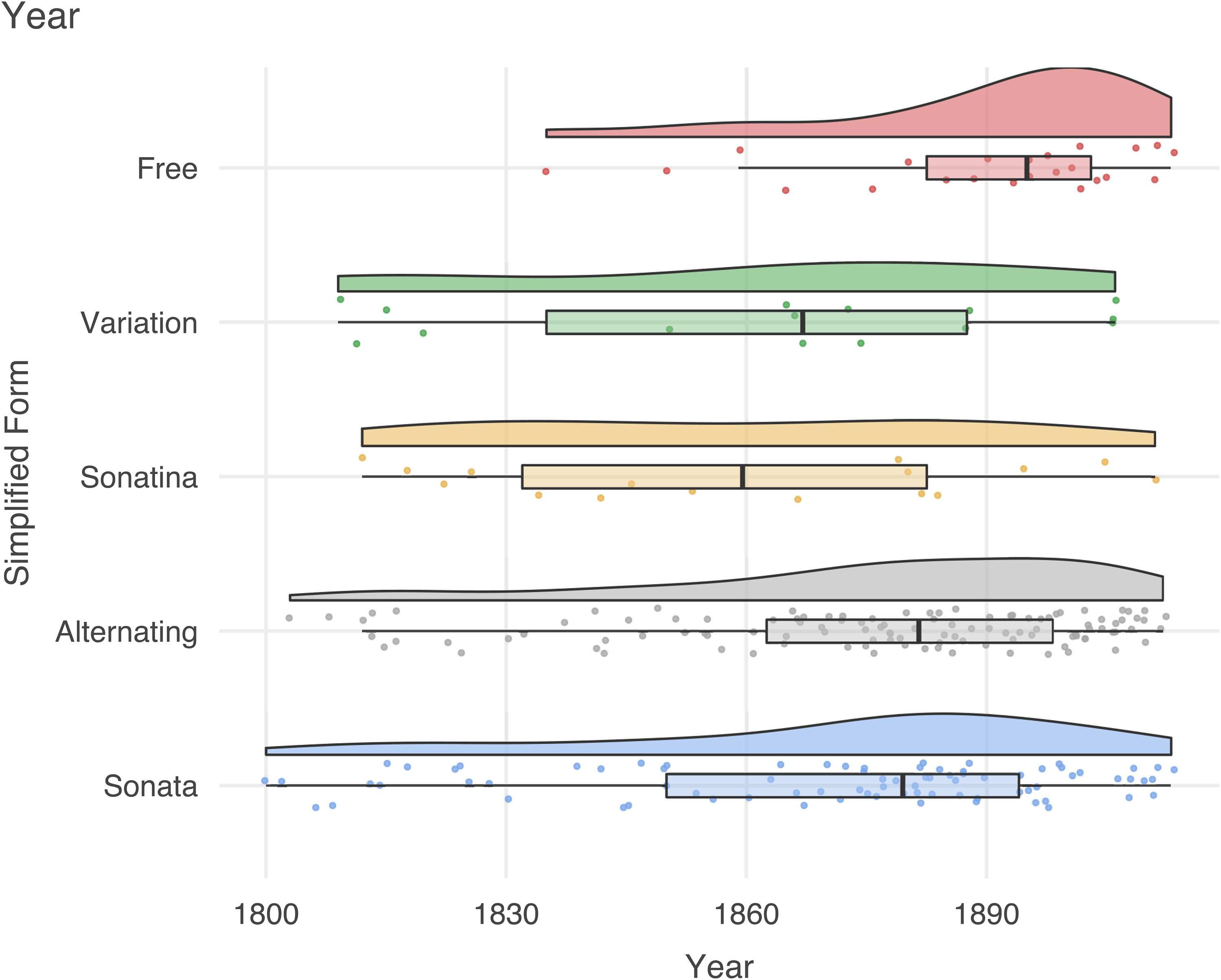
Distribution of slow movements’ general form over time.
Finally, a Chi-square test confirmed that conventional four-movement structure (where slow movements occur in second position), is more common before 1800 (71%) than after 1800 (54%), χ2(1, n = 385) = 10.70, p = .001. Post hoc analysis revealed that this structure is especially common between 1780 and 1829: only four (7%) pieces analyzed from this 50-year period—Mozart's 34th and 38th, and Beethoven's Sixth and Ninth—deviate from it.
Style Comparison Before and After 1800
Nearly all slow movements sampled began quietly. This convention is particularly strong before 1800 (94% piano and 3% pianissimo, n = 35, Mdn = 2.00, IQR = 0.00, Min = 1, Max = 6), but it persists after 1800, as well (82% begin piano or quieter; Mdn = 2.00, IQR = 1.00). Apart from this commonality, there were clear differences before and after 1800 for each of the criteria discussed above: mode, key relationship, tonal distance, metric instability, movement form, and symphony structure.
For mode comparison, we excluded the seven symphonies (3%) and six slow movements (2%) from the post-1800 corpus whose mode was ambiguous. As reported, 63% of slow movements from our primary sample (1800–1913) did not match the symphony, while they were typically matched before 1800 (83%), indicating sharply differing practices between centuries, χ2(1, n = 385) = 71.62, p < .001. Because major mode is predominant in pre-1800 symphonies, we looked at symphony/movement mode match (yes/no) grouped by mode of symphony (major/minor). A Chi-square test showed that the tendency for mode mismatch after 1800 was attributable more to minor-key symphonies (84% had a major-key slow movement) than to major-key ones (60% had a minor-key slow movements), χ 2 (1, n = 233) = 47.05, p < .001.
Another difference between centuries involved overall use of minor (see Table 2). Our data included almost five times as many symphonies (45% of total) composed in minor after 1800 as there were before, χ 2 (1, n = 383) = 55.20, p < .001. There were three times as many minor slow movements (28%) after 1800, χ2(1, n = 387) = 14.83, p < .001. Thus, minor-mode appears to be used more after 1800, with the additional specification that this increase disproportionately favors fast-tempo movements (i.e., outer movements) over slow-tempo ones.
Distributions of mode before and after 1800.

Tonal distance among the pre-1800 symphonies was limited to predictable, local keys (Mdn = 1.00, IQR = 0.00, Min = 0, Max = 3). Only one of them (0.7%) ventured into more remote territory (the slow movement of Haydn's 99th in Eb Major is in G Major; tonal distance = 3). Post-1800 slow movements exhibited more diversity of key relationship (see Table 3) and tonal distance (Mdn = 2.00, IQR = 1.00) (see Table 4).
Key relationships of slow movement to the symphony before and after 1800.

Tonal distance between symphony and slow movement before and after 1800.

Discussion
Using the notion of perceptual contrast as a lens, this corpus research attempts to lend structure to the concept of symphonic slow movements in Western art music. Our analysis confirms that slow movements are loci of large-scale contrast between movements in addition to tempo, and that composers’ use of contrast across parameters changed measurably over time. A statistical approach to synchronic, within-symphony contrasts not only helps us to characterize slow movements, it is also a useful tool for measuring diachronic, between-symphony style change. Our cluster analysis supports prior qualitative assertions about Beethoven's impact on symphonic repertoire, and we point to distinct strains of influence flowing from individual works. Finally, our prominence analysis suggests that, on the whole, statistical typicality predicts against cultural longevity.
Large-Scale Contrast
Warrenburg and Huron (2019) showed that slower, quieter passages typically follow high-energy ones in multi-section Western classical music. Our findings converge with theirs at the next structural level up. There were only two pieces sampled (Mahler's Tenth and Sibelius's Fourth) with an opening slow movement. Moreover, there were only four with concluding slow movements. Thus, a slow movement is typically an inner movement. Beyond tempo, musical mode is a dimension whose affective influence is easily perceived by enculturated listeners (Dalla Bella et al., 2001). Modal opposition does occur in 18th-century symphonies, but there it usually occurs within a single movement, for example in development sections (Irving, 2013). We found that, while the mode of symphony and slow movement rarely differ before 1800, they usually do after 1800. The findings that minor mode is used more after 1800, and that fast minor is disproportionately favored, are consistent with previous research (Horn & Huron, 2015; Post & Huron, 2009). Minor mode, as such, in combination with between-movement modal contrast is strongly associated with the Long 19th Century.
We expected key differentiation between part (slow movement) and whole (symphony) to be common; but we were surprised at just how unyielding a convention that type of contrast is: we found no slow movements matching both the key and the mode of their symphony between 1780 (Haydn's 62nd) and 1893 (Tchaikovsky's Sixth). There is also a clear increase in tonal distance between movements over time: forerunners of the symphony genre (e.g., Bach's Orchestral Suites or Händel's Water Music) involve tonal distances of 0 or 1 (usually relative minor) from movement to movement. Moving into the early era of multi-movement symphonies (Haydn/Mozart), key differentiation between movements is consistent but limited. After 1800, tonal distance increases, perhaps in two stages: before 1865 (Mdn = 1.00, IQR = 1.00) and after (Mdn = 2.00, IQR = 2.00). While this research does not address the tonal distance of other kinds of inner movements (e.g., scherzos) relative to the symphony as a whole, it is quite common for dance movements to be in the main key of the symphony. At any rate, the results above support the hypothesis that symphonic slow movements generally exhibit intensifying large-scale tonal contrast.
The focus of this research has been the largest subdivisions of the piece (movements) and parameters that prominently delineate contrast at that scale (tempo, key, and mode). Future research could focus on different parameters (such as dynamics, instrumentation, melodic ambit, rhythm, and texture) or evaluate ways in which 19th-century slow movements exhibit intra-movement contrast. Indeed, our results already suggest further avenues of research. For example, we found that a total of 84% of slow movements sampled for opening dynamic (n = 281) begin quietly. This association of slow and quiet seems logical from the contrast perspective, given that fast movements often end with goal-affirming force (Berger, 2007; Caplin, 2004). Quiet opening dynamics also becloud surface-level rhythmic features that could otherwise compete for subjective salience (London, 2011), which may in turn prime listeners to entrain at a slower metrical level. Slow movements that begin loudly while exhibiting an active rhythmic surface are, indeed, exceedingly rare, perhaps because the combination of loudness and rhythmic subdivision presents ambiguous cues that resist classification as perceptually slow.
“Arpeggiated” Style Change
The juxtaposition and reconciliation of discontinuous materials is considered a hallmark of “Romantic” aesthetics (Agawu, 2009; Schlegel, 1991); we therefore expected, and found, differences in compositional practice before and after 1800. But we also found differing rates of parametric change that call for further examination, and perhaps refinement, of period boundaries. To be sure, parsing music history into eras can be a fraught exercise (Webster, 2004). Some prefer essentially ahistorical grouping parameters (Frank, 1955); still others reject stylistic line-drawing out of hand (Brown, 2001). Yet, to the extent that chronological subdivision is interesting or useful, our data reveal disparate rates of change. The two parameters to change first after the turn of the century (i.e., increased use of minor mode and frequency of modal contrast between movements) do so only gradually. Moreover, it is worth noting that the so-called “Sturm-und-Drang” symphonies of the 1760s and 1770s are typically in minor, as well. On the other hand, the four-movement fast-slow-fast(dance)-fast structure is remarkably stable (94%), remaining essentially unchanged from 1780 to 1830. This corroborates both Webster's (2001) notion of a “First Viennese Modernism,” as well as what Hepokoski calls a “centering phase” of sonata form during this timeframe (2020, p. 303). Both tonal distance and metric instability, measured here by within-movement meter change, increase after 1865—both with considerable help, one might suppose, from the music/essays of Liszt and Wagner.
The conjectural boundaries outlined above (ca. 1780, 1830, and 1865) are consistent with two other empirical studies that, importantly, examined parameters different from ours; Weiß and colleagues (2019) aggregated melodic and harmonic profiles, and Rodriguez Zivic and colleagues (2013) analyzed melodic interval content. It is important to consider, however, that an evolving (or “spontaneously mutating”) compositional strategy in one genre is not presumptively synchronic across all of them. For example, a symphony from 1850 may bear far less resemblance to a piano sonata composed in the same year than it does to a piano sonata written in 1815, and for reasons that deserve inquiry—the effects of technology, or divergent attitudes about the social functions of chamber music and the institution of the orchestra (Spitzer & Zaslaw, 2004). In that respect, our research also harmonizes with calls for style analyses that are alert to chronologically staggered parameter change (see the evolution curves in Weiß et al., 2019), or that contemplate differences among multiple genres (LaRue, 1970; Meyer 1989).
Precisely why these patterns of large-scale contrast shifted lies beyond the scope of this research, although there are sensible cultural/psychological rationales available. The steadily increasing temporal scale of 19th-century symphonies might have encouraged bolder contrast; or, per Meyer (1989, p. 208), the “declining sophistication” of 19th-century audiences might have necessitated it. There may be other socio-cultural reasons beyond audience discernment to explain why the nuances of the pre-Revolutionary aesthetics gave way to bolder contrast in the Romantic Century. Future research might explore them, specifically: (1) the nature of other forms of parametric change in the symphonic genre; (2) the timing of such changes; and (3) the way rates of change differ among musical genres (solo, chamber, opera, etc.). Future empirical work could also track correlations between internal musical data and external criteria, hypothesizing the effect of an event—or technical advent—on a musical corpus.
Symphony Clusters
An examination of members constituting our clusters suggests that they might, indeed, be described as qualitatively coherent “types.”
Members of
Any principle uniting the final group is necessarily informal (since they are outliers). Nevertheless, this group includes many examples that might be described as “norm-breaking” (e.g., highly original symphonies by Mahler, Nielsen, Bendix, and Draeseke). A movement exhibiting either an exceptionally quiet or a rare loud opening likely occurs in this group. It has the highest Atypicality Index (Mdn = 2.00, IQR = 2.00), and accounts for most (67%) of the remotest key relationships (tonal distance = 4), and each of the five cases (2%) of key/mode equivalence (tonal distance = 0).
Beethoven as Prototype
Our foregoing analysis has pointed to some historical inflection points for style demarcation. It bears mentioning that, because our comparison sample was comprised of Haydn and Mozart symphonies, there is a gap from the years 1796 to 1799. While this gap could ostensibly limit the scope of inference as to what changes occurred to symphonic style at the close of the 18th century, it does seem that precisely those years saw an overall decline in symphonic output, one that Buurman (2020) attributes to the genre's uneven transition from effectively private, aristocratic entertainment to public format. (Buurman also outlines the unfavorable socio-political circumstances that might have led Beethoven to delay writing a symphony between 1795 and 1800.) Regardless, as our statistical results suggest, the year 1800 does not mark the most persuasive turning point. If Goehr's “centurist” claim that “we [should] all agree something happened around 1800” (1992, p. 119) is valid, it is tempting to say that “something” is not a trend—it is Beethoven. Indeed, statistical changes occurring after the 1820s even bolster the argument that Beethoven initiated new trends, because it would have taken time for his innovations to spread. It is, of course, possible that Beethoven merely incorporated a great many novel stylistic possibilities as they emerged without, himself, being their originator. 3 At any rate, his post facto status as a model for later generations of composers is uncontested as a matter of historical record; and, given the distribution of his symphonies in our clusters (as well as the characteristics of other works within them), a Beethovenian genealogy does seem plausible (Table 1).
Typicality as Predictor of Obscurity
Our descriptive typology aggregates some component features of style quantitatively and without regard to specific works. The patterns uncovered with respect to number of movements, mode, and symphony key distributions for both pre and post 1800 corpora converge with a prior survey of German symphonies from 1800–1914 by Kirby (1995). Others (e.g., number of movements, position of slow movement, slow movement key) correspond to the results of another corpus study by Cannon (2016). One might therefore broadly define a “typical” 19th-century slow movement using the Atypicality Index above. The results of our cluster analysis, on the other hand, suggest a genealogy in which Beethovenian prototypes form the base of four different branches rather than suggesting any single type. It is not illogical that composers would rely on sanctioned models, particularly when attempting a large-scale form like the symphony, nor is it farfetched to imagine Beethoven creating more than one viable exemplar.
No branch in our cluster analysis yields more or less prominent fruit. It was the case, however, that across all clusters, the 43 (18% of total sample) fully type-conforming symphonies (AtI = 0) are mostly the work of little-known composers, such as Abert, Gouvy, Huber, Norman, and Scharwenka. Moreover, the eight fully conforming symphonies by prominent composers (Bruckner, Schubert, Dvorak, Mendelssohn, Rimsky-Korsakov, and Strauss), would likely be described by musicologists as lesser-known works within those composers’ respective outputs. Again, while measurements of typicality and present-day prominence are not intended as qualitative judgments, complete statistical conformity seems to predict against lasting esteem. The remaining four symphonies with AtI of 0 (Beethoven's First and Fifth, Brahms’ First and Third) might suggest that typicality and longevity are independent; but they are also such exceptional works that they invite another interpretation. That is, the documented influence of Beethoven's Fifth all but entails its similarity to later works; and, for his part, Brahms is known to history as the composer who most successfully embraced and extended Beethoven's symphonic legacy.
Conclusion
This research presents a corpus analysis of 246 symphonic slow movements composed between 1800 and 1913. It aggregates statistical features and characterizes synchronic relationships of movements to the symphonies in which they appear, as well as diachronic relationships between pieces over time. The synchronic hypotheses, that slow movements exhibit contrast beyond tempo, were supported. Future research might explore the perceptual nature and limitations of musical contrast over varying temporal-structural levels, for example, whether some forms of contrast are preferred locally (harmony, rhythm) while others are optimal at a global structural level (mode, tempo).
Diachronic analysis points to chronologically uneven rates of change across parameters in ways that both confirm some traditional style boundaries and complicate others. Some disagreement may always persist because of a conflict between two approaches to understanding musical style: a statistical one that describes distributed common practice, and an another that emphasizes the transformative influence of innovative works. 4 This research, while not necessarily reconciling those two approaches, benefits from the application of both in concert.
Dahlhaus (1989) observed that “[t]he history of the symphony…looks almost like a history of the conclusions that composers were able to draw from Beethoven's various models of the symphonic principle: from the Third and Seventh Symphonies in the case of Berlioz, the Sixth in the case of Mendelssohn, and the Ninth in the case of Bruckner” (p. 78). One need not accept those conclusions unquestioningly (cf. Brodbeck, 2013), but the fact remains that 19th-century symphonists faced irreconcilable pressures to imbue normative models with novelty. Robert Schumann, for instance, was capable of exhorting composers, “Everything as in Beethoven,” only to conclude the same thought by describing the need “to advance [the modern symphony] according to new standards” (cited in Pederson, 1993, p. 20, emphasis added). Typicality in the 19th century was ultimately neither a safeguard against criticism nor a guarantee of success. Thus, there was apparently no danger to a composer following a particularized Beethovenian model. Yet our atypicality and prominence analyses do point to risk of a different sort: unswerving adherence to undifferentiated norms (whatever their source) may yield unmemorable music. There is even some evidence for the obverse. The 60 most atypical works (AtI ≥ 3) include a high number of frequently performed symphonies in (e.g., Beethoven's Seventh, Tchaikovsky's Sixth, Franck's D Minor, six symphonies by Mahler and four by Sibelius).
Future corpus analysis using similar typicality and prominence measures could advance on these first steps. For now, Ernst Gombrich's comments about the history of art seem apt: “the more we become aware of the enormous pull in man to repeat what he has learned, the greater will be our admiration for those exceptional beings who could break this spell and make a significant advance on which others could build” (1960, p. 20). We cannot, of course, assume that the typicality described above amounts to typicality across all dimensions, nor do we assume that “unmemorable” music follows directly from adherence to norms. Finally, we cannot conclude that composers of “norm-breaker” symphonies consciously sought to avoid unflattering comparison with Beethoven, the “norm-maker.” Judging from the pieces in our sample, we can merely say that fortune appears to favor the bold.
Supplemental Material
sj-xlsx-1-mns-10.1177_20592043231182275 - Supplemental material for The Contrast Principle, Typicality, and Cultural Longevity in 19th-Century Symphony Slow Movements: A Corpus Analysis
Supplemental material, sj-xlsx-1-mns-10.1177_20592043231182275 for The Contrast Principle, Typicality, and Cultural Longevity in 19th-Century Symphony Slow Movements: A Corpus Analysis by Geoffrey McDonald and Clemens Wöllner in Music & Science
Supplemental Material
sj-xlsx-2-mns-10.1177_20592043231182275 - Supplemental material for The Contrast Principle, Typicality, and Cultural Longevity in 19th-Century Symphony Slow Movements: A Corpus Analysis
Supplemental material, sj-xlsx-2-mns-10.1177_20592043231182275 for The Contrast Principle, Typicality, and Cultural Longevity in 19th-Century Symphony Slow Movements: A Corpus Analysis by Geoffrey McDonald and Clemens Wöllner in Music & Science
Footnotes
Action Editor
Tomas McAuley, University College Dublin, School of Music.
Peer Review
One anonymous reviewer.
Frank Hentschel, Universität zu Köln Musikwissenschaftliches Institut.
Contributorship
Both authors conceived the study and analyzed the data. GM compiled the corpus data and drafted the manuscript; CW reviewed and edited the manuscript.
Declaration of Conflicting Interests
The authors declared no potential conflicts of interest with respect to the research, authorship, and/or publication of this article.
Ethical Approval
This research did not require ethics committee or IRB approval. This research did not involve the use of personal data, fieldwork, or experiments involving human or animal participants, or work with children, vulnerable individuals, or clinical populations.
Funding
This work was supported by a Consolidator Grant from the European Research Council (Grant No. 725319) to the second author for the project “Slow Motion: Transformations of Musical Time in Perception and Performance.”

Supplemental Material
Supplemental material for this article is available online.
Notes
References
Supplementary Material
Please find the following supplemental material available below.
For Open Access articles published under a Creative Commons License, all supplemental material carries the same license as the article it is associated with.
For non-Open Access articles published, all supplemental material carries a non-exclusive license, and permission requests for re-use of supplemental material or any part of supplemental material shall be sent directly to the copyright owner as specified in the copyright notice associated with the article.
