



Abstract
Expert musicians portray awe-inspiring precision, timing, and phrasing and may be thought to partake in a “hive-mind.” Such a shared musical absorption is characterized by a heightened empathic relation, mutual trust, and a sense that the music “takes over,” thus uniting the performers’ musical intentions. Previous studies have found correlations between empathic concern or shared experience and cardiac synchrony (CS). We aimed to investigate shared musical absorption in terms of CS by analyzing CS in two quartets: a student quartet, the Borealis String Quartet (BSQ), and an expert quartet, the Danish String Quartet (DSQ), world-renowned for their interpretations and cohesion. These two quartets performed the same Haydn excerpt in seven conditions, some of which were designed to disrupt their absorption. Using multidimensional recurrence quantification analysis (MdRQA), we found that: (1) performing resulted in significantly increased CS in both quartets compared with resting; (2) across all conditions, the DSQ had a significantly higher CS than the BSQ; (3) the BSQ's CS was inversely correlated with the degree of disruption; 4) for the DSQ, the CS remained constant across all levels of disruption, besides one added extreme disruption—a sight-reading condition. These findings tentatively support the claim that a sense of shared musical absorption, as well as group expertise, is correlated with CS.
Keywords
Introduction
Human beings coordinate their actions in the most extraordinary ways. Music ensembles are one of the most exquisite examples of such interaction. Yet, the peak of joint human performance is to be found in expert musicians’ shared and interactive precision, timing, and phrasing. While performing, such musicians claim to sometimes undergo intense shared experiences, where their sense of self blurs and they enter a “hive-mind,” playing almost as one organism. Such “blurring” is described in several strands of literature pertaining to both the sense of self and the sense of agency in fields within, as well as without, aesthetic and artistic research (Benson, 1993; Loehr, 2022; Pacherie, 2012; Silver et al., 2021). Phenomenological research has documented that, in its strongest forms, such musical absorption can be experienced as a sense of shared emotions, trust, and direct contact with each other's movements (Høffding, 2019). A member of the Danish String Quartet (DSQ) expresses it as follows: “But I also enormously enjoy closing my eyes, even if we play very slowly and then trust that the other…that we follow one another, feel the energy, here we shift the bowing, that it does not become a thing of vision, but that you can sense it, there is the bow-shift, right?”…“When you perform in the quartet…you know what the others are doing without looking at them. When everyone in the quartet is in this state, it is just like there is a bubble of sound over everyone's heads that you can just form as you wish.”…“Something is affected and some choices are made, but I just don’t know where it comes from. When we perform these chorals and they change. It might be that it comes from me, but I have no clue. It emerges so instinctively.” (Høffding, 2019, p. 244)
Using this previous knowledge about the relation between CS and shared experience, we aimed to examine whether the sense of shared musical absorption in string quartet performance correlates with CS. Unlike choir singing, where sound production is directly linked to breath control, which directly influences cardiac activity, string quartet members do not need to synchronize their breathing. If we were to find high degrees of CS in the string quartets, we could hence rule out that this was solely caused by breathing synchronization, but rather that it—like in the nonmusical cases presented above—would correlate with an embodied mental synchronization phenomenon such as shared musical absorption.
Achieving synchrony and harmony in a quartet requires precise sensorimotor coordination and mental effort (Bishop et al., 2021a, 2021c; Gonzalez-Sanchez et al., 2019). Expert musicians have a better capacity to control their motion and minimize muscle effort relative to less skilled musicians (Furuya et al., 2011; Furuya & Kinoshita, 2007, 2008). They can also better monitor the sound to adjust body motions in real-time to ensure the quality and desired musical intention (Brown et al., 2015). This allows them to better perceive, coordinate, and reproduce expressiveness in music (Chaffin & Lisboa, 2008; Clarke, 1989, 1993). However, no studies correlate joint musical expertise with a physiological synchrony measure such as CS. Further, and unlike our study, most of the above-mentioned studies do not rely on top-level international musical ensembles such as the DSQ.
Despite evidence that musicians utilize, besides the auditory, visual, tactile, proprioceptive, and sometimes vestibular feedback during performances (Brown et al., 2015), the exact role of the various sensory modalities for group cohesion remains unclear. On the one hand, musical experts have been found to coordinate with each other accurately without visual or other types of sensory feedback (Bishop & Goebl, 2015; Bishop et al., 2021a; Goebl & Palmer, 2009; Keller & Appel, 2010). On the other hand, visual cues have been found as a key element that can affect group cohesion and artistic expression in the musical ensemble (D’Amario et al., 2018). For instance, visual communication is one of the most useful channels to facilitate leader–follower coupling in string quartet performance (Chang et al., 2017). In addition, eye contact is frequently used in popular music bands (Kurosawa & Davidson, 2005), which suggests that it improves communication of expressiveness and intent in musical performance (Bishop et al., 2021a; Castellano et al., 2008; Clayton, 2007; Dahl & Friberg, 2007). Researchers have also found reduced synchrony and musical cohesion in the absence of visual information in piano and vocal duets (D’Amario et al., 2018, 2019; Kawase, 2014; Palmer et al., 2019). In contrast, the DSQ claims to musically communicate best with their eyes closed (Blum & Quartet, 1987; Høffding, 2019), suggestive of a certain bodily-based attunement or “intercorporeity” (Fuchs, 2017). Our experiment sought to disrupt shared musical absorption by manipulating the degree of possible visual contact to further investigate the importance of visual communication in musical cohesion.
Most of the previously mentioned studies only examine CS on the dyad level because their analyses are methodologically limited by the quantity of variables supported, as seen in cross-correlation methods (Konvalinka et al., 2011) or phase-coupling methods (Müller & Lindenberger, 2011; Yoon et al., 2019). For instance, in the fire-walking study of Konvalinka et al. (2011), the fire-walkers’ CS were analyzed in three dyads: fire-walker/related spectator, fire-walker/tangentially related spectator, and fire-walker/unrelated spectator. The result of this analysis revealed that the closer the relationship between the fire-walker and the spectator, the greater the CS. To go beyond the dyad, we extended previous studies on shared experience and CS by implementing a novel multivariate method, multidimensional recurrence quantification analysis (MdRQA) (Wallot et al., 2016c), to quantify CS between all four musicians in the quartets. MdRQA is a multivariate recurrence-based method designed to capture the nonlinear dynamics and repetition of the same or similar values between multidimensions time series (Dimitriev et al., 2020; Javorka et al., 2009; Marwan et al., 2007). It can be implemented to examine synchrony levels of behavior and physiological data for multiple participants (n > 2) in group activities at different levels (Wallot & Leonardi, 2018; Wallot et al., 2016c) and features robust procedures to address outliers and heterogeneous variance over time (Marwan et al., 2007). Therefore, MdRQA was particularly suited to investigate the string quartets’ CS in the present study.
The present study is based on cardiac data from two string quartets: the Borealis String Quartet (BSQ), a group of bachelor students from the Norwegian Academy of Music who had played together for about six months, and the Danish String Quartet (DSQ), which is considered one of the world's finest quartets and has a shared history of over 20 years, well documented in ethnographic and phenomenological research (Høffding, 2019). Comparing the cardiac data from the BSQ and the DSQ, we used MdRQA to investigate whether shared musical absorption and joint expertise correlated with CS.
The first part of the experiment consisted of the BSQ performing the first 68 bars of Joseph Haydn's String Quartet in B-flat major six times in five different conditions (Figure 1) and a Quiet baseline where they sat still together. Three conditions (Blind, Score-directed, and Violin-isolated) were disruptive, constraining the musicians’ visual communication and, hence, their shared musical absorption. Blind was expectedly the most difficult condition, followed by Violin-isolated and Score-directed (Figure 2).

Experimental conditions.

Photos from experiments.
The DSQ part of the experiment replicated the BSQ design except for two specific changes. First, we introduced a Moving baseline condition before Blind where they played a scale in unison. This was done to assess possible differences between merely playing together and playing actual music. Second, we introduced an extreme-disruption condition to challenge their shared musical absorption: Sight-reading a piece they had never played before: Langgaard's String Quartet No. 5, 2nd movement. Since we were not convinced that the disruptive conditions would really disrupt the experts, in this condition, the DSQ was forced to perform with no preparation. This differs from normal circumstances, in which they can always prepare in advance.
We hypothesized that: (1) for both quartets, performing together would increase group-level CS compared with the quiet baseline; (2) for the BSQ, the disruption conditions would negatively affect CS as a physiological proxy of disrupted shared musical absorption; and (3) for differences between the BSQ and the DSQ, the disruption conditions would affect the DSQ's CS less than the BSQ's.
Materials and Methods
Participants
The present study includes the analysis of the cardiac data in the MusicLab Copenhagen data set (Høffding et al., 2021) and the Borealis String Quartet Research Concert (Høffding et al., 2022) from two string quartets: the Borealis String Quartet (BSQ) and the Danish String Quartet (DSQ). The BSQ is a student quartet from the Norwegian Academy of Music. The musicians were 20–21 years old (one female, three male) and had been playing together for about half a year. The DSQ is internationally acclaimed and has performed with the same four members since 2008. The musicians were 36–39 years old (four males). As ECM recording artists and GRAMMY-nominated musicians, they have released 11 albums, conducted several world tours, and won numerous international chamber music awards. All participants consented in writing to data collection, and both quartets were interested in having their names disclosed. The two experiments were approved by the Norwegian Center for Research Data (NSD), reference numbers 915228 and 748915.
Materials
The two quartets played the first 68 bars of the String Quartet in B-flat major, Op. 76, No. 4, Allegro con spirito, by Joseph Haydn in Normal-rehearsal, Replication-rehearsal, Violin-isolated, Blind, Score-directed, and Concert conditions. In addition, the DSQ recorded a Moving baseline in the form of a scale in unison and an extra Sight-reading condition of Langgaard's String Quartet No. 5, 2nd movement.
Procedure
Similar experimental procedures were used for both quartets. The BSQ experiment was performed in the fourMs Lab at the University of Oslo on December 9, 2019. They had been practicing the piece for three months. After the equipment setup and a short warm-up, we recorded a 40-s break before condition 1 where they sat still as a quiet baseline. Then, the quartet performed the six conditions (Blind, Score-directed, Normal-rehearsal, Violin-isolated, Replication-rehearsal, Concert).
The DSQ experiment took place in a concert hall (Musikkens Hus) in Copenhagen on October 26, 2021. The DSQ had not prepared the piece in advance and were given 30 min before the experiment to familiarize themselves with the score. We first recorded a three-minute Quiet baseline followed by the Moving baseline, Blind, Score-directed, Normal-rehearsal, Violin-isolated, Replication-rehearsal, Sight-reading, and Concert.
In both experimental sections, the musicians had short breaks between each performance condition, while researchers repositioned musicians according to the experimental design. During these pauses, the musicians were allowed to chat and discuss previous performances. The duration of each break was approximately the same (Bishop et al., 2021b). On the day of the experiment, all participants kept their habitual sleep and coffee intake and did not report any hearing loss or physical discomfort.
The electrocardiogram (EKG) was obtained for the four musicians through three-lead Delsys Trigno EKG sensors placed on their chests. A series of other experiments were performed in parallel, so musicians were also equipped with motion capture suits and eye-tracking glasses. The EKG sensors were cleaned with alcohol wipes before the experiment and the wires and sensors were secured with medical tape to avoid noise from possible sensor shifting. The EKG data was transmitted through Bluetooth to a laptop in real-time via a Delsys host base, with a maximum sampling rate of 4370 Sa/s.
Data Preprocessing
EKG data was exported from Delsys EMGworks 4.8.0 software for further preprocessing, and the R-R interval—the interval between two successive R-waves of heartbeats—was extracted with the Python package Neurokit 2 (Makowski et al., 2021). To address potential inaccuracies related to incorrect heartbeat detection and signal artifacts (Peltola, 2012), we applied the Python package Systole (Legrand & Allen, 2022) and visual inspection to ensure the artifacts were properly removed from the data. Since the R-R intervals typically have inconsistent data lengths across participants due to individual differences in heartbeat frequencies, we calculated beats-per-minute (BPM) values. This calculation was done in nonoverlapping 500 ms intervals to obtain the time series at the same rate for each participant within the quartet. While the calculation of BPM from RR-intervals often is done across larger windows to smooth-out some of the variability, in the present case we chose a small window to keep as much of the variability of the RR-intervals in the BPM series. This way, information in the variability of the data also regarding biological fluctuations is kept, and to the extent that these fluctuations carry meaningful information (Goldberger, 1992), such a procedure enhances the sensitivity of the recurrence-based analysis (Gordon et al., 2021; Wallot et al., 2013). Finally, all the time series were subjected to a z-score normalization before being processed for data analysis, since we focused on the similarities or differences based on the property of the sequential order in the time series, rather than the differences based on the level or variance (Gordon et al., 2021; Wallot et al., 2016a) (Figure 3).

Data processing workflow.
Data Analysis
We implemented the MdRQA in MATLAB (MathWorks, Natick, MA) to quantify CS (Wallot et al., 2016c). MdRQA is a multivariate recurrence-based method developed to capture the nonlinear multidimensional dynamics between several time series, derived from the recurrence plot (RP), a two-dimensional visualization of the recurrent behavior in dynamic systems (Eckmann et al., 1987). The RP is a symmetric matrix with identical time series along the x and y axes. On this RP, we chart recurrence points (usually 1s in a binary recurrence matrix) when a time series, or its embedded coordinate series, revisits the same (or similar) coordinate in phase-space. If two points of a time series of embedded coordinates are far away from each other, we chart no recurrence point (usually a 0 in a binary recurrence matrix). This binarization is done by first calculating the Euclidean distances between coordinate pairs of data points in a time series, and then applying a threshold, which then either sorts these distances into recurrences (i.e., small distances) or nonrecurrences (i.e., large distances), resulting in dots that are marked on the plot (Gordon et al., 2021; Konvalinka et al., 2011; Wallot et al., 2016c). This can be formally expressed as

MdRQA provides several outcome measures (e.g., percent recurrence (REC), percent determinism (DET), average diagonal line length (ADL)) to quantify the different properties of RP hence capturing different aspects of shared dynamics of multidimensional time series. For data with stochastic features such as BPM or R-R interval, these different outcome measures provided by MdRQA usually show a similar pattern, and they are usually strongly correlated with each other and do not provide differential information (Gordon et al., 2021; Wallot & Leonardi, 2018). Of these, Determinism (DET) was selected as the indicator of CS, which is based on the recurrence point density and calculated as the percentage of recurrent points that form diagonal lines in RP (Konvalinka et al., 2011; Wallot et al., 2016c). DET measures the extent of signals repeating in adjacent trajectories (Wallot et al., 2013) and has been proven to reveal synchronous behavior in oscillator systems (Shockley et al., 2002). DET has also been applied to quantify interpersonal synchrony (Fusaroli et al., 2014; Gordon et al., 2021; Riley et al., 2011; Wallot et al., 2016b) in several empirical studies.
In the present study, we are particularly interested in shared cardiac patterns over time. This means that cardiac activity between group members not only coordinates occasionally (e.g., for a single heartbeat) but also synchronizes in successive “trajectories” of cardiac patterns. This makes sense from the perspective of the actual kind of performance activity in a quartet, which is about longer-lasting coordination of action, arousal, and other internal states. DET can adequately capture such processes, as the measure in particular quantifies the presence of such longer-lasting states or trajectories in the heart beat data. DET with a similar amount of recurrence implies a stronger coupling between time series, indicating such a longer-lasting pattern (Gordon et al., 2021; Wallot et al., 2016c). In our data set, higher DET measured from the RP cardiac patterns generated by the four members of the string quartet represents higher CS within the group.
Recurrence-based analysis requires reconstructing the phase-space profile to properly capture time-series dynamics (Wallot & Mønster, 2018). Since the recurrence-based analysis uses a time-delayed embedding method (Takens, 1981) to reconstruct the higher dimensional phase-space, one needs to calculate two parameters: The delay parameter tau, representing the delay plotting the time series against itself and the embedding parameter D and indicating the number of dimensions that needs to be embedded in the reconstructed phase-space. Different time series lead to different estimates of the parameters (Wallot & Leonardi, 2018; Wallot et al., 2016c). In the present study, we implemented multidimensional false-nearest-neighbor (mdFNN) and average mutual information (AMI) through the custom MATLAB scripts published by Wallot and Mønster (2018) on four-channel BPM data in every condition. Specifically, tau was determined as the first local minimum of the AMI of the time series (Fraser & Swinney, 1986) and D was chosen as a point close to zero of the FNN function (Gordon et al., 2021; Wallot & Leonardi, 2018; Wallot et al., 2016c; Wright & Palmer, 2020). When these functions did not reveal a clear zero point or local minimum point, a point of no change was selected instead, which demonstrates that the signal is sufficiently projected to higher dimensions (Wallot & Mønster, 2018). Finally, the threshold (or radius) parameter r was determined by yielding the percentage of recurrence points from MdRQA among all the conditions between 5% and 10% (Wallot & Leonardi, 2018).
MdRQA requires applying the same set of parameters to every time series to ensure the appropriate comparison between time series. This is because different parameters lead to a differential in the RQA results due to the choice of parameters, rather than revealing inherent differences in the time series data themselves (Wallot & Leonardi, 2018; Wallot et al., 2016c). We averaged the estimates and rounded them to a set of constants to fit the full sample for cross-comparison in two perspectives: (1) the group-level CS comparison between experimental conditions for each quartet, and (2) the group-level CS comparison between the two quartets in the same experimental conditions. For (1), the estimates were averaged between conditions for the corresponding quartet: for DSQ, tau = 8, D = 6, and
Data Validation
For the group-level CS comparison between experimental conditions, we applied a customized bootstrapping method. This was because we only have two sets of data. MdRQA only generates one data point for each experimental condition on DET and conventional data validation methods cannot compute significance between conditions. This bootstrapping method originally calculated the 95% confidence interval based on a bootstrap of the distribution of vertical/diagonal lines of the RP (Schinkel et al., 2009). In our context, as we have repeated measures data, we modified the method so that the confidence intervals are not based on the bootstrapped data of a single time series but on the differences between the respective pairs (different conditions) of bootstraps. If the confidence interval does not contain 0, this is equivalent to a significance test with
Note that for the bootstrap approach of deducing confidence intervals for differences between conditions, the width of the confidence intervals has not been adjusted for family-wise alpha-error inflation. This means that some of the reported effects ought to be validated with independently collected data. However, since we are dealing with an exploratory attempt to quantify single-case type data (i.e., individual concerts and music performances), we think the consequences associated with heightened alpha-error are less severe than the consequences of heightened beta-error. Nevertheless, this has to be kept in mind when evaluating the results presented here.
Interviews
To inquire about the experience of performing in the experiment, short qualitative interviews with BSQ and DSQ were conducted. The background theoretical framework of “shared musical absorption” (Høffding, 2019) is based on thorough semi-structured, qualitative “Phenomenological Interviews” (Høffding & Martiny, 2016). The interviews conducted in conjunction with the experiment, however, simply focused on the quartets’ impression of the experiment, whether the experimental equipment was disruptive, and how they found the disruption conditions. The interviews were conducted in Danish and Norwegian.
Results
We report two perspectives on the data (Figures 4–6): (1) the group-level CS comparison between experimental conditions for each quartet separately; and (2) the group-level CS comparison between the two quartets in the shared experimental conditions.

DSQ CS.
BSQ CS.

Comparison of average group-level CS between DSQ and BSQ.
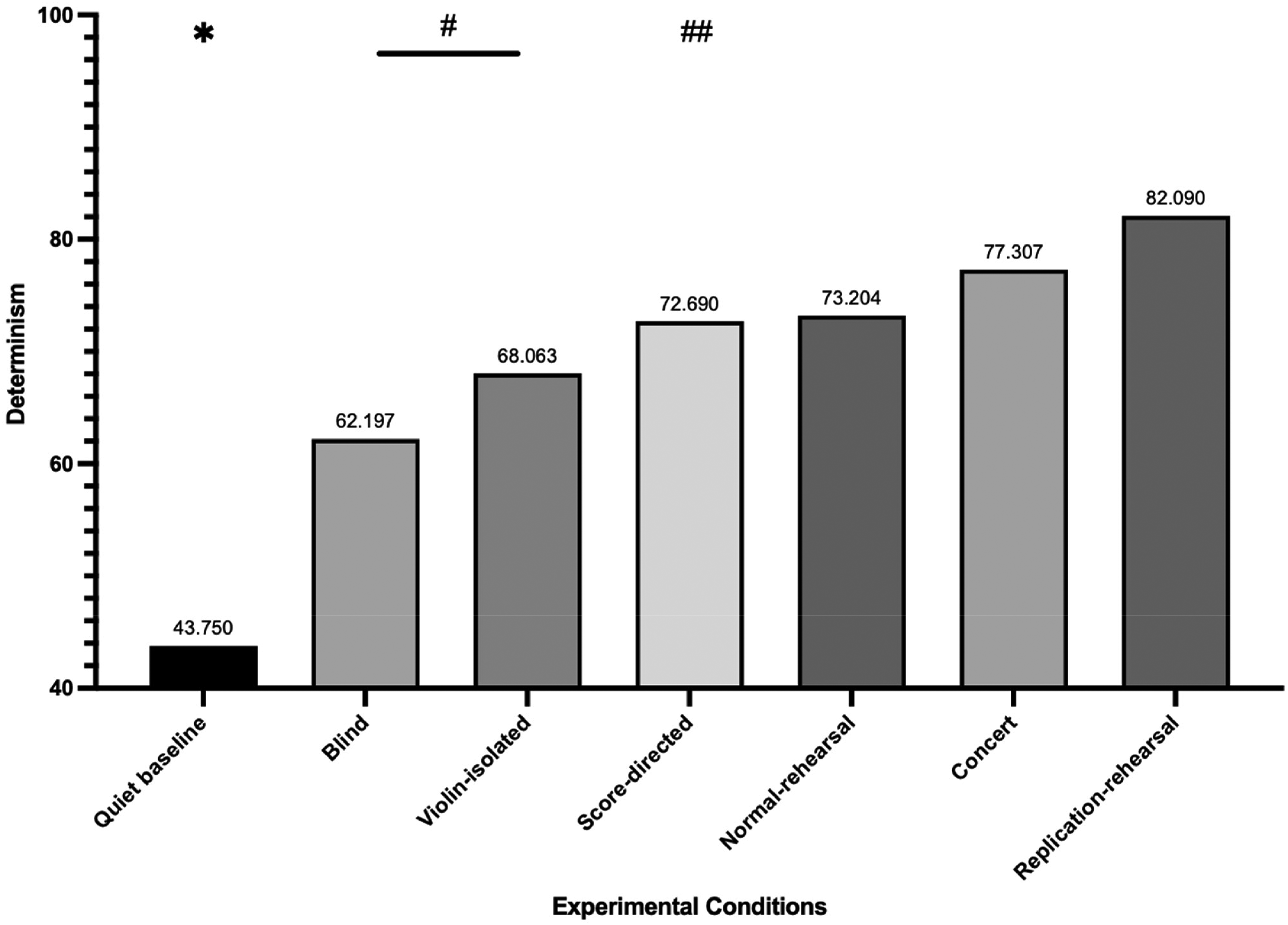
The results demonstrate that the two quartets exhibited similar patterns in group-level CS: consistent with our hypothesis, the DSQ's and BSQ's synchrony levels of the Quiet baseline were significantly lower than all other conditions. In addition, for DSQ (Figure 4), only the Sight-reading condition was significantly lower than the Normal-rehearsal and Replication-rehearsal (95%-CI [−7.23, −0.84]), as well as Concert conditions (95%-CI [−7.68, −1.64]). There were no statistically significant differences between other condition pairs (Figures 5 and Figures 7. For complete results, supplementary information).

The recurrence plots (RPs) of DSQ in four conditions.
In contrast, while the BSQ's CS demonstrates a similar pattern to that of the DSQ, it was influenced negatively by the Blind, Violin-isolated, and Score-directed conditions, indicating that the CS decrease was related to the level of disruption and its associated degree of possible visual contact (Figures 5 and 8). Blind was significantly lower than Score-directed (95%-CI [−18.84, −3.06]), Normal-rehearsal and Replication-rehearsal (95%-CI [−23.75, −7.85]), and Concert conditions (95%-CI [−23.44, −7.86]). There was no statistically significant difference between Blind and Violin-isolated (95%-CI [−14.34, 1.90]). Moreover, in terms of statistical significance, Violin-isolated was substantially lower than Score-directed (95%-CI [−9.53, −0.12]), Normal-rehearsal and Replication-rehearsal (95%-CI [−14.34, −5.01]), and Concert conditions (95%-CI[−13.69, −4.57]). Score-directed was also statistically significantly lower than Normal-rehearsal and Replication-rehearsal (95%-CI [−9.40, −0.31]), and Concert conditions (95%-CI [−8.74, −0.76]). Similar to the CS in DSQ, there was no statistically significant difference between Normal-rehearsal and Replication-rehearsal conditions and the Concert condition (95%-CI [−3.74, 4.27]).

The recurrence plots (RPs) of BSQ in four conditions.
To address the differences between DSQ and BSQ, we performed a parallel comparison by recalibrating the MdRQA's parameters in six identical experimental conditions of DSQ and BSQ (Blind, Violin-isolated, Score-directed, Normal-rehearsal, Replication-rehearsal, Concert), as MdRQA requires the application of the same set of parameters for results comparison. As mentioned, the DSQ's DET is higher in every condition, and the independent samples t-test demonstrates that the DSQ's average DET (mean = 95.03) is significantly higher than the BSQ's (mean = 73.32) [t(10) = 9.61,
Discussion
Considering previous empirical evidence on increased CS in group cohesion and shared experience (Busuito et al., 2019; Golland et al., 2015; Konvalinka et al., 2011; Müller & Lindenberger, 2011; Tomashin et al., 2022; Yoon et al., 2019), we believe that our results indicate that CS correlates with a shared sense of musical absorption. By “indicate,” we here mean that our study alone is insufficient to provide direct evidence of such a correlation: this putative correlation is abducted, as inference to the most plausible explanation. Such a correlation is consistent with the idea that music performance is a rewarding and motivating activity that facilitates joint action and develops social bonding. It is also consistent with the idea that the involuntary responses of the autonomic nervous system, which co-regulates cardiac activity, serve as a critical indicator of emotional experiences and social engagement (Bernardi et al., 2017; Scherer, 2005; Shaffer et al., 2014; Shaffer & Ginsberg, 2017).
In the present comparative study of a student and an expert string quartet, we have investigated the relation between CS, shared musical absorption, and joint expertise with the following hypotheses: (1) for both quartets, performing together would increase group-level CS compared with the quiet baseline; (2) for the BSQ, the disruption conditions would negatively affect CS as a physiological proxy of disrupted shared musical absorption; and (3) for differences between BSQ and DSQ, based on a joint expertise effect, with low or nonexisting demand for visual communication, the disruption conditions would affect DSQ's CS less than BSQ's.
For the first hypothesis, consistent with our expectations, both string quartets demonstrated a significantly higher CS when they performed together than for the Quiet baseline. This result corroborates previous choir singing studies (Müller & Lindenberger, 2011; Ruiz-Blais et al., 2020; Vickhoff et al., 2013), and provides the first evidence that playing in a string quartet can promote CS. Consequently, we believe that the level of CS in music performance cannot be attributed only to respiratory control. Rather, CS may operate in ways similar to the mechanisms of synchrony found in nonmusical social activities, where it constitutes a physiological index of mental sharing, bearing on empathy (Pérez et al., 2021), as well as shared emotions and shared experiences (Busuito et al., 2019; Konvalinka et al., 2011).
Our second hypothesis, concerning the BSQ, was supported insofar as the disruption conditions reduced CS to the degree associated with the level of disruption. This is consistent with posterior qualitative interviews, in which some BSQ members mention that the experiment was disruptive as they were placed in unusual ways and could not visually communicate as they normally would. Moreover, this result is also supported by previous empirical findings that mutual gaze is important to facilitate musical cohesion in joint performance (D’Amario et al., 2018, 2019). It hence indicates that reduced CS, as the index of their sense of shared musical absorption, was disrupted by the visual communication constraints.
For the third hypothesis, our analysis shows that across all overlapping conditions, DSQ had a substantially higher CS level than the BSQ and that the DSQ's CS was not significantly affected by the disruption conditions. Based on previous empirical studies of expert musicians (Brown et al., 2015; Furuya & Kinoshita, 2007, 2008), the most plausible reason is that they are experts with a long shared history: throughout hundreds of concerts, their musical cohesion and shared musical absorption have grown resilient to disruptions. This interpretation is backed by a short posterior qualitative interview in which the DSQ stated that the disruption conditions were not particularly challenging. Only the extreme-disruption condition resulted in a significant CS decrease. From an inspection of the audio-visual recordings, it is evident that the DSQ was struggling to stay synchronized, as the first violinist skipped an entire line at the end of the piece. Summing up, our results indicate that CS is a physiological marker of shared musical absorption influenced by the level of shared expertise.
In addition, our findings indicate that for musical experts with a long, shared history, visual communication is not necessary for cardiac cohesion. This is aligned with the DSQ quotes in the introduction, stating that they close their eyes to obtain a more intense experience of shared musical absorption (Høffding, 2019). The DSQ associate shared musical absorption with trust, listening, and “feeling” each other's movements. In embodied cognitive science and phenomenology, it is accepted that the sense of the boundaries of one's own body can incorporate objects (Merleau-Ponty, 2004) and even partake in others’ body schemata (Soliman & Glenberg, 2014; Soliman et al., 2015). The sense of partaking in each other's body and movement is called “intercorporeity” (Fuchs, 2017), and our results could be interpreted to consider CS as a shared physiological instantiation of such “intercorporeity.” In other words, our study indicates that CS can be seen as a physiological measure of shared expertise and absorption—that the “hive-mind” has a physiological correlation. Referring back to the fire-walking study (Konvalinka et al., 2011), our results corroborate those findings, tapping into the same embodied cognitive function: the stronger the bond during a shared experience, the higher the CS. The exact causal relation and analytic distinctions between expertise, trust, absorption, and shared experience need further empirical and conceptual work to settle. It will also take further reflection and argumentation to identify the exact ways in which this “hive-mind” is related to the blurring of self and agency (Benson, 1993; Pacherie, 2012) mentioned in the introduction of this paper.
An advantage of the present study is access to the lived experience and physiological data from one of the world's best string quartets. Moreover, we adopted an ecological approach to the experiment over and above a strict laboratory setting because we were interested in musicians’ reactions to, and experiences of, real performances. Given the limitation of the small sample size and the possible influence of order effects, there might very well exist explanations other than the ones presented here. This also relates to the problem of multiple testing in the present data set. Yet, the present study provides the first evidence that string quartet performance promotes CS, most likely as correlated with shared musical absorption and group expertise.
Supplemental Material
sj-docx-1-mns-10.1177_20592043231168597 - Supplemental material for Into the Hive-Mind: Shared Absorption and Cardiac Interrelations in Expert and Student String Quartets
Supplemental material, sj-docx-1-mns-10.1177_20592043231168597 for Into the Hive-Mind: Shared Absorption and Cardiac Interrelations in Expert and Student String Quartets by Simon Høffding, Wenbo Yi, Eigil Lippert, Victor Gonzales Sanchez, Laura Bishop, Bruno Laeng, Anne Danielsen, Alexander Refsum Jensenius and Sebastian Wallot in Music & Science
Footnotes
Acknowledgements
We would like to thank the Danish String Quartet and the Borealis String Quartet for participating in the experiments. We also thank Andreas Roepstorff for his instrumental role in shaping the work. Finally, we sincerely thank all RITMO members who supported this work.
Action Editor
Niels Chr. Hansen, Aarhus University, Department of Clinical Medicine, Center for Music in the Brain.
Peer Review
Shannon Proksch, Augustana University, Psychology Department. One anonymous reviewer.
Declaration of Conflicting Interests
The author(s) declared no potential conflicts of interest with respect to the research, authorship, and/or publication of this article.
Ethical Approval Statement
This research was reviewed and approved by the Norwegian Centre for Research Data (NSD), reference numbers 915228 and 748915.
Funding
This work was supported by the University of Oslo and the Research Council of Norway through its Centres of Excellence scheme, project number 262762 as well as its IKTPLUSS initiative, project number 311746. Sebastian Wallot was supported by German Science Foundation (DFG; grant number 442405852).
ORCID iDs

Supplemental Material
Supplemental material for this article is available online.
References
Supplementary Material
Please find the following supplemental material available below.
For Open Access articles published under a Creative Commons License, all supplemental material carries the same license as the article it is associated with.
For non-Open Access articles published, all supplemental material carries a non-exclusive license, and permission requests for re-use of supplemental material or any part of supplemental material shall be sent directly to the copyright owner as specified in the copyright notice associated with the article.
