



Abstract
Listening to music can cause experiences of nostalgia and melancholia. Although both concepts are theoretically related, to date they have not been analyzed together regarding their emotional and cognitive profiles. In this study, we identify their theoretical underpinnings and determine how they can be measured empirically. We analyze how listening to music causes nostalgia and melancholia, and whether both experiences are related to different behavioral intentions. To this end, we conducted an online experiment with 359 participants who listened to music they considered either nostalgic, melancholic, or neutral. Afterward, participants answered 122 questionnaire items related to nostalgia and melancholia. Using Structural Equation Modeling, and more specifically Multiple Indicators and Multiple Causes Modeling, we first developed two new scales: the Formative Nostalgia Scale and the Formative Melancholia Scale. Both scales consist of five items each. Results showed that listening to music indeed increased nostalgia and melancholia. Although considerably different, the concepts are related. Listening to nostalgic music increases melancholia, whereas listening to melancholic music does not increase nostalgia. Also, both experiences are related to different behavioral intentions. Whereas experiencing nostalgia was associated with a stronger intention to share the music and to listen to it again, experiencing melancholia revealed the exact opposite relation.
Theoretical Background
Music has the powerful capacity to impact our thoughts and to affect our emotions (Batcho et al., 2008; Irrgang & Egermann, 2016; Lamont, 2012). It helps us manage our emotional experiences (Zillmann, 1988) and maintain our subjective well-being (Hays, 2005). One of the various experiences triggered by music is nostalgia (Chung, 2016). Nostalgia is intricate, yet powerful: It lets us think about and embrace the past, it can heighten our spirits, foster self-esteem, nurture social support, reduce attachment anxiety, and even decrease death-related thoughts (Holak & Havlena, 1998; Routledge et al., 2008; Sedikides et al., 2004; Wildschut et al., 2006; Wildschut, 2017). On the other hand, nostalgia is not only positive; conversely, it also involves several negative affects such as sadness, remorse, or regret (Barrett et al., 2010; Batcho, 2013; Chung, 2016).
Closely related, listening to music can make us pensive or contemplative and can cause ruminating or mind-wandering (Brady & Haapala, 2003). We might have thoughts about the past, the present, or the future; we might think of people that were once close but aren't anymore, or ponder what the future will bring. In contrast to nostalgia, however, this experience is more negative, wistful, and depressing (Brady & Haapala, 2003). It is known as melancholia.
Perhaps the most intriguing aspect of both nostalgia and melancholia is their emotional ambivalence. “Nostalgia is a bittersweet emotion, but more sweet than bitter” (Leunissen et al., 2021, p. 152) and “the quality of the [melancholic] feeling resembles and overlaps with sadness, but is more refined, involving some degree of pleasure, although not as much as sweet pleasure” (Brady & Haapala, 2003). Both represent highly complex experiences that are not simple affective emotions, but can be described as mental states, which is further explained in the section “Mental States and Meta-Appraisals”. Indeed, the distinction between nostalgia and melancholia does not seem too pronounced at times. However, although both concepts stem from a clinical tradition that is related to depression (Batcho, 2013), to date, and to the best of our knowledge, there is no research that focuses on their similarities, differences, and relationships explicitly.
In this study, we pursue three goals: First, we want to find out which affective and cognitive components determine nostalgia and melancholia conceptually. To this end, we collect and test several existing scales and identify items that best predict both experiences. These items result in two novel scales of nostalgia and melancholia. Throughout this paper, the term “item” describes a question or statement used as a measurement instrument within a questionnaire. Second, we investigate whether nostalgia and melancholia can be evoked through music chosen to evoke different mental states. Third, we investigate whether experiencing nostalgia and melancholia impacts people's behavior. Do experiences of nostalgia and melancholia affect intentions of subsequent music reception and sharing?
Conceptualizing Nostalgia and Melancholia
The term nostalgia derives from two Greek notions, “one of which is Nostos, return to the native land; the other, Algos, signifies suffering or grief” (Batcho, 2013, p. 166). The original understanding of the concept was often compared to homesickness (Batcho, 2013, p. 166; Wildschut et al., 2006, p. 988). These terms, however, started drifting apart in the 20th century, as distances became less of an obstacle, and the term “nostalgia” was no longer used exclusively in reference to a place but rather in reference to time (Batcho, 2013; Wildschut, 2017). Around the same time, nostalgia was not regarded a psychiatric disorder anymore, but a type of depression (Wildschut, 2017, p. 304). By now, it is widely recognized as an emotional experience and defined as “a feeling of pleasure and also slight sadness when you think about things that happened in the past” (Cambridge University Press, 2023) or “[a] preference (general liking, positive attitude, or favorable affect) toward objects (people, places, or things) that were more common (popular, fashionable, or widely circulated) when one was younger (in early adulthood, in adolescence, in childhood, or even before birth)” (Holbrook & Schindler, 1991, p. 330). Researchers have identified different types of nostalgia. The most common type, personal nostalgia, is oriented towards past personal experiences, and it is experienced in the moment (Batcho, 2020). Another type is historical nostalgia, which is the reflection on past generations and on times and events someone has not experienced themselves (Wulf et al., 2019). As an extension of personal nostalgia, anticipatory nostalgia is the experience of missing the present already while it is happening, not only afterwards (Batcho, 2020). As personal and historical nostalgia are the most prototypical forms of nostalgia, these types are in the focus of this study.
Melancholia (or melancholy) is defined as “a pensive mood” (Merriam-Webster, 2023a), “an experience which combines the pleasure of feeling sad with sober self-reflection” (Smith, 2014, p. 447), and a “sublimated mellow sorrow, which through reflection has brighter aspects woven into it” (Brady & Haapala, 2003, p. 6). Just like nostalgia, melancholia was considered a clinical condition for a long time (p. 2). Sigmund Freud, for example, understood melancholia as a mental illness, closely related to depression and narcissism (Smith, 2014, p. 447). The ancient Greeks, 19th-century English romantics, and earlier English religious poetry, however, praised melancholia for contributing to a more balanced life (p. 448). Notably, melancholia lacks a concise theoretical definition that would separate it from related notions such as sadness and depression (Brady & Haapala, 2003, p. 2). Brady and Haapala (2003) hence suggests to “progress beyond these rather narrow meanings of the concept,” because “melancholy is a more refined emotion with qualities of its own” (p. 2). In other words, melancholia is more than depression and negativity and may not only be understood as a clinical condition, but also as an emotional phenomenon, just like nostalgia.
Despite several differences, nostalgia and melancholia have much in common. First, they both entail affects, including positive and negative facets. Such a blend of affective elements is unique to few emotional experiences, and nostalgia and melancholia are two of them (Schubert, 2016; van Tilburg et al., 2019; Zentner et al., 2008). Second, they both involve cognitions, mostly in the form of reflections about the past and/or the present. Indeed, it is probably the considerable role of temporal distance that leads to an association between both concepts (van Tilburg et al., 2019). Third, they are meta-appraisals, which is to say that first a specific set of cognitions and affects is experienced, which is then in a second process labeled as a nostalgic or a melancholic experience (Bartsch et al., 2008).
Affects
It is possible to experience positive and negative affective experiences simultaneously or to enjoy negative affective experiences. Schubert (2016) argues that people are capable of enjoying negative emotional experiences as they are able to recognize the context in which they occur and adjust their degree of aversion/hostility accordingly. They are capable of decoupling the subjective experience and motivational action surrounding, for example, sadness. According to Schubert (2016), when it is evoked in an artistic context, the recipient knows that “it does not cause ‘actual’ harm” (p. 4). Also, “in the absence of aversive/hostile tendency, any kind of thought is enjoyable” (p. 4). Similarly, Taruffi and Koelsch (2014) argue that people are able to enjoy sad music because it has no real-life implications. Another approach to explaining why positive and negative affect are not always distinct is that emotions which are not prototypical (i.e., joy and sadness) may not be distinct and thus lead to emotional blends (Barrett et al., 2010; Leunissen et al., 2021). Nostalgia and melancholia are both characterized by a blend of positive and negative affect and are therefore experienced as ambivalent.
When feeling nostalgic, we may experience positive affects such as happiness, pride, joy, warmth, desire, gratitude, affection, tenderness, elation, pleasure, satisfaction, and euphoria; at the same time, we may also experience negative affects such as sadness, disappointment, loss, irritation, fear, mourning, stress, poignancy, and regret (Barrett et al., 2010; Batcho, 2013; Chung, 2016; Holak & Havlena, 1992; Wildschut et al., 2006). In a study on music-evoked nostalgia, Barrett et al. (2010) found that nostalgia was more strongly related to the number of positive emotions than the number of negative emotions induced by music. Similarly, reliving nostalgic events induces more positive emotions than reliving ordinary events (Wildschut et al., 2006; Wildschut, 2017). In another study on the comparison between nostalgia, rumination, and counter-factual thinking, nostalgia emerged as the only one not related to the destructive use of autobiographical memories for reviving bitterness (Cheung et al., 2018). These results illustrate that despite its ambivalence, nostalgia is consistently experienced as positive overall (Barrett et al., 2010; Cheung et al., 2018; Leunissen et al., 2021; Wildschut, 2017).
Melancholia is the most frequently reported sadness-like state evoked by music (Zentner et al., 2008). In essence, it is “the sadness feeling once the distress that accompanies its appearance in real life is removed” (Zentner et al., 2008, p. 513). When feeling melancholic, we may experience negative affects such as sadness, sorrow, despair, dread, and grief; at the same time, we may also experience more positive ones such as longing, pleasure, sublime, hope, excitement, and joy (Peltola & Eerola, 2016; Zentner et al., 2008). Although melancholia does involve “some degree of pleasure” (Brady & Haapala, 2003, p. 2), it is more closely related to sadness and therefore predominantly negative. Thus, nostalgic events are perceived as more pleasant than melancholic events overall (van Tilburg et al., 2019).
Cognitions
The affects associated with nostalgia and melancholia are related to specific cognitions. Nostalgia involves recalling autobiographic/episodic memories, which are often triggered by specific stimuli (Barrett et al., 2010; Chung, 2016, p. 33; Lahdelma & Eerola, 2015, p. 246; Sedikides et al., 2004, p. 205). Stimuli and memories frequently associated with nostalgia include the self, interactions with (close) others, social gatherings, one's home, and specific objects (Holak & Havlena, 1992, 1998; Wildschut et al., 2006; Wulf et al., 2019). Events that are considered nostalgic are appraised as pleasant, irretrievably lost, temporally distant, and unique – a specific profile which it shares with no other emotional experience (van Tilburg et al., 2019).
Melancholia is likewise often (although not always) triggered by and associated with specific memories and people. The predominant cognition is the subject of loss, but in a more abstract manner than in nostalgia (Brady & Haapala, 2003; Eerola & Peltola, 2016; Smith, 2014). For example, we feel melancholic when thinking of close others who have passed away or the course of our lives (Eerola & Peltola, 2016; Peltola & Eerola, 2016; Smith, 2014). According to van Tilburg et al. (2019), melancholia involves more reflection than nostalgia.
Mental States and Meta-Appraisals
There are several different understandings of what nostalgia and melancholia actually are. For example, nostalgia was termed a basic/prototypical emotion (Chung, 2016), a complex emotion (Sedikides et al., 2004; Wildschut et al., 2006), an emotional blend (Barrett et al., 2010), and a nonbasic/secondary emotion (Sedikides et al., 2004). In this paper, we offer a different understanding. As outlined above, nostalgia and melancholia involve the experience of several affects, which are also ambivalent. Nostalgia and melancholia can therefore not be considered emotional prototypes or basic emotions such as fear, anger, or happiness, which are by definition uni-dimensional. In addition, because both concepts involve specific additional cognitions (we cannot feel nostalgic or melancholic without thinking about the past), they are more complex than regular emotions and involve higher-level cognitive processes.
Instead, we argue that nostalgia and melancholia represent mental states. We feel nostalgic or melancholic only when we experience a particular and delicate mix of specific affects and cognitions, while knowing that the negative facets do not have serious implications for us. For example, the more a person thinks about something from their past, the more they feel sad but also thankful, the more likely they are to experience a state of nostalgia. As a result, nostalgia and melancholia are substantially more complex than basic emotions such as anger. Instead, they can be compared to other more intricate experiences such as jealousy, schadenfreude (the joy of experiencing someone else fail), homesickness, wanderlust (the urge to explore the world), or hygge (a specific kind of comfort). Perhaps the most well-known mental state is being in love.
We all know from personal experience that these specific mental states exist. They can be shared inter-subjectively and across cultures (e.g., Juslin et al., 2016). However, although it is easy to experience these states, it is often much more difficult to label them. This is because being able to label a specific mental state as nostalgic or melancholic requires an elaborate socio-cultural learning process. And interestingly, although everyone can experience these states, we sometimes cannot verbalize them, which is why their labels are often imported from foreign languages.
Put more technically, being able to label a specific mental state as nostalgic or melancholic requires a so-called meta-appraisal process (also known as second-order appraisal; see, e.g., Bartsch et al., 2008). In a first appraisal process, we evaluate how we feel and what we currently think – a process that is considerably affected by the context of the experience, as it can even lead to the enjoyment of typically negative affect (Schubert, 2016). In a second appraisal process, we then evaluate our general mental state of cognitions and affects, searching for an adequate label. For example, this would be the moment when we realize we are in love.
The aforementioned theoretical rationales have several practical implications. Most importantly, from a theoretical perspective, nostalgia and melancholia should not be understood as reflective constructs, the default approach in most social sciences, but as formative constructs (Kline, 2016). To explain, nostalgia and melancholia do not reflect in affects and cognitions; instead, affects and cognitions form our mental states of nostalgia and melancholia. In other words, whereas in reflective constructs “the causality flows from the latent variable to the indicators” (Söllner et al., 2010, p. 68), in formative constructs the causality “flows from the indicators to the latent construct” (Söllner et al., 2010, p. 68), the latter being more adequate for measuring nostalgia and melancholia.
As a result, there are two ways of measuring nostalgia and melancholia. First, if we want to understand what nostalgia and melancholia actually are, we need to adopt a formative approach and test what affects and what cognitions determine both concepts. Second, to determine if a sensation is labeled as nostalgic or melancholic, we can adopt a reflective approach and directly ask whether a person currently feels that way.
To the best of our knowledge, to date, this understanding of nostalgia and melancholia has not been employed in research. Most scales focused only on specific aspects of nostalgia and melancholia, using one-dimensional measures (e.g., Barrett et al., 2010) or reflective indicators (e.g., Batcho, 1995). In this study, we hence adopt a novel theoretical and empirical approach in order to find out which affects and cognitions determine and, literally, form nostalgia and melancholia.
Research Question 1: What are the components of nostalgia and melancholia?
Causes of Nostalgia and Melancholia
What causes nostalgia and melancholia? Media play an important role in a person's development (Loveland et al., 2010) and music is able to evoke autobiographic memories (Middeke & Wald, 2011), which suggests that music should be able to evoke nostalgia and melancholia.
Indeed, common triggers of nostalgia include negative mood and emotions like sadness and loneliness, sensory inputs, and media content (Barrett et al., 2010; Botstein, 2000; Chung, 2016; Holak & Havlena, 1992; Wildschut et al., 2006; Wildschut, 2017; Wulf et al., 2019). Several studies have investigated “mediated nostalgia” (Wulf et al., 2019), particularly as evoked through sad songs (Eerola et al., 2016; Juslin et al., 2016; Juslin & Laukka, 2004). Taruffi and Koelsch (2014) found that nostalgia even emerged as the most frequently indicated emotional response to sad music. Further, the familiarity and autobiographical salience of a song increases experienced nostalgia (Barrett et al., 2010). In a study on autobiographical memories evoked by music, Janata et al. (2007) found that almost a third of such memories were described as nostalgic. Hence, the more a song is associated with someone's personal past, the more it evokes nostalgia.
If memories triggered by music are associated with loss, melancholia is another emotional experience that can occur. In that vein, Brady and Haapala (2003) note that “when discussing the arts, the closest we come to finding melancholy as a mood is in music” (p. 8). Similarly, Eerola et al. (2016) noted that melancholia is among the top-ranking emotions involved in experiences with sad music. As a result, it is reasonable to assume that both nostalgia and melancholia can be induced by music.
However, two interesting questions are left unanswered. First, when listening to music, which components of nostalgia and melancholia are affected the most, respectively? Second, do the effects depend on the type of music one is listening to? Specifically, does listening to music considered nostalgic also cause melancholia, and does listening to music considered melancholic also increase nostalgia?
Research Question 2: How does listening to music chosen to evoke different mental states affect nostalgia and melancholia?
Outcomes of Nostalgia and Melancholia
What are the behavioral outcomes of experiencing nostalgia and melancholia? So far, it has been shown that both experiences are indeed powerful and that they can affect subsequent behavior. Specifically, by letting individuals relive predominantly social memories, nostalgia can stir one's need to belong (Loveland et al., 2010), nurture the desire to partake in social activities (Sedikides et al., 2004), and increase social connectedness and perceptions of social support (Wildschut, 2017). In addition, media-induced nostalgia likely increases people's willingness to share that media content with loved ones, to consume it again, and to act altruistically (Chung, 2016). In short, nostalgia seems to have an activating and stimulating effect. We hence assume that nostalgia makes people more likely to share and to relive the media content that triggered nostalgia.
We are not aware of any research that has explicitly and empirically analyzed the behavioral effects of experiencing melancholia. Because melancholia is conceptually related to nostalgia, as they both represent mixed, ambivalent states and share multiple characteristics, it seems possible that experiencing melancholia leads to the same stimulating behavioral effects. On the other hand, because melancholia is more negative, more closely related to depression (Brady & Haapala, 2003) and involves more reflection than nostalgia (van Tilburg et al., 2019), it might also be more inhibiting and petrifying. People who experience melancholia after listening to a song might therefore be less likely to share that song with others or to listen to it again.
Research Question 3: How do nostalgia and melancholia relate to behavioral intentions?
Method
We report how we determined our sample size, all data exclusions, all manipulations, and all measures. The entire study was conducted in German.
Procedure
Given the lack of instruments for measuring melancholia as a mental state, we first conducted a focus group interview to generate novel items. We conducted the interview with four students from the local university who were native speakers. The interviews were recorded on audio and all participants consented to the procedure. On the basis of the focus group, we developed several novel items, which capture both affects and cognitions (see section Novel melancholia items).
For the main study, we used a convenience sampling approach. We recruited participants from different sources, such as the local university, online communities, small panel-agencies, and local networks. All participants lived in Germany and the survey was conducted in German. As such, there was no reason to assume any language barrier. As incentive, participants had the chance to win two 15€ Amazon coupons. Data collection took place in December 2017.
For answering our research questions, we ran an online experiment. We followed the approaches by Holbrook and Schindler (1991), Michels-Ratliff and Ennis (2016), and Wildschut et al. (2006). We first instructed participants to listen to a specific song of their own liking on their preferred platform (e.g., Spotify or YouTube). It is difficult to elicit autobiographical memories and conversely even more difficult to evoke nostalgia or melancholia with random music (Janata et al., 2007). Furthermore, objective characteristics of songs do not seem to affect their potential for evoking, for example, nostalgia (Barrett et al., 2010, p. 401). For these reasons, we avoided picking songs ourselves in case they would not have evoked the respective, highly subjective mental states in many participants due to their age, particular taste in music, etc. Participants were randomly assigned to three experimental groups. In the group Nostalgia, participants were instructed to listen to a song they considered nostalgic; in the group Melancholia, participants were instructed to listen to a song they considered melancholic; in the Control Group, participants were instructed to listen to a song of their own choice.
It was very important to avoid conceptual ambiguity in participants, as nostalgia and melancholia are complex constructs. Also, melancholia is less familiar than nostalgia. A comparison between nostalgia and melancholia regarding their popularity in Google searches worldwide since 2004 shows that both spellings, melancholia and melancholy, are hardly as well-known as the term nostalgia (Google Trends, 2022a, 2022b). Participants were therefore shown a brief definition (in German) of either nostalgia or melancholia, depending on the group they were assigned to. These definitions were created by the researchers and based on the literature review. They can be translated to “nostalgia is an emotional condition that is characterized by remembering things from the past and, as a result, yearningly indulging oneself in memories” and “melancholia is an emotional condition that is characterized by being absorbed in thought, wistful, afflicted and pensive.”
Participants were recommended to use headphones and to remain undisturbed during the study. As a manipulation check, before proceeding to the first page of the questionnaire, we asked participants whether they had actually listened to a song that matched the instructions. Only those who answered yes were directed further.
In the questionnaire, participants also indicated which artist they listened to. As a plausibility check, we looked at the ones occurring most frequently. In the nostalgia group, participants listened to Queen, Blind Guardian, Freundeskreis, Linkin Park, and Rise Against. In the melancholia group, participants listened to Adele, Coldplay, Enya, Herbert Grönemeyer, and Johnny Cash. In the control group, Ed Sheeran and Imagine Dragons were the most popular artists. Fifteen percent of all participants listened to the music in combination with a video. Participation took between 10 and 15 min overall.
Before taking part in the experiment, participants provided informed consent and could withdraw at any point without needing to provide a reason. At the end of the survey, they were also encouraged to express comments or any potential concerns regarding the study. No concerns were expressed. Also, participants were allowed to choose a piece of music to their own liking for the experimental manipulation, which means that they were not exposed to any content they might disapprove of.
Participants
The data of 15 participants were deleted because they answered the questions in less than one minute after opening the survey, which indicates that they had not really listened to music. Missing values were treated with case-wise deletion. Overall, N = 344 participants took part in the study (nNos = 117, nMel = 111, nCon = 116). The mean age was M = 30 years (SD = 11 years). Sixty percent of the participants were female (n = 206). We asked participants about the highest level of school education they achieved. On average, they were highly educated: 1% reported having no degree, 12% middle/junior high school, 38% high school, and 49% college. The experimental groups did not differ significantly regarding their sociodemographic characteristics.
Measures
In what follows, we list all variables that were collected to measure nostalgia and melancholia. All items were measured on a scale with seven response options, ranging from 1 (not at all) to 7 (extremely). For a list of all items, additional confirmatory factor analyses, psychometric statistics, and item distributions, see the online supplementary material (OSM) at https://osf.io/7srfq.
Self-Reported Nostalgia
Two items measured experiences of nostalgia in a direct and explicit way. The first item was “I feel nostalgic at the moment” (Wildschut et al., 2006, p. 983) and the second item was “The piece of music evoked nostalgic feelings” (Chung, 2016, p. 29). The two items were used as manifest indicators of a latent, reflective measure of nostalgia.
Nostalgia Inventory
We collected the Nostalgia Inventory (Batcho, 1995), which assesses the degree to which individuals currently miss specific aspects from their past. It is supposed to measure personal as opposed to historical nostalgia. The scale consists of 20 items, including “Places” and “The way people were.”
Nostalgia Scale
We also used the Nostalgia Scale developed by Holbrook and Schindler (1994), measuring historical instead of personal nostalgia, in order to acknowledge both types of nostalgia. The scale consists of eight items, including “Things used to be better in the good old days” or “We are experiencing a decline in the quality of life.”
Recalling Related Others
We adopted four items from the nostalgia dimension Recalling Related Others developed by Chung (2016), which represent reflection on people from one's past due to media content. The scale consists of items such as “It makes me think about someone in the past” and “It makes me recall someone who was related to it.”
Nostalgic Memories
Next, we used the seven-item scale developed by Chung (2016), which measures how consuming media content affects nostalgia. The scale focuses on cognitions. For example, two of those items are “It made me think about when I was younger” and “It evoked fond memories.”
Self-Reported Melancholia
In accordance with self-reported nostalgia, we used the two items “I feel melancholic at the moment” and “The piece of music evoked melancholic feelings” as manifest indicators of a latent, reflective measure of melancholia.
Novel Melancholia Items
On the basis of the focus group interview and literature review (e.g., Eerola & Peltola, 2016; Peltola & Eerola, 2016; Smith, 2014; van Tilburg et al., 2019), 11 novel items were designed to capture melancholia. The scale addresses both emotional and cognitive aspects in the context of music perception. Items include, for example, “I was absorbed in thought” and “I wanted to have some peace and quiet.”
Topics of Thought
As another measure of cognitions, we employed eight items that captured the topics participants thought about. For example, they assessed the degree to which participants had thought about “Places” or “Objects.” The scale was adopted from existing work, literature review (Holak & Havlena, 1992; e.g., Holak & Havlena, 1998; Wildschut et al., 2006), and the focus group interview.
Positive and Negative Affect
In accordance with previous research, we used the Positive and Negative Affect Schedule (PANAS) (Watson et al., 1988) to measure emotions more generally. The PANAS consists of two dimensions with 10 items each. Participants were asked to indicate to what extent they experienced these affective emotions while listening to the piece of music. The first dimension, positive affect, includes items such as “Excited” and “Attentive.” The second dimension, negative affect, includes items such as “Afraid” and “Jittery.”
Behavioral Intentions
Aligned with Chung (2016), we collected eight items that measured the behavioral intentions (a) to share the piece of music with others and (b) to listen to it again. Two of those items are “It makes me realize I would enjoy sharing this with family” and “It makes me want to know about it more.”
Data Analysis
With Research Question 1, we set out to determine which items best predict nostalgia and melancholia. We hence collected a large number of items (overall, 122 items; see above). All items were selected on the basis of the aforementioned theoretical considerations. From this collection, we selected items on the basis their empirical criterion validity. In other words, we aimed to select the items that best predicted the self-reported measures of nostalgia and melancholia. This is a common approach that can be found in the context of famous scales such as the Minnesota Multiphasic Personality Inventory (MMPI; McKinley & Hathaway, 1944). To this end, we ran two multiple regression models in which all items were included as predictor variables; one with self-reported nostalgia and one with self-reported melancholia as the criterion. To circumvent multicollinearity, we removed 14 items because they exhibited strong inter-correlations (i.e., above r = .70), while adding little incremental predictive validity. We selected all items with a p-value below p = .10. 1
In a next step, we ran several iterative Structural Equation Models (SEM) to determine the exact loading of the respective items on the latent factors of nostalgia and melancholia. To adopt a formative approach, we specified so-called Multiple Indicators and Multiple Causes Models (MIMIC; Ríos-Bedoya et al., 2009). On the basis of the loadings of the final model, we then computed two new weighted scales – the Formative Nostalgia Scale and the Formative Melancholia Scale. These two weighted scales were then used for all subsequent analyses.
Please note that understanding nostalgia and melancholia as formative constructs has other implications as well. For example, the items of a formative construct are not required to correlate or to form a uni-dimensional factor structure (Kline, 2016). As a result, it is not necessary to run further factor analyses.
Research Question 2 was tested using SEM. We wanted to investigate how listening to music chosen to evoke different mental states affect nostalgia and melancholia. The experimental groups were compared individually using contrasts. In order to better understand which aspects of nostalgia and melancholia were influenced specifically, we analyzed how listening to music affected the individual indicators/components of both concepts. We used separate regressions to investigate the effects of music chosen to evoke different mental states on the formative and individual measures of nostalgia and melancholia, respectively. To better visualize the results, we display the means for all groups alongside their 95% confidence intervals, which were computed using bootstraps with 1000 draws (see Figure 2).
Research Question 3 was tested also using SEM. We analyzed whether and how the Formative Nostalgia Scale and the Formative Melancholia Scale predicted behavioral intentions.
All SEMs were estimated using Maximum Likelihood estimation. Effects larger than β = .10 were considered small, β = .30 medium-sized, and β = .50 large (Cohen, 1992). We set an alpha level of 5 percent. In terms of power, we aimed for collecting the largest sample possible. Specifically, it was our aim to be able to find small to medium-sized effects (i.e., β = .20) with a probability of at least 80%, which led to a minimum sample size of N = 193. Sensitivity analyses revealed we were able to identify effects of β = .19 with a probability of 95%.
For the analyses, coding, and typesetting, we used R (Version 4.2.2; R Core Team, 2018) and the R-packages ggplot2 (Version 3.4.0; Wickham, 2016), lavaan (Version 0.6.13; Rosseel, 2012), lm.beta (Behrendt, 2014), magrittr (Version 2.0.3; Bache & Wickham, 2014), papaja (Version 0.1.1; Aust & Barth, 2018), psych (Version 2.2.9; Revelle, 2018), semTools (Version 0.5.6; Jorgensen et al., 2018), and tidyverse (Version 1.3.2; Wickham, 2017). Additional information, the data, the analysis scripts, and a completely reproducible version of this manuscript can be found in the OSM.
Results
Measuring Nostalgia and Melancholia
With Research Question 1, we identified the items that best measured nostalgia and melancholia. The MIMIC model that we configured fit the data well χ2(31) = 73.24, p < .001, CFI = .97, RMSEA = .06, 90% CI [.04, .08], SRMR = .02. Following the procedure mentioned above, using a p-value threshold of p < .10, we found that experiences of nostalgia and melancholia were predicted by five items each. For a list of all items including their respective weights, see Table 1. For a visualization of the MIMIC model, see Figure 1.

Research Question 1: Visualization of MIMIC model, which was used to determine the loadings of the items on the latent measures of nostalgia and melancholia. The latent factors were identified by measuring participants current experiences of nostalgia/melancholia, as well as their perceptions of how the music made them feel nostalgic/melancholic. Standardized coefficients are reported.
Items measuring nostalgia and melancholia. When using the items in future studies, compute scales using weighted means.

The results showed that both affects and cognitions were crucial. As expected, most items that most strongly predicted nostalgia were positively valenced, as evidenced by participants experiencing fond memories and enthusiasm. However, experiencing nostalgia was also related to feeling slightly more lonely. Melancholia, on the other hand, was decidedly more negative, as evidenced by feelings of distress and wistfulness. It was characterized by a particularly strong self-orientation and inwardness, as participants felt pensive and wanted some peace and quiet. The formative measures of nostalgia and melancholia were associated with β = .21.
Overall, the five items measuring nostalgia explained 56% of the variance in the latent formative factor of nostalgia. The five items measuring melancholia explained 76% of the variance in the latent formative factor of melancholia. In the social sciences, a correlation coefficient of .7/.8 is typically considered to be a strong to very strong effect (e.g., Cohen, 1992), which corresponds to explained variance of 49–64%. This means that the explained variance of nostalgia can be considered at least high and the explained variance of melancholia very high.
Effects on Nostalgia and Melancholia
With Research Question 2, we investigated whether listening to nostalgic, melancholic, or generic music affected the experiences of nostalgia and melancholia.
As expected, compared to the control group, listening to nostalgic music made participants much more nostalgic, β = .44, b = 1.05, 95% CI [0.77, 1.32], z = 7.47, p < .001. As a result, the experimental manipulation was successful. Specifically, when compared to the control group, four out of five individual items measuring nostalgia showed significantly higher levels. Participants were more likely to think about the past in general, to think about a specific person from the past, to feel lonely, and to have fond memories of the past. Only the level of enthusiasm was equally high in both groups. Interestingly, listening to nostalgic music also increased levels of melancholia, β = .32, b = 0.91, 95% CI [0.56, 1.25], z = 5.17, p < .001. Compared to the control condition, listening to nostalgic music made participants somewhat more distressed, pensive, wistful, and aware of the transience of time, too, which are formative elements of melancholia.
Next, listening to melancholic music made participants significantly more melancholic compared to the control group, β = .54, b = 1.67, 95% CI [1.34, 2.01], z = 9.79, p < .001. As a result, also this experimental manipulation was successful. Specifically, when compared to the control group, all items measuring melancholia showed significantly higher levels. Participants were much more distressed, pensive, wistful, aware of the transience of time, and wanted more peace and quiet. Listening to melancholic music did not increase levels of nostalgia, β = .09, b = 0.23, 95% CI [−0.09, 0.56], z = 1.42, p = .156.
When comparing the nostalgia and melancholia groups with each other, both parallels and differences can be found. Participants in both groups were equally likely to think of a person from the past and to feel lonely. Likewise, both groups felt equally susceptible to the transience of time. But there were also differences. Participants listening to nostalgic music were much more enthusiastic, had more fond memories, and were more likely to think about the past in general. Participants listening to melancholic music, in turn, were even more pensive, wistful, wanted more peace and quiet, were more distressed, and lonelier.
For an overview of all results see Table 2, and for a visualization see Figure 2.
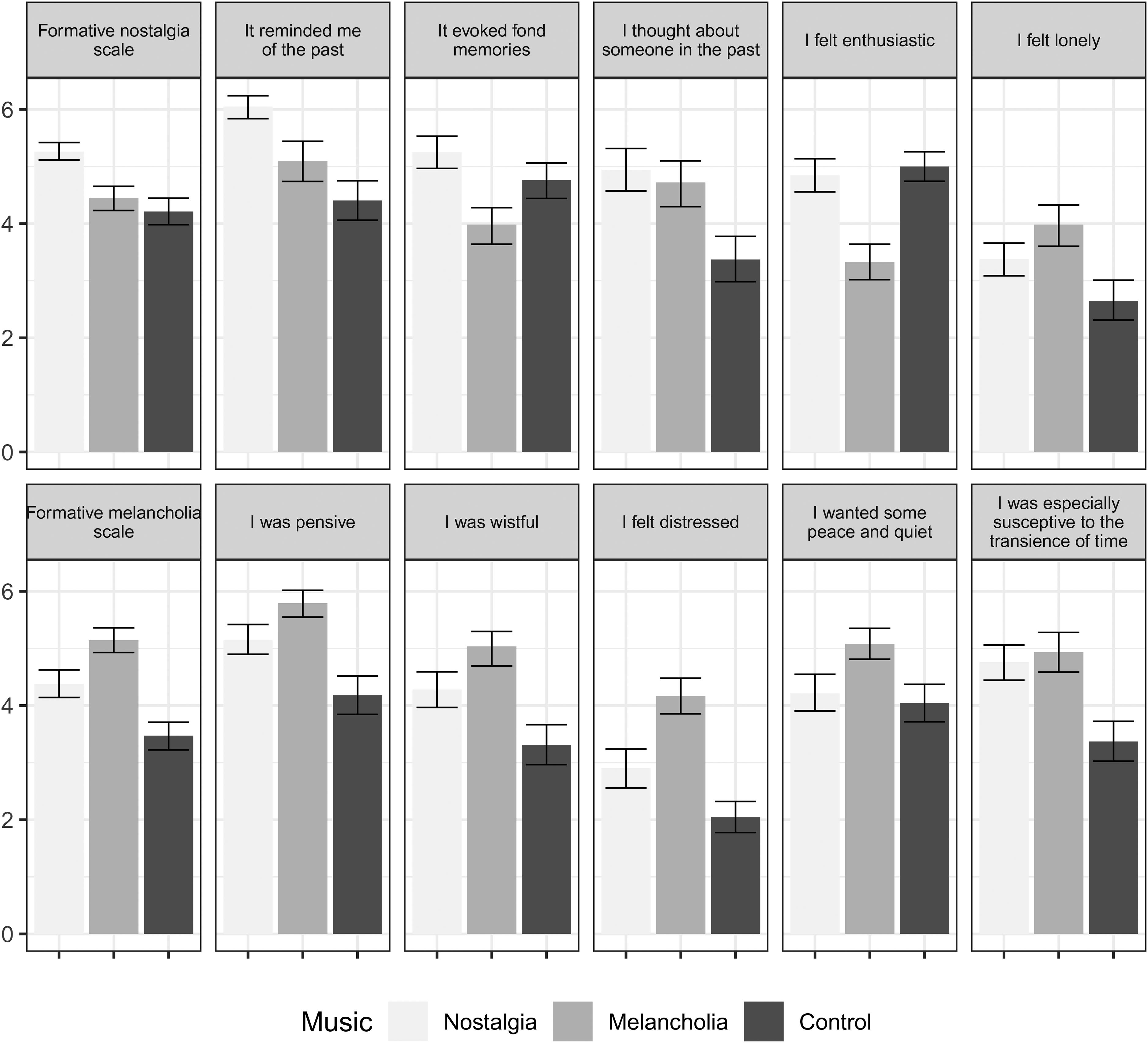
The effects of listening to music chosen to evoke different mental states on nostalgia and melancholia. The top row contains the formative nostalgia measure and all selected predictors of nostalgia, the bottom row the formative nostalgia measure and all selected predictors of melancholia. Error bars represent 95% confidence intervals.
Effects of music chosen to evoke different mental states on nostalgia and melancholia.
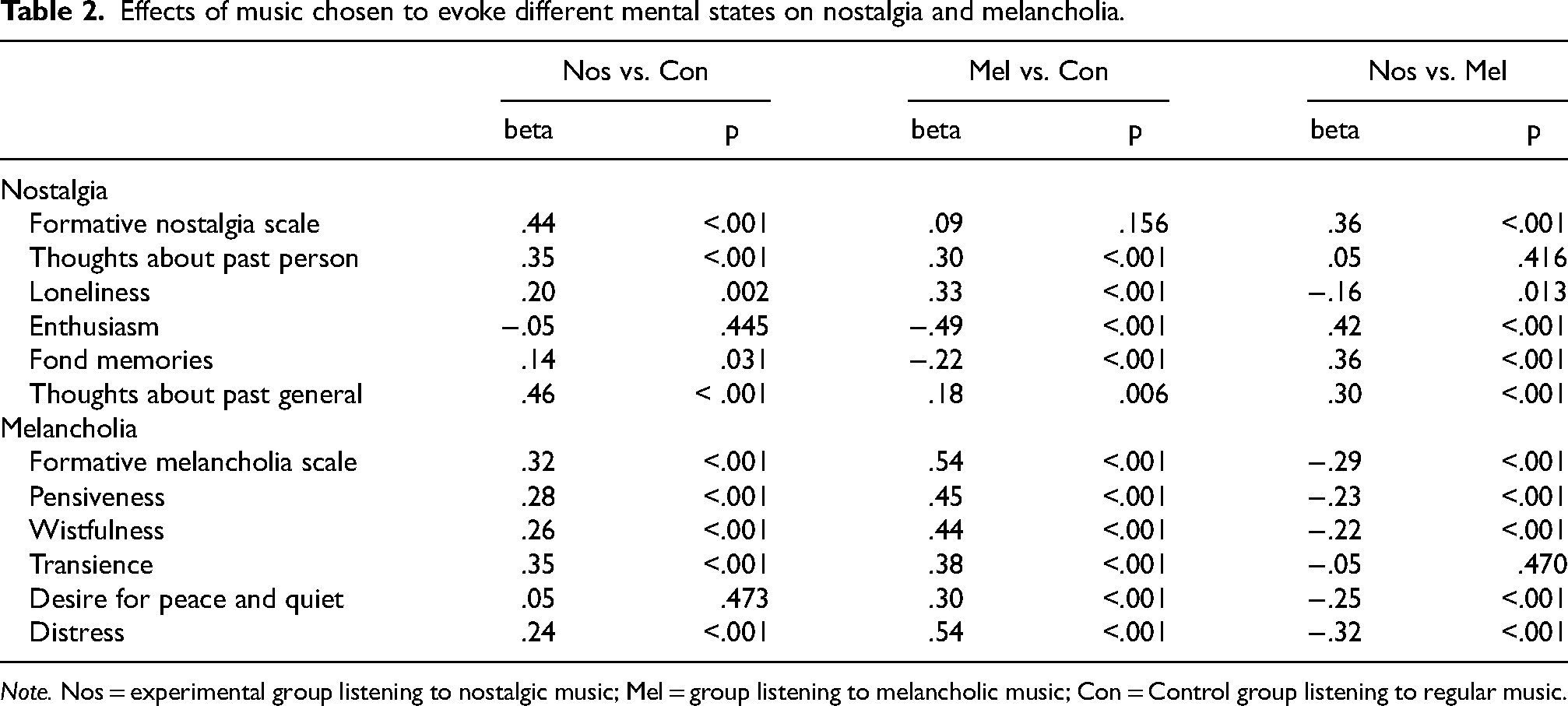
Note. Nos = experimental group listening to nostalgic music; Mel = group listening to melancholic music; Con = Control group listening to regular music.
Effects of Nostalgia and Melancholia
With Research Question 3, we analyzed whether experiencing nostalgia was related to changes in behavioral intentions. Participants who were more nostalgic were more intent on sharing the music with others, β = .26, b = 0.33, 95% CI [0.18, 0.47], z = 4.41, p < .001. The effect was small to medium-sized. Participants who were more nostalgic were also more intent on listening to the music again, β = .15, b = 0.15, 95% CI [0.02, 0.29], z = 2.31, p = .021. The effect was small.
Participants who experienced more melancholia than others were moderately less likely to share that music with others, β = −.18, b = −0.18, 95% CI [−0.30, −0.07], z = −3.03, p = .002. Finally, participants who experienced more melancholia were moderately less likely to listen to the music again, β = −.18, b = −0.16, 95% CI [−0.27, −0.05], z = −2.85, p = .004. Both effects were small.
For an overview of the results, see Table 3.
Relations between the formative scales of nostalgia and melancholia and intentions to again listen to the music and to share it with others.

Discussion
In this study, we investigated the conceptual nature of nostalgia and melancholia. We analyzed how both experiences are affected by listening to music chosen to evoke different mental states, and whether feeling nostalgic and melancholic is related to changes in behavioral intentions. On the basis of theoretical considerations and empirical research, we argued that nostalgia and melancholia describe mental states. During these mental states, we experience specific affects and cognitions. As a result, this is the first study to analyze nostalgia and melancholia as formative constructs.
Using a criterion validity approach, we compared overall 122 items and selected the 10 items that best predicted self-reported nostalgia and melancholia. Specifically, results showed that we label a state nostalgic when we are feeling enthusiastic as well as lonely. Next to these affects, we also experience typical cognitions. When nostalgic, we are also thinking about the past or a specific person we once knew, and we are reliving fond memories. This profile suits a description by Wulf et al. (2019), who noted that “nostalgic entertainment experiences represent a unique blend of both pleasurable and meaningful experiences” (p. 805). Our results confirm that nostalgia is an ambivalent experience consisting of both cognitions and affects (Barrett et al., 2010; Chung, 2016). They hence align with previous research, which found that positive memories and thinking of other people are typical aspects of nostalgia (Holak & Havlena, 1992; Wildschut et al., 2006).
Melancholia likewise consists of several affects and cognitions. Regarding its emotional components, when melancholic, we feel heavily distressed but also wistful. Regarding cognitions, we label a state melancholic if we are likewise pensive, that is, thinking about various different topics. As van Tilburg et al. (2019) noted, melancholia seems to involve more reflection than nostalgia. Interestingly, melancholia was also predicted significantly by the (somewhat exotic) item that people were more aware of the “transience of time,” which expresses a certain grief, or “weltschmerz” (that is, being in pain about the entire world; Merriam-Webster, 2023b), but also mindfulness. Hence, melancholia is less about specific memories and more about general feelings of loss, which aligns well with existing literature (Brady & Haapala, 2003; Eerola & Peltola, 2016; Smith, 2014). Melancholia seems to be a rather overarching, abstract state of thinking, whereas nostalgia is more specific and directed toward objects or persons. Together, this again confirms that melancholia is ambivalent and mainly negative, but also that there must be something positive that is currently lacking, missing, or out of reach, but that is worth attaining. In addition, experiencing melancholia also means wanting some peace and quiet, wanting to be left alone. Melancholia is therefore not so much about feeling lonely but about wanting to be alone, about experiencing solitude (Russell et al., 2012). Hence, melancholia has an introverted, private nature (Smith, 2014). This finding emerged already in the focus group interview, during which participants expressed that melancholia is about self-care, feeling grounded, and being egocentric.
Not only melancholia can be described as a coping mechanism for the passage of time – nostalgia is also thought to enable continuity between past and present selves (Wildschut, 2017). Possibly, this is ultimately what connects nostalgia and melancholia; they both let us revisit the past (van Tilburg et al., 2019) and use it for appreciating and re-evaluating both the past and the present. Nostalgia serves this purpose in a more romantic, benevolent manner, and melancholia in a more pondering, somber manner.
Can music trigger nostalgia and melancholia, and if so, what aspects? Using an experimental design with three groups (nostalgic music, melancholic music, and regular music), we found that listening to music considered nostalgic indeed increased nostalgia. In particular, when compared to regular music, listening to nostalgic music altered especially the cognitive components of nostalgia. The strongest effect was that participants reflected much more about specific events and people from the past. Emotionally, both kinds of music seem to make their listeners comparably enthusiastic. This is not surprising, because listening to music generally evokes positive emotions (Zentner et al., 2008, p. 513), and when given a choice, people typically choose uplifting music (Zillmann, 1988). That said, listening to nostalgic music still increases perceptions of loneliness.
Listening to music considered melancholic increased melancholia. However, in contrast to nostalgic music, melancholic music has a stronger impact on affects as compared to cognitions. When listening to melancholic music, levels of distress were high, whereas levels of enthusiasm were low in comparison to listening to nostalgic or regular music. Melancholic music made participants even more wistful than nostalgic music. Interestingly, although loneliness has emerged as an indicator of nostalgia, listening to melancholic music leads to even higher levels of loneliness than nostalgic music. This shows that listening to music considered melancholic certainly affects feelings of loneliness, but that those feelings do not contribute much to the assessment of melancholia after all. Cognitively, listening to melancholic music made participants most pensive. The focus was on the past: Above all, respondents thought about people they once knew, but also about the past in general. However, people were less likely to have fond memories.
Interestingly, whereas listening to nostalgic music also increased general levels of melancholia, listening to melancholic music did not increase general levels of nostalgia. Taruffi and Koelsch (2014) found that sad music evokes nostalgia more than any other emotional state. The fact that melancholic music did not evoke nostalgia in our study speaks for a clear distinction between sadness and melancholia. Melancholia is more complex, involving not only a blend of emotions, but also cognitions (e.g., pensiveness) and a more elaborate appraisal process. In a study on emotions evoked by music, Zentner et al. (2008) conceptualized nostalgia as a reflective latent variable, melancholia being one of its manifest indicators. This could explain the influence of nostalgic music on melancholia, but not the other way around. Pensiveness and wistfulness are involved in nostalgia, too, as thinking of and missing the past are two of its defining aspects. However, listening to nostalgic music does not make participants want more peace and quiet, which fits the more social nature of nostalgia (see below), but speaks against melancholia being an indicator of nostalgia. The association between the formative measures of nostalgia and melancholia was rather low, which suggests a distinction between them, despite their similarities due to their orientation towards the past. While van Tilburg et al. (2019) found a stronger correlation between nostalgia and melancholia (.41) than we did, they also acknowledged that it is probably (only) the focus on temporal distance that associates them, leaving room for considerable differences otherwise.
Do nostalgia and melancholia relate to different behavioral intentions? The short answer is: Yes, they do. Participants who experienced higher levels of nostalgia expressed a stronger wish to share the piece of music they had just listened to with others. Similarly, they were also more likely to listen to that piece of music again. This fits previous research that identified increased social connectedness as an effect of nostalgia (Cheung et al., 2018; Wildschut et al., 2006; Wildschut, 2017). Experiencing melancholia, on the other hand, is related to a decreased intention to share the music with others and to further engage with it. This non-social quality and restricted desirability clearly differentiates melancholia from nostalgia. Whereas nostalgia is more social and uplifting, melancholia is more private and mentally taxing (e.g., van Tilburg et al., 2019). We want to share nostalgic experiences with others and relive them, but we want to keep melancholic experiences away from others and avoid them.
Looking at all results combined, we find several similarities between nostalgia and melancholia. For example, both concepts are mental states that include both affects and cognition. Cognitively, both include a focus on the past from a perspective of loss. Emotionally, both are highly ambivalent, and include positive and negative elements. At the same time, several differences exist. Most prominently, nostalgia feels much more positive. When feeling nostalgic, the negativity does not lead to resignation and introversion. Instead, it still allows for (and even encourages) sharing and reliving the experience.
Although melancholia is taxing from a hedonistic perspective, it might offer crucial benefits from an eudaimonic perspective. Albeit emotionally unpleasant, thinking about one's losses might also foster appreciation for what is still there. It might lead to subsequent course corrections. Nostalgia has already been investigated in the light of this two-factor model of entertainment (Wulf et al., 2019); the same situation likely also applies to melancholia.
Limitations and Future Research
Before they were exposed to the stimulus, we provided participants with definitions of either nostalgia or melancholia, depending on the group they were assigned to. We decided to do so in order to avoid incongruities between the definitions used in research and the intuitive understanding of the broad public, especially in the case of melancholia, as it is less familiar than nostalgia. We attempted to find a balance between providing definitions that are precise, but do not give away too many attributes, as the latter might render the answers given in the subsequent questionnaire a self-fulfilling prophecy. However, one could argue that this may still have happened due to the distinct adjectives used in the definitions which re-appeared in questionnaire items and which ultimately might have led to these very items emerging as the best predictors for self-reported nostalgia and melancholia, respectively. While we do not dispute that this may have happened to a certain degree, we would like to stress that all participants answered all questionnaire items. For example, participants in the nostalgia group may certainly have tended to score higher on items that bore similarities to the definition of nostalgia they were provided – however, roughly two thirds of the answers to these items came from participants in the melancholia and control groups. Therefore, the selection of the best predictors was only partially based on answers from participants in the respective experimental groups. The fact that nostalgic music also evoked melancholia and most of its elements significantly more than music in the control group, and that we made similar observations for melancholic music, shows that a bias introduced by reading the definitions alone hardly accounted for our findings.
We used self-reported nostalgia and melancholia as the criteria for the identification of their components, respectively. At first glance, this may contradict the necessity of a formative modeling of nostalgia and melancholia that we proposed in the first place. However, the MIMIC model we used merged the experiencing (as measured by the components) and the labeling (as measured by the self-reported experience) of nostalgia and melancholia in order to operationalize the perspective of them being meta-appraisals, which we elaborated on in this paper. Nostalgia and melancholia are supposed to be formed by the experiencing of their components, as well as reflect in their recognition by people themselves, which is why we chose this exact approach. Furthermore, the final selection of items based on their criterion validity may seem too data-driven and to lack a clear theoretical foundation to begin with. However, all items that we included were derived from existing research, theoretical models, and analyses. To make sure that all relevant aspects of both constructs were included, we also conducted a focus group interview and designed several additional items.
The focus group interview involved only four students. While low sample size is typical for a focus group interview, the fact that all participants were students may suggest that the results are biased. However, “homogeneity in focus group construction is considered essential for group interaction and dynamics” (Grønkjær et al., 2011, p. 23). It is still important for the moderator to “challenge the participants’ accounts and ensure that all participants have the chance to express their views” (p. 26), which is exactly what we did as best as we could.
We measured only the relations between experiencing nostalgia and melancholia and behavioral intentions. As a result, our research design does not allow for causal inferences regarding the behavioral effects of nostalgia and melancholia. Theoretically, it seems more plausible that both experiences affect behavioral intentions than vice versa. Nonetheless, we encourage future research to address this question using study designs that explicitly address causality – preferably by collecting behavioral data. Also, we focused on only two possible outcomes of experiencing nostalgia and melancholia, while there are evidently many more. For example, it would be interesting to see whether experiencing melancholia leads to course corrections or reassessments, which could, for example, result in contacting a former friend or ex partner.
In this study, we induced nostalgia and melancholia via music. It would be interesting to see whether our conceptualization remains valid when nostalgia and melancholia are evoked via other media (Sedikides et al., 2015). Due to the scales’ general nature, we assume that they can also be used in other contexts with different stimuli. Likewise, the scales might also be helpful for research questions not related to media. Especially the Formative Melancholia Scale represents, to the best of our knowledge, the first and only scale for measuring melancholia as the cognitive-emotional experience that it is. If used in future research, we recommend not simply calculating the means of the five items each. Instead, in order to acknowledge the formative nature and different weights of the items, we recommend calculating weighted means using the values presented in Table 1. Employing both scales in different contexts, especially with different stimuli, should further advance our understanding of these intricate, fleeting, and fascinating concepts.
Conclusion
Nostalgia and melancholia are closely related on a conceptual level. At the same time, they are also markedly distinct. Specifically, nostalgia is a predominantly positive experience that stems from appreciating good times and the people associated with it. In addition, there is the uncomfortable confrontation with the fact that those good times are over. As a result, people want to share triggers of nostalgia with others and are looking forward to reliving nostalgic experiences.
Melancholia, on the other hand, has a more somber tone. It is a solitary, introverted experience, and involves ruminating about things that have happened in one's life. These ruminations are general, without a specific focus. When feeling melancholic, people prefer to be left alone. They want to indulge in the experience which, although distressing, possibly provides a cathartic function. That being said, people seem uncomfortable with sharing or further engaging with the trigger of melancholia.
Music has the powerful capacity to impact our thoughts and to affect our emotions. Among others, it lets us relive the past, mourn its loss, learn from it, and appreciate the present. It lets us enjoy sadness, lament happiness, and does this in a more immediate way than other forms of media due to its ease of infiltrating our thoughts and emotions, as it has done for so many centuries and millennia.
Footnotes
Action Editor
Kelly Jakubowski, Durham University, Department of Music.
Peer Review
Imre Lahdelma, Durham University, Department of Music.
Caitlyn Trevor, University of Birmingham, Department of Music.
Contributorship
RT designed the study; RT collected the data; RT conducted the focus group; TD & RT analyzed the data; TD & RT wrote the manuscript. Additional information, the data, the analysis scripts, and a completely reproducible version of this manuscript can be found in the online supplementary material at  .
.
Declaration of Conflicting Interests
The author(s) declared no potential conflicts of interest with respect to the research, authorship, and/or publication of this article.
Ethical Approval
This study was conducted in Germany, where external ethical approval in psychological research is still not yet mandatory and only required in specific cases. Such cases include (a) the expectation that participants take risks, (b) when deliberately not informing participants about the study procedure, or (c) when stimulating participants physically (DFG, 2023), none of which were the case in our study. The data were collected in the context of the first author's master's thesis, which was evaluated and formally approved by the respective department chair at the University of Hohenheim in Stuttgart, Germany.
Funding
The author(s) received no financial support for the research, authorship, and/or publication of this article.