




Abstract
The convention of performing from memory is a well-established practice among pianists, but an exception is often made for contemporary piano repertoire. Even so, a number of renowned pianists continue performing highly demanding compositions of this genre from memory, and this practice is commended by contemporary composers. No research to date has systematically investigated musicians’ views on this matter and explored detailed accounts of how to prepare and memorise such repertoire. In this study six renowned professional pianists with experience in performing contemporary piano repertoire were interviewed on their approaches to learning and memorising this music. Interpretative Phenomenological Analysis of the pianists’ accounts revealed a variety of views on performing contemporary music from memory, with some pianists advocating benefits from performing by heart and others from using the score. The general practice strategies reported resembled approaches described by skilled musicians in relation to standard repertoire, with some variations related to different types of contemporary music styles. Memorisation accounts emphasised the importance of strategies such as mental rehearsal, chunking, and reliance on different types of memory and their combination.
Keywords
Introduction
The Convention of Performing from Memory
The virtuosity promoted during the romantic era instigated a tradition among pianists of playing without the score, well-established since the late 19th century (Ginsborg, 2004; Mishra, 2016; Williamon, 2002). Nowadays, audiences have become accustomed to seeing pianists performing from memory in different scenarios, such as examinations, competitions, and recitals (Ginsborg, 2004). Nonetheless, an exception is often made for contemporary piano repertoire, 1 as “players are silently excused memorising it since it can be phenomenally difficult to remember accurately” (Hamilton, 2008, p. 80). Even though performing with a score has become generally acceptable for this type of repertoire (Mishra, 2014), no one has so far attempted to explore why this music is considered to be particularly difficult to remember. Some renowned soloists of contemporary piano repertoire continue performing highly demanding compositions from memory. Moreover, contemporary composers also commend this practice for specific pieces. As an example, George Crumb considers that compositions using symbolic notation (e.g., circular, spiral or cross forms) should be performed without the score. As mentioned in his preface to the well-known piano work Makrokosmos, “the symbolic notations […] must, obviously, be memorised when performed. In fact, the entire work becomes much more dramatic and musical if it is played from memory” (Crumb, 1972). Although rules freeing musicians to perform new styles of repertoire from memory have appeared in competitions and recital settings (Hamilton, 2008; Mishra, 2014), there is still a lack of studies investigating pianists’ opinions about this matter and exploring how memorisation unfolds in this context.
Approaches to Memorisation
The demands required to perform entire recitals by heart have long captured the attention of performers, teachers and researchers. Common insights have emerged from accounts of pedagogues and studies in music psychology, namely the use of different types of memories (visual, aural, kinaesthetic, emotional, linguistic, conceptual) and the importance of musical analysis as means of exploring patterns and identifying the structure of music, which later can be used to organize practice and secure memorisation (Chaffin et al., 2003; Hallam, 1997; Hughes, 1915; Rubin-Rabson, 1937; Williamon & Valentine, 2002).
The existing principles of memorisation that are thought to apply to musicians are strongly based on the use of conceptual knowledge of tonal musical vernacular. Previous research found that skilled musicians encode music more rapidly and effectively than novices, because they associate new musical information to ready-made chunks stored in long-term memory after years of training. Tonal patterns (e.g., chords, scales, arpeggios, or harmonic progressions) have often been reported as possible chunks (Chaffin et al., 2002; Chaffin & Logan, 2006; Halpern & Bower, 1982). Other studies also found that professional musicians rely on well-known hierarchical frameworks, such as the formal structure of the music, to organise practice and to secure memorisation (Chaffin et al., 2002, Chaffin et al., 2010; Williamon, 2002). Nonetheless, these studies have been highly focused on memorisation of tonal music written before the 20th century (Aiello, 2000; Chaffin et al., 2002; Noyle, 1987).
As emphasised by Apel (1972), although tonality dominates about two centuries of music creation, since the end of the 19th century composers have progressively moved away from tonal concepts and standard structures and started exploring very different principles of composition, giving rise to different styles of contemporary music, such as serialism, new complexity, experimental music, minimalism and beyond (Kostka & Santa, 2018).
New developments in contemporary repertoire have elicited new performance considerations, requiring musicians to push the limits of virtuosity, to perform new instrumental techniques, to deal with less familiar notation, to articulate with complex sonic structures, and to explore new ways of expression in musical performance (Clarke & Doffman, 2014; Kanga, 2002). Performers interested in music written after this period need to adapt to these changes and interact with less familiar musical language and unconventional performance practices.
Professional pianists’ reports of learning approaches to contemporary piano music can be found in previous research (Thomas, 1999, 2009). A case study by Mishra and Fast (2015) also examined practice strategies employed by a professional musician while preparing a commissioned piece for its first performance. Although these studies have provided important insights on how musicians prepare this repertoire for performance, they have not directly addressed the topic of memorisation. Except for a few studies (Chueke & Chaffin, 2016; Ginsborg & Chaffin, 2011a, 2011b; Soares, 2015; Tsintzou & Theodorakis, 2008), there is still little suggestion in the literature of how to memorise repertoire with less familiar musical information, unconventional performance practices, and unfamiliar structural forms.
The first longitudinal case studies on memorisation of non-tonal musical excerpts highlighted the importance of relying on the subjective understanding of the formal structure of the music to organise practice and secure memorisation (Chaffin & Chueke, 2016; Soares, 2015). Soares (2015) provided qualitative examination of specific techniques used by himself and other piano students to memorise a wide range of contemporary piano repertoire. Some strategies resembled those reported in previous studies, namely the use of segmented practice (Chaffin & Imreh, 1997; Ginsborg, 2004; Mishra, 2011; Williamon & Valentine, 2002) or pre-analysis of the score (Aiello, 2000; Hallam, 1997; Rubin-Rabson, 1937). However, some pianists used different techniques to deal with the complex demands of this repertoire, such as associating non-tonal information with tonal music knowledge (e.g., intervallic or harmonic relationships). This technique was also reported by Tsintzou and Theodorakis (2008). Another strategy used was the development of localised cues, such as hand shapes, specific intervals, or sound features (Soares, 2015).
The first studies on memorisation of non-tonal music opened the doors to the understanding of how musicians cope with memorisation of challenging compositions. However, no study to date has systematically investigated pianists’ views towards performing this repertoire from memory. Moreover, the existing reports have so far been mainly confined to brief musical excerpts and individual case studies. Beyond this reduced number of studies, scant literature exists concerning musicians’ views on memorisation of this repertoire, as well as the memorisation strategies used in this context.
Aims of the Present Study
This study sought to examine pianists’ views and experiences of learning and memorising contemporary piano repertoire. The first aim was to extend previous research by systematically investigating professional pianists’ attitudes towards performing contemporary piano repertoire from memory. The second aim was to expand previous knowledge on memorisation strategies used by experienced musicians by exploring in depth how experienced musicians approach learning and memorisation of this repertoire.
Method
This study followed a qualitative methodology based on semistructured interviews with professional pianists, thus extending previous phenomenological research on music memorisation (Aiello, 2000; Chen, 2015; Ginsborg, 2000; Hallam, 1997; Holmes, 2005; Humphreys, 1993). The methodological approach followed the Interpretative Phenomenological Analysis (IPA) protocol proposed by Smith et al. (2009). The aim of IPA is to provide an in-depth exploration of personal experiences and examine how individuals make sense of their personal and social world (Storey, 2015). In this exploratory study we assume that knowledge is context-specific and influenced by the perceiver. Learning and memorisation are considered here as phenomena that should be interpreted within specific contexts. The primary intention is not to generate a theory of how musicians memorise non-tonal music, but to understand how the phenomenon unfolds in this context.
Participants
Six professional pianists with experience in performing contemporary piano repertoire were interviewed. The main aim was to explore experiences of a very specific group of pianists, who perform at an international level and are experienced in performing contemporary music. The pianists were recruited through personal and professional networks of the investigators. The participants agreed for their names to be used. They are Andrew Ball, Andrew Zolinsky, Christopher Goddard, Christos Triantafillou, Ermis Theodorakis, and Philip Thomas. These pianists have all performed a wide range of contemporary piano repertoire throughout their careers, and some also have composition experience. Detailed information about each pianist's careers can be found in Table 1. The complete transcriptions of the interviews can be found in Fonte (2020).
Short biographies of the participants in the study.

Note. Comments are attributed to each pianist as indicated by their initials.
Design and Procedure
This study employed a semi-structured interview approach to allow for a comprehensive exploration of the pianists’ views and experiences of performing contemporary piano repertoire. An interview topic guide was created and used for all interviews, covering four main domains: (1) attitudes towards performing from memory; (2) experiences of learning, memorising and performing from memory; (3) skills required to perform contemporary music; and (4) experiences relevant to the performance of contemporary music. All types of contemporary piano repertoire were included. The effectiveness of the interview schedule was evaluated through a pilot study with four postgraduate students from the Royal College of Music. The interviews lasted, on average, between 50 min and 4 hr. Interviews were recorded with a digital audio recorder. Each interview was recorded and later transcribed verbatim with verbal and written consent from the participants. Each pianist's transcripts were later sent to them to verify content accuracy.
Data Analysis
The interviews were analysed using IPA (Smith et al., 2009). The software NVivo 12 was used to carry out the analysis, while following the protocol recommended by Smith et al. (2009). Three main stages were followed when conducting the analysis: (1) several readings of each individual transcript, while annotating exploratory comments with key aspects found in the data; (2) examination of the exploratory comments and annotation of emerging themes; and (3) grouping of themes into superordinate themes. The themes were cross-checked among the researchers for further validation (two researchers read the manuscripts, coded the documents, and later discussed the emergent themes). Due to the open-ended nature of the interviews, only themes common to all participants are reported. In this paper, the main themes are discussed below.
Results
The pianists provided rich and detailed descriptions of their views and experiences of learning and memorising contemporary piano repertoire. Five superordinate themes emerged from the analysis: a) performance of contemporary music; b) the choice of playing with or without the score; c) practice approaches; d) memorisation approaches; and e) performance experiences. Within each of these themes, several sub-themes elucidate in more detail these pianists’ experiences and views on the topic. Table 2 outlines the superordinate themes and sub-themes identified in the IPA analysis, accompanied by verbatim illustrative quotations.
Common superordinate and subthemes from the IPA analysis.
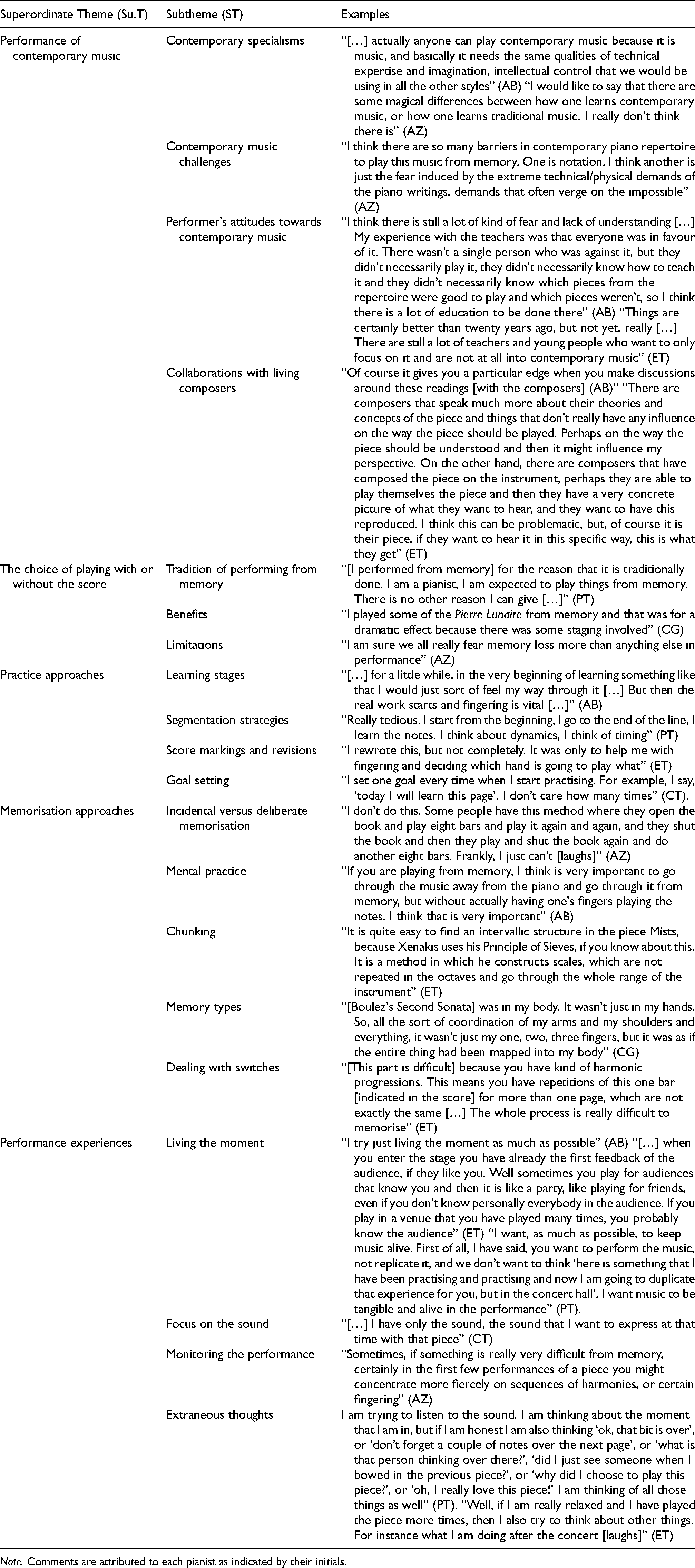
Note. Comments are attributed to each pianist as indicated by their initials.
Performance of Contemporary Music
Contemporary Specialisms
During the interviews, all pianists described their experiences of performing contemporary music, drawing comparisons with other styles of repertoire. One topic addressed was the idea of contemporary specialisms, namely the preconceived impression that contemporary music is a specialised field and requires a very specific learning approach. Zolinsky and Ball asserted, however, that contemporary music is, after all, music and that pianists will use essentially the same skills as in other styles of repertoire, thus refuting the idea of contemporary specialisms (See Table 2).
Contemporary Music Challenges
All pianists observed that this repertoire has specific challenges when compared with earlier music styles. They noticed that in several contemporary pieces there is an absence of obvious structures and patterns, usually found in earlier styles of repertoire. Thomas pointed out how most of the experimental music he plays “doesn’t have so many traditional ideas about shape and gesture, phrasing […]” (PT). Ball added that in some contemporary piano pieces “there is not necessarily any harmony”. In this case, pianists need to find their way into it. However, particularly when the style is unfamiliar, “it might take a long time before you could see why the notes there interact with each other” (AB). Goddard noticed that this music violently confronts standard principals found in tonal repertoire. When talking about his experiences of learning Boulez's Piano Sonata No. 2, he noted: […] it is very striving, it is very sort of disjointed melodically. There are a lot of huge leaps all over the piano, and this is all coincidental. This is all sort of against the pianisms of prior music with proximal finger work, such as scales, simple arpeggios. So, it not only doesn’t do that, I think that violently confronts those things. (CG)
Several pianists noted that contemporary music writing is often problematic. Zolinsky observed: I think one has to accept that a lot of contemporary piano music, even though it sounds wonderful and that is why we play it, it is not particularly well written for the piano. It doesn’t really lie under the hand particularly brilliantly. I am not saying the majority, but a lot doesn’t in the same way as playing, you know, Chopin's Sonata No. 3 does. And so, therefore, it's extremely hard to create the sense of physical memory about it. (AZ)
The same point was mentioned by Goddard in relation to Boulez's writing, stating that “he writes all these things that are sort of impractical, and there are always weird polyphonic streams that don’t seem to match when your hands are playing […]” (CG). These impracticalities are, for Triantafillou, an effect of the existing separation between performance and composition practices: Currently pianists don’t have the time or need to train in composition and composers don’t have the time or need to train on an instrument […] And this is one problem. It doesn’t matter what you can do in your mind if you can’t apply it in practice. (CT)
The obstacles related to absence of well-known musical vernacular and impractical writing inevitably affect the time spent learning this repertoire. Goddard remembered how he spent “half an afternoon to learn a system” of Boulez's Sonata No. 2 (CG).
Finally, some pianists pointed out difficulties related to rhythmic complexity and tempo changes. Goddard noticed how frustrating it becomes learning music with no time signatures “because you don’t have this signposting guide, to guide your thinking […]” (CD). Theodorakis and Triantafillou also emphasised the importance of learning how to deal with the recurrent changes of tempo in this music.
Performer's Attitudes Towards Contemporary Music
The pianists in this study also touched upon attitudes of other performers towards this music. Ball mentioned that there is still “fear and lack of understanding” among performers. Goddard, Theodorakis, and Triantafillou pointed out that pianists are not exposed enough to contemporary music during their training. Although things are changing, it is still not enough (See Table 2).
Collaborations with Living Composers
Contact and collaboration with living composers was mentioned as a special situation that performers get to experience when performing new music. Ball believes that “all pianists should work with the composer at some point […]” (AB). Most pianists stated that working with living composers does not affect their learning approaches very strongly but can provide important insights in relation to music interpretation (See Table 2).
The Choice of Playing with or Without the Score
Playing from memory is a choice for these pianists, involving different factors. Theodorakis and Triantafillou usually play from memory, including different styles of contemporary piano repertoire. Goddard plans to memorise some contemporary pieces, but others he memorised without any deliberate intention. Zolinsky sets out to memorise as much as possible, but he plays some contemporary works with the score, not only because of the challenges mentioned above but for other factors that are discussed below. Ball used to play standard pieces of piano repertoire from memory, but most contemporary pieces he performs with the score. Thomas nowadays performs his entire repertoire with the music.
Tradition of Performing from Memory
Most pianists mentioned the tradition of performing from memory as a reason for playing without a score. Thomas explained that the last piece he had memorised was Berio's Sequenza 4 because it is how it is traditionally done: “I am a pianist, I am expected to play things from memory” (PT). Triantafillou admitted that he was initially “led to do it in this classical world”, although personally he “never felt forced to do it”, as he plays by heart because he likes to memorise. Ball talked about how he disapproves of these conventions. In the end, what should matter is what produces the best performance: After all it is crazy, the whole tradition of playing from memory. Imagine sort of explaining to a Martian, from outer space [laughs], “well, piano solo, piano concertos you must play from memory, violinists must play concertos from memory, but sonatas from the music, violin sonatas. If the violinists play from memory, the pianists should play from memory as well. Wind instrumentalists don’t tend to play from memory at all”. […] Just do whatever is going to produce the best performances. (AB)
Nevertheless, he admitted feeling inclined to prefer memorised performances with more standard repertoire, noticing that “playing something like the Tchaikovsky concerto does somehow feel very strange to play with the music” (AB). Zolinsky agreed, observing that when he listens to performances with the score something “doesn’t feel as connected” (AZ).
Benefits
Several benefits of memorising music were identified as reasons to play without a score, namely deep knowledge of the music, improved listening abilities, freedom, and improved communication and expressivity. This last benefit was claimed by Goddard as a reason for playing Schoenberg's Op. 23 from memory because he saw expressiveness in the music and wanted to convey this during the performance: I have chosen to approach from the more expressive, dramatic world, and for that I thought that to do it from memory would have been a means of liberating myself from the very precise details and open myself to be expressive with the piece. (CG)
Goddard and Triantafillou noted some very specific reasons for performing contemporary piano repertoire without a score, related to the desired performance effect, namely “staging involved” (CG) or playing with “the lights out, fully” (CT).
Limitations
The pianists also identified limitations in performing from memory, such as the extra anxiety caused by the fear of memory loss. Thomas noticed how this extra layer of stress can disrupt the performance: “I do remember, in those times when I did memorise things, finding the extra layer of nerves of just thinking, what if I forget? That itself being unhelpful and so, I tended not to do it” (PT). Ball believes that in cases where memorisation is a source of anxiety, having the score on stage can be a freeing element: […] sometimes there could be a freedom in playing with the music. Sometimes taking the pressure off the memory can disinhibit too, release new sorts of freedom, creativity and I think everyone suffers from some sort of nervousness about memorising, even the greatest musicians. (AB)
Some pianists noticed that memorisation also takes extra practice time, particularly in contemporary piano repertoire. Ball recognised that, as he is a quick learner, playing some contemporary pieces from memory “would have been a luxury” (AB). Ball and Zolinsky also emphasised that, in contemporary pieces, this extra time is just not worth the effort because “people are going to listen to them very occasionally” (AB).
Finally, Thomas recognises that the “ideal situation is that you have memorised [the music], you have internalised it, that you know what is happening next” (PT), even when you play with the score. Nonetheless, he believes that when musicians memorise they tend to rely on one version of the music, but permanent knowledge of the music should not be the ultimate goal, particularly in some styles of contemporary music, such as experimental repertoire. Having the score on stage can raise the likelihood of alertness to spontaneous ideas that might arise during performance: I want to be alert to something that might occur to me at the moment and that might come through the notation. It might come through other means, just the response to my touch, to the piano, the acoustics, the audience, what I ate that day, any number of things. But it may also come through the notation. (PT)
Practice Approaches
Learning Stages
The pianists described in detail how they practice different styles of contemporary piano repertoire. All mentioned starting by identifying the task's demands before approaching detailed work. Theodorakis noticed how he starts by understanding the music language and its form: First, I have to see what the piece is about, and with this I mean not in a poetical sense, such as describing the nature or feelings. I try much more to see how the form works, what parts it has and also the composition methods; for instance, if it is really twelve-tone music or if there are any special chords or intervallic formations. (ET)
Ball starts by “feeling his way through the piece”, even if the music is impossible to sight read: “however inaccurately I found it useful just a few times to kind of try and feel my way through it, feel it almost with my arms rather than my fingers”. (AB) Thomas and Triantafillou usually preview the work with a notational overview, analysing the score visually. Triantafillou noticed that in this first learning stage he looks for “music geometry”: One thing that attracts me in contemporary music is geometry. And these composers have in their pieces total geometry. So, first of all, I need to see this scheme. I don’t care what the notes are, but I try to see one scheme in general, just superficially. (CT)
“Total geometry” is, for Triantafillou, not only how the composer's intention is exposed and organised in the music, but also how the performer interprets those ideas and “translates in practical ways, by performing it” (CT). Therefore, more than the conceptual image of musical shape, this pianist thinks about how the piece will be embodied. Finally, geometry also involves rhythmic framework and the resulting sound of the piece, elements that will represent its specific character.
Segmentation Strategies
All pianists reported focusing on detailed work after identifying the task demands, following a segmented approach (Mishra, 2005). The criteria used to segment the piece for practice often involves the score layout at the initial stages. Goddard divided Boulez's Sonata No. 2 into the systems found on the page, while figuring out how to subdivide the music later on: “In terms of process, I literally took each system at a time, and I thought about how I was going to subdivide it” (CG). Thomas and Theodorakis reported singling out difficult passages. When talking about Cage's Piano Concerto, Thomas noted: “For instance, this piece has three really difficult pages. So, I just practice those pages over and over again, and I will do it slowly. And then I will take a deep breath and go forward [laughs]” (PT).
One common insight addressed during the interviews was the importance of processing all musical elements simultaneously. Triantafillou highlighted that one cannot start with the notes and rhythms and then learn the other elements afterwards: […] you have to learn all these indications, you don’t just start with the notes or rhythms and then the rest. No! You need to follow everything he writes, the senza pedal, una corda, tre corde and so on”. (CT)
Zolinsky supported this idea, stressing that “it is really important to put everything in right at the beginning of the process” (AZ). He believes that this approach will ensure a proper and effective development of physical memory because we are “loading the right information, we are creating the right habits” (AZ).
Score Markings and Revisions
Some pianists mentioned rewriting the original score at the initial stages of practice. Theodorakis rewrote parts of Frank Cox's Etude No. 4 to help him figure out practical issues, such as fingering: I rewrote this, but not completely; it was only to help me with fingering and deciding which hand is going to play what. And then I worked with both kinds of scores, simultaneously, because what I notate here is still pretty rough. It does not include the exact pulses, any articulation, or the exact dynamics […] For this extreme degree of complexity it is helpful. (ET)
Thomas also mentioned rewriting music requiring improvisation, to make decisions on the material he will use to improvise. Besides writing new versions, some pianists mentioned adding markings to the score to help find logic in the music. Triantafillou always starts by writing the rhythmic framework of the piece, identifying where the rhythmic groupings fit within the general pulse. The pianist reported using this strategy in every contemporary piece he learns, preparing the score for practice in the first stages of learning by marking the rhythmic structure.
Goal Setting
Goal setting was highlighted as an important element during practice. Triantafillou pointed out: “I set one goal every time when I start practising. For example, I say “today I will learn this page”. I don’t care how many times” (CT). Ball also mentioned using goal setting in relation to memorisation of Tippett's Sonata No. 3: “Then I would be very rigorous, I would determine I was going to learn 17 bars each day, maybe not a huge number of bars, but I would do it, I would make myself do it” (AB).
Memorisation Approaches
Incidental Versus Deliberate Memorisation
The pianists provided very specific examples of how they memorise, reporting both deliberate and incidental approaches to memorisation, depending on the task demands. Ball reported using a deliberate approach when memorising Tippett's Sonata No. 3, as he would just select a specific part of the piece and make himself memorise it, even if he was “playing at half past midnight” (AB). Goddard also adopted a deliberate approach when memorising Schoenberg Op. 23 because he had a specific goal for the performance and had decided to play by heart. However, when he learned Boulez's Sonata No. 2, it never crossed his mind to memorise the piece: The Boulez, I did not set out to memorise by any means. That piece was something that I learned. I didn’t have any experience, and it was by far the most complex piece that I have ever played […] But I spent so much time with the piece that eventually I just had it memorised. So, I just sort of woke up one day and I thought, I don’t even need the score for this anymore. (CG)
Zolinsky believes that the ideal approach is to let memorisation “take the natural course” (AZ). Nevertheless, he reported memorising deliberately when time is short, even though rushed approaches result in poor long-term recall, as “two months later they are just gone” (AZ).
Mental Practice
The pianists highlighted the importance of practising away from the piano as a complement to memorisation. Ball stressed that “if you are playing from memory [..] [it] is very important to go through the music away from the piano and go through it from memory” (AB). Zolinsky also believes that this is a very strong strategy: “It is a really strong form of memory, actually, because you are not distracted by technical difficulties or actually putting the right notes down. You are just purely seeing it, as I would see it when I teach somebody […]” (AZ).
Some pianists stressed the importance of musical analysis as a vital tool for memorisation. Ball mentioned harmonic analysis in relation to tonal music but stressed that musical analysis should be what makes sense to the performer. He highlighted this point particularly when asked how he analyses contemporary pieces: It depends on the piece. You have to find a way into it […] So, it doesn’t have to be a specific sort of analysis, and in a way, it doesn’t even have to be something that the composer intends, but if it makes sense to you then it will help. (AB)
Triantafillou and Theodorakis reported analysing the score to understand and work out its complexities. Theodorakis mentioned working out complex rhythms “on the table” because “only practising the pitches does not help” (ET). These two pianists also mentioned imagining the sound of the music and their movements.
Chunking
Goddard, Triantafillou, and Theodorakis mentioned chunking the music into meaningful patterns during their memorisation process. Goddard referred this strategy in relation to tonal music, but the other two pianists were specifically talking about contemporary repertoire. In the piece God Good Luck, by Kyriakides, Triantafillou noticed that some groups of notes form very specific patterns, which are “easier for the hand to remember” (CT). In this case, patterns are not conceptual groupings, as in tonal music, but hand shapes.
Theodorakis believes that, even in contemporary non-tonal music, it is always possible to find ways to organise pitches and stressed how essential this practice is for memorisation: “even if I have to memorise the absolute chaos, then I try to put the pitches together in these kinds of models” (ET). He noted that the application of organisational models is more intuitive in tonal music, but observed that some contemporary piano works also have some recognisable tonal patterns. In this case he associates those entities to the new information. For example, in the opening of Alban Berg's Sonata it is possible to identify resemblances to minor chords or augmented chords. Even if the patterns are not exactly tonal, “in principle there are still recognisable, almost tonal elements, extended” (ET).
This pianist also observed that some contemporary composers use specific models or entities in their writing. This is the case for Xenakis, who uses stochastic composition, sieve theory or general theories of musical time (Squibbs, 2002). Theodorakis used this knowledge to memorise his piece Mists: It is quite easy to find an intervallic structure in the piece Mists, because Xenakis uses his Principle of Sieves, if you know about this. It is a method in which he constructs scales, which are not repeated in the octaves and go through the whole range of the instrument […] When a particular scale is in use, then it is like as if there are no other keys, everything that happens here on this scale would have this complete intervallic structure. It doesn’t matter if there are clouds or melodies, you will have the same sound, you will have the same intervals. Of course he doesn’t only use this scale, he uses other rotations and transportations, but the principle is the same and this is also a great help. (ET)
When pitches are too dispersed, Theodorakis uses different techniques to organise the information. For example, to memorise the opening of Herma by Xenakis he condensed the pitches into one octave and looked for harmonic entities within those pitches.
Memory Types
The pianists mentioned several memory types while describing their memorisation process. Several spoke about kinaesthetic memory. Ball considers this type of memory vital in non-tonal music: I think what I rely on the most is muscle. Actually, I know that it is not fashionable, but that is why fingering is so important to me. I think that's got the sort of wellspring of the quick, intuitive, almost reflex movements. Well, not almost, but definitely reflex movements that you need for that sort of difficult frame, complex, and basically not tonal music. So if it is hard sort of finding chords that you know, necessarily, the chords that are just specific to a piece. (AB)
Usually, in previous literature, “musicians talk about physical memory ‘as being in the hands’” (Chaffin, Logan, & Begosh, 2009, p. 355). The pianists in this study provided similar descriptions, but noticed that in some contemporary pieces they not only develop physical memory in their hands, but in the whole body. When explaining how he developed incidental memory of Boulez's Second Sonata, Goddard noticed: It was in my body. It wasn’t just in my hands. So, all the sort of coordination of my arms and my shoulders and everything, it wasn’t just my one, two, three fingers, but it was as if the entire thing had been mapped into my body. (CG)
The other three pianists also highlighted the importance of imagining the sound of the music, a process often associated to auditory memory (Ginsborg, 2017). Zolinsky mentioned visual memory, noticing that even though he does not see exactly what is written on the score, he has “a sense of where something is on the page and somehow that ignites the memory” (AZ). Theodorakis also mentioned relying on this type of memory as an “extra aid”: I also do it photographically, this is kind of an extra aid of memory. It is mostly with pieces that I have learned recently. I always know when the pitch changes, or when there is a line break, or where the systems change. This is a kind of memory which is not a musical one, but it helps. You don’t get lost. (ET)
Several pianists underlined that these memories need to be accompanied by “thinking about what is happening”, about “the structure of the music” (AZ), and by thinking “how the piece works together as a totality” (CG). Thomas mentioned that when he used to memorise music, he focused a lot more on music shape than he does now. Triantafillou emphasised the importance of being aware of the general scheme of the piece that, in contemporary music, he sees as “music geometry”.
The pianists did not report favouring one kind of memory over the others. Their memorisation process appears to rely on a combination of different memory types and is adapted to the type of piece and task constraints.
Dealing with Switches
Some pianists mentioned a major memorisation challenge, related to the appearance of the “same motives, but [with] slightly different repetitions” (ET). This feature is present in several styles of repertoire and has been referred to in previous studies on music memorisation as switches (Chaffin et al., 2002). Theodorakis mentioned finding this feature in works by Messiaen or Mahnkopf and noticed how it can become a true challenge for memorisation. When asked how he deals with this issue, particularly in the piece Vingt Regards sur l’Enfant-Jésus by Messiaen, he answered: This took some time […] trying to bring everything in my head without getting confused. Of course I invented some places, some features to hold on to. For instance, what is the initial chord that every bar starts with […]? Every triad has a different character […].(ET)
Performance Experiences
The learning and memorisation experiences previously described eventually culminate in a performance. All pianists described how they experience this moment.
Living the Moment
Ball tries to live the moment as much as possible. For him, the ideal performance situation is when one is secure enough to just enjoy the experience and float above it: When I am playing at my best, it is just living in the moment, and when it really works well, and that is not by any means all the time, I feel as I am not really having to play it myself. I feel as if I am sort of floating above what is happening, but that doesn’t happen all that often, but that is the best feeling one has. (AB)
Theodorakis reported perceiving the audience's feedback, and Thomas focusses on keeping the music alive and fresh in every performance (See Table 2).
Focus on the Sound
During performance, Thomas reported listening very carefully to the sound (Table 2). Triantafillou shared the same experience, noticing that he is mainly focused on listening to himself, as if he was in the audience: […] I have only the sound, the sound that I want to express at that time with that piece. I don’t think, I simply listen to the sound, I listen to myself like I am in the audience. I let myself [go] and enjoy all of this. (CT)
Monitoring the Performance
Some pianists emphasised that the performance needs to be monitored, even if trying to live in the moment. Ball observed that “[…] of course one has to anticipate it, as I just said one has to think ahead for difficult moments. But not too much ahead or you will lose the sense of being in the now” (AB). Zolinsky mentioned that when the piece is particularly difficult to memorise, it is important to focus on specific cues, such as “sequences of harmonies or certain fingering” (AZ). Goddard noticed that in “brutally physical” pieces, such as the Boulez's Sonata No. 2, it is also important to pace the energy and tension in order to “retain something for the last [moment]” (CG).
Extraneous Thoughts
Several pianists also noticed the emergence of extraneous thoughts during performance. Thomas admitted that, although he tries to focus on the sound, it is difficult to avoid thinking about peripheral things during performance. Theodorakis mentioned that when he is relaxed about the performance, he also has thoughts unrelated to the music (See Table 2).
Discussion
The present study sought to investigate professional pianists’ views on performing from memory and to explore practice and memorisation approaches in contemporary piano repertoire. The rich descriptions emerging from the six interviews demonstrated distinct views towards the practice of performing from memory, as well as a wide range of approaches used to prepare contemporary piano repertoire for performance.
Some pianists stressed how contemporary music is, ultimately, music. This means that this repertoire is basically learned the same way as other musical styles. Nevertheless, all pianists identified features of this repertoire that can become true challenges for learning and memorisation. First, several contemporary pieces do not contain obvious patterns and structures. Second, the musical writing is often problematic, as it is mainly based on compositional procedures, but not performance-oriented, possibly affecting the development of physical memory. This issue has also been addressed by other performers of contemporary music in previous research (Thomas, 1999).
In relation to performing contemporary repertoire from memory, the views were diverse, with some pianists reporting that they perform everything without a score, others with a score, and the remainder depending on the piece and the task demands. The pianists identified several factors involved in their decisions to perform with or without a score. Particularly in more standard repertoire, the tradition of performing from memory appears to have an impact. Some pianists criticised these conventions but also admitted feeling inclined to prefer memorised performances. Previous research has also suggested that musicians can be “biased in favour of performances without the music stand” (Williamon, 1999, p. 93). All pianists also reported several benefits from this practice, namely deep knowledge of the music, freedom, improved listening and communication, and the ability to work on the music in their minds. Most of these benefits have been repeatedly reported in previous literature and appear to also apply in this repertoire (Chaffin et al., 2002; Elder, 1989; Hallam, 1997; Noyle, 1987; Williamon, 1999). Some pianists reported specific reasons for performing contemporary repertoire from memory, for example for a dramatic effect on stage.
The pianists also pointed out problems related to memorised performances, such as the extra anxiety caused by fear of memory failure and the extra time spent memorising. This last point was particularly emphasised in relation to contemporary music because of the challenges posed by the repertoire. Some pianists questioned the point of going to the extra trouble of memorising it, since this music is often performed less frequently than more standard pieces.
The multiplicity of performance practices and compositional methods employed in contemporary piano repertoire resulted in varied approaches to practice and memorisation. The general descriptions of practice, however, fitted remarkably well with existing descriptions of practice behaviour of standard repertoire at higher levels of expertise (Chaffin et al., 2013; Miklaszewski, 1989; Mishra, 2005; Williamon & Valentine, 2002). All pianists spoke about the importance of identifying the task demands before engaging in detailed work (Chaffin et al., 2003). Triantafillou mentioned searching for the geometry of the piece, which refers not only to how the composer's ideas are organised in the music, but also how they will be interpreted and embodied by the performer. The geometry incorporates more than the representation of conceptual elements, including the resulting sound and the rhythmical framework. This idea can be associated to the concept of the big picture previously reported in the literature (Chaffin et al. 2003), but with specific features related to this repertoire, such as the importance of embodied interpretation and rhythmical framework.
The pianists also reported using a segmented approach to practice, which actually appears to be a favoured method among experienced musicians in other styles of repertoire (Chaffin & Imreh, 2001; Gerling & Dos Santos, 2017; Mishra, 2005). Previous research has found that musical structure is often used as a criterion to segment practice and to guide encoding and retrieval (Williamon & Egner, 2004; Williamon & Valentine, 2002). In this study the pianists mentioned relying on visual layout of the score, particularly in the first stages of practice. Observational research on music memorisation has neglected score layout as a possible criterion to segment practice and has mainly focused on the role of structure (Chaffin et al., 2010; Chaffin & Imreh, 2002; Williamon & Valentine, 2002). Some pianists reported rewriting problematic notation to help decide practical issues (e.g., fingerings), or to make personal decisions (e.g., improvisation). These strategies have been previously reported by other pianists in other genres of classical music (Chaffin et al. 2002; Fowke, 2021) and appear to be also very useful to deal with challenges posed by contemporary repertoire. When dealing with music with highly complex rhythms (e.g., repertoire from the new complexity school), some pianists mentioned marking the rhythmic framework of the piece on the score, highlighting the location of the general pulse to guide them throughout.
The reports on memorisation techniques revealed, as in previous studies, idiosyncrasy and variety, depending on the personal learning styles, task demands and type of repertoire (Mishra, 2005; Williamon, 1999). Some pianists reported using a deliberate approach to memorisation, while others just let memorisation take its natural course and develop spontaneously. Although contemporary music is usually considered more difficult to memorise (Hamilton, 2008; Mishra, 2005; Oura & Hatano, 1988), Goddard and Zolinsky noticed that memorisation can also be developed naturally in this music, although it takes time and investment of effort.
All pianists spoke about the benefits of mental practice in relation to memorisation of this repertoire. Musical analysis was reported as a powerful tool to deal with the complexities of contemporary scores, or to understand how pitches interact. Ball reinforced the idea that musical analysis can be subjective and personal and not necessarily related to the structural principles used by the composer. The potential of this practice as a complement to memorisation, as well as different types of imagery, has been suggested in previous research (Holmes, 2005; Rubin-Rabson, 1937). Nevertheless, previous observational studies examining preparation for memorised performances by expert musicians have not examined in depth the role of this technique for memorisation (Chaffin & Imreh, 2002; Chaffin & Lisboa, 2008).
Another strategy mentioned in the interviews is well known in the literature on expert memory and is often referred to as chunking (Gobet et al., 2001). This technique consists of grouping the pitches into meaningful units. In tonal music, musicians can chunk the information into well-known tonal patterns, such as chords, intervals or scales (Halpern & Bower, 1982). Triantafillou and Theodorakis reported using the same technique in contemporary repertoire but using different types of chunks. Triantafillou reported chunking the notes into hand shapes, a strategy reported in previous studies as blocking (Nellons, 1974). Depending on the piece, Theodorakis uses different organisational principles to chunk the information. If the piece has elements associated with tonal vernacular, he associates the new information to tonal patterns. Nevertheless, if tonality is completely absent, he often relies on the compositional models employed by the composer.
The technique of chunking material into meaningful units based on stored knowledge of the domain is usually advocated in theories of expert memory (Gobet, 1998) and has been used to explain expert memorists’ exceptional memory abilities. Theodorakis has performed a wide range of contemporary repertoire for several decades and is himself a composer. Therefore, he appears to have acquired an extensive knowledge of this domain, which allows him to encode the information in a meaningful way. His remarks suggest that the chunking principle often advocated in theories of expert memory can apply to contemporary music, when musicians have acquired specific knowledge of this domain (Gobet, 1998).
The pianists in this study also mentioned the use of different types of memory while encoding and retrieving contemporary works – i.e., auditory, visual, and conceptual. All reported using kinaesthetic memory, but noticed that this memory not only develops in their hands, but in their entire body. Because some pieces are so physically demanding, the performance of the music becomes almost choreographic and involves the body as a whole. The pianists did not favour one type of memory over the others, relying on their combination, as has often been noted in previous studies on music memorisation (Hallam, 1997). Finally, some pianists mentioned the existence of similar passages with minor differences (switches) in several contemporary pieces and identified them as challenging to memorisation. The solutions proposed to solve these passages resemble strategies reported in previous literature (Chaffin & Imreh, 2002); however, they were often inventively adapted to this kind of repertoire.
During performance, several pianists reported living in the moment as much as possible, although some recognised that monitoring of the performance is also necessary, highlighting the importance of focusing on specific landmarks or of pacing the energy in demanding pieces. Some of the landmarks, such as specific fingerings or harmonies, resemble the concept of performance cues (PCs) advocated by PC theory (Chaffin et al., 2002; Ginsborg et al., 2012; Ginsborg & Chaffin, 2011a). Some pianists also noticed how they are sometimes dominated by external thoughts and highlighted the importance of avoiding negative thoughts.
Conclusion
This study provided thorough descriptions of how experienced soloists tackle the complex challenges faced in memorising contemporary piano music. Several insights were related to previous accounts of expert music memorisation proposed in the literature (Chaffin et al., 2002). The interviews systematically explored musicians’ views on performing contemporary music with the score for the first time. Findings revealed new strategies specific to this repertoire, such as the use of the visual layout of the score for segmentation, idiosyncratic musical analysis, and the use of chunking based on contemporary models of composition. The study breaks new ground by adding to a body of research that is mostly based on memorisation of tonal repertoire. These issues should be explored in further depth in subsequent studies by observing the entire process of learning and memorising contemporary compositions by different musicians. Future research could explore specific practice and memorisation approaches used in different styles of contemporary music.
Footnotes
Action Editor
Emily Payne, University of Leeds, School of Music.
Peer Review
Rita Aiello, New York University, Department of Psychology.
Roger Chaffin, University of Connecticut, Department of Psychological Sciences.
Declaration of Conflicting Interests
The author(s) declared no potential conflicts of interest with respect to the research, authorship, and/or publication of this article.
Ethical Approval
The ethics committee of Conservatoires UK (CUK) approved this study on the 1st of December 2014.
Funding
The author(s) disclosed receipt of the following financial support for the research, authorship, and/or publication of this article: This work was supported by the Fundação para a Ciência e Tecnologia (grant number SFRH/BD/123776/2016) and Centre for Humanistic Studies of the University of Minho.
