




Abstract
Research has shown that having a sight impairment (SI) may impact on participation in recreational and social activities. Yet, the musical lives of these individuals have seldom been explored, despite evidence of the importance of music to the lives of many, and the well-being benefits associated with musical engagement. The current study used semistructured interviews to explore the musical lives of 20 individuals living with a severe SI (SSI). Interpretative phenomenological analysis of interview transcripts identified four main themes: The importance of music and sound; Accessibility and inclusion in musical experiences; The impact of changing sight and changing perceptions on musical experiences; and Establishing identities in music. The study offers detailed insight into the musical lives of participants, identifying physical, social, and individual factors which impact on their musical engagement. Participants’ accounts highlighted the importance of music to their lives, as well as challenges experienced in relation to activities such as music listening, music-making, and attending live events. Findings demonstrate that while music may fulfill important functions in the lives of individuals living with SSI, musical participation may be impacted by issues of accessibility.
Keywords
Introduction
Music psychological literature has shown that musical engagement may be associated with a range of positive social, cognitive, and emotional outcomes (Greb et al., 2018; Rentfrow, 2012; Schäfer et al., 2013). Research has also identified positive health and well-being outcomes associated with music-making (Creech et al., 2013; Koehler & Neubauer, 2019), listening (Groarke & Hogan, 2016; Papinczak et al., 2015), and attending live events (Ballantyne et al., 2014; Shibazaki & Marshall, 2017) although, the practical and psychological challenges associated with these activities have also been acknowledged. Singers, for example, may benefit socially from choral singing (Livesey et al., 2012) but might also feel pressure when performing, and be required to manage criticism from conductors and other singers (Livesey et al., 2012; Kreutz & Brünger, 2012). Likewise, live events might offer the listener unique and immersive musical experiences (Ballantyne et al., 2014), but practical barriers such as cost and distance to travel (Brown & Knox, 2017), and negative experiences relating to personal safety (Hill et al., 2020), may impact on attendance and enjoyment. Furthermore, research demonstrates that socioeconomic factors may impact on musical engagement; social disadvantage has been linked to lower levels of musical learning during childhood (Associated Board of the Royal Schools of Music, 2014), and lower engagement in arts activities such as music listening and event attendance (Tymoszuk et al., 2021). For individuals with a disability, these findings may be of particular significance, given associations between disability and social disadvantage (Loopstra et al., 2019; Morciano et al., 2015). Despite this, there has been little consideration of the musical lives of individuals living with a disability. In the case of sight impairment (SI), there has been some exploration of the lives of musicians with SI within historic traditions and worldwide communities (Baker & Green, 2017; Groemer, 2012) but less focus on the diverse range of experiences that constitute the everyday musical lives of both musicians and nonmusicians with SI. This study seeks to explore these experiences, including music-making, and music listening at home and in live contexts, in the lives of individuals with severe SI (SSI), a level of vision associated with low visual acuity (ability to see detail) and/or significant loss of visual field (the extent to which objects can be seen to the side when looking ahead).
The Prevalence and Experience of Sight Impairment
The Royal National Institute of Blind People estimates that there are currently around 782,000 living with SI or SSI (blindness) in the UK, of which 292,000 (37%) are estimated to have SSI (The Royal National Institute of the Blind, 2021). This figure is predicted to rise to 365,000 by 2030 due to the country’s aging population and a rise in age-related sight loss (Pezzullo et al., 2018; The Royal National Institute of the Blind, 2021). Research has identified various challenges that individuals with SI may experience in relation to activities of daily living (Brown et al., 2014; Knudtson et al., 2005), mobility and travel (Williams et al., 2013; Wong, 2018), additional costs of living (Köberlein et al., 2013; Wong et al., 2008), and technological engagement (Ashraf et al., 2016; El-Glaly et al., 2013). The impact of SI on psychological health and well-being has also been documented (Garcia et al., 2017; van der Aa et al., 2015). Research suggests that individuals with SI experience greater difficulty performing daily activities, are more dependent on others, and report reduced quality of life (assessed by measures of health-related Quality of Life) than individuals with no SI, or other chronic conditions (Langelaan et al., 2007; Varma et al., 2006). Older adults with sight loss may be at particular risk of depression and anxiety (Dawson et al., 2014; Han et al., 2019; van der Aa et al., 2015; Zheng et al., 2017), and adjustment to sight loss may result in distress and denial (Bergeron & Wanet-Defalque, 2013; Stanford et al., 2009), the latter of which is associated with disbelief or refusal to acknowledge an impairment (Tuttle & Tuttle, 2004). Both physical discomfort and psychosocial factors such as social limitations and feeling helpless may contribute to increased levels of depression in individuals with sight loss (Zheng et al., 2017).
Qualitative research offers a valuable tool for generating in-depth knowledge relating to the lived experiences of individuals who have SI, and the impact of SI on well-being (Nyman et al., 2012; Senthil et al., 2017; Sim, 2020). These methods have also been utilized to identify barriers to participation in educational (Bishop & Rhind, 2011; Lourens & Swartz, 2016), recreational (Berger, 2012; Bisset, 2016; Green & Miyahara, 2007), and employment (Coffey et al., 2014; Grussenmeyer et al., 2017) settings. Such research demonstrates the impact of physical, sociocultural, political, and economic barriers on the participation of individuals with SI (Phoenix et al., 2015).
Musical Engagement and Sight Impairment
Although progress has been made towards understanding the experiences and challenges associated with the recreational lives of individuals with SI (Fryer, 2020; Jaarsma et al., 2014; Jin et al., 2019), some aspects of their lives remain underexplored (Andrade et al., 2019), including their experiences with music. Research undertaken by Park (2017) and Baker and Green (2017) are exceptions, with both studies employing life history methodologies to provide in-depth insight into the experiences of visually impaired musicians. Park (2017) explored the lives of eight musicians, identifying two key turning points which had impacted most on them: acceptance of SI, and choosing to focus on music during their education. Personal and professional progression was influenced by adaption to SI, management of hostile social environments, professional goals, and continued musical learning. Using a combination of data from life-history interviews (n = 60) and an international survey (n = 191) Baker and Green (2017) highlighted the range of instruments played by musicians with SI worldwide, the breadth of musical genres in which they participated, and the opportunities that oral traditions and informal learning offered these individuals. However, challenges associated with music-making, learning, and employment were identified, including engaging with printed notation, performing in ensembles, managing technological change, and discriminatory attitudes. Participants also highlighted differing attitudes toward the place of SI in their professional identity (e.g., using an impairment for self-promotion and as a unique “selling point” versus actively avoiding disclosure of an impairment in promotional materials) and the value of the disability music scene (networks and ensembles of musicians with disabilities creating spaces in which to work) to musicians. These studies offer a representation of a worldwide socio-music group (musicians with SI) whose lives have seldom been explored, but the experiences of those engaging with music primarily through listening remain underrepresented in the literature.
A small amount of quantitative work on this topic has also been undertaken (Park & Chong, 2019; Park et al., 2015). Park et al. (2015) explored musical attitudes and uses of music among sight impaired (n = 63) and typically sighted (n = 74) participants. Those who had SI attributed greater importance to music in meeting interpersonal (e.g., emotional support) and communal goals (e.g., a sense of belonging) and were more likely to engage with music for leisure than sighted participants. Differences in emotional responses to music have also been reported, with Park and Chong (2019) reporting that participants with a SI (n = 60) showed significantly higher arousal and a greater preference for music labeled as “sad” when listening to emotion-inducing excerpts than sighted participants (n = 60). Although these studies indicate differences in the musical experiences of sight impaired and typically sighted individuals, exploration of why these differences might exist has yet to be undertaken. This is surprising given the long-standing associations drawn between SI and musical life (Baker & Green, 2017), and evidence that music may play a particularly important role in the lives of children with SI (Matawa, 2009; Pring & Ockelford, 2005).
The current study offers an in-depth exploration of the musical experiences of a group of adults with SSI using semistructured qualitative interviews. As in the work of Park (2017) and Baker and Green (2017), these methods provide a detailed and contextually sensitive narrative description of participants’ experiences, generated through inductive interaction with the dataset (Nyman et al., 2012). The current study seeks to expand on existing knowledge relating to the lives of amateur and professional musicians with SI through the inclusion of individuals with an even wider range of musical backgrounds and interests, including both those self-identifying as musicians and nonmusicians. The article will address the following broad research questions:
What role does music play in the lives of individuals who have SI? In what way might SI impact on an individuals’ musical engagement?
The study contributes to the wider discourse surrounding accessibility and participation in the context of musical engagement through the representation of the experiences of individuals with SI, whose musical lives have received limited attention in the literature.
Method
Participants
Semistructured interviews were used to gather data from 20 participants aged 20–84 years (M = 51.15 years, SD = 15.82). Participants were primarily recruited from England (Six from Leeds and the surrounding areas, three from London, and two each from the Midlands, Surrey, Kent, and Chester. One participant each came from Cambridgeshire, North Wales, and Australia). Some participants were related. Adam and Mike were brothers, Henry and Jack were father and son, and James and Eleanor were husband and wife. Inclusion criteria were (1) being 16 years or above, and (2) having a registered or unregistered SI (previously known as “partial sight”) or SSI (previously known as “blind”). These categories encompass sight loss at a level that permits certification of SI as a disability. All participants had SSI; 18 had lived with SI or SSI since birth or childhood, five of which had a degenerative condition and had experienced decreasing levels of vision during their life, and two who had experienced sight loss during their 20s (Greg and Lily). This contrasts the experiences of the majority of people living with SSI in England and Wales, who have late-onset sight loss resulting from age-related macular degeneration (Rahman et al., 2020). Table 1 provides an overview of demographics, education, musical engagement, and relationships between participants.
Overview of interview participants’ age, sight impairment, musical background, and education.
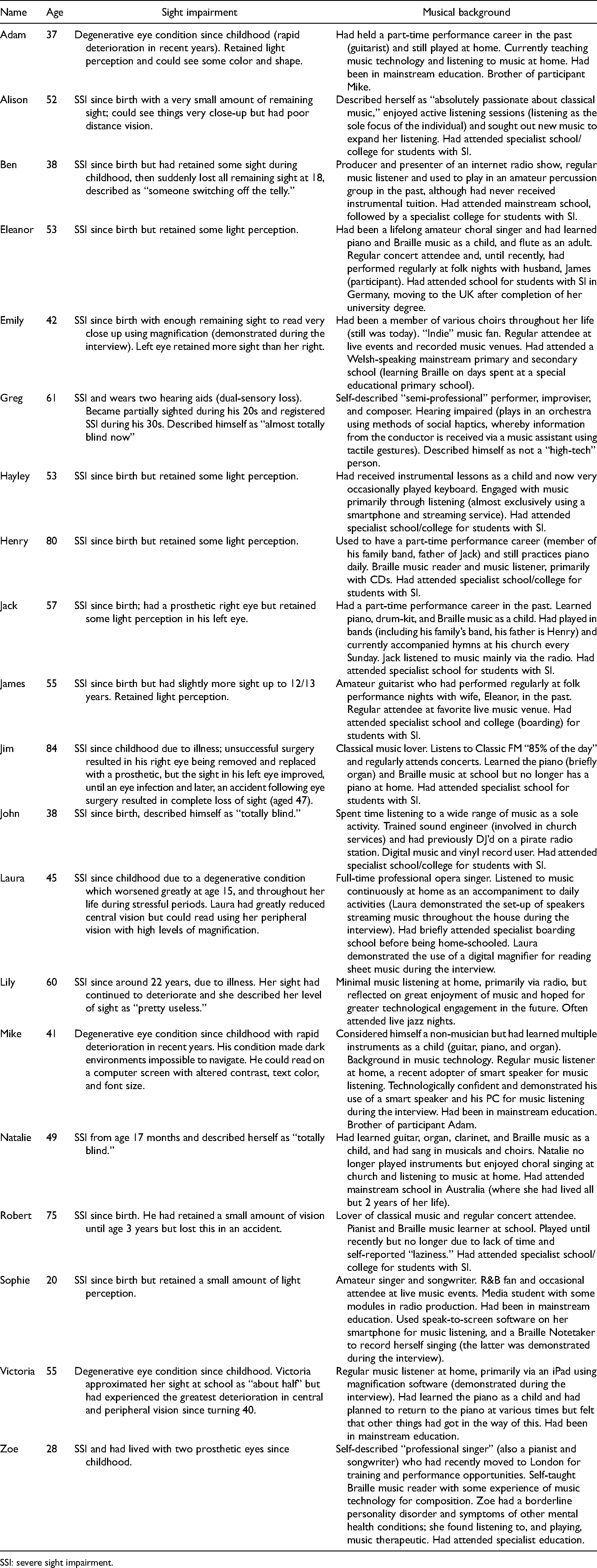
SSI: severe sight impairment.
Materials
An interview schedule was used to guide interviews through topics of relevance to the research questions, and to contextualize the experiences of participants within the broader literature relating to musical engagement (see Appendix A for interview schedule). The development of the interview schedule was informed by a pilot focus group study carried out with participants with SI (n = 17). Focus groups provided initial insight into topics of salience, such as the functions fulfilled by music, experiences of listening to and making music, and if, and how, SI may impact on musical experiences and accessibility. The schedule was used flexibly, allowing for a natural flow in conversation and for individuals to focus on topics of most relevance to them.
Procedure
Ethical approval was granted by the University of Leeds Research Ethics Committee (PVAR 15-042). Participants were recruited using convenience sampling. Study information was emailed or posted on social media sites to potential participants via contacts at sight loss organizations or other participants. The researcher also posted on social media groups created by, and for, members with SI. Individuals were informed of the aims of the research, the background of the lead researcher, the length of interviews, details regarding audio recording and transcription, and an overview of topics to be discussed. The importance of speaking to individuals with different musical interests and backgrounds was emphasized during recruitment.
Prior to the interview, participants gave verbal consent, which was audio recorded; a consent form was completed, signed, and dated by the researcher. Where possible, participants were interviewed in-person at home, to facilitate a relaxed discussion. This allowed participants access to their devices and music collections, should they wish to demonstrate their use (see Table 1 for instances where technology was demonstrated). Nine interviews were carried out in the homes of participants, one at a participant’s workplace, and the remaining 10 over the phone or Skype. Interviews lasted around one hour. Interviews were audio-recorded and transcribed verbatim prior to data analysis. Results are reported using pseudonyms.
Data Analysis
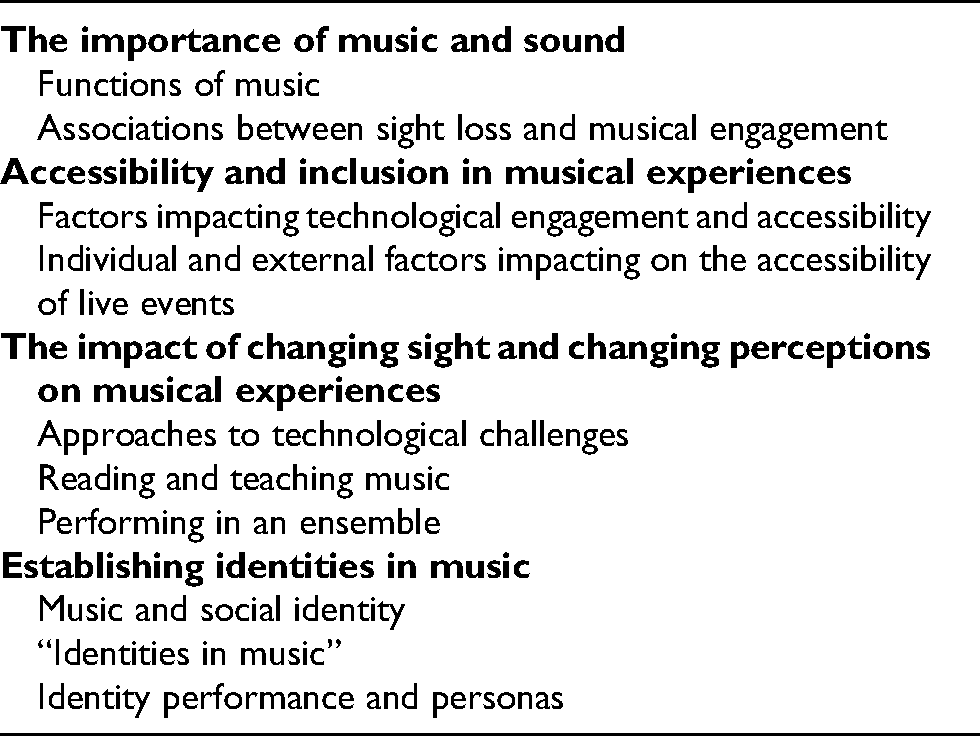
Interpretative phenomenological analysis (IPA) was utilized to provide a detailed examination of participants’ personal experiences (Smith & Osborn, 2008). IPA proceeded in line with the phases set out by (Smith, 2008). This process began with numerous readings of the first transcript before initial annotations, and then emerging themes, were documented. The process was repeated for all transcripts, using the themes from the first case to orient analysis. Themes that appeared to capture similar experiences were clustered to indicate broader, coherent themes. At this point, a sample of the dataset (four transcripts) was cross-examined by an independent researcher, who had the experience of qualitative analysis, to ensure that themes adequately reflected the words of participants. No divergences were identified, which provided support for the emergent coding framework. NVIVO software was used to collate phrases that supported themes, allowing constant checking of themes against the data (Smith, 2008). Themes were amalgamated, and the list of themes was explored to identify connections and develop superordinate themes. There was a general coherence in themes across the dataset. A final list of superordinate and subordinate themes was compiled (see Appendix B). Four superordinate themes were identified, which form the basis of the following results: The importance of music and sound; Accessibility and inclusion in musical experiences; The impact of changing sight and changing perceptions on musical experiences; and Establishing identities in music. Table 2 provides an overview of the results.
Overview of results.
Reflexivity and the Researcher
IPA acknowledges that the researcher cannot remain a neutral bystander and that their preconceptions may influence the research process and the interpretation of data (Smith, 2008). The lead researcher who undertook data collection and analysis is a trained musician with an academic background in music and psychology. Although this allowed the researcher to bring a genuine interest and enthusiasm to discussions, their preconceptions regarding the importance of music may have influenced their approach to the topic at hand and their view of the dataset. Furthermore, as a researcher with typical sight, preconceptions relating to the experiences of participants must also be acknowledged. A pilot study carried out prior to interviews allowed the researcher to gain an understanding of the breadth of experiences associated with SI and musical life and ensure that this informed the question development. During interviews, the researcher sought to remain open to the range of experiences likely to be evident, allowing participants the freedom to discuss topics of most importance to them. In this context, it was the participant, not the researcher, who was the “expert” (Smith & Osborn, 2008).
Results
The Importance of Music and Sound
Participants were engaged in a variety of musical activities, including music listening at home, attending live music events, and both amateur and professional music-making alone and in ensembles. The importance of music to participants in the current study may partly reflect the recruitment strategy employed; the search for participants for a study exploring musical life likely attracted the interest of those for whom music played an important role in their lives. Nonetheless, this strategy was successful in recruiting participants whose musical backgrounds and interests varied widely. Participants were asked to reflect on memorable musical experiences, with Greg and Jack recalling live experiences as a listener at a Paul McCartney concert, and a performer in a band, respectively. Before the curtains were raised, obviously Paul McCartney chose this, there was a lot of Eric Satie light classical piano music, modern 1920s music which was absolutely perfect, and then there was some kind of spark or some change in atmosphere, immense change, when the curtains opened the Satie music stopped and the whole atmosphere changed, and the music changed and Paul McCartney entered the stage (Greg)
We've played pubs that we've got really going you know, and part of the audience are rocking and dancing and then they're cheering and they want more and you think you're going to go all night (Jack)
Jack’s comments highlight the reciprocal relationship between audience and performer which might influence the experience of a live musical event for both parties (cf., Brand et al., 2012; Newton, 2014). As in existing literature (Ballantyne et al., 2014; Brown & Knox, 2017), connections between audience members were also important in providing a unique musical and social experience, as Emily commented, “I like that buzz of a big crowd.”
Music listening at home fulfilled a range of functions identified in research with general populations, including mood regulation, and a source of entertainment or motivation during household activities (Lamont et al., 2016; Schäfer et al., 2013). Music was an opportunity to practice analytical thinking for Jim, who had been a keen pianist in the past. I'm really listening to it, listening to the various parts, so when it's a symphony or a piano concerto I'm really into that, and I try and cut the melody out but listen to the harmony and listen to the various parts that contribute toward that performance (Jim, 84)
Jim believed that a reduction in his vision over time had increased his ability to focus on specific details during music listening.
As someone who's had varying levels of sight across the timescale Jim, have you ever noticed any difference in the way that you listen or the way that you are hearing and processing sound?
I hear more now of the different parts of an orchestra or something like that, or in the quartet or whatever they're playing, I think that's become more acute over the last what, ten years or something like that, yes I do, and that's what I enjoy about it, it's like digging deep
Participants also reflected on music’s ability to meet emotional needs relating to sight loss. This function became increasingly important to Lily during a hospital stay six months after her sight began to deteriorate due to an undiagnosed illness.
I know that you did say when you were in hospital it [music] was particularly important to you, do you think there have been any other occasions, or could you expand on why that was particularly important at that time?
The answer to both questions would be yes. When I was in hospital when the tumor was diagnosed, I mean you kind of spend a lot of time, you're just kind of lying in bed and thinking about things and being upset… one particular album, a McCoy Tyner album, jazz album, well two really, helped me kind of just get through… that was yeah 6 months after my sight first became affected so it was kind of all a bit unknown
Participants in the research of Baker and Green (2017) reported similar therapeutic functions associated with musical engagement during ill-health, both related and unrelated to sight loss. As in existing literature, emotional functions were also important during adolescence (Saarikallio & Erkkilä, 2007). Music had played a central role in Ben’s early life, as a way of processing frustrations he associated with limitations imposed on his life as a result of his SI.
So could you tell me about an occasion in your life, so any point, when music was especially important to you, so when it fulfilled a particularly important role?
Oh that's a very good question that [both laughing] Oh I'm glad you've asked this one because it's going to make me think [long pause] Probably listening to Nirvana when I was growing up because I found that it was very hard core because I was rebelling like I wasn't happy with my current status of just being at home and listening to music… I wanted something better and by listening to that kind of music, it kind of helped to deal with it in my own head even if I couldn't do anything about it… even if I can't get out and play with kids maybe because I'm blind maybe that's the reason, I mean I'm sure that wasn't the reason but that's how I felt, maybe it was the blindness that made my parents like protecting me and that's how I saw it
As Saarikallio (2019) suggests, emotional processing, alongside performing identity, gaining a sense of agency, and developing relationships, may be important to the critical identity formation which occurs during youth. The role of music in identity is returned to in more detail below.
The concepts of connection and disconnection through music were important. In the first instance, music offered individuals a valuable connection to the world and the people around them. Natalie reflected on the importance of music when visiting new places. When I travel to other countries and that kind of thing, music is another way of getting an insight or connection with the culture of wherever we are, so I tend to be very aware of music wherever I am… it’s I think a part of just painting a fuller picture. And I suppose if you think of music as an extension of sound that kind of makes sense, maybe in the same way that somebody else might take an interest in the artwork or architecture… I guess music for me is you know, an accessible kind of way of tapping into that difference or similarity (Natalie)
Greg, too, reflected on the significance of encounters with music as he moved around his environment. Walking out of Clapham Common when they used to have a Sunsplash going out of the station and you feel the reggae beats and I've got nowhere near the speakers, this was miles down, I'd say a good mile and a half… but you feel the beats coming from the distance, steady heartbeat into your belly (Greg)
Through music, Greg made tangible, full-body connection to the world, the importance of which was perhaps even greater given his dual-sensory loss (Greg had both SI and hearing impairments in both ears).
Music also had a role to play in connecting individuals with others. Emily commented that during choral singing, “you get a real feeling of being together as one, as a group,” while music and singing had played an important role in the relationship Sophie shared with one of her friends, who had now passed away. The first talent show we did and we got best newcomer award for it and we sang Mercy by Duffy so every time that plays anywhere, often it'll play like randomly on a station or I'll hear it in the supermarket and be like, oh that's the song [laughing] so it kind of always holds that kind of memory (Sophie)
Natalie also reflected on music’s ability to connect individuals to memories of loved ones. For their daughter’s 21st birthday celebration, Natalie and her husband had put together a slideshow of photographs to be shown alongside music. Although Natalie was able to discuss the photographs with her husband, it was her selection of music that was of greatest significance. The big thing for me was choosing the music that would go behind that because that was something that I connected with directly rather than indirectly with someone describing the pictures, if that makes sense (Natalie)
Music offered Natalie a meaningful and accessible connection to her daughter and the memories they shared, playing an important role in her autobiographical narrative (Belfi et al., 2016; DeNora, 2000).
In contrast, Adam reflected on music listening as an opportunity to disconnect, or escape from, the environment. Adam considered social interactions difficult due to his inability to recognize faces at a distance, and music listening via a portable device offered a means of concealing these difficulties when in public.
And you said that you're using headphones. I'm guessing that that's not a problem in terms of awareness, sensory awareness when walking?
I don't have it particularly loud… I suppose it's a bit of a kind of, what's the right word, not safety blanket, but having headphones in and somebody calls you and you don't answer, you've got a get-out haven't you, as in, I didn't hear you, it wasn't I didn't see you, 'cause I had my music in
Literature highlights the role of portable listening devices in the creation of separate auditory spaces (Biserna, 2015; Heye & Lamont, 2010). This space was important to Adam, whose account reflects Bull’s (2007) conception of the “auditory bubble,” a space in which portable devices offer the user the ability to move through space with control over the aesthetic, cognitive and social aspects of their day (p. 3). Adam, who was not comfortable sharing the extent of his sight loss with others, made use of this bubble to maintain control over whether or not others were aware of his impairment. Adam retained light perception and was able to recognize some color and shape, thus, visual input likely contributed to his ability to orientate and navigate in public spaces while listening to music. This was in contrast to Natalie, whose sight was almost completely lacking. Natalie avoided the use of portable devices during travel, reporting, “I tend not to listen to something when I’m out walking… I just need to concentrate too much on the environment.” This reflects literature that highlights the importance of auditory cues in the navigation processes of individuals with SI (Schinazi et al., 2016). The different levels of sight maintained by Adam and Natalie undoubtedly impacted on their use, or avoidance, of portable music listening devices in the context of personal public travel.
There was also a discussion of the importance of music in the lives of individuals because of their SI. Musicians in the work of Baker and Green (2017) reflected similarly on the value of music-making as an activity through which individuals could connect with each other, regardless of their SI. There were those for whom both music listening and music-making had offered accessible hobbies, particularly during childhood. The school was putting on a musical and I actually took part in that… I think it was a really big part in just settling into the school and being accepted if you like, 'cause it was just something that I did in the same way as everyone else (Natalie)
In contrast to these social benefits, musical engagement had taken the place of social interactions during Ben’s childhood. Music helped me a lot because I didn't have many other hobbies, my only outlet was listening to sports, football, rugby commentaries on the radio, and listening to music (Ben)
Listening to the radio, and music in particular, was one of the few activities Ben believed had been accessible to him as a child, a source of solace, entertainment, and an emotional outlet during a time that appeared to be fraught with frustration and feelings of missing out. Ben had reflected on his religious family’s disapproval of his enjoyment of popular music as an adult, although he had persisted in his musical pursuits and music continued to be an important source of enjoyment through listening and internet radio DJing. Mike also reflected on the accessibility of music listening, noting that, “Even if you can’t see you can still enjoy it [music]… no one can take that away from me.” Despite Mike’s deteriorating vision, this was an activity that remained accessible to him, thanks to his integration of mainstream technology in his everyday life. The accessibility of music-making to visually impaired individuals was also discussed. There's certain things that blind people aren't going to do… you won't find many totally blind people who are great photographers, or painters, so music is something that's open to them, so it might be that because it's open to them that they're a bit more likely to go down that route because other routes are denied to them (James)
In addition to James viewing music as something which was accessible for someone with SI, he also suggested that other activities may be out-of-reach to them due to limitations imposed by others. This belief reflects research that continues to document the systematic exclusion of people with a disability (Milner & Kelly, 2009; Snyder et al., 2010). Such exclusion may influence, and be influenced by, beliefs about the accessibility or appropriateness of activities for individuals who have a disability. Thus, social, cultural, and environmental factors may contribute to perceptions regarding musical engagement and SI. For example, Baker and Green (2017) point to long-standing societal associations between SI and musicality. In the current study, this was reflected by Sophie’s comments, “I think a lot of people who are blind… they do kind of have some kind of connection to music,” and Alison’s belief that, “it’s largely because I’m visually impaired that I’m so close and passionate about my music.” The influence of these perceptions was also evident in the experiences of Mike, who reported that his mother was influenced by her beliefs regarding what activities may be most accessible, and of greatest value, to her sons, both of whom had SI. She [Mike’s mother] claims she got both me and my brother into music because she knew we had an eyesight problem, she thought it would be something that we could focus on… she always said that… if I couldn't work, she's like you can still teach music (Mike)
Mike highlights the early age at which external influences might begin to shape the musical engagement of individuals born with SI. Pring and Ockelford (2005) suggest a natural emphasis on music from the caregivers of children with SI, and in the current study, school was the source of many early musical memories. Jack reflected on what he believed to be the encouragement of musical engagement during his education, “Oh yeah, the specialist schools encouraged you to take up an instrument from the early days,” while Emily, who had attended mainstream schools, emphasized the impact of her family and her Welsh upbringing on her early musical involvement, “We’re all in choirs, my dad’s in a male voice choir, my mum’s in the choir, my nephew’s in an opera, so we like singing.” Baker and Green (2017) found that musicians with SI reported a reduction in musical opportunities and learning resulting from the closure of many Schools for the Blind, but in the current study, both specialist and mainstream schooling were associated with formative musical experiences, and individuals educated in either context went on to develop a diverse range of musical skills and interests.
Accessibility and Inclusion in Musical Experiences
Participants reflected on accessibility and inclusion in relation to technology, information, and event attendance. Individual differences in the nature of participants’ SI, attitudes toward SI, and their past experiences all contributed to a fluid concept of accessibility. The accessibility of technology, for example, reflected not only the design of devices, applications, and webpages but also the unique characteristics of an individuals’ SI (e.g., residual vision allowed visual interactions with touchscreen technologies for some, while others with less remaining vision employed text-to-speech functionality) and their technological abilities.
As with research carried out with sighted participants, age appeared to be a predictor of device and internet use (Kuoppamäki et al., 2017; Neves et al., 2013). Older participants tended to report low levels of technological ability and difficulties learning how to use devices for music listening. Greg avoided touchscreen technologies, commenting that “it’s all too much for me now, I find the whole lot confusing,” although his additional hearing impairment may have created further challenges relating to the use of technology and accessibility features such as text-to-speech software. Robert felt that he had missed out on the benefits of recent technological developments as a result of his age. I was just born a bit too early… I'm not very techy and so I'm no good at downloading or listening to things on Spotify, or archiving my collection… I wish I'd done that because I'd have saved an awful lot of money, instead of buying CDs (Robert)
As in existing literature (Broady et al., 2010; Kim & Choudhury, 2020), the perceived and actual difficulty of learning was a barrier to the uptake of technology in older participants. Participants reported practical barriers to music listening at home, although this tended to be with older technologies, such as CDs and vinyl, which had largely been usurped by alternative means of music listening. Mike reflected on the frustration experienced as his sight had deteriorated and his ability to access his collection was lost, “it kind of got to that point where I stopped listening to things because I couldn’t be bothered.” Increasingly accessible mainstream devices which provide opportunities for eyes-free interactions (Hakobyan et al., 2013) had impacted positively on Mike’s engagement with music at home. With Alexa now I know exactly what I've got… you can say things like I don't know, “Shuffle rock music”, and it'll just literally play any rock music that it can find… and it's just easy (Mike)
Despite this, Mike acknowledged his preference for, “something physical,” a fondness he attributed to his father’s influence (the owner of a music market stall). Similarly, vinyl provided John with a physical connection to musical experiences, “as far as a bit of techno and house goes I do prefer to dig out my old vinyl and have a bit of a DJ session,” offering a different relationship to music than that which is offered by digital listening experiences (Magaudda, 2011). The benefits of online music subscription services were, however, recognized, including reducing the cost of accessing a wide range of music, “I used to spend like literally hundreds of pounds on iTunes, I’m terrible. This way I’m not spending as much” (Zoe) and overcoming past difficulties experienced when accessing a physical collection.
Do you think that having your iPhone and having Spotify and that kind of access, do you see your music listening now as different to how it was say a few years ago or in the past?
More, yeah because to be honest I'd dropped off my music listening a bit, partly because I had a lot of stuff going on in my life but partly because I thought, oh god I've got to go through all those CDs and sort them all out if I want to play something, but now yeah, it's [smartphone] kind of rebuilt my interest if you like, I've never lost it but it just made it so easy
It was notable that no participants reported the use of devices designed specifically for users with SI to engage with audio media for music listening, such as “easy-to-read” radios or Sonic’s USB player (see https://shop.rnib.org.uk/technology for further examples). Sophie did, however, use a Braille Notetaker to record herself singing. Laura cited cost as the main reason to avoid specialist devices, “I didn’t want to get into a system where I’d got to buy an expensive piece of equipment from the RNIB and then have a subscription on top of that.” Past research has also identified cost, as well as difficulties using devices and identifying appropriate support, as barriers to the uptake of assistive technology (McGrath & Astell, 2017).
Accessibility of events reflected a range of both individual and external factors. The physical environment, for example, could create difficulties. Thus, while live events provided opportunities for Adam to spend time with friends, he also reflected on the importance of attending with the “right” companion in order to feel confident and circumvent navigation difficulties. In terms of the venues, the biggest issue I always face is the lighting, and signs you know, where is it? I'd never be confident enough to go on my own 'cause it'd be a nightmare, and I would only go with people that I felt comfortable with… the kind of people where we can laugh it off if something happens you know, like I end up in the ladies looking for them (Adam)
Reflecting this, Natalie and Victoria reported the positive impact of companion ticket schemes (which permit an attendee who has a disability to access a free ticket for a companion) on event attendance. I kind of go, oh you know what, I think I will go and I'll be able to invite someone to come with me, particularly if it's not something that I think my husband would enjoy or he's going to be away (Natalie)
The availability of these tickets may be particularly important for individuals with SI who rely on others to help them travel to events, face additional costs of private transport, for example, taxis, and/or live in areas serviced by inadequate public transport (Phoenix et al., 2015). Companion ticket schemes also allowed access to a wider range of seating, for which additional cost may be a barrier to access (e.g., boxes or uninterrupted sight lines). Victoria was able to utilize her residual vision at events thanks to companion tickets because she “could afford to sit somewhere near the front.” This was in stark contrast to one concert she had attended prior to her learning about accessibility schemes. I've taken the girls to see Robbie Williams but actually I wanted to go, and we were up in the Gods somewhere dealing with a crowd of twelve thousand people which is another story, and you can pick up the atmosphere, you can enjoy the music, but you'd have absolutely no concept of what was going on visually (Victoria)
Accessing information and booking tickets could also be challenging. Online information lacked detail regarding the facilities, services, and tickets available to attendees with SI and could be difficult to find. For this reason, James and Lily preferred to seek information and book tickets over the phone. We tend to book by phone only because it gives you the chance of getting a slightly more personal touch… you get the feeling from someone's voice what they say to you about whether they're lying when they say, oh yes of course we'll have someone to meet you there (James)
I'd rather ring and talk to someone, and also if there's concessions which there are sometimes it's easy to find out about them over the phone as well (Lily)
James’s comments also suggest a possible failing to deliver policy in practice, even where accessibility provisions might be offered. In contrast, Laura felt that “tickets and information are fairly readily available to get online,” although it was difficult to be “at the head of the queue for things” when using accessibility software to navigate a website.
Overall, services to support visually impaired attendees, such as Audio Description (AD), which provides a commentary for audience members (Audio Description Association, 2020) and Touch Tours (TT), which give attendees the opportunity to touch sets, props, and costumes before a performance (Society of London Theatre, 2017), were viewed favorably. However, Emily reflected on the low availability of AD, “generally they have audio described performance on a Thursday afternoon once in a run… you have to be free on those dates, and it’s generally a matinee in the afternoon.” A lack of information about AD was also viewed as problematic. I don't think it's well enough advertised… we turned up to something not knowing that there'd been a touch tour so we didn't get the touch tour, and I only got the audio described tour because I was using a cane and somebody assumed and came over to talk (Victoria)
Although AD and TT might enhance live event experiences for visually impaired attendees, inadequate promotion, and provision may limit their contribution to event accessibility.
Familiarity of venues and knowledge of staff support also impacted on the perceived accessibility of events. Appraisals of staff support varied across participants’ accounts. I just go up to the desk and say I'm visually impaired, I'm attending this concert on my own, can you just help me to my seat, yes of course, usually people are very much engaging and happy to help they're usually fine (Alison)
You've said about the large venues being not very enjoyable and not entirely accessible either, how you think that maybe those kind of places might tackle those issues, make those places more accessible, do you think that there's a way that they could do that?
They should be better organised on their help, they're all offering it, they all say they provide it, but in these big arenas, I mean a lot of our blind friends go to them and just put up with whatever, and sometimes they get good service, sometimes they get less good service
As highlighted by Attitude is Everything (2016), levels of staff training, interactions between attendees and staff, and staff members’ abilities to provide the necessary stewarding and information in an appropriate and timely manner can have a profound impact on the service provided to, and the accessibility of events for, deaf and disabled attendees.
Research continues to document the challenges that both indoor and outdoor environments may pose for visually impaired people, including obstacles, navigation in unfamiliar surroundings, and poorly maintained surfaces (Blessenohl et al., 2015; Kirchner et al., 2008). In the current study, obstacles, including audience members and seats, poor lighting, and the identification of entrances, exits, and facilities such as ticket offices, were all problematic. Even the lighting kind of in the foyer was a little bit dull… lighting's my biggest thing, I think if I didn’t have the lighting issue I'd probably do a bit more (Adam)
Difficulties with navigation are not limited to the experiences of those living with SI, but SI may exacerbate these difficulties. Adam and Mike both reflected on the difficulty of locating toilets. I suppose there's hidden apprehensions and there can be anxiety alongside things of not knowing where things are, like toilets are always a complete nightmare (Adam)
Mike felt similarly, “My biggest biggest problem is finding toilets.” Research documents the difficulties that individuals with SI may have finding public toilets, including locating and entering, inadequate lighting, distinguishing low contrast items (e.g., white walls and white toilets), and anxieties relating to hygiene and injury (Greed, 2003; Michael, 2008; Omoto, 2020). Disabled toilets exist to overcome such difficulties. Only in recent years have I realised that hang on a minute, I [would] actually be classed as disabled, I can use a disabled toilet… if I can manage to go to a regular one I would do especially if there's like a wheelchair person waiting… but most places that isn't the case… So, it's easier to hop in there, if the lighting's poor I can use the camera on my phone to look where the toilet is. If you're in a regular toilet you got problems (Mike)
However, Mike’s comments highlight that people with SI may not always feel eligible for their use (Michael, 2008). The continued use of the wheelchair symbol to identify disabled facilities, and a tendency to focus on the needs of those with physical disabilities in their design (Greed, 2003; Siu & Wong, 2013) may discourage use among attendees with SI.
Crowding and interactions with other audience members were also a source of concern. The ability to maintain personal space was central to feelings of safety, while a lack of personal space was a source of anxiety due to the potential risk of disturbing others. I feel a lot more relaxed to enjoy a performance say where there's seating as opposed to if you're going to something where everyone's just all standing and mushed in together… I just like to know kind of where is my space so I don't have to be thinking about, you know, am I going to get bumped or pushed or am I going to step on someone (Natalie)
Existing research suggests that individuals with SI experience reduced feelings of personal safety due to not being able to see those around them in noisy and crowded spaces and may experience negative responses in instances where they unknowingly invade the space of others (Branham et al., 2017). Victoria highlighted the importance of appropriate seating to overcome this challenge; being seated avoided the need to actively “manage my space or other people’s space.”
The Impact of Changing Sight and Changing Attitudes on Musical Experiences
Adam, Jim, Laura, Lily, Mike, and Victoria had all lived with varying levels of sight at different points of their life, and it was clear that their changing attitudes toward their SI, and their perceptions of their abilities, had impacted on their approach to musical engagement over time. Existing literature highlights that changes in sight require processes of adjustment and relearning, thus, psychological impacts of late-onset sight loss may be far greater than those associated with a lifelong SI (Schinazi, 2007; Wahl, 2013). This was reflected in the current study, with those who experienced deteriorating sight differing in their approach to challenges to those with a lifelong, but largely unchanging, SI. For example, both Mike and Sophie spoke of limited access to visual information relating to recorded music (e.g., album covers, lyrics, or song lists). This created frustration for Mike, because he was no longer able to engage as he had before, but in contrast, provided Sophie with an opportunity to create a more interesting listening experience.
How did you know what you were going to listen to, how did you go and choose the right CD?
I never used any Braille labels or anything but thinking about it maybe at one time I did, and then stopped bothering and just thought well you know what, it might be interesting to just put one in and just listen to it instead of knowing what it is
This attitude was also reflected in Sophie’s use of the “Shuffle” function on her portable listening device, “I don’t want to listen to it in the right order [laughing] 'cause it’s boring.” Undoubtedly, Mike and Sophie’s attitudes reflected their different experiences with SI; Sophie had lived her entire life with a similar level of vision, while Mike had experienced significant deterioration in sight over time and thus, a continuing need for adaptation in many aspects of his life. A further challenge for Mike was that having developed the skill as a child, he could now no longer read stave notation. As a result, Mike felt unable to share his musical knowledge with his children in the way that he wanted to.
Looking back now do you regret having not carried on [playing guitar]?
I would like to be able to show my children more stuff… I would love to be able to just literally read the music and teach them properly, I think a big thing about learning it early on is that you actually do read the music so you actually get that basic understanding
The belief that engaging with music through written notation was the “proper” means by which to do so was clearly harmful to Mike’s self-esteem and deterred him from engaging his children in musical learning. Laura had also grown-up reading stave notation and a deterioration in her sight had made this task increasingly difficult. As a professional musician, Laura’s response to this challenge was driven by professional necessity to continue learning her vocal lines, “I’ve not found a way of memorizing at all that doesn’t involve sitting down at my machine and reading music.” Over time, Laura had progressed through technological devices which provided increasing levels of magnification, but this was a concern given the expected future deterioration in her vision. If I lost the vision that I've still got I wouldn't be able to learn music because I don't read Braille music, I read staff notation, I'd have to learn Braille music but then there's so little of what I do available in Braille format that would be really restrictive (Laura)
Although Mike and Laura had experienced similar difficulties accessing sheet music, their responses to this challenge were contrasting: an insurmountable restraint, versus a challenge in need of a practical and achievable solution. Research continues to demonstrate the role of underlying individual factors such as acceptance and positive attitude on psychological adjustment to sight loss (Nyman et al., 2012), although the necessity of adapting to this change was also far greater for professional musician Laura, than for amateur musician Mike.
Adam had performed as a member of bands throughout his life and spoke of the ease with which he could often play, including his ability to “drift off” onstage. However, he also spoke of practical challenges associated with low lighting on stage, which meant requesting easier parts, and his inability to assist his bandmates in setting up and derigging performances. The latter was exacerbated by Adam’s reticence to divulge the extent of his SI to his bandmates. With the band I mean that was awkward actually because I only knew one of the lads and he was the only one who knew about my eyes and everything and I had to sort of say to the others, because I was debating whether to quit really early on actually 'cause I thought it was becoming a nightmare 'cause I don't drive, difficult getting to rehearsals, people having to pick me up run me around, and then I was thinking when we do get to gigs it's going to be a nightmare for them, I can't really help with getting equipment in and out… I'm a bit of a liability and then performance-wise, needing fairly decent lighting but they were spot on lads where they actually bough a light rig (Adam)
Adam experienced increased feelings of dependence on others, a response often associated with deteriorating sight (Nyman et al., 2012), which posed a risk to his continued participation in the band. Only after feeling confident enough to share his SI with his bandmates were they able to provide him with the practical support he needed. Adam’s comments highlight the interaction of practical challenges associated with performing as a musician with SI, with those relating to an individual’s beliefs regarding their SI, and how others might view their sight loss.
Establishing Identities in Music
Music played an important role in how participants presented themselves to the world, echoing previous research which has highlighted the role of music in the construction and affirmation of individual and group identities, through shared preferences and experiences (DeNora, 2000). The latter was central to Emily’s maintenance of long-standing friendships; club nights continued to be an important part of their lives even now. Being with friends and being in a nightclub and the excitement of running onto the floor because like the Smith's “Ask” has come on, or we used to go to Broadway Boulevard here which is mostly dance but it used to have three songs that they would play and it was Leveller's “One Way of Life”, and it was “Jump Around” and “Smells Like Teen Spirit” and when they used to come on we used to run onto the dance floor and jump jump (Emily)
The continued importance of indie music to Emily and her friends reflects the role that research has shown music to play in identity construction during young adulthood, and a tendency toward preferences established at this time (Lamont & Loveday, 2020).
Hargreaves et al. (2017) describe identities in music (IIM), as reflecting established roles, categories, and self-concepts of musicianship. In line with this conceptualization, participants revealed a plethora of IIM. Alison, for example, commented that “I’m not a musician I just put myself big-time in the category of being a really good appreciator, but I’m not a musician,” while Greg and Laura described themselves as a “semi-professional” performer, improviser and composer, and a “professional classical singer,” respectively. Participants engaged in multiple and various musical activities (see Table 1 for details of participants’ musical participation), illustrating Rickard and Chin’s (2017) view of musicianship as a multidimensional concept that encompasses not only music production (e.g., music-making) but also music reception (music-listening).
Music offered participants opportunities for shared experiences through activities such as ensemble playing, live event attendance, and discussions with friends and families of shared and contrasting musical preferences. James described the social aspects of his (and wife, Eleanor’s) involvement in folk festivals. I've had some incredible times playing music… we're not professionals or anything… we used to go to a lot of folk like festivals and stuff… we used to sit on the sort of fringe and go to the pubs in the vicinity and just do a few sessions. Everyone brought their guitar or their instrument or their banjo or whatever it was along, we just played stuff, you know, played together, I think the biggest thrill I get is actually playing with other people (James)
Opportunities for shared musical experiences had been particularly important in offering Natalie a sense of inclusion during her teenage years. When I started high school, the school was putting on a musical and I actually took part in that, just as a member of the chorus but that was, I think it was a really big part in just settling into the school and being accepted if you like, 'cause it was just something that I did in the same way as everyone else did and all of that kind of thing, so yep being able to do that was fabulous (Natalie)
Music-making provided opportunities to construct alternative identities to those embodied and enacted in participants’ everyday lives, highlighting the role of music in offering environments to construct, reconstruct, and consciously test new identities (Elliott & Silverman, 2017). This was true for Adam, who had held a part-time performance career alongside his teaching career for several years, and Laura, a full-time opera singer. Although typically shy, performing offered Adam a means of distancing himself from this aspect of his character and adopting an alternative and confident onstage persona. I'm actually fairly comfortable performing but I hate talking [laughing] (Adam)
As evidenced in Scott’s (2017) exploration of shy performativity in the performing arts, the performance context was a chance for Adam to, “put a bit of an act on,” and exercise a greater sense of self-confidence than experienced ordinarily. The idea of adopting alternative personas was also key to Laura’s reflections on musical performance, which offered her a space in which her identity as a mother, a wife, and a person with SI, truly become secondary to her identity as a musician. I can remember saying to somebody once, because they wondered if when I played [character’s name omitted] I was going to play her as blind, and I said no… why would I play her as blind, I'm putting a blonde wig on you know, I'm playing her as blonde, why would I want to play her as blind, I want a night off being blind you know, I want a bit of a break from that (Laura)
In line with Hargreaves et al. (2002) social constructionist conceptualization of multiple musical identities, the personalities adopted by Laura and Adam in everyday life and onstage were contradictory. Opportunities to adopt these alternative identities allowed Laura to avoid any disability-first identities that might be imposed on her, highlighting that, “I’m not a blind singer, I’m a singer who is blind.” The work of Baker and Green (2017) demonstrates that many musicians, like Laura, may choose to avoid associations with disability arts and disability-first language as a marketing tool for this reason. This was in contrast to Greg, whose involvement in ensembles with other musicians who had disability, was an important part of professional life.
Summary of Key Findings
What Role Does Music Play in the Lives of Individuals who Have Sight Impairment?
Discussion with participants highlighted the range of experiences associated with musical engagement, which reflected their diverse musical backgrounds and interests. Positive experiences with music were cited by all, and these experiences played important roles in participants’ lives as sources of musical learning, social activity, and emotional regulation. Many of the functions fulfilled by music in the current study reflected those identified in existing literature (Lamont et al., 2016), while others were closely associated with participants’ experiences of SI and the centrality of auditory input and output to their lives. For example, music provided information about surroundings and connected individuals to their environments in a way that was viewed as particularly important given the lack of access to visual information. It also helped those experiencing sight loss to cope with worries relating to their vision and provided a hobby that was considered more accessible than other activities. As with typically sighted individuals, the role of music in providing a space and means to construct identities was also important (DeNora, 2000; Elliott & Silverman, 2017). Opportunities to exercise alternative identities may be of particular significance to musicians with SI who, like Laura, appreciated the opportunity to separate herself from aspects of her identity that she associated with her SI.
In What Way Might Sight Impairment Impact on an Individuals’ Musical Experiences?
All participants considered music-making and/or music listening an accessible hobby, but issues of accessibility and inclusion were also highlighted. Existing research exploring the recreational and social lives of individuals with SI has identified both practical and psychological barriers to participation (Fryer, 2020; Jaarsma et al., 2014; Jin et al., 2019; Vučinić et al., 2020). Similar challenges were evident in the current study. Practical challenges relating to music-making included reading music and setting up/performing onstage. These practical difficulties, however, had psychological implications, including feelings of frustration and dependence on others. There were those for whom technology had increased the accessibility of music listening experiences, evidencing progress toward universally accessible technology. However, some, particularly older participants, had actively avoided new devices, and indicated a lack of technological confidence. Given that the majority of those living with SI in the UK are elderly, and that sensory loss may create barriers to technology use in older adults (Gitlow, 2014), continued efforts to ensure the universal design and adequate technological support for those living with SI are required.
Results also highlighted barriers to live event attendance, many of which reflected those found to impact more generally on the recreational lives of individuals with SI; these included challenging physical environments (Berger, 2012; Green & Miyahara, 2007) and difficulties accessing information (Jaarsma et al., 2014; Szpiro et al., 2016). The positive impact of attending events with a companion on participants’ confidence was apparent. Although cost was not cited directly as a limiting factor on attendance, the emphasis on the importance of companion ticket schemes for attendees with SI suggests that this may be one-factor at-play in decisions relating to attendance, as well as the accessibility of the physical environment. Current findings expand on knowledge relating to the experiences of deaf and disabled attendees (Attitude is Everything, 2016, 2018), indicating that while live music events offer a meaningful and socially fulfilling pastime for attendees with SI, their needs have not yet been adequately addressed. Further discussion of how the barriers to live event attendance may be overcome for visually impaired attendees is provided elsewhere (Castle et al., 2022).
Although many of the participants reflected on the importance of music to their lives, their musical backgrounds, the exact nature of their SI, their attitude toward SI, and their approach to managing challenges, all impacted on the extent to which they engaged with musical activities. It was those with late-onset sight loss, or degenerative conditions which impacted their sight over time, who faced perhaps the biggest challenge, with a need to adapt or reconsider decisions relating to their musical engagement, as with other aspects of their lives (Binns et al., 2013).
Methodological Considerations and Future Directions
Utilizing an in-depth qualitative approach, the current study offers detailed insight into the musical lives of adults living with SSI. The study expands on studies that have employed quantitative methods to explore predefined aspects of musical experience in adults with SI (Park & Chong, 2019; Park et al., 2015), and qualitative research which has focused solely on the lives of visually impaired musicians (Baker & Green, 2017; Park, 2017). The study’s inductive approach ensures that findings are grounded in the words and experiences of participants, highlighting the influence of participants’ differing preferences, needs, and attitudes on musical experiences. However, the study has some limitations. There were few young adults involved, and none under the age of 20 years. This may limit the knowledge generated in relation to technological engagement and attendance at events, with evidence of generational differences in music consumption, music technology use (McIntyre, 2011; Nowak & Bennett, 2020), and music event attendance (Arts Council England, 2015; Webster et al., 2018). Also, most participants had been living with a SI (progressing to SSI) or SSI for their whole life. This does not reflect the experiences of the majority of people living with SI or SSI in the UK, who are mostly older adults with age-related sight loss (Pezzullo et al., 2018). Further research which focuses on the musical lives of younger adults with a SI or SSI, those impacted by late-onset sight loss, and individuals with recent and/or sudden sight loss, would be beneficial. This is particularly important given the negative impacts that deteriorating sight was found to have on some participants’ musical lives. There is a need to better understand how periods of transition, changing priorities, and adaption to sight loss may impact on engagement with music, and other leisure and social activities. Longitudinal studies and utilization of techniques such as Experience Sampling Methods could offer useful tools for capturing the dynamics of musical experience, and the impact of changing vision on musical engagement over time. Also, while the current study sought to include participants who retained a greater level of vision (i.e., were “sight impaired” or “partially sighted”), convenience sampling resulted in sample where all participants had an SSI. Future research may wish to consider how factors such as severity of SI impact on access to, and engagement with, musical activities.
Finally, existing literature has documented the impact of disability on social and cultural participation (Bascom et al., 2017) and individuals with SI are more likely to be older and living with other (and multiple) disabilities or conditions than those with no SI (McLean et al., 2014). A focus on the potential impacts of comorbid conditions and/or disabilities on the accessibility of musical experiences for those living with SI may also be useful in identifying areas for improvement to accessibility in relation to technology, music-making, or event attendance, and instigating change which benefits these individuals.
Conclusion
This study utilized qualitative research methods in the exploration of the musical lives of individuals with SSI. Unlike past explorations, the study included not only those involved in amateur or professional music-making but also those for whom music listening was their primary means of engaging with music. Findings contribute to the discourse surrounding musical engagement, highlighting the participation of individuals with SSI in a variety of musical activities, and the functions fulfilled by music in their lives. Findings also provide knowledge relating to accessibility and inclusion in the context of musical engagement, evidencing the physical, social, and individual factors which may act as barriers to musical participation for individuals with SSI. The importance of music to the lives of participants in the current study, and previous research (Park et al., 2015), serves to highlight the ongoing need to represent the voices of these individuals in research relating to musical life, including, but not limited to, technological design and device choice, events and audience experiences, music-making, performing, and education.
Supplemental Material
sj-docx-1-mns-10.1177_20592043221083296 - Supplemental material for The Musical Experiences of Adults with Severe Sight Impairment: An Interpretative Phenomenological Analysis
Supplemental material, sj-docx-1-mns-10.1177_20592043221083296 for The Musical Experiences of Adults with Severe Sight Impairment: An Interpretative Phenomenological Analysis by Claire L. Castle, Alinka E. Greasley and Karen Burland in Music & Science
Supplemental Material
sj-docx-2-mns-10.1177_20592043221083296 - Supplemental material for The Musical Experiences of Adults with Severe Sight Impairment: An Interpretative Phenomenological Analysis
Supplemental material, sj-docx-2-mns-10.1177_20592043221083296 for The Musical Experiences of Adults with Severe Sight Impairment: An Interpretative Phenomenological Analysis by Claire L. Castle, Alinka E. Greasley and Karen Burland in Music & Science
Footnotes
Action Editor
Adam Ockelford, University of Roehampton, Applied Music Research Centre.
Peer Review
One anonymous reviewer.
Graham Welch, University College London, Institute of Education.
Author Contributions
CC conceived the study, recruited participants, gained ethical approval, gathered and analyzed data, and researched literature. AG and KB contributed to study design and analytical processes. CC wrote the first draft of the manuscript. All authors reviewed and edited early versions of the manuscript and approved the final version of the manuscript.
Declaration of Conflicting Interests
The author(s) declared no potential conflicts of interest with respect to the research, authorship, and/or publication of this article.
Funding
The author(s) disclosed receipt of the following financial support for the research, authorship, and/or publication of this article: This work was supported by one of the University of Leeds' 110 Anniversary Research Scholarships.

Supplemental Material
Supplemental material for this article is available online.
References
Supplementary Material
Please find the following supplemental material available below.
For Open Access articles published under a Creative Commons License, all supplemental material carries the same license as the article it is associated with.
For non-Open Access articles published, all supplemental material carries a non-exclusive license, and permission requests for re-use of supplemental material or any part of supplemental material shall be sent directly to the copyright owner as specified in the copyright notice associated with the article.
