




Abstract
Listening to music often triggers strong memories of events from our past, which influence how we affectively experience music listening and can therefore contribute to music’s therapeutic capacity. The aim of this study was to examine the valence and content of spontaneous music-evoked autobiographical memories (MEAMs) in listeners with self-reported depression, who typically demonstrate negatively biased autobiographical memory. Eighteen depressed and 21 controls participated in a music-listening experiment where they listened to a personalized music stimulus, described their memories, and thereafter rated the valence of these memories and of their induced affect. Participants’ ratings were statistically analysed, while the memory content was analysed with the use of a computerized text-analysis method and with a qualitative thematic analysis. Quantitative ratings of valence revealed a significant difference between groups: half of the depressed, compared to none of the controls, recalled a negative memory, and these were experienced with negative induced affect. The qualitative thematic analysis of the memory descriptions revealed that both depressed and control participants’ memories could be categorized into three first-level themes: (1) personal, (2) relationships, and (3) activities. Depressed participants’ negative memories were mainly located in the ‘relationships’ theme and included memories about loss and dysfunctional relationships, such as bullying, and in the ‘personal’ theme, including memories of mental health struggles and coping with music. Approximately a third of depressed participants recalled positive memories, and these were either related to loving family relationships or to activities. Limitations concerning the small sample size and implications regarding the function of music listening for depressed individuals are discussed.
Keywords
Literature
Music is ubiquitous, accompanying us in activities as ordinary as driving and exercising (Juslin et al., 2008), to significant events such as weddings and celebrations (Gregory, 1997). Consequently music, as our life’s ‘soundtrack’, is strongly linked to autobiographical memories. These memories influence how we affectively experience music listening and can consequently contribute to music’s healing potential, the capacity of music to serve as a resource for our emotionality, health and wellbeing (Fancourt & Finn, 2019; MacDonald et al., 2012).
People experiencing depression typically tend to remember more negative personal events (Joormann & Arditte, 2014) and have difficulty recalling positive memories (Werner-Seidler & Moulds, 2011). If this is also the case with autobiographical memories evoked by music, then personal music listening may not always be a beneficial activity for mental health promotion in this population. The aim of this study is to answer this question by investigating the valence and content of music-evoked autobiographical memories (MEAMs) in individuals experiencing depression.
Music-evoked Autobiographical Memories
MEAMs play an important role in the music-listening experience. First, the potential of music to evoke memories functions as an important motive for engaging in music listening (Sloboda & O’Neill, 2001). Furthermore, the retrieval of MEAMs often leads to an emotional reaction, acting as an important emotion-induction mechanism (Janata et al., 2007; Juslin et al., 2015). Typically, these emotions are positive in valence, as indicated by research on listener samples drawn from typical populations (Jakubowski & Ghosh, 2019; Janata et al., 2007). Memories may also boost the emotional experience of music listening regardless of the affective valence; when compared to musical features as an emotion induction mechanism, memories were more strongly linked to higher pleasure of social emotions (e.g. kinship, tenderness) and to higher displeasure of sadness (Maksimainen et al., 2018). Consequently, MEAMs contribute to our emotional experiences with music and can therefore cumulatively influence music-related mental health outcomes.
Musical Experience in Depression
Major depression is a highly prevalent psychiatric disorder. According to the World Health Organization (WHO), depression is the leading cause of disability worldwide (World Health Organization [WHO], 2017). Depression is classified as a mood disorder and is per definition a condition of negative affect. However, the disorder is not characterized solely by increased negative, but also by reduced positive affect (Singer & Salovey, 1988; Werner-Seidler & Moulds, 2011). This impaired ability to experience positive emotions, also called anhedonia, is key in the disorder, as positive affective experiences function as a buffer against depressed mood (Singer & Salovey, 1988). Therefore, one way of approaching the treatment of depression, applied for instance in behavioural activation, is by encouraging patients to engage in pleasurable activities (Cuijpers et al., 2007). One such activity could be everyday personal music listening, which can provide cumulative health benefits (Miranda et al., 2012).
However, the effect of music listening on mental health is not always positive, and in certain cases unhealthy music-listening behaviours, such as maladaptive emotion regulation with music, may promote psychopathology (Marik & Stegemann, 2016). This is especially observed in people with internalizing symptoms (Miranda et al., 2012). Depressed adolescents, for instance, have been shown to be prone to couple their music listening with ruminative tendencies, social isolation, and an inability to improve their mood (Saarikallio et al., 2015).
With regards to MEAMs, Sakka & Juslin (2018a) found that participants with high depression levels reported lower induced happiness to music evoking episodic memories compared to non-depressed participants, while Garrido (2018) found that people with tendencies for depression experience nostalgic remembering with music with negative emotional responses. It therefore appears that memories with music play a unique role in how depressed people experience music. However, no research, to our knowledge, has directly investigated the content of MEAMs in depressed people, who typically demonstrate autobiographical memory alterations (Joormann & Arditte, 2014).
Depressed individuals are biased towards recalling negative information, including autobiographical memories (Joormann & Arditte, 2014; Mathews & MacLeod, 2005). This bias appears to remain even after depression has remitted, suggesting that it contributes to the disorder as a vulnerability factor (Joormann & Arditte, 2014). Research also shows that these negative memories contribute to the maintenance of depression, as they prolong the experience of negative affect (Singer & Salovey, 1988). Besides demonstrating a preferential recollection of negative information, depressed individuals also show an impaired ability to retrieve positive memories (Werner-Seidler & Moulds, 2011).
The Present Study
To reiterate, music is capable of triggering autobiographical memories, typically associated with positive emotions. Depression is characterized by negatively biased autobiographical memory recollection and an increased tendency to experience negative affect during music listening. The aim of the present study was to investigate the valence and content of memories evoked by music in people experiencing depression. This aim was approached in two ways: (1) hypothesis-driven analysis of memory valence and valence of induced affect, based on quantitative ratings; and (2) exploratory analysis of memory content, based on the memory descriptions, using a computerized text-analysis method and a qualitative thematic analysis.
The study focuses exclusively on spontaneous (contrary to voluntarily retrieved) memories, as these are typically the type that best describe MEAM experiences in everyday life (El Haj et al., 2012; Jakubowski & Ghosh, 2019). To this end, participants were asked to listen to a personalized music stimulus, without any further instructions, and to then describe and rate their eventual memories. We hypothesized that, compared to controls, depressed participants would retrieve (1) more negative MEAMs, and would experience (2) more negative induced affect. In addition, we explored the content of these memories, based on the participants’ qualitative descriptions. Finally, we explored the time-period of the MEAMs, defined as age of participant during the event.
Method
Participants
Participants were recruited via two advertisements targeting individuals with high levels of depression (defined as individuals with a BDI-II score ≥ 14, indicating mild, moderate and/or severe depression) and controls (individuals with a BDI-II score < 14, indicating minimal depression, and no diagnosis of a psychiatric disorder). These were distributed to healthcare professionals and were posted at the campus of Uppsala University and on the Internet (via social media). Participation was voluntary and anonymous and did not offer any monetary compensation; psychology students could however receive course points for participating.
Seventy-three individuals applied via the registration form (see Procedure) to participate in the study. From these, 11 participants reported having a diagnosis of depression, but their BDI-II scores were sub-threshold, indicating no depression. These individuals were excluded, as they did not fit the inclusion criteria for either the depressed or the control group. The remaining 62 participants were contacted via email with the weblink to the study. From these, 23 did not submit their responses. The final sample thus consisted of 39 participants (Swedish nationality; 7 males; age: 18–55 years, M = 29.87, SD = 10.35). Eighteen participants (1 male) formed the depressed group, with average age M = 28.52 years (SD = 9.34) and a mean BDI-II score of M = 32.44, which corresponds to ‘severe’ depression (SD = 9.33). Fifteen of the depressed participants had a diagnosis and 13 were on psychotropic medication and/or in psychotherapy. The remaining 21 participants (6 males) formed the control group (age: M = 31.44, SD = 11.50; BDI-II scores: M = 4.86, SD = 4.14).
The two groups did not differ significantly in terms of gender (χ 2(1) = 3.49, p = .06) or age (t(37) = -.88, p = .39). Six participants from the control group and seven from the depressed reportedly played a musical instrument, while five control and two depressed participants reported that they had received musical education. Groups did not differ significantly with regards to either musical instrument (χ 2(1) = .46, p = .50) or musical education (χ 2(1) = 1.06, p = .30).
Musical Compilation Stimulus
To maximize the probability of MEAM evocation and to create a balance between ecologically valid and experimentally controlled stimuli, a combination of both experimenter-selected music (cf. Belfi et al., 2016; Janata et al., 2007; Schulkind et al., 1999) and personal music (cf. El Haj et al., 2012) was used. An individualized set of music pieces was thus assembled for each participant, including 5–10 personal (participants’ favourite music, which they provided during the registration) and 20 experimental (popular ‘hits’ from participants’ youth, that is, the period when they were approximately 10–25 years old, which corresponds to the time when the ‘reminiscence bump’ occurs; Conway & Holmes, 2005) pieces.
The participants in the current sample covered a wide age range (18–55) and were thus distributed across four age groups (i.e. 18–25, 26–35, 36–45, 46–55 years old). Ten of the most popular ‘hits’ from five eras were selected: 1970s, 1980s, 1990s, 2000s, 2010s. Popular hits represented pieces that were high on Swedish billboards, according to the data from Swedish websites such as ‘Sverige topp listan’ and ‘Sveriges radio’. For each participant (and corresponding age group) music from the two eras corresponding to their youth was selected. For example, participants aged 18–25 listened to popular pieces from the 2000s and 2010s, whereas participants aged 36–45 listened to pieces from the 1980s and 1990s. Therefore, for each participant (and corresponding age group) there was a set of 20 pieces from their youth. In addition to these, each individualized stimuli set also featured 5–10 personal pieces, which participants provided during their registration (see Procedure).
The goal of the task was to maximize the probability of participants retrieving spontaneous (i.e. involuntary) memories. It was thus important that participants listened to a sufficient number of pieces, while still remaining unaware that their memories would be measured, by avoiding the repetition of memory questions after each stimulus. To achieve this, 10 pieces (5 experimental and 5 personal) were drawn from each participant’s individualized stimuli set, segmented into 30-sec fragments, and combined into a single compilation stimulus.
Measures
Depression
The Beck Depression Inventory-II (BDI-II; Beck et al., 1996) was administered during registration for measuring depression. The BDI-II is a widely used instrument for measuring level of depression and has been shown to demonstrate good internal consistency reliability and test-retest reliability (Arnau et al., 2001). In the present sample, Cronbach’s alpha reliability was α = .97, indicating excellent internal consistency reliability.
Self-report
The valence of memory and of induced emotion were measured with one item each, asking: ‘Is this memory positive or negative?’ and ‘How does this memory make you feel?’ respectively. These were rated on a 5-point scale each, ranging from 0 (very negative) to 4 (very positive). Participants were also asked how old they were when the event described in the memory took place (analysed as period) with an open-ended question.
Procedure
All data were collected online. During registration, participants received information about the study. After providing informed consent, they submitted background information, a selection of 5–10 pieces of their all-time favourite music (defined as ‘pieces that have stuck with them over the years, from childhood until today, which have an important meaning for them and which they have listened to often’ 1 ), as well as one piece that always makes them feel good. 2 Finally, they completed the BDI-II depression test. The study was approved by the Swedish Ethical Review Authority and participation was voluntary and anonymous.
Experimental Task
People who registered their interest in participating received an email with a weblink to the study together with instructions, requesting them to choose a convenient time when they would be able to sit alone and undisturbed at their personal computer for approximately 30 min to complete the music-listening experiment. Once they were directed to the study and after providing informed consent, participants were instructed to listen to the music by clicking on a link. Because the objective was to measure spontaneous memories, it was important that participants were not aware that their memories were being measured. Thus, the instructions did not reveal any further explanation at this point. After listening to the music, participants were asked if the music evoked any memory of an event from their lives. If they answered ‘yes’, they were given 5 min to write down the memory with as much detail as possible (cf. El Haj et al., 2012). In case the music evoked more than one memory, the instructions specified that participants should describe the one they remembered the best. Following their memory description, participants responded to the self-report items.
Data Treatment
The self-report items were statistically analysed, and ratings were compared between the two participant groups. The memory valence and induced emotion valence data are ordinal (5-point Likert-type scales) and were thus analysed with the non-parametric Mann-Whitney test. The period data (age of participant during event) were categorized into age groups, and between-group differences were analysed with Fisher’s exact test.
The content of the memory descriptions was first analysed with the use of Linguistic Inquiry and Word Count (LIWC2015; Pennebaker et al., 2015), a widely used and validated computerized text analysis software (Tausczik & Pennebaker, 2010). LIWC codes words according to approximately 90 variables belonging to different categories, such as language and linguistic dimensions, psychological constructs and personal concern categories. This software is particularly useful for analysing verbal expression of emotion (Kahn et al., 2007) and has also been used in previous studies for measuring MEAM characteristics (e.g. Jakubowski & Ghosh, 2019; Janata et al., 2007). Because the content analysis in the present study was exploratory, we decided to analyse the memories based on LIWC variables that have been previously investigated in relation to MEAMs (e.g. Jakubowski & Ghosh, 2019; Janata et al., 2007), enabling the comparability of our findings. MEAMs were thus analysed according to (1) affective processes, (2) social processes, and (3) personal concerns.
The memory descriptions were next analysed qualitatively following Braun and Clarke’s (2006) thematic analysis principles. The analysis was conducted by the first author with consultation on the procedure and on the interpretations by the second author and was performed in two phases: (1) data familiarization and generation of initial codes, and (2) identification, revision and definition of themes. The analysis employed an inductive, data-driven approach, as there were no specific theoretical hypotheses regarding memory content. In order to avoid researcher bias, the first phase of the analysis was performed simultaneously for all participants so that the researcher was blind to participant group (depressed versus controls). The generation of initial codes consisted of detecting codes for (1) content and (2) emotional terms. The coding focused on ‘semantic’ coding, although in certain cases codes were constructed to give an abstract representation of an underlying phenomenon. For instance, a memory description with verbatim content ‘it felt like I had taken one step further in life somehow’ was given the code ‘personal growth’. The data were then categorized according to participant group for the second phase of the analysis, and the codes for each group were organized into higher-order themes, with the help of thematic mind maps (Braun & Clarke, 2006).
Results
As the task measured spontaneous memories, naturally, some participants (23%) did not experience a MEAM. The analyses below are therefore based on the data from the 30 participants who did retrieve a memory with the music (Depressed group: n = 15, including 1 male, mean age M = 31.47, SD = 12.43; BDI-II score M = 32.27, SD = 10.17; Control group: n = 15, 4 males, mean age M = 26.13, SD = 7.02; mean BDI-II score M = 6.00, SD = 3.87).
Quantitative Analyses
Memory Valence
Figure 1a displays the distribution of memory valence per participant group, and in particular the frequency in percentage of memories for each valence rating (with 0 indicating ‘very negative’ and 4 indicating ‘very positive’). As can be seen, depressed individuals retrieved memories across the valence spectrum, while controls’ memories were skewed towards positive valence. The between-group difference in median valence scores can be seen in the boxplot in Figure 1b. This difference was statistically tested with a Mann-Whitney test which revealed a significant difference, with MEAMs significantly more negative for depressed (Mdn = 2.00, M = 1.93, SD = 1.53) compared to controls (Mdn = 4.00, M = 3.60, SD = .63), U = 44.50, Z = -2.99, p = .001, r = -.55, indicating a large effect (Cohen, 1992).

Frequency in percentage of memories for each valence rating split by participant group (0: very negative – 4: very positive)

Boxplot of memory valence scores split by participant group (0: very negative – 4: very positive)
Valence of Induced Emotion
The valence of induced emotion was significantly correlated with the valence of the memory (Spearman’s rank-order correlation r S(28) = .95, p < .001, indicating a large effect size; Cohen, 1992). The distribution of induced valence scores per participant group and the between-group comparison of median scores can be seen in Figures 2a and 2b respectively. As was in the case of memory valence, depressed participants’ induced valence covered the whole range of scores in comparison to the controls’, which were predominately positive. A Mann-Whitney test showed that depressed participants reported feeling significantly more negative (Mdn = 1.00, M = 1.73, SD = 1.62) compared to controls (Mdn = 4.00, M = 3.40, SD = .82), U = 51.50, Z = -2.65, p = .002, r = -.48, a medium towards large effect (Cohen, 1992).

Frequency in percentage of induced affect for each valence rating split by participant group (0: very negative – 4: very positive)

Boxplot of induced valence scores split by participant group (0: very negative – 4: very positive)
Period of Memory
Participants were also asked how old they were during the event described in their memory. Memories were classified into three memory period categories: (1) childhood (younger than 13 years); (2) adolescence (13–18 years); and (3) adulthood (older than 18 years). Table 1 represents the frequencies of retrieved memories in each category for each participant group and for the total sample. As can be seen, over the whole sample, memories were roughly equally distributed across the three periods. However, when examining each group separately, we can see that depressed participants retrieved mostly childhood (46.67%) and least adulthood (20.00%) memories, while controls retrieved least childhood memories (13.33%), but recalled approximately equal number of adolescent and adulthood memories (46.67% and 40.00% respectively). The association between period and group was not significant (Fisher’s Exact Test p = .21, Cramer’s V = .37, indicating a large effect size [Cohen, 1988]), indicating that there was no difference in memory period between the two participant groups.
Frequencies and percentages of retrieved memories in terms of period (per participant group and for the whole sample).

Content Analysis with LIWC
The memory descriptions were first analysed with LIWC2015. Over the whole sample, MEAM descriptions were on average 96 words long (range: 9 – 295, SD = 73.56). Data were analysed using the LIWC internal dictionary 2015, which included 93% of the words contained in the data. LIWC codes words according to psychologically relevant categories, such as affective or social processes. Here, the MEAMs were analysed in relation to three main categories, each including several subcategories: (1) affective processes, (2) social processes, and (3) personal concerns.
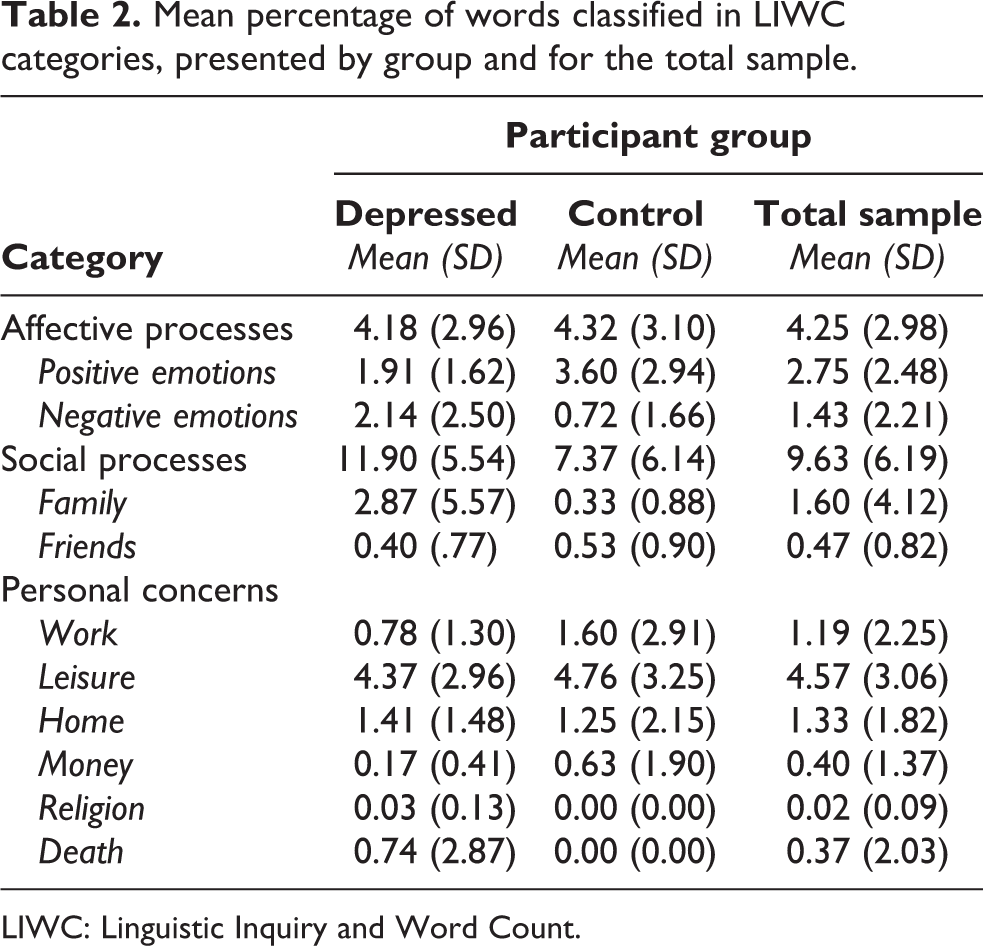
Table 2 presents the mean percentage of words in each category, both for the whole participant sample and for each group separately. With regards to the main categories, over the whole sample, 4.25% of words were related to affective processes and 9.63% to social processes. (LIWC does not provide a percentage for the main category ‘personal concerns’.) Regarding subcategories, the ‘personal concerns’ subcategory ‘leisure’ (4.57%) was evident in MEAM descriptions in relatively high percentages.
Mean percentage of words classified in LIWC categories, presented by group and for the total sample.
LIWC: Linguistic Inquiry and Word Count.
Given the particular focus of this study on affective content, participants’ self-report ratings of MEAM valence were correlated with the LIWC subcategories ‘positive emotions’ and ‘negative emotions’. ‘Negative emotions’ was significantly correlated with ‘MEAM valence’ in the expected (negative) direction, r = -.58, p = .001, indicating a large effect size (Cohen, 1992). Though not statistically significant, the correlation between ‘positive emotions’ and ‘MEAM valence’ was also in the expected (positive) direction and represented a medium effect size (Cohen, 1992), r = .31, p = .096. While depressed participants’ MEAMs contained fewer positive and more negative words compared to controls’ memories, these differences were not statistically significant (positive words: t(28) = 1.95, p = .061, Cohen’s d = .71, indicating a medium-large effect size [Cohen, 1992]; negative words: t(28) = -1.83, p = .077, Cohen’s d = .67, a medium-large effect size [Cohen, 1992]). T-tests comparing the two groups on the remaining categories revealed no statistically significant differences (ps > .05).
Qualitative Thematic Analysis
Themes in Depressed Participants’ Memories
After the familiarization and generation of initial codes, the codes for each group were organized into higher-order themes. Figure 3 displays a thematic map, based on the initial codes for the depressed participants’ memories. Three first-level themes were derived, each containing a number of subthemes: (1) ‘personal’, including two subthemes, (1a) ‘mental states’ and (1b) ‘emotion regulation’; (2) ‘relationships’, including (2a) ‘love’ (loving relationships), (2b) ‘dysfunctional’ (relationships), and (2c) ‘loss’; and (3) ‘activities’, including two subthemes, namely (3a) ‘music’ (musical activities) and (3b) ‘music as background’ (to other activities).

Thematic map of the depressed participants’ memory content codes. First-level themes are marked with bold capital letters. Subthemes are marked with italic capital letters. Content codes are marked with lowercase letters. Marked with dark text on light background are content codes belonging to negative memories, as rated by participants.
Personal
A number of participants reported that the music reminded them of a particular mental state. One participant reported that the music is connected to an experience of personal growth. For other participants, the music brought back memories of times of mental health struggles, anxiety and loneliness. One memory refers to an incident of a panic attack. In relation to difficult mental states, a common theme in the data was the memory of how music had functioned at that time as a medium for emotion regulation and coping. Here participants refer to music being ‘one’s best and only friend’ in lonely times, feelings of being understood by music, feeling soothed by music, and music being a medium for expressing emotions and thoughts.
Relationships
Besides themes of personal experiences, there were several memories referring to relationships. Some of these referred to loving relationships, such as the participant who remembered listening to music with their father and feeling a ‘sense of togetherness and love’, or the participant who recalled a time when they were filled with a ‘sense of overpowering love’ for their siblings. There were also reports of dysfunctional relationships, such as the memory of being sexually assaulted or betrayed by a loved one. A recurring code within this theme was bullying, with three participants referring to memories of being bullied at school. The third subcategory in relationships contains memories of loss. Here, one participant refers to missing their stepfather, two participants refer to the end of a romantic relationship, and one describes the memory of the death of their grandfather.
Activities
‘Activities’ is the final and least prominent theme and contains memories of musical activities (going to a concert, listening to music with dad), and memories of music as background to other activities, such as travelling or watching a movie.
Emotional terms
The quantitative analysis revealed that the main difference between depressed and controls was in the occurrence of negative memories. Approximately half of depressed participants’ memories but none of controls’ were rated as negative (0: very negative or 1: negative), while 60% of memories induced a negative emotion in depressed participants, in comparison to one memory (6%) in the control group. We were therefore interested in further investigating the content of the negative memories. The codes belonging to negative memories are marked with dark text in the thematic map (Figure 3). As can be seen, there is a clear distinction of negative valence within different themes: most of the memories relating to ‘personal’ experiences (such as mental states and emotion regulation) were negative memories. As expected, memories of dysfunctional relationships and loss were negative, but not memories of loving relationships. Finally, memories related to activities were not negative.
The emotional terms used in the negative memories were: missing (father/father), anxiety, loneliness, feeling horrible, love (for music/romantic), shame, crying, feeling life was over, serious, sad, and strong feeling. The emotional terms used in the remaining memories were: content, happy, sense of togetherness, love, feels fun, overpowering love, happiness, special feeling, crying (from love).
Themes in Control Participants’ Memories
A thematic map for the control participants’ memory content is shown in Figure 4. As can be seen, the first-level themes identified were similar to those of depressed participants, and were namely (1) ‘activities’, (2) ‘personal’, and (3) ‘relationships’. Contrary to the depressed, though, the most prominent theme was ‘activities’, which includes the subthemes of (1a) ‘music’ (musical activities, such as making music at home, singing and dancing, being at a concert) and (1b) ‘music as background’ (to other activities, such as working out, travelling, planning a school performance). The ‘personal’ theme includes two subthemes, namely (2a) ‘emotional’ and (2b) ‘achievements’. Two participants remembered events related to personal achievements, namely the memory of winning a competition and a memory of carrying out a successful speech at school. With regards to ‘emotional’ content, one participant remembers a time of mental health difficulties (anorexia) and how music would give hope and reduce anxiety, while for another participant the music triggers a memory of an episode when they were feeling sad and were ruminating over past events. Finally, the third theme, ‘relationships’, included no subthemes and three codes: a memory of a relationship with a woman, a memory of a relationship that ended, and a memory of the participant’s wedding day.

Thematic map of the control participants’ memory content codes. First-level themes are marked with bold capital letters. Subthemes are marked with italic capital letters. Content codes are marked with lowercase letters.
Emotional terms
The emotional terms used in the control participants’ memories were: sad, feeling bad, hope, dream away, anxiety, crying, crazy experience, incredibly fun, pleased, proud, confident, emotional moment, fascinated, nostalgic, positive feelings, magical, happy, huge joy and relief, feeling of fulfilment, felt well, laughed, love (the music).
Discussion
Quantitative Findings
Valence
The aim of this study was to investigate spontaneous MEAMs in people experiencing depression, by statistically comparing depressed and control participants’ valence of memory and of induced affect, and by qualitatively exploring the content of these memories. We first hypothesized that depressed participants would retrieve more negative MEAMs compared to controls. The results of participants’ ratings confirmed this hypothesis, revealing a statistically significant difference with a large effect size: about half of the depressed, compared to none of the controls, rated their memories as negative in valence. This finding is consistent with the predictions of cognitive bias theories and suggests that the negative bias is also apparent in memories retrieved with music, despite music listening being typically (but not exclusively) experienced as a pleasurable activity, serving hedonistic functions (e.g. Juslin & Laukka, 2004). While this is the first study to report biased memory during music listening, negatively biased processing of music has been reported in depressed individuals in other domains of cognition, such as emotion recognition and perception (Punkanen et al., 2011).
We next hypothesized that depressed participants would experience more negative affective responses to their memories. This hypothesis was also confirmed and the difference between groups in self-reported affective reactions was statistically significant in the expected direction, revealing a large effect size. This is consistent with the findings of a study reporting that depressed individuals responded with lower happiness than non-depressed to music which evoked memories (Sakka & Juslin, 2018a). This result also aligns with the findings of Garrido (2018), who reports that people with tendencies for clinical depression may not always benefit from nostalgic memories with music. According to this study, nostalgic remembering may lead to negative emotional experiences for these people and this can be explained by a maladaptive emotion regulation style. The current data suggest that such negative responses to MEAMs may in fact be due to negative memory bias.
The control participants’ MEAMs and the associated induced emotions were rated positive (besides one participant’s induced emotion rating which was negative). These findings are in line with previous research indicating that music typically gives rise to positive affective responses (Juslin & Laukka, 2004) and with the finding that music evoking memories induces mainly positive emotions (Jakubowski & Ghosh, 2019; Janata et al., 2007). However, while music evoking memories evokes mostly positive emotional reactions, MEAMs have also been found to be the most common trigger for music-evoked sadness (Taruffi & Koelsch, 2014). While this was not the case with the responses of the control participants, it appears to describe the responses of about half of the depressed individuals.
Previous research suggests that MEAMs evoke the associated emotion in the listener (Baumgartner, 1992; Janata et al., 2007), and the present study verifies this: the valence of the memory and the induced emotion were positively correlated, sharing 92% of the variance. However, the very high correlation should be cautiously interpreted, as it could possibly reflect a methodological shortcoming regarding the items’ construct validity, namely that the two valence items in fact measured the same construct.
Period
Regarding the period of the memory’s event, we found that MEAMs over the whole sample were roughly equally distributed between childhood, adolescent, and adulthood memories. Considering that the experimental music pieces (which constituted half of the stimuli) were music from participants’ youth, it was not surprising to find that the majority of memories were from childhood and adolescence (70% for the whole sample, 80% for the depressed participants, though there was no statistically significant difference between depressed and control participants).
Cady et al. (2007) found that college students’ MEAMs were rated as more pleasant when these memories referred to childhood compared to when they referred to recent events. However, when it comes to depression, Biedermann et al. (2017) found that depressed people’s childhood memories were negative and less specific compared to those of non-depressed people. One way of interpreting this is in the light of an existing relationship between depression and childhood trauma and early life stress (Huh et al., 2017; Tunnard et al., 2014). Consequently, our finding of increased prevalence of negative MEAMs in depressed individuals could potentially be partly explained by the large proportion of childhood and adolescent MEAMs in this sample, in combination with the tendency for negative childhood memories in depression. In other words, the prevalence of negative MEAMs in our depressed sample may be partly due to the fact that many of these were childhood memories.
Content Analysis
The content of MEAMs was analysed with LIWC and words were coded according to three psychologically relevant categories: affective processes, social processes, and personal concerns. On average, 4.18% of the MEAM content over our whole sample was associated with affective processes, which is comparable to the 4% occurring in Jakubowski and Ghosh (2019) and to the 3.59% in Janata’s et al. (2007) study. Examining affective valence, we found that the MEAMs of our control group contained similar percentages of positive and negative words (3.60 for the ‘positive emotions’ and .72 for the ‘negative emotions’ subcategories) compared to the sample in Jakubowski and Ghosh’s (2019) study (3.11 and .89 respectively).
However, a different pattern is observed in the emotional content of our depressed group’s MEAMs. Here, the percentage of negative words (2.14) was larger than that of positive words (1.91). When comparing depressed and control participants’ affective content, we did not find a significant difference in the percentage of negative and positive words, as we did for their self-reported affective valence. On the one hand, this finding may be a result of low statistical power due to our small sample size, as these group differences represented medium towards large effect sizes.
Another way of viewing this discrepancy between self-reports and memory content is in terms of a combined cognitive bias hypothesis, the view that cognitive biases in depression interact with each other (Everaert et al., 2012). Besides biases in memory, depression is also associated with a biased interpretation, which may interact with the memory bias (Salemink et al., 2010; Tran et al., 2011). The self-reports may thus reflect the combined effect of a memory bias (negative memory content) and interpretation bias (evaluation of these memories as negative), in contrast to the memory content, which would not include this effect of the interpretation bias. In other words, the negative memory bias may reflect not only the content remembered, but also the interpretation and affective experience of that memory.
The percentage of emotional words contained in MEAMs over the whole sample was also associated with self-reported MEAM valence. Specifically, there was a significant negative correlation between self-reported valence and percentage of negative words, indicating that lower self-reported valence (approaching negative valence) was associated with an increased use of negative emotional words.
In agreement with previous research (Jakubowski & Ghosh, 2019; Janata et al., 2007), we also found a relatively high percentage of words associated with ‘social processes’ (9.63%), such as ‘family’ and ‘friends’. These findings are also reflected in the results of the thematic analysis (see Figures 3 and 4), where ‘relationships’ constituted one of the three first-level themes in both participant groups. Finally, one subcategory that was prominently represented in our participants’ MEAMs was ‘leisure’. This finding can also be related to the thematic analysis, where ‘activities’ formed another of the three first-level themes (Figures 3 and 4). The finding is also in agreement with the results of previous studies (Jakubowski & Ghosh, 2019; Janata et al., 2007) and is to be expected, as music listening itself is considered to be a leisure activity.
Thematic Analysis
The thematic analysis revealed that both depressed and control participants’ MEAM content could be organized in three comparable first-level themes, namely ‘personal’, ‘activities’, and ‘relationships’. The main difference between groups was found in the prominence of each theme. The most prominent theme for depressed participants was ‘relationships’, followed by ‘personal’, and finally by ‘activities’, while the exact opposite order appeared in control participants’ memory content. The common themes identified in our overall sample are comparable to the LIWC content analysis and to previous studies of Janata et al. (2007) and Jakubowski and Ghosh (2019), who found that the most frequent words in participants’ MEAM descriptions related to social situations and people (friends, boy/girlfriend, family), activities (dancing, singing, driving) and school. However, there were two main differences between our present findings and the previous studies, which for the most relate to the depressed participants’ negative MEAMs: the first regards the ‘personal’ subthemes ‘mental states’ and ‘emotion regulation’, and the second regards the ‘relationships’ subthemes of ‘dysfunctional relationships’ and memories of ‘loss’.
Depressed Participants’ MEAM Content
Two related subthemes that emerged from depressed participants’ negative MEAMs were past mental health struggles in combination with the function of music for coping. This is not surprising considering that music becomes perceived as being emotionally important particularly during difficult life periods (Saarikallio, 2011) and is often used by depressed individuals as a medium for emotion regulation (Garrido & Schubert, 2015; McFerran & Saarikallio, 2014; Sakka & Juslin, 2018b). Music was referred to as being a companion, one’s ‘best and only friend’ during difficult times, and a source of support and understanding. This is closely related to Saarikallio and Erkkilä’s (2007) construct of ‘solace’ as a regulation strategy, defined as comfort and feelings of being understood when experiencing sadness and troubles. This function of music becomes particularly relevant when considering the relationship between depression and loneliness, which has been described as a subtype of depression that involves interpersonal issues (Anderson, 1999). The predominance of the ‘relationships’ theme in depressed individuals’ negative MEAMs, combined with the use of the emotional terms ‘loneliness’ and ‘missing’, suggests that people experiencing depression and its associated loneliness may be inclined to listen to music for the purpose of solace.
Music also seemed to function as a medium for expressing difficult thoughts and emotions. Wilhelm et al. (2013) found that depressed people were more likely to use music for matching, experiencing and expressing their emotions compared to non-depressed. Depression is associated with alexithymia (Taylor & Bagby, 2004) – a difficulty in describing and identifying emotions (Taylor et al., 1991). Therefore, music, having the potential to express and induce strong emotions, may function as a helpful expressive medium when words do not suffice to describe emotions. Participants’ MEAMs also included memories of crying with music and of soothing from the experience of panic. These experiences can be related to Saarikallio and Erkkilä’s (2007) ‘discharge’ strategy or to the concept of venting negative emotions. While a common strategy during music listening, musical discharge has been associated with neuroticism and anxiety (Carlson et al., 2015) and with psychopathology in adolescents (Thomson et al., 2014).
Two other prominent subthemes in depressed participants’ negative MEAMs, which represent the main difference in MEAM content between groups, relate to ‘loss’ and to ‘dysfunctional relationships’, such as bullying, sexual assault and betrayal. Memories referring to bullying at school, as well as memories of growing up without a father and of dysfunctional paternal relationships, can be connected to the aforementioned relationship between depression and early life trauma (Huh et al., 2017; Tunnard et al., 2014).
These themes of mental ill-health and the related emotion regulatory function of music, as well as dysfunctional relationships with parents, bullying, sexual assault, betrayal and loss, have one thing in common: they are characterized by depressogenic content, through describing either the depressive state itself, or a potentially depression-triggering experience. This finding is in accordance with the hypothesis of disorder-specific biases in depressed patients’ memories and with the study of Witheridge et al. (2010), who found that depressed participants’ autobiographical memories were characterized by increased depressogenic content.
While half of the depressed participants retrieved negative MEAMs, there was also about a third who rated their memories and induced affect as positive. A couple of these memories referred to loving family relationships (overpowering love for siblings, togetherness with father), which is considered to be an important factor associated with resilience against depression (Dowrick et al., 2008). The remaining positive MEAMs related to activities, such as being at a concert, singing with dad, travelling, or watching a movie. These themes are comparable to MEAM content in non-depressed individuals (Janata et al., 2007; Jakubowski & Ghosh, 2019). In the present study, ‘activities’ was the most prominent theme identified in control participants’ memories, which were all positive in valence.
Control Participants’ MEAM Content
The most prominent theme in control participants’ MEAM content was ‘activities’, including musical activities (e.g. being at a concert, singing, dancing) as well as activities with music as background (e.g. travelling, working out). This finding aligns with previous research on MEAM content of typical (non-depressed) individuals (Janata et al., 2007; Jakubowski & Ghosh, 2019). However, our control sample reported only few MEAMs referring to relationships, which was one of the most common themes in those previous studies. Nevertheless, the largest difference from the previous studies relates to the theme of ‘personal’ content, including the subthemes ‘achievements’ and ‘emotional’ states.
Regarding emotional states, one control participant described a memory of a past mental health disorder and how music helped them cope at that time, similar to the ‘mental states’ and ‘emotion regulation’ MEAMs of some depressed participants. A notable difference, though, is that while participants who at the time of the study were depressed rated the content of these MEAMs negatively and responded with negative induced affect, this control participant responded to the same type of memory with positive affect. This may indicate that the depressed participants were biased towards evaluating and reacting to the negative aspect of the memory (the mental health struggle), in line with the depression-related negative bias, while the recovered control participant responded to the positive aspect of the memory (how music helped in coping and provided hope).
Methodological Considerations
A limitation of this study concerns the small and predominantly female participant sample, which impedes the generalizability of the findings and reduces the statistical power of the quantitative analyses. The small sample, although not uncommon in qualitative research (Vasileiou et al., 2018), should also be considered when interpreting the results from the thematic analysis. Music-listening experiences are idiosyncratic in nature and depend on a complex interaction between listener characteristics, musical features and the given situation (Gabrielsson, 2010). Therefore, the current results should be interpreted considering that they may partly reflect specific characteristics of this participant sample and/or the choice of music stimuli. An additional limitation related to our participants is that we do not have data on participants’ history of depression, which limits the interpretation of our results. One participant in the control group described a memory of a time when they were living with anorexia. Although this participant was not experiencing depression at the time of the study and reported no diagnosis of a mental disorder, we cannot exclude the possibility that this participant had a history of depression, which is a comorbid condition to anorexia nervosa (Blinder et al., 2006). A methodological strength of this study was the use of individually tailored music stimuli, including both personally chosen and age-sensitive music pieces. Besides promoting ecological validity, this method of stimuli selection appeared to be an efficient approach for evoking and measuring spontaneous MEAMs, as 77% of participants retrieved an involuntary MEAM (compared to, e.g., the 30% estimated in Janata et al., 2007).
Implications and Future Directions
The findings from the present study, while preliminary, may have implications for understanding how individuals with depression experience music listening in everyday life. While, in general, memory serves as an efficient mechanism for evoking positive emotions (Janata et al., 2007), this may not always be the case in depression. For half of the depressed participants, the music triggered negative spontaneous autobiographical memories. Memories that are involuntary in nature and negative in valence fit the description of intrusive memories, which are common in depression (Moulds & Krans, 2015) and may occur either in response to, or in absence of, an identifiable trigger (Williams & Moulds, 2007). The present findings suggest that music may act as a trigger for intrusive memories for some depressed individuals, particularly when the music is associated with childhood and adolescent memories.
Negative memories and the associated negative emotional experiences are characteristic in depression. The finding that music may also be a trigger of such experiences does not suggest that listening to music will lead to increased negative experiences compared to not listening to music. In order to test this, we would need to compare the emotional content of spontaneous memories evoked with and without music. However, what this finding does suggest is that even music listening, which is typically regarded as a pleasurable activity (Juslin & Laukka, 2004), may be a trigger of depressive experiences.
If spontaneous negative MEAMs are common in the everyday life of depressed individuals, this could have at least three implications we could postulate about: (1) the experience of such memories with music and the associated negative affective response may impart negative health effects to these individuals; (2) these negative experiences may demotivate depressed individuals to engage in music listening overall, since MEAMs play a role in motivating people to listen to music (e.g. Sloboda & O’Neill, 2001); and (3) in other cases, music’s ability to evoke such memories may encourage the use of music listening for contemplating over negative past events, either in an adaptive self-reflective manner, or in a maladaptive ruminative style. Our results do not confirm whether the heightened negative valence of memories in the depressed individuals was an indicator of adaptive or maladaptive contemplation: our participants could have been ruminating or being self-reflective. It remains for future research to investigate whether this is the case with MEAMs and emotion regulation during music listening.
The present findings may also be suggestive for how music can be used in a psychotherapeutic setting. While spontaneously evoked negative memories may be disturbing for the individual, it has been suggested that clinical interventions should not aim to reduce their occurrence but should try to alter their interpretation (Moulds & Krans, 2015). In the context of music psychotherapy, music typically serves as a trigger for memories, images and emotional experiences, creating a tolerable space for the difficult experiences to be approached and further processed (Erkkilä et al., 2012). Music-based psychotherapy has been evidenced as an effective form of therapy for depressed clients (Erkkilä et al., 2012). This study demonstrates that personal music is an efficient tool to evoke both positive and negative autobiographical memories in depressed individuals and may therefore be a useful therapeutic aid for talking-based psychotherapy, as well as music-based psychotherapy.
For a third of our depressed sample, listening to personal music evoked positive memories and the associated affective response. These memories were mainly about loving family relationships and activities, such as music activities and travelling. Reminiscing about positive memories is a protective factor against stress (Speer & Delgado, 2017) and is typically impaired in people with depression (Werner-Seidler & Moulds, 2011). However, for a few of our participants, personal music was able to trigger such memories, suggesting that, in some cases, personal music may actually function as a medium for positive reminiscence in depression. Future research can investigate the factors underlying this valence variation in MEAMs, such as individual differences or musical choices, in order to delineate in which cases personal music listening may be an aid for depressed people, and in which it may in fact promote negative affect. Such knowledge can help individuals modify their listening styles towards more adaptive, preventive and counteractive patterns.
Footnotes
Peer Review
Aenne Brielmann, Max-Planck-Institute for Biological Cybernetics.
Dave Miranda, University of Ottawa, School of Psychology.
Action Editors
Amy Belfi, Missouri University of Science and Technology, Department of Psychological Science.
Kelly Jakubowski, Durham University, Department of Music.
Special Issue
Music and autobiographical memory.
Special Collection
Music and autobiographical memory.
Author contribution
LSS conceived and designed the study, in collaboration with SS. LSS collected and statistically analysed the data. LSS and SS were involved in the qualitative data analyses. LSS wrote the first draft of the manuscript. LSS and SS reviewed and edited the manuscript and approved the final version of the manuscript.
Declaration of conflicting interests
The author(s) declared no potential conflicts of interest with respect to the research, authorship, and/or publication of this article.
Funding
The author(s) disclosed receipt of the following financial support for the research, authorship, and/or publication of this article: This work was supported by the Ryoichi Sasakawa Young Leader Fellowship fund.
