



Abstract
This article describes the design and implementation of a survey instrument specifically developed for 6–17-year-old Australian choral singers to access and measure participants’ perceptions of their self-esteem, self-efficacy, musical identity and social engagement as outcomes of participation in a high-quality choral ensemble. After reviewing existing music surveys and identifying their strengths, complementarities, differences and potential weaknesses, we adapted established surveys from psychology and social science literature to the choral music setting. An initial draft survey was trialled with higher education choristers and refined prior to implementation in six young choirs that were noted for their high-quality performance. Data from 202 surveys were analysed using confirmatory factor analysis and this resulted in a four-factor model. The validated survey was implemented twice over a six-month period with 61 choristers drawn from three choirs. Results showed that social and psychological benefits of choir participation were evidenced, maintained and even improved over time. Findings support the suitability and psychometric soundness of this new survey instrument, and demonstrate the usefulness of adapting psychological/social survey instruments to music research.
Introduction
The singing behaviour and development of cathedral choristers and in equivalent high-quality secular settings, such as children’s and youth choirs, has been a focus of research over the past two decades. For example, Author 2 (2011), Author 2 et al. (2020), Hill (2019), Howard and Author 3 (2005), and Williams, Author 3 and Howard (2005) have all investigated various elements contributing to the acquisition of early choral expertise. Given that most children’s music education customarily occurs in a collective setting (particularly in an age-defined classroom) and can commence at an increasingly early age, it is important to investigate how participation in choral singing may impact on children’s and adolescents’ perceptions of themselves and their musical identity, as well as the social impact of these learning experiences.
This article reports on one aspect of a large research project that aimed to understand the nature and development of early choral skills in high-quality children and youth choirs and to identify the pedagogical practices and environmental constraints that support these. The project employed multiple data collection approaches, including observations, interviews and a chorister survey. Since no chorister survey aimed at children and adolescents existed, we designed and implemented an instrument, the Child and Adolescent Chorister Survey (CACES). Our survey aimed to access and measure choral participants’ perceptions of their self-esteem, self-efficacy, musical identity and social engagement as wider outcomes of participation in a high-quality choral ensemble. This article provides an account of the design, implementation and analysis of the new survey instrument.
Survey Instruments in Music Research
In order to design a survey instrument specifically for singers aged 6–17 years – the age range of target choirs involved in the research project – we began by reviewing previous music surveys. Those surveys related to our research focus on self and musical identity include those by Austin (1990), Draves (2008), Kruse (2012), Morin et al. (2017), Nash (2017), Randles (2010), and Simpkins et al. (2010). However, these surveys focused on different age groups (college/university students and adults), different musical tasks and settings (composition, song-writing, band and piano lessons, and community music), general preferences for music versus sport and self-perceived music abilities, rather than on the target group for our study of children and adolescent choristers, and the phenomena of interest, self and music identity. As a consequence, we focused our attention on those music surveys investigating singing in order to interrogate their development and implementation.
An early choral survey of third–sixth grade students (N = 542) by Mizener (1993) showed generally positive attitudes towards singing, particularly among girls and younger children. The study reported results under five subheadings: singing interest, choir participation, classroom and out-of-school singing activities, and self-evaluation of singing skill. Some questions utilised ‘yes’ or ‘no’ responses, but – for most statements – participants had a choice of four options: True, Sometimes, Not True and Not Sure. Sienbenaler (2008) modified this survey to improve its structure and examine the attitudes towards singing and song preferences of third–fifth grade students (N = 249). The study found more positive attitudes towards singing and choir participation among girls rather than boys, and a decline in positive attitudes as children grew older. Whilst significant results for various survey statements were reported, the details of the entire survey were not provided, thus making it difficult to interpret the results. It also appears that all questions were worded in the positive, requiring only true or false responses. This may be problematic, as customarily survey design recommends use of Likert-type scales (Likert, 1932) and some negatively worded questions to avoid automatic responses (DeVellis, 2012).
Orton and Pitts (2019) surveyed adolescent perceptions of singing by asking English students in school Years 7, 8 and 9 (ages 12–14 years) to rate their enjoyment of various school-based and out-of-school music activities. The study reported a strong impact of motivation, confidence, self-efficacy and autonomy on the enjoyment of singing, with girls reportedly demonstrating more mature and flexible perceptions of singing. The results were reported as mean ratings (out of a maximum of six) for each school Year and across the two sexes. Students’ open-ended responses were coded under three themes – intrinsic beliefs, indications of self-efficacy and autonomy – and reported in percentages. Given the healthy sample size (N = 192), more complex statistical analyses such as t-tests might well have yielded greater insights into the differences between the sexes.
Lucas (2011) surveyed 101 American male students in Grades 7 and 8 (mean age 13.77 years) regarding the factors that influenced their enrolment in choir, attitudes towards singing in general and views of others regarding their choir participation. The study found that the main factor impacting choir participation was enjoyment of singing, with choristers viewed as the most popular students in their schools. Data from a 24-statement survey that used a 4-point Likert scale were analysed using chi-square, with results reported as means and standard deviations. While this study contributes to our understanding of adolescent male singers’ attitudes, the lack of comparison with other male students in the same schools who did not chose to join a choir or to female choristers in the same choirs limits the findings’ impact.
Clift and Hancox (2010) administered a large survey to adult choristers from England, Germany and Australia (N = 1,124) by combining questions from an earlier musical survey pilot with a well-established and validated health questionnaire developed by the World Health Organisation. The responses were analysed using principal components analysis, with 12 items loading strongly on one factor: the sense of happiness produced by singing. Sex differences were reported, but shown to be minimal. A later study by Clift et al. (2016) surveyed partners of military personnel regarding the perceived effect of singing on their health and wellbeing, using statements regarding enjoyment of performing with the choir, development of singing ability, personal and musical confidence, and support from family members. The results were tabulated separately for each category for choristers (N = 464) and also the Military Wives Choirs Foundation committee members who also sang (N = 173) and outlined the five sections of the survey and reported the results for each question in percentages of a 5-point Likert scale. Given the large number of participants, this study could have carried out more complex statistical analyses that might have yielded further information regarding the positive effects on health and wellbeing of adults attributed to choral singing.
To ensure a broad and deep examination of possible survey design and contents, we turned to music surveys addressing other phenomena such as mood regulation, social cohesion/emotional wellbeing, and self-efficacy to observe effective survey development procedures. A well-structured survey is typically developed in two stages: first, trialling the survey, and then testing and validating the instrument. For example, Boer et al. (2012) developed the RESPECT–Music survey to capture affective, contemplative, intrapersonal, social and socio-cultural functions of music in everyday life of young people from six countries. A ten-factor structure revealed the impact of music on psychological aspects such as ‘cognitive concentration, political attitudes, values, venting, social bonding, family affiliation, cultural identity, emotional expression, dancing, and music in the background’ (p. 365). The RESPECT–Music scale was further refined by Boer and Abubakar (2014) to investigate music listening in families and peer groups across four cultures: Kenya, the Philippines, New Zealand and Germany. This study used confirmatory statistical analyses to reveal loading on five latent factors: musical family rituals, musical peer rituals, family cohesion, peer group cohesion and affective wellbeing. Additional analyses regarding age, sex and musicianship were carried out to consider the impact of these variables on the results and demonstrated stable outcomes, unaffected by demographic variations. Both of these studies showed that musical rituals could have a positive impact on the emotional and social development of young people across the globe.
Ritchie and Williamon (2011a) designed and validated their Self-Efficacy for Music Learning questionnaire to examine self-efficacy beliefs of higher education music students. The survey utilised 11 statements regarding self-efficacy for music learning, focusing on confidence to learn, problem solving, practising, goal setting and perseverance. Nine similar statements regarding self-efficacy for music performing were also used. The statements under both subscales were worded positively and negatively to ensure a consistency of responses and utilised a 7-point Likert scale response. Exploratory factor analysis was employed in this study, using the quartimax method of orthogonal rotation. Results demonstrated the stability of the instrument from pre-to-post-test and showed that participants’ self-efficacy for music learning was higher than self-efficacy for music performing. The survey was then implemented in a large study of 7 to 9 year olds in the UK (Ritchie & Williamon, 2011b), comparing self-efficacy of students receiving music instruction versus those who did not, and also investigated any sex differences among the music learners. This second study confirmed the original questionnaire design, showing that music tuition had a positive and statistically significant impact on students’ self-efficacy, and that the girls had achieved significantly higher scores than the boys. Their conclusion was that experience in instrumental/vocal music tuition was the strongest predictor for children’s self-efficacy.
The initial Music in Mood Regulation scale (MMR) was developed by Saarikallio (2008) using confirmatory factor analysis (CFA) to establish an acceptable factor structure. This was further refined and validated in a shorter version, the Brief Music in Mood Regulation scale (B-MMR), in two stages: first, developing a new instrument using a large number of participants (N = 1,515) and then testing this on a smaller number (N = 526) (Saarikallio, 2012). The survey utilised seven subheadings: entertainment, revival, strong sensation, diversion, discharge, mental work and solace. The participants were asked to respond to several statements using a 5-point Likert scale. The results demonstrated a strong impact of music on mood regulation and a more nuanced understanding of how the identified seven regulatory strategies operated. The three highest scoring statements were used in the final brief version of the survey, thus providing researchers with a new tool that could be implemented in future studies to examine the impact of factors such as age, personality, musical training and preferences on mood regulation through music (see also Saarikallio et al., 2020, for a recent adaptation of this instrument).
The validated music surveys in the preceding discussion did not investigate choral singing and the existing singing surveys did not investigate high-quality child and adolescent choirs (the target group in this study). Therefore, we combined the research foci from previous singing surveys and from other effective music survey instruments to examine the following areas of interest in high-quality choral ensembles: Self-esteem (Clift et al., 2016 – adults) – increased choral skills and confidence in and enjoyment of singing. Self-efficacy (Ritchie & Williamon, 2011b – children aged 7–9 years) – higher self-efficacy in students engaged with music tuition than those who were not, and higher scoring by girls than by boys. Musical identity (Mizener, 1993; Siebenaler, 2008 – children in Grades 3–6) – more positive attitudes towards singing and choir participation among girls than boys and among younger students. Social impact (Boer et al., 2012 – college and university students over 18 years; Mizener, 1993 – children in Grades 3–5) – social bonding with friends and family through music.
The design of music surveys exploring music’s possible wider impacts is often led by the music interest rather than the non-musical element that the survey is designed to measure. Consequently, the design does not always benefit from the lessons that have been learned in survey design in the wider social sciences, such as psychology. Given the absence of a reliable comprehensive survey that combined these four focus areas to investigate the social and psychological factors in choral engagement of 6–17-year-olds (rather than adults), we turned to existing validated survey instruments in psychology and social science that address the topics emerging from music research and adapted them to the context of choral singing.
Surveys in Psychology and Social Science
The Rosenberg Self-Esteem scale (Rosenberg, 1965) has been used widely in psychology and social science research for over 40 years (e.g., Baumeister et al., 2003; Ciarrochi et al., 2007; Gray-Little et al., 1997). It consists of 10 statements that measure positive and negative feelings about the self, using a 4-point Likert scale. The statements are worded alternatively positively and negatively to ensure the veracity of responses. The structure of the Rosenberg Self-Esteem Scale has been widely tested and validated in large-scale studies (e.g., Marsh et al., 2010; Supple et al., 2013), although there have been concerns about the impact of negatively worded items on certain personality characteristics (Distefano & Motl, 2006).
Schwarzer and Jerusalem’s General Self-Efficacy Scale (GSE) (1995) was originally developed in German and later translated into 28 languages. GSE measures self-beliefs regarding one’s ability to cope with new and challenging tasks and consists of 10 items rated on a 4-point Likert scale. The validity of GSE has been confirmed in large studies across many different countries (e.g., Luszczynska et al., 2005; Scherbaum et al., 2006; Scholz et al., 2002), demonstrating the robust nature of this psychometric scale and its wide application.
A recent study into social identity development of choral singers (Parker, 2014) identified the central social phenomenon as team. This suggested to us the need to research team identity scales that have been used in sports and to consider their applicability to the music team (choir) setting. Heere and James (2007) developed a multidimensional Team Identity Scale for sport that was based on social identity theory, and evaluated their new instrument using CFA on a large sample of data (N = 311). Six dimensions were revealed that focused on: personal and public evaluation, interconnection of self, sense of independence, behavioural involvement and cognitive awareness. The reliability and validity of the Team Identity Scale was later tested in four setting (team, university, city and state) and refined into the Group Identity Scale (Heere et al., 2011). Both scales were found to be robust, suggesting that statements from both instruments may be implemented in other settings with confidence.
As the result of a wide review of possible existing scales, the aim of this study was to create a new survey tool by which to measure child and adolescent chorister engagement and outcomes, and this process and its implementation are reported in the following.
Study 1: Survey Creation
Method
Initial Item Development and Revision
The new survey items were adapted from well-established and psychometrically sound measures. Wording within the items of Rosenberg’s (1965) Self-Esteem scale and Schwarzer and Jerusalem’s (1995) GSE scale were modified by the authors to suit the specific context of choral singing. These were intended to measure the constructs of self-esteem and self-efficacy for young choristers, respectively. Further, items from Heere and James’ (2007) Team Identity scale were also reworked to be context-specific to choral singing in order to gauge self-identity and social impact. To achieve this, items from the self-categorisation, private evaluation, and importance subscales were used as the basis to assess identity as a chorister. In contrast, items from the social embeddedness, attachment – sense of interdependence, behavioural involvement, and public evaluation subscales were employed and altered to measure the perceived social impact of choir participation. 1 While some of the original measures utilised 4-point response scales (i.e., General Self-Efficacy scale, Schwarzer & Jerusalem, 1995) and others 7-point scales (i.e., Team Identity scale, Heere & James, 2007), given that item presentation was to be randomised within the overall questionnaire, all statements were altered to be accompanied by a 5-point Likert response scale from 1 (strongly disagree) to 5 (strongly agree) to avoid confusion and to aid survey completion.
An initial 55-item survey draft was presented to a focus group of six higher education students currently singing in Queensland choirs (Mage = 21.83, SDage = 1.72; three males, three females). Participants were asked to review the survey questions and comment on their suitability, clarity and meaning in relation to the provided construct conceptualisations, with younger choristers in mind as recipients. If items were deemed problematic, participants were asked to suggest alternative wording for the statement or recommend deletion.
Items were revised and/or deleted based on participant and researcher consensus. Consequently, two items from the self-efficacy subscale, three of the 12 subscale items used to tap identity, and 11 of the 23 subscale items employed to measure social impact, were removed. Deletions occurred if item statements were deemed inconsistent with the intended construct, lacked suitable adaption to the choir singing context, or possessed wording/concepts believed to be too complex for children to grasp. To ensure that the four content domains would be captured well, an additional four items were generated and added to the overall survey. These utilised the conceptualisations and construct definitions of the original scale authors as a guide. Lastly, since a shorter-form of questionnaire was desired, items were deleted if the core essence of a construct was judged to be summarised in fewer questions, indicating redundancy or duplication of content. This effort produced a 42-item scale that was employed in our main survey development study.
Pilot of CACES: Sample and Measures
A total of N=202 child and adolescent choristers completed the amended 42-item CACES during choir rehearsals. Participants were drawn from six different primary and secondary school choirs across three Australian cities. Choristers had to audition to join the choirs and choir activities were subsidised by schools.
Although surveys were completed by each participant individually, choir directors provided assistance if a participant found the meaning of a question unclear; this occurred for a small number of younger choristers who struggled with reverse-worded item statements. The amended questionnaire was designed to measure four core constructs capturing the experiences and psychological outcomes for children and adolescents participating in a choir. Specifically, (a) 12 items tapped choristers’ self-esteem, (b) eight items measured self-efficacy, (c) 10 items gauged the extent to which being a chorister was intrinsic to their self-identity, and (d) 12 items determined the social impact of being in a choir on one’s self and significant others in one’s life. High-quality choirs with well-known conductors 2 were selected deliberately to participate in order to help determine the (a) applicability of items, as well as (b) the extent of outcomes that can arise due to choir participation and engagement. This was to ascertain the boundary applications of our new questionnaire. Table 1 lists a breakdown of the sample demographic characteristics.
Frequency (n) and percentage (%) decomposition of demographic characteristics for the Study 1 analytic sample.

Note. N=202. Percentages may not sum to 100.00% across categories within a demographic variable due to rounding.
Analytical Approach
The aim of Study 1 was to create a new survey tool by which to measure child and adolescent chorister engagement and outcomes. To this end, we chose as our analytical approach a CFA that had been previously implemented by Boer and Abubakar (2014) and Saarikallio (2008). CFA was conducted to validate the expected four-factor structure for the 42 items contained within the CACES questionnaire (Table 2). Initial results suggested modifications to the existing structure (i.e., the removal of six questions that loaded poorly), resulting in a final four-factor model that contained 36 items. This modified four-factor model (see Figure 1) was then compared and contrasted against an alternative single-factor structure, whereby the former provided not only a good fit for observed scores, but also a more plausible account for the sample data than the latter.
Proposed four factors and associated CACES items submitted to CFA, along with descriptive statistics, initial four-factor standardised item loadings and SMCs.

(R) indicates reverse-scored items. All presented means are after relevant reverse-scoring has taken place. p < .001.

CFA of the final 36 CACES items: the modified four-factor solution. Standardised parameter estimates are presented for all model regression weights, with squared multiple correlations (SMCs) as an indicator of effect size provided in parentheses for each path. * p < .05, ** p < .01, *** p < .001.
Results
Descriptive statistics for the questionnaire items (Table 2) revealed a trend whereby choristers held overall generally positive attitudes regarding choir engagement and the outcomes it produced, as all reported item mean values were above the scale neutral mid-point (i.e., all were greater than 3.00). Preliminary analyses further revealed that, consistent with the ceiling effects observed for many of the items, the distributions for 24 of the 42 scale items displayed significant skew and seven exhibited significant kurtosis (see Table 2). 3 These results violated the basic assumption of criterion normality that underlies standard performance of a CFA. Therefore, a bootstrap approach was employed for the intended CFA using 5,000 re-samples, engaging the Bollen-Stine method and robust bootstrap-adjusted fit indices advocated by Walker and Smith (2017) when dealing with non-normal data.
To confirm the proposed four-factor structure of the CACES, the scale items were submitted to a CFA. Specifically, the model was assessed for fit in relation to the 42 scale items measuring the four intended latent constructs of chorister’s (a) self-esteem, (b) self-efficacy, (c) identity and (d) social impact. Given that the items addressing these four factors were adapted from well-established previous measures of the same constructs, prior administrations of each of these more general scales from which our new composite scale was adapted served as the theoretical foundation for our decisions regarding (a) the number of factors for the underlying structure, and (b) which scale items should load upon which factors. Specifically (as previously reported), 12 items were constrained to the self-esteem factor (for items and content, see Table 2), eight items were specified to load upon the self-efficacy factor, 10 items were confined to load on the identity factor and the remaining 12 items were stipulated to load onto the social impact factor. Each item was specified to load upon a single factor only. Since all the latent constructs concerned evaluations of the positive outcomes of choir participation, the four factors were allowed to correlate within the model. Intercorrelations among all 42 original scale items are provided in Table 3. Note that these are presented as Spearman rho values, owing to the non-normal nature of many of the item response distributions.
Item loadings and effect sizes (SMCs) for the single-factor model, and Spearman’s rho intercorrelations for the CACES items (N=202).

Note. † p < .10, * p < .05, ** p < .01, *** p < .001.
A CFA was applied to assess the underlying latent structure to the 42 CACES questionnaire items. The initial proposed four-factor structure failed to provide a good fit, whereby the observed data differed significantly from the hypothesised model, χ2(814, N = 202) = 1015.59, p < .001. The remaining fit indices also did not quite meet the .95 recommended threshold cut-off for acceptable fit (Hu & Bentler, 1999): CFIadj = .944, IFIadj = .945, TLIadj = .941. However, the model residual index was below the .06 threshold as recommended by Hu and Bentler (1999), demonstrating a low error between the proposed model and data: RMSEAadj = .035.
The standardised parameter estimates (see Table 2 for initial factor loadings and squared multiple correlations within the four-factor model) revealed that, while all items loaded significantly upon their respective proposed factors, these loadings varied greatly in strength (i.e., .36–.75 for self-esteem, .26–.70 for self-efficacy, .36–.80 for identity and .33–.72 for social impact). The four factors themselves demonstrated moderate-to-high associations from .58 to .91, supporting use of a model that permitted the underlying constructs to correlate. Removal of items 3, 4, 8, 13, 26 and 28 was suggested by the model due to poor loading weights, as well as cross-loading of item 26 onto the three other unintended factors. Consequently, model modifications involved dropping these six aforementioned items.
The resulting modified four-factor model displayed significantly better fit than the originally hypothesised four-factor structure, Δχ2(225) = 287.24, p = .003. Despite the sensitive chi-square test returning a significant result, χ2(589, N = 202) = 728.35, p < .001, the remaining fit indices suggested that the structure provided a plausible account for the observed data, CFIadj = .957, IFIadj = .957, TLIadj = .954, RMSEAadj = .034. Once modifications were enacted, all four subscales demonstrated acceptable or higher reliability (i.e., self-esteem scale α = .87, self-efficacy scale α = .83, identity scale α = .86 and social impact scale α = .79).
The single-factor solution was assessed to determine if a unitary factor tapping general benefits of choir participation and engagement could provide a better explanation for the data. All 42 original CACES items were predetermined to load on a single factor (α = .94) and submitted to a CFA. The proposed single-factor structure differed significantly from the observed data, indicating poor overall model fit, χ2(819, N = 202) = 1023.04, p < .001. This lack of adequate model fit was further reflected by the majority of other fit indices: CFIadj = .944, IFIadj = .944, TLIadj = .941, RMSEAadj = .004. Together, these findings indicated that a single-factor solution was not a viable account for the current data. Standardised item loadings for the single-factor alternate model are presented in Table 3.
The modified four-factor model provided significant improvement in model fit over the alternate single-factor structure, Δχ2(230) = 294.68, p = .003. This signified that the more complex modified four-factor model provided a more plausible theoretical account for the current data than a single construct pertaining to the overall generalised benefits of choir participation and engagement. Therefore, our findings suggested that scores on the CACES questionnaire should be conceptualised and calculated (i.e., averaged) according to the four separate factor domains labelled (a) self-esteem, (b) self-efficacy, (c) identity and (d) social impact. Taken together, these results provided confirmation for the hypothesised four-factor approach to the benefits that choir participation and engagement can bring for children and adolescents.
Study 2: Survey Application
Given that the 36-item CACES was established as reliable and valid in Study 1, this second study focused on an application of the new questionnaire to discover the attitude levels regarding positive non-technical benefits held by young choir singers, as well as any changes that may occur over time.
Method
Implementation of the New CACES: Sample and Measures
The 36-item four-factor CACES questionnaire (see Appendix A) was completed twice by N = 61 children and adolescents from three primary and secondary school choirs across Queensland, Australia. Again, high-quality choirs were consciously chosen to gain insight into the extent of the impact carried by youth choir participation. Choristers had to audition to join the choir and choir activities were subsidised by schools, government and philanthropy.
Surveys were administered approximately 6 months (i.e., two school terms) apart in order to gauge any change in positive experiences and psychological outcomes gained from choir engagement relative to a baseline (Time 1) measure taken earlier in participants’ choir membership. Items within the CACES questionnaire were intended to measure choristers’ self-esteem (11 items; Time 1 α = .87; Time 2 α = .88), self-efficacy (7 items; Time 1 α = .85; Time 2 α = .86), group identity (9 items; Time 1 α = .88; Time 2 α = .89) and social impact (9 items; Time 1 α = .74; Time 2 α = .73) in relation to the specific choir context. All four subscales displayed adequate-to-good internal reliability, while the overall scale demonstrated an excellent reliability level at both time points (Time 1 α = .94, Time 2 α = .94). Responses to each of the 36 statement items were indicated on a 5-point Likert scale (1 = strongly disagree; 5 = strongly agree). Decomposition of the core participant demographic details for Study 2 is given in Table 4.
Frequency (N) and percentage (%) of key characteristics in the Study 2 analytic sample.

Note. N=61. Percentages may not sum to 100.00% across categories within a demographic variable due to rounding.
Analytical Approach
Since the implementation of the survey involved a relatively small sample and few participants in each age group (see Table 4), no statistical analyses were carried out by sex or age. Analyses involved preliminary checks upon the scale data (see Table 5), whereupon transformations were performed to the necessary subscales that violated normality assumptions. A series of repeated measures t-tests was then conducted, making use of the CACES questionnaire to assess the shift in choristers’ key advantages promoted by choir engagement. Specifically, the four separate CACES subscales of self-esteem, self-efficacy, identity and social impact – as well as the overall scale score – were evaluated over time to gauge potential changes in the perceptions of the experiences and psychological outcomes of choir participation held by participant young Australian singers.
Descriptive statistics for the four subscales and overall CACES scale across both assessment time points.

Note. N=61 for both Time 1 and Time 2 measures. * p < .001.
Results
Preliminary Checks
To gain insight into the personal positive advantages that young singers believed they gained from choir participation, the basic descriptive statistics for the individual CACES scale items were examined at Time 2. The second time point was chosen as to allow for clear and indicative experience and psychological repercussion levels to take proper effect, especially for children and adolescents new to their choir at Time 1. It was discovered that on the 1–5 response scale, while all items sat above the scale neutral mid-point, the majority of items (61.11%) demonstrated mean values of 4 (agree) or higher. The lowest mean score of 3.16 was shown for the reverse-scored item ‘I wish I could have more respect for myself as a choir singer’. The uniform high mean item values denoted that global agreement was held regarding the favourable outcomes that choir engagement can bring for members’ wellbeing.
In addition, each of the four CACES subscales and overall scale average scores at the two assessment time points were seen to be favourable, as all mean chorister ratings also sat above the scale mid-point (see Table 5). Preliminary evaluations revealed that the identity subscale distribution displayed significant negative skew at both Time 1 and Time 2. Specifically, the identity subscale skewness z-scores at both time points exceeded an absolute value of 3.29, commensurate with a p < .001 criterion (as per threshold guidelines recommended by Tabachnick & Fidell, 2013). Therefore, these discovered violations of normality assumptions for the identity subscale required non-linear transformation. To correct for the significant negative skew, square root calculations were performed on the reflected identity subscale scores. Higher scores on the identity subscale at both time points remained indicative of more agreement (rather than disagreement) with statements concerning the positive outcomes of choir participation for self-identity development. The remaining three subscales and overall scale scores across both time points did not display any significant skew and so were retained in the original form for later parametric analysis.
Improvements in Extra-Music Benefits over Time
To investigate whether improvements occurred in the perceived favourable experience and psychological advantages for young singers after reasonable time spent in choir, a series of repeated measures t-tests were conducted. The extra-musical benefits in relation to the specific domains of (a) self-esteem, (b) self-efficacy, (c) identity and (d) social impact, as well as (e) overall positive benefits were evaluated by comparing scores from these (sub)scales at the second time point to their respective baseline measures taken approximately 6 months (i.e., two school terms) earlier. Results revealed that participation in choir significantly improved children and adolescents’ perceptions of favourable outcomes acquired from Time 1 to Time 2 in relation to: (a) self-efficacy, t(60) = 2.44, p = .018, 95% CIs [0.44, 4.44], d = .312; (b) social impact, t(60) = 2.93, p = .005, 95% CIs [0.93, 4.93], d = .375; and (c) overall positive benefits from choir engagement, t(60) = 2.19, p = .033, 95% CIs [0.18, 4.18], d = .280. In addition, a marginal result emerged for the identity subscale, whereby self-identity development advantages trended towards improvement over time, t(60) = 1.82, p = .074, 95% CIs [-0.18, 3.82], d = .232. The only area for which no increase was noted was self-esteem, t(60) = 0.22, p = .827, 95% CIs [-1.78, 2.22], d = .028.
Discussion
A review of the music literature has revealed a relative dearth of reliable and appropriately validated survey instruments to investigate the social and psychological repercussions of participation in high-quality choirs for younger, non-adult singers. The current study sought to address this gap, employing a two-step approach. First, we aimed to develop a reliable and valid questionnaire regarding the outcomes of choir engagement specifically designed for application to a 6–17-year-old demographic. Second, once this new survey had been created, it was to be implemented in order to identify and gain clearer insight into the non-musical outcomes of choir engagement for participant Australian children.
The CACES: Scale Factor Structure
Modelled upon the previous work of Clift et al. (2016), Ritchie and Williamon (2011a, 2011b), Siebenaler (2008) and Boer et al. (2012), as well as the established scales of Rosenberg (1965), Schwarzer and Jerusalem (1995) and Heere and James (2007), the CACES questionnaire was created. Its original proposed 42-item four-factor structure encompassing (a) self-esteem, (b) self-efficacy, (c) identity and (d) social impact was found not to explain the expressed social and psychological outcomes of choir participation for children and adolescents adequately within the participants. However, minor modifications were suggested and performed involving the removal of six items that loaded poorly onto the hypothesised framework. The resultant 36-item structure covering the same four construct areas captured well the social and psychological consequences of choir singing for Australian youths. This modified four-factor model spoke better to the underlying latent constructs than a single-factor structure addressing the general positive aspects of choir participation for young singers, providing a more plausible and, thus, more complex multifaceted explanation for the present data.
Each of the self-esteem, self-efficacy, identity and social impact subscales produced acceptable internal reliability levels and demonstrated the construct validity of this new measure. Therefore, the modified 36-item four-factor CACES questionnaire offers a reliable and valid survey tool by which to measure the multifaceted non-musical benefits of choir engagement for young choristers.
Our findings confirmed the importance of these four core constructs, and demonstrated that each was imperative for child and adolescent growth for those who participate in self-selected groups. Prior literature has illustrated that these social and psychological areas are different and important aspects of extra-curricular activities for children, adolescents and adults, and affect their development and growth beyond the acquisition of purely technical skills, such as singing and music learning components. For example, the grounded theory of social development in adolescent choristers highlighted the categories of self-esteem (i.e., pride in oneself and pride in choir membership) and personal identity development (i.e., self-acceptance and promotion of greater creativity; Parker, 2014). Self-efficacy was illustrated in 7–9-year-old children via their display of confidence in ability to learn music for a concert, perseverance with dedicated practice due to belief in their capacity to do well, and resilience when faced with difficulties (Ritchie & Williamon, 2011b). Ubiquitous results have also been discovered on the strong social bonding and support music creates with friends and family (e.g., Boer et al., 2012; Mizener, 1993). Findings from the present study echo the existing limited research within the music literature and demonstrate its extension and relevance to a young chorister population. In this, the four key areas of self-esteem, self-efficacy, identity and social impact represent distinct core concepts and processes to be considered when evaluating the outcomes of choir engagement.
Perceived Non-Music Benefits of Youth Choir Participation and Engagement
Addressing the fundamental aim of the second study, application of the new 36-item CACES questionnaire revealed that globally positive views were held by child and adolescent singers regarding the advantages of choir engagement, as indicated by all ratings sitting above the neutral scale mid-point. Favourable endorsement was seen for all aspects within each of the four key domains, with benefits manifest in the form of high self-esteem, personal beliefs in one’s ability to manage musical situations effectively (self-efficacy), an elevated sense of identity and belonging associated to one’s choir, and positive consequences for one’s social life and support received from significant others. This portrayed a sense of optimism in the viewpoints held by young Australian choristers regarding the beneficial outcomes that choir participation offers its members, and the high prevalence with which these attitudes were held.
The changes over a six-month period included beneficial increases in (a) child and adolescent choristers’ beliefs that they were competent and confident in their musical problem-solving skills (musical self-efficacy), (b) the social impact of choral engagement on young singers’ lives by forming strong personal bonds to the group and the social support of significant others in their lives, and (c) overall general combined non-musical benefits across the four domains of self-esteem, self-efficacy, identity and social impact. The improvement in overall general non-musical benefits was likely driven by the changes in the self-efficacy and social impact components. There was also a trend for choir participation to boost the healthy development of self-identity, whereby the strong personal importance of the choir to the child and adolescent singers tended to increase over time. While the primary objective of choir membership was to impart musical skills and technical expertise, positive spill-over effects were witnessed whereby child and adolescent choristers’ social and psychological wellbeing were also promoted in all areas except self-esteem. However, any improvements in self-esteem may not have been detected due to ceiling effects, with self-esteem scores being very high across both assessment points.
Our findings regarding high overall levels of self-efficacy in the choirs and positive changes over time in this construct generally align with Ritchie and Williamon (2011b), who found self-efficacy to be positively associated with musical learning (including singing) in primary school children. Results from the current study concur with prior research regarding the idea that singing in choir generated positive social impact outcomes, including a sense of pleasure from actively being around and interacting with fellow choristers for adolescent singers (Orton & Pitts, 2019). Our findings are consistent with those of Parker (2014), who established that a sense of team identity with one’s choir was a major social factor and benefit for adolescents.
Caution should be exercised in interpretation of our overall findings, as causality for these relationships could not be firmly established. Consequently, it can only be stated justifiably that choir participation was associated strongly with – rather than caused – positive improvements to child and adolescent choristers in the domains of self-efficacy, social impact and overall general non-music benefits. Focusing on high-quality choirs was also a limitation of this study as no comparison was made to normal population.
The value of choir participation for children and adolescents was demonstrated beyond mere acquisition of musical expertise and in areas of social and psychological wellbeing (as in Stewart & Lonsdale, 2016). This knowledge can be used to promote participation in extra-curricular youth choirs and inform educational policy, particularly at a time when there is considerable concern about children and young people’s mental health and wellbeing in Australia and elsewhere (e.g., Lawrence et al., 2019; Mission Australia & Black Dog Institute, 2019). Engendering support for these programs offers an avenue by which Australian children and adolescents (and others internationally) who participate in musical collectives may gain additional wellbeing benefits, supporting and nurturing the social and psychological growth of our nation’s youth as they simultaneously acquire musical expertise.
Conclusions and Implications
Given that previous large-scale research found a significant relationship between children’s singing competency and sense of being socially included (Author 3 et al., 2014), understanding the non-technical impact this carries for child and adolescent choristers in terms of social and psychological wellbeing can inform the development of policy and practice in the education sector. The present study reported the design, implementation and analysis of the CACES. The aims were twofold: first, to develop a reliable and valid choir survey tool that addressed the substantive theory and methodological issues of previous measures, with a specific relevance to young singers; and second, to apply that new psychometrically sound questionnaire to identify the existing social and psychological benefit levels within a sample of young choristers.
Our findings revealed the modified 36-item CACES questionnaire was successful in capturing benefits of youth choir singing in the four distinct proposed domains of self-esteem, self-efficacy, identity and social impact. This new measure demonstrated suitable reliability and validity in terms of the proposed underlying construct framework. Clear and positive extra-musical impacts from choir participation were identified for the Australian chorister participants. These included favourable overall general levels of non-music advantages and benefits within each of the four specific key areas of self-esteem, self-efficacy, identity and social impact. Overall, the present study findings showcased the utility of the new CACES questionnaire as a tool to capture the social and psychological outcomes that arise from choir participation, as well as a tool to track changes in these aspects over time. Future research could utilise the CACES questionnaire in various choral settings to examine whether the four psychological and social factors identified in our study play a specific role in fostering choral expertise, and also examine sex and age differences of large populations of choristers.
Footnotes
Acknowledgements
The authors would like to thank Dr Joanne E. Brown, School of Psychology, University of Queensland, Australia, for her significant contribution to the statistical analyses for this publication.
Action Editor
Elaine King, University of Hull, School of Arts.
Peer Review
Mary Stakelum, University of Reading, Graduate School. One anonymous reviewer.
Author Contributions
MSB and GFW conceived the study as a component of the Australian Research Council Discovery Grant DP170103377 Barrett, M.S. & Welch, G.F. (2017–2019). KZ researched the literature, developed the survey in consultation with MSB, GFW, and the statistician, gained ethical approval, recruited participants, collected survey data and worked with the statistician on data analysis. KZ wrote the first draft of the manuscript. All authors reviewed and edited the manuscript and approved the final version of the manuscript.
Ethical Approval
Ethical clearance was provided by the Human Research Ethics Office, University of Queensland, Australia (No. 2017001112).
Funding
The author(s) disclosed receipt of the following financial support for the research, authorship, and/or publication of this article: This research was funded by the Australian Research Council Discovery Grant DP170103377 Barrett, M.S. & Welch, G.F. (2017–2019), Pedagogies of expertise in musical thought and practice.

Notes
Appendix A
Child and Adolescent Chorister Engagement Survey (CACES) – 36-item version.
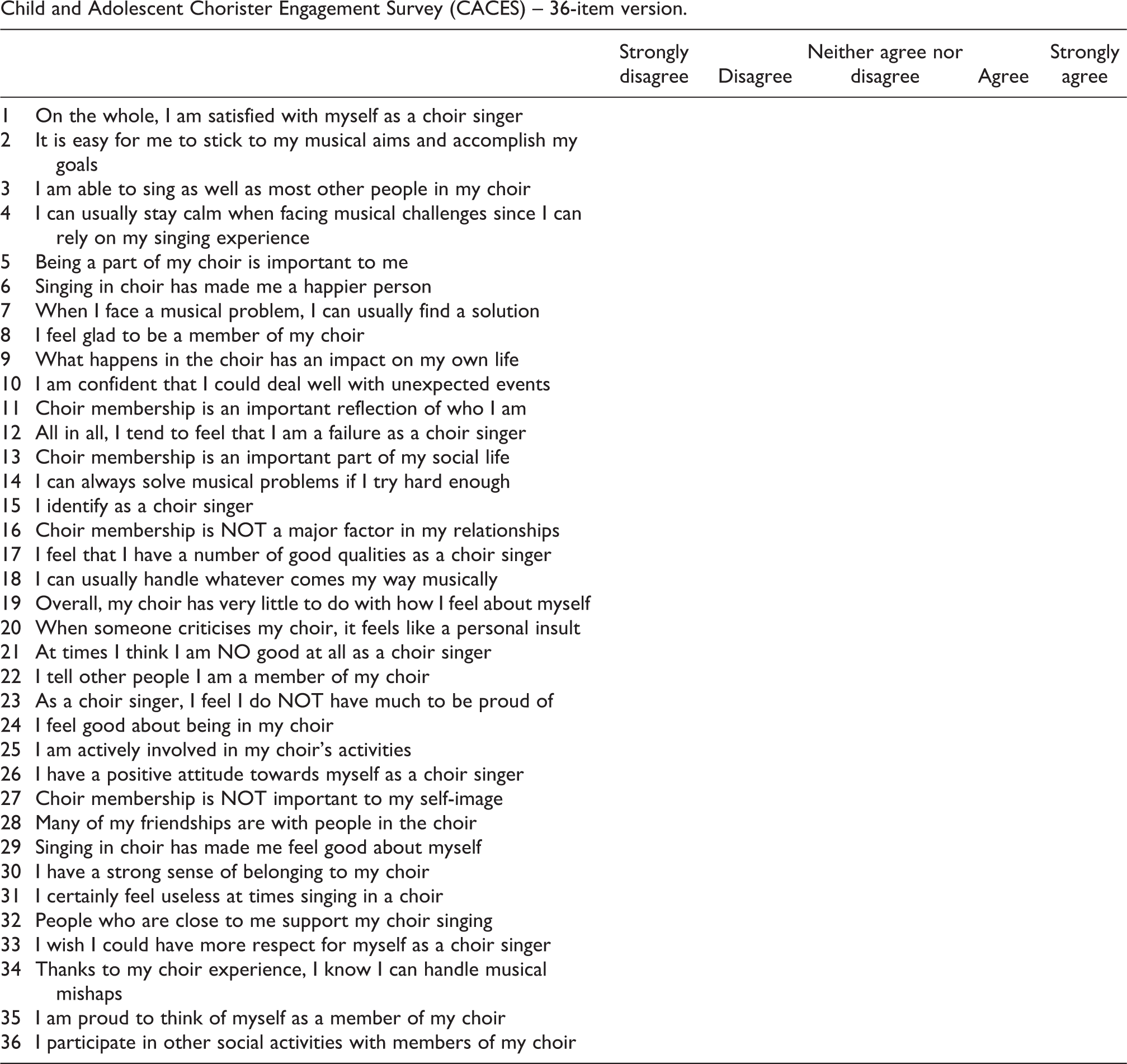
| Strongly disagree | Disagree | Neither agree nor disagree | Agree | Strongly agree | ||
|---|---|---|---|---|---|---|
| 1 | On the whole, I am satisfied with myself as a choir singer | |||||
| 2 | It is easy for me to stick to my musical aims and accomplish my goals | |||||
| 3 | I am able to sing as well as most other people in my choir | |||||
| 4 | I can usually stay calm when facing musical challenges since I can rely on my singing experience | |||||
| 5 | Being a part of my choir is important to me | |||||
| 6 | Singing in choir has made me a happier person | |||||
| 7 | When I face a musical problem, I can usually find a solution | |||||
| 8 | I feel glad to be a member of my choir | |||||
| 9 | What happens in the choir has an impact on my own life | |||||
| 10 | I am confident that I could deal well with unexpected events | |||||
| 11 | Choir membership is an important reflection of who I am | |||||
| 12 | All in all, I tend to feel that I am a failure as a choir singer | |||||
| 13 | Choir membership is an important part of my social life | |||||
| 14 | I can always solve musical problems if I try hard enough | |||||
| 15 | I identify as a choir singer | |||||
| 16 | Choir membership is NOT a major factor in my relationships | |||||
| 17 | I feel that I have a number of good qualities as a choir singer | |||||
| 18 | I can usually handle whatever comes my way musically | |||||
| 19 | Overall, my choir has very little to do with how I feel about myself | |||||
| 20 | When someone criticises my choir, it feels like a personal insult | |||||
| 21 | At times I think I am NO good at all as a choir singer | |||||
| 22 | I tell other people I am a member of my choir | |||||
| 23 | As a choir singer, I feel I do NOT have much to be proud of | |||||
| 24 | I feel good about being in my choir | |||||
| 25 | I am actively involved in my choir’s activities | |||||
| 26 | I have a positive attitude towards myself as a choir singer | |||||
| 27 | Choir membership is NOT important to my self-image | |||||
| 28 | Many of my friendships are with people in the choir | |||||
| 29 | Singing in choir has made me feel good about myself | |||||
| 30 | I have a strong sense of belonging to my choir | |||||
| 31 | I certainly feel useless at times singing in a choir | |||||
| 32 | People who are close to me support my choir singing | |||||
| 33 | I wish I could have more respect for myself as a choir singer | |||||
| 34 | Thanks to my choir experience, I know I can handle musical mishaps | |||||
| 35 | I am proud to think of myself as a member of my choir | |||||
| 36 | I participate in other social activities with members of my choir |