



Abstract
Background
Music is beneficial in Parkinson's care; for example, rhythm can improve gait, and singing can improve communication. Ways of ameliorating symptoms and enhancing quality of life are important adjuncts to pharmacological and surgical therapies that have limitions and complex side effects. Knowing how to use music, however, requires an understanding of cultural and personal preferences, rather than a prescriptive approach.
Methods
We conducted a mixed methods study via an online survey investigating how Swiss people with Parkinson's (PwP) use music in their everyday lives. This follows a similar survey of PwP in the UK, enabling consideration of cultural differences and insight into potential generalities.
Results
As with the UK findings, the top three uses of music were aesthetic appreciation, relaxation, and motivation. However, this sample of Swiss PwP (N = 44) reported more use of music for cathartic purposes, personal anthems, and distraction than PwP in the UK. Using the Barcelona Music Reward Questionnaire for the first time with PwP we found significant positive correlations (p < .01) between those top three themes and the mood regulation and social reward subthemes, between emotional evocation and cathartic purpose, and between sensory-motor elements and motivation. Qualitative analysis showed that Swiss PwP have a deep love of music from their homeland and connection with Swiss music, for example, yodelling. Similarities with the UK survey included the importance of the feeling of energy in music to invigorate, and gentleness in music to regenerate.
Discussion & Conclusion
Understanding the similarities and differences across cultures will facilitate individualized care and support broader guidelines for the use of music in Parkinson's rehabilitation. Although the small sample here does not reflect the complexity of Swiss musical culture, it does provide further support for the inclusion of strategies utilizing heard and imagined music to promote activity, support relaxation, and regulate mood.
Parkinson's disease is a neurodegenerative condition that is characterized by impaired voluntary motor control including tremors and bradykinesia (slowness of movement), as well as a range of non-motor symptoms including anxiety, depression, pain, and apathy (Bloem et al., 2021; Smith et al., 2024). As Parkinson's is caused by the lack of dopamine-producing cells in the substantia nigra pars compact area of the brain, treatment typically focuses on levodopa, which can be converted to dopamine, though side-effects (including overuse and dyskinesia -erratic writhing movements) are common (Lang & Obeso, 2004).
Music has been used in non-pharmacological adjunct therapies to ameliorate symptoms for people with Parkinson's (PwP 1 ) (Fox et al., 2018; Karageorghis et al., 2020). For example, rhythmic auditory stimulation (RAS) is a technique used in neurologic music therapy that can improve gait by teaching PwP how to synchronize their steps to a beat (Thaut et al., 2019). However, knowing which music to use and in which context to best effect is a difficult question to answer in general, given that “people's experiences with music are intensely personal” (Greasley et al., 2013, p. 405). Nevertheless, knowing which music to use, when, and why, specifically in relation to Parkinson's care, is the question asked of us by our Parkinson's advisory group (Rose et al., 2022).
To try to answer this, we first explored uses of music among PwP in a workshop setting that provided seven key themes: aesthetic appreciation, cognition, emotional release, psychological, motivational, for movement, and for relaxation (see Figure 1, Rose et al., 2022). We then conducted a wider survey to explore how PwP use music in their everyday lives in the UK (Poliakoff et al., 2023: Rose et al., 2023). This helped to define the existing seven themes and added two further themes (using music for walking and having a song as a personal anthem) for PwP in the UK.

Descriptions by Swiss people with Parkinson's of their preferred music styles.
This groundwork was an important part of a larger project that involved the development of a new group-based music-and-movement intervention created in collaboration with PwP, practitioners, therapists, medical professionals, and researchers in the UK and Switzerland (Rose et al., 2025). Knowing which music to use became a pragmatic concern, especially as music can differentiate between groups of individuals “more so than any other cultural field” (Greasley, Lamont & Sloboda, 2013, p. 402). Considering the importance of understanding cross-cultural differences in music studies (Jacoby et al., 2020), we conducted a survey to explore the use of music in PwP in Switzerland.
In this context, it is important to note that Switzerland is a confederation of 26 partially sovereign cantons that had existed since the Middle Ages and were transformed into a federal state in 1848 (Maissen, 2016). These federally united cantons are distinguished by their own cultural identities thought to be based on the mentality of “the tribe and the village” (Lüthy, 2003, p. 414) and linguistic variations of the four official languages (German, French, Italian, Romansh). This has resulted in the existence of an enormous number of political, cultural, and social societies representing regional diversity (Erne & Gull, 2014; Evéquoz & Camp, 2018).
Against this background it comes as no surprise that the establishment of the modern federal state in 1848 reflected the principle of “diversity in unity” rather than shared cultural, linguistic, and religious understanding. In contrast to other European countries, Switzerland was created by people's conscious will and a consensus to create a “nation by will” that guarantees political rights and freedom (Baldassarre 2025; Kreis, 2011; Piccardi, 2008/09/09; von Salis, 1968, p. 111). Moreover, music plays a significant role in the formation of identity as well as social cohesion, both in general and in relation to the specific Swiss context; music mirrors people's perception of themselves and how they connect with their peers and communities (Baldassarre, 2007, Baldassarre 2025; Boer & Abubakar, 2014; Huss & Bos, 2020; Odermatt & Zimmermann, 2021; Theorell, 2014; Westvall & Achieng’ Akuno, 2024).
Here we report a mixed methods study that aimed to investigate how PwP from Switzerland use music in their everyday lives. Our secondary research question was whether the results of this study differ from previous findings from PwP in the UK. Where possible we compare the findings from this study not only to those from the UK survey but also to normative data, that is, other existing data sets.
Methods
Recruitment
Participants were recruited using existing networks established by the research team and through contact with Parkinson Schweiz (the main Swiss Parkinson's charity) and Luzerner Kantonsspital (LUKS; the local hospital). Invitations describing the survey and providing a link to the survey were hosted on the Parkinson Schweiz website and Facebook page and provided in a mail out to interested parties who had signed up to learn more about our research at a local information day at LUKS. Inclusion criteria included being over 18 years of age and being formally diagnosed with Parkinson's disease. Exclusion was based on not meeting the inclusion criterion or not agreeing to the study conditions (described below).
Survey Description
The survey was hosted on Qualtrics (Provo, UT) between August 2022 and October 2023. Respondents were assured that their participation was anonymized (i.e., Qualtrics was set up not to track IP addresses), but people could provide their contact details for several reasons. Participants could ask us to contact them to help them complete the survey via telephone or video call (although only one PwP requested this service). They could also let us know if they wanted to be informed about the results, take part in an upcoming intervention, and/or be contacted to take part in further research on this topic.
We then explained the purpose of the study and asked participants to confirm (a) that they were over 18 years of age, (b) that they had read the information sheet provided, (c) that they understood that their data would be used anonymously, and (d) that they had been diagnosed with Parkinson's disease by a medical professional (such as a neurologist) before asking for consent. Informed consent was thus provided by selecting the appropriate tick box (“Yes” to continue the study; “No” to end participation).
During the survey we asked for details of the participants’ medication regimens (type and dosage to ascertain levodopa daily equivalent dosage, not reported herein), time since diagnosis (duration), and diagnoses of other physical and psychological health conditions (i.e., co-morbidity). We also collected general demographic data including culturally specific data such as nationality (open text box), and canton of residence (open text box).
Validated versions of measures were used whenever possible, as described in the section below. When a validated version was not available, and for our bespoke qualitative items, the linguistic skills of the research team (including Italian, French, German, and English) were used in line with the back translation method advised by Ozolins et al. (2020).
Ethical Approval
The Ethics Committee of Lucerne University of Applied Sciences and Arts approved this study in Switzerland, Protocol Number EK-HSLU 010 M 20.
Measures
Parkinson's Disease Questionnaire on Quality of Life (PDQ-8)
The PDQ-8 (Jenkinson et al., 1997) consists of eight items scored 0–4. A global score is reached by transforming the summative score to percentiles, whereby a higher score indicates poorer quality of life. The English language version of the PDQ-8 has been shown to have good internal reliability, with Cronbach's alpha statistics of > .8, and it is highly correlated with the parent measure, the PDQ-39 (Jenkinson & Fitzpatrick, 2007). As the eight items for this measure are taken from the PDQ-39, which is available in Swiss German (licensed by Oxford University Innovation and validated by Berger et al., 1999), we used these items to generate a German language version of the PDQ-8 for this survey.
Parkinson's Activities of Daily Living Scale (PADLS)
The PADLS (Hobson et al., 2001) evaluates the impact of Parkinson's on activities of daily living using five descriptive statements (levels 1–5, 5 being the highest level of impact). The PADLS has been shown to have good internal reliability, with Cronbach's alpha statistics of > .9 (Alves et al., 2021).
Gold Music Sophistication Index (Gold MSI)
The Gold MSI (Müllensiefen et al., 2014; Schaal et al., 2014) is a self-report inventory for measuring individual differences in “musical sophistication” or the musicality of non-musicians. The full inventory includes a general score and several subscales (e.g., musical training). Here we included only the 18 items needed to generate the general score. Normative data are available for the English population, based on a large sample from the UK (N = 147,000), but a validated German version of the MSI exists and this was used herein (Schaal et al., 2014). We also included one item that related to the subscale for Active Musical Engagement: “I listen attentively to music for _?_ per day – Please select the amount that most reflects the amount of time you attentively listen to music each day (7-point Likert scale from 0–15 min to more than 4 h per day).”
Bucknell Auditory Imagery Scale–Vividness (BAIS)
The BAIS (Halpern, 2015) is a 14-item measure that asks participants to rate how vividly they can imagine sounds in different scenarios on a seven-point scale from “no image” to “as vivid as the actual sound.” For example, “Consider the beginning of the song ‘Happy Birthday.’ The sound of a trumpet beginning the piece.” An unpublished German language version of the BAIS was provided by the author herself (Halpern, private communication in which she described the process as a bilingual translation from Language 1 to Language 2, then a naive bilingual backtranslation from Language 2 to Language 1). Comparison data from the original study (N = 76 college students) are used herein.
Barcelona Music Reward Questionnaire (BMRQ)
The BMRQ (Mas-Herrero et al., 2013) is a 20-item questionnaire that (reliability coefficients provided in parenthesis) provides one global score (.92) and five subscales: Music Seeking (.89), Social Reward (.78), Emotional Evocation (.88), Mood Regulation (.87), and Sensory-Motor (.93). In the original article, normative data are provided as per the results from N = 857 participants and transformed to T scores for each subscale.
Qualitative Items
Musical Preferences
We asked the participants an open question about which types of music they liked and why. To reduce potential cultural bias, rather than ask them to select genre from an a priori list (as had been the case in the UK survey), participants were instructed that they could note down any style, genre, artists, or pieces of music so that we did not miss any colloquial musical terms.
Uses of Music Themes
Participants were asked to report whether they used music according to nine themes developed by Rose et al. (2023). These included: aesthetic appreciation (subthemes options included “beauty,” “entertainment,” “to sing along,” and other), catharsis (i.e., “to let my feelings out,” for which subthemes included music for “happiness,” “energy,” “reminiscing,” “anger,” “grieving,” “crying,” and other), music for motivation (subthemes included “energy,” “everyday tasks,” “exercise,” and other), music as a personal anthem (yes + explanation, or no), music for relaxation, music for distraction, music for concentration, and music “as company.” We also included music for walking, as with the previous survey (subthemes included “to walk faster,” “to control my steps,” or “to synchronize”), but this time we also included an option to describe reasons why participants did not use music for walking. Based on conversations with PwP, we included the following options: (a) they didn’t have any difficulty walking, (b) they didn’t know you could use music in that way, (c) they found it difficult to do in public, (d) they did not have the necessary technology, or (e) other.
For all themes and subthemes, we provided an open text box and asked participants to tell us about any specific songs or musical genres that they listened to for this reason and what about it was useful.
Research Design, Data Preparation, Statistics, and Qualitative Coding
This study was conducted as a convergent mixed methods design (Fetters & Freshwater, 2015). Regarding the survey, all items were set up so that answering was voluntary (i.e., Qualtrics was not set to “forced answer”); consequently, we report the n per factor in the results and the weighted percentage. To compare the normative values for the BMRQ, the additive subscale scores were transformed to T values as recommended by the authors (Mas-Herrero et al., 2013). Other than this, no additional data were imputed, and all missing data points are reported.
One-sample t tests were used when comparing the data from this sample to that from the UK (N = 217) and/or normative values. Pearson’s correlations were used to explore relationships between variables of interest: Two-sided p values are reported due to no specific hypotheses regarding sample differences. Estimates of effect sizes are presented as Cohen's d where a .2 is considered small, .5 as medium, and .8 as large (Cohen, 1992). To reduce the probability of family-wise error, we used a Bonferroni correction where alpha p < .01 to denote the level of significance.
Regarding the qualitative data, to reduce bias and optimize this process, the second author coded 30% of the data separately from the first author. The authors then discussed areas of conflict, overlap, and descriptors until they agreed, and a final code book was generated in line with the guidance provided by Vaughn and Turner (2016). We noticed that some participants repeated the same material (music genres, artists, and/or songs) for different reasons. To avoid conflation or over-representation, we inductively coded these data to generate themes and subthemes separately, then either reintegrated these into the original themes or used them to generate new themes.
Results
Participant Characteristics
In total, 44 Swiss PwP responded to the survey between August 2022 and October 2023. Respondents were split between those who identified as male (n = 23) and female (n = 21). The mean age was 65.61 years (SD = 9.17, Range 40 to 84 years). Of these, 33 (75%) completed the whole survey. Years since diagnosis for the sample was M = 8.24, (SD = 5.69, Range .5 to 20 years) and the majority (n = 25, 61%) reported the second of the five levels of symptoms on the PADLS. Most of the remaining respondents (n = 12, 29%) reported level 1 (the least symptomatic level), n = 3 (7%) reported level 3, n = 1 (2%) reported level 4, and none reported level 5 (the most severe level). The mean percentile score for the PDQ-8 (where a higher score (0–100) equates to worse quality of life) was 25.96 (SD = 4.38, Range 3.13–53.13). We asked the participants if they had been diagnosed with any other conditions; n = 22 (50%) reported physical comorbidity and n = 10, (23%) reported psychological comorbidity – see Supplementary Table 1 for full details.
The survey was offered (via a drop-down list) in German, Italian, French (and English as this is widely spoken in Switzerland). The majority chose to use the German language version (n = 41, 93%), two chose the English (5%) and one (2%) chose the Italian language version. We also asked participants about their place of residence: n = 14 (33%) stated they lived in Luzern, n = 9 (21%) in Zurich, n = 3 (7%) each in Ticino, St. Gallen, Obwalden, and Bern, n = 2 (5%), of which one lived in Solothurn and the other was a Swiss person currently living in the UK, and n = 1 (2%) each in Aargau, Basel, Nidwalden, and Zug.
Many of the sample were retired (n = 24, 55%), though some (n = 8, 18%) were still working (paid) part-time, and one (2%) was still working full time. Some had stopped working because of Parkinson's (n = 5, 11%). Of the six who selected “Other,” four reported receiving disability pensions (ranging from 30% to full time), one explained that they volunteered helping people with dementia, and another stated “pensioniert, aber Ruhestand ist nicht das richtige Wort” (Retired, but retirement is not the right word).
The sample were highly educated with n = 18 (41%) stating they had achieved post graduate status (master's or PhD) and n = 13, (30%) selecting graduate status (university degree or professional equivalent). A quarter, n = 11 (25%) achieved A-levels (Matura); n = 2 (5%) achieved O-level equivalent.
As the survey was rather long, we included two attention checks; n = 38 scored correctly for the first and n = 36 scored correctly for the second (n = 5 missing for the first attention check and n = 8 missing for the second attention check). On checking the other scores, we could not see any patterns suggesting misunderstandings, so we did not exclude any further data points.
At the end of the survey (n = 19 missing), we asked participants (a) if they wanted to be informed about the results, n = 24 (75%) agreed; (b) if they would agree to being contacted about future research on this subject, n = 23 (72%) agreed; and/or (c) if they would like to take part in an upcoming intervention, n = 25 (78%) agreed.
Quantitative Results
Music Preferences
In total, 233 examples were provided. We grouped these according to genre where possible, and where unclear (e.g., for the term “gentle” or “live” music), we kept the original descriptions. Figure 1 depicts all the music descriptions as described by the PwP who participated, except for those with only one supporter.
The most popular genre included types of rock (including classic rock, rock’n’roll, heavy metal, punk, and prog), followed by classical (including modern, romantic, baroque, and opera) and folk (including descriptions such as “authentic,” and Irish) music.
Single music preferences included musicals, big band, German pop, disco, ’80s, ’90s, alphorn, drumming music, hip hop, chill/lounge music, electronic dance music, and music that the person could play (as in perform themselves).
In response to our item regarding ways in which respondents listen to music, the majority n = 26 (68%) reported a combination of background and attentive listening, n = 7 (18%) reported mostly listening attentively, and n = 3 (8%) said mainly in the background (n = 6 missing). Table 1 shows the answers related to the single item from the MSI that asks how long respondents listen for per day.
MSI Active Engagement single item.a

I listen attentively to music for _?_ per day – Please select the amount that most reflects the amount of time you attentively listen to music each day.
When asked how they listened to music, respondents could indicate multiple options. The most frequently chosen option was Radio (n = 30, 79%), followed by Streaming (n = 24, 63%), and Using a Personal Listening Device (e.g., phone, MP3 player, (n = 24, 63%), CD (n = 12, 32%), “When they were doing something musical” (e.g., singing in a choir, (n = 12, 32%), Using a Smart Device (e.g., Alexa, (n = 3, 8%), “Other people chose the music” (n = 2, 5%), and Other (n = 8, 21%). Answers for “Other” included playing records, live music (concerts, opera, church), listening through hearing aids, and “using good speakers as I attach great importance to good sound quality.”
Table 2 (see also Figure 2) reports the frequencies of use and number of examples provided by the Swiss participants for the a priori themes as previously used in the UK survey.
Frequencies and examples provided of main themes of music use as reported by people with Parkinson's in Switzerland.

Regarding the use of personal anthems, n = 25 (66%) participants selected “Yes, I think so” and n = 13 (34%) selected “No, not really.”
Regarding the subthemes for Aesthetic Appreciation, 28 PwP (78%) selected for “Beauty”, 23 (64%) so that they could “Sing or hum along,” 22 (61%) for “Entertainment” and 14 (39%) for “Other.”
Regarding the subthemes for Catharsis, 25 PwP (57%) selected for “Happiness” (9 examples provided), 21 (48%) for “Reminiscence” (7 examples), 20 (46%) for “Energy” (1 example), 14 (32%) “To help me cry” (5 examples), 11 (25%) for “Grieving”, 10 (23%) for “Anger,” and two (5%) for “Other” (four examples for each of the last three descriptors).
Regarding the subthemes for Walking, 14 PwP (100%) selected “To synchronize”, 13 (93%) “To walk faster”, 11 (79%) “To control my steps” and four “Other” as reasons they used music for walking.
We added an option for participants to describe why they did not use music for walking; n = 16 (33%) reported that they did not have difficulty walking, n = 6 (25%) selected that they “Didn’t know you could use music for walking”, n = 3 (13%) selected that it was “Difficult to do in public”, n = 2 (8%) selected that they “Didn’t have the necessary technology” and n = 9 (38%) reported “Other.”
All findings pertaining to “Other” for these themes and the remaining subthemes can be found in the section reporting the qualitative findings.
Comparison with UK Survey on Uses of Music Among People with Parkinson's (Quantitative Data)
As shown in Figure 2, the ways in which PwP in Switzerland and the UK use music were similar, though Swiss PwP seem to use music more as personal anthems (+21 percentile points), to let their feelings out (+16 percentile points), as a distraction (+11 percentile points), and less for concentration (−11 percentile points).

Comparison of ways in which people with Parkinson's from the UK (N = 217) and Switzerland (N = 44) use music in their everyday lives. As with the UK data, the selections “Sometimes” and “Often” by participants are combined to show overall use.
Standardized Questionnaires
The results of the standardized questionnaires and (where possible) the comparison to normative values and the values from the UK survey are shown in Table 3.
Results of standardized questionnaires and comparisons to normative and UK values.

Normative values are described per measure in the methods section except for the PDQ 8 percentile.
The mean (SD) data used here for the PDQ 8 sample are based on the Norlin et al., 2023 survey of 3413 PwP in Sweden.
PDQ-8
This sample did not differ from the UK sample in terms of age or gender balance, and the scores from this sample did not differ significantly from the UK sample scores for the PDQ 8 (p > .3), or from the mean value of the large sample in the study undertaken by Norlin and colleagues (2023; p > .7). We found a significant positive correlation between the PDQ 8 and music for Walking, r(38) = .47, p = .003.
Gold MSI
For the MSI General scale, this sample did score higher than the UK sample, t(23) = 3.57, p = .021, Mean diff = 9.65, 95% CI = (4.06, 5.24), d = .73, but not significantly higher than the German normative value (p = .06). There was no correlation between the MSI general score and the PDQ 8, p > .4. There were no significant correlations between the uses of music (a priori themes) and the Gold MSI global score.
BAIS
For the BAIS Vividness Global Score, the present sample scored significantly lower compared to the original Halpern (2015) sample, t(32) = -3.11, p < .01, Mean diff = −.54, 95% CI = (−.90, −.19), but significantly higher than the UK sample, t(32) = 4.76, p < .001, Mean diff = .83, 95% CI = (.47, 1.18), d = .83.
As with the UK survey, we separated the musical from the non-musical auditory imagery items but found no significant differences between the present sample’s scores and the UK sample for musical imagery (p > .9) and non-musical imagery (p > .8). In this sample, music and non-musical sound imagery were highly correlated r(33) = .77, p < .001.
We found a significant positive correlation between the BAIS vividness score and Music for Aesthetic Appreciation theme, r(33) = .40, p = .01.
BMRQ
There were no significant differences between this sample and the normative values for the BMRQ global scores or subscales (all p > .9).
We found significant positive correlations between the BMRQ global and subscales and music use themes, as shown in Figure 3.
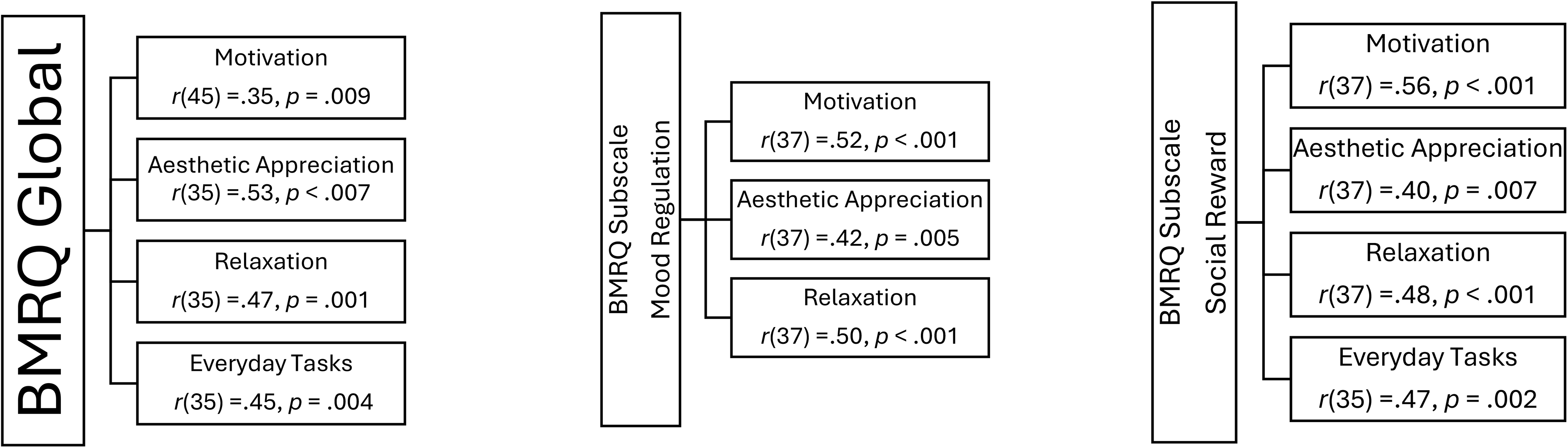
Left panel: Significant positive correlations between the Barcelona Music Reward Questionnaire (BMRQ) Global Scale and the themed uses of music among Swiss people with Parkinson's. Central panel: Significant positive correlations between the BMRQ subscale of Mood Regulation and the themed uses of music among Swiss people with Parkinson's. Right panel: Significant positive correlations between the BMRQ subscale of Social Reward and the themed uses of music among Swiss people with Parkinson's.
Additionally, for the BMRQ subscale Emotional Evocation, we found a significant correlation with music “to let your feelings out” r(35) = .52, p < .001 and a significant correlation between Sensory-Motor and music for Motivation, r(37) = .43, p = .005.
Qualitative Results
Here we first present the qualitative findings of the deductive analysis (i.e., based on a priori themes from the UK survey) on the uses of music by Swiss PwP in order of frequency chosen, thereby enriching the data shown in Table 2. This will be followed by additional themes that emerged through inductive coding, specific to this data set. Verbatim quotes are provided (in italics) to ensure that the voices of the participants are represented (although we have adjusted some spelling for clarity). In some cases, participants wrote notes in Swiss German. We have not adjusted these to high German to preserve the authenticity of the voice of the participants.
Aesthetic Appreciation
Participants provided 43 examples of music they engaged with for aesthetic appreciation. The main music descriptions for this theme with six mentions each were classical (e.g., Fidelio by Ludwig van Beethoven) and pop (e.g., ABBA, Queen, Phil Collins) music followed by five mentions each of famous pieces, types of rock and schlager music (artists such as Heimweh and Max Raabe). Four participants mentioned music from their homeland and three mentioned folk music. There were two mentions each of naturjodel (this type of yodelling focuses on syllables and the vocal aesthetics of regional sounds, which distinguishes it from modern yodelling, which focuses on strophic text), musicals, film music, jazz (e.g., Birdland by Quincy Jones), songs from schools (e.g., Pippi Langstrumpf (Pippa Longstocking)), choral or opera singing, singer-songwriter and music from the ’60s and the ’70s. Single mentions were made for brass bands (Black Dyke Mills Band); yodelling (specifically Nadja Räss) and alphorns; Christmas; TV and radio; disco; world; light; funny music; earworms; and live music. Additionally, single participants mentioned the following aspects of music as important for this theme: lyrics, immersion, connectedness, and lifting mood. As one participant said “weil es mich in gute Stimmung versetzt” (because it puts me in a good mood).
Relaxation
Participants provided 16 example of music they used for relaxation. The most commonly chosen type of music was classical (7), followed by meditation (4), country & western (3), jazz and piano (2 each), with additional single mentions for Swiss music, radio, indie-pop, and accordion. The qualities of the music included softness (2), slowness (1), and soothing (1).
Participants mentioned both “calming down” (8) and relaxing (7), with direct examples such as “Um das Nervensystem zu beruhigen” (to calm the nervous system) or “Musik geht durch den ganzen Körper und lenkt ein Spannungsgrund aus dem Körper” (Music goes through the whole body and draws the tension out of the body).
In comparison, when referring to relaxation, an example of a description would be so that “Ich kann mich mit Musik besser entspannen. Dann aber nicht kraftvolle Musik, sondern sanftere, z.B. Blues, Klavierkonzerte von Mozart” (I can relax better with music. But then not powerful music, softer music, e.g., blues, Mozart piano concertos.) Five participants also mentioned using music to “stop thoughts.” For example, “Auch wenn man sehr willensstark ist so gibt es doch im Leben und meistens eher abends spät Momente wo du über dein Leben und Mr. Parkinson als Dauergast nachdenkst und vermutlich ein wenig mir dir selbst haderst. Wahrscheinlich suche ich in diesem Moment eher unbewusst die Entspannung – auch wenn ich sonst fast nie Musik höre – durch tendenzmässig sanfte Musik.” (Even if you are very strong-willed, there are moments in life and usually late in the evening when you think about your life and Mr Parkinson as a permanent guest and probably struggle a little with yourself. I’m probably unconsciously looking for relaxation at that moment – even though I hardly ever listen to music otherwise – through music that tends to be soft.)
Similarly, three participants mentioned music as a tool for immersion, sometimes directly related to Parkinson's, such as,
“Mit Musik tauche ich in eine andere Welt, lenke mich ab, vergesse Parkinson, Ärger, trübe Stimmung” (With music I immerse myself in another world, distract myself, forget Parkinson's, anger, gloomy mood). Participants also mentioned this less directly: “Wenn ich Musik höre, habe ich keine anderen Gedanken” (when I listen to music, I have no other thoughts). Four people mentioned using music to aid meditation, closing their eyes and practicing breathing, and one participant mentioned using music to “push the pain away” “um körperliche Schmerzen (Muskeln und Gelenke) wegzuschieben.”
A further four participants mentioned using music to help them fall asleep at night, often saying that they used headphones so as not to wake their partner. Finally, a small proportion (one each) of participants explained they used music to “let go,” to allow their minds to wander, or to find peace.
Motivation
Participants provided 38 examples of music they used for motivation, the majority of which were various types of rock (12), pop (11) or listening to the radio (8). Singer-songwriter, classical and schlager were also popular descriptions (4 each), and ’60s, Latin, and jazz were next (3 examples each). There were six instances where two participants described a type: Swiss music, easy listening, background, singalong, playlists (e.g., on Spotify) and choral music. Single mentions included country, world, film, electronic dance music, ’70s, brass bands, soul, live music and Christmas songs. Descriptions of the type included having a strong beat, being rhythmic or groovy (4), and loud (1).
The major use of motivating music was for exercise or sport (8), followed by relaxation (5) (the participants said that they needed music to help them to relax), to help pass the time in general (3), for example “Damit die Zeit schneller vergeht, wenn man allein zu Hause ist” (so that time passes faster when you are alone at home), when doing something else (3) (e.g., knitting, driving, cleaning), and as a distraction from worrying (3). Two participants said that they used music for dancing, two for walking, and one each reported that they used music for meditation and to let their feelings out.
On occasion, a participant would combine uses as in this example, “um mich zu motivieren für sportliche Tätigkeiten, um Emotionen zuzulassen (z. Bsp. Freude, Wut, Trauer). Musik über Kopfhörer beim Laufen verringert Trigger wie z. B. enge Stellen, viele Leute, die Gedanken sind beim Musikhören und nicht der Vorstellung, was alles passieren/schiefgehen könnte (Ablenkungseffekt). (to motivate myself for sporting activities, to allow emotions to show (e.g., joy, anger, sadness), music through headphones while running reduces triggers such as narrow places, lots of people, thoughts are listening to music and not imagining what could happen/go wrong (distraction effect)).
Company
When asked whether they used music for company, participants provided three examples; ABBA for cleaning; Beethoven's 9th symphony for connectedness, community, and belonging; and Don Carlo by Guiseppe Verdi, or his Requiem, when the participant felt emotional. The radio, or background music was the main source of music in this theme, and the main purposes of using music for company were when driving (alone) in the car and/or simply being alone at home (6), for example “Beim Autofahren. Oder wenn ich mal alleine zu Hause bin. Es ist dann Gesellschaft und ungestörter Genuss” (When I’m driving. Or when I’m alone at home. It is then company and undisturbed enjoyment). However, participants also explicitly reported using music when feeling lonely (4), “Weil es die Einsamkeit vertreibt und mich einbettet in etwas Grösseres, Ganzes oder ablenkt” (because it dispels loneliness and embeds me in something bigger, something whole or distracts me).
Connectedness was an important subtheme (4), with one participant explaining “Musik gibt mir das Gefühl nicht alleine zu sein” (Music gives me the feeling of not being alone) and another saying “Lieder mit Kollegen teilen ist toll. Erregt schöne Erinnerungen” (Sharing songs with colleagues is great. Evokes nice memories). Another common subtheme for music as company was using music when doing chores. As one participant said, “Wenn man alleine zu Hause ist für längere Zeit. Musik quer durchs Gemüsebeet ausm Radio” (When you’re home alone for a long time. Music “across the vegetable patch” [meaning all styles] from the radio). There were no specific mentions of Parkinson's in this theme, though it was clear participants were spending a lot of time alone, putting the radio on so that they didn’t have to eat lunch “alone” and to give a feeling of liveliness to their home.
Catharsis
We asked participants whether they used music to let their feelings out, and if so, for which of the following feelings they used music.
Happy – Nine examples were provided for this emotion including “all music” (5), pop (3), folk (3), singer-songwriters (2), and single mentions each for disco, jazz, boogie-woogie, and brass bands. Four themes emerged as important: General Affect (touching, moving, soothing (3)), Upbeat and Cheerful (2), Love of Homeland (1), and Connectedness (1). The overall sentiment here was for “Musik geht ins Herz” (music that goes straight to your heart).
Reminiscence – Seven examples were provided including folk (2), live concerts (2), and single mentions each for classical, disco, and musicals on stage or screen (e.g., “Dirty Dancing”). The main reasons were described as celebrations; special occasions/events; and/or times (5), encounters (1), and experiences (1), as exemplified here: “Erinnerungen an schöne Begegnungen, an die Jugendzeit, an spezielle Feste” (Memories of beautiful encounters, of youth, of special celebrations).
Crying – Six examples were provided by participants including large scale classical pieces, French ballads (chanson Français), love songs (e.g., “The Rose” by Bette Midler), pop (Amy Winehouse), folk (Heimweh) and schlager (“Kitschige schöne Musik” - kitschy music). As described by one participant, the songs should be “So emotional dass ich weinen kann” (so emotional that I can cry) but also offer some spiritual consolation.
Anger – Four examples were provided for this feeling, mostly in the rock genre or piano music, including Frank Zappa, Nina Hagen, Gianna Nanini, and Guerm et Zaka.
Grieving – Four examples were provided, mainly connected to family members or special times as would be expected with musically-evoked autobiographical memories (i.e., MEAMs). Musically, participants mentioned ballads (2), music with profound lyrics (2), Swiss folk (1), and instrumental (1) as part of this theme. One example that encapsulates the instrumental is “Spiegel im Spiegel” by Arvo Pärt (1978).
Energy – One example was given for this theme, a song by Peter Maffay “Über 7 Brücken musst du gehen” (1978). Two distinct reasons were provided: (a) to invigorate and (b) to regenerate. This apparent dichotomy can be illustrated by this explanation, “Kraft schöpfen durch Entspannung oder mit rhythmischer, kraftvoller Musik angesteckt zu werden” (to gain strength through relaxation or being infected with rhythmic, powerful music).
Distraction
Two specific examples were provided, Frank Zappa's “Sheik Yerbouti” (1979) and Carole King's “You’ve Got a Friend” (1971). The reasons given were for shifting moods; as one participant described it: “wenn ich verägert bin, höre ich Musik, oder jeden Abend” (When I’m angry, I listen to music maybe every night).
Only one participant specifically mentioned this use in relation to their Parkinson's: “Schlechter Tag bei Parkinson, Musik als Ablenkung, um nicht in Depression zu verfallen” (On bad days with Parkinson's, music can be a distraction to avoid falling into depression). The main themes described were using music to regulate mood (to soothe, relieve tension, and manage stress) (10) or more explicitly to manage rumination (8) as illustrated here, “Wenn ich Spital-Besuche mache, belastet mich das. Es geht mir dann besser, wenn ich mich mit Musik ablenke” (When I visit hospitals, it stresses me out. I feel better when I distract myself with music).
Three participants also described using music as a distraction when painting, when reading, or simply to motivate themselves to keep going. In addition to the three participants who associated rock or loud music with distracting oneself from feeling angry, participants also mentioned the importance of melody (2) and of singing along (2) and having music on in the background such as the radio (2). One person mentioned Swing “dann tanze ich oder singe mit” (then I dance or sing along).
Personal Anthems
Thirty-eight examples were provided for this theme, with a small number of genres and many reasons. The six styles of music described were film music (2), rock (Pink Floyd and Queen), and one mention each for classical, opera, concerts, and gentle music. The two most prominent reasons provided by participants were: (a) connection with lyrics (11) and (b) reminiscence (11). These themes were often combined, as illustrated by one participant who mentioned the song “Another Brick in the Wall” by Pink Floyd (1979), saying, “Text ist wichtig, Rebellion, Erinnerung an die Jugendzeit” (Lyrics are important, rebellion, memories of youth). Reminiscence as a subtheme included different age periods (childhood associations, carefree flirtatious youth) and places (holidays and adventures).
For Concentration
The main reasons given in relation to this theme were self-regulation (4), such as “Weil ich durch die MUSIK ruhig werde, und mich beser fühle. Wenn ich zu einem Gespräch gehe, höre ich auf dem Weg Musik” (Because music calms me down and makes me feel better. When I go to a meeting or an appointment, I listen to music on the way). The other main reason was for ambience (3), mostly when doing other things (e.g., Suduko). One participant stated that when they need to concentrate, they cannot listen to music, whilst another said that they listen to music specifically to block out tinnitus, and another said they can only concentrate when listening to music. Finally, one participant said “Con una musica ritmata, seguo il ritmo, mi da una carica” (With rhythmic music, I follow the beat, it gives me a charge). Two people mentioned listening to mainstream music on the radio in the background. Ludovico Enaudi, the Italian pianist and composer, was the only example provided, and this was for when practicing Taiji Ball (a Qigong practice using a small ball).
For Walking
For those who selected walking as a theme, rhythmic music was explicitly mentioned (4), though styles varied from dance music (2), salsa (2), and pop (2) to classical and metal (1 mention each) and there was another single mention for all kinds of music. Four specific examples were providing including “Cumbia a La Gente” by Guaynaa (2022), “Ily Aye” by Schiller (2008), music by Antonio Vivaldi (in general), and William Russo's “Street Music” OP 65, which was specifically chosen to try to coordinate with the different beats. No further text was provided for the “Other” category for “Not walking.”
Types of Tasks
In this survey we also asked Swiss PwP about the types of tasks they used music for. In total, 24 participants (67%) mentioned using music in this way. The main tasks mentioned were when doing chores such as cleaning or ironing (15), followed by crafting (e.g., knitting) and cooking (3 each), when doing sport, or reading (2 each), with single mentions for when working, writing cards or letters, doing the accounts, and driving. The main reason given was because music was rhythmic and energizing (6), providing pace, motivation, or distraction (2 each). Whilst three people mentioned using music to help them when they had trouble sleeping, one mentioned using music to help them wake up, another to cope with life, and another to feel joy. The main way that participants described listening to music was in the background/on the radio (7), with two people each mentioning country music or pop, and single mentions each of film music, nature sounds, heavy metal, singer songwriter, arias, polka, quiet music, and alphorn. Eleven specific examples were provided including several mentions of local radio stations, and different types for different reasons; for example “Bügeln zu Arien. Putzen zu Filmmusik” (Ironing to arias. Cleaning to film music).
Music Inside the Mind
We also asked Swiss PwP if they experienced music inside their minds, and if so, what type of music, or how did it manifest. The main example of when participants imagined music inside their minds was during everyday tasks (12) that were usually done in silence and alone, such as showering or housework. Several (6) specifically mentioned imagining music when “on the move,” for example, walking, driving, cycling, or riding. Regarding the type of music, participants mentioned having a catchy melody (e.g., pop, schlager) that they usually hummed (7), especially if they couldn’t remember the lyrics (3), though they did sing when they could remember the lyrics (4). Four people specified folk music and three people mentioned hymns. One example that illustrates how these reasons could be intertwined is as follows: “Worship-Lieder, aber eigentlich summe ich dann vor mich hin, Text ist teilweise auch da und wichtig, manchmal fantasiere ich auch eigene spontane Melodien” (Worship songs, but actually I hum to myself, the lyrics are sometimes there and important, sometimes I also fantasize my own spontaneous melodies).
Model of Music Use
Due to the large amount of overlap between themes (participant tended to repeat the same information about how they use music rather than relating the use directly to the theme), we aggregated the frequency of mentions in the qualitative data for reasons for using music, the descriptions of musical attributes per theme, and the descriptors of the times and places the participants mentioned using music (see Supplementary Tables S2, S3, and S4). We then used these to develop the model shown in Figure 4 as an overview of how Swiss people with Parkinson's (N = 44) use music in their everyday lives.
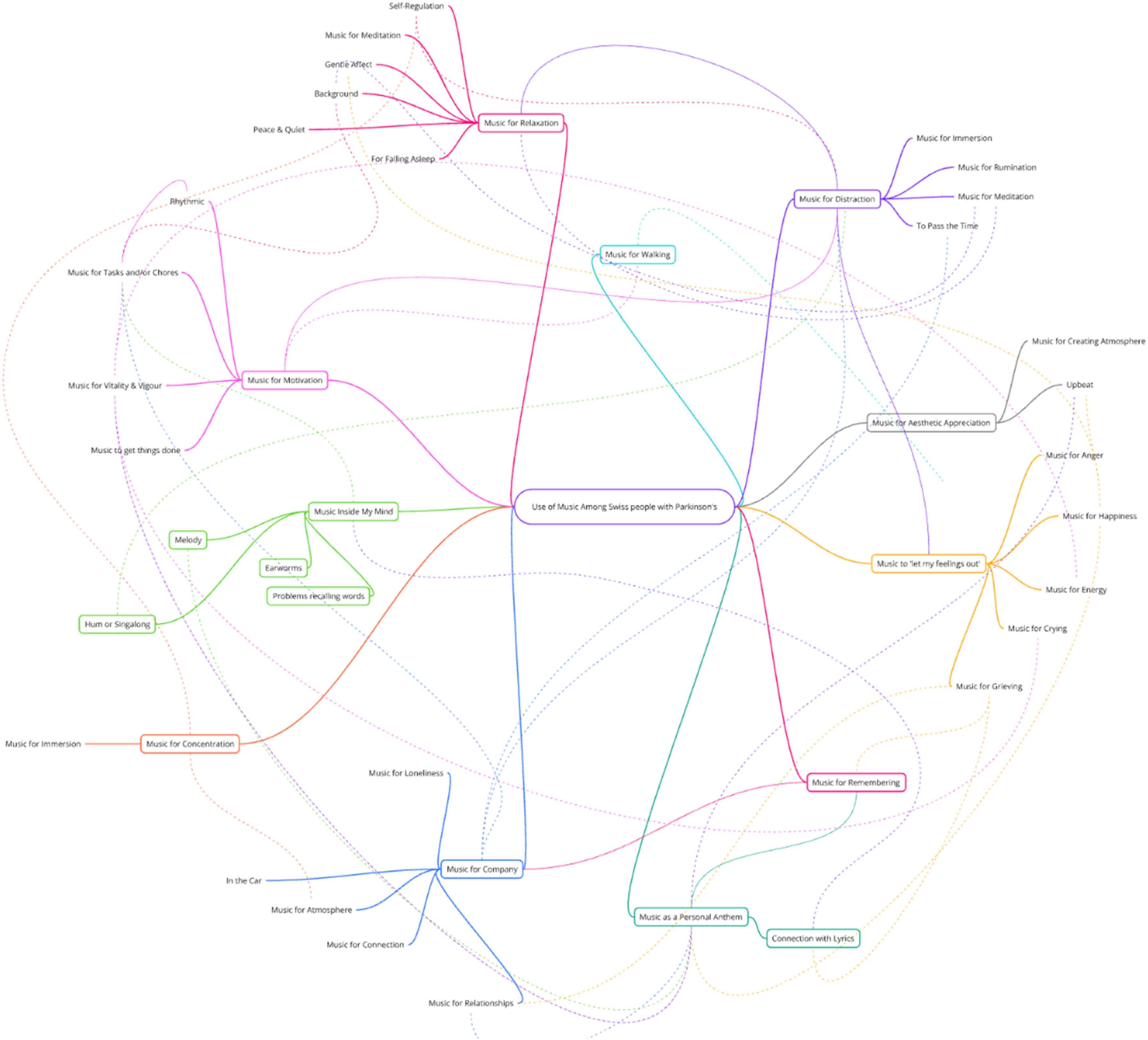
Preliminary model of aggregated data showing main themes and subthemes of the uses of music among Swiss people with Parkinson's (N = 44) and their relationship with each other. Curved rectangles depict main (a priori) themes and inductively derived subthemes, with singular descriptions of subthemes shown connected to subthemes by lines. Dotted lines show the overlaps between themes observed in secondary analysis of aggregated data.
Comparison with UK Survey on Uses of Music Among People with Parkinson's (Qualitative)
In relation to “aesthetic appreciation,” the UK data suggested similar main themes to the Swiss dataset, although choral/vocal music featured more prominently. For the “relaxation” theme, the UK and Swiss qualitative data were very similar; however, sleep and de-stressing also emerged as prominent themes for the UK data. UK respondents’ comments on participants’ uses of music for motivation focused mainly on rock and pop music and in line with the results above; UK participants mentioned music for exercise in this category, and listening to the radio, plus listening to music alongside doing household chores. Comments in the “other” category of the UK data suggested themes of relaxation and music to improve mood. UK themes emerging in relation to music for “company” were similar to the Swiss dataset, with music used in the car or while driving being the most commonly reported use. Listening to the radio was mentioned by many UK participants, along with listening while alone (or to relieve loneliness), and singing or humming alone. Many participants also mentioned that music can be used to relieve silence or for its emotional impact. Many of the themes in the UK dataset in relation to music used “to feel” were similar to the Swiss data; participants reported reminiscing about people and places, and death and funeral experiences linked to grieving. One difference to the Swiss dataset was that multiple UK participants mentioned “loud” music in relation to letting out anger. Comments in the “music as a distraction” dataset for the UK revealed similar themes to the data analyzed above: links with Parkinson's and as a distraction from other activities (and to reduce boredom/pass the time), and music to change one's mood. Distraction from anxiety and stress also emerged as themes in the UK data, and COVID was a minor theme, likely due to data being collected during this time.
The comparison between UK and Swiss responses in relation to music as a personal anthem reveals insightful similarities and differences. The lyrics of the music, and themes of memory and nostalgia were common in both. The band Queen was mentioned in both datasets. However, the most common theme in the UK dataset was in relation to strong emotions, and music being experienced as powerful or uplifting. Additional themes emerged from UK participants in comparison to the Swiss data, including the rhythm or beat of the music, and philosophical reflections on life in general.
For “concentration,” UK participants mainly mentioned listening to music while doing work (studying, revising, or working at a computer) or chores, listening in the background, or using music to drown out other sounds or “interference”. Work did not emerge as a main theme in the Swiss dataset, and this could indicate a cultural difference in uses of music by these populations. The UK data revealed similar themes in the text given by participants in relation to music used for walking – the rhythm or beat of the music was mentioned frequently. Specific music types mentioned included pop and rock music, plus marching music, which did not emerge in the Swiss data.
Discussion
We conducted an online survey to investigate how Swiss PwP use music in their everyday lives, enabling us to compare our findings with a similar survey of PwP from the UK (Poliakoff et al., 2023: Rose et al., 2023). Although this sample was much smaller (N = 44 vs. N = 217) and reflected mostly the German-speaking area of Switzerland, it did not differ from the UK in terms of general demographic makeup or the severity of the effects of Parkinson's.
Ways of Listening to Music
The balance between attentive listening and background use of music was very similar to the UK, though 11% spent four or more hours listening to music in this sample. The percentage use of devices followed the same pattern as the UK (i.e., mostly radio (∼70%), followed by using a personal device, streaming or CDs (∼50%), using a smart device, or listening to music when doing something musical (∼30%). Swiss PwP also described listened more to “live music,” though this may be an artefact of the UK survey taking place during the COVID-19 lockdowns. The Swiss PwP also mentioned music that they played (performed) themselves; future studies could explore the effects of Parkinson's on PwP who are, or were, musicians.
Uses of Music
Regarding the main themes in terms of uses of music, as with the UK, these were music for aesthetic appreciation, motivation, and relaxation, though this was potentially biased by using the a priori categories. Nevertheless, it is striking that the weighted percentage of subthemes is similar for aesthetic appreciation, with “aesthetic value” (i.e., beauty) being the most important, followed equally by “entertainment” value and for “singing or humming along.”
The same genres of rock and pop emerged alongside descriptions of rhythmic or “groovy” music in music for motivation (though schlager also featured here), which was mostly used when doing sports or exercising. One participant specifically mentioned using music when running to help reduce triggers (such as narrow spaces and/or lots of people) and to reduce rumination. This would also be an interesting avenue to follow up in future studies.
Regarding the use of music for relaxation, the participants emphasized the calming of the nervous emphasizing the calming of the nervous system, drawing tension out of the body, providing distraction from pain, and to help with sleep. These findings require further investigation, especially as, in common with the UK findings, the music for this theme was mostly classical, though music specifically for meditation and again “gentle” music were also mentioned.
Music for company and music for walking were also reported at similar levels and for similar reasons to the UK. For those who did not use music for walking, about one third of those who responded did not have any problems with their gait, but others “didn’t know you could use music for walking.” This suggests that more can be done to disseminate the body of work demonstrating rhythmic entrainment is feasible and helpful for gait issues (Bella et al., 2017; Harrison et al., 2019; Thaut et al., 2019). Three Swiss PwP said that it was “difficult to do in public,” and two explained that they “didn’t have the necessary technology.”
The two main differences from the UK data were higher uses of music to let your feelings out (i.e., cathartic experience) and songs as personal anthems. However, the loading of subthemes for the former was similar in that music for happiness was chosen the most, followed by music for remembering, then crying, grieving, and anger. Regarding music for happiness, a love of the homeland featured once more, perhaps suggesting more prevalent sentimentalism than the UK, as one participant explained that “Musik geht ins Herz” (music that goes straight to your heart).
Many examples were provided for the personal anthem theme, with the connection with lyrics and reminiscence being the strongest reasoning provided. An important new theme emerged from the qualitative data here, that of vitality in music, by which we mean songs that included descriptions of power, strength, fighting, overcoming, and survival. As only one participant explicitly mentioned Parkinson's, it could be that participants were using personally meaningful songs for specific or combined purposes, such as reminiscing whilst relaxing. It is also possible that the term “personal anthem” did not translate with the same resonance as might be expected in the UK.
The one theme that was chosen less frequently by the Swiss PwP compared to the UK was music for concentration, and several participants mentioned not being able to listen to music when they needed to concentrate, in line with reported difficulties with dual tasks for PwP (Brown et al., 2009). However, we also speculate that when people connect so emotionally to music, that this music would then not be suitable for concentration. The main reasons provided by the Swiss participants who did use music for concentration were to calm down or “feel better,” or for ambience (when doing other things, such as Sudoku).
Musical Preferences
Regarding music preferences, it was clear that, as with the UK sample, Swiss PwP in this study rated rock, pop, and classical music most highly, closely followed by jazz, folk, and dance music (Figure 1). This general finding is supported by a 2024 study that investigated the musical preferences of listeners (radio and digital platforms) in Switzerland (N = 988, 18–64 years). Most people in Switzerland reported liking pop/contemporary music (41%), closely followed by rock/alternative/indie music (38%) and dance/electronic music (34%), followed by hip hop/R&B, classical music, and world music that were reported in the upper 20% range. Jazz, blues, and country (19% each) and schlager (11%) were ranked lower. In our study, we also found some evidence of an affiliation with Swiss cultural identity for some of the participants. Unfortunately, no data were available for Swiss traditional music from the 2024 study, though it may have been included in the group of “Other” (Bashir, 2024). According to a radio broadcast by Schweizer Radio und Fernsehen (Swiss Radio and Television) aired on September 23, 2023 there has been in increase in interest in Swiss traditional music (especially among young listeners) as evidenced by the now highly popular Alpentöne festival.2 Our data could reflect this emerging trend or rekindling of interest in Swiss traditional music: Six PwP mentioned folk music (though this included Irish as well as “authentic Swiss” folk), six mentioned schlager music, five “music from the homeland,” and three wrote about different types of yodelling as important music for them (Figure 1).
As pointed out in the introduction to this article, the formation of Switzerland as a nation is based strongly on its acceptance and celebration cross regional identities (Lüthy, 2003), which are also present in its folklore and music. The importance of this history may be reflected in the musical genre choices mentioned by PwP in Switzerland, such as the two types of yodelling (Naturjodel and “Jodellied,” or the yodel song), and folkloristic songs (Volkslieder). The themes of such music often include the beauty of the Swiss landscape, descriptions of farming life in the alpine regions, and the more universal themes such as love for the homeland, sometimes referred to as the maladie Suisse (Douglass, 2019). It should therefore be noted that this music instils a sense of care and belonging that is associated with agriculturalism (rather than a form of nationalistic pride or strong patriotism), although it was first mentioned in a medical dissertation by Hofer (1669–1752), who wrote of the songs of the Swiss mercenaries who were missing home and the sounds of the cowbells in the Alps (Douglass, 2019).
“Schlager” music is a specific style of popular music developed in and known to German-speaking regions of Europe (mainly Germany, Switzerland, and Austria). This somewhat conservative musical style had its golden era between 1945–1975 and in many ways acted as a counterpoint to the rock & roll movement of the English-speaking world (Mendívil, 2017). A possible reason for its relevance in this study is that “Schlager” music encourages its listeners to partake in the music making process (Mendívil, 2017) and sing along (Sūna, 2013). Overall, the music creates a sense of coming home and safety through its simple musical and lyrical construction (Kelly, 2016; Mendívil, 2017; Sūna, 2013). A further possible connection between “Schlager” music and PwP in Switzerland is participants’ age, as this musical genre finds its largest audience in elderly people (Sūna, 2013). This observation coincides with findings in this study as mean age of participants is 65 years.
As pointed out by Jacoby and colleagues (2020), music studies usually take place in WEIRD (Western, Educated, Industrialized, Rich, and Democratic) societies, and as part of cross-cultural studies often conducted to compare cultural understandings between the global North and the global South. Here we have attempted to reflect upon cultural nuances within WEIRD countries to help us to attenuate the choices of music to be used in an intervention that will be delivered in the UK and Switzerland. Although research has been conducted on the mechanisms of music (e.g., beat clarity in RAS therapy), such critical awareness of the role of ecologically valid music within rehabilitation strategies has yet to be established.
In addition to cultural or regional identity, the emergent theme of “personal anthems” suggests that, for PwP, music may act as an anchor to their personal identity, from which they may become dissociated because of their diagnosis as they experience a shift from person to patient (Nehra et al., 2023). This resonates to some extent with the descriptions herein and elsewhere of the betrayal by one's own body experienced by some PwP. As one participant commented, “Even if you are very strong-willed, there are moments in life and usually late in the evening when you think about your life and Mr. Parkinson as a permanent guest and probably struggle a little with yourself.”
Maintaining a coherent sense of self was the main theme found in a study exploring how people adjust to living with Parkinson's (Wieringa et al., 2022). As Jakubowski and colleagues (2025) discussed recently, we must take care to increase participant diversity in music studies. As suggested by Tang (2024), this means broadening our conceptualization of “culture” and recognizing that “culture manifests in the individual” (p.1). This could include exploring how we turn to music to help us through difficult times at various stages across our lifespans.
Application for Rehabilitation Strategies
It is important to understand that the pathology of Parkinson's does not seem to affect how PwP use music in their everyday lives. Our inclusion of the BMRQ is helpful here as it showed that the three most frequently chosen themes, aesthetic appreciation, motivation, and relaxation, were (partially) associated with the Mood Regulation and Social Reward subthemes of the BMRQ, suggesting general tendencies in line with many surveys on the use of music (e.g., North et al., 2004). Perhaps more importantly, the direct (but still partial) associations between Emotional Evaluation and cathartic experience and Sensory-Motor and motivation suggest that the BMRQ could be a useful screening tool in evaluating whether music would be an effective addition to a person's care plan. Individualized care is one of the top priorities for PwP, and a core concept in ensuring patient-centered perspectives are at the forefront of all treatment plans (Bloem et al., 2020).
Similarly, the “music inside the mind” theme provided useful insights to explore how best to incorporate endogenous cueing (i.e., internalized representations of, for example, a line from a song) into rehabilitation strategies. Swiss PwP seemed to imagine music when doing chores (e.g., housework, or showering) and when “on the move” (e.g., walking, driving, cycling, riding). These activities, although not all rhythmic, involve repetitive actions, which may provide some mental affordance that supports the use of musical (and motor) imagery in rehabilitation.
The small number of participants is an undoubted limitation of this study, and it is regrettable that we were unable to recruit PwP from the different language regions of Switzerland as this would undoubtedly have increased the impact of this study. Nevertheless, the detailed information shared by these participants provided useful specialist regional insights that demonstrate how the choices of music can be attuned to group use in rehabilitation (Rose et al., 2025).
Conclusion
A mixed methods online survey conducted with German-speaking Swiss PwP found some culturally specific affiliations with music associated with the region (e.g., yodelling, Swiss folk, and schlager music), yet similarities with the UK suggest general uses relevant for Parkinson's rehabilitation, such as the importance of the feeling of energy in music to invigorate, and gentleness in music to regenerate. Consideration of the nuances in personal and regional music cultures could help tailor rehabilitation strategies that focus on music as an active ingredient.
Supplemental Material
sj-docx-1-mns-10.1177_20592043251371380 - Supplemental material for The Use of Music Among Swiss People with Parkinson's: A Mixed Methods Survey and Comparison to the UK Findings
Supplemental material, sj-docx-1-mns-10.1177_20592043251371380 for The Use of Music Among Swiss People with Parkinson's: A Mixed Methods Survey and Comparison to the UK Findings by Dawn C. Rose, Martina Stadelmann, Rafael Jerjen, Sabrina Köchli, Olivier Senn, Antonio Baldassarre, Ellen Poliakoff and Michelle Phillips in Music & Science
Supplemental Material
sj-docx-2-mns-10.1177_20592043251371380 - Supplemental material for The Use of Music Among Swiss People with Parkinson's: A Mixed Methods Survey and Comparison to the UK Findings
Supplemental material, sj-docx-2-mns-10.1177_20592043251371380 for The Use of Music Among Swiss People with Parkinson's: A Mixed Methods Survey and Comparison to the UK Findings by Dawn C. Rose, Martina Stadelmann, Rafael Jerjen, Sabrina Köchli, Olivier Senn, Antonio Baldassarre, Ellen Poliakoff and Michelle Phillips in Music & Science
Supplemental Material
sj-docx-3-mns-10.1177_20592043251371380 - Supplemental material for The Use of Music Among Swiss People with Parkinson's: A Mixed Methods Survey and Comparison to the UK Findings
Supplemental material, sj-docx-3-mns-10.1177_20592043251371380 for The Use of Music Among Swiss People with Parkinson's: A Mixed Methods Survey and Comparison to the UK Findings by Dawn C. Rose, Martina Stadelmann, Rafael Jerjen, Sabrina Köchli, Olivier Senn, Antonio Baldassarre, Ellen Poliakoff and Michelle Phillips in Music & Science
Supplemental Material
sj-docx-4-mns-10.1177_20592043251371380 - Supplemental material for The Use of Music Among Swiss People with Parkinson's: A Mixed Methods Survey and Comparison to the UK Findings
Supplemental material, sj-docx-4-mns-10.1177_20592043251371380 for The Use of Music Among Swiss People with Parkinson's: A Mixed Methods Survey and Comparison to the UK Findings by Dawn C. Rose, Martina Stadelmann, Rafael Jerjen, Sabrina Köchli, Olivier Senn, Antonio Baldassarre, Ellen Poliakoff and Michelle Phillips in Music & Science
Footnotes
Acknowledgements
We thank Paolo Paolantonio and Marietta Ungerer for their assistance in collecting data and translating materials.
Action Editor
Orii McDermott, University of Nottingham, Faculty of Medicine & Health Sciences.
Peer Review
Bryony Waters-Harvey, University of Sheffield.
Becky Dowson, Anglia Ruskin University.
Data Availability Statement

Author Contributions
MS, MP: Formal Analysis.
DCR, MP, EP: Conceptualization.
DCR, MS, SK, MP: Data Curation.
DCR, MS, MP: Formal Analysis.
DCR: Funding Acquisition.
DCR, MS, SK, MP: Investigation.
DCR, MP, EP: Methodology.
DCR, MS, SK: Project Administration.
DCR, MS, RJ, SK, OS, AB, EP, MP: Writing - original draft.
DCR, SK, RJ, MS, OS, AB, EP, MP: Writing - review and editing.
Declaration of Conflicting Interests
The authors declared no potential conflicts of interest with respect to the research, authorship, and/or publication of this article.
Ethical Approval
The Ethics Committee of Lucerne University of Applied Sciences and Arts approved this study in Switzerland; Protocol Number
Funding
This research was partially funded by the Swiss National Science Foundation Project (Grant 100001C_204/290), and a non-universities grant from Parkinson Schweiz, in addition to the support of all the institutions of the authors.
Supplemental Material
Supplemental material for this article is available online.