




Abstract
Visual mental imagery has been proposed to be an underlying mechanism of music-induced emotion, yet very little is known about the phenomenon due to its ephemeral nature. The present study utilised a saccadic eye-movement task designed to suppress visual imagery during music listening. Thirty-five participants took part in Distractor (eye-movement) and Control (blank screen) conditions, and reported the prevalence, control, and vividness of their visual imagery, and felt emotion ratings using the GEMS-9 in response to short excerpts of film music. The results show that the eye-movement task was highly effective in reducing ratings for prevalence and vividness of visual imagery, and for one GEMS item, Nostalgia, but was not successful in reducing control of imagery or the remaining GEMS items in response to the music. This represents a novel approach to understanding the potentially causal role of visual imagery on music-induced emotion, on which future research can build by considering the attentional mechanisms that a distraction task may pose during music-induced visual imagery formation.
Introduction
Forming mental images of objects or past events occupies a significant portion of our waking lives, whether we do so deliberately or not. This involves the construction of a visual mental image without the influence of a physical external stimulus. Conjuring mental imagery is thought to make an important contribution to the aesthetic appeal of artistic mediums; for example, in poetry (Belfi et al., 2017) and while reading (Brosch 2017, 2018). Individuals also vary in the extent to which they are inclined to form mental images (Sunday et al., 2017). These individual differences have been found to correlate with variation in performance on certain perceptual tasks. For example, those who formed more vivid visual images were better able to detect salient changes in the details of a picture compared with those whose mental images were less vivid, which is thought to be due to their greater strategic ability to retain the more important salient features rather than non-salient, as opposed to being better visualisers (Gur & Hilgard, 1975; Rodway et al., 2006). This can also be shown through brain imaging studies, which suggest that high and low imagers tend to perform the same task using differing coding strategies pertaining to memory retention (Fulford et al., 2018; Logie et al., 2011; Sheehan, 1967).
Considerable research has shown that music can induce emotion in the listener (Evans & Schubert, 2008; Kallinen & Ravaja, 2006; Koelsch, 2014; Lundqvist et al., 2009; Vuoskoski et al., 2012). Likewise, mental images can also evoke powerful emotional responses, and some have suggested that visual mental imagery (VMI) and emotions are uniquely connected, which is considered in great length in Lang’s (1979) bio-informational theory of emotional imagery. There is also some empirical support for this; for instance, Holmes and Mathews (2005) found that voluntarily imagining a negative event led to higher anxiety ratings than when listening and thinking about the verbal meaning of the event, suggesting that imagery with a visual basis provides easier access to emotion than imagery with a linguistic basis.
Music’s ability to trigger mental images linked with emotional content has been explored within the music cognition domain (Balteş & Miu, 2014; Juslin et al., 2008; Taruffi et al., 2017). In particular, Juslin and Västfjäll (2008) have put forward the pivotal framework of underlying psychological mechanisms that could influence music-induced emotion, including brain stem reflex, evaluative conditioning, emotional contagion, visual imagery, episodic memory, and musical expectancy (later also including rhythmic entrainment and aesthetic judgement, in an update of the framework (Juslin, 2013)). Certain mechanisms have been researched extensively in previous literature. Emotional contagion and episodic memory are two examples whose detectable characteristics have allowed them to be robustly measured and controlled (e.g., Jäncke, 2008; Juslin et al., 2015). However, literature on other more abstract mechanisms, including VMI, is scant in comparison (Küssner & Eerola, 2019; Taruffi & Küssner, 2019; Vuoskoski & Eerola, 2015).
Whilst never being explicitly manipulated, VMI has been mentioned in several papers to explain increased feelings of emotion. Balteş and Miu (2014) assessed individual differences in music-induced emotion and asked participants to rate their emotional responses after each act of a performance of Madame Butterfly, as well as their trait empathy, VMI, and mood. They found that the traits predicted up to 20% of emotion reactivity, prompting an enquiry into whether there may have been additional mechanisms involved. Furthermore, Vuoskoski and Eerola (2015) suggest that their condition containing a narrative description of a piece of music led to stronger feelings of emotion due to being mediated by VMI that was promoted by the contextual information, compared with their no-narrative condition. Nevertheless, the causal relationship between VMI and music-induced emotion remains under-explored (Day & Thompson, 2019; Vroegh, 2018). The present study addresses this question, using a visual imagery suppression approach borrowed from clinical psychology.
To begin to understand whether VMI may have a potentially causal role in the induction of emotion during music listening, it is necessary to find an approach that can experimentally manipulate the degree to which VMI can occur and determine the degree to which the concurrently felt emotion is changed (Stratton & Zalanowski, 1992). In the present study, we used a visuospatial suppression approach to do this. This method involves requiring the participant to make saccadic eye-movements similar to that utilised by Andrade et al. (1997) and, in a follow-up, by Kemps and Tiggemann (2007) in their investigations into the modal specificity of cognitive interference. This indicates that, in accordance with the principles of working memory, a simultaneous visual task will interfere with processing in the visuospatial sketchpad (and, vice versa, an auditory task with the phonological loop) due to competition for limited cognitive resources in the short-term memory store (Baddeley & Andrade, 2000). This idea is reinforced by research that has found worsened flashback instances as a result of incompatible modality between the mental flashback and the concurrent interference task (Bourne et al., 2010; Holmes et al., 2004). For example, Holmes et al. (2010) found playing the computer game Pub Quiz, a verbal/conceptual task, to significantly increase flashbacks after watching a trauma film compared with no-task, whereas playing the computer game Tetris, a visuospatial task, reduced flashbacks compared with no-task, even when both tasks were rated similarly for enjoyment and difficulty.
Interference techniques are largely used as a tool for aiding those who experience unwanted and intrusive VMI, and are paramount for the development of certain cognitive therapies, even those incorporating imagery generation with music (i.e. the Bonny Method; Beck et al., 2015; Karagozoglu et al., 2013; Lin et al., 2010). The limited processing capacity of the visuospatial sketchpad (Baddeley & Hitch, 1974) is what renders relevant interference possible. This has been supported using clinical (Jensen, 1994; Shapiro, 1989a) as well as non-clinical samples (Andrade et al., 1997; Stuart et al., 2006; van den Hout et al., 2001), finding similar effectiveness of imagery interference with some reporting suppression levels of up to 70% (Shapiro, 1989b). Furthermore, several studies have employed experimental analogues of post-traumatic stress disorder to highlight the distinct effects of selective interference with output that relates to the modality that the task occupies (Holmes et al., 2010; Lau-Zhu et al., 2017). This feature is crucial in the development of the current study’s method.
There is empirical evidence linking selective interference, VMI, and emotion induction. Andrade et al. (1997) found that a visuospatial task reduced the vividness of visual images in response to personal recollections (rather than distressing photographs), which in turn reduced emotion responses to the memories due to the personal investment in the imagery task (which was not present in response to the photographs). Similar findings in follow-up studies by Kavanagh et al. (2001) and van den Hout et al. (2001) support the notion that reducing the vividness of memories varying in emotional quality using a visuo-spatial eye-movement task led to the emotionality of the memories being reduced. Given the promising empirical evidence linking selective interference, VMI, and emotion induction just described, we sought to extend such an investigation to the musical domain.
The current study asked participants to report on the prevalence, control, and vividness of any VMI they may have experienced in response to 20 musical excerpts from a database of film music (Eerola & Vuoskoski, 2011). On the basis of the previously described literature, we hypothesised that a task involving saccadic eye-movements would reduce the prevalence of VMI, that is, a rating of the extent to which VMI was present or not, which would in turn lead to attenuated ratings of music-induced emotion in comparison with a no-task condition. The degree to which vividness and control of VMI would be affected was also explored, and the impact of these on ratings of induced emotion, which was measured using the Geneva Emotional Music Scale (GEMS; Zentner et al., 2008). As an additional analysis to supplement our main predictions, we correlated these self-report VMI ratings with general VMI ability using the Vividness of Visual Imagery Questionnaire (VVIQ; Marks, 1973) as an independent measure of VMI capability.
Methods
Design
The experiment used a within-subjects design, and the order of the conditions was counterbalanced across participants. The dependent variables were the VMI and the music-induced emotional response ratings.
Participants
Thirty-five participants aged 19–41 years (22 female, 13 male; M age = 25.51, SD = 5.2) took part in the experiment. Participants were collected using opportunity sampling, social media, and word-of-mouth. The study recruited participants with a range of musical and non-musical backgrounds. Postgraduate students comprised 71% of the sample, 17% were employed, and 11% were undergraduate students. This research was granted ethical approval by the Ethics Committee of Goldsmiths, University of London, and all participants provided written informed consent before taking part in the study.
Materials
Musical Stimuli
The musical stimuli comprised 20 short (25 seconds to 1 minute) film excerpts obtained from Eerola and Vuoskoski’s (2011) list of 360 excerpts (as opposed to their subsequently condensed list of 110, enabling us to access a greater number of longer musical excerpts). In their study, the authors provided empirical support for the excerpts’ abilities to represent certain emotions using a listening experiment involving 116 non-musicians. The emotional labels utilised by Eerola and Vuoskoski encompass basic (Happy, Sad, Tender, Fearful, Angry, Surprising) and dimensional (Valence, Arousal, Tension) categories. The musical stimuli in the present study were chosen according to an online pilot study which we ran using using Eerola and Vuoskoski’s collection of emotionally stimulating musical excerpts. The purpose of this pilot study (N = 34, aged 18–57 years, M age = 26.64, SD = 9.29) was to ensure that VMI could be conjured in response to the short musical excerpts, and to exclude familiar excerpts. From the pilot data, this study included Happy (×4), Sad (×4), Tender (×4), Fearful (×4), High Valence (×2), and Low Valence (×2) excerpts, in order to represent a variety of emotion categories and to account for the musical excerpts that induced amongst the highest VMI ratings in the pilot study. These 20 excerpts were split evenly into two sets (named set 1 and set 2) that were matched according to emotion type. The order of the 20 excerpts within each set was randomised and set 1 was always presented first in one condition followed by set 2 in the next condition. Conditions were counterbalanced for each participant.
Experimental Tasks
The eye-movement distractor task was adapted from Kemps and Tiggemann (2007). It was created using Matlab with the Psychtoolbox-3 extension for creating visual experiments. In this task, participants followed a 3 × 3 mm white square that flashed on alternate sides of the screen 25 cm apart for 200 ms with a 200 ms inter-stimulus interval. The task was modified from previous studies to include a catch trial intended to ensure the participants’ compliance with the instructions. This included a square that would flash once in red, blue, or green at any random point during a trial, before returning to white and continuing flashing. Participants were required to report the colour of the square after listening, along with VMI and music-induced emotion self-report ratings. For the control task, participants were presented with a blank grey screen, without any type of distraction.
Behavioural Measures
Visual imagery ratings were obtained using three items from Pekala’s (1991) Phenomenology of Consciousness Inventory (PCI), a 53-item questionnaire that assesses personal perceptual experiences. Participants were asked about the prevalence of their imagery (I experienced a great deal of visual imagery/I experienced no visual imagery at all [Q.12]); their control over their imagery (The thoughts and images I had were under my control; I decided what I thought or imagined/Images and thoughts popped into my mind without my control [Q.3]); and finally the vividness of their imagery (My visual imagery was so vivid and three-dimensional, it seemed real/My visual imagery was so vague and diffuse, it was hard to get an image of anything [Q.18]). Items were rated along a 7-point Likert scale. These items will henceforth be referred to as PCI-Prevalence, PCI-Control, and PCI-Vividness, respectively.
Music-induced emotional response ratings were obtained using the 9-item version of the Geneva Emotional Music Scale (GEMS-9; Zentner et al., 2008) to measure participants’ music-induced emotion. Participants rated the nine items Wonder, Transcendence, Power, Tenderness, Nostalgia, Peacefulness, Joyful Activation, Sadness, and Tension, along a 5-point Likert scale from 1 = Not at all to 5 = Very Much. These nine items were also regarded separately as they each reflect distinct emotions, which allows for more nuanced evaluations of the differences that may appear across conditions.
The Vividness of Visual Imagery Questionnaire (VVIQ; Marks, 1973) was used to measure participants’ general mental imagery abilities. The questionnaire presented 16 evocative statements to which the participants were instructed to attempt to form a visual mental image in response. Respondents rated the vividness of their VMI along a 5-point Likert scale from 1 = No image at all, you only ‘know’ that you are thinking of an object to 5 = Perfectly clear and vivid as real seeing.
Procedure
The experiment was carried out individually in a quiet room, and the session lasted approximately 50 minutes. Participants were seated ca. 45 cm from a 13-inch monitor screen and were provided with headphones. Participants were given a consent form containing all relevant information to the experiment and security information.
For the eye-movement task, participants were told that they were about to observe a small white square flash quickly on alternate sides of the screen. They were instructed to keep their head still and use only their eyes to follow the square. During this task, participants were instructed that they would listen to short excerpts of music, and that after the end of each piece, they would be asked to answer questions about any VMI experienced and the emotional responses that the music had elicited. Participants were given brief explanations as to the meaning behind each VMI question and clarifications for rating the emotions they felt, rather than what emotion they thought the music was trying to convey. They were warned that at any point during the piece, a square would flash in a different colour, and that they should write what they saw on the question provided with the PCI and GEMS-9 components.
For the control task, participants were instructed to look at a blank screen whilst listening to each musical excerpt, and to keep their eyes open throughout. They were told to report on any VMI experienced as well as their emotional responses to the stimulus at the end of each trial. Following the completion of the conditions, participants were asked to fill in a short demographic questionnaire and the VVIQ.
Results
Visual Mental Imagery Ratings
A repeated measures MANOVA was conducted to compare ratings on all three PCI items (Prevalence; Control; Vividness) between our two conditions (Distractor task; Control task) (see Figure 1). There was a significant difference in PCI items between the two Conditions, F(3, 32) = 13.9, p < .001, Wilk’s Λ = .43, partial η2 = .57. Bonferroni-corrected univariate tests also showed a significant difference between Conditions for PCI-Prevalence, F(1, 34) = 34.23, p < .001, partial η2 = .50, and for PCI-Vividness, F(1, 34) = 11.69, p = .002, partial η2 = .26. There was no significant difference between Conditions for PCI-Control, F(1, 34) = 1.55, p = .222.
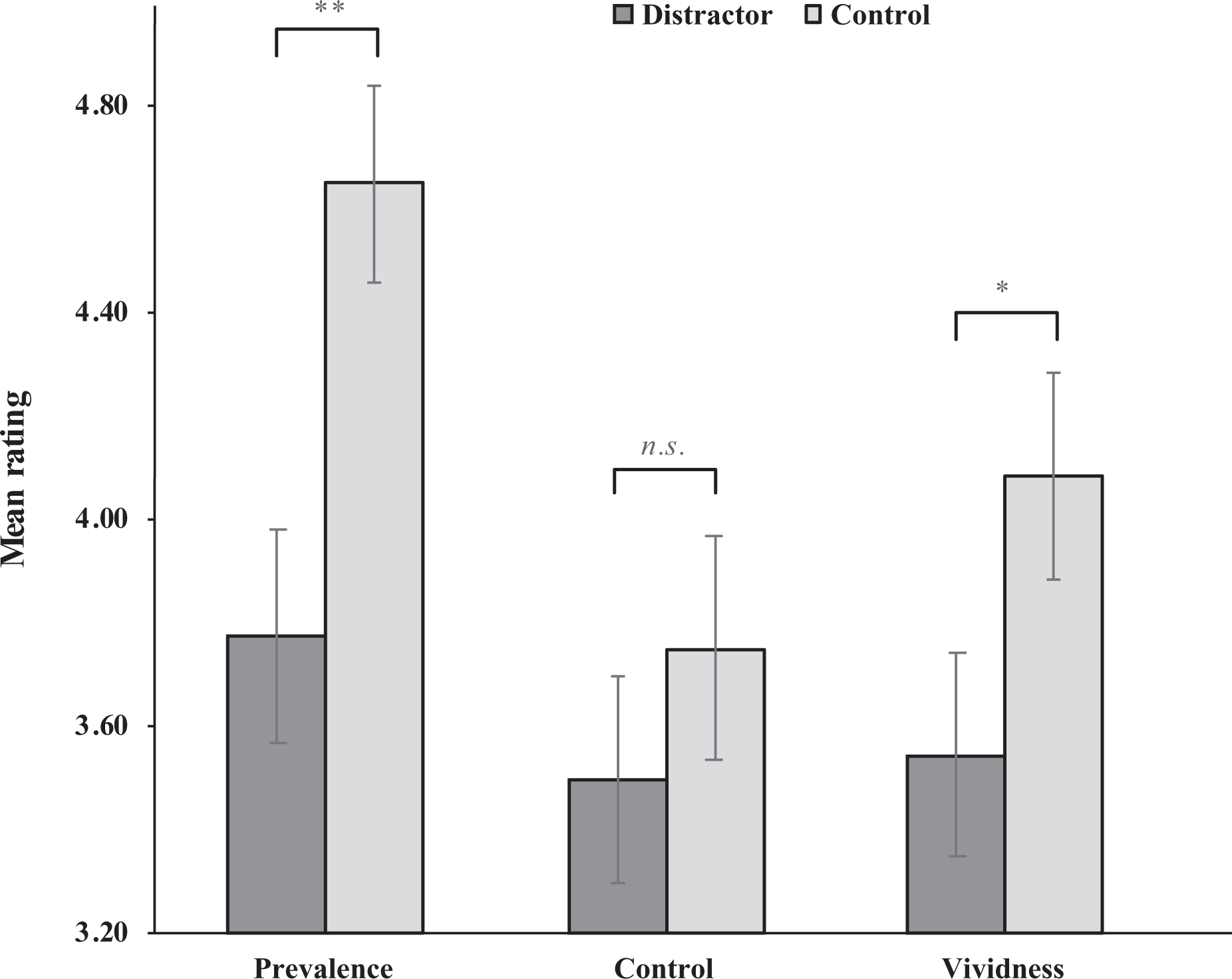
Mean ratings (± standard error of the mean) of self-report VMI items, PCI-Prevalence, PCI-Control and PCI-Vividness, grouped by the Distractor and Control conditions. Prevalence and Vividness showed significant differences between groups after Bonferroni correction, with lower ratings of each item in the Distractor condition. Control showed a similar trend but did not reach significance. * *= p < .001, * = p < .0167, n.s. = non-significant.
Music-Induced Emotion Ratings
A repeated measures MANOVA was conducted to compare ratings on the GEMS-9 items between conditions (see Figure 2). There was no significant difference in GEMS-9 items between the two Conditions, F(9, 26) = 1.63, p = .159, Wilk’s Λ = .64 (Distractor task: M = 2.26, SE = .080; Control task: M = 2.36, SE = .077). Bonferroni-corrected univariate tests showed a significant difference between Conditions for the GEMS item Nostalgia, F(1, 34) = 9.13, p = .005, partial η2 = .21. There were no significant differences between Conditions for the remaining GEMS items, Wonder, F(1, 34) = .91, p = .347, Transcendence, F(1, 34) = 2.05, p = .162, Power, F(1, 34) = .805, p = .376, Tenderness, F(1, 34) = 3.6, p = .066, Peacefulness, F(1, 34) = 6.41, p = .016, Joyful Activation, F(1, 34) = .334, p = .567, Sadness, F(1, 34) = 2.84, p = .101, and Tension, F(1, 34) = .346, p = .560.

Mean ratings (± standard error of the mean) of self-report GEMS-9 items for felt emotion, grouped by the Distractor and Control conditions. One item, Nostalgia, showed a significant difference between groups after Bonferroni correction, with lower ratings shown in the Distractor condition. The remaining items showed a similar trend but did not reach significance. * = p < .006.
General Imagery Abilities
A Pearson correlation coefficient was implemented to examine the correlation between general imagery abilities on the VVIQ and the three VMI items. The VMI ratings of the musical stimuli from the pilot study and the control condition of the current study were pooled together, resulting in a sample of 69 participants. Cronbach’s Alpha analysis showed a reliability level of α = .86. There was a significant positive correlation between the VVIQ ratings (M = 3.76, SD = .60) and PCI-Prevalence (M = 4.3, SD = 1.29), r = .53, p < .001, and PCI-Vividness (M = 3.8, SD = 1.27), r = .52, p < .001. There was no significant correlation between the VVIQ and PCI-Control (M = 3.85, SD = 1.26), r = .19, p = .115.
Discussion
The primary aim of the current study was to investigate whether a visuospatial task would be successful in suppressing the formation of VMI, and if this would attenuate music-induced emotion during music listening. As a secondary analysis, we aimed to explore the extent to which the VMI ratings provided in response to the PCI subscales would be correlated with general imagery abilities obtained from the VVIQ. As hypothesised, the eye-movement suppression task significantly reduced ratings of VMI and significantly reduced music-induced emotion ratings for one GEMS item, Nostalgia, when compared with the control condition.
The current findings – whereby overall ratings of VMI were reduced in the distractor condition compared with the control condition – are in line with previous research within the domain of clinical psychology (Holmes et al., 2010; James et al., 2015; Kemps & Tiggemann, 2007; van den Hout et al., 2001). The prevalence of VMI ratings showed the most dramatic reduction in response to the eye-movement task, closely followed by suppression of the vividness of imagery. The control of imagery showed the least reduction (see Figure 1) and the difference observed did not reach significance, which may be attributed to the difficulty in assessing the controllability of one’s own imagery. Similar trends were shown for the majority of the GEMS-9 items, with ratings in the distractor condition being lower than those in the control condition including one item reaching significance (see Figure 2). This confirms the feasibility of using saccadic eye-movements to restrict VMI formation. In addition, our pooled sample demonstrated that the VVIQ ratings were significantly correlated with prevalence and vividness of VMI, but not correlated with control of VMI, confirming our secondary prediction. Participants’ ratings of VMI control might not exhibit enough consistency to be accounted for by general imagery ability on the VVIQ. However, these findings provide support for further examining vividness as a salient feature of VMI (Küssner & Eerola, 2019).
One might consider why the ‘control’ component of VMI component has not received nearly as much emphasis as vividness in research. In a factor analysis including nine imagery questionnaires, Lorenz and Neisser (1985) identified Vividness and Control as an imagery factor, along with Spatial Manipulation, Spontaneous Elaboration, and Childhood Memories. Richardson (1977) defines control of imagery as the ability to alter or replace an image at will. However, in his own factor analysis of a multitude of imagery questionnaires, he found that most questionnaires often have diverging definitions of the term, as opposed to vividness, which is usually more consistently used. Whilst the disputes surrounding control may reflect the relatively nascent stage of VMI research, there are pertinent issues surrounding this particular item, as notably demonstrated in our own findings. The control item used here asked participants to relay whether their imagery was spontaneous or whether they purposely meant to conjure VMI, which is a question that may seem counterintuitive to ask and may even blur our intention to measure voluntary or involuntary VMI. Nevertheless, participants had difficulty communicating this detail of their imagery, necessitating a more rounded assessment of the components that make up VMI.
In relation to previous clinical research, we illustrate the need to further examine the claim of modality-specific interference. Whilst the current study confirmed the intrusiveness of saccadic eye-movements on VMI, can the same be said about other types of disruptive tasks? Several previous researchers have found successful effects of other types of visuospatial tasks, as well as primarily visual or spatial tasks. In order to investigate varying degrees of visuospatial demand, Holmes et al. (2004) have accounted for possible attentional mechanisms by including a condition in which their visuospatial tapping task was over-practised prior to carrying out the main task. However, what our current findings do not rule out is the possibility that VMI was reduced due to a general attentional effect. The differential effects of various distractor tasks on the subsystems of working memory have been demonstrated in previous research (Stuart et al., 2006), but this is yet to be confirmed whilst taking part in music listening tasks. Thus, the act of interfering with the formation of visual images is mostly characterised by the competition for limited cognitive resources (Johnston et al., 1972; Murdock, 1965). The majority of previous research has focused on interfering with previously encoded memories (Holmes et al., 2004). Conversely, some researchers suggest that rapid horizontal eye-movements possess the potential to enhance memory retrieval due to stimulation of the visuomotor and somatosensory systems from the alternating stimulation of the brain hemispheres (Nieuwenhuis et al., 2013; Propper & Christman, 2008). Others have found more tenuous results and implicate the potential influence of handedness (Lyle & Martin, 2010), which we did not assess. Whilst these findings appear to differ from the principles underlying the current research, it should be noted that the positive memory effects found have often been applied to semantic memory through word recall and so may not reflect the same additive effects of cognitive overload in the same modality. Moreover, the extent to which these same principles can be fully extended to music-induced VMI is still in need of further investigation, especially with regard to the voluntary or involuntary nature of VMI reports and the thematic content of the VMI descriptions.
It is possible that the emotionality of an image may not only be connected to the existence of the image, but also to its vividness. Studies will often only ask participants to report on the vividness of their imagery (Gur & Hilgard, 1975; Rodway et al., 2006; Sheehan, 1967), as this tends to imply the presence of imagery. Pearson et al. (2011) found that participants can successfully evaluate their own VMI when asked to rate the vividness of an imagined visual pattern before being presented with a perceptual ocular task. They conclude that the effort expended to create mental images tends to facilitate increased introspection.
To what extent can similar aims be applied to other underlying mechanisms of emotion? Some have already considered such questions. Miu and Balteş (2012) manipulated cognitive empathy by asking participants to listen to a sad aria and a happy operatic song with either high empathy (imagining the feelings of the performer and trying to feel them) or low empathy (taking an objective and unaffected view of the performance). They found emotional response related closely to the emotion content of the music, with increased feelings of nostalgia towards the sad aria, and increased feelings of power towards the happy operatic song. Such a design demonstrates a novel approach for investigating a potentially causal link between empathy and music-induced emotions and has provided further implications into the differential effects that music conveying different emotions can have on subsequent induced emotion. This is not the first study to effectively incorporate manipulation methods in uncovering multiple underlying mechanisms for music-induced emotions (Juslin et al., 2013, 2015), emphasising the plausibility of opening up further investigations into VMI alongside additional mechanisms from Juslin’s (2013) BRECVEMA framework.
Such manipulations can extend to examining the significance of physiological or experiential responses to music. In a recent novel investigation by Bannister and Eerola (2018), chills experiences were manipulated by removing pre-established chills sections from three musical pieces. Using continuous self-reported chills and skin conductance (SC) measurements, they found a significant decrease in chills responses in the manipulated pieces, with some inconsistent decreases in SC measurements, but not necessarily any significant changes in the emotional experience. The studies that have employed manipulation techniques previously suggested by Juslin et al. (2013) are broadening our understanding of music-elicited emotions, and these methods can considerably guide and supplement other applications involving music as therapy (Bradt et al., 2015). In order to aid such treatments, Daly et al. (2015) sought to formulate a model that predicted the type of emotion induced within the listener according to their neural activity using electroencephalogram (EEG) recordings, and the acoustical features of the music, demonstrating 20% of variance explained with significant accuracy.
Limitations and future directions
The implication of a link between VMI and induced emotion from the current results stems from observing robust effects of suppression in both variables. In order to make more conclusive remarks regarding the mechanisms that underlie emotion, it would be fruitful to incorporate an analysis that accounts for the variance posed by VMI on emotion. Not only would this strengthen claims involving the relationship between these variables, but it would also leave room to consider other mechanisms and adjust the methodology accordingly. In addition, this would ultimately shed light on the direction of the relationship, which some have already clarified is at least bi-directional whilst undertaking certain tasks (Holmes & Mathews, 2005; Mammarella, 2011), but further investigation is still needed.
The current study demonstrated the effectiveness of using visuospatial distractor tasks within the context of music research. However, only one example of one type of distractor task was utilised here, and explorations into other types of distraction tasks may help extend research methodology and corroborate the current findings. In addition, trialling tasks comprising different modalities (e.g., visual: McConnell & Quinn, 2004; spatial, Quinn, 1994; verbal: Brooks, 1967, 1968) would determine the effectiveness or limitations for matching certain tasks with certain types of imagery or emotional mechanism.
It would be useful to investigate the types of VMI that participants are experiencing. Evidence on this is highly limited, but those available demonstrate significant potential. In a recent investigation, Küssner and Eerola (2019) identified Vivid and Soothing factors of music-elicited VMI that contain a variety of concrete and abstract types of imagery and show interweaving links with music-elicited emotion. Further exploration into the types of imagery that are experienced in response to different styles of music may supplement such investigations and are an appropriate pre-requisite to researching VMI. As the authors of the aforementioned paper note, the next important step would be to support a causal link between music, VMI, and emotion induction, which the current study can serve as a preliminary first attempt.
Likewise, future research might focus on inspecting certain emotions that seem to be suppressed more easily, rather than the wider exploratory approach taken in this investigation. Interestingly, several studies have suggested different mechanisms that are involved in mediating the process of enjoying sad music (Vuoskoski & Eerola, 2012), such as empathy (Eerola et al., 2016; Vuoskoski et al., 2012) and feelings of being moved (Vuoskoski & Eerola, 2017). Therefore, we might find distinct interactions that can be polarised according to the valence of the music as well as our subsequent reaction to it, and may even bring into question the involvement of aesthetic emotions, such as awe and being moved (Brattico et al., 2013; Juslin, 2013; Konečni, 2005).
In addition to this, a contrasting approach to the one taken here might involve amplification of the VMI mechanism. For example, using a narrative mode of amplification, Vuoskoski and Eerola (2015) suggest that giving their participants contextual information of a piece of music promoted VMI that led to a heightened emotional response, with participants reporting up to 80% of relevant VMI. Non-musical investigations also support this approach. Renner et al. (2019) suggest that imagery can be used to motivate the productivity levels of an individual. This is compatible with Holmes et al.’s (2008) theory that imagery acts as an emotional amplifier of anxiety within a specific clinical population, providing further implications for how this may be applied to amplify positive affective states within therapeutic settings.
Conclusion
Taken together, we have shown that an eye-movement visuospatial task is effective in reducing instances of VMI in response to short film excerpts of music, with similar, albeit slight, reductions in music-induced emotion ratings. Despite the several possible factors that might explain the nature of the suppression effects found here, we have been able to provide an initial practical approach into unpacking the causal link between VMI and music-induced emotion. There are a diverse range of possible pathways and many open questions related to imagery, which would further benefit from the exploration of the attentional processes that a suppression task is likely to involve while conjuring music-induced VMI.
Footnotes
Action Editor
Alexandra Lamont, Keele University, School of Psychology.
Peer Review
Amy Belfi, Missouri University of Science and Technology, Department of Psychological Science.
Sara Spotorno, Keele University, School of Psychology.
Author Contribution
SH, LS and MBK conceived the design of the study. SH was involved in participant recruitment, data collection and data analysis. SH wrote the first draft of the manuscript. LS and MBK critically reviewed and approved the final version of the manuscript.
Declaration of Conflicting Interests
The author(s) declared no potential conflicts of interest with respect to the research, authorship, and/or publication of this article.
Funding
The author(s) received no financial support for the research, authorship, and/or publication of this article.
