



Abstract
Synesthesia is a perceptual and conceptual phenomenon that has been linked to a heightened capacity for mental imagery. However, our understanding of music-related types of synesthesia and mental imagery is still in its infancy. This study therefore aims to examine the relationship between music-related types of synesthesia and mental imagery in a sample of synesthete musicians. Four forms of data collection were employed: an online survey, a synesthesia test battery, an absolute pitch test, and a semi-structured interview. This article focuses on results obtained in response to open-ended questions relating to synesthete musicians’ mental imagery. An analysis of the interview data revealed heightened vividness of auditory imagery (AI), including the ability to control the speed, dynamics, and intensity of the imagery. A bidirectional analysis of the functional relationship between AI and synesthesia ascertained that multimodal mental imagery (MMI) could be triggered by AI, thus bypassing the need for sensory stimulation. Furthermore, cases of complex visual imagery (CVI) were confirmed to meet the synesthetic criteria of being automatic and involuntary, as well as being consistent and stable mappings between specific musical stimuli and CVI. These findings are noteworthy as they call into question the general assumption that synesthetic percepts are generic and simple in nature. Together, these findings contribute to our understanding of music-related types of synesthesia and mental imagery, challenge contemporary understanding of certain categorical aspects of music-related synesthetic percepts, and provide us with a deeper understanding of the nature of cross-modal associations in general.
Keywords
Introduction
Synesthesia is a perceptual and conceptual phenomenon that has been linked to a heightened capacity for mental imagery (Barnett & Newell, 2008; Chiou et al., 2018; Chun & Hupé, 2016; Mealor et al., 2016; Meier & Rothen, 2013; Spiller et al., 2015). However, our understanding of music-related types of synesthesia and mental imagery is still in its infancy. This study therefore aims to examine the relationship between music-related types of synesthesia and mental imagery in a sample of synesthete musicians. As certain aspects of mental imagery may be associated with particular types of synesthesia (Price, 2009; Simner, Mayo, & Spiller, 2009), this study focuses on music-related types of synesthesia to allow for a consideration of mental imagery within this specific group.
In synesthesia, the stimulation of one sensory or cognitive pathway leads to an automatic, involuntary experience in a second sensory or cognitive pathway (Cytowic, 1989, 2002). It is a variation of experience that affects approximately 2–4% of the general population (Simner et al., 2006b; Carmichael et al., 2015, 2019); while rare, it does occur more frequently in populations of arts professionals, including musicians, and people engaged in the creative industries (Lunke & Meier, 2019; Ramachandran & Hubbard, 2001; Rich, Bradshaw, & Mattingley, 2005; Rothen & Meier, 2010). In synesthesia, the triggering stimulus is known as the inducer, while the resultant synesthetic experience is referred to as the concurrent (Grossenbacher, 1997). For example, in music-color synesthesia, music (the inducer) would result in the experience of color (the concurrent). Synesthesia can be described as perceptual, in which the inducers are sensory stimuli (such as music), or conceptual, where the concurrents are induced by perceiving particular concepts (such as numbers) (Grossenbacher & Lovelace, 2001; Robertson & Sagiv, 2005).
People with synesthesia are referred to as synesthetes, and the range and variety of their experiences is vast. Indeed, there are currently at least 75 documented types of synesthesia, with the majority of these types (between 82% and 88%) triggered by language units such as graphemes, phonemes, and words (Niccolai et al., 2012; Simner et al., 2006a; 2006b). However, for the purposes of this study, the focus is on music-related types of synesthesia. There are a wide range of music-related types of synesthesia that have been documented, with a range of types of inducers, such as musical notes, musical keys or tonalities, and musical instrument sounds (Day, 2005, 2022; Glasser, 2018). Synesthetes report experiencing not just color, but shape, movement, and texture, in response to music, as well as flavor, smell, or any number of other perceptual or sensory concurrents (Glasser, 2018; Mills et al., 2003). The most widely studied and documented type of music-inducing synesthesia is—broadly defined—music-color synesthesia. Estimations on the prevalence of music-color synesthesia within the synesthete population vary considerably, ranging from 18.7% (Barnett et al., 2008), 25% (Rich et al., 2005), to 41% (Niccolai et al., 2012). Regardless of the exact prevalence, music-related types of synesthesia remain under-researched in relation to other types of synesthesia, leading to calls for future studies to address their development, and move beyond a focus on the most commonly studied ordinal types of synesthesia, such as grapheme-color synesthesia (Hubbard, 2007; Meier & Rothen, 2015). Since these statements have been made, several researchers have taken up the challenge and are beginning to address this imbalance (see, for example, Curwen, 2018, 2022a, 2022b; Glasser, 2016, 2018, 2021; 2022; Itoh & Nakada, 2018; Itoh et al., 2017, 2019; Lima, 2019).
Historically, diagnosing synesthesia has met with several challenges (Simner, 2012), and the subjective nature of synesthesia and its idiosyncrasy make it difficult to place within general scientific taxonomy (Hochel & Milán, 2008). An initial series of diagnostic criteria was introduced by Cytowic in 1989, which has since undergone revisions to incorporate evidencebased changes in current understanding of the synesthetic phenomenon (Cytowic, 1989, 1993, 2002). Current thinking now also reflects a shift from considering these criteria as diagnostic, to them having a more categorical role. The current five criteria (2002) considered when categorizing synesthesia are that synesthesia is:
involuntary and automatic consistent and generic spatially extended memorable affect-laden.
Of the five criteria, only the first two are currently accepted to describe the essential features of the synesthetic phenomenon and are therefore the most widely accepted within the scientific community (Hochel & Milán, 2008; Simner, 2012; but see Ward & Mattingley, 2006, for a discussion of considering reliability over time—consistency—as an associated characteristic of synesthesia rather than an a priori defining one). The remaining three criteria are suggested to represent characteristics that are observed to a greater or lesser degree in the overwhelming majority of cases of synesthesia, without necessarily being present in every case (Hochel & Milán, 2008). When considering the experiences outlined in this study, special focus will be given to the involuntary, simultaneous, and automatic appearance of the synesthetic percepts, as well as their consistent and generic nature. Indeed, it is the second concept iterated within the second criteria (‘generic’) that is of most interest in relation to mental imagery, as it suggests that to be classified as ‘synesthesia’, percepts must be generic and limited, in the sense that they are not elaborate or pictorial (Cytowic, 1989). Current thinking around synesthetic percepts suggests that they correspond to basic perceptual qualities—often colored—such as lines, spirals, blocks, grills, or geometric forms. It is suggested that this generic and limited aspect to the percepts, in addition to their consistency and durability, sets synesthesia apart from other phenomena such as psychotic hallucinations (Hochel & Milán, 2008). These criteria will be of importance in considering the cases of visual and auditory imagery outlined in this article; furthermore, this current conceptualization of the generic and limited framing of the synesthetic phenomenon, as it pertains to music-related types of synesthesia, will be challenged by the current study.
Even though most humans are not necessarily conscious of it, mental imagery is an integral component of everyday perceptual processing. Mental imagery can be defined as perceptual processing that is not triggered by corresponding sensory stimulation in a given sense modality, where the representation of sensory information is formed without direct external stimulus (Nanay, 2018; Pearson, Naselaris, Holmes, & Kosslyn, 2015). Within the framework of mental imagery, two subgroups can be delineated: unimodal and multimodal mental imagery.
Unimodal mental imagery refers to perceptual processing in a particular sense modality, without corresponding sensory stimulation of that same sense modality. Both visual and auditory imagery (VI and AI respectively) fall into this category, as they refer to conscious or unconscious visual or aural activation, lacking a perceptual trigger (direct visual or auditory perceptual input). Involuntary musical imagery (INMI), also known as ‘earworms’, is the experience of having a melody or tune continuously repeat in one's mind without conscious effort or control, and is a commonly experienced form of unimodal mental imagery. While higher self-reported levels of visual imagery (VI) in synesthesia have been previously reported (Barnett et al., 2008; Price, 2009), there is a paucity of research examining the levels of auditory imagery (AI) in synesthete populations. To examine this question from an auditory perspective, the synesthete-musicians in this study were asked to indicate the intensity of their AI, and a discussion of these results is undertaken.
Multimodal mental imagery (MMI), on the other hand, refers to mental imagery that, while not triggered by direct stimulation of the sense modality in question, is triggered by sensory stimulation of a different sense modality (Nanay, 2018). The majority of our encounters with everyday objects and events are multisensory, and it therefore follows that MMI is equally as common. Multimodal mental imagery can take on a number of forms, and includes the ability to mentally generate sensory experiences that involve more than one modality, such as imagining a vivid scene or scenario while listening to a piece of music. One specific form of perceptual phenomena that falls into the category of MMI, and which is of particular interest to this study, is synesthesia. While MMI more broadly involves the voluntary and deliberate generation of sensory experiences that involve multiple modalities, synesthesia involves the involuntary and automatic perception of a sensory modality in response to stimuli in another modality. Focusing on synesthesia as an idiosyncratic form of MMI supports an increase in our understanding of the synesthetic phenomenon, as well as provides a rationale for the focus in this article on an exceptional and distinct example of synesthesia as MMI: that of complex visual imagery (CVI). Cases of involuntary CVI in response to auditory (musical) stimuli reported by participants in this study will be examined.
While all these phenomena involve mental experiences related to music and/or sensory perception, the key differences lie in their specific characteristics and underlying mechanisms. For example, while synesthesia for music involves automatically and involuntarily experiencing additional sensory information (e.g., seeing colors) in response to music, musical mental imagery (a form of AI) involves hearing music in one's head without any external auditory input. Furthermore, synesthesia for music involves cross-activation between different sensory regions in the brain, while musical mental imagery involves the activation of auditory regions without any external stimulation. What all of these phenomena share, however, is that they involve the mental representation or perception of music without being triggered by corresponding sensory stimulation.
Given the similarities between their phenomenological experiences, it is not difficult to appreciate why synesthesia and mental imagery are frequently compared. However, the relationship between synesthesia and mental imagery remains nuanced and unclear. What we do know about synesthesia and mental imagery is that links have been found in multiple domains, particularly when focusing on grapheme-color synesthesia; people with this specific type of synesthesia have been found, for example, to score significantly higher than controls on visual imagery measures (Barnett & Newell, 2008; Chiou et al., 2018; Chun & Hupé, 2016; Mealor et al., 2016; Spiller et al., 2015). The question remains, however, as to the role of referral bias, as most studies have tended to test self-referred synesthetes; vivid visual imagery may therefore be a characteristic of certain synesthetes, but not others (Simner, 2013). It has furthermore been argued that it is more likely that a heightened capacity for mental imagery supports the development of synesthesia, rather than synesthesia being causally linked to heightened imagery (Price & Pearson, 2013; Ward, 2021; Ward & Filiz, 2020). While there is clear evidence that vivid mental imagery and synesthesia are intimately related, the directionality of the effect, or indeed the potential causality, remains uncertain (Dance et al., 2021).
Research interest in synesthesia spans more than a century, yet despite the longevity of this interest, the reality of the phenomenon, and its automatic and involuntary nature, its measurable perceptual consequences have only recently been demonstrated (Hochel & Milán, 2008; Hubbard & Ramachandran, 2005; Jewanski, Day, & Ward 2009). Indeed, while tests exist to measure and categorize certain types of synesthesia, no battery of tests currently exists that encompasses the full range of music-related types of synesthesia; music and auditory related types of synesthesia therefore remain in the infancy of their research potential (Glasser, 2020, 2021). Examining the connection between music and mental imagery in the synesthete population not only contributes to our understanding of the uniquely complex perceptual and conceptual phenomenon of synesthesia, but also provides us with a deeper understanding of the nature of cross-modal associations in general (Taruffi & Küssner, 2019).
Method
Participants
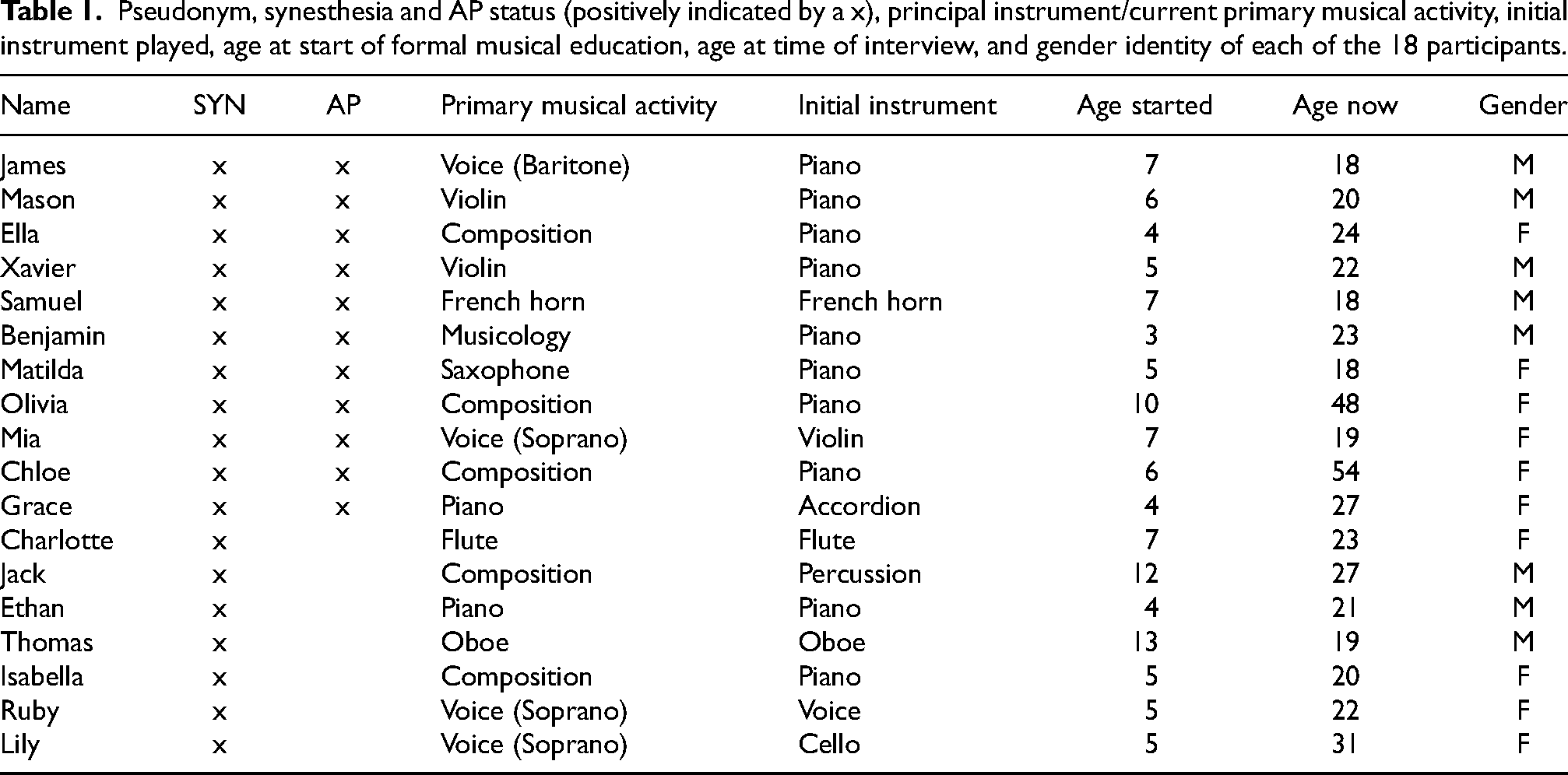
Participants were drawn from the population of staff and music students within the Melbourne Conservatorium of Music (MCM), the University of Melbourne. The MCM is the largest and most comprehensive music program in Australia, and has a student population who are both musically skilled and intellectually distinguished. Participants were recruited through word of mouth. The total number of participants recruited was 18, consisting of 1 academic staff member and 17 students. Of the 18 synesthete participants in this study, 11 also have absolute pitch (AP). Participant characteristics are described in Table 1.
Pseudonym, synesthesia and AP status (positively indicated by a x), principal instrument/current primary musical activity, initial instrument played, age at start of formal musical education, age at time of interview, and gender identity of each of the 18 participants.
All participation was voluntary, and the University of Melbourne human ethics committee approved this research (ID. 1340162). Written informed consent was obtained prior to any study activities, and was obtained for inclusion in the study, the collection of data, and dissemination and publication of the results. Participants were not renumerated for their participation.
Procedure and Materials
Four forms of data collection were employed. Participants were invited to undertake an online survey aimed at gathering background information to assist with the study, followed by a test battery to measure, categorize, and confirm synesthesia. As synesthesia and absolute pitch (AP) are two uncommon cognitive phenomena that have been anecdotally reported to occur together in individuals (Bernard, 1986; Gregersen et al., 2013; Hänggi et al., 2008), the synesthetes in this study were also invited to undertake an AP test. Finally, a semi-structured interview was conducted with each participant with confirmed synesthesia.
Potential research participants were initially asked to complete an online survey, where a brief description of synesthesia was given. Participants were first questioned as to whether they possess synesthesia, and could answer yes, no, or unsure, to this question. Participants were also asked to indicate what type or types of synesthesia they experienced, and whether these perceptual experiences had always been present. People with synesthesia are often unaware of the fact that what they experience differs from typical perception, and that it is labelled ‘synesthesia’. For this reason, all potential participants were asked to read through an itemized list of the 63 types of synesthesia that had been catalogued to date; participants were asked to place a tick in the box next to the type(s) of synesthesia they experienced. They were given the option of either a ‘yes’ or ‘unsure’ response. If they were sure that they did not have a particular type, they were instructed to leave that type blank.
Participants who indicated in the online survey that they did have, or were unsure if they had, at least one type of synesthesia (n = 18), were invited to complete The Synesthesia Test, a unified collection of tests that includes a survey and several online software programs and is freely available online at www.synesthete.org (Eagleman et al., 2007). In The Synesthesia Test, genuineness of synesthetic experiences is verified by means of a test of consistency, where participants are asked to match concurrents to inducers (for example, colors to musical tones in the case of a participant with tone-color synesthesia). This task is repeated in a randomized manner across three separate trials for each type of synesthesia (Eagleman et al., 2007). This test battery has been demonstrated as a valid measure of synesthesia, and the consistency with which this test battery measures synesthetic concurrents is an indication of the test's reliability. Because of technological limitations, however, it is currently impossible to test for certain types of synesthesia (for example, types of synesthesia that incorporate taste, smell, orgasm, or tactile sensations). As all participants in this study had at least one type of testable music-related type of synesthesia (such as musical note–color or musical instrument sound–color), the online synesthesia test available at www.synesthete.org (Eagleman et al., 2007) remained a valid testing option for the purposes of this study. Participants who indicated they experienced certain types of music-related synesthesia that were not testable using current consistency tests (such as musical note–flavor or musical instrument sound–flavor), were asked to provide further information during the interview process; these descriptive self-reports form part of the analysis of their synesthetic percepts. In this study, 14 music-induced types of synesthesia were reported, with the four most prevalent being musical note–color (n = 14; 77.8% of synesthetes), key or tonality–color (n = 13; 72.2% of synesthetes), and in equal third place instrument sound–color (n = 11; 61.1% of synesthetes) and general musical sound–color (n = 11; 61.1% of synesthetes) (see Table 2).
Prevalence of types of synesthesia: List of the 14 types of music-induced synesthesia reported by the 18 synesthete participants in this study.
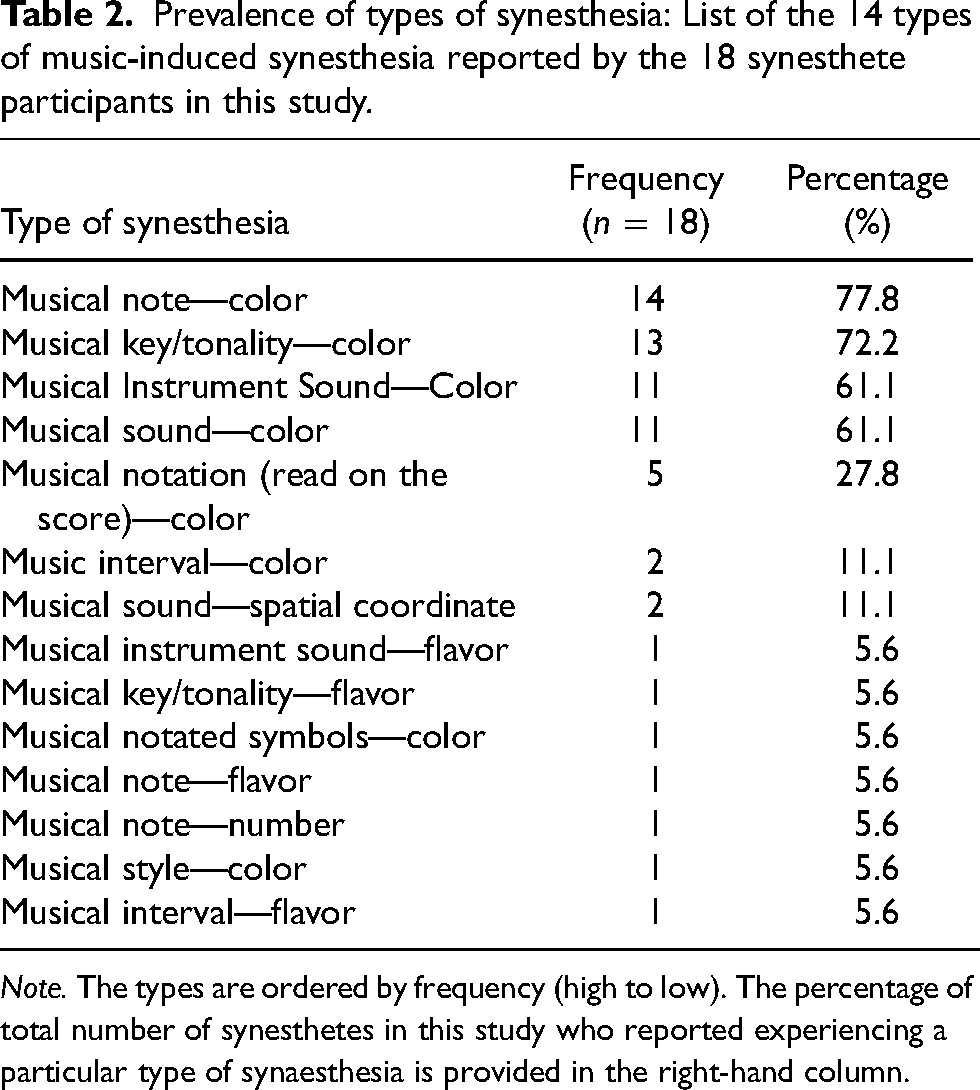
Note. The types are ordered by frequency (high to low). The percentage of total number of synesthetes in this study who reported experiencing a particular type of synaesthesia is provided in the right-hand column.
All participants were invited to undertake a two-task AP test devised by the author. The first task was developed to measure the recognition accuracy of piano tones, and was modelled on previous tests by Baharloo and colleagues (1998), Deutsch and colleagues (Deutsch et al., 2009; Deutsch et al., 2006), and Wilson and colleagues (Wilson et al., 2009, 2012). For this study, the participants were presented with a set of 36 notes spanning a three-octave range between C3 (131 Hz) and B5 (988 Hz). The stimuli were piano tones generated on a synthesizer tuned to A4 = 440 Hz. The lowest and highest octaves of the piano were omitted. Tones were played in a pseudorandom order, but in order to minimize the use of relative pitch as an aide, successive tones were separated by an interval larger than an octave. The tones were digitally recorded and edited to have uniform durations of 500 ms, with 2.5 s response time between tones (1 stimulus = 3 s). Because of the automatic nature of AP, AP possessors are not only more accurate, but are also much faster at pitch identification than relative pitch possessors (Dooley, 2011). The response window was therefore kept short to minimize accurate pitch naming based on relative pitch judgments (Wilson et al., 2012). The second task was developed to measure the recognition accuracy of pure tones. This task was identical to the precedent task in number and duration, although the ordering of tones was different. Pure tones were digitally synthesized. Tones of different frequencies were synthesized with different amplitudes, to equalize perceived loudness. Sine-wave tones had frequencies corresponding to the 36 musical notes from C3 to B5, on the basis of A4 = 440 Hz. Each tone had a duration of 500 ms, with 2.5 s response time between tones (1 stimulus = 3 s). The scoring of the AP test was modelled after Wilson et al. (2012); participants who obtained a total number of correct responses above 80%, for both piano and pure tone tasks, were classified as AP possessors, while those who scored between 20–80% correct responses were classified as quasi absolute pitch (QAP) possessors (Wilson et al., 2012). As QAP is regarded as a weak form of AP, and this study is primarily focused on the lived-world experiences of musician synesthetes, both AP and QAP possessors are treated equally within the analyses and discussion of results.
Semi-structured life world interviews were conducted by the author with all 18 participants. This type of interview is defined by Kvale and Brinkmann (2009) as “an interview with the purpose of obtaining descriptions of the life world of the interviewee in order to interpret the meaning of the described phenomena” (2009, 3). Interviews were scripted according to a sequence of themes—however, the semi-structured nature of the interview ensured openness in the form and sequence of the questions asked—with the possibility of following-up and re-examining responses given by the interviewee (Spradley, 1979). During the interview, participants were asked questions relating to their earliest memories of their synesthetic percepts, general questions relating to the type(s) of synesthesia they experience, and the impact of synesthesia on their creativity and musicianship, musical abilities, performance, and motivation. Participants were specifically asked questions relating to their visual and auditory imagery, such as ‘How vivid is your musical imagery?’ and ‘How vivid is your visual imagery?’, as well as secondary questions such as ‘Do you ever feel that your musical imagery would block out external noises?’, as well as questions relating to whether their visual imagery was as strong as their musical imagery, or vice versa, as guided by their responses. Interviews were digitally audio-recorded with participants’ permission and were on average 1:23:57 in duration (range:
Data Analysis
Given the narrative approach employed in the design and execution of the interviews in this study, an eclectic bricolage form was chosen for the analysis of the interview transcripts (Kvale & Brinkmann, 2009). Bricolage is a common form of interview analysis that differentiates itself from more systematic analytical techniques such as coding and categorization (Kvale & Brinkmann, 2009), and describes a form of interview analysis that incorporates a mixture of ad hoc techniques and conceptual approaches to generate meaning from a large body of transcripts. The recorded interviews were initially listened to, and the interview transcripts were initially read in full, to obtain an overall impression and ensure a deep familiarity with the content of the interviews (Braun & Clarke, 2013, 2019, 2020, 2021). During this stage, reflexivity was practiced to ensure critical self-inquiry enabled the identification of the potential impact of positionality on any subsequent interpretations (Braun & Clarke, 2013, 2019). Following on from this initial stage, a deep analysis of identified passages and statements of interest was undertaken. Interview statements were categorized to facilitate the comparison of a large number of transcripts while providing an overview of the data collected. Meaning generated from these sections was portrayed through a combination of participants statements, descriptive statistics, and figures. Miles and Huberman (1994) compiled a list of ad hoc methods for qualitative data analysis which included techniques such as noting patterns and themes, clustering, counting, noting relations between variables, and finding intervening variables. Meaning was therefore generated through these interview transcripts by employing these techniques, with the results arranged from the descriptive to the explanatory, and from the concrete to the more conceptual and abstract (Kvale & Brinkmann, 2009).
Results
This article centers on the results obtained in response to open-ended questions relating to synesthete musicians’ mental imagery. Imagery was an unexpectedly prevalent topic of discussion during the interview process, and one that was often elaborated on by the participants themselves. Due to the frequency with which it was discussed and based on prior research that has highlighted the link between imagery and synesthesia (Barnett & Newell, 2008; Chiou et al., 2018; Chun & Hupé, 2016; Mealor et al., 2016; Spiller et al., 2015), this article assesses the role of synesthesia on unimodal and multimodal mental imagery. In the following analyses of the results, unimodal mental imagery (UMI) and multimodal mental imagery (MMI) are examined separately. First, the influence of synesthesia on the enhancement of one form of UMI—auditory imagery (AI)—is investigated. Second, in the context of MMI, the functional relationship between synesthesia and AI is explored. This includes an investigation of the capacity for AI to induce synesthetic percepts. Furthermore, a case study of AI potentially induced by synesthesia is analyzed. To conclude, this section presents unexpected data from four case studies, demonstrating examples of complex visual imagery (CVI) induced by musical stimuli.
As noted in the data analysis section of this article, a bricolage analysis method was applied to investigate the connection between synesthesia and mental imagery. As such, the reporting of results is arranged by moving from descriptive to explanatory and from concrete to conceptual, as recommended by Kvale and Brinkmann (2009).
Unimodal Mental Imagery
Participant responses to the question “How vivid is your auditory imagery?” were categorized into three of a possible of five levels. The three self-reported levels of auditory imagery (AI) from synesthetes in this study are outlined in Table 3. Labelling of both ‘extreme’ and ‘strong’ levels of vividness occurred when participants indicated that their AI was “as strong” as hearing music externally (live or recording): the differentiating characteristic between the two levels was that participant's AI was labelled as ‘extreme’ if they indicated their AI could “block out” external sounds, whereas AI labelled as ‘strong’ could not. A ‘high’ level of AI indicated being able to hear music vividly in the ‘mind's ear’, although this level of audiation is less clear than hearing external music. A ‘low’ level of AI indicated the inability to clearly hear music internally, while an ‘extremely low’ level indicated a lack of AI; however, none of the participants in this study indicated having ‘low’ or ‘extremely low’ levels of Al.
Overall responses to the question: “How vivid is your auditory imagery?”

Given that a substantial number of synesthetes in this study also possess AP (n = 11), a comparison of the levels of AI reported by synesthetes with and without AP was undertaken. This uncovered no noteworthy differences between groups. However, of particular interest in Table 2 is the percentage of participants who described the vividness of their AI as ‘extreme’, i.e., as able to block out external sounds. Indeed, 33.3% of all participants (n = 6) indicated experiencing extreme AI. Representative quotes from these participants include: There are times where I have been thinking of music and I’ve been so lost in the sound world that it blocks out external noises. Coming back to what I was saying about me going around the playground [as a child], I think I could do that; I think I could block out the sounds of the children [pauses] with the music [auditory imagery]. (Benjamin – synesthesia and AP) It can definitely take my attention away from other external things that may be happening. (Jack – synesthesia) [speaking about auditory imagery] It's not really playing on a radio in the way that if something is playing on the radio, you can still hear other people. It's more that I can’t hear anything but it. (Ethan – synesthesia)
Analyses of reported levels of AI also sought to distinguish whether there were any factors that differentiated imagery from live or recorded performance. Participants noted two key differentiating factors: surprise and control.
Differentiation between AI and external hearing was reported as not necessarily being due to the vividness of the perceptual phenomenon, but rather by its ability to ‘surprise’, as exemplified in the following observation: “The only difference is that in the live situation, if someone else is playing, there can still be some surprises. An instrument could suddenly have a resonance that you didn’t expect or that somebody might think to turn a phrase in a way that you didn’t imagine. Other than that, the mental image of the music in my head is as strong as an actual performance.” AI was also distinguished from external hearing by the fact that the internal perception of time could be identified as differing from the external one, therefore the imagery could be sped up or slowed down at will. This sense of control over the imagery process was also highlighted through comments that participants can, for example, “turn it up” at will, thus enabling them to block out externally occurring sounds.
Participants reported their heightened AI being present since early childhood, and indeed before commencing formal musical training. Interestingly, the link between AI and AP was also made by participants with both conditions, who recall involuntarily hearing individual notes in their mind's ear prior to formal musical training, at which point they were taught what these internally heard notes were called and were able to assign associated pitch labels.
Multimodal Mental Imagery: Synesthesia and Complex Visual Imagery
As noted in the introduction to this article, multimodal mental imagery (MMI) is a form of perceptual processing that is not triggered by sensory stimulation in the same sense modality. It does, however, involve sensory stimulation from a different sense modality. The question of MMI is addressed in the following two subsections: first, with the exploration of the functional relationship between AI and synesthesia, and second, with case study analyses of reported cases of music-related complex visual imagery (CVI).
The relationship between synesthesia and AI is examined bidirectionally. First, the potential for AI to induce synesthetic percepts, thus bypassing perceptual triggers altogether, is examined. Second, the potential for synesthesia to act as a trigger for AI is investigated by examining a rare case of’ potentially bidirectional sound–color synesthesia. The second section of this exploration of MMI reports on unexpected data collected during this study concerning cases of music-related involuntary complex visual imagery (CVI). Four case study of analyses of CVI in synesthete musicians are presented, including reports of familiar and unfamiliar scenes.
Auditory Imagery Inducing Synesthesia
Three participants reported AI-induced synesthetic percepts. Of the three, two were also AP possessors. The AI of these two participants was described as consisting of musical imagery in the correct key, which subsequently induced synesthetic percepts that were typically associated with the corresponding pitch or tonality of their AP. The experience of their synesthetic percepts, however, differed for both participants: one participant asserted the AI-induced synesthetic colors would be identical to those induced by a genuine musical experience, whereas the second participant noted that the shades of AI-induced synesthetic colors were faded and lighter than sensory-induced synesthetic percepts. The third participant, who was not an AP possessor, indicated that while AI did induce synesthetic color percepts, there are instances where the AI-induced color percepts are “wrong”, i.e., there are instances where their imagery, and corresponding synesthetic color percepts, are not in the same tonality as the original musical stimuli. If the synesthete subsequently plays the music they were internally hearing and finds their AI to have been in the wrong tonality, their synesthetic color percepts immediately change to reflect the colors associated with the corrected tonality.
These three examples suggest that voluntary AI can therefore trigger corresponding MMI—in this case synesthesia—thus bypassing perceptual triggers altogether. The functional differences between multimodal mental imagery, sensory-induced synesthesia, and AI-induced synesthesia, are outlined in Figure 1.

A representation of the functional difference between multimodal mental imagery (MMI), synaesthesia (as a specific form of MMI), and imagery-induced synesthesia. In imagery-induced synesthesia (pathway number 3), synesthesia is induced without direct sensory stimulation.
Synesthesia Inducing Auditory Imagery
To examine the possibility that synesthesia could induce involuntary AI, the case of Ethan, who potentially exhibits a rare case of bidirectional synesthesia, was examined. For Ethan, not only does music induce colors, but seeing a vibrant color on a large surface directly after practicing or performing music will, conversely, induce musical imagery: I’ll play a chord or I’ll hear a chord or a melodic sequence in my head. After a while, it will stop. If I’ve been playing in D major and I see the bright color yellow, I will then have a piece – completely away from what I’ve been playing, though – playing in my head. I will probably have never played it before, or maybe played it. I don’t know. I’ll just hear this piece and it will be interesting and then it will go away in about ten minutes if I stop looking at the color.
As the consistency, stability, and duration of the AI in question all violate contemporary understanding of synesthesia, it is possible this color-music form of perceptual experience is an involuntary and vivid AI experience. The reliance of this specific case of AI on an involuntary and vivid prior genuine synesthetic experience does, however, leave this question open, as Ethan's induced musical percepts are evidently profoundly contingent on his synesthesia.
Regardless of whether this perceptual experience of music is synesthesia or imagery, Ethan described it as “incredibly vivid”, to the extent that he “can’t really focus on anything else.” Indeed, Ethan classified the experience as being more vivid than listening to real, externally generated music: “…if something is playing on the radio, you can still hear other people. It's more that I can’t hear anything but it.” Thus, like other participants, Ethan described this internal musical experience as qualitatively different and heightened.
Complex Visual Imagery
Visual imagery (such as colored percepts) induced by an auditory trigger (such as music) is one of the most prevalent documented types of synesthetic multimodal mental imagery (MMI) (Niccolai et al., 2012). In these cases, the visual imagery (VI) induced is currently reported as being generic in nature, consisting of colors and simple geometric shapes. The second categorical criteria of synesthesia, “Synesthetic percepts are consistent and generic,” is thus of particular interest to this section on MMI. Indeed, the second concept outlined in this criterion is that synesthetic percepts are “generic,” in that they correspond to basic perceptual qualities. These “form constants” (lines, spirals, blocks, grills, or geometric forms) were initially identified in the 1920s by the German psychologist Heinrich Klüver, and are not elaborate or pictorial (Cytowic, 1989; Klüver, 1928). This is an integral aspect of the synesthetic phenomenon, which sets it apart from hallucinations (Hochel & Milán, 2008).
Genuine synesthetic percepts are widely accepted as being generic in nature and lacking complex or pictorial properties. The limited nature of synesthetic percepts is thus broadly unchallenged in contemporary research. Within this study, however, four synesthete participants—Ethan, Charlotte, Matilda, and Mason—reported experiencing complex visual imagery (CVI) in response to musical stimuli. To be able to ascertain whether complex cases of VI can be viewed as valid forms of synesthetic processing, they must meet the remaining (historically) diagnostic criteria of synesthesia, that are currently considered as categorical. Of these criteria, the two most fundamental aspects are their involuntary nature, and consistency.
The first of these criteria refers to the involuntary and automatic nature of synesthetic percepts. This subsection examines cases of involuntary CVI: cases where synesthetes indicated that their percepts were complex or pictorial in nature, yet simultaneously and automatically induced by specific musical excerpts or pieces. These images are reported in all cases as being involuntary, and unable to be suppressed. As such, these complex images fulfil the first criteria. The question of their consistency is addressed within the following case studies.
The complex images reported fall into two broad categories: images of unfamiliar or familiar scenes, objects, or places. Of the four synesthetes who reported CVI, three indicated that their imagery was of places, landmarks, or objects that were unfamiliar to them. The scenes described fitted broadly into the categories of nature (sun, trees, woods, grass, leaves, flowers), objects (candles, towers, buildings), or locations (roads, intersections, crossroads). One of these synesthetes—Ethan—also described an example of an object that was familiar to him; similarly, a fourth synesthete described experiencing visual images of familiar scenes in response to musical stimuli.
Case Study 1: Ethan
Ethan possesses a rare type of projected, potentially bidirectional sound–color synesthesia. He reported his percepts are often overwhelming, and this difficulty is equally perceivable in discussion of his CVI: I’d been experiencing what felt like a blur of senses in a way that I couldn’t really focus on one or the other. I couldn’t focus on one sense. I couldn’t focus on just listening to music without seeing these colors and it got to the point where I just got really frustrated with it. It was really quite hard to focus on practicing when every time I was playing in a certain key, I’d see this color. Sometimes I’d see images of animals or flowers or something. I don’t know why. To this day, I don’t know why.
The nature scene Ethan described is present every time he plays this particular piece, and is not only “frustrating”, but also inhibiting, as the instantaneous key changes of the Sonata are accompanied by equally instantaneous ‘scene’ changes. Ethan reported being influenced by his synesthetic percepts in his interpretative decisions, and thus this lack of gradual development increases his difficulty in transitioning between sections: “I’ll find it really hard to get a gradual feeling throughout the entire piece.” In an attempt to counteract this effect Ethan made the deliberate choice to write down the colors and images he sees directly onto his scores. As notated recollections of his imagery, these representations are used to enhance his ability to play “in that mood.” Ethan has found this method to be effective in allowing him to smoothly and optimally interpret the music he is playing, and thus “all my scores are literally just covered in pencil markings of different colors, different notes and different images.”
Ethan was not aware of any connection between the music and specific imagery he sees. There was, however, one exception: This Debussy piece that I’m playing at the moment, whilst there's no color that comes with it, I always have an image in my head. I can’t remember how old I was, somewhere in the vicinity of 10 to 15 – I think earlier, 12 or 13. I went to Paris for the first time and visited Sacré Coeur [a Basilica in Paris]. Whenever I play this Debussy I always remember getting this candle from Sacré Coeur which is about this tall and this thin [indicates with hands]. It was a red candle in a glass container and whenever I play this Debussy piece, I always think of that candle. It always just comes to me. I don’t know why. I’ve never made the correlation.
Case Study 2: Charlotte
In a similar way to Ethan, Charlotte described experiencing CVI in association with her synesthetic colors. Natural elements such as flowers were also present in her imagery, and—like Ethan—she also described a field of yellow flowers; the only differentiating element between her description and that of Ethan's is that hers is induced by music in C major (and not D major). This idiosyncrasy aside, their descriptions are strikingly similar, as Charlotte explained: C major is always yellow. I might be playing something in C major and I usually get similar scenes playing in my head. It's a yellow scene but it might be looking at an open field with lots of flowers and the whole thing's sort of yellow…just like I’d see them in real life. Everything is almost like looking at a dream as well. So it's very much in my head but it's all colored slightly differently. I could listen to that and I’d see that picture but I’d also know it was yellow. Everything looks yellow! [Laughs] They’re all in these colors but it's almost like watching a movie at the same time. Quite often they’re for particular pieces of music as well…A good example is whenever I listen to “Greensleeves” [a traditional English folk song], I’m looking at my feet on the ground covered in these dark green leaves. It's almost like walking through a forest. Everything's this brownish-green color though. I have heard it transposed and it does make things strange. I’ll start with the same image but it's almost like my brain's getting lost in trying to find a different color. I remember hearing a jazz arrangement of “Greensleeves” and it was totally different. The picture changed. Everything changed to orange. It just wasn’t the same.
One final image provided by Charlotte involves a bell tower, which Charlotte indicated is a “dominant” image, and one that occurs frequently: “Other things, one that's really dominant is that I see a bell tower that's a greyish blue and there are doves coming out of it.” While regularly concomitant with her music listening, this is also the image Charlotte experiences systematically during orgasms, and thus could be argued to be emotionally meaningful for her. Like all her other imagery, however, she is unaware of the meaning or provenance of the image and its corresponding color. When describing her orgasm-image association she revealed: Again, it's an image thing. So, at that point, that's the particular – that's the one that's really prominent. That's the bell tower thing that I see quite often and it's always light blue, almost like looking at white light. There's light blue around that and there are doves flying. That's what I see whenever that happens… It happens every time the same way, exactly.
The consequence of Charlotte's CVI on her musical decision-making is substantial, as she admitted: “Yeah, I find they tend to direct me. I will be drawn to something more if I had that reaction that was a nice color or a nice picture.” Understandably, the opposite is also true, with Charlotte admitting to disliking music that induces disagreeable colors or images. Charlotte furthermore described how the modulating musical stimuli would modify the imagery she was experiencing: I remember playing Gaubert. It was initially like I’d start a phrase and I could see almost a ribbon unravelling in my head of the notes. But then it became fully fledged. It was almost like I could see this ribbon in different colors, changing with the music. Then it grew into a picture. Then I saw the paddock. With that piece, everything's got this yellow light over it. I can see it's very open as well. There are trees either side but they are sort of back, away from the image. I can see the sun and everything's yellow stained. I can see flowers everywhere and grass as well, but that picture also changes as that piece progresses. Sections of it become whole colors as well. I see that picture, but as it moves on, it becomes a light orange. It becomes light blue. When the piece concludes, it almost fades away entirely. So as soon as the music stops, it almost winds back down to that ribbon of color. It's grown out of something. That's probably the best way I can describe it.”
Case Study 3: Matilda
Matilda is not only a synesthete, but also the only AP possessor in this group of three. She described often seeing complex scenes when listening to music, particularly if engaged in mundane tasks, or in a relaxed state. The scenes she sees are either of nature or of a road, which she will travel down to the movement of the music. These scenes, once established for a particular song or piece, remain the same at every hearing of the piece, and are therefore consistent. Intriguingly, the scenes may take on the color of the tonality the music is written in, but they may also take on the color of the album cover or artwork that accompanies the piece. She depicted the color of the album cover, for example, as often occurring in the “background” of her imagery: “Ah, yes. I’m actually thinking of an album right now. The album cover is mostly blue but it's in [pauses] E major. The whole album is mainly in E major. So, it's like a conflict between what I see on the cover and what I hear in my mind. So, they share, they share.” The color of the tonality and color of the album cover thus often co-occur and blend within the same mental imagery.
When questioned on the natural scenes and roads she sees, Matilda was adamant these are places that are unfamiliar to her; rather, they are standard representations of these scenes. The scenes can be distracting, as she is incapable of switching them off if desired. Indeed, Matilda admitted she does not listen to music before going to bed, as these scenes will distract her, and make falling asleep more difficult.
Case Study 4: Mason
Mason has multiple types of synesthesia, including color and taste percepts induced by music, as well as AP. Mason made it clear he does not see what could typically be described as Klüver's form constants, yet indicated he does “sometimes have memories” which he involuntarily associates with a particular musical piece. At first glance this appears to be a reliable description of music serving as a retrieval cue in the case of episodic memory. Indeed, Mason acknowledged that this might be the reason for his imagery, yet countered this assumption by indicating that the scenes he sees—although often of familiar places—will have no conscious or evident connection to the music he is hearing. Mason thus distinguished music as a catalyst for episodic memory from the CVI he experiences, and described the places as recognizable visual scenes, lacking people, and also lacking situations or events. The scenes are also generally of empty spaces, such as a street, school ground or natural scenery, and might include physical objects such as buildings. While the imagery does not occur with all music, he did indicate that once an association has been made between a specific piece and a specific visual scene, that association remains stable: “Recurring, yeah. So, there might be a specific piece of music and then, at a particular spot, I’ll always get taken back to a specific location that I was at once.” While Mason indicated these scenes are inherently uncolored, they are imbued with the associated synesthetic colors induced by the tonality and instrumentation of the music he is listening to. His synesthetic percepts thus override and take precedence over any colors he would typically recall in association with the places and locations he experiences.
Discussion
The aim of this study was to examine the relationship between music-related types of synesthesia and mental imagery in a sample of synesthete musicians. An analysis of the interview data obtained from the musicians in this study revealed heightened vividness of auditory imagery (AI), including the ability to control the speed, dynamics, and intensity of the imagery. A bidirectional analysis of the functional relationship between AI and synesthesia ascertained that multimodal mental imagery (MMI) could be triggered by AI, thus bypassing the need for sensory stimulation. Furthermore, cases of complex visual imagery (CVI) reported in this study were confirmed to meet the synesthetic categorization criteria of being automatic and involuntary, as well as being consistent and stable mappings between specific musical stimuli and complex imagery. These findings are noteworthy because they call into question the general assumption that synesthetic percepts are generic and simple in nature.
To explore these findings in more detail, let us begin by considering the function of AI in synesthesia. The findings of this study add to the growing evidence that synesthesia is linked to more vivid imagery (Barnett & Newell, 2008; Chiou et al., 2018; Chun & Hupé, 2016; Mealor et al., 2016; Spiller et al., 2015), and extends these previous findings by focusing on music-related types of synesthesia and their impact on auditory imagery. Reports from synesthetes in this study that their auditory imagery is noticeably stronger than their visual imagery support findings that synesthetes report higher imagery for modalities involved in their synesthesia (Spiller et al., 2015). Furthermore, heightened AI was reported as potentially triggering involuntary synesthesia, facilitated by synesthetic associations. As not all participants in this study have absolute pitch (AP), it appears that AP is not a necessary condition for this to occur. Thus, not all MMI requires sensory stimulation; rather synesthesia is a form of perceptual processing that can be triggered by AI. This finding supports previous research by Spiller and Jansari (2008), who found that synesthetic experiences could be elicited by visual mental images of inducers. Synesthetic percepts were also reported as inducing AI in a rare case of potentially bidirectional sound–color synesthesia. As the perceptual experiences of music reported are contingent on genuine sound–color synesthesia, yet fail to meet the categorical criteria of synesthesia, it remains unclear whether this unique case is best classified as synesthesia or imagery. Regardless of its exact definition, this experience is highly vivid. These examples highlight the importance of AI within synesthetic processing, as well as underscore the potential for synesthesia to induce AI.
Beyond the expected observation of unimodal imagery, an analysis of the interview data uncovered an unanticipated outcome: the appearance of complex visual imagery (CVI) in the reports of synesthete musicians. Synesthetic percepts are reported in the research literature as being simple in form (Cytowic, 1989; Hochel & Milán, 2008). Consequently, the interview template of this study did not include questions intending to assess the appearance of complex visual imagery (CVI) with participants. The first encounter with involuntary CVI in the synesthete population of this study occurred during the interview with Ethan, where he unexpectedly depicted the music-induced complex images he experiences. These images are intrinsically linked to his synesthetic color percepts, and were initially dismissed as an anomaly, potentially linked to his epilepsy and subsequent seizures (aspects that were discussed during the interview). This evaluation came into question when, in an interview the following day, Charlotte spontaneously offered strikingly similar accounts of CVI. It was clear, therefore, that this complex imagery was an integral component of the synesthetic percepts described by these participants, and no more exceptional to them than the colors they perceived. Questions pertaining to CVI were therefore added to the interview template, and two more cases of CVI were uncovered.
Perhaps somewhat surprisingly, there do not appear to be any differentiating characteristics between the four cases of self-reported CVI and the other synesthetes in this study. An examination of the types of synesthesia and demographic characteristics of these participants uncovered no specific conditions that could be suggested as characteristic of those participants who reported experiencing CVI.
One unforeseen result within participant descriptions of their synesthetic percepts was the almost total lack of reference to any of Klüver's form constants (Klüver, 1928). This was true of the entire group of synesthetes, and not just within the group of participants who experience CVI. Three minor cases of form constants were uncovered within the synesthete group as a whole: musical scales inducing bubbles that morph, loud noises such as “bangs” inducing black and white sparks, and individual notes inducing colored clouds. Indeed, examples such as the one from a participant, who when asked if they saw shapes, lines, or zigzags replied, “No, definitely not that”, are even more unexpected in light of the reports of involuntary complex visual imagery.
The reported deficiency of forms or shapes in response to musical stimuli is remarkable. Indeed, Charlotte indicated music always induces images: “Yes, if it's a full phrase or a piece of music, they always do. They’re always with images. If I’m listening to disjointed notes, then they’re just a color.” Charlotte differentiated between “music” and “notes”, and this distinction is key to understanding the phenomenon of CVI induced by music. Ordinal systems, such as musical scales, are comparable to linguistic ordinal systems such as alphabetic systems and numbers. As such, these musical systems mirror what we know of synesthetic percepts which include colors and simple form constants. For Charlotte, her scales are an excellent example of this, and are indeed an illustration of what could be included as a description of Klüver's form constants, as they are circular formations that “drift”: “They kind of morph…it's like I’m looking at these changing shapes. They’re like bubbles. You see bubbles blowing on the breeze except these ones are filled in and they’re colored. They morph as the scale goes up.” Once her listening experience involves “music,” and not just an ordered system of notes, she will automatically experience CVI, which mirrors the complexity and movement of the sound source she is experiencing.
To ascertain whether the cases of CVI reported in this study could potentially be validated as genuine types of synesthesia, the descriptions provided by the four participants were compared to the five criteria used to categorize synesthesia (Cytowic, 2002):
involuntary and automatic consistent and generic spatially extended memorable affect-laden.
Of these five criteria, it is the first two that are generally regarded as crucial in defining the essential features of the synesthetic phenomenon (Hochel & Milán, 2008; Simner, 2012). The images depicted in the cases of CVI were validated as being involuntary and consistent, thus meeting the first two criteria. Three participants indicated visualizing the images in their “mind's eye,” with only Ethan reporting experiencing images projected in his peripersonal space. This is in keeping with his colored percepts which are also projected. In this sense, CVI appears to mirror the participants’ other types of music-induced synesthesia.
All four participants acknowledged that their CVI is memorable. Furthermore, the affect-laden aspect of the CVI described in each case can be discerned in two ways. First, all four participants noted a feeling of certitude and conviction as to the validity of their images. The reality and validity of these images was clearly evidenced by Ethan's account of “reaching” for these images in his peripheral vision as a child. Second, these images can be associated with both agreeable and disagreeable emotional responses. Charlotte's admission that she is drawn to music that induces “nice” colors or images, and conversely dislikes music that induces disagreeable colors or images, is an exemplifying case in point.
The four cases of CVI considered in this study have consequently been found to validate all five criteria used to categorize synesthesia, except for the second requirement of the second criterion (that percepts are generic or simple in nature). These cases report involuntary, stable mappings, which are furthermore noted as being spatially extended, memorable, and affect laden. These percepts are not, however, “generic.” Thus, it can be argued that the cases of CVI reported above are genuine examples of synesthetic percepts if the requirement that percepts be “generic” is taken to be more descriptive than categorical, or if the field of accepted synesthetic percepts is extended to incorporate some or all cases of involuntary, automatic, and consistent music-induced CVI.
Limitations and Future Directions
One shortcoming of the present study is that the reports outlined above are from self-referred synesthetes. As there is some indication that heightened imagery only emerges in synesthetes who are most aware of their synesthesia (Ward et al., 2018), future studies should include reports from synesthetes identified through random selection. It is worth noting, however, that imagery was only one topic within a broader discussion with these synesthete musicians; participants in this study were therefore not self-referring based on the topic of imagery, but on the impact of synesthesia on their musical development more generally. Indeed, it is also for this reason that no control groups—neither non-synesthete musicians nor non-musician controls—were included in this study. Therefore, questions about the vividness of auditory imagery were not able to be asked of controls, which would have informed our understanding of the potential uniqueness of the experiences of synesthete musicians. Future research is strongly encouraged to address this shortcoming.
It is also important to note that the relatively small sample size limits the generalizability of the conclusions that can be drawn from the data. Nonetheless, this study offers the first exploration of the relationship between music-related types of synesthesia and mental imagery in a sample of synesthete musicians. While this study does not address questions of directionality and causality, the self-reports of synesthete musicians summarized in this study unlock a wealth of potential future research directions to further our understanding of the relationship between music-related types of synesthesia and imagery.
Conclusion
We began this article by acknowledging that while synesthesia has been linked to a heightened capacity for mental imagery in previous research, our understanding of music-related types of synesthesia and mental imagery is still in its infancy. The findings of this study therefore have important implications for psychologists, music psychologists, and musicians, and provide a critical initial step in rethinking synesthesia through the lens of its music-related types.
For psychologists, the findings of this study challenge the notion that research can examine auditory processes of music perception independently of the other senses (in particular, vision). Instead, this research highlights the notion that synesthesia is a multisensory representational system that supports our understanding of the interaction of our senses. For music psychologists, the results of this study expand conceptions of musicality in ways that encompass atypical forms of processing, such as the multisensory processing found to occur in synesthesia. The richness of these results substantially improves our understanding of how individual psychological processes shape our multifaceted, multidimensional, and multisensory musical experiences. For musicians, an increase in their own understanding of synesthesia and their unique experiences can be affirming. This research also has implications for how musicianship is taught to musicians with synesthesia. While translating the highly idiosyncratic learning and developmental trajectories of synesthetes into complex teaching environments is challenging, understanding the unique experiences of synesthetes enables practical adaptions to be made to the design of educational approaches.
Taken together, the findings of this study contribute to our understanding of music-related types of synesthesia and mental imagery, challenge contemporary understanding of certain categorical aspects of music-induced synesthetic percepts, and provide us with a deeper understanding of the nature of cross-modal associations in general.
On reflection, it is not surprising that research to date—which tends towards the investigation of ordinal types of synesthesia—has not yet uncovered cases of involuntary CVI as a synesthetic phenomenon. As the case of Charlotte strikingly depicts, the ordinal systems of music and other symbolic systems, such as alphabets and numbers, do indeed appear to induce colors and simple forms. As ordinal types of synesthesia, such as grapheme-color synesthesia, are by far the most widely studied, contemporary research has consequently (if indirectly) delayed research into other types of synesthesia, such music-related types. Indeed, Meier and Rothen (2015) explicitly called for future studies to address “the development of other forms, for example, sound-colour synaesthesia” (2015, 2). This article therefore adds to and extends recent research into music-related types of synesthesia (see, for example, Curwen, 2018, 2022a, 2022b; Glasser, 2016, 2018, 2021; 2022; Itoh & Nakada, 2018; Itoh et al., 2019; Itoh et al., 2017; Lima, 2019): an important development in the synesthesia research landscape.
Music is not purely the sum of its notes. Music is a temporal art, with movement, form, structure, and emotional induction. Consequently, it is possible that music-induced multimodal mental imagery (MMI) in general—and CVI in particular—exists due to music's temporal and complex structure, which CVI mirrors. Expanding synesthesia research more broadly to include music-related types of synesthesia was therefore an important direction for this study to take.
Footnotes
Acknowledgement
The author expresses sincere gratitude to all individuals who participated in this research.
Action Editor
Liila Taruffi, Durham University, Department of Music.
Peer Review
Caroline Curwen, University of Sheffield, Department of Music.
Beat Meier, University of Bern, Institute of Psychology.
Contributorship
SG researched literature and conceived the study. SG designed, gaining ethical approval, recruited participants and analyzed data for the study. As sole author, SG wrote the first draft of the manuscript, reviewed and edited the manuscript, and approved the final version of the manuscript.
Data Statement
The Ethics approval for this project did not permit the sharing of the collected data.
Declaration of Conflicting Interests
The author(s) declared no potential conflicts of interest with respect to the research, authorship, and/or publication of this article.
Ethical Approval
The ethics committee of The University of Melbourne approved this study (ID number: 1340162).
Funding
The author(s) received no financial support for the research, authorship, and/or publication of this article.
