




Abstract
While Wagner and his music have been studied extensively from musicological and music-theoretical perspectives, recent scientific approaches shed light on perceptual processes implicated in the experience of Wagner’s music, yielding important insights into the (re)cognition of musical form. Since findings from such studies are mainly discussed within the realm of music psychology and rarely find their way (back) into musicological discourses, the starting point of the present study is a specific interpretation of form in the “Tristan” Prelude (Prelude to Tristan und Isolde) with a view to engaging in an exchange between music-theoretical and cognitive approaches (such as the theory of conceptual metaphor and image schema theory) to Wagner’s music. In his article “Circular form in the ‘Tristan’ Prelude”, Robert P. Morgan developed a new music-analytical approach to studying form in Wagner’s music, proposing that the musical form of the Prelude can be understood as a circle. Morgan provides an empirically-tractable hypothesis which was tested in a listening study with 45 participants to investigate the extent to which Morgan’s analytical shape is audibly perceived. Contrary to Morgan’s circular interpretation of form in the “Tristan” Prelude, the findings of our study suggest the primacy of a different visual figure, the spiral. However, recourse to the analytic discourse suggests that the spiral can be understood as a further development of Morgan’s figure of thought, synthesizing representations of the Prelude's repetition and development by capturing its unique coincidence of both linearity and circularity. This approach to understanding the “Tristan” Prelude demonstrates how applying music-theoretical and cognitive science approaches gives rise to a fruitful dialogue for both disciplines.
Introduction
Richard Wagner and his music have been the topic of a wide range of music-theoretical and musicological research (see, for example, Bailey, 1977; Bribitzer-Stull, 2015; Deathridge & Dahlhaus, 1984; Dreyfus, 2012; Thorau, 2003), but the extent to which structural properties of Wagner’s music affect listeners’ perception and cognition remains underexamined (see Baker & Müllensiefen, 2017). The lack of perceptual studies is surprising, as Wagner’s musical works offer the possibility to investigate a broad array of music-psychological phenomena ranging from multimodal perception to emotional responses and musical memory. For instance, examining the perception and recognition of leitmotifs in Wagner’s music can shed new light on mnemonic and emotive processes implicated in the perception of large-scale musical forms. Initial attempts at studying this aimed to investigate personal and contextual factors influencing listeners’ perception of leitmotifs. Using a section of Wagner’s Das Rheingold, Deliège (1992) found that respondents with more musical training show higher rates of leitmotif recognition than musically untrained participants. On the other hand, Morimoto, Kamekawa and Marui (2009) demonstrated that additional verbal information about the musical material does not significantly affect the recognition of leitmotifs. Similarly, studying the interaction of visual and auditory input, Albrecht and Frieler (2014) were able to demonstrate that, compared to listening alone, listening and watching the second scene of the first act of Wagner’s Siegfried reduces the ability to recognize leitmotifs. However, using the same musical passage, Müllensiefen and colleagues (Müllensiefen, Baker, Rhodes, Crawford, & Dreyfus, 2016) showed that knowledge of the life and music of Richard Wagner is the most important predictor of leitmotif detection. The importance of this knowledge for the recognition of leitmotifs has been further revealed in another experiment based on the aforementioned scene from Siegfried (Act I, scene 2), by Baker and Müllensiefen (2017). On this occasion, the authors noted that a higher structural complexity of the leitmotifs is detrimental to the ability to recognize them.
As these studies demonstrate, investigating the perception and recognition of leitmotifs in Wagner’s music can lead to important insights into the cognition of leitmotifs, as well as musical form and structure in general. But how can scientific findings be fruitfully (re-)integrated in the music-analytical and music-theoretical discourse? To facilitate this process, the present study investigates audience perception of musical form in Wagner’s music by adopting the specific musicological interpretation of form introduced by Morgan (2000). Based on an analysis of Wagner's “Tristan” Prelude this study provides an example of how combining music-theoretical and music-psychological approaches may result in a mutually beneficial dialogue.
In his article “Circular form in the ‘Tristan’ Prelude,” Morgan (2000) developed a new theoretical approach to analyzing the musical form of the Prelude. This topic has been studied before, especially by Leichtentritt (first published in the second edition of his monograph Musikalische Formenlehre, 1987 [1920]; an English translation of his analysis of the “Tristan” Prelude can be found in Leichtentritt, 1985), Lorenz (1923; an English translation can be found in Lorenz, 1985), Jackson (1975) and Kinderman (1983). The title of Lorenz’s two-part monograph Das Geheimnis der Form bei Richard Wagner (The Secret of Form in the Music of Richard Wagner; 1966 [1926]) conveys the difficulty of this debate, as Wagner’s music hitherto seemed to resist predominant categories of formal analysis.
Lorenz’s analysis demonstrates an apologetic motivation of defending Wagner's music against accusations of formlessness—one of the oldest stereotypes of anti-Wagnerian criticism (recently exemplified in McClatchie, 1998). His main thesis states that the “Tristan” Prelude has a “vollkommene Bogenform” (complete arch form). Lorenz follows an aesthetic oriented around symmetry, which he attempts to establish through idealized proportions. Symptomatic of his dogmatism is that Lorenz separated the end of the Prelude (mm. 90–111). He justifies this by referring to a concertante version of the Prelude of 1860, for which Wagner composed an ending, which begins after m. 89 of the Prelude: “If Wagner suppressed several of the final measures when adding the ending, then we have the psychological proof that he did not consider them an actual part of the Prelude” (Lorenz, 1985 [1923], p. 219). Without diving into the psychological dimension of his argument, it is inconclusive because Wagner rejected this ending as early as 1863 in favor of a different concertante version of the Prelude in which the conclusion of the musical drama (mm. 1621–1699) follows after the regular end of the Prelude (m. 111, not m. 89). For Lorenz, the thesis of the complete arch form takes absolute priority. Since the end of the Prelude seems incompatible with this model, the last 21 measures are not only excluded from his arch form but rejected outright from belonging to the Prelude in the first place.
Nevertheless, Lorenz’s essay presents a formal analysis of the Prelude, which must be regarded as a novelty at that time by its scope, detail, and focus on larger forms, contrasting previous analyses of Grunsky (1907) and Anheisser (1921), which focused on the leitmotifs and their meanings. Lorenz's arch was not included in the empirical study, because in his analysis he does not provide a corresponding visualization so that it remains unclear how exactly this arch should be understood or what it would look like. Yet, Lorenz's analysis accentuates the central problem of analyzing the Prelude, and his theoretical attitude determined the analytical discourse among successive commentators: the tension between the theoretical necessity of dividing the work into sections and segments for formal analysis versus the characteristic perception attributed to the Prelude, of a constant sense of increase. Thus, Morgan refers to Lorenz’s analysis by drawing attention to this contradiction between Lorenz’s symmetrical arch form and other commentators' understanding of the Prelude's character—“the form of the Tristan Prelude is a continuous uninterrupted whole” (Mitchell, 1967, p. 264) or, as Leichtentritt (1985 [1920], p. 183) puts it: “the ear hears an unbroken chain of melodic phrases; it perceives only a difference in intensity, in color, in accumulation of sound, but not a difference in melodic character.” Accordingly, Morgan asks (2000, p. 73): “How can the form of the Prelude be analyzed so as to respond to the dynamic character of the music, confirming rather than opposing or ignoring it?” A possible solution, he argues, is the focus on repetition, combined with a departure from traditional models of form. Instead of taking the leitmotifs and examining their repetition—like Jackson (1975) had done before—Morgan regards repetition itself as constituting units. In this way, he distinguishes three recurring main units and four singularly occurring units marked by capital letters and lowercase letters, respectively. Due to the predominantly non-transposed presentations of the main units, Morgan identifies each unit by the specific musical third that is formed by the simplified interval of the outer voices in the initial harmony for each unit's presentation. His main thesis is that these units, connected with the tonal structure, are arranged in a circle (see Figure 1).

Morgan’s circular interpretation of form in the “Tristan” Prelude (Morgan, 2000, p. 90).
As shown in Morgan’s figure, he positions unit A in the middle, around which the remaining segments are arranged in a circle. Unit A always leads to unit B with which the circular process begins. Thus, unit B returns to B via unit v and C and describes a whole circular movement. Following this process unit w now leads to unit C. Instead of unit B, unit x sounds with the same third of unit B and leads to unit B-3 (which now has the third of unit C) and again to unit B with the original third (F–A). Unit y breaks the circle and leads to the center: unit A. This reprise of unit A leads—as before—back to unit B. Unit z, however, leads back to unit A, which again leads to unit B. Finally, unit A-4 leads as a functional dominant to the initial key of Act I, scene 1.
Since Morgan’s central criticism of Lorenz’s analysis was aimed at the contradiction between auditory perception and Lorenz’s result of a symmetrical arch form, it must be asked whether and to what extent Morgan’s figure of thought can be experienced via listening. Do respondents associate a circle with the experience of listening to the “Tristan” Prelude? Morgan’s figure of thought of a circle provides a thesis that can be perceptually tested. This approach is related to recent developments in music theory, of testing analytical insights with respondents, to emphasize the listening experience without neglecting the “classical” analysis of the musical text (see Utz, 2017).
But first, it is worth to reflect the implications that come with the concept of a figure of thought (“Denkfigur”). The term requires an explanation, especially as it is used as a more-or-less technical term in virtually all humanities and cultural studies (for a historical and systematic revision in the history of philosophy see Neuber & Veressov, 2010). Here, it is understood as an attempt to grasp a musical form by means of a visual figure. Although music is still primarily thought of as an aural phenomenon, it is common to think of and represent musical form in a graphical format, in which time converts into a spatially represented dimension. Bonds (2010, p. 302) reminds us that the “power of the eye (to use Schenker’s term) allows us to forget that both the means and the tendency to think of form as a spatial construct are relatively recent phenomena.” “Form is considered,” as Taylor (2010, p. 70) describes it, “to be a simultaneous, atemporal entity, standing outside the temporally contingent process of the music yet intrinsically bound up with it.” When Lorenz speaks of an arch form or Morgan of a circular form in the “Tristan” Prelude, it is based on a concept of form conceived visually (see Stollberg, 2006, pp. 7–21). Regarding this architectural understanding of form, Taylor (2010, p. 70) states that form “does not exist in a concrete ontological sense but is created retrospectively in the mind of the listener.” A figure of thought directly refers to the visual (neural) correlate of the listeners' respective conceptions of form. It allows the analyst and the reader—in contrast to language—to take in the form of a musical piece at a glance. Moreover, the representation of musical form “both reflects and shapes the way in which we think about it” (Bonds, 2010, p. 265).
One way to reflect the role of image-like figures of thought in fields of musical discourse is metaphor theory. For Lakoff and Johnson (1980, p. 5), “the essence of metaphor is understanding and experiencing one kind of thing in terms of another.” Lakoff and Johnson propose that metaphor is a form of cross-domain mapping, “a basic structure of understanding through which we conceptualize one domain (typically unfamiliar or abstract—the target domain) in terms of another (most often familiar and concrete—the source domain)” (Zbikowski, 1998, p. 3). The approach stands for a change of perspective in which the metaphor is not only a literary device but a fundamental structure of human thought (Lakoff, 1993; for a detailed account of traditional metaphor theories, see Lakoff and Turner, 1989). As a consequence, the theory of conceptual metaphor became widely discussed in cognitive sciences (Barsalou, 2010), with important implications for music theory and analysis (Asknes, 2001; Bauer, 2004; Brower, 2000; Cook, 1998; Larson, 2012; Mead, 1999; O’Donnell, 1999; Saslaw, 1997–1998; Spitzer, 2004; Thorau, 2012). Zbikowski (1998, 2002, 2008), for example, adopts the cognitive perspective on metaphor (Lakoff, 1993) to show that music represents a conceptual domain that can be drawn into such cross-domain mapping. In this sense, the figure of thought can be understood as a metaphor. In describing the musical form of the “Tristan” Prelude as a circle, Morgan transfers a system of concepts from its typical realm into a new realm. With the circle, Morgan adopts a very basic geometrically defined figure that can serve as a structural image but at the same time might also suggest multiple related connotations.
Aims and hypothesis
The aim of this study is to investigate what kind of visual figure listeners associate with the “Tristan” Prelude and how participants justify their choice. In line with Morgan’s approach it is hypothesized that most listeners, independently of their musical training and familiarity with this piece, would select a circle and it is expected that their justifications—regardless of the participants’ choice—would reveal a process of cross-domain mapping, as discussed above. Such a finding would provide new insights into the understanding of musical form in the “Tristan” Prelude.
Methods
Participants
Of 69 respondents of a convenience sample who took part in an online survey, 45 (21 female) completed the whole questionnaire and were utilized for the data analysis. Twenty-one respondents were aged over 50 years, ten were between 40 and 50 years, eight between 20 and 30 years, five between 30 and 40 years and one under 20 years. Professional musicians (n = 26) constituted the largest group of respondents (57.78%), followed by other professions (35.56%) and students (6.67%).
Materials and procedure
After querying basic demographic information (age range, sex and profession), the respondents were asked to listen to a 2012 recording of the whole of the Prelude to Tristan und Isolde performed by the Berlin Radio Symphony Orchestra under the supervision of Marek Janowski (Wagner, 2012 recording). To draw their attention to the central parameter of the survey, all respondents were asked to “listen to the following music and pay attention to its musical form and structure.” Subsequently, they were prompted to rate on a 10-point Likert scale (ranging from 1 = totally disagree to 10 = totally agree) the extent to which several geometric figures reflected the musical form they perceived. With reference to Morgan, a focus on geometric figures in a two-dimensional space (planar figures) seemed most reasonable. Accordingly, the respondents were asked to rate the degree of suitability for a triangle, a rectangle, a circle, a horizontal line, and a spiral. The questionnaire contained no drawings of these figures. In a final question, they were asked to select one figure which best reflected their perception of the musical form and to briefly explain their choice. Given that the respondents used metaphorical language to justify their choices, their interpretations of the figures of thought will be analyzed with the theory of conceptual metaphor and image schema theory.
Results
Of all respondents, 22 reported that they knew the musical piece and seven respondents indicated that they had performed it. An analysis of variance (ANOVA) revealed a significant main effect of Geometric Figure, F (2.961, 121.385) = 28.551 p < 0.001, partial η2 = 0.411. Neither Musicianship (p = 0.254) nor Familiarity (p = 0.091) reached significance. Whereas the means for the rectangle, horizontal line, triangle and circle are 1.84, 2.08, 4.00 and 5.26, respectively, for the spiral, it is 6.91 (see Figure 2).

Mean values (+/- 95% confidence interval) of the rated degrees of suitability for different geometric figures for the “Tristan” Prelude.
Planned contrasts were computed to compare the rated degrees of suitability for the circle with those for all other geometric figures (see Table 1). Results revealed significant differences for all contrasts except the comparison between circle and triangle. Note that while respondents rated the circle as a more suitable visual figure than the rectangle and the horizontal line, the rated degree of suitability for the spiral is significantly larger compared to that for the circle.
Planned contrasts between the rated degrees of suitability for the circle and those for the other geometric figures for the “Tristan” Prelude.

Note. p values smaller than 0.05 indicate a significant difference. Degrees of freedom were 1 and 41 for all contrasts.
The selection of the spiral as the most suitable visual representation for the form of the “Tristan” Prelude was confirmed through analysis of the multiple-choice question (“Which figure best reflects your perception of the musical form?”). A chi-square test revealed a significant result (χ2(2) = 16.933, p < 0.001). Again, neither Musicianship (χ2(2) = 3.610, p = 0.165) nor Familiarity (χ2(2) = 2.233, p = 0.327) had an effect on the respondents’ choice. The rectangle and the horizontal line were never chosen, while eight subjects chose the circle (17.78%) and nine subjects the triangle (20%). At the top of the list is the spiral, which was selected by 28 respondents (62.22%) as the most suitable visual figure for the “Tristan” Prelude. An overview of the absolute frequencies can be seen in Table 2.
Absolute frequencies of the multiple-choice question re. the most suitable geometric figure for the “Tristan” Prelude with the respective subcategories of the respondents.
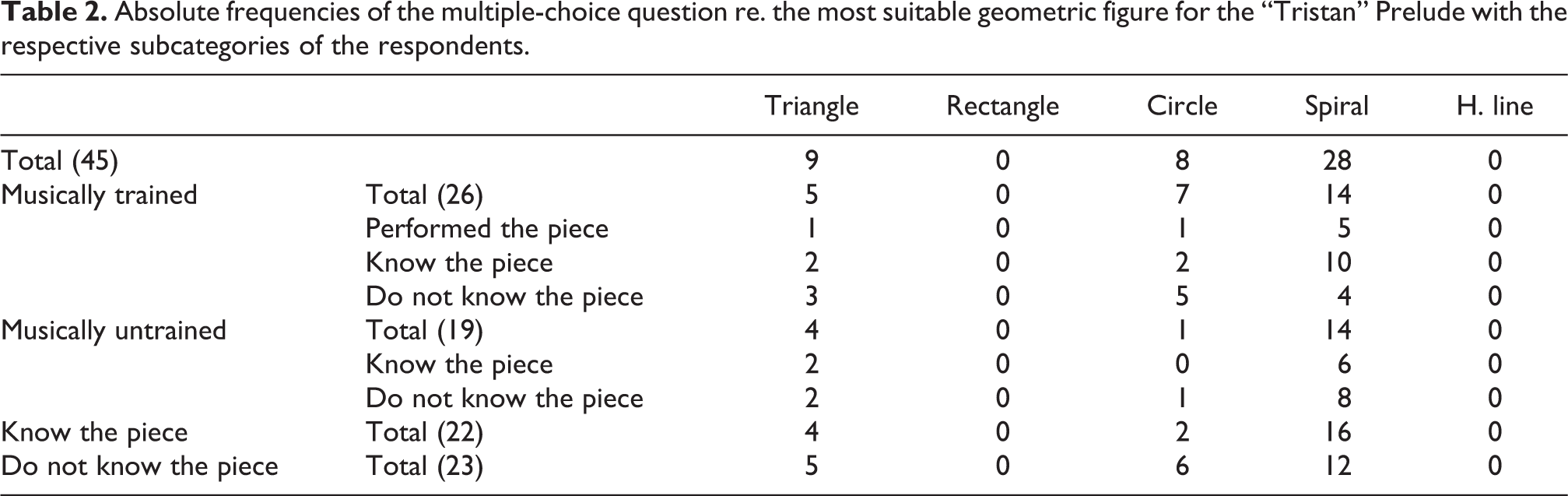
These results suggest that the initial research hypothesis seems to be refuted: Morgan’s formal analytic shape does not seem to reflect auditory perceptions of the “Tristan” Prelude, since the majority of respondents did not choose the circle. It should be noted, however, that although familiarity did not influence participants’ responses in this study, it is a broad term that could be further explored in subsequent studies, such as familiarity with the music, the musical score, various performances, etc. Also, the interpretation of the score by the conductor and the orchestra could play a role, such that in further studies, various CD recordings should be used and compared.
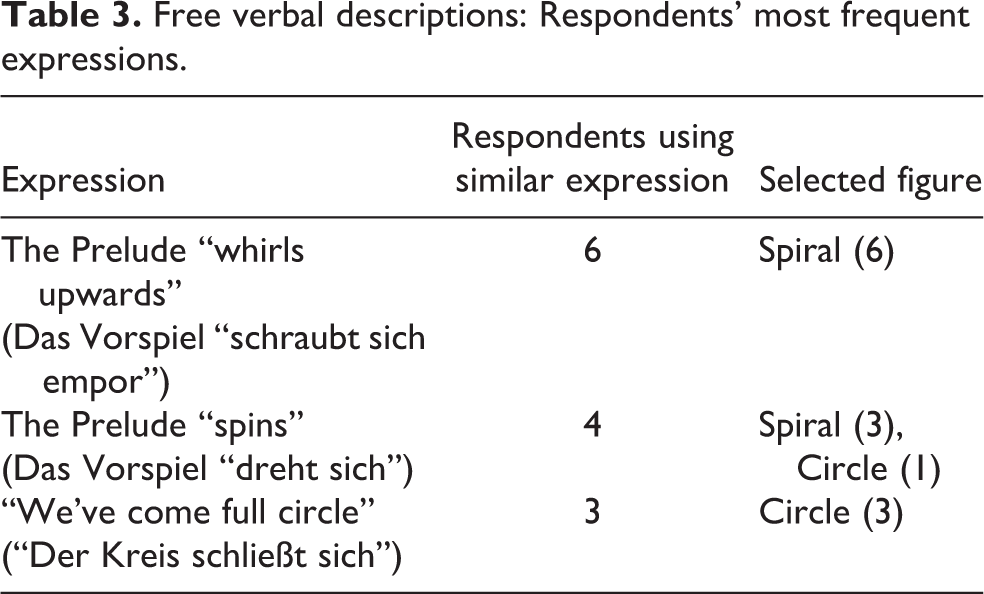
Table 3 shows the most frequent expressions used by the respondents for the selected figure which best reflected their perception of the musical form. The answers were given in German, and both the original and an English translation are provided. As shown in Table 3, the use of the metaphors of spinning (used by four respondents) as well as of whirling upwards (used by six respondents) stands out. Other possible translations for “schraubt sich empor” might be “to force upwards,” “to corkscrew upwards,” and “to gyrate upwards.” Either way, the twisting motion of or resembling that of a screw is striking in the German formulation.
Free verbal descriptions: Respondents’ most frequent expressions.
Discussion
Of all respondents, 17.78% chose the circle as the visualization that best represents the form of Wagner’s “Tristan” Prelude. However, one should note that Morgan’s illustration is not just a simple circle: it has arrows that convey movement and direction to the circle (Figure 1). This visual dynamic connotation was not available to the respondents and yet, some respondents themselves attributed this connotation to the circle: three respondents justified their selection with the relationship between beginning and end (“we’ve come full circle,” see Table 3). For the analysis of this statement, the image schema theory can be helpful. Johnson (1987, p. 2) describes an image schema as “a dynamic pattern that functions somewhat like the abstract structure of an image, and thereby connects up a vast range of different experiences that manifest the same recurring structure.” These patterns “provide the basis for the concepts and relationships essential to metaphor” (Zbikowski, 2002, p. 68). Therefore, the image schema theory tries to answer the question of the grounding of the process of cross-domain mapping by providing the fundamental structures upon which conceptual metaphors are based. In our example, the “Path schema” (see Johnson, 1987, pp. 113–117) seems to provide the basis for the metaphorical mapping from “circle” onto “musical form in the ‘Tristan’ Prelude.” For Johnson (1987, p. 114), this image schema has three typical characteristics: “(a) Because the beginning and end points of a path are connected by a series of contiguous locations, it follows that, if you start at point A and move along a path to a further point B, then you have passed through all the intermediate points in between. (b) We can impose directionality on a path. […] (c) Paths can have temporal dimensions mapped onto them.” The expression “we’ve come full circle” certainly maps a temporal dimension onto the circle as it is assumed that “we start at Point A (the source) at time T1, and move to point B (the goal) at time T2” (Johnson, 1987, p. 114). However, given that respondents chose this phrase for the circle (circular spatialization) and not for the horizontal line (linear spatialization), the following wording would be more appropriate: we start at Point A (the source) at time T1, and move to point A again (the goal) at time T2. The metaphorical interpretation of the “Path schema” correlates the domain of physical structure with the elements of music by mapping musical sections onto physical locations. In this respect, the conceptual metaphor could be stated as
The relationship between beginning and end, which is represented in the proposed conceptual metaphor, can also be found in most analyses of the “Tristan” Prelude: Kurth (1985 [1923], p. 195) sees after the climax in m. 83 an equivalent to the beginning because the musical design can be understood as a “highest dynamic culmination […] which empties into the same melancholy dismembered [Tristan] chord from which it began.” Leichtentritt (1985 [1920], p. 185) refers both mm. 75–83 and mm. 84–111 to the beginning of the Prelude. Lorenz (1985 [1923], p. 215) is the only one decidedly opposed to the reprise after the climax, interpreting the actual climax as a reprise and the part thereafter as a coda. Morgan (2000, pp. 100–101) wants to close the discussion about the reprise by saying that in both sections (mm. 63–83 and mm. 84–111) the opening material reappears. It should be noted, nonetheless, that Morgan’s general analytic shape does not correspond to the majority listening experience of our respondents. Morgan’s criticism of Lorenz regarding the contradiction between his arch form and the experience of “what any listener hears” (Morgan, 2000, p. 72) can also be applied to Morgan’s own figure in this regard.
Twenty percent of respondents selected the triangle. One respondent justified their choice with the dynamics of the music. The Prelude has a dynamic development that allows the association of a triangle as musical texture, dynamics, harmony, orchestration and the intertwining of leitmotifs lead to a climax after which the quieter music of the beginning returns variedly. In Leichtentritt’s (1987 [1920]) analysis of the “Tristan” Prelude, he interprets the surging and ebbing motion, manifest already in the first two measures, as a structural element whereby the dynamic becomes a constructive, formal element, as shown in his visualization (Figure 3). The similarity of his representation to the geometric figure of a triangle shows that the selection of the triangle seems analytically traceable as one can associate with it a progression to a climax and a subsequent return; a development which is also existent in the analytical discourse (see above).
Leichtentritt’s interpretation of form in the “Tristan” Prelude (I) (Leichtentritt, 1987 [1920], p. 369) © by Breitkopf & Härtel, Wiesbaden.
The spiral was selected by 62.22% of all respondents. Here, the frequent use of the metaphor of “whirling upwards” (used by six respondents, see Table 3) stands out. The “Cycle schema” and the “Scale schema” seem to provide the basis for the metaphorical mapping from “spiral” onto “musical form in the ‘Tristan’ Prelude”. For Johnson (1987, p. 121), “the Cycle schema manifests a definite recurring internal structure.” This correlates with Morgan’s conclusion that in the Prelude an extraordinary degree of repetition prevails. However, the respondents said that the “Tristan” Prelude “whirls upwards” (“schraubt sich empor”), it does not only “whirls” (“schrauben”). That is why the “Scale schema” seems equally fitting. Johnson (1987, p. 122) claims that the “Scale schema is basic to both the quantitative and qualitative aspects of our experience.” The conceptual metaphor
Morgan, in proposing repetition as the essential prerequisite for the constitution of form in his analysis, was able to ascertain the extraordinary extent of this formal principle in the Prelude, intensified as it is, solely by three main units: “Of course, the repetition of formal units in itself is nothing new. What is new (paradoxically) is the extent of repetition” (2000, p. 99; emphasis original). But how is the continuous increase compatible with constant repetition? When considering difference as a central feature of repetition, it is possible to connect circularity with linearity, that is repetition with development (cf. Mahrenholz, 1998, pp. 2233–2234). The listeners of the “Tristan” Prelude thus hear numerous repetitions; but also, the high degree of differences is remarkable, which—and this seems paradoxical to begin with—is emphasized by the high degree of repetition. The constant repetition does not highlight itself—it highlights the variations and questions its own status as recurrence. A tension arises between the origin and the result of repetition.
Accordingly, proposing a circle as a figure of thought for the musical form of the “Tristan” Prelude could be misleading, as it does not mirror this tension and development. The recurrence of one unit is not the same as the initial unit (as suggested by a circle, see Figure 1). Instead, a spiral appears to be more suitable since it connects circularity with linearity such that not only the repetition is visualized and emphasized, but also the increasing development and variations.
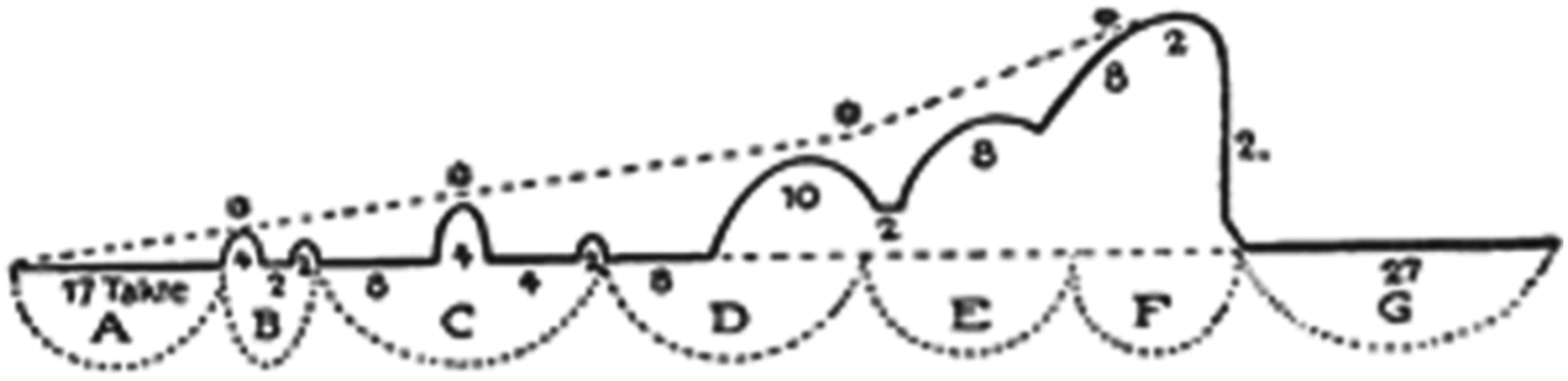
To give a concrete example of this simultaneity, the first formal analysis of the “Tristan” Prelude needs to be revisited: Leichtentritt (1987 [1920]) also visualized the mutual relations of the single sections, as depicted in Figure 4. With regard to Leichtentritt’s illustration, it is striking that every section is labeled with a different letter but the mutual relations are illustrated by brackets, instead of conventional music-theoretical nomenclature, i.e. of repeating letters or when they are significant variations, rendered as A’, B’, etc, which he used in other analyses (see Leichtentritt, 1987 [1920], p. 373 or p. 401, for instance). Since Leichtentritt does not address this decision, one can only speculate about the intention. One possible motivation, however, would be to emphasize the mutual reference of the musical sections on the one hand and the autonomy of the individual sections resulting from the high degree of transformation on the other. It seems as if Leichtentritt was aware of the problem of constant repetition with increasing difference, so that the use of brackets and consecutive letters appears as a compromise in this respect. It is therefore surprising that the Prelude’s simultaneity of repetition and development discussed here is already to some extent evident in the visualization of the first formal analysis, or rather that the results of the present study provide a new perspective on Leichtentritt’s representation of form.

Leichtentritt’s interpretation of form in the “Tristan” Prelude (II) (Leichtentritt, 1987 [1920], p. 369) © Breitkopf & Härtel, Wiesbaden.
The spiral, in contrast to the circle, emphasizes linearity without disregarding this circularity. Therefore, the musical form in the “Tristan” Prelude can be better conceptualized temporally as well as spatially. Especially on the basis of Morgan’s result on the extent of repetition in the Prelude, this figure of thought offers a possible explanation for the Prelude’s character stated in its reception and musicological discourse. Since in the figure of a spiral, linearity and circularity coincide with each other, both the extent of the repetition as well as the constant development and increase can be equally considered and presented to the reader. The development towards a climax can also be associated with a spiral, as an inward spiral inevitably ends up in a crisis due to the ever-decreasing space.
Conclusions
Starting from a music-analytical thesis, the empirical investigation of the perception of musical form shows that Morgan’s circle mirrors the listening experience of only 17.78% of the respondents. The theory of conceptual metaphor and the image schema theory provided valuable insights into how the subjects might have understood the geometric figures in relation to the “Tristan” Prelude. The majority (62.22%) chose a figure of thought which can be understood as a further development of Morgan’s approach, because the contradiction between extensive repetition and steady increase appears resolved as the spiral connects circularity with linearity.
Cook (1987, 1992) has already called attention to the discrepancy between auditory experience and the musicological manner of explaining music. Based on Schenkerian Analysis, he assumes that “listeners do not normally experience the unity of tonal structure” (Cook, 1987, p. 28). But, for Cook, such discrepancies between perception and analytical interpretation of formal structure in music do not invalidate the analytical approach because “its value lies precisely in its capacity to modify normal perception through enhancing the listener’s awareness of the long-range structural coherence characteristic of many tonal compositions” (1987, p. 28). Thus, large-scale musical forms are not normally reflected in the listening experience: the value of such analytical debate rather lies in the possible perceptual enhancement of the listener. This assumption suggests a unidirectional relationship insofar as the perception of music is enriched by its analytical discourse, with the identification of large-scale musical forms reserved for music-analytical debate. Although this aspect is certainly right in part—listening for form is certainly not the major mode of aesthetic enjoyment and, after all, musical forms and their geometric analytical models are elaborate abstractions—here, a plea is made for a bidirectional approach, since it is assumed that this relationship also exists vice versa. The consideration of different listening experiences can lead to a broadening of analytical perception and perspectives. This study aims to serve as an example in this regard.
As a result, the music-analytical discourse of form in turn gains a new thesis that needs to be reviewed in the score of the “Tristan” Prelude. As one of the present authors (Rudolph, 2017) has argued recently, envisioning the musical form of the “Tristan” Prelude in the analytical shape of a spiral is not only fruitful for the concrete music analysis—with regards to the “cyclic form” of Taylor (2010, 2016) and the “rotational form” of Hepokoski and Darcy (2006)—but also more compatible with music-aesthetical (see Mahrenholz, 1998) and philosophical (Deleuze, 1994 [1968], 2006 [1962]) approaches.
Footnotes
Acknowledgements
We are grateful to Christian Thorau, Matthias Haenisch and the two reviewers for useful suggestions and critical feedback on an earlier version of this paper. We would also like to thank Oren Vinogradov for proof-reading, Evelin Flöther and Gerlinde Scholz for assisting with data collection, and all participants of this study for their time.
Contributorship
PR conceived of the idea for the study. PR and MBK developed the design and PR collected the data. PR and MBK analyzed the data and PR wrote the first draft of the manuscript. MBK revised the first draft. Both PR and MBK approved the final version of the manuscript.
Declaration of conflicting interests
The authors declared no potential conflicts of interest with respect to the research, authorship, and/or publication of this article.
Funding
The authors received no financial support for the research, authorship, and/or publication of this article.
Peer review
Isabel Martinez, Universidad Nacional de La Plata, Facultad de Bellas Artes.
Mark Reybrouck, KU Leuven - University of Leuven, Musicology Research Group.