




Abstract
Social network sites (SNS) allow for interaction between musicians and fans, including parasocial relationships. The present research approaches the topic from the perspective of psychology and particularly previous research concerning attachment styles, celebrity interest, and their correlates. Using an online survey (N = 464), we considered whether psychological variables could predict whether individuals interact with musicians on SNS, and their opinions about doing so. Findings demonstrate that users’ celebrity attitudes and relationship attachment styles are important in predicting the extent to which they utilize SNS to interact with musicians. Therefore, it seems that SNS music fan behaviors have an overtly psychological component, such that further research might adopt a psychological rather than technological approach in predicting commercial usage.
Participation in social media is a mainstream activity of considerable commercial importance. As of 2016, 79% of online US adults used social networking websites (SNS) (Greenwood, Perrin, & Duggan, 2016). Individuals utilize these social platforms for many reasons, including to interact with celebrities and especially with musicians (Chen, 2011). In April 2016, musicians made up seven of the 20 most liked people on Facebook, five of the 10 most followed people on Instagram, seven of the 10 most followed people on Twitter, and all of the 10 most watched videos on YouTube (International Federation of the Phonographic Industry, 2016).
Social media, including SNS, increase the potential for musician–fan interactions, providing more opportunities for fans to engage with musicians (Click, Lee, & Holladay, 2013; Usher, 2015), and the music industry has been quick to seize the marketing potential of this. Some musicians, perceived as inaccessible previously, are now interacting directly with fans online, sharing their lives in a more unfiltered manner (Burns, 2009). Fans of pop musician Lady Gaga (known particularly for using social media to interact with fans), for example, perceive her social media outputs as involved, authentic, intimate, and reciprocal forms of communication (Click et al., 2013). As Burns (2009) wrote, “we are seeing a cultural shift in music as a result of social media, and in turn, a shift in social media because of music” (p. 106).
As such, it is impossible to understand the role of music in the modern social world without an understanding of music in the context of SNS; however, little research attention has been paid to music-related behaviors on SNS (Krause, North, & Heritage, 2014). In the light of these concerns, the present research focused on whether interaction with musicians via SNS was related to constructs implicated in previous research on parasocial relationships with public figures and the formation and maintenance of interpersonal relationships. In particular, the present study was concerned with whether celebrity attitudes, attachment, self-esteem, and personality were associated with one’s behaviors concerning musicians via SNS.
Social network sites have changed interpersonal interaction (Frederick, Lim, Clavio, & Walsh, 2012) and allow for surveillance (Joinson, 2008), such that people can read, follow, and interact with material that family, friends, celebrities, and political leaders share on those sites. Indeed, the internet is quickly changing “the fan–celebrity dynamic” and celebrities are using SNS to create forms of connection with fans (Stever, 2011, p. 1366). The interactive component may lead to interactions and relationships, both real and imagined on and offline. This is because these celebrities “use online media to share aspects of their lives, habits, thoughts, and daily activities with audiences” (Clark, 2016, p. 187; see also Kim & Song, 2016). The possibility of imagined relationships relates to parasocial relationships, which provide the illusion of a friend-like relationship between an individual and a media persona (Clark, 2016; Rubin & McHugh, 1987). Such parasocial relationships typically remain one-sided, without contact from the celebrity to the media user (Frederick et al., 2012). Indeed, evidence exists showing that parasocial relationships are formed via commonplace technologies, including television, video games, films, books, music, and radio (e.g., Derrick, Gabriel, & Hugenberg, 2009; Rubin & McHugh, 1987; Savage & Spence, 2014), as well as through internet media, such as online communities (Ballantine & Martin, 2005) and SNS (e.g., Baek, Bae, & Jang, 2013; Clark, 2016; Kim, Ko, & Kim, 2015).
Previous media research has considered whether established social psychological phenomena are modified in the context of social networks (Martin & North, 2015). The parasocial relationships formed with news and radio presenters, fictional characters from TV and books, and with actors have a potentially pathological nature (Clark, 2016; Sheridan, Maltby, & Gillett, 2006) such that a number of these cases end up in court. These parasocial relationships, including those considered to be pathological, can be developed via the internet and SNS (Ballantine & Martin, 2005; Clark, 2016; Stever & Lawson, 2013). Although celebrity culture and SNS are prominent in daily life, such interactions have not been well researched (Kim & Song, 2016), particularly from the perspective of more mainstream psychological theories, or with regard to the relationship between fans and their fan objects (Click et al., 2013). It is possible that (parasocial) relationships with well-known individuals vary depending on the domain in which a public figure came to prominence (Giles, 2002; North, Bland, & Ellis, 2005), such that research is needed that addresses interactions with musicians specifically. Moreover, research suggests that fans’ expectations of celebrity behavior have changed as a consequence of SNS (Click et al., 2013): SNS offer the potential for 24-hour, real-time interaction between users (Usher, 2015), such that ongoing SNS interaction is common (Marwick & Boyd, 2011). While previous researchers have posed questions around the performativity and authenticity of celebrity SNS use (e.g., Marshall, 2010; Papacharissi, 2012), this work has tended to consider the discourse from a journalism or media perspective, rather than to consider the (perceived) relationships that result from SNS use and interaction. As this brief review indicates, SNS interaction is a prominent feature of fans’ expectations of musicians and may relate to parasocial relationships between the fans and their favorite musicians, although little is known about this, particularly from a psychological perspective. Consequently, the present research investigated the relationship between fans’ use of SNS regarding their favorite musicians and celebrity attitudes in light of the theoretical perspective of parasocial relationships with celebrities/musicians.
Celebrity attitudes, attachment, and personality
Since SNS interest in well-known musicians has the characteristics of a parasocial relationship with any celebrity, it makes sense to consider this via a dedicated measure that exists within the psychological literature, namely the Celebrity Attitudes Scale (McCutcheon, Lange, & Houran, 2002). Prior research using the Celebrity Attitudes Scale has shown a difference between mundane interest in celebrities that facilitates social interaction and provides entertainment (so-called “entertainment-social” uses), the perception of an intense and internalized bond between the fan and the celebrity (so-called “intense personal”), and borderline pathological interest in a given celebrity whereby the fan believes themselves to be involved in a developing relationship with the celebrity (Sheridan et al., 2006). More detailed work utilizing this scale has explored celebrity attitudes regarding their relationship to personality (e.g., Maltby, McCutcheon, & Lowinger, 2011), self-esteem (North, Sheridan, Maltby, & Gillett, 2007), and attachment (McCutcheon, Scott, Aruguete, & Parker, 2006). It is possible that interactions with musicians on SNS can be characterized similarly, although the extent to which this stems from an entertainment-driven motivation rather than something more intense and/or pathological is unclear.
In a similar vein, given that social (and parasocial) interaction is related to attachment (e.g., Giles, 2002; Giles & Maltby, 2004; McCutcheon et al., 2006), it is possible that attachment styles may also be related to online fandom concerning musicians. As Derrick et al. (2009, p. 352) stated, technological parasocial relationships can be “surrogates for actual belongingness”. Previous research concerning celebrity attitudes and attachment has indicated that attachment to peers and parents is related to developing an interest in celebrities, such that an intense interest in celebrities has been associated with low levels of security and closeness in reciprocal interpersonal relationships (Giles & Maltby, 2004), and also low self-esteem (Sheridan, North, Maltby, & Gillett, 2007). Further, research has demonstrated that attachment styles are related to parasocial interactions with regard to television viewing (e.g., Cohen, 2004; Cole & Leets, 1999). Other studies have examined personality characteristics associated with celebrity worship. For example, extroversion is associated with an entertainment-social interest in celebrities, while neuroticism is associated with more intense and compulsive feelings towards celebrities (Maltby, Day, McCutheon, Houran, & Ashe, 2006; Maltby et al., 2011).
More generally, there is evidence that attachment, personality, and self-esteem are related to SNS use. For example, individuals with high attachment anxiety are more likely to use Facebook (Oldmeadow, Quinn, & Kowert, 2013); the mediated nature of social interactions online may well be attractive to individuals with attachment insecurities. With regard to personality, extraversion has been associated with higher levels of SNS use and with socially motivated use (Moore & McElroy, 2012; Nadkarni & Hofmann, 2012; Ryan & Xenos, 2011). Thus, there is the possibility that individuals higher in extraversion are more likely to embrace SNS fan practices. With regard to self-esteem, there is evidence that self-esteem is associated with SNS gratifications: for example, SNS use serves to reduce barriers to interacting with acquaintances for students with lower self-esteem (Steinfield, Ellison, & Lampe, 2008). Additional evidence suggests that people high in positive collective self-esteem are strongly motivated to use SNS to communicate (Barker, 2009). Therefore, we might arrive at a much more subtle understanding of what motivates music fan SNS practices through consideration of attachment, personality, and self-esteem in their own right in addition to their relationship with scores on the celebrity attitude scale.
Demographic variables
Other research has also identified associations between SNS use and demographic variables, including age and gender. Older individuals may use SNS to a lesser degree than younger individuals, perhaps, as Pettijohn II, LaPiene, Pettijohn, and Horting (2012) suggested, due to lower levels of familiarity with the technology or a focus on different social goals. While SNS adoption rates are increasing among older populations, SNS sites are still most popular among 18–29-year-olds (Brenner & Smith, 2013), a time in life at which musical taste develops rapidly and contributes to a number of social cognitions (Tarrant, North, & Hargreaves, 2002). Similarly, men are more likely to listen to music, watch videos, and look for information about leisure activities online than are women (Jones, Johnson-Yale, Millermaier, & Pérez, 2009). Conversely, women are less likely to use technology to discover new music than men (Tepper & Hargittai, 2009), therefore it is plausible that SNS music fan practices may vary such that we may need to control for gender-related effects. Consequently, the present research also included these demographic variables so that their influence could be addressed statistically.
Aims and research questions
The present study was primarily concerned with whether celebrity attitudes, attachment, self-esteem, and personality were associated with SNS behaviors concerning musicians in particular (RQ1). Since the present research was a “first” in this respect, it was difficult to make confident predictions concerning the direction of these relationships, although the evidence to date suggests that there should be relationships between these variables. The research also considered a secondary issue, namely whether the same variables (celebrity attitudes, attachment, self-esteem, and personality) were related to the opinions and expectations that SNS users have concerning their experience with their favorite musicians and their music. These opinions and expectations are inherently tied to the music itself, by way of the musicians. The popularity of musicians on SNS, YouTube, and other social media platforms (alongside the shift in music towards online streaming) means that it becomes increasingly important to understand consumers’ expectations of the online behavior of their favorite musicians. We, therefore, specifically investigated whether celebrity attitudes, attachment, self-esteem, and personality were related to the opinion that musicians should use SNS to interact with their fans (RQ2), and the belief that SNS interactions with musicians influence the individual’s experience of listening to that musician’s music (RQ3).
Method
Participants
Participants were recruited via advertising on the lead author’s website, the university’s student research participation program, and dedicated online research participation websites. Analyses were performed using the data from 464 individuals who resided in the United States, the United Kingdom, and Australia (42.24% US, 32.33% UK, 25.43% Australia). Note that data from an additional 65 participants were excluded from the analyses, as these individuals resided in other countries. Mean responses to each variable were calculated separately for participants from the three countries from which data were employed. The product-moment correlations between these three data sets ranged from .994–.997, and so the three sets of data were pooled in subsequent analyses. The sample was predominantly female (72.90%) with ages ranging from 16–70 years (M = 21.79, Mdn = 20, SD = 7.14), and 16.70% of the sample had a university qualification. Participation was voluntary: some current university students received coursework credit, and the remaining participants received no compensation for their efforts.
Measures
Participants reported their age, gender, whether they had a university degree, and their country of residence.
Celebrity attitudes
Following North and Sheridan’s (2009) use of McCutcheon et al.’s (2002) Celebrity Attitudes Scale to address favorite public figures, a nine-item shortened version was created to address musicians specifically. This was achieved by replacing “celebrity”/“favorite public figure” with “favorite musician” in the wording of the items and by using the three highest-loading statements from the three subscales (entertainment-social, intense personal, and borderline pathological) identified by North and Sheridan (2009). Therefore, the measure’s three subscales were represented in a manner that avoided over-burdening participants, given that other scales were also employed. Example items include, “It is enjoyable just to be with others who like my favourite musician” and “If my favourite musician saw me in a restaurant they would ask me to sit down and talk” (all items are included in Table 1). Participants responded to statements using a five-point scale (anchored by Strongly disagree and Strongly agree).
Loadings for principal components analysis with varimax rotation of the celebrity attitude statements.

Note. Loadings < .3 are suppressed.
aFactors 1 and 2 were labelled as borderline pathological and entertainment, respectively.
The Celebrity Attitudes Scale items were subjected to a varimax principal components analysis, rather than assuming that the proposed three subcomponents of the measure would hold true for our sample (given the limited amount of existing research on the factor structure of the questionnaire). Following the Kaiser criterion, two factors were extracted, which accounted for 64.82% of the variance (see Table 1). Factor 1 reflected a borderline pathological interest in celebrity musicians and was labeled “borderline pathological” (Cronbach’s alpha = .81). Factor 2, labeled “entertainment”, reflected a social, entertainment-related interest in celebrities (Cronbach’s alpha = .84). As Table 1 shows, both factors subsume elements of the “intense personal” form of celebrity attitudes identified in the original development of the scale.
Personality
Langford’s (2003) Big Five proxy scale was used because of its concise nature and demonstrated reliability (Langford, 2003; North, 2010). Moreover, Langford (2003) noted that this measure “is similar to, and can sometimes equal or even exceed, the predictive validity of [much longer] multi-item measures” (p. 1139). The Langford measure requires participants to rate themselves on one seven-point scale (anchored by adjectives) for each Big Five dimension respectively, namely openness (“uncreative–creative”), conscientiousness (“lazy–hard-working”), extraversion (“shy–outgoing”), agreeableness, (“headstrong–gentle”) and neuroticism (“nervous–at ease”).
Self-esteem
Individuals completed Rosenberg’s (1989) 10-item self-esteem measure, by indicating the extent to which they agreed with a series of statements about themselves (e.g., “I feel I have a number of good qualities”) using four-point Likert scales (Strongly disagree to Strongly agree; Cronbach’s alpha = .90).
Attachment
The Experiences in Close Relationships – Revised Shortened Questionnaire (Fraley, Heffernan, Vicary, & Brumbaugh, 2011) assessed attachment with regard to both best-friend and dating/marital partner relationships separately. Individuals completed the attachment-related anxiety and attachment-related avoidance scales, each employing nine items (e.g., “I usually discuss my problems and concerns with this person” and “I often worry that this person doesn’t really care for me”), using seven-point scales (Not at all to Completely agree), resulting in four scores per individual (Cronbach’s alphas ranged from .84 to .93).
SNS usage
Previous research concerning SNS usage has tended to use self-reported behaviors (e.g., Gosling et al., 2011; Pempek et al., 2009), which seems justifiable given both Hampton, Goulet, Marlow, and Rainie’s (2012) and Junco’s (2013) findings that self-reported Facebook usage corresponded closely with actual Facebook activity. Since no established measure to address SNS behavior for musician interaction existed, the authors drew on more general research on SNS actions (e.g., Baek, Holton, Harp, & Yaschur, 2011; Park, Kee, & Valenzuela, 2009) to devise four questions. Thus, participants were asked to report the percentage of their time on SNS spent passively reading about musicians, the percentage of time spent actively interacting with or posting about musicians on SNS, the percentage of their SNS contacts that were specifically musicians (as opposed to friends or other celebrities), and an average estimate of time per day in minutes spent following and interacting with musicians via SNS.
A principal components analysis (with varimax rotation) concerning these four SNS usage responses resulted in two factors, which accounted for 75.57% of the variance (Table 2). Three items loaded onto Factor 1, which was labeled “musician interaction”, as it represented individuals spending time interacting with musicians via SNS (Cronbach’s alpha = .76). In contrast, the remaining single item concerned a general passive use of SNS that was characterized by consuming rather than actively creating content, which was labeled as “surveillance”. These two factors are referred to hereafter as the SNS behavior factors.
Loadings for principal components analysis with varimax rotation of the SNS behaviors items.

Note. Loadings < .3 are suppressed.
aFactors 1 and 2 were labelled as musician interaction and surveillance, respectively.
SNS opinions
Finally, participants rated their degree of agreement with nine statements on five-point scales (anchored by Not at all and Completely) concerning whether they thought SNS was beneficial to the user in terms of knowledge, opinions, and enjoyment of musicians and their music (e.g., “being able to interact with/follow a musician using social networks enhances my experience with their music” and “musicians should use social networks as a way of interacting with their fans”: a complete list of these items is provided in Table 3). Again, these statements were designed to specifically address musician interactions on SNS, taking the lead from more general research on the uses of music in everday life (e.g., Chamorro-Premuzic & Furnham, 2007; Lonsdale & North, 2011).
Varimax rotated solution for the principal components analysis of the SNS opinion statements.

Note. Loadings < .3 are suppressed.
aFactors 1 and 2 were labelled as valued musician involvement and SNS irrelevance, respectively.
These nine statements were subjected to a principal components analysis (with varimax rotation), which yielded two factors with eigenvalues greater than one, accounting for 64.97% of the variance (Table 3). Factor 1 reflected the opinion that musicians should use SNS and that the participants felt that their interactions with musicians via SNS affected their listening experience, and thus was labeled “valued musician involvement” (Cronbach’s alpha = .90). Factor 2, “SNS irrelevance”, represented the opinion that SNS had no influence on an individual’s listening experience (Cronbach’s alpha = .64). These two factors are referred to hereafter as the SNS opinions factors.
Procedure
Following ethics approval, participants conducted an online questionnaire available via a direct link from the lead author’s website, the university’s student research participation website, or dedicated online research participation websites. Individuals were guided through the questionnaire via a series of webpages after indicating their consent, and were debriefed on the final page of the survey.
Results and discussion
Prior to analyses, we used algebraic transformations to improve univariate normality for non-normal predictor variables. Judgment was made for each variable independently, such that depending on the deviation severity, square root, log, and inverse transformations were performed. All other statistical assumptions were met.
Interacting with musicians via SNS
Implemented through SPSS (version 22), two hierarchical multiple regression analyses (α = .025) addressed which variables could predict using SNS to interact with musicians (RQ1). Scores on the two SNS behavior factors, musician interaction and surveillance, were each entered as the criterion variables in separate analyses. To consider the predictive utility of the psychological constructs, we entered age, gender, and university qualification in the first block of predictor variables, and entered the five personality scores, self-esteem score, four attachment scores, and two celebrity attitudes scores in the second block of predictor variables.
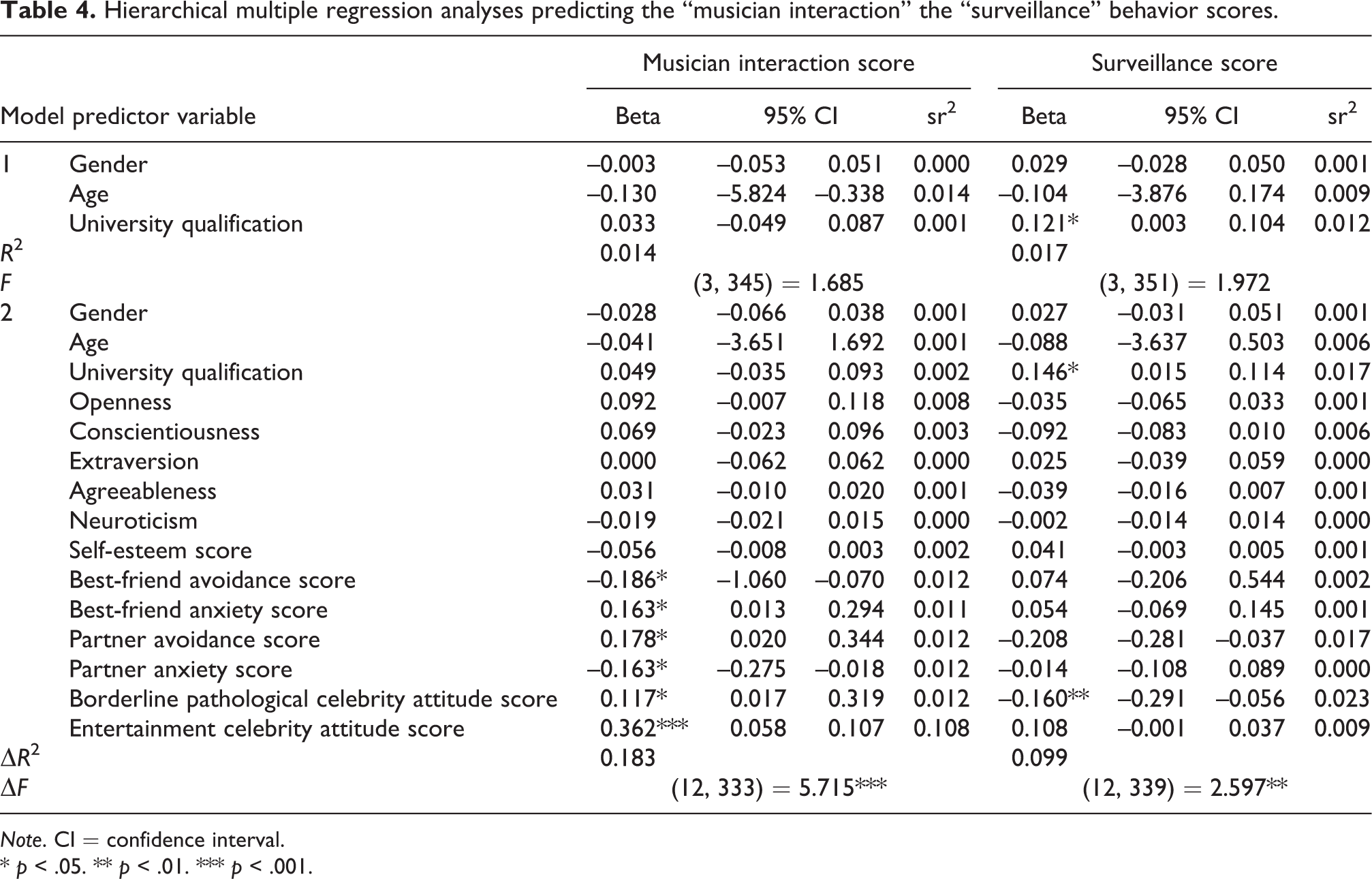
The first analysis concerned the musician interaction scores, which reflect time spent interacting with musicians via SNS. The predictor variables in combination explained a significant 18.30% of the variance in musician interaction scores, R 2 = .18, adjusted R 2 = .15, F(15, 333) = 4.96, p < .001; f 2 = .224 (details are reported in Table 4). The significant predictor variables indicate that people’s attachments to friends and partners as well as their celebrity attitudes are related to their behaviors. The findings concerning relationships with best friends suggest that participants with scores indicating a preoccupied style (i.e., more anxious and less avoidant) are more likely to spend time interacting with musicians via SNS. With regard to relationships with partners, the results suggest that participants with scores indicating a dismissive style (i.e., more avoidant and less anxious) are more likely to interact with musicians via SNS. As such, these findings suggest that SNS interactions with musicians are related to attachment. Both the borderline pathological and entertainment celebrity attitudes were also positively associated with using SNS to interact with musicians: the entertainment-based celebrity interest score demonstrated the highest sr2 value, indicating that interaction with musicians via SNS has a clear entertainment-based component, which exists independent of personality, self-esteem, and attachment. Consequently, it is likely that SNS offers users an additional, entertainment-driven means of learning about and interacting with their favourite musicians. However, the findings concerning the borderline pathological factor indicate that SNS interactions with musicians may be varied, and include potentially less positive, or pathological types of usage.
Hierarchical multiple regression analyses predicting the “musician interaction” the “surveillance” behavior scores.
Note. CI = confidence interval.
* p < .05. ** p < .01. *** p < .001.
The second analysis concerned the surveillance behavior scores, which indicate the passive use of SNS for consumption rather than the creation of content. Overall the predictor variables explained a significant 9.90% of the variance concerning surveillance scores, R2 = .10, adjusted R2 = .06, F(15, 339) = 2.50, p = .002; f2 = .110 (details are found in Table 4). Individuals with a university degree had significantly higher scores on the surveillance behavior factor. More importantly, the borderline pathological celebrity attitudes score was negatively associated with the surveillance behavior score. Given that the borderline pathological celebrity score was positively associated with an active use of SNS and negatively associated with a passive use, we might interpret these findings together showing that participants who scored higher on the borderline pathological score were more prone to interact with, rather than merely surveil, musicians via SNS, perhaps reflecting an attempt by these people to use SNS to produce and sustain parasocial relationships. Although less theoretically coherent, an alternative interpretation is also possible, in that the borderline pathological attitude could be interpreted in terms of attempts (successful or otherwise) to make direct contact, while the entertainment attitude reflects a more passive pattern of interest. With this conceptualization, then, the more pathological form is positively associated with an active use of SNS motivated by making contact, while negatively associated with the more passive style of consumption via surveillance. Given that the attachment and personality variables were not significant predictors, it appears that these psychological constructs are less suited to explaining the surveillance behavior than the musician interaction behavior.
SNS opinions
Research questions 2 and 3 concerned participants’ beliefs concerning whether musicians should use SNS to interact with fans, and whether these interactions influence the listener’s experience of that musician’s music. However, these two opinions both loaded onto the valued musician involvement factor. Therefore, both research questions were examined concurrently: a pair of hierarchical multiple regression analyses (α = .025) considered the participants’ opinions about interacting with musicians via SNS. Again, scores on the two opinion factors, valued musician involvement and SNS irrelevance, were entered as the criterion variables in separate analyses employing the same set of predictor variables as before.
The analysis concerning SNS irrelevance was non-significant (R2 = .05, adjusted R2 = .01, F(15, 407) = 1.33, p = .180; f2 = .053). As such, the psychological variables in questions appear to be unrelated to the opinion that SNS had no influence on an individual’s listening experience. However, in combination, the predictor variables explained a significant 28.10% of the variance in valued musician involvement scores, R 2 = .28, adjusted R 2 = .26, F(15, 407) = 10.67, p < .001; f 2 = .391 (details are reported in Table 5). As partner avoidance was negatively associated with valuing musician involvement, this finding suggests that people who are comfortable sharing information with their partners believe that musicians should share with their fans on SNS. As such they believe that their experience with musicians and their music benefits from the musicians participating in SNS. Both celebrity attitude scores were associated positively with valuing musician involvement, independently of personality, self-esteem, and attachment. These findings were logical given that both entertainment and borderline pathological ends would be served by the involvement of the musicians in question.
Hierarchical multiple regression analysis predicting the “valued musician involvement” and “SNS irrelevance” opinions.

Note. CI = confidence interval.
* p < .05. ** p < .01. *** p < .001.
Conclusions
While social media and music are linked closely in the modern era, little previous research has considered the use of SNS as the context for music fan practices (Krause et al., 2014). Therefore, this study addressed online music fan practices to investigate parasocial interactions via celebrity attitudes. As such, this connects the present findings to a number of other studies concerning psychological correlates of celebrity attitudes, which in turn raises a number of further issues for further research. Considering the participatory culture of SNS with regard to interaction theory, the present results demonstrated that people’s celebrity attitudes and relationship attachment styles are important in predicting the extent to which users personally utilize SNS to interact with musicians. Attachment and celebrity attitudes were associated with the view that musicians should use SNS. Such findings can be interpreted in light of previous work that suggests that SNS can promote interactions, including those that are parasocial in nature (e.g., Oldmeadow et al., 2013; Sheridan et al., 2006). While entertainment-based interest in musicians was associated with using SNS to learn about and interact with musicians, so too was the borderline pathological style of interest. In particular, because the borderline pathological celebrity score was positively associated with an active use of SNS and negatively associated with a passive use, these findings support previous research that SNS do assist in the production and perpetuation of parasocial relationships (e.g., Ballantine & Martin, 2005; Clark, 2016).
In a similar vein, it is also interesting that personality and self-esteem were not significant predictors within the multiple regressions when attachment and celebrity attitudes were considered, despite previous findings that these variables are related to one another. Celebrity attitudes and attachment styles relate to SNS interactions with musicians apparently without any contribution from self-esteem or personality. Social network site interaction with musicians appears to arise from a desire for parasocial interaction, rather than an attempt to compensate for motivations arising from personality or self-esteem. Clearly, future research is needed to verify the role of personality and self-esteem in parasocial interactions via SNS.
The present study is not without limitations, however. Notably, participants were asked to report on their use of SNS across all relevant platforms. It is possible that the pattern of findings identified here may differ by SNS platform, which would require future research to investigate. For example, Twitter supports one-sided message broadcasting, while Instagram is image-based, and Facebook allows for brand marketing through dedicated pages and advertising. Moreover, fans’ interpretations of their relationships may also depend on the nature of a given musician’s platform use. For instance, is an artist who uses SNS only to share music-related information (e.g., album release dates and concert information) regarded similarly to an artist who also shares personal or day-to-day details (e.g., photos of their leisure activities), or an artist who replies to fan questions? It is unclear how parasocial relationships with these artists may differ. Indeed, SNS users’ perceptions of the authenticity (e.g., Marwick & Boyd, 2011; Usher, 2015) and performativity (e.g., Papacharissi, 2012) of artists’ SNS use could also be an influence. It is possible that parasocial relationships are exaggerated when musicians share more personal information via SNS, as it may engender among SNS users the sense of participating in their private, daily lives.
Fan communities and their members could also be explicitly explored. As Stever (2011) claimed, there are other social motivations for forming affiliations with others based on celebrities; and it may be that these other reasons are related to SNS behaviors in specific ways as well. Future research might employ interviews or focus groups to address these questions.
Secondly, participants did not report on who their favorite musician was, and no indication of their favorite musician’s status was taken. Thus, the sample may have reported on a wide range of musicians; further, it is possible that sompe participants may have had real, and even extensive, interaction with relatively low-status musicians (as opposed to responding about popstars). Given the broad direction to complete the Celebrity Atitudes Scale about a favorite musician, future research may also take into account musician status. It is entirely possible that SNS interactions with amateur and lower-status musicians differ to those with popstars. How might “in real life” and/or reciprocated musician relationships differ on platforms that afford the same possibilities for interaction with known associates and celebrities alike?
Thirdly, as many of the sample were university-aged, it would be interesting to consider how broadly the results can be generalized. Thus age could also feature in future research to better define SNS behavior. Lastly, given that this is a relatively unstudied phenomenon, making use of qualitative methods is warranted in the future in order to examine SNS interactions with musicians in greater depth.
By indicating that the psychological concepts of celebrity attitudes and attachment are related to how people perform online music practices, this study serves as a foundation for future work. As SNS features and functions continue to evolve, usage will likely become correspondingly complex, and this complexity will likely require a thorough understanding of individual difference factors that drive idiosyncratic usage patterns. It will be important to continue to consider the individual, and the present results offer initial insight into how aspects of the individual guide music fan practices in the context of SNS.
Given that these findings imply that attachment style and celebrity attitudes are important to consider regarding people’s online beliefs and behaviors, the implications of these findings are relevant to the clinical context with regard to parasocial relationships. Moreover, the present results also have some obvious practical implications concerning how people interact with others online in everyday life. These implications will themselves evolve over time in reflection of the growing complexity of the websites themselves. For instance, if entertainment is driving usage then we would expect that musicians will gain SNS followers if they provide material that speaks to this. For example, information that can be enjoyed and shared with other people known to the user, while in contrast, simply providing information to users on SNS may be an unsuccessful strategy. Similarly, the present findings concerning the relationship between SNS use and particular types of attachment style suggest that musicians would gain SNS followers by providing material that mitigates users’ relationship anxieties and provides clear evidence of a strong (albeit parasocial) relationship between musician and user.
Footnotes
Contributorship
AK conceived and designed the project; collected, analyzed, and interpreted the data; and drafted and revised significant parts of the publication. AN contributed to the design of the project, the interpretation of the results, and the drafting of the manuscript. BH contributed to the analysis and interpretation of the results and contributed to the drafting of the manuscript.
Declaration of conflicting interests
The authors declared no potential conflicts of interest with respect to the research, authorship, and/or publication of this article.
Funding
The authors received no financial support for the research, authorship, and/or publication of this article.

Peer review
David Giles, Department of Psychology, University of Winchester.
Suvi Saarikallio, Department of Music, Art and Culture, University of Jyvaskyla.