




Abstract
Background
Bibliometric analysis is commonly used to identify influential research within a given topic.
Purpose
To identify the 100 top-cited articles in head and neck radiology, analyse the history and trends in head and neck imaging research, and understand what constitutes a highly cited work.
Material and Methods
A literature search was performed on the Thomson Reuters Web of Science using pre-defined search terms. The results were ranked according to citation count and screened to create a single database. The information included in the database were: Web of Science citations, year published, first author, primary institution, country of origin, journal, journal impact factor, title, study design, study focus and modality.
Results
24,664 eligible papers were returned. Citations for the 100 top-cited articles ranged from 115 to 1185, and citations per year ranged from 3.5 to 197.5. More than half of the articles were published in the 2000s (n = 67). Radiology has the greatest number of publications (n = 22), followed by Journal of Nuclear Medicine (n = 14). Positron Emission Tomography (n = 56) was the most commonly studied modality, followed by Magnetic Resonance (n = 40) and Computed Tomography (n = 31). The most common topics of publication were diagnosis (n = 63), followed by prognosis (n = 16).
Conclusion
This study provides insights into the most influential research in head and neck radiology in the current time. It also serves as a guide to the characteristics of a highly cited work in this field.
Keywords
Introduction
Bibliometrics is the statistical evaluation of publications to allow for the assessment of impact, research performance and author productivity. Citation count is one of the bibliometric parameters which allows us to identify the most influential articles and their impacts on their fields.1–3 Bibliometric analysis is useful in identifying trends in a specific field of research and directions for future research.
There have been many studies investigating the most frequently cited articles in different medical fields.4–7 Within the field of radiology, there have been articles evaluating the top cited papers for a specific journal,8,9 for the field of radiology10–12 and for radiology subspecialties.13–15
To the best of our knowledge, there have been no bibliometric analyses focusing on the area of head and neck radiology that includes all types of studies. Therefore, the aim of this study was to identify and examine the top 100 most cited articles on head and neck radiology across all scientific journals. By not restricting our search to the articles published in radiology-specific journals as performed by other studies,11,12 we complied a comprehensive list of most influential articles in head and neck radiology. This study presents the most influential publications to date in the field to provide a perspective on the current research trends and future research directions.
Material and Methods
A bibliometric analysis of the most highly cited articles in Head and Neck Radiology was conducted in April 2020. We performed a search on Thomson Reuters Web of Science (WOS) using the following key terms: · Head and neck AND radiology OR · Head and neck AND imaging OR · Head and neck AND (XR OR X ray OR radiograph) OR · Head and neck AND (CT OR computed tomography) OR · Head and neck AND (MR OR magnetic resonance) OR · Head and neck AND (US OR ultrasound OR sonography) OR · Head and neck AND (IR OR interventional radiology) OR · Head and neck AND nuclear imaging OR · Head and neck AND nuclear medicine
This returned a total of 24,664 articles and all articles were included, regardless of language or electronic availability of articles. The results were then sorted by the number of citations from the most cited to the least cited. This method was developed by Paladugu et al. 16 and was used in several other studies.13,17,18 Each article was assessed for inclusion. Articles were included if they focused on diagnostic imaging interpretation, imaging technique, comparison of modalities, utility and role of different imaging modalities or trends in head and neck radiology. Articles that focused on head and neck pathologies other than head and neck cancer such as thyroid disorders were also included. Articles were excluded if they did not pertain to head and neck radiology, if the primary focus was not on head and neck, or if they focused on neuroimaging or dental imaging. Articles that mainly focused on therapeutic radiology were also excluded.
The top 100 most cited articles were identified and compiled into a single database. The database included: WOS citations, year published, first author, primary institution, country of origin, journal, journal impact factor, title, study design, study focus and modality.
Results
The top 100 most cited articles, with a mean citation number of 181.73 and median of 156, are shown in Table 1. The number of citations ranged from 115 to 1185.
The 100 top-cited articles in head and neck radiology ranked in descending number of citations.

Citations per year
Citations per year ranged from 3.5 to 197.5 with a mean of 13.2 and a median of 10.6 per year. The article by Aerts HJWL et al. 19 is the most cited article in the list and has the highest number of citations per year.
Year of publication
The articles were published between 1983 and 2016; 2005 and 2009 had the greatest number of publications, with 10 articles each year. More than half of the articles on the list were published in the 2000s. Fig. 1 shows the distribution of the articles and the total number of citations by a five-year span of publication.

Distribution of the 100 top-cited articles in head and neck radiology and total number of citations by five-year span of publication.
Most common first author
There was a total of 83 first authors on the top 100 list. Amongst them, Vandecaveye V, Vandenbrekel MWM and Schoder H have the greatest number of articles, with three articles each. There were 14 authors that were first authors of more than one article to the top 100 list.
Journals
The top 100 articles were published across 26 journals (Table 2). Radiology has the greatest number of publications (n = 22), followed by Journal of Nuclear Medicine (n = 14). New England Journal of Medicine had the highest impact factor of 70.67 and contributed to one article on the list.
Journals in which the 100 top-cited articles in head and neck radiology were published.

aTitle change in 2013, previously “Archives of Otolaryngology-Head and Neck Surgery”.
Country and institution of origin
The United States (USA) has the greatest number of publications on the list (n = 44), followed by Germany (n = 10). The results are shown in Fig. 2. In terms of the affiliated academic institutions of the first authors on the list, Memorial Sloan Kettering Cancer Centre has the highest number of articles (n = 6), followed by University Hospital Leuven (n = 5) and University of California Los Angeles (n = 5).

Country of the first author for 100 top-cited articles in head and neck radiology.
Study design
Study design was mostly prospective (n = 80), followed by reviews (n = 11), retrospective (n = 8) and a mix of prospective and retrospective (n = 1) (Table 3).
Descriptors of the 100 top-cited articles in head and neck radiology.
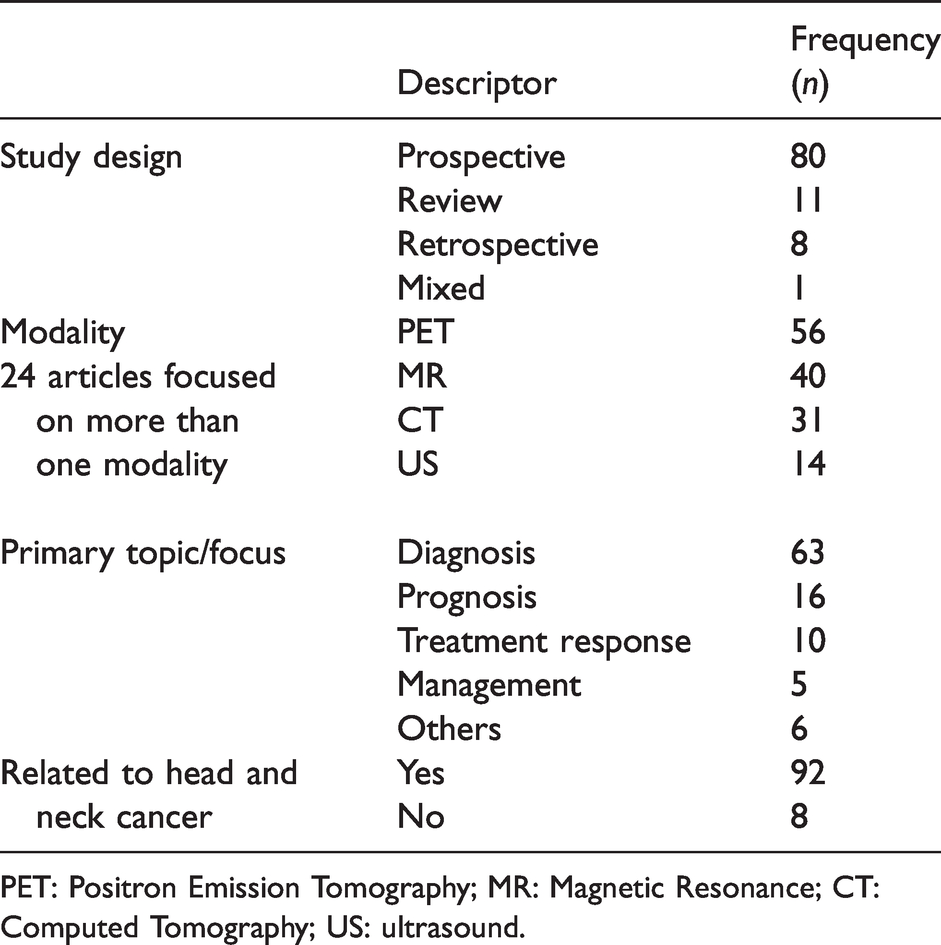
PET: Positron Emission Tomography; MR: Magnetic Resonance; CT: Computed Tomography; US: ultrasound.
Topic
Imaging modality, primary topic/focus of the article and if the article was head and neck cancer related were also evaluated for all of the articles on the list. This is shown in Table 3.
Discussion
The current bibliometric analysis offers some interesting insights into the field of head and neck radiology research, its history and how head and neck imaging has evolved over the years.
From our analysis, the most cited article was published in Nature Communications by Aerts HJWL et al. titled ‘Decoding tumour phenotype by non-invasive imaging using a quantitative radiomics approach’ in 2014. 19 This article has also received the greatest number of citations per year, with an average of 197.5 citations per year. We noted that 90 out of 100 articles were published before 2010. This might bias the list in favour of the articles that had been published for a longer period of time and hence accumulated a larger number of citations. We have, therefore, included the average citations per year in our analysis (Table 1) for the articles on the top 100 list. Looking at the top 10 articles by average citations per year, six of the articles were published after 2010 while all of them were published after 2000.
Analysing the top three articles with the most citations per year, it was interesting to note that they were all published in the 2000s. Computed Tomography (CT) imaging was a recurring theme in all three articles and all of them focused on the clinical utility of non-invasive imaging in the clinical management of patients with head and neck cancer. These results may have reflected the trend in clinical medicine of this era, where imaging was being integrated into diagnosis and management alongside clinical examination. 20
It was also noteworthy that the most cited article on the top 100 list (1185 citations) is approximately 6.5 times that of the mean (182) and 7.6 times that of the median (156). There is also a significant discrepancy between the most cited paper and the rest of the papers on the list (range, 115–448). We propose that this could be due to the increasing emphasis placed on evaluating the prognosis of the head and neck cancer patients using non-invasive imaging. Prognostic imaging was also discussed in 16 other articles on the top 100 list.
The top three journals (Radiology, Journal of Nuclear Medicine and International Journal of Radiation Oncology Biology Physics) with the most publications on the top 100 list are all journals in the field of radiology. This is in contrast to the findings of a previous bibliometric analysis focusing on head and neck cancer in general, 18 which showed that the top contributing journals were high impact factor general medical journals such as the New England Journal of Medicine and Lancet. This difference might be due to the fact that we are focusing specifically on radiology in the head and neck region.
The journal impact factor is the average number of citations received by articles published in the journal in the last two years. By reviewing the impact factors of the journals on the top 100 list, we can evaluate the quality and influence of the top 100 cited articles. The higher the impact factor, the more influential the journal is in their field. This is supported by the fact that the three journals above are amongst the top 10 journals in the field of radiology by impact factor. 21
Forty-four percent of the top 100 articles were from academic institutions in the USA. This was also seen in other bibliometric analyses in head and neck surgery6,22 and radiology.12,13 This might be attributed by the tendency of the USA authors to cite local papers and their influential research culture in medical training.23,24
From our analysis, 92 out of 100 articles were related to head and neck cancer. Eight other articles focused on other head and neck pathologies such as hyperparathyroidism, thyroid disorders, vascular malformations and hemangiomas. The prevalence of head and neck cancer-related articles in the top 100 list might be explained by the fact that cancer imaging is an important strand in head and neck radiology. Positron Emission Tomography (PET) seemed to be a recurring theme in all decades and was the most studied imaging modality. The popularity of these themes might be explained by the evolution of PET in oncologic imaging over the years. 25 Examining the articles on the list by decade shows some trends in the progression of head and neck radiology research. Papers from the 1980s were mainly on diagnostic imaging with one article in the late 1980s discussing about fluorodeoxyglucose-PET. 26 This decade also marked the beginning of extensive research on the use of PET in head and neck conditions, which continued into the next few decades. In the 1990s, studies compared different imaging modalities and compared these modalities with established screening and diagnosing methods. They were also evaluated for their clinical utility. This then gave way to studies that focused more on the clinical utility of the different imaging modalities, particularly PET. Several number of articles from this decade also looked into hypoxia imaging with PET.27–30 Finally, a trend towards using imaging for surveillance and treatment response was noted for studies published in the 2010s. It is expected that imaging modalities relating to early detection and surveillance of head and neck cancer will continue to be a main focus of research in the field of head and neck radiology in the future. This is because many of these imaging modalities now play an integral role in the diagnostic and surveillance pathways of head and neck cancer. With the increasing interests on non-invasive investigative techniques, it is predicted that imaging modalities such as PET and MRI will continue to be extensively researched.
This is the first bibliometric analysis focusing on head and neck radiology. Having such a list can provide radiologists and researchers with information on the most influential papers in the field of head and neck radiology. It also provides insights into how head and neck radiology has evolved over the decades and the advances in head and neck radiology research.
Our study has limitations as with all bibliometric analyses. First, our main limitation is the search terms that were used in this study. Articles that did not use ‘head and neck’ as a keyword may have been excluded from our database. Similarly, our database was restricted to articles, which included ‘radiology’ or ‘imaging’ or one of the imaging modalities mentioned above. Second, citation numbers often differ between databases such as WOS, Scopus, PubMed and Google Scholar. We chose WOS as it is the most commonly used database for bibliometric analyses. Finally, with our study being a bibliometric analysis, there is a tendency for bias in favour of older publications. 23 To address this issue, we have also measured the number of citations per year (Table 1). It showed that the top 10 articles ranked by average citations per year were all published after 2000.
In conclusion, this study has provided a detailed analysis of top 100 most cited papers in head and neck radiology, providing insights into the most influential research in the field of head and neck radiology in the current time and allowing for the analysis and prediction of future trends. This bibliometric analysis also provides researchers with information on the characteristics of the highly cited papers in this field.
Footnotes
Declaration of Conflicting Interests
The author(s) declared no potential conflicts of interest with respect to the research, authorship, and/or publication of this article.
Funding
The author(s) received no financial support for the research, authorship, and/or publication of this article.
