




Abstract
The Indonesian government's attention to economic infrastructure development has increased over the last two decades. However, there has been a trend of rampant rent-seeking in infrastructure projects by elites in both local and central governments. Nonetheless, why and how rent-seeking practices in infrastructure projects have been so endemic in Indonesian local government remains poorly understood. This article addresses this by investigating how infrastructure development in local government serves dual functions of economic growth and political commodity by utilising qualitative data obtained from interviews in Central Kalimantan (2016) and East Nusa Tenggara (2020) provinces. This data confirms the existence of infrastructure's dual function, in which official regional development planning documents and accompanying regulations are more likely to function as a legal umbrella for legalising rent-seeking practices. The term ‘unjust by default‘ identifies the practice of rent-seeking by formalising political-economic interests into regional development planning documents and manipulating regulations in order to implement infrastructure development programmes.
Infrastructure developments return to the development economists’ agenda and are subsequently followed by donors and governments. Hencce, no wonder this infrastructure agenda has been ‘reborn’ and has become an academic and policy interest. (Estache, 2008)
Introduction
Over the past 20 years, the Indonesian government has very aggressively prioritised policies on economic infrastructure development (Salim and Negara, 2018). During the presidency of Susilo Bambang Yudhoyono (2004–2014), for example, bold measures were taken to improve the quantity and quality of infrastructure by not only increasing the role of local government through decentralisation policies but also increasing state budget allocations for infrastructure, both through conventional schemes and the Special Allocation Fund (DAK). The same policy tone was also pursued by the government of Joko Widodo (Jokowi), both in his first (2014–2019) and second term (2019–2024).
However, the Indonesian government's strong commitment to infrastructure development has been accompanied by rampant corruption (Olken, 2007), particularly in infrastructure projects (i.e. ICW, 2021). Many officials in the executive branch as well as national and regional legislators have been brought to court and prosecuted for abusing their authority in using budget allocations for infrastructure. Data from Kompas indicates that, as of January 2023, the Corruption Eradication Commission (KPK) has handled the cases of 155 mayors/regents and their deputies and 23 governors (Kompas, 2023).
Many infrastructure developments have been instrumentalised as ‘cash cows‘ (Boas et al., 2014; Rose-Ackerman, 1999) for distributing state assets from these projects among the political elites. For instance, the KPK prosecuted 444 corruption cases in Indonesia in 2020, with estimated state losses of IDR18.6 trillion (Tambunan, 2023; Zulkarwin, 2021). Most of these corruption cases were associated with government tenders, including infrastructure tenders to be looted by political elites. The modus operandi of this corruption is typified by collusion and entanglement between contractors, companies and politicians in the executive and legislative branches of governments (Zulkarwin, 2021). Winters (2013) calls this politik bagi-bagi, or the politics of wealth transfer, which aims to obscure the checks-and-balances mechanism between executive and legislative government. That corruption has been endemic in Indonesia was also confirmed by economic research from 2001 to 2015, with losses due to corruption in Indonesia reaching IDR203.9 trillion (Mhardhika, 2019). Recently, the KPK charged the Governor of Papua, Lukas Enembe, for alleged mega-corruption in infrastructure development in his province (Ni'am and Setuningsih, 2023; Ni’am and Asril, 2023). The Coordinating-Minister for Politics, Law and Security, Mahfud MD, revealed in 2022 that Enembe's alleged corruption had totalled 560 billion rupiahs (CNN Indonesia, 2020).
Following Estache's (2008) quote above, the practice of corruption in infrastructure development in Indonesia is not unique. Estache explored the notion of infrastructure development as a political commodity, emphasising the role of infrastructure projects as political tools that governments use to achieve various political objectives. Estache argued that infrastructure development can be driven by political considerations rather than purely economic or technical factors.
Estache (2008) further argued that infrastructure projects often serve as visible symbols of political power and legitimacy for governments. They can enhance the reputation of political leaders, demonstrate their commitment to development and public welfare and secure widespread support (Supriadi et al., 2021). Infrastructure investment is apparent and tangible, with the potential to generate immediate benefits for the population, such as improved transportation, access to services and job creation (Bueno de Mesquita, 2003; Flyvbjerg, 2005; Golden and Picci, 2005; Lehne et al., 2018). Therefore, politicians may prioritise infrastructure development to gain electoral support and maintain their hold on power . Similarly, many previous studies determined that incumbents facing political competition in elections have an incentive to control infrastructure projects to gain political support from the populace (Boas et al., 2014; ; Bueno de Mesquita, 2003; Lake and Baum, 2001; Min, 2015; Rose-Ackerman, 1999; Wade, 1982). In addition, various studies suggest that political elites design infrastructure developments as cash cows to distribute kickbacks for their benefit (Bussell, 2012; Harding, 2015; Lehne et al., 2018; Samuels, 2002; Stasavage, 2005).
Estache (2008) also highlights the potential for corruption and rent-seeking behaviour in infrastructure projects. Due to the enormous financial resources involved, infrastructure development can be susceptible to political manipulation, including bribery, favouritism and kickbacks (Chen et al., 2020; Hindess, 2005; Kyriacou et al., 2015). Politicians and government officials may exploit infrastructure projects to generate personal or political gains, divert funds or benefit specific interest groups. This aspect of infrastructure as a political commodity underscores the need for transparency, accountability and good governance in that sector (Fisman et al., 2014; Flyvbjerg et al., 2003).
Furthermore, Estache (2008) argues that infrastructure projects can be used as instruments of regional or social-political strategy. Governments may strategically allocate infrastructure investment to specific regions or social groups to promote economic development, reduce regional disparities or appease potential social tensions. Infrastructure can become a tool for political bargaining and negotiation, with the government using it as leverage to secure support or cooperation from different actors (Cheng and Urpelainen, 2019; Clarke and Xhu, 2004; Gerring and Thacker, 2004).
Overall, Estache's (2008) notion of infrastructure development as a political commodity highlights the intertwined nature of infrastructure and politics. While infrastructure projects are undoubtedly essential for economic development and societal progress, they are also shaped by political considerations such as electoral dynamics, power dynamics and the pursuit of political objectives (Golden and Min, 2013; Patnaik, 2015). Understanding these dynamics is crucial for comprehending the complexities and challenges associated with infrastructure development and ensuring its effective and equitable implementation.
Rent-seeking in natural resources such as mining, forestry and fisheries in Indonesia has been widely investigated. However, many scholars still seem oblivious to rent-seeking practices in infrastructure development and overlook the possibility of the dual function of infrastructure development as economic development and as serving a rent-seeking agenda (Ghosh Banerjee et al., 2006). This has left us with an unclear picture of how infrastructure can be instrumentalised to distribute capital amongst the elite. This study endeavours to correct that omission and aims to investigate the question of how rent-seeking in infrastructure development has transpired and to identify the evidence of the ‘dual function’ of infrastructure developments‘, as suggested by Estache (2008), in the context of Indonesian local government. In so doing, data from the author's research in Central Kalimantan province in 2016 and East Nusa Tenggara (NTT) province in 2020 will be utilised. These two periods (2016 and 2020) were deliberately chosen to determine change and continuity in the political economy characteristics of local government policies in infrastructure development in the first and second periods of Jokowi's administration.
This study argues that the presence of the political-economic interests of local government elites, political parties and entrepreneurs in implementing infrastructure development plays a significant role in the inefficiency and discontinuity in infrastructure development. This implies that the issue of infrastructure development has not only been used as a political commodity to gain support from the populace but has also been used in rent-seeking practices to amass short-term economic benefits and political capital. The official documents of regional development planning and the various regulations have ultimately functioned more as a legal umbrella for the legalisation of rent-seeking practices. This practice can be called ‘Unjust by Default’. The material presented here should contribute to elaborating Estache's (2008) proposition on the dual function of infrastructure development, in particular, and the discourse on rent-seeking practices in Indonesia, in general.
The following discussion will begin by unpacking the political economy of local government policies in infrastructure development in Central Kalimantan province (2016) and NTT (2020). It will then proceed to discuss and present the generalisations about how the findings of the studies can explain the main theme of this article: Unjust by Default.
Research methodology
This study employs qualitative research to address the issue by purposive sampling. This involves deliberately selecting participants based on their specific qualities or characteristics that are relevant to the research question (Creswell 2014; 1998; Creswell and Poth, 2018). Purposive sampling is instrumental in this study and aims to gather information-rich cases related to rent-seeking in local infrastructure development (Palinkas et al., 2013). This research used three data collection methods: literature survey, documentation study and in-depth interviews.
Research into the academic literature involved searching for theories and data related to the research topic. This utilised sources such as books, scientific works, journals or published data from regional elections and regional development planning. The second method, of documentation study, involved a thorough search for various documents. These included the Victory–Joss vision and mission documents, the Regional Medium-Term Development Plan (RMTDP), minutes of legislative meetings, news coverage and public discussion of the programmes of gubernatorial and deputy gubernatorial candidates. Other documents, such as letters and essential notes, were also examined. This comprehensive document search was necessary to obtain accurate data, evidence and explanations.
Thirdly, in-depth interviews with key purposively determined informants were conducted. They were identified based on the researcher's judgement regarding who was appropriate (meeting the requirements) to be an informant; based on this sampling technique, the researcher identified 27 participants who were key actors or the main perpetrators in the cases studied. This method makes it easier for the researcher to capture important information from key informants – in this case, directly. A recorder was used when conducting the interviews with informants. The informants in the study were an elected governor, the leader of the political party supporting the Victory–Joss pair, the Victory–Joss campaign team, their regional election vision and mission formulation team, the RMTDP drafting team, civil servants, regional legislators, academics, a journalist, a businessman and a tourism activist.
The semi-structured interview approach utilised involved a combination of closed and open-ended questions. For each semi-structured interview, the researcher created a set of tailored questions and critical themes designed explicitly for that interviewee (Erickson, 1986; Kallio et al., 2016). An interview guide was used to ensure that all relevant questions were covered during each interview session (Kallio et al., 2016). This also provided flexibility, enabling the researcher to adapt and inquire based on the direction of the interview. This flexibility enabled the exploration of the complex and evolving phenomena in rent-seeking in infrastructure projects and prevalent corruption practices such as bribery, kickbacks and embezzlement which can lead to inflated project costs and substandard infrastructure.
Political economy of Central Kalimantan provincial government policy in infrastructure development
Based on official documents and data from several interviewees in Central Kalimantan, especially in the Kapuas district, local governments are highly committed to developing social and economic infrastructure, as embodied in the official RMTDP or Recana Pembangunan Jangka Menengah Daerah (RPJMD, 2019–2024; 2015–2019). This commitment also extends to the infrastructure development programme stipulated in the Regional Strategic Plan. However, the plan and the implementation of infrastructure development face several obstacles: limited regional financial capacity (budget), geographical conditions/characteristics and accompanying political-economic factors.
Interviews with several local elite politicians in the Central Kalimantan provincial government reveal that the priority for economic infrastructure development is land transport. Water transport was only focused on developing harbours, including Tanjung Tawas and Batanjung harbours located in the Kapuas district. To support the provincial government, for example, around 85% of 2015's IDR3.62 trillion regional budget was allocated to infrastructure development (Interview with Head of Central Kalimantan Provincial Bappeda, 25 May 2016; Head of Commission D, Central Kalimantan Provincial Parliament, 26 May 2016).
The Central Kalimantan provincial government's policy of giving less priority to the development of water transport is ironic because, given that the province is geographically connected by large rivers, the development of water transport should be a priority. However, local government officials prioritise land transport infrastructure over water transport because the rivers silt up. Thus, water transport can only facilitate small tonnage vessels (Interview with Head of Sarpras, Central Kalimantan Bappeda, 25 May 2016).
What, however, are the specific programme plans if the economic infrastructure development priorities are focused on land transport development? According to ‘BH’, a senior official at the Central Kalimantan provincial office (Interview, 25 May 2016), the priority of the Central Kalimantan provincial government in land transport development was more directed at building and improving the quality of provincial and strategic roads. Strategic roads connect districts and have an essential access role in developing regional economic potential (connecting production centres with outlets). This policy was preferred because only approximately 50% of the ideal number of roads needed in Central Kalimantan had been built.
Another issue requiring special attention was the construction of roads that connect districts/cities with sub-districts (cross-district roads) and sub-districts with villages (cross-village roads). The construction of these two categories of road is under the authority of the district government. However, to accelerate the development of regional economic infrastructure, and at the request of the district/municipal governments, the provincial government is also involved in constructing district, sub-district and village roads. The provincial government thus provides the road construction budget and implements the project. However, once the physical construction of the road has been completed, it is handed over to the district/municipal government. Thus, the management and maintenance of the road, including the necessary budget, become the responsibility of the district/city government (Interview with BH, 25 May 2016).
Several obstacles have yet to be overcome in realising local government plans for economic infrastructure development, particularly in the development of land transport facilities. In general, such obstacles are:
The limited financial capacity of local government. The geographical condition of Central Kalimantan province, which is mainly peatland, where the budgets required for road construction per metre can be three times the cost of road construction on ordinary land. The low participation of the private sector in road construction. The dominant sectoral ego of local government agencies. In principle, Regional Development Agency consistently implements infrastructure development planning following the RMTDP to benefit the populace. However, due to political interests, planning and implementing infrastructure development is instrumentalised chiefly as a ‘project’ instead of sustainable infrastructure development. So, local infrastructure development is mainly utilised to fulfil individuals’ and local political elites’ short-term economic and political interests. The idea that infrastructure development accelerates regional economic growth is not the concern of local government. I am deliberately revealing this so that you [the researcher] can find out and explore further the root of the problem. (Interview 25 May 2016)
However, there is still one constraint that is much more fundamental: the political-economic interests of the local government elite. Interviews with several interviewees indicate that infrastructure development agendas, particularly road development, are open to the short-term political-economic interests of elites. An indication of this was revealed in an interview with ‘KB’ (a high-ranking official in the Central Kalimantan provincial office), who explicitly stated that the political-economic interests of local government elites had contributed to the discrepancies between the planning and implementation of infrastructure development programmes in Central Kalimantan province. The following excerpt from the interview with KB elaborates this:
BH further claimed that short-term political-economic elite interests are adopted by officials in the regional executive and legislators in the local Regional People's Representative Assembly to repay political promises to their constituents. Consequently, most infrastructure development programmes are employed as political projects by elites and rent-seekers. What BH says is confirmed by several interviews with local parliamentarians. For instance, ‘HU’, a Golkar party politician, claimed that: We local parliament members have always proposed road construction to local executive government, particularly village roads, during the Regional Budget and Expenditure Revenue meeting at the local parliament. The proposals we submit are generally based on the people's aspirations. However, the local executive government rejected our proposal, and if this happens, we cannot do anything. Sometimes the government accept the proposal; however, the implementation of the proposal relies on the authority of the Technical Committee at the Public Works Agency. (Interview 27 May 2016)
Another indication of the short-term political-economic interests of elites in infrastructure development, especially in road development, is shown by the failure to implement the Central Kalimantan provincial regulation that obliges palm oil, coal and other businesses to build their own roads. According to ‘KS’, an officer at the Central Kalimantan Provincial Regional Development Agency, political factors were one reason why the regulation did not work. Furthermore, he says that, generally, major companies have the backing of government officials (central/regional), such as political party elites and military generals (Interview with KS, 25 May 2016).
Generally, rent-seeking is still endemic in Central Kalimantan, particularly in infrastructure projects. For instance, the Central Kalimantan High Prosecutor's Office arrested ‘HAT’ for alleged corruption in the construction of inter-village roads to 11 villages along the Sanamang River, Katingan Hulu District, Katingan Regency in fiscal year 2020 (Nufus, 2023). Another case is corruption in a slum infrastructure development project in Kahayan Hilir District, Pulang Pisau Regency (Pulpis) in 2016 (Kaltengonline, 2022). The Central Kalimantan High Prosecutor's Office named three suspects in alleged corruption in the construction of Haji Muhammad Sidik Airport, Central Teweh, North Barito Regency, Central Kalimantan, with an estimated state loss of IDR17 billion (Kompas, 2018). In addition, based on KPK data, over 2017–2020 there were 403 complaints from the public regarding acts of corruption in Central Kalimantan. The KPK has handled a total of five cases, among which is the alleged corruption in an infrastructure development involving peatland rewetting by the Peatland Restoration Agency (BRG) through the Central Kalimantan Environment Agency (DLH) in 2017–2019 (Prokalteng, 2019).
Political economy of the regional government of East Nusa Tenggara in infrastructure development
Similar to Central Kalimantan province in this regard is the NTT government's infrastructure development. The similarities lie in the NTT government's commitment to develop land and water transport infrastructure primarily to support the development of the tourism sector. This commitment was legally formalised in the RMTDP and the Regional Government Work Plan of NTT province for 2018–2023. However, the differences are in the characteristics of political-economic practices in the implementation of infrastructure development, the motives of the political-economic interests of the elites and the way in which interests are contested.
More specifically, the RMTDP of NTT province 2018–2023 is a regional development planning document based on the vision and mission of the elected governor and vice governor, Viktor Bungtilu Laiskodat and Josef Nae Soi (‘Victory–Joss’). According to Law No. 25/2004 and Minister of Home Affairs Regulation No. 86/2017, preparation of the RMTDP is to be performed by technocrats and led by the Regional Development Planning Agency or RDPA.
However, the drafting process of the RMTDP of NTT 2018–2023 was unusual since it was drafted by three teams: the RDPA team, the Transition Team and the team appointed by the elected governor (Interview with EM, 28 April 2020). The RDPA team comprised bureaucrats from all Regional Apparatus Organisations, while the Transition Team consisted of members of the Victory–Joss team and local university experts. The Victory–Joss team comprised local businesspeople in the tourism industry who are close allies to the elected governor and were given the extraordinary privilege of designing development strategies in the tourism sector (Interview with FN, staff from RDPA and member of the RMTDP team, 27 April 2020). In essence, the RMTDP team was dominated by non-bureaucratic actors, and this was significant because non-bureaucrats have become more powerful than state actors in designing the RMTDP of NTT. The Transition and VBL teams prevailed; they were able to corruptly inscribe the interests of the elites from the governor's political party supporters, businesspeople and the governor's business interests in preparing the drafting process of RMTDP.
The NTT Regional House of Representatives passed the RMTDP draft into Regional Regulation Number 4 of 2019 concerning the 2018–2023 RMTDP. Notably, tourism infrastructure development has been the prime mover of economic development. This is odd, however, because tourism infrastructure development as a prime economic development is rare in Indonesia. However, in the case of NTT, it is evident that economic infrastructure is directed mainly at improving and providing land, sea and air transport to support tourism industries.
The RMTDP was politicised by including the political economy interests of regional elites. It is therefore not surprising that, later in its implementation phase, it has become an arena for rent-seeking practices. For instance, the road construction programme implemented since 2019 is mainly controlled by political party elites and entrepreneurs affiliated with the political parties that supported the Victory–Joss campaign in the 2018 gubernatorial election.
One of the political party elite figures who supported the Victory–Joss team in the 2018 gubernatorial election who received road construction projects is ‘UJ’. Data from the NTT Electronic Procurement Service (LPSE) between 2019 and 2021 documents that UJ's company worked on several road construction projects sourced from the NTT Regional Budget. Among these were the Bokong–Lelogama road construction project in Kupang district along 40 km, with a project value of IDR75 billion, and the Waiklambu–Riung–Mboras road construction project in Manggarai district, with a project value of IDR66 billion in the 2019 fiscal year. In the 2020 budget year, they worked on the Puukungu–Orakose–Kamubheka road construction project in Ende district with a value of IDR24 billion, and the Aeramo–Kaburea cross-district road project on the North Coast (Pantura) of Flores Island with a value of IDR55 billion.
In addition to the political party elite, several entrepreneurs affiliated with political parties supporting Victory–Joss in the 2018 gubernatorial election obtained road construction projects. Among them are ‘MR’ and ‘LM’. Both received infrastructure development projects in 2019–2021, including: a) the construction of the Kolisia bridge in Sikka district, with a project value of IDR13 billion; b) the construction of a 10 km hot-mix road in East Manggarai district and the Nangaroro–Maunura–Maunori road construction project in Nagekeo district, with a project value of IDR8 billion; and c) a hot-mix road construction project in Kupang district and the Nggongi–Wahang–Malahar road construction project in East Sumba district, with a project value of IDR7 billion (Data LPSE-East Nusa Tenggara Province, 2019). In the 2020 fiscal year, they again acquired a local road improvement and routine maintenance project, supporting the Komodo National Tourism Strategic Area (KSPN) (Noa–Hita–Golowelu) along 62.2 km, with a contract value of IDR65.3 billion (LPSE-East Nusa Tenggara Province Data, 2020).
Other local businesspeople affiliated with political parties who supported the Victory–Joss pair in the 2018 gubernatorial race and who also received projects to develop economic infrastructure facilities and infrastructure are ‘BY’, ‘PB’ and ‘LB’. This trio are entrepreneurs engaged in the maritime sector in inter-island shipping transport. In 2020, Governor Viktor Laiskodat implemented a strategy of ‘opening access to sea and air shipping around the three Rings of Beauty’. In order to support his policy, the governor issued inter-island shipping licences to companies owned by the trio. Governor Viktor Laiskodat inaugurated the maiden voyage on 2 October 2020 on the Kupang–Semau–Rote crossing (Media Indonesia, 2020). Then, in implementing the 2021 programme, the three entrepreneurs again received a shipping permit for the Kupang–Larantuka crossing route, East Flores. This second ship was inaugurated directly by Governor Viktor Laiskodat on 29 August 2021 at the port of Bolok Kupang (Tempo, 2021b).
Moreover, in the 2018 NTT regional elections, the Nasdem, Golkar, Hanura and PPP parties supported the Victory–Joss pair. Over time, not all supporting parties have been involved in political decisions after winning the regional elections. For the preparation of the RMTDP, for example, only the Nasdem party was involved through the participation of its two central cadres: Daniel Kameo and Sarah Lery Mboeik (interview with Winston Rondo, 29 March 2020). They are also part of the Victory–Joss vision and mission formulation team. Consequently, only the interests of the Nadem party are found in the RMTDP. Another regional elite figure who was dominant in preparing the RMTDP was Jacky Ully, chair of the NTT Nasdem Party Regional Leadership Council. Before becoming a politician, Ully was a local businessman who owned PT Surya Agung Kencana, a company engaged in road construction. Ully founded this company after retiring from the National Police and started working on road construction projects in NTT in 2009 (Interview with Jacky Ully, 10 August 2020).
As a politician-businessman, Ully got the right momentum to integrate his political and economic interests into regional development planning when the party he led won the 2018 NTT regional elections; the elected governor was his good friend. The road infrastructure development programme integrates the interest of working on road infrastructure development projects into the RMTDP. This programme is contained in the strategy ‘Procuring land, sea and air transportation infrastructure’ in the third mission and ‘Improving physical infrastructure supporting the tourism sector’ in the second mission. These two strategies include, among other things, road infrastructure development.
The emergence of the road infrastructure development programme in these two strategic forms cannot be separated from the role of Ully. He was involved in an agreement between Viktor Laiskodat, represented by the RMTDP drafting team, and the political party leadership supporting Victory–Joss. Their main agreement is that the construction of all 2650 km of provincial roads in 22 districts/cities will be carried out simultaneously in just three years of regional development implementation. In this agreement, the infrastructure development budget, including road construction, is planned using a regional loan scheme (interview with Sarah Lery Mboeik, 11 May 2020). Therefore, this informal agreement is not recorded in the RMTDP document.
According to Sarah Lery Mboeik, the elite political parties involved in this agreement were Ully, chair of the NTT Nasdem Party Regional Leadership Council; Mohamad Ansor, deputy chair of the NTT Golkar Party Regional Leadership Council; Jimmy Sianto, chair of the Hanura Party Regional Leadership Council; and Djainudin, chair of the Council Regional Leader of the NTT PPP Party. Each represents the four parties supporting Victory–Joss. Meanwhile, the RMTDP drafting team was represented by David Pandie, Daniel Kameo, Sarah Lery Mboeik and I Wayan Darmawa as head of the NTT Bappeda at the time (interview with Sarah Lery Mboeik, 11 May 2020). The meeting between the RPJMD drafting team and the elite of the supporting political party took place in the office of the NTT Nasdem Party Regional Leadership Council's chair, which was the winning secretariat for Victory–Joss at that time. The following is what Sarah Lery Mboeik said: That was a thorough plan; we planned to build a massive infrastructure. All provincial roads will be built in just three years. The governor does not want gradual development. However, other than roads, tourism infrastructure will still be built within five years. So we have to invite discussions with all the supporting party leaders because the plan is to use regional loans to build the infrastructure. I was afraid that the proposal would be rejected when it was executed at the regional people's representative council. So we agreed from the start with the party chairman. There are Mr Jacky [chair of the Nasdem party], Mr Ansor [deputy chair of the Golkar Party], Mr Jimmy [chair of the Hanura Party], Mr Djainudin [chair of the PPP Party].
This informal agreement introduced the infrastructure development concept using a regional loan scheme. More specifically, all provincial roads would be constructed within three years. This agreement makes regional loans essential for delivering a road infrastructure development programme. According to Winston Rondo, building road infrastructure using regional loans has never been implemented in NTT. This only happened during the leadership of Governor Viktor Laiskodat. On the other hand, such road construction methods tend to be project based because local governments will build infrastructure on a large scale. These infrastructure projects emerged due to development methods using regional loans, which were carried out by the elite of the political party supporting the Victory–Joss team, one of whom was Ully.
Discussion
Under the visionary leadership of President Joko Widodo, also known as ‘Jokowi’, the Indonesian government has embarked on a transformative journey in infrastructure development (Negara, 2016; Negara and Suryadinata, 2018; Warburton, 2016; 2018). This commitment is not just a mere promise but a tangible reality, as evidenced by the prioritisation of over 200 extensive urban and regional infrastructure megaprojects (Hudalah et al., 2020). These include toll roads, highways, railways, airports, seaports, industrial parks and special economic zones (SEZs), all of which are set to reshape the country's landscape. These projects, outlined in Presidential Regulation 3/2016 on the acceleration of National Strategic Project (PSN) implementation and its yearly amendments, are not only about infrastructure but also about the future of Indonesia (Hudalah et al., 2010; Warburton, 2018).
State-owned holding companies have been used to funding projects that take a long time to develop and to tackling capital market problems. This suggests a change in how governance approaches the issue (Kim, 2018; Warburton, 2016; 2018). Furthermore, incorporating financial elements into urban infrastructure projects through public–private partnerships has created speculative areas controlled by the government. These areas significantly impact the planning and implementation of infrastructure projects (Anguelov, 2022; Kenny, 2009a; Sukwika, 2018 (2018 ). However, the Jokowi administration has been criticised for prioritising infrastructure development to benefit the privileged class and the general population (Ginting and Naqvi, 2020). The administration intends to tackle economic issues and to foster development by reallocating budget resources to infrastructure development and enacting bureaucratic and regulatory changes (Arif, 2021).
However, infrastructure development is vulnerable to plunder by political elites (Kyriacou et al., 2015) because road infrastructure projects require many official authorisations, thus creating space for rent seeking. Local politicians can thus demand a portion of the project to enrich themselves or to distribute capital to their patron. This modus operandi transpires through lobbying, budget scalping and bribery. Corruption in infrastructure has been rampant in Indonesia since Soeharto's administration (Robison and Hadiz, 2004). Many government programmes, including infrastructure projects, are plundered by elite politicians for their economic benefit (Zulkarwin, 2021). Corruption in local infrastructure development in Indonesia has become a significant issue, especially with the surge in cases involving local public leaders (). The decentralisation of democratic governance has granted regional governments more authority, leading to a rise in instances of corruption at the local level (Prud’homme, 1995. This trend has adversely affected the efficient management of regional resources and compromised infrastructure projects’ integr (Thomas, 2021; Tireuov et al., 2022).
In the two cases investigated above, infrastructure development is more than just economic development strategies. It has a dual function: economic development and rent seeking (Estache, 2008). In NTT and Central Kalimantan, infrastructure projects have become a priority for local policymakers as they serve their own economic interests. How, then, do such projects become an instrument of local political elites to transfer capital from the state to their own pockets? Our analysis suggests illicit collusion between local elites to overpower infrastructure projects in order to transfer the state budget to their pockets by controlling the policymaking of the RMTDP and the tender process of road construction. The political-economic interests of local elites are formalised into regional development plans, such as the RMTDP, and regulations which are meant to support infrastructure development are manipulated in the implementation phase. We have, then, referred to this phenomenon as ‘Unjust by Default’.
Collusion and the overwhelming domination of the elected governor's team in the RMTDP drafting process were apparent. This practice, however, is contrary to Law No. 25 of 2004, which states that the authority to draft the RMTDP lies with the Regional Development Planning Agency (RDPA). According to Ministerial Regulation of Home Affairs No. 86 of 2017, the authority of the RDPA to prepare the RMTDP is by involving experts and stakeholders from outside the bureaucracy. The RMTDP is usually developed from the regional head's vision, mission and core programmes. In addition, Article 19, Paragraph 3 of Law No. 25 of 2004 states that the RMTDP is prepared and authorised by the regional head and local legislature three months after the regional head's inauguration. After the RMTDP draft is formalised in a formula of regional regulation, it becomes a legal regional development document. In the case of the NTT RMTDP, tourism infrastructure development is a legal instrument of the government to boost economic development, even though this agenda has been instrumentalised by the local elites for their economic benefit. Thus, it is reasonable to suggest that the local government's political economy in infrastructure development is unjust by default.
Since the formulation of the RMTDP, the lobbying process involves a transition team of the elected governor, local businesspeople and the governor's cronies to achieve a consensus on tourism infrastructure development as a strategic economic development programme. In this case, there was collusive interpenetration between the local executive – represented by the RDPA – the transition team and local businesspeople. According to Katz and Mair (2009), this collusion is reciprocal because the local executive penetrates the state budget via the RMTDP to access strategic resources like the infrastructure budget. In this context, the local elites legalise their economic agenda as stipulated in the RMTDP and thus become the legal means of local governance in NTT.
Discussion about the RMTDP is dominated by a collusive strategy that perpetuates ‘pie sharing’ among local elites and their cronies. All the interviewees in this research support this claim and demonstrate that the pie sharing of economic resources (i.e. infrastructure contracts) was allotted to the governor's allies from both political parties and local business elites after the Victory–Joss win in the 2018 gubernatorial election. This confirms Winters’ (2016) politik bagi-bagi theory by which elites distribute capital from the state budget or assets to their allies to strengthen their economic benefits and status quo.
Mahfud argues that many government programmes, including infrastructure development, are subject to endemic plunder by elites (Robison and Hadiz, 2004). Furthermore, he claims that the law is purchasable (Purwadi, 2015; Taher, 2019Tirto, 2020). Elites can capture the law by bribing the legislators and executive government policymakers to insert particular articles in laws (Hargens, 2020; Rock and Bonnett, 2004). In the case of infrastructure development in Central Kalimantan and NTT, bribery is not the principal way of understanding the priority of infrastructure development as stipulated in the RMTDP. However, it is reasonable to claim that local elites have captured and ‘ordered’ the agenda of infrastructure development as a major priority for local economic development. This is also why infrastructure development has not significantly impacted sustainable local livelihoods (Kenny, 2009b), since the infrastructure agenda was used in local economic development to distribute capital from the state budget to local elites.
To understand how infrastructure development is instrumentalised in distributing capital from the state budget to the pockets of elites, we should examine Indonesian democratic practices, particularly in national and local elections. Many have suggested that Indonesian democracy is marred by patronage (Abdullah, 2016; Berenschot, 2018; Choi, 2009; Robison, 1986; Robison and Hadiz, 2004; Winters, 2011, 2013, 2016).
Rent seeking, particularly in infrastructure development, engenders ‘patronage democracy’ (Ambardi, 2009, 2011; Aspinall and Berenschot, 2019; Bourchier and Hadiz, 2003). ‘Patronage’ is a political tactic that provides favours, such as goods and services, in exchange for electoral support (Aspinall, 2014; Aspinall and Mietzner, 2014; Tambunan, 2022, 2023). Patronage democracy engenders illicit practices in politics and government, which prevents government from effectively distributing resources and enforcing the rule of law (Bourchier and Hadiz, 2003; Slater, 2018; Slater and Simmons, 2012). Patronage democracy allows political elites to intervene in policymaking by employing their political power (Abdullah, 2016; Mietzner, 2012, 2013). In the RMTDP legislation of NTT, the dominance of the elected governor's team in its drafting was apparent by including tourism infrastructure development as a significant economic development. Subsequently, after the RMTDP was passed, it was kickback time – most of the infrastructure project tenders were allotted to the governor's business allies and political supporters.
Hence, infrastructure development in NTT essentially demonstrates what Estache (2008) calls the dual function of infrastructure: to serve both economic development and rent-seeking practices. These rent-seeking practices transpired when most road construction from 2019 to 2022 was performed by local companies affiliated with the elected governor. This confirms that infrastructure development serves political ends to divert funds from the state to a specific group (Gulzar and Pasquale, 2017; Rio, 2021; ).
In both local and central government, rent seeking has also been embedded in illicit practices such as bribing legislators and budget scalping in regulation discussions (Winters, 2015). In the case of RMTDP legislation, where tourist infrastructure became the principal economic development in NTT, bribery was not evident. However, the dominance of Governor Victor through his particular team members, local businesspeople in tourism and elite supporters from political parties was evident. Hence, as Estache (2008) suggested, infrastructure development has a dual function as a political commodity and an economic strategy. In the RMTDP legislative process, infrastructure development in the tourism sector was mainly politicised: accessing the state budget to enrich the elected governor's allies to amass capital for their regional economic ascendancy.
As mentioned above, this claim is also reinforced by the fact that infrastructure procurement is one of the most plundered budgets in local government (Media Indonesia, 2022). Deputy Chair of the Corruption Eradication Commission (KPK) Alexander Marwata vindicated this assertion, positing that the quality of infrastructure in Indonesia would be better if not for corruption during tenders, budgeting and project implementation. For instance, if the contract value is 100%, the infrastructure's real value will only be 50% of the initial contract because the remainder is divided by local government for the executive and legislature (Kamil, 2022). Mutual agreement and malicious conspiracy transpire in tendering processes – contractors will make a profit of 10–15% of the contract value, deposit commitments for budget certainty will amount to 7%, commitment fees to 20% and manipulation of procurement reports to 5% (KPK, 2022). Endemic rent seeking in infrastructure procurement is evident from the corruption cases in Table 1. The trend demonstrates that more budget for infrastructure procurement leads to increased corruption and state losses.
Total budget for infrastructure development, corruption cases and state losses.
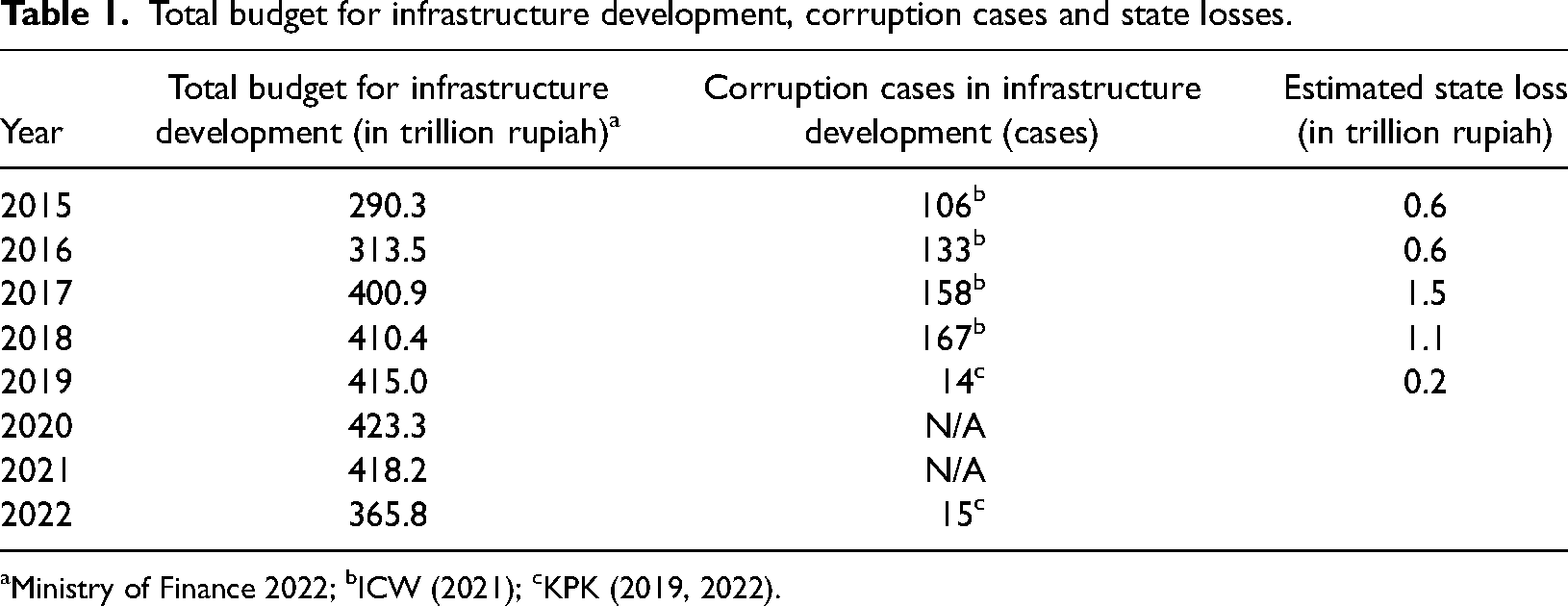
Ministry of Finance 2022; bICW (2021); cKPK (2019, 2022).
Rent-seeking practices in infrastructure procurement confirm Winter's (2015) theory that some government programmes, laws and policies have been instrumentalised to distribute wealth and capital among elites in government, political parties and business. Winter's analysis shows that local elites have instrumentalised infrastructure development to distribute wealth among their circles or to pay back money they spend in elections.
Studies such as those by Berenschot (2018), Hakim and Jurdi (2017) and Zulkarwin (2021) also reinforce that of Winter (2015), arguing that elites have instrumentalised some government programmes and policies by shielding their agenda in highly politicised government policies such as tourism infrastructure development in NTT to plunder state assets for the governor's cronies. Under President Yudhono, the Hambalang infrastructure mega-scandals had also featured allegations of plundering to finance political parties (Kompas, 2013). The project had four budget amendments: initially, the cost to build the project was only US$9 million, but later the government and legislature agreed to increase the project to US$16 million, and it was again amended to US$57 million before finally surging to US$179 million (Kompas, 2013). The infrastructure induced calamities and was a total failure. The media, scholars and other experts believe that the elites in Yudhono's government should be held accountable. However, this case is still not resolved because politik bagi-bagi, or capital transfer, within the elites is difficult to prosecute ( CNN Indonesia, 2020 ). Winters (2013) suggests that corruption typically entangles elites such as businesspeople, executive officials and legislators (see also Savirani and Wardhani, 2022). Investigating this is thus challenging since unravelling such cases is incredibly difficult because mechanisms of checks and balances have been blurred by collusion among governing elites.
Conclusion
Research in the Central Kalimantan and NTT provinces indicates that the decentralisation of authority to local governments and the increase in development budget allocations are only partially connected to an increase in the quantity and quality of infrastructure in these regions. This discrepancy occurs because of several constraints in the implementation of infrastructure development programmes. However, there are non-technical constraints behind technical matters that significantly contribute to bias in the implementation of regional infrastructure development programmes. The obstacle in question is the presence of the political-economic interests of the elites of local government administrators, political parties and entrepreneurs affiliated with parties supporting the regional governors and deputy governors during local elections.
Some indications of this tendency are shown in the infiltration of road construction project proposals by local legislators during regional expenditure discussions and the failure to implement the Central Kalimantan provincial regulation that requires palm oil, coal and mining entrepreneurs to build their own roads due to the alleged ‘backing’ of government officials (central/regional), political party officials and military generals. The same trend is also apparent in NTT where political elites instrumentalised the 2018–2023 RMTDP for political and economic benefit. The existence of non-bureaucratic actors (Transition and VBL Teams) in the preparation of the NTT RMTDP only represents the interests of political party elites who supported the Victory–Joss team in the 2018 gubernatorial election, as well as businesspeople and the governor's cronies and his business interests. Thus, it is not surprising that implementing the RMTDP, especially in infrastructure development, has become an arena for rent-seeking practices.
On a theoretical level, the research findings on the presence of the political-economic interests of local government elites, political parties and entrepreneurs in implementing infrastructure development confirm Estache's (2008) analysis that political factors play a significant role in inefficiency and discontinuity in infrastructure development. Politicians control infrastructure development because it has high political value. This implies that infrastructure development has not only been used as a political commodity to gain support from the populace but has also been used in rent-seeking practices to amass short-term economic benefits and political capital.
The official documents of regional development planning and the various regulations that accompany them ultimately function as mere legal umbrellas for rent-seeking practices. Political-economic interests are formalised into regional development plans, and regulations are manipulated in the implementation phase of the infrastructure development programme, described as ‘unjust by default’.
While regulatory flexibility is necessary to provide space for innovation by policymakers, it also allows policy manipulation to legitimise rent seeking. Therefore, it is not surprising that politicians and government officials are usually very fond of regulations that are general (containing ‘rubber articles’) and that tend to be normative (Schlirf et al., 2009) because they provide opportunities for multiple interpretations which create ‘grey spaces’. The practice of ‘unjust by default’ thus transpires.
Overall, the research data from the provinces of Central Kalimantan and NTT clearly confirm the dual function of infrastructure proposed in this article's introduction concerning the results of Estache (2008): infrastructure development acts not only as a determinant variable for economic growth and competitiveness but also as a ‘political commodity’ for the governing elites.
Footnotes
Declaration of conflicting interests
The authors declared no potential conflicts of interest with respect to the research, authorship, and/or publication of this article.
Funding
The authors received no financial support for the research, authorship, and/or publication of this article.

Correction (August 2024):
Article has been revised to update first author's affiliation.