



Abstract
This paper analyses the performance and appropriateness of the Indonesian government’s ‘good governance’ institutional reform aimed at stimulating infrastructure construction. During the 15 years after the 1997 Asian financial crisis, the government attempted to strengthen formal institutions with the goal of improving public investment efficiency and attracting private investors. By analysing policies in the construction industry in terms of company registration, procurement and state enterprises, the paper finds that the outcome was far from what was expected by technocratic-bureaucratic reform promoters as interest groups frequently succeeded in capturing the new institutional system. This paper then challenges the dominant narrative that overwhelmingly blames incomplete institutional reform for Indonesia’s slow infrastructure construction. Given the inherent market failure and political challenges in institutional reform, the paper argues that passive developmentalist policies, which resulted in conflictual state–business relations and insufficient public investment, were a prime cause that then set the stage for the emergence of state-led infrastructure development strategy from the mid-2010s.
Introduction
Indonesia’s infrastructure development accelerated during the second half of the 2010s. Indonesia watchers have noted that the state-led development strategy has begun to produce visible outcomes (Guild, 2019; McCawley, 2019; Ray and Ing, 2016). Projects such as linking trans-Java toll-roads, expanding trans-Sumatra toll-roads, constructing inter-urban railways and the Jakarta-Bandung high speed railways, and building ports and airports have made notable progress, though these projects have not been without delays (Sekretariat Kabinet Republik Indonesia, 2018).
President Joko Widodo (Jokowi) focused resources on addressing infrastructure deficits because he understood the potential political merits of solving this economic issue. During the second half of the 2010s, there was a drastic restructuring of the composition of government spending. The central government’s capital spending expanded, whereas fuel subsidies shrunk. For the first time in a decade during which comparable data is available, capital spending became larger than fuel subsidies in 2015 (Central Bank of Indonesia, n.d.). In 2019, the final year of Jokowi’s first term, the total budget allocation for infrastructure was four times larger than fuel subsidies (Kementerian Keuangan, 2019).
Furthermore, Jokowi supported state-owned enterprises (SOEs) with a range of policy measures and directed them to invest and implement major infrastructure projects (Kim, 2019, 2021). This strategy made a notable change in Indonesia’s corporate landscape. Figure 1 illustrates the rapid increase of state-owned construction firms in the rankings of listed companies. For example, Waskita Karya, a partially state-owned construction firm, rose from 94th in 2014 to 16th in 2019, making it among the largest 3% of listed firms. The mobilization of SOEs also strengthened the country’s infrastructure budget absorptive capacity. Despite concerns surrounding the strategy’s negative consequences, such as expanding debt and crowding out (Curristine et al., 2018), infrastructure development performance helped Jokowi’s re-election in 2019 (McCawley, 2019).
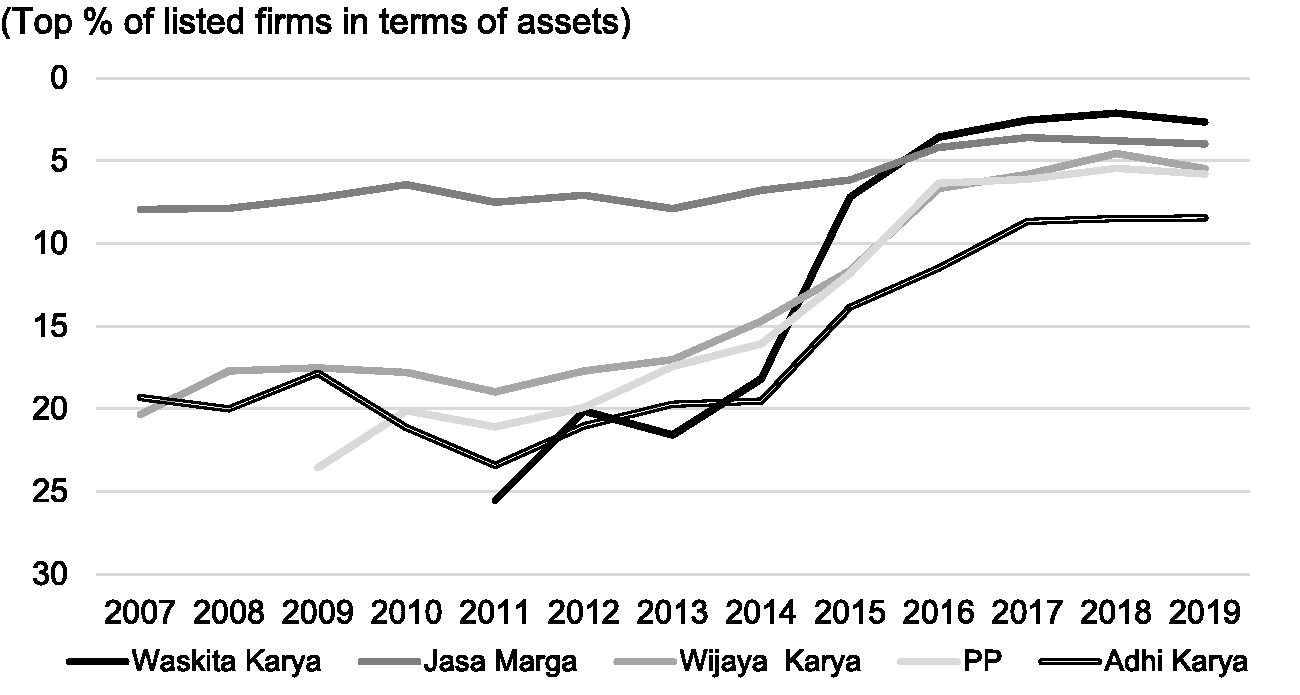
Ranking of Indonesia’s construction sector SOEs among all listed companies, 2007–2019. Note: PP stands for Pembangunan Perumahan. Source: Author’s construction based on Osiris.
While this narrative has gained significant attention, the underlying structural reasons for choosing this particular infrastructure development strategy have been overshadowed by the focus on Jokowi’s ‘pragmatism’. This paper analyses construction sector reform efforts since the 1997 Asian financial crisis to accurately situate the emergence of state-led strategy.
Since democratization began in Indonesia following the Asian financial crisis, the infrastructure deficit has gradually become a major issue in political and economic arenas. Politicians have regarded this issue as an opportunity to gain popularity and have made countless promises to enhance infrastructure. However, actual infrastructure supply often failed to meet politicians’ promises and electorates’ expectations until the mid-2010s. Figure 2, for example, shows that the length of asphalt road relative to the number of vehicles has fallen since the 1990s. It demonstrates that the speed of infrastructure expansion fell far short of the massive demand created by the country’s urbanization and economic development. As this trend continued, the infrastructure issue increasingly took centre stage during political elections. Weak infrastructure development has also caused uncertainty and congestion and was seen as a primary factor in making the country unattractive to businesses seeking investment opportunities. Infrastructure has been labelled as one of the most significant challenges in many large emerging economies over the past decades. This is especially the case in Indonesia, where lack of infrastructure availability in particular has been a consistent issue (Figure 3).
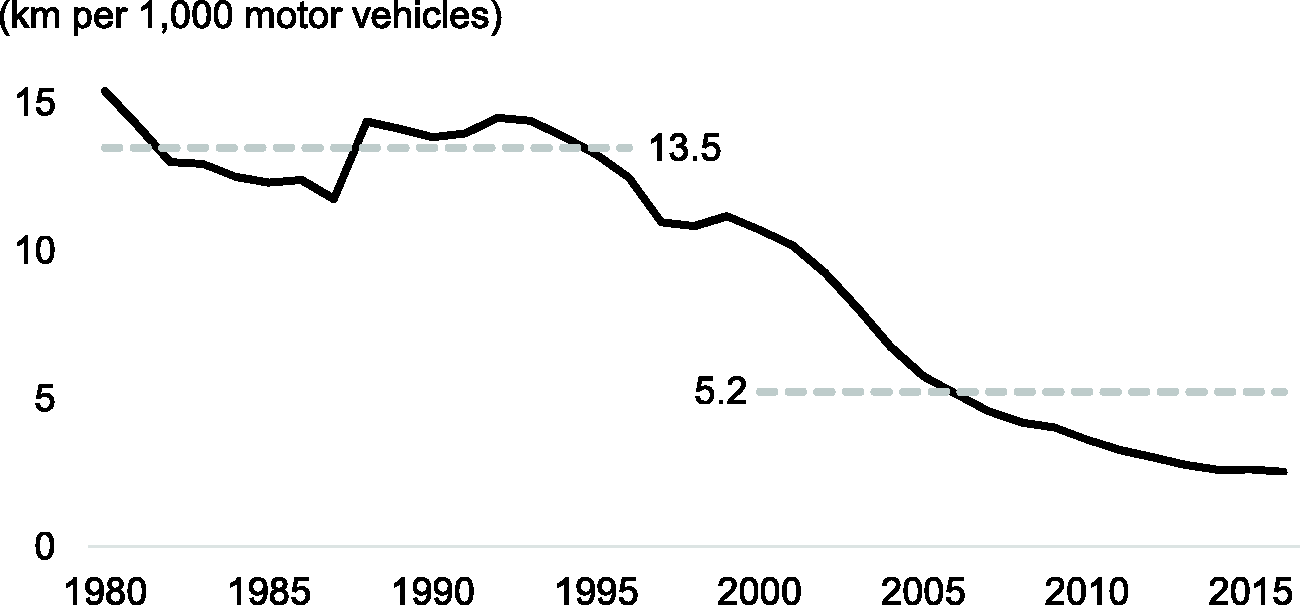
Length of asphalt roads, Indonesia, 1970–2015. Source: Author’s calculations using data from Statistics Indonesia.
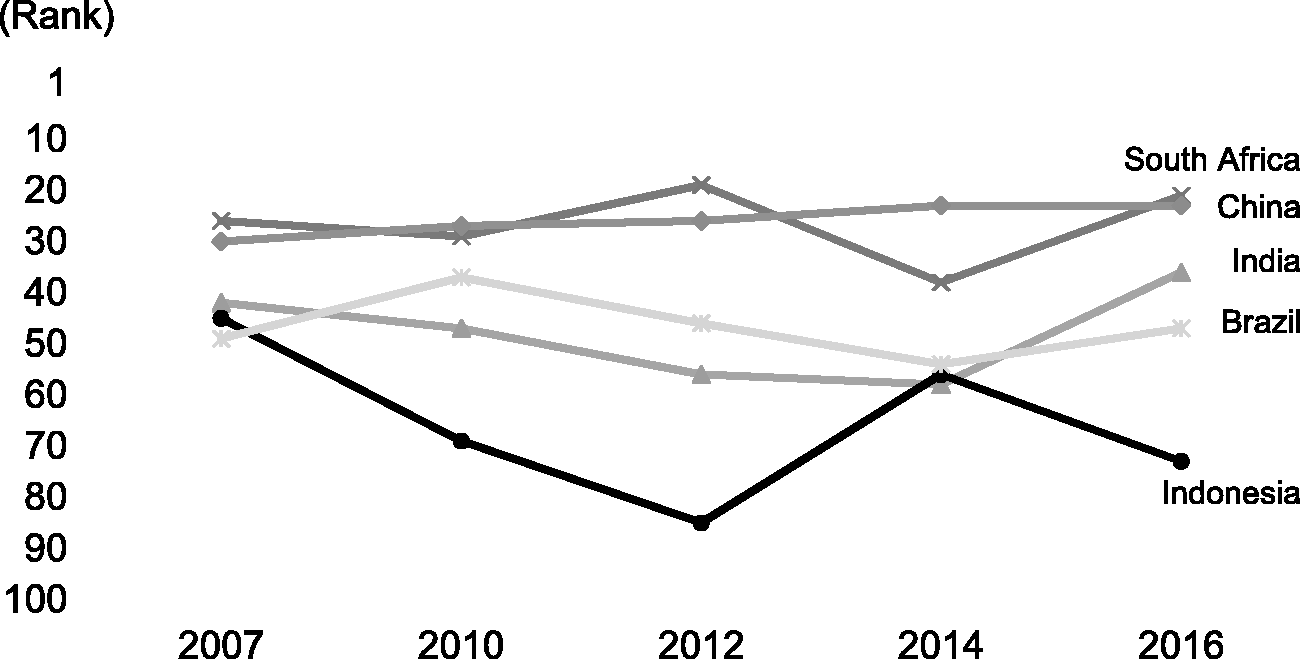
Quality of trade and transport-related infrastructure, large developing economies, selected years between 2007 and 2016. Source: World Bank Logistics Performance Index.
While infrastructure development was relatively slow, the construction sector expanded rapidly with spurts of property boom in Indonesia. In this paper, the mismatch between infrastructure development and construction sector growth is analysed by unpacking the government’s shifting role during the 15 years following the crisis. This paper uncovers issues that explain Indonesia’s disappointing infrastructure development by analysing not only the outcome but also the appropriateness of relying on institutional reform in the construction sector following the Asian financial crisis. In doing so, the paper takes a step further than criticising the ‘post-Washington consensus’ institutional reform and suggests a new analytical angle based on state developmentalism. This paper contributes theoretically by connecting studies on the political economy of governance reform in developing countries with the developmental state literature. It reinterprets the disappointing outcome of market-oriented institutional reform through the viewpoint of state developmentalism and argues that the slow progress in infrastructure development was caused by the government’s withdrawal from orchestrating and participating in infrastructure construction. Using the case of Indonesia, this finding helps explain the recent resurgence of state capitalism in many developing economies which aim to stimulate economic growth by accelerating infrastructure expansion.
This paper presents two main arguments. The institutional changes during the 15 years after the crisis aimed to invigorate infrastructure construction by moving the Indonesian government towards a regulatory state. However, the result was unsatisfactory as new formal rules and organizations were often challenged by a number of stakeholders through not only illegal methods but also legal mechanisms under democracy. While performance was disappointing, it was not surprising considering that state–society conflicts are inherent in regulatory reform, particularly within a political regime with decentralized power. This argument builds on literature on the politics of establishing ‘apolitical’ governing institutions.
This paper also argues that imitating the regulatory state, however desirable in the long-term, was not only challenging in implementation but also insufficient for stimulating infrastructure construction in the context of a country with severe market failures and young democratic institutions. This paper suggests that a primary reason for slow infrastructure construction was a lack of activist-type developmentalist policies. This argument departs from conventional views presented in international organizations’ policy reports and market-oriented analyses, which focus on the potential role of private investment and the importance of regulatory reform. Based on this finding, this paper argues that there should be a reorientation of the view that the advancement of market-supporting institutions and the government’s active participation in economic development are necessarily conflictual. This analytical angle aids in understanding the emergence of state-led infrastructure development strategy from the mid-2010s.
This paper is structured as follows. The next section discusses this paper’s analytical framework. The subsequent section provides a broader context in which construction sector reform was pursued by discussing how ‘good governance’ agendas permeated into Indonesia’s institutional restructuring. The following section analyses the aims, contents and performance of regulatory reform in the construction sector in the decade following the crisis. The section takes a look at the policies initiated with the goal of constraining the government’s sectoral governance, rent distribution and direct participation. More specifically, the section reviews policies on company registration, public procurement and SOE operation. The subsequent section then challenges the widely accepted view, which argues that the struggles in regulatory reform were the main reason for slow infrastructure construction. There were many challenges in institutional restructuring, but they are insufficient in fully explaining infrastructure construction performance. Therefore, this section argues that a major cause was, in fact, weak developmentalist policies that went hand in hand with ‘good governance’ institutional reform. The final section concludes the paper.
Analytical framework
Democratic societies involve diverse demands and methods of expressing them through formal institutional mechanisms. This diversity of demands and expression of those demands has been the core of the ‘good governance’ reform aimed at achieving a wide range of goals including democratic representation, participation, transparency, accountability, property rights and efficient public administration in developing countries. Specifically, the ‘good governance’ reform has focused on establishing and engineering formal institutions capable of achieving these goals (Gisselquist, 2012).
The literature on ‘political settlements’ does not deny the importance of the formal institutional system in place. However, the literature criticises that traditional institutional analysis has often overlooked the importance of power structure and informal linkages in defining the process of creating and distributing rents (Khan, 2010, 2019). The existing formal institutions are not completely ineffective in democratic developing countries, yet a variety of powerful agents can ignore or even change the rules of the game. Rent seekers can use their economic and political capital to selectively take advantage of formal institutions to guard interests while using informal networks to extend benefits. Therefore, the ‘good governance’ reform, which aims at making formal institutions ‘more advanced’, often leads to a large gap between expectations and actual outcomes.
Focusing on the infrastructure sector, Davidson (2015) also emphasizes the importance of considering both formal and informal institutions and the interaction between them when understanding economic reform outcomes. A key contribution of this work is specifying the key actors by disaggregating the ‘state’ and the ‘society’ in the context of democratic Indonesia. The main subgroups which can influence formal legislative changes are the executive branch, parliamentary organs, businesses, civil society organizations and international development financial agencies, reflecting the pluralistic tradition (Ford and Pepinsky, 2014). In contrast, the range of actors with strong influence over the actual designing and implementation of regulations is narrower, a reality that supports the oligarchic thesis (Robison and Hadiz, 2004). Policy outcomes largely depend on the extent to which the goals of the political elites and businesses are aligned and how those actors pursue goals through informal negotiation processes within the formal institutional environment, as also highlighted by Sato (2017).
Another key contribution of Davidson (2015) is the discussion of the central government policymakers’ complex and diverse incentives that include but also extend beyond materialistic benefits. A detailed look at toll road building in young democratic Indonesia shows the government is rummaging through a jumble of targets including accelerating economic development, ensuring fiscal health, satisfying businesses and investors, avoiding societal disorder, and pursuing democratization and decentralization, with the executive paying the most attention to popular image, party politics and future elections. This multitude of goals contributes to intra-administration and societal conflicts, gaps between rhetoric and reality, and frequent policy reversals.
Building on these analytical frameworks, this paper examines the laws and regulations adopted to solve the construction sector’s perceived problems and accelerate infrastructure development in Indonesia. It analyses the challenges that arose at the implementation stage due to the businesses’ efforts to manipulate the new institutional environment. The paper also examines the government’s shifting priorities and approaches as the construction sector reform panned out and faced hurdles.
Analyses of the struggles in institutional reform, especially analyses with a particular focus on the governments’ role in economic governance, often face the ‘so-what’ question. Such analyses tend to conclude the unsuitability or difficulties of imposing externally designed, or ‘internationally acceptable’, governance structures yet fall short of providing an alternative method for solving particular economic challenges. This paper fills this gap by linking the literature on the political economy of economic reform with the developmental state literature.
The disappointment in the ‘good governance’ institutional reform has nudged the international development community to shift from the ‘best-practice’ approach to the ‘best-fit’ approach as the latter takes into account the context of the political economy (Hickey, 2012: 688). A related suggestion has been to pursue ‘good/just enough governance’ that involves clarifying priorities, understanding trade-offs, and taking into account variations in reform effectiveness and speed across different areas of governance (Grindle, 2004; Levy and Fukuyama, 2010). This shift from a radical to a gradual approach displays the continued attachment to ‘good governance’ institutional reform and the tendency to overlook mechanisms that could build states’ developmentalist capabilities for mobilizing large public investments and managing growth-distribution nexuses (Batley et al., 2012; Hickey, 2012; Kwon and Kim, 2014; Rodrik, 2000).
The developmental state literature demonstrates two important pillars of rapid economic advancement: the government’s (i) conditional support to productivity-enhancing activities based on collaborative state–business networks and (ii) direct financing and investment in accumulating productive assets (Haggard, 2018). This paper reinterprets the disappointing outcome of ‘good governance’ reform policies for infrastructure development in Indonesia through the lens of state–business relations (Brinkerhoff and Goldsmith, 2005; Khan, 2007). It also goes a step further by criticising the then-dominant stance that supported the state’s limited investment role in infrastructure development.
Spread of ‘good governance’ agendas in Indonesia
Only several years after it was named one of the Asian miracle economies (World Bank, 1993), Indonesia experienced the most severe economic crisis in its modern history. In 1997, foreign capital began to withdraw from one Asian economy after another, forcing a number of countries to give up their pegged exchange rate systems. Combined with worsening real economic conditions and investment sentiment, financial capital continued to leave the region, meaning that several countries had to ask the International Monetary Fund (IMF) for bailouts. Indonesia was unarguably the worst-hit economy in the region with its gross domestic product (GDP) shrinking 13.1% in 1998. The economic effects were also prolonged; per capita GDP, after more than halving during 1997–1998, only reached the pre-crisis level in 2005. Furthermore, the unemployment rate continued to increase until 2005. Indonesia also ended up with a huge government debt equivalent to 87.4% of GDP in 2000. Laeven and Valencia (2018) put the gross fiscal costs of Indonesia’s banking crisis during this period at 56.8% of GDP, which is the largest figure in the world between 1970 and 2017.
The severe and long-lasting nature of the economic effects of the Asian financial crisis on Indonesia in comparison with other countries can be attributed to political reasons as much as to financial vulnerability. From the dawn of the crisis, the autocrat’s poor health and the uncertainty of a three-decade old authoritarian regime’s future were at the heart of this ‘Indonesia discount’. During the bailout negotiation period, the regime’s past resilience and deep-rooted oligarchic networks raised questions about the government’s policy credibility (Hofman et al., 2004). After the eventual fall of the regime along with societal uprising, a chaotic period ensued for some time during which the country had three new presidents in less than four years. This section takes a close look at the ‘good governance’ reform drive that grew out of this dual (political and economic) crisis in Indonesia and compares two major perspectives on reform results.
Post-crisis reform direction
The Asian financial crisis had multiple causes. Jayasuriya and Rosser (2001) summarize three main theories: the ‘macroeconomic mismanagement thesis’, the ‘government failure/crony capitalism thesis’ and the ‘premature financial liberalization thesis’. According to the first two theses, even after notable economic liberalization, these economies remained vulnerable due to the uncertainty and inefficiency brought about by the remnants of the statist political system. Although Asian countries maintained fiscal health, the first thesis argues that the government managed the exchange and interest rate regimes heavy-handedly. The second thesis emphasizes opaque state–business relations involving government guarantees, support and rent-seeking deals. In contrast, the third thesis tends to be more sceptical about the past liberalization. It argues that the shock was amplified by the corporate and financial sectors’ heavy reliance on short-term foreign debt (Burnside et al., 2016; King, 2001; Radelet and Sachs, 1998). It also discusses how excessive asset price inflation led to property price and stock market bubbles which ultimately burst, affecting real and financial sectors during the crisis (Collyns and Senhadji, 2002; Quigley, 2001). While the criticism of the third thesis focuses on unprepared liberalization, this thesis is often linked to the second thesis. In combination, the second and third theses highlight the governments’ inadequate regulations over financial activities, especially the activities of politically connected conglomerates which disproportionately benefited from easier access to finance and the property and stock market boom. Any one of these three theses could explain why the economic restructuring policies of IMF bailout programmes involved institutional reform aimed at curbing the government’s discretionary power.
Compared to other countries, the crony capitalism problem was considered to have had a more prominent role in causing the crisis in Indonesia. At the time of the crisis, Indonesia was the only autocratic regime among countries experiencing the crisis. 1 Suharto had been ruling Indonesia for 31 years and held a firm grip over the country’s political economy by presiding the ‘circulation’ and ‘accumulation’ of key resources for decades (Sidel, 1998). The circle of beneficiaries became increasingly smaller during the last decade, intensifying diverse actors’ dissatisfaction with the regime (Fukuoka, 2013). The scale of wealth accumulated by Suharto’s family and cronies was remarkable. Suharto himself was the 6th richest person in the world in 1997, behind petrostates’ royal families and the United States’ wealthiest businessmen (Forbes, n.d.). While Indonesia’s GDP at the time was less than half of South Korea’s, Suharto’s wealth was larger than the combined wealth of the four families of South Korea included in the list of world’s billionaires. Six ethnic Chinese Indonesian businessmen who had built diversified conglomerates leveraging their close connection with Suharto were also included on this list. During Suharto’s reign, stakeholders who would usually keep the government in check in a democracy, such as opposition parties, civil society and judiciary, were suppressed or marginalized by the authoritarian government (Hofman et al., 2004).
The Suharto regime collapsed during the Asian financial crisis as the economic difficulty ignited discontent that had been building up in the society. Indonesia then began its path towards democratization with an indirect competitive presidential election in 1999 and a direct presidential election in 2004. The ‘big bang’ decentralization was implemented from 2001, providing more authority to regional governments (Davidson, 2018). In the economy, the liberalization stance, which began in the mid-1980s, continued in earnest. Tariffs, non-tariff barriers and investment regulations were significantly loosened under the IMF’s guidance (Pangestu et al., 2015). Another pillar of economic restructuring was the ‘good governance’ reform, which involved establishing formal legislation and governance organizations (Davidson, 2016).
The ‘good governance’ reform promoted by international financial institutions (IFIs) from the 1990s went further than previously promoted economic liberalization measures in curbing government power in developing countries. Under the so-called post- or augmented Washington Consensus, ‘getting institutions right’ became the mantra (Rodrik, 2006). In particular, during the Asian financial crisis, IFIs’ level of interference with the sovereign governments’ jurisdiction extended as IFIs actively prescribed institutional reform agendas (Feldstein, 1998). This reform’s main economic policy items were to establish or improve rule-of-law institutions to guarantee property rights, anti-corruption institutions to strengthen transparency, antitrust institutions to invigorate market competition and sectoral governance institutions to ensure predictability. These institutions had to be, according to this new mantra, independent from the government to allow them to be guarded from factional politics and patronage networks. This reform agenda also played a key role in presenting a rhetoric that it was not market liberalization policies per se that had caused economic malaise in developing countries but an error was found in the political environment in which these policies were pursued (Carroll, 2012). According to this view, for market liberalization to truly have a positive effect, it needs to be accompanied by institutional reforms that curb the government’s discretionary power and stimulate competition. The ideal form of economic governance through this reform is that of a ‘regulatory state’, with a role of providing apolitical institutions necessary for the efficient functioning of markets based on economic incentives.
In Indonesia, ‘good governance’ reform agendas seemingly fit the public mood following the crisis. Anger towards the three-decade old authoritarian government was at its peak. Since the origin of the crisis was the financial sector, many blamed the country’s largest capitalists, particularly Chinese-Indonesian cronies with close links to the presidential palace who had benefited from the banking sector liberalization over the previous decade (Borsuk and Chng, 2014; Dieleman, 2007; Robison and Hadiz, 2004). In this atmosphere, ‘good governance’ reform was viewed as an important means of facilitating political and economic democracy. In a more immediate term, this reform was viewed as necessary in dismantling the network of corruption, collusion and nepotism that grew under Suharto.
IFIs, which had strong leverage over capital-dry Indonesia in the aftermath of the economic crisis, promoted ‘good governance’ agendas alongside further economic liberalization. The active promotion of ‘getting institutions right’ was in a stark contrast to IFIs’ limited interest in this issue before the crisis (World Bank, 1993). A speech given by Wolfowitz (2006) in Jakarta summarizes the IFIs’ position effectively. Wolfowitz, World Bank President at the time of the speech, recalled the crisis period by stating that ‘The World Bank first acknowledged corruption as a major impediment to development only ten years ago [emphasis added]’. Wolfowitz, who served as the United States Ambassador to Indonesia in the late 1980s, when Suharto’s patronage system was unmissable, emphasized the importance of ‘good governance’ after observing that ‘corruption contributed significantly to the economic collapse of 1997–1998’. He also stated that ‘corruption thrives in countries where private investors face cumbersome procedures and excessive regulations’, highlighting that corruption can be eradicated by shrinking the state’s role in the economy. After the effects of the crisis had ebbed, international bodies such as the Organisation for Economic Co-operation and Development (OECD) and donor agencies regularly advised and pressured Indonesia to conduct pro-market governance reform (Jarvis, 2017).
Since the crisis, numerous organizations have been born or transformed in Indonesia. The reform efforts to secure the rule-of-law led to strengthening the Supreme Court and establishing the Constitutional Court (Butt, 2015), efforts to improve transparency led to establishing the Anti-Corruption Commission (KPK) (Butt, 2012), efforts to foster market competition led to establishing the Business Competition Supervisory Commission (KPPU) (Thee, 2002) and efforts to ensure predictability led to sectoral governance institutions being established in infrastructure segments such as gas, telecommunication, and road, water, and air transportation (OECD, 2010a). These organizations had varying levels of independence and power to implement a new array of regulations, verify compliance and influence legislative changes.
Technical and political economy viewpoints
The governance institutions that have been established since the economic crisis have gained attention in literature on Indonesia’s infrastructure. This literature has often focused on analysing how the country’s institutional characteristics have caused slow infrastructure development. Within this literature, there are two distinctive groups analysing the issue from different perspectives.
The first group deals with technocratic bureaucracy and emphasizes formal institutions’ weak independence, power, compatibility and capability in Indonesia (OECD, 2010a, 2012). In this view, the main concern is the immaturity of Indonesia’s formal institutions, which were born through incomplete or partial reform. The disappointing result of the effort to attract infrastructure investment can be attributed to these institutions’ failure to ensure profitability and predictability for private businesses. This analysis, explicitly and implicitly, understands private investment as a potential key driver of infrastructure expansion in developing countries. Infrastructure projects are often characterized by large up-front costs, long-term lifespan, positive externalities and natural monopolies (Glaeser and Poterba, 2020; Straub, 2008). Nonetheless, the view discussed here tends to prioritize shrinking the state’s direct participation based on concerns about fiscal situations and government failures (Grishin and Walton, 2016; Helm, 2010; OECD, 2012). According to this view, ‘lack of financing’ is not an issue even for a developing country like Indonesia: private money is ready to be deployed as long as the government appropriately de-risks ventures by providing guarantees and stability at various stages, such as project planning, land acquisition and pricing (McCawley, 2015; Patunru and Von Luebke, 2010). Although the domestic financial market remains underdeveloped, there exist profit-seeking international investors; thus, the argument concludes, further liberalization along with governance reform is important. This ‘development as de-risking paradigm’, or the ‘Wall Street Consensus’, overlooks the significant financial, social and political burden that governments incur in the process of facilitating private investment and guaranteeing profits (Gabor, 2021).
The policy recommendation based on this understanding is to continue with governance reforms following the ‘internationally accepted best practice’, which involves strengthening independence, responsibilities and accountability of regulatory organizations; tidying up legal complications; improving coordination within the government apparatus; and ending central bureaucracy’s dual role as regulator and service provider. The strong leadership of rational policymakers and the accumulation of experience are suggested as vital components of successful reform. In Indonesia during the 15 years after the crisis, this narrative played an important role in the designing of the infrastructure development strategy, leading governments to highlight the importance of public–private partnerships and business-friendly environments (Salim and Negara, 2018).
The second group focuses on the political economy of institutional reform. Existing literature on this topic understands institutional outcomes as the result of continuous conflict and contest between different factions of political, economic and societal actors, with the oligarchic force playing a central role in Indonesia. A combination of strong politico-economic elite networks and weak governance capacity has led to disappointing institutional reform results in many developing countries (Åslund, 2014; Black and Tarassova, 2003; Cameron, 2021; Ford et al., 2016; Hadiz and Robison, 2005; Lough and Dubrovskiy, 2018; Winters, 2011). The common outcome is the predominance of clientelism, nepotism and regulatory capture, all of which are mainly the result of elites with economic power directly or indirectly infiltrating key political and governance institutions at central or regional levels. Many elites can not only avoid anti-corruption purges at the initial stage of institutional reform but also, as the reform drive wanes, proactively influence policy areas directly related to their business interests such as market opening, privatization, procurement, corporate governance, and labour and environmental standards.
According to this view, the ‘good governance’ institutional reform implemented after the crisis was expected to produce disappointing results in Indonesia (Jayasuriya and Rosser, 2001; Robison et al., 2005). Indeed, the institutional reform, or the process of changing the rules of the game, suffered from stakeholders’ interference. Stakeholders, particularly rent-seeking business elites, influenced the reform process through formal and informal means in the economic and political arena to make the institutional system favour them. Even if these actors failed to fully reflect their desires at the stage of legislative changes, they were able to avoid abiding by the new regulations by taking advantage of the governance organizations’ weak capacity. In cases where governance organizations’ capacity was relatively strong, rent-seekers then attempted to circumvent monitoring and penalties by capturing these organizations through various measures (Fukuoka, 2012; Hadiz and Robison, 2005). The reform processes were even more complex in Indonesia as they happened alongside the collapse of Suharto’s centralized bribe-taking system and the establishment of diffused corruption networks following political and fiscal decentralization (Dick and Mulholland, 2011; Hadiz, 2004; Kang, 2003). This literature has generally been sceptical about transplanting a set of ‘good governance’ regulatory modalities in Indonesia and views this method of reform as unrealistic given the pre-existing power distribution and institutional endowments. These political economy issues have been discussed at the level of infrastructure segments, such as toll-roads (Davidson, 2015) and electricity (Jarvis, 2012).
This paper builds on existing literature on Indonesia’s infrastructure development discussed in this section. Compared to studies focusing on infrastructure segments, this paper analyses the construction sector, which has been afforded limited attention in the literature. The following section reviews how the ‘good governance’ reform in three policy areas struggled to achieve the goals.
Institutional reform in the construction industry
Patronage in the construction industry was perceived as one of the Suharto era’s main problems following the Asian financial crisis. While Suharto recycled natural resource revenues to expand infrastructure investment (Booth, 2015; McCawley, 2015), the reform supporters’ focus after the crisis was not on what had been built, instead centring on the actors who had benefited from the contracts and licenses offered by the authoritarian government. Under Suharto, the construction industry acted as a main avenue through which private capital was accumulated (Robison, 1986). While the state directly made deals with the largest conglomerates, smaller construction firms were nurtured through corporatist organizations (Van Klinken and Aspinall, 2011). During the final decade of Suharto’s rule, the president’s family actively participated in infrastructure construction and benefited from preferential access to projects, finance and SOEs (Davidson, 2015; Jakarta Post, 1995). On top of acting as business partners of Suharto-linked companies, construction sector SOEs enabled oligarchs’ complex financing arrangements (AFP, 1998) and conducted tokenistic projects (Rosser, 1983).
Indonesia’s construction industry reform plans after the crisis were aimed to turn the arm-in-arm relations between the government and construction firms into arm’s length relations. This section discusses institutional reform in the construction sector, which was designed to withdraw the state from company registration, public procurement and SOE operations. The institutional reform in this sector formed an important component of the wider infrastructure sector strategy, which also involved a string of new regulations and organizations in individual infrastructure segments. This strategy had two major goals. The first of these goals was to increase the efficiency of limited public infrastructure investment and the second was to stimulate private participation in infrastructure development (Lindblad and Thee, 2007; Soesastro and Atje, 2005). This section discusses how reform efforts struggled to achieve these goals.
Reform efforts
The government’s efforts to create a rule-based governance system in the construction industry began with the adoption of the Construction Services Law in 1999. 2 In front of the largest construction sector business association, then President Habibie presented an ambitious vision by stating that this law would ‘ensure healthy and fair competition, and with that we will be able to prevent collusive and corrupt practices in the construction sector’ (Jakarta Post, 1998). The law sent the message that it was the construction industry itself, or the ‘construction services society’, that was in charge of developing the sector. The construction services society, which was represented by an independent institution, was given responsibilities of managing important affairs across the sector. One of these responsibilities was registering construction companies and professionals in an attempt to weaken the government’s direct control over the firms’ entry into the sector. In 2000, the Construction Services Development Boards (LPJKs), which consisted of one central organization and regional organizations in each province, was established. 3 LPJK was allowed to shift registration roles to accredited business associations in the construction industry. This policy was in line with decentralization and deregulation processes ongoing across the wider economy.
Another area of reform in the construction sector was public procurement, which was understood as an important avenue through which the government distributed rents. The complex, overlapping rules on public procurement in the pre-crisis period had been criticized for causing confusion, contradiction and corruption (World Bank, 2001). The reform began in 2000 and regulations evolved in a trial-and-error manner (Jabes and Wehrlé, 2005; OECD, 2007). 4 Numerous amendments attempted to clarify stakeholders’ roles, which themselves also evolved with fiscal decentralization and public administration restructuring. A principal element of this reform was the establishment of the National Public Procurement Agency (LKPP) in 2007. 5 LKPP, a non-ministerial institution, was responsible for managing various stages of the public procurement process, including formulating overall procurement strategies and supporting and advising stakeholders. Organizational size increased significantly since establishment with the support from the government and donor agencies (Attström and Ismail, 2010). Furthermore, government units were obliged to establish procurement units (ULPs), which were designed as permanent technocratic organizations in charge of the tendering process. 6 The deadline was set in 2010 for government units to establish ULPs by 2014. 7 Before the reform, tendering was conducted by procurement committees composed of government officials assigned on a contract basis. Another major reform was the adoption of the Electronic Procurement Service (LPSE) system, which aimed to strengthen transparency and efficiency. The government mandated electronic procurement for government contracts from 2012. 8 As a result of setting up these institutions, reports have concluded that many aspects of Indonesia’s procurement system, while there is room for further improvement, resembled generally accepted international standards (Hattari, 2015; Ollivaud, 2017; Yulianto and Oeyoen, 2011).
Another pillar of construction sector reform involved the privatization and marketization of SOEs, some of which were Indonesia’s largest construction firms. Amidst difficult fiscal circumstances, the government sought to earn revenue by selling SOEs’ equity and shifting SOEs’ operational goals away from public good provision towards profitability. Partial privatization was a component of the plan to strengthen profitability by exposing management to market forces and embracing financial sector monitoring on corruption and organizational slack (Rakhman, 2018; Wicaksono, 2008). While the plan to sell equity was often delayed due to weak stock market and political opposition, partial privatization was eventually conducted in some of the largest construction sector SOEs, including Adhi Karya (2004), Pembangunan Perumahan (2004), Jasa Marga (2007), Wijaya Karya (2007) and Waskita Karya (2012), in which the government remained majority shareholder. 9 As the construction industry was viewed as a competitive sector in which ‘the private sector can easily operate’ (Hermawan, 2007), privatization was notable in contrast to monopolized infrastructure operation sectors. The government also embedded elements of ‘good corporate governance’ in legislation on SOEs. 10 These elements included improving corporate information transparency and monitoring, granting greater independence to boards of directors, stipulating the process of appointing and dismissing directors, setting up special bodies for checks-and-balances, and auditing financial statements. As a result, Indonesia’s ‘good corporate governance’ framework for SOEs was identical to international benchmarks by mid-2000s (ADB, 2008). Furthermore, there were legal provisions intended to restrict government intervention and protect SOE independence (OECD, 2010b).
Reform struggles
Despite new regulations and organizations emulating ‘good governance’ institutions being established in the construction industry, construction projects were at the centre of many corruption cases and anti-competitive cases (Jawa Pos, 2017; Putra, 2016). Decentralization of patronage networks has also been reported in studies on regional construction projects (Attström and Ismail, 2010; Savirani, 2014; Tidey, 2013; Van Klinken and Aspinall, 2011). These networks have involved exchanging bribes, campaign funds, and electoral support for construction projects. Artificial contracts and ‘flag companies’ have also been found to be implicated in many of these cases. Despite institutional reform in public procurement and the adjustment of the roles of private companies and SOEs, the immediate outcomes in terms of corruption and competition were disappointing. The rest of this section highlights how informal patronage networks often outperformed formal institutions introduced in the previous subsection.
After shifting a large part of the sectoral governance role to the private sector by implementing the Construction Services Law, business associations began to swamp and take charge of sectoral governance. Then, many of these business associations became epicentres of rent-seeking activities (KPPU, 2007). Regional LPJKs were often left with insufficient resources and experts, as well as public officials with ambiguous roles. Business associations could then take advantage of this regulatory vacuum and manoeuvre LPJKs for their own benefit. Business associations with an authority assigned by LPJKs to classify and certify companies could use their power to create an entry barrier and thereby marking their business territory. Several associations were established and gained the certification role for narrowly specified types of construction works that could have already been conducted by the existing firms. KPPU (2007: 61–62) used the examples of business associations in the subsectors related to building maintenance, mechanical–electrical works and concrete asphalt to highlight these problems. Business associations could also benefit from certification-related fees. The actual cost of gaining certification could be multiple times larger than the official rate (KPPU, 2007: 55).
Partly as a result of this uncontrolled registration during the reform period, the number of construction firms nearly trebled in just a decade from 51,622 in 1999 to 151,537 in 2009 (BPS, 2016). Many of these firms were small or inactive and only created in order to satisfy new procurement regulations, such as incentives for enterprises of certain sizes and competition-related procedural requirements. More capable firms could also profit by lending their inactive subsidiaries to less capable firms to enable weak firms in entering contract bidding. Soemardi and Wirahadikusumah (2009: 1228) estimate that, at the end of the 2000s, approximately 90% of the construction companies in Indonesia were small scale and over two-thirds of those small construction companies were fictitious or inactive. Another source estimates that 60% of all construction companies in the first half of 2010 were inactive (Antara, 2014). Moreover, while many smaller active firms struggled to build technical capacity, larger firms could take advantage of their position and make significant profits through subcontracting (OECD, 2015; Soemardi and Wirahadikusumah, 2009; Tarnes, 2011). LPJKs did not effectively monitor and regulate rent-seeking activities as they were often controlled by business associations led by construction firms with financial capacity and political networks (KPPU, 2007).
As the evidence of disappointing reform outcomes piled up, the government began a new stage of re-regulation. In 2010, the government amended the Government Regulations on the Role of the Construction Services Society with the aim of centralizing the governing role. 11 The new regulation stipulated that (i) newly established ‘certification units’ of LPJKs are responsible for the company registration process rather than the accredited business association, (ii) the criteria for classification and qualification are regulated by ministerial regulations rather than LPJKs, (iii) detailed operations of LPJKs are regulated by ministerial regulations rather than LPJK’s own statutes and by-laws, (iv) LPJK board members need to be confirmed by the government, (v) newly established functional government units or ‘secretariats’ are responsible for supporting the implementation of LPJK duties and (vi) the government may fund LPJK activities.
The process of re-regulation was met with fierce opposition from the private sector. The opponents argued that the government wanted to return to the Suharto-style governance when the state controlled construction sector operation. Weakening of the LPJKs’ independence, the opponents argued, would worsen market competition and corruption. Furthermore, opponents highlighted that some new aspects of the amended government regulation conflicted with the Construction Services Law, a legislation of a higher level. Legal wrangling and open disputes between the government and businesses ensued (Antara, 2010, 2011c, 2011d; Suara Pembaruan, 2011). After minor changes to some legislative elements reflecting the Supreme Court’s judgement, the re-regulation package, with its main aim of centralizing the governing role, was implemented. 12 State–business conflicts then reached a peak in 2011, with the establishment of two separate national level LPJKs, one by the Ministry of Public Works and another by the private sector (Antara, 2011b). The government emphasized that there was only one national-level LPJK and reminded the contractors that they would not be able to join government tenders without certificates given by the government-established LPJK board (Antara, 2011a). Similar conflicts were also found on a regional level (Antara, 2012a, 2012b). After the legitimacy of the government-established LPJK had been confirmed, the market participants’ acknowledgement of this organization increased (Antara, 2012c; Citra Indonesia, 2014). 13
The reform outcomes regarding SOEs were equally troubling. Despite partial privatization and ‘good corporate governance’ reform, SOEs were often at the centre of illicit activities in the construction sector. In the newly democratized environment, SOEs began to be monitored by various stakeholders who could or were mandated to reveal information on SOEs’ wrongdoings. Not only the civil society organizations but also a range of public organizations such as KPK, KPPU, the Supreme Audit Board (BPK) and Financial and Development Supervisory Agency (BPKP), as well as the Ministry of Public Works and the Ministry of State-Owned Enterprises, reported the construction sector SOEs’ misconduct (Berita Satu, 2012; Bisnis Indonesia, 2006a, 2006b; Koran Tempo, 2011; OECD, 2009).
The involvement of SOEs in various construction procurement scandals illustrates the severity of reform struggles. During the first half of the 2010s, the Hambalang corruption scandal shook the country’s political scene. The scandal involved construction sector SOEs paying large bribes to policymakers in order to win a contract to build a sports training and education centre. As the president’s close political allies and government officials were involved, this scandal weakened the president’s political position (Jong, 2013; Kusumawati, 2016; Tempo, 2013). This case also revealed SOEs abusing their market power and profiting from subcontracting (Setuningsih, 2013). Another notable case involved construction sector SOEs providing graft to win a construction projects for the National Sports Games in Riau (Harahap, 2013; Tempo, 2012). Furthermore, SOEs’ image was damaged as there was a string of high-profile infrastructure accidents, such as the collapse of Kutai Kartanegara Bridge, in the early 2010s (Hussain, 2011; Rina et al., 2011).
The gap between the policy goals and the actual outcomes in the construction industry highlights the limitations of the institutional reform conducted since the crisis. Although a long list of new formal regulations and organizations have been established, the rent-seekers, both private firms and SOEs, attempted to capture the new system using financial power and political connections. The actors in and around the construction industry have been able to benefit from trading resources, even with various formal institutions in place to separate businesses from politicians and bureaucrats. Analyses based on technocratic bureaucracy and those based on political economy provide different diagnoses and prescriptions. Technocratic bureaucracy analyses argue that the incomplete or slow construction sector reform has been a problem, meaning that the government should continue to strengthen formal institutions by emulating the ‘international best practice’. Political economy analyses would argue that stakeholder conflicts are inherent in regulatory reform and the implantation of ‘best practice’ formal institutions is not only unrealistic but also ineffective. Despite their differences, both analyses emphasize that the disappointing reform outcomes in the construction sector are linked to Indonesia’s poor infrastructure development performance.
While not overlooking the link between adequate institutional environment and infrastructure development (Kenny, 2007), as well as the difficulties of institutional reform, which involves adjusting power structures and requires certain bureaucratic techniques, the following section argues that weak developmentalist policies, rather than the ‘incomplete’ institutional reform per se, were the major factors that caused slow infrastructure construction. The following section further builds on literature on the political economy of institutional reform and integrates it with the developmental state literature to pursue this argument.
A developmentalist perspective: The state’s withdrawal
The construction sectors of late-developing countries face many challenges. One of the main uncertainties for businesses is their relationship with the government, which is often the major client, as well as provider of finance, land and regulations. Construction firms also encounter challenges in making long-term investments to improve firm productivity because of the unique characteristics of the sector such as a limited role of economies of scale (Hillebrandt, 2000; Myres, 2013). Despite these difficulties, early writers on development economics have highlighted the governments’ relatively weak interest in this sector that supplies physical infrastructure (Kirmani, 1988; Lewis, 1955; Moavenzadeh, 1978). In national economic development strategies, the focus has been on what infrastructure is demanded by the ‘leading’ industries, such as manufacturing and agriculture, rather than the construction sector that fulfils this demand. This neglect has been described as ‘forgotten developments’ (Ofori, 2015: 117). Against this background, this section provides a brief discussion of the state’s role during rapid infrastructure expansion in selected Asian economies. The section then demonstrates that the Indonesian government’s withdrawal from building productive state–business relations in the construction sector, as well as from directly investing in and constructing infrastructure, was at the centre of the slow infrastructure development in the post-Asian financial crisis period.
State as investor and facilitator
While the literature on government policies during East Asia’s rapid economic development focuses on ‘leading’ industries, key insights can be made into the state’s role in infrastructure construction. The policy focus varied across countries yet there was commonality in the existence of productivity-enhancing state–business relations that enabled the economic actors to find binding constraints and provide adequate strategies. Where market and coordination failures are widespread and resources are scarce, the process of finding economic challenges and solutions depends on credible, stable state–business relations (Amsden, 1989; Chang, 1998; Maxfield and Schneider, 1997; Rodrik, 1991).
The governments of Asia’s fast-growing economies played an important developmental role, albeit with differing levels of direct participation, in invigorating their construction industry. Governments actively interacted with the construction industry to support firms to gain competitiveness while also directing them to participate in infrastructure development. On top of providing large public investments, governments supported construction firms by adopting policies that involved searching for and offering opportunities to achieve economies of scale and gain experience domestically and abroad. In some cases, governments orchestrated state-owned construction firms to achieve the developmental goal. Similar to much of the developing world, construction contracts and policy support were often used for rent-distribution in these countries (Kim, 1976; Liou, 2014) but also involved measures and resources to effectively build key infrastructure. This subsection briefly discusses the cases of Singapore, South Korea and China during their high growth period when strong infrastructure development and a construction boom progressed together.
Ofori (1988, 1994) highlights Singapore as a country whose government actively guided construction companies towards supporting the country’s infrastructure development. The construction sector’s value added grew by over 13% per annum between 1960 and 1984, which was higher than the annual GDP growth rate of 9%. The capital formation in construction and works increased 33-fold during this period. The author showed that in addition to a massive public investment in housing and infrastructure, the Singaporean government supported the construction industry by providing vital construction materials and adopting selective liberalization policies in trade and labour markets in the 1970s, with the aim of supporting the local construction sector. Policies were also implemented with the goal of stimulating the formation of joint ventures between domestic and foreign construction firms through which the former could benefit from the transfer of technology and knowhow. Beginning in the 1980s, various training schemes were adopted in order to increase the skills and sophistication of the domestic construction companies (Debrah and Ofori, 2001).
The construction industry of South Korea achieved rapid growth during the government-centred development era. The South Korean government adopted five-year economic development plans between 1962 and 1981 and regarded the construction sector as an important tool in effectively implementing these plans. During this period, the construction industry grew 13.1% per annum, higher than the annual average GDP growth rate of 9.7% (Bank of Korea, n.d.). The government supported training by investing heavily in infrastructure and giving opportunities to local construction companies. For example, the then-largest infrastructure project, the Gyeongbu Expressway, was carried out by 16 local construction firms between 1968 and 1970, even though all but one had no prior experience in carrying out large-scale construction works. Moreover, the government’s strict control of licenses resulted in a massive expansion of pre-existing construction firms during the 1970s. The government also encouraged local companies to enter the global market. Consequently, the success of South Korean construction firms in the Middle East played an important role in supporting Korea’s economic growth in the 1970s (Jeon, 2010; Kim, 2003: 35–53; Shon, 2013). The construction firms which grew notably during this period were mostly subsidiaries of large business conglomerates. The governments used various tools, such as providing opportunities to conglomerates’ subsidiaries in other economic sectors, with an aim to increase the productivity of infrastructure construction in terms of cost and time. By 1983, all 10 of the largest business groups in South Korea had diversified into the construction industry (Chang and Choi, 1988: 144). Many of those groups’ construction subsidiaries have now grown to be major companies in the global construction market.
The Chinese government took on a more interventionist role by using its state enterprises to invest in, construct and manage key infrastructure. The growth rate of its construction industry outpaced the overall economic growth during the first two decades of the economic restructuring period that began in 1978. This growth was driven by a huge demand in the east coastal regions, which were experiencing rapid industrialization and urbanization. Reform in the construction sector and the tendering process enticed private contractors. However, SOEs enjoyed ties to the bureaucracy and strong financial backing from the government that allowed them to maintain dominant positions. SOEs, which accounted for 7.6% of all construction contractors, were responsible for 40.0% of the country’s construction output in 1994 (Chen, 1998: 715). SOEs assumed a pivotal role in infrastructure construction as they pursued the state’s policy objectives or national goals. In the 2000s, government efforts to strengthen economic and diplomatic ties with developing countries, as well as increased competition in the domestic market, led Chinese construction firms to actively enter the international market (Brautigam, 2009; Zhao and Shen, 2008). As the competitiveness of leading state enterprises has improved with the government’s continued investment and support, China’s contractors have become major players in the international construction industry.
In contrast to these countries’ experience, Indonesia’s construction sector strategy during the 15 years following the Asian financial crisis involved weak governmental participation in terms of investment and mobilization of construction businesses, private and public, for infrastructure development. The rest of this section links the Indonesian government’s weak developmentalist policy stance to the country’s slow infrastructure expansion.
Vacuum left by the state
Following the Asian financial crisis, infrastructure development in Indonesia struggled to meet the growing demand that arose from urbanization and economic development. In examining various segments, Resosudarmo and Yusuf (2009) and McCawley (2015) find that the speed of infrastructure expansion has substantially slowed. In contrast, Indonesia’s construction sector expanded rapidly during the 15 years after the crisis. After the setback in the late 1990s, the construction sector’s GDP share increased from 5.0% in 2000 to 10.1% in 2014 (Figure 4). The share in post-crisis Indonesia was even larger than that of other Asian countries at similar income levels. Moreover, the construction sector’s growth trajectory in Indonesia since the crisis stood out in terms of speed and longevity, providing evidence of a construction boom despite slow infrastructure development.
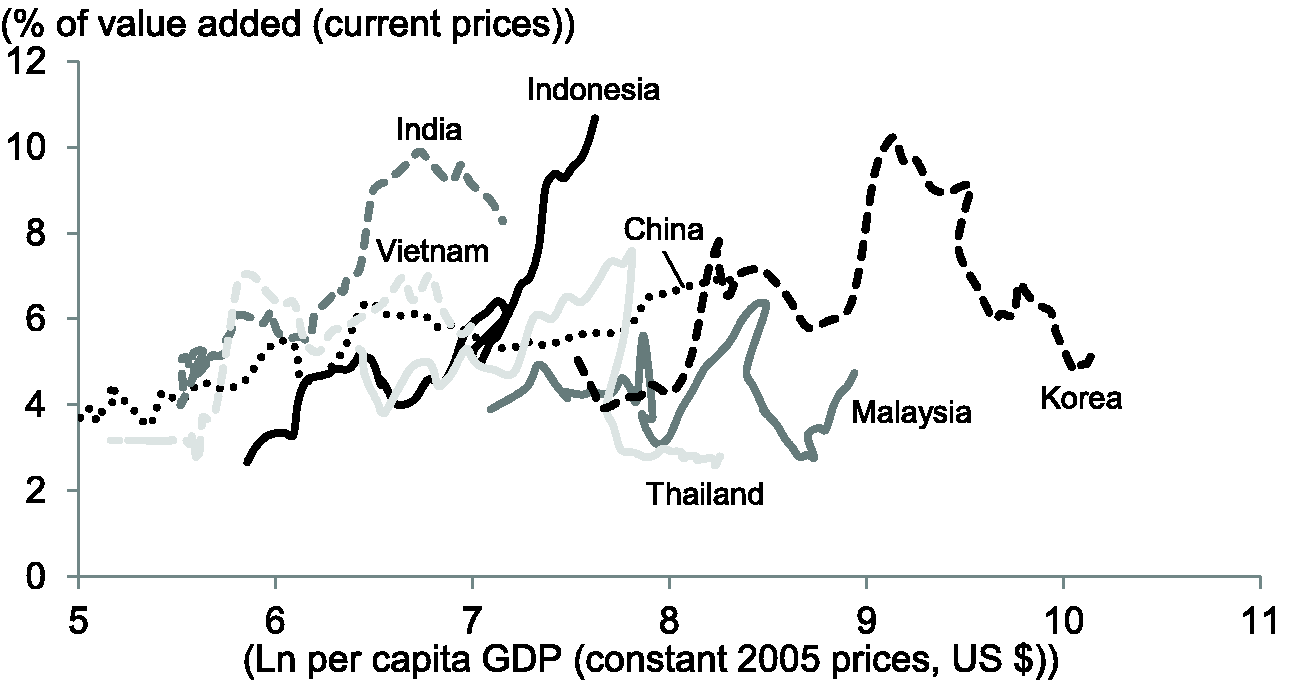
Value-added share of construction sector, selected Asian economies, 1970–2015. Source: Author’s calculations using data from the United Nations National Accounts Main Aggregates Database.
Investment trajectories also show a significant gap between infrastructure development and construction sector expansion. Building investment, as a proportion of GDP, increased from 15.1% in 2000 to 27.0% in 2014, leading to the expansion of the overall investment ratio from 19.0% to 31.7% (BPS, n.d.). However, infrastructure investment fell during this period from 7.8% of the GDP in 1995–1997 to 2.7% in 2010–2014 (Prospera, n.d.). The expansion of construction investment since the end of the 1990s has been centred around residential and commercial buildings (World Bank, 2014). This trend accompanied a property boom during the early 2010s, which benefited Indonesia’s large private conglomerates with real estate businesses (DBS Group Research, 2017; Herlambang et al., 2019).
Figure 5 takes a closer look and shows that infrastructure investment, as a share of GDP, declined from all three major sources of finance. Despite numerous formal institutions in place, private investment continued a downward path. After nearly shrinking by three quarters during the late 1990s, government investment recovered slightly but continued to stay below the pre-crisis share. The changes in SOEs’ investment were particularly dramatic as profit motivation gradually took over development goals.
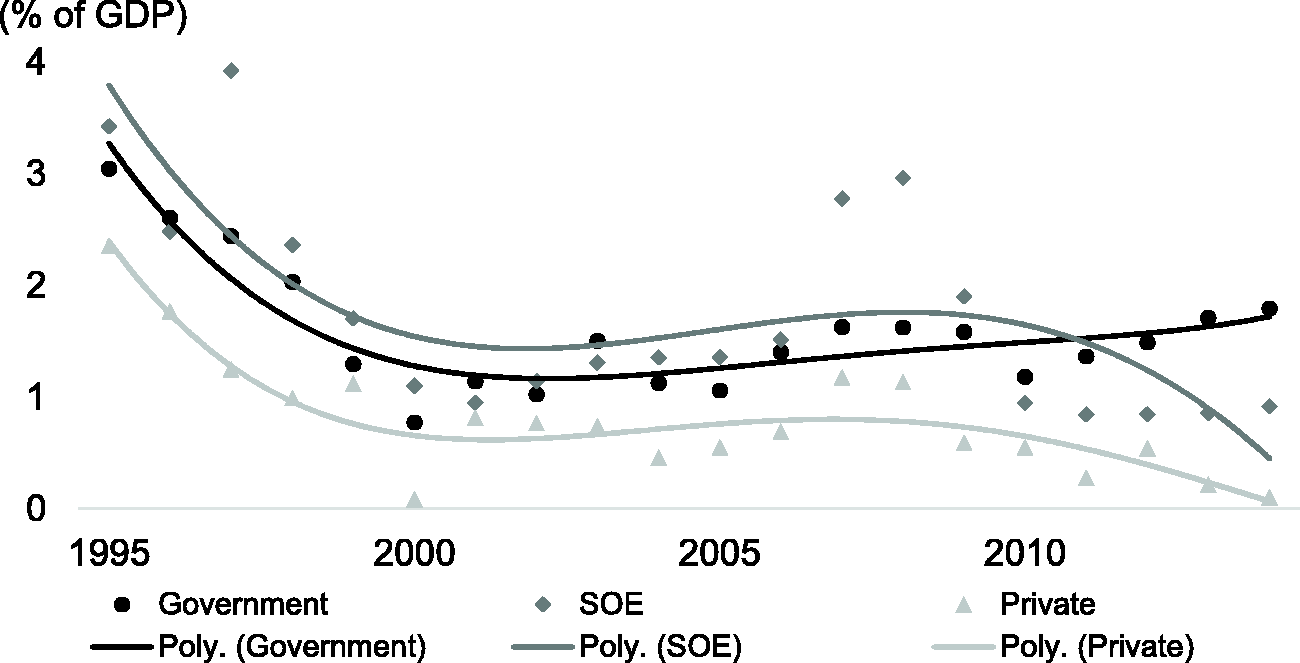
Infrastructure investment disaggregated by financing source, Indonesia, 1995–2014. Note: ‘Poly.’ refers to an order 4 polynomial trend line. Source: Author’s calculations using data from Prospera.
This subsection argues that the gap between the construction sector expansion and infrastructure development was due to the government’s weak developmentalist policies. Rather than blaming the slow infrastructure development on incomplete institutional reform, this subsection argues that a more immediate cause was the government’s withdrawal from aspects of infrastructure construction. Overall, the reduction in infrastructure investment can be attributed to the government’s struggles in carrying out the governing, investing, and project implementing roles.
Firstly, the government withdrew substantially from directly governing the construction sector during the decade following the Asian financial crisis. In particular, the decision to invite business associations to be in charge of company registration led to unsustainable outcomes, leading KPPU to conclude that LPJKs had become a source of new problems. The period of de-regulation with the aim of dismantling state–business relations was followed by a period of re-regulation characterized by conflictual state–business relations. As a result, the government had a weak influence over private construction firms in directing them to contribute to infrastructure development as investors or contractors during both periods. Domestic construction firms also continuously complained about the government’s opening up of the sector to foreign companies (Bisnis Indonesia, 2010). The number of registered foreign construction companies increased from 129 in 2005 to 302 in 2013, mainly due to the active entry of East Asian companies (Asosiasi Kontraktor Indonesia, 2014). The result was state–business relations that struggled to establish a mutual understanding of the need for infrastructure investment expansion and a productive rent-sharing system necessary for effectively conducting infrastructure projects.
Secondly, the government’s withdrawal from infrastructure construction was also notable in its investment role through the state budget (Figure 5). Following the crisis, the government aimed to reduce its debt, which had greatly expanded due to bank bailouts and weak economic recovery. In 2003, the fiscal stabilization plan was institutionalized through the adoption of the fiscal rule that limited the general government debt to 60% of GDP and annual government deficits to 3% of GDP. During this period, fiscal revenues struggled to expand as the government avoided the radical overhaul of the tax system. The central government’s capital investment was also constrained by fiscal decentralization, which directed significant resources to regional governments. There was also increased pressure to increase social spending (Blöndal et al., 2009). Another challenge was rising energy prices and the political difficulties in restructuring the fuel subsidy system (Chelminski, 2018). While some changes in the fiscal management environment were more structural as they were linked to decentralization, certain fiscal policies, such as those on regressive fuel subsidies, that affected available resources for infrastructure investment was the government’s political decision in a competitive democracy. Between 2005 and 2014, not once did the central government’s capital spending exceeded fuel subsidies (Central Bank of Indonesia, n.d.).
Lastly, the government’s withdrawal from infrastructure construction was also seen in SOE operations. Involvement in patronage notwithstanding, SOEs were important contributors to infrastructure development before the crisis as investors and contractors. Following the crisis, however, SOE restructuring involving partial privatization and good corporate governance aimed to turn SOEs into fiscal contributors (Kim, 2019). The corporate strategies and project portfolios of these SOEs, which are also some of the largest construction firms in the country, increasingly reflected the government goal of profit enhancement. A significant shrinking of SOE infrastructure investment in Figure 5 indicates that SOEs, partially privatized companies in particular, became more selective when choosing projects that would reflect shifting corporate goals (Davidson, 2015).
In summary, this section discussed how Indonesia’s good governance institutional reform was accompanied by the state’s withdrawal from governing, investing and project implementing roles. Institutional reform involving deregulation and re-regulation was a political process that created uncertainty and conflict between stakeholders and the state. Ironically, this reform period, which caused significant instability, was when the government decided to rely on private sector participation in infrastructure development. The government and SOEs reduced investment and SOE operations were adjusted with the aim of increasing fiscal revenues. Even if one assumes that the institutional reform had been successful and the private businesses ended up facing a similar level of ‘certainty’ in the new institutional system as they did under the Suharto’s patronage network, it is difficult to imagine private investors filling the hole left by the state. Even if private infrastructure investment had returned to its pre-crisis status, as a proportion to GDP, total infrastructure investment would have been 3.6 percentage points lower during 2010–2014 compared to that of 1995–1997.
Conclusion
The market-oriented ‘good governance’ reform did see the continuation of corruption and unfair practices, frequently in different forms to those of the past. However, incomplete institutional reform is insufficient in fully explaining Indonesia’s poor infrastructure development outcome. This paper’s principal argument is that it was the government’s weak developmentalist policies that caused inadequate infrastructure performance during the 15 years following the Asian financial crisis. State–business relations turned conflictual, particularly when the government began the course of re-regulation to address the problems of de-regulation. Most importantly, government investment on infrastructure construction declined significantly compared to the period before the crisis. This withdrawal happened when Indonesia encountered a significant market and coordination failure or when the unwillingness of the private sector to invest in long-term infrastructure projects was rife given the new regulatory environment. Considering the political economic challenges associated with institutional reform, the ‘lack of financing’ from private sources was a serious challenge.
Although it may appear incoherent to pro-market reformers, this period of reform struggles, combined with inherent market failure problems in infrastructure development, was when a more activist role of the government in project investment and implementation was needed. Analysing developing countries’ infrastructure strategy over the decades, the Commission on Growth and Development (2008: 36–37) states the following: Governments should recognize that their own infrastructure investments are an indispensable complement to private efforts. If they abrogate the public investment function, it will not be replaced by private providers. Growth and delivery of basic services to the public will suffer as a result.
This paper began with an overview of new state-led infrastructure development strategy and subsequently provided a detailed discussion of the historical background from which this strategy begun to emerge in the mid-2010s. By analysing construction sector reform and infrastructure investment from a developmentalist perspective, the new strategy can be viewed as a systematic and strategic response to past experiences that revealed the structural difficulties with emulating the regulatory state and insufficiency of relying on ‘potential’ private investment. However, this conclusion should not dismiss past and current efforts to improve institutional mechanisms (Salim and Negara, 2018). The aim of this paper is not to pit new state-led development strategy against past market-oriented reform. This dichotomous view is unlikely to be useful. Recent state-led development strategy and monitoring of productive rent-sharing mechanisms depend on post-crisis regulations and organizations, some of which were discussed in this paper (Kim, 2021). Further research could be conducted into how certain formal institutions and developmentalist policies complement or conflict with one another. Moreover, the political coalitions behind the new developmentalist policies require further investigation.
Finally, it is not yet clear how the strengthening statism in infrastructure development in developing countries such as Indonesia is perceived by norm-setting bodies such as IFIs, many of which continue to adhere to market liberalization. The imperative of ‘getting the territory right’ has strengthened globally since the 2000s, leading to an acceleration of infrastructure development across cities and nations (Schindler and Kanai, 2021). This infrastructure-led development strategy has often been driven by governments and parastatals, therefore coincided with the resurgence of state capitalism (Alami et al., 2021). Further research could analyse the extent to which norm-setting organizations support these trends and encourage the state’s participation in organizing, financing, constructing and operating physical infrastructure. On a related note, the future of China’s state capitalism, in which infrastructure expansion is a key component, is expected to influence the global norm-setting. Therefore, China’s infrastructure development strategy led by the state and the recently highlighted problems related to project selection and management, debt financing, overcapacity, asset price bubbles and environment require close examination (Ansar et al., 2016). Such an analysis could offer clues about the persistence of Indonesia’s new development strategy going forward.
Footnotes
Acknowledgements
I would like to thank anonymous referees and the editors of the journal for their constructive comments on this article. I would also like to thank Andy Sumner and Peter Kingstone for their helpful suggestions on earlier versions of this article.
Declaration of Conflicting Interests
The author(s) declared no potential conflicts of interest with respect to the research, authorship, and/or publication of this article.
Funding
The author(s) received no financial support for the research, authorship, and/or publication of this article.
